Kainantu, Papua New Guinea
23 memories from Kainantu, Papua New Guinea

A vibrant fuchsia bougainvillea flower dominates the frame, its papery bracts sharply triangular. Lush green foliage surrounds the flower, creating a dense background. Leaves vary in shape and texture, from deeply veined ivy-like leaves to smooth, glossy ones. Sunlight filters through the leaves, highlighting their texture and adding depth to the scene. A glimpse of additional bougainvillea flowers suggests a vibrant, blooming plant.
Kainantu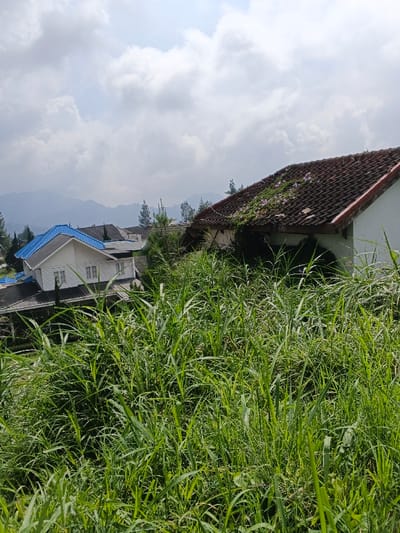
A high-angle view showcases overgrown green grasses in the foreground. In the background, a couple of houses are partially visible. One has a blue roof and white walls; the other features a reddish-brown tiled roof with some vine growth. Further back, a slightly out-of-focus mountain range stretches across the horizon under a cloudy sky.
Kainantu
The image captures a close-up view of two vibrant purple, trumpet-shaped flowers blooming on a leafy green vine. The larger, fully open flower is prominently featured in the lower center, while another similar flower is visible further up and to the left. A third flower bud is partially visible near the top right. The flowers have a distinct radial pattern on their petals, with a darker purple center. The vine wraps around and through a dark, sturdy metal beam or wooden structure that runs horizontally across the middle of the frame. Behind the vine and flowers, a wire mesh fence is discernible, serving as a support for the climbing plant. Many of the vine's leaves are green, but some show signs of insect damage, with visible holes. The background reveals a bright, slightly hazy or overcast sky, suggesting it is daytime. Below the sky, faint outlines of distant residential buildings with terracotta-colored roofs can be seen, partially obscured by more foliage and the fence. Further in the distance, green hills or trees complete the landscape. A subtle lens flare is visible in the upper right portion of the image, indicating direct sunlight or bright light source. The overall impression is one of natural beauty in a semi-urban or rural setting. There is no human activity or visible text. The scene conveys a sense of peace and growth, characteristic of the natural environment in Kainantu, Papua New Guinea.
Kainantu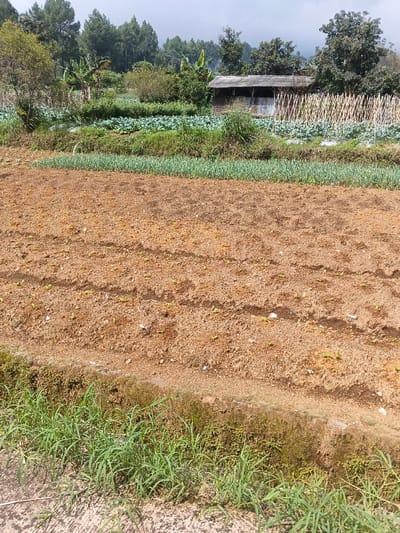
The image displays a multi-layered agricultural landscape, likely a farm situated in a rural, hilly region under daylight conditions. In the foreground, a strip of vibrant green grass grows along a dirt and mossy bank, separating the cultivated areas from an unseen path or boundary. Directly beyond this, the closest section of the mid-ground features reddish-brown, freshly tilled soil with visible rows of tiny, light green sprouts, indicating recent planting activity. This area transitions into a long, neat band of dense, bright green, narrow-leaf crops, possibly onions or leeks. Further back, the farm encompasses a larger section with broader-leaf green crops, resembling cabbage or broccoli, growing in neat rows. To the right, a field utilizes numerous tall bamboo poles as stakes, likely for supporting climbing plants such as beans. A rustic wooden structure with a dark, possibly corrugated iron roof, stands nestled among the trees in the upper mid-ground, serving as a shed or shelter. The background is dominated by a dense line of various trees, including tall conifers and other broadleaf species, suggesting a forested or mountainous periphery. The sky appears overcast or hazy, contributing to diffused lighting. No individuals are present in the image, and there is no visible text. The scene captures the industrious and fertile nature of farming in what appears to be a peaceful, rural setting.
Kainantu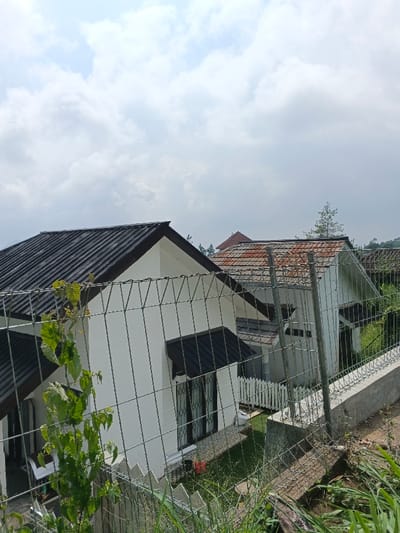
Two white houses with dark and red roofs stand side by side, partially obscured by a wire fence. The front house features dark-framed windows and a smaller roof over the entrance. A bit of green vegetation is visible in the foreground, growing along the fence. The sky above is filled with puffy white clouds, suggesting a partly sunny day. The setting appears to be a hillside or elevated area, with glimpses of more greenery in the background.
Kainantu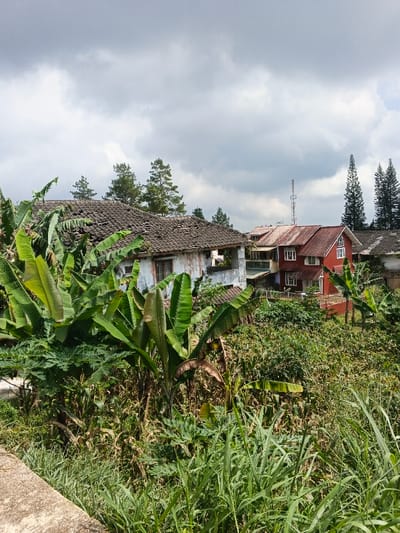
This daytime photograph captures a rural or semi-rural landscape in Kainantu, Papua New Guinea, under an overcast sky. The scene is characterized by abundant, lush vegetation and several houses. In the foreground, dense tropical greenery dominates, featuring large banana plants with broad leaves and tall green grasses. A concrete edge or path is visible at the bottom left. The midground features two prominent houses: to the left, an older, weathered house with discolored, light-painted walls and a dark, tiled roof that shows significant damage and missing tiles. To its right, a vibrant red house with contrasting white window frames and a matching red roof appears in better condition. Other buildings are partially visible further in the background. Tall, slender pine-like trees are scattered throughout the midground and background, rising above the houses and foliage. A cell tower or radio mast is discernible on the distant horizon, piercing through the heavy, diffused grey clouds that cover the entire sky. The cloudy weather suggests either an impending rain or a typically overcast tropical day. No people or discernible activities are present, lending a static, natural feel to the image. The overall impression is one of tropical growth encroaching on human structures, reflecting a blend of nature and habitation in the given setting.
Kainantu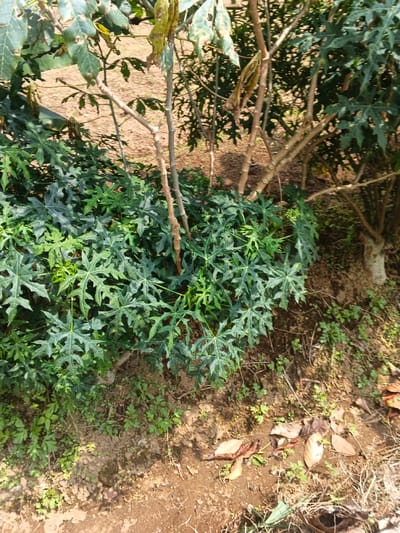
The image captures a vibrant outdoor scene dominated by dense green foliage. In the foreground, a cluster of plants with distinctive palmate leaves resembling Chaya (Cnidoscolus aconitifolius) grows luxuriantly close to the ground. These broad, deeply lobed leaves are a rich green color and appear healthy. Behind the leafy foreground plants, several slender, light brown tree branches rise upwards. Some of these branches are bare, while others bear sparse, withered leaves or remnants of dried foliage. The background shows more green foliage and bare branches, with hints of a lighter, open area beyond, possibly a field or path. The ground consists of reddish-brown soil, typical of many tropical regions, with patches of smaller green weeds and scattered dry brown leaves, particularly visible in the lower right corner. The lighting suggests it is daytime, with bright, natural sunlight illuminating the scene and creating subtle shadows among the plants, indicating clear weather. No people are visible, nor is there any discernible text. The lush vegetation and type of plant growth are consistent with a tropical environment, aligning with the location context of Kainantu, Papua New Guinea.
Kainantu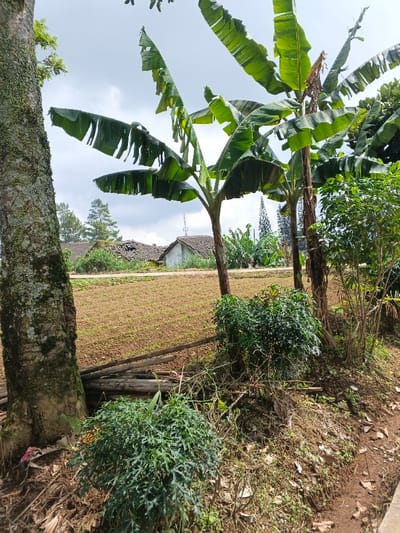
The scene captures a rural landscape. A large, mossy tree trunk stands on the left, adjacent to a cluster of plants and wooden logs. Banana trees with broad, green leaves dominate the center. Beyond, a plowed field stretches towards a few houses with tiled roofs under a partly cloudy sky. Additional greenery surrounds the buildings. The foreground shows a dirt path.
Kainantu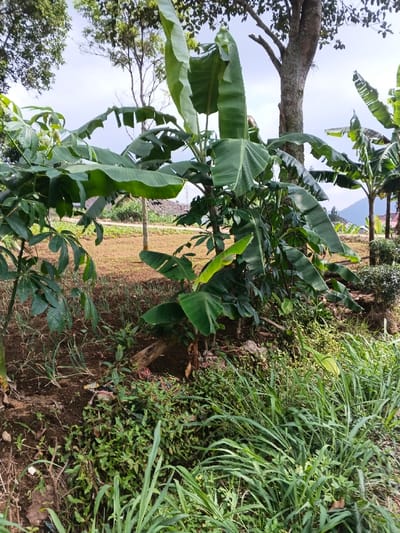
Lush greenery fills the landscape. Banana trees with large leaves stand prominently, intertwined with cassava plants. Tall trees frame the scene, set against a backdrop of distant hills under a cloudy sky. The ground is covered in soil, grass, and diverse vegetation. A building is seen in the distance.
Kainantu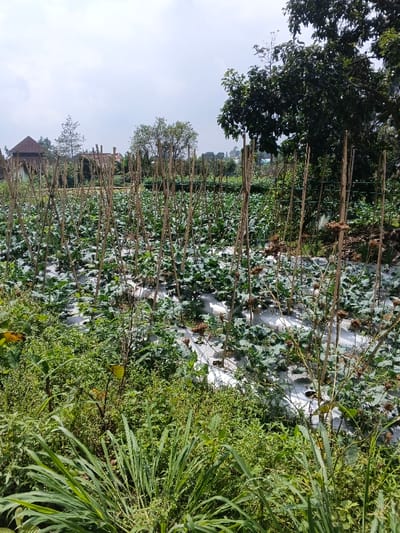
The image captures an outdoor agricultural landscape, likely a farm or extensive garden, under a bright, partly cloudy sky. The scene is characterized by active cultivation. In the immediate foreground, a dense array of uncultivated green foliage, including tall grasses and various plants, forms a natural barrier, partially obscuring the view into the main field. The midground showcases a structured farming area. Rows of leafy green crops are visible, planted in soil that is covered by white plastic mulch film. This film runs across the entire field, with the crops emerging through openings in the sheeting. Numerous slender wooden or bamboo stakes are driven vertically into the ground, interspersed throughout the crop rows, suggesting support structures for climbing plants. Among the vibrant green foliage, some dried, brown plant stalks are also present, indicating either a different plant type or a stage of the growing cycle. In the background, a cluster of trees with dense, dark green canopies can be seen, partially obscuring distant details. Beyond the trees, glimpses of buildings with reddish-brown roofs are visible, suggesting nearby residential or agricultural structures within a rural or semi-rural setting. The time of day appears to be daytime, with ample natural light, though the sky has a hazy or slightly overcast quality. The scene evokes a sense of peaceful, productive rural life. No human activity is directly visible, but the organized planting and use of mulch and stakes indicate ongoing agricultural work. There is no visible text in the image. The environment and farming methods are consistent with those found in regions like Kainantu, Papua New Guinea.
Kainantu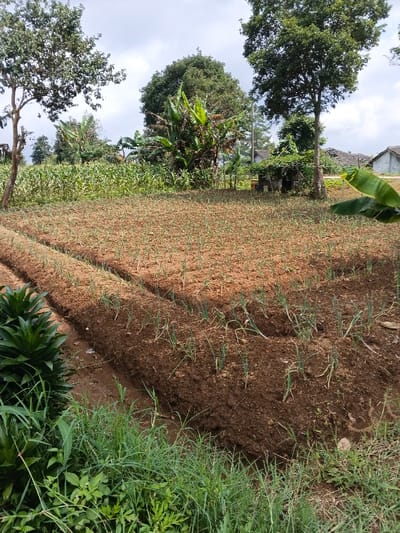
The image displays a vibrant agricultural landscape in Kainantu, Papua New Guinea, under a partly cloudy or overcast sky during daytime. The foreground is filled with lush green grass and broad-leaved plants, framing a well-maintained field. The dominant feature in the midground is an extensive cultivated plot of rich, brown soil. This field is arranged in neat rows, where numerous young green shoots, possibly spring onions or a similar crop, are visibly growing. Two distinct, empty furrows run diagonally across the lower left portion of this field, suggesting recent preparation or ongoing planting. Further back, a dense area of taller green crops, resembling corn, stretches across the width of the image. The background features a variety of mature trees with full, leafy canopies, including several prominent banana trees with their large, characteristic leaves. Simple residential structures with corrugated iron roofs are partially visible among the trees in the far background, hinting at a rural community. A utility pole can also be seen. No people are present, but the organized planting and healthy vegetation indicate active farming. The overall impression is one of a productive, rural agricultural setting. There is no visible text in the image.
Kainantu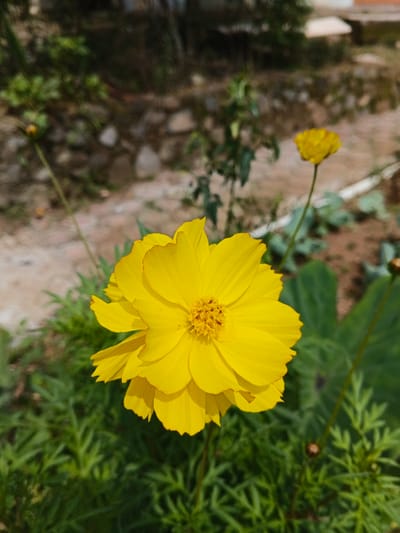
The image presents a close-up, brightly lit outdoor scene featuring a vibrant yellow flower as the central subject. This flower, likely a variety of Cosmos, is in sharp focus and dominates the lower center of the frame, displaying numerous layered petals and a textured, golden-yellow center. Some petals show a subtle reddish-brown tint along their edges. Surrounding the main flower and extending into the foreground and midground is rich green foliage, with some leaves exhibiting fine, fern-like structures. In the soft, blurred background to the right, another smaller, out-of-focus yellow flower is visible, along with additional green vegetation. The distant background consists of muted tones of brown earth or soil and indistinct blurry elements, possibly indicating more distant plants or structures. The lighting is bright and natural, suggesting a sunny daytime setting without harsh shadows, implying clear weather conditions. The scene captures the tranquility and beauty of nature. No specific activity or event is taking place other than the static presence of the flowers. There is no visible text within the image. This natural setting is located in Kainantu, Papua New Guinea.
Kainantu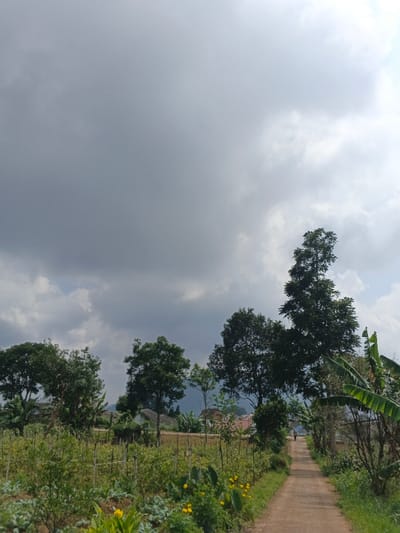
A dirt road stretches into the distance, flanked by lush vegetation and trees. Cultivated plants and crops flourish in the foreground, interspersed with small yellow flowers. Houses are visible in the background, nestled among the greenery. A person walks along the road. Overcast skies dominate the scene, with dark gray and white clouds creating a dramatic backdrop. Hints of blue sky peek through the cloud cover.
Kainantu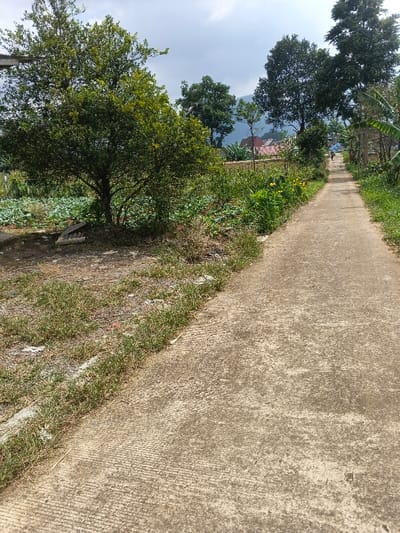
This image depicts a sunlit, narrow concrete path extending into the distance through a lush, rural landscape in Kainantu, Papua New Guinea. The path itself is textured with horizontal grooves, indicating its concrete construction. On the left side of the path, a prominent, dense green tree stands tall, its foliage vibrant under the daylight. Beyond this tree, a cultivated field is visible, filled with rows of leafy green crops, possibly cabbages or similar vegetables. The ground immediately adjacent to the path on this side consists of patchy grass, dry earth, and some discarded materials, including what appears to be a concrete slab, near the base of the large tree. The right side of the path is bordered by an abundance of natural vegetation, including wild grasses, bushes, and smaller trees. Some scattered yellow wildflowers add a touch of color to the greenery. Further along the path, in the mid-ground, several houses with distinct red roofs are nestled among the trees, suggesting a small community or village. A solitary human figure can be seen walking away from the viewer, far down the path, providing a sense of scale. The background reveals undulating hills or mountains under a bright, partly cloudy sky. The scene is illuminated by strong daylight, likely late morning or early afternoon, contributing to the clear visibility and vibrant colors. The overall atmosphere is one of tranquility and rural life. There is no visible text in the image.
Kainantu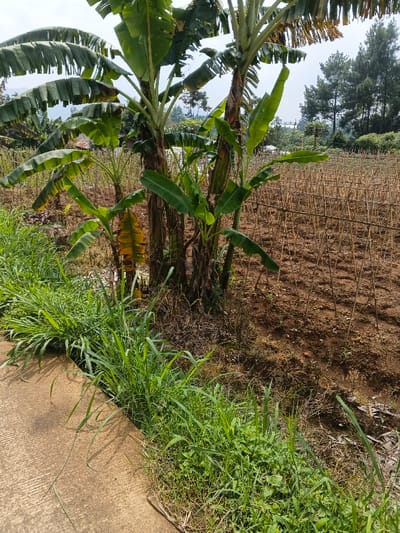
A scene depicting banana trees prominently in the foreground, with a field of small wooden stakes stretching into the distance. The ground is predominantly brown. Lush green grass grows along the edge of a concrete path in the lower left corner. The background features trees. The sky is bright and appears to be daytime.
Kainantu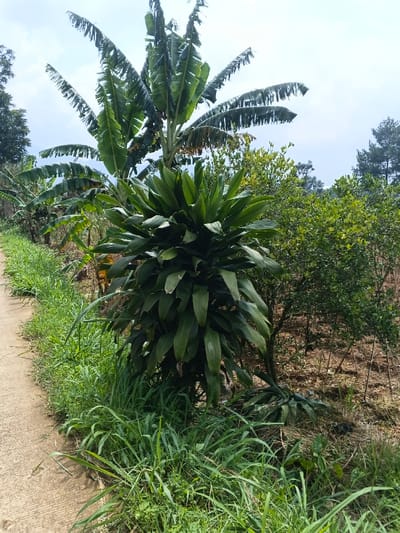
A vibrant tropical scene showcases lush greenery. A stout Dracaena plant stands prominently, its broad leaves a deep green. Towering above, banana trees display their iconic, arching foliage. A narrow concrete path edges the scene, bordered by tall, verdant grass. Behind the Dracaena, a small citrus tree adds texture. Bare soil reveals cultivated rows in the background. A blue sky peeks through the dense canopy, lending a bright contrast to the rich vegetation.
Kainantu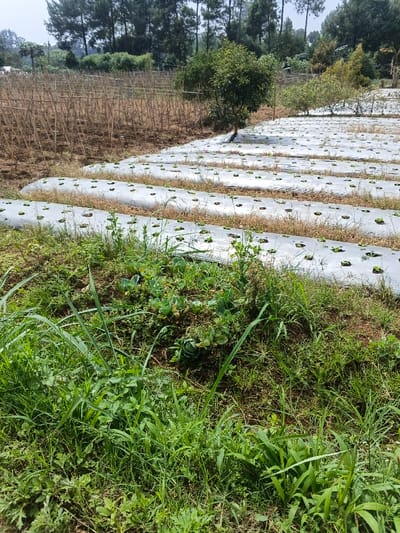
This image depicts an agricultural field or farm located in a rural setting, likely Kainantu, Papua New Guinea, as provided in the context. The foreground is dominated by uncultivated ground covered in thick green grass and various weeds. A small patch of larger, possibly cabbage-like plants, can be seen growing among the wild vegetation in the lower-left. The mid-ground features a cultivated area with multiple parallel rows of young plants. These plants are growing through holes in white or light-colored plastic mulch, a common farming technique to conserve moisture and suppress weeds. The plants appear to be small, leafy greens, possibly lettuce or similar vegetables. Between the mulched rows, sparse dry grass and soil are visible. A small, leafy tree stands prominently towards the center-left of this cultivated section. Further to the left, a large section of bare earth is visible, where numerous tall wooden stakes form a trellis system, suggesting future or past cultivation of climbing plants like beans or tomatoes. Another smaller tree is visible behind the mulched rows on the right. The background shows a distant hillside covered with numerous tall conifer trees, possibly pines, under a bright, clear sky. The scene takes place during the daytime under sunny conditions, indicated by the bright lighting and lack of shadows suggesting an overcast sky. No people or visible text are present in the image. The overall impression is one of active agricultural production in a natural, open environment.
Kainantu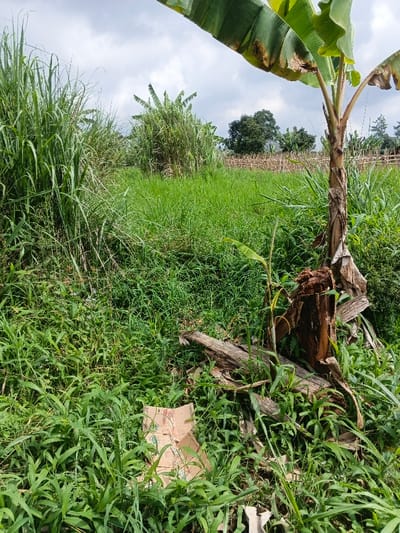
Lush, overgrown field dominated by tall grasses and greenery. A banana tree stands to the right with a broken trunk surrounded by fallen leaves and wood debris. A discarded cardboard box is partially hidden within the dense ground cover in the foreground. A rustic wooden fence is visible in the background amidst other vegetation under a cloudy sky.
Kainantu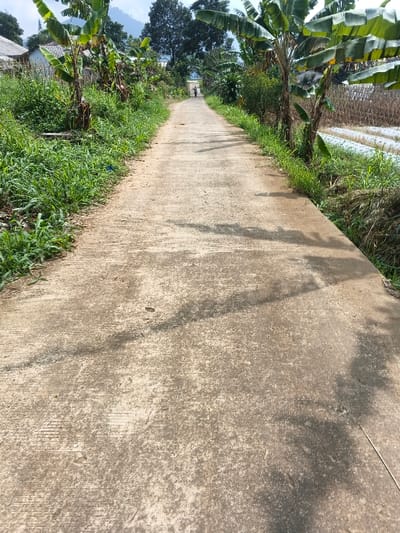
This image depicts a long, narrow concrete path extending into the distance through a rural landscape, situated in Kainantu, Papua New Guinea. The path appears worn, with various textures and shadows cast across its surface, suggesting bright daylight. On both sides, the path is flanked by dense, lush green vegetation. Numerous banana trees with large, broad leaves are prominent features, especially on the left and right edges of the pathway, mixing with other green foliage and tall grasses. On the far left, parts of simple houses with light-colored roofs are visible amidst the trees, indicating a residential area. To the right of the path, an agricultural field stretches out, characterized by neat rows covered with white plastic sheeting, likely for crop cultivation or protection. In the far distance, at the vanishing point of the path, two small human figures can be seen walking away from the camera. The clear and bright illumination, along with the distinct shadows, indicates a sunny day, likely mid-morning or late afternoon. The overall scene portrays a tranquil, natural environment with a mix of residential and agricultural activity. There is no visible text in the image.
Kainantu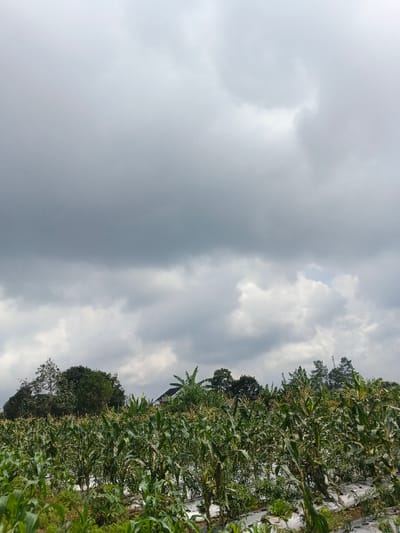
A landscape features a cornfield in the foreground. Rows of cornstalks stand tall against a backdrop of trees and a cloudy sky. The sky is overcast with layers of grey clouds obscuring the sunlight. White plastic mulch covers the ground between the rows of corn, and smaller plants grow in the foreground, adding to the scene's agricultural feel.
Kainantu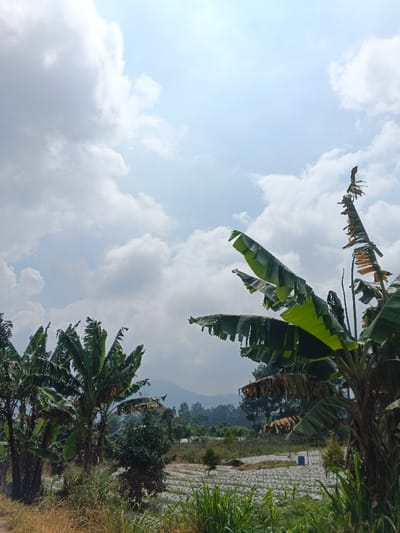
This image presents a vibrant, sunlit rural landscape, characteristic of a mountainous region like Kainantu, Papua New Guinea. The upper half of the frame is dominated by a bright, partly cloudy sky, with scattered white and light grey cumulus clouds against a pale blue backdrop. A strong light source, presumably the sun, is visible in the upper right quadrant, indicating mid-day. In the foreground and mid-ground, lush green vegetation is abundant. Prominent are several banana trees; a cluster of them with broad, intact leaves stands on the left, while on the right, a large banana tree with distinctively torn and weathered leaves, alongside fresh green growth, occupies the immediate foreground. Other green plants, including tall grasses and shrubs, fill the lower portions of the frame. In the distance, a line of pine-like trees is visible. Between the immediate vegetation and the background, agricultural fields stretch across the mid-ground. These fields show rows of cultivated crops, many covered with what appears to be a light-colored plastic mulch, a common farming practice. In the far background, hazy, undulating mountains or hills rise, creating a scenic backdrop. No people or specific activities are depicted, portraying a serene and natural environment focused on agriculture and the landscape. The weather is clear and bright. There is no visible text in the image. The scene conveys the tranquility and natural beauty of a tropical highland farming area.
Kainantu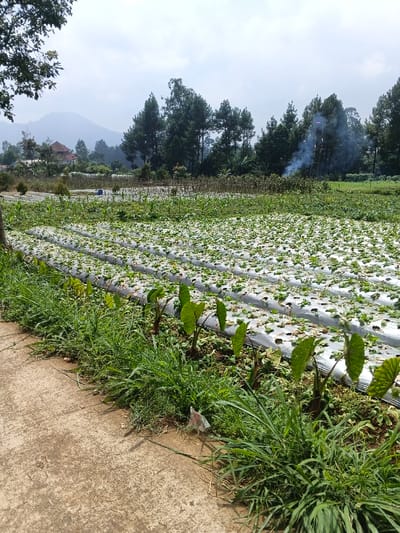
A rural scene showcases a vast field cultivated with crops covered in white plastic sheeting. Lush green foliage and tall grass line the edge of the field. A weathered, concrete path runs alongside the field, contrasting with the vibrant vegetation. In the background, a mountain range is visible amidst towering pine trees, with a wisp of smoke adding a touch of intrigue. A single building is partially visible in the distance.
Kainantu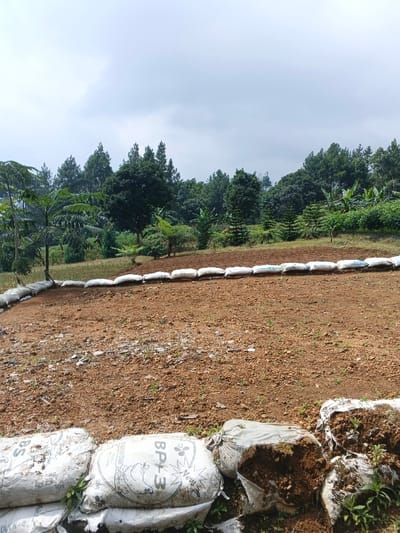
A plot of red-brown soil is surrounded by white sandbags. The bags form a low retaining wall, preventing soil erosion. In the background, a line of trees and vegetation extends across the horizon under a cloudy sky. The trees are a mix of pines and leafy species. The scene appears to be an agricultural project in a rural or hilly area.
Kainantu