Kanazawa, Japan
30 memories from Kanazawa, Japan
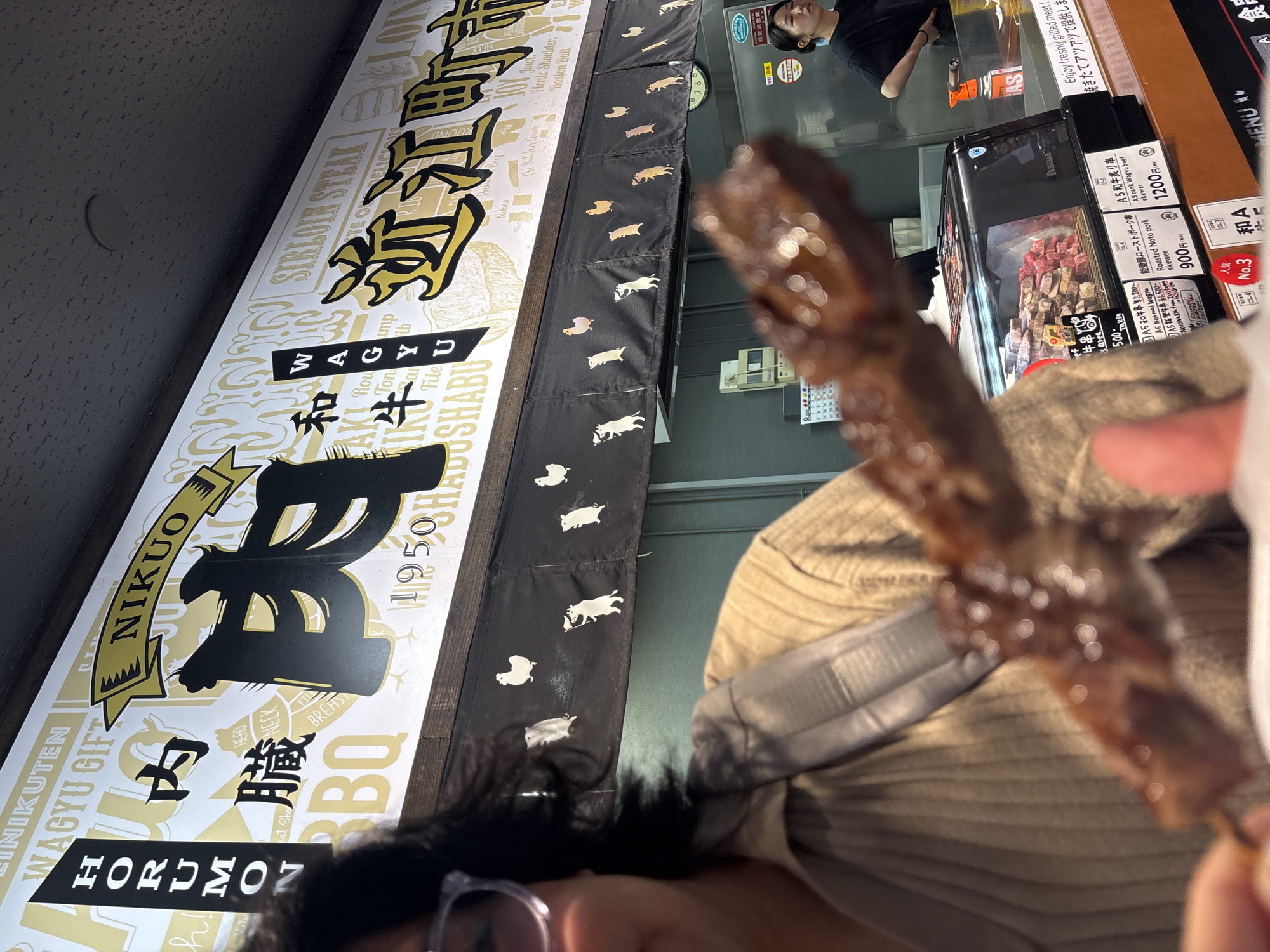
The scene captures an interior view of a bustling food stall, identified as "NIKUO" (肉夫), specializing in meat, located within Omicho Market (近江町市場) in Kanazawa, Japan. In the foreground, a person's upper body is partially visible on the left, wearing glasses and a light brown, ribbed knit sweater. A gray strap, likely from a bag or camera, crosses their shoulder. Their hand, mostly out of frame, holds a dark, glossy, cooked meat skewer directly in the center, rendered out of focus. Above and behind the person, a wide illuminated sign prominently displays "NIKUO" in a golden banner. Large black Japanese characters spell "肉" (Niku - meat) and "和牛" (Wagyu - Japanese beef). Additional Japanese text includes "HORUMON" (ホルモン) and "内臓" (Naizou - offal/viscera) on the left, and "近江町" (Omicho) on the right. English text such as "WAGYU GIFT," "SIRLOIN STEAK," and "SHABUSHABU" are also present. The year "1950" is visible, suggesting establishment. Illustrations of various meat cuts like "HEAD," "NECK," "FILLET," and "BREASTS" are interspersed. Below the main sign, a black fabric curtain, typical of Japanese shop entrances, hangs with a repetitive pattern of white silhouettes depicting chickens and pigs, some pigs holding small flags. Beneath the curtain, a refrigerated glass display case showcases numerous cuts of raw red meat, likely beef and pork, neatly arranged. Visible price tags include "A5 和牛串焼き" (A5 Wagyu beef skewer) for 1200 yen and "能登豚ローストポーク串" (Noto pork roast skewer) for 900 yen. A red sign indicates "人気 No.3" (Popular No.3). In the background, behind the counter and display case, a female staff member wearing a black uniform stands with her hands on her hips, looking towards the right. A stainless steel counter surface and various kitchen equipment are visible, including a red spray bottle labeled "GAS."
Kanazawa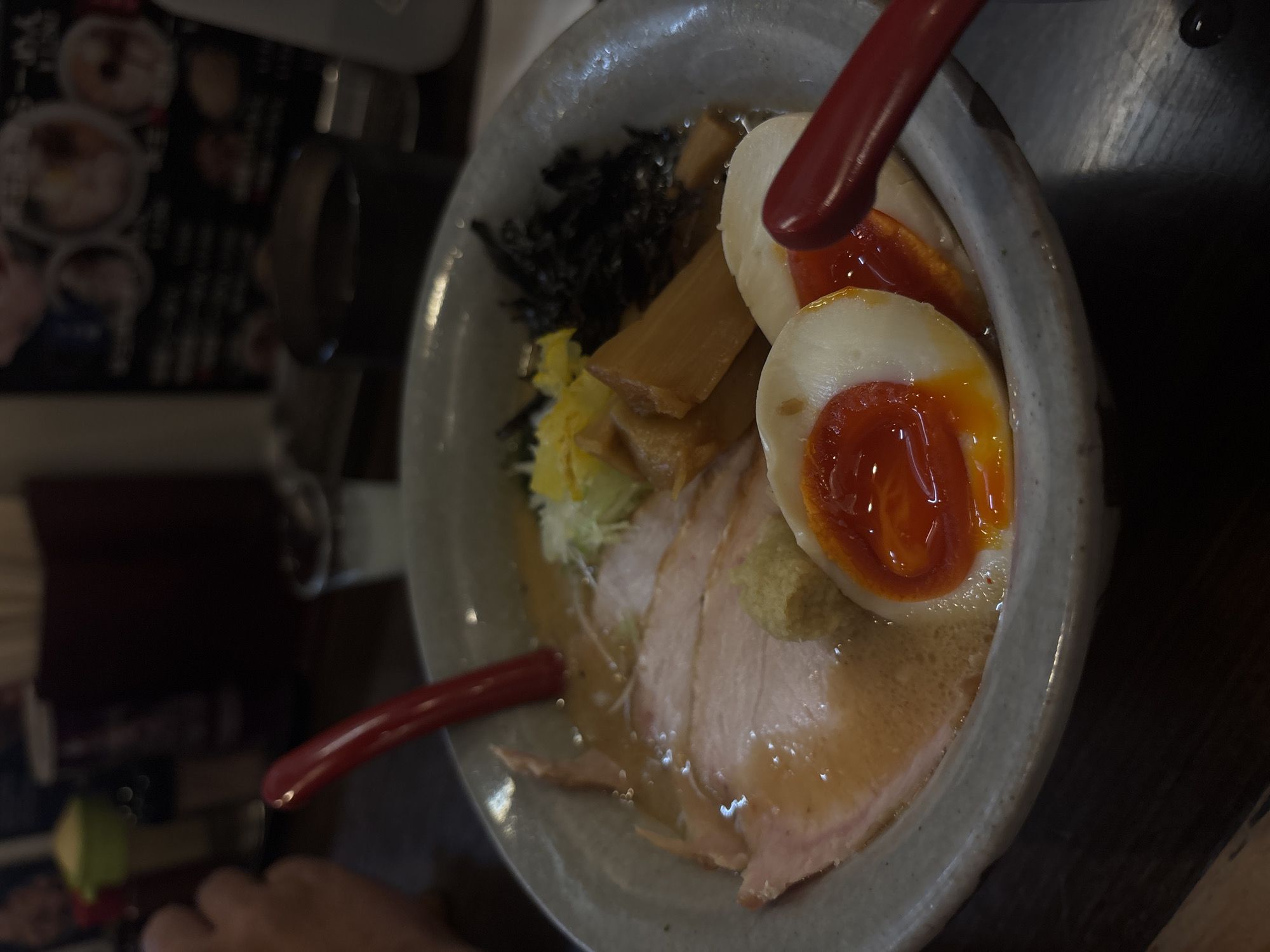
This image presents a close-up, slightly elevated view of a bowl of ramen in an indoor restaurant environment. The ramen is contained within a light grey, textured ceramic bowl. The broth is light brown and opaque, with visible oil droplets. Toppings include multiple thin, light pink slices of pork chashu, two halves of a soft-boiled ajitama egg with bright orange, semi-liquid yolks, and firm white albumen. Other visible toppings are elongated pieces of light brown menma (bamboo shoots), dark, thin strips consistent with kikurage mushrooms or seaweed, a small mound of finely minced green onions, a cluster of bright yellow shredded material, and a small dollop of light green paste situated on a pork slice. A red-handled spoon is positioned inside the bowl, pointing towards the upper left. A second red-handled spoon is partially visible in the lower right, outside the bowl. The background is blurred, showing a portion of a person's hand on the left, various table condiments including a green shaker and a dark caddy in the center-left, and a menu board featuring Japanese text and illustrations of ramen bowls in the upper right. The scene is illuminated by artificial interior lighting. While the image is consistent with a ramen restaurant in Japan, no specific visual identifiers are present to forensically determine the exact location within the city of Kanazawa.
Kanazawa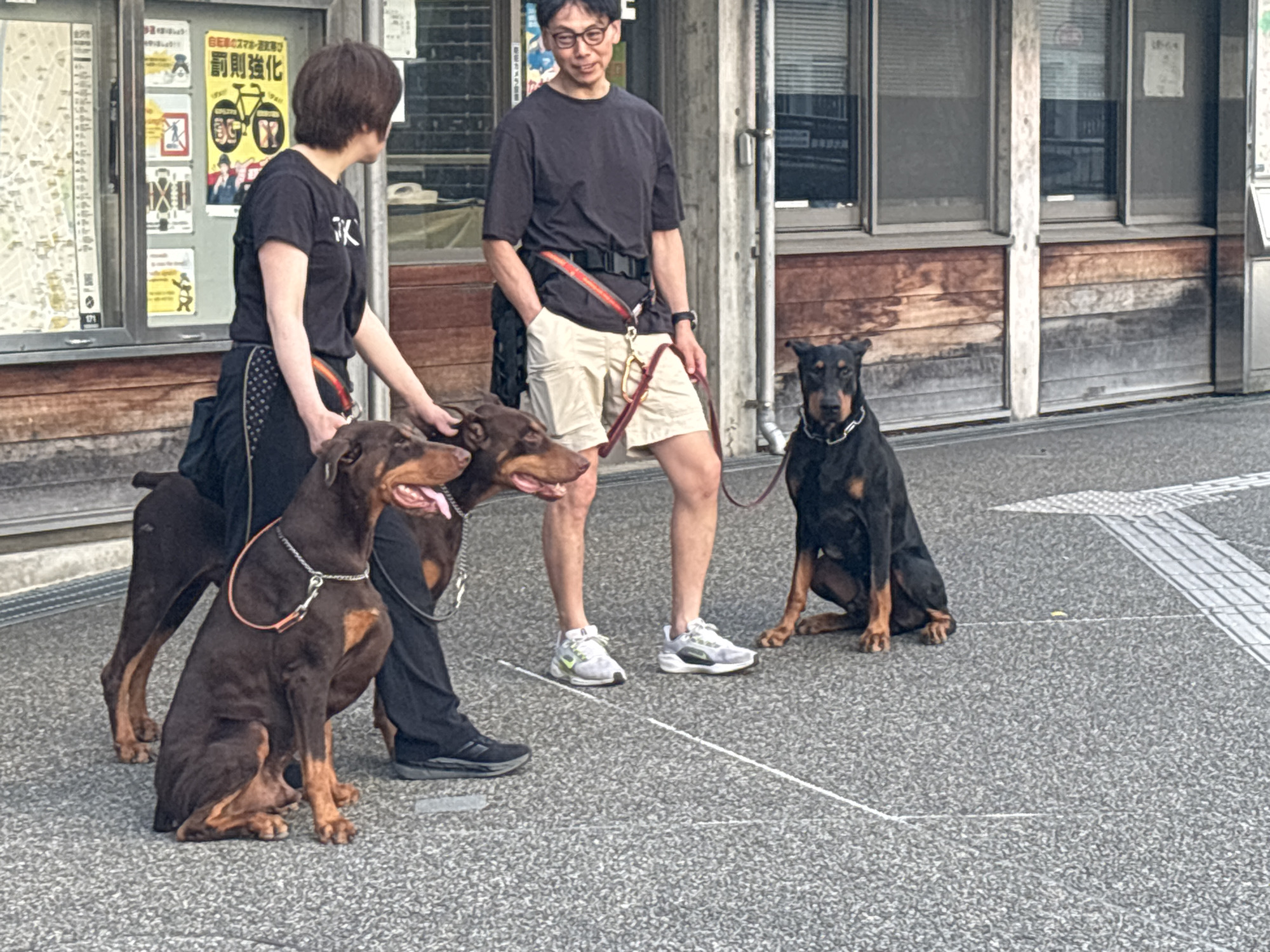
This image depicts an outdoor urban scene in Kanazawa, Japan, identifiable by Japanese text on a public information poster, specifically mentioning "金沢市" (Kanazawa City) and "自転車ルール強化" (Bicycle Rule Enforcement Strengthening). In the foreground, two individuals are present with three Doberman Pinscher dogs on a grey, speckled asphalt or concrete pavement. On the left, a woman with short, dark brown hair, wearing a black short-sleeved t-shirt and dark pants, faces right and slightly away from the camera. Her left hand rests on the head of one of two brown Doberman Pinschers. This brown Doberman is seated, looking towards the right, with its tongue slightly extended and a red leash attached to its choke chain collar. A second brown Doberman stands partially behind the seated one, its head visible near the woman's hand, also with its tongue slightly out. In the center, a man with glasses, wearing a black short-sleeved t-shirt, light beige shorts, and white sneakers, stands facing the camera with a slight smile. A black belt with a red strap is visible around his waist, from which a black leash extends. His hands are in his pockets. To the man's right, a black Doberman Pinscher is seated upright, facing the camera directly with an alert expression. This dog wears a metal choke chain collar, and its black leash is held by the man. The background features a building with a lower section clad in horizontal wooden panels of various brown and grey tones. Above the paneling are windows with light-colored frames, some showing internal blinds. The leftmost window displays a large, partially illegible map or directory. The central window contains several posters, including the prominent yellow one detailing "Bicycle Rule Enforcement Strengthening" with a bicycle graphic, affirming the Kanazawa location. The pavement on the far right includes a strip of white tactile paving. The scene is illuminated by natural daylight.
Kanazawa
A close-up, eye-level outdoor selfie depicts a young woman smiling in golden hour sunlight in Kanazawa, Japan. Her face is partially obscured by her long, brown hair with blonde and caramel highlights, which also casts soft shadows. Visible features include her right eye, which is brown, part of her nose, and her pink-lipped mouth curved in a smile. Her right cheek exhibits a warm, rosy flush from the direct sunlight. She is wearing dark-lensed sunglasses with a black frame, which are suspended by a prominent metallic chain around her neck; the chain features a distinct 'V'-shaped emblem. A finger, presumably her right index finger, is visible near the bottom right, lightly touching the sunglass frame. The background, blurred, reveals a clear blue sky with some wispy clouds at the top left, and green foliage, including trees and grass, suggestive of a park or natural outdoor setting, with a path or road also visible to the left.
Kanazawa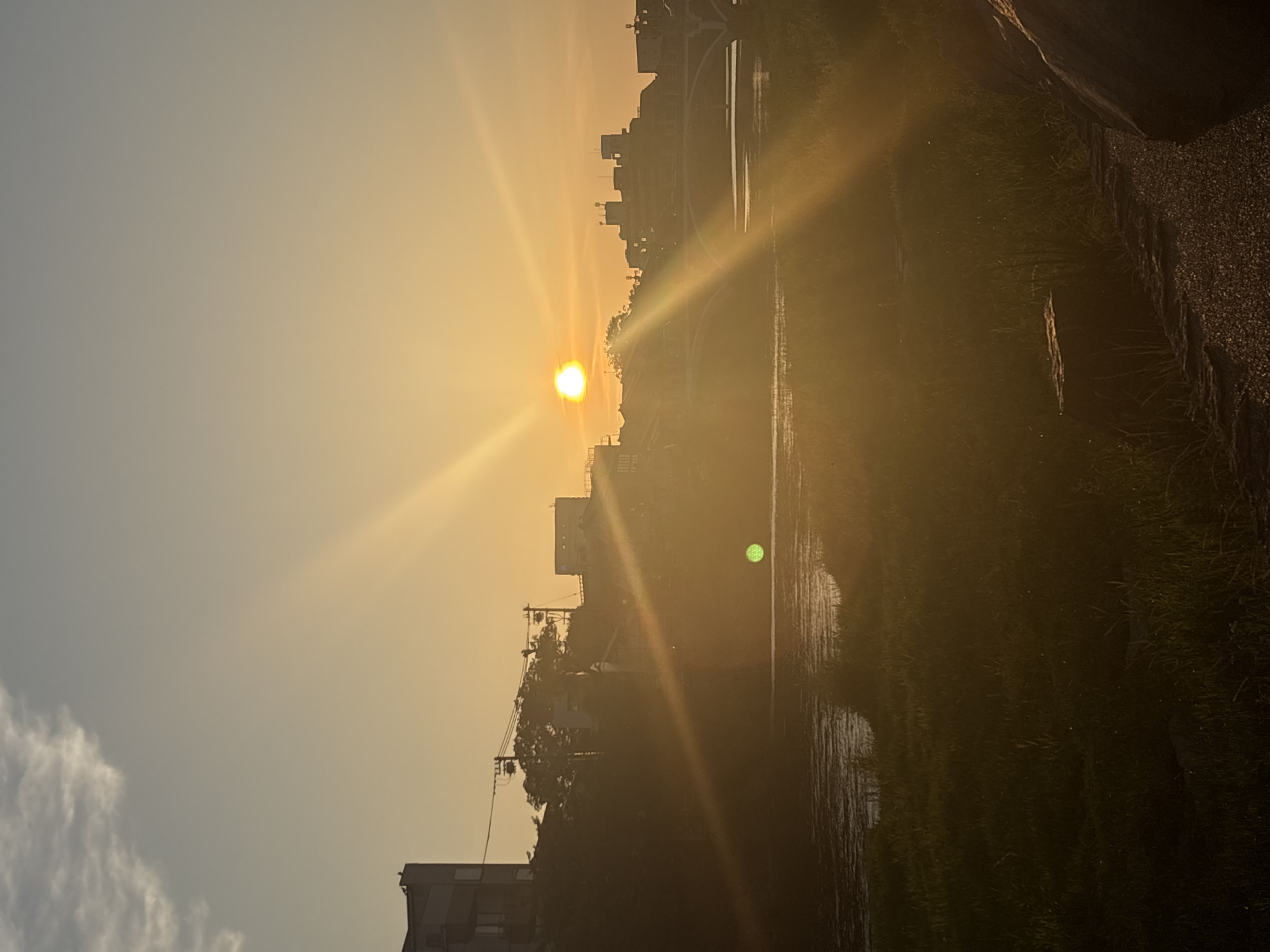
This image captures a sunset or sunrise over an urban river in Kanazawa, Japan. The sun, a brilliant white-yellow orb, is positioned in the upper center-right, emitting intense golden rays and lens flares that traverse the scene diagonally. The sky transitions from a pale blue-grey with diffuse clouds in the upper left to a warm, vibrant golden-orange closer to the horizon and the sun. The river, characteristic of urban waterways in Kanazawa such as the Saigawa or Asanogawa, flows across the mid-ground, displaying ripples on its surface and reflecting the warm ambient light. The river's banks are lined with dark, silhouetted vegetation. On the left bank, dense trees and bushes obscure a hillside, behind which the outlines of multi-story buildings and utility infrastructure, including power lines, are visible. The right bank features a silhouette of urban development, including multiple buildings forming a skyline. A prominent multi-arch bridge spans the river towards the right side of the frame. In the foreground on the right, a dark grassy bank is visible, interspersed with large rocks and a gravel path. Individual blades of grass are discernible, some possibly catching dew or moisture. A distinct, circular green lens flare appears in the lower-mid section of the image, slightly to the left of the sun's central light path. The overall lighting conditions suggest either early morning or late evening, bathing the landscape in a warm, hazy glow.
Kanazawa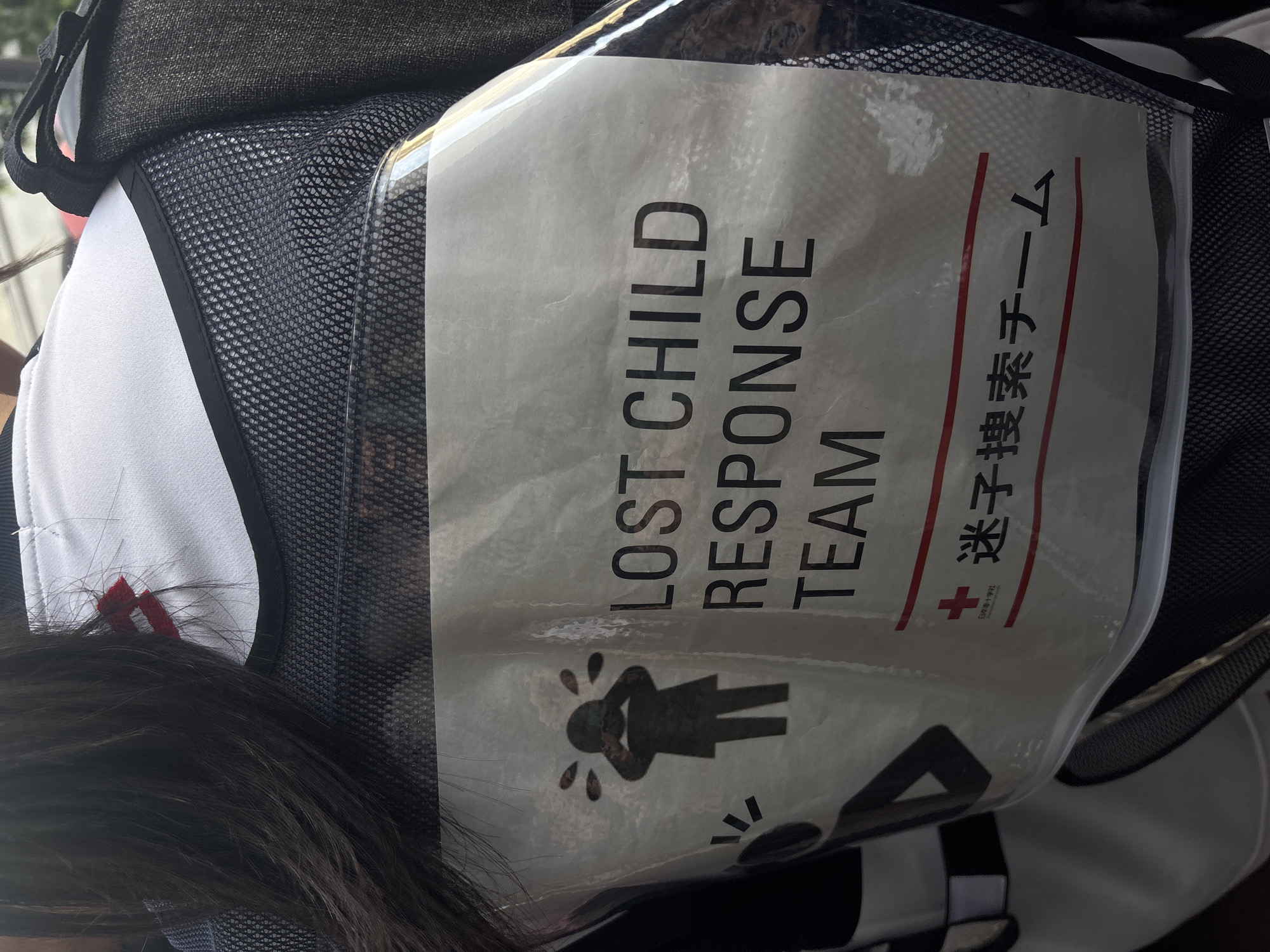
The image displays a close-up, rear view of an individual in the city of Kanazawa, Japan, wearing a specialized vest. The person has long, dark hair visible over their left shoulder and down their back. They are wearing a white upper garment with a small red embroidered symbol, possibly a double horizontal bar, visible at the collar area. Over this, a dark, mesh-textured vest is worn, featuring a large transparent plastic pocket on the back. A black strap from a backpack or bag is visible on the right shoulder. Inside the clear pocket of the vest, a white sheet of paper is inserted, displaying text and an illustration. The prominent English text reads "LOST CHILD RESPONSE TEAM" in black capital letters. To the left of this text is a black silhouette of a child figure, depicted with hands covering its face and tear-like droplets around its head, suggesting distress. Below the English text, a red horizontal line is present, followed by a red cross symbol. Adjacent to the cross, Japanese text reads "迷子捜索チーム" (Maigo Sōsaku Chīmu), which translates to "Lost Child Search Team." A second red horizontal line appears below the Japanese text. A smaller, faint white text, unidentifiable, is visible near the red cross. The overall appearance suggests a uniform for personnel involved in locating missing children.
Kanazawa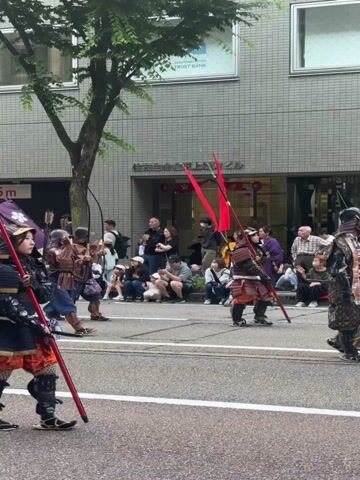
A low-angle, full shot captures a street parade with two individuals dressed as samurai warriors, facing right in the foreground, holding tall red flags on long poles with a white triangular tip. They wear traditional samurai armor, including helmets, dark blue and black chest plates, and orange hakama pants. The first samurai, positioned on the left, has a dark-colored umbrella with a white cherry blossom design tied to their back. In the background, a crowd of spectators watches from the sidewalk. A multi-story grey building with multiple windows and a sign reading "TRUST BANK" is visible behind the crowd.
Kanazawa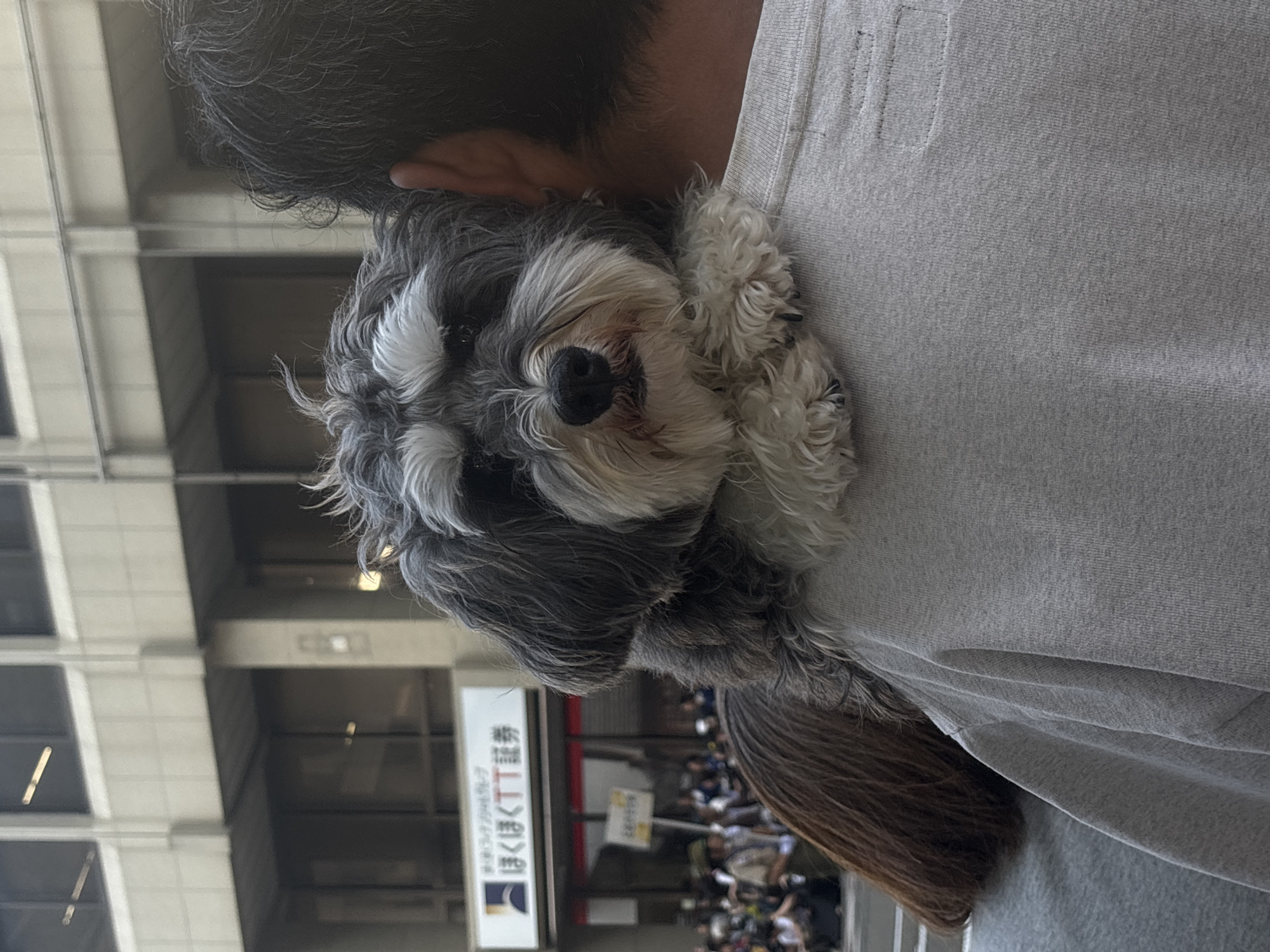
The image depicts a street scene focusing on two individuals and a dog. The primary subject is an individual seen from behind, wearing a light grey, ribbed crewneck sweatshirt. A small, long-haired dog, predominantly grey and white with a black nose and shaggy facial fur, is resting its front paws on the individual's right shoulder, looking directly towards the viewer. Its eyes are partially obscured by its fur. To the left of this primary subject, the back and long brown hair of a second individual are visible. In the background, across a public thoroughfare, a multi-story building with a light-colored facade and dark, rectangular windows is visible. A prominent white rectangular sign with black and orange Japanese text is affixed to the building's lower section. The text reads "〇〇フィナンシャルグループ" (〇〇 Financial Group) and "ほくほくTT証券" (Hokuhoku TT Securities). The presence of "Hokuhoku TT Securities" identifies the location as being within the Hokuriku region of Japan, specifically consistent with the city of Kanazawa. Further in the background, a crowd of out-of-focus individuals is visible on the street, some appearing to hold upright objects resembling signs or flags. The scene is illuminated by ambient daylight. No specific actions beyond the dog resting on the shoulder are discernible.
Kanazawa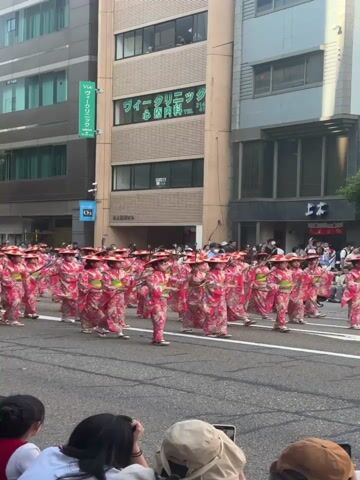
A large group of people in traditional Japanese attire, specifically pink kimonos with floral patterns and straw hats, march in a parade down a city street. They are holding what appear to be short, thin poles or batons. The street is lined with multi-story buildings, some with storefronts and signs in Japanese. Spectators are visible in the foreground, with the backs of their heads indicating they are seated or standing along the parade route. The weather appears to be sunny.
Kanazawa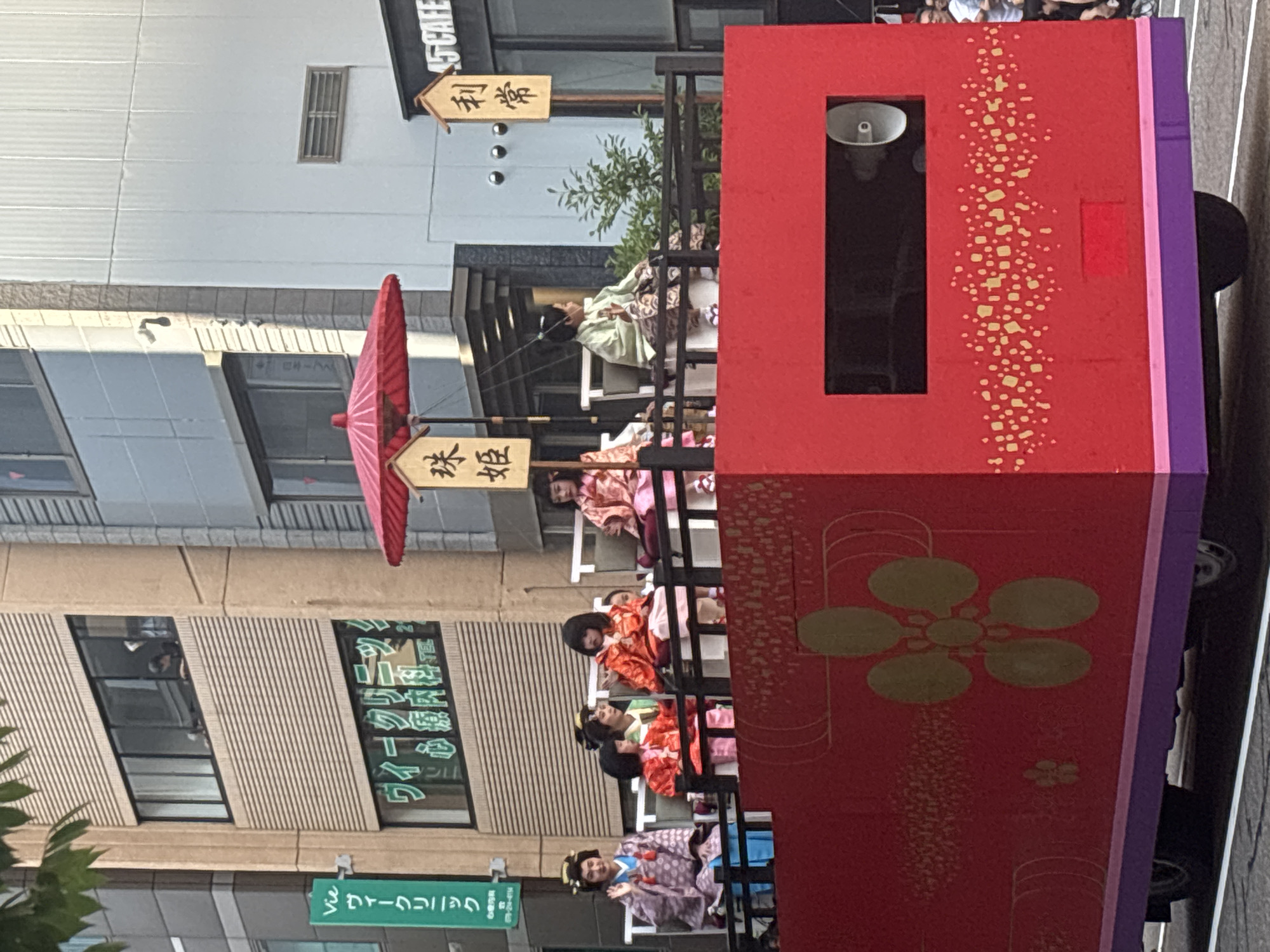
This detailed image captures a daytime scene on a city street in Kanazawa, Japan, likely during the Kanazawa Hyakumangoku Festival, given the traditional attire and names displayed. In the foreground, a large, rectangular parade float dominates the lower half of the frame. The float is primarily red with a purple base trim and is adorned with gold-colored decorative patterns, including prominent five-petal floral motifs and speckled designs. Two small wheels are visible beneath the float. On the right side of the float, a horizontal rectangular opening reveals a white megaphone speaker oriented outwards. Seated atop the float, behind a dark railing, are at least six individuals dressed in traditional Japanese garments (kimonos) and elaborate hairstyles. From left to right: a woman in a purple patterned kimono with an ornate traditional hairstyle is gesturing with her right hand; two young children in orange-red kimonos sit beside her; a woman in a lighter green kimono is positioned behind them; another person in an orange-red kimono is seated further right; a woman in a light green kimono with patterned lower garments (possibly hakama) holds an object; and a woman in a pink patterned kimono is partially visible on the far right. A large red traditional Japanese umbrella (wagasa) is mounted on the left side of the float, next to a wooden sign with the Japanese characters "珠姫" (Tamahime) written vertically in black. Another wooden sign, positioned further right on the float, displays "利常" (Toshitsune). The background features urban buildings. On the left, a multi-story building with light brown/beige horizontally ridged paneling is visible. On its second floor, people are visible through large windows, looking down at the street; one person wears a dark top. On the ground floor of this building, a large window displays green Japanese characters on a dark background, reading "ウィーククリニック" (Week Clinic), "心療内科" (Psychosomatic Internal Medicine), and "TEL". A vertical green sign attached to this building reads "Vie" and "ヴィーククリニック" (Vie Clinic) in white text. To the right, another building with lighter-colored (white/light grey) paneling features a small rectangular ventilation grate. At street level on the right, a black sign for "45 CAFE" is visible. A small green bush is situated between the float and the right-side building. The street surface is asphalt with a visible white line. The overall lighting is even, suggesting an overcast daytime. Faintly visible spectators in modern clothing can be seen on the far
Kanazawa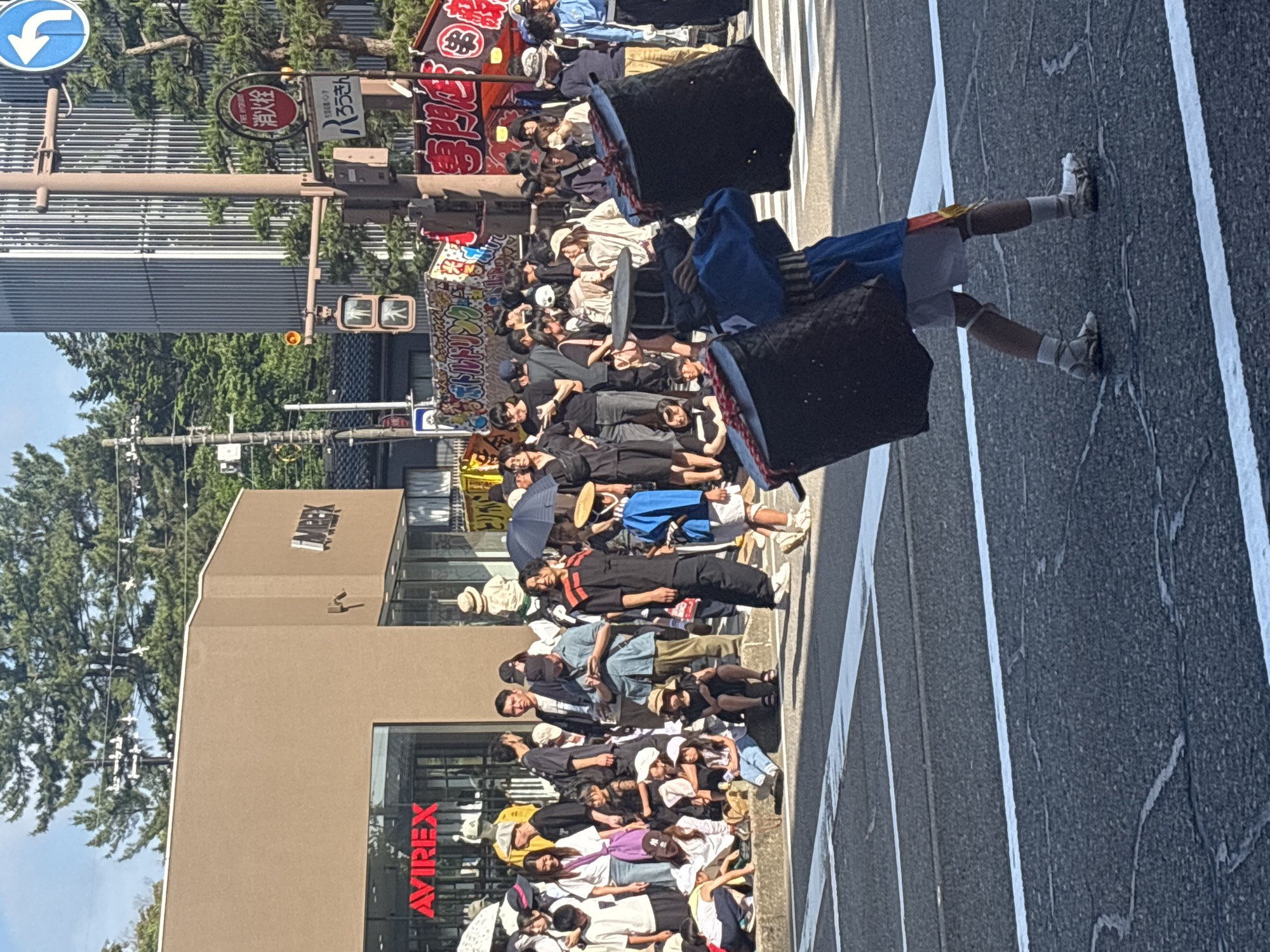
This is a daytime photograph depicting a street scene in Katamachi, Kanazawa, Japan, during what appears to be a public event or festival. In the immediate foreground, a person in traditional Japanese attire is crossing the street from left to right on a white-striped crosswalk. They are wearing a blue short-sleeved garment with red-orange accents, white shorts, white tabi-style socks, and straw sandals. A broad, flat straw hat covers their head. They are carrying two large, dark, cylindrical, woven objects, resembling baskets or drums, suspended from a harness worn over their shoulders. These objects are positioned one on each side of their body. In the mid-ground, a substantial crowd of people, casually dressed, lines the left side of the street. Many are standing, observing the event, while others are seated on the curb. Behind them, a two-story commercial building with a light brown facade is visible. The ground floor features large display windows and a red illuminated sign that reads "AVIREX." A separate, partially visible sign on the upper facade reads "IMREX." Further to the right, a multi-post traffic light structure stands. It displays a circular blue sign with a white left-turn arrow, a circular red sign with white Japanese characters reading "消火栓" (Shōkasen - Fire Hydrant), and a white rectangular sign with Japanese text "はろうきん" (Haroukin - referring to Hokuriku Bank). Colorful banners with Japanese text, including "ボトルドリンク" (Bottle Drink) and "専門店" (Senmonten - specialty store), are strung across the street in the background, further indicating a festival atmosphere. In the distant background, above the buildings and trees, a tall, modern building with a vertically ribbed, light-colored facade is visible under a clear blue sky. Green trees are interspersed throughout the scene, particularly in the upper right. The asphalt road shows white road markings and minor surface cracks. The scene is brightly lit by direct sunlight, casting distinct shadows.
Kanazawa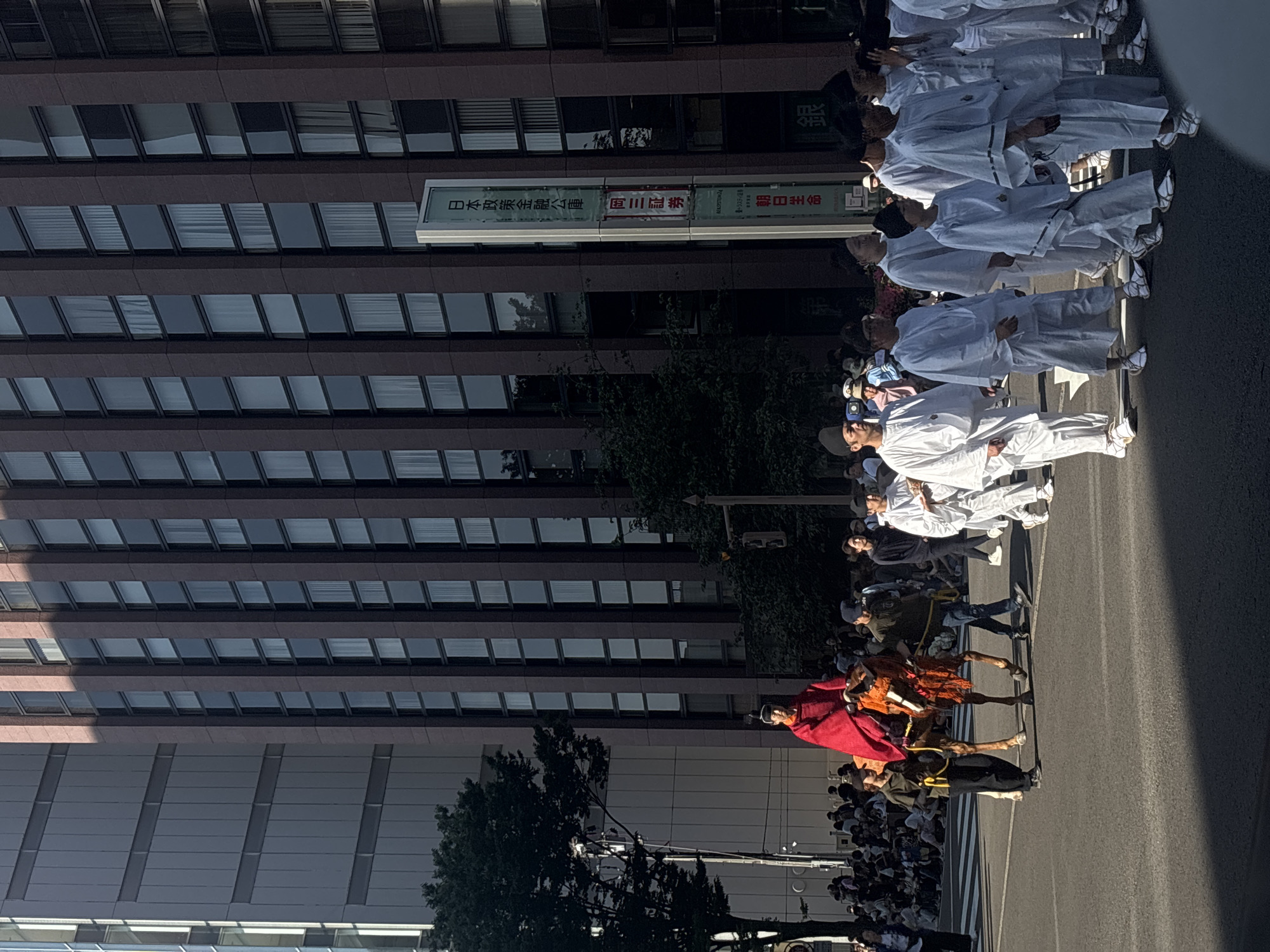
A daytime parade or procession unfolds on a paved city street in Kanazawa, Japan. The precise location is identifiable by a tall, vertical building sign on the right displaying "日本政策金融公庫" (Japan Finance Corporation), "岡三証券" (Okasan Securities), and "朝日生命" (Asahi Life), placing the scene likely on Hirosaka Dori near Korinbo. A central figure, adorned in a prominent red cloak and dark traditional headwear, rides a reddish-brown animal, possibly a horse, decorated with orange and red fabric. An individual in dark attire and a cap walks alongside the animal's left, appearing to guide it. In the right foreground, a group of approximately eight individuals dressed in matching white traditional Japanese garments, dark headwear, and white traditional sandals walks in a disciplined formation from right to left. Other procession participants are visible behind the animal. On the far left, numerous spectators, some seated, observe the event from the side of the street. The urban environment includes a prominent multi-story building on the right with a dark brown facade and numerous regularly spaced rectangular windows, reflecting elements of the sky. To the left, behind a large green tree, another tall building with a lighter grey, panelled facade is visible. Long, distinct shadows extend across the street from right to left, indicating a low sun angle, suggesting either morning or late afternoon. A traffic light pole is partially visible on the right.
Kanazawa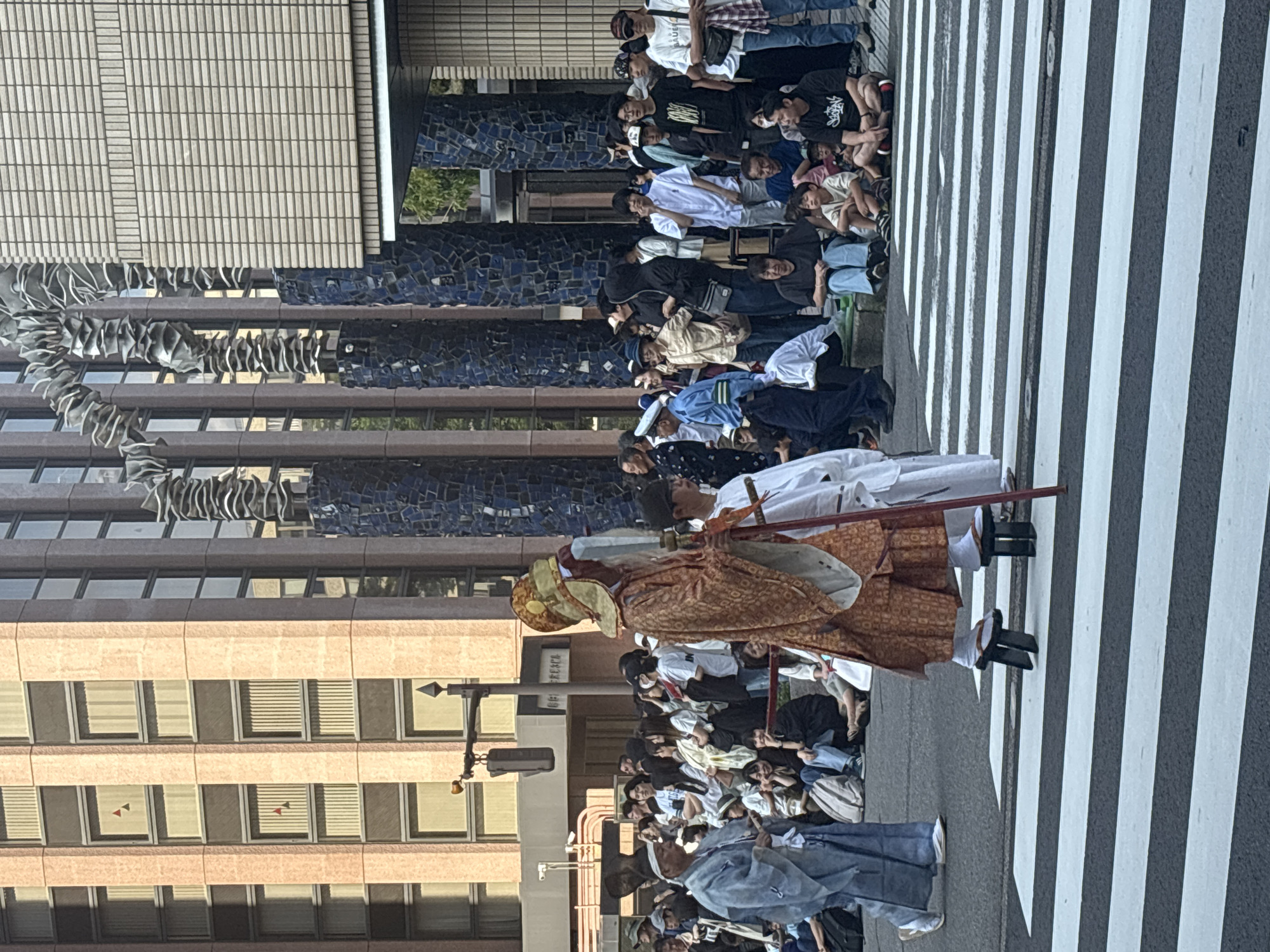
This detailed image captures a vibrant street scene in Kanazawa, Japan, showcasing a cultural procession or festival. The foreground is dominated by a black asphalt road featuring a prominent white and black zebra crossing. Three figures in ceremonial attire are central to the scene, traversing the zebra crossing. The most prominent figure, positioned slightly right of center, is an adult wearing an elaborate, patterned orange and gold brocade robe. This individual is equipped with white tabi socks and walks on two tall, black wooden stilts, resembling elevated geta. A large, ornate golden hat or headdress crowns their head, and they hold a long, red staff capped with a distinctive silver or white blade-like ornament. Their face is partially obscured by white coloring or a mask. To the left of this central figure, another individual in a light blue traditional Japanese robe (kimono-style top and hakama-like pants) and a tall, black, flat-topped hat walks on the paved area alongside the street. A third participant, younger in appearance and dressed in a simple white robe, is positioned to the right of the stilt-walker, holding a small white stick or implement. Numerous spectators line both sides of the street, observing the procession. They consist of a diverse group of adults and children, casually dressed in modern clothing such as t-shirts, jeans, and caps. Many are seated directly on the pavement, while others stand behind them. On the left side, a police officer in a blue uniform is visible among the crowd. The background features urban architecture. To the left, a multi-story building with a light reddish-brown, textured facade and multiple rectangular windows, many fitted with light-colored blinds, rises. Two of these windows, on the left section of the building, contain small red triangular ornaments. To the right, a section of a building with a light-grey, horizontally tiled or bricked exterior is visible. Interspersed in the mid-ground are striking public art installations: tall, cylindrical pillars composed of dark blue, irregularly shaped mosaic tiles. From the top of these pillars, large, metallic, undulating, and stacked ribbon-like sculptures curve upwards. A black street light pole with a visible amber traffic signal is located above the crowd on the left. The scene is illuminated by bright daylight, casting distinct shadows.
Kanazawa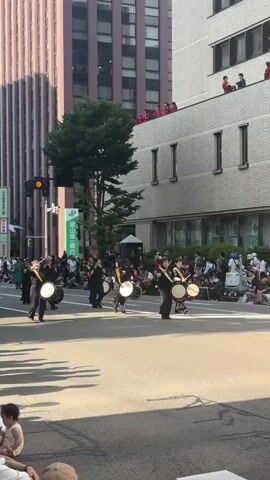
A daytime wide shot shows a Japanese street parade with approximately 10 performers in black clothing with yellow sashes, walking forward with taiko drums and flutes, in a straight line on a city street. Spectators sit on the curbs, and some people stand on a building's rooftop balcony on the right. Tall buildings line both sides of the street. Shadows of unseen objects are visible in the foreground.
Kanazawa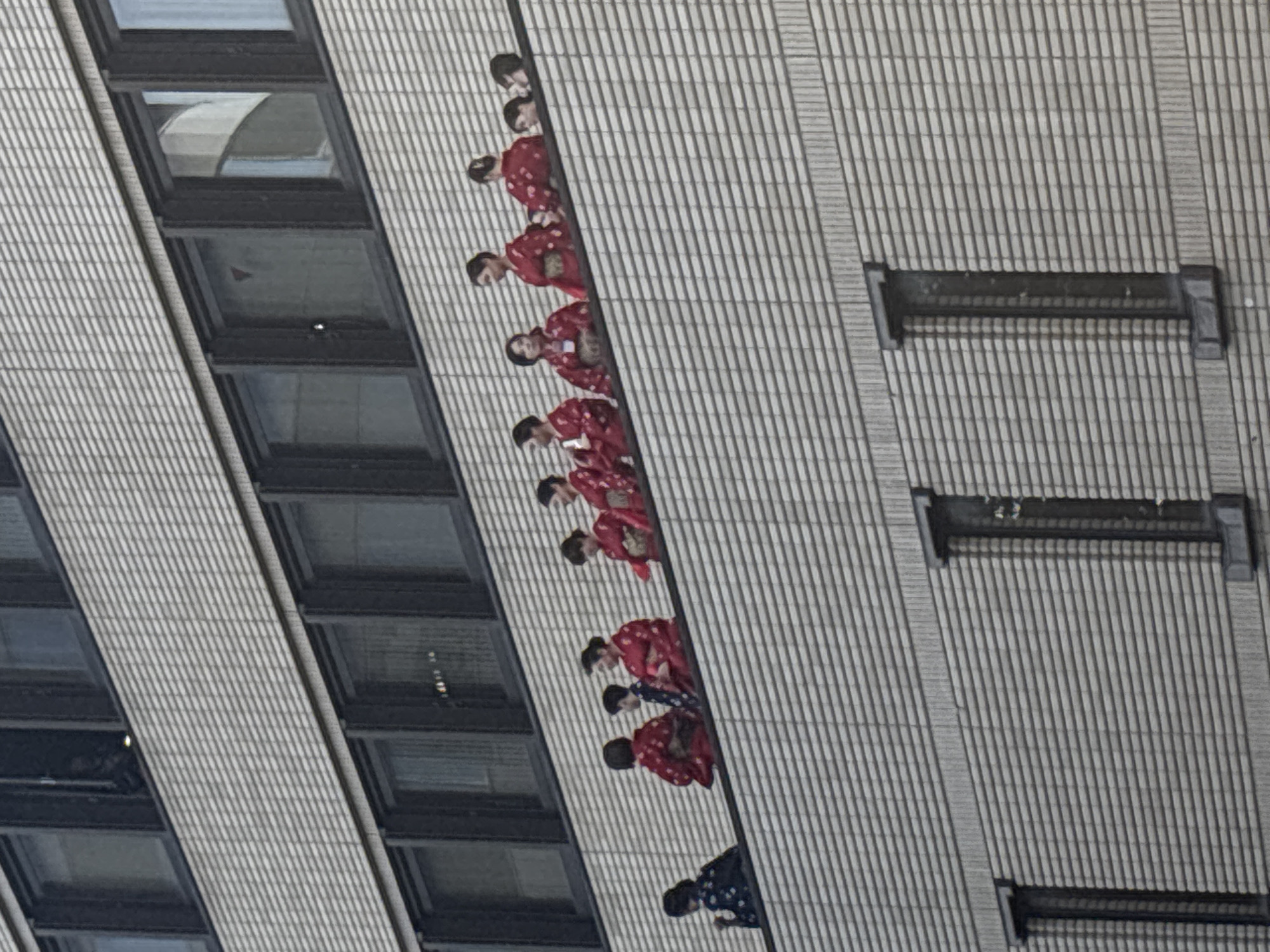
The image displays a detailed view of a light-colored, multi-story building facade, likely in an urban setting. A group of approximately thirteen individuals, predominantly women, are lined up on a narrow architectural ledge or balcony spanning the width of the building. Most of the individuals are dressed in traditional Japanese kimonos, primarily in shades of red with intricate patterns, suggesting a cultural event or performance. One person on the far left wears a dark blue or black kimono with a lighter pattern. Their posture indicates they are standing and observing, with their attention directed outwards from the building. Above and below this group, rows of dark-framed rectangular windows are visible, reflecting elements of the surrounding environment. Given the traditional attire and the context provided, this scene is consistent with an observation point or public appearance in a historic district, such as the Higashi Chaya District in Kanazawa, Japan.
Kanazawa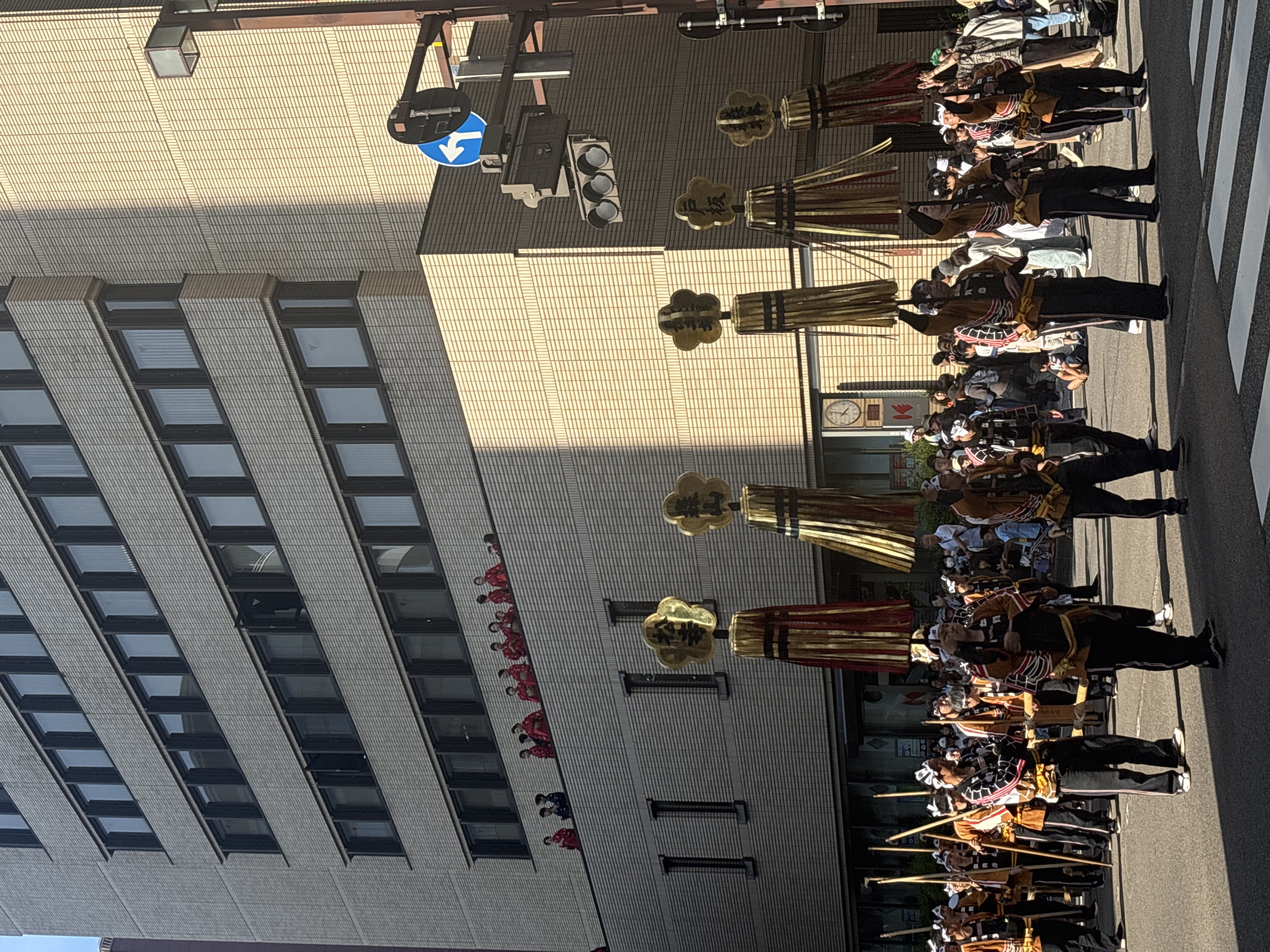
This daytime image depicts a street scene during a festival parade in Kanazawa, Japan, likely the Hyakumangoku Matsuri. The perspective is slightly elevated, looking down a city street towards a multi-story building. In the foreground and mid-ground, a procession of approximately 20-30 individuals, predominantly men, advances on a paved street. They are dressed in traditional festival attire consisting of black trousers, short-sleeved jackets (some brown with black stripes, others patterned), and white headbands. Several men carry long wooden poles. Prominently featured are five tall, decorative elements, each topped with a gold, five-petaled motif displaying kanji characters. From left to right, these read "松ヶ枝" (Matsugae), "祭山" (Matsuyama), "祭山" (Matsuyama), "戸板" (Toita), and "松ヶ枝" (Matsugae). Beneath these gold tops are cylindrical structures composed of vertical red and gold, or gold and black, tassels or strips. The individuals holding these elements typically have them raised above their heads or shoulders. Spectators line the sides of the street behind the procession. The street surface includes a visible white crosswalk in the lower right. In the mid-ground, on a lower-level balcony or terrace of the multi-story building, a group of approximately 10-15 women is observing the parade. They are attired in red kimonos, some with dark patterns, and have traditional hairstyles. The background is dominated by the multi-story building, which features a light-colored brick or tiled facade and multiple rows of rectangular windows with dark frames. The building exhibits recessed sections on some floors, creating architectural variation. On the right side of the image, a dark metal pole supports a set of three dark-lensed traffic lights and a circular blue sign with a white left-turn arrow. A square-shaped street light fixture is also mounted on the pole. Strong sunlight illuminates the upper right portion of the building, casting distinct shadows across the street and lower parts of the building.
Kanazawa![A collection of ten Japanese swords, primarily katana and wakizashi, are displayed horizontally on a light-colored wooden slatted wall within an establishment in Kanazawa, Japan. Each sword is held by black, L-shaped wall mounts. To the far right, a single Japanese sword stands vertically on a black floor stand against a textured, light brown wall.
The horizontal display features swords with varying handle (tsuka) and scabbard (saya) colors and designs. From top to bottom:
1. A sword with a black handle featuring white accents and a dark tsuba. A white tag on its handle reads "Kondo Isami." Another tag indicates "¥32,000." Its saya is mostly obscured by the sword above, but a red saya is visible beneath it.
2. A sword with a black handle featuring red accents and a dark, circular tsuba. Its saya is red with subtle black patterns.
3. A sword with a black handle featuring red accents and a dark, intricately designed tsuba. Its saya is bright red with three distinct gold circular symbols. A white tag displays Japanese text and "¥24,000 (tax inc)."
4. A sword with a black handle featuring black and red accents. Its saya exhibits a marbled pattern of dark brown and red.
5. A sword with a black handle and a tsuba. Its saya has a dark gray and black marbled or patterned finish.
6. A sword with a black handle. Its saya is a dark teal or greenish color. A white tag with Japanese text indicates "¥24,000."
7. A sword with a black handle. Its saya is purple with subtle patterns.
8. A sword with a black handle. Its saya is black.
9. A sword with a black handle featuring gold ornamentation. Its saya is black with gold ornamentation near the tip.
10. A sword with a black handle featuring gold ornamentation. Its saya is red with gold patterns.
On the upper left of the image, a white informational sign is partially visible, stating "se Hijikata Toshizo's favorite [sword] made by Izuminokami."
The vertically standing sword on the right has a red, diamond-pattern wrapped handle with a gold pommel cap and a gold tsuba. Its scabbard is black, adorned with a green and gold braided cord (sageo). The environment is an indoor setting with warm, artificial lighting. No individuals are present.](https://firebasestorage.googleapis.com/v0/b/patr-3a75e.appspot.com/o/uploads%2Fimage_picker_5252d55f-7c0f-4cc3-8.jpg?alt=media)
A collection of ten Japanese swords, primarily katana and wakizashi, are displayed horizontally on a light-colored wooden slatted wall within an establishment in Kanazawa, Japan. Each sword is held by black, L-shaped wall mounts. To the far right, a single Japanese sword stands vertically on a black floor stand against a textured, light brown wall. The horizontal display features swords with varying handle (tsuka) and scabbard (saya) colors and designs. From top to bottom: 1. A sword with a black handle featuring white accents and a dark tsuba. A white tag on its handle reads "Kondo Isami." Another tag indicates "¥32,000." Its saya is mostly obscured by the sword above, but a red saya is visible beneath it. 2. A sword with a black handle featuring red accents and a dark, circular tsuba. Its saya is red with subtle black patterns. 3. A sword with a black handle featuring red accents and a dark, intricately designed tsuba. Its saya is bright red with three distinct gold circular symbols. A white tag displays Japanese text and "¥24,000 (tax inc)." 4. A sword with a black handle featuring black and red accents. Its saya exhibits a marbled pattern of dark brown and red. 5. A sword with a black handle and a tsuba. Its saya has a dark gray and black marbled or patterned finish. 6. A sword with a black handle. Its saya is a dark teal or greenish color. A white tag with Japanese text indicates "¥24,000." 7. A sword with a black handle. Its saya is purple with subtle patterns. 8. A sword with a black handle. Its saya is black. 9. A sword with a black handle featuring gold ornamentation. Its saya is black with gold ornamentation near the tip. 10. A sword with a black handle featuring gold ornamentation. Its saya is red with gold patterns. On the upper left of the image, a white informational sign is partially visible, stating "se Hijikata Toshizo's favorite [sword] made by Izuminokami." The vertically standing sword on the right has a red, diamond-pattern wrapped handle with a gold pommel cap and a gold tsuba. Its scabbard is black, adorned with a green and gold braided cord (sageo). The environment is an indoor setting with warm, artificial lighting. No individuals are present.
Kanazawa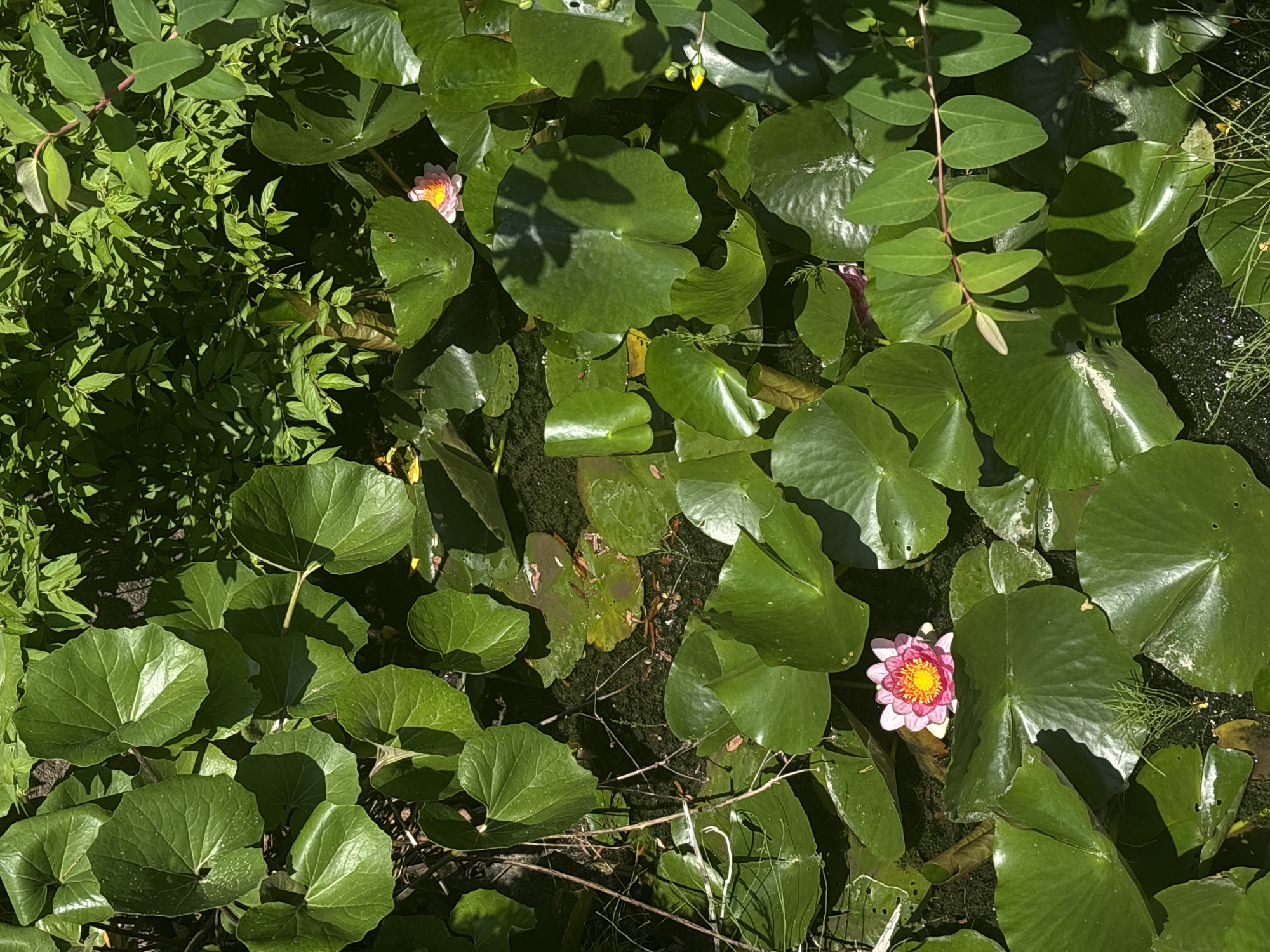
This detailed overhead image depicts a segment of a verdant pond located in Kanazawa, Japan, under direct sunlight. The water's surface is largely covered by numerous large, round green lily pads (Nymphaeaceae). Two water lilies are in bloom: one prominent pink and yellow flower with a distinct central yellow stamen cluster is positioned in the lower center, and a smaller, paler pink flower is visible in the upper right quadrant. The water, visible in gaps between the pads, appears dark and contains some submerged aquatic growth. Surrounding the pond are various green terrestrial plants: large, cordate leaves with visible venation occupy the upper left, dense shrubbery with smaller leaves is in the upper right background, and a branch bearing paired ovate leaves and small yellow buds extends into the lower right foreground. Sunlight creates strong highlights on the foliage and casts distinct shadows on several lily pads. No individuals or fauna are present.
Kanazawa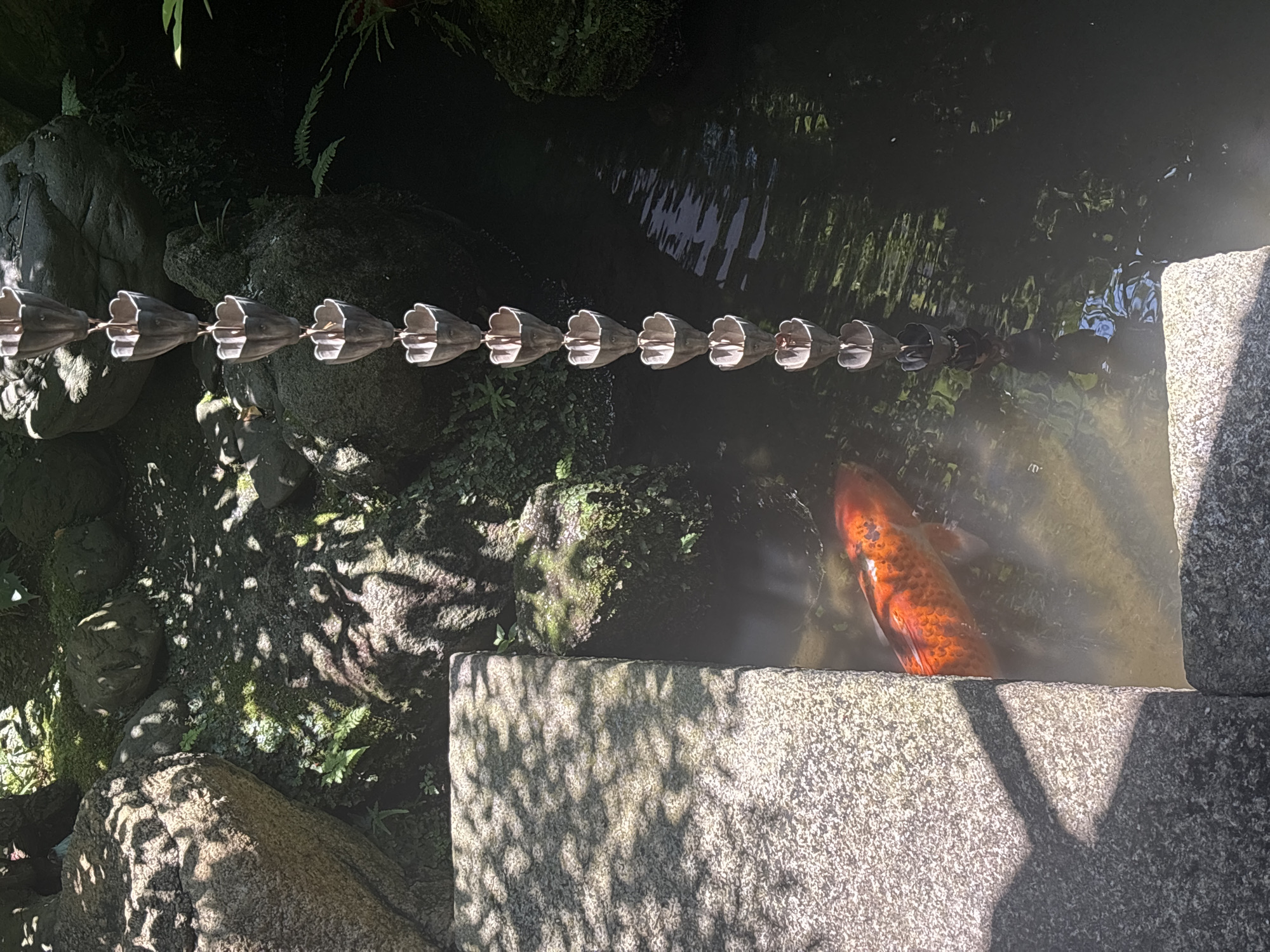
The scene depicts an outdoor garden environment in Kanazawa, Japan. A prominent orange koi fish with white markings is observed in the clear water in the lower-left section, positioned alongside a light-colored, textured stone slab. Overhead foliage casts dappled shadows across the stone surface and the surrounding ground. To the right, a traditional kusari-doi (rain chain) composed of interconnected metal, cup-shaped elements descends vertically, with its lower end submerged in the water, causing ripples. Large natural rocks, some covered in moss and small green plants including ferns, define the edges of the water body and form the background. The water appears dark in areas, reflecting light and elements above. No individuals are visible.
Kanazawa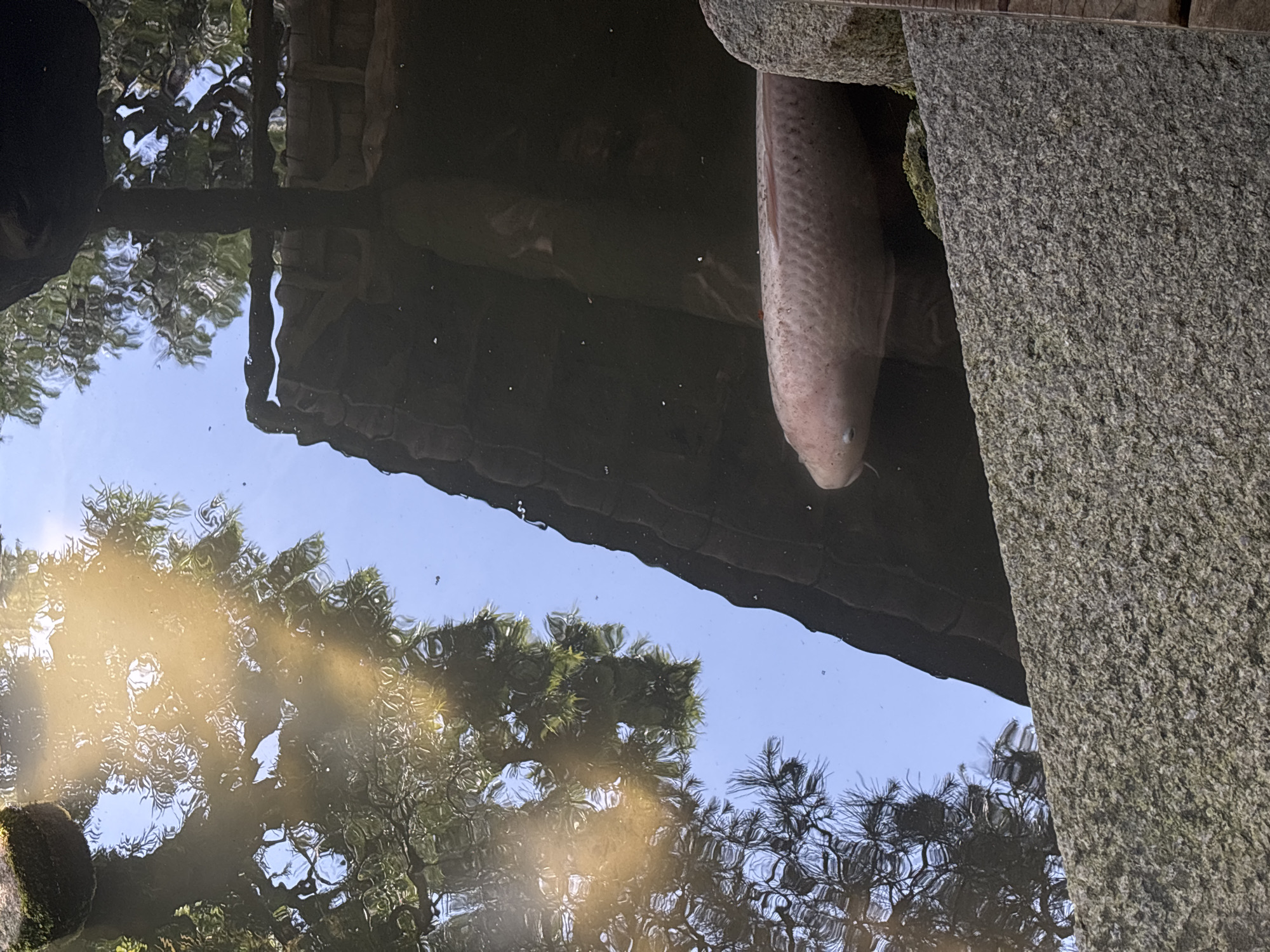
This image presents a detailed view of a pond, strongly suggesting a location within Kenroku-en Garden in Kanazawa, Japan. A large, pale pinkish-white koi (Japanese carp) is visible in the lower-right quadrant, partially submerged in dark water. Its head, with small dark eyes, is oriented towards the lower-left, and its body exhibits distinct scales with a faint reddish hue near a fin. The surface of the water functions as a mirror, prominently reflecting a bright, clear blue sky in the upper-left and central portions of the image. Overlapping these reflections are numerous wavy distortions of lush green foliage from overhead trees, indicative of sunlight filtering through deciduous leaves, and some darker, possibly coniferous, tree reflections. A significant dark, angular reflection of a traditional Japanese architectural element, likely a roof eave or building support, is observable in the upper-central and right-central reflected areas, casting a deep shadow into the water. The foreground is defined by a rough-textured, light gray granite stone wall or barrier, serving as the edge of the pond. This stone shows granular details and minimal patches of moss growth. Small, bright white specks, possibly minute floating debris or light reflections, are scattered across the dark water surface, particularly around the koi. The perspective is an overhead view looking down into the pond. No human subjects or their interactions are present in the scene.
Kanazawa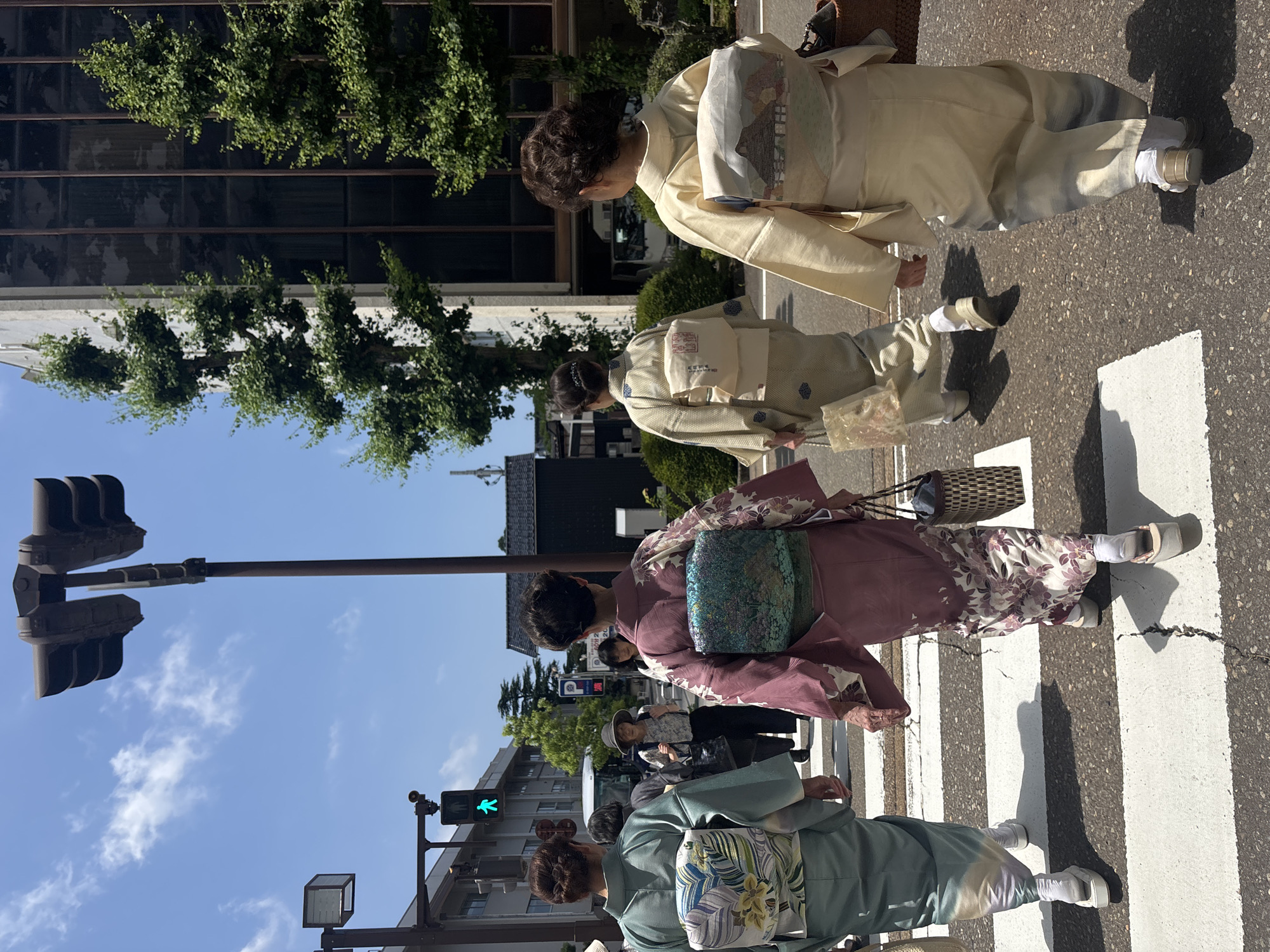
Four women in traditional kimonos are depicted walking away from the viewer, crossing a zebra-marked asphalt street from left to right, in the city of Kanazawa, Japan. The scene is illuminated by bright daylight under a clear blue sky with sparse white clouds. From left to right, the women are dressed as follows: 1. A woman in a pale teal kimono with a multicolored obi featuring large leaf and floral patterns. She wears white tabi socks and white platform sandals. 2. A woman in a dark pink kimono with a floral print near the hem and sleeves, paired with a shimmering teal and green obi. She wears white tabi socks and light-colored platform sandals. 3. A woman in a light beige kimono with small blue geometric motifs, and a cream-colored obi bearing a red-stamped design. She wears white tabi socks and light-colored sandals. 4. A woman in a pale yellow kimono with an obi depicting a landscape scene including a thatched-roof house and mountains. She wears white tabi socks and brown/gold sandals. Each of the four kimono-clad women carries a bag: the leftmost carries a light woven bag, the second a dark woven bag, the third a translucent patterned bag, and the rightmost a dark woven basket-like bag. In the mid-ground, a fifth woman wearing a hat, a patterned top, and dark trousers is visible walking towards the camera on the opposite side of the street. The street features a white zebra crossing, with a visible crack in the asphalt in the foreground. On the left, a traffic light pole displays a green pedestrian "walk" signal. A larger, dark-colored traffic light pole with multiple light heads stands centrally in the upper frame. Buildings with windows and green foliage from trees line both sides of the street. Shadows of the people and the central traffic light pole are distinctly cast on the street surface.
Kanazawa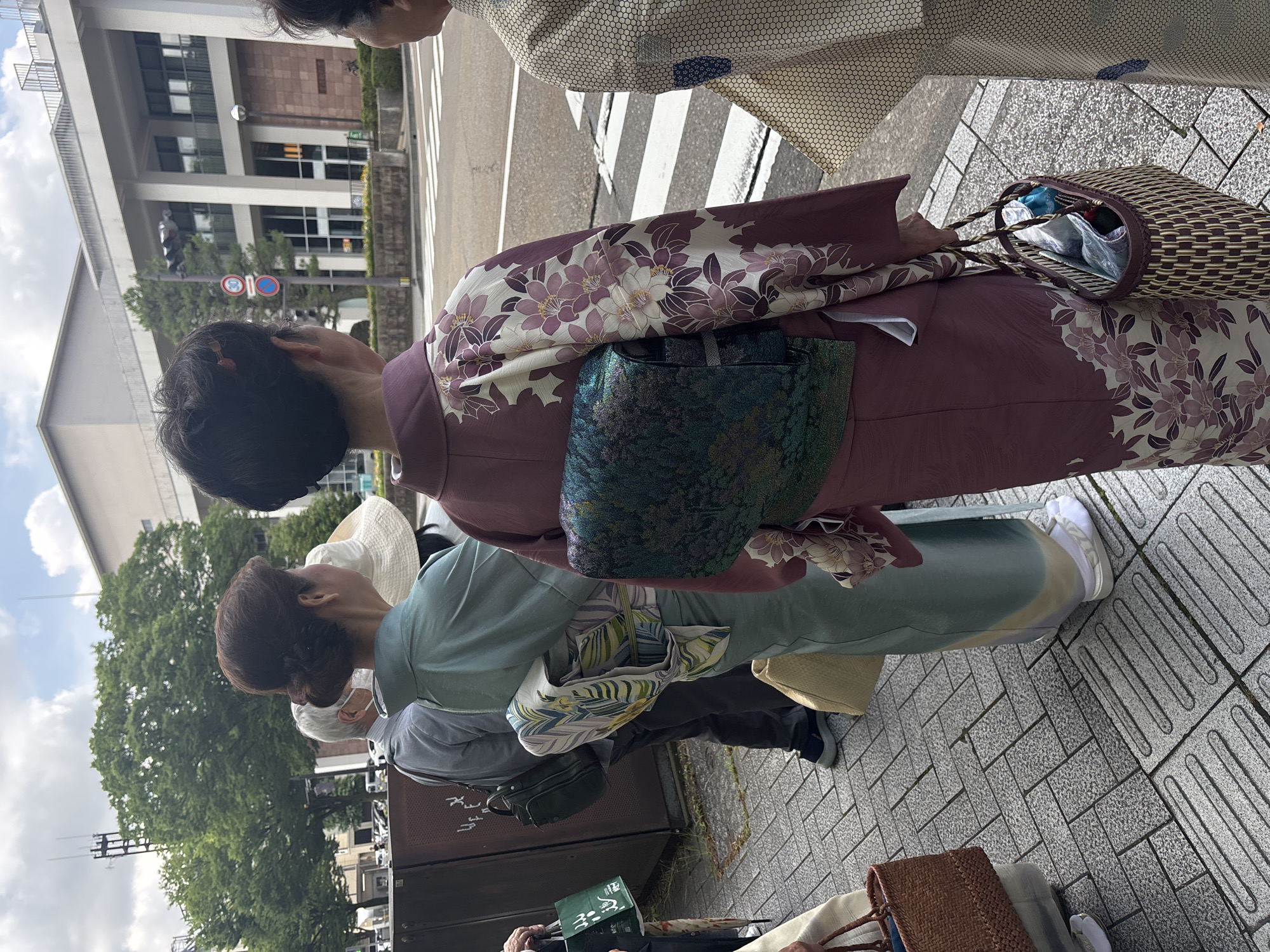
The image captures a street scene in Kanazawa, Japan, showing several individuals standing on a sidewalk, primarily viewed from behind, under a cloudy sky. In the mid-ground, three women are dressed in traditional Japanese kimonos. The central figure wears a light teal-colored kimono with a subtly patterned fabric. Her white obi (sash) is decorated with a vibrant pattern of green, yellow, and blue stylized leaves. Her dark hair is styled in a neat, low bun. To her right, a woman is seen in a deep reddish-purple kimono. This kimono features prominent white panels on the sleeves and lower back, adorned with patterns of purple and white flowers and dark green leaves. Her obi is a dark, iridescent teal with a rich, textured appearance. She holds a rectangular, dark brown woven basket bag with fine horizontal gold stripes in her right hand. Both women wear white tabi socks and white zori sandals. To the far right, partially visible, is a third woman in a light cream-colored kimono with a delicate hexagonal geometric pattern and a small, rectangular blue patch on the sleeve. Behind the woman in the teal kimono, an older man with grey hair is visible. He wears a short-sleeved grey collared shirt, dark pants, and carries a black shoulder bag. Another individual, largely obscured by the central figure, wears a wide-brimmed white sun hat. On the far left, a hand is partially visible holding a green paper bag with a white graphic. The group stands on a grey paved sidewalk composed of rectangular blocks, interspersed with tactile paving blocks featuring parallel ridges. Across a street, marked by a white pedestrian crossing (zebra stripes), a large, modern, light-colored building with multiple stories is visible. This building features a prominent colonnade and large windows. Green trees are interspersed throughout the background, partially obscuring other structures. A red circular traffic sign indicating "30" is mounted on a pole near the street, accompanied by a smaller blue rectangular sign. A black street lamp with a white globe is also visible across the street.
Kanazawa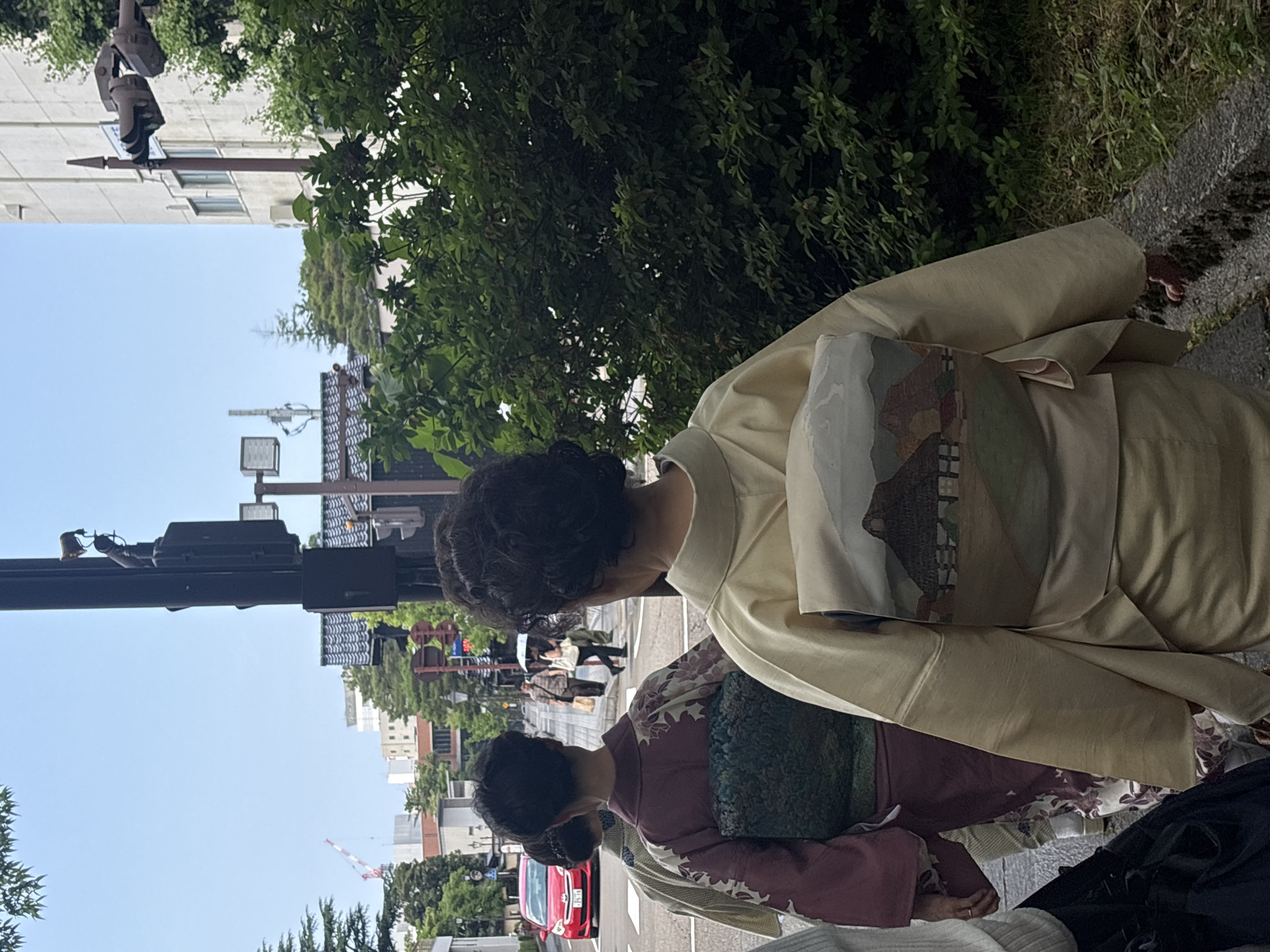
This image captures a daytime street scene in Kanazawa, Japan, under a light blue sky that appears clear or partly cloudy. In the foreground, three women are walking away from the camera, all dressed in traditional Japanese kimonos. The woman closest to the viewer on the right wears a light gold kimono with an obi (sash) featuring a landscape design that includes traditional thatched-roof houses set against mountains. Her dark hair is styled in a neat bun. To her left, another woman wears a deep maroon kimono adorned with a subtle light-colored floral or botanical pattern, complemented by a dark green, textured obi. A third woman, partially visible on the far left, wears a lighter, possibly cream-colored kimono. In the midground, a red hatchback car, identifiable as a Toyota model, is on the asphalt road, displaying a Japanese license plate with the visible characters 'な 75-76'. On the sidewalk beyond the car and the kimono-clad women, other pedestrians are walking; one man carries a paper bag, and a woman further back holds an open umbrella. The urban environment features a blend of modern and traditional elements. Multiple utility poles, traffic lights, and streetlights line the road. A prominent black utility pole on the right side of the image supports signal boxes and is topped with a small, light brown animal figurine, possibly a dog or fox. Lush green trees and dense bushes flank both sides of the street, with a significant hedge on the right. In the background, various multi-story buildings are visible, some exhibiting traditional dark tiled roofs, against the light blue sky.
Kanazawa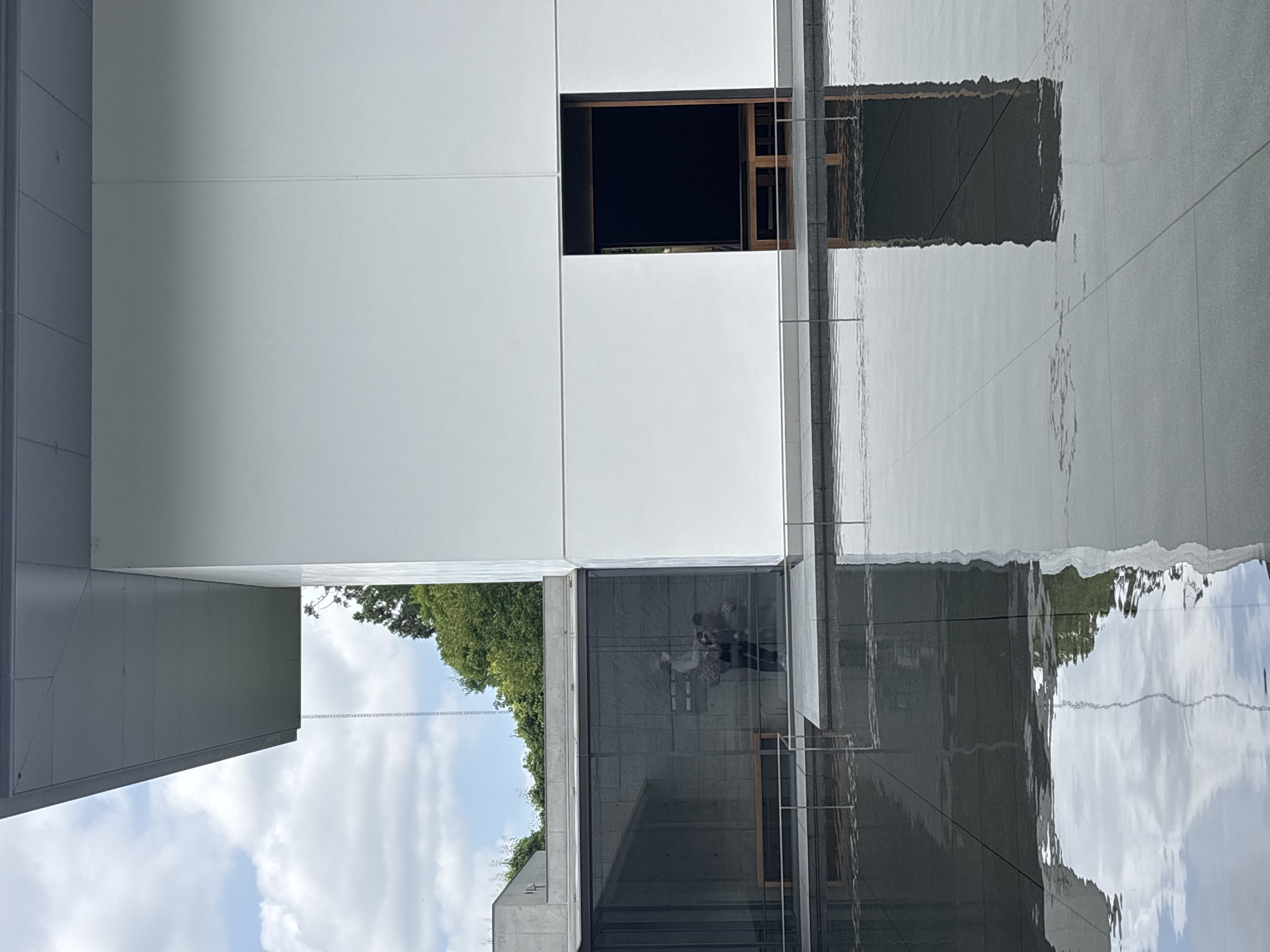
The image depicts a modern architectural complex at the 21st Century Museum of Contemporary Art in Kanazawa, Japan, viewed across a large, dark-tiled water feature that occupies the foreground. The building on the right features a stark, multi-paneled white facade with clean horizontal lines. A large, dark, rectangular opening, possibly an entrance or deep recess, is present in the lower right section of this facade, revealing a dark interior with visible light brown wooden elements at its base. To the left of the white facade, a dark-tinted glass wall extends across the mid-ground. This glass wall has a visible grid structure and reflects the interior, where at least two human figures are discernible. One figure, wearing a light-colored top and a face mask, is centrally reflected. Faint outlines of what appear to be light brown benches are also reflected inside. Beyond the glass wall, another section of the building with a flat, light grey roof is visible, with green trees peaking over it and in the distance. A dark grey, flat roof overhang extends from the top left of the building against a partly cloudy blue sky. A slender, silver-colored metal rain chain hangs vertically from the edge of this overhang, disappearing towards the water feature. A thin, grey metal handrailing runs horizontally along the edge between the building's base and the water feature. The water itself is dark and reflective, mirroring the sky with patches of white clouds and the building's structures, including the white facade, the dark opening, and the rain chain which creates a distinct wavy vertical reflection. The bottom of the water feature reveals a grid of large, dark grey square tiles. The water's surface exhibits ripples, distorting the reflections.
Kanazawa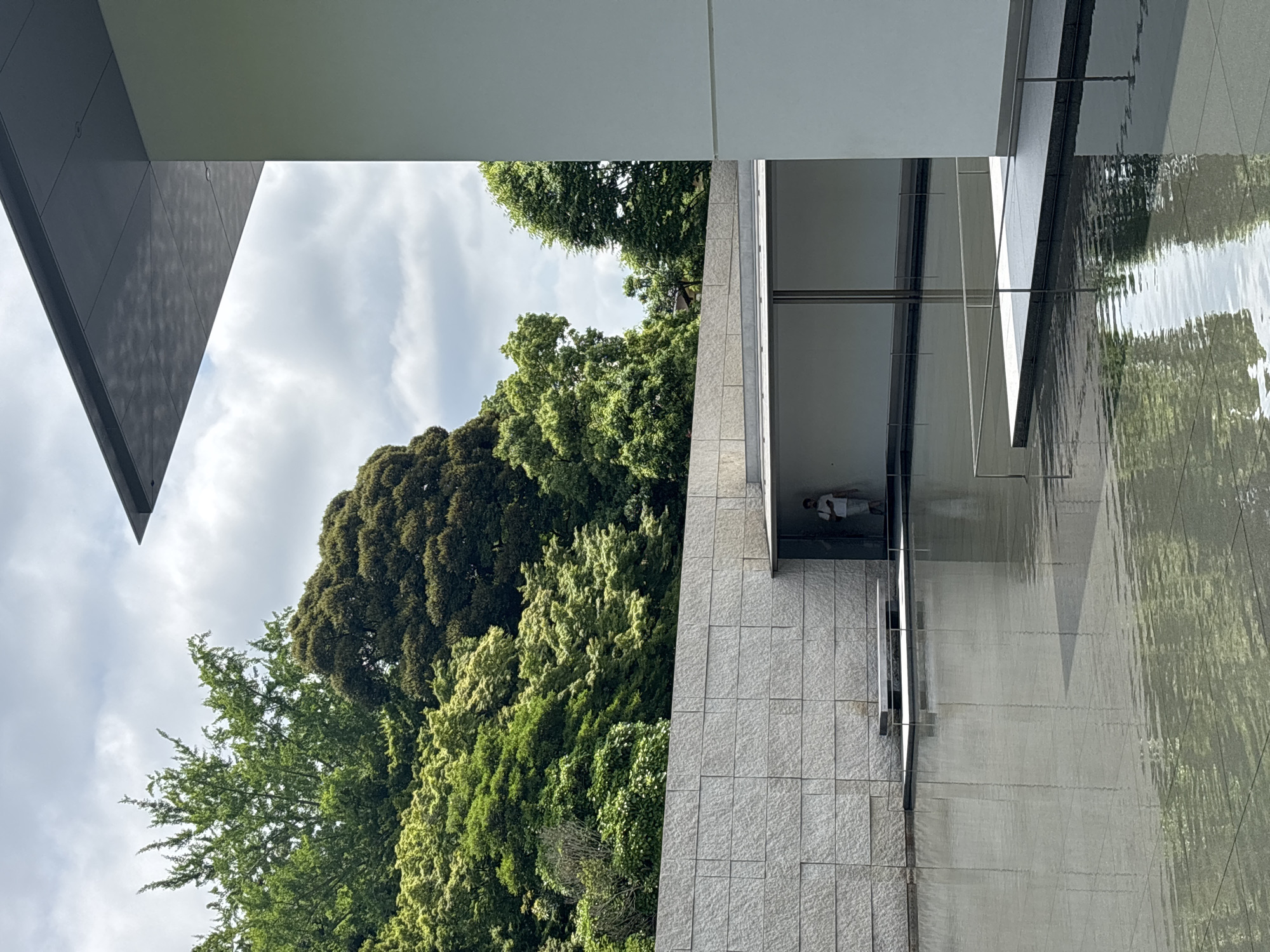
This image captures a view of the 21st Century Museum of Contemporary Art in Kanazawa, Japan. The scene features a modern architectural design, a reflecting pool, and dense natural foliage under a cloudy sky. A large, shallow reflecting pool occupies the lower half of the frame, its surface displaying ripples and reflections of the surrounding elements. To the far right, a tall, plain, light-colored building wall extends vertically, topped by a dark, flat, cantilevered roof overhang whose underside reveals a subtle grid pattern. In the mid-left, a horizontal wall constructed from light grey, textured stone blocks provides a visual boundary. Set within this stone wall is a sheltered alcove or walkway, where a single individual dressed in light clothing stands, facing right. A minimalist bench or seating platform is positioned at the edge of the reflecting pool in front of the stone wall. Behind the architectural elements and dominating the upper left and central background, a dense expanse of lush green trees, displaying various shades from light to dark green, creates a vibrant natural backdrop. The sky above is overcast with soft, grey clouds.
Kanazawa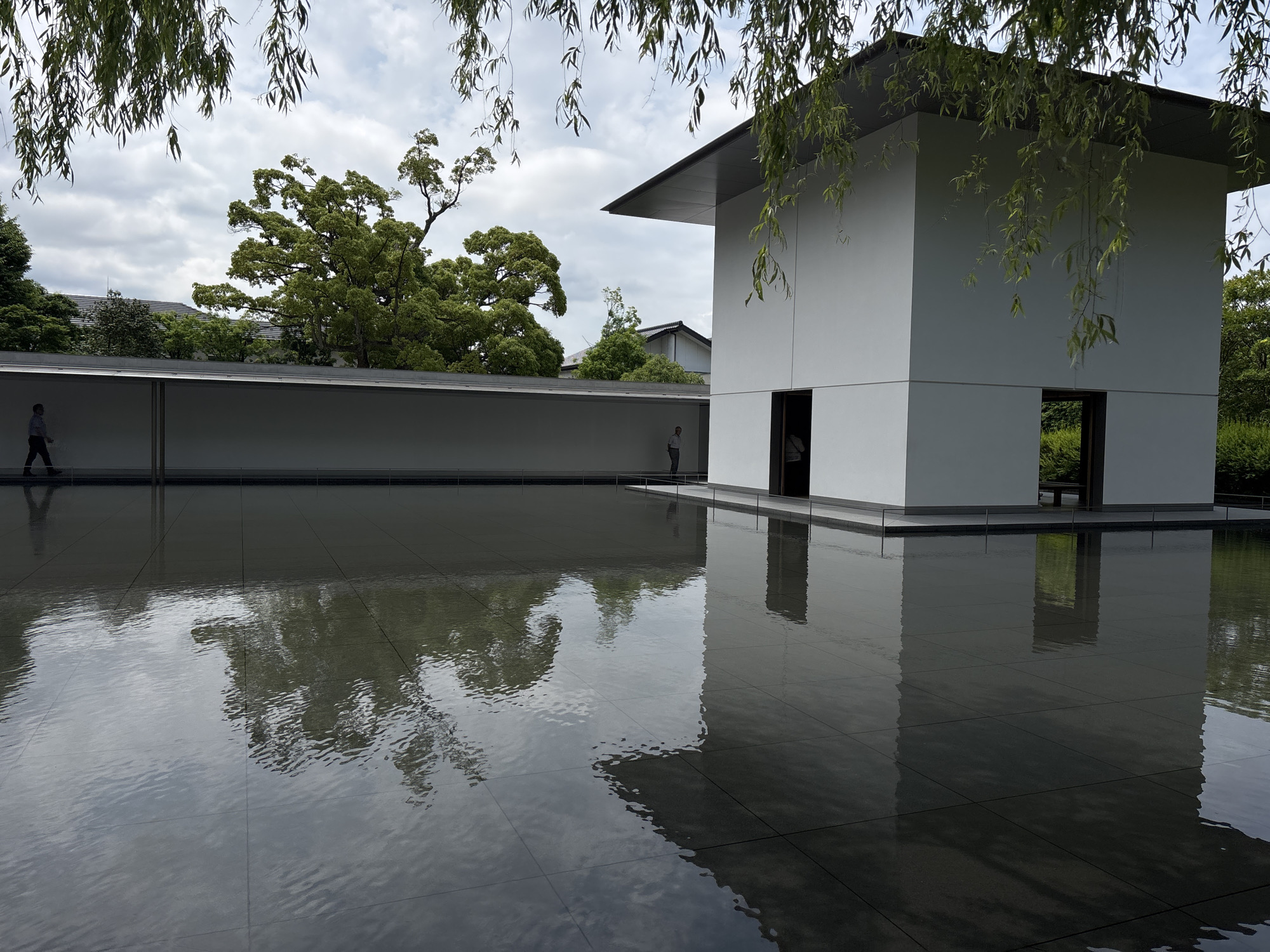
This image captures the D.T. Suzuki Museum in Kanazawa, Japan, a minimalist architectural complex featuring a prominent reflecting pool under an overcast sky. A stark white, two-story, cuboid building with a dark, flat, overhanging roof occupies the right side of the frame. This building has large, dark, rectangular openings on its visible facades, one of which shows a partially obscured individual's silhouette inside. Another person is standing near the building's exterior entrance on the far side of the pool, wearing a light-colored shirt and dark trousers. A large, dark reflecting pool fills the foreground and mid-ground, its surface characterized by slight ripples that distort reflections but clearly show the white building, the cloudy sky, and surrounding foliage. The pool's base is tiled with dark square pavers. Extending horizontally across the mid-ground on the left is a long, low, white wall with a dark coping. A person is seen walking from left to right along a path adjacent to this wall, dressed in dark trousers and a light-colored shirt. The upper edge of the frame is adorned with dark green, elongated leaves from weeping willow branches that hang down into the scene. Beyond the architectural structures and the pool, a dense backdrop of lush green trees is visible, with a particularly large, full tree dominating the left background. The sky is predominantly grey and cloudy, indicating an overcast day.
Kanazawa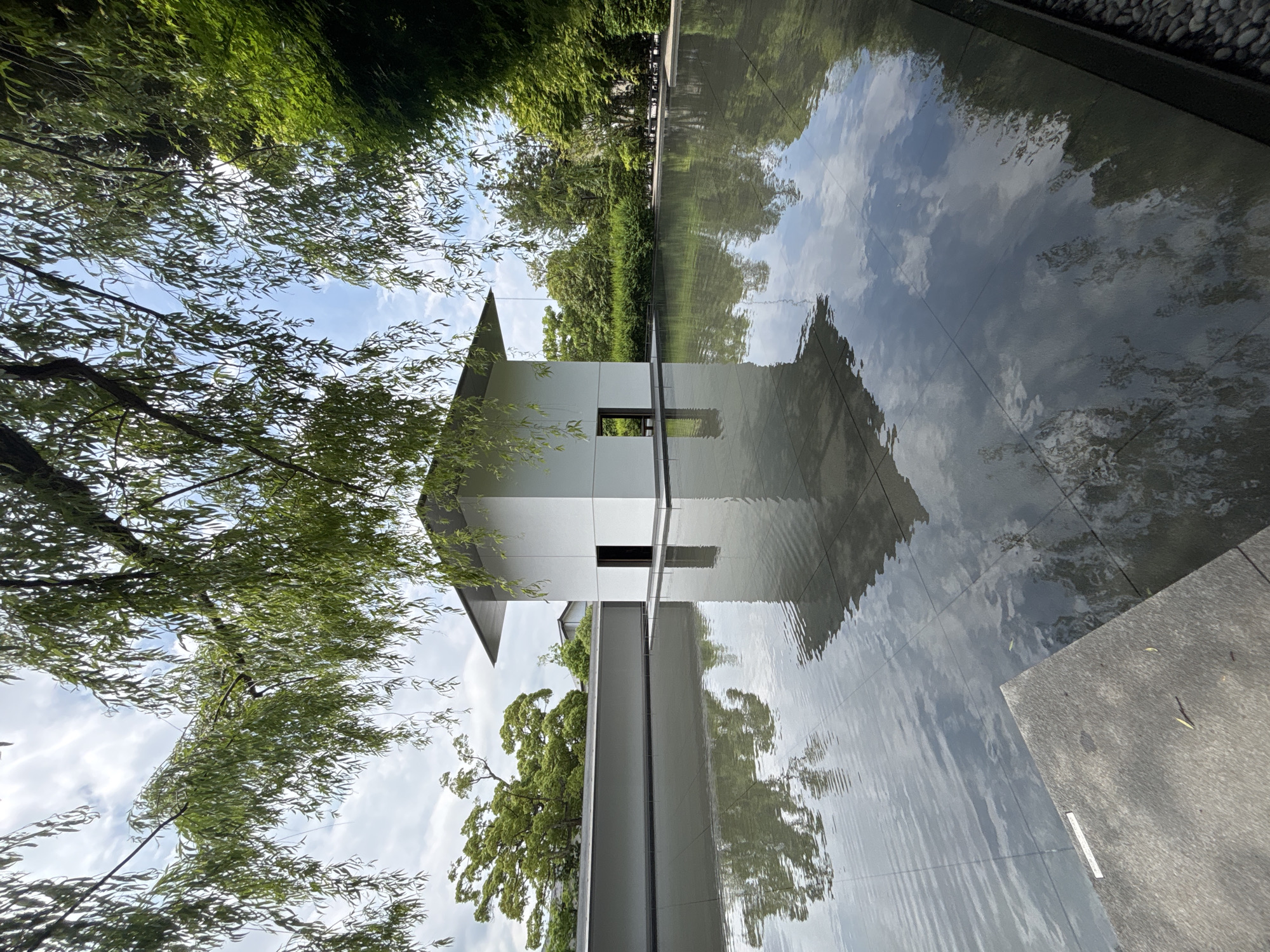
This forensic image captures an outdoor architectural scene at the 21st Century Museum of Contemporary Art in Kanazawa, Japan. A minimalistic, white cuboid building, topped with a dark, flat overhanging roof, is centrally positioned within a large, shallow, dark-tiled water feature. The building exhibits at least two recessed, dark, rectangular openings on its visible facade, suggesting doorways. The water feature reflects the building, sections of the partly cloudy blue sky, and the surrounding vegetation. Numerous long, slender, light green leaves of weeping willow-like trees drape down into the upper portion of the frame, partially obscuring the sky and the building's upper structure, and their reflections are visible on the water. Beyond the water feature, a low, light grey wall extends horizontally behind the central building, with larger green trees visible further in the background to the left. Dense green foliage and additional trees are present along the right side of the frame. The foreground on the bottom left corner includes a dark grey, textured rectangular slab of pavement or stone that borders the water. The water's surface displays slight ripples, particularly noticeable in the reflections of the sky and trees. Small, dark pebbles line the edge of the water feature on the far right. The sky above is characterized by white cumulus clouds against a pale blue background. No individuals are present in the depicted scene.
Kanazawa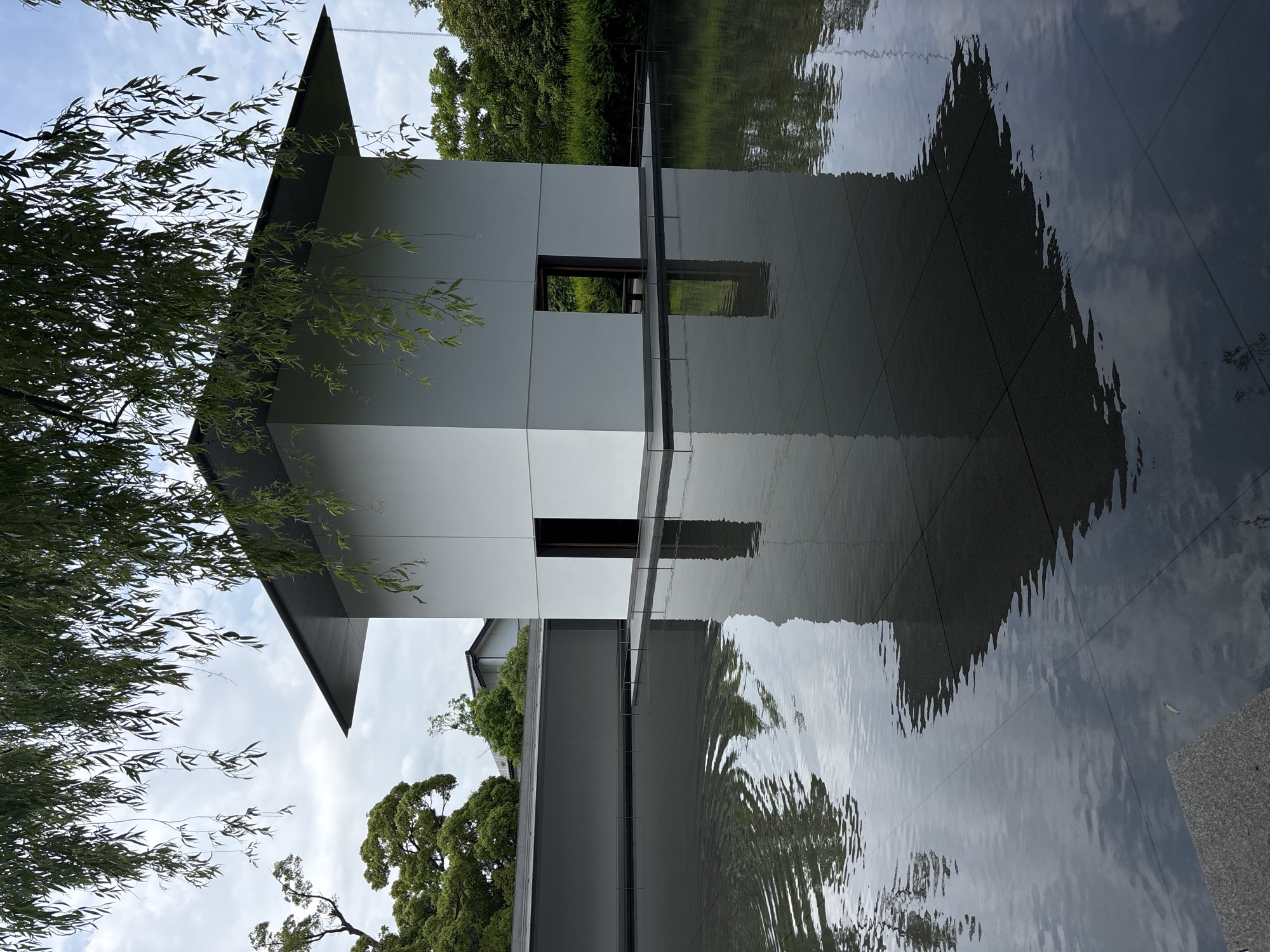
A minimalist, modern, white, cube-like building with a wide, dark grey overhanging roof stands centrally within a dark, still reflective pool of water under an overcast sky. The building features two dark, rectangular open doorways on the side facing the viewer, which are clearly reflected in the water below. The water's surface exhibits subtle ripples, particularly on the left side, slightly distorting the reflections of the sky and surrounding foliage. The building itself is situated on a dark, tiled platform that extends into the water. In the upper portion of the frame, weeping willow branches with slender green leaves hang down, partially obscuring the building's roof and the sky. To the left of the building, a long, low, grey wall runs horizontally, behind which lush green trees with dense canopies are visible. Further in the background, a traditional Japanese-style dark tiled roof is discernable amongst the trees. To the right of the building, dense green bushes and trees form a continuous backdrop. The reflections in the water accurately mirror the building's white walls, dark doorways, and the overhead sky and willow branches. No people are visible in the scene. This architectural scene is characteristic of the D.T. Suzuki Museum in Kanazawa, Japan.
Kanazawa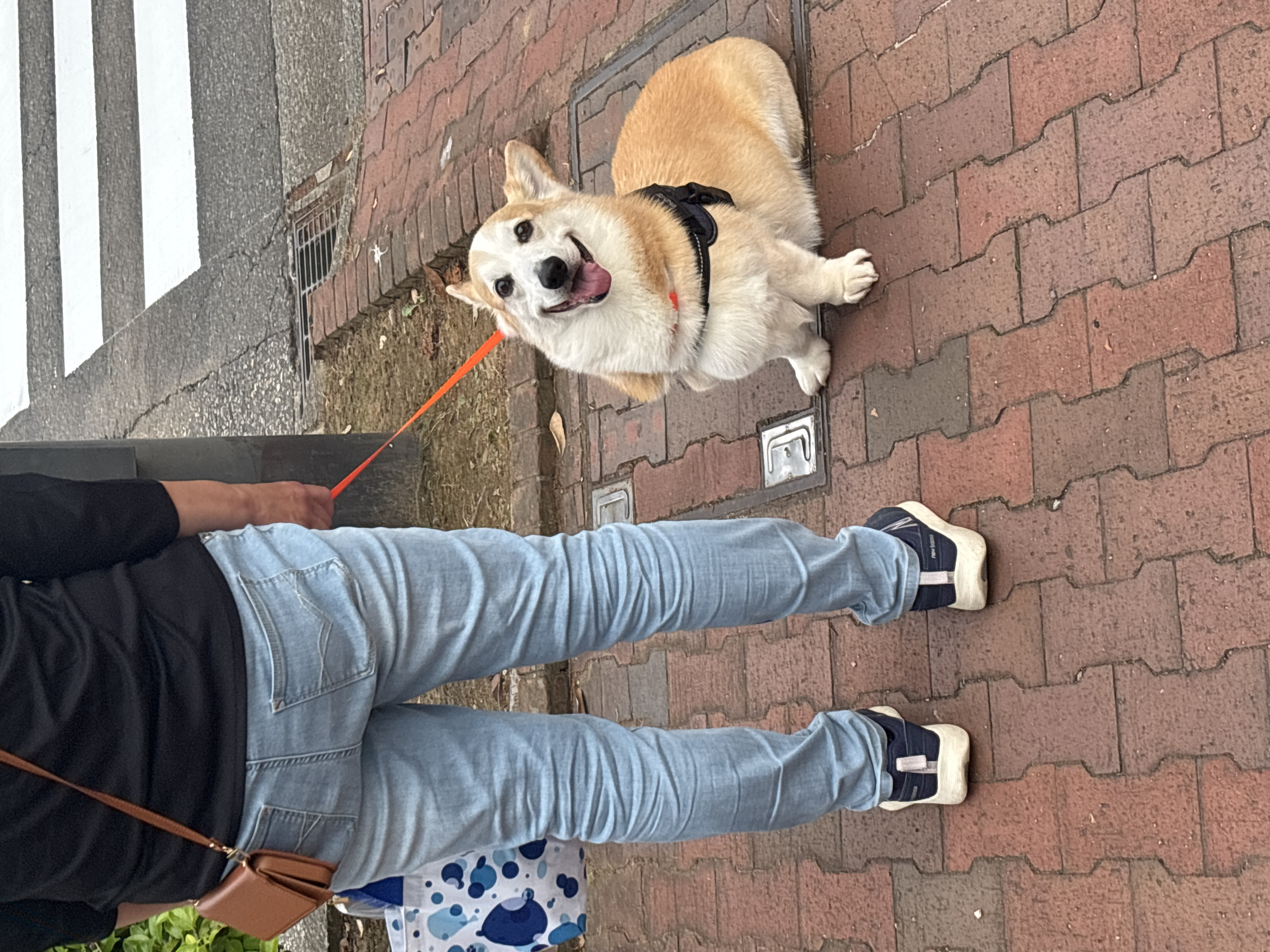
An overhead, high-angle view captures a person walking a Corgi dog on a paved street or sidewalk in Kanazawa, Japan. The Corgi, a light brown and white dog, is positioned centrally and looks up at the camera with a wide, happy, open-mouthed expression, its tongue slightly visible. It wears a black harness and is attached to a bright orange leash, held by the person. The person is visible from the waist down, wearing light blue jeans, a black long-sleeved top, and dark sneakers with light soles. The word "New Balance" is clearly visible on the side of one of the person's sneakers. A small, light brown shoulder bag hangs from their right side, and they appear to be carrying another blue and white patterned bag in their left hand. The ground is primarily composed of reddish-brown interlocking brick pavement, showing signs of use and some dirt. Towards the upper left, a section of gray asphalt or concrete features prominent white stripes, indicating a pedestrian crosswalk. Metal grates or utility covers are embedded in the brick pavement. Sparse green vegetation is visible along the edges of the paved area. The scene is brightly lit, suggesting daytime conditions, possibly overcast given the lack of strong shadows.
Kanazawa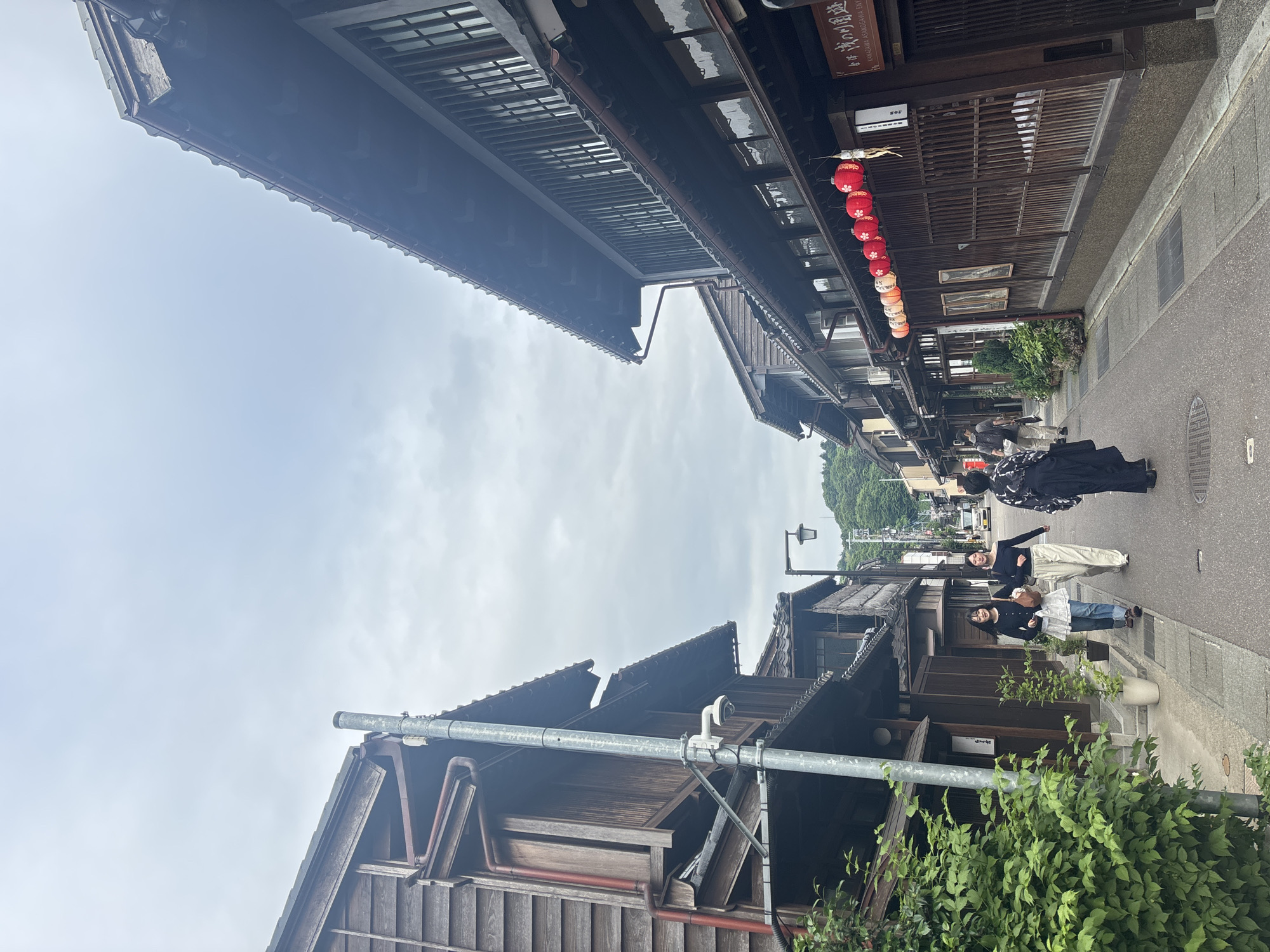
An overhead view captures a traditional street scene in Kanazawa, Japan, under an overcast sky. The image is oriented vertically, showing the sky at the top and bottom with buildings on either side, as if looking up a narrow street from a low angle. When viewed correctly, the perspective is down a historic street flanked by dark-stained wooden buildings with traditional tiled roofs and intricate latticework. On the right side of the street, a row of red and white lanterns with floral patterns hangs from the eaves of a building, beneath a sign with Japanese characters and partially visible English text that might read "SAMURAI-GASHIRUYA-EN". Below the lanterns, two framed pictures are displayed on the wooden facade. The left side of the street features similar traditional wooden architecture, with prominent drainage pipes and gutters. A utility pole with a mounted camera is visible in the foreground on this side. Several people are walking along the paved street, moving away from the viewer. One individual in a dark, possibly traditional, garment walks in the center. Behind them, two women in casual attire – one in a black top and white pants, the other in a black top, blue jeans, and a white ruffled undershirt, carrying a light brown bag – are visible. Green foliage, including bushes and potted plants, lines the sidewalk. In the distance, more buildings and a tree-covered hillside are visible under the muted light of the cloudy day. The overall atmosphere suggests a quiet, historic district.
Kanazawa