Kara-Talaa, Kyrgyzstan
20 memories from Kara-Talaa, Kyrgyzstan
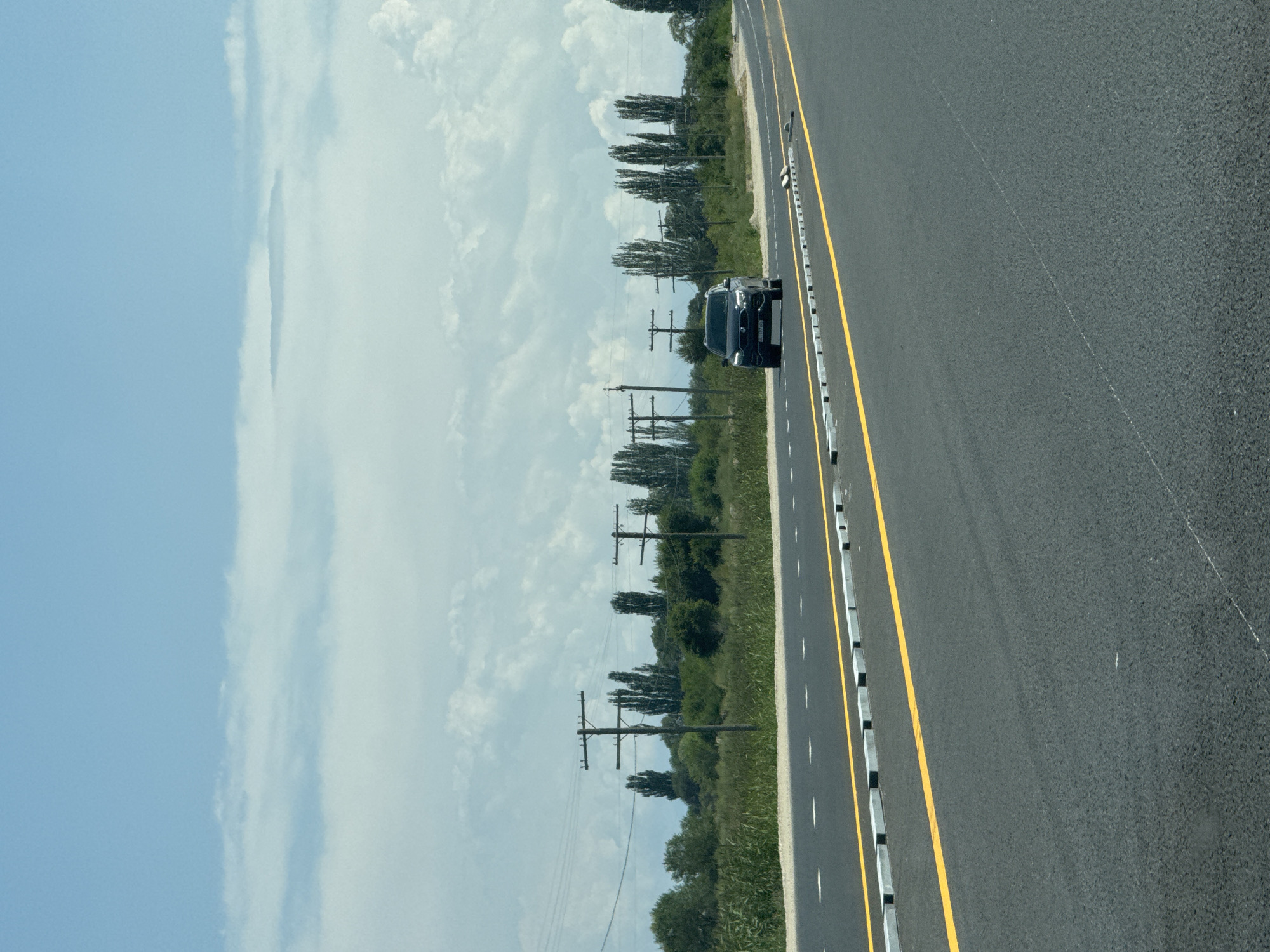
A dark SUV is driving on a highway with a yellow line and reflective markers on the shoulder. In the background, there are power lines supported by wooden poles, tall thin trees, and lush green vegetation. The sky is partly cloudy with patches of blue. The image appears to be taken from another vehicle on the highway. The scene is consistent with a rural or semi-rural highway in the vicinity of Kara-Talaa, Kyrgyzstan, given the style of power lines and the landscape.
Kara-Talaa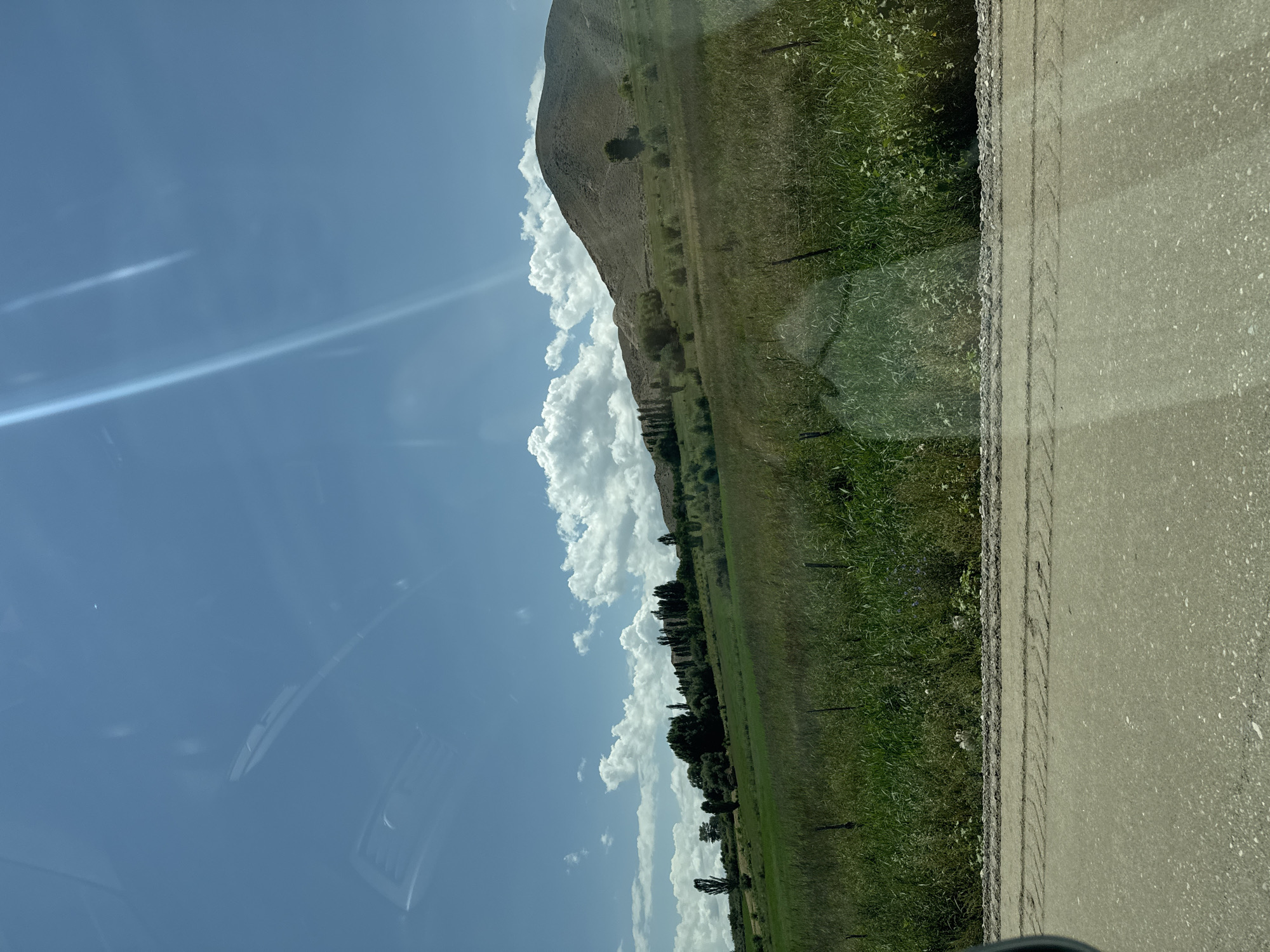
The image depicts a scenic view of a rural landscape, likely taken from a vehicle. The foreground is dominated by a light-colored asphalt road with visible tire tracks. Beyond the road, a fence separates it from a field of tall green grass and vegetation. In the middle ground, a rolling green hillside is covered with various trees, some appearing to be coniferous and others deciduous. Further in the distance, a large, barren, and gently sloping hill forms the backdrop. The sky is a clear blue with scattered white cumulus clouds, and sunlight beams diagonally across the upper portion of the image, creating a lens flare effect. The overall impression is one of a peaceful, natural environment. The image is tagged with Kara-Talaa, Kyrgyzstan, suggesting this is the geographical location. There are no people or animals visible in the image, and no discernible action or interaction.
Kara-Talaa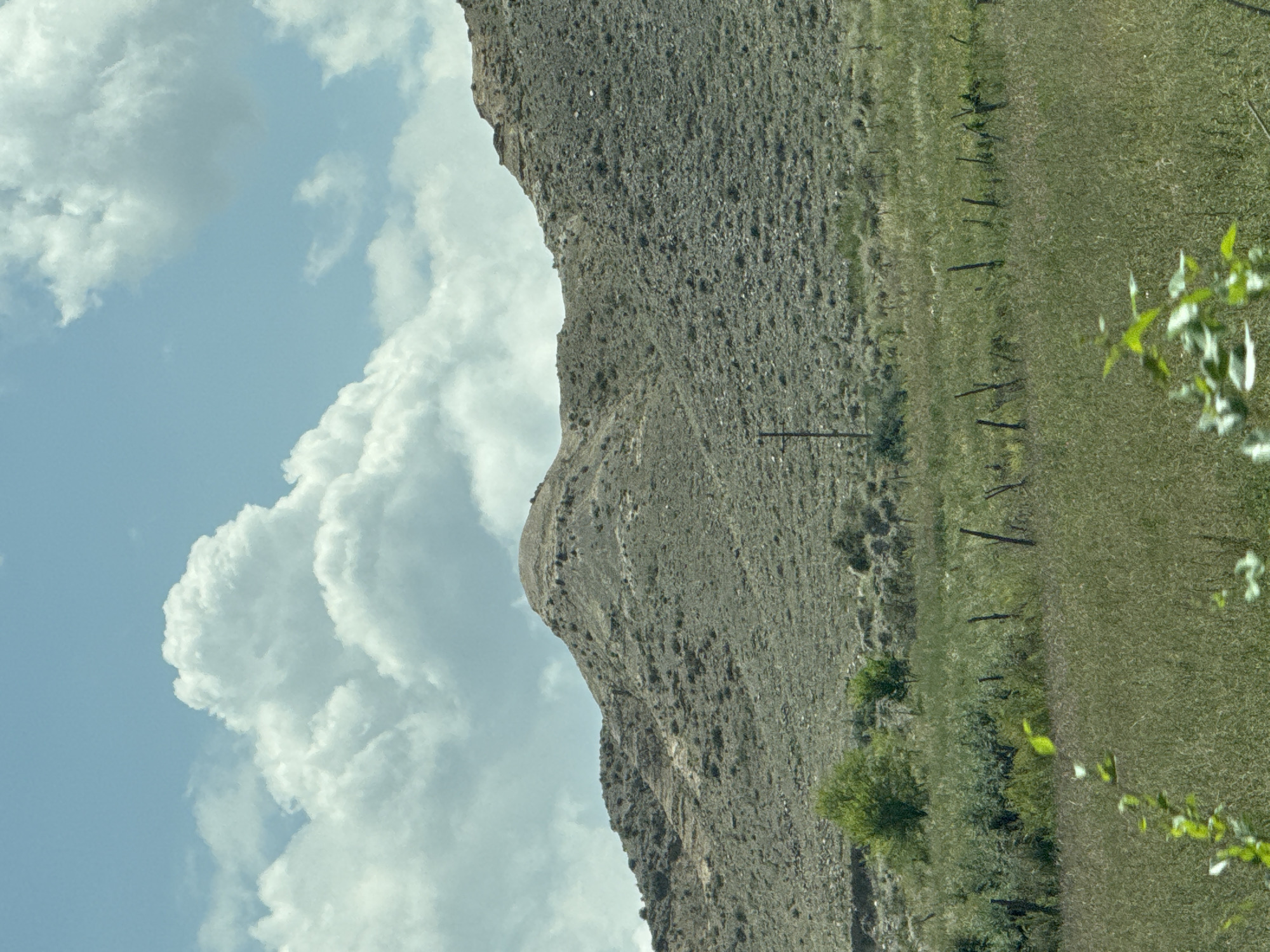
An outdoor, mid-range, eye-level shot shows a mountainous landscape with a cloudy sky overhead. The mountain range in the background is covered in dry brush and rocks, with a peak in the center of the frame. The foreground is a field of tall, dry grass with scattered fence posts. In the mid-ground, there are some green bushes and trees. The sky is bright blue with large, fluffy white clouds. There are no people or animals visible in the image, and no specific actions are taking place. The scene appears to be a natural landscape in a rural or undeveloped area. The image does not contain any specific landmarks or features that would indicate the location in the city of Kara-Talaa, Kyrgyzstan.
Kara-Talaa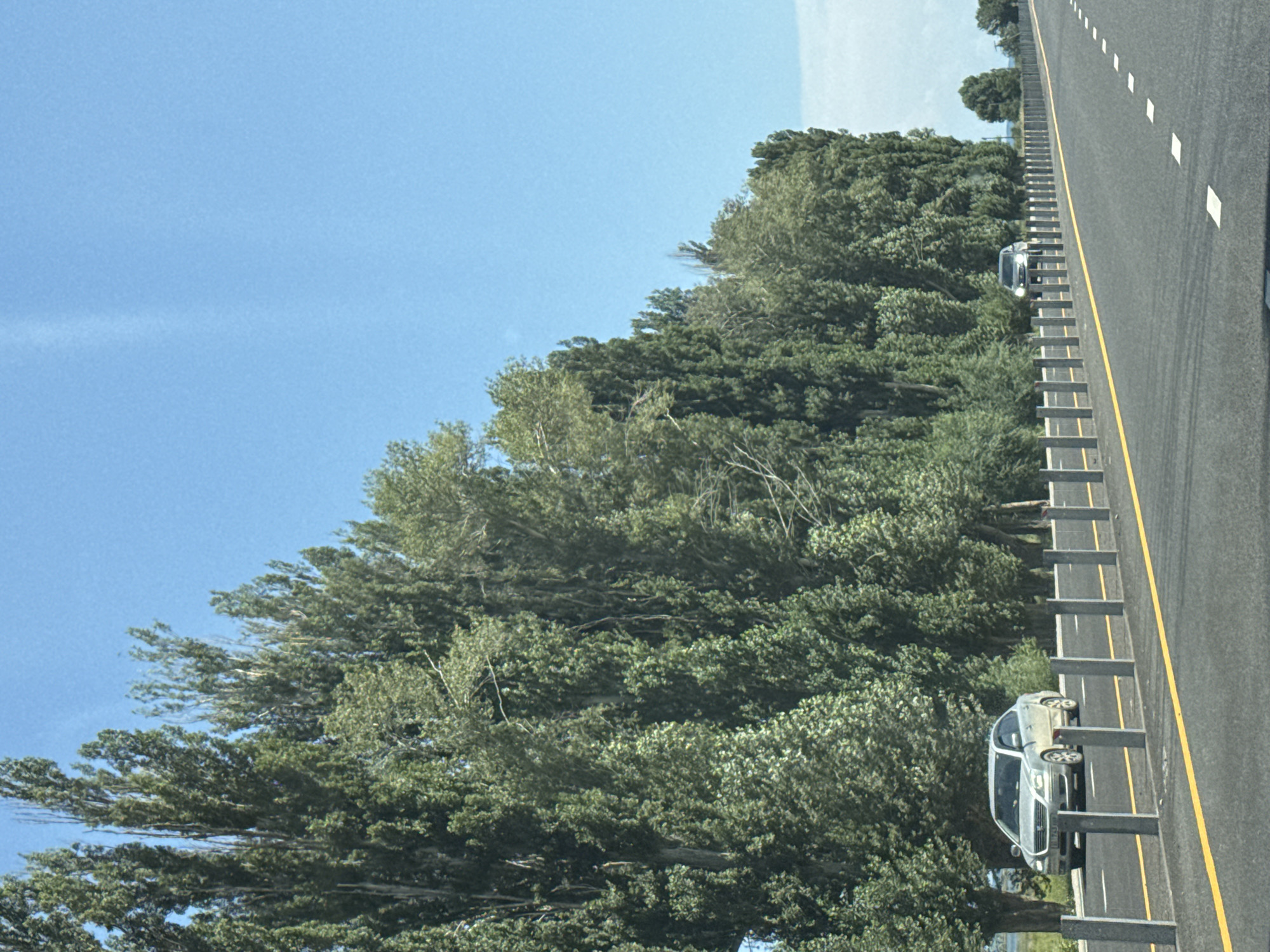
The image shows a highway lined with tall trees. A silver sedan is driving on the highway, and a dark-colored vehicle is visible in the distance. The sky is clear and blue. The scene appears to be in a rural area outside of a city, likely in the vicinity of Kara-Talaa, Kyrgyzstan, based on the context provided, though the image itself does not contain explicit identifying markers of that specific location.
Kara-Talaa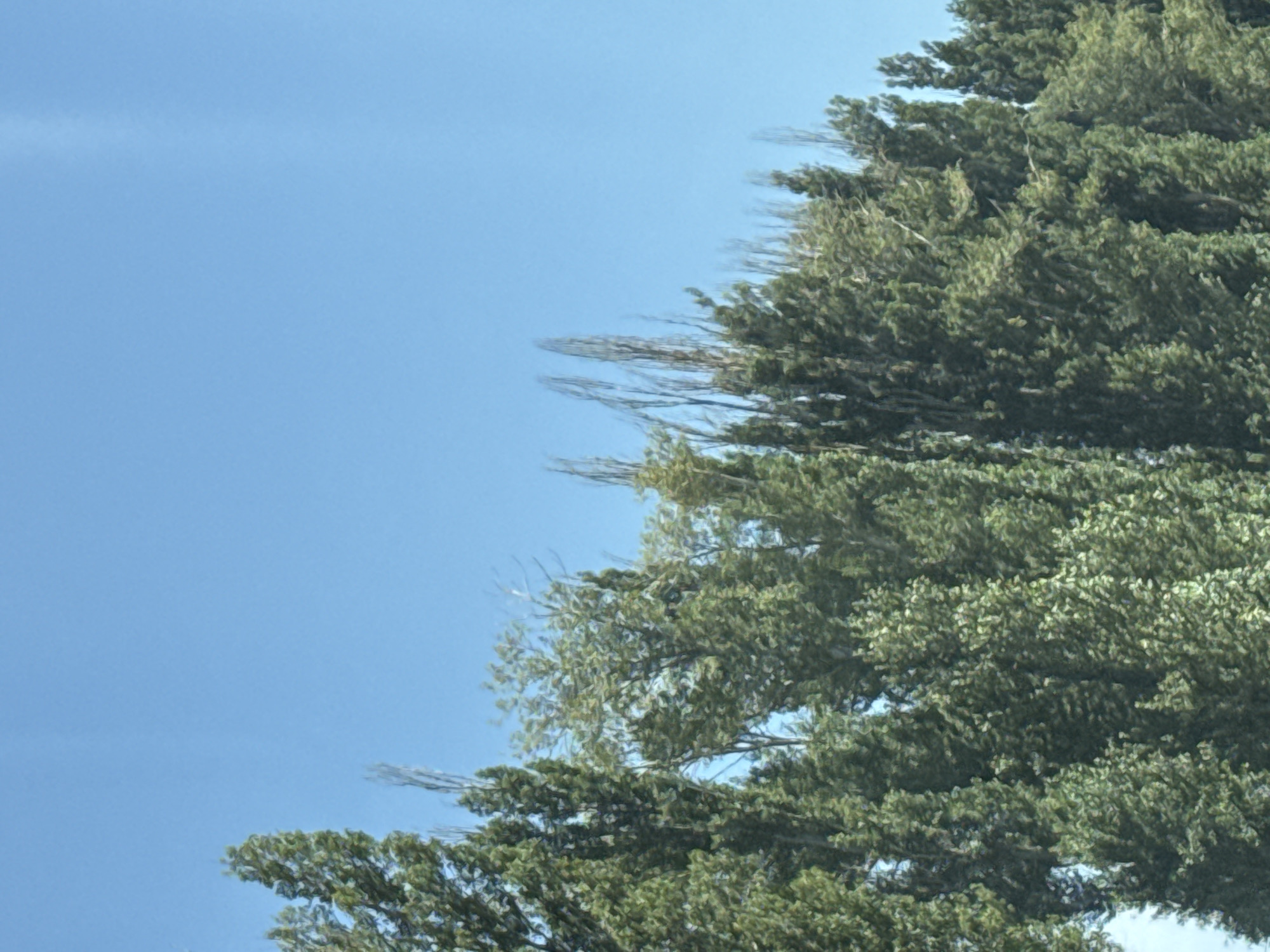
The image shows a row of tall trees against a bright blue sky. The trees are lush and green, with dense foliage. Some of the trees appear to be taller and more slender than others, with thinner branches reaching upwards. The sky is clear and cloudless, suggesting a sunny day. The image does not depict any people, structures, or identifiable landmarks that would specifically place it in Kara-Talaa, Kyrgyzstan. The scene is natural, focusing solely on the trees and the sky.
Kara-Talaa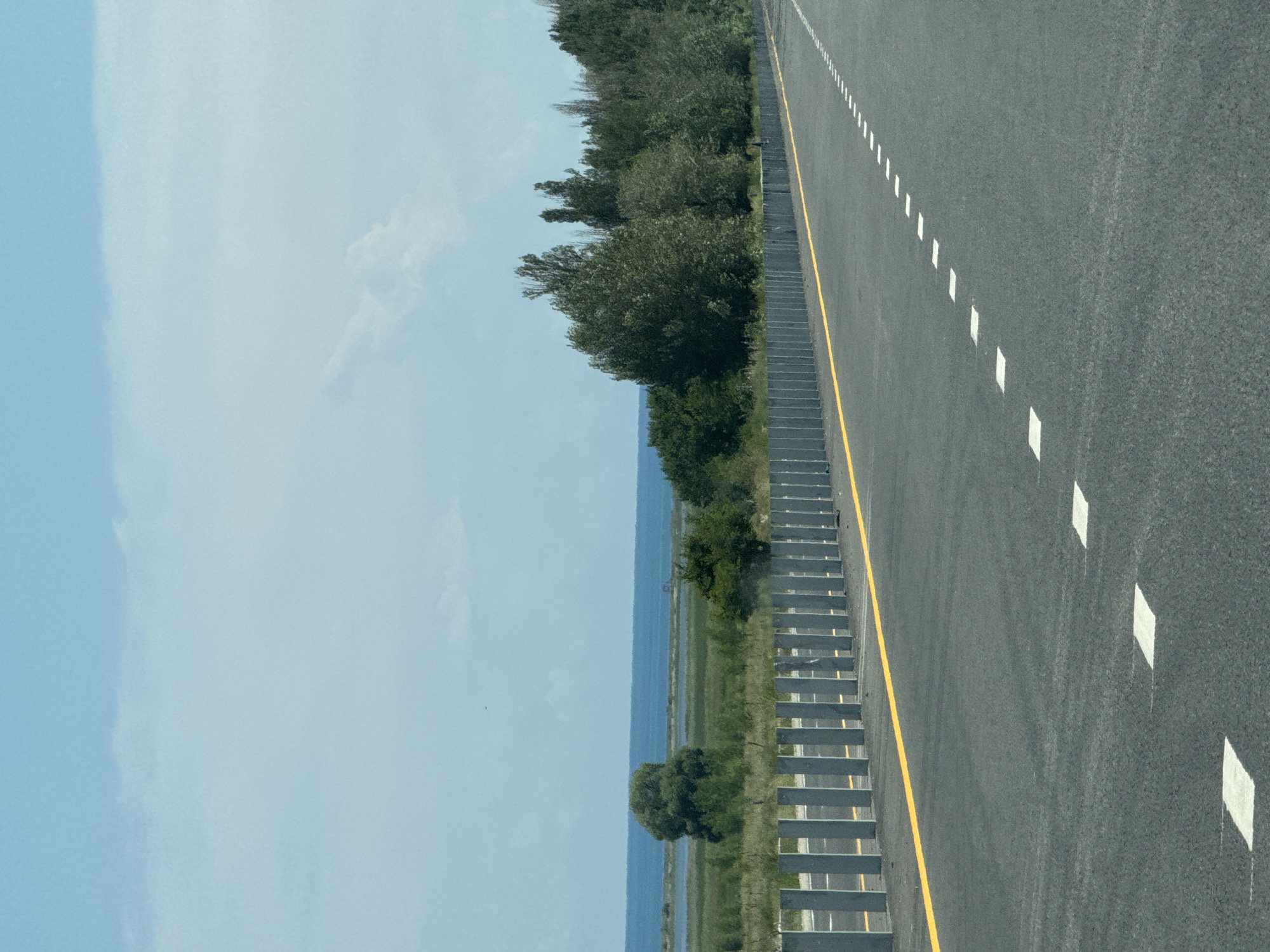
The image depicts a road with a concrete barrier and yellow line on the left side, and a body of water and trees in the background under a cloudy sky. The road has white dashed lines painted on it, indicating lane markings. The scene appears to be located in or near the city of Kara-Talaa, Kyrgyzstan, given the context provided. There are no people or animals visible in the image. The environment is a roadside with natural elements in the distance.
Kara-Talaa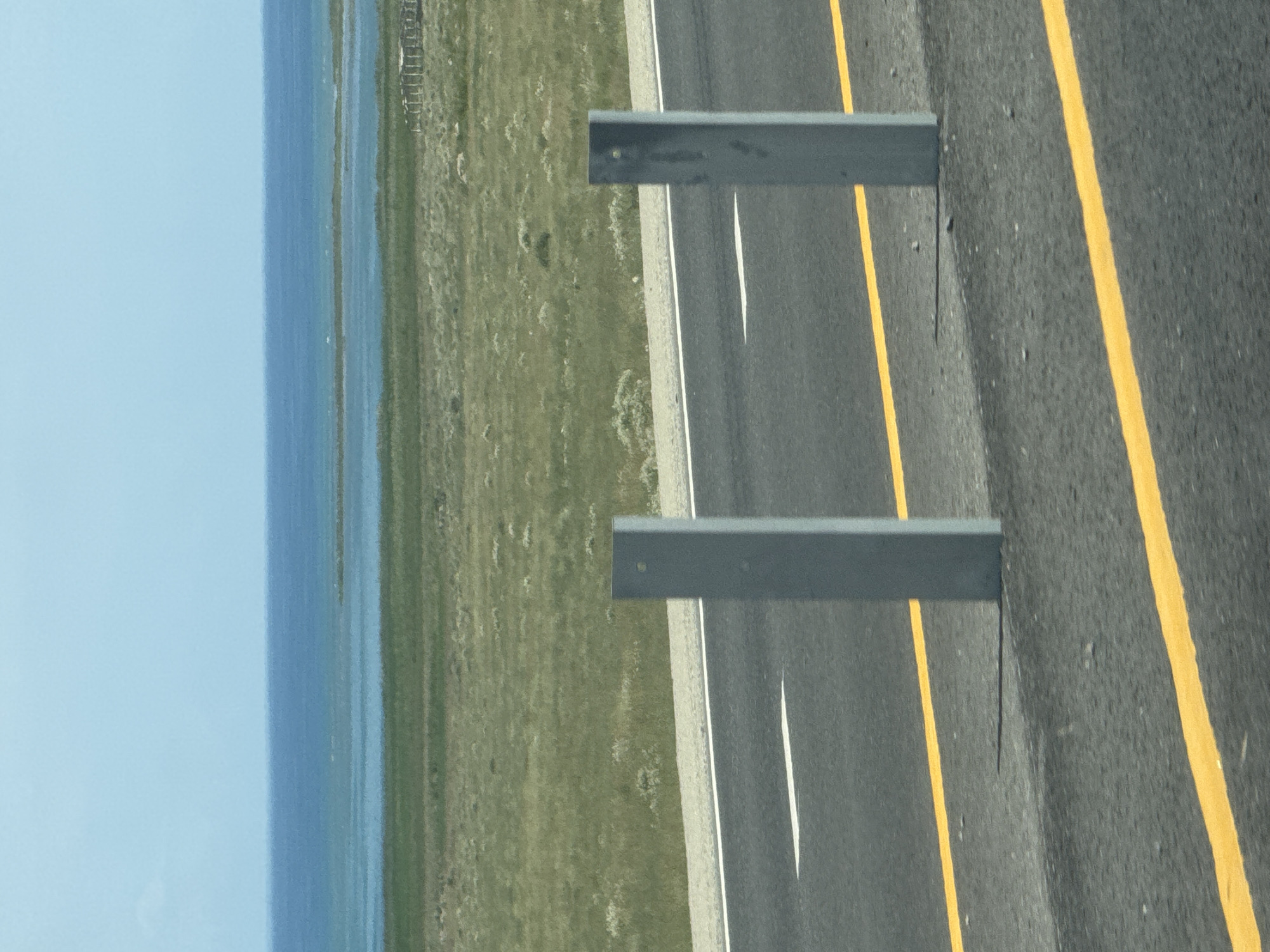
The image displays a roadside scene with a body of water and grassland in the background. In the foreground, a paved road with yellow and white lane markings is visible. Two gray metal posts are positioned on the right side of the road, casting shadows. The landscape beyond the road consists of dry, green grassland, with a body of water and a light blue sky in the distance. The overall impression is that of a natural, open environment, possibly in a rural or undeveloped area. There are no people or specific landmarks visible that would definitively place the scene in Kara-Talaa, Kyrgyzstan.
Kara-Talaa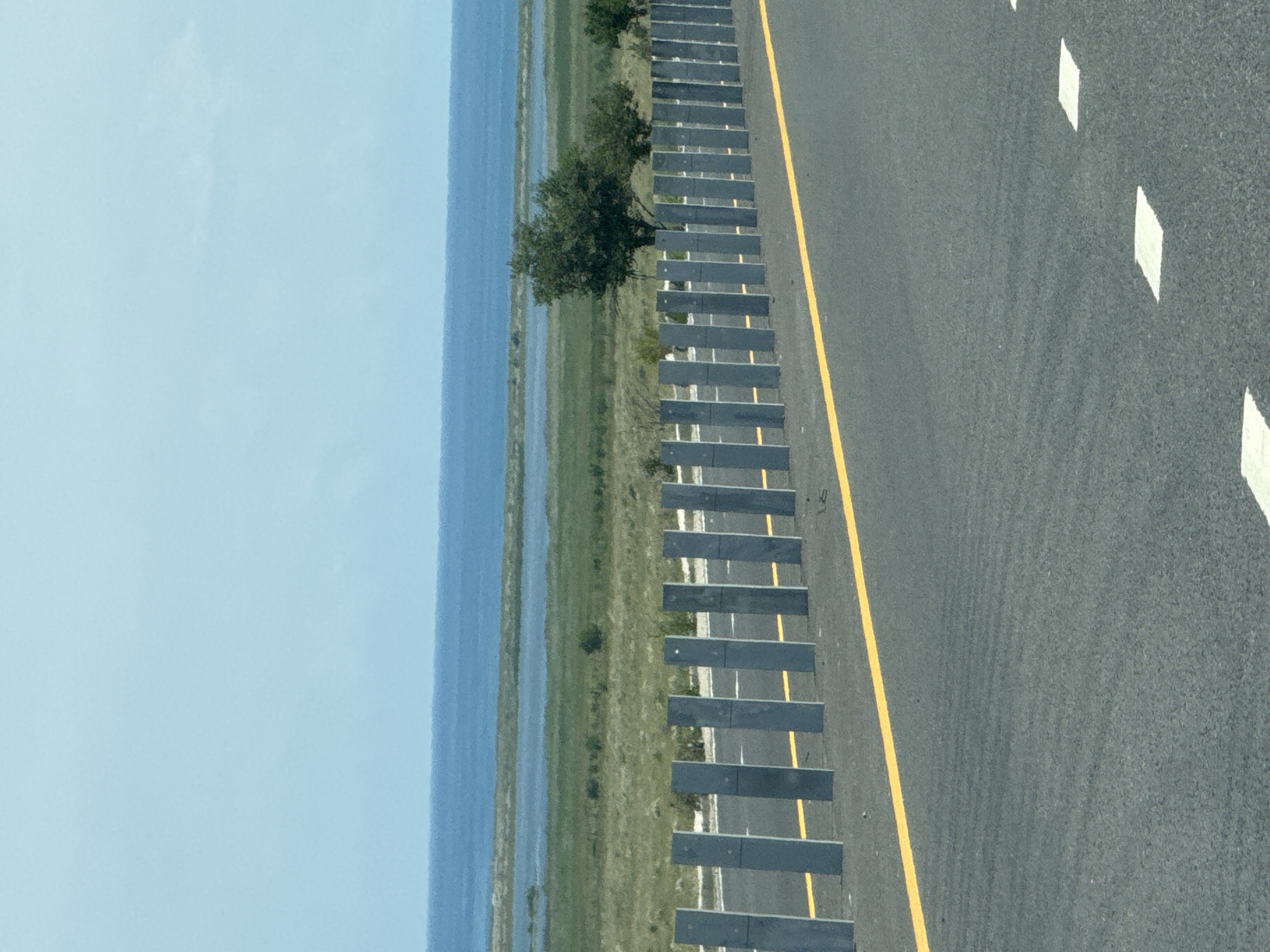
The image depicts a roadside scene with a clear blue sky and a body of water in the background. In the foreground, a grey asphalt road runs diagonally from the bottom left to the top right. A bright yellow line marks the edge of the road. A row of tall, grey, rectangular posts stands along the roadside, separated by short distances, forming a barrier. Beyond the barrier, a grassy landscape stretches towards the water. Several trees are scattered across the landscape. The body of water is calm and appears to be a large lake or sea. The scene suggests an outdoor environment, possibly a highway or coastal road, with sparse vegetation and a vast expanse of water. There are no people or animals visible in the image. The location in the city of Kara-Talaa, Kyrgyzstan is not identifiable from the visual information provided.
Kara-Talaa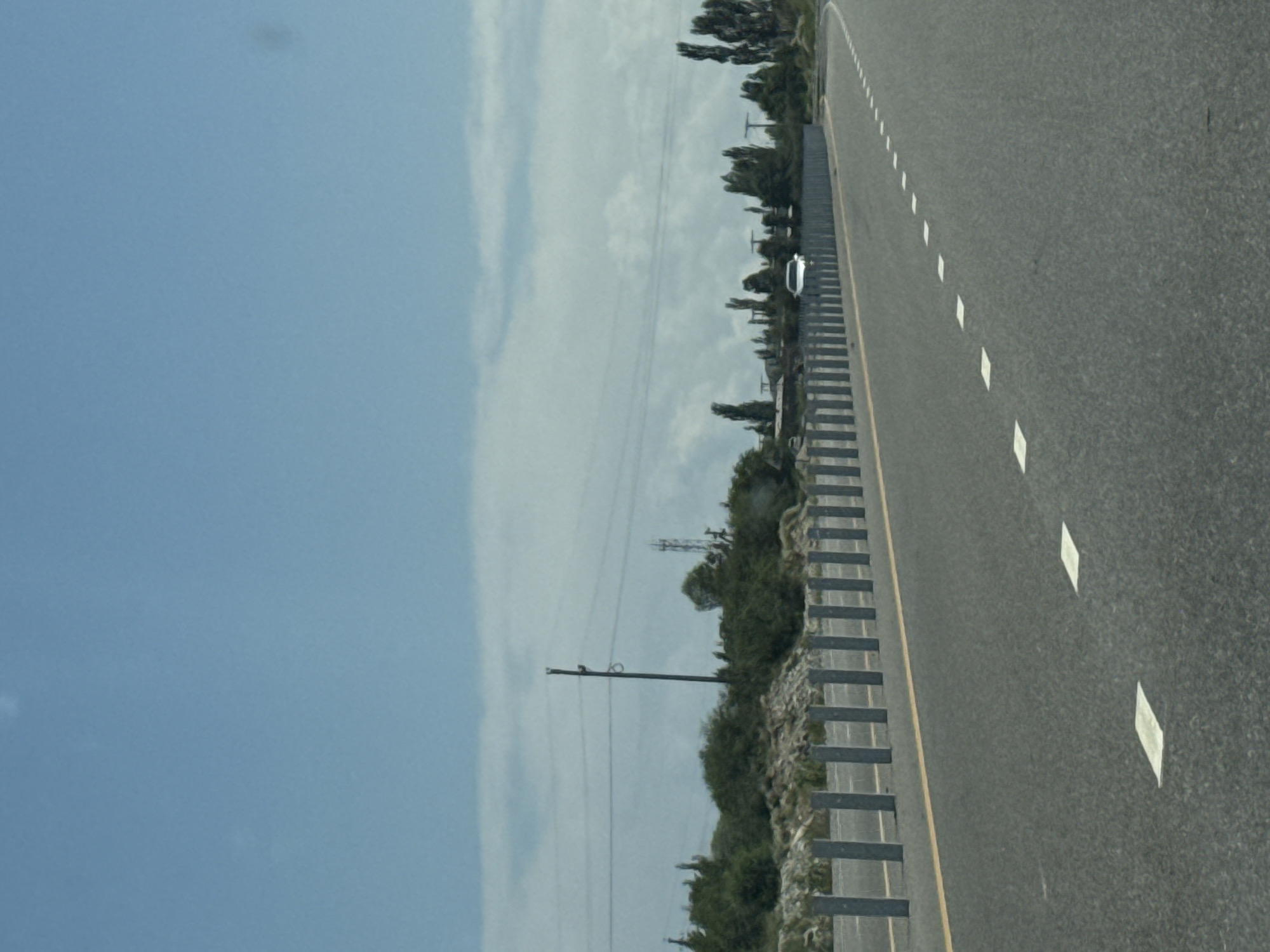
The image depicts a paved highway with intermittent white lane markings, characteristic of a rural or semi-rural setting. The road is bordered on the left by a line of vertical metallic bollards, a safety barrier, and beyond that, a vegetated embankment with scattered trees and shrubbery. A single white vehicle is visible on the road in the distance, beyond the bollard barrier. In the background, a power line pole with visible wires stretches across the frame, alongside more trees and what appears to be a radio tower. The sky is predominantly blue with scattered clouds, indicating daytime. This scene is consistent with the landscape found in and around Kara-Talaa, Kyrgyzstan, known for its open terrain and infrastructure supporting transportation routes. There are no people visible in the image.
Kara-Talaa
An outdoor, slightly blurred, vertical shot shows a wooden utility pole in the center foreground. Multiple dark wires extend from the top of the pole across a pale, overcast sky. Behind the pole, a vast expanse of tall, green grass stretches to the horizon. In the distance, a thin strip of water, possibly a lake or sea, is visible against the sky. A dirt or gravel road is in the immediate foreground, also slightly blurred, indicating motion. There are no people or animals visible in the scene. The setting appears to be a rural or semi-rural area, possibly Kara-Talaa, Kyrgyzstan, given the presence of the utility pole and vast open landscape.
Kara-Talaa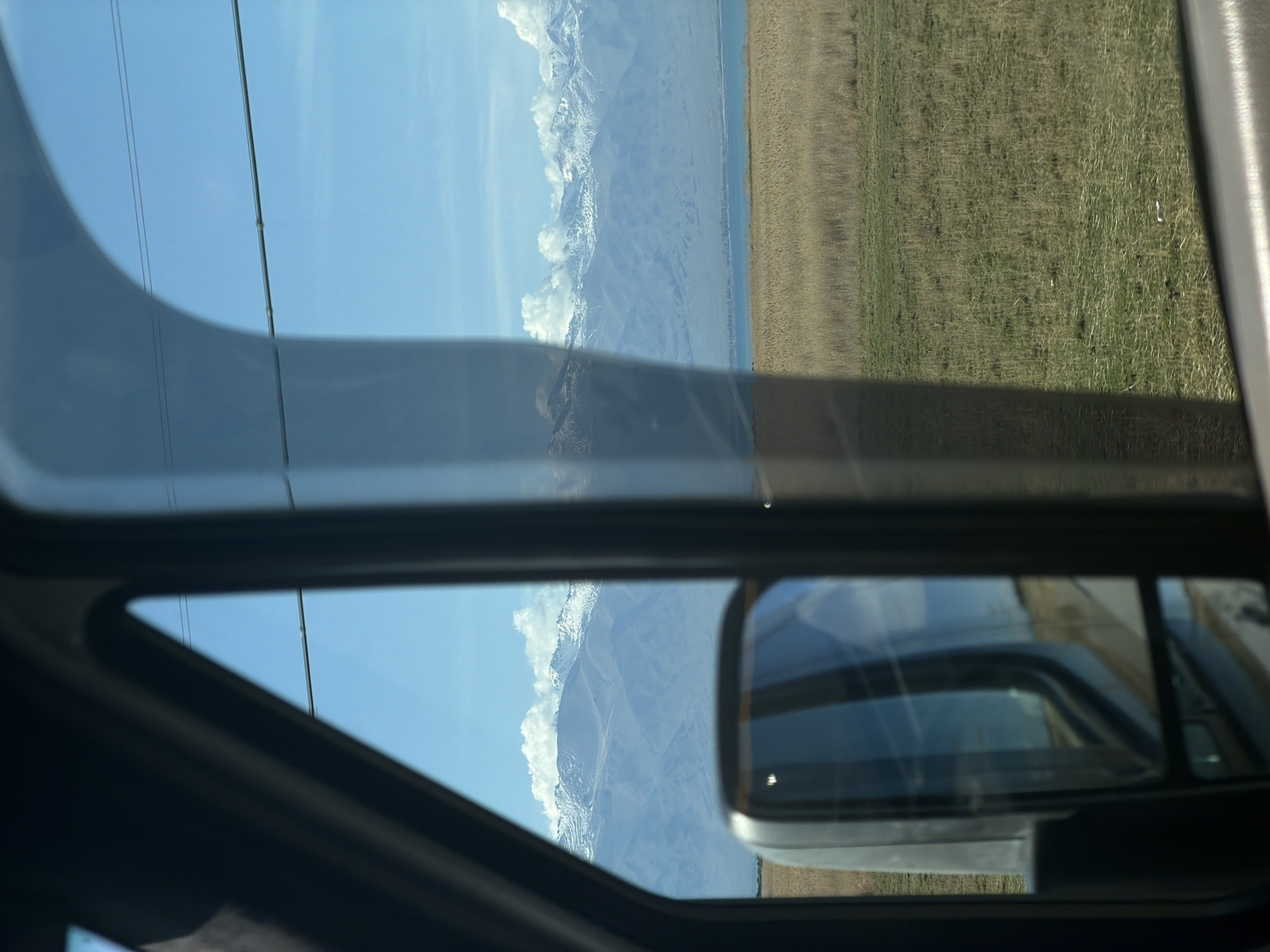
The image, taken from inside a vehicle, shows a landscape viewed through the window. In the foreground, parts of the vehicle's interior, including the side mirror, are visible. The background reveals a panoramic view. To the left, there's a clear blue sky with sparse white clouds. Below the sky, a mountain range with snow-capped peaks stretches along the horizon. Adjacent to the mountains, there's a body of water, possibly a lake or a wide river. To the right of the frame, a field of dry grass or vegetation extends into the distance. There is no information in the image indicating the location is in Kara-Talaa, Kyrgyzstan. No people, specific objects, or actions are discernible from the image. The scene presents a natural landscape from a vehicle's perspective.
Kara-Talaa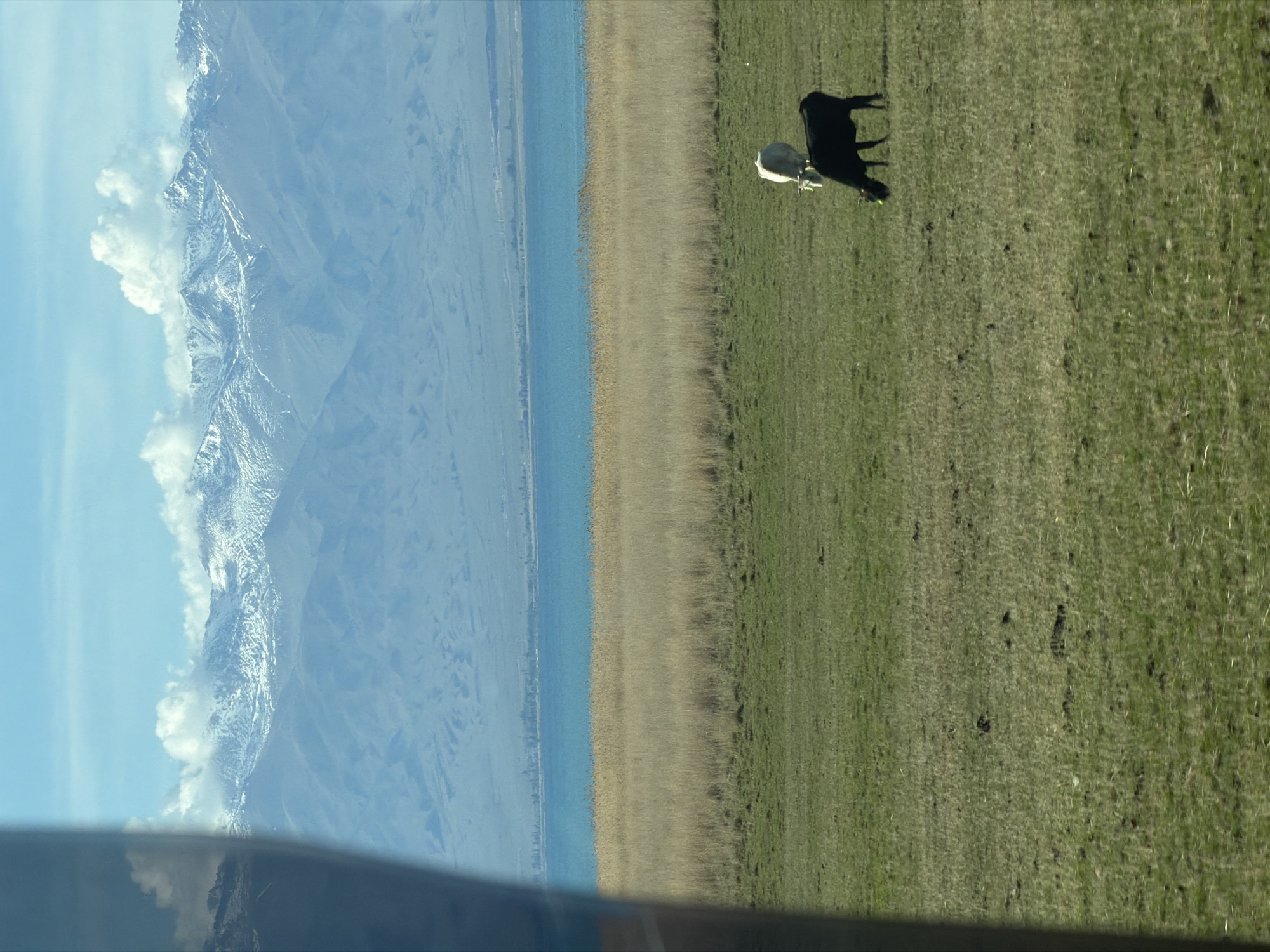
The image shows a landscape scene in Kara-Talaa, Kyrgyzstan, featuring a body of water, possibly a lake, next to a tall grass or reed area, adjacent to a green grassy field. Snow-capped mountains are visible in the background, partly obscured by clouds. Two cows, one black and one white, are grazing in the grassy field. The image appears to have been taken from an elevated position or potentially from the air.
Kara-Talaa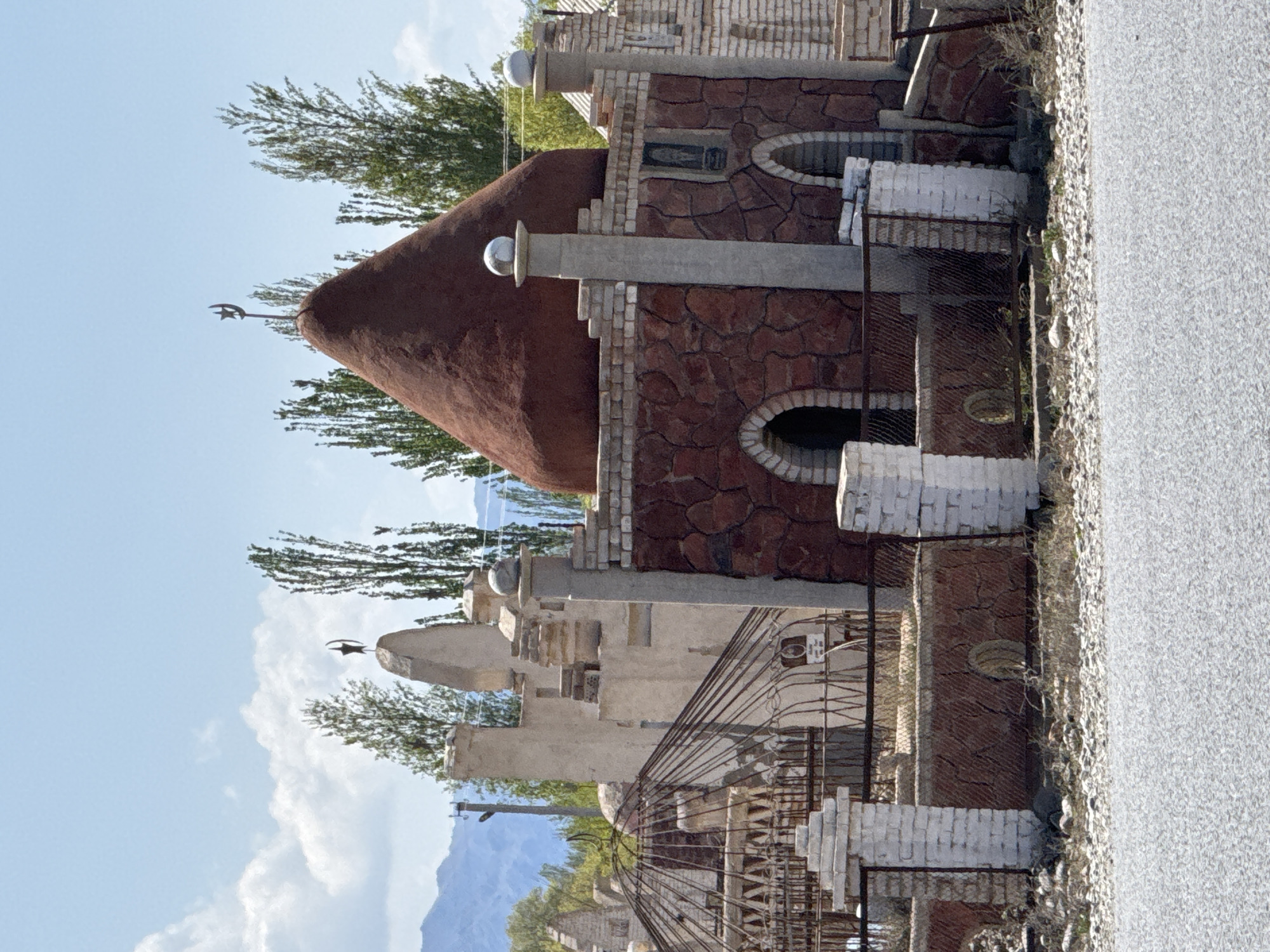
The image displays a collection of unique architectural structures, likely a memorial complex or cemetery, set against a natural landscape under a bright, clear sky. The central and most prominent structure features a reddish-brown, conical roof and walls made of irregular, reddish-brown stone or faux stone cladding. It is accentuated with light-colored brickwork and concrete elements, including pillars topped with reflective spherical finials and arched niches. A small, dark rectangular plaque or framed image is visible on one of its walls, but any text or details within it are illegible. To the left and slightly behind this main building are other lighter-colored structures, constructed from what appears to be light-colored bricks or concrete blocks. Several of these, including the main conical-roofed building and smaller monuments, are topped with distinct finials depicting a crescent moon and a star, a significant symbol in Islamic culture. Metal fencing or grates are visible around and between some of the structures. Lush green trees are scattered throughout the scene, especially in the background and surrounding the buildings. Distant mountains rise under a bright blue sky, which has a few scattered white clouds. The foreground shows a light-colored, textured ground, possibly a road or pathway, with some dry vegetation. The bright sunlight indicates it is daytime, likely late morning or early afternoon, with sunny weather. No people or specific activities are visible, suggesting a tranquil and possibly sacred site. The crescent and star finials strongly suggest the location is an Islamic cemetery, mazar (shrine), or a similar memorial site in Kara-Talaa, Kyrgyzstan.
Kara-Talaa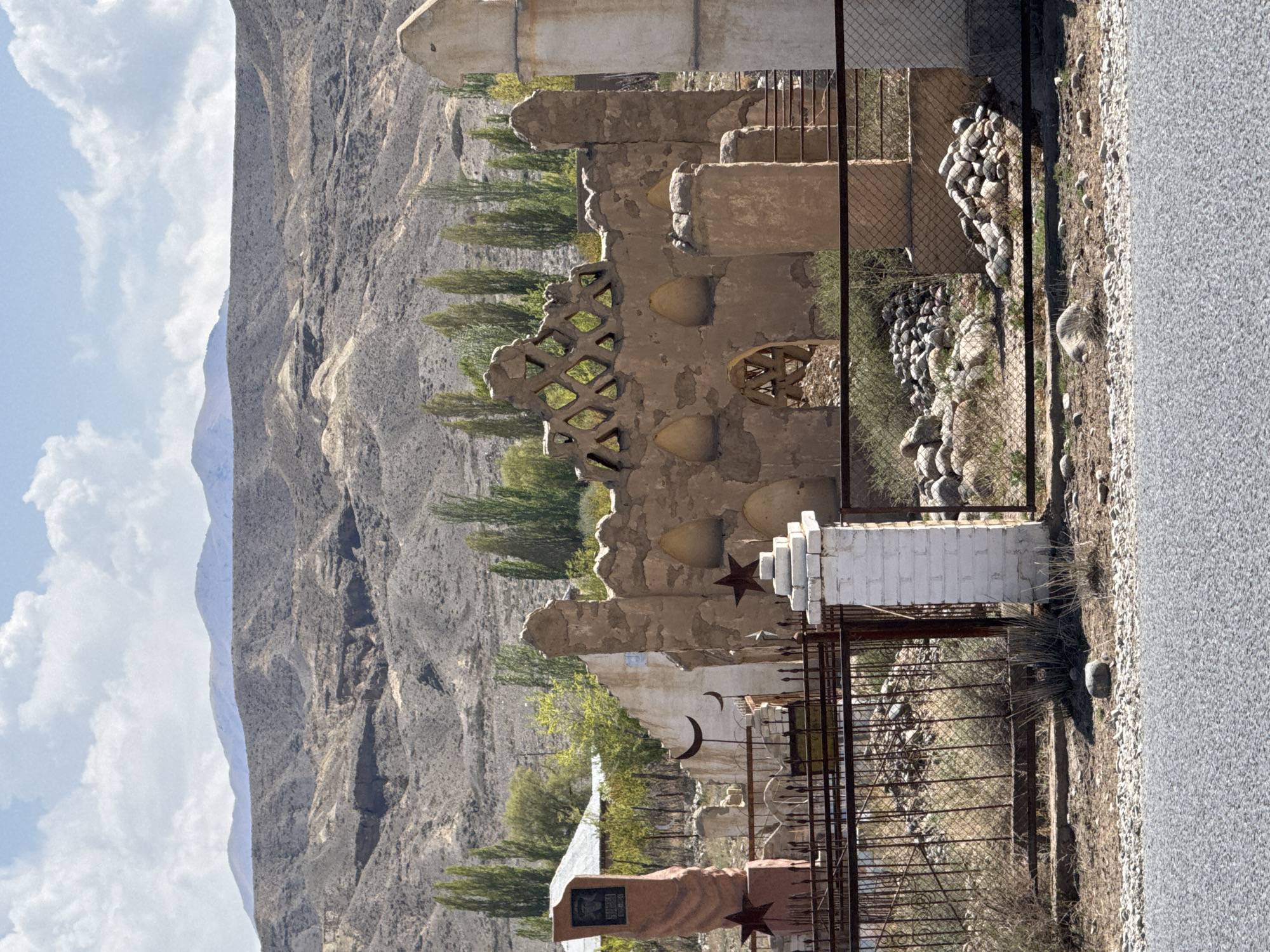
The image depicts a solemn landscape featuring a mountainous backdrop, a paved road, and what appears to be a cemetery or memorial area. The scene is set in Kara-Talaa, Kyrgyzstan, under a partly cloudy daytime sky. In the foreground, a gray paved road runs horizontally with a gravel shoulder. Beyond the road, a chain-link fence separates the road from a series of structures, which include various grave markers and walls. Many grave markers are simple rectangular stones, while others are more ornate. Prominent symbols visible include five-pointed stars, often on white pedestals or attached to grave markers, and crescent moons, some cut into metal or affixed to structures. One notable reddish-brown grave marker in the bottom-left features a dark plaque with indistinct text, likely in a local script. Another structure is made of white bricks. A rough, textured wall with decorative cutouts and embedded round or beehive-like shapes forms part of the memorial area. Behind these structures, scattered tall, slender trees with green foliage are visible, adding a touch of life to the otherwise arid surroundings. Further back, towering, barren mountains with deep crevices and varied rock formations dominate the background, their gray and brown hues contrasting with the blue sky and white clouds. No human activity is depicted in the image, suggesting a quiet and contemplative atmosphere. The symbols on the graves and the rugged terrain are consistent with the Central Asian location.
Kara-Talaa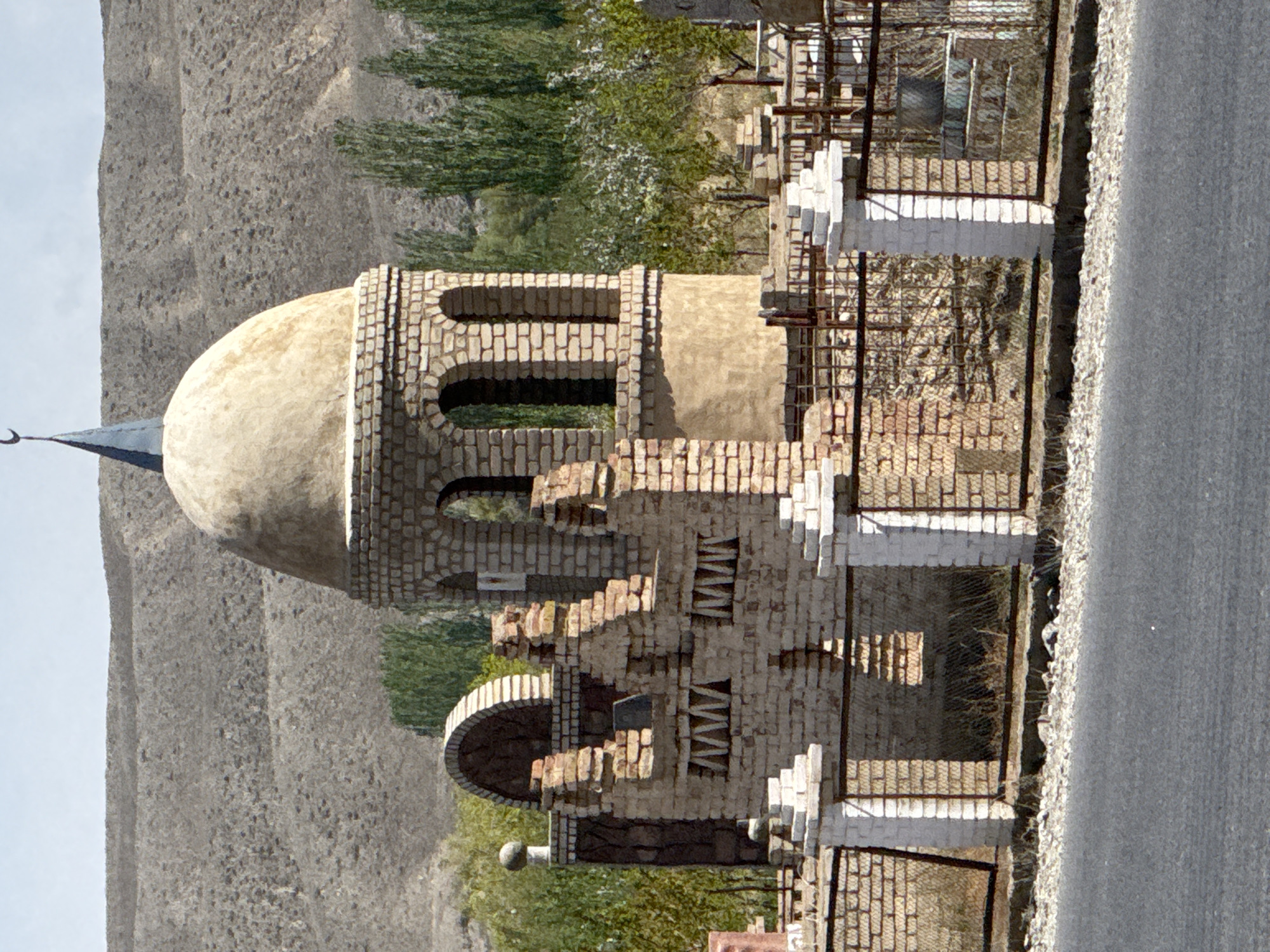
The image, when viewed as if correctly oriented, presents a light-colored brick structure, likely a mausoleum or memorial, situated in a mountainous, arid landscape. The building features a prominent, smooth, light-beige dome at its apex. Extending from the dome's side is a slender, pointed spire adorned with a crescent moon finial, hinting at Islamic architectural influence. The structure itself is built from light-toned bricks, arranged in decorative patterns. It includes several arched openings or windows in its upper section and more intricate brickwork in its lower parts, featuring stepped elements and smaller arches. Some sections, possibly pillars or railings, are painted white, providing a contrast to the brick. Metal fencing surrounds the structure in places, suggesting an enclosed boundary. The setting is characterized by sparse green trees and shrubs, some with lighter foliage, contrasting with the barren, rocky mountains that dominate the background. A paved or gravel road runs along the immediate foreground of the scene. The bright, clear sky and short shadows indicate strong daylight, likely midday. No people or activities are visible in the image. There is no visible text. The overall scene is consistent with the landscape and architectural styles found in Central Asia, such as Kara-Talaa, Kyrgyzstan.
Kara-Talaa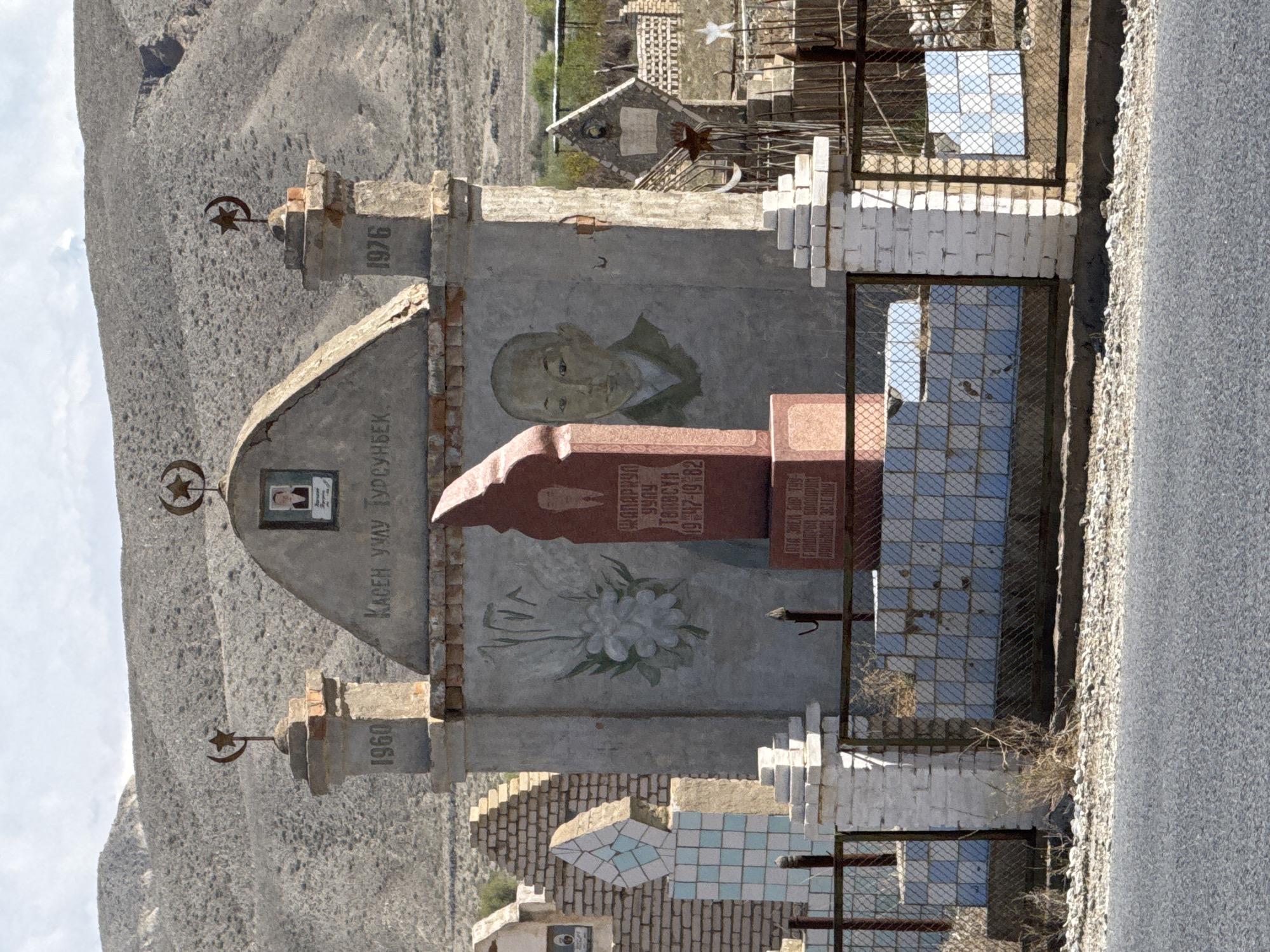
This image captures a section of a cemetery in Kara-Talaa, Kyrgyzstan, set against a backdrop of barren, rocky mountains under a bright, partly cloudy sky. The central focus is an elaborate grave structure, appearing to be made of concrete or stucco, with an arched top. This main structure features an integrated portrait of a man painted in green and grey tones, as well as a framed photograph of another individual, possibly a woman or younger man, above it. A painted floral arrangement, consisting of white flowers and green leaves, adorns the lower part of the structure. Two posts flank the main structure, each topped with a crescent moon and star symbol. The left post displays the year "1960," while the right post shows "1976." Text written vertically below the framed photo reads "КАСЕН УУЛУ ТУРСУНБЕК" (KASEN UULU TURSUNBEK). Adjacent to the painted structure is a distinct, reddish-brown granite headstone. Inscribed on it is "ХАЙДАРОВ УУЛУ ТОЛУСУН" (KHAIDAROV UULU TOLUSUN), with the years "1917-1982" indicating the person's lifespan. Below this, text reads "ЭКИ ДҮЙНӨ БАР БОЛСУН" (May both worlds be well/exist) and "СОГУШУН ВЕТЕРАНЫ" (War Veteran). The foreground shows a chain-link fence sectioned with white brickwork and blue-and-white tiled panels. Beyond this, a grey, paved road or path runs along the right side. In the background, other grave markers and structures can be seen, hinting at a larger burial ground. The overall scene suggests a blend of Islamic and possibly Soviet-era influences in the memorialization practices, reflecting the region's cultural history. The time of day is bright, likely daytime, with clear visibility of the arid landscape.
Kara-Talaa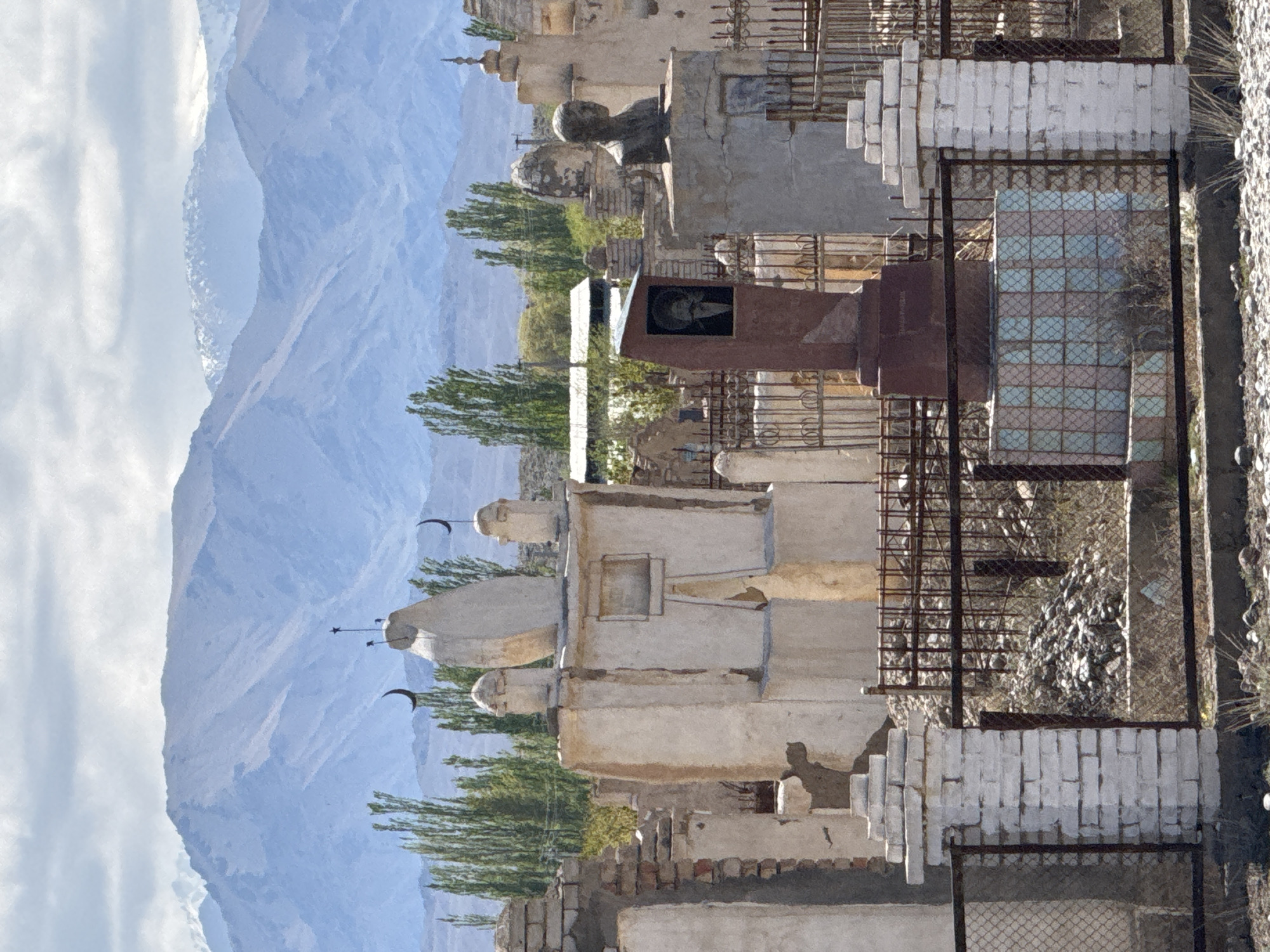
The image displays a cemetery situated in a mountainous landscape, likely Kara-Talaa, Kyrgyzstan. Numerous gravestones and burial enclosures populate the foreground and midground. Many gravestones are made of light-colored stone or concrete, presenting diverse designs; some feature rounded, dome-like tops, and at least two are adorned with crescent moon symbols, hinting at an Islamic cultural influence. A notable reddish-brown gravestone towards the center-right includes a framed portrait of an individual. Several grave plots are demarcated by low brick walls or rusted metal fences, with one enclosure on the right exhibiting a decorative pattern of blue and white tiles or glass blocks. Scattered trees grow among the burial sites. In the background, imposing mountains dominate the horizon, their upper sections softly veiled by clouds or haze. The scene is illuminated by clear daylight, suggesting a daytime setting. No discernible text is visible on any of the markers.
Kara-Talaa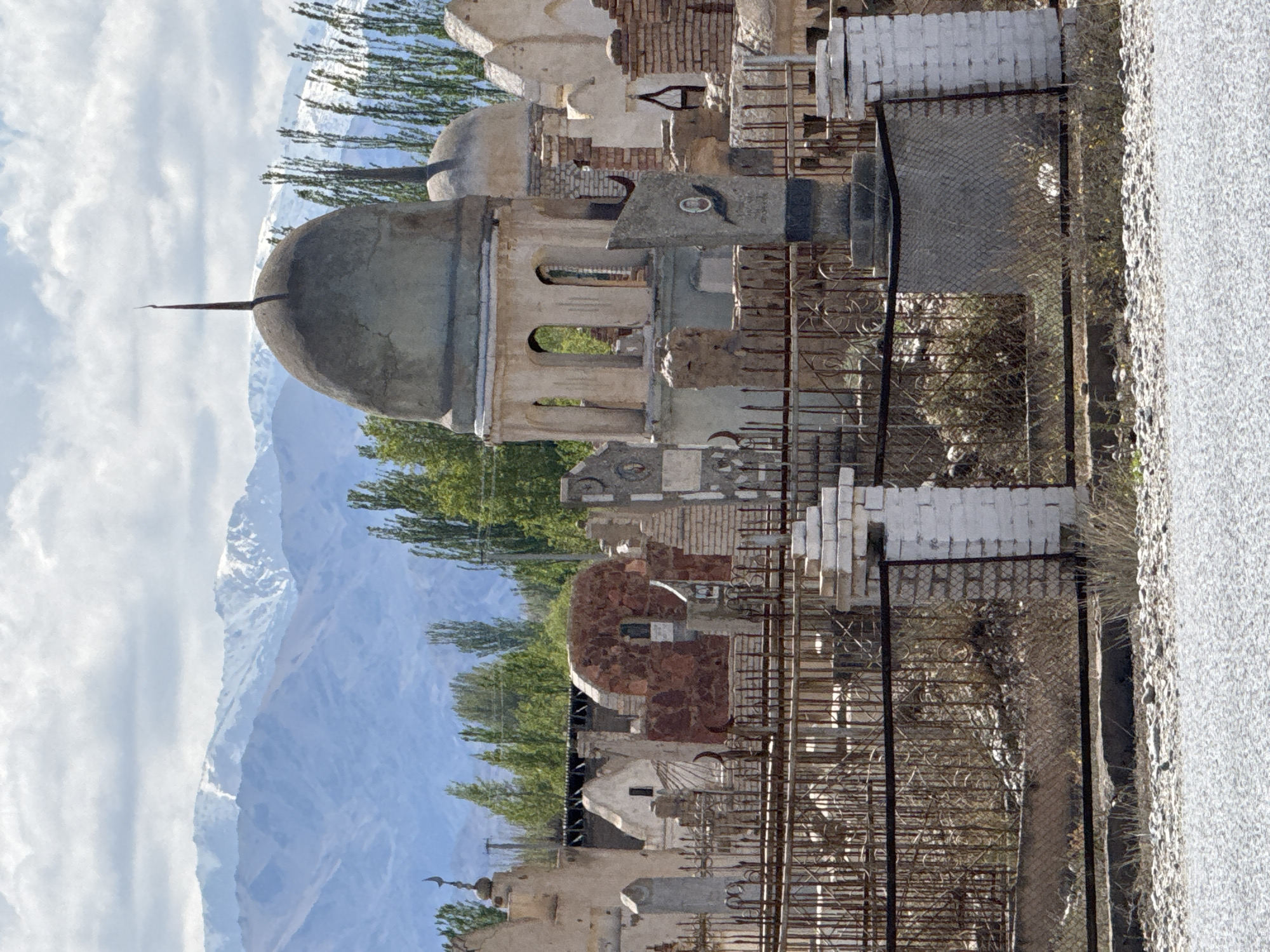
The image depicts a cemetery or graveyard in Kara-Talaa, Kyrgyzstan, set against a dramatic mountainous backdrop. In the foreground and midground, numerous graves and tomb structures are visible, varying in design and construction. One prominent structure features a large, smooth, grey dome topped with a spired finial. Nearby, another grave structure has a reddish, rough-hewn stone dome. Many graves are enclosed by simple metal fences or chain-link barriers, with some headstones appearing to be constructed from brick or concrete blocks. The overall architecture suggests a blend of traditional and functional styles. Behind the cemetery, a line of tall, green trees separates the burial ground from majestic, snow-capped mountains that dominate the background. The sky above is partially cloudy, indicating daytime, likely late morning or early afternoon given the soft light and shadows. To the immediate right (in the original image orientation, but bottom in a corrected landscape view), a gravelly path or road runs alongside the cemetery. No people are visible, and there is no apparent activity taking place. The scene conveys a sense of solemnity and peace, integrating human memory with a powerful natural landscape. No discernible text is visible on any of the grave markers or structures.
Kara-Talaa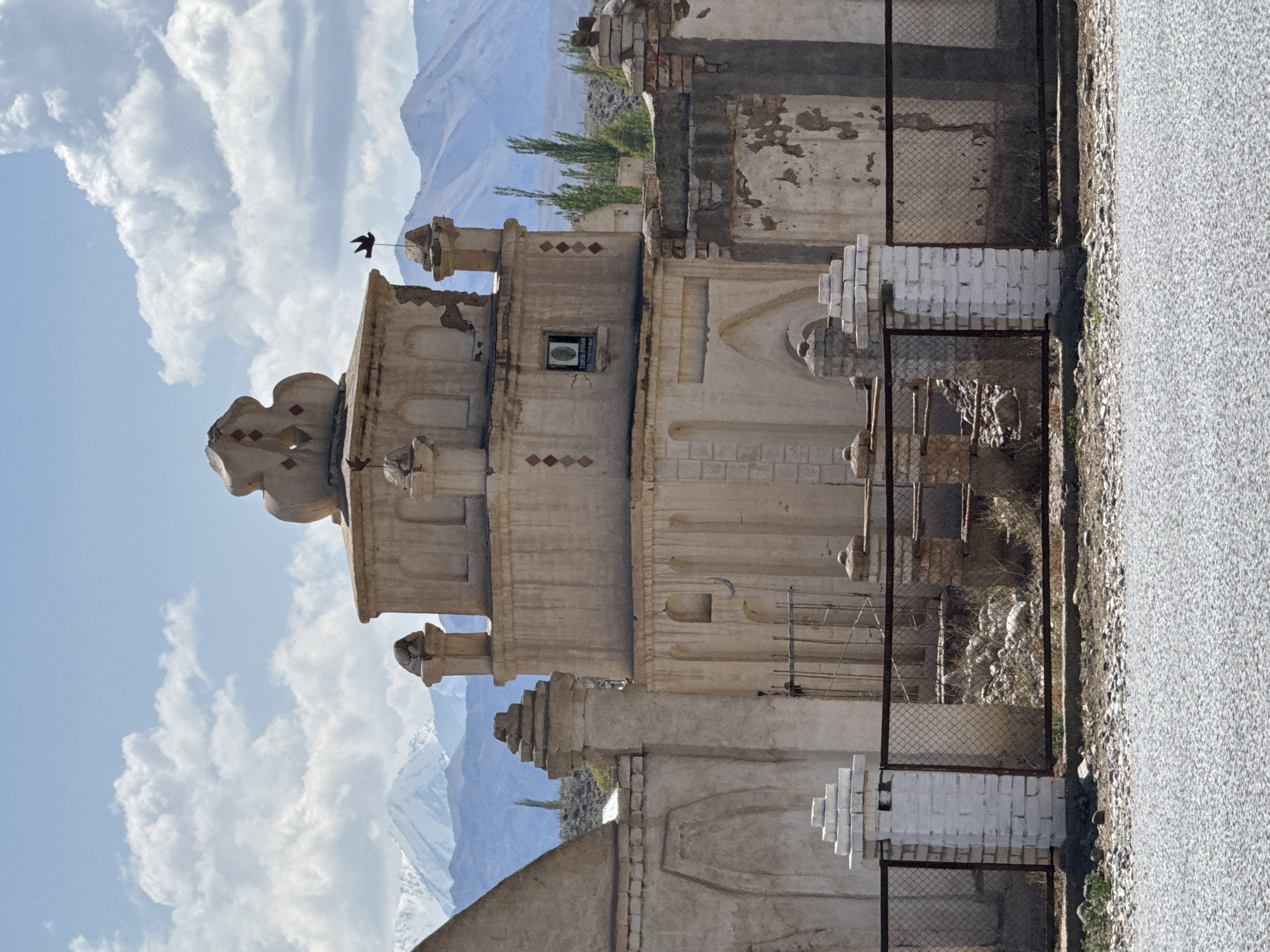
The image, when viewed in its correct orientation, captures a multi-tiered, light-colored building set against a backdrop of expansive, hazy mountains under a bright, partially cloudy sky. The building, possibly a mosque or shrine, exhibits an aged appearance with worn surfaces, peeling plaster, and exposed brickwork in areas. Architecturally, it features several levels, dome-like finials on its roof, and decorative elements such as rhombus patterns embedded in its walls. A notable detail is a small, modern air conditioning unit visible in an opening on one of the building's central tiers. Perched atop the highest finial is a small, dark bird. In the background, the scene is dominated by large, rugged mountains, characteristic of a high-altitude or arid environment, with hints of sparse vegetation including a few green trees. The sky is bright blue, dotted with large, white, fluffy clouds, suggesting clear weather. To the right of the building, a wire mesh fence with distinct white brick sections runs parallel to a paved road or path. The area enclosed by the fence appears to be an unkempt space with rubble and some growth. The overall scene is static, devoid of people or specific events, and exudes a sense of quietude. The bright daylight indicates it is likely midday or early afternoon. No visible text is present in the image. The setting points to a remote location in Kara-Talaa, Kyrgyzstan.
Kara-Talaa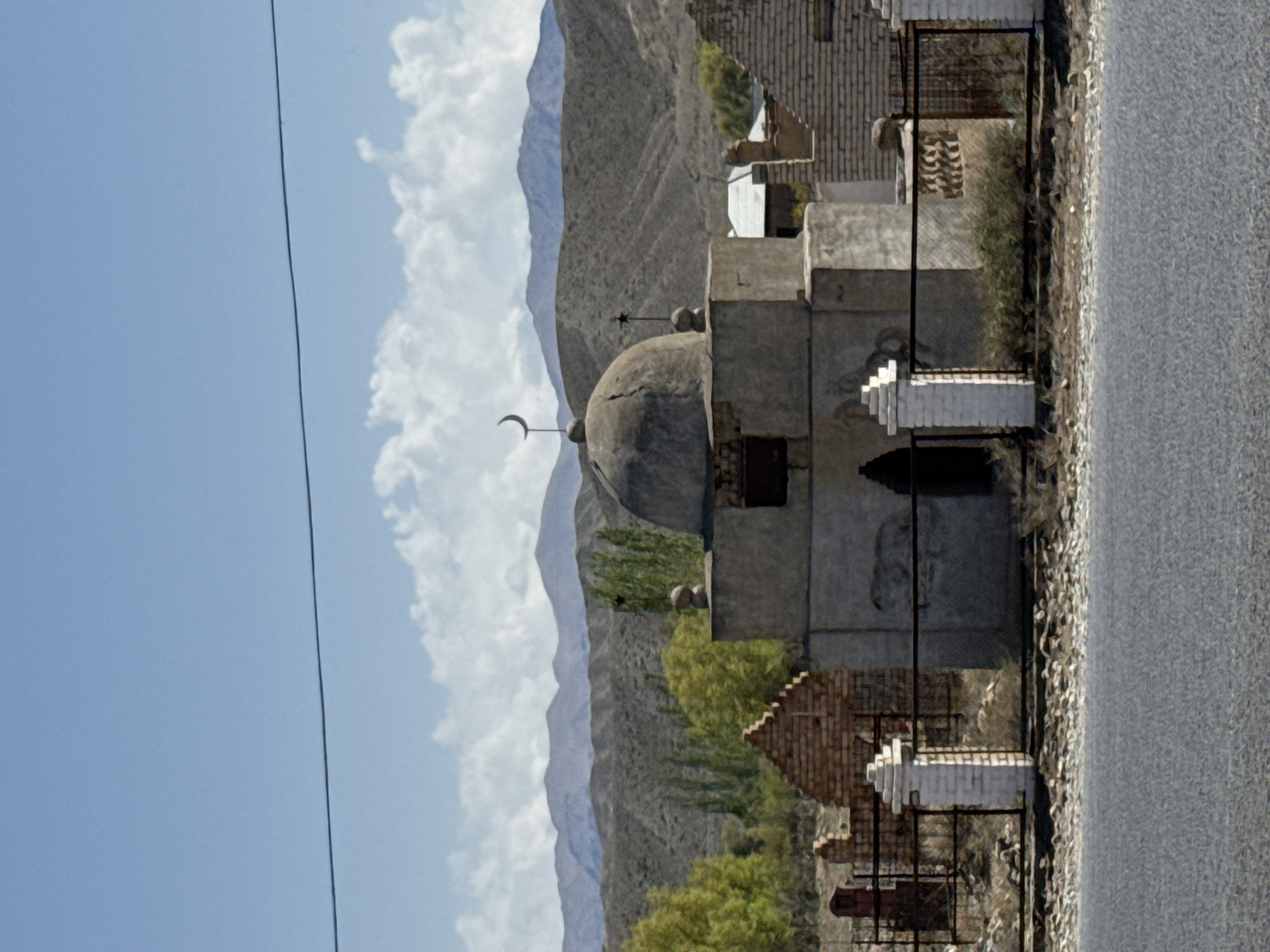
This image captures a serene, mountainous landscape in Kara-Talaa, Kyrgyzstan, featuring a notable architectural structure. The scene is set during the daytime under a clear blue sky adorned with scattered white, cumulus clouds. The central subject is a light-colored, possibly stone or concrete, building with a prominent dome topped by a crescent moon finial, indicating an Islamic context, likely a mosque, shrine, or mausoleum (mazar). The dome exhibits visible cracks, suggesting age. To the right of this main structure and extending into the foreground, several other buildings or enclosures, constructed from brick and rough-hewn stone, are visible, some partially enclosed by dark metal fences. Behind these structures, a range of rugged, greyish-brown mountains dominates the background, their arid slopes stretching across the horizon. Green foliage, including trees and bushes, provides patches of vegetation at the base of the mountains and around the buildings. A single, thin dark wire or cable horizontally traverses the upper part of the sky, adding a subtle modern element to the otherwise traditional landscape. The immediate foreground on the right side of the image presents a wide, textured, greyish surface that appears to be an unpaved road or a large, flat, gravelly area. No people or distinct activities are visible, emphasizing the tranquil and somewhat remote nature of the location. There is no visible text within the image.
Kara-Talaa