Karanganyar, Indonesia
30 memories from Karanganyar, Indonesia
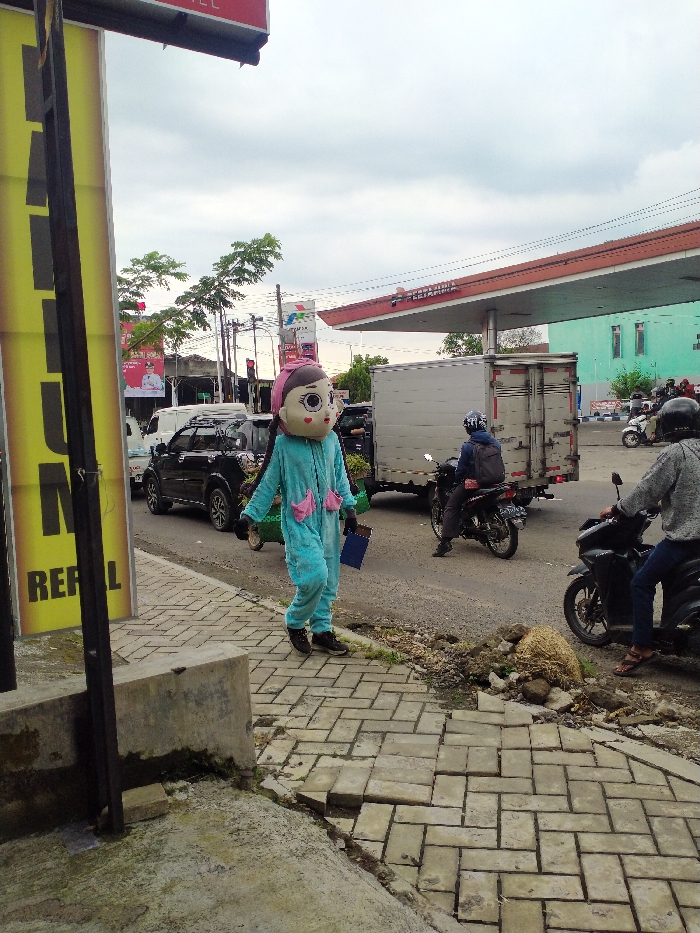
The image depicts an outdoor street scene in Karanganyar, Indonesia, under an overcast daytime sky. The primary subject is a person in a light blue mascot costume, designed to resemble a cartoon girl with a large head, dark hair, and wide, circular eyes, complemented by a small pink bow on the head. The full-body costume features pink accents, possibly pockets, and the mascot is walking on a paved sidewalk of interlocking bricks, carrying a dark blue clipboard in its left hand. A green cart is partially visible next to the mascot. The setting is a road with moderate traffic. Vehicles visible include a black SUV and a white box truck. Two individuals on motorcycles are prominent: one rider in a dark jacket and helmet is behind the white truck, and another in a grey top and helmet is on a black motorcycle closer to the viewer. In the background, a Pertamina gas station is clearly identifiable by its red-trimmed canopy and "PERTAMINA" signage, indicating a commercial area. Behind the station, a light green building is visible. On the far left, a large yellow sign is partially seen, bearing vertical black lettering with the word "REAL" clearly visible. Further in the background on the left, a red banner with unreadable Indonesian text and an image of a person suggests an advertisement or political poster. The sidewalk surface shows signs of wear and damage, with some bricks dislodged, and a pile of dirt and rubble lies on the roadside. The overall scene portrays everyday activity on a busy street.
Karanganyar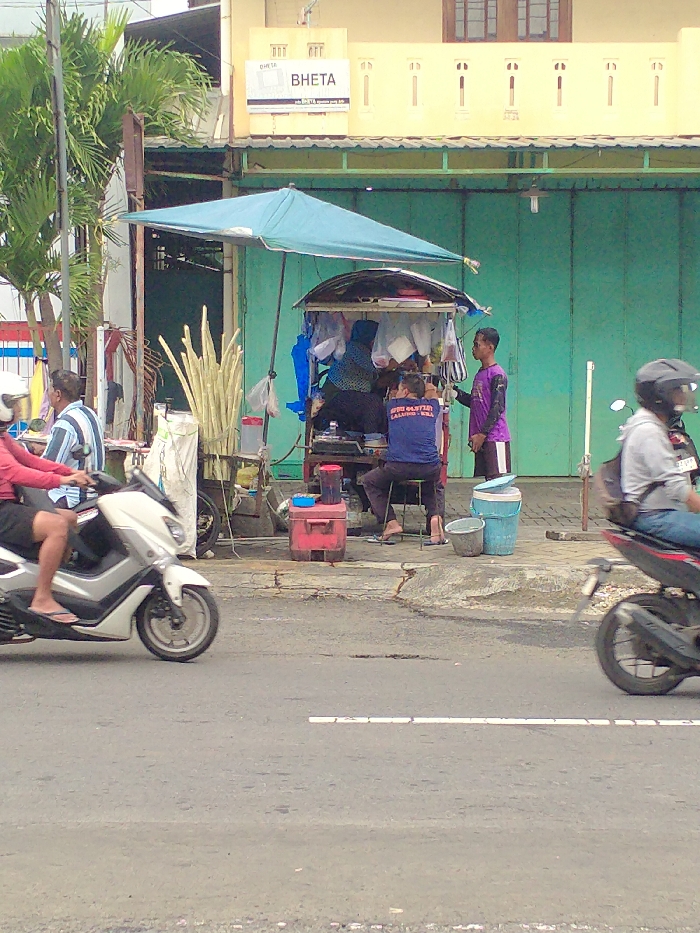
This daytime image captures a vibrant street scene in Karanganyar, Indonesia, showcasing a bustling roadside sugarcane juice stall. The main subject is a vendor's cart, shaded by a prominent blue umbrella, with numerous long sugarcane stalks piled high, ready for processing. At least five individuals are visible: two people on scooters are in motion on the asphalt road in the foreground—one in a red shirt on a white scooter, and another in a grey hoodie on a dark scooter. Near the sugarcane stall, a person with a head covering appears to be working behind the counter. Next to them, a man in a blue t-shirt sits on a stool, possibly a vendor or patron, with his shirt displaying the text "SPESIAL ES TEBU LALUNG - KRA," indicating "Special Sugarcane Ice" and a specific location (Lalung, Karanganyar). Another man in a purple shirt stands nearby, looking towards the stall. Further left, another man in a striped shirt stands beside a white cart that also holds sugarcane stalks. The setting includes a building in the background with a light yellow upper facade and closed green metal doors on the lower level. A sign on this building clearly reads "BHETA," with additional smaller text "info BHETA" and "bhetaproduction only 010." Green palm trees are visible on the left side, adding a tropical element to the urban environment. The bright lighting suggests it is a clear, sunny day. The overall scene depicts typical daily life and street commerce in the region.
Karanganyar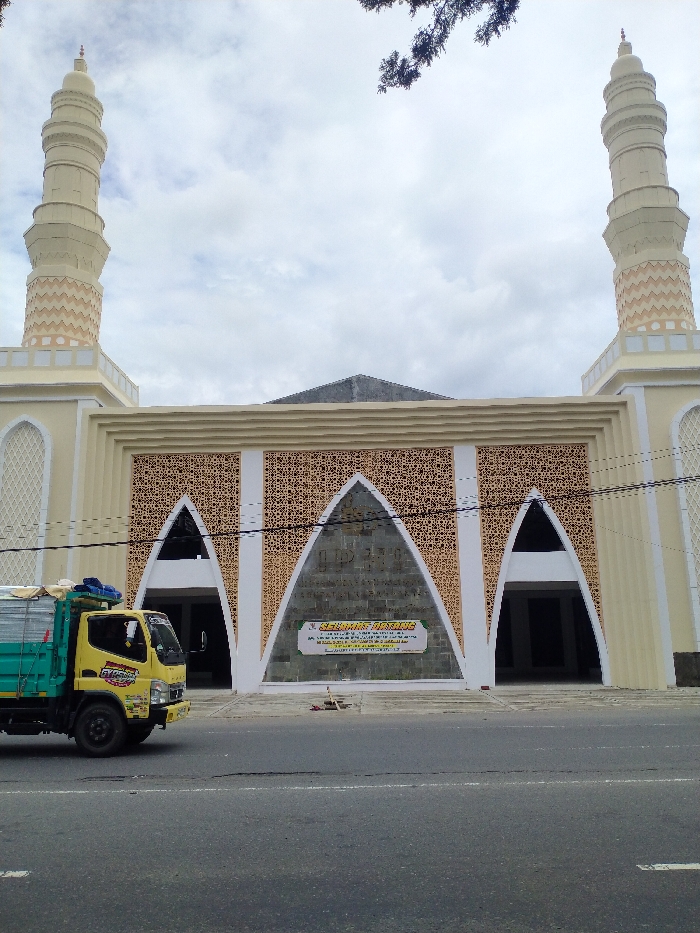
A daytime exterior shot captures a mosque and a truck in Karanganyar, Indonesia, under an overcast sky. The prominent subject is a large, light-colored mosque featuring two tall, slender minarets flanking its facade. The mosque's front is adorned with intricate geometric patterned panels, predominantly above three large arched entrances. The central arch is the widest and set back, containing a banner. The two side arches lead into shaded areas. In the foreground, a yellow delivery truck with a green open bed is seen moving or parked on an asphalt road. The truck's cab has "BYPASS" written on its door. Overhanging branches of a tree are visible in the upper left corner, and power lines cross horizontally across the middle of the frame. The banner within the central archway of the mosque prominently displays "SELAMAT DATANG" (Welcome) in large letters, with smaller, less legible text underneath, likely providing further information or a message. The mosque appears to be a new or recently renovated structure. The scene depicts a typical street view in an urban or semi-urban setting.
Karanganyar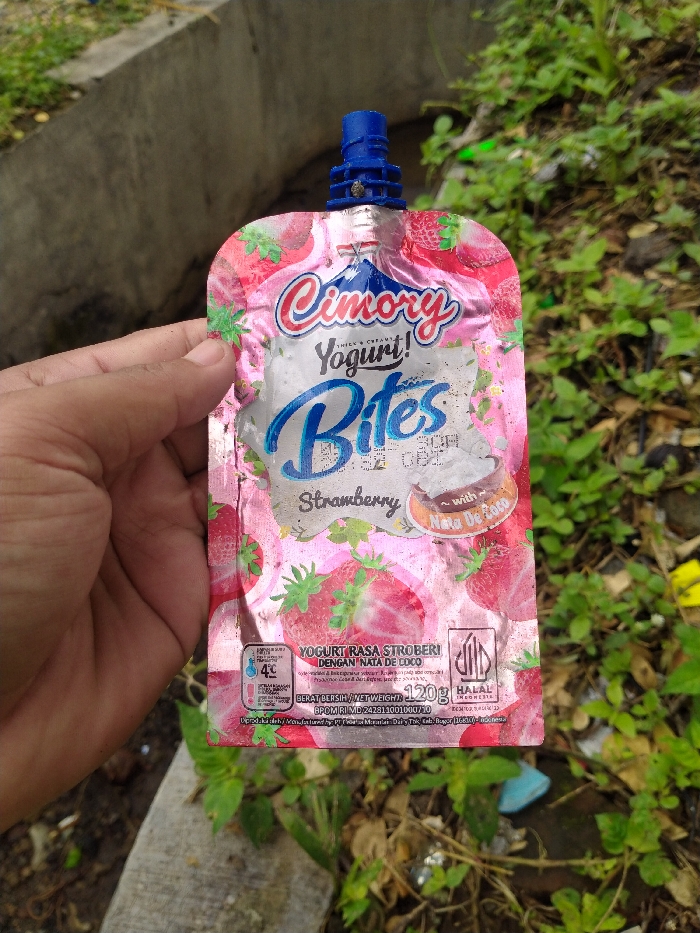
A hand holds a pink Cimory Yogurt Bites pouch with a blue spout, featuring a strawberry flavor with nata de coco. The pouch, which appears slightly worn, is held against a bright outdoor background of green vegetation and a concrete structure. Visible text on the pouch includes: - "Cimory Yogurt! Bites" - "Strawberry ~ with Nata De Coco" - "YOGURT RASA STROBERI DENGAN NATA DE COCO" (Strawberry flavored yogurt with nata de coco) - A recommendation to keep it at "4°C" - "BERAT BERSIH / NET WEIGHT: 120g" - "HALAL INDONESIA" logo - "BPOM RI MD 242811001000/10" - Partially visible text: "DIPRODUKSI OLEH / MANUFACTURED BY PT. Cisarua Mountain Dairy, Tbk. Kab. Bogor 16830 - Indonesia" The setting is outdoors, likely during the daytime, with ample natural light. The background features overgrown green plants and a concrete barrier or wall, suggesting an informal outdoor environment. This image was captured in Karanganyar, Indonesia.
Karanganyar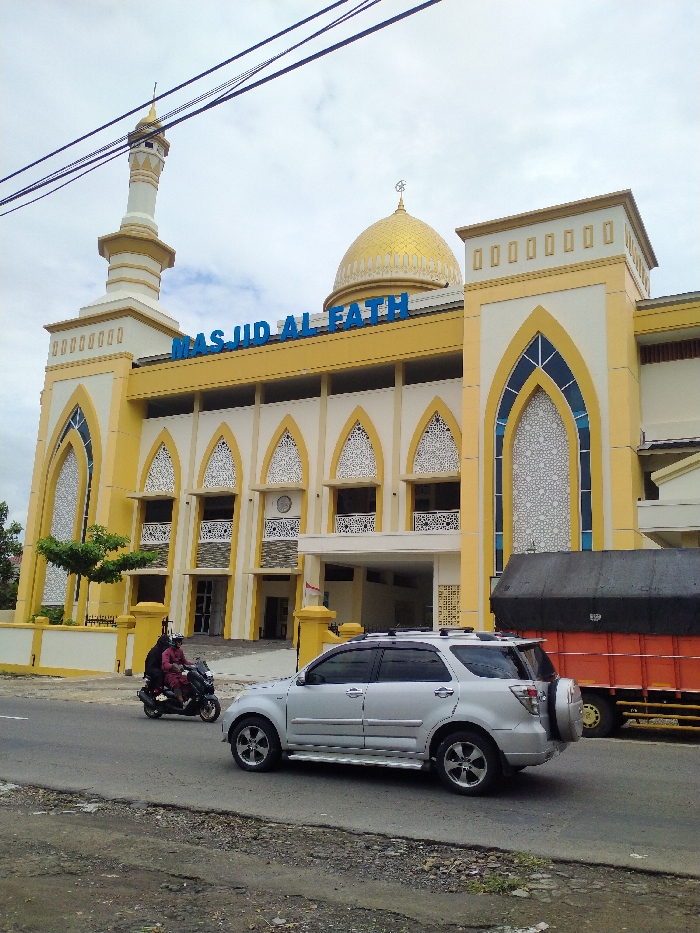
The image captures a vibrant street scene in Karanganyar, Indonesia, featuring the "MASJID AL FATH" mosque as its prominent backdrop. The mosque is a large, brightly colored building with a facade primarily in yellow and white, accented with blue details on its arched window frames and the mosque's name. It features a tall minaret on the left with a golden finial, and a large golden dome at its center, also topped with an Islamic crescent and star. Intricate white patterns fill the arched windows and panels along the mosque's lower level. In the foreground, a two-lane asphalt road runs horizontally. On the left side of the road, a motorcycle with two riders, one wearing a red top, is visible, appearing to move past the mosque. To the right of the motorcycle, a silver SUV, possibly a Toyota Rush given its distinctive spare tire mounted on the rear door, is also on the road, heading in the same direction. Further to the right and slightly behind the SUV, a large red truck with a black tarp covering its cargo area is also seen on the road. The sky is overcast, suggesting a cloudy day, though the lighting is bright. Overhead, several power lines stretch across the frame, partially obscuring the sky above the mosque. The immediate roadside in the foreground shows some gravel and uneven terrain. The overall impression is a bustling daytime scene in an urban or semi-urban setting, with a striking religious building as a central focal point.
Karanganyar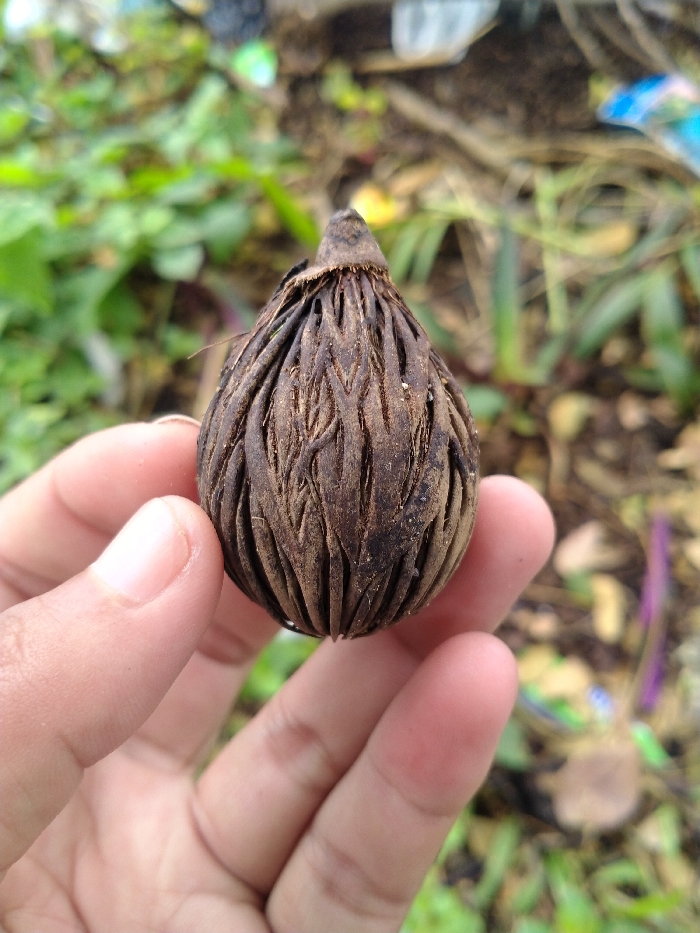
A close-up outdoor shot features a person's hand holding a dried, brown, and highly textured object. The object is roughly ovoid or tear-drop shaped, about the size of a small palm fruit, and possesses a distinctly fibrous and deeply wrinkled surface. This intricate texture forms a pattern of raised, irregular ridges and grooves that converge towards a pointed tip at one end, indicating where it might have been attached to a stem or plant. The object's color is a dark, muted brown with lighter tan or dusty highlights in its depressions, characteristic of a dried seed, nut, or fruit. The hand, showing parts of the thumb, index finger, and palm, gently cradles the object, presenting it towards the camera. The skin appears light-toned and healthy. The background is softly blurred, depicting an outdoor scene with predominantly green foliage, likely grass and other plants, interspersed with patches of brown earth. This suggests a natural or garden environment, possibly somewhat unkempt, as faint, colorful blurs in the distant background might indicate scattered debris. The natural lighting confirms it is daytime. The activity shown is the examination or presentation of this natural specimen. There are no visible emotions or text. The object's appearance, resembling a dried palm seed, is consistent with the location context of Karanganyar, Indonesia, a region known for its tropical flora.
Karanganyar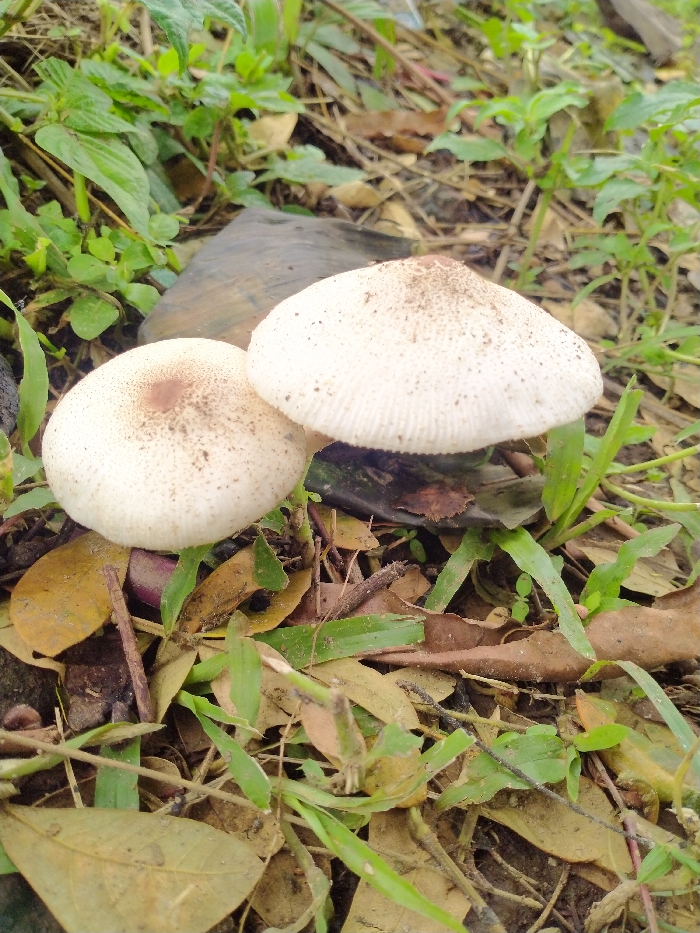
A close-up, low-angle shot captures two light-colored mushrooms growing amidst natural ground cover in what appears to be an outdoor setting in Karanganyar, Indonesia. The two mushrooms, likely fungi of the *Agaricaceae* family, are the primary subjects, positioned in the lower-center of the frame. The mushroom on the right is larger, featuring an off-white, somewhat conical cap with visible radial striations along its edge, suggesting gill structure beneath. Its surface has scattered brown specks, more concentrated towards the apex. The mushroom on the left is slightly smaller and more rounded, with an off-white cap that has a distinct, reddish-brown central patch and similar brown specks distributed across its surface. The stems of both mushrooms are largely obscured by surrounding foliage and debris. The mushrooms are nestled in a bed of green foliage, including various grasses and broad-leaf plants, interspersed with numerous dried brown leaves and twigs. A dark, indistinct object, possibly a piece of bark or rock, is visible behind the mushrooms, creating a natural backdrop. The ground is dark earth, partially covered by the organic matter. The scene depicts a static natural environment. The lighting suggests daytime, possibly under an overcast sky or in a shaded area, as there are no harsh shadows. No human activity or specific event is taking place, and no emotions are conveyed. There is no visible text in the image. The overall impression is one of natural growth and decomposition on a forest floor or similar uncultivated area.
Karanganyar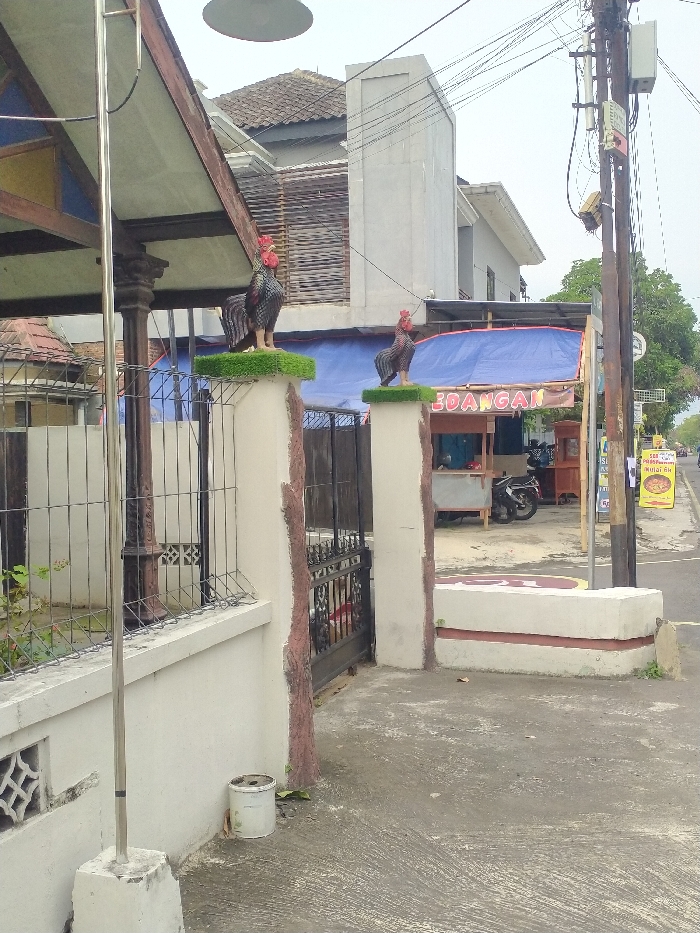
This image depicts a street scene in Karanganyar, Indonesia, captured on an overcast or hazy day. The foreground features an entrance to a property, marked by a white and brown fence and a dark metal gate. Two decorative rooster statues, one dark grey with a red comb and the other reddish-brown, stand prominently on top of the gate pillars, each on a patch of artificial green grass. A tall metal pole, possibly for a flag, is fixed into the ground on the left side of the entrance, and a white bucket rests at its base. Behind the fence, parts of two buildings are visible: a traditional structure with a reddish-brown tiled roof and a more modern, grey two-story building. To the right of the gate, a roadside stall covered by a blue tarp is present. The banner on the tarp displays partially visible text that appears to read "SOANGAN" or "GOANGAN". A motorcycle is parked near this stall. The background shows a paved street stretching into the distance. A utility pole heavily laden with numerous wires and electrical components stands beside the road. Several small signs are attached to the pole and along the street. A notable yellow sign advertises food, with visible text including "MIE AYAM," "BASO," and "SOTO," suggesting a local food vendor. Trees line the far side of the road. No individuals are present, and the scene is static, capturing an everyday street view.
Karanganyar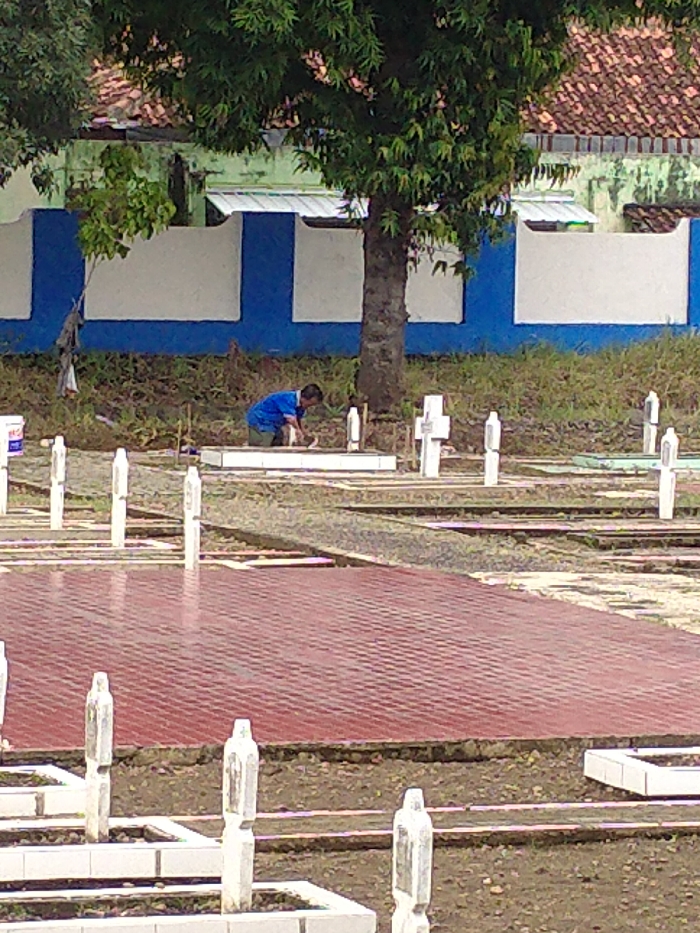
The image captures a daytime scene within a cemetery or burial ground in Karanganyar, Indonesia. In the mid-ground, a lone individual, dressed in a blue short-sleeved shirt and dark pants, kneels beside a grave marker. The person appears to be meticulously cleaning or tending to the grave with a small object in their hands. The cemetery is characterized by numerous white grave markers. Some are simple, upright rectangular posts, while others are distinctly cross-shaped, indicating a Christian burial ground. A prominent red-tiled pathway or area cuts across the mid-ground, separating sections of graves. The ground between the graves consists of earth and sparse, dry vegetation. In the background, a large, leafy green tree stands tall, its foliage obscuring part of a blue and white painted wall or fence. Beyond this wall, faint glimpses of buildings with orange-tiled roofs and light green walls are visible through the trees, suggesting a surrounding residential or village area. A white bucket or container is visible to the far left in the foreground. The lighting is soft and diffused, indicating an overcast day or perhaps early morning/late afternoon, without harsh shadows. The overall atmosphere suggests quiet devotion and upkeep. There is no discernible text visible on any of the grave markers or other objects in the image.
Karanganyar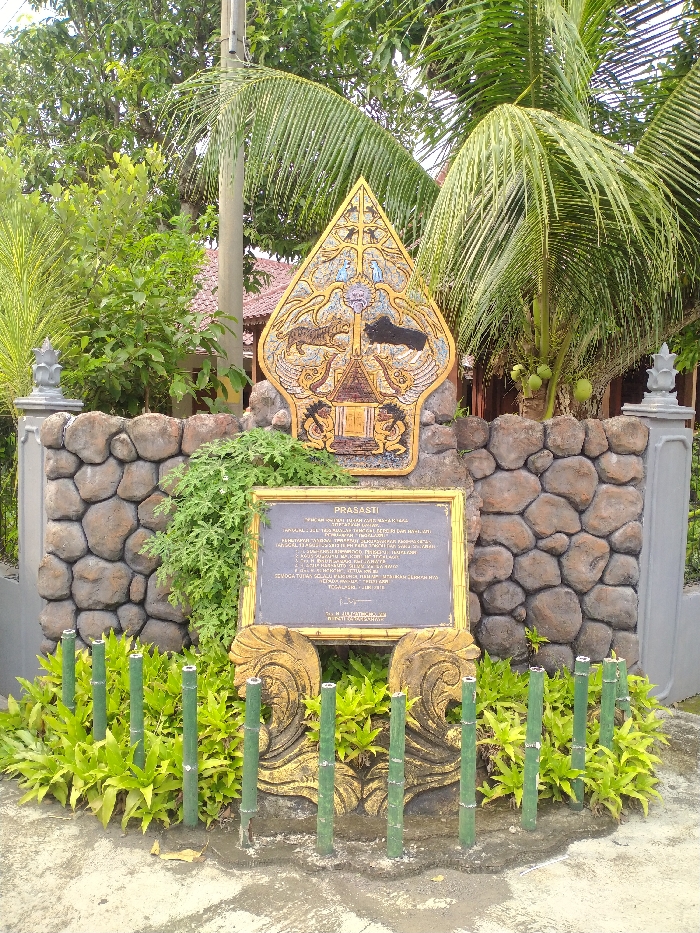
This daytime outdoor shot captures a monument in Karanganyar, Indonesia, set against a backdrop of lush green foliage and a clear sky. The central feature is a stele-like structure, part of a stone-patterned wall. Atop this wall stands a prominent, intricately carved golden "gunungan" (a traditional Javanese wayang kulit motif representing a mountain or tree of life). The gunungan depicts symbolic figures and patterns, including what appear to be a house/temple structure, animal forms (possibly a tiger), and birds. Below the gunungan, a rectangular black plaque framed in gold is mounted on the wall. The base of the monument is surrounded by vibrant green plants, with a semi-circle of short, green bamboo poles arranged in front of it, acting as a decorative boundary. In the background, tall green trees, including palm trees laden with coconuts, are visible. A building with a red-tiled roof is partially obscured by the dense vegetation on the right. The lighting suggests a clear and bright day. The visible text on the plaque reads: "PRASASTI" (Inscription/Charter) "Visi Kementerian Agraria dan Tata Ruang/Badan Pertanahan Nasional: TERWUJUDNYA PENATAAU RUANG DAN PERTANAN YANO BERKEADILAN DAN KEBERLANJUTAN UNTUK KEMAKMURAN RAKYAT" (Vision of the Ministry of Agrarian Affairs and Spatial Planning/National Land Agency: The realization of fair and sustainable spatial planning and land management for the prosperity of the people) "VISI PEMBANGUNAN KABUPATEN KARANGANYAR 2018-2023: MAJU DAN INOVATIF DENGAN DIDUKUNG OLEH MASYARAKAT YANG MANDIRI, SEJAHTERA, DAN BERKARAKTER" (Vision for the Development of Karanganyar Regency 2018-2023: Advanced and Innovative, supported by an independent, prosperous, and characterful society) "Pesan:" (Message:) 1. "Peran Pertanahan adalah mengembalikan Hak Rakyat, sebagai Pondasi Kehidupan Masyarakat, untuk dapat hidup layak" (The role of Land Affairs is to restore the rights of the people, as the foundation of community life, to live decently) 2. "Pertanahan sebagai Pondasi, dalam meningkatkan Harkat dan Martabat Rakyat" (Land Affairs as a foundation, in improving the dignity and honor of the people) 3. "Pertanahan sebagai pondasi, membangun Ekonomi Rakyat" (Land Affairs as a foundation, building the people's economy) 4. "Pertanahan sebagai pondasi, dalam menciptakan Kedamaian" (Land Affairs as a foundation, in creating peace) 5. "Pertanahan sebagai Pondasi, mewujudkan Kebahagiaan Rakyat" (Land Affairs as a foundation, realizing the happiness of the people) Dated "YOGYAKARTA, ... JANUARI 2018" Signed "A.n. MENTERI AGRARIA DAN TATA RUANG/ KEPALA BADAN PERTANAHAN NASIONAL DR. Ir. H. SUDIJONO MS. DIREKTUR JENDERAL HUBUNGAN HUKUM PERTANAHAN" (On behalf of the Minister of Agrarian
Karanganyar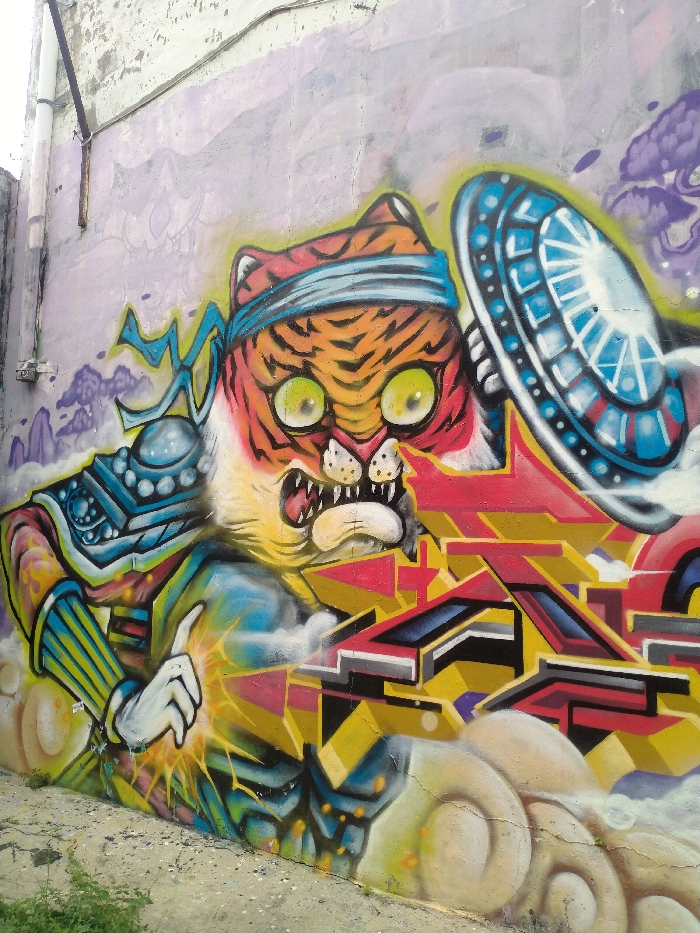
This full-shot image captures a vibrant graffiti mural on a weathered light purple wall, likely in an urban outdoor setting in Karanganyar, Indonesia. The central subject is a dynamic, anthropomorphic tiger-like character with orange and black stripes, large, intense yellow-green eyes, and a fierce, open-mouthed expression revealing fangs. The character wears a light blue headband and is adorned with stylized armor, including a prominent blue and gold shoulder pad and arm protector. Its left hand is raised, with the index finger pointing upwards, from which bright yellow and white energy or light appears to emanate, suggesting a magical or powerful action. To the right of the tiger's head, there is a large, circular, disc-like object, possibly a stylized shield or UFO, rendered in shades of blue, white, and silver with intricate geometric patterns. Below the tiger and the disc, an intricate, angular graffiti tag dominates the lower right portion of the mural. It features complex, interlocking geometric shapes in red, yellow, black, and blue, forming abstract letters or symbols that are not explicitly legible. The background of the mural includes stylized purple clouds and distant mountain-like forms, contributing to a fantastical atmosphere. The wall itself shows signs of wear, with peeling paint and cracks. Along the far left edge, a white PVC pipe runs vertically, and a dark cable is visible horizontally above it. The ground at the bottom left shows patches of dirt, grass, and concrete. The overall impression is one of intense energy and imaginative street art.
Karanganyar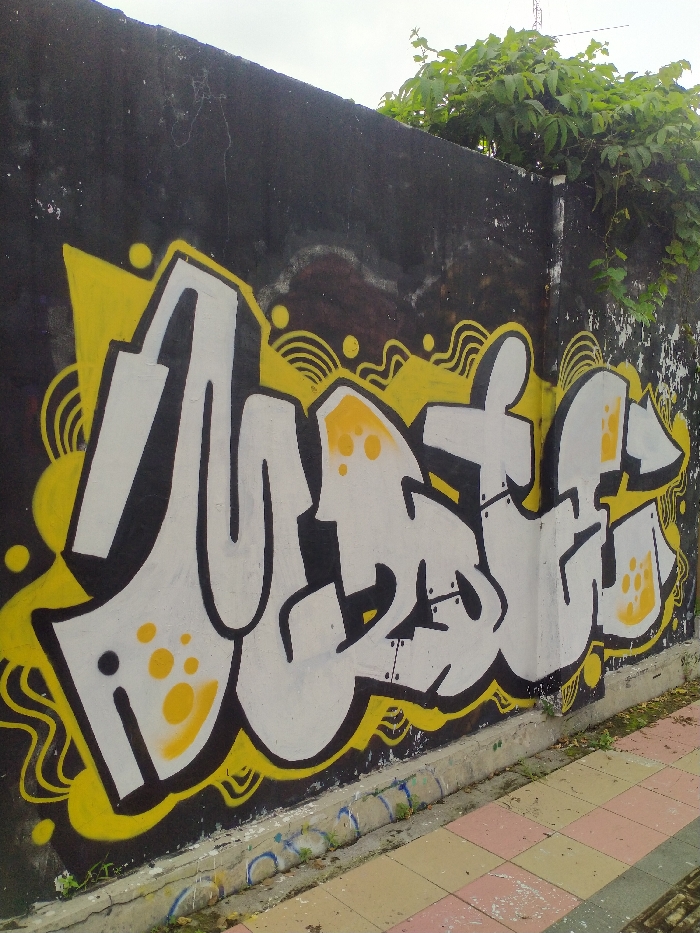
An outdoor shot captures a vibrant graffiti artwork spray-painted on a dark, weathered concrete wall. The wall, possibly a perimeter wall, is black and shows signs of age, with visible cracks and some discolored patches, particularly towards the top. Over the top edge and corner of the wall, lush green leafy vegetation is growing, suggesting an unkempt or naturalized environment. Above the wall, an overcast, light grey sky is visible, indicating daytime. The prominent graffiti piece features large, bold, highly stylized letters outlined in black and filled with white paint. A bright yellow color is used both as an intricate background design, with wavy lines and circular accents, and as highlights within the white letters. Some white sections of the letters are further embellished with patterns of small yellow dots. Upon closer inspection, the graffiti appears to spell the word "MUSTIKA." The letters are crafted in a complex wildstyle or bubble style, common in graffiti art, with interlocking and flowing elements. The first letter is a clear 'M', followed by a distinct 'U'. The subsequent letters, 'S', 'T', 'I', 'K', and 'A', are progressively more stylized but still discernible as part of the word. At the base of the wall, a concrete curb or drainage channel runs parallel to the sidewalk. The sidewalk itself is paved with checkered tiles in alternating shades of pink and light beige or off-white. Some older, faded blue markings, possibly remnants of earlier graffiti or paint, are visible on the concrete curb. No people or active events are present in the static scene. The image provides a glimpse of urban or suburban street art in Karanganyar, Indonesia.
Karanganyar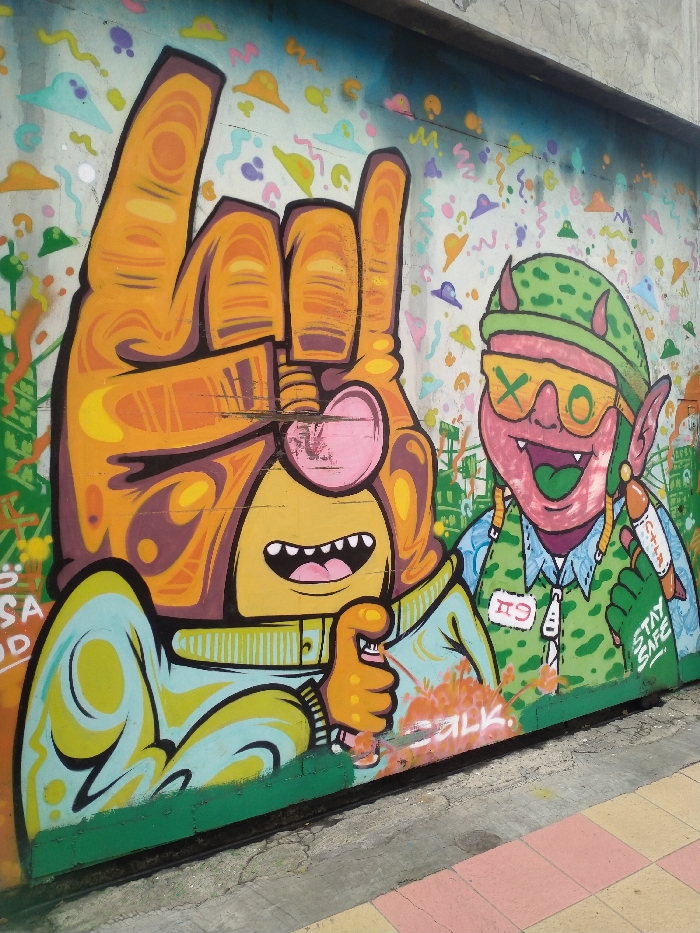
A vibrant graffiti mural adorns a concrete wall, featuring two stylized, cartoon-like characters rendered in bold outlines and bright colors. The scene is brightly lit, suggesting daytime, and the base of the wall transitions to a concrete path with pink and yellow checkered tiles, indicating an outdoor urban setting in Karanganyar, Indonesia. On the left, a large, orange, gloved hand forms a "rock on" or "I love you" gesture with its thumb, index, and pinky fingers extended. Below this hand, a character with a yellow face, wide open-mouthed smile, and visible teeth is depicted. A pink heart shape partially covers its eye area. This character wears a light blue and yellow long-sleeved garment with swirling patterns. To its right, a green-skinned imp or goblin-like character is portrayed. It has pointed ears and small red horns protruding from a green, camouflage-patterned military-style cap. Large yellow sunglasses obscure its eyes, bearing the text "X O" on the lenses. This character also has a wide, joyous, open-mouthed expression with a green tongue and visible teeth. It wears a camouflage vest over a light blue shirt, with a white tag pinned to its chest displaying "#9". In its right hand, it holds a red, rocket-shaped object, possibly a spray can or firecracker, with the text "CITY" and "STAY SAFE" visible on its side. The background of the mural is a lighter wall covered with numerous small, colorful, abstract shapes, including stylized clouds, squiggles, and other organic forms, giving a playful and whimsical feel. Near the bottom center of the mural, below the right character, faint orange paint splatters partially obscure the word "SILK".
Karanganyar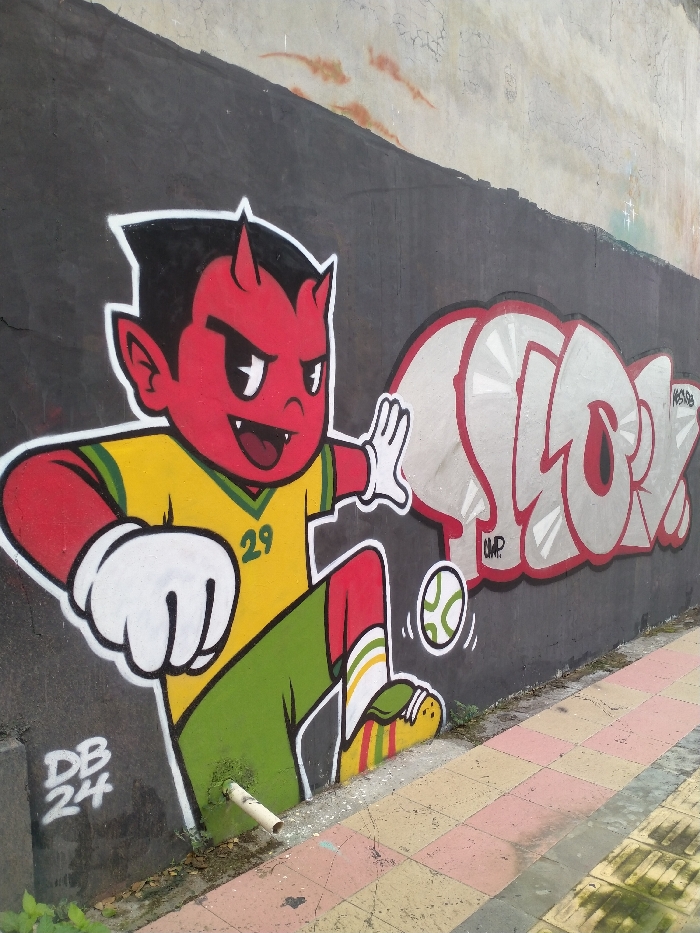
This media file features a vibrant graffiti mural painted on a textured concrete wall in Karanganyar, Indonesia. The central subject is a cartoon character, depicted as a red-skinned, black-haired boy with small horns, pointed ears, and sharp fangs, giving him an impish or devil-like appearance. The character is actively engaged in what appears to be a soccer game. He is shown mid-action, seemingly kicking a small, stylized soccer ball with green markings. He wears a yellow soccer jersey with green accents, emblazoned with the number "29" on the front. His attire also includes green shorts, and distinctive red, yellow, and white striped socks paired with yellow shoes. His expression is energetic and somewhat mischievous, with wide eyes and a visible smile revealing his fangs. To the right of the character, the word "SLORK" is painted in a large, bubble-style graffiti font, outlined in red with a light grey fill that has a radiant line pattern. Below "SLORK," a smaller tag reads "UMP," and another tag, "KRESNA," is visible above and to the right. On the lower left section of the wall, near the character's feet, the tag "DB 24" is present. A notable detail is the clever integration of a real-world object into the artwork: a white PVC pipe protrudes from the base of the wall, appearing to emerge from beneath the character's green shorts. The wall itself is dark grey in its lower section, transitioning to a lighter, weathered grey above. The scene is set outdoors, with a paved sidewalk featuring pink, yellow, and grey tiles visible in the foreground. The lighting suggests it is daytime.
Karanganyar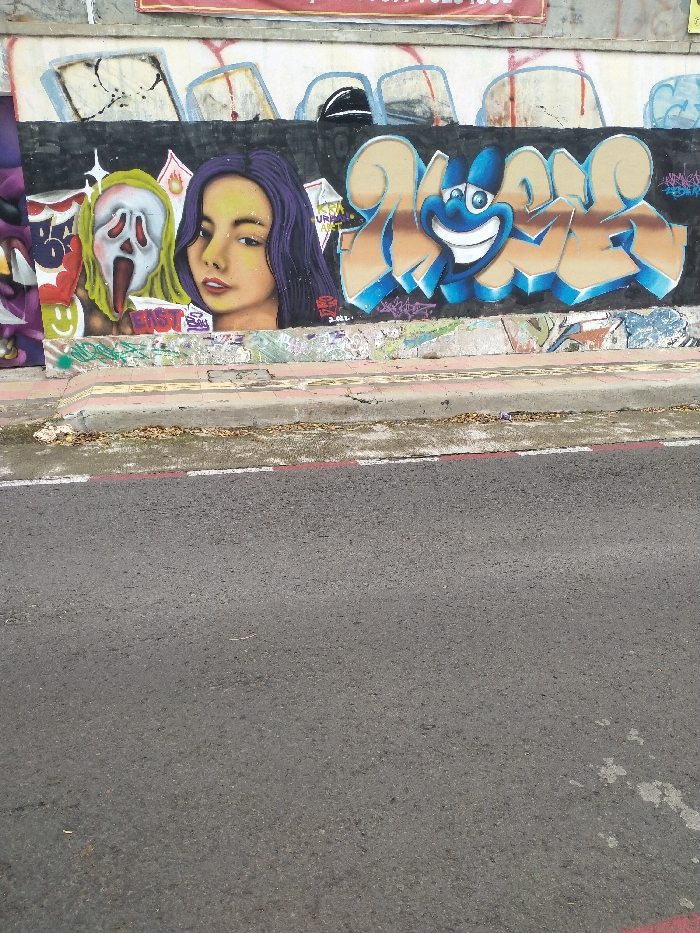
The image captures a vibrant graffiti mural spanning a wall beside an asphalt road in Karanganyar, Indonesia. The scene suggests a daytime setting, with clear lighting. The mural itself is composed of several distinct elements. On the left, a stylized rendition of the "Ghostface" mask from the *Scream* movie franchise is visible, characterized by its white, screaming face against a greenish-yellow background. Below this, the word "EAST" is painted in red. Central to the mural is a realistic portrait of a young woman with long, dark, possibly purple hair, depicted with a calm expression. Near her right shoulder, the year "2021" and the phrase "URBAN ART" are discernible, along with other small tags. To the right, a large, elaborate graffiti piece features blue and orange bubble letters, potentially spelling a word like "HOME." This design incorporates a playful, blue cartoon-like face with large, expressive eyes and a wide, grinning mouth. The base of the wall beneath these main artworks is covered with various smaller, overlapping tags and paint splatters, including green and blue. Above the primary mural, the upper section of the wall displays older, more faded graffiti and paint, with partially visible text that includes what appears to be a phone number "977 7020 9283" and other illegible words. Below the wall, a concrete curb separates the art from the road. The street itself is dark grey asphalt, featuring a distinct white dashed line and a solid red line running parallel to the curb. No human subjects or active events are present, focusing solely on the urban landscape and street art.
Karanganyar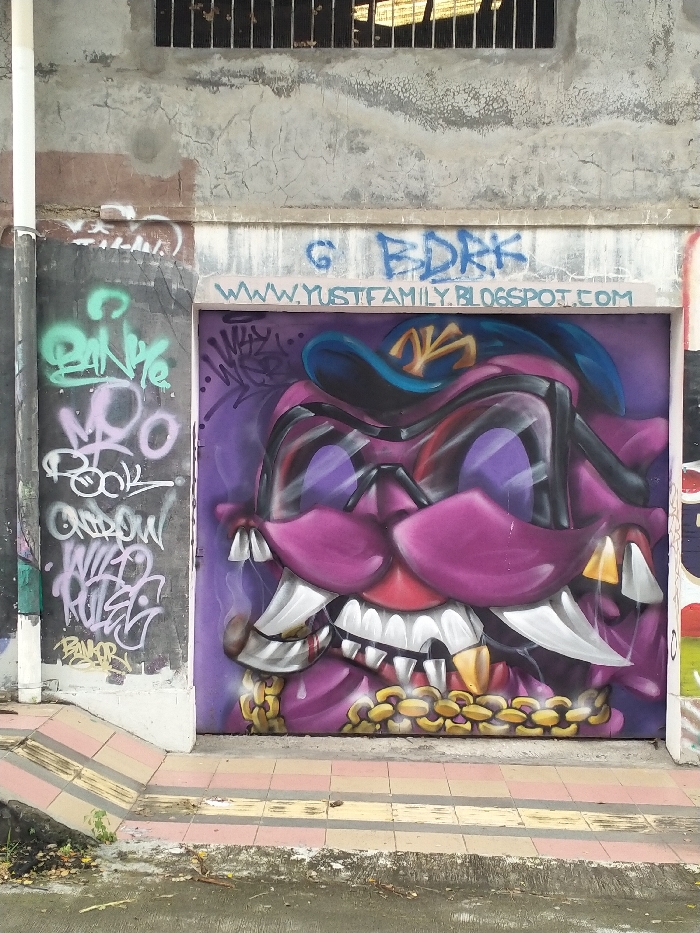
This media file presents a vibrant and detailed graffiti artwork on a metal shutter within an urban setting in Karanganyar, Indonesia. The central piece is a large, stylized depiction of an aggressive-looking character or monster head, dominated by shades of purple and magenta. It features prominent, intense dark eyes, an open maw revealing numerous sharp white fangs, some tipped with gold, and a heavy golden chain encircling its lower jaw. A blue baseball cap with a distinct yellow emblem (possibly a stylized 'NY') sits atop its head. Above the main artwork, blue graffiti reads "G BDRK" and "WWW.YUSTFAMILY.BLOGSPOT.COM". To the left, a concrete wall is heavily tagged with multiple layers of graffiti in various colors, including light green, white, and grey. Visible words and tags include "MOO", "ROCK", "WILD RULER", and "BANOR", amidst other less legible script. The scene is an outdoor public space, likely a street or alley. The walls are made of weathered concrete, and an upper window is fitted with metal bars. A tiled sidewalk with yellow and pink stripes occupies the foreground, suggesting a pedestrian area. The image is captured during daylight, indicating clear weather. The overall impression is one of a dynamic urban landscape adorned with street art.
Karanganyar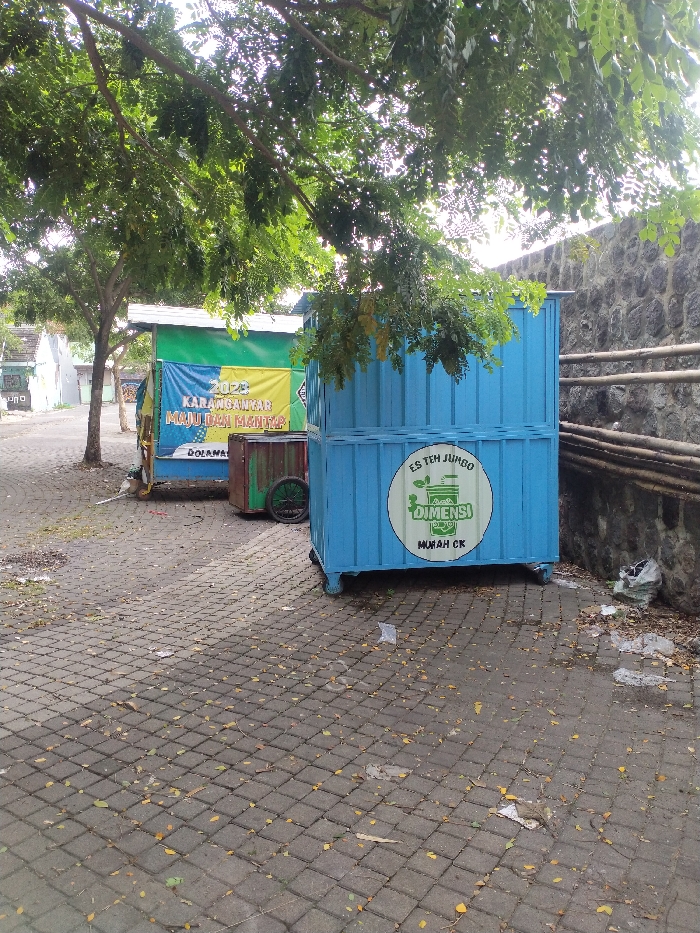
This outdoor scene captures a paved area, likely a street or public pathway, shaded by several green-leafed trees. On the right, a dark stone wall runs along the edge of the paved surface. The ground is made of interlocking square pavers and has scattered dry leaves and some litter, particularly near the wall and the blue stall. Two portable stalls or carts are prominent. The one closer to the foreground and on the right is bright blue, made of corrugated metal. It has a circular white logo on its side with green text that reads "ES TEH JUMBO", "DIMENSI", and "MURAH CK". Further back and to the left is another stall, green and yellow, with a fabric banner draped across its front. The banner displays the text "2023", "KARANGANYAR", "MAJU DAN MANDIRI", and "DOLANAN". Behind this stall, a smaller, rustic-looking cart with wooden wheels is partially visible. No people are present in the image. The time of day appears to be sunny daytime, with bright light filtering through the tree canopy, creating dappled shadows on the ground. The location is consistent with a public area in Karanganyar, Indonesia, as indicated by the text on the banner. The presence of the stalls suggests a commercial setting where food or drinks might be sold.
Karanganyar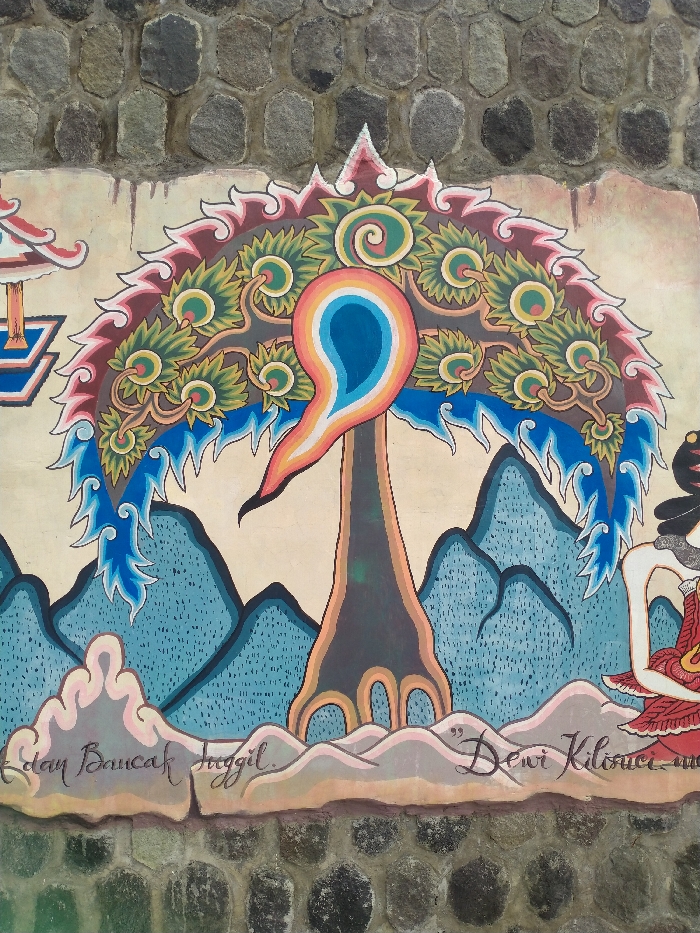
A vibrant mural in the traditional Indonesian Wayang style is painted on a light-colored wall, framed by rough-hewn grey and brown stones above and below. The central element of the mural is a highly stylized, tree-like figure, reminiscent of a *Gunungan* or *Kayon* from shadow puppet theatre. Its broad, ornate canopy is rich with patterns in green, yellow, and red hues, featuring prominent swirling motifs. A striking, elongated teardrop or flame shape forms the center of the canopy, showcasing a rainbow of colors including red, orange, yellow, and shades of blue. The tree's dark brown trunk extends downwards, with stylized roots. Behind the tree, undulating blue mountains with a textured, stippled appearance rise. To the far left, a portion of a tiered pagoda-like structure with a red roof is visible. On the far right, a seated figure, likely a deity or character from folklore, is depicted with red and gold attire, characteristic of traditional Indonesian art. The overall scene is static and decorative, presented as a piece of public art. Visible text is inscribed on a light brown, cloud-like element at the bottom of the mural. On the left side, partially cropped, the text reads "day Buncak Jagil." On the right side, also partially cropped, it reads "Dewi Kilosuci." The mural's intricate details and color palette suggest a cultural or mythological narrative.
Karanganyar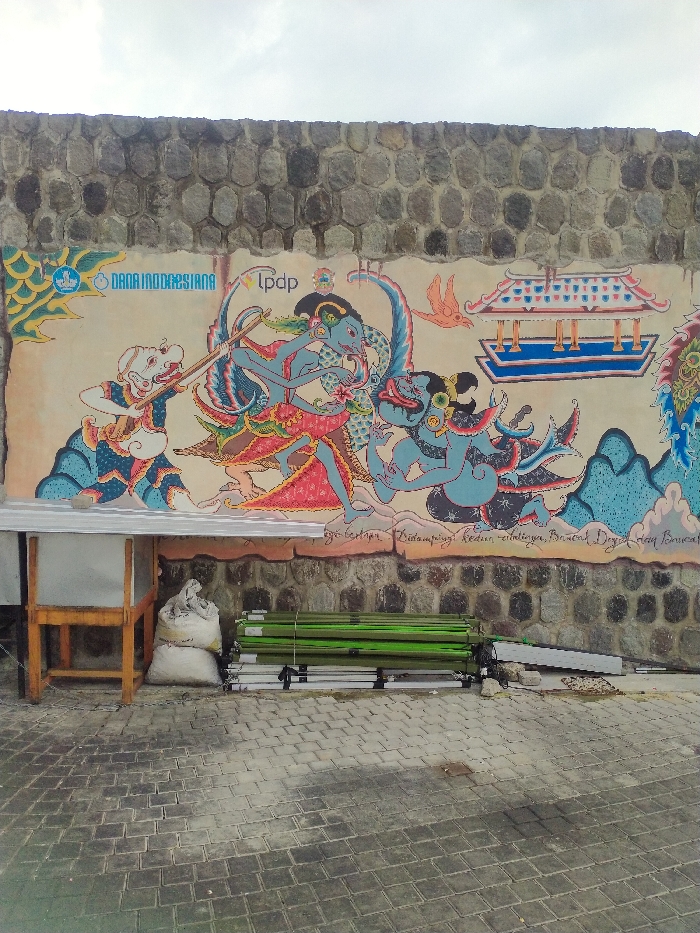
An outdoor scene features a vibrant mural painted on a stone wall under an overcast sky. The wall itself is constructed from large, irregularly shaped grey stones. The mural, rendered in a style reminiscent of traditional Indonesian Wayang art, depicts several figures in dynamic poses against a light background. On the far left, a light-skinned character, possibly a Punakawan (clown figure from Javanese shadow puppet theater), is shown holding a long staff or spear. To its right, a central blue-skinned figure, likely a deity or hero, wears an elaborate headdress and garments, and appears to be drawing a bow, with a green-feathered wing-like element behind its head. Further right, another blue-skinned character, possibly a demon or another powerful figure, is also depicted in an active pose. A traditional Indonesian pavilion-style building with a red roof and blue base, an orange bird, and stylized blue mountain shapes complete the background elements of the mural. Visible text on the mural includes: * On the upper left: A blue and white logo (featuring a stylized figure or boat) next to the words "DANA INDONESIANA". * On the upper center: The letters "lpdp" in lowercase. * Along the bottom of the mural, a line of handwritten text in Indonesian is partially legible. Parts read "yang bertau.", followed by "Didampingi kedamaian," and then less clear words, which the OCR suggests include "kedun dingen, Binnend Dryill day lonuca." In the foreground, to the left, there is a simple wooden stand or table with a white surface, possibly covered by a tarp. Beneath it, two white sacks are stacked. To the right, a pile of folded green items, resembling chairs or small tents, are stacked horizontally on the ground, alongside some silver-colored metal frames. The ground is paved with grey rectangular interlocking blocks, indicating a public or semi-public outdoor area.
Karanganyar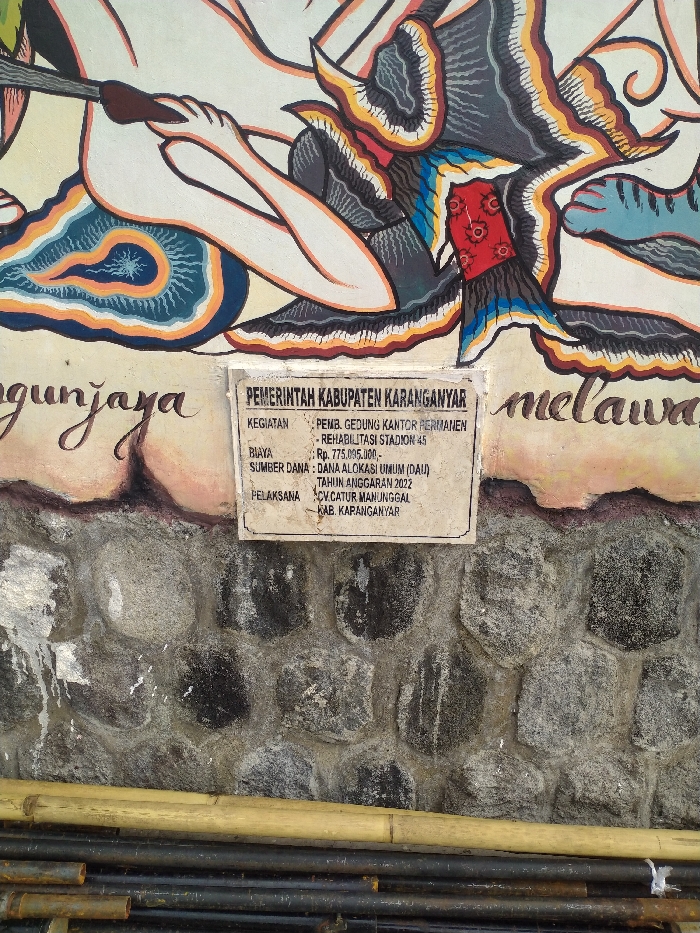
An outdoor, eye-level shot captures a vibrant mural, a project information board, and a stone wall in Karanganyar, Indonesia. The upper portion of the image is dominated by a colorful mural, likely in the style of traditional Indonesian art, featuring stylized figures with intricate patterns in shades of blue, orange, red, black, and white. Parts of the mural show human-like hands holding an object, and elaborate, wing-like or costume elements. Text from the mural, partially visible on the left, reads "gunjaya," and on the right, "melawa." Below the mural, centered in the frame, is a rectangular white sign with black text, serving as a project information board. It details a government initiative from the "PEMERINTAH KABUPATEN KARANGANYAR" (Karanganyar Regency Government). The "KEGIATAN" (Activity/Project) includes "PEMB. GEDUNG KANTOR PERMANEN" (Permanent Office Building Construction) and "REHABILITASI STADION 45" (Rehabilitation of Stadium 45). The "BIAYA" (Cost) is listed as "Rp. 775.095.000,-" (775,095,000 Indonesian Rupiah), funded by "DANA ALOKASI UMUM (DAU)" (General Allocation Fund) for the "TAHUN ANGGARAN 2022" (Fiscal Year 2022). The "PELAKSANA" (Contractor) is "CV. CATUR MANUNGGAL KAB. KARANGANYAR." Below the sign, a robust stone wall with irregular, dark grey rocks cemented together forms the lower half of the image. At the very bottom, several long bamboo poles and possibly some dark, cylindrical metal pipes are stacked horizontally, suggesting ongoing construction or materials storage. The lighting indicates it is daytime with clear weather. The overall scene reflects a public infrastructure project in progress or recently completed, adorned with local artistic elements.
Karanganyar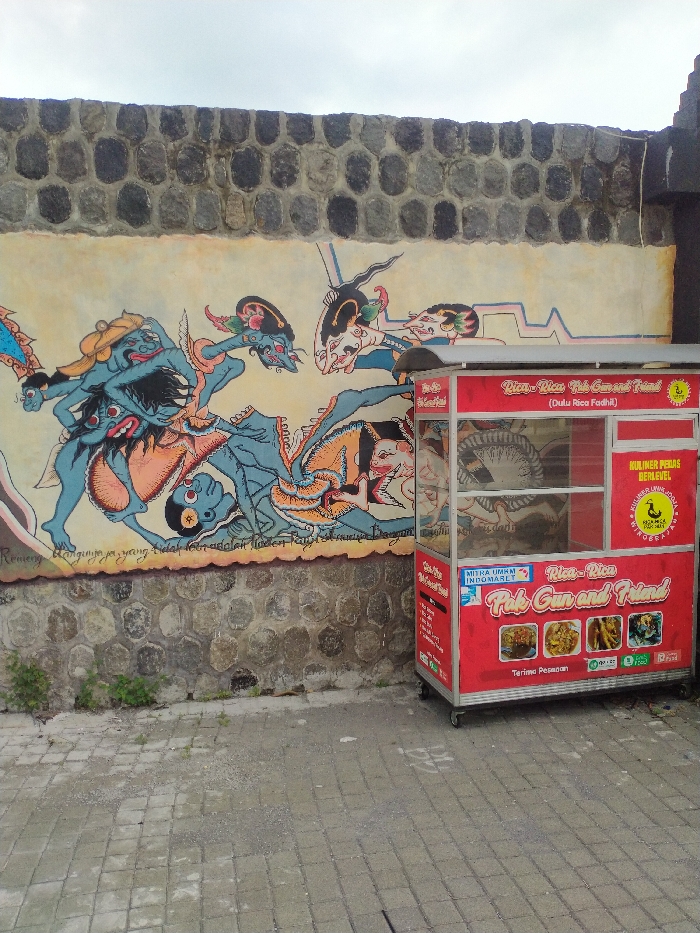
An outdoor scene in Karanganyar, Indonesia, features a vibrant mural painted on a textured, light-colored wall, which rests atop a rugged stone foundation. The mural, rendered in a traditional Indonesian style reminiscent of Wayang figures, depicts several blue-skinned characters engaged in what appears to be a struggle or dynamic interaction. One large, multi-armed figure dominates the left side, while other figures, some fallen or in motion, are spread across the mural. Beneath these figures, fragmented Indonesian text is visible, including words like "Remeng," "tidak," and "adalah." In front of the mural, to the right, stands a bright red food cart on wheels. The cart has glass display cases, though they appear mostly empty. Prominently displayed on the cart is the branding "Rica - Rica Pak Gun and Friend," with a smaller subtitle "(Dulu Rica Fadhil)." Yellow labels on the side advertise "KULINER PEDAS BERLEVEL" (Spicy Culinary Level) and "KULINER INDONESIA BEDA RASA" (Indonesian Cuisine Different Taste), featuring a duck logo. Below, it notes "MITRA UMKM INDOMARET" (Indomaret MSME Partner) and shows images of various food items, including chicken/meat dishes and fried snacks. The bottom of the cart reads "Terima Pesanan" (Accept Orders). The ground beneath the cart and wall is paved with gray rectangular blocks. The sky above is overcast, suggesting a cloudy day.
Karanganyar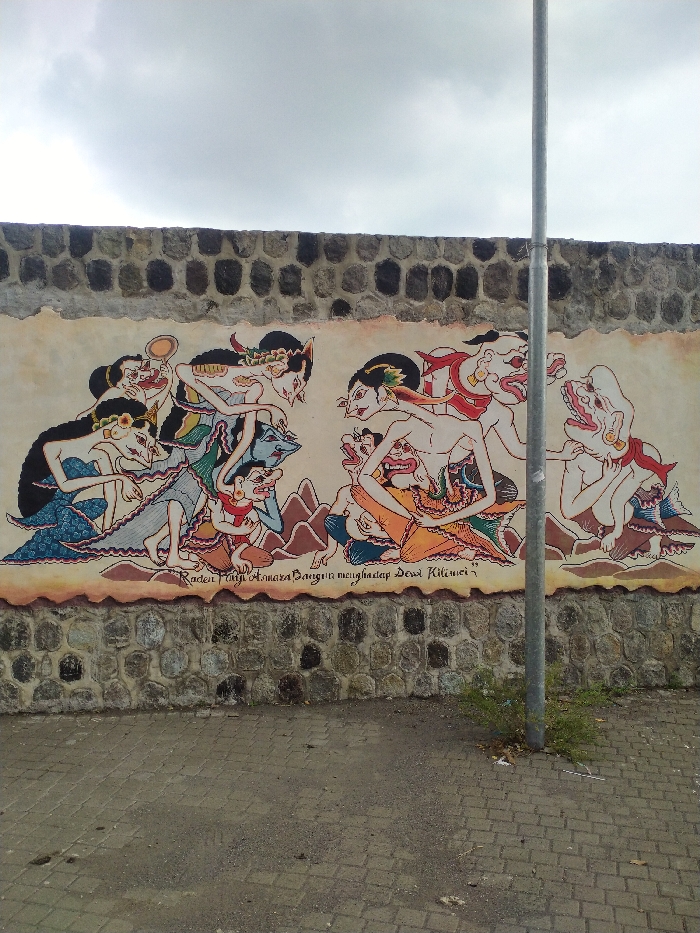
A vibrant mural, painted in the traditional Javanese wayang style, adorns a stone wall in Karanganyar, Indonesia. The artwork depicts a dynamic narrative scene featuring numerous stylized figures. On the left, several characters, some with intricate headdresses and delicate features, are engaged in various poses, including one holding a round object resembling a mirror. The central part of the mural shows a key interaction between figures, one of whom is identified by the accompanying text. To the right, more grotesque or demonic-looking figures with large, open mouths and exaggerated features are visible. Below the central figures, text written in white states: "Raden Panji Amara Bangun menghadap Dewi Kilisuci." This translates to "Raden Panji Amara Bangun meets Dewi Kilisuci," indicating a specific mythological or historical encounter. The figures are rendered with distinctive colors, including blues, reds, golds, and greens, and wear traditional clothing and ornaments. The mural is painted directly onto a section of a robust stone wall, constructed from irregularly shaped dark grey and brown rocks. Below the wall, the ground is paved with grey interlocking bricks, suggesting a sidewalk or public pathway. A tall, slender metal pole, possibly a street light post, stands on the right side of the frame, partially obscuring the mural. The sky above is overcast with a blanket of grey clouds, indicating a cloudy daytime.
Karanganyar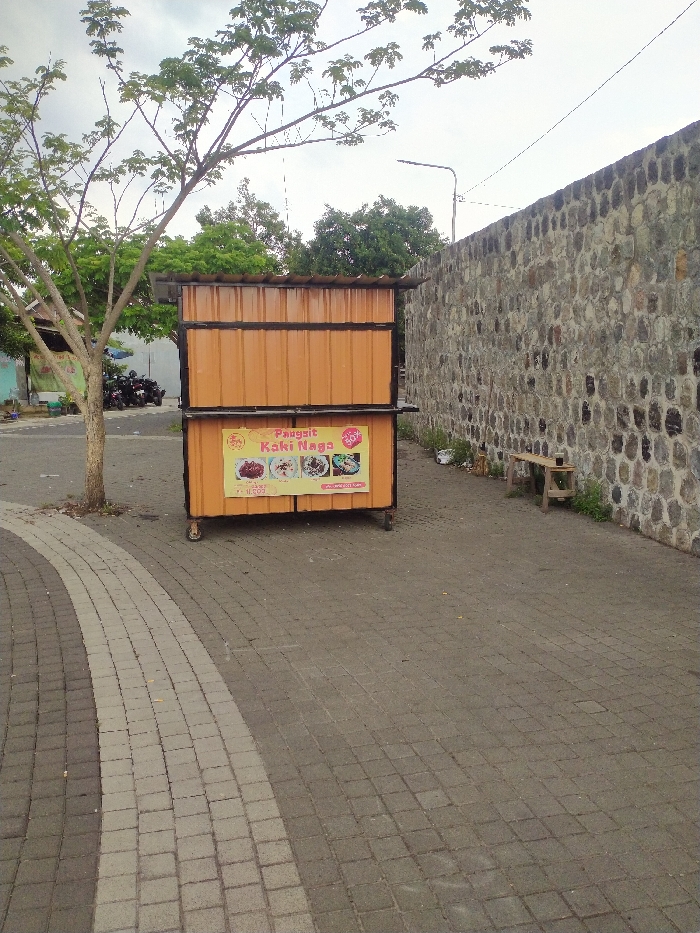
An outdoor scene features an orange-brown metal food cart with a black frame and small wheels, positioned on a paved surface. To the left of the cart stands a tree with green leaves and a slender trunk. To the right, a tall, rough stone wall extends into the distance, made of various dark-colored stones. A small wooden bench sits at the base of the wall on the right side. The ground is paved with interlocking concrete blocks. In the foreground, a curved section of lighter grey and white blocks creates a distinct path against the darker grey pavement. Beyond the tree, glimpses of parked motorbikes and a building are visible. The sky is overcast, indicating daytime. The front of the food cart displays a yellow banner with the prominent text "Pangsit Kaki Naga" (Dragon Foot Dumplings/Wontons) in red and white letters. Below this, four circular images showcase different food items offered. Visible details on the banner include a price of "11.000" (likely Indonesian Rupiah) and a "50%" discount icon, along with the text "BOX BOX". No people or active events are present, suggesting a quiet moment in this public space in Karanganyar, Indonesia.
Karanganyar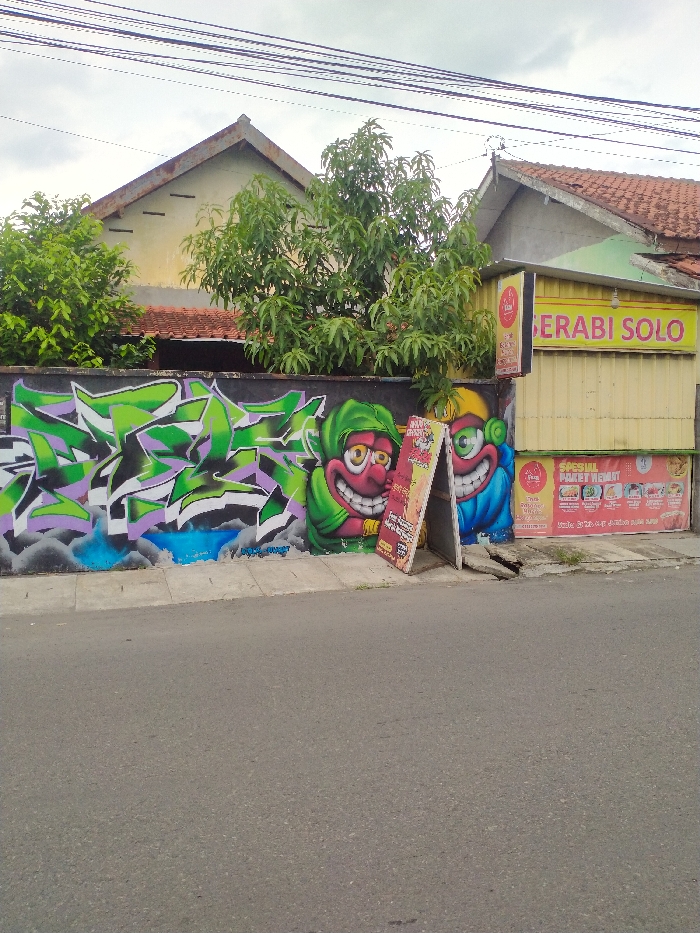
The image captures a daytime scene in Karanganyar, Indonesia, featuring a vibrant street-side wall and a food stall. In the foreground, a gray asphalt road stretches across the bottom, bordered by a concrete curb. The main subject is a black wall adorned with colorful graffiti. On the left, large, jagged, abstract lettering in shades of green, purple, white, and black with blue highlights occupies a significant portion. To its right, two cartoonish characters are depicted. Both have large, wide smiles with prominent teeth and exaggerated, wide-open eyes. One character, predominantly green and red, wears a hood, while the other, mostly blue and yellow, also sports a hood. In front of the graffiti, two A-frame sandwich board signs stand on the sidewalk, advertising various items. The text on these signs is largely unreadable, but one appears to promote a "DISKON" (discount) and "PROMO." To the far right, a small, yellow-sided food stall or kiosk is visible. A prominent sign on its upper section reads "GERABI SOLO" in blue text on a yellow background. Below this, a banner advertises "SPESIAL PAKET HEMAT" (Special Economical Package) with images of food items and mentions "THIS FRIDAY & SATURDAY." In the background, behind the wall and stall, are parts of residential houses with reddish-brown tiled roofs. Lush green trees are interspersed between the buildings and the wall. Overhead, multiple black power lines crisscross against a cloudy, overcast sky, indicating a bright but not sunny day. No people are visible, and there is no specific activity taking place in the captured moment.
Karanganyar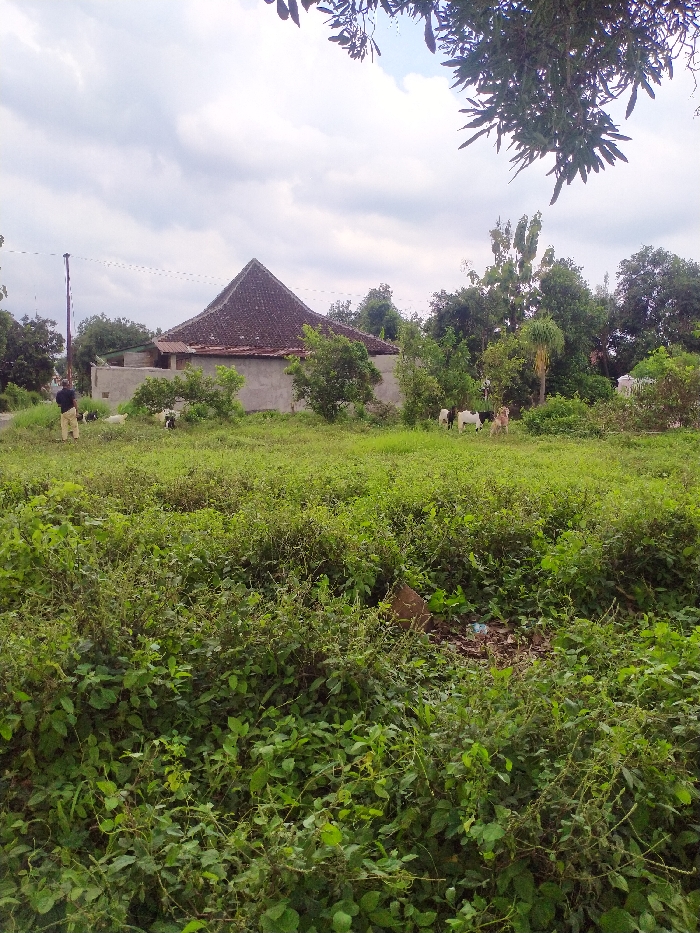
This image depicts a rural or semi-rural landscape in Karanganyar, Indonesia, characterized by abundant greenery under a bright, cloudy sky. The foreground is densely covered with lush green vegetation, including tall grass and various bushes. In the mid-ground, a distinctive house features a high-pitched, dark tiled roof and unpainted concrete or stucco walls. To the left of the house, a dark utility pole stands tall, with wires stretching horizontally across the scene. One person is visible on the far left, wearing a dark shirt and light-colored pants, standing with their back partially turned, seemingly observing the surroundings. Scattered in the mid-ground, to the right of the person and in front of the house and trees, are several goats of varying colors (white, black, light brown), appearing to graze or rest. The background is dominated by a dense collection of green trees and foliage, creating a natural backdrop. Overhanging dark green leaves from a tree partially frame the top right corner of the image. A small amount of dark brown and light blue debris is visible amidst the overgrown grass in the lower mid-right. The scene conveys a peaceful, everyday rural setting, likely during daylight hours given the overall brightness and lack of harsh shadows. There is no visible text in the image.
Karanganyar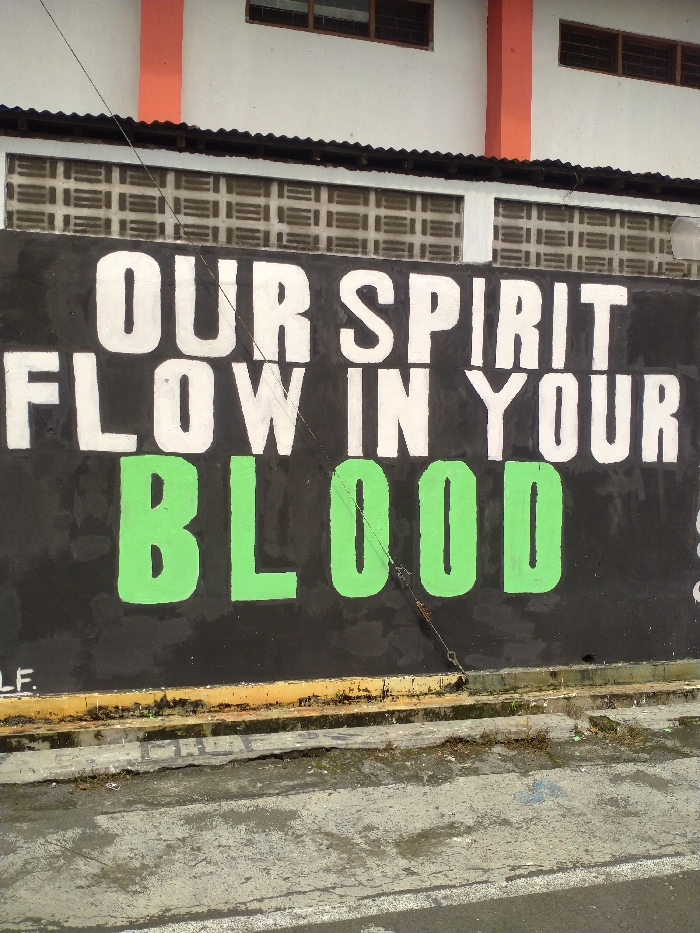
The image displays an outdoor urban scene in Karanganyar, Indonesia, centered on a black wall featuring prominent graffiti. The main message, painted in large capital letters, reads: "OUR SPIRIT FLOW IN YOUR BLOOD." The words "OUR SPIRIT" and "FLOW IN YOUR" are in white, while "BLOOD" is rendered in a vivid, bright green, creating a stark visual contrast against the dark wall. A small, partially visible inscription, "LF.", appears in the bottom left corner of the wall. Behind the graffiti wall, a building with white walls and orange structural beams is visible, featuring multiple horizontal windows with grates. The base of the black wall shows signs of wear and rust, where it meets an uneven concrete sidewalk or ground. A thin wire or cable runs diagonally across the wall, partially obscuring the text. The scene appears to be set during the daytime, under diffused or overcast lighting, as indicated by the soft illumination and lack of harsh shadows. There are no people visible in the frame, allowing the graffiti to be the sole narrative focus. The text itself conveys a strong and intense message of shared essence or pervasive influence, suggesting a deep connection or declaration within its local context. The overall impression is that of a raw, expressive urban landscape.
Karanganyar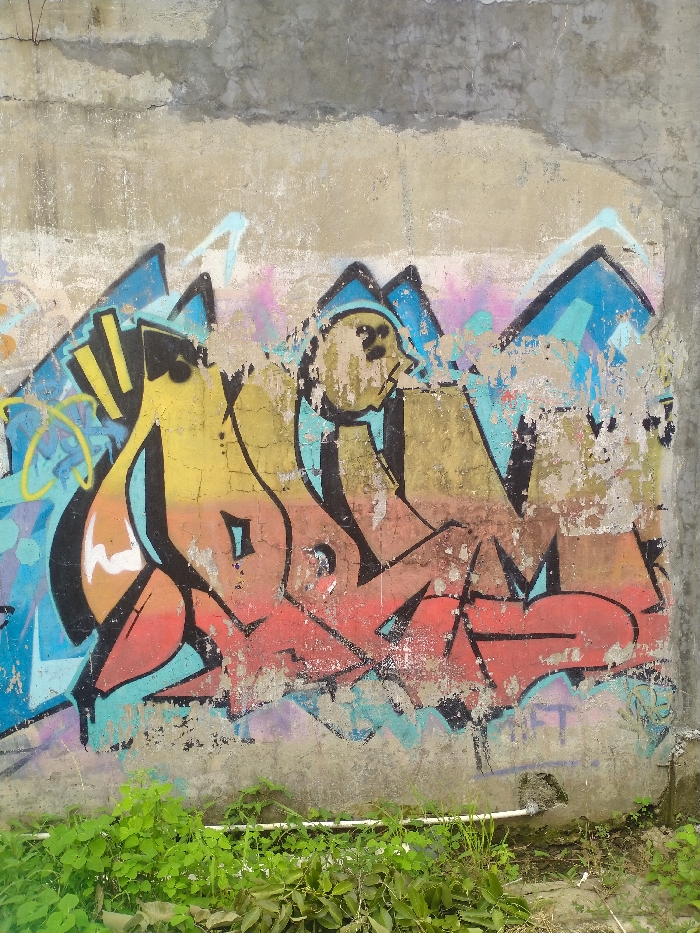
The image captures a weathered concrete wall in Karanganyar, Indonesia, covered in colorful graffiti art. The wall itself shows significant signs of age and decay, with large sections of paint having peeled, chipped, or faded, revealing the rough concrete texture beneath. The graffiti consists of highly stylized, blocky letters or shapes, rendered in a "wildstyle" fashion, making them challenging to read explicitly. The dominant colors within the artwork are bright yellow, transitioning into orange and red towards the lower sections of the letters, all outlined with thick black lines. Splashes of lighter blue and hints of pink spray paint form a background behind these main elements, adding depth to the piece. A notable detail within one of the central letters is a small, face-like feature. At the base of the wall, a vibrant patch of green foliage, comprising small plants and grass, grows, partially obscuring a thin white pipe or hose that runs horizontally across the bottom of the frame. The scene is illuminated by daylight, suggesting it was captured during the day with clear visibility and no harsh shadows. The overall impression is one of urban artistic expression on a deteriorating urban surface.
Karanganyar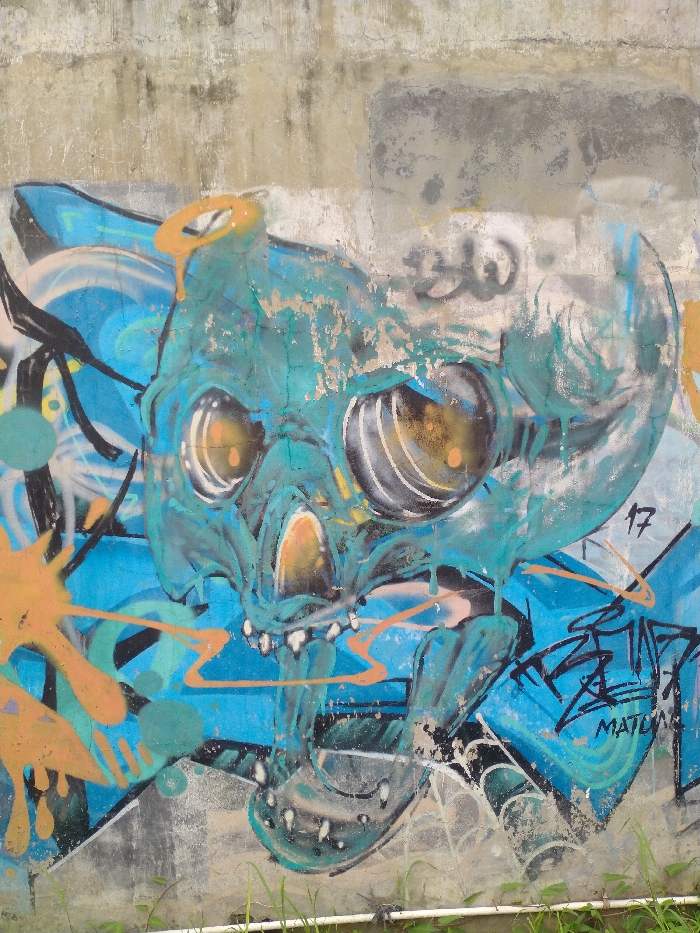
This media file depicts a vibrant and weathered graffiti mural on a concrete wall, likely outdoors in Karanganyar, Indonesia. The central subject of the graffiti is a large, stylized skull or monstrous head, predominantly rendered in shades of blue and teal. Its surface shows significant texture and areas where the paint appears chipped or worn, either intentionally or due to age. The skull features large, expressive eyes with glowing orange-yellow centers, highlighted by black and white details. An orange, halo-like ring with drips sits above the skull's head, and splashes of orange paint are scattered on the left side of the artwork, contrasting with the blue background. The graffiti background itself consists of various shades of blue with black and white outlines and abstract shapes. The concrete wall above and around the graffiti is visible, showing signs of aging, with weathered grey and beige patches. At the very bottom of the image, green grass and a white pipe are discernible, indicating the wall is at ground level. Visible text within the graffiti includes the number "17" on the right side of the skull. Below this, towards the bottom right, there is stylized black tagging, with the word "MATURA" clearly legible underneath. The image appears to be taken during daylight.
Karanganyar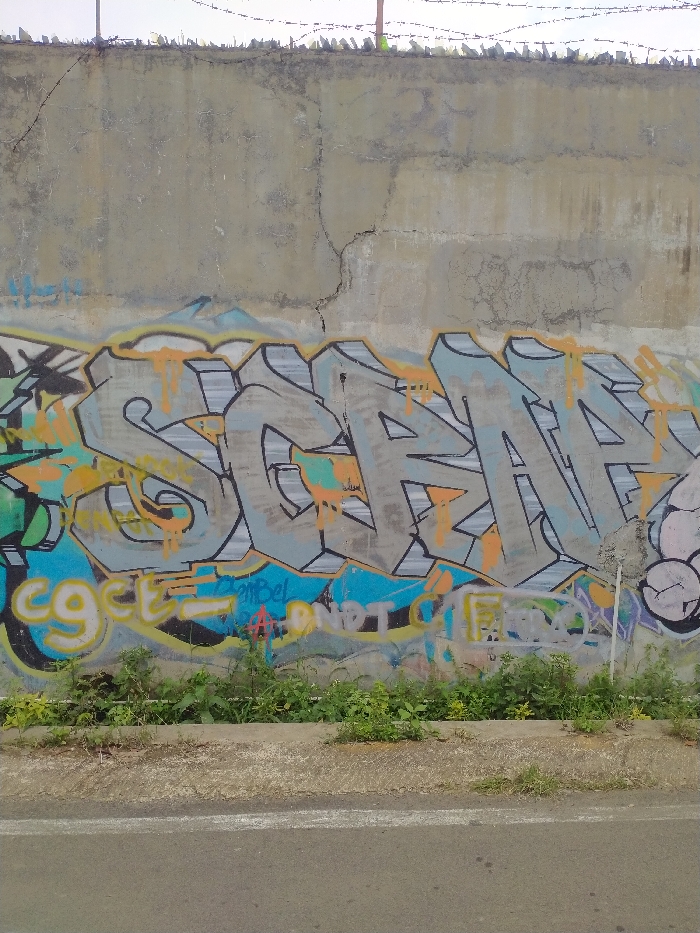
The image captures a graffitied concrete wall located alongside an asphalt road in Karanganyar, Indonesia. The weathered, light gray wall is heavily cracked, with a prominent fissure running vertically and then horizontally across its upper section. Along the top edge, sharp barbed wire is visible, suggesting a security measure. The wall is covered with multiple layers of graffiti. The most prominent piece is a large, stylized word "SCRAM" rendered in gray with black outlines, accented by patches of orange and light blue, and set against a bright blue background. Below this, several smaller tags and words are visible, including yellow letters spelling "cget" and red text that appears to read "AnBel A" and "dnot" (possibly part of "don't"). Other, less legible markings are also present. A strip of green vegetation, consisting of various plants and weeds, grows at the base of the wall, separating it from the road. In the immediate foreground, a section of an asphalt road is visible, bordered by a lighter gray curb or edge. The scene is brightly lit, indicating it is daytime, with a light, indistinct sky above the wall. No people or animals are present in the image.
Karanganyar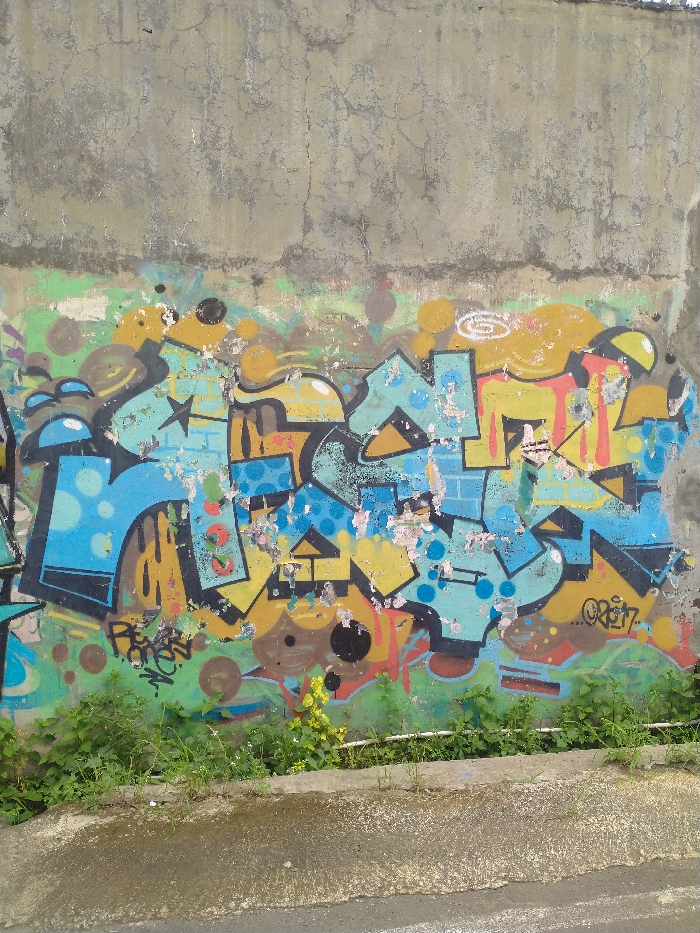
The image displays a section of a concrete wall in Karanganyar, Indonesia, heavily adorned with colorful graffiti art. The upper part of the wall is bare, rough grey concrete, showing cracks and signs of wear. Below this, a large, complex graffiti piece dominates the central area, rendered in a wildstyle or bubble letter format. The graffiti primarily uses bright blue, yellow, and orange tones, outlined in black, with splashes of red and green accents. Various elements like stars, circles, and dripping paint contribute to its intricate design. The paint is visibly weathered and peeling in several spots, revealing the lighter concrete beneath and indicating the artwork's age or exposure to the elements. At the very bottom of the wall, and extending onto the ground, is a lush growth of green weeds and small plants, partially covering the lower section of the graffiti and a green base layer of paint. The ground in front of the wall is a dark, possibly damp, asphalt or concrete surface. No people or specific activities are depicted; the scene is static, showcasing urban art within its environment. The lighting suggests it is daytime with clear weather. While much of the stylized text is difficult to decipher, a small tag towards the lower right of the main graffiti piece appears to read "ORBIT".
Karanganyar