Kaura Goje, Nigeria
30 memories from Kaura Goje, Nigeria
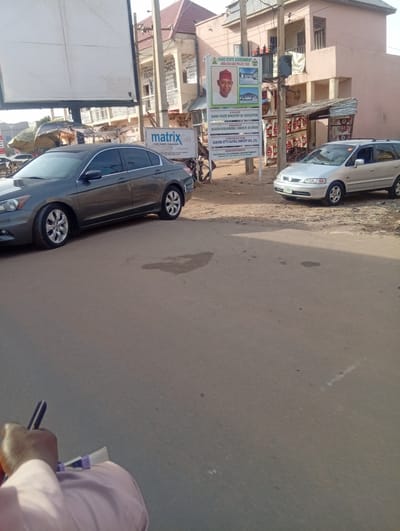
The image captures a street scene in Kaura Goje, Nigeria, showcasing two parked vehicles. A dark grey sedan is situated on the left side of the road, while a silver minivan is parked on the right. In the background, a building with signage for "CHOICE FASHION" and "SUPERMODEL DRESS" is visible. Further in the background to the right, is a pinkish building. A sign displaying "KANO STATE GOVERNMENT" and "KANO STATE MINISTRY OF EDUCATION" can be seen near the silver minivan. A smaller sign reading "matrix Gas" is positioned near the dark grey sedan. A person can be seen in the foreground, holding an object that appears to be a pen. The environment seems dusty and somewhat cluttered.
Kaura Goje
A motivational message is displayed on a vibrant pink background. White text states, "I believe that every single event in life happens in an opportunity to choose love over fear." Below the text, a horizontal line precedes a smiley face wearing sunglasses. The overall composition is simple, featuring a powerful sentiment conveyed through text and a lighthearted emoji.
Kaura Goje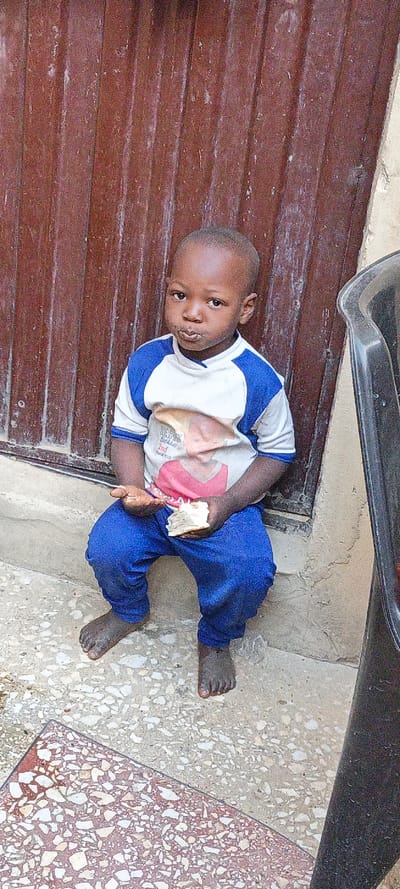
The image displays a full-body shot of a young, dark-skinned child seated on a concrete surface. The child is looking directly at the viewer with a neutral, slightly pouting expression, and there is a visible white residue around their mouth, suggesting they are eating. The child is wearing a short-sleeved t-shirt that is predominantly white with blue raglan sleeves and a blue collar. On the front of the t-shirt, there is a printed image of a person with what appears to be reddish-brown hair. Below this image, text is partially visible, which reads "HAPPY Birthday" followed by "2nd" and "2013", indicating the shirt may be a commemorative item for a second birthday from that year. The child is also wearing blue full-length pants and is barefoot, with their feet resting on the patterned ground. In both hands, the child holds a piece of light-colored bread or pastry. The piece in their left hand appears to be smaller or crumbled, while the piece in their right hand is larger and shows signs of being torn or eaten. The background behind the child consists of a reddish-brown vertical surface, which resembles corrugated metal or weathered wooden planks, possibly part of a door or wall. The ground beneath the child is a light-colored concrete or tiled surface mottled with various shades of gray, white, and red aggregate. To the far right of the frame, a dark, partially visible object, possibly a black plastic chair or container, is present. The overall lighting suggests the photo was taken during the day, likely outdoors.
Kaura Goje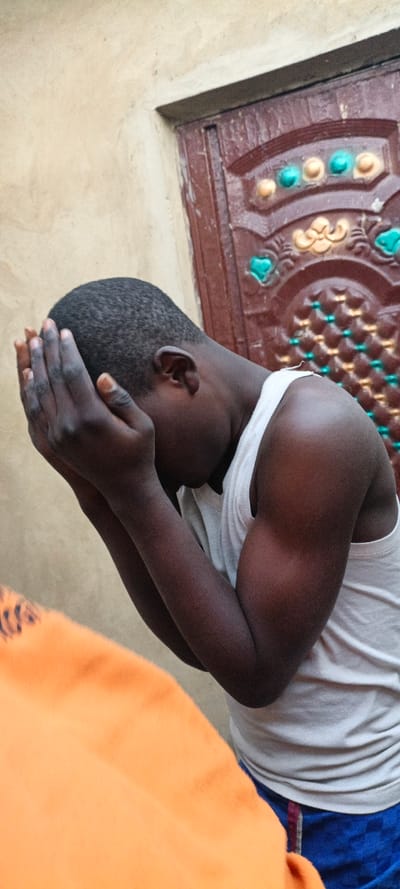
The scene in Kaura Goje, Nigeria, depicts a young male with dark skin and short, dark hair, positioned with his head bowed forward and hands covering his face. He is wearing a white sleeveless undershirt and blue shorts featuring a faint checkered pattern. His hands are clasped together, palms pressed against his forehead and eyes. Behind him, to the left, is a light beige or tan wall with a smooth, possibly stuccoed texture. To his right, a dark reddish-brown wooden door or doorframe is visible, featuring ornate, embossed or carved decorative patterns in teal and orange/gold colors. A portion of an orange textile object or garment is present in the lower-left foreground, partially obscuring the view, suggesting another presence or item nearby.
Kaura Goje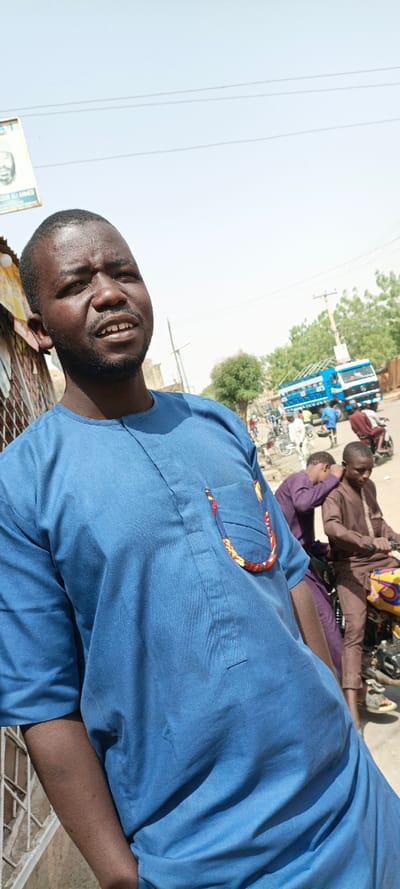
The image displays a street scene in Kaura Goje, Nigeria, under bright, clear daylight with a pale blue sky overhead, crossed by utility lines. The central figure is an adult male with dark skin, short dark hair, and a beard, positioned in the foreground, looking upwards and to the right with a slightly open mouth. He wears a solid blue, long-sleeved tunic, which features a left chest pocket adorned with a colorful fabric trim displaying red, yellow, blue, and black patterns. His right arm hangs beside him. In the midground, to the right of the central figure, a young male in a brown long-sleeved garment sits on a yellow and black motorcycle. Another male, wearing a purple long-sleeved garment, is partially visible nearby, leaning forward. Additional indistinct figures and bicycles populate the background, indicating active street traffic. On the far left, a partial white sign with "BASHIR ALI AHMED" visible hangs from a structure. Further back, a large blue and white truck with a distinct cargo area is visible on the street. Utility poles and sparse green trees are present throughout the background, with the ground appearing to be a mix of dirt and pavement.
Kaura Goje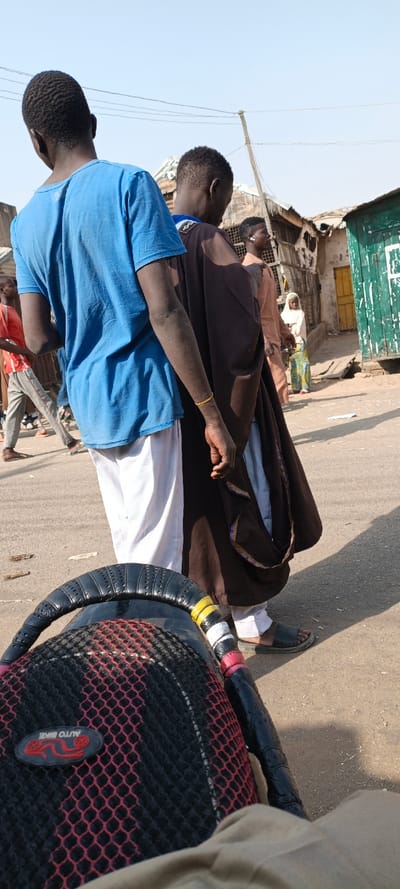
The image captures a street scene in Kaura Goje, Nigeria, from the perspective of someone seated on a motorcycle. In the immediate foreground, the black seat and grab rail of a motorcycle are visible, featuring a red and black mesh cover with an "AUTO BIKE" patch. The grab rail is wrapped with yellow, white, and red tape. In the mid-ground, several individuals are present. Closest to the camera, with their back to the viewer, is a dark-skinned male wearing a light blue t-shirt and white trousers. To his right and slightly behind him is another dark-skinned male, also facing away, wearing a dark brown flowing garment over a lighter undergarment and white trousers, with black sandals on his feet. A gold-colored bracelet is visible on his right wrist. Further to the right and partially obscured, a third dark-skinned male is seen in a tan shirt, with an earpiece in his right ear. To the far left, a fourth dark-skinned male in a red t-shirt and grey trousers walks away from the camera. A young female child in a white hijab and a long, colorful patterned dress stands further back on the right side of the street. The background consists of weathered buildings and structures under a clear, bright blue sky. On the right, a building with a peeling green facade and a yellow door is visible. Another structure behind the child has a lighter wall and a partially open yellow door. Corrugated metal roofs are visible on several buildings. A wooden utility pole stands towards the center-right. The ground is a light-colored asphalt or dirt road, showing distinct shadows cast by the strong daylight.
Kaura Goje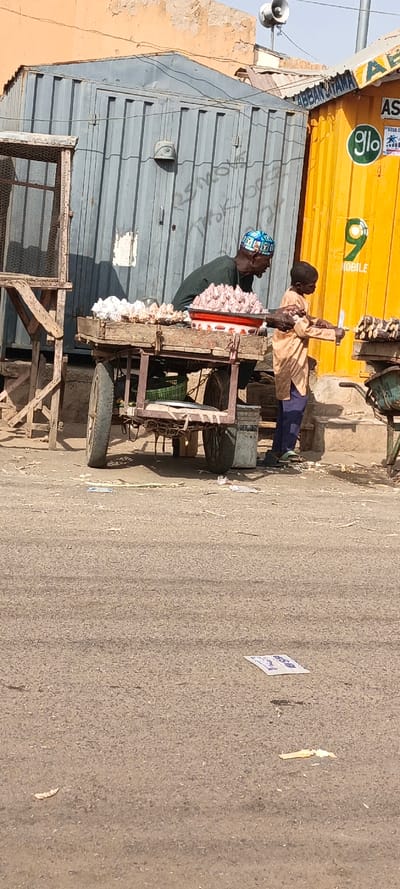
The scene depicts a street-level commercial area in Kaura Goje, Nigeria, under daylight conditions. Two individuals are present: an adult male and a child male. The adult male, with dark skin and wearing a dark green long-sleeved shirt and a patterned blue and white cap, stands behind a two-wheeled wooden vendor cart. This cart displays multiple piles of light-colored, knobby produce, consistent with ginger or garlic, and a red-rimmed white enamel basin containing a reddish, granular substance. The child male, with dark skin and dressed in a light tan tunic and dark blue trousers with green sandals, stands to the right of the main vendor cart. He holds a silver-bladed knife in his right hand, positioned towards dark, segmented stalks (likely sugarcane) arranged on a smaller, green metal cart. In the background, two repurposed shipping containers serve as commercial structures. To the left, a weathered gray corrugated metal container exhibits partial white graffiti. To the right, a bright yellow corrugated metal container features prominent "glo" and "9 MOBILE" telecommunication logos, with the text "ABBAN UTAMA" visible above. Behind these structures, a faded orange-brown building wall with peeling plaster is visible. A white horn speaker is mounted on a pole above the yellow container. The ground is a gray asphalt surface, sparsely scattered with small pieces of debris, including organic matter and a white paper wrapper with blue text in the foreground.
Kaura Goje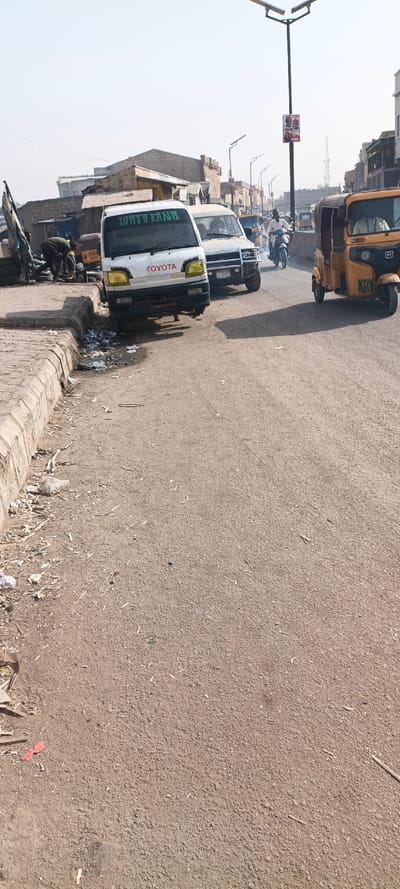
This image captures a daytime street scene in Kaura Goje, Nigeria. The foreground presents a dusty, paved road with a raised concrete curb on the left, bordering an unpaved shoulder scattered with litter, plastic bags, and wood debris. On the left side of the frame, a person in dark clothing is bent over near a collection of dark objects, possibly tires, on the shoulder. Adjacent to this, a white Toyota minivan with "WATH RANA" written in green on its windshield and yellow-tinted headlights is positioned with its front wheels on the unpaved shoulder and its rear on the paved road; its front bumper appears to be missing. Behind the Toyota minivan, a second white van equipped with a large metal front bumper guard is visible. Further down the road, an individual on a motorcycle, wearing a light-colored shirt, rides toward the right side of the frame, with visible exhaust fumes trailing. To the far right, a yellow auto-rickshaw, marked "KRY" on its side, is in motion, heading away from the viewer. Other indistinct vehicles, including additional auto-rickshaws, and figures are present further down the street. The background reveals a series of single and multi-story buildings lining both sides of the street, some appearing to be constructed with exposed brick or concrete, and some in various states of completion or disrepair. Modern streetlights with solar panels are erected along the thoroughfare, one of which displays a multi-person political poster. The sky is a uniform, light, hazy blue.
Kaura Goje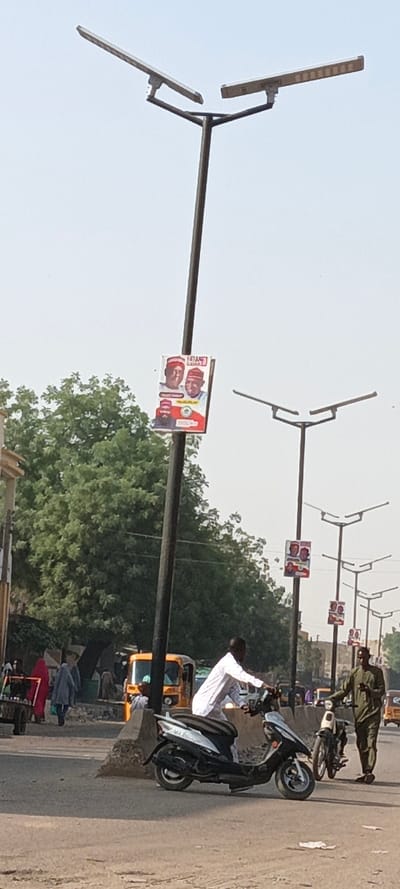
This image captures a daytime street scene in Kaura Goje, Nigeria. A dark-colored streetlight pole with a bifurcated top supporting two rectangular solar panel/LED light fixtures dominates the left-center foreground. A rectangular political campaign poster, featuring three male individuals in traditional attire and red caps, is affixed to this pole. To the right, a series of identical solar-powered streetlights extends into the distance, each displaying similar campaign posters. On the paved road surface in the mid-ground, a man dressed in a white tunic is situated on a white and black scooter, facing right. To his immediate right, another man in an olive-green traditional outfit stands next to a lighter-colored motorcycle. In the background on the left, a large, dense green tree is visible. Several pedestrians, including individuals in red and light blue garments, are walking along the side of the road. Multiple yellow auto-rickshaws (Keke Napep) are also present further down the street. The road surface exhibits signs of use, and a concrete barrier is visible at the base of the main streetlight pole. The sky is clear and bright.
Kaura Goje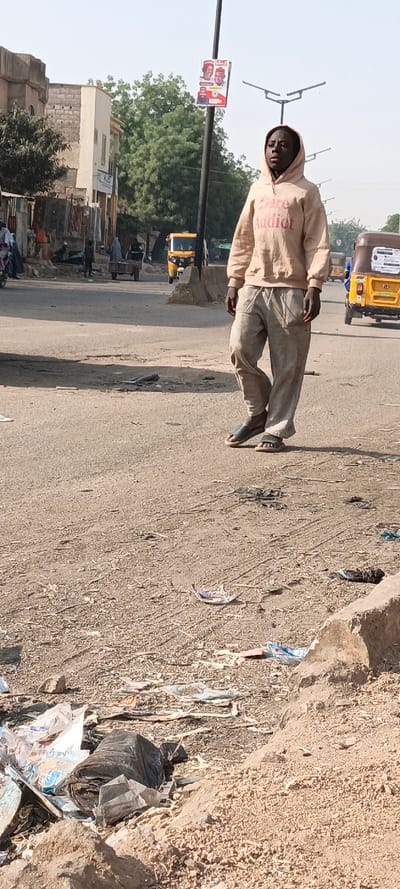
An outdoor street scene in Kaura Goje, Nigeria, is depicted under clear daylight. A dark-skinned individual, appearing male, stands in the center-right foreground, facing slightly left with a neutral expression. He wears a light peach-colored hooded sweatshirt with "Dare Addict" printed in reddish-brown text, loose light grey pants, and dark grey open-toed sandals. The immediate foreground consists of rough, unpaved earth covered extensively with litter, including crumpled plastic bags (one black, one white/blue) and paper debris. Beyond this, a paved road extends into the midground, featuring concrete median barriers. On the left side of the road, several indistinct figures are visible, along with a yellow three-wheeled auto-rickshaw. A person in a light-colored full-body garment pushes a two-wheeled cart along the road. On the far right, another yellow three-wheeled auto-rickshaw is present. In the background, a line of buildings constructed from light-colored blocks and painted facades is visible on the left, interspersed with green trees. A dark street light pole stands to the left of the central individual, bearing a rectangular political poster featuring two smiling men in red caps and a red, green, and white national emblem. Additional streetlights with three-pronged fixtures are seen further down the road. The sky is clear and light blue.
Kaura Goje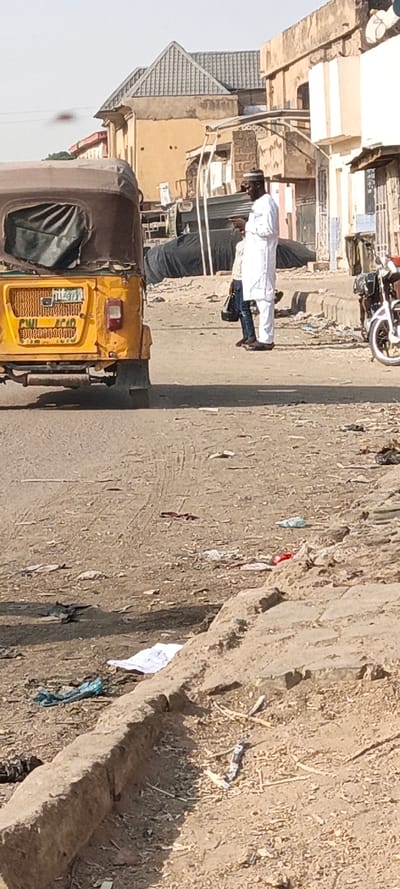
The scene is an outdoor, daytime view in Kaura Goje, Nigeria, showing a dusty, unpaved road and surrounding structures. On the left, the rear of a yellow tricycle with a brown fabric canopy is visible, displaying a license plate "CWR 4731" and additional Arabic script. The road surface is uneven, marked with tire tracks, and heavily littered with various debris including plastic bags, paper, and miscellaneous refuse. In the mid-ground, two males are standing on the dirt shoulder of the road. The man on the right, dressed in a long white traditional robe and a white kufi cap, stands facing left with his right arm raised in a gesturing motion. Partially obscured behind him, a second male is visible, wearing blue jeans and holding a dark bag in his left hand. To the far right, the front wheel and partial frame of a white motorcycle are visible. The background is populated with several buildings of varying construction. A prominent structure features light-colored walls and a distinct, grey-patterned gabled roof. Other buildings appear to be in various states of finish or disrepair, with some showing exposed brickwork and simplified architectural forms. A concrete curb or drainage edge runs diagonally across the lower right foreground.
Kaura Goje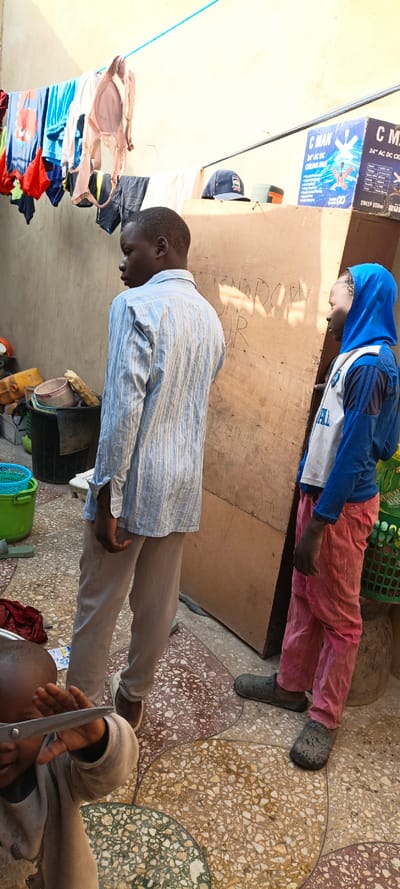
The image portrays an outdoor domestic scene in Kaura Goje, Nigeria. Three individuals are present on a multi-colored terrazzo-style tiled floor. In the foreground, a child, partially cropped, holds a pair of silver-handled scissors. Standing center-left, a male in a light blue and white striped long-sleeve shirt and light brown trousers faces right, away from the camera. To his right, a younger male, seen in profile, wears a blue hooded long-sleeve shirt with white and blue chest detailing, pink trousers, and dark slip-on shoes, also facing right. Behind the two standing males is a large, vertical light-brown wooden panel bearing dark, handwritten graffiti, including "SNAROWY JR". To the left, various containers are stacked, including a black bucket, a white bucket, and yellow jerrycans. Above, a blue rope clothesline extends across the upper frame, draped with assorted garments, including t-shirts and a light-colored bra. In the upper right, a "C MAN 24" AC/DC CEILING FAN" cardboard box is visible on a surface, next to a dark blue baseball cap. The background features light-colored walls, and the scene is illuminated by bright daylight.
Kaura Goje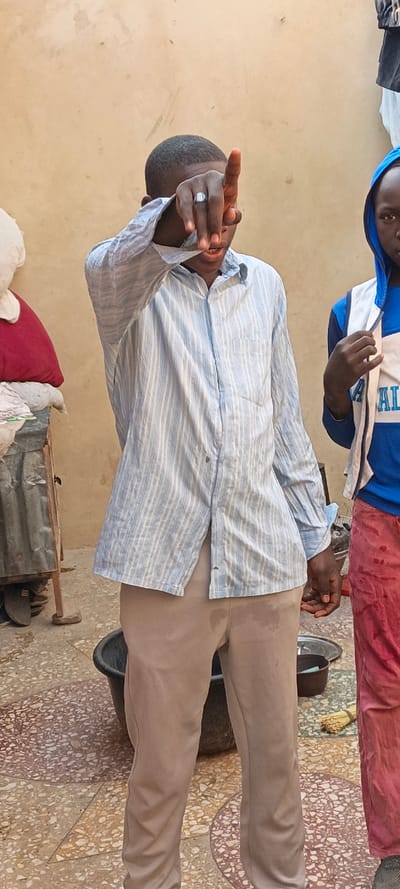
The image features two young individuals in what appears to be an outdoor or semi-outdoor setting in Kaura Goje, Nigeria, under bright daylight. The central figure is a young person with dark skin and short, dark hair, wearing a light blue and white striped long-sleeved button-up shirt and light brown/khaki trousers. This individual is making a gesture with their right hand, with the index finger pointing upwards, partially obscuring their face. A silver-colored ring with a rectangular setting is visible on their right ring finger. Their mouth is slightly open, possibly indicating speech or a reaction. The light brown trousers have several noticeable damp spots or stains. To the right, partially visible, is another young person with dark skin, wearing a blue hooded top with white accents and red or pink trousers. Only a portion of their face and upper body is visible. They are looking towards the camera, with their right hand resting near their chest. Their red trousers also display damp spots. The background consists of a plain, light brown wall. To the far left, a white pillow or plush toy and a red cushion are stacked on a low structure. A corrugated metal object is also partially seen on the left. The ground is covered in a multi-colored mosaic tile pattern, incorporating shades of beige, brown, and white. A black plastic basin sits on the ground between the two people. Closer to the right-hand subject, a small dark pot, a metal tray, and a traditional straw broom are visible on the ground. The overall scene suggests an informal, possibly domestic or communal environment. No specific activity beyond standing and gesturing is explicitly taking place, though the damp clothing on both individuals might imply recent interaction with water or liquids. There is no clearly legible text visible anywhere in the image.
Kaura Goje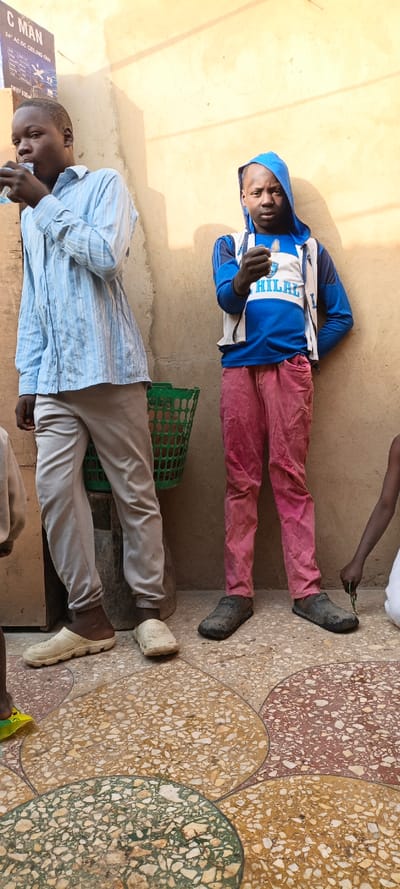
A full-color, vertical photograph depicts two young males and a partial third figure standing against a light-colored wall in Kaura Goje, Nigeria. The setting appears to be an outdoor or semi-outdoor area, illuminated by bright daylight, as indicated by the prominent shadows cast on the wall. On the left, a young man, likely in his late teens or early twenties, wears a light blue striped long-sleeved shirt and light grey trousers. He is captured in the act of drinking from a small, clear plastic pouch or bottle. His feet are clad in off-white clogs. To his right stands a younger male, presumably a pre-teen or early teen. He is dressed in a blue and white hooded jacket, which features the word "HILAL" prominently on the front. He wears vibrant pink or red pants and dark, textured slip-on shoes. He holds a small, light-colored object in his right hand, looking down towards it. A partial view of a third, smaller figure, a child, is visible on the far right, wearing a white garment and holding a small green object. Behind the two main figures, a green plastic basket is visible. On the upper left side of the image, a sign is affixed to the wall. Visible text on the sign includes "C MAN" at the top, followed by "24" AC DC CEILING FAN," and partially visible text indicating "SWEEP 800MM." The ground features a distinctive terrazzo floor patterned with large, irregular shapes in shades of light brown, green, and reddish-brown, separated by dark lines. The scene conveys a casual, everyday moment in a local setting.
Kaura Goje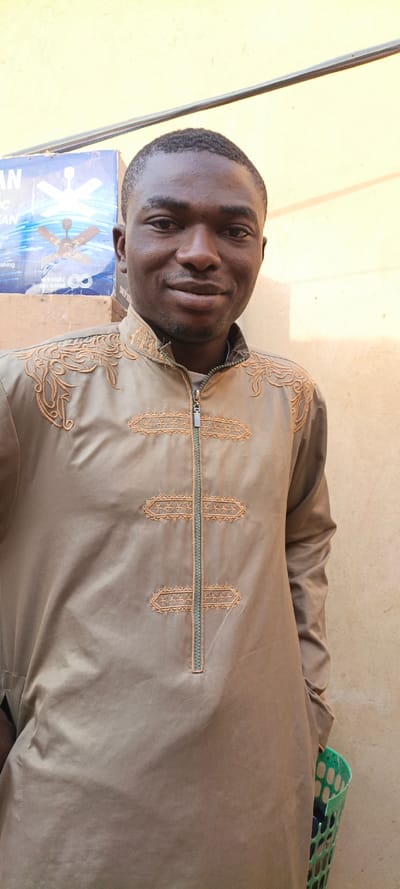
A man poses indoors, wearing a tan, ornate, zippered jacket. The jacket features elaborate embroidery around the shoulders and down the zipper. A box with a ceiling fan illustration sits slightly behind him. His expression is soft, with a slight smile. A green plastic basket is visible at the bottom right of the frame. The background appears to be a plain, light-colored wall.
Kaura Goje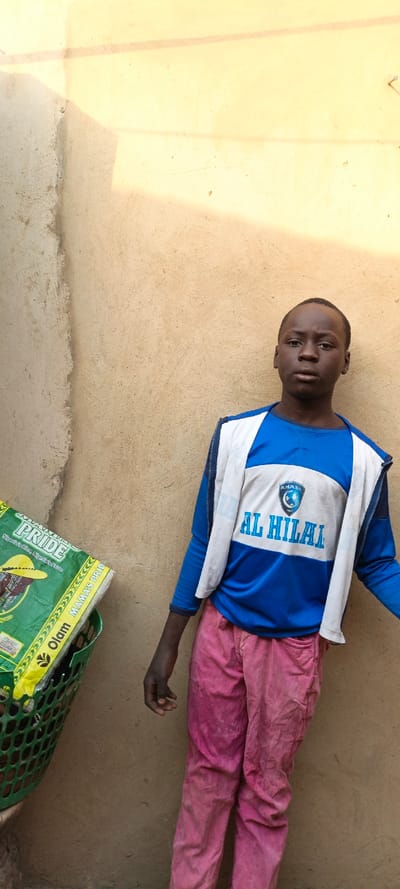
A young male, appearing to be a child or early teenager, stands centrally against a light tan, textured wall outdoors. He has dark skin and looks directly at the camera with a neutral expression. He is dressed in a blue long-sleeved shirt featuring a white central panel. On this panel, the word "AL HILAL" is printed in blue capital letters, with a crest above it that includes what appears to be "A.H.A.S.C. 1957". Over the shirt, he wears an open, white sleeveless vest or light jacket. His trousers are a faded pink or reddish color and appear worn. To the left of the boy, partially visible, is a green plastic basket containing a large green and yellow bag. Text on the bag includes "PRIDE", "Nigeria's Rice. Nigeria's Pride", "Olam", and "MAMAS PRIDE". The scene is brightly illuminated by natural sunlight, casting visible shadows on the wall, suggesting it is daytime with clear, sunny weather. The background wall shows some wear and discoloration. The overall setting is simple and appears to be an outdoor area in Kaura Goje, Nigeria. The boy is not engaged in any specific activity beyond posing for the photograph.
Kaura Goje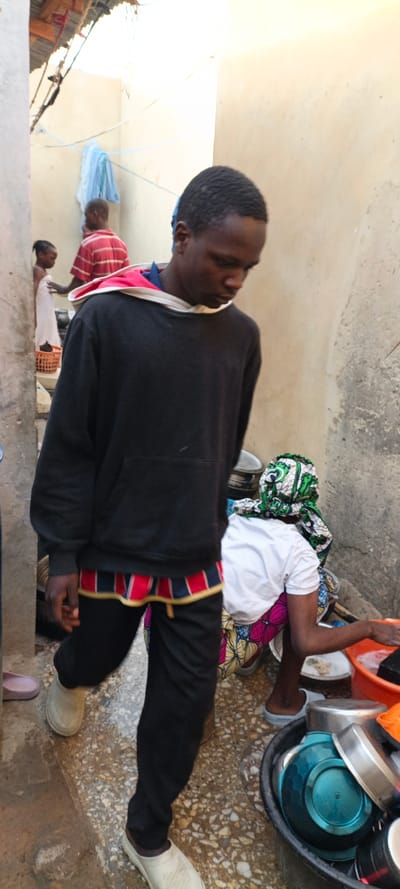
The image captures a candid moment in a narrow outdoor corridor or alleyway, likely within a residential compound in Kaura Goje, Nigeria. The walls are light-colored and appear to be made of concrete or mud brick, with a corrugated metal roof visible in the upper left corner. In the foreground, a young Black man walks towards the left side of the frame. He is dressed in a black hooded sweatshirt with a red and white lining visible in the hood, worn over a blue collared shirt. A distinctive band of red, blue, and yellow striped fabric is visible beneath the hem of his sweatshirt, possibly an underlying garment. He wears black pants and light-colored, slip-on shoes or clogs. His head is slightly bowed, and his expression is neutral. To the right, partially obscured by the foreground man, a woman is seen from behind, squatting or kneeling. She is engaged in washing dishes, immersing her hands in an orange basin. She wears a white t-shirt, a vibrantly patterned skirt or wrapper in green, pink, and yellow, and a matching green and white patterned head covering. Various metal and plastic bowls are visible in a larger black basin next to her. Further in the background, to the left, another man in a red and white striped shirt stands near a young child. The child is wrapped in a white cloth or towel and stands beside a brown woven basket. A light blue piece of cloth hangs on a line strung across the alleyway. The ground is wet and appears to be a mix of concrete and pebbles. The bright lighting suggests it is daytime. There is no visible text in the image. The scene depicts routine domestic activities in a bustling outdoor setting.
Kaura Goje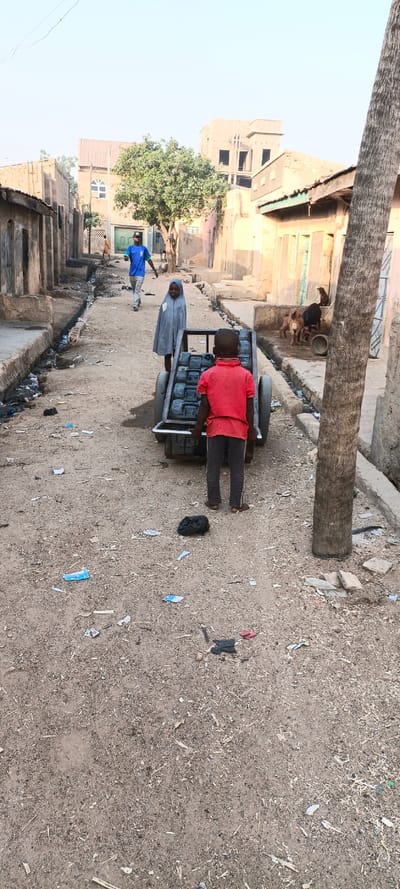
A vertical shot captures a dusty, unpaved street scene in Kaura Goje, Nigeria, under a bright, clear sky, suggesting either morning or late afternoon. In the foreground, a young boy in a red short-sleeved shirt and dark pants, barefoot, stands with his back to the camera, appearing to push a metal handcart. The cart is heavily loaded with multiple dark, rectangular containers, likely jerrycans used for transporting water. To the left of the cart, a young girl wearing a grey hijab and a loose-fitting robe stands, looking towards the camera with a neutral expression. Further down the street, a man in a blue t-shirt and light-colored pants walks towards the viewer. Another person in lighter clothing is visible in the distance on the left side of the street. The street is lined with various buildings, predominantly single or two-story structures, some appearing unfinished or in a state of disrepair. A leafy green tree stands in the mid-ground on the left, providing a focal point amidst the buildings. On the right side of the frame, the thick trunk of a palm tree partially obscures a view of additional buildings and several goats, possibly with a dog, gathered near a drainage ditch that runs parallel to the street. The ground throughout the image is covered in sand and dirt, scattered with debris, including plastic wrappers, paper, and wood chips, indicating unpaved conditions and visible litter. The drainage ditches flanking the street also contain accumulated trash. The scene portrays daily life, highlighting activities like water transport in a residential area with a visible lack of modern infrastructure. No discernible text is visible.
Kaura Goje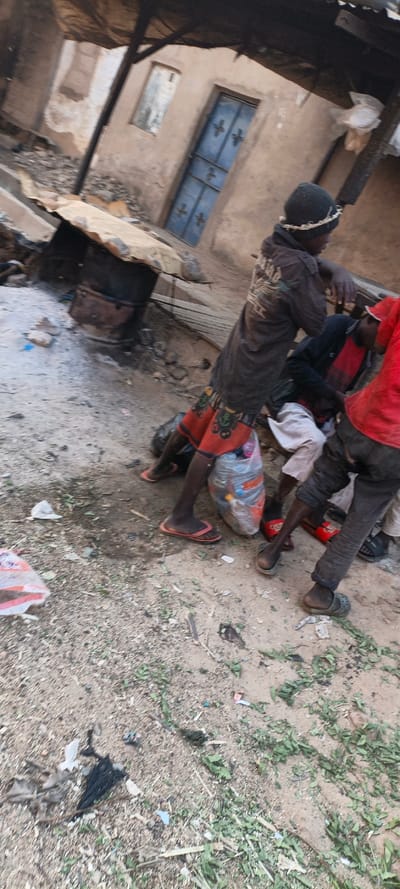
Amidst a dilapidated landscape with damaged buildings, a group of children gathers. One wears a beanie, a dark jacket, and red patterned shorts, holding a plastic bag filled with various items. Another child sports a red shirt and dark pants, while a third is partly visible. The ground is littered with debris and sparse vegetation, adding to the overall impression of poverty and neglect.
Kaura Goje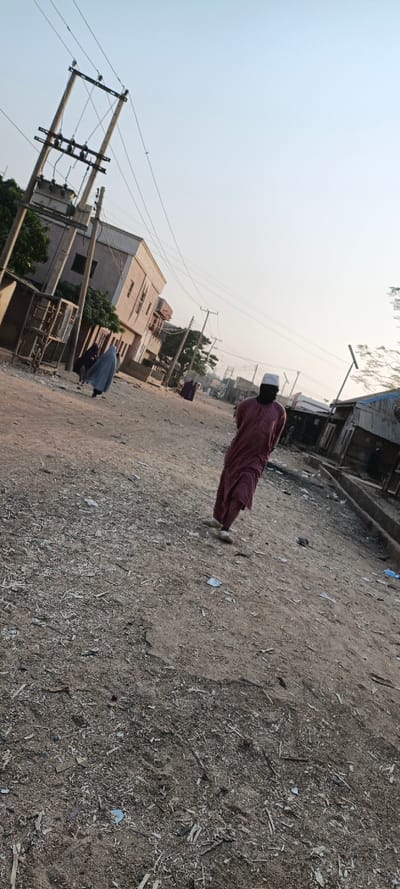
A street scene shows a man wearing a maroon robe and white cap walking towards the viewer. Another person in a full blue robe walks in the opposite direction. The unpaved street is filled with debris. Buildings line both sides of the road. Power lines are visible above. The sky is a light blue.
Kaura Goje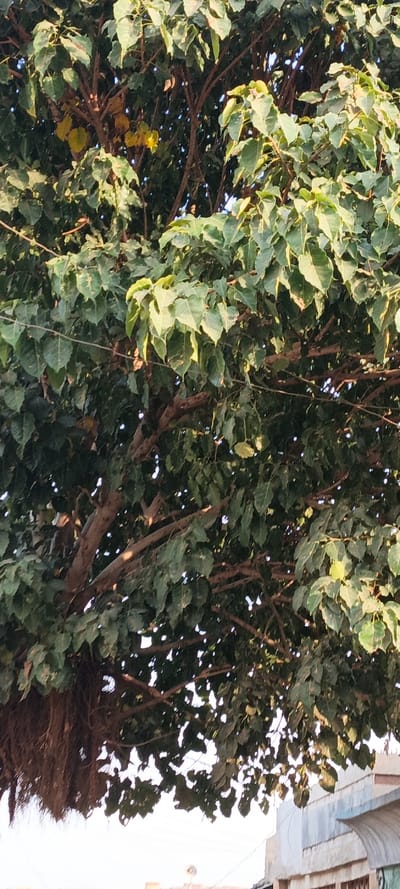
This vertical image displays a vibrant, dense canopy of a large tree, likely a Ficus species such as a Banyan or Peepal, given the visible thick branches and prominent aerial roots hanging from the lower left side. The tree is abundant with green, heart-shaped leaves, though some scattered leaves within the canopy show a yellowish hue, indicating natural variation or age. Sunlight filters through the foliage, creating bright highlights on many of the leaves and illuminating parts of the branches, suggesting either early morning or late afternoon. The upper two-thirds of the frame are dominated by the intricate network of leaves and branches. Below the tree, a bright, clear sky is visible. In the bottom right corner, a segment of a light-colored building can be seen, characterized by its light blue and white facade and distinct architectural lines. A corrugated metal awning or roof structure extends from the building. A thin, dark wire or cable runs horizontally across the lower part of the image, passing near the building. The scene depicts an outdoor setting, likely in an urban or semi-urban area within Kaura Goje, Nigeria. There are no people or specific activities taking place. The overall impression is one of natural tranquility amidst a built environment under clear, sunny weather conditions. No text is visible in the image.
Kaura Goje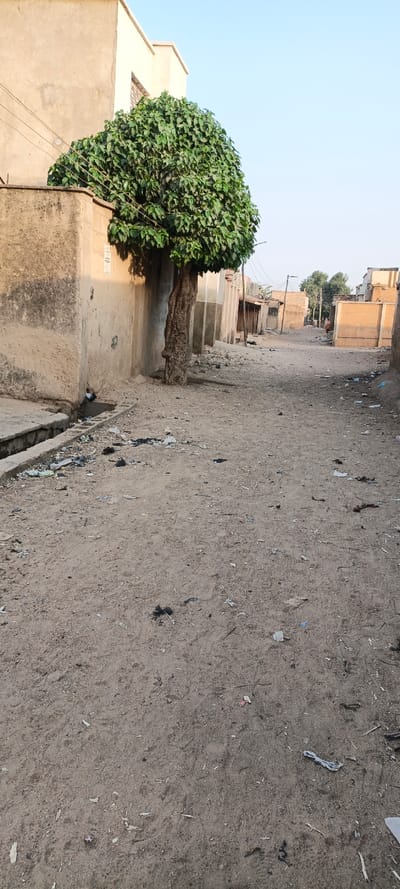
The image depicts a dusty, unpaved road stretching into the distance in a residential or semi-urban setting, likely Kaura Goje, Nigeria. Buildings with simple, unpainted or light-colored walls and flat roofs line both sides of the path. In the foreground on the left, a large, bushy tree with dense green foliage and a thick, gnarled trunk stands next to a building. A concrete drainage channel runs along the left edge of the road, and both the road surface and the ditch are visibly scattered with litter, including pieces of paper, plastic, and other debris. Further down the street, utility poles and overhead wires are visible. The lighting suggests either early morning or late afternoon, with a clear, light blue sky overhead, indicative of fair weather. The scene appears quiet, with the only discernible activity being the faint outlines of one or two human figures in the far distance down the road, too indistinct to determine their actions. The general impression is of an ordinary street scene in a community, characterized by its unpaved surface and scattered refuse. No legible text is visible on any objects or structures.
Kaura Goje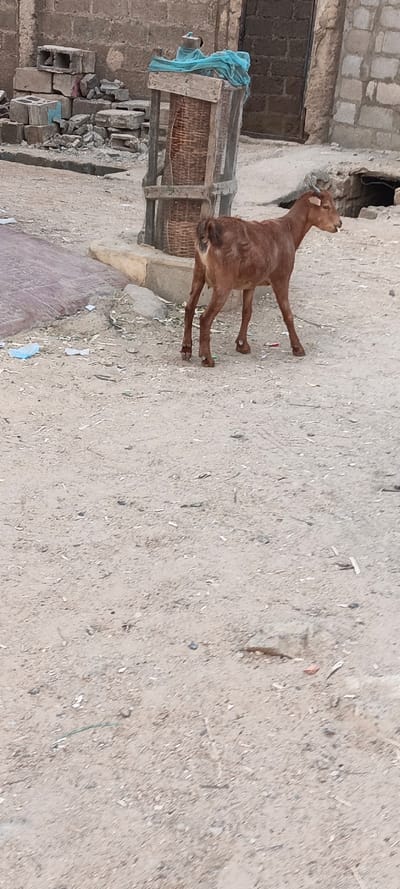
A brown goat stands on a dirt road in a residential area. The goat is slender and appears to be facing right, with its tail slightly raised. Behind it, there's a makeshift wooden and woven basket structure covered with a blue cloth. In the background, a partially constructed building and a stone building with a dark doorway are visible. Scattered debris and a piece of blue plastic litter the ground.
Kaura Goje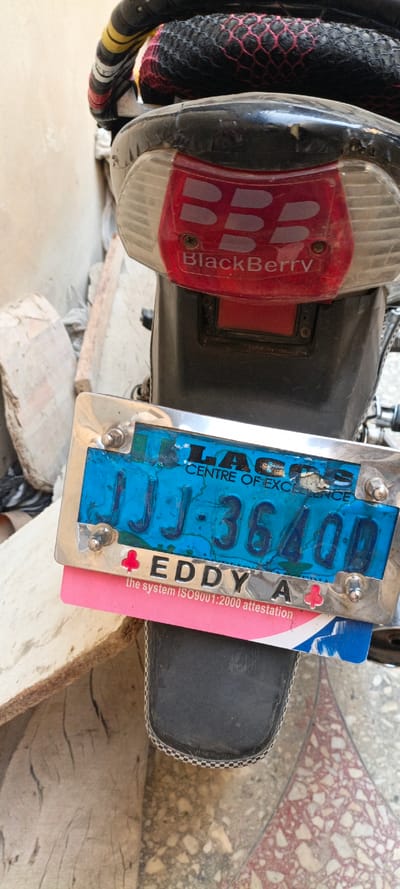
The image captures a close-up view of the rear section of a motorcycle or scooter, possibly parked in an outdoor setting in Kaura Goje, Nigeria. The primary subject is the vehicle's tail light assembly and license plate. The tail light features a red lens with a prominent "BlackBerry" logo, consisting of the triple B symbol and the word "BlackBerry" beneath it. Below the tail light, a blue license plate is attached within a metallic frame. Visible text on the plate includes "LAGOS" (partially obscured) and "CENTRE OF EXCELLENCE" at the top, and the alphanumeric sequence "JJJ-36400D" centrally. Below the license plate, a pink and blue card or sticker is partially visible, bearing the text "EDDY A" next to a red clover-like symbol, followed by "the system ISO9001:2000 attestation". The motorcycle's rear fender is black plastic, and parts of the seat or luggage rack are visible above, covered with black netting that has a red mesh pattern. The background on the left shows a rough, light-colored wall or concrete structure, with some debris on the ground. The ground beneath the vehicle is a tiled surface with a mosaic pattern of reddish and beige tones. No activity is taking place, and the scene appears static, suggesting the vehicle is stationary. The wear and tear on the vehicle parts, particularly the faded license plate and scratches on the fender, indicate regular use.
Kaura Goje
A woman with a green and white patterned headwrap and a white shirt looks up at the camera. An orange bucket filled with various dishes and a green cup sits below her. Behind her, there are two black buckets, one of which appears to contain a gray substance. A concrete wall is visible to the left. Her expression is neutral, with a slight upward gaze.
Kaura Goje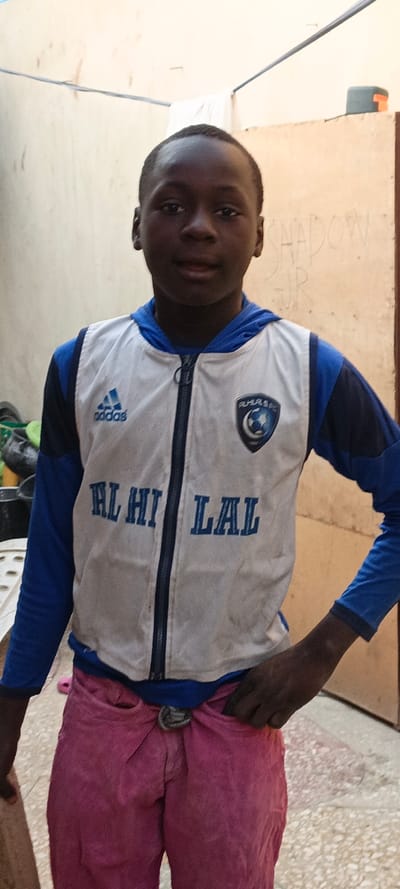
A young boy stands indoors wearing a white and blue Adidas jacket with "Al Hilal" printed on it and the Al Hilal FC logo. He also wears pink pants with a knotted rope or belt. The background appears to be a simple courtyard with light-colored walls. Graffiti is visible on the wall behind him.
Kaura Goje
A blurred snapshot presents two women dressed in flowing garments, one green and the other red, walking along a dirt path flanked by buildings. Another figure, in a dark robe, trails behind. The scene appears to be in a village or settlement with a mix of aged concrete structures and a large tree. The ground is littered with debris, contributing to the overall sense of motion and blur.
Kaura Goje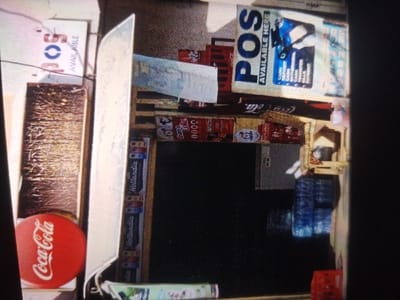
The scene depicts an outdoor commercial vending stall or shop frontage situated in Kaura Goje, Nigeria. The establishment offers Point-of-Sale (POS) services, evidenced by a prominent sign displaying "POS AVAILABLE HERE" and detailing services such as "CASH DEPOSIT," "WITHDRAWAL," "BILLS PAYMENT," and "TRANSFER." Another "POS AVAILABLE" sign is partially visible on the upper left. The stall's merchandise includes stacked red Coca-Cola crates, some containing bottles, positioned on the right side. Several blue plastic crates filled with bottled water are visible below these crates. A red circular sign featuring the Coca-Cola logo rests on a wooden surface to the far left. Display units feature "Hollandia" branding. A dark, rectangular opening, likely a counter or service window, is centrally located, with a gray refrigerator or cooler visible behind it to the right. Various smaller packaged goods, including an item branded "Sweet Me" with "0000" below it, are arranged around the stall. A large, reflective, silver-colored object, possibly a metal sheet, is prominent on the left side of the frame, partially obscuring other elements. No individuals are present in the image, and no specific actions or interactions are depicted.
Kaura Goje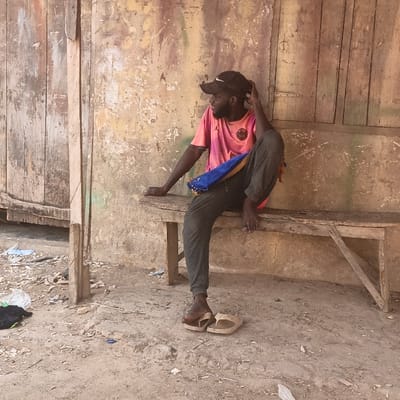
An adult male is seated on a weathered wooden bench in Kaura Goje, Nigeria. He is positioned against a distressed, light brown wall featuring peeling paint and a visible patch of green discoloration. To the left, a vertically paneled wooden door or shutter is partially visible. The ground consists of dry, uneven dirt littered with various pieces of trash, including plastic fragments and a white plastic bag. The male, with dark skin and a beard, wears a black baseball cap with a white logo, a pink short-sleeved t-shirt with a club crest (likely Paris Saint-Germain), and dark-colored track pants. A blue and yellow striped fabric item is draped over his left thigh. His right hand is raised to his head, appearing to adjust his cap or hair, while his left arm rests on the bench to his side. His right leg is bent with the foot on the bench, and his left leg extends towards the ground. A pair of light brown flip-flops are present, one partially on his left foot, the other resting on the ground nearby. He is looking towards the left of the frame. The scene is illuminated by direct daylight.
Kaura Goje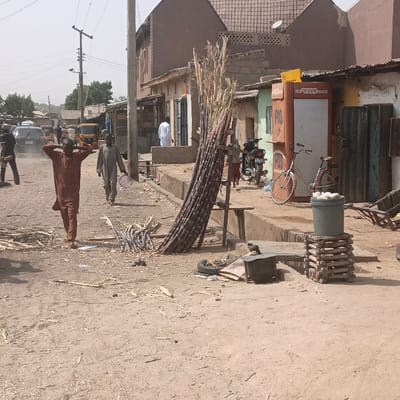
The scene depicts a daytime street view in Kaura Goje, Nigeria, characterized by an unpaved, dusty thoroughfare. In the mid-ground, a large bundle of sugarcane stalks leans against a wooden stand on the right side of the dirt road, with scattered smaller pieces of sugarcane and debris on the ground directly in front. A grey bucket, containing white ovoid objects, rests on a stack of wooden planks on the far right. Adjacent to this, a light-colored bicycle is parked next to an orange-brown "POS" (Point of Sale) kiosk, which stands against a light green building. A dark motorcycle is parked further back on the right. On the left side of the dirt road, two men are visible. The man in the foreground wears a brown garment and has his hands placed on or near his head while walking towards the viewer. Behind him, another man in a light-colored garment walks away from the viewer, carrying a light-colored bowl in his left hand. In the background on the left, several vehicles, including a dark sedan and a yellow auto-rickshaw, are visible on the street. Utility poles with overhead wires are present on the left side of the road. Buildings with varying architectural styles, including a multi-story brown building with a tiled roof and single-story structures, line both sides of the street. A man in a white garment stands in a doorway of a building on the right side of the mid-ground. The sky is clear and light.
Kaura Goje