Kecamatan Kebakkramat, Indonesia
30 memories from Kecamatan Kebakkramat, Indonesia
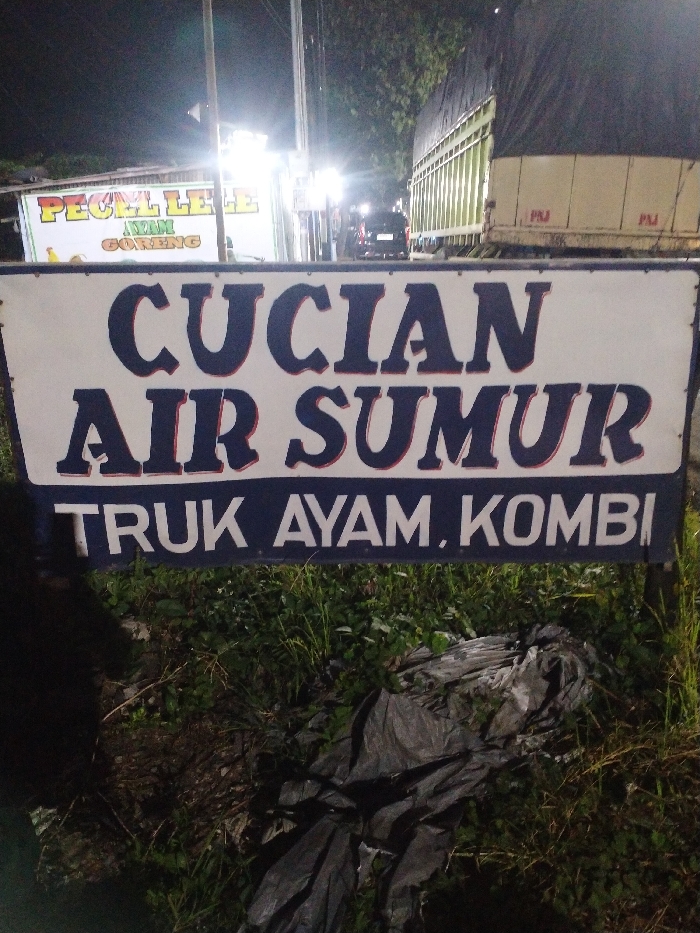
The image shows a white sign with blue lettering that reads "CUCIAN AIR SUMUR TRUK AYAM. KOMBI" in front of a dark green bush. There is a partially obscured building and a truck in the background. The scene is located in Kecamatan Kebakkramat, Indonesia, at coordinates -7.504 latitude and 110.916 longitude. The sign appears to be an advertisement for a well water laundry service for chicken trucks. The sign is illuminated by artificial light, the rest of the scene is shrouded in darkness. There is a large piece of black plastic in the foreground.
Kecamatan Kebakkramat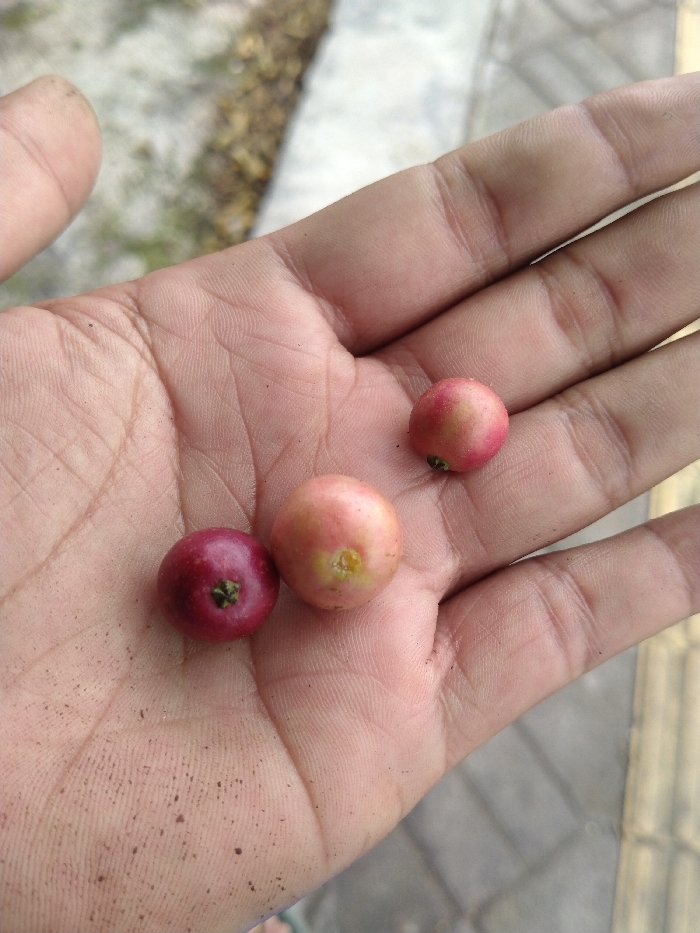
The image captures a close-up view of a person's left hand, palm facing upwards, holding three small, spherical fruits. The hand appears to be slightly soiled or dusty, suggesting an outdoor setting or recent activity. The three fruits vary slightly in color. One fruit, located towards the lower left of the palm, is a rich, deep reddish-purple. The other two fruits are a lighter hue, exhibiting a gradient from pink to pale yellow. Each fruit features a small, green or brownish, star-shaped calyx remnant at one end. The background is softly blurred, indicating an outdoor environment with natural daylight. Visible elements in the background suggest ground, possibly a paved path or dirt, consistent with an open-air scene. No specific time of day or weather conditions are explicitly discernible beyond being daytime. There is no visible text in the image. The scene is set in Kecamatan Kebakkramat, Indonesia.
Kecamatan Kebakkramat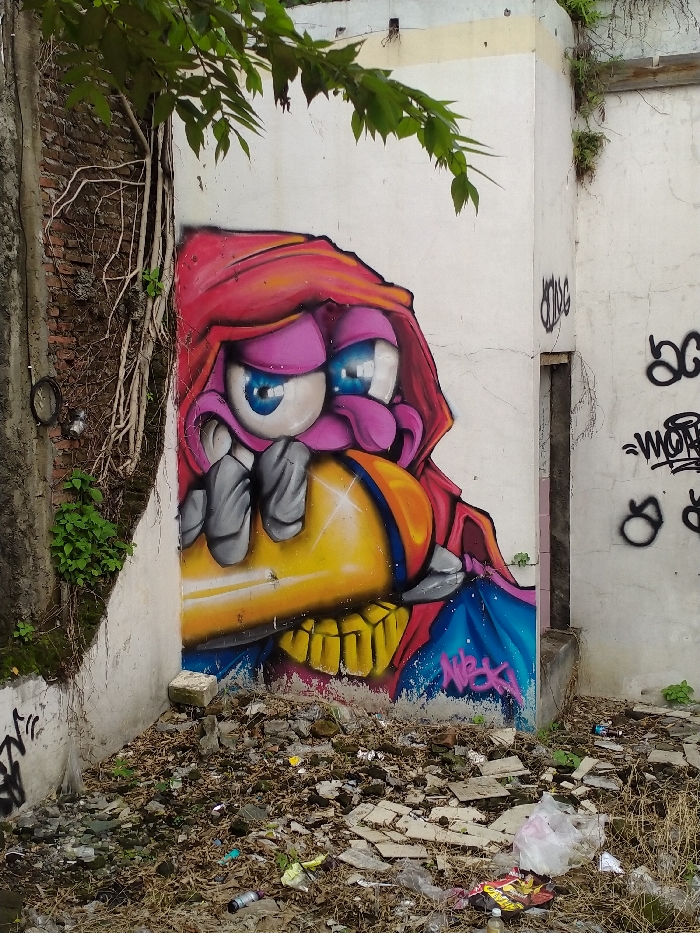
A vibrant graffiti mural of a stylized, cartoon-like character dominates the center of the image, painted on a white wall within what appears to be a dilapidated or abandoned building. The character features a large, rounded head in bright pink, wide, intense blue eyes with prominent white reflections, and a large, shiny yellow beak-like mouth revealing yellow, fang-like teeth. Gray, clawed hands grasp the beak, and a red hooded garment covers its head, extending into a blue and red cloak around its body. To the left of the mural, a raw brick wall is partially covered by intertwining tree roots and vibrant green climbing plants. Green leaves from an overhead branch also extend into the top of the frame. To the right, another section of the white wall shows several black, less distinct graffiti tags. The ground in the foreground is a rough expanse of dry leaves, dirt, and significant amounts of litter, including plastic bags, bottles, and broken pieces of concrete or ceramic. The scene is illuminated by diffused daylight, indicating it is daytime. There is no human activity taking place. The character's expression is somewhat menacing or determined, with its wide eyes and prominent teeth. The setting suggests an urban environment, specifically a neglected or derelict structure in Kecamatan Kebakkramat, Indonesia. The visible text "Neko" is present as a signature on the lower right side of the graffiti mural in pink and white letters.
Kecamatan Kebakkramat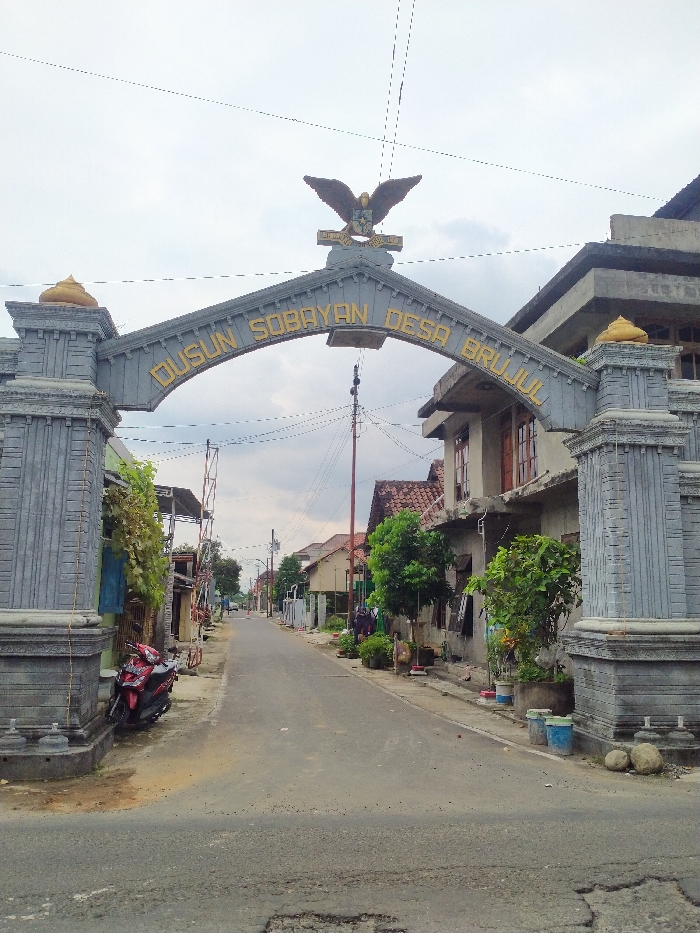
The image captures a static view of the entrance to a village or hamlet in Kecamatan Kebakkramat, Indonesia, characterized by a prominent decorative archway spanning a paved road. The archway, constructed from what appears to be grey concrete or stone with sculpted details, features golden-colored lettering on its curved beam that reads "DUSUN SOBRAYAN DESA BRUJUL". A large, dark-colored statue of an eagle with outstretched wings and a crest in its claws is mounted at the apex of the archway. The archway is supported by two robust pillars, each adorned with a golden, shell-like ornament on top. The paved road extends straight into the distance, flanked by a mix of single and two-story residential buildings on both sides. These houses exhibit varying architectural styles, some with exposed concrete and others with tiled roofs. Along the sides of the road, particularly in front of the houses, there are various potted plants and small trees, adding greenery to the scene. On the left side of the road, just past the archway, a red scooter is parked. Utility poles with numerous overhead wires are visible along the road, indicating a typical village infrastructure. The sky is overcast with a blanket of grey clouds, suggesting either an early morning, late afternoon, or simply a cloudy day. The overall impression is that of a quiet, rural or semi-urban setting. No people are visible, and no specific activities are taking place.
Kecamatan Kebakkramat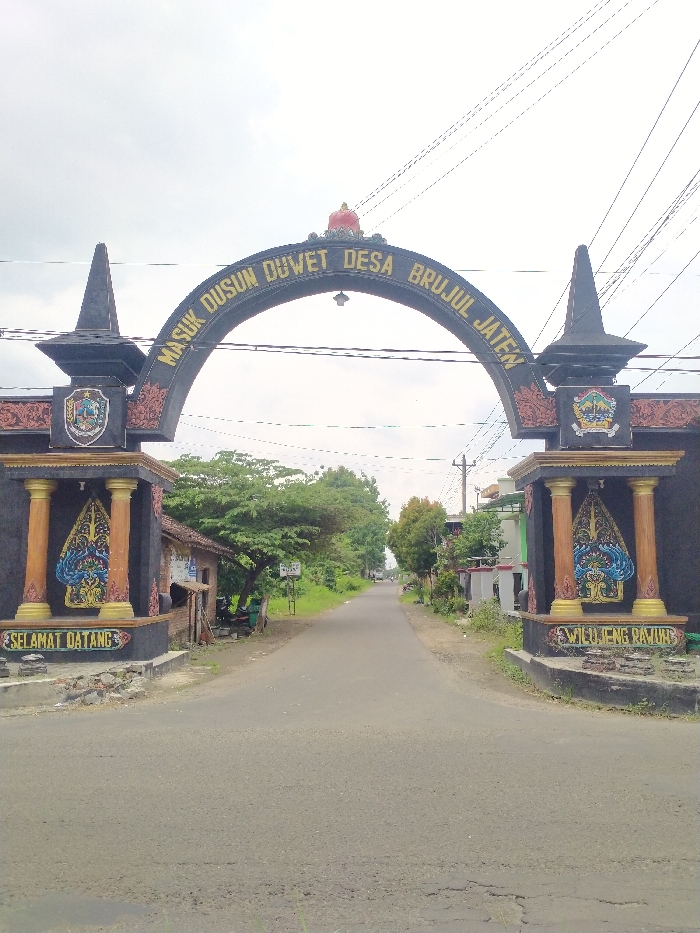
An outdoor, eye-level shot captures an ornate archway marking the entrance to a village in Kecamatan Kebakkramat, Indonesia. The dark archway spans a paved road, with golden lettering on its curve that reads, "MASUK DUSUN DUWET DESA BRUJUL JATEN," translating to "Enter Dusun Duwet, Brujul Jaten Village." A decorative, reddish crown-like element adorns the peak of the arch. The archway is supported by two robust pillars. Each pillar features a crest or emblem near its top, followed by a vibrant panel depicting traditional Indonesian wayang kulit (puppet) figures, predominantly in blue, gold, and red hues. At the base of the left pillar, the words "SELAMAT DATANG" (Indonesian for "Welcome") are displayed, while the right pillar's base reads "WILUJENG RAWUH" (Javanese for "Welcome"). The asphalt road, showing some minor cracks in the foreground, extends straight through the archway into the distance, appearing to be a single lane in each direction. It is flanked on both sides by abundant green trees and foliage, with glimpses of simple houses or structures nestled within the greenery. Overhead power lines are visible against the bright, overcast sky, suggesting it is daytime. The scene is static, devoid of people or active events, portraying a typical entrance to a rural or semi-rural Indonesian settlement.
Kecamatan Kebakkramat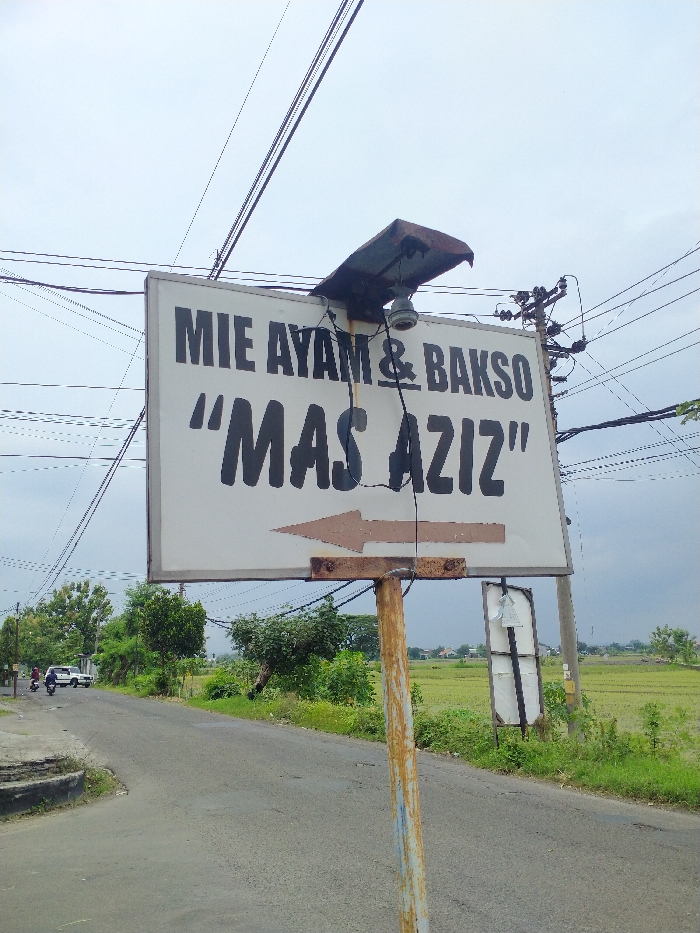
This media file depicts a rural or semi-rural roadside scene in Kecamatan Kebakkramat, Indonesia, under an overcast sky. In the foreground, a prominent white rectangular sign, supported by a rusty metal pole, directs travelers. The sign displays black text reading "MIE AYAM & BAKSO" (Indonesian for Chicken Noodles & Meatballs) and ""MAS AZIZ"", along with a brown arrow pointing to the left. A small solar panel and a light fixture are mounted above the sign, likely for nighttime illumination. The setting includes a paved road with green trees and bushes lining its side. Beyond the vegetation, extensive green rice fields (paddy fields) are visible, extending into the distance where some scattered buildings can be discerned. Numerous electrical wires crisscross the sky, connected to utility poles, one of which stands on the right side of the road. On the road, a white car and a scooter carrying at least one person are seen, indicating general traffic activity. Another individual is visible near the car. A second, partially visible billboard or sign structure stands further down the road on the right. The scene conveys a sense of local life, with the sign advertising a modest food establishment in an agricultural landscape. The weather is cloudy, providing soft, diffused light during the daytime.
Kecamatan Kebakkramat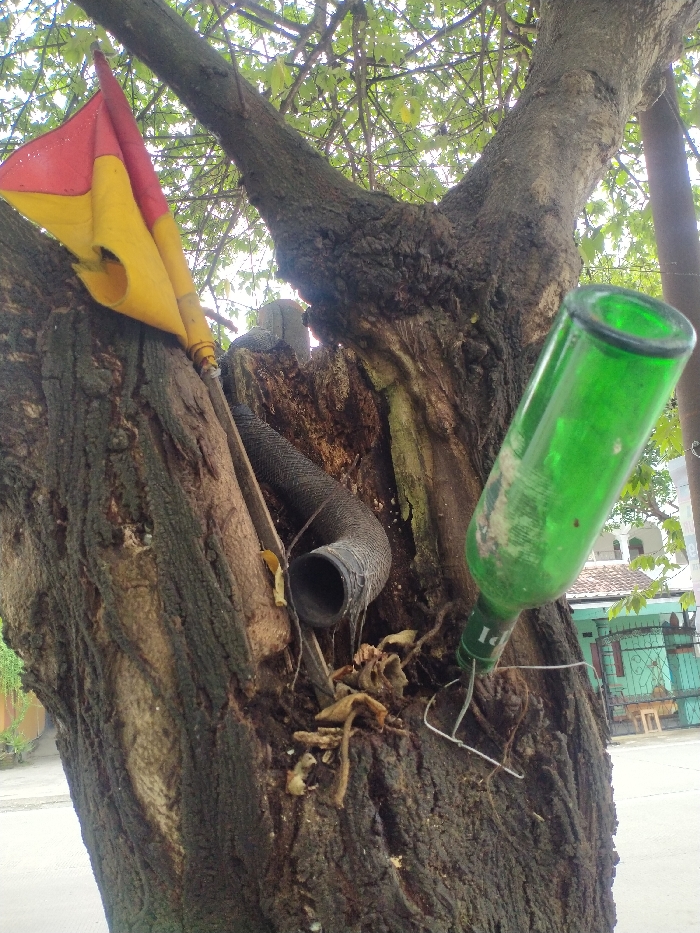
This image captures a close-up view of a robust tree trunk adorned with various objects in what appears to be an outdoor, semi-urban setting in Kecamatan Kebakkramat, Indonesia. The tree has thick, dark, and textured bark, suggesting age. Embedded within a natural hollow or cavity on the left side of the tree is a weathered red and yellow flag, possibly made of fabric, with its pole visible. Adjacent to the flag, a dark, corrugated tube or hose, likely made of plastic or rubber, emerges from the tree's opening and curves downwards into the cavity, surrounded by dried leaves and debris. On the right side of the trunk, a green glass bottle is angled downwards, seemingly secured to the bark with thin metal wires or similar fasteners. The bottle appears to be empty and bears partial text "PI" or "IP" on its side. More dried leaves and organic matter are visible around the bottle's base. In the background, hints of green foliage from the tree's canopy are visible against a bright sky, indicating daytime. Distantly, a light blue or green metal fence or gate can be seen, behind which a building with a white, dome-like structure, possibly a mosque or part of a house, is partially visible. No human activity is depicted in the static scene. The image provides a glimpse into an area where human-made objects have become integrated with natural elements.
Kecamatan Kebakkramat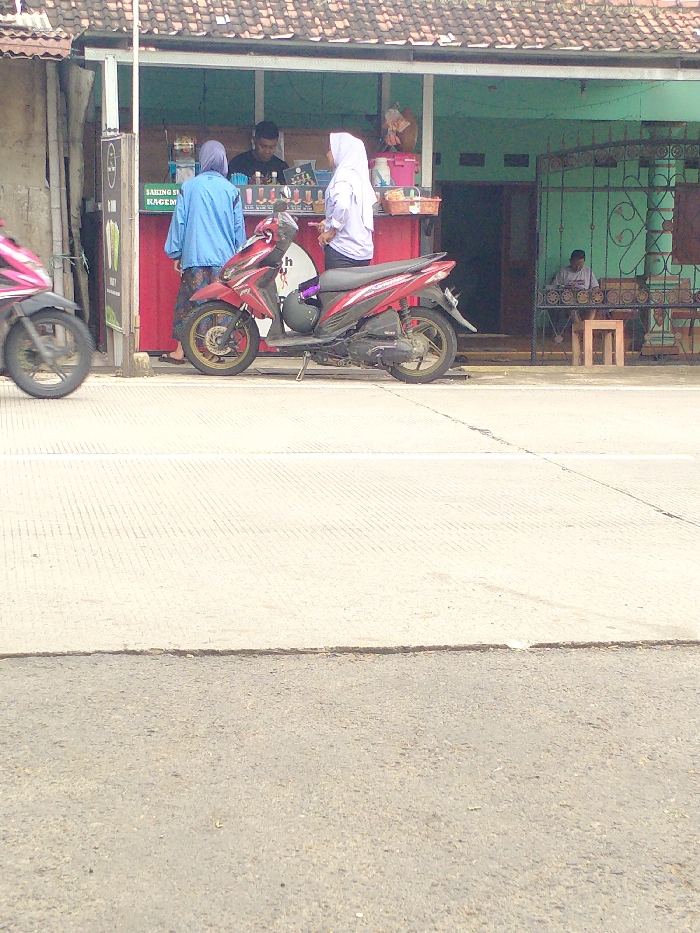
The image captures a vibrant street scene in Kecamatan Kebakkramat, Indonesia, featuring a roadside food stall in front of a building. In the center, two women, both wearing headscarves (hijabs)—one in a blue top and the other in white—are positioned at the red-fronted stall. A male vendor stands behind the counter, attending to them, with various cups and containers of what appear to be beverages displayed. A red scooter is parked directly in front of the stall, facing right, with a helmet hanging from its handle. On the far left, the front wheel and part of another pink motorbike are visible, suggesting ongoing traffic. To the right of the stall, a man is seated at a wooden table inside a building with a green facade and an ornate metal gate. He appears to be looking down, possibly at a phone or tablet. The setting suggests a daytime scene with bright, natural lighting and clear weather. The ground in the foreground and midground consists of a light-colored concrete road with horizontal scoring, transitioning to darker asphalt closer to the viewer. On the left side of the stall, a vertical sign is partially visible with text, including "SAKONG SE" and "KAGEM." The overall atmosphere is that of a typical daily commerce activity in an Indonesian urban or suburban area.
Kecamatan Kebakkramat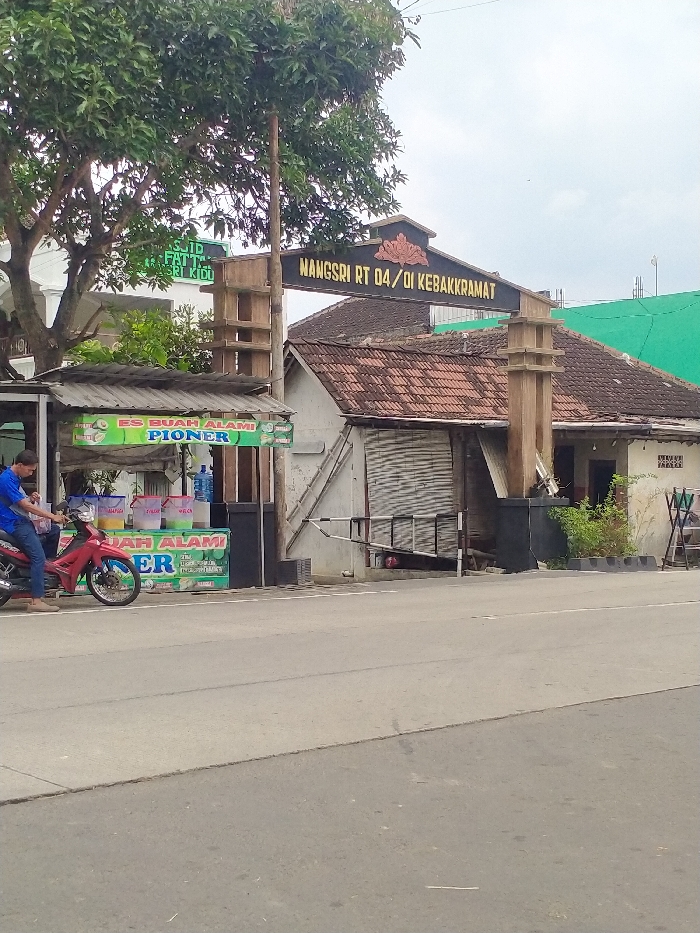
This street-level photograph captures a community entrance in Kecamatan Kebakkramat, Indonesia, under an overcast sky during daytime. A prominent, ornate gate spans a path leading into the neighborhood, featuring a sign that reads "NANGSRI RT 04/DI KEBAKKRAMAT." A metal barrier arm extends across this entrance. To the left of the gate, a modest street vendor stall with a corrugated roof is set up, advertising "ES BUAH ALAMI PIONER" (Natural Fruit Ice PIONER). Several large, clear containers of drinks and water bottles are visible on the stall. A man in a blue shirt is seated on a red motorcycle, parked on the asphalt road directly in front of the vendor stall. Behind the stall and to the left, a large tree partially obscures a white building, which appears to be a mosque, with some visible text suggesting "MASJID FATTAH SRI KIDUL." To the right of the entrance gate, a small house with a traditional red-tiled roof and a closed roller shutter stands. The main asphalt road occupies the foreground, creating a clear separation from the community entrance. The scene depicts a quiet, functional local setting.
Kecamatan Kebakkramat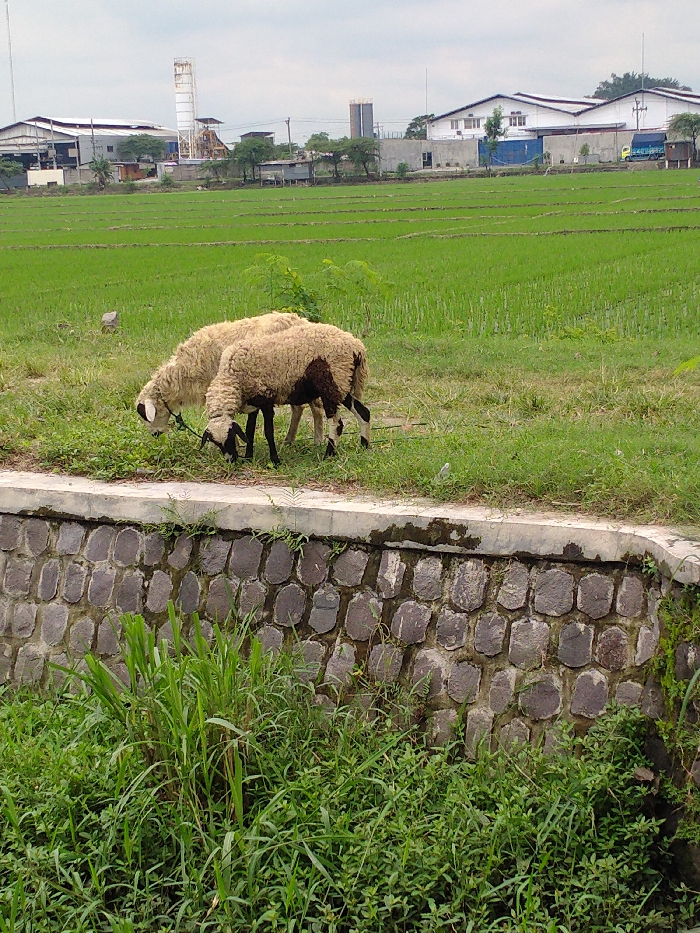
The image depicts a semi-rural landscape in Kecamatan Kebakkramat, Indonesia, under an overcast sky. In the midground, two sheep are actively grazing on a patch of green grass. The sheep on the left is mostly light-colored and has a blue tether around its neck. The second sheep, partially obscured by the first, is also light-colored but features noticeable dark brown or black patches on its body and dark legs. Behind the sheep, expansive, verdant rice fields extend horizontally across the scene, indicating young rice crops. A small, light-colored bird is faintly visible on the ground within the rice fields. In the distant background, several industrial structures rise above the fields. These include tall, white silo-like buildings and a series of white-roofed warehouses or factory buildings, with some industrial equipment and what appears to be a truck visible near one of the buildings. In the foreground, a robust stone wall, possibly a retaining wall or an irrigation channel embankment, runs across the bottom section of the frame. The wall is constructed from textured, oblong stones set in mortar and topped with a smooth concrete cap. Below the wall, a dense growth of various green grasses and plants fills the lower foreground. The scene presents a juxtaposition of agricultural life, represented by the sheep and rice fields, with nearby industrial development. There is no visible text in the image.
Kecamatan Kebakkramat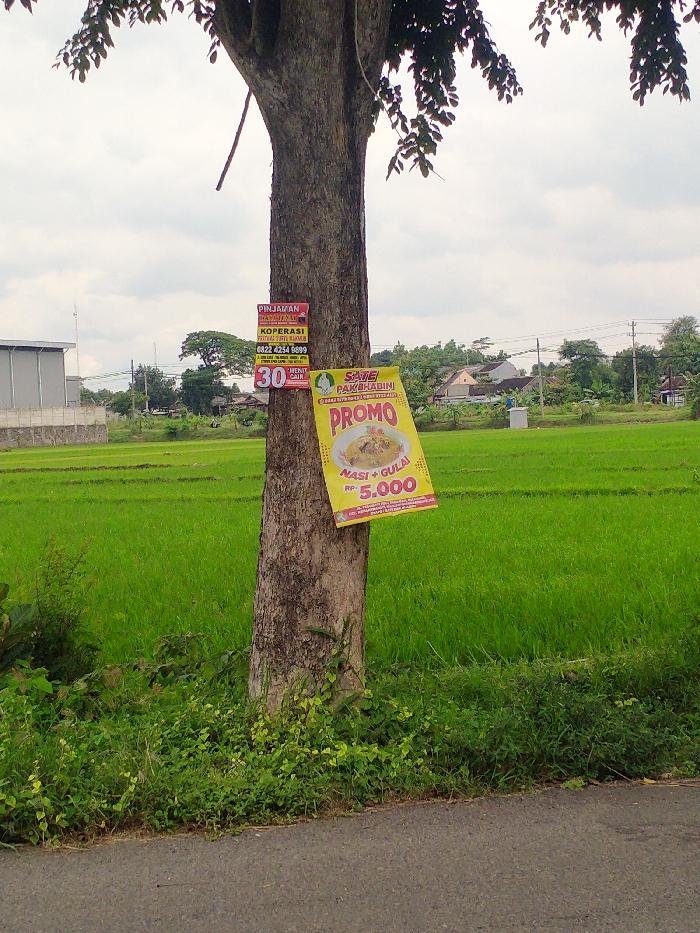
This outdoor shot captures a thick tree trunk in the foreground, serving as a makeshift billboard for two promotional posters. The tree stands at the edge of a paved road or path, with green grass and foliage covering its base. Beyond the tree, vibrant green rice paddies stretch across the mid-ground, indicating a rural or semi-rural setting. In the distant background, under an overcast sky, are scattered buildings, utility poles, and more trees, suggesting a village or small town. The lighting is soft and diffused, typical of a cloudy day. Two signs are attached to the tree trunk: 1. **Top poster (red and yellow):** Advertises "PINJAMAN DANA TUNAI" (Cash Loan) from a "KOPERASI" (Cooperative), accepting "JAMINAN BPKB" (vehicle ownership document as collateral). It provides a contact number (0822 4254 9899) and promises "30 MENIT CAIR" (30 minutes disbursement). 2. **Bottom poster (yellow):** Promotes "SATE PAK DHABINI" (Pak Dhabini Satay) with a "PROMO." It features an image of a dish and explicitly states "NASI + GULAI" (Rice + Gulai) for "RP. 5.000" (Indonesian Rupiah 5,000). Smaller, less legible text at the bottom likely includes an address or further details, possibly mentioning "Setiap hari buka" (open every day). No people are visible in the tranquil scene, which highlights the juxtaposition of commercial advertisements against a natural, agricultural backdrop in Kecamatan Kebakkramat, Indonesia.
Kecamatan Kebakkramat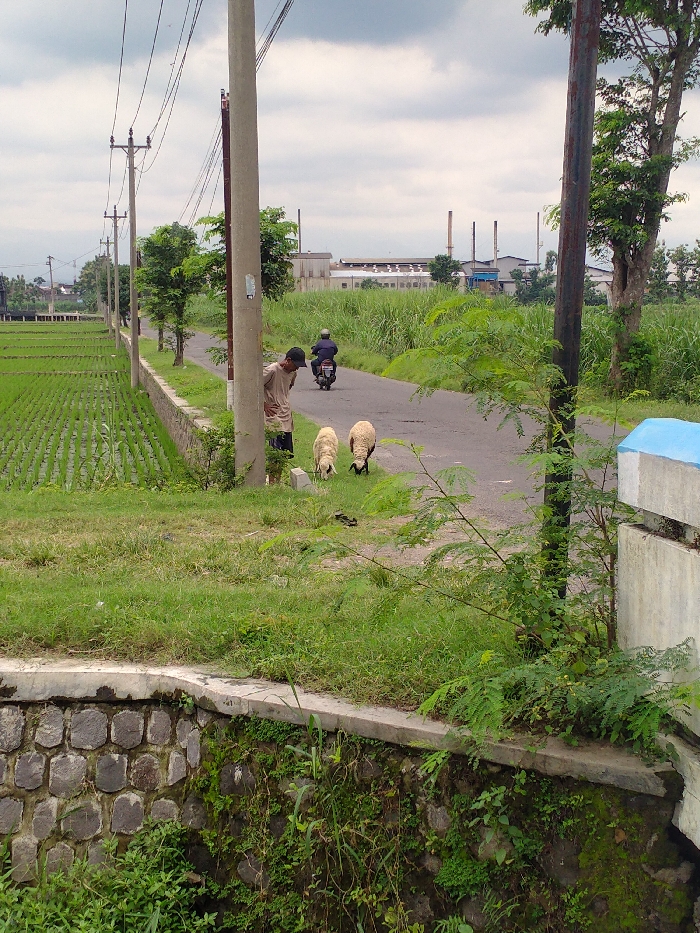
This medium shot captures a semi-rural scene in Kecamatan Kebakkramat, Indonesia, under an overcast sky. The image is dominated by lush green vegetation, a narrow paved road, and utility poles with power lines extending into the distance. In the foreground, a young man wearing a light-colored shirt and a dark cap stands near a concrete utility pole, looking towards the road. Two light-colored sheep, possibly goats, are grazing on the grassy verge directly in front of him, close to the edge of the road. Further down the road, a person on a black motorcycle is seen driving away from the viewer. To the left, expansive rice fields stretch towards the horizon, neatly patterned with young green crops. A low stone wall with a concrete cap separates the rice fields from the grassy shoulder of the road. On the right, more dense greenery and small trees line the road. In the mid-ground, a factory complex with several industrial chimneys is visible under the cloudy sky, suggesting a mix of agricultural and industrial landscapes. The foreground also features a stone retaining wall covered in moss and various plants, indicating a slight elevation change from the lower left to the road level. The overall impression is one of a quiet, everyday scene in a working rural area, with elements of both nature and human infrastructure coexisting. No discernible text is visible in the image.
Kecamatan Kebakkramat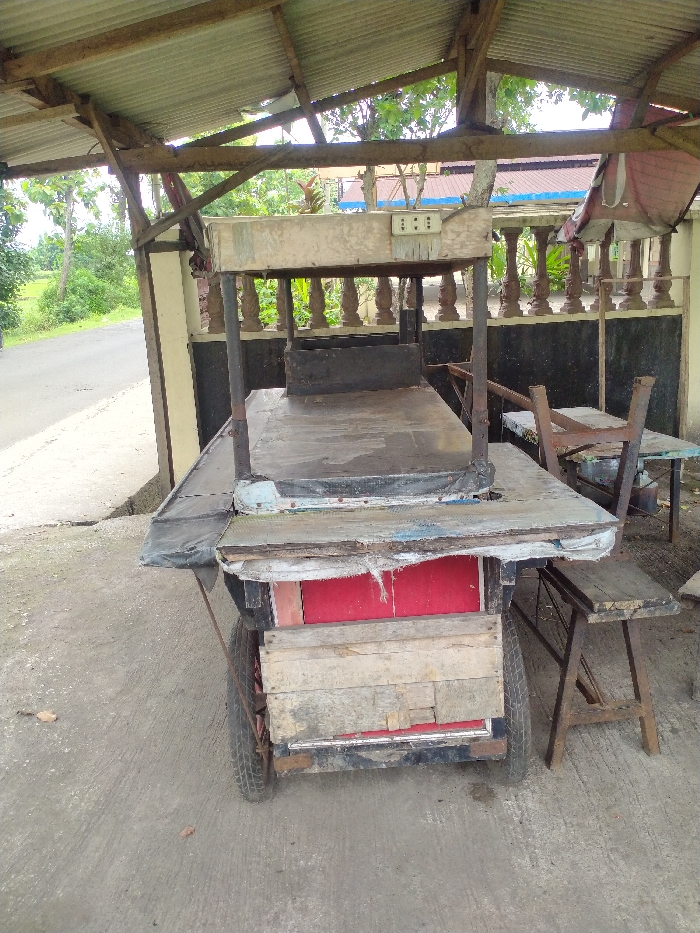
The image presents an empty, rustic street vendor's cart situated under a basic lean-to roof, constructed from corrugated metal sheets supported by wooden beams. The setting is outdoors, likely by a roadside, with a paved road and dense green foliage visible to the left. The central subject is a well-used, mobile food cart, predominantly made of wood. It features a large, flat, dark-colored main counter surface. An elevated wooden structure above the main counter displays a row of three electrical outlets. A black, rectangular container or basin rests on the main counter. The lower part of the cart shows weathered wooden panels and sections painted in red. Two wheels are visible on the left side, indicating its function as a mobile stall. To the right of the cart, a simple wooden stool with an A-frame base sits on the concrete ground. Further back, another small table or bench holds an inverted chair. In the background, a light-colored building with a decorative balustrade and a dark-painted lower section is partially visible behind trees. The scene suggests daytime, with soft, diffused lighting indicating possibly overcast weather. No individuals are present, and there is no discernible activity taking place. The general appearance of the cart and its surroundings evokes a small, local business environment typical of places like Kecamatan Kebakkramat, Indonesia. There is no visible text.
Kecamatan Kebakkramat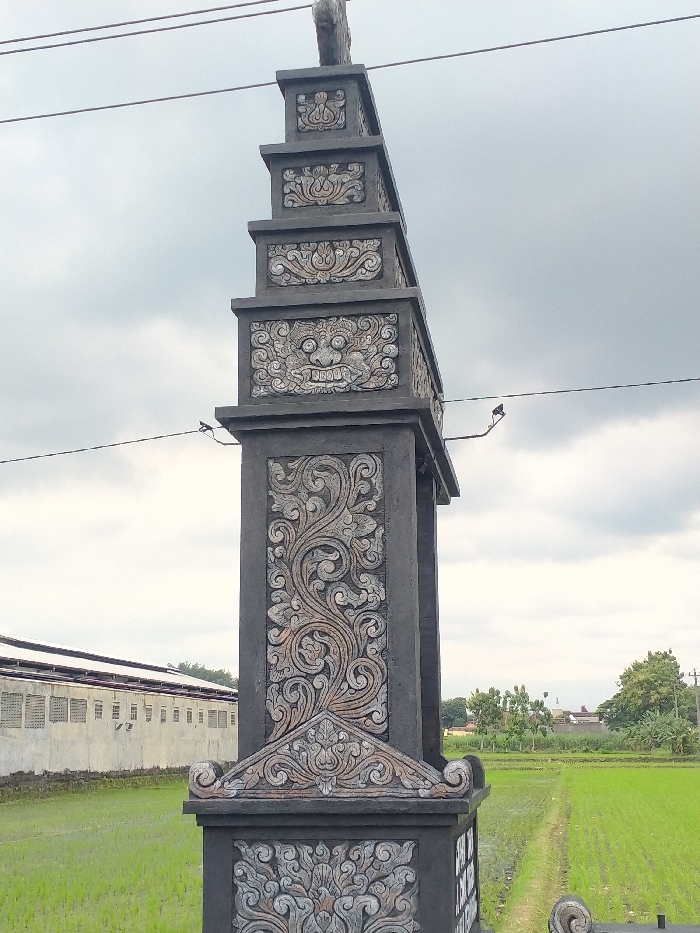
The image displays a tall, dark grey decorative gate pillar or architectural column, likely made of concrete or stone. The pillar is intricately carved with traditional Indonesian motifs. A prominent feature is a stylized, somewhat fierce face with large eyes and a wide mouth, possibly representing a Boma or Kala face, located on one of the upper tiers. Below and around this, elaborate swirling floral and foliate patterns are carved into the pillar, rendered in lighter grey and brownish tones against the darker background of the pillar's surface. In the background to the left, a long, low-lying building with a light-colored roof and numerous small rectangular windows or vents is visible. Lush green rice paddies or agricultural fields dominate the foreground and mid-ground on both sides of the pillar, with a narrow dirt path running through the fields on the right. Further in the distance on the right, trees and some indistinct buildings are present under an overcast, cloudy sky. Electrical wires stretch horizontally across the upper portion of the frame, passing near the top of the pillar. A small, dark bird can be seen perched on a branch or wire near the pillar in some cropped views. The scene depicts a static, rural landscape in Indonesia (Kecamatan Kebakkramat), characterized by traditional architecture and agriculture. The time of day appears to be daytime, with soft, diffused light due to the cloudy weather. No people or activities are visible, and there is no discernible text in the image.
Kecamatan Kebakkramat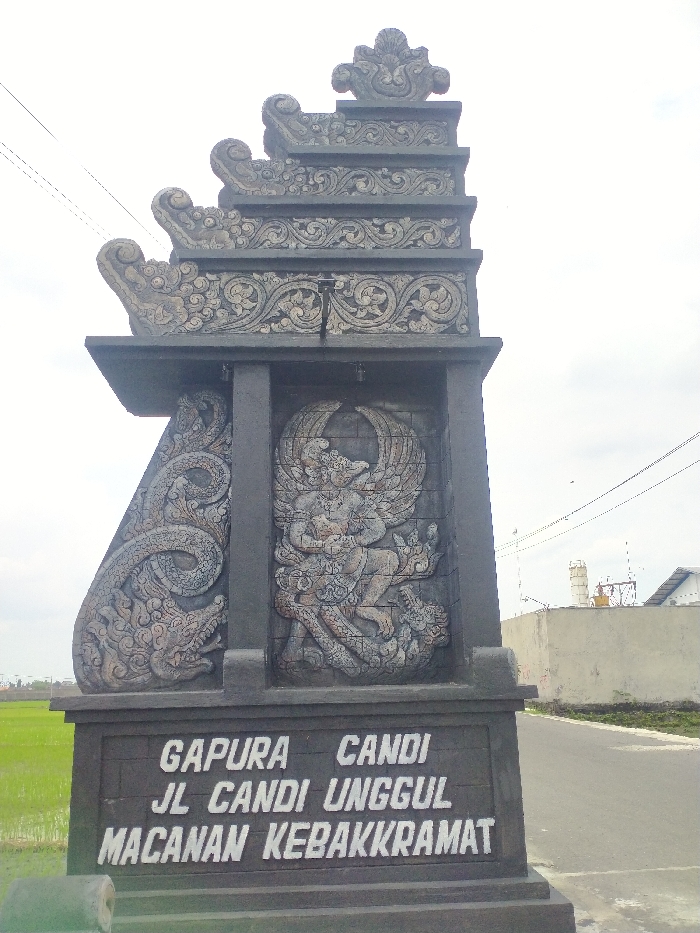
A large, ornate stone gateway, known as a "gapura," stands prominently in the center of the frame. The gate is dark gray with lighter, intricately carved stone details, featuring multiple tiered levels at the top adorned with floral and swirling motifs. Below the upper tiers, on the front face of the gate, there is a large relief carving of a winged, human-like figure, likely Garuda, grasping a serpentine creature or naga. To the left of this central carving, on the side of the gate, another relief depicts a coiled dragon-like figure with scales and a detailed head. The gate is situated next to a paved road that stretches into the distance on the right side of the image. To the left of the gate, a vibrant green rice paddy field is visible, suggesting an agricultural landscape. In the background, beyond the road and field, are several buildings, including what appears to be industrial structures or tall tanks, and utility poles with overhead wires. The sky is overcast and bright, indicating daytime without direct sunlight. At the base of the gate, white capital letters against a dark background display text in Indonesian. The text reads: "GAPURA CANDI" "JL CANDI UNGGUL" "MACANAN KEBAKKRAMAT" This signage identifies the structure as a temple gate and indicates its location on Jalan Candi Unggul in Macanan, within the Kecamatan Kebakkramat area of Indonesia.
Kecamatan Kebakkramat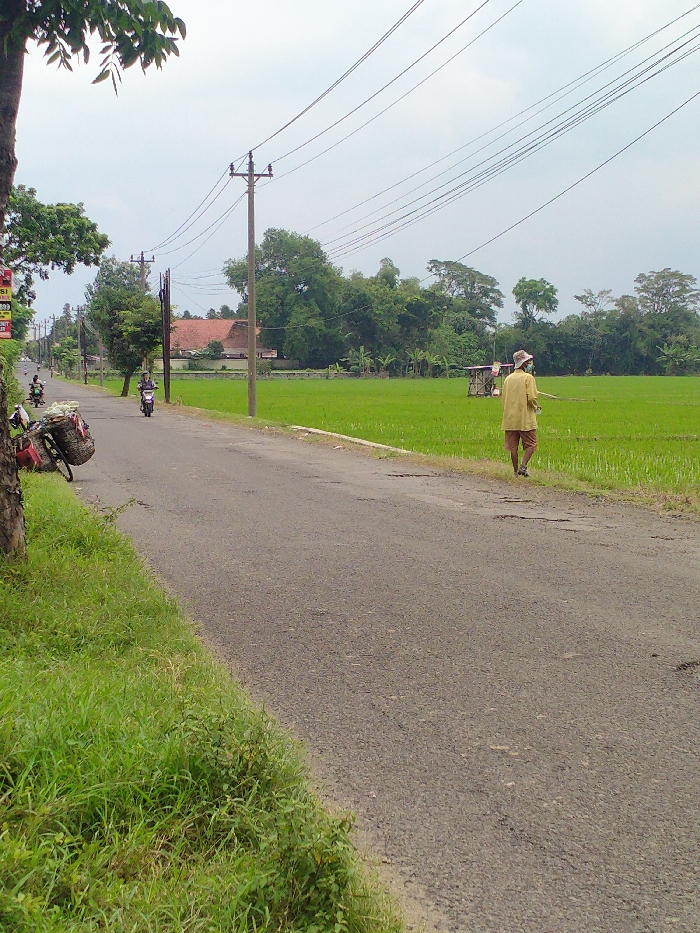
This media file depicts a rural road scene in Kecamatan Kebakkramat, Indonesia, on an overcast day. A paved road, appearing slightly worn in places, cuts through the middle of the frame, leading into the distance. To the left, a strip of green grass borders the road, with a tree trunk visible in the immediate foreground. A red and white sign, partially obscured, is attached to a pole on the far left, displaying text that includes "SASI" and "BERAS". On the right side of the road, a man walks away from the viewer, heading down the road parallel to a lush, bright green rice field. He is dressed in a light-colored long-sleeved shirt, shorts, a hat, and what appears to be a face mask. He carries a long stick or tool over his right shoulder. Within the rice field, closer to the distant tree line, a small, rustic wooden shack or shelter stands. In the background, beyond the rice fields and trees, a house with a distinct terracotta-colored roof is visible. Several utility poles with numerous power lines stretch across the frame, following the path of the road. Further down the road, two motorcyclists can be seen riding, and another motorcycle, possibly a delivery bike with baskets attached, is leaning against a tree on the left side of the road. The sky is largely white and cloudy, suggesting a bright but overcast daytime. The scene portrays a typical agricultural landscape and daily life in a rural Indonesian area.
Kecamatan Kebakkramat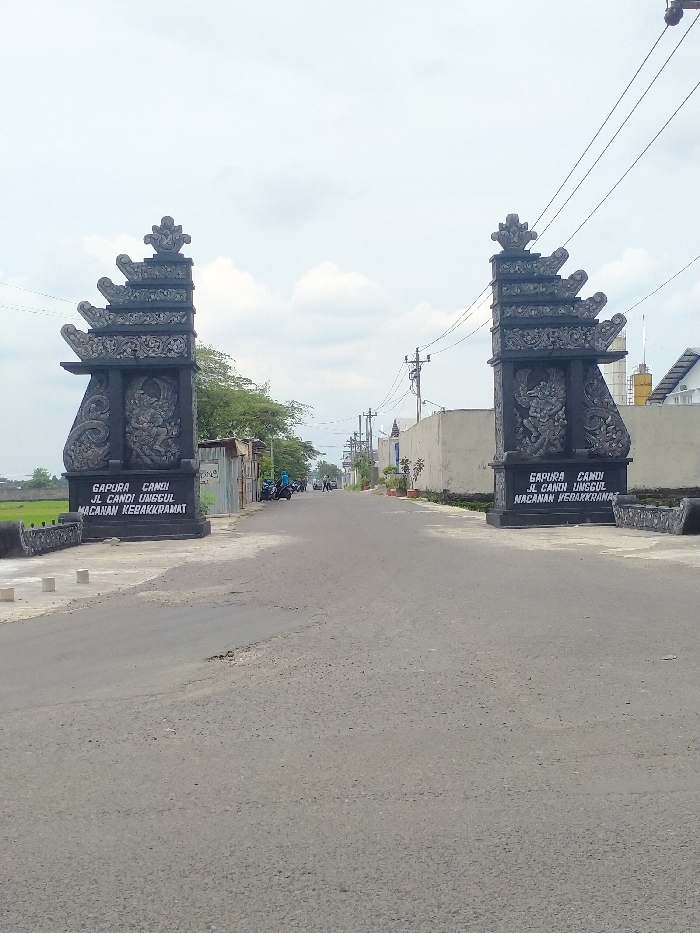
The image captures a straight-on view of a paved road flanked by two ornate *gapura*, or traditional Indonesian split gates, marking an entryway. The scene is set outdoors under a partly cloudy sky, suggesting daytime. The two prominent *gapura* are dark in color, likely stone or concrete, and feature intricate carvings, including tiered roof structures and figures on their lower sections. On the base of the left gate, white text is clearly visible, reading: "GAPURA CANDI", "JL CANDI UNGGUL", and "MACANAN KEBAKKRAMAT". Similar text is partially visible on the right gate, with the OCR suggesting "JL CANDIN LINGGUL" and "NACANAN PEDAKKRANAJ", likely intended to be identical to the left gate. These texts, particularly "Kebakkramat," confirm the location context of Kecamatan Kebakkramat, Indonesia. The asphalt road extends into the distance, showing some signs of wear such as cracks and minor potholes. Utility poles and overhead power lines run along both sides of the road. To the left, beyond the gate, there's lush green vegetation, possibly agricultural fields or dense trees, and a few small, simple buildings. Several motorcycles are parked further down the road on the left, with a few indistinct figures of people visible nearby. To the right, a long concrete wall borders the road, interspersed with potted plants. Further down this side, houses with various rooflines, including a distinct white one, can be seen. No specific event or activity is prominently featured; the image presents a snapshot of a typical day in this locale.
Kecamatan Kebakkramat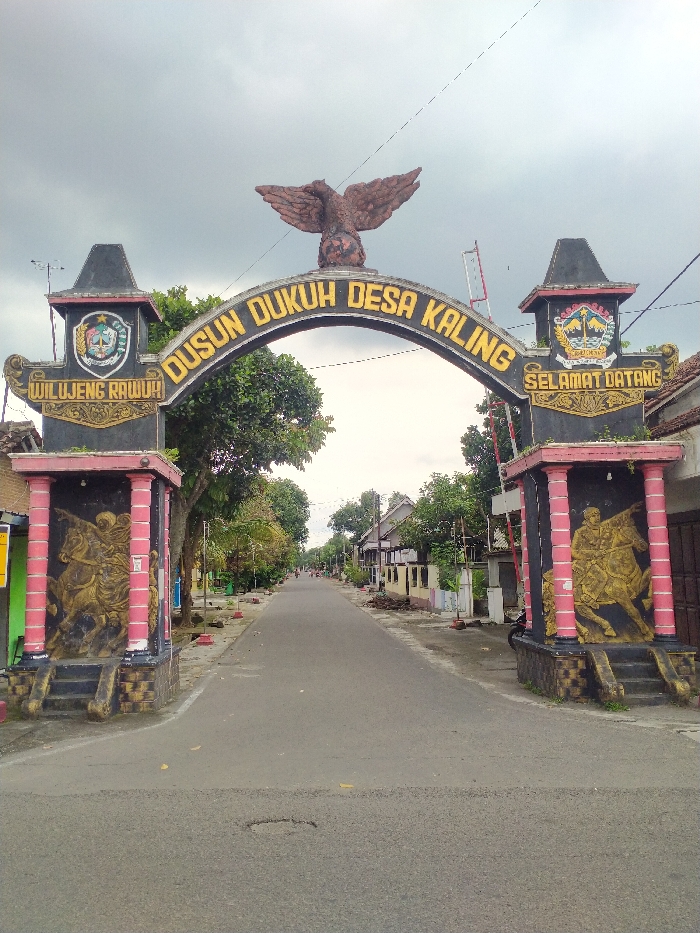
This image presents a welcoming archway marking the entrance to a village or hamlet in what appears to be a rural or semi-urban setting in Kecamatan Kebakkramat, Indonesia. The archway, predominantly black and gold, spans a paved road that extends straight into the distance, flanked by residential houses and trees under an overcast sky. A large, brown eagle sculpture with outstretched wings is prominently perched atop the center of the arch. Bold gold letters on the arch clearly state "DUSUN DUKUH DESA KALING." The arch is supported by two decorative pillars, also in black and gold with pinkish-red accents. The left pillar features an emblem and the Javanese welcome phrase "WILUJENG RAWUH!", while the right pillar displays a similar emblem and the Indonesian welcome "SELAMAT DATANG." Both pillars are adorned with golden bas-reliefs depicting dynamic figures, seemingly warriors, on horseback. Beyond the arch, the asphalt road is visible, with modest, single-story homes lining both sides. The houses exhibit typical Indonesian architectural styles, with tiled roofs and some greenery. Numerous trees provide shade along the street. In the far distance, a few small figures can be discerned, suggesting people going about their daily routines. The sky is uniformly overcast, indicating either a cloudy day, early morning, or late afternoon, with diffused lighting across the scene. Power lines are visible stretching across the top of the frame.
Kecamatan Kebakkramat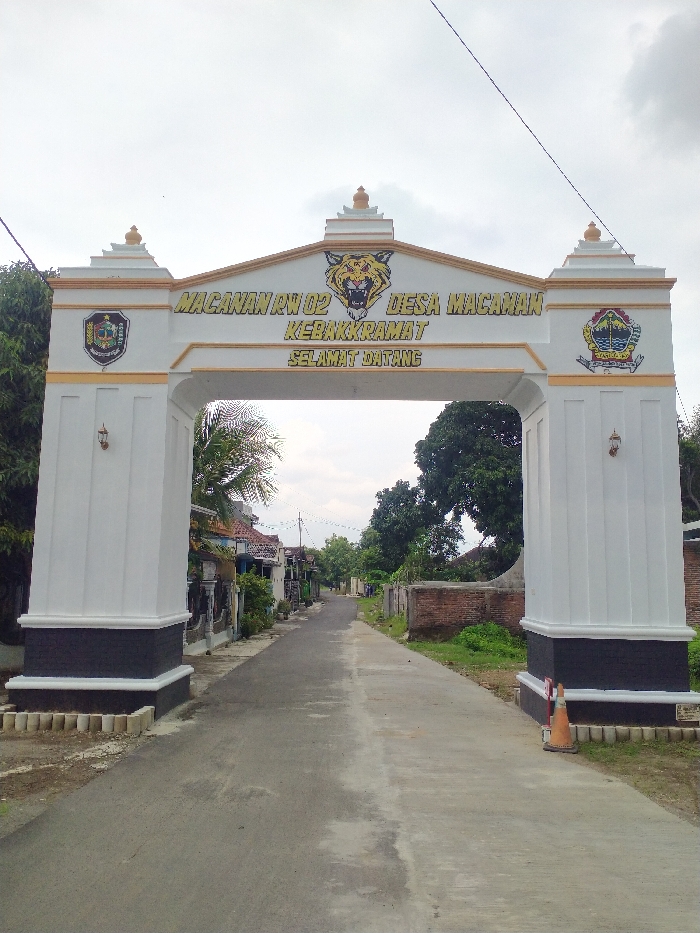
The image captures a static scene featuring a white and gold archway spanning a paved road, serving as an entrance or welcome gate to a community. No people are visible in the frame. The archway is the dominant subject, constructed from white masonry with gold trim along its edges and decorative elements on top of its columns. At the center of the arch, a large, stylized yellow and black tiger head emblem is prominently displayed. To the left and right of the tiger head, two shields or emblems are affixed to the arch, featuring colorful designs that appear to be coats of arms or regional symbols. Visible text on the archway reads: * Top line: "MACANAN RW 02" (likely a neighborhood or sub-district name and number). * Middle line: "DESA MACANAN" (Village of Macanan). * Next line: "KEBAKKRAMAT" (referring to Kecamatan Kebakkramat, the sub-district). * Bottom line: "SELAMAT DATANG" (Welcome). The road beneath the archway is paved, appearing to be asphalt or concrete, extending into the distance. It is relatively narrow, suggesting a village or residential street. Along both sides of the road, various houses and structures are visible, mostly single-story with some fencing and greenery. The architectural style appears typical of Indonesian rural or semi-urban dwellings. Lush green trees and foliage are scattered throughout the scene, particularly on the left and right sides of the archway and further down the road, indicating a verdant environment. The sky is overcast, suggesting a cloudy day or a time of day when the sun is not directly overhead, such as morning or late afternoon. The overall lighting is soft and diffused. An orange traffic cone is placed near the base of the right archway pillar. The setting is clearly a residential area within Kecamatan Kebakkramat, Indonesia, marked by the welcoming gate.
Kecamatan Kebakkramat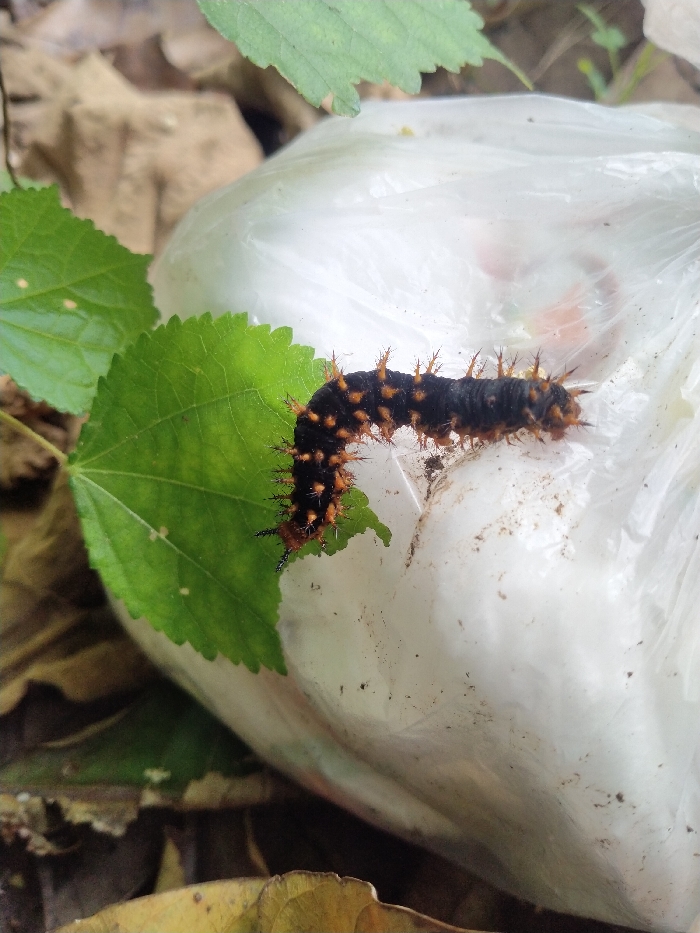
A close-up, ground-level photograph captures a striking caterpillar in an outdoor setting, likely in Kecamatan Kebakkramat, Indonesia. The main subject is a black caterpillar adorned with numerous sharp, orange or reddish-brown spines or tubercles along its segmented body. The caterpillar is positioned on a vibrant green leaf, with its head seemingly near an eaten portion of the leaf's edge, suggesting it might be feeding or has recently fed. The green leaf rests upon or beside a crumpled, translucent white plastic bag. The bag shows some signs of dirt and minor debris on its surface, indicating its presence in an outdoor, potentially unkempt environment. In the background and foreground, out-of-focus elements include other green leaves, brown dried leaves, and earthy tones, further establishing the natural setting. The clear, bright lighting suggests the photograph was taken during the daytime. There is no visible text in the image, and no specific weather conditions or emotional context can be discerned. The scene presents a small glimpse into the intersection of wildlife and human activity, with the caterpillar making its way amidst natural foliage and discarded plastic.
Kecamatan Kebakkramat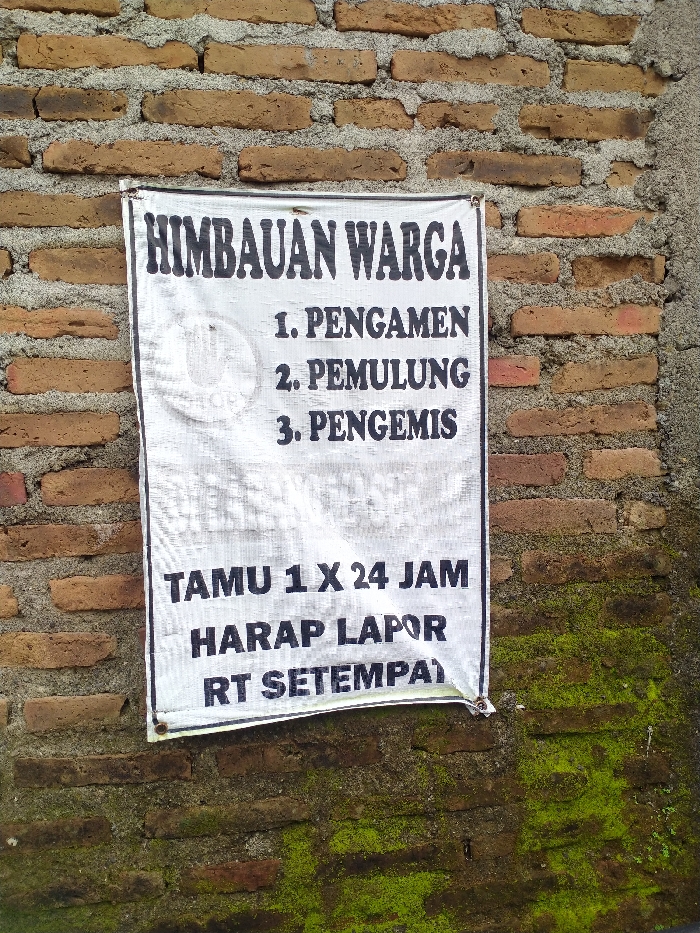
A white sign with black, bold text is prominently displayed against a weathered brick wall. The sign, made of a fabric-like material, is attached to the wall, possibly by nails or staples, and shows some creasing and slight wear. The background is a rustic brick wall composed of reddish-brown bricks with visible grey mortar, indicating an outdoor setting. Patches of vibrant green moss grow on the lower and right sections of the brick wall, suggesting a humid environment or shade. The text on the sign is in Indonesian and reads: "HIMBAUAN WARGA" (COMMUNITY ANNOUNCEMENT / WARNING) "1. PENGAMEN" (1. STREET MUSICIANS/BUSKERS) "2. PEMULUNG" (2. SCAVENGERS/RECYCLERS) "3. PENGEMIS" (3. BEGGARS) Below this list, there's another directive: "TAMU 1 X 24 JAM" (GUESTS FOR 1 X 24 HOURS) "HARAP LAPOR" (PLEASE REPORT) "RT SETEMPAT" (TO THE LOCAL RT - Rukun Tetangga, a neighborhood association leader) The sign serves as a set of community rules or a warning to residents and visitors in the Kecamatan Kebakkramat, Indonesia, indicating that the presence or activities of street musicians, scavengers, and beggars are being regulated or discouraged. It also stipulates a requirement for guests staying longer than 24 hours to be reported to the local neighborhood head. The overall impression is one of community organization and an effort to maintain order or security within the area. The image appears to be taken during the daytime, with soft, diffused lighting.
Kecamatan Kebakkramat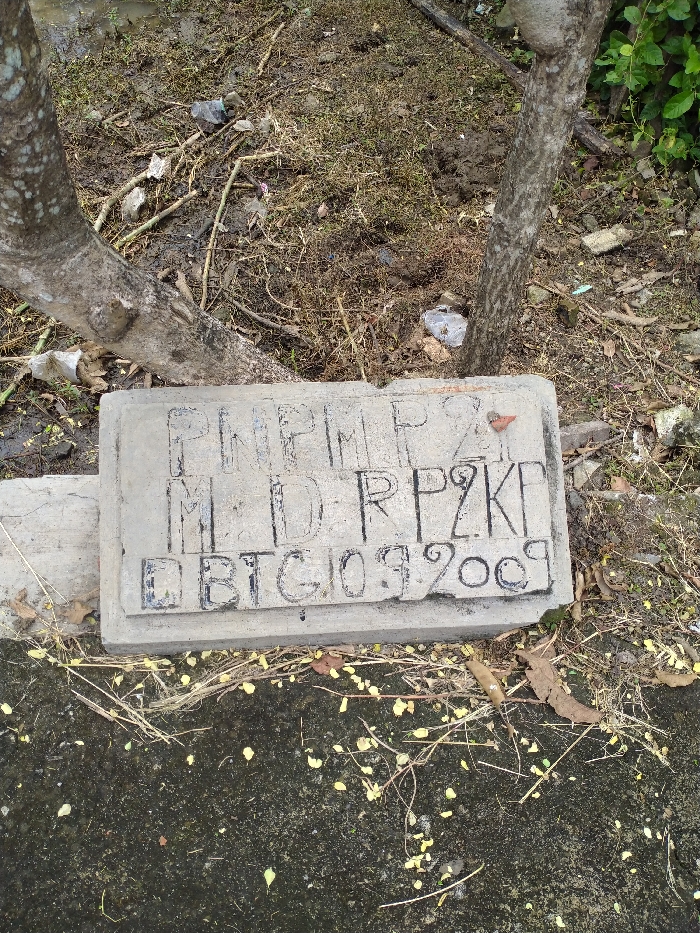
This media file captures an outdoor scene featuring a rectangular concrete slab resting on the ground, positioned between the trunks of two trees. The slab, which appears weathered, has text carved or etched into its surface, with some letters highlighted in black paint. The visible text on the slab reads: PNPMPZ M.D.RPZKI DBTC032009 The surrounding environment consists of muddy ground covered with dry grass, small branches, and some debris or litter, particularly visible in the area around the tree trunks. In the foreground, there is a darker, possibly wet or stained, paved surface. The scene is static, showing no human activity. The natural light indicates it is daytime. Based on the provided context, the location suggests an area in Kecamatan Kebakkramat, Indonesia.
Kecamatan Kebakkramat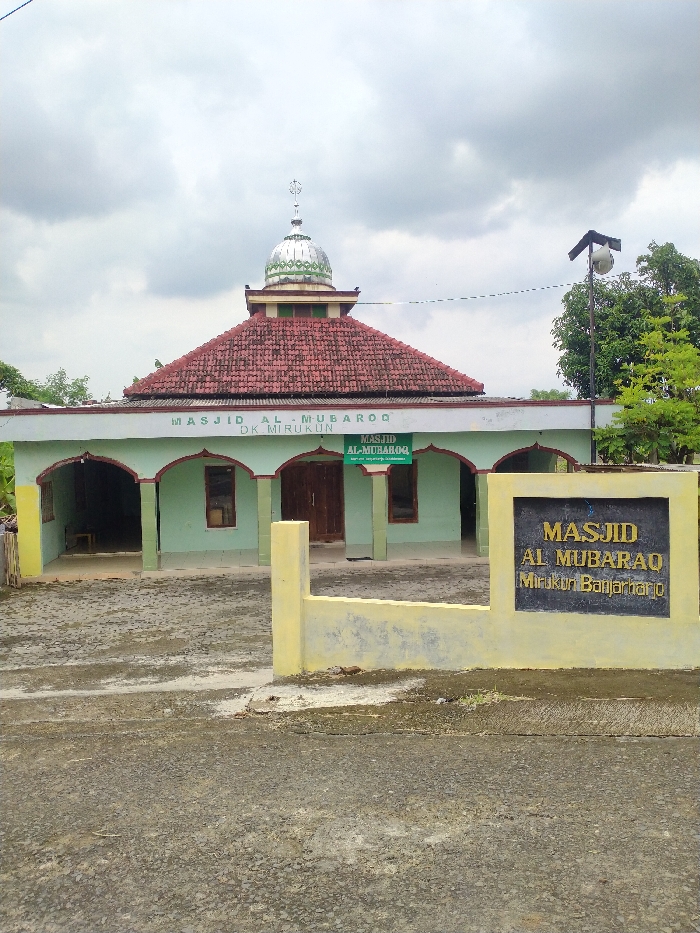
An exterior shot captures Masjid Al-Mubarooq, a mosque located in Kecamatan Kebakkramat, Indonesia, under an overcast sky. The mosque features light greenish-blue walls with darker green trim around its arched entranceways and windows. Its roof is covered with reddish-brown tiles, and a small, silver-colored dome topped with a finial sits centrally above the roofline. Two wooden double doors are visible at the main entrance. In front of the mosque, a paved, somewhat rough ground leads up to the building. A low, yellow-painted wall or boundary runs across the foreground. Integrated into this wall on the right side is a larger, black rectangular sign with raised yellow text that reads: "MASJID AL MUBARAQ Mirukon Banjarharjo". Above the main entrance of the mosque, a banner displays "MASJID AL-MUBAROQ DK MIRUKUN". Additionally, a smaller, green hanging sign with "MASJID AL-MUBAROQ" and some indistinct smaller text is positioned centrally near the entrance. To the right of the mosque, a pole with a speaker or light fixture is visible, alongside some green foliage from nearby trees. No people or specific activities are depicted in the static scene. The overall impression is a community mosque with functional and modest architecture, situated in what appears to be a non-urban setting during daytime.
Kecamatan Kebakkramat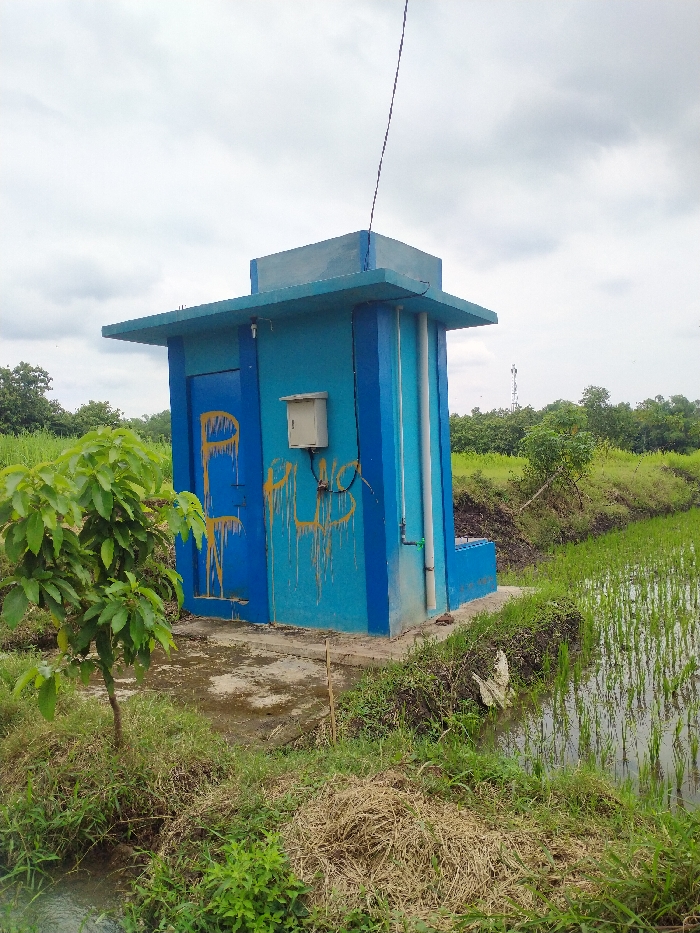
This image captures a small, utilitarian blue building situated amidst an agricultural landscape, specifically rice paddies, in Kecamatan Kebakkramat, Indonesia. The building itself is a bright aqua blue with darker blue trim on its edges and roof, suggesting a fresh coat of paint or well-maintained structure. It features a flat roof with a slightly wider overhang and appears to be made of concrete or similar sturdy material. On the front of the building, a door is visible, and to its right, an off-white electrical box is mounted on the wall. Yellow spray-painted graffiti is prominent on the door and the wall to the right of it; the text on the door looks like a stylized "P" or "PL," while the text on the wall appears to read "PLUS" or "PLUG." Several white pipes run vertically along the right side of the building, indicating some form of water or utility connection. A thin black wire, possibly an antenna or power line, extends upwards from the building towards the sky. The setting is predominantly green, with lush rice plants growing in flooded paddies to the right and foreground of the building. An irrigation ditch or small waterway runs along the edge of the field. The ground immediately around the building is a mix of bare, damp earth and patches of grass and weeds. A small, leafy green tree or shrub stands to the left foreground of the building, while dried straw or grass is scattered near the base of the building and the adjacent ditch. In the background, beyond the rice fields, are numerous other trees and a cloudy, overcast sky, indicating daytime with diffused light. A tall, distant tower, possibly a cellular tower, can be glimpsed on the horizon to the right, suggesting the presence of modern infrastructure nearby. No people are visible in the scene, which conveys a sense of quiet rural utility.
Kecamatan Kebakkramat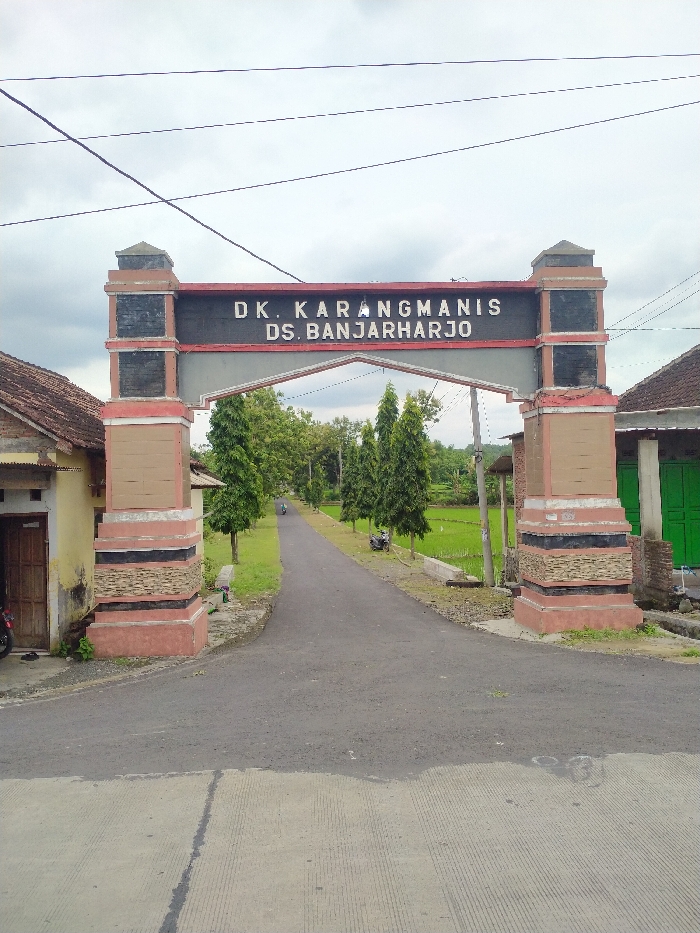
This image depicts the entrance to a rural area in Kecamatan Kebakkramat, Indonesia, characterized by a prominent gate bearing a location sign. The gate features two robust pillars with layered stone-like textures in reddish-brown, black, and beige, supporting a dark horizontal beam. Clearly inscribed on the beam are the words "DK. KARANGMANIS" on the upper line and "DS. BANJARHARJO" below, indicating the Hamlet of Karangmanis within Banjarharjo Village. A paved asphalt road leads directly through the gate and recedes into the distance, flanked on both sides by tall, slender evergreen trees. On the right side of the road, beyond the trees, lush green rice paddies are visible, signifying an agricultural landscape. On the left, partially obscured by the gate pillar, is a traditional house with a tiled roof. Another house, with a green door, is visible to the right. In the mid-distance on the road, a person is seen riding a motorcycle, while another motorcycle is parked on the right shoulder. Overhead, several utility wires crisscross the cloudy sky, suggesting an overcast day. The scene conveys a quiet, rural village setting during daytime, with no specific activity beyond the passage of the lone motorcycle.
Kecamatan Kebakkramat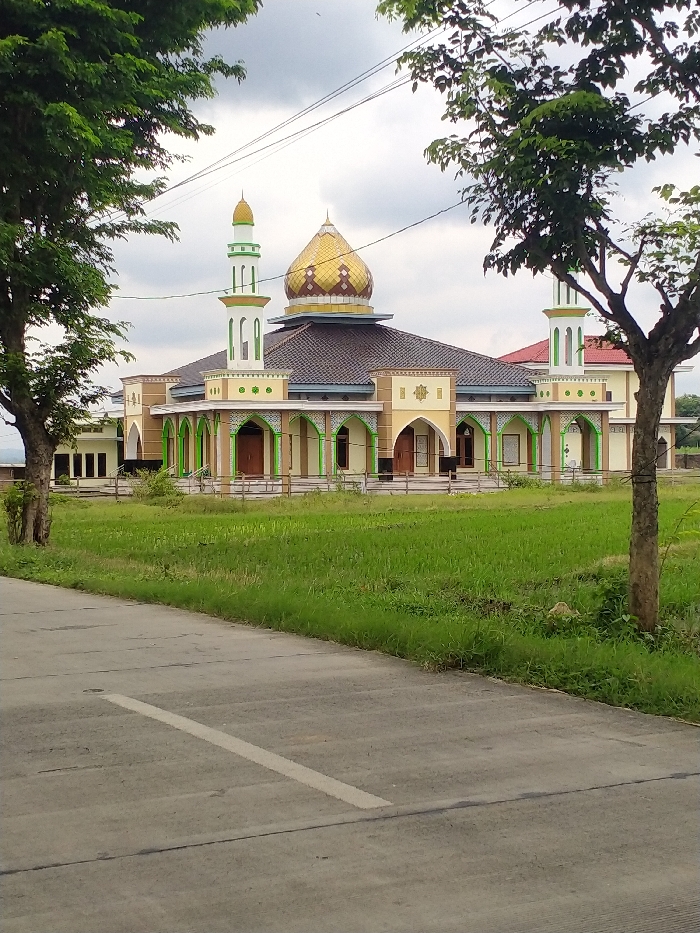
The image captures a modern mosque with a distinctive golden dome and two slender minarets, set against an overcast sky. The mosque features light yellow walls with green and brown decorative accents, including a series of arched facades along its front and sides. The roof is dark brown with a tiled appearance. The minarets are white and green, topped with small golden finials, complementing the larger central dome which has a patterned surface. The mosque is framed by lush green trees on both the left and right sides of the foreground, their branches and leaves extending into the upper corners of the frame. In front of the mosque, there is an expanse of vibrant green grass or cultivated field. A paved road or path, light grey in color with a faint white marking, occupies the lower left portion of the image, curving away into the distance. Power lines are faintly visible stretching across the cloudy sky above the mosque. The scene depicts a tranquil daytime setting, likely late morning or early afternoon, characterized by soft, diffused light due to the cloudy weather. No people or active events are visible. The architecture of the mosque and the surrounding natural landscape suggest a peaceful, possibly rural or semi-rural, environment in Kecamatan Kebakkramat, Indonesia.
Kecamatan Kebakkramat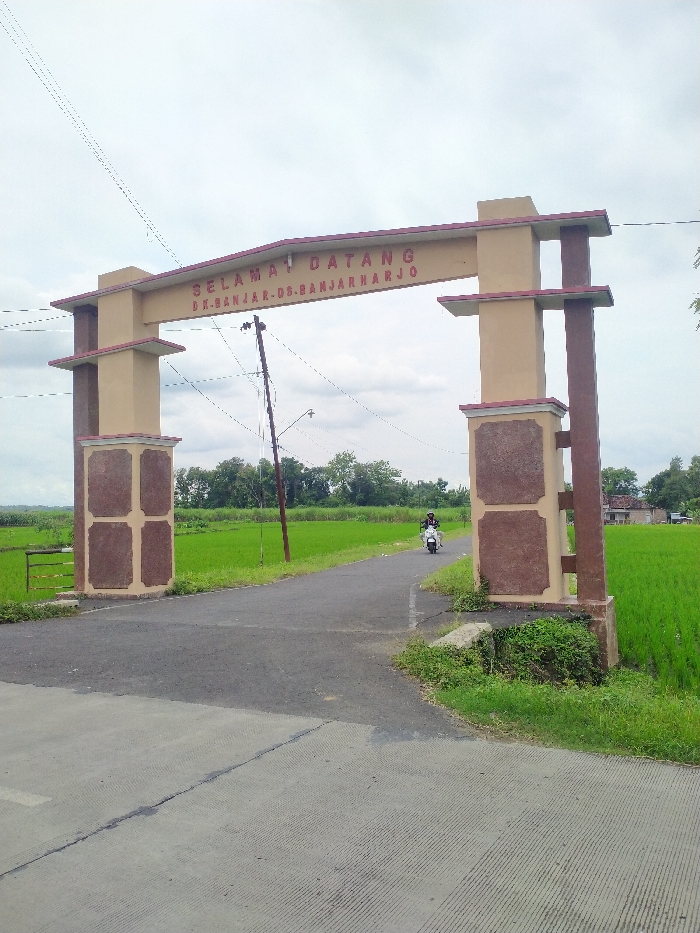
The image captures a rural entrance marked by a decorative archway, likely in Kecamatan Kebakkramat, Indonesia. The archway spans a paved road, featuring beige pillars and a crossbeam adorned with reddish-brown accents. Prominently displayed on the archway is the text "SELAMAT DATANG" (Welcome) followed by "DK. BANJAR - DS. BANJARHARJO," identifying the hamlet (Dukuh) and village (Desa) being entered. The scene is set under an overcast sky, suggesting a cloudy daytime. On both sides of the road, vibrant green rice fields stretch into the distance, indicating a fertile, agricultural landscape. A narrow asphalt road passes under the archway, leading towards a line of trees on the horizon. A single power pole stands near the left pillar of the arch, with power lines visible across the sky. In the mid-ground, a person wearing a helmet is riding a white scooter or motorcycle away from the viewer, having just passed or in the process of passing under the archway. The ground in front of the archway is a lighter concrete slab, transitioning to the darker asphalt road. The overall impression is that of a quiet, welcoming entrance to a village surrounded by rice paddies.
Kecamatan Kebakkramat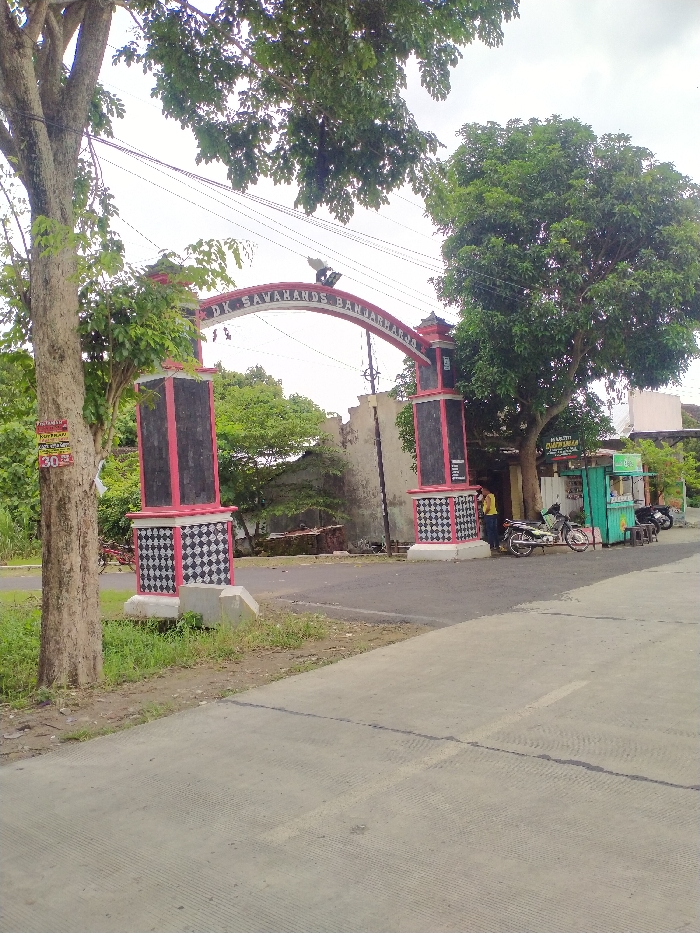
The image depicts a daytime scene at the entrance to a community in Kecamatan Kebakkramat, Indonesia, marked by a decorative arched gate. The gate features two substantial pillars and an arch connecting them. The pillars are painted with red and black accents, and their bases exhibit a distinct black and white checkerboard pattern. Text on the arch clearly reads "DK. SAWAHANDS BANJARHARJO", with a light fixture mounted above it. On the left side of the frame, a large tree trunk and its foliage partially obscure the gate. A red and white sign is attached to the tree, displaying the text "KOPI KAKI" and the number "30". To the right of the gate, another large, leafy tree stands beside a small, light blue/green street stall or shop. A person wearing a yellow shirt is visible standing near the right pillar of the gate, in proximity to the stall. Several motorcycles are parked in front of the stall, and a bicycle is partially visible near the left pillar. The ground in the foreground is a concrete road, which changes to an asphalt surface beyond the gate. The sky appears overcast, indicating a cloudy day. In the background, behind the gate, more trees and some buildings are visible. Power lines traverse the sky above the gate. The overall scene suggests a local community entrance, possibly a casual gathering point or business area, characteristic of a rural or semi-rural setting.
Kecamatan Kebakkramat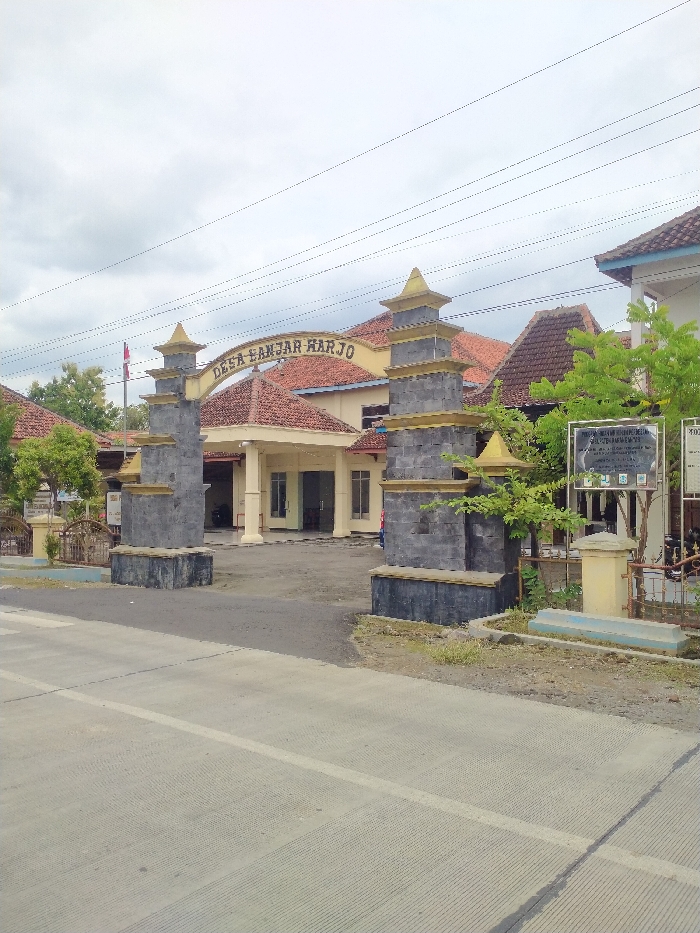
The image presents a view of the entrance to Desa Banjar Harjo (Banjar Harjo Village) in Kecamatan Kebakkramat, Indonesia. A prominent gateway, composed of two substantial pillars made of grey stone blocks and topped with golden-yellow pyramid-like caps, frames the access point. An arched sign spanning between the pillars clearly displays the text "DESA BANJAR HARJO" in golden-yellow lettering. Behind the archway, a single-story building with light-colored walls and a reddish-brown tiled roof, likely a village office or community center, is visible. The architecture features multiple gables and a covered porch area. Green trees and shrubs are interspersed around the entrance and alongside the buildings, contributing natural elements to the setting. On the right side of the archway, two informational signs are positioned; one partially legible sign begins with "PEMERINTAH KABUPATEN..." (Government of Regency...). A flag pole bearing a red and white flag, presumably the Indonesian flag, is visible further back on the left. In the foreground, a grey concrete road with a subtle white line extends across the lower portion of the image. The sky is overcast, providing diffused lighting characteristic of a cloudy day. No people or specific activities are depicted, giving the scene a quiet and still atmosphere.
Kecamatan Kebakkramat