Khan Yunis, Palestinian Territory
30 memories from Khan Yunis, Palestinian Territory
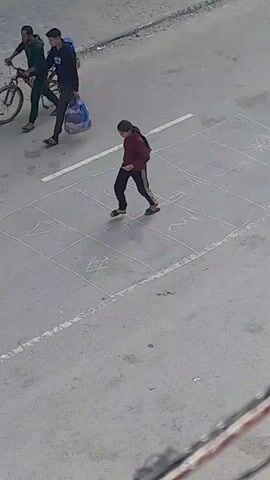
A high-angle shot captures a young girl playing hopscotch on a paved surface, likely a street or courtyard. She is wearing a maroon long-sleeved top and dark pants with white stripes, moving through a chalk-drawn hopscotch grid. The grid consists of multiple squares and rectangles, some containing numbers like '2', '3', '7', '8', and others with symbols such as 'X', an 'O', and a squiggly line. The girl skillfully jumps and hops across the squares. In the background, two individuals walk past from left to right. One is wearing a dark jacket and dark pants, carrying a light-colored bag with a blue pattern. The other, partially obscured, also wears dark clothing. The ground is a uniform grey pavement, with some lighter lines, possibly faded road markings or chalk from other games, visible further back. The overall lighting suggests it is daytime, possibly overcast. The scene depicts a common childhood game being played in an urban outdoor setting.
Khan Yunis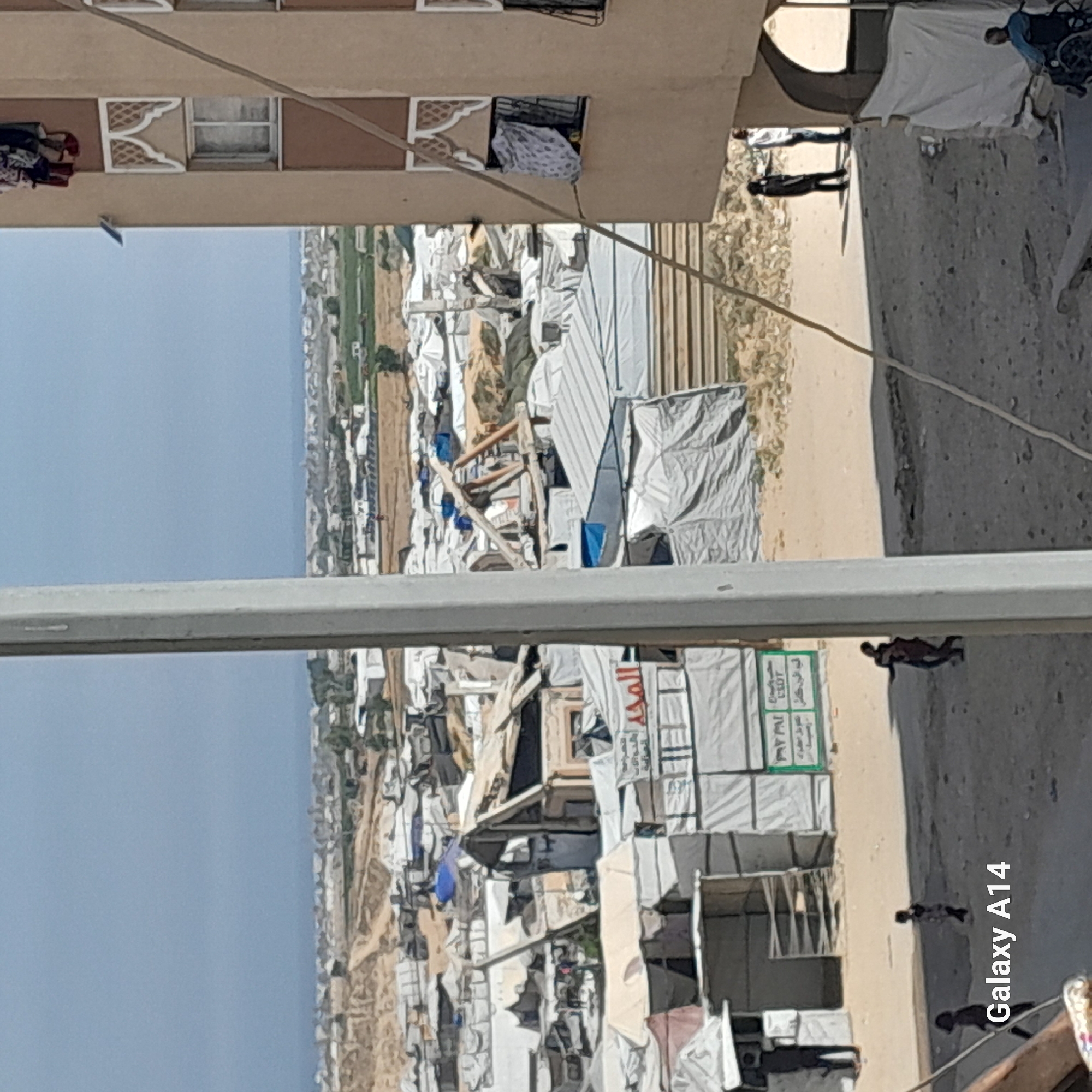
The image, taken during the daytime under a clear sky, depicts a densely populated area in what appears to be a displacement or refugee camp, consistent with the Khan Yunis context. In the foreground, a multi-story building with light brown and darker brown sections and decorative white window frames stands on the left. Clothes are seen hanging to dry from one of its windows. Several thin wires or cables crisscross the frame. The mid-ground and background are dominated by a sprawling settlement of numerous makeshift shelters. These structures are constructed from various materials, including white, grey, and beige tarpaulins, wood, and possibly corrugated metal, indicating temporary and improvised living conditions. They are packed closely together, extending far into the distance towards the horizon. A dirt or unpaved path runs along the right side of the image, where several individuals are visible. One person, wearing a blue top and dark trousers, is pushing what appears to be a wheelchair or cart. Further down the path, two darker figures are walking. Other figures can be seen near the entrance of the permanent building. Arabic text is visible on some of the banners and signs within the camp. One sign with a green border and text on a white background, potentially reading "ليون حلويات" (Lyon Sweets), and another prominent sign with red Arabic text, possibly "المجد" (Al-Majd, meaning "The Glory"), can be identified. The watermark "Galaxy A14" is present in the bottom right corner of the image.
Khan Yunis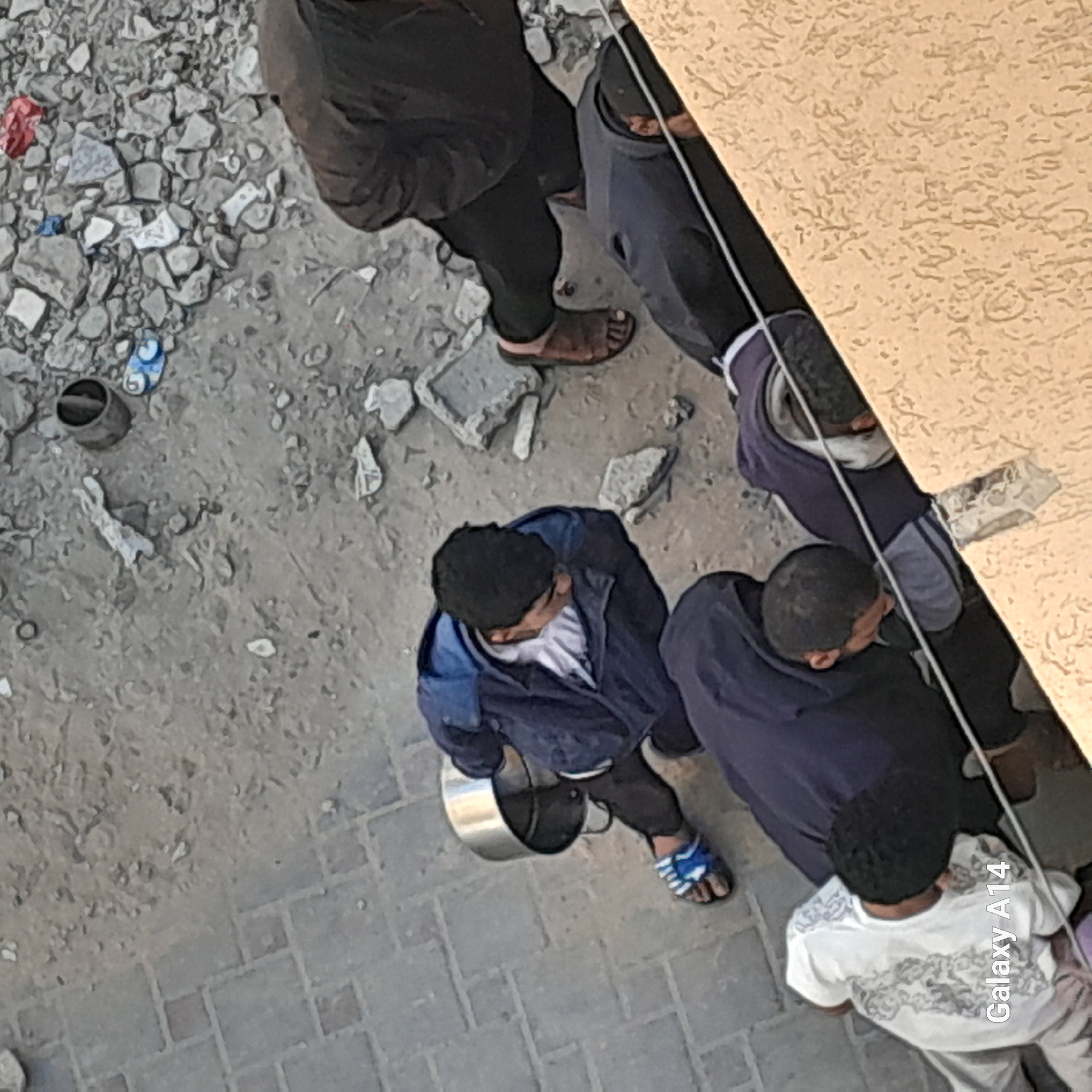
Aerial view of a group of people near a building. A person in a blue jacket holds a metal container. The ground is a mix of pavement and debris. The location is Khan Yunis, Palestinian Territory.
Khan Yunis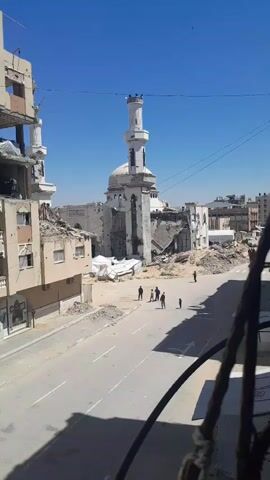
This media file depicts a scene of extensive destruction in an urban area, identified as Khan Yunis in the Palestinian Territory. The central focus is a heavily damaged mosque with a prominent, but also damaged, minaret still standing. Its dome is partially missing, and large sections of the mosque's structure appear to have collapsed into rubble. Surrounding the mosque are multi-story buildings, many of which are severely damaged or reduced to partial ruins. Walls are blown out, interiors exposed, and debris is scattered extensively across the scene, particularly around the base of the mosque and along the sides of the paved street. The street itself appears largely intact, albeit with some scattered rubble. Several people, including adults and at least one child, are seen walking along the street. They are moving through the devastated environment, suggesting an ongoing presence of residents despite the destruction. One cluster of individuals is visible near the entrance of the damaged mosque. The video is recorded on a bright, sunny day with a clear blue sky, casting distinct shadows, indicating a mid-morning or early afternoon time. The weather appears calm. The perspective is from an elevated position, possibly a balcony or higher floor of a building, looking down onto the street and the ruined landscape. A dark metal railing is visible in the foreground, partially obstructing the view. Visible text on signs is mostly in Arabic. On a damaged building to the left, a sign contains partially legible text, including "CAT." On a sign in the lower right, the word "أفراح" (Afrah, meaning "joys" or "weddings") is somewhat discernible, though the full context of the sign is unclear. The overall scene conveys a profound sense of devastation resulting from conflict, yet life continues as people navigate the altered landscape.
Khan Yunis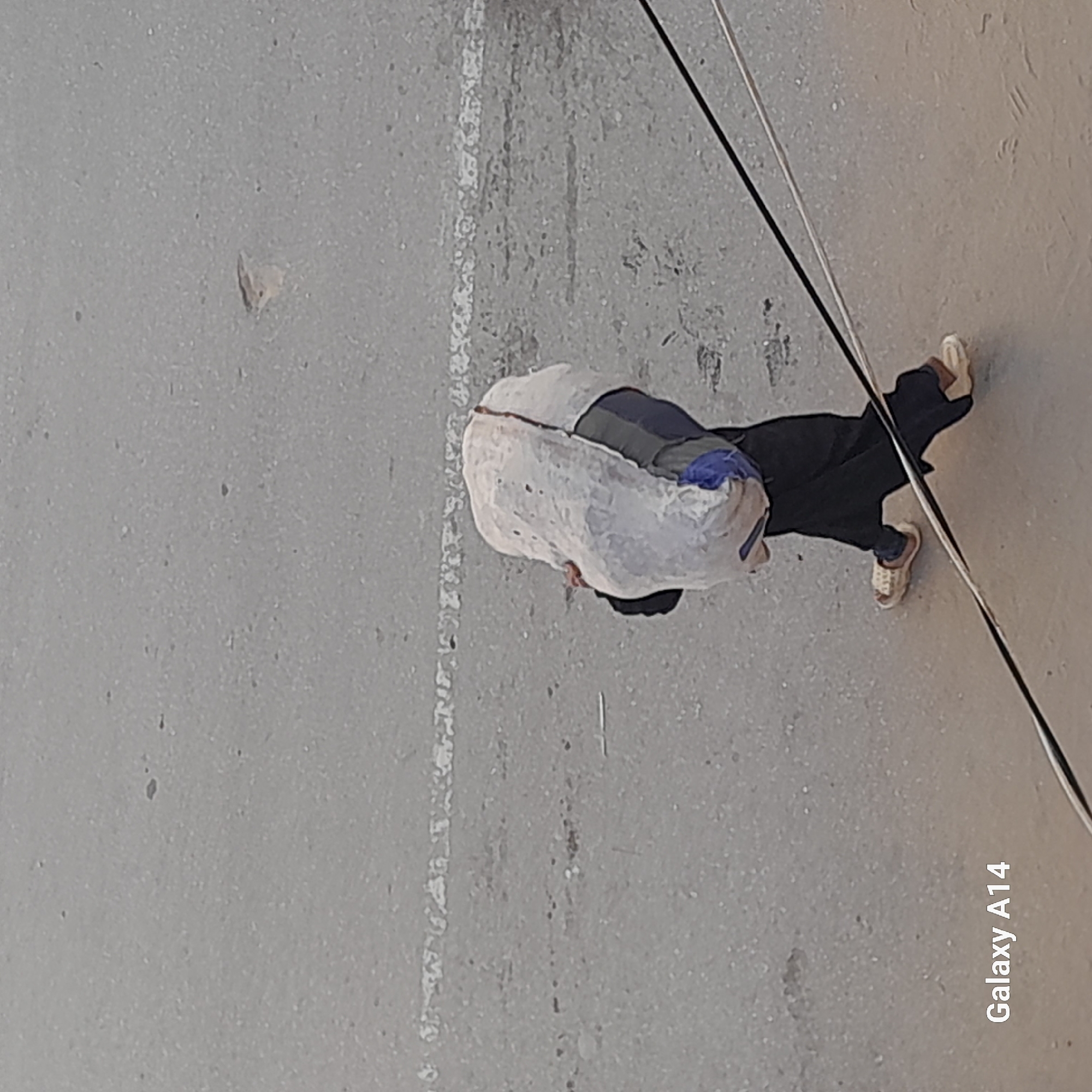
An overhead, medium shot depicts a person walking on a concrete surface, likely a street. The person is carrying a large, white sack on their back. They are wearing dark clothing and light-colored sandals. Power lines are visible in the upper right corner of the frame. A worn white line is present on the concrete to the left of the person. "Galaxy A14" is printed in the lower right corner. The location is presumed to be the city of Khan Yunis, Palestinian Territory, based on the prompt.
Khan Yunis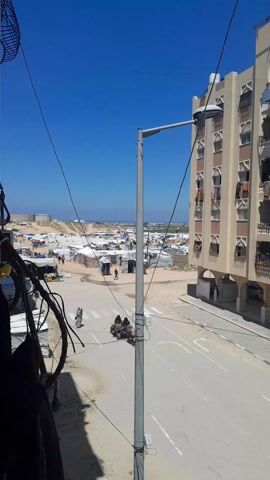
The video shows an aerial view of a dusty urban landscape with a refugee camp in the background. The scene is captured on a bright, clear day under a blue sky. In the foreground, an asphalt road runs horizontally across the frame, and a donkey-drawn cart with several people on board is moving along the road. A woman in traditional clothing is seen walking on the crosswalk. The refugee camp behind them consists of numerous white tents. A large building with several floors and balconies is on the right side of the road. Tangled electrical wires are visible on the left side of the frame, partly obscuring the view. A street lamp stands in the middle of the road.
Khan Yunis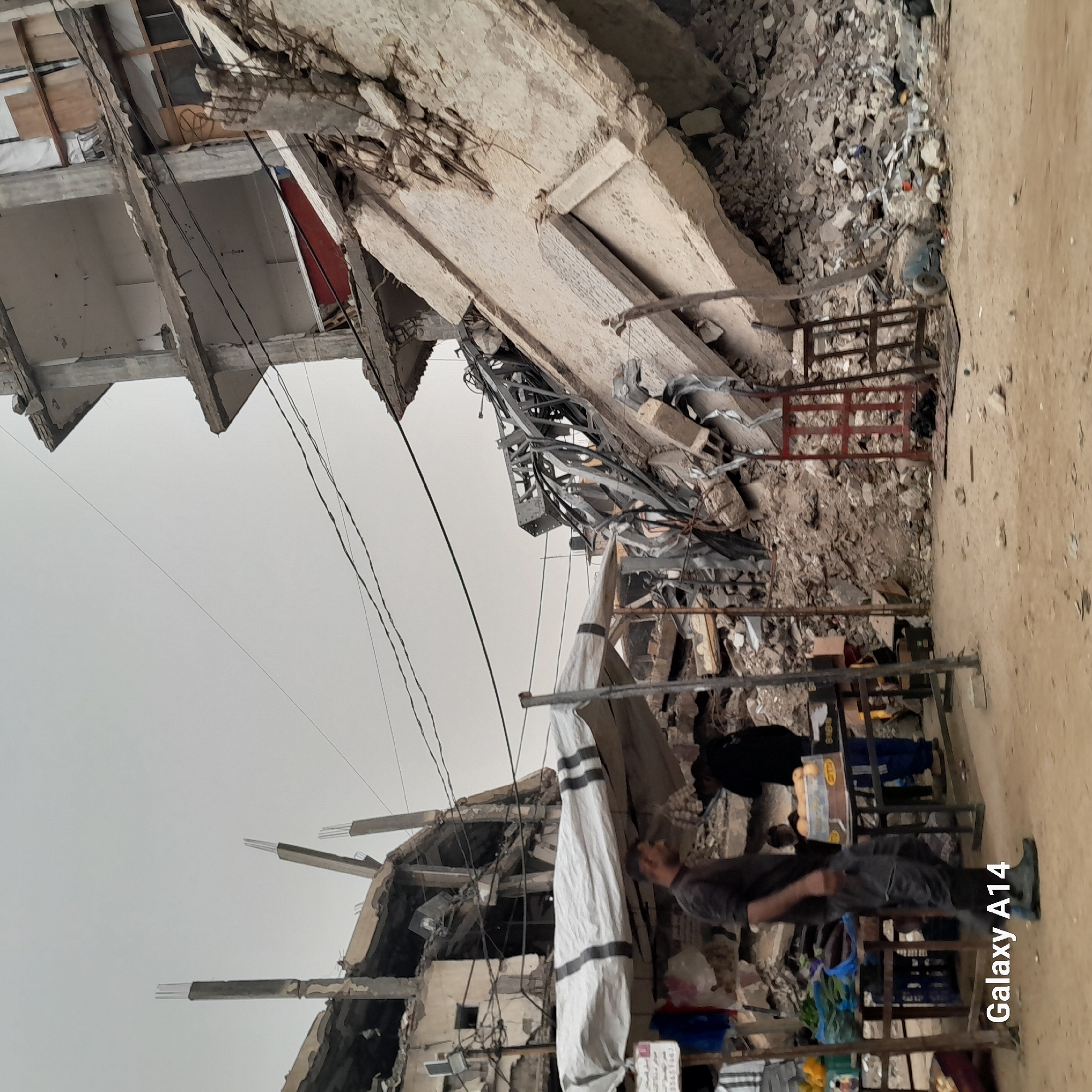
The image depicts a scene in what appears to be Khan Yunis, Palestinian Territory, judging by available context and details visible. A partially collapsed building dominates the background, with debris strewn about. Power lines are visible overhead. In the foreground, a man stands next to a makeshift structure, possibly a market stall. It holds various items, including what looks like packaged goods and textiles. The man seems to be looking or attending to items on the stall. The overall atmosphere suggests destruction and a struggling informal economy.
Khan Yunis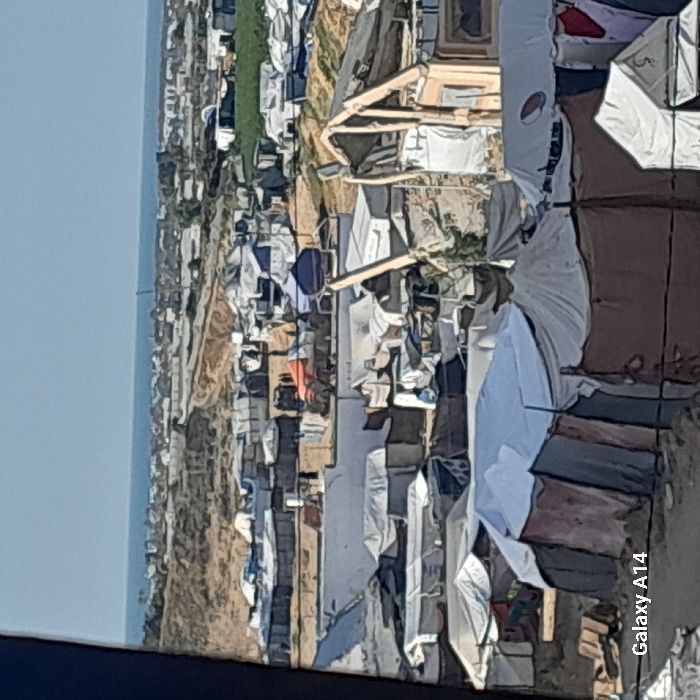
The image displays a sprawling, densely packed displacement camp in Khan Yunis, Palestinian Territory, under clear daylight conditions. Numerous temporary shelters and tents, constructed from various materials including white, light blue, grey, and brown tarpaulins and fabrics, dominate the foreground and midground. Some structures incorporate visible wooden frames. The camp is situated on sandy, undulating terrain, with areas of cleared ground and low concrete walls visible. In the midground, a prominent orange tarp-covered object is discernible among the shelters. Beyond the immediate settlement, the landscape transitions into sandy hills, which meet a coastal strip featuring scattered low-rise buildings. The Mediterranean Sea stretches across the distant horizon, beneath a clear blue sky. No specific individuals, actions, or interactions are clearly identifiable within the frame due to the distance and resolution.
Khan Yunis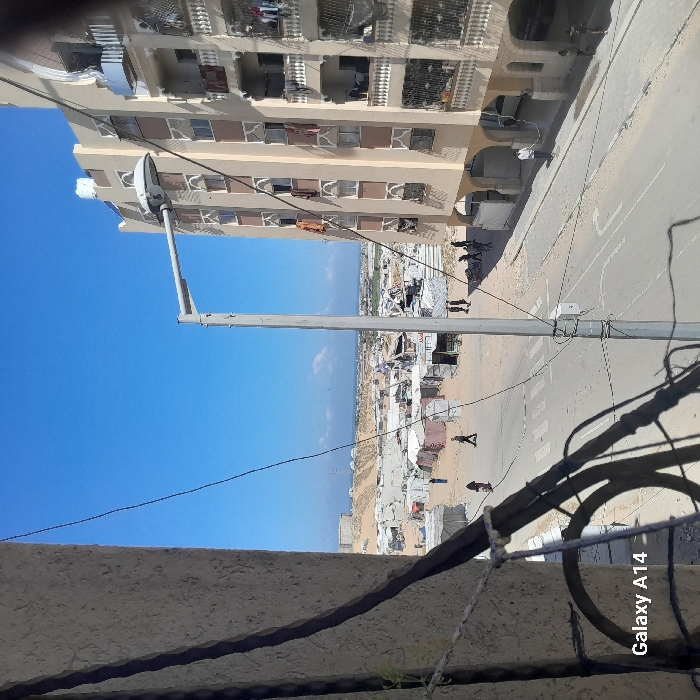
The image, captured from an elevated viewpoint in Khan Yunis, Palestinian Territory, presents a daytime scene under a clear blue sky. In the foreground, dark cables cross the frame, partially obscuring a light-colored building edge on the left. A light gray street light pole stands prominently in the mid-ground, casting a shadow to its left. Below the street light, a paved road with a pedestrian crosswalk extends horizontally. Individuals are visible on and adjacent to the road; one person walks left-to-right on the crosswalk, another stands near a building to the far right, and a small group moves on the unpaved ground to the right of the road. To the right of the street light and road, a multi-story residential building with a light-beige facade, balconies, and patterned window surrounds occupies the right side of the frame. Laundry or fabrics hang from multiple windows and balconies, and a white water tank is visible on its roof. To the left of the street and extending into the background, an expansive area of makeshift shelters, tents, and rudimentary structures is spread across sandy, uneven terrain, indicative of an informal settlement or refugee camp. Several people are observed moving within this area. Beyond the camp, large mounds of earth or sand are present, with the distant Mediterranean Sea visible on the horizon. The scene depicts a populated area blending urban residential structures with an extensive, temporary settlement.
Khan Yunis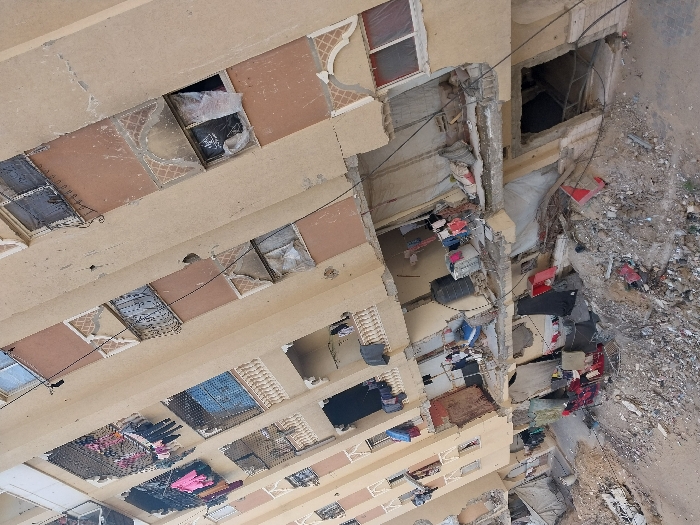
The image displays a multi-story residential building in Khan Yunis, Palestinian Territory, presenting extensive damage. The building's facade, predominantly beige with sections of faded orange, exhibits numerous cracks, impact points, and areas where plaster is missing. Many windows are shattered, with openings on various floors covered by black or white plastic sheeting, fabric, or blankets. Soot marks are visible around several window frames, particularly on the orange sections of the building. Laundry, including brightly colored clothes, hangs from multiple balconies, suggesting potential continued habitation or an attempt at normalcy. The lower levels of the structure are severely compromised, featuring fractured concrete slabs, exposed twisted rebar, and visible interior spaces. A significant amount of debris, including broken concrete, metal fragments, and various discarded items, litters the ground directly in front of and below the damaged sections of the building. Black plastic water tanks are observable on at least two lower-level balconies. The ground extending from the building is unpaved, covered in loose dirt and rubble. No individuals are discernible within the scene.
Khan Yunis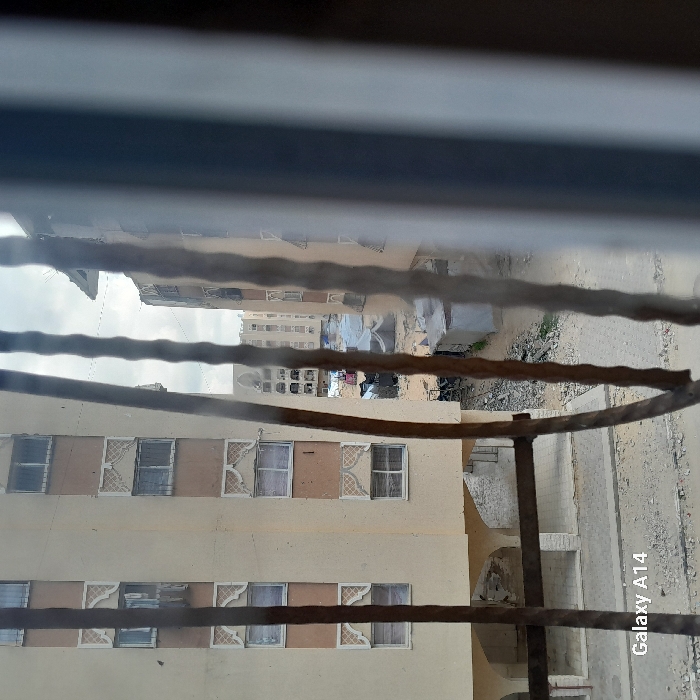
The image provides a view from an elevated position, looking out through multiple blurry, dark vertical metal bars. The scene depicts an urban landscape in Khan Yunis, Palestinian Territory, showing signs of extensive damage and disruption. On the left, a multi-story, light-colored residential building features decorative brown vertical sections and patterned window surrounds; numerous windows appear dark or damaged. The building displays visible structural damage, particularly at its base where arched openings lead to a recessed area containing debris, and on upper floors. Opposite this structure, an unpaved ground area is covered with dirt, dust, and rubble, including piles of fragmented concrete. In the central midground, a cluster of makeshift shelters, constructed from dark tarpaulins or fabric, is present, alongside smaller, simple concrete or metal structures. Further residential buildings, some also exhibiting damage, are visible in the background under an overcast sky. A similarly styled, multi-story building on the right is partially visible and shows significant damage to its upper sections, presenting a jagged, broken profile. No individuals or specific activities are discernible within the frame. A "Galaxy A14" watermark is visible in the lower-left corner.
Khan Yunis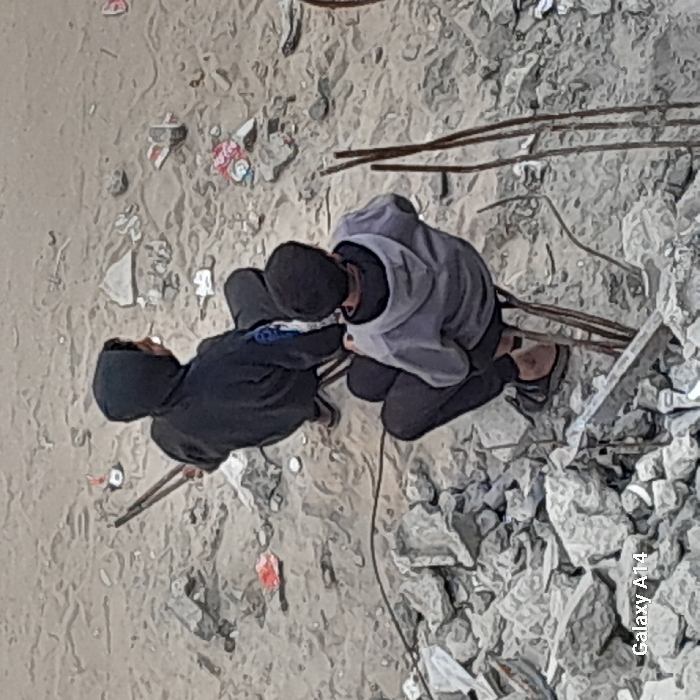
An overhead view captures two individuals seated amidst a debris-strewn landscape in Khan Yunis, Palestinian Territory. The ground is a mix of light-colored soil, sand, and abundant rubble, primarily fragmented concrete and rocks. The individual in the foreground, facing away from the camera, wears a light gray hooded sweatshirt, dark pants, and dark flip-flops, crouching on exposed, bent metal rods. Behind and to their left, another individual, wearing a dark hooded sweatshirt and dark pants, holds a long, dark, two-pronged gripping tool. This individual is also seated or crouched on similar metal rods. Both individuals are oriented towards the upper right portion of the frame. The immediate environment includes scattered refuse, such as fragments of red and white plastic wrappers, alongside numerous pieces of construction debris and protruding metal rebar. The background maintains a consistent appearance of disturbed earth and structural wreckage.
Khan Yunis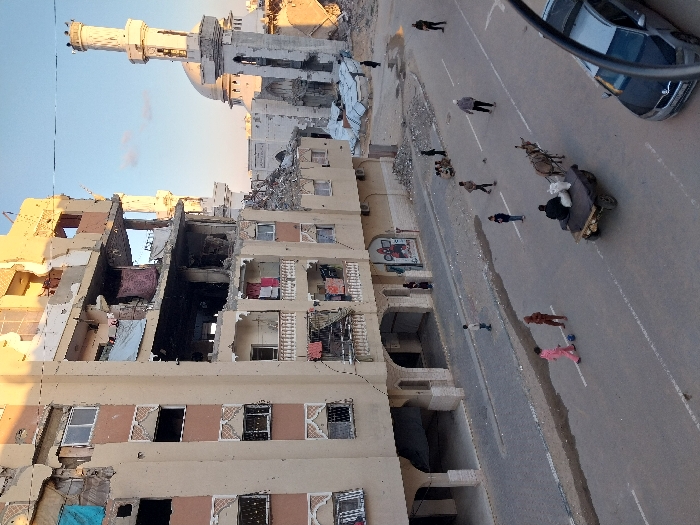
The image depicts a street scene in Khan Yunis, Palestinian Territory, during late afternoon or early morning. A multi-story residential building on the left shows significant structural damage, with upper floors partially collapsed, exposed interiors, missing windows, and damaged balconies. Debris is visible within and around the structure. To the right, a mosque with a distinct minaret and dome is also damaged, with rubble present at its base and a partially destroyed minaret top. The paved street below features white lane markings and patches of debris or moisture. Numerous individuals populate the street: two children in pink and brown clothing play with a ball in the road, a man sits on a donkey-drawn cart moving away from the viewer, and several other adults and children walk or stand along the street. A silver sedan is partially visible on the far right. The scene is illuminated by warm, low-angle sunlight, casting long shadows.
Khan Yunis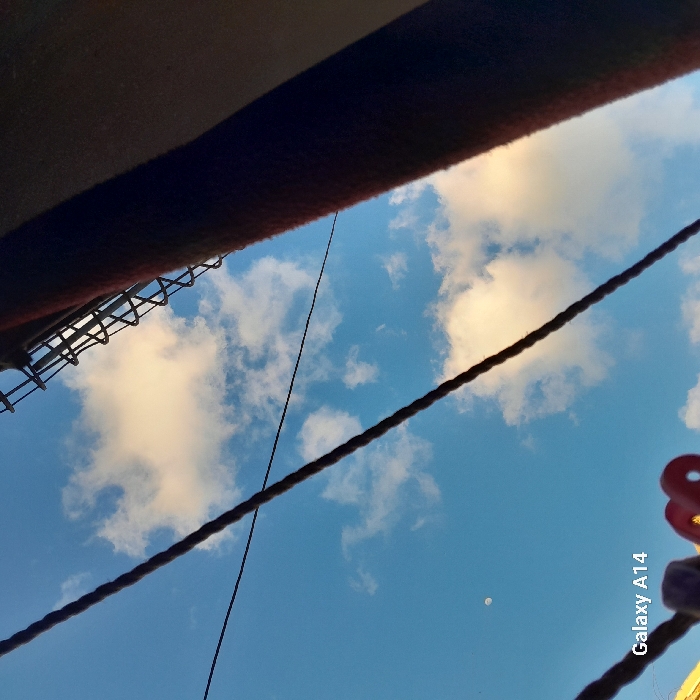
An upward-angled photograph captures a partially obscured view of a blue sky with scattered white cumulus clouds, taken in the city of Khan Yunis, Palestinian Territory. A distinct crescent moon is visible in the upper-left quadrant of the sky. In the foreground, a thick, dark, braided rope runs diagonally from the lower-left to the upper-right. Below this rope, in the bottom-left corner, fragments of small, brightly colored plastic objects, specifically red, purple, and yellow elements consistent with clothespins, are partially visible. A thinner, dark horizontal wire or cord traverses the mid-left portion of the frame. Along the right edge, a large, dark, vertically oriented object with a textured, possibly fabric surface (appears reddish-brown in hue), partially frames the scene. Above this vertical object, a section of a dark metal grid or mesh structure is visible against the sky. The watermark "Galaxy A14" is present in the lower-left corner.
Khan Yunis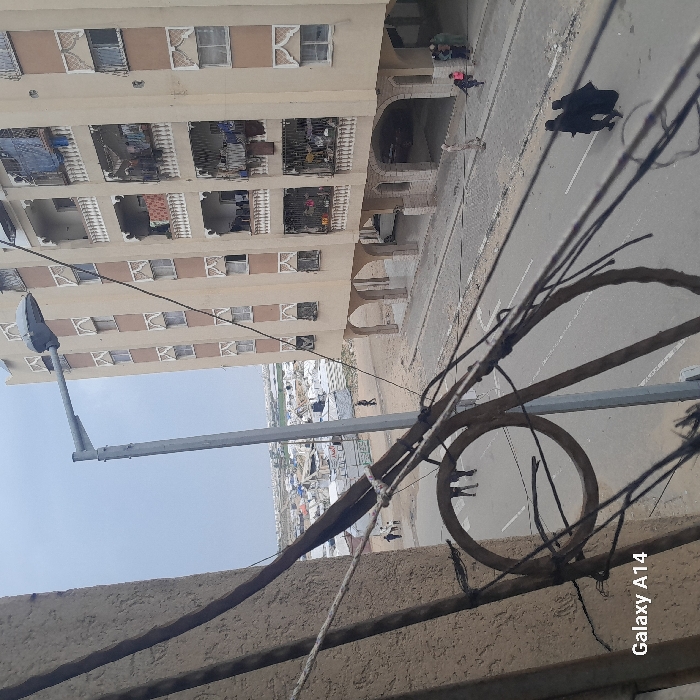
An elevated view in Khan Yunis, Palestinian Territory, captures a street, residential building, and a distant displacement camp under an overcast sky. In the foreground, a textured light-colored wall on the left is partially obscured by multiple dark electrical wires, including a prominent circular coil. "Galaxy A14" is visible in the lower-left corner. The midground features a paved road with a lighter-colored sidewalk. A tall, grey metal street lamp with a modern fixture stands centrally. To the right, a six-story residential building with a light beige facade, brown vertical strips, and ornate white window frames and balcony railings dominates. Laundry hangs on several balconies. The ground floor is characterized by a series of arched open spaces. On the street, two individuals dressed in dark abayas walk away from the viewer in the bottom right. Further along the street, a solitary figure in light clothing walks near the building's base. A small group, including a child in pink, walks closer to the building's arched ground floor, and another small group is visible on a dirt path to the left. The background reveals an extensive area covered with numerous white tents, indicative of a large displacement camp. Beyond the camp, other urban structures and sparse vegetation are visible under a uniformly light grey sky.
Khan Yunis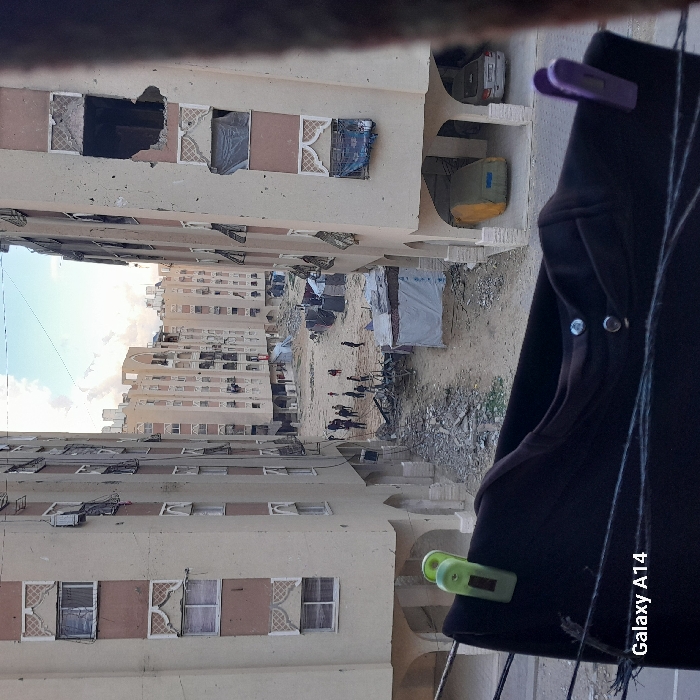
The image, taken from an elevated perspective, depicts a severely damaged urban residential area in Khan Yunis, Palestinian Territory. Multiple multi-story apartment buildings with light-colored facades and decorative window accents frame a central, unpaved area. Many windows on these buildings are broken, missing glass, or covered with makeshift materials; significant structural damage, including large open holes in upper floor walls, is evident on the rightmost building. The ground level between the buildings is heavily covered with rubble, debris, and scattered refuse. Several makeshift tents or shelters constructed from tarpaulins are present in this central area. Approximately 10-15 individuals, consisting of adults and some children, are observed standing or walking in small groups amidst the debris. In the immediate foreground, a dark garment hangs on a clothesline, secured by one green and one purple clothespin. Under the arched ground-floor supports of the building on the right, a vehicle is covered with a yellowish-green tarp, and a silver sedan is partially visible nearby. The sky above is partly cloudy.
Khan Yunis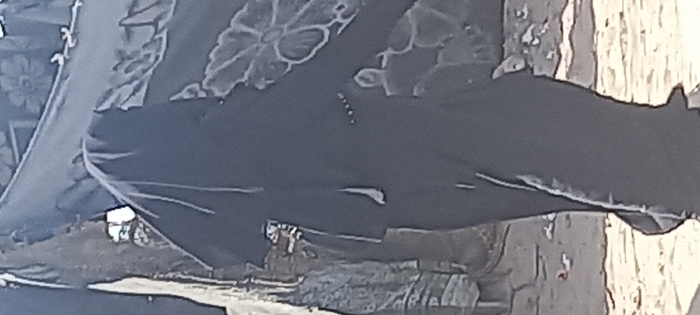
An outdoor scene in Khan Yunis, Palestinian Territory, shows a single individual, dressed in full black attire including a head covering, standing or walking. The person's face is not visible. Small light-colored embellishments are arranged vertically on the upper right side of the garment, and a white tag or fabric piece hangs from the left side. To the left of the individual, an irregular, light-colored structure or wall is visible. To the right, a large dark fabric panel, possibly a tarp or blanket, with a distinct light-colored floral or circular pattern, is draped vertically. The ground beneath the person is uneven, appearing to be dirt or sand, with scattered fragments of debris, including reddish-orange and white pieces.
Khan Yunis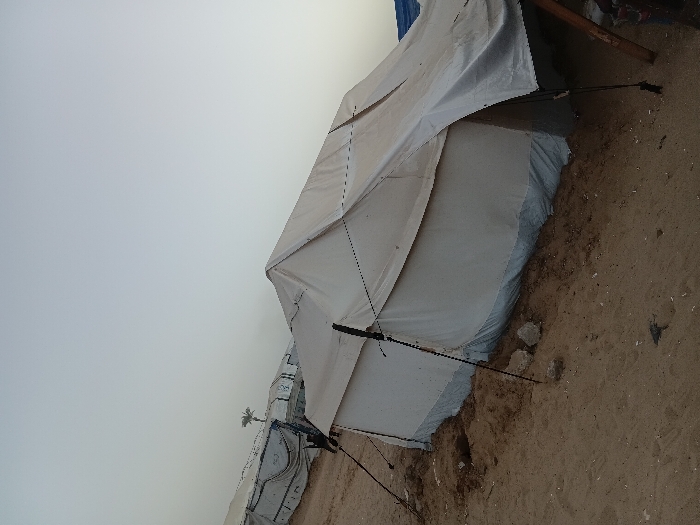
The image captures an outdoor scene featuring several large, light-colored tents under an overcast sky. The primary focus is on a prominent tent in the mid-ground, positioned slightly to the right of the frame. This tent is constructed from a white or very light grey, heavy fabric or tarp material, suggesting a durable, temporary shelter. It has a pitched roof design, with visible black ropes or guy lines extending from its sides to anchor it to the sandy ground. One such rope stretches diagonally from the tent's mid-section towards the lower left of the image. The lower part of the tent appears to be secured or reinforced, possibly by piling sand or dirt against its base, and a bluish tarp-like material can be seen layered along its top edge, suggesting a multi-layered wall or repair. The ground surrounding the tents is predominantly dry, light brown, sandy earth, with scattered small rocks and debris, indicating a possibly arid or semi-arid environment. To the far right, partially cut off, a section of what appears to be rough wooden beams or supports is visible, hinting at other nearby structures or collected materials. In the background, further to the left, another similar tent is partially visible, also light-colored and of similar construction, though its full extent is obscured. A small, light-colored object, possibly a small plant or a piece of debris, can be seen clinging to the side of this background tent. The sky occupies a significant portion of the upper half of the image, presenting a uniform, pale grey-blue color, characteristic of an overcast day or perhaps twilight hours (early morning or late afternoon). There are no distinct clouds, only a flat, diffused light. The image is captured with a tilted perspective, causing the horizon line to appear diagonally across the frame. There are no people visible, and no specific activity is taking place, although the presence of multiple tents strongly suggests a temporary settlement or camp. No discernible text is visible anywhere in the image.
Khan Yunis
The image captures a top-down view of a dark-colored mug or small saucepan filled with a light brown, creamy liquid, most likely tea or coffee with milk. The container appears to be made of a dark material, possibly metal, and has a subtle handle visible extending to the right. The surface of the liquid is smooth and shows a distinct curved reflection, indicating a light source from above and slightly to the left. The container is placed on a patterned fabric surface, which serves as the background. This fabric features repeating floral or leaf motifs in shades of maroon or deep red, intermingled with lighter brown or beige tones, against a lighter, possibly off-white or light brown base. The overall lighting suggests an indoor setting. No people or text are visible in the image.
Khan Yunis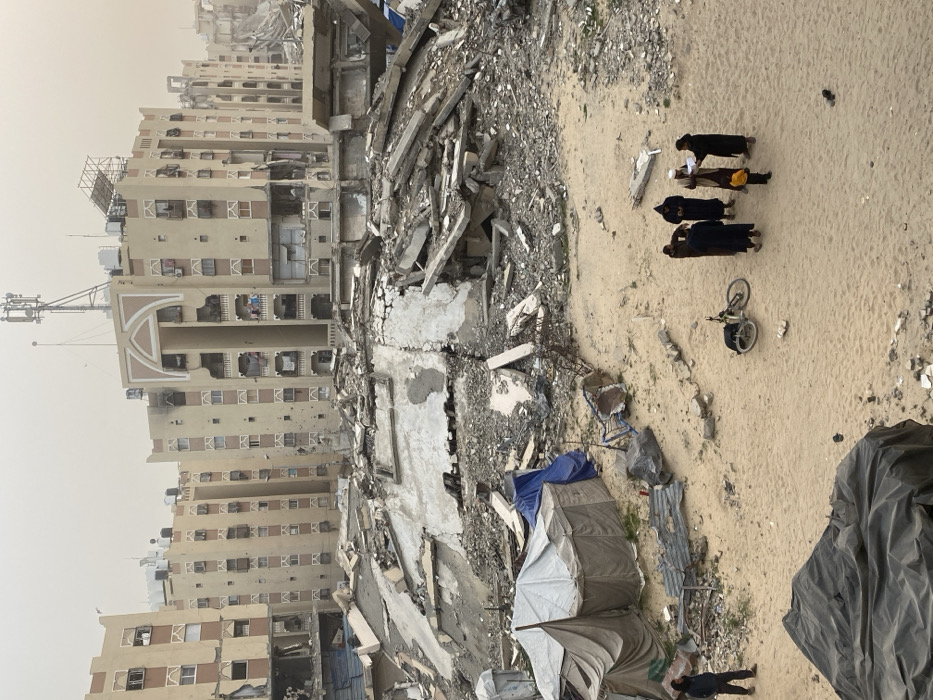
The image depicts a devastated urban landscape in Khan Yunis, Palestinian Territory, under an overcast or hazy sky. In the background, multiple multi-story residential buildings stand, many exhibiting severe structural damage, including partially collapsed sections, blown-out windows, and blackened facades indicating fire damage. Some buildings retain architectural details like arched entryways and balconies, where laundry is visible on less damaged sections. Communication antennas, satellite dishes, and water tanks are present on rooftops. The midground is dominated by large, irregular piles of concrete rubble, twisted rebar, and debris from collapsed structures, forming a chaotic mound of building remnants. To the left of this rubble, several makeshift tents constructed from light-colored canvas and blue tarpaulins are erected on the sandy ground, suggesting temporary shelter. Scattered metallic debris and broken objects are visible near these tents. The foreground consists of a relatively open, sandy ground area. On the right, a group of five individuals is gathered. Four adults, dressed in dark, long garments, some with head coverings, surround a smaller child in a yellow top. One adult holds and appears to be reading from a white sheet of paper. A bicycle lies on its side in the sand near this group. To the far left, a lone male figure in dark clothing and a head covering stands facing towards the right. A large, dark tarp or fabric bundle is partially visible in the bottom left corner. The overall scene conveys widespread destruction and makeshift living conditions.
Khan Yunis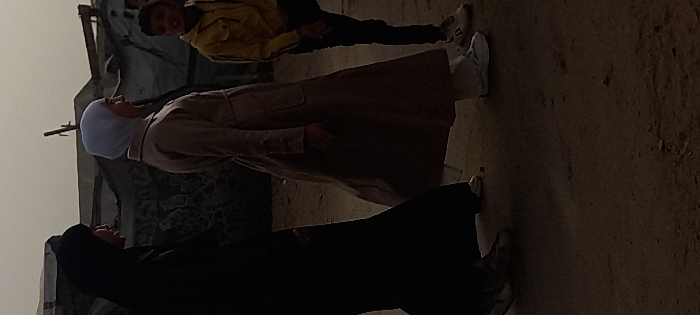
The image depicts an outdoor scene featuring three individuals on an unpaved, dusty ground. The overall lighting suggests it is daytime, possibly overcast or hazy, as there are no harsh shadows. In the foreground, on the left side, stands a person wearing a long black garment, likely an abaya, and a black head covering that conceals their face, possibly a niqab. They are standing with their body angled towards the right, looking slightly upwards towards the person in the middle. They are wearing light-colored footwear. In the center of the frame, another person is standing, dressed in a light brown or beige long coat or dress, reminiscent of an abaya, and a light blue or white head covering (hijab). This individual is facing slightly towards the left side of the frame (relative to their upright position), with their face visible in profile. They are wearing white sneakers. Further in the background, towards the right, a young person, possibly a child or teenager, is visible. They are wearing a bright yellow long-sleeved top and dark trousers. This person is looking generally towards the viewer, with a slight smile on their face. Their hands are down at their sides, and they are wearing dark shoes. The background consists of rough, possibly dilapidated structures or walls made of earth or stone, with visible textures and some debris. The sky above is a uniform light grey or tan, blending into the distant structures. The ground is uneven dirt or sand, with small rocks and irregularities. The individuals appear to be standing and observing, possibly engaged in a casual interaction or simply present in the outdoor environment. There is no visible text in the image.
Khan Yunis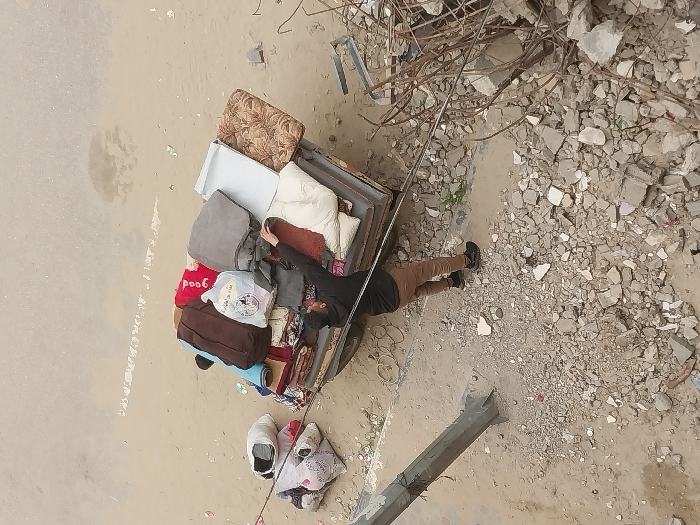
An overhead view captures an adult male interacting with a heavily laden utility vehicle or cart in Khan Yunis, Palestinian Territory. The male, dressed in a dark long-sleeved top, light brown trousers, and dark shoes, stands to the left of the vehicle's bed, reaching with his right hand to adjust or secure items. The vehicle bed is stacked with household goods, including a red blanket with "good" visible text, a gray blanket, a white patterned blanket, a dark brown bag, a plain white cushion, a floral-patterned cushion, a metallic panel, and several plastic bags, one partially displaying Arabic text. To the left of the vehicle, additional bundled items in white bags rest on the ground. The surrounding environment consists of unpaved, light brown earth extensively mixed with concrete rubble and scattered debris. A light-colored utility pole or beam is visible on the left side of the frame, embedded in the debris. To the right, a substantial pile of twisted rebar and other structural wreckage indicates a destroyed area. The background shows a broad expanse of light-colored, unpaved ground, likely a dirt road or open area.
Khan Yunis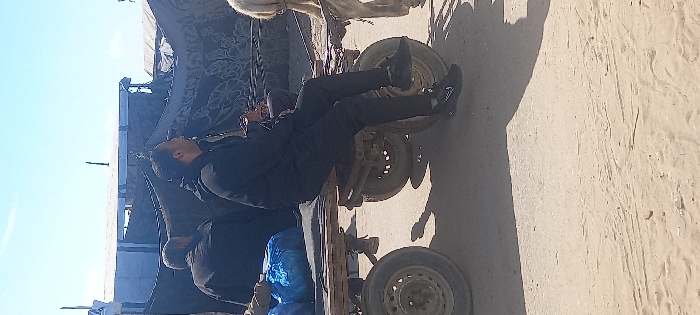
Two men in dark clothing are working on the underside of a horse-drawn carriage. The carriage has four wheels and is parked on a sandy surface. One man is lying on his back beneath the carriage, apparently making repairs. Blue tarp or material is visible near the carriage. The area appears to be an outdoor location, possibly a roadside or rural setting.
Khan Yunis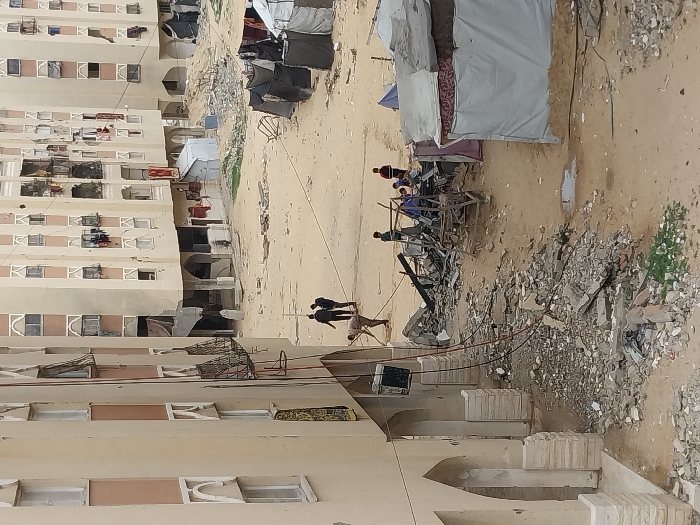
The image depicts an outdoor scene in a residential area within Khan Yunis, Palestinian Territory, characterized by extensive structural damage and makeshift living conditions. In the foreground, a multi-story, light-colored building with arched ground-level features and damaged upper-floor windows anchors the left side. Utility wires hang from this structure towards a pile of rubble consisting of concrete fragments, rebar, and shattered building materials that extends across the dusty, uneven ground. In the mid-ground, a man in light attire is actively clearing debris with a tool. To his left, two men in dark clothing walk away from the viewer. Further right, a group of approximately four to five individuals, including adults and possibly children, are gathered around a larger accumulation of demolition debris and what appears to be the remnants of a destroyed structure or scaffolding. Several makeshift shelters, constructed from tarpaulins, fabric, and mattresses, are present, particularly on the right side of the frame, with clothes visible hanging from them and near surrounding buildings. In the background, multiple multi-story residential buildings, similar in architectural style to the foreground structure, line a wide, unpaved area. These buildings exhibit visible damage, including shattered windows, exposed interiors, and general disarray. Clothes are hanging from many windows and balconies. The ground throughout the scene is predominantly dirt or sand, with scattered patches of sparse green vegetation and small puddles. The sky is overcast, providing diffused lighting. The overall scene suggests a recently damaged urban environment with ongoing efforts to clear debris and establish temporary shelter.
Khan Yunis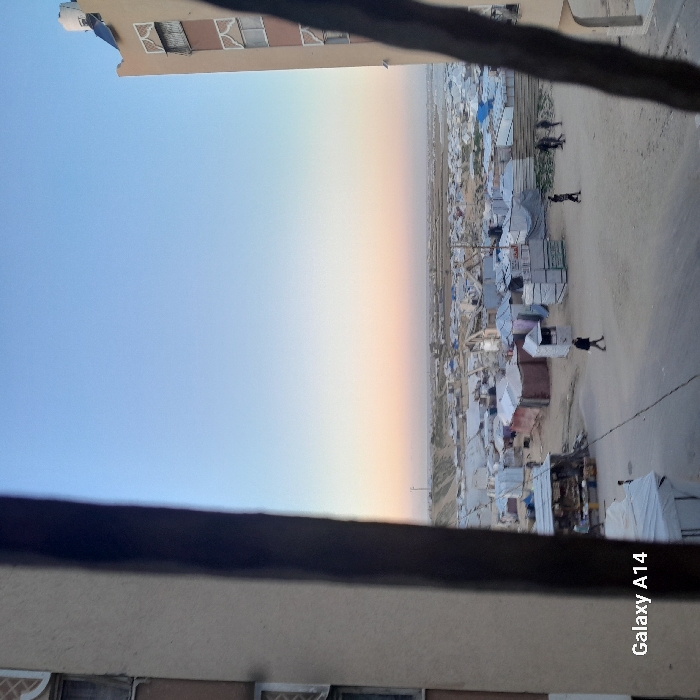
The image captures an expansive outdoor scene, viewed from an elevated perspective, likely from a window or balcony. The photograph is oriented vertically but depicts a landscape that appears to have been taken horizontally and then rotated. When viewed upright (rotated 90 degrees clockwise), a dark horizontal bar, resembling a railing or window frame, runs across the bottom section of the image, partially obscuring the lower view. Below this bar, the light brown/beige exterior wall of a building is visible, featuring several windows or vents. To the left side of the frame, a portion of a light brown building rises, displaying multiple windows or openings, some fitted with shutters or blinds. On its roof, a metallic object, possibly a solar water heater or an antenna, can be seen. The dominant feature from the mid-ground extending to the distant horizon on the right is a sprawling settlement or camp. It is densely packed with numerous small, irregularly shaped structures, appearing to be tents or makeshift shelters, primarily in shades of white, grey, and light blue. Some darker, more solid-looking buildings are also interspersed within the camp. Unpaved dirt paths or roads wind through the settlement. Several small, dark figures, presumably people, are visible walking or standing within the camp area, indicating human presence and activity. The sky occupies the upper portion of the image, displaying a gentle gradient of colors. It transitions from a clear, light blue at the top to a soft peach, orange, and yellowish hue closer to the distant, flat horizon line. This coloration suggests either a sunrise or a sunset. The horizon stretches far into the distance, indicating a vast, open landscape, possibly a plain or desert. In the bottom right corner of the re-oriented image, the white text "Galaxy A14" is visible, indicating the device used to capture the photograph.
Khan Yunis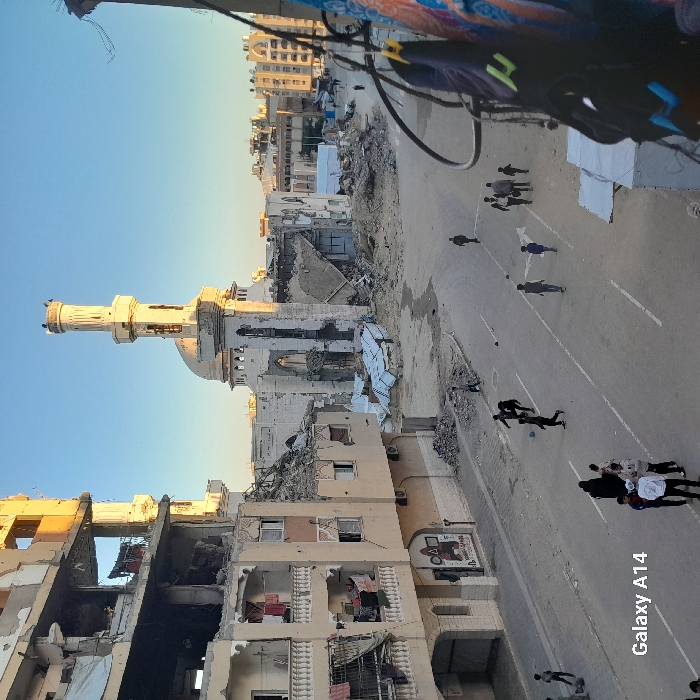
The image captures a street scene amidst war-torn buildings, with a mosque prominently standing partially destroyed. People walk on the street, suggesting movement and life persisting despite the surrounding devastation. The buildings on either side of the road are heavily damaged, exposing interiors and indicating the scale of destruction. The presence of a clear sky contrasts sharply with the ground-level chaos, creating a poignant juxtaposition.
Khan Yunis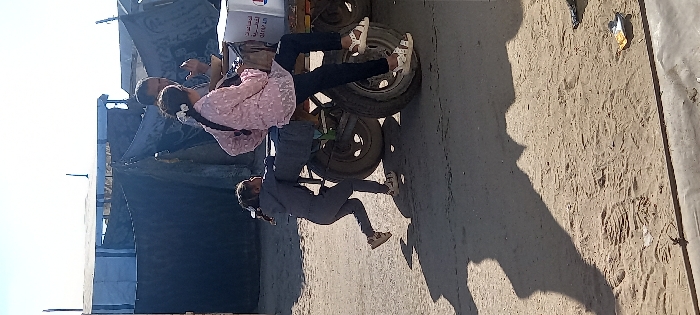
An outdoor scene in Khan Yunis, Palestinian Territory, depicts three individuals interacting with a two-wheeled cart on a dirt and sand surface under a clear sky. A young girl in a gray tracksuit and sandals is positioned on the left, actively pushing the cart from behind. Another girl, wearing a pink patterned long-sleeved top, dark pants, and white sandals, sits sideways on the cart's frame, with her legs dangling over one of the wheels. An adult male, partially visible behind the second girl, is also on or near the cart, appearing to hold something in his hand. The cart carries a white box with red and blue markings and Arabic text. In the background, several makeshift structures, constructed from tarpaulins and other materials, are visible, suggesting a temporary settlement. Long shadows are cast on the ground from the subjects and the cart, indicating direct sunlight.
Khan Yunis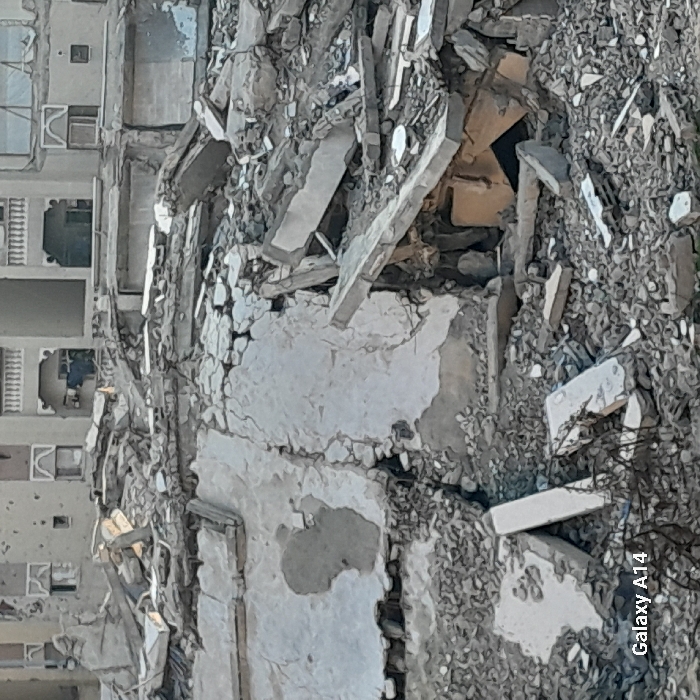
Debris and rubble are piled high, revealing remnants of a destroyed building. Concrete slabs, shattered bricks, and loose gravel dominate the scene. In the background, parts of an adjacent, seemingly undamaged building are visible, showcasing windows and balconies. The destruction contrasts starkly with the standing structure, indicating a catastrophic event. A "Galaxy A14" watermark appears in the corner.
Khan Yunis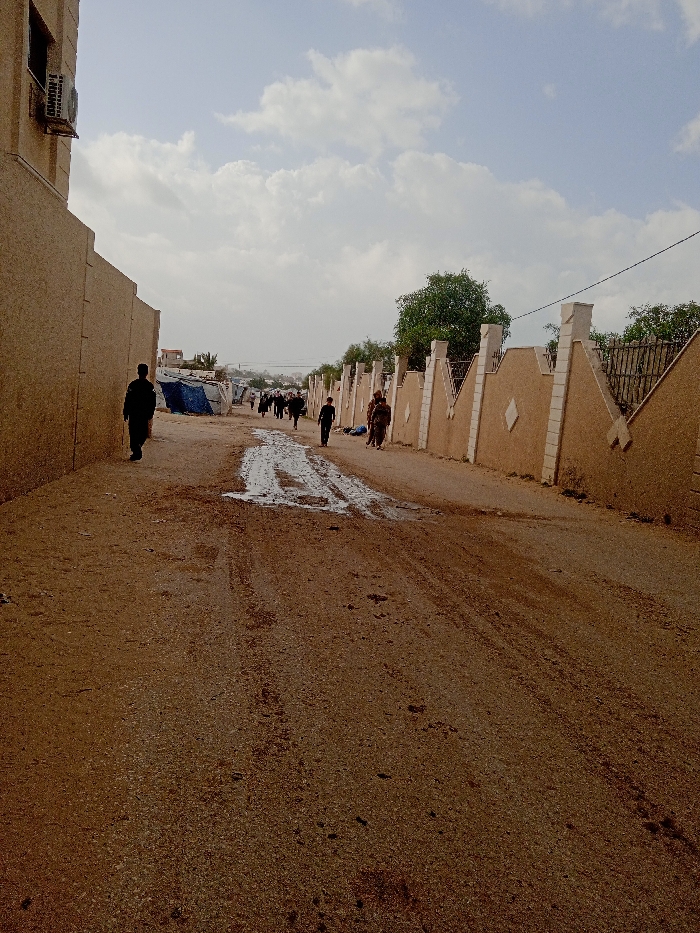
The image depicts a dirt road in Khan Yunis, Palestinian Territory, under a partly cloudy sky. The road surface is unpaved, showing tire tracks and a prominent muddy patch near the center of the frame. On the left, a light tan building wall with a textured finish extends into the distance, featuring an external air conditioning unit mounted high on its initial section. On the right, a decorative light tan wall with repetitive white or light-colored pillars and diamond-shaped inserts runs parallel to the road, topped by sections of metal fencing and partially obscured by green foliage. Numerous individuals, estimated at 8-10, are observed walking away from the camera along the road. One person in dark clothing is on the far left, near the building wall. Further down the road, a group of people, some appearing to carry bundles, are visible walking towards structures constructed from blue tarpaulins and other materials, suggesting temporary shelters or a camp in the middle distance.
Khan Yunis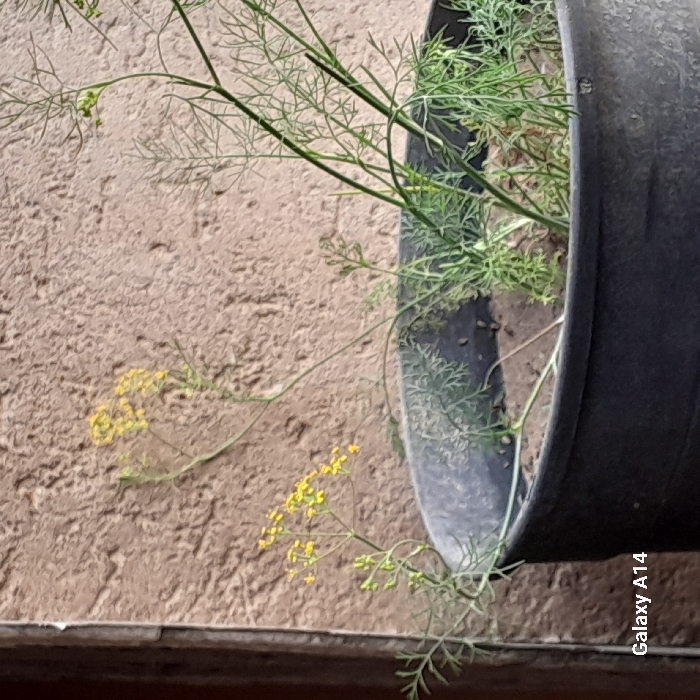
The image displays a close-up, eye-level view of a plant growing in a dark-colored pot, positioned against a textured wall in the city of Khan Yunis, Palestinian Territory. The plant features delicate, feathery green leaves and multiple stems topped with small clusters of bright yellow flowers. The pot is dark, appearing to be made of plastic, with soil visible around the plant's base. The background consists of a rough, light brown or beige stucco-like wall. A dark vertical structure, possibly a door or window frame, is visible along the far left edge of the image. No people are present, and no actions or interactions are depicted. The text "Galaxy A14" is visible in the bottom-left corner of the image.
Khan Yunis