Kochi, India
30 memories from Kochi, India
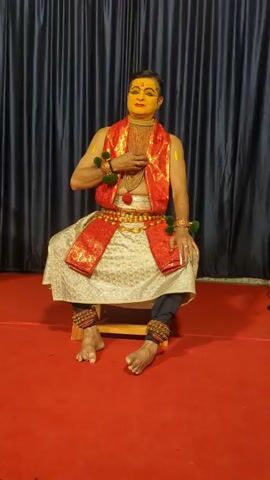
A male performer, dressed in traditional Indian attire for a dance performance, sits on a stool against a dark curtain backdrop. He has elaborate yellow face paint with red accents around his eyes and mouth, a bright red vest, and a golden belt. His legs are bent, and his feet are bare, adorned with ankle bells. He wears armbands with green pom-poms and a golden necklace. The stage floor is covered in red carpet. The video shows him in a static pose, likely at the beginning or end of a performance.
Kochi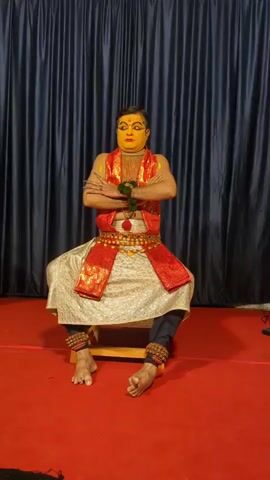
A man in elaborate Kathakali costume and makeup sits cross-legged on a red carpet in front of a black curtain. He has yellow face paint with red accents around his eyes and on his lips. He wears a red and gold vest, a white garment draped over his lower body, and black pants. His wrists and ankles are adorned with beaded bracelets. His arms are crossed in front of him, and he holds a green object in his hands. The video captures the man sitting in a static pose, with the accompanying audio featuring percussive musical accompaniment.
Kochi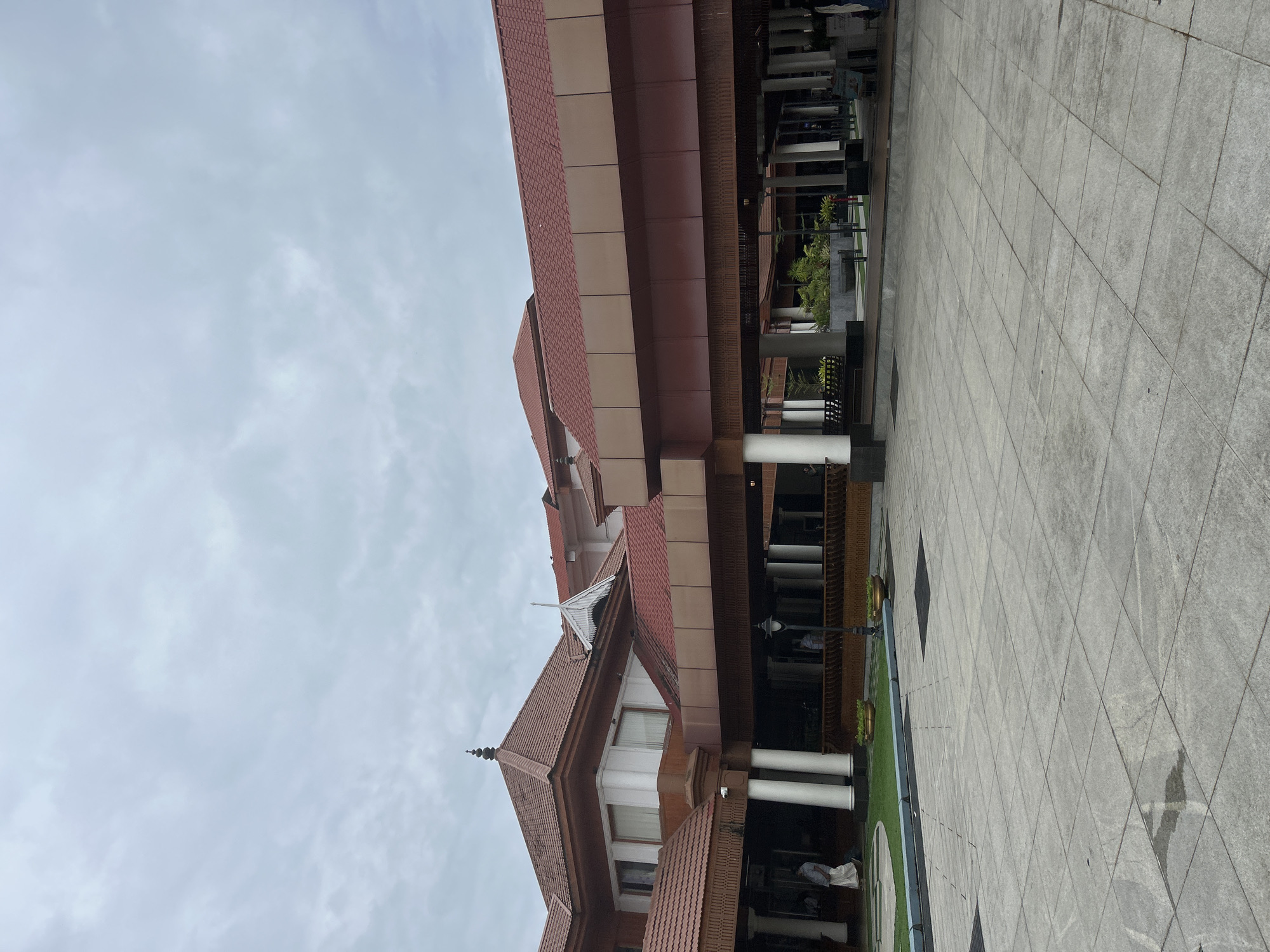
The image shows a wide, tiled plaza in front of a building with a prominent red tiled roof and brown trim. The building features a series of covered walkways supported by white columns, and the roofline has several tiered sections with decorative elements. In the background, people are visible walking and standing under the covered areas, some appearing to be staff members in traditional Indian attire. There is a patch of green grass with planters to the left of the building, and a few potted plants are visible under the covered walkways. The sky is overcast with gray clouds. The plaza appears to be an entrance area, possibly to a public building or a hotel. This appears to be the entrance to the Cochin International Airport (COK) in Kochi, India.
Kochi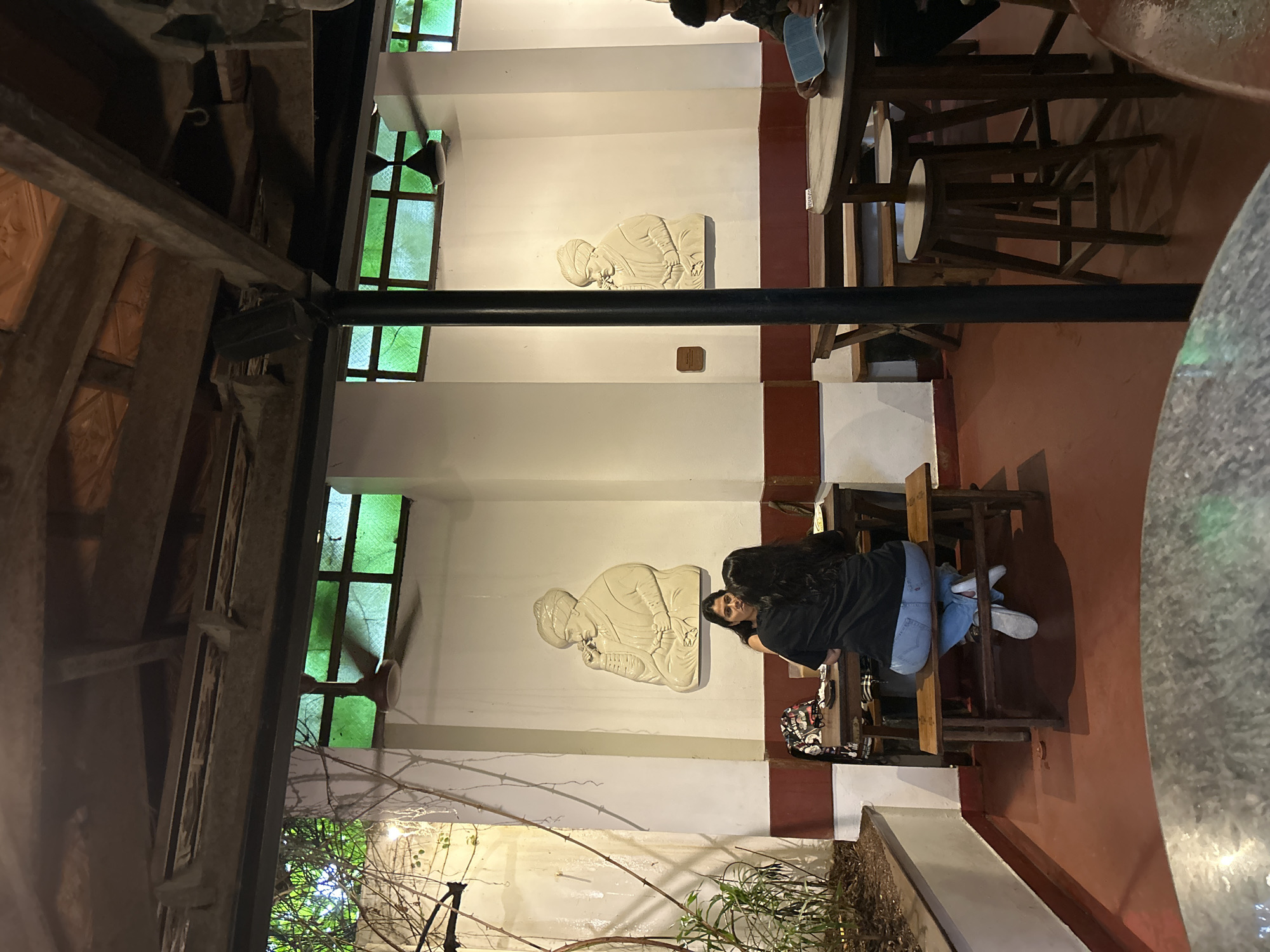
This image depicts a rustic and traditionally-styled cafe or restaurant interior, likely in Kochi, India, given the location context. The lighting suggests it is either evening or a low-light indoor environment. The scene is captured from a slightly elevated perspective, looking down into a seating area. In the foreground, a person with long dark hair, wearing a black top, light blue jeans, and white sneakers, is seated at a dark wooden table. They turn their head towards the viewer, offering a subtle smile. A patterned bag rests on the chair beside them. Another individual is partially visible in the upper right, seated at a different wooden table, with only their lower body and sandals showing. The decor includes white walls prominently featuring two large, light-colored bas-relief sculptures. These carvings depict a seated figure, possibly a sage or elder in traditional attire, adding a cultural element to the space. Multiple windows with green-tinted glass panes and dark frames are visible along the far wall, providing some filtered light and a view of outdoor foliage, including bare branches. The structural elements of the space are notable, with heavy dark wooden beams forming the ceiling structure and a prominent black horizontal beam crossing the mid-ground. The floor is a reddish-brown color, likely tiled or concrete. The overall activity involves people seated at tables, suggesting dining or socializing. Small, indecipherable plaques or labels are visible on a wall and a table.
Kochi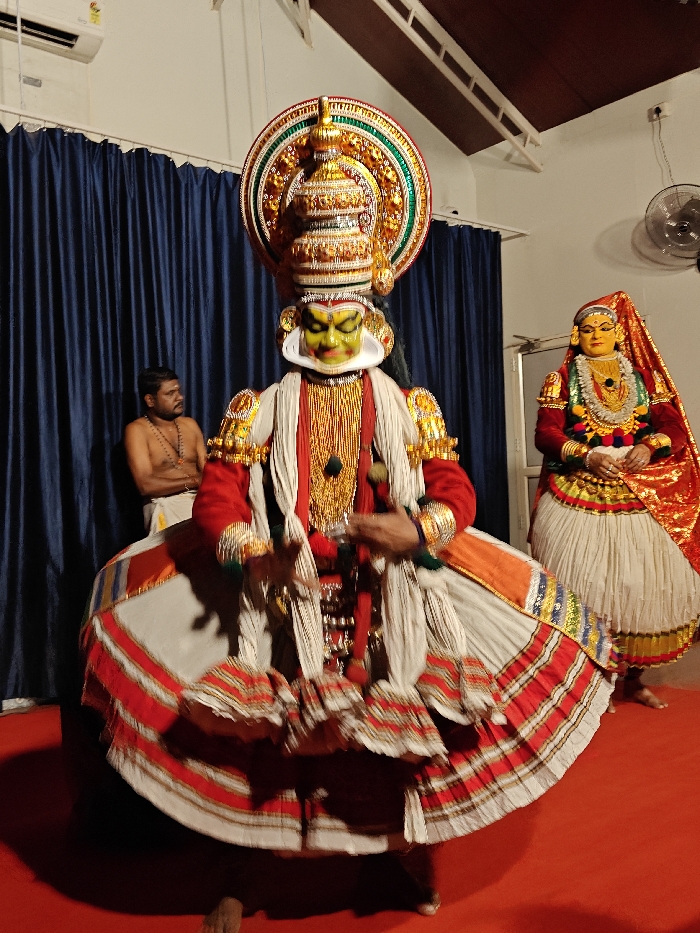
The image captures an indoor Kathakali performance at a dedicated venue in Kochi, Kerala, India. The central figure is a male performer in a vibrant Pacha vesham (green-faced character) costume, standing barefoot on a red carpeted stage. He wears elaborate green and red facial makeup, a prominent golden crown (Kireedam) with a circular green and gold halo, a red long-sleeved jacket adorned with gold, multiple gold necklaces, and a voluminous, layered white skirt featuring red and gold striped borders. His hands are positioned in a traditional mudra. To the left of the central performer, a bare-chested man with dark hair and a beard, wearing a white dhoti and a string of beads, stands against dark blue curtains. He observes the primary performer. To the central performer's right, a second performer, likely portraying a female character (Stri vesham), stands in profile. This individual has yellow-orange facial makeup, a red and gold head covering, extensive gold jewelry, a red long-sleeved top, and a white pleated skirt with a colorful waistband. The background consists of dark blue stage curtains, a white air conditioning unit mounted high on the left wall, and a dark brown sloped ceiling with white support beams. A black wall-mounted fan is visible on the upper right, and a white door frame is partially seen behind the rightmost performer. The scene is illuminated by interior lighting, casting a warm glow on the performers and stage.
Kochi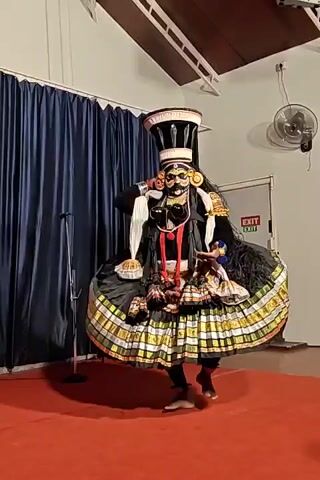
The video shows a person in a elaborate costume performing a traditional dance. The dancer, who appears to be male, is dressed in a black and gold plaid skirt-like garment with a tall, ornate headpiece. He is wearing a black mask with golden accents and has long, dark hair. The dancer moves rhythmically on a red-carpeted stage, making gestures with his hands. In the background, a man in traditional Indian attire plays an instrument. The room has blue curtains, a white ceiling with wooden beams, and an exit sign on a white door. A microphone stand is visible near the front of the stage.
Kochi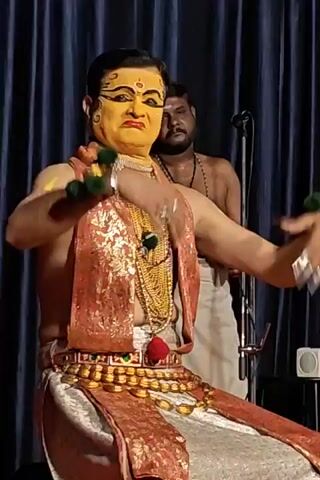
Here's a description of the video: A male performer in traditional Kathakali costume and makeup sits center stage against a dark blue curtain. The man has yellow face paint with black eyeliner, a gold necklace and belt, and a colorful scarf or shawl draped over his shoulders. He makes gestures with his hands, demonstrating intricate mudras (hand gestures) common in classical Indian dance. He has green and yellow pompoms on his wrists. Behind him, out of focus, stands another man wearing a white garment and a necklace of beads. A microphone stand is also visible in the background. There is a small sound system on the floor in the bottom right. The lighting is bright, illuminating the performer and his costume.
Kochi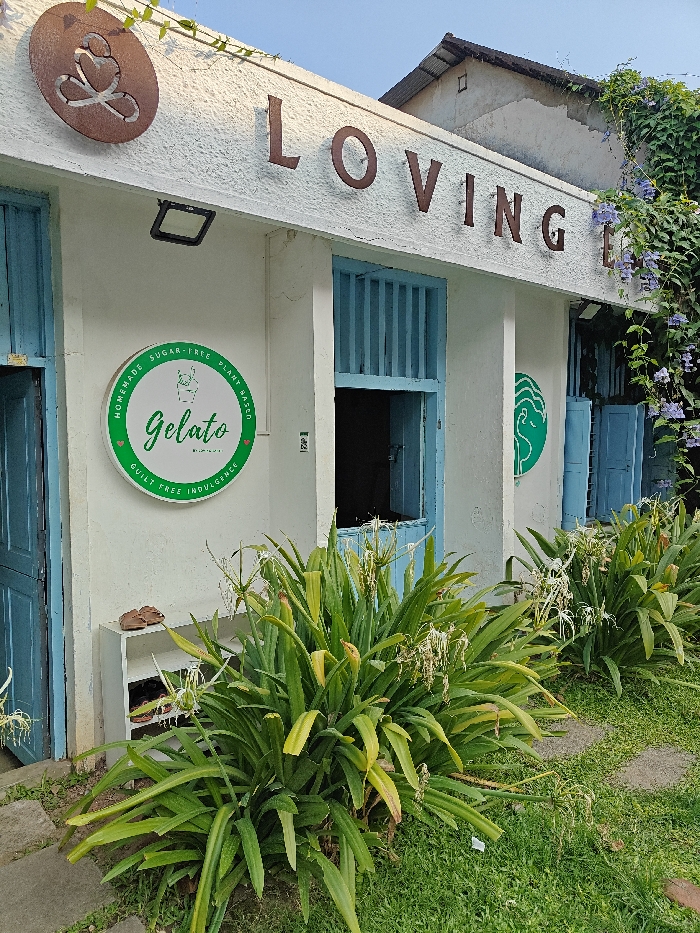
The image displays the exterior of a commercial establishment named "Loving Earth," a gelato shop located in Kochi, India. The building features a white, textured facade with prominent brown block letters spelling "LOVING EARTH" mounted across its upper section. A circular green and white sign, visible on the left wall, advertises "Homemade Sugar-Free Plant-Based Gelato." A teal-colored wooden door is partially open on the far left, revealing a dark interior. Central to the facade is an open window with teal vertical bars and a lower open section. To the right, another window with closed teal shutters is partially covered by climbing vines with small purple flowers. A black rectangular light fixture is mounted above the gelato sign. In the foreground, a bed of lush green, broad-leafed plants with numerous white, spidery flowers dominates the scene, set against a backdrop of green grass and sections of a stone path. To the left of this plant bed, a small white, two-tiered shoe rack holds a pair of brown sandals on its top shelf. A rustic metal art piece, depicting a stylized human figure with a heart, is affixed to the top left portion of the building's facade. An adjacent structure with a corrugated metal roof is partially visible in the upper background. No individuals are present in the scene.
Kochi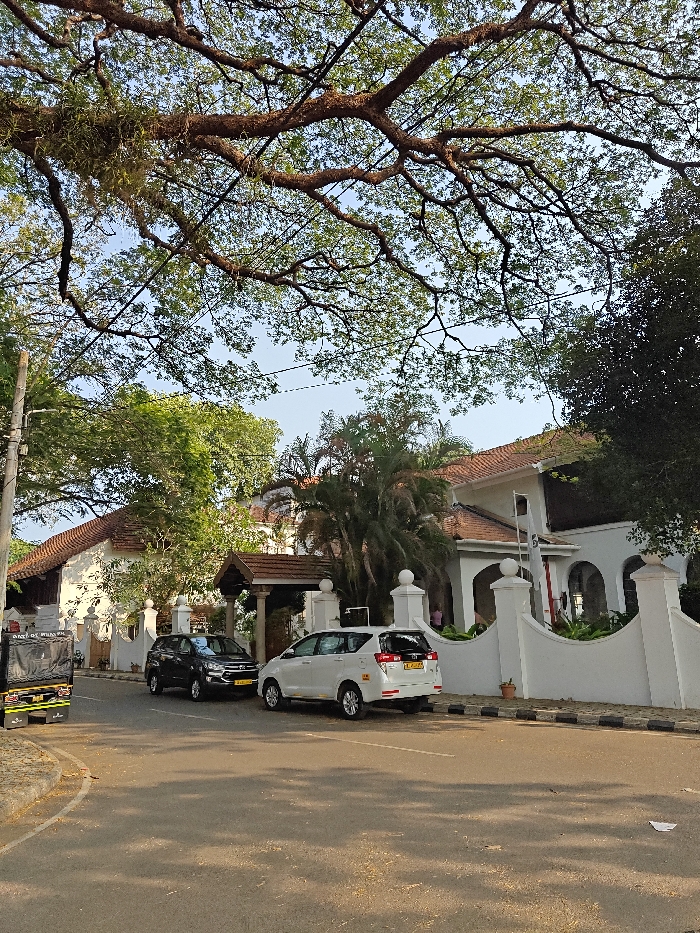
The image displays a street scene in Kochi, India, under a clear sky partially covered by a dense, leafy tree canopy. The foreground features an asphalt road with visible shadows. A white Toyota Innova multi-purpose vehicle (MPV), marked "TAXI" with license plate KL 07 BZ 3330, is parked parallel to the right curb, facing away from the viewer. A black Toyota Innova Crysta SUV is positioned slightly ahead of the white MPV, also facing away. On the far left, a dark-colored three-wheeled auto-rickshaw is partially visible. A white, decorative boundary wall with pillars topped by spherical finials and curved sections separates the road from a large, white building with a red-tiled roof. This building features multiple arched openings and a prominent dark-wood, tiled portico above an entrance. A white flag, displaying a blue emblem, is affixed to the building's façade. Lush green vegetation, including palm trees, is visible within the property behind the wall. A utility pole stands on the far left, supporting overhead wires. A small terracotta pot rests near the base of the white wall on the right. No individuals are visible.
Kochi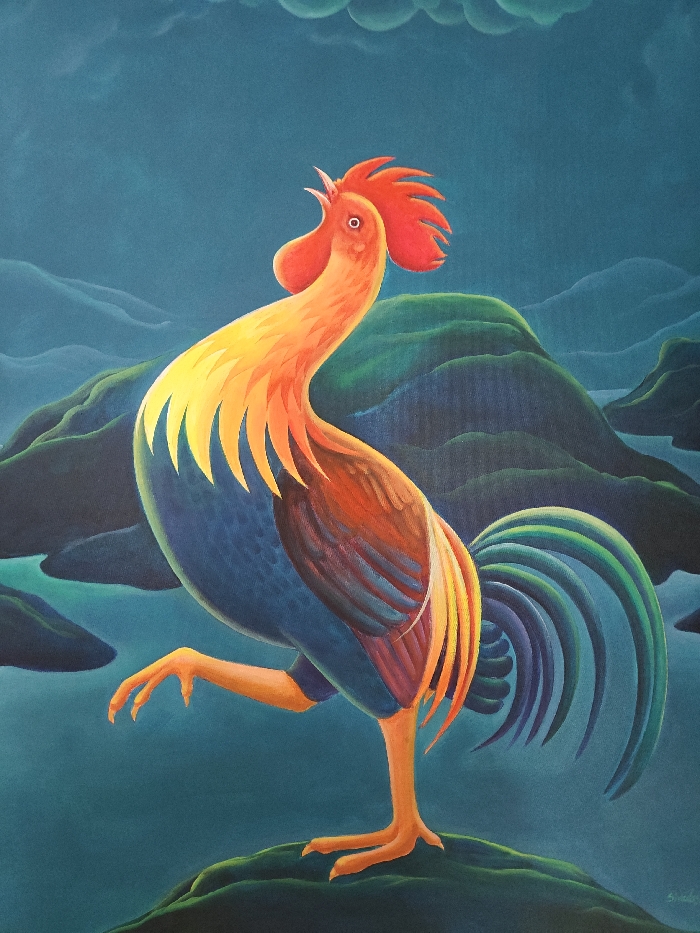
This image is a vertical painting featuring a stylized rooster against an abstract landscape. The central subject is a large rooster depicted in profile, facing left, with its head tilted upwards and beak open, suggestive of crowing. Its head, neck, and upper back are rendered in bright yellow and orange hues, transitioning to darker orange and red on its wings. The rooster's body is deep blue, and its prominent comb and wattles are vibrant red. Its tail feathers display a curvilinear design in shades of blue, green, and yellow. The rooster stands on its right leg, with its left leg raised and bent. It is positioned on a dark green, undulating foreground landform. The background features a series of dark blue-green hills or islands interspersed with bodies of teal-blue water. The sky is a dark teal with subtle, lighter cloud formations in the upper left quadrant. The scene is an artistic creation and does not depict a specific, identifiable real-world location within the city of Kochi, India.
Kochi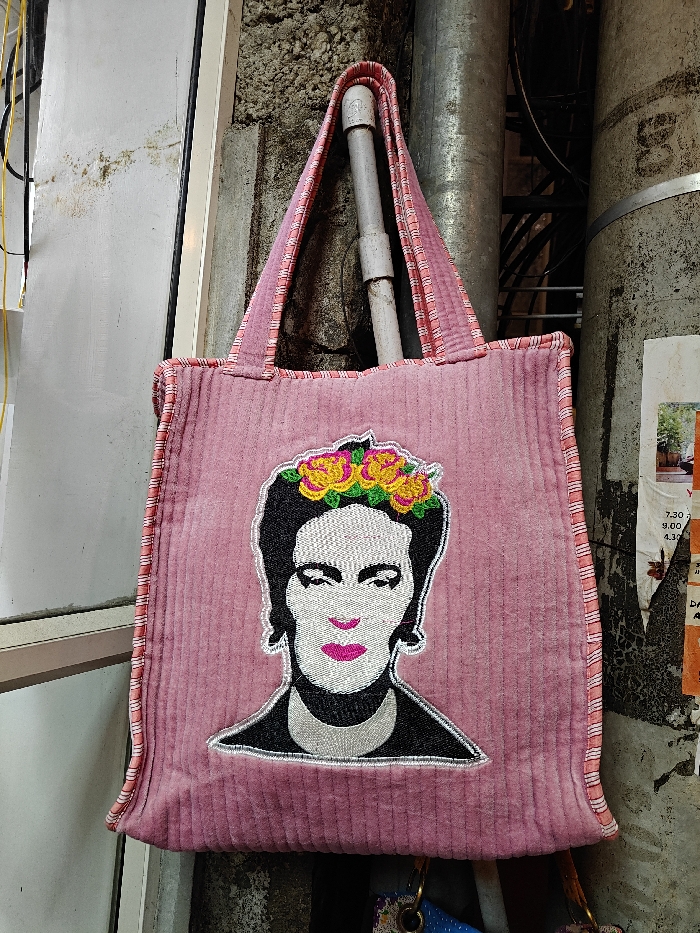
A pink corduroy tote bag, featuring an embroidered image of Frida Kahlo's face with a yellow and orange floral crown and fuchsia lips, hangs in an urban setting within Kochi, India. The bag, characterized by vertical ribbed texture and striped pink and white trim on its handles, is suspended from a grey pipe. The background consists of a stained, light grey concrete wall. To the left, a white vertical building panel or frame is partially visible with yellow and black electrical wires. To the right, another vertical grey pipe and a weathered, partially obscured white paper poster with black text, including timings (e.g., "7:30 am", "3.00 pm", "4.30 pm") and Malayalam script, are visible against the wall. No individuals are present in the frame.
Kochi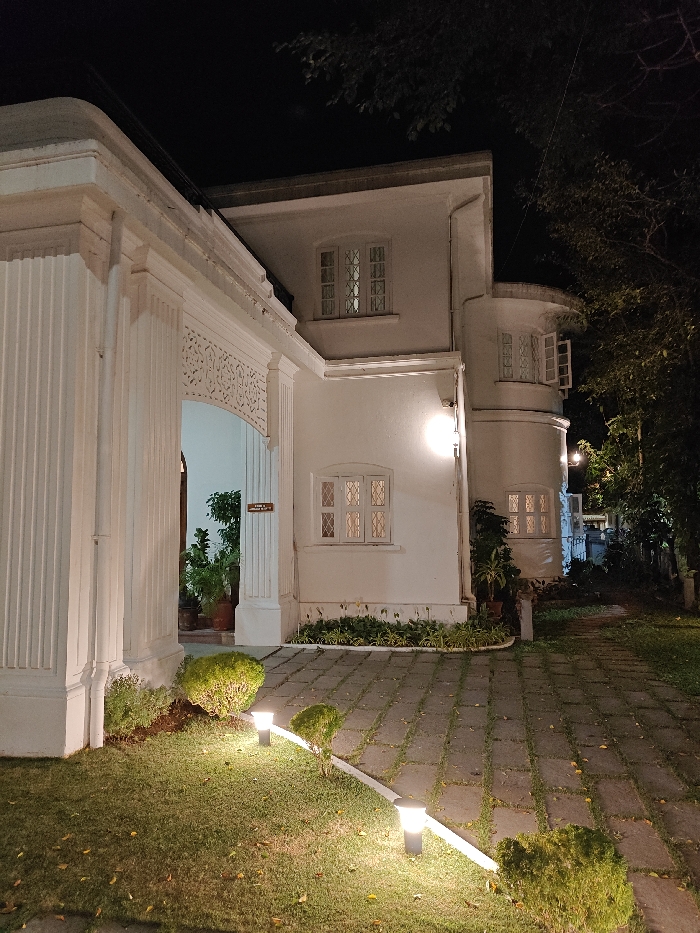
This image captures the illuminated exterior of a white, two-story colonial-style building at night, located in Kasa Kadavu, Mattancherry, Fort Kochi, India. The structure features a large entrance archway on the left with fluted white columns and intricate decorative carving above the arch. Inside the archway, potted plants are visible, along with a wooden sign reading "KASA KADAVU" and "STORAGE AREA". The building's main facade on the right side displays multiple multi-paned white windows; three are on the ground floor, and two on the upper floor, one of which is part of a rounded bay extension and is slightly ajar. The building is lit by several wall-mounted exterior light fixtures. In the foreground, a stone paver pathway runs alongside a manicured grass lawn, dotted with small, low-lying shrubs. Both the lawn and pathway are illuminated by multiple cylindrical ground-level lights. Dense dark foliage outlines the building against a dark night sky in the background. No individuals are present in the scene.
Kochi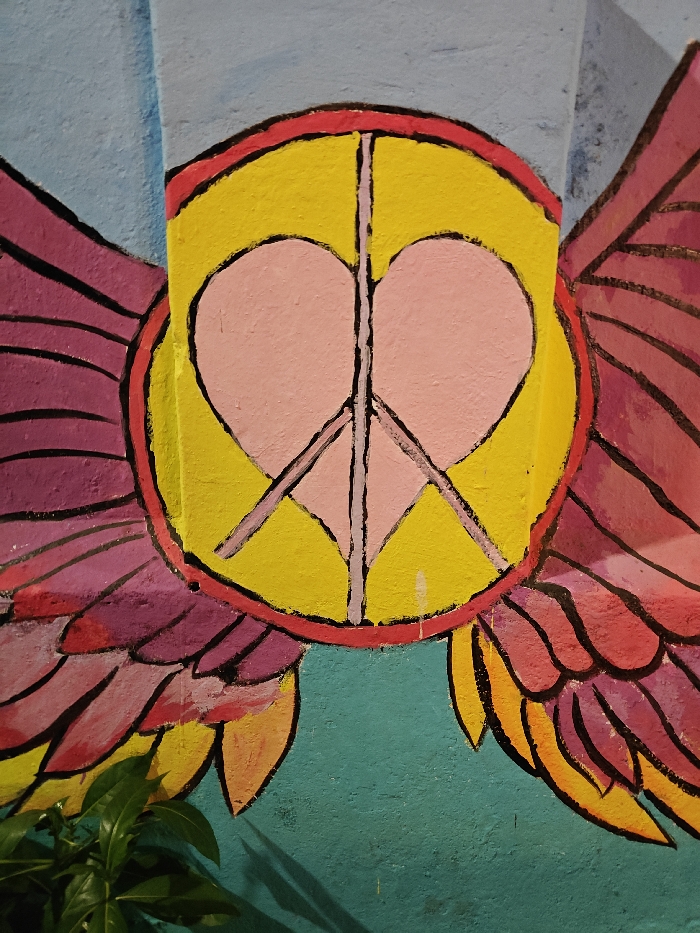
This image displays a vibrant mural painted on a wall in Kochi, India. The central artwork consists of a yellow circular emblem outlined in red. Within this yellow circle, a pink heart shape is prominently featured, bisected by the black lines forming a peace symbol. Stylized wings, rendered in shades of pink, purple, and orange, extend outwards from both sides of the central circular emblem. The upper section of the wall is painted light blue, while the lower section is teal. In the bottom left corner, green foliage from a plant is visible, partially obscuring the base of the left wing and the teal wall.
Kochi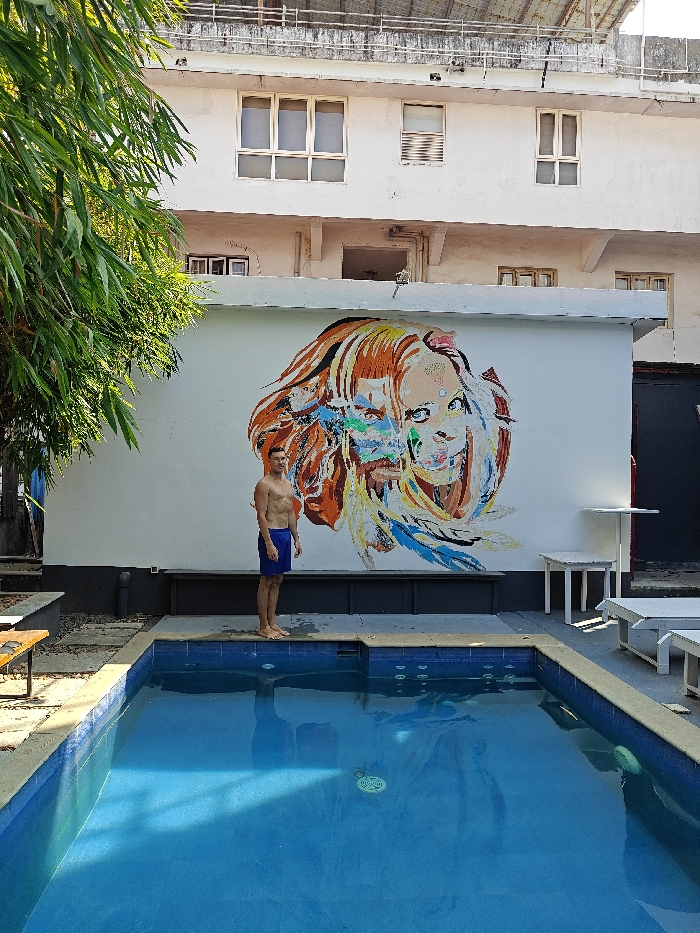
An outdoor scene in Kochi, India, features a fair-skinned male in blue swimming trunks standing barefoot at the edge of a rectangular swimming pool filled with clear blue water. He faces forward, shirtless, with arms at his sides. Behind him, a large, vibrant mural depicting two abstract, intertwined female faces in an expressive style with orange, red, blue, green, and white hues covers a white wall. Above the mural wall, a multi-story white building with several framed windows and an open balcony structure is visible. To the left of the pool, lush green foliage, resembling bamboo, partially frames the scene. To the right of the pool, white outdoor furniture consisting of two small tables with chairs and two lounge chairs is present on a paved area. The environment suggests a recreational space within a residential or hospitality complex.
Kochi
The video shows a small, rectangular swimming pool filled with bright blue water. Behind the pool, a white wall is adorned with a large, colorful mural featuring the combined faces of a man and a woman. To the left, a leafy green tree partially obscures the view of the building above the wall, which has white walls and dark-framed windows. A few white tables and lounge chairs are visible on the right side of the pool. The scene is well-lit, suggesting it is daytime.
Kochi
The image presents the interior of a motorized three-wheeled passenger vehicle (auto-rickshaw) on a sunlit urban street in Kochi, India. The primary subject is an individual viewed from the back, with long dark hair styled in a high ponytail. They are wearing a white, ribbed, long-sleeved crop top, which exposes the lower back, and blue elastic-waist pants. Sunglasses are positioned on the back of their head/neck. The individual is seated, leaning forward with their arms resting on the vehicle's structural frame. Ahead of them, the back of another individual wearing a light brown shirt is partially visible. The vehicle's interior upholstery, including the seats and side panels, features a repeating red and black geometric pattern. A black shoulder bag with a visible handle rests on the seat to the right of the primary subject. Through the vehicle's open side, a blurred background reveals a street, various buildings, and commercial signage, including a red sign, indicative of an urban setting.
Kochi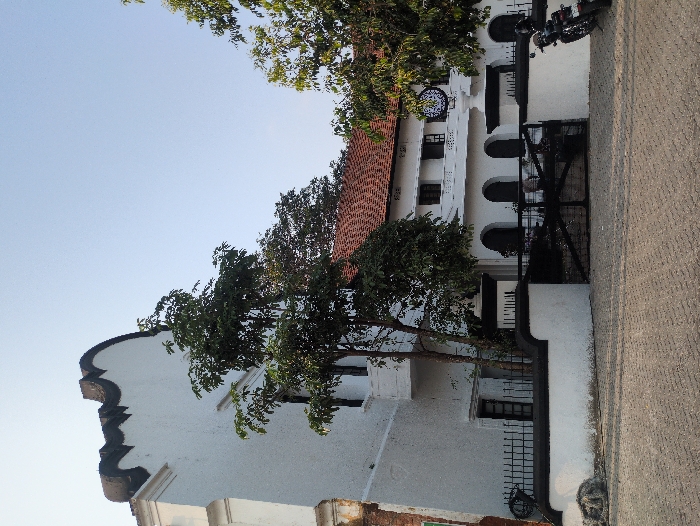
The image displays the exterior of the Pepper House, a colonial-era building situated in Fort Kochi, Kochi, India. The scene is illuminated by natural daylight under a clear, pale blue sky. The main subject is a multi-story, predominantly white stucco building featuring a distinctive scrolled parapet painted black along its upper left edge. A reddish-brown tiled roof is visible above the lower white sections of the structure. The building's ground level is fronted by a low white wall with black decorative fencing, centrally interrupted by a large, two-part black metal gate. Above the gate, three arched doorways or windows are recessed into the white facade. To the right of these arches, a white circular emblem, resembling a clock face or stylized logo with a dark border, is mounted on the wall. A small white balcony extends from the upper left side of the building. Several trees with green foliage are present, one standing directly in front of the left portion of the building, partially obscuring it. The foreground is paved with grey interlocking pavers arranged in a diagonal pattern. A loose coil of dark rope or cable rests on the ground near the base of the left wall. A black motorcycle, appearing to be a cruiser-style model, is parked on its kickstand to the far right of the frame. No individuals or active interactions are visible.
Kochi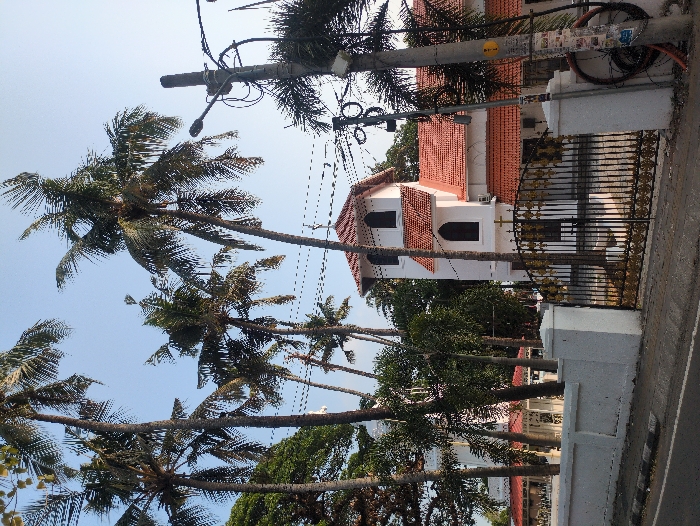
This image depicts the St. Francis CSI Church, located in Fort Kochi, Kochi, Kerala, India, viewed from a roadside perspective on a clear day. The primary subject is a multi-story white building with a prominent red-tiled roof. A distinctive white square tower with a red pyramidal roof and dark, arched windows rises from the structure, slightly right of center. The church's white walls contrast with its red clay tile roof sections. A small cross is affixed to the church facade just above the main gate. In the background, to the left of the main church structure, another white, dome-roofed building is partially visible amidst dense green foliage. In the foreground, a low, white concrete compound wall separates the church property from a paved road, which features a black-and-white striped curb marking. A black wrought-iron gate with intricate gold decorative elements forms the main entrance through the wall. Numerous tall, slender palm trees with green fronds dominate the upper and mid-sections of the image, partially obscuring the church building and extending into the clear blue sky. Additional green trees and shrubbery are visible within the church compound. On the far right, a grey utility pole stands upright, supporting a black street lamp fixture that extends to the left. Multiple black electrical wires crisscross the sky from this pole. A bundled black cable is attached to the lower section of the pole, which also displays a yellow circular sticker marked with a 'T'. No people or vehicles are present in the scene.
Kochi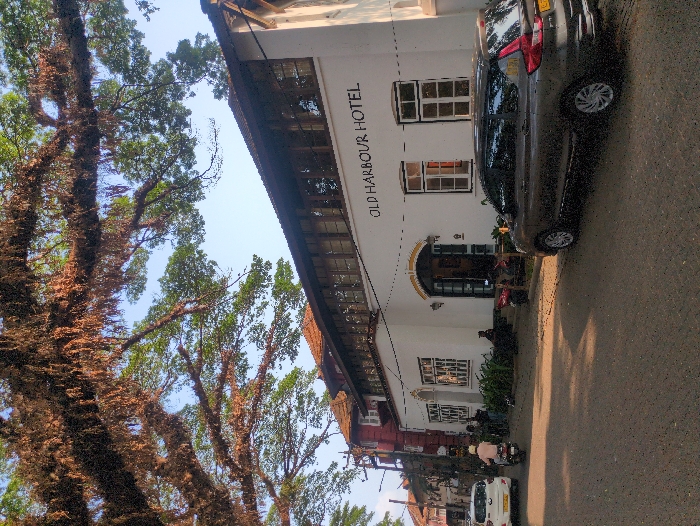
The image depicts a street scene in Fort Kochi, Kochi, Kerala, India. The prominent structure is a white-walled building identified by text as the "Old Harbour Hotel." The hotel features a large arched entrance in the center, flanked by rectangular windows, and a continuous band of windows on the upper floor, all beneath a tiled roof. Overhead, large tree branches covered in epiphytes and moss extend across the frame against a clear blue sky. On the paved road in front of the hotel, a dark grey multi-purpose vehicle (likely a Maruti Suzuki Ertiga based on visible features) is parked on the right side, facing away from the viewer. Its license plate begins with "KL," indicating Kerala registration. Further down the street, a white hatchback (Hyundai i10 model or similar) is visible. A person on a light-colored scooter or motorcycle, wearing a light-colored shirt and helmet, is traveling away from the camera in the left lane. Several individuals are present near the hotel entrance and on the adjacent sidewalk. Some are seated on steps or benches outside the hotel, while others appear to be standing. Two scooters or motorcycles are parked near the hotel entrance steps. The general environment suggests an established urban area with trees providing natural canopy.
Kochi
The video shows a beach scene on a cloudy day. A line of dark rocks borders the foreground, transitioning to a sandy beach where waves crash in a white foam. In the distance, a land mass is visible, topped with trees and a building. Two people are seen walking along the shoreline. Further out on the water, a boat is visible.
Kochi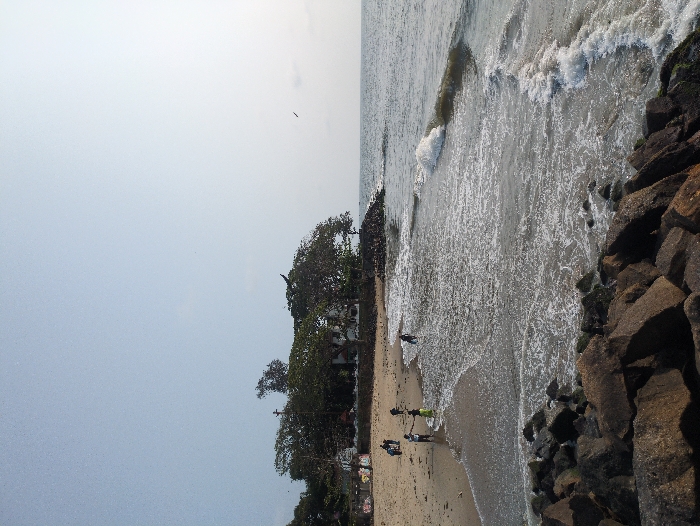
The image presents a sunlit coastal scene in Kochi, India. In the foreground, a prominent collection of large, irregular dark grey and brown rocks forms a breakwater, some exhibiting patches of green algae. The midground features the sea with light green-grey water, characterized by numerous white-foamed waves breaking against the rocky foreground and the sandy shore. A light brown sandy beach stretches from the left midground, curving towards the right distance. Approximately 10-15 individuals are dispersed across the beach and within the shallow surf. Several people, including at least two children, are observed wading in the incoming waves, with water reaching up to their ankles or knees. One person is distinctly visible standing in the shallow water, wearing a bright green garment. Other individuals are walking on the drier sand further from the waterline. The background along the beach is dominated by a dense line of mature green trees, some appearing tropical. A light-colored building with a visible roof is partially discernible behind these trees on the left side of the frame. Faint structural outlines or a wall are also visible along the upper treeline towards the right. The sky occupies the upper two-fifths of the image, appearing clear and a pale blue, transitioning to a brighter, slightly hazy white-blue towards the right horizon. A small dark speck, possibly a bird, is present in the upper right sky.
Kochi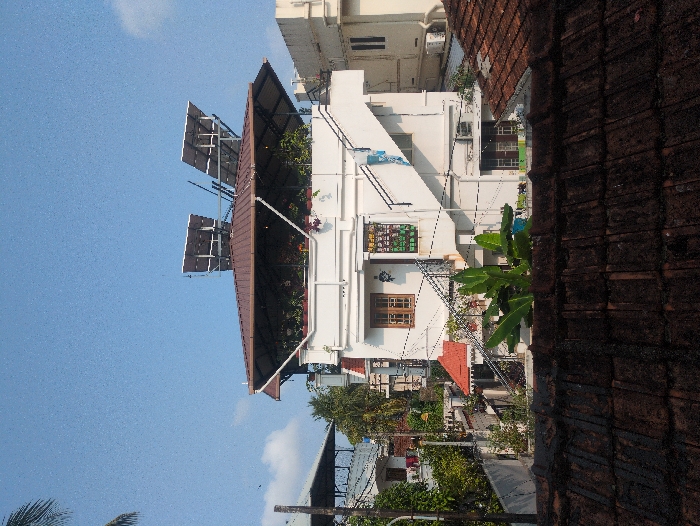
The image depicts a residential scene in Kochi, India, under a clear blue sky. In the foreground, a dark, weathered, traditional tiled roof is partially visible, indicating the viewer's elevated perspective. The central subject is a multi-story, white-painted building with architectural details. Its upper level features a brown hip roof with a flat section where a rooftop garden or planted area is present. Above this, two distinct arrays of solar panels are mounted on metal frameworks, angled for solar exposure. An external white concrete staircase ascends the right side of the building, leading to the roof level; a blue and white patterned cloth is draped over its railing. The facade includes a brown wooden-framed window and a green-framed window with security bars. Below the brown window, a green and yellow sign with Malayalam script is affixed. Potted plants are visible on the balconies and ledges. A white air conditioning condenser unit is mounted on the exterior wall to the right. The mid-ground features dense tropical foliage, including banana plants, partially obscuring the lower sections of the main building. In the background, a tightly packed urban environment is visible with various residential structures, some featuring red-tiled roofs and white walls. Utility poles and a network of overhead wires are present. Palm trees and other greenery are scattered throughout the scene. No individuals or specific human actions are discernible.
Kochi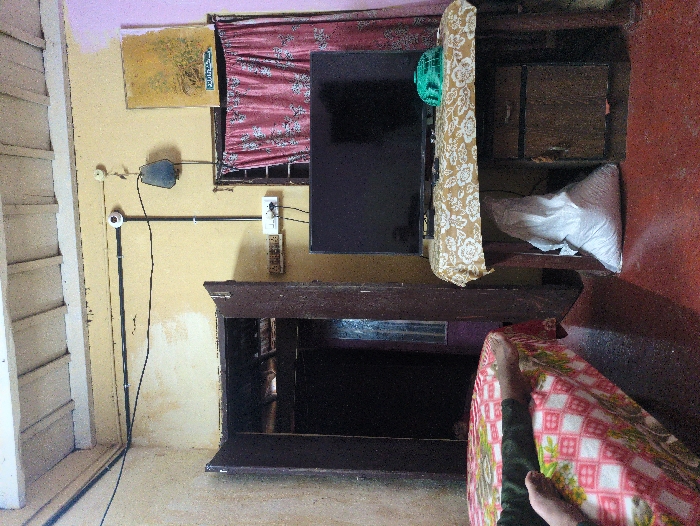
An interior room in Kochi, India, is presented with a partial view of an individual resting on a bed in the lower-left foreground. The person's bare feet and lower left leg, clad in dark trousers, are visible on a bed covered with white and red patterned bedding featuring a house-like motif. To the right, a dark flat-screen television sits on a wooden table draped with a light-colored floral tablecloth. A green object, possibly a hat or container, is on the table beside the television. Under the table, a white sack and a small, dark wooden cabinet with a single drawer are visible. The floor is a reddish-brown. The primary wall is painted a faded light yellow, exhibiting signs of wear and discoloration, while a section to the far right is painted light purple. A dark wooden double door, partially open, reveals a darker, ambiguous space beyond. Black electrical conduit runs along the top section of the yellow wall, leading to a white switchboard with multiple outlets and switches. Above the switchboard, a white spherical device is mounted on the conduit, with a dark, teardrop-shaped object hanging below it. A yellow-framed artwork, displaying script identified as Arabic, is affixed to the wall to the right, above a window partially obscured by a red floral curtain. The ceiling is white, featuring visible beams.
Kochi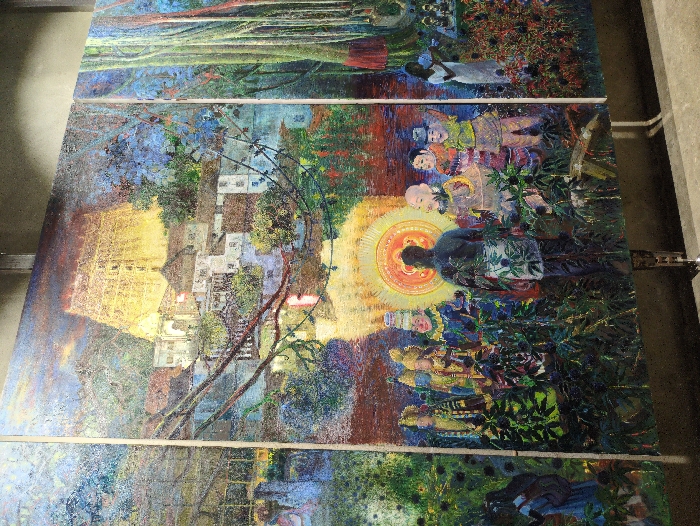
The image displays a large, multi-panel painting, likely a triptych, presented vertically on exhibition stands within an indoor space. The artwork employs a highly textured, vibrant style, utilizing rich blues, greens, yellows, reds, and browns. The upper portion of the painting features a towering, golden-hued gopuram, characteristic of South Indian temple architecture, specifically resembling the Sree Padmanabhaswamy Temple. Below and around this structure, numerous white-walled houses with reddish roofs are nestled amidst dense green and blue foliage. A body of water, reflecting the sky and buildings, occupies the mid-ground, with dark branches extending over it. The sky above the temple appears dark and dramatic. The lower and central sections of the painting depict a gathering of figures. A central figure, seen from behind, wears dark clothing with a light, leafy-patterned waist wrap, facing a prominent, radiant circular emblem featuring orange and red patterns. To the left of this central figure, several individuals with distinct headdresses and colorful, traditional garments stand amidst lush, dark green plants. To the right, other figures include a bald, bearded individual and another wearing a conical hat, also in colorful attire. The immediate foreground is dense with broad-leaved plants, partially obscuring the figures' lower bodies. The rightmost panel features tall, slender trees with hanging roots, resembling banyan trees, extending vertically. In the lower right, a female figure dressed in white is positioned amidst red and green flora, appearing to interact with small objects on a low platform or altar. The artwork is physically displayed in an indoor setting, with metal stands visible supporting the panels at the bottom. The location of the display is an indoor gallery or exhibition space, such as those found in the city of Kochi, India.
Kochi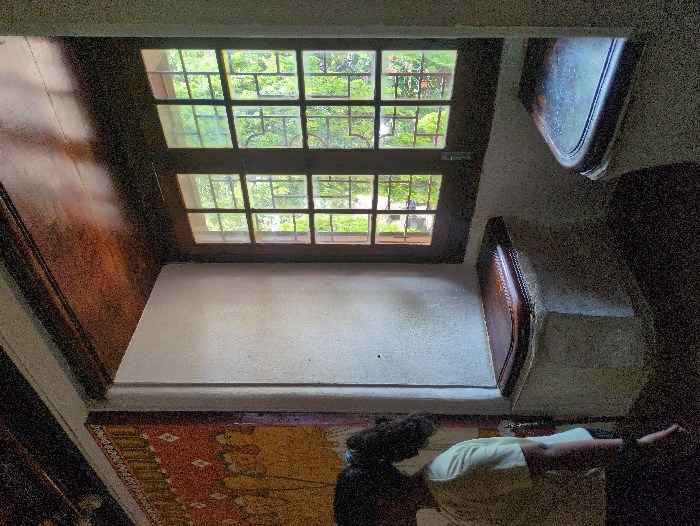
The image depicts the interior of a historical building, identified as Mattancherry Palace in Kochi, India. On the left, a person, seen from the mid-torso up and facing away from the camera, stands near a wall featuring a large, intricate mural. The individual has dark hair tied in a ponytail and wears a light-colored, short-sleeved top and dark lower garments. The mural, rendered in earth tones including gold, red, and white, portrays multiple figures in a traditional Indian artistic style. To the right, a deep window recess is illuminated by natural light entering through a large, multi-paned wooden window. The window consists of two vertical sections, each divided into multiple smaller rectangular panes by a dark grid frame. Green foliage is visible beyond the window, suggesting an outdoor garden or trees. Within the window recess, two built-in stone benches are present: one to the left under the window, and another extending from the right wall into the recess. Both benches are topped with dark, polished wooden cushions featuring rounded edges and decorative trim. The walls are thick and painted an off-white or light beige. A dark wooden beam runs horizontally across the top of the frame, above the mural and window. The floor is dark and unadorned.
Kochi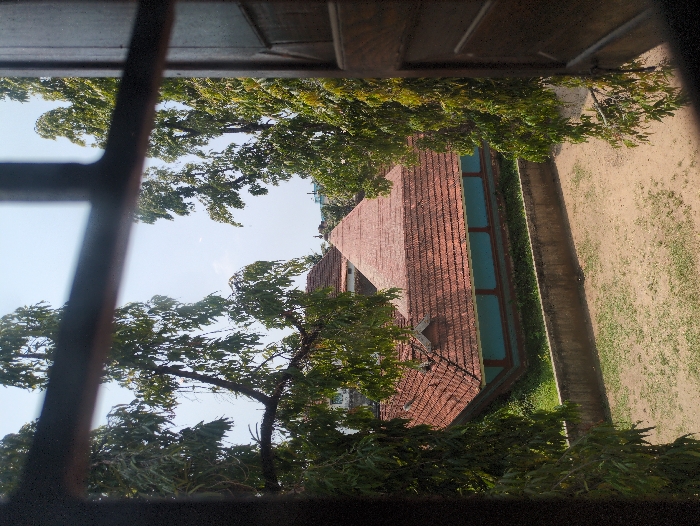
The image displays an outdoor scene viewed through a dark-framed window, with partial wooden shutter elements visible on the right. A traditional Kerala-style building with a multi-layered, red-tiled roof dominates the middle ground. The roof features a central, elevated pyramid-shaped section surrounded by sloping tiled surfaces. The building's exterior walls are painted a distinct light teal or turquoise color, with vertical decorative elements. Immediately surrounding the building is a narrow strip of green grass, separated by a low concrete wall from a larger foreground area of dry, light brown earth with sparse green patches. Dense green trees with abundant foliage frame the building on both sides and extend upwards into a clear, light blue sky. No individuals or animals are present. The architectural style is consistent with traditional structures found in Kochi, India.
Kochi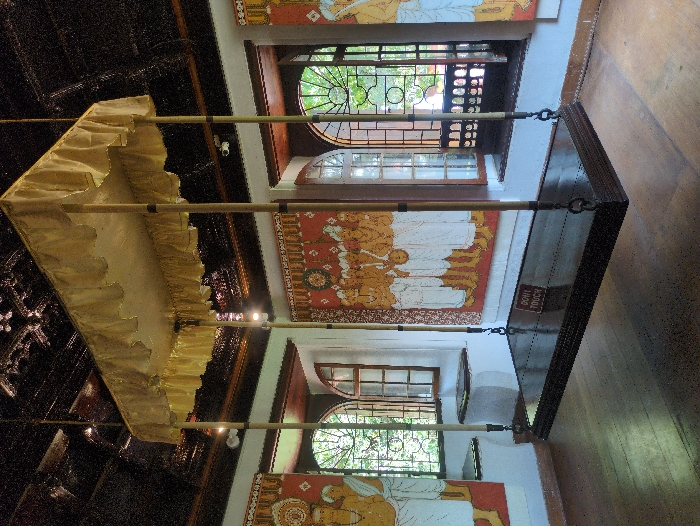
An antique wooden swing, known as an *oonjal*, dominates the center of a well-lit room in the Mattancherry Palace, Kochi, India. The swing features a rectangular, dark brown, polished wooden platform, suspended by four black metal chains. Each chain attaches to a light-colored wooden pole, which extends upwards to support a rectangular, ruffled, golden fabric canopy. A small, dark brown sign with "DON'T TOUCH" in white text rests on the swing's platform. The room's walls are light-colored, serving as a backdrop for three large traditional Kerala mural paintings. The central mural, on a vibrant red background, depicts multiple figures in traditional attire, possibly deities or royal figures, one holding a musical instrument. Portions of two additional murals, each showing a standing figure in white, are visible on the left and right walls. The dark wooden ceiling above is ornately carved with intricate patterns, and several recessed light fixtures illuminate the space. Three multi-paned wooden windows are visible along the right wall, with one on the left. The central right window features an intricate dark metal grille, and glimpses of green foliage are visible through the open windows, suggesting a garden exterior. The floor is made of polished wooden planks.
Kochi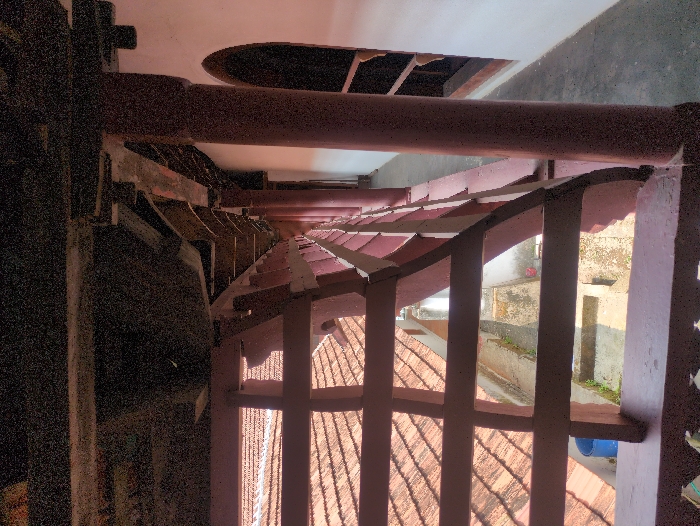
This image depicts a covered wooden walkway within the Mattancherry Palace in Mattancherry, Kochi, India, viewed from an elevated perspective. The foreground features a reddish-brown wooden balustrade with carved detailing along its lower edge. To the left, a portion of a sloped roof covered with terracotta tiles is visible. Below the walkway and roofline, an open-air concrete courtyard or alleyway is observable, containing some vegetation and a blue cylindrical barrel. The right side of the image is dominated by a long, colonnaded walkway, supported by multiple reddish-brown wooden pillars. This walkway runs parallel to a white-painted wall that features at least one dark, arched opening. The ceiling structure above the walkway consists of dark, exposed wooden beams and supporting elements. The scene is illuminated by natural light. No individuals are depicted.
Kochi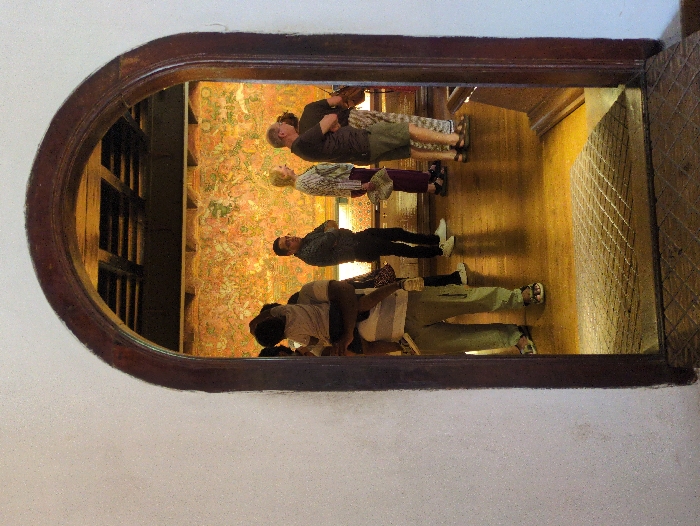
The image displays an interior view framed by a dark brown arched wooden doorway, likely situated within the Mattancherry Palace in Fort Kochi, Kochi, India. The foreground shows a light-colored, textured wall. Beyond the archway, an interior room features a reflective, polished wooden floor and a dark ceiling with exposed wooden beams. The far wall is dominated by a large, intricately detailed mural, exhibiting a palette of warm orange, red, and yellow with green and white accents, consistent with traditional Kerala mural art depicting figures and scenes. Approximately six individuals are present in the room, all oriented towards and observing the mural. On the left, partially within the doorway's frame, a person wearing light trousers and a striped top carries a small child on their shoulders; the child faces the mural, reaching upwards with one arm. To the right, a man in a dark jacket stands with arms crossed. Further right, a woman with light hair, wearing a patterned top, holds a folded document. Beside her, a man in a dark t-shirt and light shorts stands. Additional figures are partially visible further right. The room is illuminated, with the mural appearing distinctly bright.
Kochi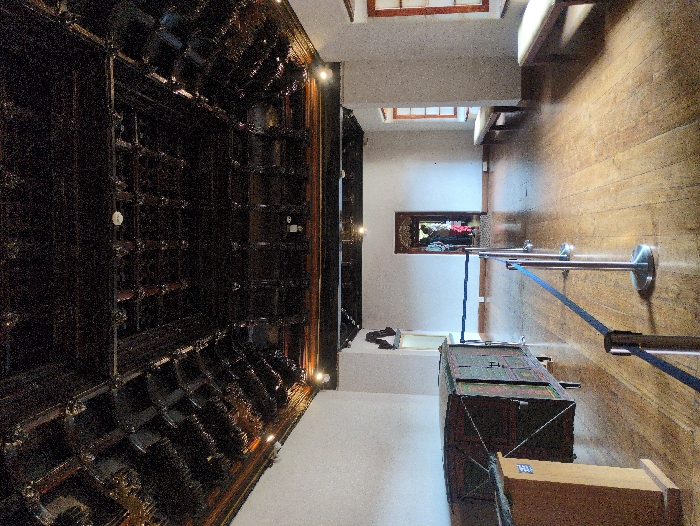
The image depicts a large, well-lit exhibition room within the Mattancherry Palace in Kochi, Kerala, India. The most striking architectural feature is the dark, intricately carved wooden coffered ceiling, adorned with numerous patterns and integrated spotlights. The walls are uniformly white, and the floor consists of polished light-brown wooden planks. On the left side of the room, an antique dark wooden chest or cabinet, featuring distinct green and reddish decorative panels, is displayed. This artifact is positioned behind a visitor barrier composed of polished silver stanchions connected by blue velvet ropes, which extends into the mid-ground. Along the right wall, two plain wooden benches with light-colored cushions are situated beneath rectangular windows framed in dark wood. At the far end of the room, a wide doorway with an ornate, dark carved wooden frame provides access to an adjacent area. Through this doorway, several indistinct figures, identified as visitors, are visible, some wearing brightly colored clothing, suggesting movement into or out of the room. The overall scene is static, captured from a slightly low-angle perspective, emphasizing the ceiling and the depth of the room.
Kochi