Kolwara, Papua New Guinea
30 memories from Kolwara, Papua New Guinea
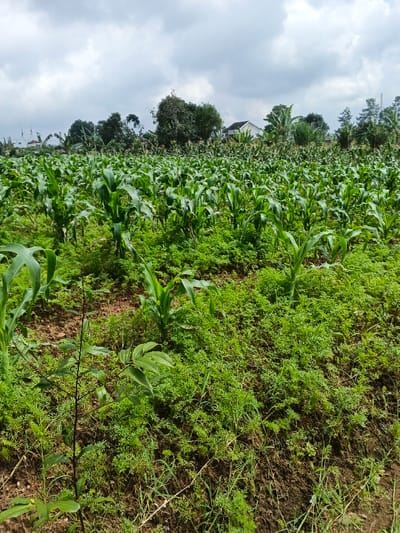
The image displays a vibrant agricultural field in Kolwara, Papua New Guinea, under a bright, cloudy sky. The foreground and midground are densely covered with two types of green crops. Prominently featured are numerous young corn (maize) plants, their broad, light green leaves reaching upwards. Interspersed and growing thickly between the corn stalks, covering much of the soil, is another low-growing crop with very fine, feathery, bright green leaves, resembling carrot tops or a similar plant, suggesting intercropping. In the background, a dense line of various trees with dark green foliage forms a natural backdrop. Parts of residential houses with white walls and dark roofs are visible peeking through the trees on both the left and right sides of the image, indicating the proximity of a village or settlement to the cultivated land. The sky above is largely overcast with white and grey clouds, suggesting a bright but diffused daylight, likely mid-morning or afternoon. The scene depicts a peaceful, productive rural landscape. No people are visible, and no specific activities are taking place within the frame, focusing solely on the flourishing plant life. There is no visible text in the image.
Kolwara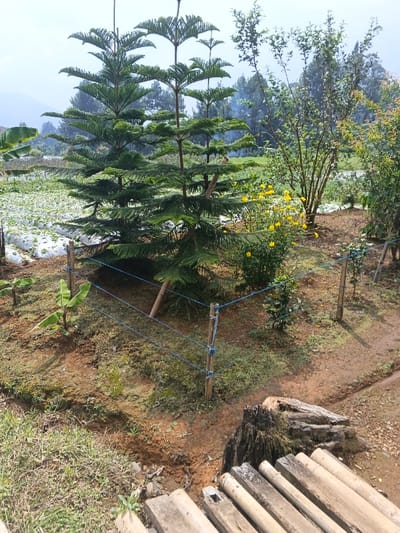
This outdoor image depicts a lush, rural landscape, likely an agricultural or garden area, set in Kolwara, Papua New Guinea. In the mid-ground, two prominent, layered conifer trees, resembling Norfolk Island pines, stand tall with their distinctive flat branches. To the left of these trees, several young banana plants with broad green leaves grow in the reddish-brown soil. A simple, low fence made of rough wooden posts and blue rope delineates an area in front of the large trees. Behind this fence, to the left, a body of water or a field appears to be covered with white, possibly agricultural, sheeting, suggesting cultivation. To the right of the conifers, a cluster of vibrant yellow flowering bushes adds a splash of color, surrounded by other green shrubs and trees. The background features distant, hazy green hills, suggesting a mountainous or undulating terrain under a bright, diffused sky, indicating an overcast day or early morning/late afternoon light. In the immediate foreground on the right, a rustic pathway or small bridge made of weathered wooden planks and bamboo crosses over a shallow ditch or eroded area. A large, gnarled tree stump is visible next to this structure. The ground in the foreground consists of reddish-brown earth with scattered patches of green grass and moss. No people or visible text are present in the scene. The overall impression is one of natural beauty and human cultivation in a serene, remote setting.
Kolwara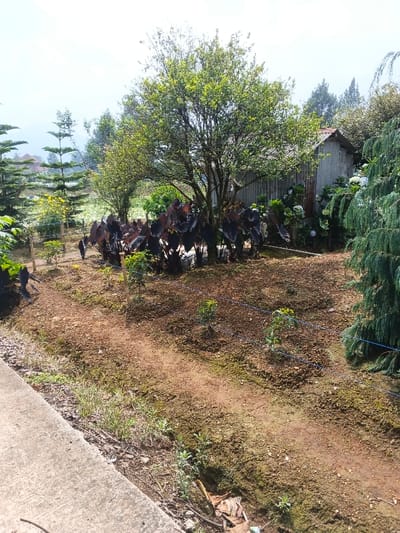
This image captures a vibrant garden or cultivated plot in Kolwara, Papua New Guinea, under bright daylight. No people are visible in the scene. In the foreground, a concrete edge runs along the bottom left, alongside a shallow dirt path or trench containing sparse weeds and some dried organic debris. The main midground features a large area of reddish-brown, recently tilled soil, indicating cultivation. Scattered within this area are several small, green plants, possibly young seedlings. Blue strings are strung horizontally across this plot, attached to small wooden stakes, suggesting a layout for planting or a temporary boundary. Towards the center and mid-background, a prominent leafy green tree stands, partially obscuring a rustic shed made of corrugated metal and wood on the right. Directly in front of this tree and extending leftwards is a dense cluster of plants with large, dark, possibly purplish-black leaves, resembling tropical foliage like taro. To the right of the shed, some white flowering plants, possibly hydrangeas, are visible. On the far right, a tall, feathery evergreen tree frames the scene. The left side of the background reveals several tall, conical evergreen trees, resembling Norfolk Island pines, with some yellow flowering shrubs beneath them. A glimpse of a house roof can be seen in the distant background on the left. The sky, visible at the top, is bright and clear, indicating a sunny day, likely midday or early afternoon, given the strong, clear illumination. No text is visible in the image.
Kolwara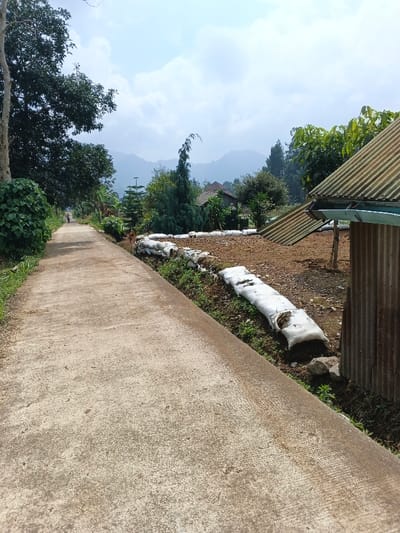
The image captures a rural or semi-rural landscape, likely a village or countryside area. A concrete path, slightly lighter in color due to wear or dust, extends from the foreground into the distance on the left side of the frame. Lush green foliage and large trees line the left side of the path, casting some shade. On the right side of the path, there is a lower-lying area with green weeds and small plants, followed by what appears to be cultivated brown earth or a field. Several white sacks, possibly filled with soil or sand, are laid out along the edge of this field, potentially serving as erosion control or a boundary. Further to the right, a portion of a building with a corrugated metal roof is visible, suggesting a simple dwelling or agricultural structure. In the mid-ground, a small, indistinct figure of a person appears to be walking away on the concrete path. Beyond the immediate surroundings, a dense mix of green trees and smaller houses can be seen. In the far background, majestic mountains rise, their outlines softened by atmospheric haze under a bright sky with scattered white clouds. The overall impression is one of peaceful, daytime rural life. No visible text is present in the image.
Kolwara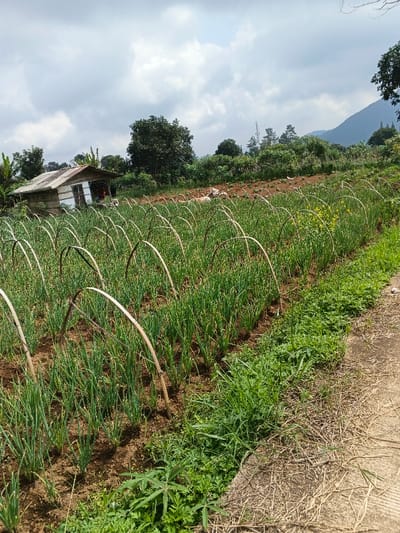
This image presents a serene agricultural landscape in Kolwara, Papua New Guinea, under a bright, overcast sky with scattered clouds. The primary subject is a field meticulously cultivated with rows of vibrant green crops, which appear to be a type of onion or scallion. Many of these rows feature distinctive, arched structures made from bent bamboo stakes, likely used to support protective coverings or provide shade for the growing plants. The dark, tilled soil contrasts with the verdant foliage. In the mid-ground, slightly to the left, a rustic, small shack or shed stands with a corrugated metal roof and simple wooden walls. Its utilitarian appearance suggests it serves as a storage unit or temporary shelter for farm workers. Beyond the field and the shack, a dense line of lush green trees forms the backdrop, with the gentle contours of distant hills or mountains visible against the sky, indicating a mountainous or hilly terrain. The foreground on the right side of the image features an unpaved path or track, bordered by patches of dry grass and more vigorous green weeds and plants growing wild along the edge of the cultivated field. The absence of people and the bright, diffused lighting contribute to a quiet, peaceful atmosphere, highlighting the agricultural activity and the natural beauty of the rural setting. No visible text is present in the image.
Kolwara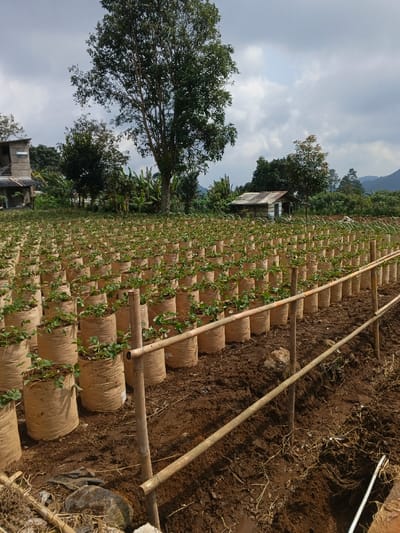
The image captures an expansive outdoor farming scene in Kolwara, Papua New Guinea, under a partly cloudy sky. The foreground and midground are filled with numerous rows of plants, each growing in individual cylindrical fabric pots. These pots are densely packed and arranged in neat, parallel lines that stretch into the distance, suggesting a large-scale cultivation effort, possibly for strawberries given the appearance of the young plants. A simple barrier or support structure made of horizontal bamboo poles held by vertical bamboo stakes runs across the lower right section of the image, separating the viewer from the main field of potted plants. The ground is dark, tilled soil, with some natural debris and small rocks scattered in the immediate foreground. In the mid-distance and background, lush green vegetation is abundant. A large, mature tree with a full canopy stands prominently towards the center-left, flanked by other smaller trees and dense foliage. Two small, rustic buildings are visible: one on the far left, partially hidden by trees, and another on the right with a light-colored wall and a corrugated metal roof, blending into the rural landscape. In the far distance, gentle hills or mountains are silhouetted against the sky. The time of day appears to be daytime, likely late morning or early afternoon, with bright, diffused light suggesting either an overcast or partly cloudy sky. No human activity or individuals are visible, leaving the agricultural setup as the sole focus. The scene conveys a sense of organized farming within a verdant, natural, and remote environment. No text is visible in the image.
Kolwara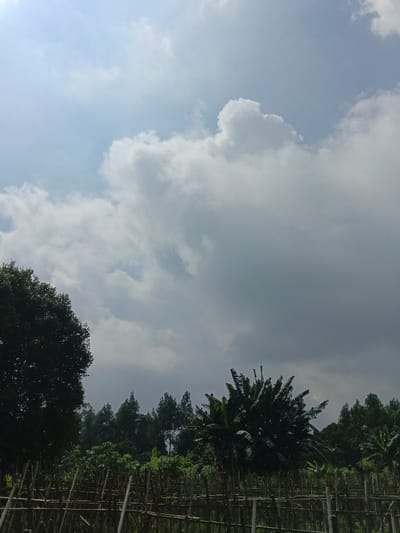
The image captures a serene outdoor landscape, likely a rural or agricultural area, under a dynamic sky. The upper portion of the frame is dominated by the sky, displaying a mix of bright blue patches and expansive clouds ranging from white to varying shades of grey, indicating either a partially cloudy day or potentially an approaching change in weather. In the lower half of the image, lush vegetation is prominent. The foreground features what appears to be a cultivated field or garden, where numerous young plants are supported by a rustic, lattice-like structure made of bamboo or thin wooden poles, forming a distinct horizontal element across the scene. Behind this cultivated area, a dense line of trees forms the natural horizon. On the far left, a large, dark-leaved tree fills the corner, its canopy robust. Towards the center-right, a prominent, bushy banana or plantain tree stands out with its large fronds, flanked by other trees including some taller, slender, possibly pine-like varieties. The overall lighting suggests it is daytime, although the heavy cloud cover gives some areas a slightly subdued illumination. There are no people visible, and no specific activities are taking place; the scene is static and observational. The types of trees and agricultural setup are consistent with a tropical or subtropical environment, aligning with the provided context of Kolwara, Papua New Guinea. No text is visible within the image.
Kolwara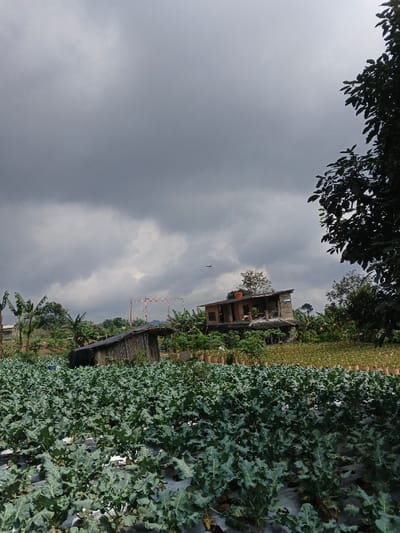
This photograph depicts an expansive agricultural landscape in Kolwara, Papua New Guinea, under a heavily overcast sky. The foreground is filled with a neatly arranged field of green, leafy crops, likely broccoli or cabbage, planted in rows with white plastic mulch film covering the soil between them. In the mid-ground, several structures and dense vegetation populate the scene. To the left, a rustic wooden shack with a dark roof stands, possibly used for storage or as a shelter. Further to the right and on slightly higher ground, a two-story wooden house with multiple balconies and a dark roof is visible, and an orange water tank is positioned on its roof. Between these structures, lush tropical trees and shrubs, along with other cultivated plants in pots, are scattered across the terrain. A distinctive structure made of red and white poles, possibly a makeshift goal post or a support frame, stands out in the mid-distance. The background reveals rolling green hills covered with abundant foliage, suggesting a verdant, hilly environment. The sky is completely blanketed by thick, dark grey clouds, indicating a cloudy or potentially stormy day. High in the sky, a small, dark object that appears to be a distant aircraft, possibly a propeller plane or drone, is barely discernible. No people are visible, and there is no visible text in the image. The overall scene conveys a sense of serene rural productivity under a somber sky.
Kolwara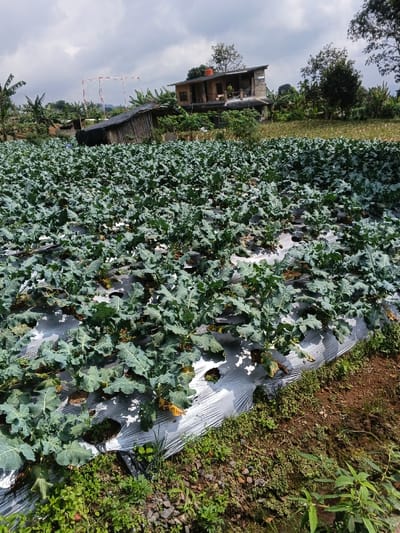
This daytime image captures a vast agricultural field, likely situated in a rural area like Kolwara, Papua New Guinea. The foreground and midground are covered by rows of green, leafy plants, consistent with a brassica species such as broccoli or cabbage. These plants are cultivated through holes in a white or silver plastic mulching sheet, which covers the ground between them, indicating modern farming practices. Some of the plant leaves exhibit signs of yellowing or drying. In the background, a cluster of rustic buildings is visible amidst lush greenery. The most prominent structure is a multi-story house, possibly constructed from wood or natural materials, featuring an orange water tank on its roof. Next to it, a smaller, dark-colored building is partially obscured by vegetation. Farther in the distance, a distinctive white and red striped frame-like structure stands against the partly cloudy sky. Numerous trees, including what appear to be banana plants on the left, frame the scene. The overall setting is one of active cultivation within a natural, rural landscape. No people are visible in the image, but the organized planting and structures suggest ongoing agricultural activity. The lighting indicates it is daytime, under a partly cloudy sky. The tropical-looking vegetation and rustic architecture align with the provided location context of Papua New Guinea. There is no visible text present in the image.
Kolwara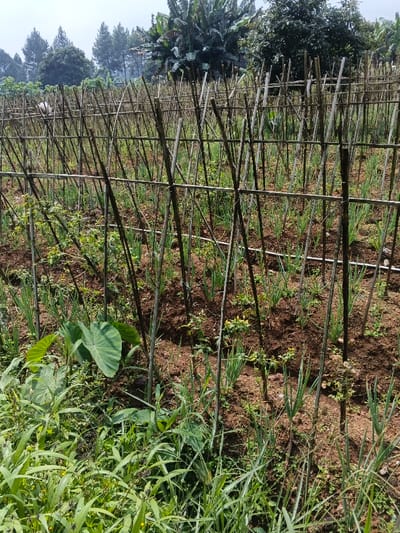
A cultivated field features rows of vertical bamboo poles, interspersed with greenery, presumably crops. Lush vegetation, including broadleaf plants, fills the foreground. Above the field, trees line the horizon, including banana trees. The scene suggests small-scale farming in a lush, possibly tropical environment.
Kolwara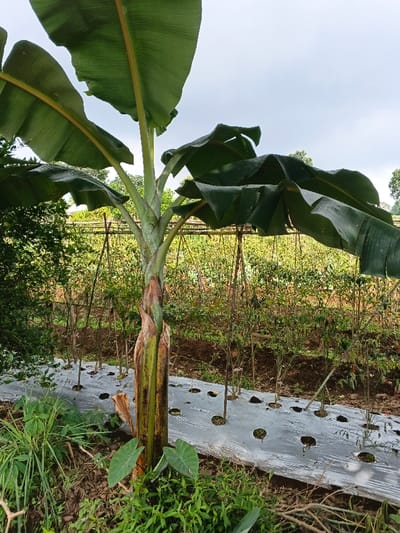
A banana plant with large green leaves dominates the foreground. Behind it, a field of plants with supportive stakes extends into the distance. The crops are planted in rows covered with reflective, perforated plastic sheeting. Weeds and other vegetation grow around the base of the banana plant. The sky is overcast.
Kolwara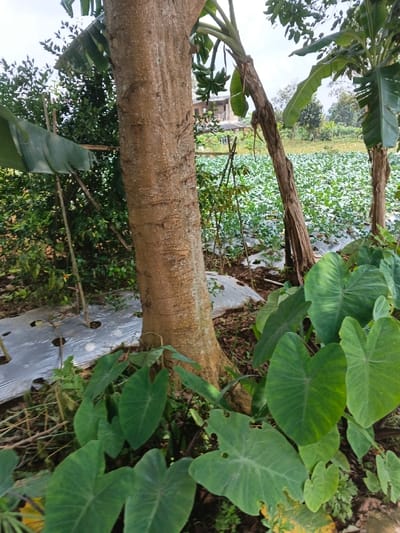
This image captures a vibrant agricultural scene in Kolwara, Papua New Guinea, under bright daylight conditions. The foreground is dominated by a thick, light brown tree trunk on the left, with large, heart-shaped green leaves, characteristic of taro or colocasia plants, growing around its base and extending to the lower right. In the mid-ground, a banana plant stands to the right of the large tree, bearing a cluster of green, unripe bananas. Another banana plant is partially visible further right. The ground in this area and extending into the background is covered with rows of silver plastic mulch, a farming technique often used for moisture retention and weed control. Through openings in the mulch, green crops, possibly vegetables or other food plants, are growing in neat rows, creating a lush, verdant field that stretches across the background. Some wooden stakes or trellises are visible among these plants, supporting their growth. In the distant background, beyond the cultivated field and surrounded by foliage, a small building with a light-colored roof can be seen, hinting at a rural or village setting. No people or visible text are present in the image, which showcases active cultivation and diverse plant life typical of a tropical agricultural landscape.
Kolwara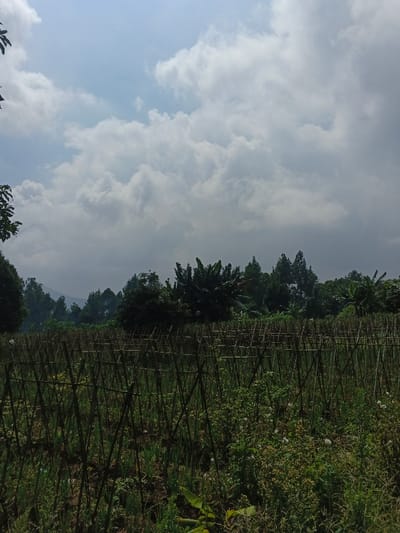
The image presents a rural agricultural scene in Kolwara, Papua New Guinea, under a bright, partly cloudy sky. The foreground features a cultivated field filled with numerous trellises, constructed from bamboo or wooden poles arranged in a repeating crisscross pattern, likely to support climbing crops. Green vegetation, including what appear to be young plants and some wilder growth, covers the ground between these structures. In the midground, a dense band of varied trees forms a natural backdrop to the field. This includes several tall, dark green trees, possibly pines, interspersed with tropical foliage, most notably large-leaved banana plants. The distant background reveals the subtle, hazy outline of mountains or large hills, partially obscured by atmospheric conditions or cloud cover. The sky above is filled with soft, white and grey cumulus clouds, with patches of blue sky visible, indicating daytime, likely late morning or early afternoon. The lighting suggests that the sun is breaking through the clouds. There are no people visible, and no specific activity is taking place, but the organized trellises imply active farming. The scene conveys a sense of peaceful agricultural productivity set within a lush, natural environment. No text is visible in the image.
Kolwara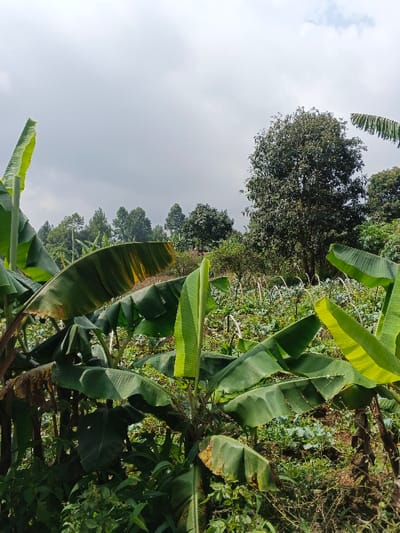
A vibrant hillside scene unfolds under a cloudy sky. Banana trees with large, green leaves dominate the foreground, some showing signs of age. Beyond, a field of cultivated crops extends up the hill. Lush, green trees fill the midground. The upper portion features more trees and a grey sky.
Kolwara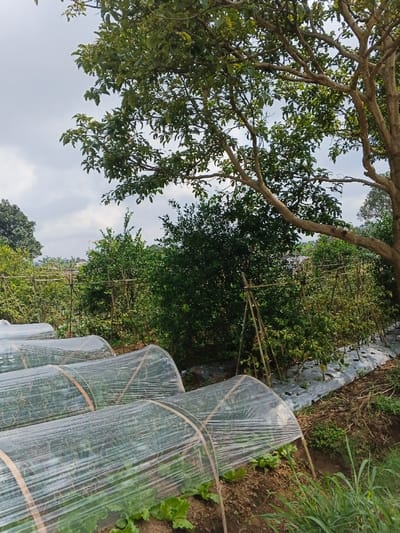
This image presents an outdoor agricultural scene, likely a garden or small farm, set against an overcast sky. The overall impression is one of active cultivation in a lush, green environment in Kolwara, Papua New Guinea. In the foreground, several distinct rows of crops are protected by clear plastic coverings stretched over curved, simple frames, possibly made of bamboo or wood. Beneath these translucent tunnels, vibrant green leafy plants, resembling lettuce or other low-growing greens, are clearly visible, thriving in the soil. Beyond these covered rows, the mid-ground reveals more extensive cultivation. Rows of taller plants are supported by trellises constructed from bamboo poles, suggesting climbing vegetables or plants requiring vertical support. Between these rows, the ground is covered with white or silver plastic mulch, a common practice to manage weeds and conserve soil moisture. Dense green foliage from various bushes and trees forms a rich backdrop to these cultivated areas. The upper right and central portions of the image are dominated by a large tree with visible branches and a thick canopy of green leaves, partially obscuring the cloudy sky. Additional trees and distant vegetation are visible throughout the background, indicating a verdant landscape. The time of day is daytime, evidenced by the natural light, though the presence of clouds suggests an overcast or partly cloudy weather condition. No people, animals, or visible text are present in the image.
Kolwara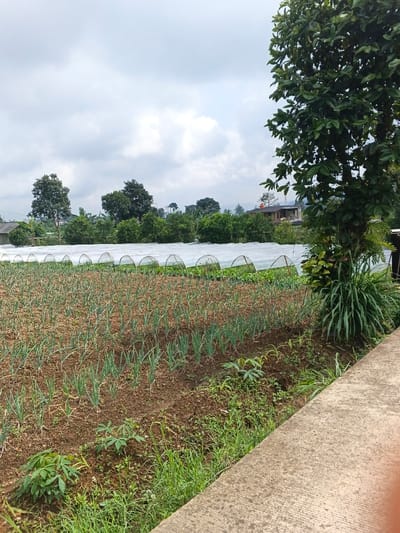
A cultivated field displays neat rows of young scallions against rich brown soil. In the background, a series of white, arched structures presumably cover other crops. Scattered trees and a building with a red roof dot the horizon under a cloudy sky. A tall tree with dark green leaves anchors the right side, accompanied by grassy foliage. A concrete ledge runs along the bottom of the image.
Kolwara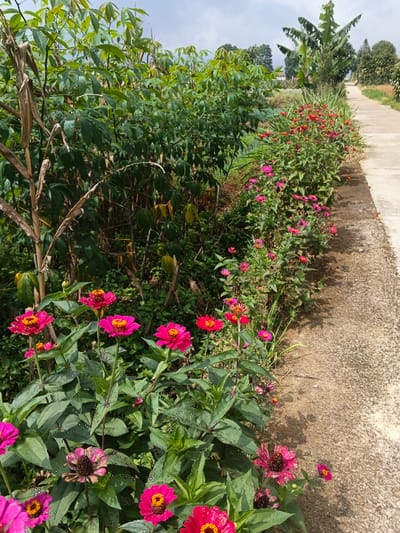
This media file captures a vibrant natural scene along a narrow path in Kolwara, Papua New Guinea. The foreground is dominated by a lush display of pink and red Zinnia flowers, many adorned with small water droplets, suggesting morning dew or recent rain. These flowers line the left edge of a light-colored, possibly concrete or gravel, path that recedes into the distance on the right side of the frame. To the left of the path, a dense expanse of green foliage, likely cassava plants, creates a natural wall. A dried, light brown stalk, resembling an old corn plant, stands vertically on the far left. Further along the path, more red and pink flowers continue the floral border. In the mid-ground, on the right side of the path, tall banana trees with their characteristic broad leaves are visible, adding to the tropical setting. The background shows a partially cloudy sky and distant greenery, indicating a rural or semi-rural landscape. The scene is brightly lit, consistent with daytime, possibly morning or early afternoon. No people or specific activities are depicted, portraying a static moment of natural beauty. There is no visible text in the image.
Kolwara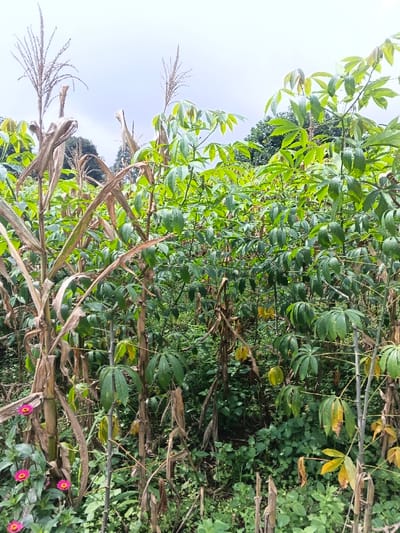
The image displays a densely vegetated agricultural field or garden, characterized by intercropping of various plants. The primary subjects are tall, dried maize (corn) stalks, identifiable by their brown, weathered appearance and visible tassels at the top, and vibrant green cassava plants, recognized by their distinctive palmate leaves. The maize stalks are predominantly located on the left side and sporadically throughout the foreground and midground, appearing to be mature or past their peak, with some leaves dried and curled. Interspersed and forming a thick canopy mostly on the right side and background are numerous cassava plants, which exhibit healthy green foliage, although some lower cassava leaves show signs of yellowing. In the bottom left corner of the frame, several bright pink zinnia flowers add a splash of color to the otherwise green and brown palette of the crops. The ground beneath the main crops is covered with a variety of smaller green plants and undergrowth, suggesting a somewhat unmanaged or naturalized agricultural setting. The scene is set outdoors under an overcast sky, indicating daytime conditions without direct sunlight. There are no people, animals, or man-made structures visible, placing the focus entirely on the plant life. The overall impression is a natural and productive, albeit wild-looking, agricultural plot in a rural environment, consistent with farming practices in regions like Kolwara, Papua New Guinea. There is no visible text in the image.
Kolwara
The image presents a close-up view of two marigold flowers amidst green foliage and light-colored ground, set in an outdoor environment in Kolwara, Papua New Guinea. The prominent subject is a large, fully bloomed marigold flower, positioned off-center towards the bottom left. Its petals are a vivid orange with pronounced reddish-brown edges, and its central florets are a bright orange, appearing intricate and textured. To its lower right, a smaller, less developed marigold flower, exhibiting similar orange and red coloration, is partially visible. The background is filled with dense green foliage, characterized by finely serrated leaves, likely belonging to marigold plants or surrounding vegetation. A dried, brownish seed head or spent flower is discernible on the upper right side, nestled amongst the green leaves. The foreground, particularly on the left, consists of a granular, light beige or off-white ground surface, suggesting sand, fine gravel, or light-colored soil. A small, blurry purple object, possibly a fallen petal or a small flower, is faintly visible near the bottom right edge. The scene depicts a tranquil moment in nature, with no specific activity or event taking place. The natural lighting suggests it is daytime, possibly morning or late afternoon, with clear weather conditions. The vibrant colors of the flowers and the lush greenery convey a sense of natural beauty and flourishing life in the tropical or subtropical setting of Papua New Guinea. No human subjects or visible text are present in the image.
Kolwara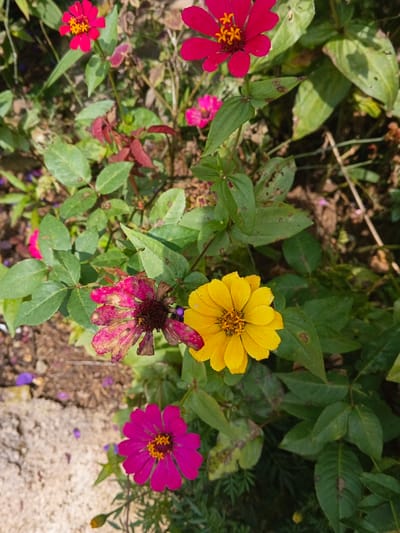
Several vibrant zinnias are prominently featured in this close-up outdoor shot, set against a backdrop of green foliage and patches of soil. The image captures the natural beauty of the flowers, showcasing various stages of their bloom. In the upper half of the frame, two bright red zinnias with distinct yellow-orange centers are in full bloom, one positioned towards the top left corner and another on the top right. A slightly smaller, blurred pink flower is visible further back in the mid-ground. The middle of the image draws attention to a contrasting pair: a vivid yellow zinnia, fully open with a detailed yellow center, stands alongside a fading, dark pink zinnia. The latter shows signs of wilting, with several petals missing or discolored, revealing its darker core. Towards the bottom left, another fresh fuchsia-colored zinnia with a bright yellow center adds to the lively color palette. A small, unopened yellow flower bud is also visible near the bottom center. The flowers are surrounded by lush green leaves, some of which appear slightly worn or spotted, indicating a natural, unmanicured environment. The ground consists of dark brown soil, with a lighter, possibly sandy or concrete, patch visible in the bottom left corner. The scene is illuminated by bright natural light, suggesting it is daytime, likely under sunny conditions. The clear lighting highlights the rich colors of the flowers. This garden scene, possibly in Kolwara, Papua New Guinea, captures a moment of flourishing flora, emphasizing both life and decline in its natural cycle. No text is visible in the image.
Kolwara
A single white zinnia flower, with a vibrant orange center, is centered in the image. The flower's petals have a slightly ruffled texture. The background is filled with lush green foliage, creating a natural and vibrant setting. The leaves vary in size and shape, adding depth to the scene. Sunlight filters through the leaves, casting subtle shadows and highlighting the flower.
Kolwara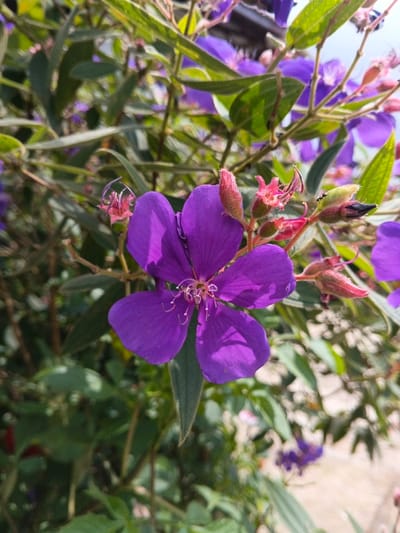
A close-up, eye-level shot captures a vibrant purple flower, likely a Tibouchina or Princess Flower, in full bloom in Kolwara, Papua New Guinea. The five-petaled flower dominates the center of the frame, showcasing its prominent white and yellow stamens with curled tips at its heart. Direct sunlight illuminates the petals, creating bright highlights and soft shadows that emphasize its rich color. Surrounding the main flower are several reddish-pink buds in various stages of development, some appearing fuzzy or spiky. The background is a dense blur of green foliage, with hints of other purple flowers, creating a natural, lush setting. The overall lighting suggests a bright, clear day. No human activity or visible text is present. The focus is sharp on the central flower, while the background and elements further from it are softly out of focus.
Kolwara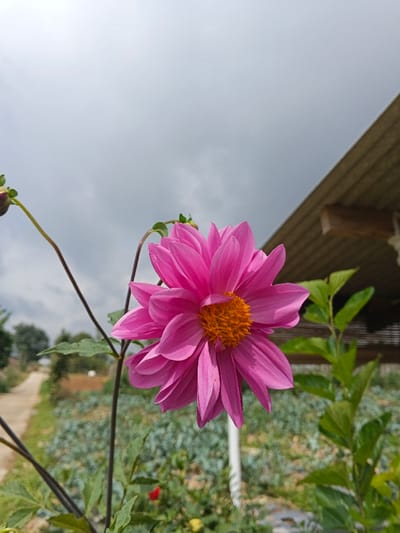
The image presents a vibrant, large pink flower, likely a dahlia, with a prominent orange-yellow center, positioned slightly to the right of the frame's center. Several closed flower buds are visible on thin stems to the left of the main bloom. Lush green foliage surrounds the flower in the foreground. The background is softly blurred, revealing an outdoor scene under an overcast, cloudy sky. To the left, a narrow, unpaved path meanders into the distance, bordered by green vegetation and a field of what appears to be low-growing crops or plants. On the right side, the edge of a building or shelter with a grey corrugated metal roof is visible, alongside a white vertical pole and more green foliage. The scene depicts a natural, possibly cultivated, environment such as a garden or small farm, under daytime conditions with diffuse light due to the cloud cover. There are no people visible, nor any specific activities taking place. No text is present in the image. The location is Kolwara, Papua New Guinea.
Kolwara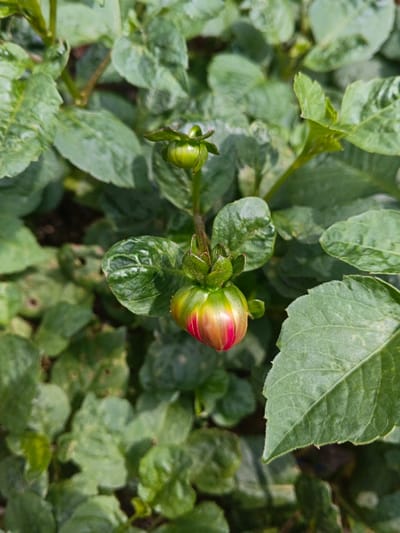
The image displays a close-up, top-down view of a plant, prominently featuring two flower buds surrounded by green foliage. The main subject is the lower, larger bud, which is partially unfurled, revealing a vibrant combination of red and yellow-pink petals emerging from its green base. The very tip of this bud remains green. Above and slightly to the left of the larger bud, a smaller, younger bud is visible, completely enclosed in green sepals, indicating an earlier stage of development. The scene is dominated by numerous green leaves that form a dense background. These leaves are broad, with visible veins and serrated edges. Some of the leaves show lighter green or yellowish mottled patterns, possibly natural variegation or minor discoloration. A few leaves also appear slightly crinkled or have small imperfections. The lighting is bright and natural, suggesting daytime conditions, likely morning or early afternoon, with soft illumination across the plant. The focus is sharp on the buds, with the background foliage gently blurred. There are no human subjects, visible activities, or discernible text. The image captures a moment of natural growth and budding of a flowering plant in Kolwara, Papua New Guinea.
Kolwara
A vibrant magenta dahlia dominates the frame, its petals neatly arranged around a golden yellow center. The flower is surrounded by lush green foliage, hinting at a thriving garden. In the background, an elongated bug perches on a stem, adding an element of wildlife to the scene. A blurry glimpse of a wooden structure suggests an outdoor setting. The overall image captures the beauty of nature in detail.
Kolwara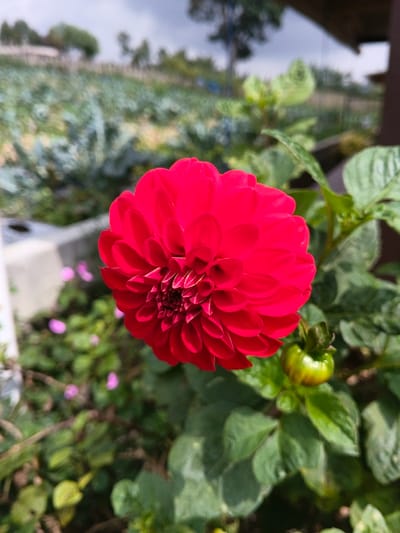
A vibrant red dahlia blooms prominently, its petals densely packed and layered. Beside it, a budding flower exhibits shades of green. The surrounding foliage is lush, with textured leaves adding depth. In the blurred background, a cultivated field or garden extends towards the horizon under a cloudy sky. The image captures a close-up perspective, emphasizing the flower's color and form against the greenery.
Kolwara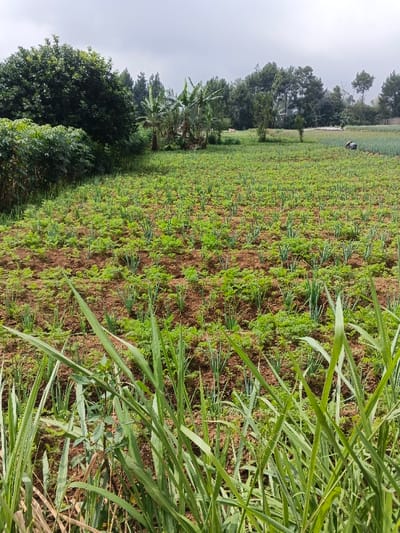
The image captures a rural agricultural landscape in Kolwara, Papua New Guinea, under an overcast sky. The scene is dominated by a large cultivated field with reddish-brown soil, densely planted with green crops arranged in discernible rows. In the immediate foreground, a patch of tall, lush green grass rises, partially obscuring the view of the field. Across the field, two primary types of crops are visible: broader, leafy green plants, resembling young carrots or similar vegetables, interspersed with rows of narrower, upright green shoots, characteristic of spring onions or chives. The meticulous planting suggests active farming. In the mid-ground, a cluster of banana trees stands prominently, surrounded by other dense green foliage. Further in the background, a line of tall, dark green trees, possibly coniferous, borders the field. On the far right side of the distant field, a person dressed in dark clothing is observed bent over, actively engaged in working the land, indicating ongoing agricultural labor. The time of day appears to be daytime, likely morning or early afternoon, given the natural light, though the sky is uniformly cloudy, diffusing any direct sunlight. The atmosphere is calm, reflecting a typical day of farming. There is no visible text in the image.
Kolwara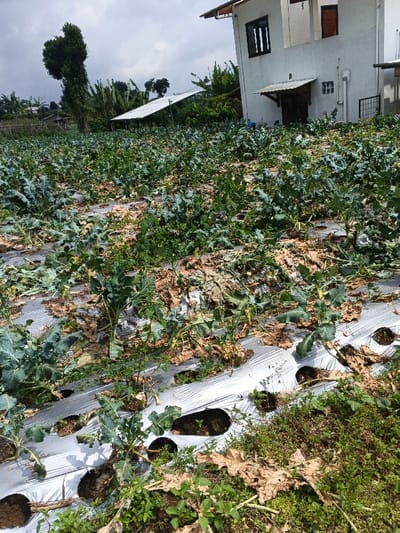
The image displays an agricultural field in Kolwara, Papua New Guinea, with a modern residential building situated at its edge. The field is extensively cultivated with what appears to be broccoli or a similar brassica crop, characterized by its large, dark green, and somewhat ruffled leaves. Many plants exhibit various stages of growth or decline; some are healthy and vibrant, while others show significant wilting, browning, and dried leaves, potentially indicating a recent harvest, plant stress, or disease. The ground between the crop rows is covered with white plastic mulch, a common agricultural technique used for weed suppression and moisture retention. This mulch appears worn in places, with cut-out holes for individual plants. On the right side of the frame, a clean, two-story white house with dark window frames and a dark entrance door stands prominently. It has a small, covered porch area. In the background, beyond the field, other structures and abundant green trees and vegetation are visible under a partly cloudy sky, suggesting a bright but not intensely sunny daytime. One notable background structure features a light-colored, angled roof, possibly a shed or a shade structure. No individuals are present in the scene, and no visible text can be identified. The image captures a blend of farming activity and residential life in a tropical setting.
Kolwara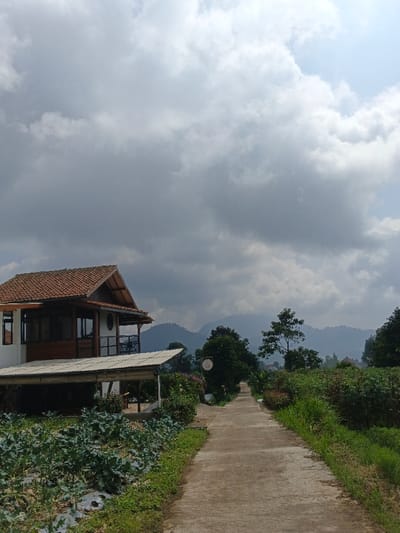
A concrete path stretches into the distance, flanked by lush green vegetation and a cultivated field on the left. A two-story building with a terracotta-tiled roof stands to the left of the path, featuring a wooden porch and a covered outdoor area. Mountains are visible in the background, shrouded in a soft haze. The sky is filled with heavy, overcast clouds, suggesting an impending storm.
Kolwara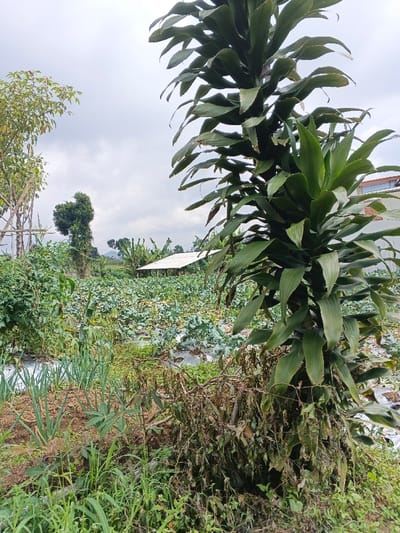
This image depicts an outdoor agricultural scene, likely a farm or cultivated garden, under an overcast sky. A prominent, tall plant with thick stalks and large, dark green leaves stands in the right foreground, extending vertically through much of the frame. Its lower section shows dried, brown foliage. To the left and extending into the mid-ground is a field with rows of leafy green crops, possibly broccoli or cauliflower, interspersed with dark plastic sheeting laid over the soil, likely for mulch or weed control. Closer to the left foreground, rows of slender, bright green plants resembling green onions or leeks are visible. In the mid-ground, a simple shelter or shed with a white roof is visible amidst the cultivated land. The background features dense green trees and foliage, with distant hills or mountains subtly silhouetted against the cloudy sky. Another tree with lighter green leaves is partially visible on the far left. The scene conveys a sense of active farming or gardening in a lush, rural environment, consistent with a setting in Kolwara, Papua New Guinea. The time of day appears to be daytime, characterized by soft, diffused lighting due to the cloudy conditions. No people or visible text are present.
Kolwara