Kramatorsk, Ukraine
30 memories from Kramatorsk, Ukraine

In Kramatorsk, Ukraine, a still life photograph captures two decorative figurines on a reflective red surface. On the left is a brown elephant figurine adorned with a detailed gold-colored armor, featuring intricate scrollwork and a fringe. The elephant has tusks and its trunk is raised. To its right is a dark red, almost black, figurine of a toad or frog-like creature, its body covered in what appears to be stacked coins, also with intricate detailing. The background includes a white object with horizontal vents, possibly a small appliance, and other indistinct items. The surface they are resting on reflects the objects and the surrounding light.
Kramatorsk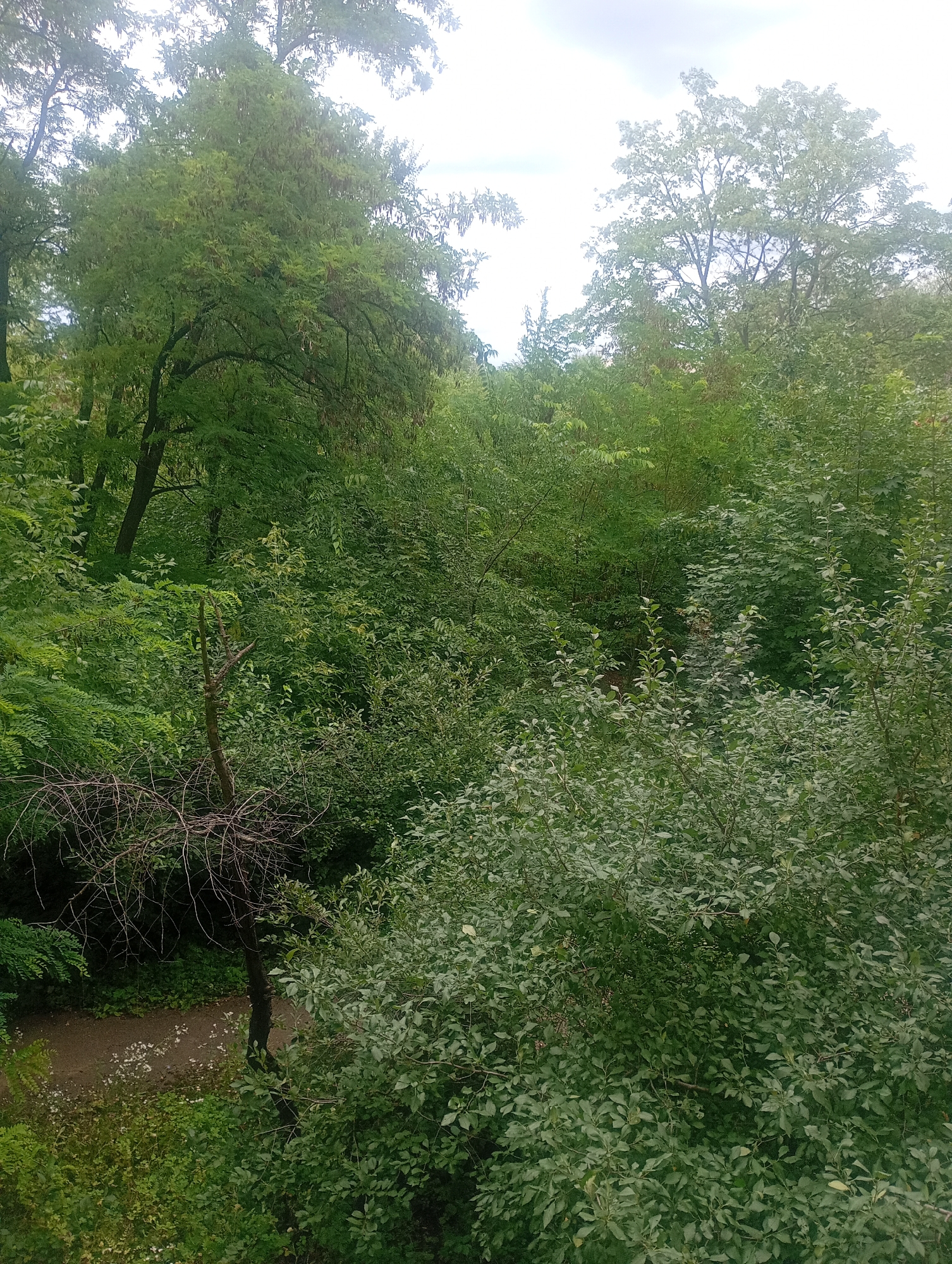
The image displays a lush, overgrown green space with dense foliage and trees. A narrow, dirt path winds through the vegetation on the left side of the image. The overall impression is one of natural wilderness within an urban setting. The scene appears to be located in Kramatorsk, Ukraine, given the context provided. There are no people or animals visible in the image.
Kramatorsk
This is a close-up, macro photograph of a patch of lichen growing on a textured surface, likely tree bark or rock. The lichen displays vibrant colors, predominantly bright yellow and orange, with some areas appearing a pale green or grey. Many of the lichen structures are cup-shaped or disc-like, with prominent orange apothecia (reproductive structures) visible within the cups. The surface texture is rough and irregular, with visible ridges and crevices. The lighting creates strong highlights and shadows, emphasizing the three-dimensional nature of the lichen. The image is focused on the detail of the lichen, with the background appearing blurred due to a shallow depth of field. There are no people, animals, or man-made objects clearly discernible within the frame. The setting is a natural environment.
Kramatorsk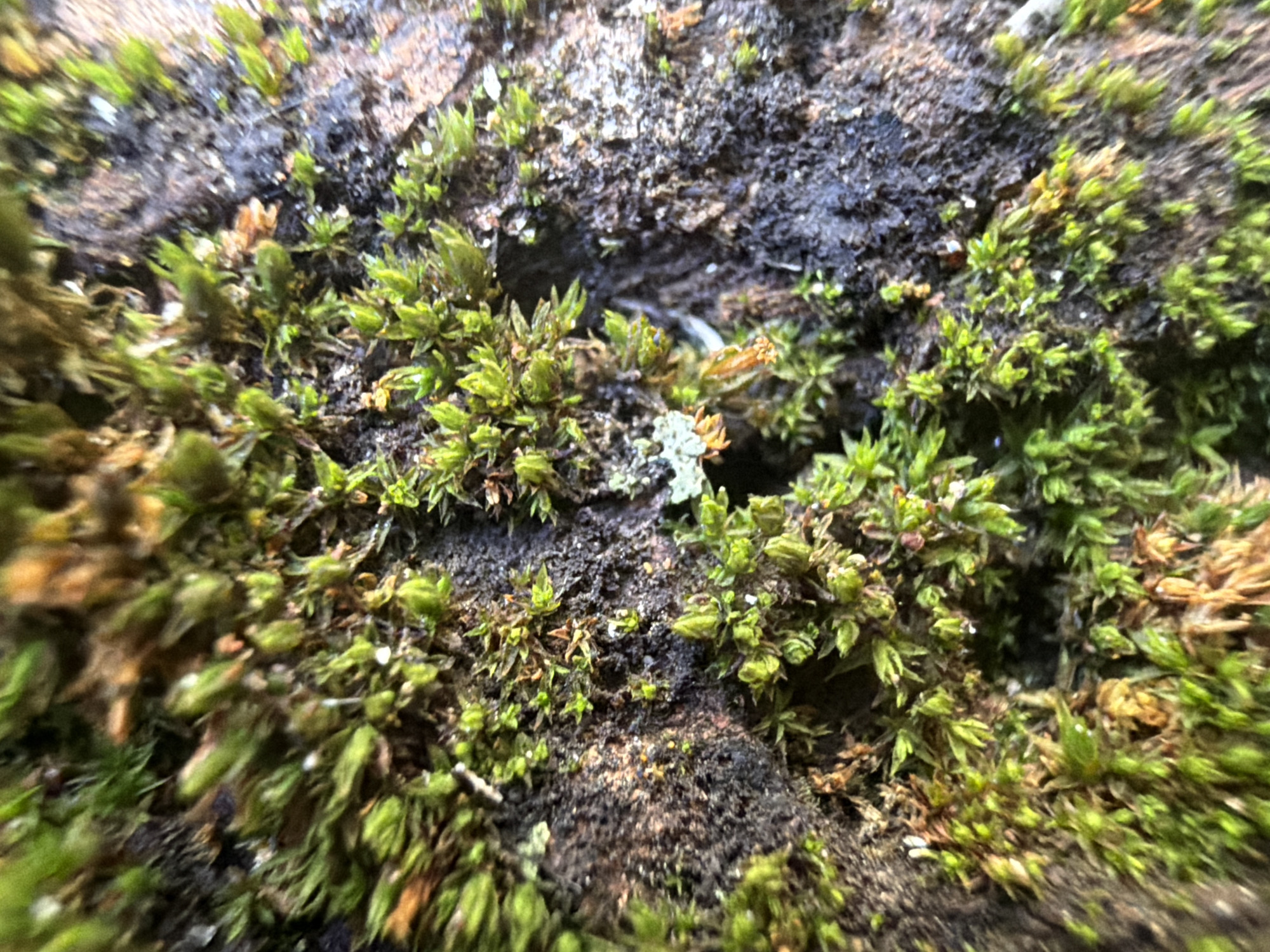
This is a close-up, high-angle shot of moss growing on a rough, textured surface, likely bark or stone. The moss is vibrant green and appears to be in various stages of growth, with some areas dense and lush, while others are sparser. The surface beneath the moss is dark brown and black, with visible textures and crevices. The image is sharply focused on the moss, with the background slightly blurred. The lighting appears natural, suggesting an outdoor environment. The exact location in Kramatorsk, Ukraine, is not discernible from the image alone, but the presence of moss suggests a natural or semi-natural setting within the city, possibly in a park, forest edge, or on an old structure. No people or animals are visible in the image.
Kramatorsk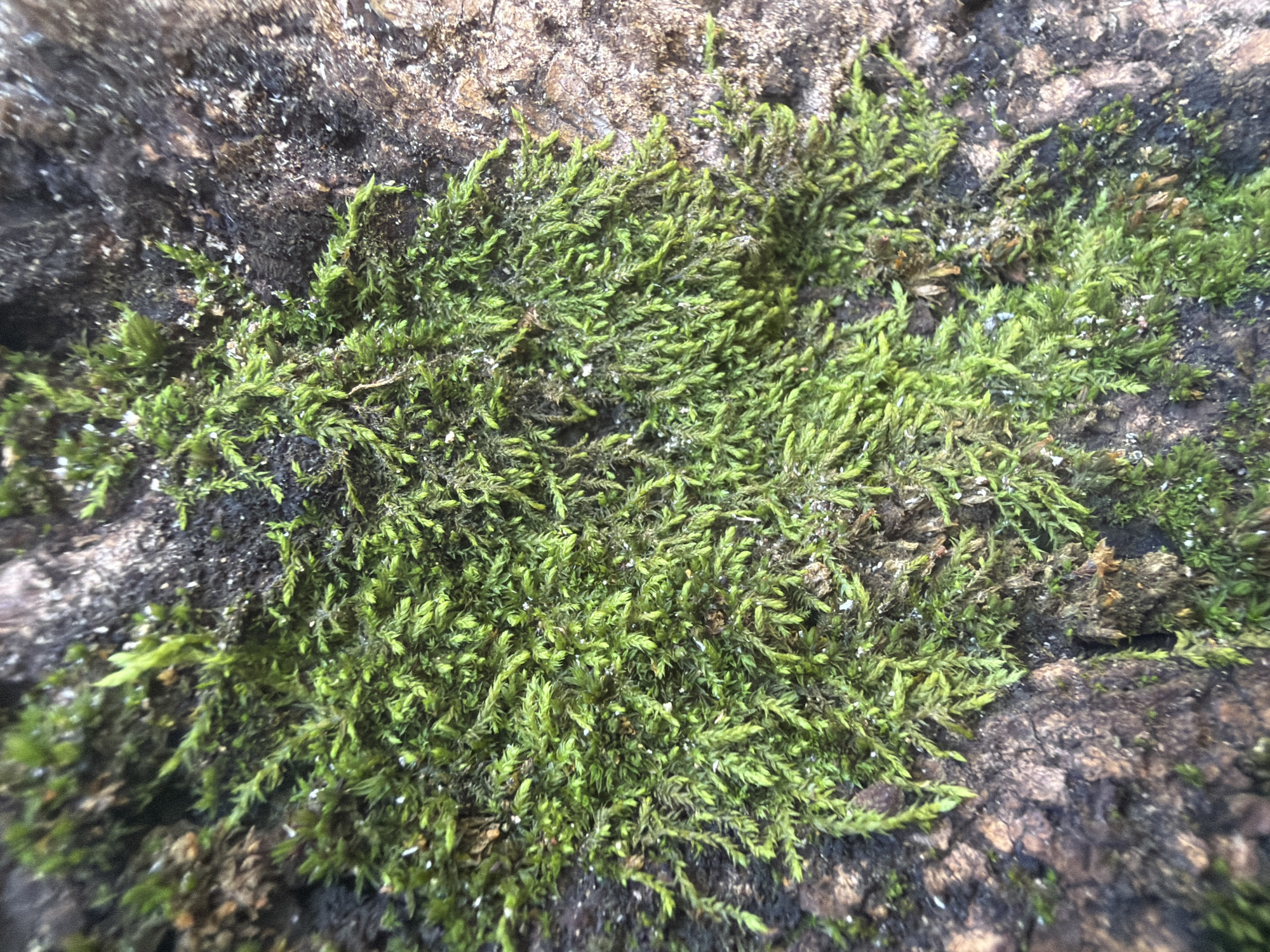
The image is a close-up, top-down view of moss growing on the textured surface of tree bark. The moss is a vibrant green, appearing dense and fibrous, with some individual stems clearly visible. Scattered among the moss are small specks of white, possibly debris or dust. The bark itself is rough and dark, with visible crevices and variations in color, ranging from deep brown to lighter greyish-brown. The lighting suggests an outdoor environment, with the focus on the natural textures and colors of the moss and bark. There is no indication of human presence or activity within the frame. The context of Kramatorsk, Ukraine, is not visually discernible from the image itself.
Kramatorsk
This is a close-up, vertical, full-frame photograph of the center of a bright yellow flower, likely taken outdoors. The flower has numerous fine, pointed, orange-yellow petals radiating outwards from a central disc covered in densely packed, tiny, finger-like structures, also in shades of orange and yellow. Some of these structures appear to have a dusty texture. The petals are elongated and linear, with visible texture and some appearing slightly dewy. The background is softly blurred and out of focus, showing hints of dark green and black, suggesting foliage or shadow. The lighting creates bright highlights on the petals and emphasizes the textured surface of the flower's center. There is no indication of any specific location within the city of Kramatorsk, Ukraine, or any people, actions, or interactions.
Kramatorsk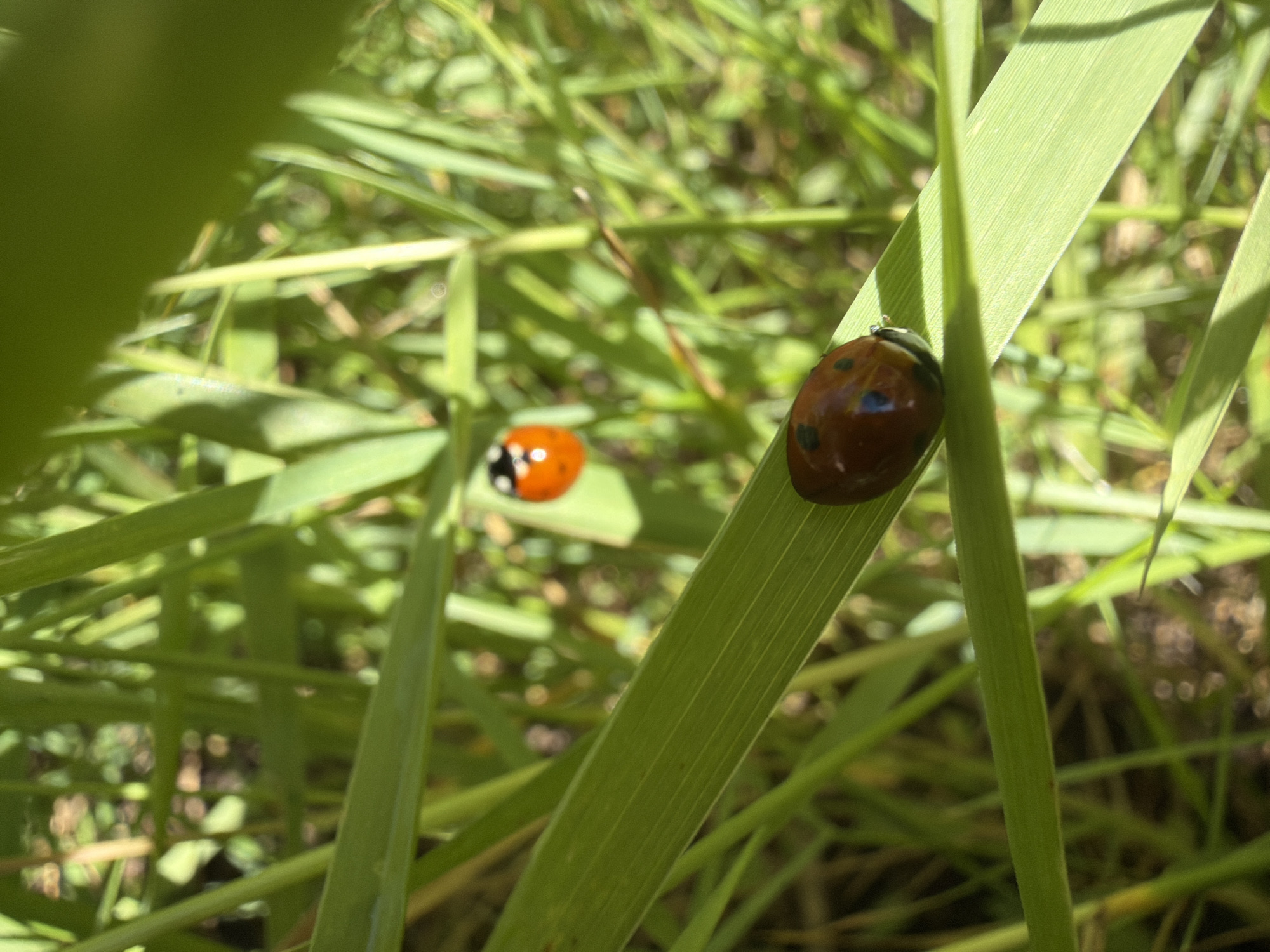
Two ladybugs are in a close-up shot amidst tall green grass. One ladybug, in the foreground, is resting on a blade of grass that runs diagonally across the frame from the lower left to the upper right. This ladybug is dark brown with visible black spots and a small black head. The second ladybug is positioned further in the background, slightly out of focus, on another blade of grass. It is bright orange with distinct black spots. The background is a blur of green grass and foliage, suggesting an outdoor, natural environment. There are no people or man-made structures visible in the image. The lighting indicates it is daytime, with sunlight casting shadows. The scene is typical of a park, garden, or wild grassy area. There is no information about the specific location within Kramatorsk, Ukraine.
Kramatorsk
A text overlay on a bright green background reads "Happiness is not about getting all you want, it is about enjoying all you have." Beside the word "have" is an emoji of the Earth. The image is not a photograph and therefore has no specific location in Kramatorsk, Ukraine.
Kramatorsk
This image is a close-up, eye-level, outdoor photograph of a staghorn sumac (Rhus typhina) fruit cluster. The cluster is deep red and fuzzy, appearing as many small, densely packed drupes, some with visible yellow stamen. The cluster is attached to a fuzzy, grayish-brown branch. The background is blurred, featuring green foliage and hints of sunlight filtering through, suggesting a natural or park-like setting. The image does not provide any specific visual cues to indicate its location within the city of Kramatorsk, Ukraine. There are no people, animals, or specific man-made objects present in the scene. The focus is entirely on the sumac fruit and its immediate surroundings.
Kramatorsk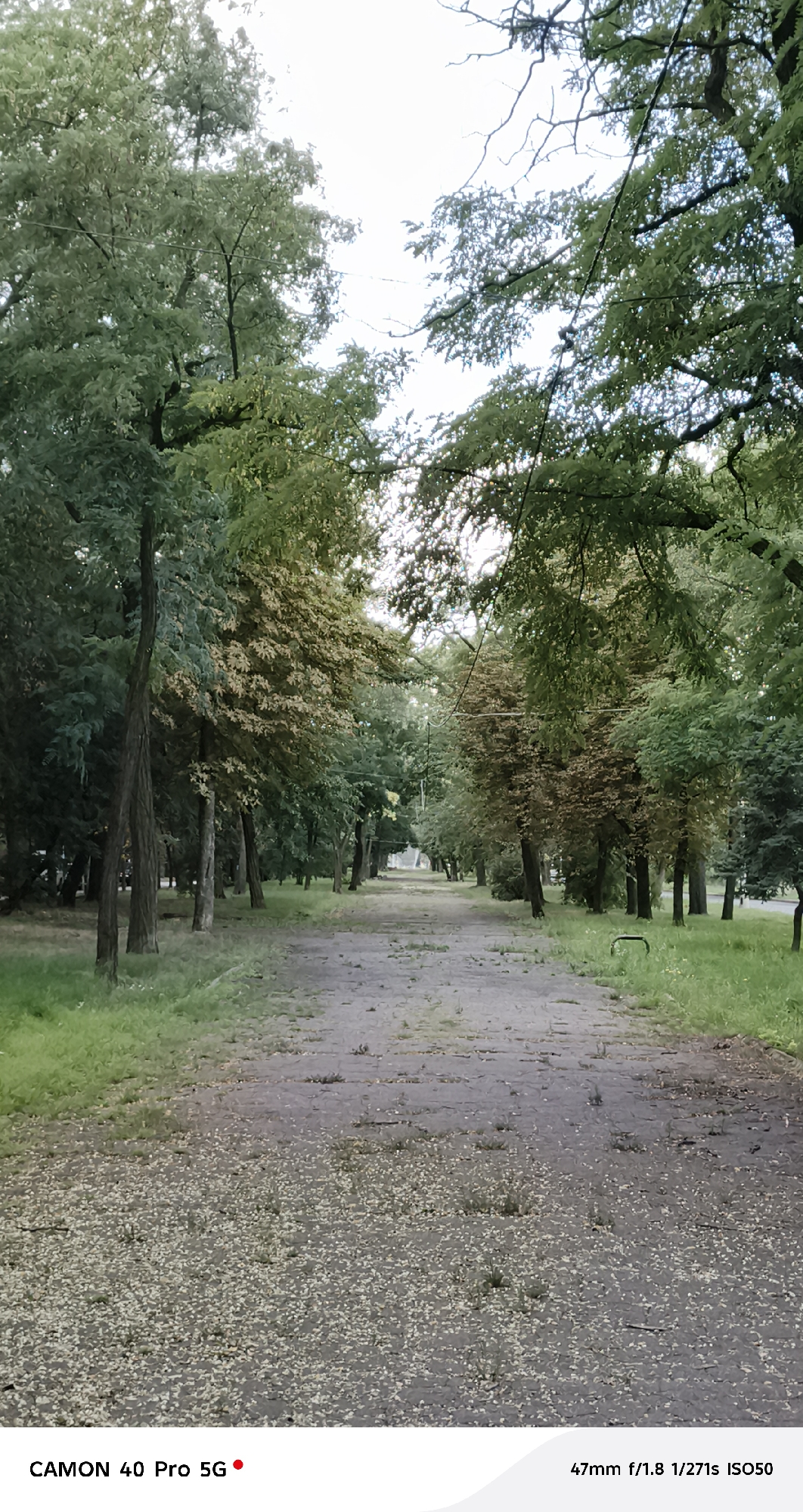
The image depicts an outdoor scene, likely a park or a tree-lined avenue, in the city of Kramatorsk, Ukraine. A paved pathway, partially covered with fallen leaves and small debris, stretches into the distance, bordered by mature trees on both sides. The trees exhibit varying foliage colors, with some displaying green leaves and others showing hints of yellow and brown, suggesting a transition into autumn. The ground on either side of the path is covered in grass and scattered leaves. The sky is overcast, providing diffused light. No people or active events are visible in the scene. The bottom of the image displays text overlay indicating camera specifications: "CAMON 40 Pro 5G" and "47mm f/1.8 1/271s ISO50".
Kramatorsk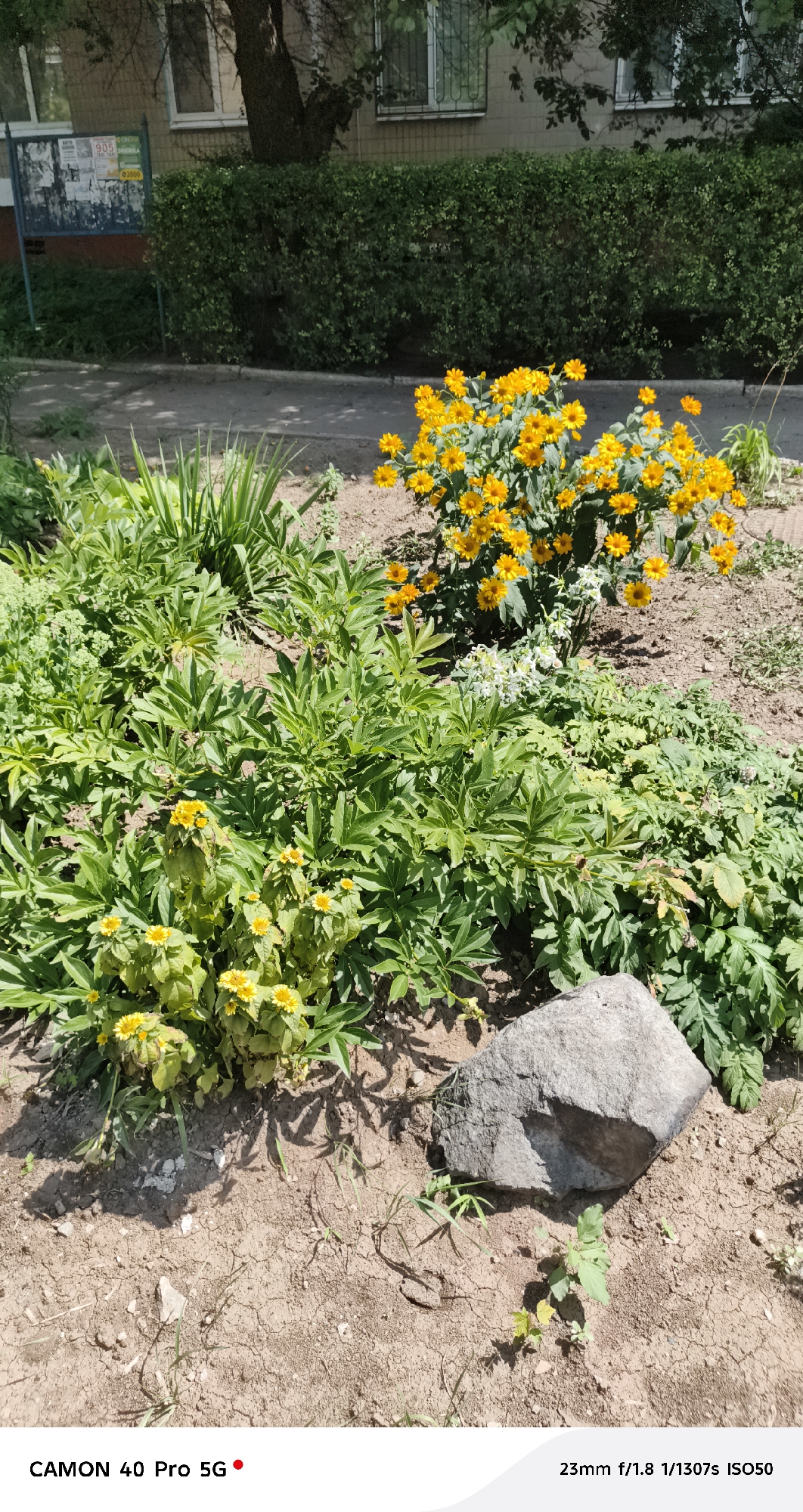
The image depicts an outdoor scene with a rock in the foreground and a bed of yellow flowers and green plants behind it. In the background, there is a building with windows and a manicured hedge. A tree is visible to the left of the building. The ground is covered in dry soil with some sparse vegetation. A sign is partially visible on the left side of the image, which appears to be a bulletin board. The text on the sign is difficult to read but contains some Ukrainian lettering. The bottom of the image contains camera information, "CAMON 40 Pro 5G" and "23mm f/1.8 1/1307s ISO50". This is a street view in Kramatorsk, Ukraine.
Kramatorsk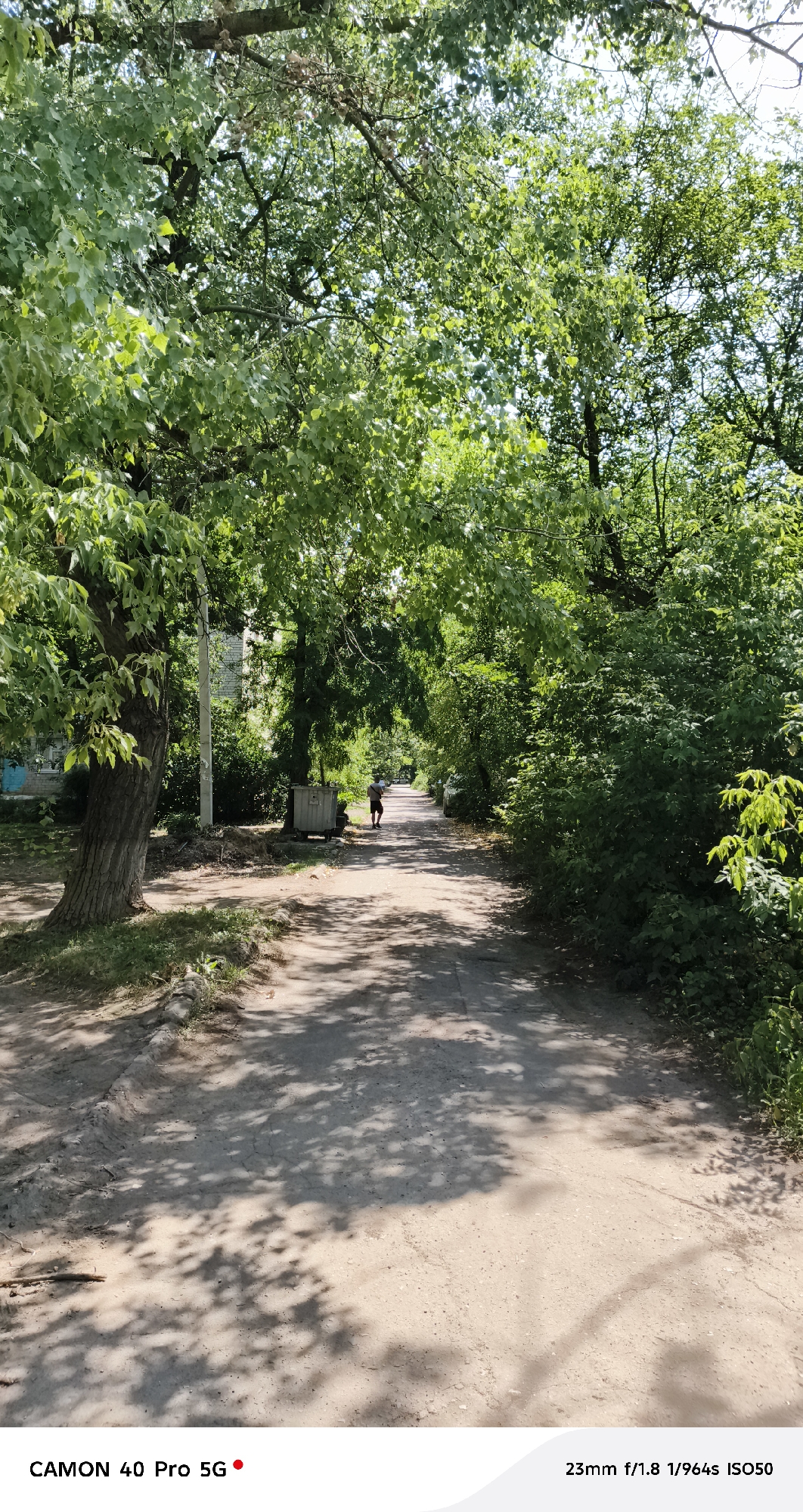
The image depicts a sun-dappled dirt path lined with lush green trees on both sides. The path is unpaved and shows signs of tire tracks, suggesting it is a road for vehicles or a well-traveled pedestrian route. On the left side of the path, a large tree trunk with textured bark dominates the foreground. In the distance, a single person is walking away from the camera, towards the vanishing point of the path. They appear to be wearing dark shorts and a light-colored shirt. To the left of the path, behind the person, a metal dumpster is visible. Further back, buildings are partially obscured by the dense foliage. The overhead tree canopy creates a dappled light effect on the path, indicating a sunny day. The time of day appears to be late morning or early afternoon, given the angle of the shadows. The setting evokes a sense of a quiet, tree-lined residential street or a park path in a rural or suburban area. Visible text at the bottom of the image includes "CAMON 40 Pro 5G" and "23mm f/1.8 1/964s ISO50", which are likely camera settings or a watermark. The location context provided is Kramatorsk, Ukraine.
Kramatorsk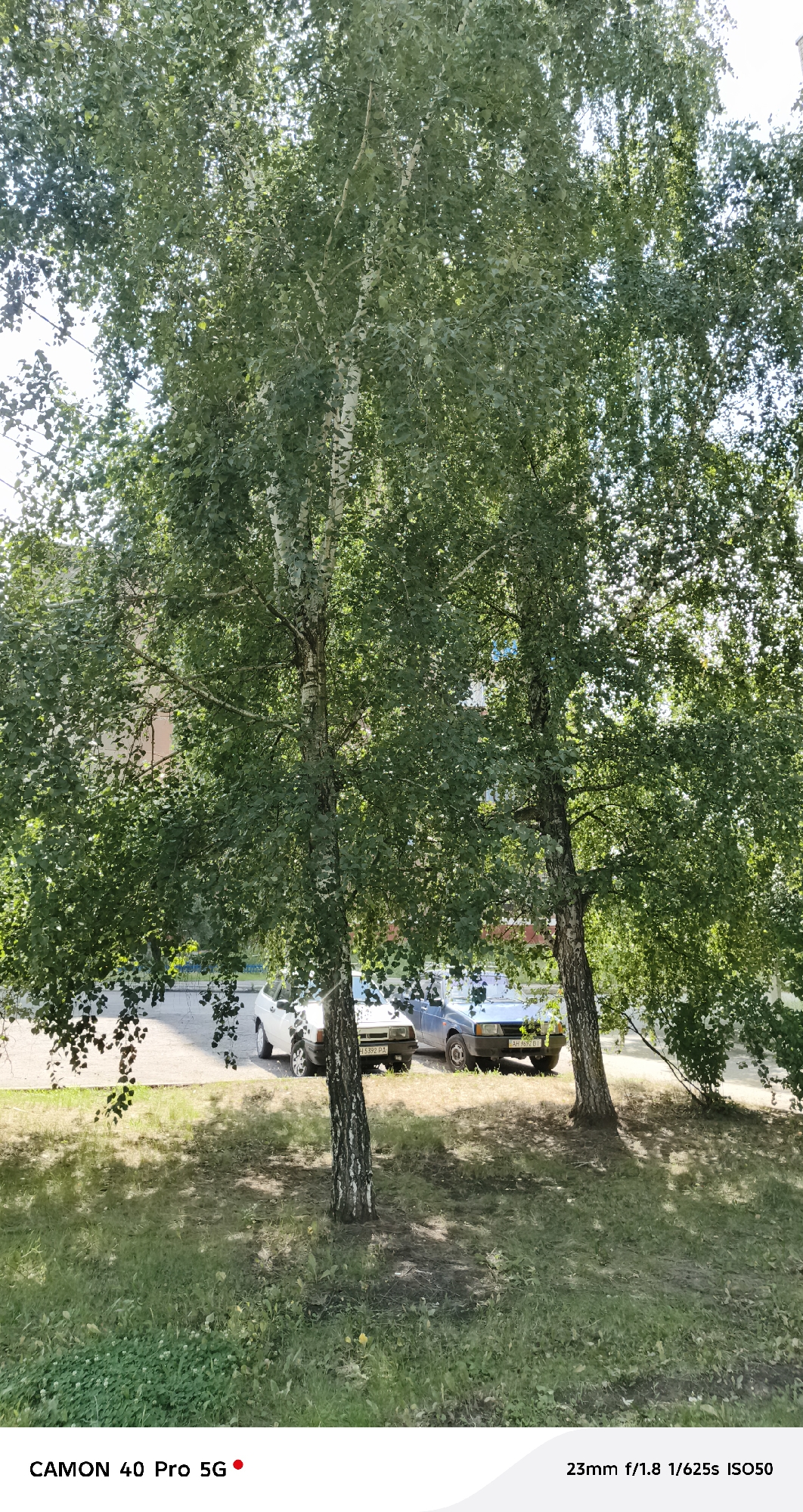
The image shows a view from an elevated position looking down at two birch trees in the foreground, with their leaves creating a canopy. Behind the trees, there are two cars parked on a paved area. The car on the left is white and has a license plate that reads "JS 392 PA". The car on the right is blue and has a license plate that reads "AH A692 BY". The background includes a building and some greenery. The ground in front of the cars is covered in dry grass, with some shadows cast by the trees. The overall scene suggests a residential or urban environment. The image appears to have been taken during the daytime, with sunlight filtering through the trees. The bottom of the image displays text indicating "CAMON 40 Pro 5G" and "23mm f/1.8 1/625s ISO50".
Kramatorsk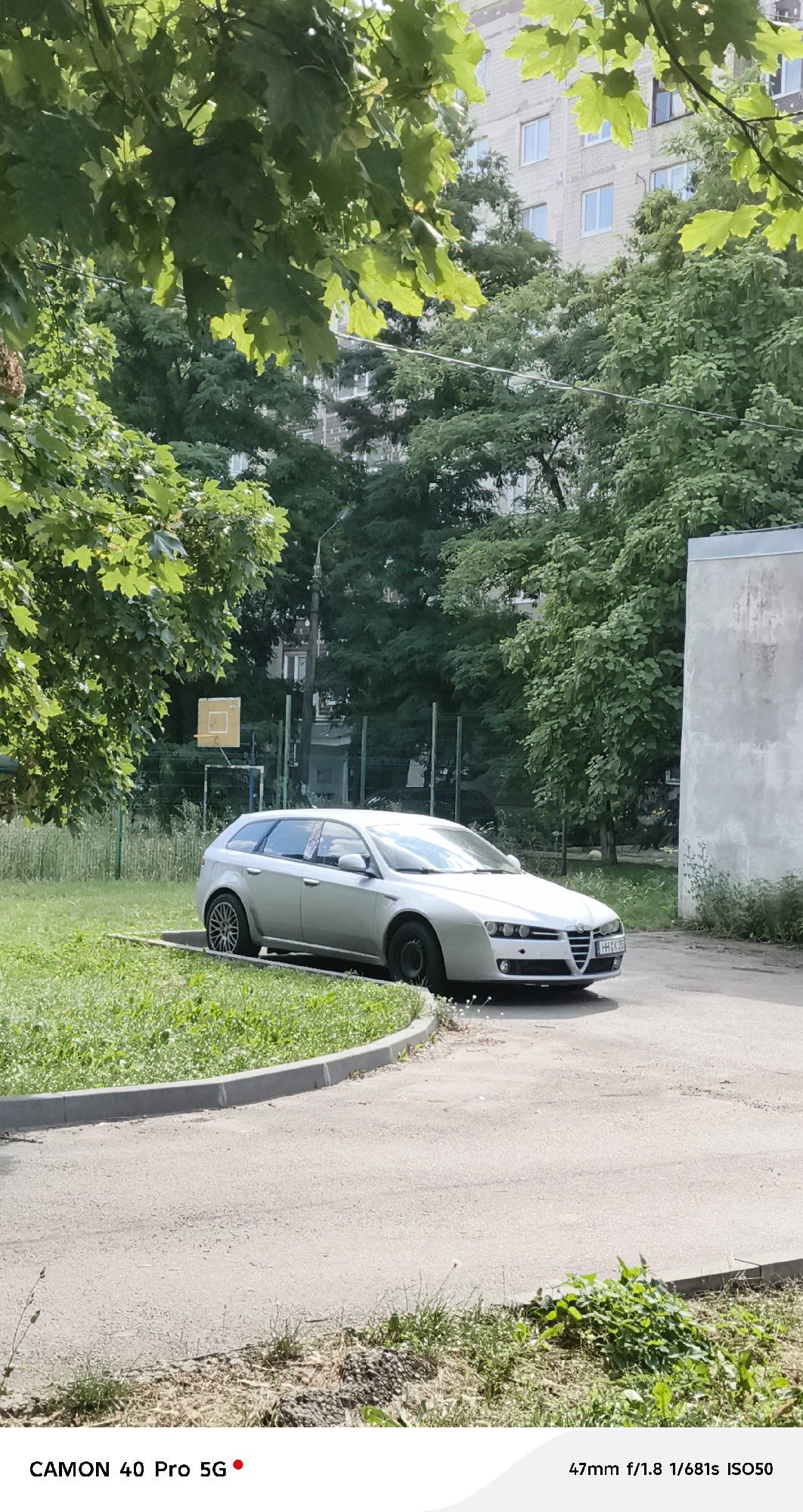
In Kramatorsk, Ukraine, a silver Alfa Romeo station wagon is parked on a paved area next to a grassy lawn. The car, facing left, has its front wheels turned slightly. Behind the car, a basketball hoop with a yellow backboard is visible, along with a chain-link fence. Lush green trees surround the scene, and a multi-story building with numerous windows is in the background. Sunlight filters through the leaves of a large tree in the foreground, casting shadows. The image captures a daytime scene in an outdoor urban environment.
Kramatorsk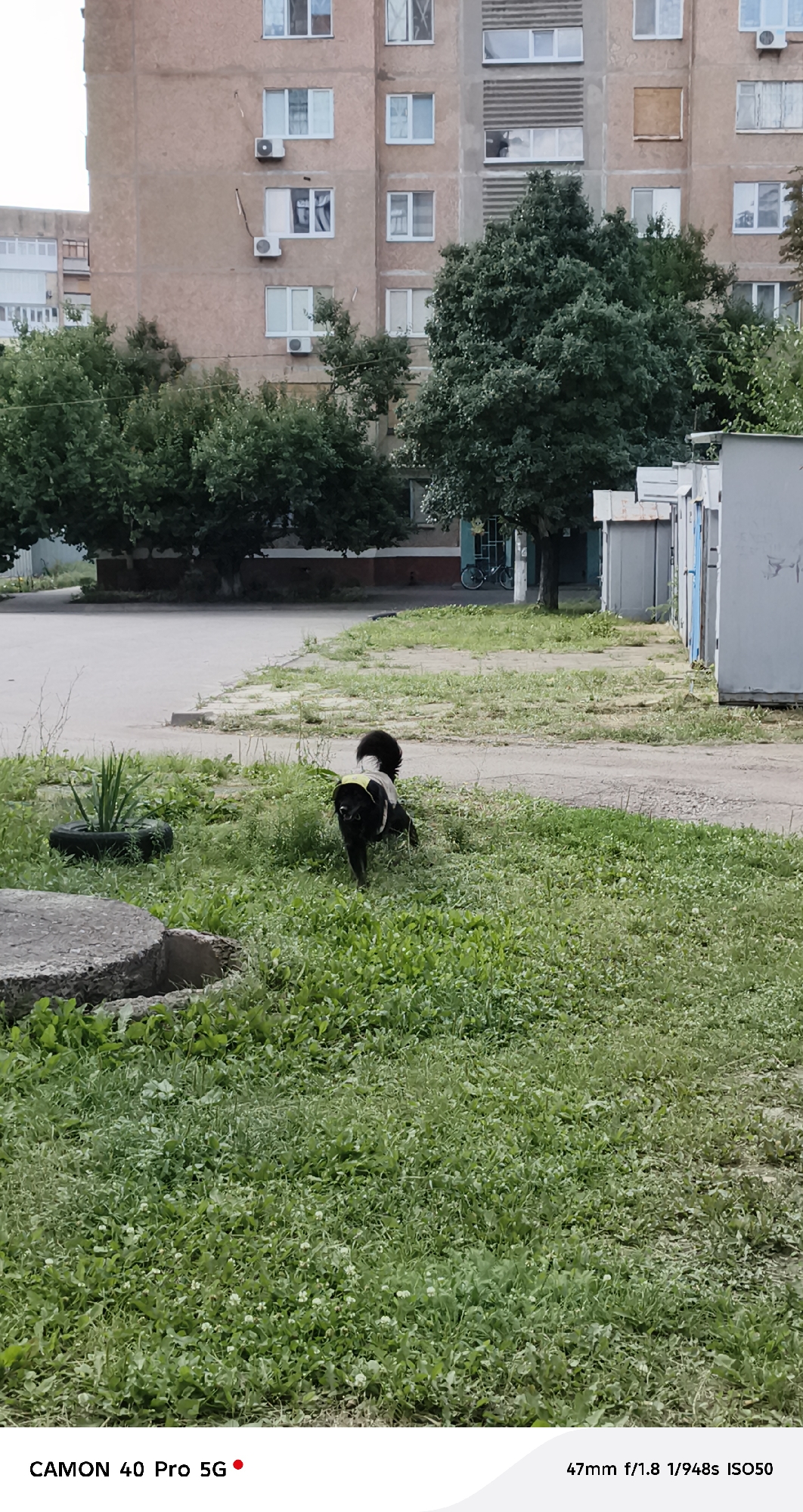
An exterior, medium-shot photograph, taken from a slightly elevated perspective, captures a black dog with a fluffy tail wearing a yellow vest, standing on a patch of overgrown grass in front of a concrete structure. The dog faces away from the camera, looking towards the right side of the frame. Behind the dog, a grey, paved area stretches into the distance, bordered by more green grass and a row of trees. Further in the background, a multi-story, beige apartment building with visible windows and air conditioning units dominates the scene, with a portion of a white building visible to its left. The overall impression is an urban setting with elements of nature encroaching on man-made structures. The location is Kramatorsk, Ukraine.
Kramatorsk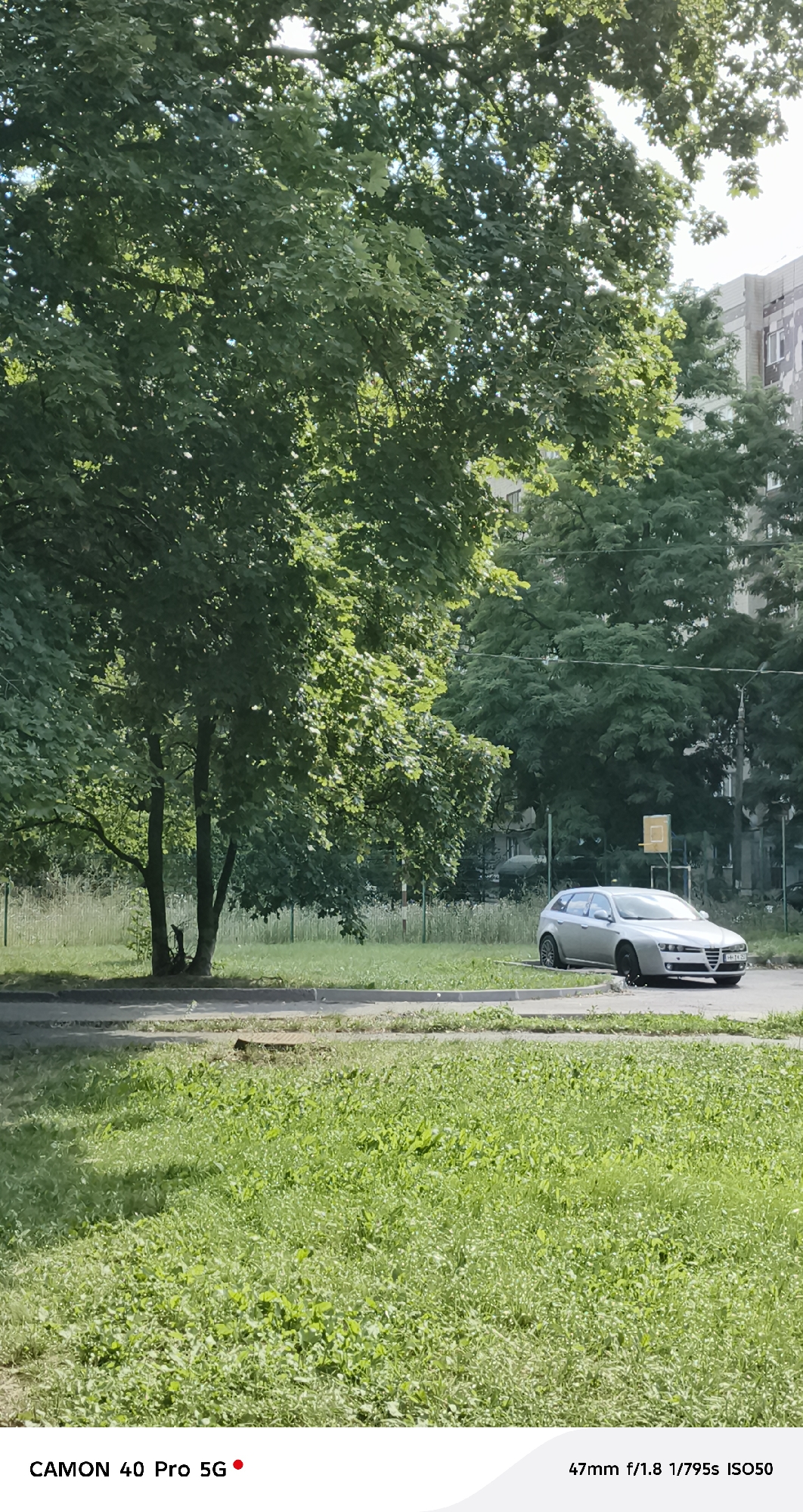
A silver station wagon is parked on the side of a road in a residential area. The car is facing left and is partially obscured by a tree. The road is asphalt and there is a sidewalk on the right side of the road. In the background, there are buildings and trees. The sky is visible and it is a clear day. The image is taken from a low angle and the car is in focus. The text at the bottom of the image reads "CAMON 40 Pro 5G" and "47mm f/1.8 1/795s ISO50".
Kramatorsk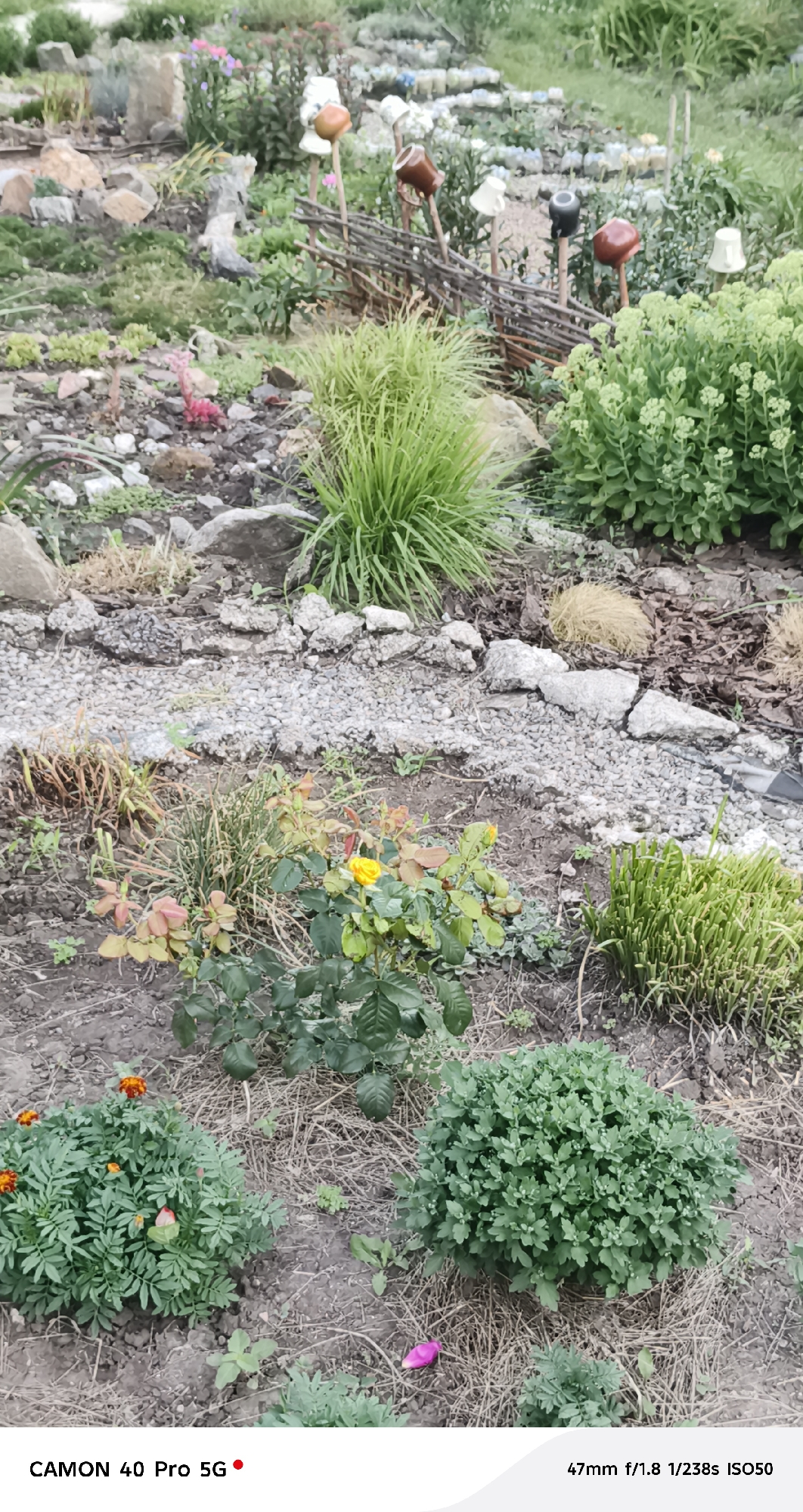
The image depicts a garden scene. In the foreground, there are several plants, including a rose bush with a single yellow bloom and two buds, and two clusters of smaller flowering plants with orange and pink blossoms. A round, bushy green plant with many small leaves is also visible to the right. The ground is covered with dry straw-like material and soil. In the mid-ground, there is a path of gray gravel and rocks, with more plants and some decorative elements made of pottery and wood. In the background, there are various plants, rocks, and what appears to be a decorative arrangement of bottles. The scene appears to be an outdoor garden in Kramatorsk, Ukraine, likely in a residential or public space, given the domestic nature of the garden elements. There are no people or animals visible in the image.
Kramatorsk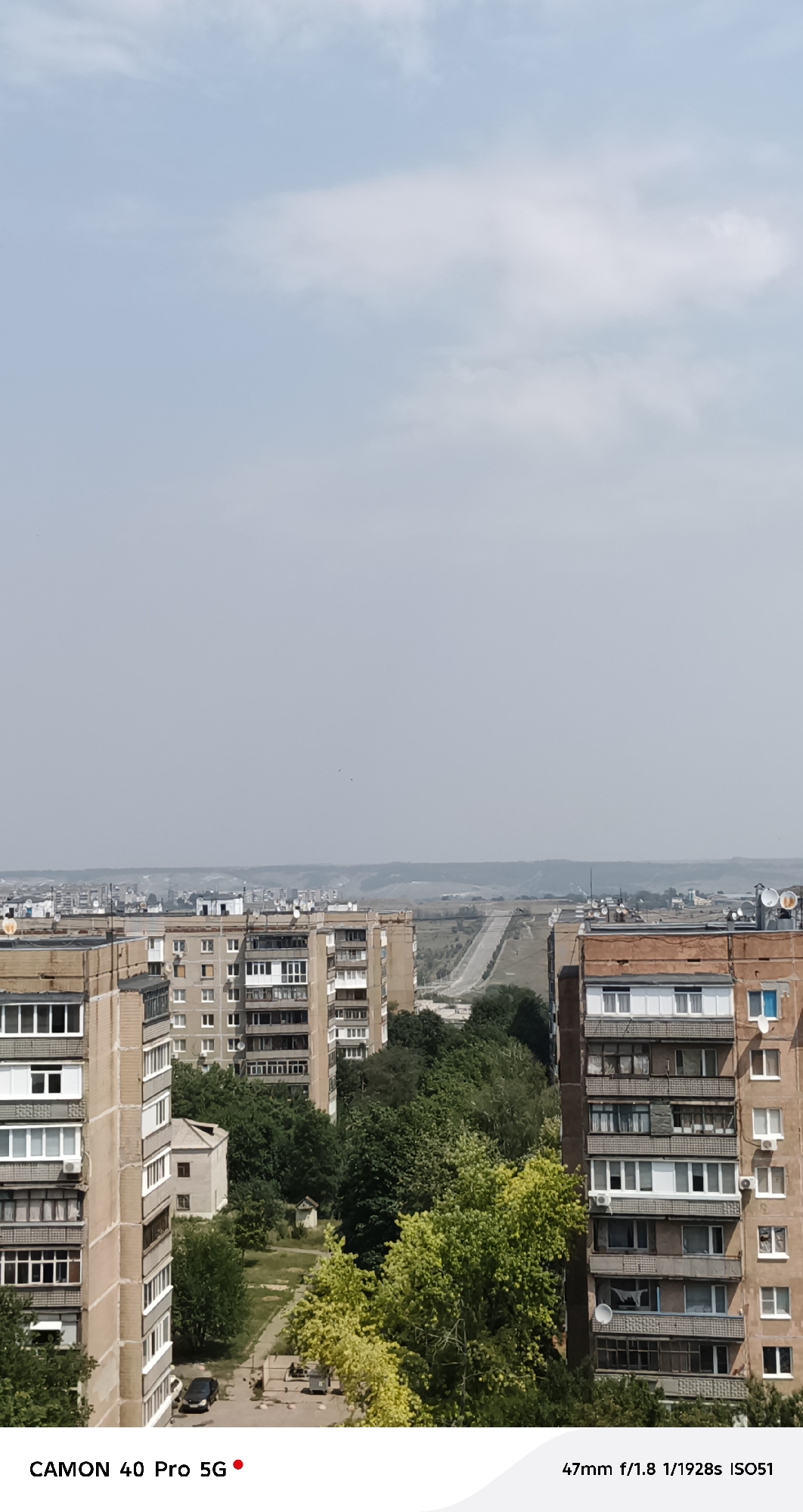
The image depicts a city skyline under a hazy sky. In the foreground, the sides of two large, multi-story apartment buildings are visible. The building on the left is lighter in color and appears to be made of concrete with numerous balconies and windows. The building on the right is a darker, reddish-brown color, also with many balconies and windows. Between and behind these buildings, a dense arrangement of green trees can be seen. Further in the background, more apartment buildings and urban structures stretch towards a distant, hazy landscape with rolling hills and a prominent, steep incline that appears to be a ski slope or a similar man-made feature. A road or pathway can be seen winding up this incline. The overall impression is of a residential area within a city, likely in Eastern Europe, given the architectural style of the buildings. The date and camera settings, "47mm f/1.8 1/1928s ISO51," are displayed at the bottom right, along with the camera model "CAMON 40 Pro 5G". The city of Kramatorsk, Ukraine, is known for its industrial architecture and its surrounding natural landscape, which could be consistent with the scene depicted. There are no people or animals visible in the image.
Kramatorsk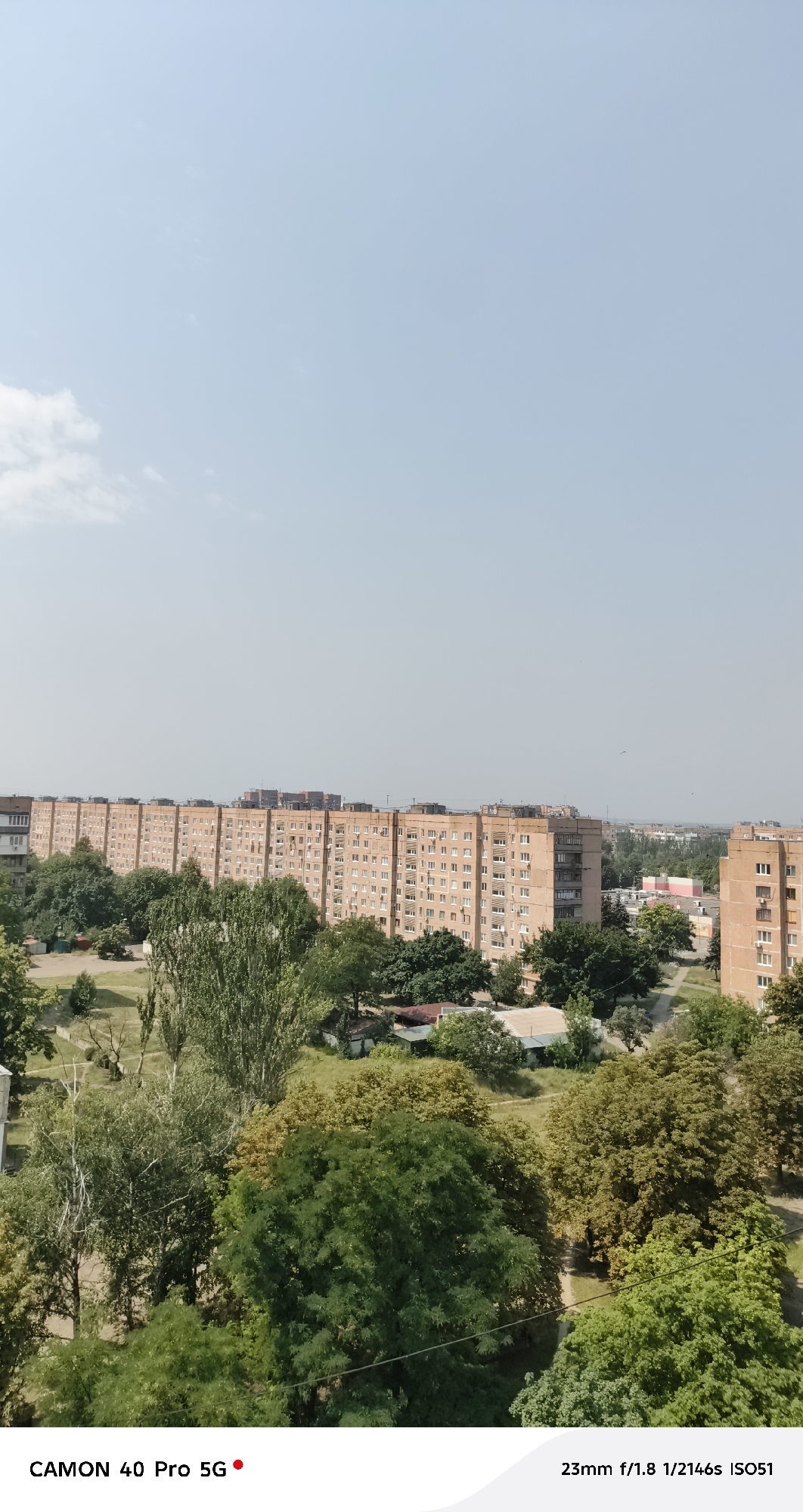
The image is an aerial view of a city, likely Kramatorsk, Ukraine, on a clear, hazy day. In the foreground, lush green trees with some autumn foliage are visible. Beyond the trees, a long, tan-colored apartment building stretches horizontally across the frame. Several other buildings, including a taller one in the distance, are also present. The sky is a pale blue with a slight haze. A white graphic overlay at the bottom of the image displays "CAMON 40 Pro 5G" and "23mm f/1.8 1/2146s ISO51". There are no people or animals visible in the scene.
Kramatorsk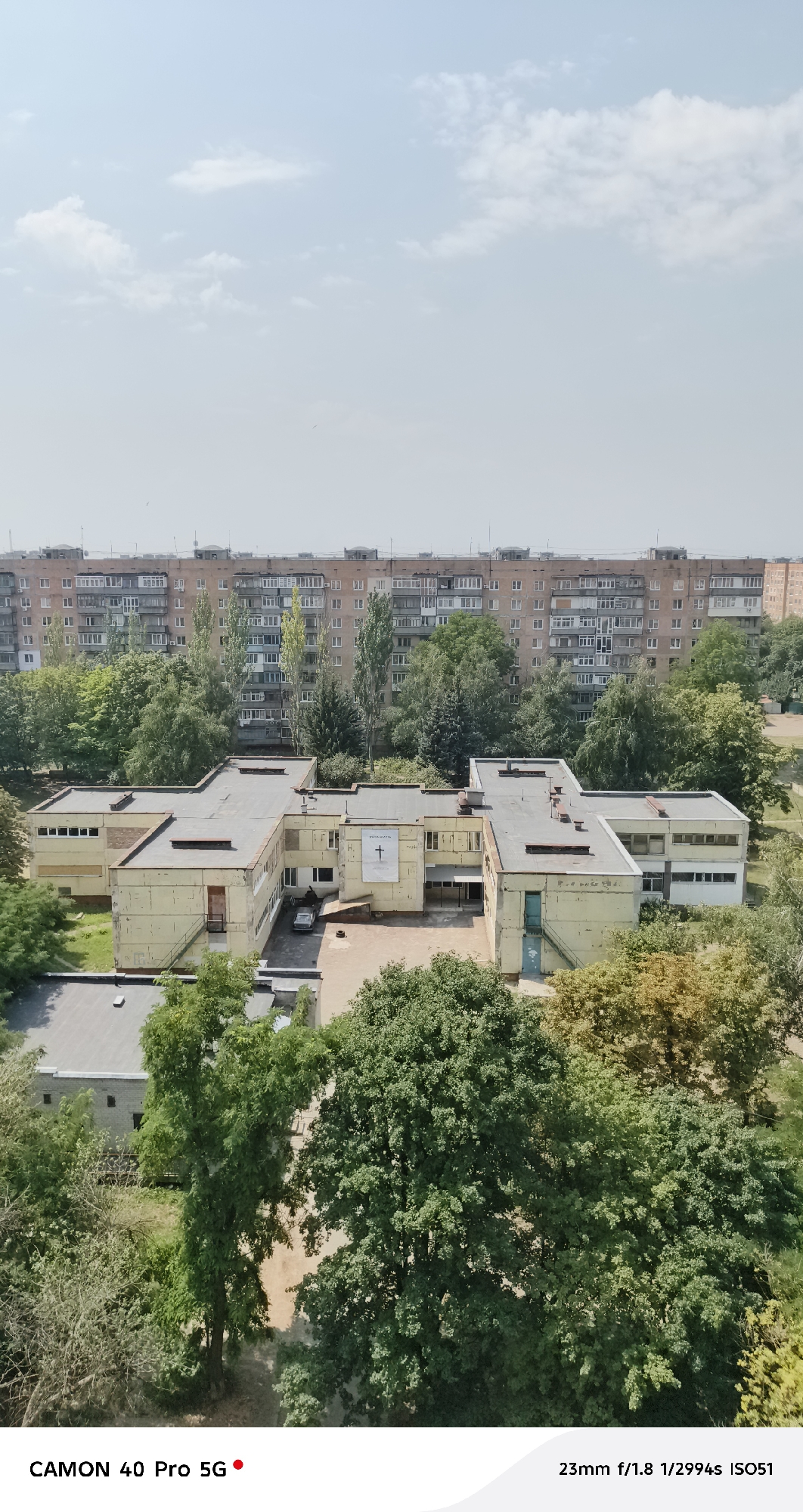
The photograph, taken from an elevated vantage point, displays a post-Soviet era urban landscape. The foreground is dominated by dense, green trees, some showing autumnal hues. In the middle ground, a two-story, light-yellow building complex with a flat, gray roof is visible. This complex has a distinctive cruciform layout and appears to be a school or similar institutional building, indicated by a large banner featuring a white cross on a gray background hanging on its facade. Several cars are parked near the building. Behind this structure, a long, multi-story apartment building, characteristic of Soviet mass housing, stretches across the horizon. Its beige and gray facade is punctuated by numerous windows and balconies. The sky above is a pale blue, hazy with some wispy clouds, suggesting fair weather. The image is captured in Kramatorsk, Ukraine.
Kramatorsk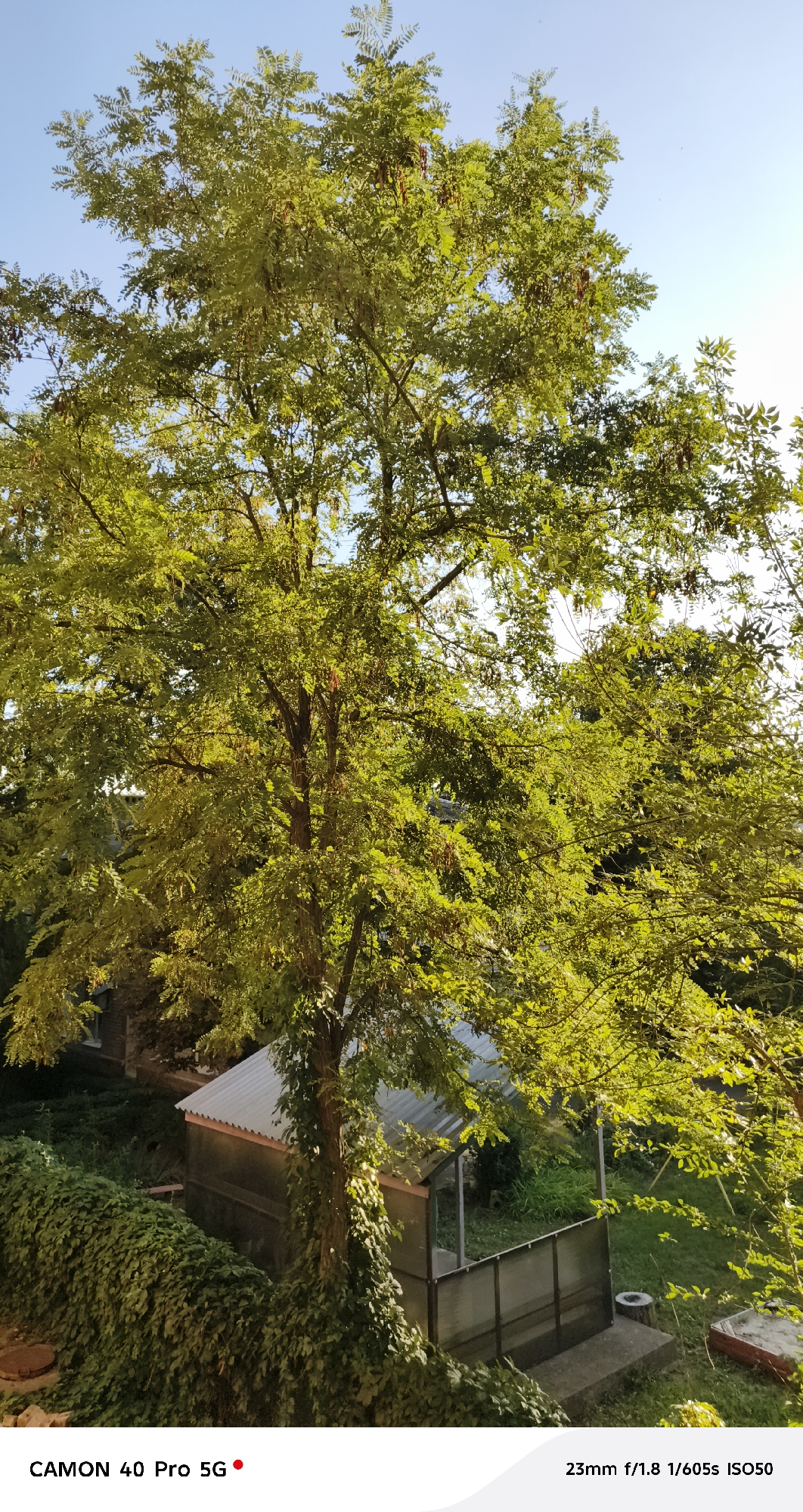
A large, leafy tree dominates the frame, its branches reaching towards a bright, clear blue sky. The leaves are a vibrant green, with some yellowing suggesting the approach of autumn. Pod-like structures hang from some of the branches, indicating it may be a species like black locust. Beneath the tree, a small, weathered greenhouse with a corrugated metal roof is visible. It appears to be situated in a garden or backyard setting. A dense wall of green ivy covers a lower section of the scene to the left, obscuring what lies behind it. The ground is covered in grass and some scattered debris, including a concrete slab and what appears to be a tree stump or a large stone. A section of a metal fence is also visible to the right of the greenhouse. The scene is brightly lit by sunlight, creating dappled shadows and highlighting the textures of the leaves and foliage. The overall impression is one of a natural, somewhat overgrown outdoor space. The image was captured in Kramatorsk, Ukraine.
Kramatorsk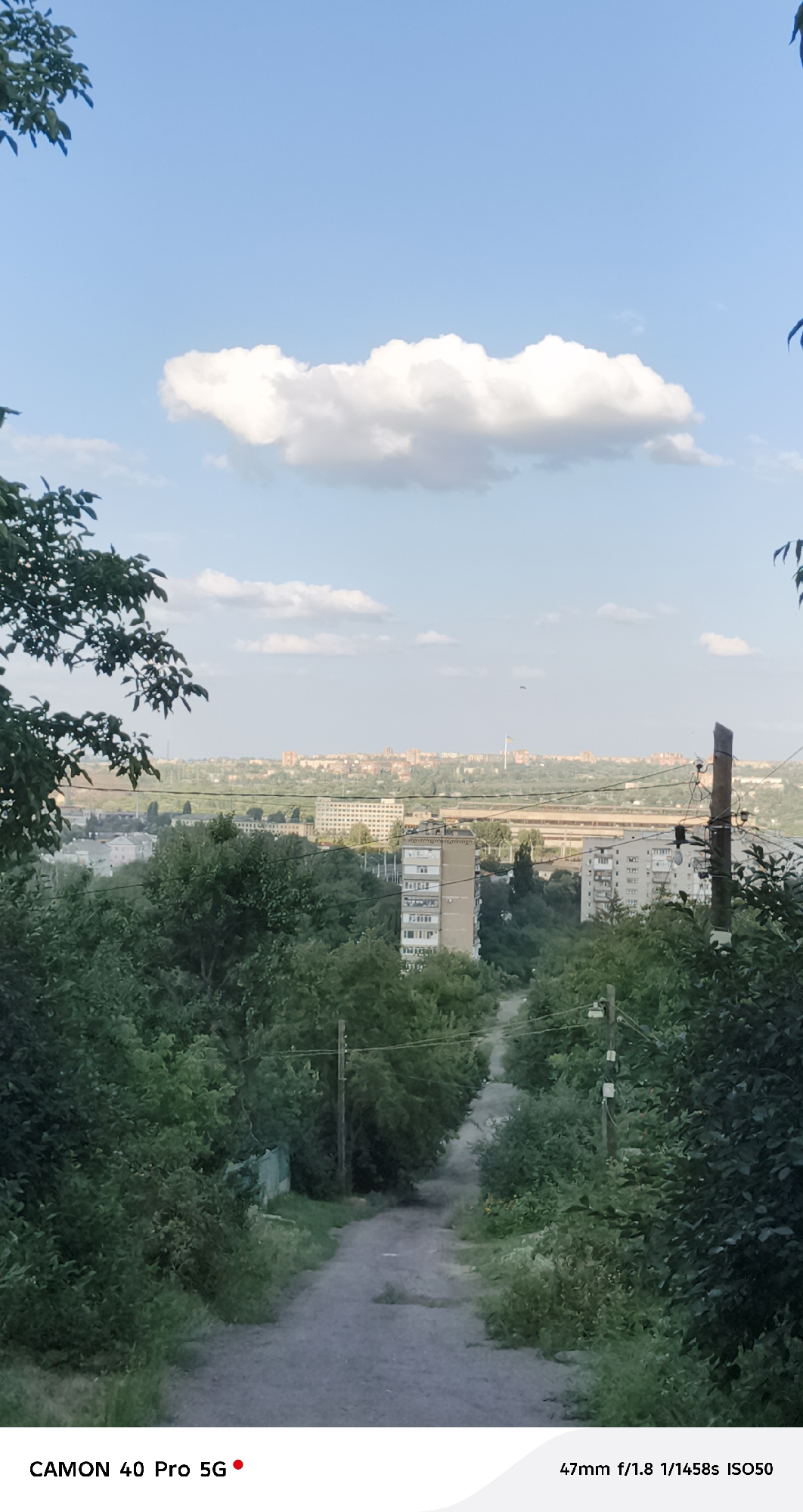
The image shows an outdoor scene with a dirt path leading downhill through dense green foliage and trees. In the distance, a city skyline is visible with several multi-story buildings, some appearing residential and others industrial. A Ukrainian flag flies from a tall pole in the distance. The sky is blue with scattered white clouds. The lower portion of the image contains text overlay indicating "CAMON 40 Pro 5G" and "47mm f/1.8 1/1458s ISO50". The setting appears to be a slightly overgrown area on the outskirts of an urban environment.
Kramatorsk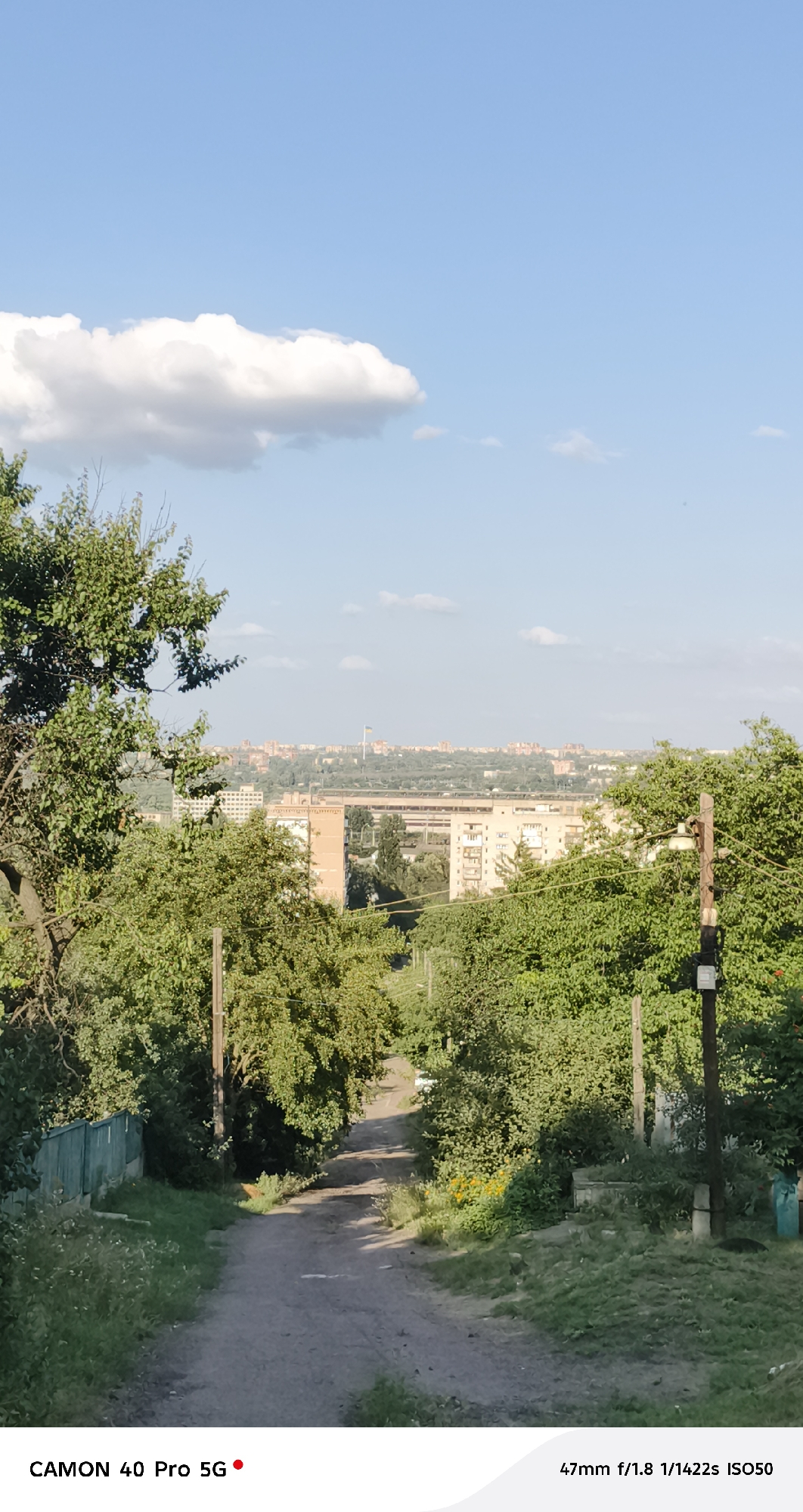
A wide-angle, eye-level outdoor photograph captures a downward sloping dirt path winding through a residential area in Kramatorsk, Ukraine. Lush green trees and foliage line both sides of the path, with a teal-colored fence visible on the left. In the background, a cluster of multi-story apartment buildings and other structures dominate the urban landscape under a clear blue sky with a few scattered white clouds. A tall pole with electrical equipment stands on the right side of the path. The image is a still from a mobile device, indicated by the text overlay at the bottom: "CAMON 40 Pro 5G" and "47mm f/1.8 1/1422s ISO50".
Kramatorsk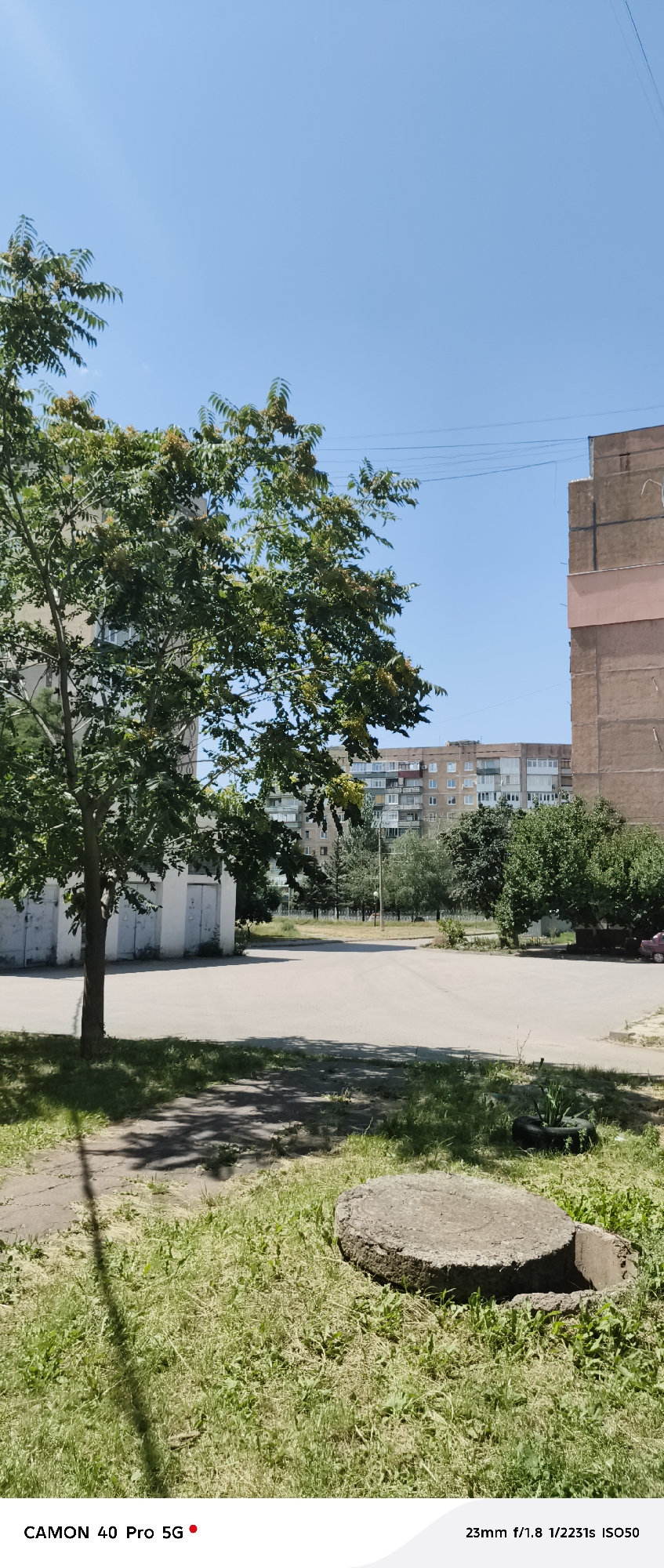
The image depicts an outdoor scene in the city of Kramatorsk, Ukraine, under a clear blue sky. In the foreground, a patch of grass is visible, with a circular concrete slab, likely a manhole cover, partially embedded in it. A thin tree trunk casts a shadow across the grass and a paved area. Beyond this, a paved lot or courtyard is visible, bordered by a low white building with several doors on the left. Further in the background, a line of trees separates the courtyard from a row of apartment buildings. The buildings are multi-story structures with visible windows and balconies, characteristic of Soviet-era architecture. A large tree with green leaves and clusters of small yellowish-brown fruits or seeds is prominently featured on the left side of the frame, obscuring parts of the buildings. The overall environment suggests a residential area within the city. The bottom edge of the image displays text that reads "CAMON 40 Pro 5G" and "23mm f/1.8 1/2231s ISO50", indicating it is a photograph taken with a specific camera model and settings. There are no people visible in the image, and no discernible actions or interactions are taking place. The scene is static and presents a view of urban infrastructure and vegetation.
Kramatorsk
The image captures an outdoor scene dominated by a large, leafy tree against a clear blue sky. The tree, rich with green foliage, occupies the lower left portion of the frame. In the background, a distant cityscape with buildings and a brick chimney is visible, suggesting an urban or semi-urban environment. The bottom of the image displays text overlaying a wavy white graphic. The text on the left reads "CAMON 40 Pro 5G" with a red dot next to it, and on the right, it shows "47mm f/1.8 1/398s ISO50". The lighting suggests it is either early morning or late afternoon.
Kramatorsk
A high-angle, medium shot shows a corgi dog eating ice cream from a cone held by a person's hand. The dog is brown and white with large ears and is positioned on a grey, concrete-like surface. The person's hand has pink fingernails and is holding the waffle cone with its pointed end towards the dog's mouth. The dog is actively licking the ice cream from the cone, with its tongue visible. The background is blurred and appears to be an outdoor environment with a rough texture.
Kramatorsk
A corgi dog with tan and white fur is looking at an ice cream cone held by a person's hand. The dog is standing on a concrete surface with visible cracks. The background is out of focus, but appears to be an outdoor setting. The image was taken in Kramatorsk, Ukraine.
Kramatorsk
A corgi dog is being fed an ice cream cone by a person's hand. The dog is on a concrete surface, possibly a sidewalk or street, with some debris scattered around. A wooden bench is visible to the right of the dog. The scene is outdoors, with natural light. The image does not provide any information about the specific location within Kramatorsk, Ukraine, or any contextual details beyond the immediate subject and its surroundings.
Kramatorsk
A close-up, eye-level shot shows a Pembroke Welsh Corgi with its head tilted upwards, intensely focused on an ice cream cone held by a person's hand. The dog's tongue is extended, licking the ice cream. The dog's fur is a mix of tan and white, and its eyes are dark brown. The ice cream is in a waffle cone and appears to be vanilla. The hand holding the cone has neatly manicured, light pink fingernails. In the background, a black container filled with cigarette butts is visible. The ground is a rough, grey, concrete surface with some cracks and small pebbles. The overall setting suggests an outdoor urban environment, possibly a street or patio in Kramatorsk, Ukraine.
Kramatorsk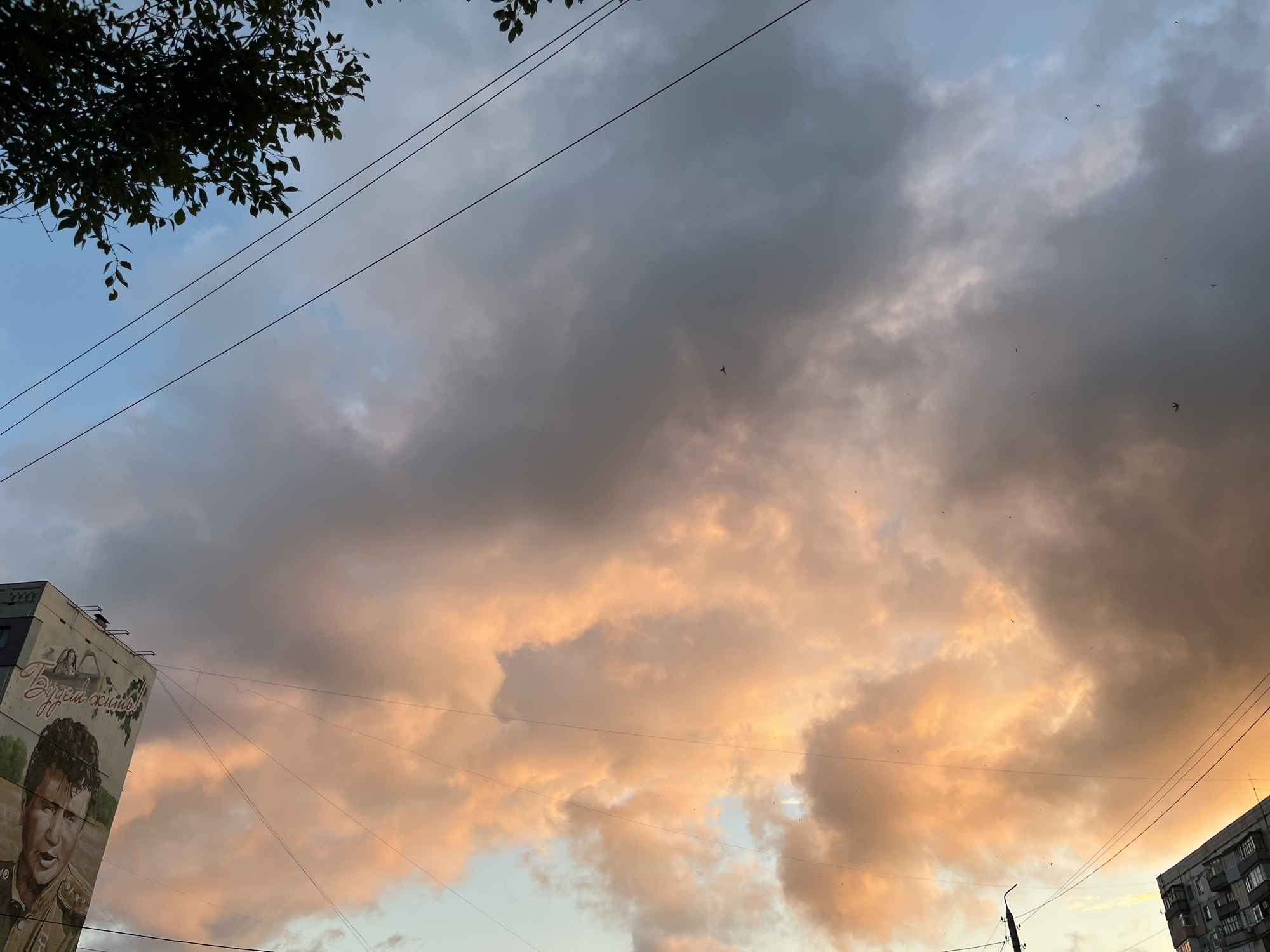
This image depicts a dramatic sunset over the city of Kramatorsk, Ukraine. The sky is filled with large, dramatic clouds, some of which are illuminated with warm orange and pink hues from the setting sun, while others remain a deep grey. Several small birds are visible in flight against the clouds. In the lower left portion of the frame, a building displays a large mural. The mural is a portrait of a man in military-style attire, with text and an image of a plane above his head. Power lines crisscross the sky, and in the lower right, the corner of an apartment building is visible. A street lamp is also present in the lower part of the image. A tree with dark green leaves is seen in the upper left corner, partially obscuring the sky. The scene captures a dynamic interplay of natural light and urban elements at dusk.
Kramatorsk