Kwazailewa, Nigeria
30 memories from Kwazailewa, Nigeria

The image displays a close-up, head-and-shoulders portrait of a male individual positioned indoors. The subject has dark skin, a short dark beard on his chin, and is wearing a dark or grey hooded garment with the hood covering his head. A dark crew-neck shirt is visible beneath the hooded top. His eyes are directed upwards and to the viewer's left, while his mouth is slightly ajar, revealing his upper teeth. The background features a light-colored, possibly tiled, ceiling with a single illuminated circular recessed light fixture located above and to the left of the subject. To the subject's right, a light-colored wall or structural column is present, adjacent to a window secured with vertical metal bars. The scene is illuminated by artificial light. The image contains no visual information to identify a specific location within Kwazailewa, Nigeria.
Kwazailewa
A close-up, frontal portrait depicts a male subject of African descent, centered within the frame. He is wearing a dark grey or black hooded sweatshirt, with the hood pulled up around his head. A light brown shirt with a dark collar is visible beneath the hooded garment. The subject has dark eyes, short dark hair, and a thin goatee extending along his jawline and a mustache. His expression is neutral to slightly smiling, with his mouth slightly open, revealing some upper teeth. The background indicates an indoor environment. To the subject's left, a light-colored wall is visible, with a dark, vertical element partially present in the lower left corner. To the subject's right, a window with horizontal and vertical metal bars (grille) is visible. Above, the ceiling is composed of light-colored grid panels, and a single, round, illuminated white LED light fixture is embedded in the ceiling. The visual information within the image does not provide specific details to confirm the location as Kwazailewa, Nigeria.
Kwazailewa
The image displays a close-up, downward-angled view of a dusty, light beige floor in an interior setting in Kwazailewa, Nigeria. Two white electrical fixtures are recessed into the floor. On the left is a square Type G electrical socket, secured by four screws, exhibiting visible dirt around its edges and in its pin receptacles. Adjacent to it on the right is a rectangular white cover plate, possibly for a data or communications outlet, also embedded in the floor and showing dust accumulation. The surrounding floor surface is covered in fine dust and scattered small, white, irregular debris fragments. In the upper left quadrant, a dark brown or black horizontal strip, appearing to be a baseboard or threshold, runs along the edge of the frame, also coated in dust. No people, active actions, or explicit interactions are visible.
Kwazailewa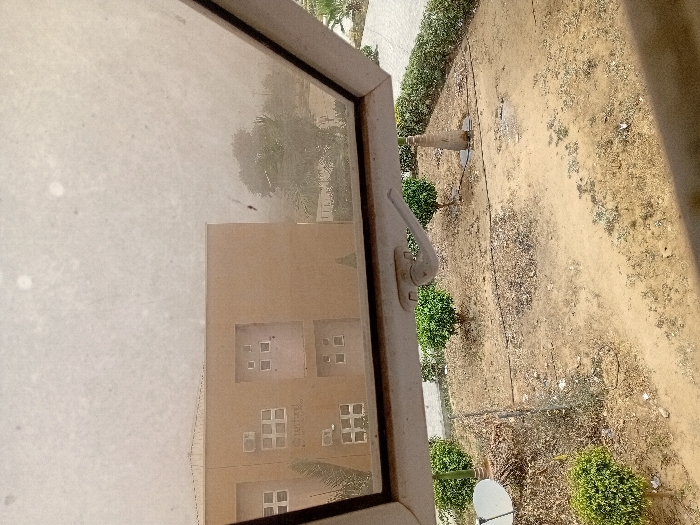
The image depicts an outdoor scene in Kwazailewa, Nigeria, viewed from an elevated position through a partially open, dusty window. In the immediate foreground, a light-colored window frame, angled upwards and to the right, is visible, featuring a white latch mechanism. The window pane is heavily marked with dust and smudges. Below the window, the midground consists of a dry, light brown dirt area, sparsely covered with small, trimmed green bushes and scattered dark organic debris. A white satellite dish is present on the left side of this ground area. A faint wire fence line runs horizontally across the midground, and a light pole with a dark base is located towards the right. The background is dominated by a two-story, tan-colored building with a flat roof. This building features multiple square and rectangular windows, along with several external air conditioning units mounted on its facade. Faint dark text, possibly "Tethered," is discernible on the building's front. To the right of the building, the distant environment appears hazy or dusty, obscuring clear details of trees and other structures. No individuals are present in the scene.
Kwazailewa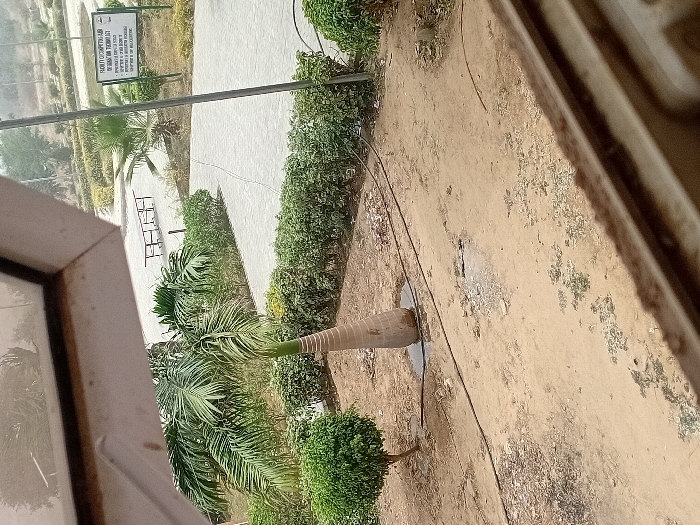
An elevated, downward-angled view captures an outdoor scene in Kwazailewa, Nigeria. The immediate foreground, partially obstructed by a window frame in the top-left and bottom-right corners, consists of dry, sandy earth with sparse green vegetation and scattered debris. A slender, small-leafed tree stands on the left. Centrally, a distinctive palm tree with a broad, conical base tapering upwards is rooted in a small puddle of water. A black hose or cable lies across the dirt ground, looping near the palm tree's base. Further into the midground, a paved pathway meanders through an area with manicured green hedges. Two unoccupied, rectangular outdoor tables are visible on a paved section. To the right, a white informational sign on a pole displays text, partially legible as "FACULTY OF COMPUTING" and "INFORMATION TECHNOLOGY." The background features additional trees and a hazy, light-colored distant horizon. No individuals are present in the scene.
Kwazailewa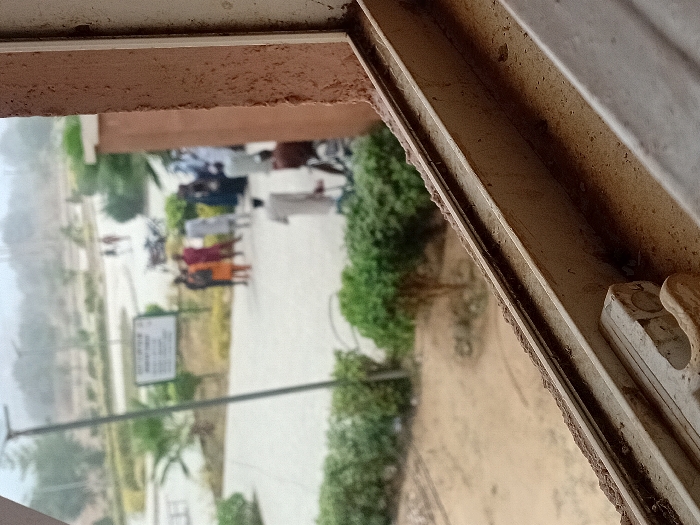
This image depicts an outdoor scene in Kwazailewa, Nigeria, viewed from an elevated vantage point through a dirty, light-colored window frame. The immediate foreground shows the window sill, heavily soiled. Below the window, dry, sandy ground with scattered green bushes is visible. In the midground, a paved walkway or plaza is populated by approximately 10 to 15 individuals, some standing in small groups, others walking. Their attire includes various colors such as orange, maroon, white, and dark blue. A tall light pole, equipped with a solar panel, stands to the left of the walkway, adjacent to a white rectangular sign displaying dark, illegible text. Sections of the paved area are bordered by manicured green bushes. The background presents a hazy, indistinct landscape featuring trees and distant structures under an overcast or dusty sky. The overall environment suggests a public or institutional outdoor space.
Kwazailewa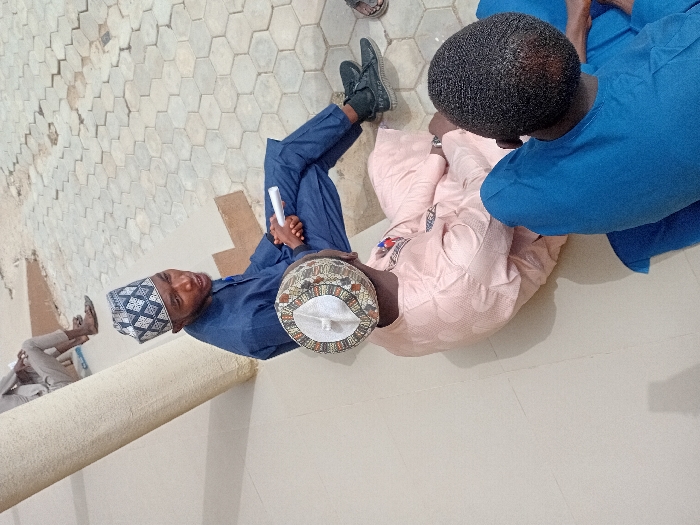
The image shows an outdoor gathering of four men in the city of Kwazailewa, Nigeria. In the foreground, a man with short, dark hair, wearing a blue traditional tunic, sits on a light-colored tiled surface with his back to the camera. To his right, another man, dressed in a light pink traditional garment and a multi-colored cap, sits facing left. He has a watch on his left wrist. Ahead of them, a third man, wearing a dark blue traditional outfit and a black and white patterned cap, sits on a light-colored step or raised platform. He holds a white rolled document in his hands and is positioned as if speaking, with his mouth slightly open. He wears black sneakers. In the upper background, a fourth individual is partially visible, seated on a higher step, wearing light-colored trousers and sandals. The ground features smooth, light-colored tiles in the foreground and hexagonal pavers in the mid-ground. A light-colored cylindrical pillar is visible on the left side of the frame.
Kwazailewa
A male subject, appearing to be a young adult, is depicted in a close-up, chest-up photograph taken outdoors in the city of Kwazailewa, Nigeria. He has dark skin, short dark hair, and a visible beard and mustache. He wears a dark, textured traditional cap and a dark garment, possibly a traditional top, visible at the shoulders and neck. The subject is looking directly at the camera with a neutral to slight smile. The background on the left consists of a textured, light beige or tan building wall. On the right, a white-framed window with multiple panes is partially visible, behind which a darker, possibly black, object with a metallic clasp is present over the subject's right shoulder.
Kwazailewa
A close-up portrait photograph depicts a young adult male with dark skin, dark short hair, a mustache, and a chin beard. He is wearing a dark-colored traditional garment and a textured grey cap. His expression is neutral, and he is looking directly at the viewer. The background consists of a light beige, textured wall, with a white-framed, multi-paned window partially visible in the upper right. The scene is located in the city of Kwazailewa, Nigeria.
Kwazailewa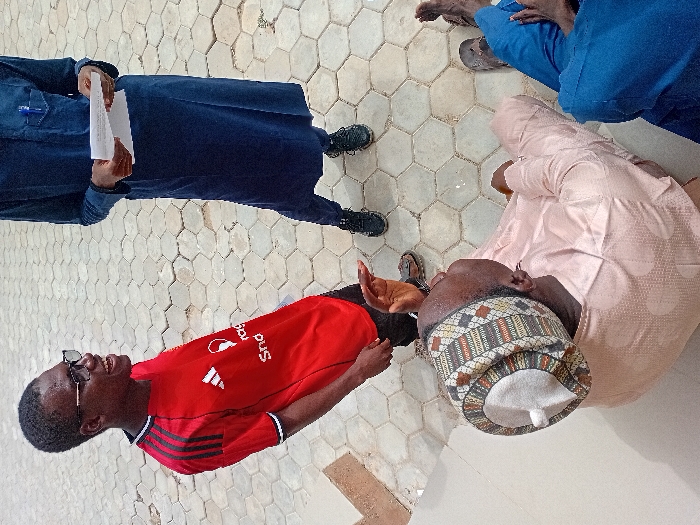
The scene, located in Kwazailewa, Nigeria, depicts an outdoor gathering of at least four individuals on a paved surface composed of light-colored hexagonal pavers and a lighter, possibly tiled, area in the lower left. The lighting indicates daylight. In the foreground, an older male is seated directly on the paved ground, wearing a light peach-colored patterned long-sleeved garment and a multi-colored patterned cap with a white central dome. He gestures with his raised right hand, palm open, and looks upwards towards the standing individuals. To his right, partially visible, is another seated individual wearing blue trousers and dark slip-on shoes. Standing to the left, a male in dark-framed glasses and a red Adidas t-shirt with black shoulder stripes is smiling broadly and looking towards the seated older male. He wears brown sandals. To the right, another individual stands, wearing a dark blue traditional long garment over dark trousers and black athletic shoes. This individual holds a folded white document in both hands at waist level; a blue pen is visible in their chest pocket. The head of the individual in the dark blue garment is not visible. The interaction suggests an ongoing discussion or address among the group.
Kwazailewa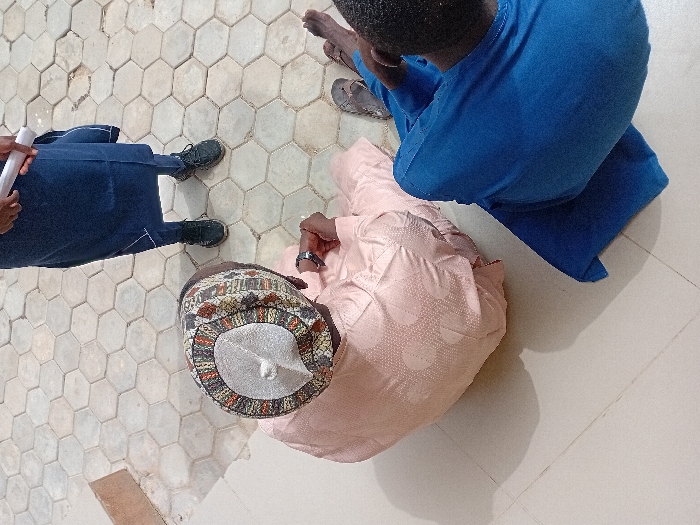
The scene is an outdoor area in Kwazailewa, Nigeria, under direct sunlight, evidenced by sharp shadows. Three individuals are present. In the mid-ground, a person is seated with their back to the viewer, wearing a light pink, dotted traditional garment and a patterned kufi cap with a light grey central dome. This individual is holding a small object in their hands, and a ring is visible on one finger. In the immediate foreground, a second individual is partially visible from the back, seated and wearing blue attire; a pair of grey sandals are near their feet. A third person stands in the background, visible from the waist down, wearing dark blue trousers and black athletic shoes, holding a rolled white document with both hands. The ground beneath the seated individuals is a light-colored, smooth tiled surface, which transitions to light grey hexagonal pavers in the background where the standing individual is positioned.
Kwazailewa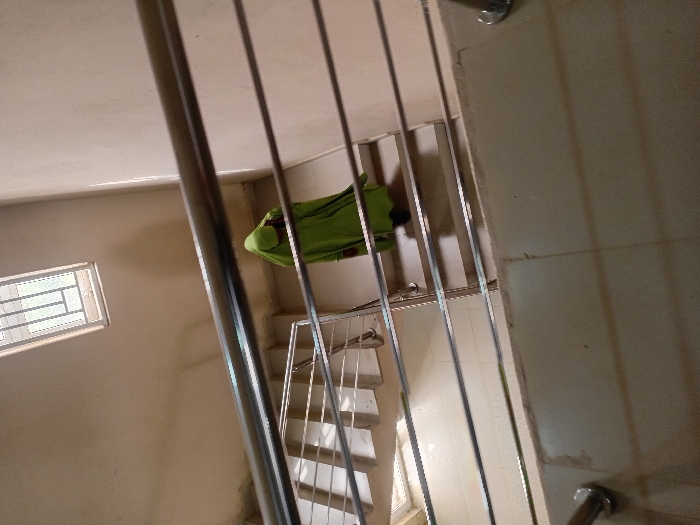
The image depicts an individual descending an interior stairwell within a building in Kwazailewa, Nigeria. The subject is viewed from an elevated perspective, positioned with their back to the camera, wearing a vibrant green full-body garment that covers their head and form. Dark footwear is visible beneath the garment. The stairwell features light-colored tiled steps and walls. A modern metal railing system, composed of multiple horizontal bars, traverses the mid-ground. A rectangular window with a visible grid pattern is situated high on a wall, providing ambient illumination. A light-colored tiled wall section forms the immediate foreground, anchoring the railing.
Kwazailewa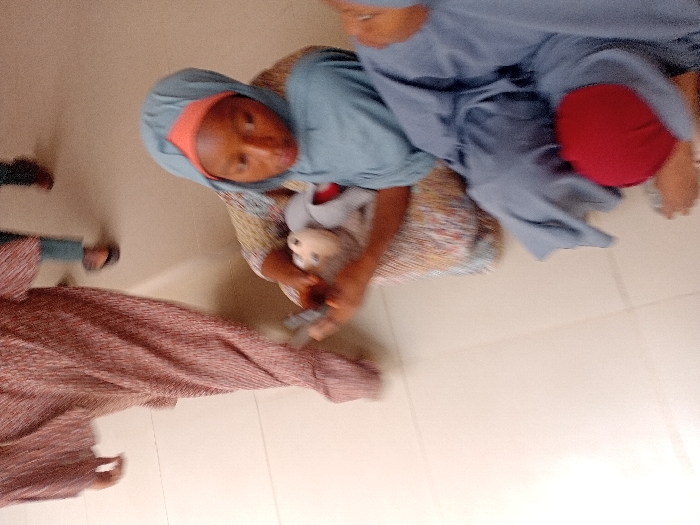
The scene depicts an indoor environment with a light-colored tiled floor in the city of Kwazailewa, Nigeria. A young female, appearing to be a child or teenager, is seated in the central foreground, wearing a patterned garment, a light blue hijab, and an orange head covering. She is observed holding two objects: a small, light-colored toy resembling a doll with a brown head and grey body in one hand, and a dark, rectangular object, possibly a mobile phone, in her other hand. Her gaze is directed downwards towards these items. To her immediate right, another individual is partially visible, seated, clad in a blue garment with a red item positioned on their lap; only their bare feet are discernible in the lower right. In the background, two additional individuals are in motion. The lower body of one person, dressed in a long, pleated, reddish-brown garment, walks from left to right. Further back, the feet, wearing dark sandals, and lower legs, clad in light blue trousers, of a fourth person are partially visible.
Kwazailewa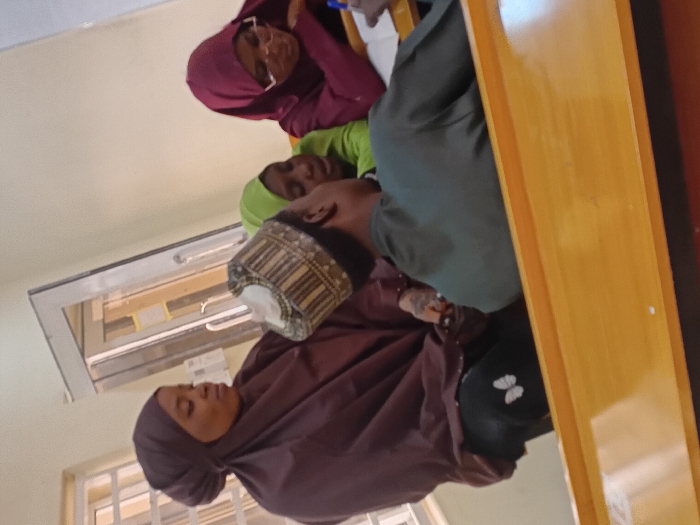
An indoor scene in Kwazailewa, Nigeria, shows four individuals seated at light-colored wooden desks. In the foreground, a male individual, viewed partially from behind, wears a dark green long-sleeved garment and a patterned cap; he holds a pen poised over a notebook. To his immediate left, a female wearing a dark brown hijab and matching attire is seated, observing the group; visible tattoos are present on her left forearm, and she wears black leggings with a white butterfly motif on the left leg. Behind the foreground male, a second female in a light green hijab is partially visible. To the right of the foreground male, a third female, wearing a dark red hijab and glasses, is focused downwards on written material. The background consists of light-colored walls, a barred window on the left, and a glass-paned door on the right.
Kwazailewa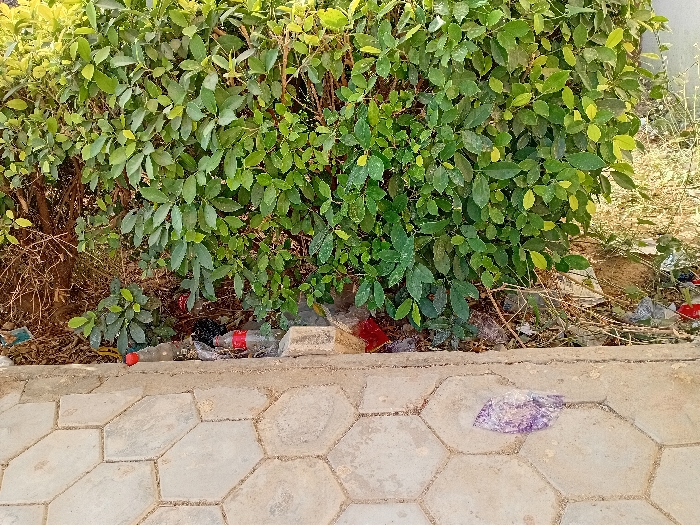
A dense green bush grows behind a low concrete retaining wall. Litter, including red plastic bottles and plastic bags, is scattered along the base of the bush. A paved walkway with large, hexagonal tiles stretches across the bottom of the frame. A crumpled piece of translucent purple plastic sits on the walkway.
Kwazailewa
A young adult male, identified as being in Kwazailewa, Nigeria, is depicted in a low-angle shot against a clear, light blue sky with sparse white clouds. The male has dark skin, a short beard, and a mustache. He wears a patterned cap, possibly a Kufi, in dark colors with light motifs. His right hand is raised to his head, with fingers resting on the cap. A ring with a visible stone is on the ring finger of his right hand. He wears a light-colored, vertically striped long-sleeved shirt with a gold-colored cufflink visible on his left wrist. A dark-strapped wristwatch is present on his left wrist. Bright sunlight emanates from the lower-left of the frame, illuminating the left side of his face and shirt. He looks directly forward towards the viewer.
Kwazailewa
A young adult male, of apparent African descent, is depicted in a close-up, outdoor photograph taken in Kwazailewa, Nigeria. He wears a white, collared garment with a decorative tan and white buttoned placket and a patterned cap (kufi-style) featuring horizontal bands of red, blue, white, and geometric motifs. He has a moustache and a chin beard, with a neutral facial expression. The sky above is bright with scattered white clouds. In the background, to the subject's left, a light-colored building is visible alongside a parked white and blue scooter and a partially obscured bicycle. A second individual in white attire is partially visible to the far left. To the subject's right, another light-colored building displays partially visible text including "tetfund," accompanied by a large palm tree with fan-shaped fronds and various green shrubs.
Kwazailewa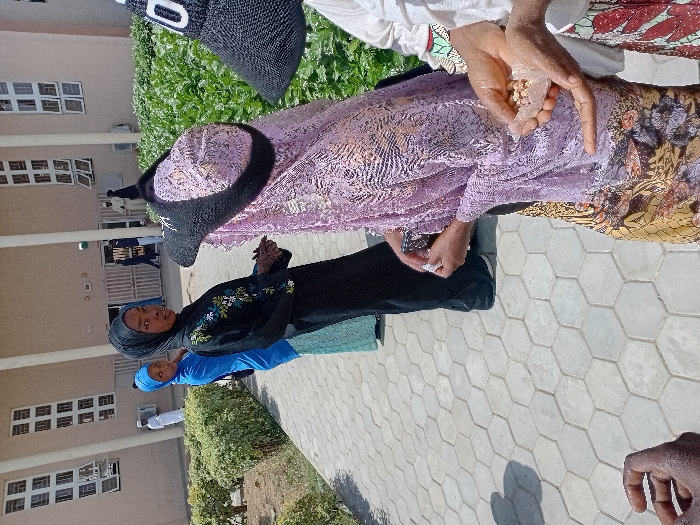
The scene is set outdoors in Kwazailewa, Nigeria, under bright daylight. A hexagonal concrete block pathway occupies the foreground and midground. On the far right, a partially visible individual wears a black visor and a patterned skirt, holding a small, clear plastic bag containing light brown seeds or nuts in their hands. Adjacent, another individual wears a light purple patterned head covering, a dark textured headpiece, and a patterned skirt, engaging their hands with a small white object. To the left, a female in a black hijab and a black dress with white and light green embroidery stands with clasped hands, looking towards the camera. Behind her, a fourth female wears a bright blue head covering and a light blue patterned skirt, facing left. The pathway is bordered by green bushes. In the background, a light-colored building with multiple rectangular windows and prominent columns is visible. Several additional individuals are present near the building's entrance.
Kwazailewa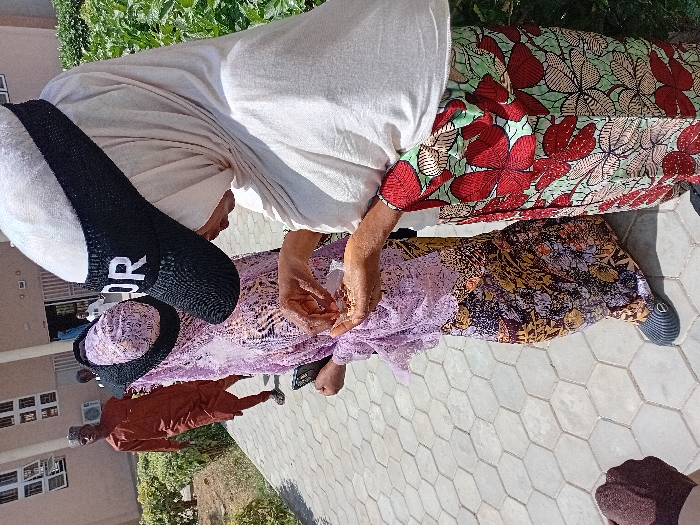
The scene depicts an outdoor setting in Kwazailewa, Nigeria, under bright daylight. In the immediate foreground, a female subject wears a light-colored hijab and a black visor with "DOR" in white uppercase letters across the front. She holds a small quantity of light-colored granular material in her cupped hands. Her lower attire is a patterned fabric featuring large red floral designs on a light green background. Adjacent and slightly behind her, a second female subject wears a purple patterned head covering and a multi-colored patterned wrapper. She holds a dark smartphone in her left hand. Her footwear consists of dark open-toed sandals on a hexagonal paved walkway. In the midground, a male subject walks away from the camera, looking over his left shoulder towards the foreground. He wears a reddish-brown traditional tunic and trousers, complemented by a dark cap. The background features a light-colored building with multiple rectangular windows and an open entrance, with green foliage visible to the right. The ground is consistently paved with light grey hexagonal tiles.
Kwazailewa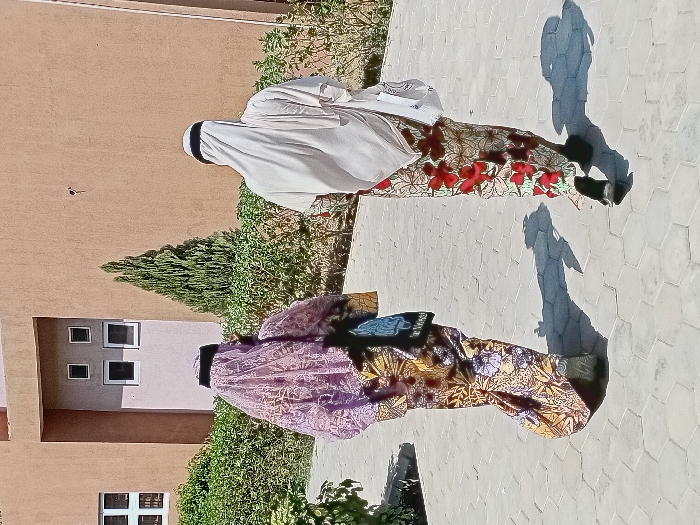
Two individuals walk away from the camera on a grey hexagonal paver walkway in the city of Kwazailewa, Nigeria. The person on the left wears a long, multi-colored patterned dress, a dark headpiece covered by a sheer purple patterned veil, and dark shoes, carrying a dark bag on their left side. The person on the right wears a light-colored draped head covering, a long skirt with a light background and red floral patterns, and dark shoes, carrying a white tote bag on their left arm. Distinct shadows are cast on the ground to their right, indicating bright sunlight from the upper left. The background features a line of green bushes and a slender coniferous tree. Behind the vegetation, a building with light brown walls is visible, displaying a white-framed multi-paned window on the left and a recessed section with four smaller square windows.
Kwazailewa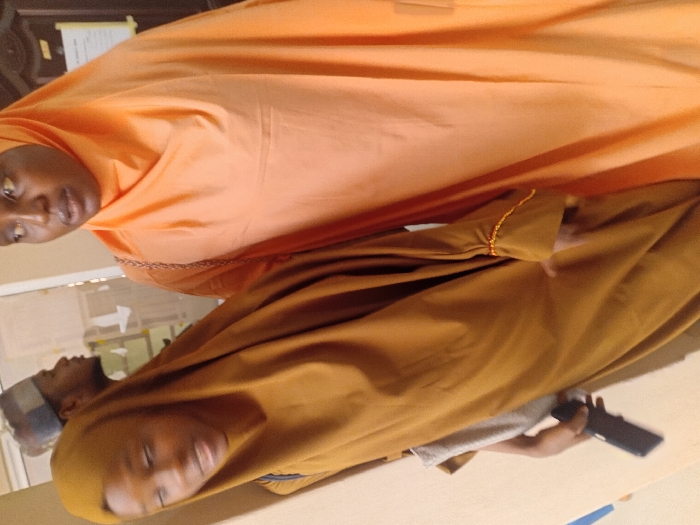
The image displays an indoor scene featuring three individuals. In the foreground, two females stand side-by-side. The female on the left, wearing a brown full-length abaya and matching hijab, holds a black smartphone in her right hand and has a light-colored strap over her left shoulder. Her face is slightly blurred, with her mouth partially open. The female on the right, wearing an orange full-length abaya and matching hijab, looks slightly upwards and to her left, with her mouth also partially open. A light-colored strap is visible on her left shoulder. In the blurred background, a male wearing a patterned cap and a light-colored shirt is visible in profile, looking to the right. The environment consists of light-colored walls, with a dark-framed doorway and a white sheet of paper or notice affixed to it visible in the background. The specific location within Kwazailewa, Nigeria, cannot be determined from the visual information presented.
Kwazailewa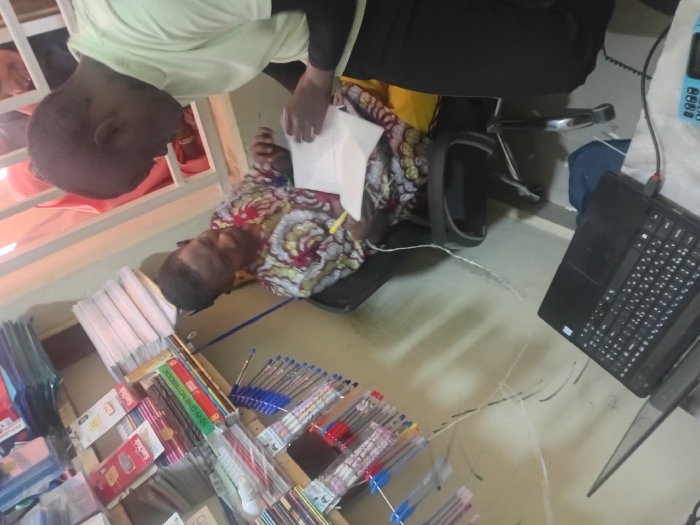
This image depicts an indoor commercial or office setting in Kwazailewa, Nigeria, characterized by stationery supplies. Two adult males are engaged in a transaction or consultation, while a third individual is partially visible in the background. The male on the left is seated in a black office chair, wearing a multicolored patterned long-sleeved shirt. He holds a yellow pen or marker in his right hand, looking intently at a stack of white papers held by the second male, with a slight smile. The male on the right is standing or leaning, dressed in a light green short-sleeved top worn over a dark long-sleeved undershirt. He holds a stack of white papers, appearing to present or review them with the seated individual, his right hand positioned over the documents. In the foreground, a black laptop is open on a reflective surface, with a red USB drive or connector inserted into its right side. A light blue keypad mobile phone is positioned to the right of the laptop, connected by a white cable. To the left, a multi-tiered wooden shelving unit displays various stationery items. Visible products include packages of SanDisk memory cards, stacks of notebooks, and numerous pens of assorted colors (blue, red, black) hanging from hooks. The walls are light-colored. Several white electrical cables are visible, traversing the wall and floor. In the upper right background, a white-barred window or partition reveals the upper portion of a third individual, partially obscured, wearing what appears to be a light pink head covering.
Kwazailewa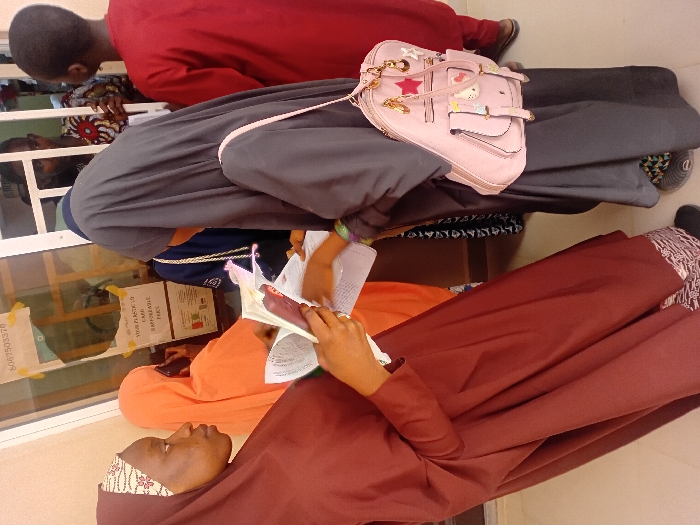
The scene is set inside a public service or registration office in Kwazailewa, Nigeria. Six individuals are present. In the foreground, a young female with light brown skin, wearing a maroon hijab and dress with a patterned forehead band, holds an open document or book in her left hand and a pink-cased smartphone in her right. She directs her gaze towards the right. To her right, another young female, partially viewed from behind, wears a dark grey hijab and dress, with a pink backpack adorned with multiple charms slung over her right shoulder. Her right hand is extended towards the documents held by the first female, suggesting an interaction or exchange. Both foreground females wear flat footwear; the one in grey has visible patterned anklewear. Behind a white-framed glass partition, three individuals are visible. One person, largely obscured, wears an orange head covering and holds a phone to their ear. To their right, a young male in a red long-sleeved shirt is partially visible. Further right, another male in a patterned shirt (red, white, black) is visible through the glass. A white rectangular sign is taped to the glass partition, displaying "VOTER PLASTIC ID CARD IS AVAILABLE" and the number "8067503370", along with a small red, green, and white segmented graphic. The background includes a light-colored wall.
Kwazailewa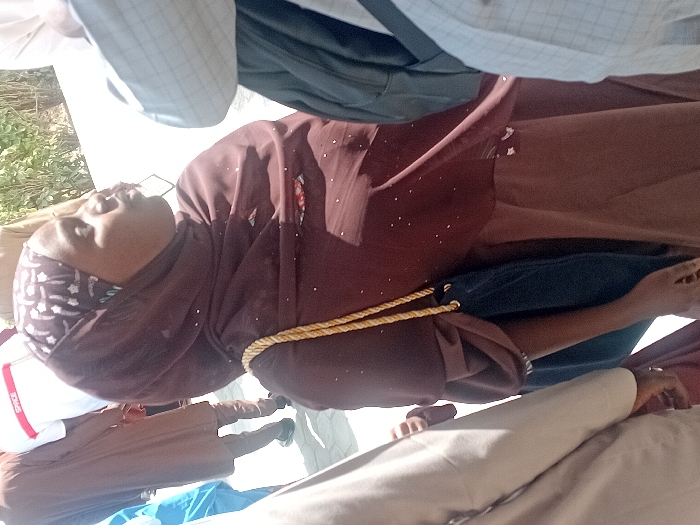
The image depicts an outdoor scene in Kwazailewa, Nigeria, under bright daylight. The central figure is a young adult female, seen in profile, looking upwards and to her right with her mouth slightly open. She wears a full-length maroon or brown garment and a matching hijab with a distinct patterned band featuring white, black, and green elements. Small reflective embellishments are visible on her clothing. She carries a dark blue drawstring bag with a gold braided strap over her left shoulder. Her right hand, partially visible, holds a small dark object. Surrounding the central figure are several other individuals, mostly partially visible. To her immediate right, the torso and arm of a person wearing a light-colored garment are present. To her left, a person is seen from behind, wearing a white t-shirt with a red horizontal stripe and the word "SPACE" visible, brown trousers, and black shoes. Further back, another individual in a brown traditional garment is partially visible. On the far right, a person wearing a light plaid shirt and a dark backpack is also partially visible. The ground surface is light-colored paving, and the background includes a light-colored wall or structure and sparse green foliage.
Kwazailewa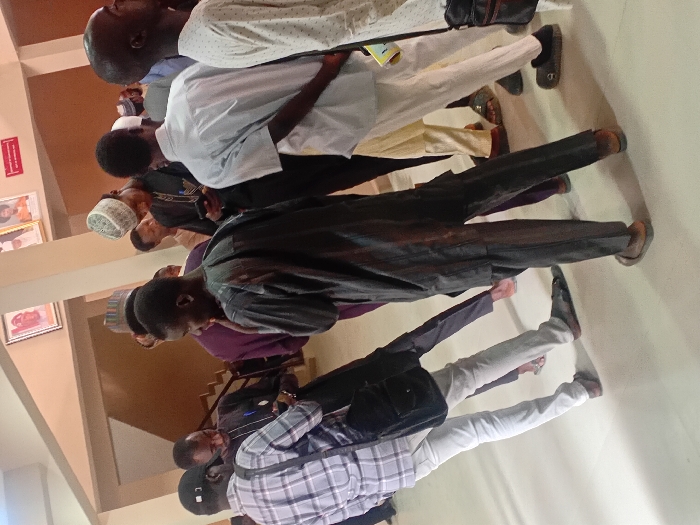
The image displays an indoor scene in the city of Kwazailewa, Nigeria, populated by approximately ten to fifteen men. The setting is a brightly lit hall or lobby with a smooth, light-colored floor and neutral-toned walls. In the upper background, two framed portraits and a small red rectangular sign are mounted on a wall. A dark-colored staircase with a visible handrail ascends on the left side of the background. The individuals are primarily young to middle-aged adult males, dressed in a combination of traditional Nigerian garments, such as kaftans and agbadas, and casual attire including shirts and trousers. Several men wear traditional caps. In the immediate foreground on the left, a man wearing a light plaid shirt, light trousers, and a dark cap carries a black shoulder bag and is focused on a smartphone. Adjacent to him, another man, seen from behind, wears a dark, possibly striped, traditional two-piece outfit and open-toe sandals. To the right of the foreground, a man in a dark traditional outfit and a white/grey patterned cap is looking down at a smartphone. Further back, another man is seen from behind, wearing a light blue/grey short-sleeved shirt and light trousers. Most individuals are standing, with several observed examining their smartphones. No direct physical interactions or explicit conversations are discernible.
Kwazailewa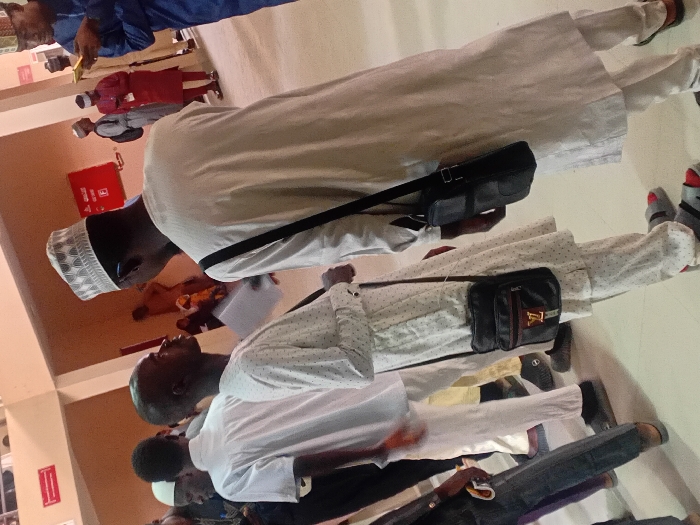
This image captures an indoor scene in the city of Kwazailewa, Nigeria, depicting a gathering of individuals within a modern public building. In the foreground, two men are central to the composition. The man on the left, with dark skin and short hair, wears a white tunic with small dark spots, white trousers, and grey-and-red sandals. A black messenger bag with a gold "LV" logo and a red-and-green stripe is slung over his left shoulder. He holds a white document in his left hand and looks upwards towards the man on his right. This second man, also with dark skin, is seen from a partial back view, wearing a plain white tunic, white trousers, and a white patterned kufi cap. A black messenger bag is slung over his left shoulder. In the mid-ground and background, numerous other individuals are visible. Most wear traditional Nigerian attire, primarily white or light-colored tunics and trousers. One man in the mid-ground on the right wears a red tunic, while another on the far right wears a blue tunic and is engrossed with a yellow object, possibly a mobile phone. The environment features light-colored walls and flooring, suggesting a well-maintained hall or institutional setting. A red fire extinguisher is mounted on the wall in the mid-background, below a red sign with white text. The overall scene conveys a sense of congregation or passage within a public space.
Kwazailewa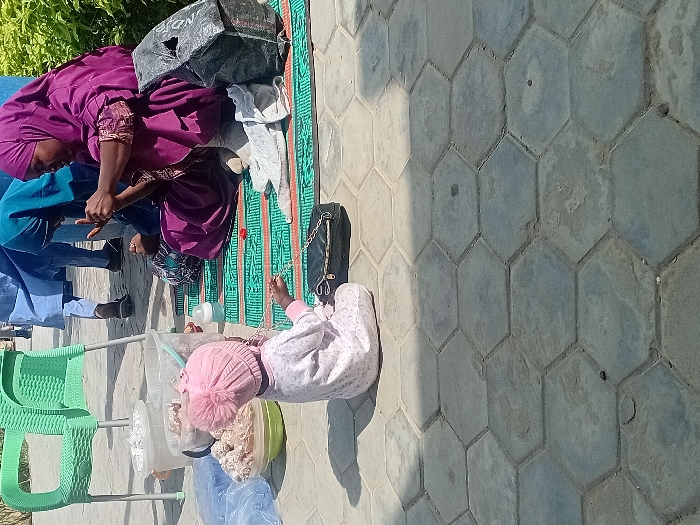
The image depicts an outdoor daytime scene in the city of Kwazailewa, Nigeria, set on a surface of hexagonal concrete pavers. In the foreground, a young child, dressed in a light-colored long-sleeved outfit and a pink knitted hat with a pom-pom, is seated on the pavers, facing away from the camera. The child holds a small, dark object in one hand and is positioned beside a small black purse with a chain strap. To the child's right, two women are seated on a green mat featuring a repeating pattern. The prominent woman wears a deep purple hijab and matching full-length attire. Her hands are raised and engaged in a focused activity. Her lower legs and feet, covered in light-colored socks or fabric, are visible. Partially obscured behind her is a second woman, dressed in a teal hijab and dark clothing, also looking downwards. Surrounding the individuals are various objects: an empty light green plastic chair is positioned to the left. Near it are two transparent plastic buckets, one containing white, fluffy material and the other with less distinct contents. A green bowl filled with numerous small, light-brown spherical items is on the ground. Several clear plastic bags are also visible. A baby bottle with a white top rests on the patterned mat. A crumpled black plastic bag is situated near the woman in purple. In the background, several blurred figures are standing, one of whom wears a light blue traditional garment. A dense green hedge or bush lines the right side of the frame. The scene is under bright natural sunlight, creating clear shadows on the paved ground.
Kwazailewa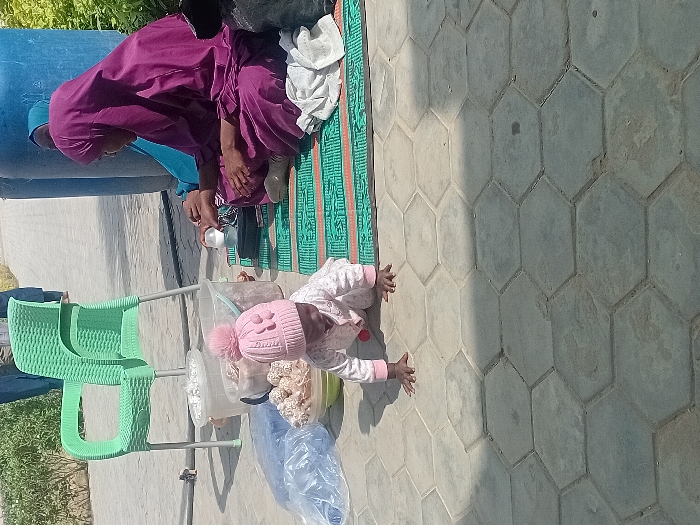
The scene is an outdoor setting in the city of Kwazailewa, Nigeria, under direct sunlight, indicated by strong shadows on the hexagonal grey concrete pavers. In the foreground, an infant is crawling on the pavement, dressed in a light-colored long-sleeved outfit and a pink knitted hat with a pom-pom. To the right, a woman in a dark purple hijab and matching long dress sits cross-legged on a green and orange patterned mat, holding a clear baby bottle with a white cap. A second woman, wearing a light blue hijab, is partially visible behind the first, also seated on the mat. Adjacent to the mat and the infant, an empty light green plastic chair with a woven pattern stands on the pavement. Near the chair are two translucent white plastic buckets, one containing unidentified light-colored contents, and a light-colored bowl filled with numerous small, spherical, light-colored items, possibly food products. A transparent blue plastic bag rests on the pavement near the bowl. Behind the seated women, two large blue plastic barrels are visible, partially obscured. In the distant background, two indistinct figures walk away from the viewer on what appears to be an unpaved area with some sparse green vegetation.
Kwazailewa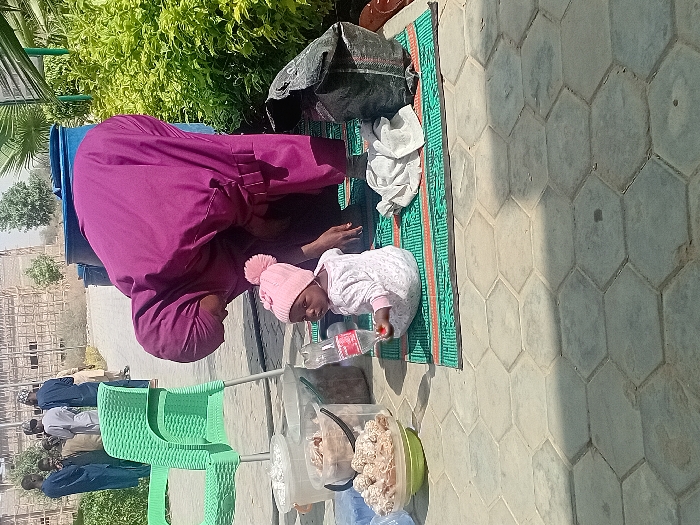
An outdoor scene in Kwazailewa, Nigeria, depicts a woman and a child on hexagonal paved ground. In the foreground, a young child, dressed in a white patterned long-sleeved garment and a pink knitted hat with a pom-pom, sits on a green and orange woven mat. The child holds a clear plastic bottle with a red label in its left hand and looks towards the camera. To the child's right, a crumpled white cloth and a dark fabric bag are present on the mat. A woman wearing a deep purple hijab and a matching long garment is bent over the mat, facing left, with her back partially towards the camera, appearing to attend to the child or items on the mat. To the left of the mat, a partially visible light green plastic chair stands near several containers: two clear plastic buckets containing various items (one with white, fluffy material, another with brownish, irregularly shaped contents), and a light green bowl holding numerous spherical, light-colored food items. In the mid-ground, behind the woman, two large blue plastic barrels are visible. Further in the background, a group of approximately five to six men, dressed in various traditional attire, stand conversing on a paved path. Behind them, a large, multi-story building under construction, primarily concrete framing, is visible. The scene is illuminated by strong sunlight, casting distinct shadows. Green bushes and plants are present on the right and left sides of the image, with palm fronds visible at the top right.
Kwazailewa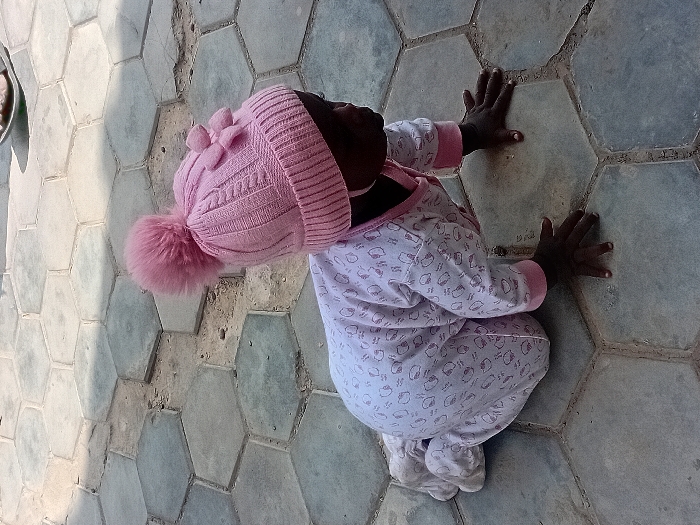
An infant is positioned on a paved surface in a crawling posture, resting on hands and knees, within the city of Kwazailewa, Nigeria. The infant, with dark skin, wears a light pink long-sleeved romper adorned with white patterns and pink trim at the collar and cuffs. A knitted pink beanie hat with a large pink pom-pom on top and a smaller decorative element on the right side covers the head. The infant's head is turned slightly to the right, looking downwards. The ground consists of unevenly laid hexagonal concrete paving tiles, exhibiting variations in shade from light to dark gray, with visible dirt and gaps between some tiles. Ambient light casts subtle shadows on the tiled surface. A blurry object, possibly a sandal or a dish, is partially visible in the upper right background.
Kwazailewa