Kyoto, Japan
30 memories from Kyoto, Japan
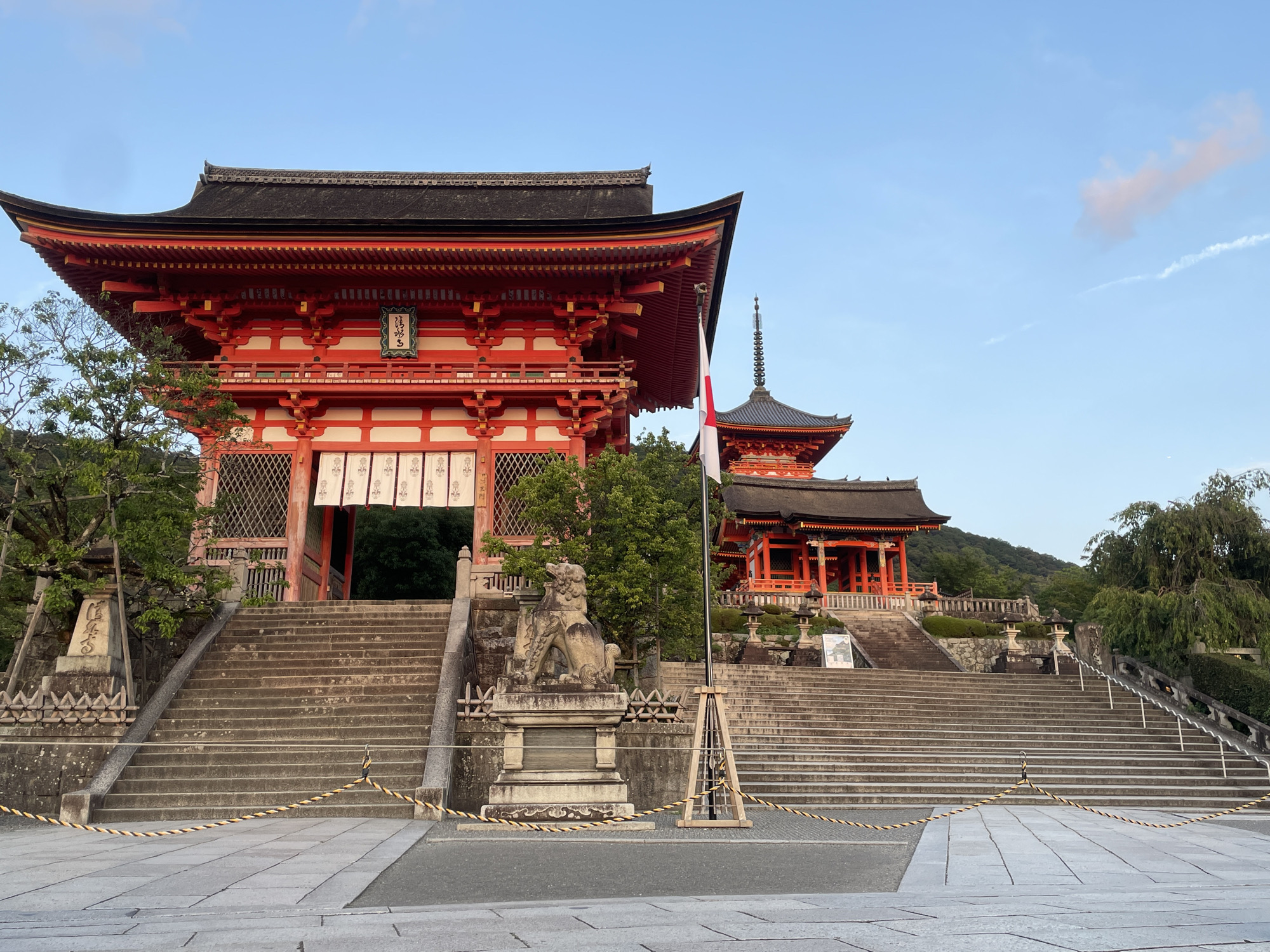
The image depicts the approach to Kiyomizu-dera Temple in Kyoto, Japan, under a clear blue sky with a few wispy clouds. In the foreground, a wide, stone staircase leads up to a large, ornate red gate. To the left of the stairs, a stone statue of a mythical creature, possibly a lion or dragon, stands guard. Beyond the gate, a smaller, similarly colored temple structure with a distinctive pointed roof is visible, along with a Japanese flag. The architecture is traditional Japanese, with dark tiled roofs, red lacquered wood, and intricate detailing. Lush green trees surround the structures, and a gently sloping, tree-covered hill forms the backdrop. The scene is serene and evokes a sense of historical and cultural significance.
Kyoto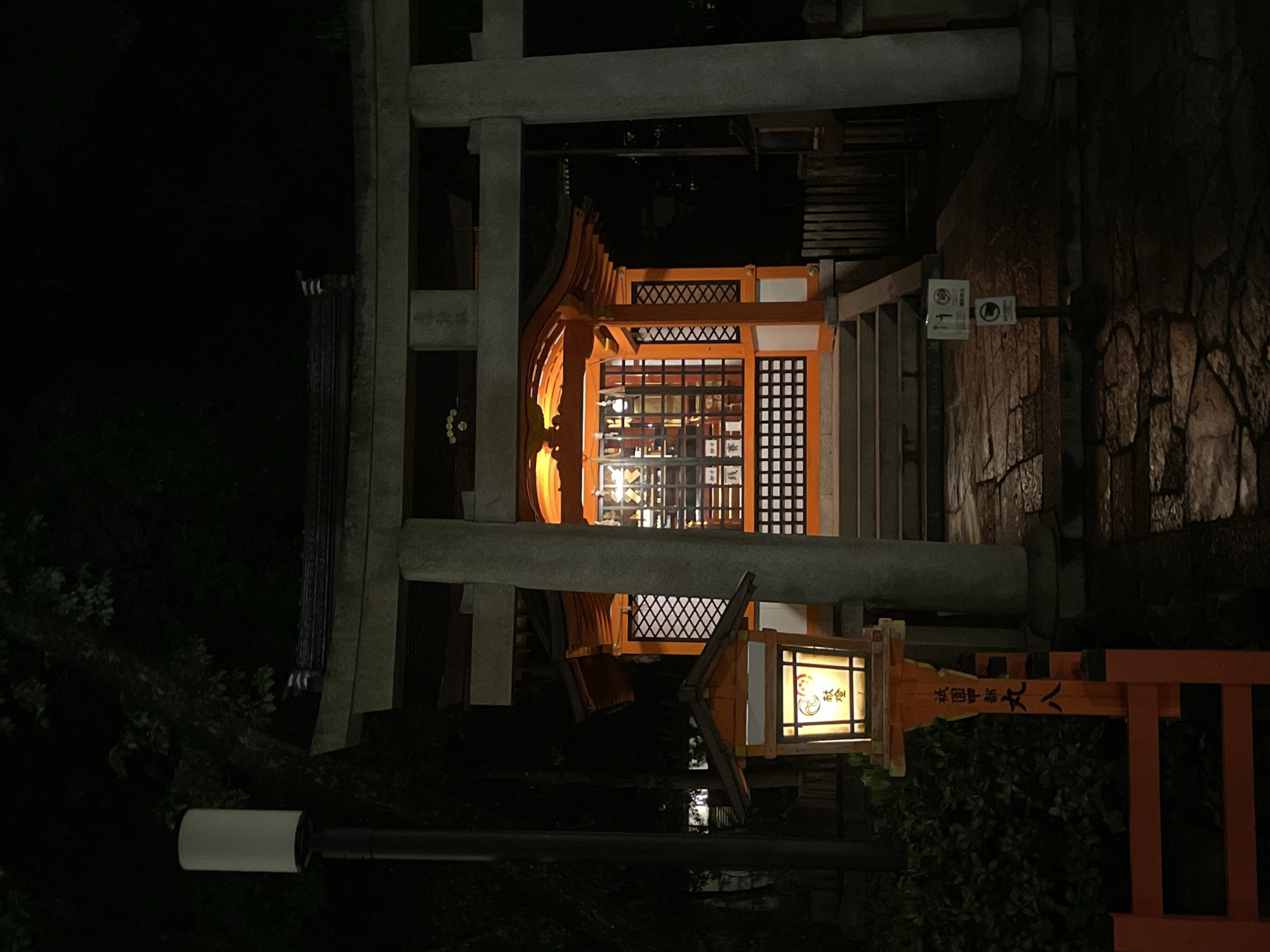
The image depicts a Japanese shrine at night, illuminated by artificial lighting. A prominent torii gate, made of concrete and stone, frames the central shrine structure, which is painted in vibrant orange and white. The shrine features a tiered roof and a latticed facade. In the foreground, a traditional Japanese lantern, known as a *chōchin*, is lit, casting a warm glow on the stone pathway. The pathway is wet, suggesting recent rain or dew. A lamppost with a cylindrical white light fixture stands to the left of the torii gate. The background is dark, with the silhouettes of trees visible. The overall scene is serene and atmospheric, typical of a Japanese temple or shrine complex after dark. The presence of a sign with Japanese text, as well as the architectural style of the shrine and torii gate, strongly suggests this location is in Kyoto, Japan, a city renowned for its numerous historical religious sites.
Kyoto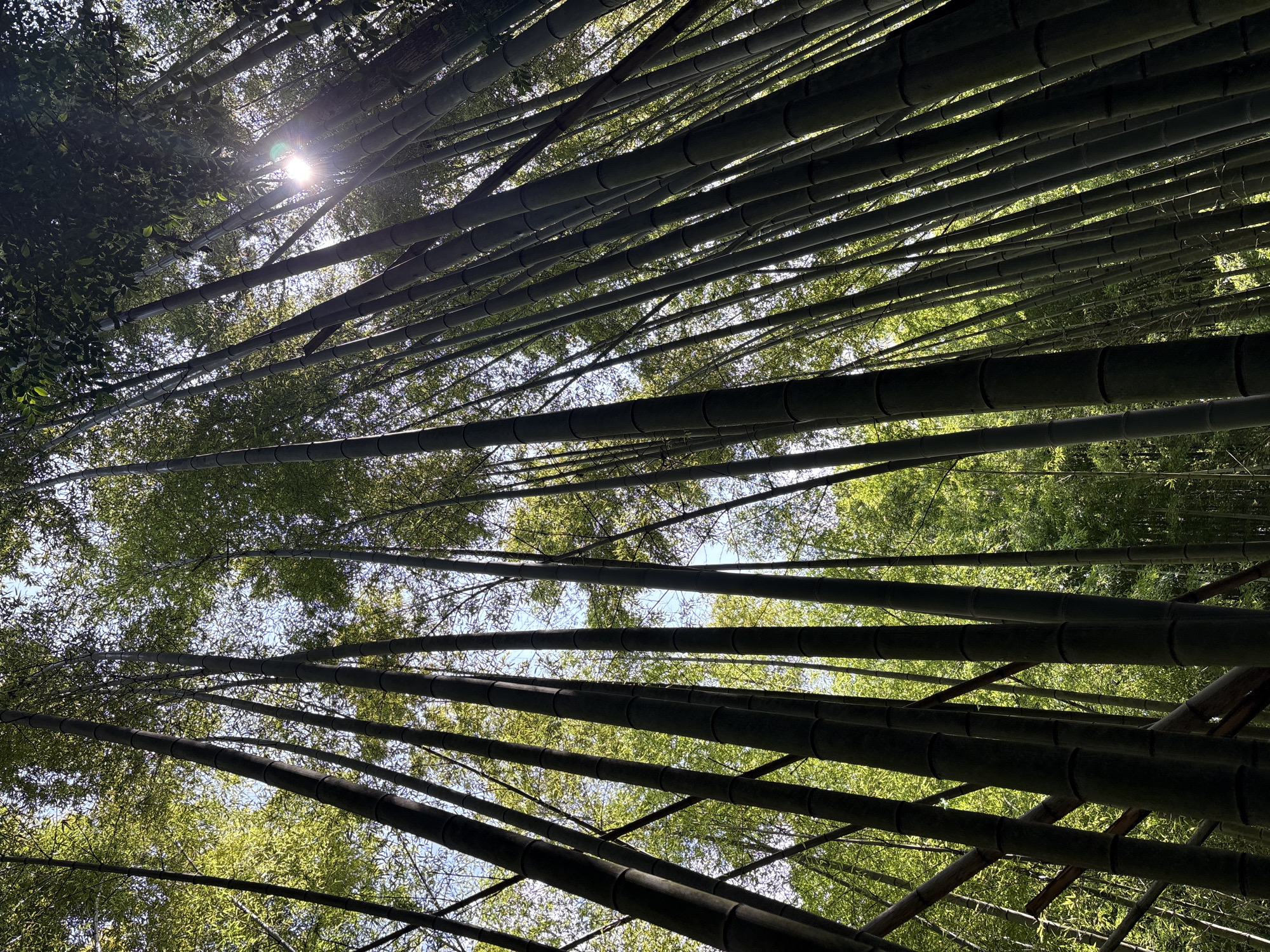
This image shows a low-angle view of a dense bamboo forest in Kyoto, Japan, likely the Arashiyama Bamboo Grove. The tall, slender bamboo stalks fill the frame, reaching towards a bright sky. Sunlight filters through the lush green leaves, creating dappled patterns and a lens flare in the upper right quadrant of the image. There are no people visible in the scene. The environment is characterized by the towering, dark green bamboo culms with their characteristic segmented appearance, and the vibrant green canopy of leaves overhead. The ground is not visible.
Kyoto
The video shows the front of a white Shinkansen train on tracks. A large, modern building with many windows is visible in the background. The train's windshield wipers are in the down position. The sky is overcast.
Kyoto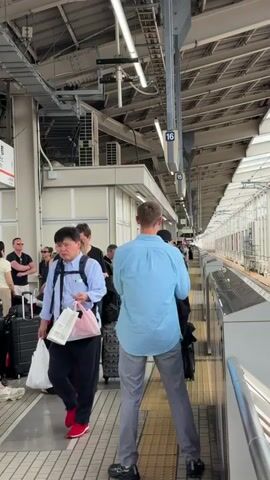
The video shows a busy train platform. Multiple people are waiting, some with luggage, suggesting travel. The people are diverse in age and ethnicity, dressed in casual clothing. One man in a blue shirt and grey pants stands facing away from the camera, holding a phone up as if taking a picture or video. Another man in a black suit and hat is closer to the camera, also with luggage. The platform is covered by a roof with industrial lighting. Tracks are visible to the right, with a train likely approaching or departing. The overall environment suggests a public transportation hub in an urban setting, possibly in Japan given the signage.
Kyoto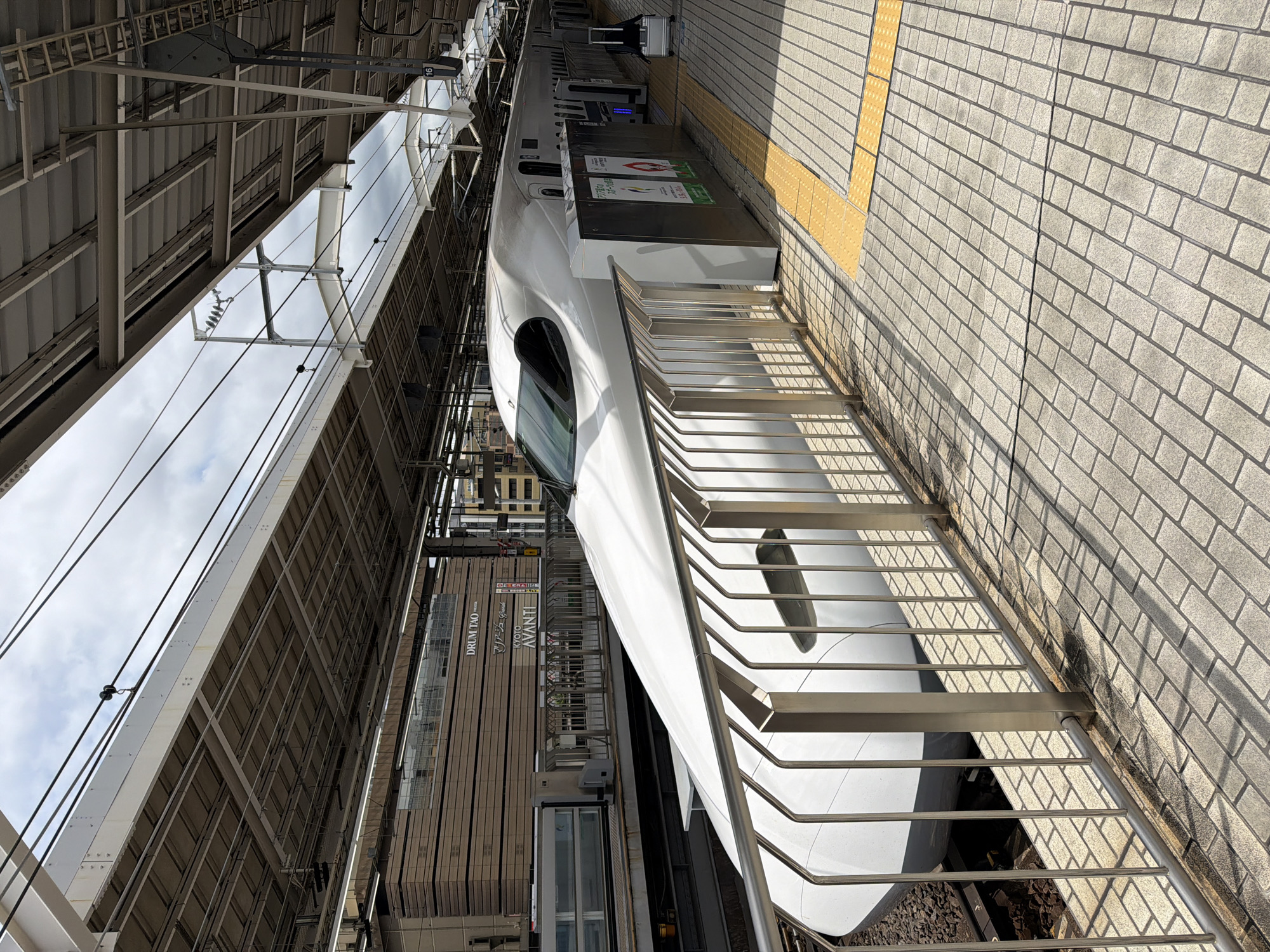
The image depicts a Shinkansen bullet train stopped at a station in Kyoto, Japan. The train, primarily white with a sleek, aerodynamic design, occupies the left side of the frame, its front section prominently visible. It is positioned on a track adjacent to a platform. The platform is paved with light-colored rectangular tiles and features a yellow tactile paving strip near the edge. A silver metal railing with vertical bars separates the platform from the train tracks. In the background, a multi-story building with horizontal wooden paneling is visible. Signage on this building reads "DRUM TAO" and "KYOTO AVANTI," suggesting a commercial or entertainment complex. Above the train and platform, a covered structure with a metallic roof supported by beams is present, with overhead electrical wires for the train's power. The sky above is partly cloudy. To the right of the train, a silver rolling suitcase stands alone on the platform. A few advertising posters are affixed to a vertical structure near the train doors. The scene is well-lit by natural daylight, casting shadows from the railing and overhead structure onto the platform tiles. No people are visible in the image. The overall environment suggests a functional, modern transportation hub.
Kyoto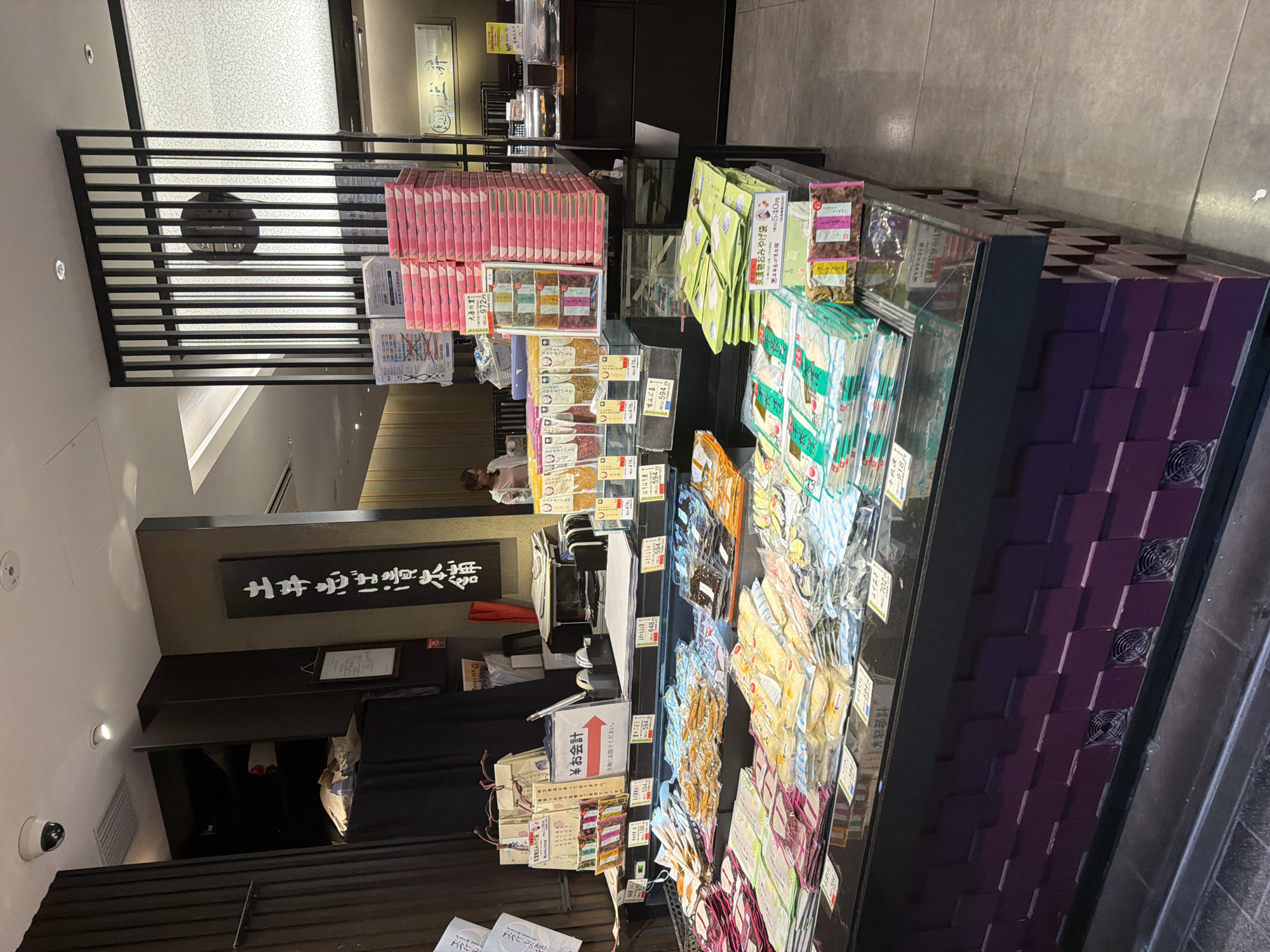
The image shows the interior of a shop in Kyoto, Japan, displaying a wide variety of packaged food items, likely souvenirs or local specialties. The products are arranged on refrigerated display shelves and on tiered stands. Many of the packages are in plastic wrapping and feature colorful designs and Japanese text. Some of the items appear to be dried goods, snacks, or confectionery. In the background, there is a vertical sign with Japanese calligraphy. A woman is visible in the background, appearing to be a staff member, standing behind a counter where there is a computer monitor and other retail equipment. The shop has modern fixtures, including a black metal partition with vertical slats and a white patterned screen behind it. The overall lighting suggests an indoor retail environment. The flooring appears to be a grey concrete or tile. The display units have purple decorative paneling at their base with visible cooling fans. A red and white sign with an arrow pointing to the right, indicating "Payment" or "Checkout" in Japanese, is prominently displayed on a shelf.
Kyoto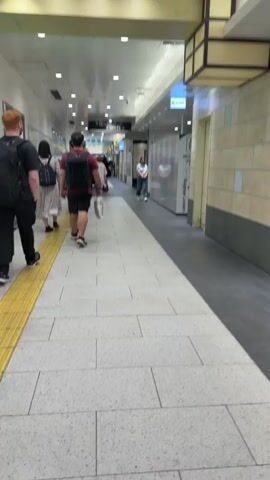
A group of people are walking down a paved hallway. The hallway has white tile floors, a yellow tactile paving strip on the left side, and fluorescent lighting from the ceiling. On the right side of the hallway are lockers labeled "Baggage Lockers." Several people are walking away from the camera, and one woman is walking towards the camera. The people are dressed in casual clothing. Some are carrying backpacks or bags. The environment appears to be a train station or airport.
Kyoto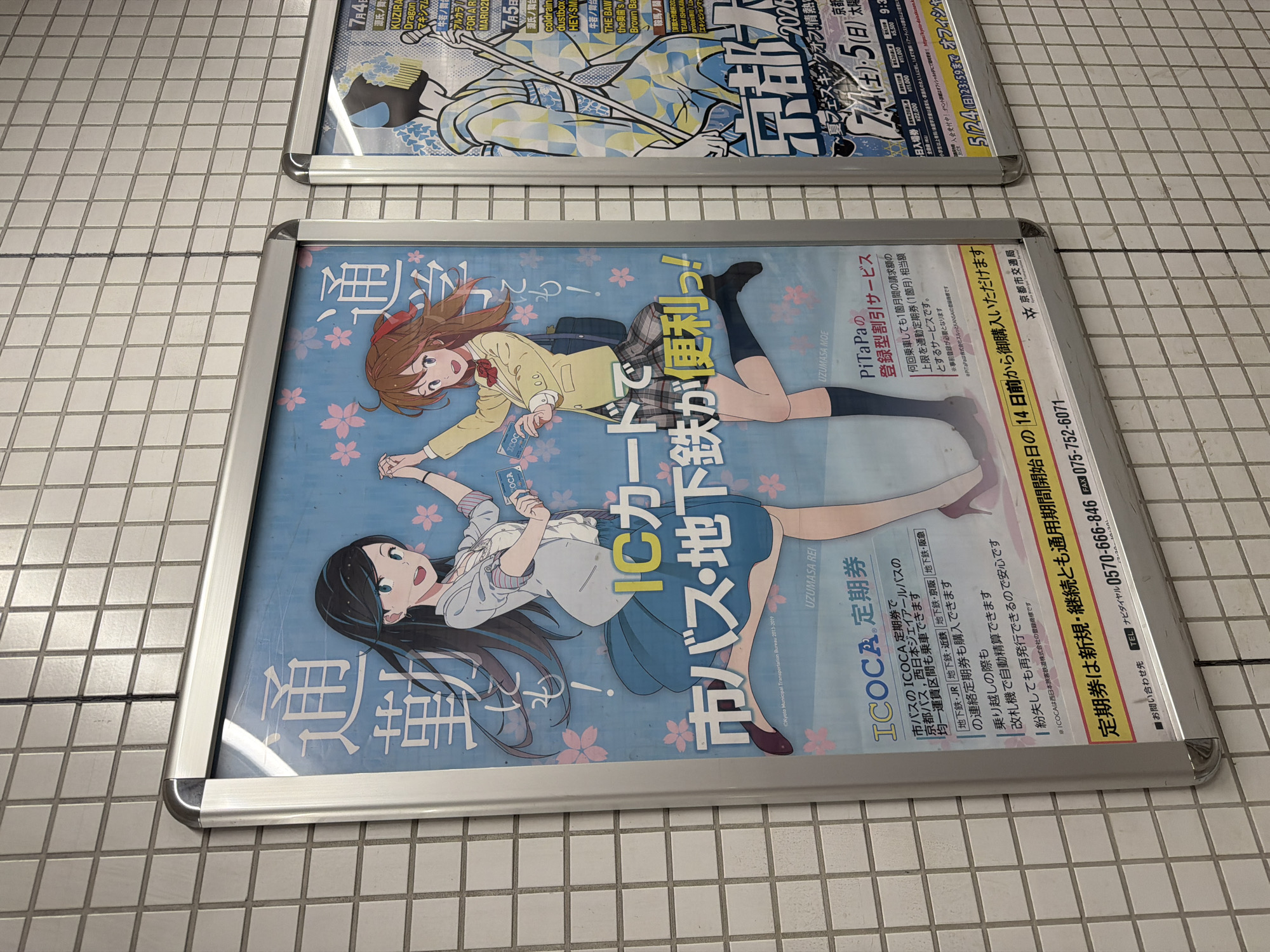
The image shows a poster on a tiled wall, likely in a subway station or public transport area in Kyoto, Japan. The poster is for ICOCA and PiTaPa, contactless smart cards used for public transportation. The poster features an anime-style illustration of two young women with pink flowers in the background. One woman has long black hair and is wearing a white blouse and blue skirt, holding an ICOCA card. The other woman has brown hair with a red ribbon and is wearing a yellow blazer and plaid skirt, also holding a card. Text on the poster promotes the convenience of using these cards for city buses and subways. Another poster to the right is partially visible and appears to be advertising an event in Kyoto, with text including "Kyoto Da..." and dates. The overall impression is a promotional display for public transportation services in Kyoto.
Kyoto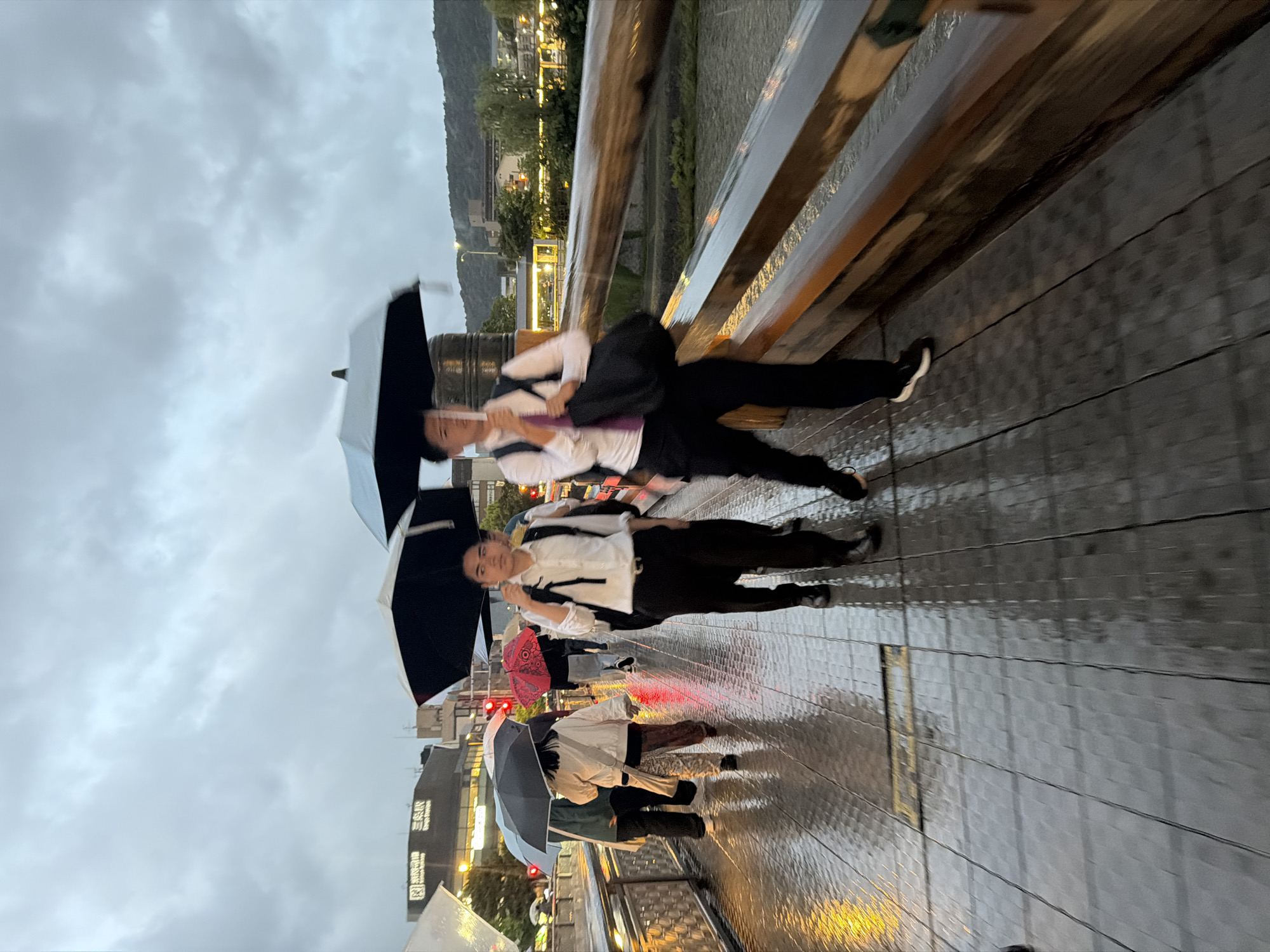
The image captures an outdoor urban scene at dusk or night during rainfall, specifically on the Sanjo Ohashi Bridge over the Kamo River in Kyoto, Japan. The sky is uniformly grey and overcast. The bridge surface is visibly wet and reflective. In the immediate foreground, two East Asian males are walking towards the viewer from the middle-ground. The male on the viewer's right is partially blurred due to motion. He wears a white button-down shirt, dark trousers, and a purple tie, carrying a black shoulder bag and holding a black umbrella over his head. The male to his left, slightly further back and in sharper focus, wears a white button-down shirt, dark trousers, and a dark backpack, also holding a black umbrella. Further into the background on the bridge, additional pedestrians are visible, moving in various directions. They are also carrying open umbrellas, some black, one distinct red with a pattern, and others of lighter hues. The bridge features wooden railings on both sides, which appear wet and reflective. Below the bridge, water from the Kamo River is discernible. On the left side of the frame, beyond the bridge, city buildings are present, displaying illuminated signs. One prominent sign clearly displays the Japanese characters '三条駅' (Sanjo Station). A red traffic light is also visible. In the background, dark, tree-covered hills rise under the low, cloudy sky, framing the cityscape.
Kyoto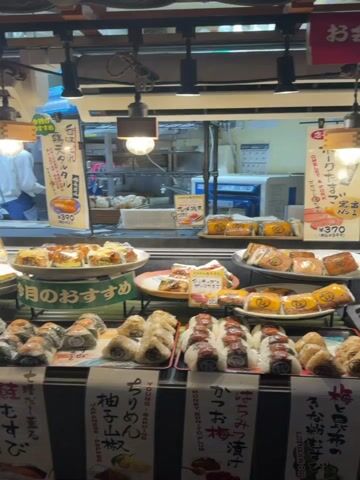
The video presents a static, eye-level shot of a food stall counter, showcasing an array of prepared Japanese food items. In the foreground, multiple rows of various onigiri (rice balls) and other small snacks are meticulously arranged on tiered, dark trays. Each section of food is accompanied by small white placards displaying Japanese text and prices, such as ¥280 and ¥210. Above the food displays, several larger signs with Japanese writing are mounted, one of which includes English text stating, "The next restroom is on the left." The display area is brightly lit by multiple industrial-style pendant lights suspended from the ceiling. In the background, behind a glass partition, a kitchen or preparation area is visible, where a person wearing a white uniform is partially seen standing on the left side of the frame.
Kyoto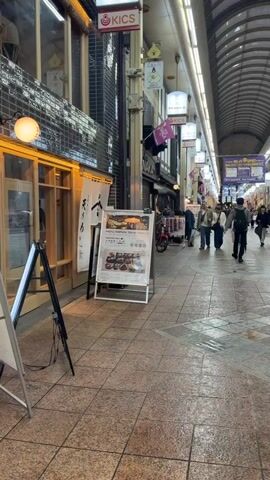
The video shows a busy, covered shopping arcade with a high, arched ceiling and overhead lights. Light-colored tiled flooring, some with patterns, extends down the arcade. On the left, an A-frame sign stands outside a shop. Various shops line both sides of the arcade, displaying signs such as "KICS" and "スギドラッグ" (Sugi Drug). Numerous people, casually dressed, walk in both directions. The camera is initially static, then slowly pans right, following a man in a dark patterned shirt and light trousers walking away from the camera, revealing more of the shops on the right side of the arcade.
Kyoto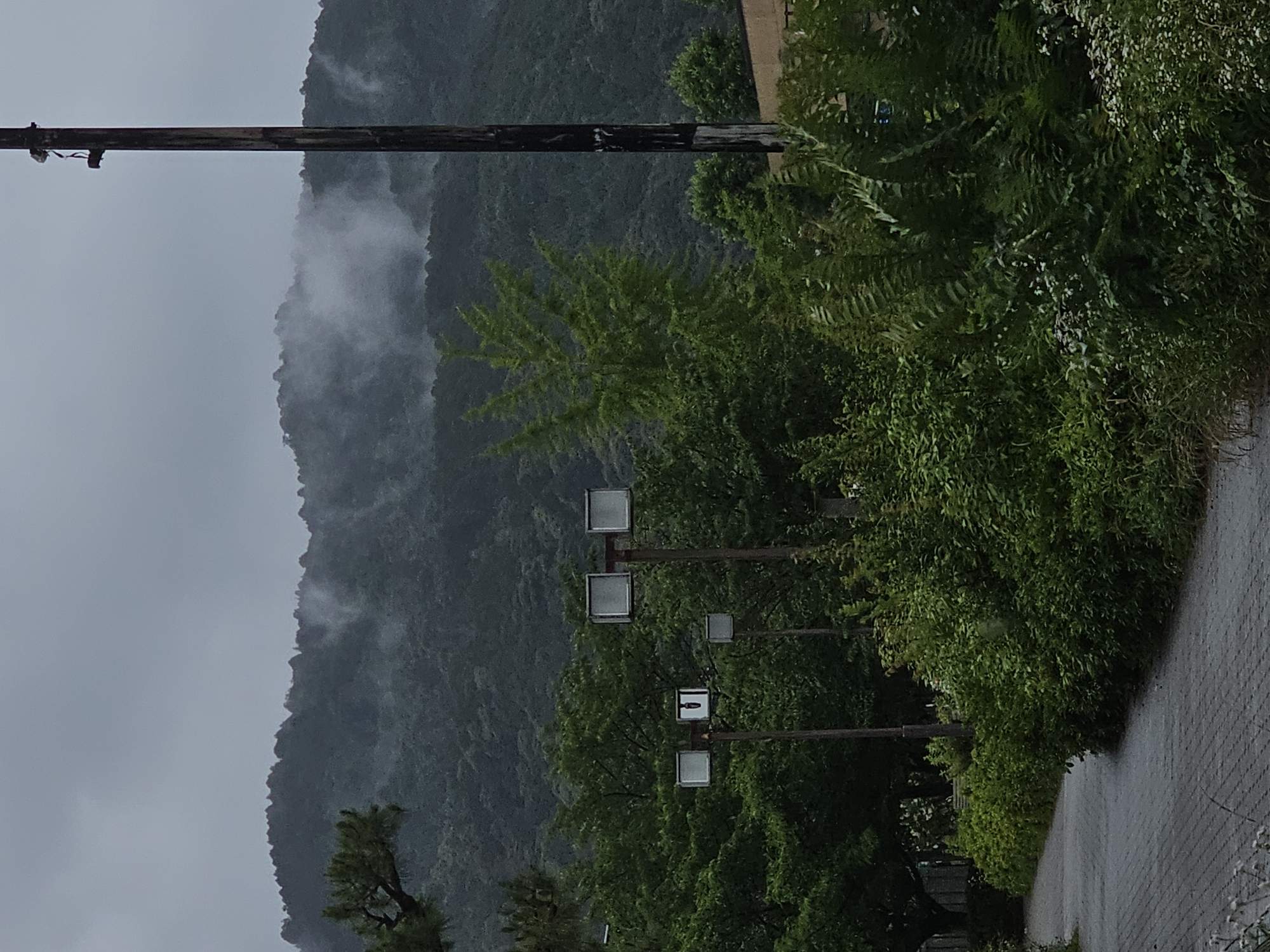
This image depicts a verdant, mountainous landscape in Kyoto, Japan, under an overcast and misty sky. The scene is likely a park or public pathway. In the background, a range of dark green, densely forested mountains is visible, partially enveloped by patches of white, low-hanging mist or clouds. The sky above is a uniform grey. The mid-ground features dense green foliage composed of various trees and bushes. Several dark poles with square, metallic floodlights are interspersed among the greenery. One of the central floodlights exhibits a dark, elongated insect, consistent with a large beetle or cicada, clinging to its underside. To the right, a tall, dark wooden utility pole stands prominently, marked with vertical white streaks on its lower section and equipped with some apparatus near its top. A light-green deciduous tree with distinctive fan-shaped leaves is situated to the left of this pole, while a darker green coniferous tree branch extends into the frame from the upper left. The foreground consists of a paved pathway made of grey rectangular pavers, curving from the lower right towards the lower left. The path is flanked by abundant, lush green bushes, ferns, and smaller plants. Small white wildflowers or weeds are visible along the immediate edge of the path in the lower-left corner. No people or other animals are present in the scene.
Kyoto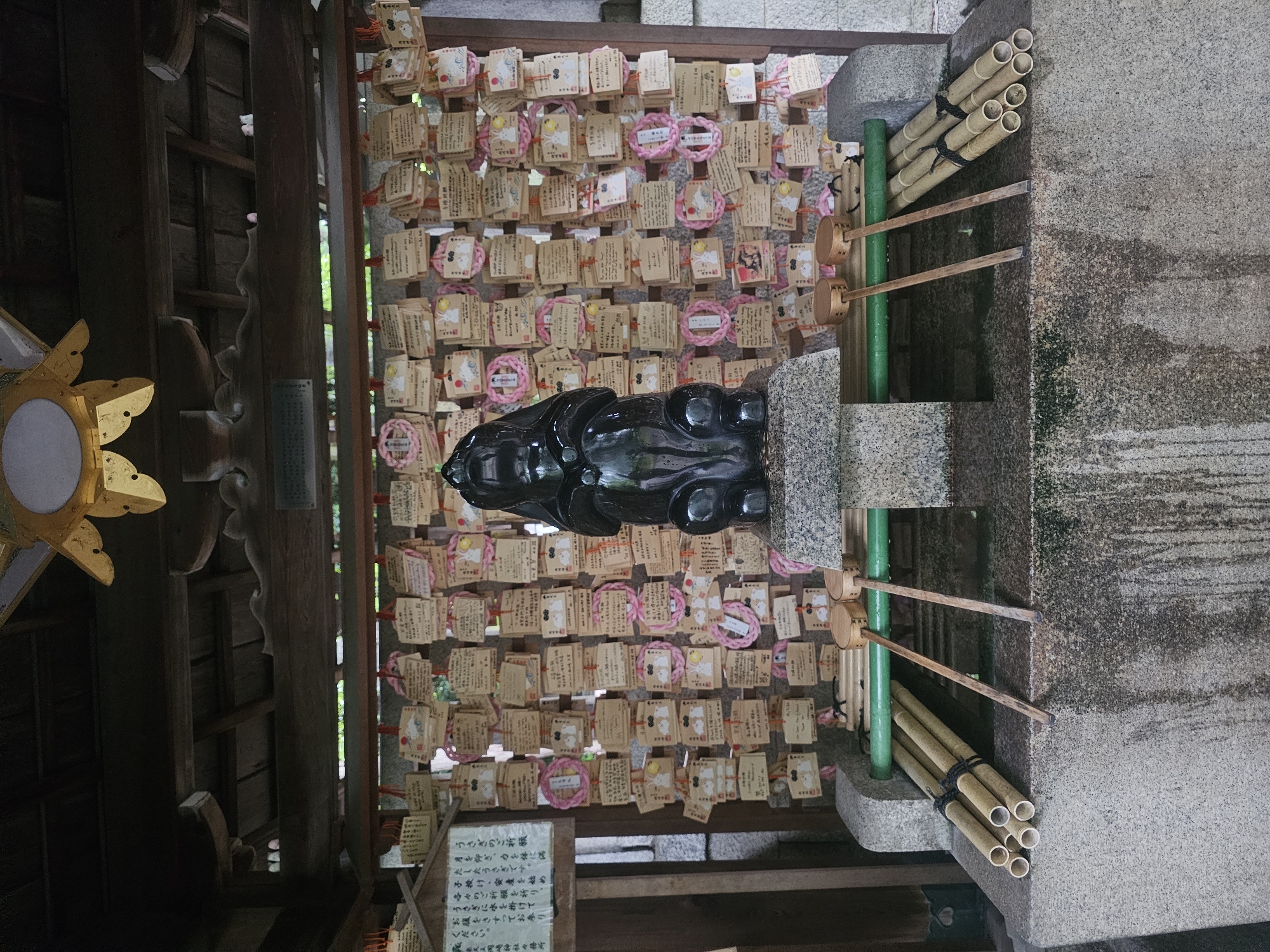
This image captures a purification area at Okazaki Shrine in Kyoto, Japan. Centrally positioned is a large, dark, glossy, stylized statue of an upright rabbit resting on a grey stone pedestal. Behind the statue, a wooden lattice wall is densely covered with numerous rectangular wooden votive tablets (ema), many featuring illustrations of two white rabbits enclosed within a pink circular rope design. A wooden sign on the left, written in Japanese, confirms the location as Okazaki Shrine and provides instructions for the ritual, indicating a wish-making process involving pouring water on the rabbit. In the foreground, a rectangular stone purification basin shows signs of water streaks and wear. Two wooden ladles (hishaku) with long handles are placed across a green pipe or channel extending into the basin. On either side of the basin, bundles of natural bamboo poles are stacked horizontally. Overhead, dark wooden architectural elements with exposed beams and carved details are visible. A golden, ornate ceiling fixture with a central circular light source is positioned at the top center of the frame. No individuals are present in the scene.
Kyoto
The video captures a view from inside a moving train, looking out a window. Initially, the reflection of the train's interior, including yellow handrails and ceiling lights, is visible. The train is moving rapidly, causing the exterior view to blur into streaks of color, showing reflections of people and advertisements. As the train slows down, the exterior becomes clearer. A green and white train on an adjacent track comes into view, its cars passing by the window. Yellow platform markings are visible on the ground between the two trains. The passing train's windows reflect the environment and show glimpses of its interior. The video ends with the train still moving past the other train.
Kyoto
The video captures a view from a moving train, looking out a window at the passing scenery on a cloudy or rainy day. Initially, the camera shows residential buildings, including a light-colored house with a dark roof. A fence and some vegetation are visible in the foreground. The train then passes by a building with a multi-level enclosure attached to its side, where a dog is briefly visible on the upper level, looking out. More residential buildings and fences appear, followed by a shot of a narrow canal or river running alongside a street. The water in the canal is still, reflecting the cloudy sky. Houses and green foliage line the banks of the canal. The video ends with the train continuing to move, revealing more of the urban landscape.
Kyoto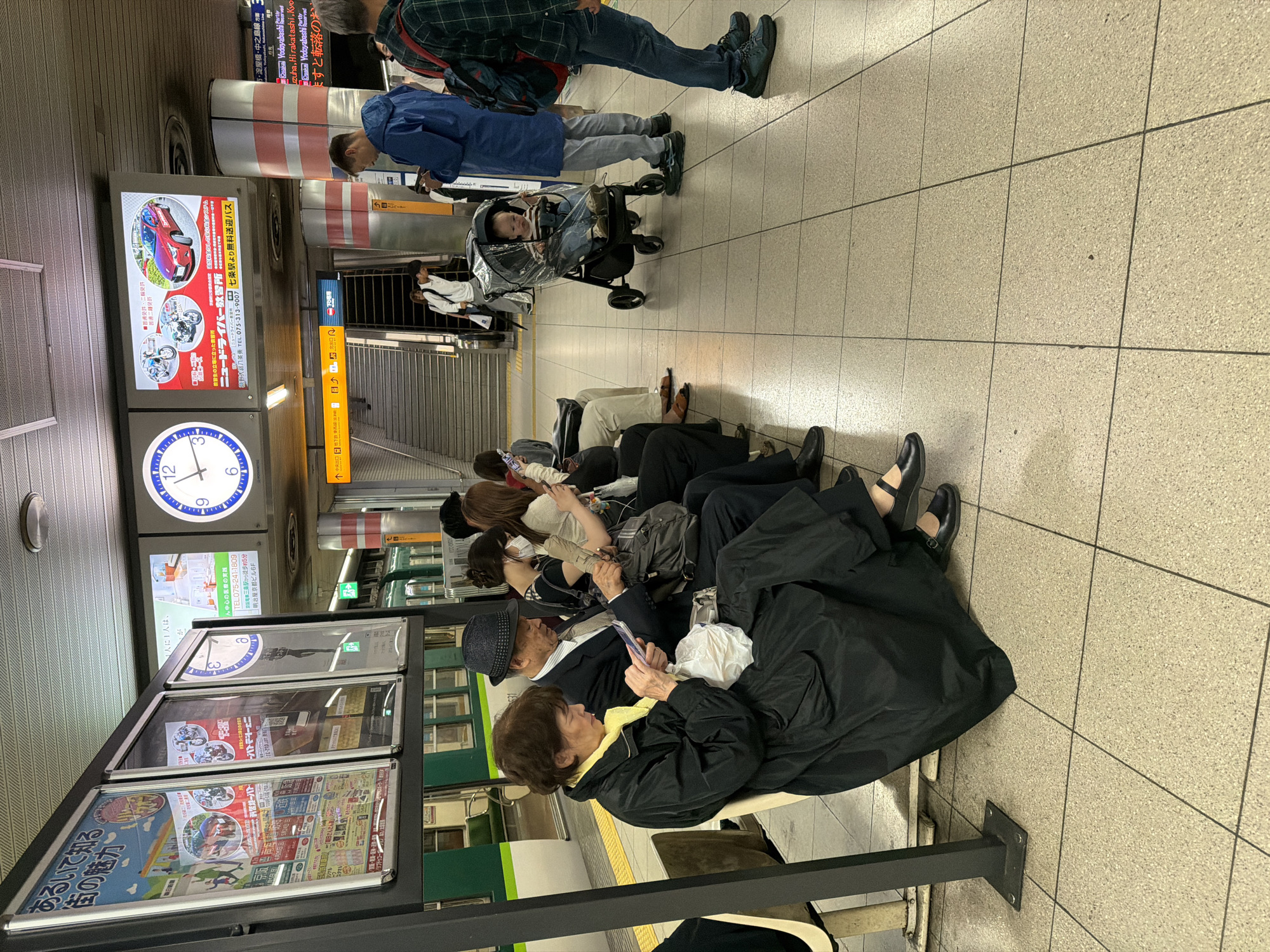
This image depicts an indoor subway station platform in Kyoto, Japan, identified by visible Japanese text and specific Kyoto references on posters. On the left, a green and white subway train is visible through the platform windows. In the foreground, a row of individuals is seated on a beige bench. An elderly East Asian woman, wearing a black coat and a yellow scarf, is seated, engrossed in her white smartphone. A white plastic bag rests on her lap. To her right, an elderly East Asian man, dressed in a dark suit, light tie, and a dark fedora hat, is also seated and looking at his smartphone. A dark messenger bag is placed on the floor beside him. Further to the right, two additional East Asian women are seated, both occupied with their smartphones; one wears a white face mask. In the middle of the tiled floor, a baby of indeterminate gender is positioned in a black stroller with a clear rain shield, looking towards the right. To the right of the stroller, a male, likely East Asian, wearing a blue hooded jacket and light grey pants, stands while viewing his smartphone. His feet are clad in dark athletic shoes. A male, likely East Asian, wearing a green and blue plaid shirt and carrying a dark backpack, is partially visible on the far right. The station ceiling is fitted with white panels and fluorescent lighting. Above the platform, a large analog clock with Roman numerals, indicating approximately 12:15 or 12:20, is mounted on the wall. To the right of the clock, two digital display screens are active; the left screen advertises a driving school with images of a red car and motorcycles, while the right screen displays an interior scene with Japanese text and a phone number. A green illuminated exit sign is visible below the digital screens. In the background, an escalator and a set of stairs lead upwards. A young East Asian male, wearing a white long-sleeved shirt and a black backpack, is seen ascending the stairs. Directional signage, featuring yellow and orange arrows, indicates "Exit" (出口) and "Subway" (地下鉄). The floor is covered with light beige-grey square tiles with dark grout lines. A cylindrical pillar with red and white stripes stands near the escalator.
Kyoto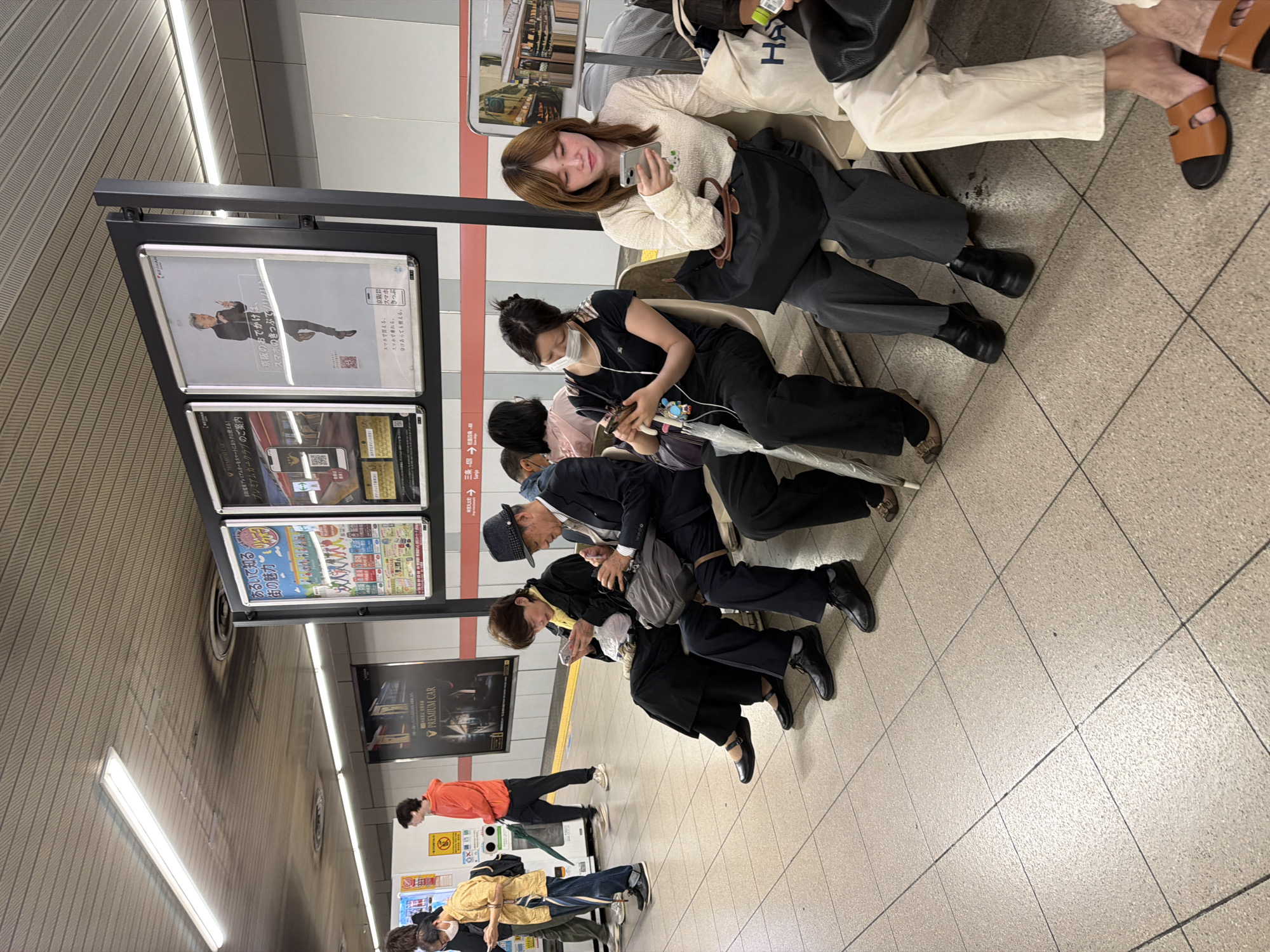
This image captures a subway or train station platform in Kyoto, Japan, identified by the "三条" (Sanjō) and "祇園四条" (Gion-Shijō) station names on a red and white sign below the advertisements, and "KEIHAN" branding on posters, indicating a Keihan Electric Railway line. The scene features seven individuals seated on a light-colored bench and two standing individuals on the left, all on a tiled platform. The ceiling is composed of light brown textured acoustic tiles with fluorescent strip lighting and some visible discoloration/stains. The walls feature a lower white section, a red horizontal stripe, and a darker gray upper section holding several illuminated advertising posters. From left to right, standing: 1. A man wearing a mustard yellow short-sleeved shirt over a green long-sleeved shirt, blue jeans, and black sneakers, with a dark backpack. He wears a white face mask and is looking down at his smartphone. 2. A man in an orange hoodie, dark pants, and light sneakers, standing further back and looking left. Behind them, a yellow and white vending machine and a multi-compartment white trash receptacle are visible. A dark green umbrella leans against the trash can. From left to right, seated on the bench: 1. A woman wearing a long black dress, black flat shoes, and a yellow scarf, intently looking at her smartphone. 2. An elderly man in a dark suit, white shirt, patterned tie, dark fedora-style hat, and black dress shoes. He holds a dark gray shoulder bag on his lap and is focused on his smartphone. 3. A woman wearing a black short-sleeved top, black pants, and a white face mask. She has a dark purple shoulder bag and a white folded umbrella leaning against her leg, and is looking at her smartphone. A colorful charm is attached to her phone. 4. A woman wearing a textured cream-colored long-sleeved top and dark gray pants. A black tote bag rests in front of her. She is engrossed in her smartphone. 5. Partially visible on the far right, a person wearing light cream-colored loose pants and brown leather sandals. A white canvas tote bag with "HA" visible is beside them, and a green packet (possibly containing tea or snacks) is on their lap. The floor is made of light beige square tiles with dark grout lines. All seated individuals, except the partially visible person on the far right, are actively engaged with their smartphones. No direct interaction
Kyoto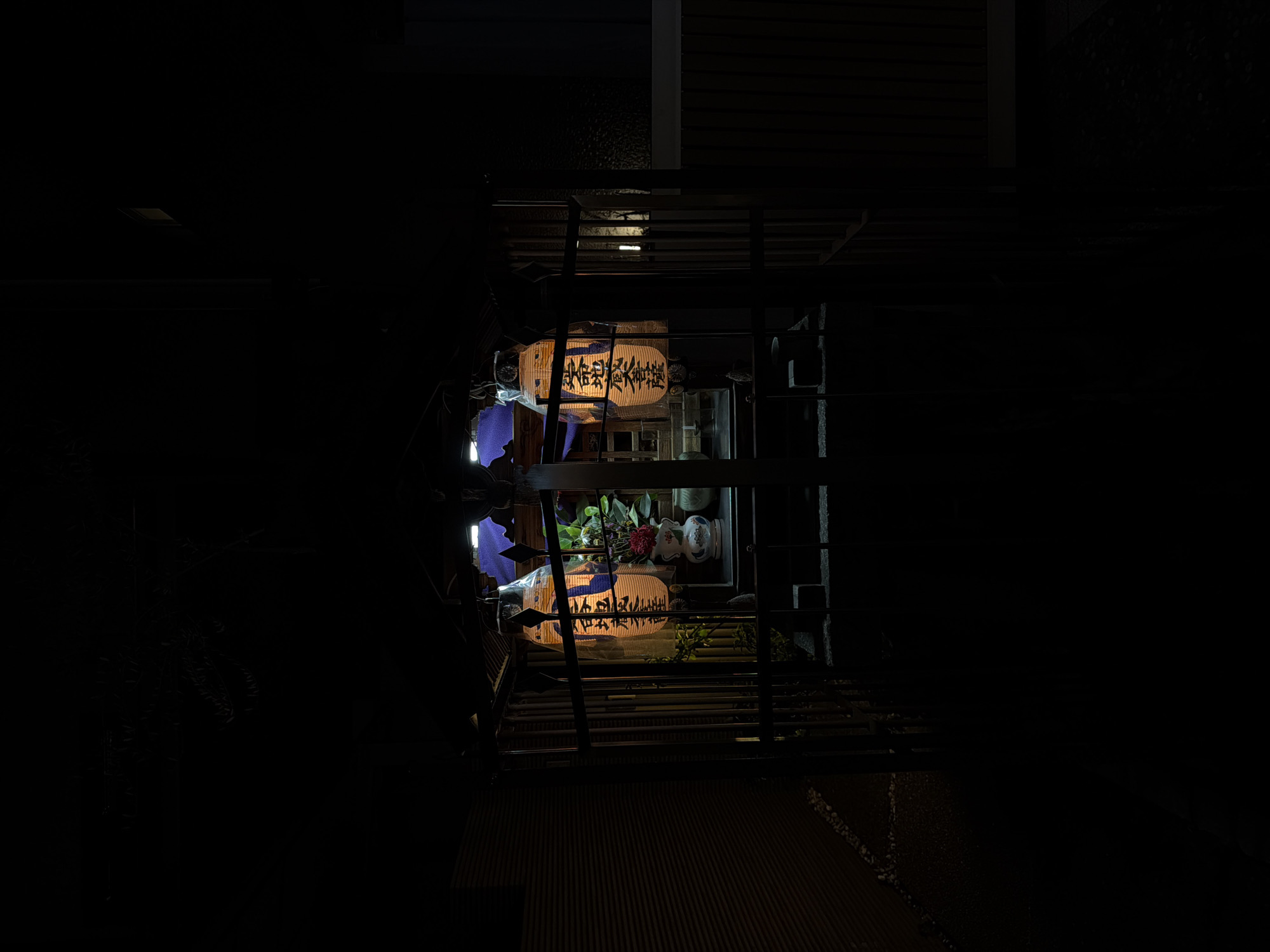
This nighttime image depicts a small, traditional Japanese Jizo shrine situated on a dark street in Kyoto, Japan. The shrine, enclosed by a dark metal or wooden gate with vertical bars, is the sole illuminated subject in the frame. Two prominent, cylindrical, cream-colored paper lanterns (chochin or andon) hang within the shrine, providing the primary light source with a warm, yellowish glow. Both lanterns feature vertical Japanese calligraphy in black ink; the right lantern clearly displays "延命地蔵菩薩" (Enmei Jizo Bosatsu), signifying "Longevity Jizo Bodhisattva." Behind the lanterns, within the shrine's interior, an altar is visible, adorned with at least one white ceramic vase containing a red flower and green foliage. A subtle blue light emanates from the upper interior of the shrine, possibly from a light source or a blue element like a roof or cloth. To the left of the shrine, a dark, textured wall or fence, possibly corrugated metal or bamboo, extends into the darkness. The ground in the foreground and on the sides appears to be dark gravel or small stones. To the right, a dark, indistinct building facade with a subtle texture is visible. No individuals are present in the scene. The overall environment suggests a quiet residential street or alley.
Kyoto
A woman in a burgundy top with long dark hair is seated at a table and eats a dumpling. She holds the dumpling with her fingers, bites into it, and then chews. A plate of dumplings and a bowl of noodles are on the table. In the background, there's a refrigerator with bottles and jars, and a wall with painted illustrations.
Kyoto
A male chef wearing a black cap, white mask, white shirt, and white apron is working in a commercial kitchen. He reaches up to a stainless steel shelf, retrieves a small blue-patterned bowl, and then uses a long-handled ladle to scoop liquid from a large metal pot on a stove into the bowl. The kitchen features stainless steel surfaces, a ventilation hood, and various kitchen equipment. In the foreground, a wooden counter separates the kitchen area from what appears to be a dining or service area, with patterned wallpaper below the counter.
Kyoto
A man in a black cap, white shirt, and white apron is cooking noodles in a kitchen. He uses a long wooden stick to stir the noodles in a pot of boiling water. He then uses a metal strainer to remove the noodles from the pot and places them in a metal bowl. He rinses the noodles with water from a tap. The kitchen has stainless steel counters and appliances, including a large pot on the left, a range hood above the cooking area, and a wooden cutting board in the foreground.
Kyoto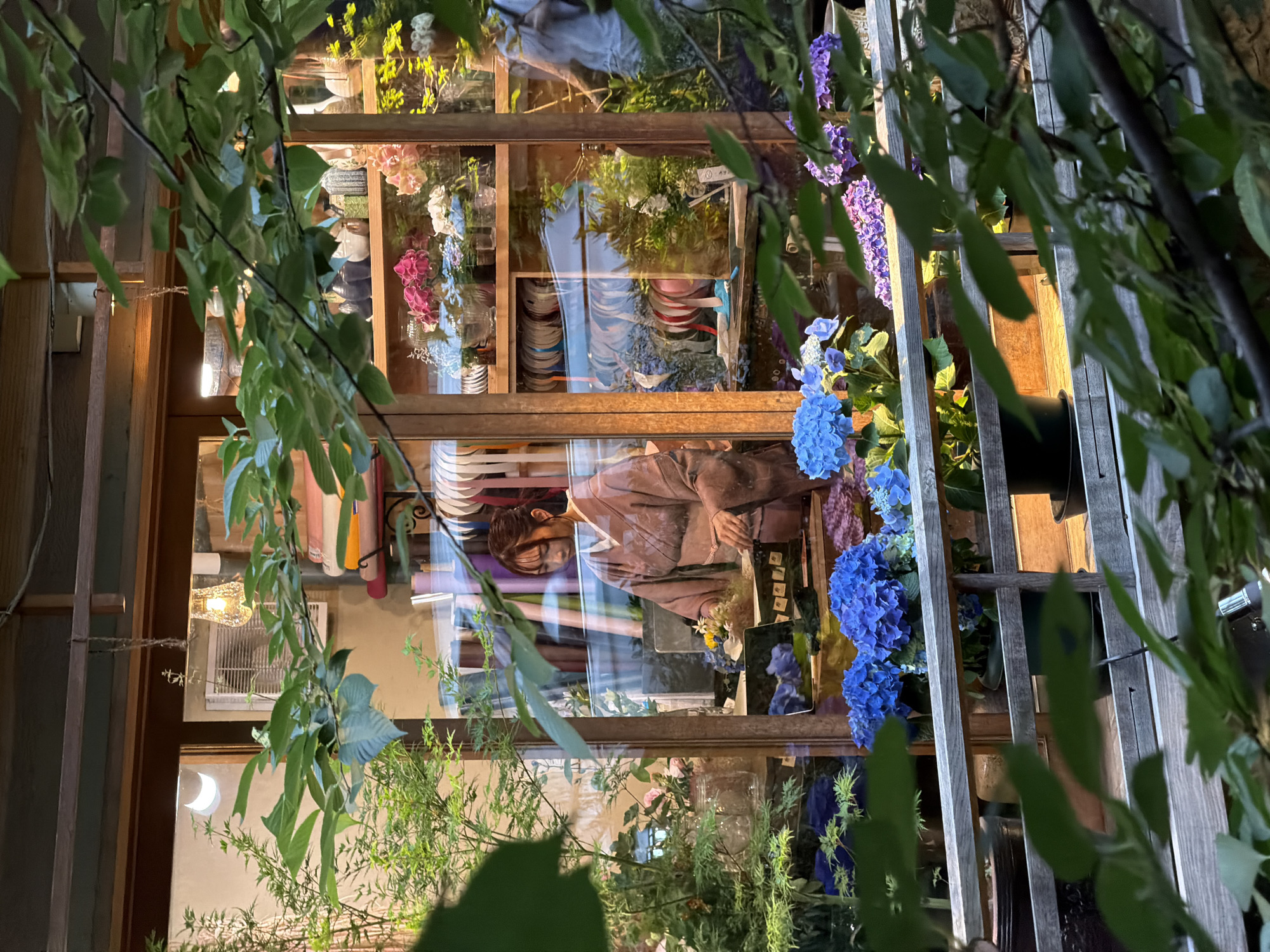
This image depicts the storefront of a flower or craft shop, likely located in Kyoto, Japan, observed through dense, blurred foreground foliage. Inside the illuminated shop, a young East Asian woman with dark hair, wearing a light brown or mauve kimono with an obi, stands behind a wooden counter. She is actively engaged, looking down at items on the counter, with her hands positioned as if arranging or working with them. An open laptop or tablet displaying blue flowers is visible on the counter beside several small, dark boxes. The shop's interior features wooden shelving stocked with numerous spools of colorful ribbons on lower shelves and various floral arrangements in clear vases on upper shelves. Specific flower types include pink and white orchids or similar blooms. A small, white wall-mounted air conditioning unit is visible above the counter. An ornate, textured glass pendant lamp hangs from the ceiling, casting warm light. In the rightmost window pane, a blurred reflection of a person in a light-colored top is visible. Outside the shop window, on a light-colored wooden railing, pots of vibrant blue and purple hydrangeas are prominently displayed. Additional green potted plants are present on the railing and in the outdoor space to the left. The scene suggests dusk or evening due to the illuminated interior contrasting with the external ambient light. The cultural attire of the woman and the shop's aesthetic align with common visual characteristics of Japan.
Kyoto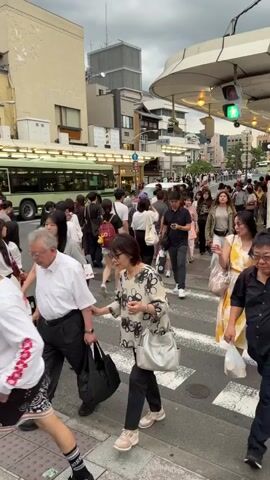
A medium shot shows a busy street crossing with many people walking across the street. The camera is positioned low, capturing the torsos and legs of the pedestrians. An older man in a white shirt and dark pants walks on the left with a cane and a black bag. A woman in a floral top and black pants walks beside him, carrying a light gray handbag. In the middle of the frame, a man in a black polo shirt and dark pants with a smartphone in hand walks while looking at the camera. In the background, a green bus and a red taxi are visible. People are moving in different directions, crossing the street. The weather appears overcast, and buildings line the street in the background.
Kyoto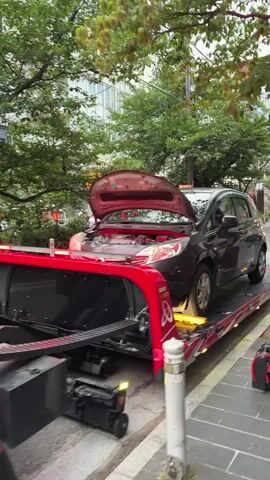
A black car with its hood open is being loaded onto a red flatbed tow truck from the front. The car is partially on the flatbed, and its front wheels are secured with yellow chocks. The tow truck has a red cab and a black flatbed with a textured surface for traction. The scene takes place outdoors on a paved surface next to a sidewalk. Trees and buildings are visible in the background. The sky is overcast, suggesting it might be an early morning, late afternoon, or cloudy day.
Kyoto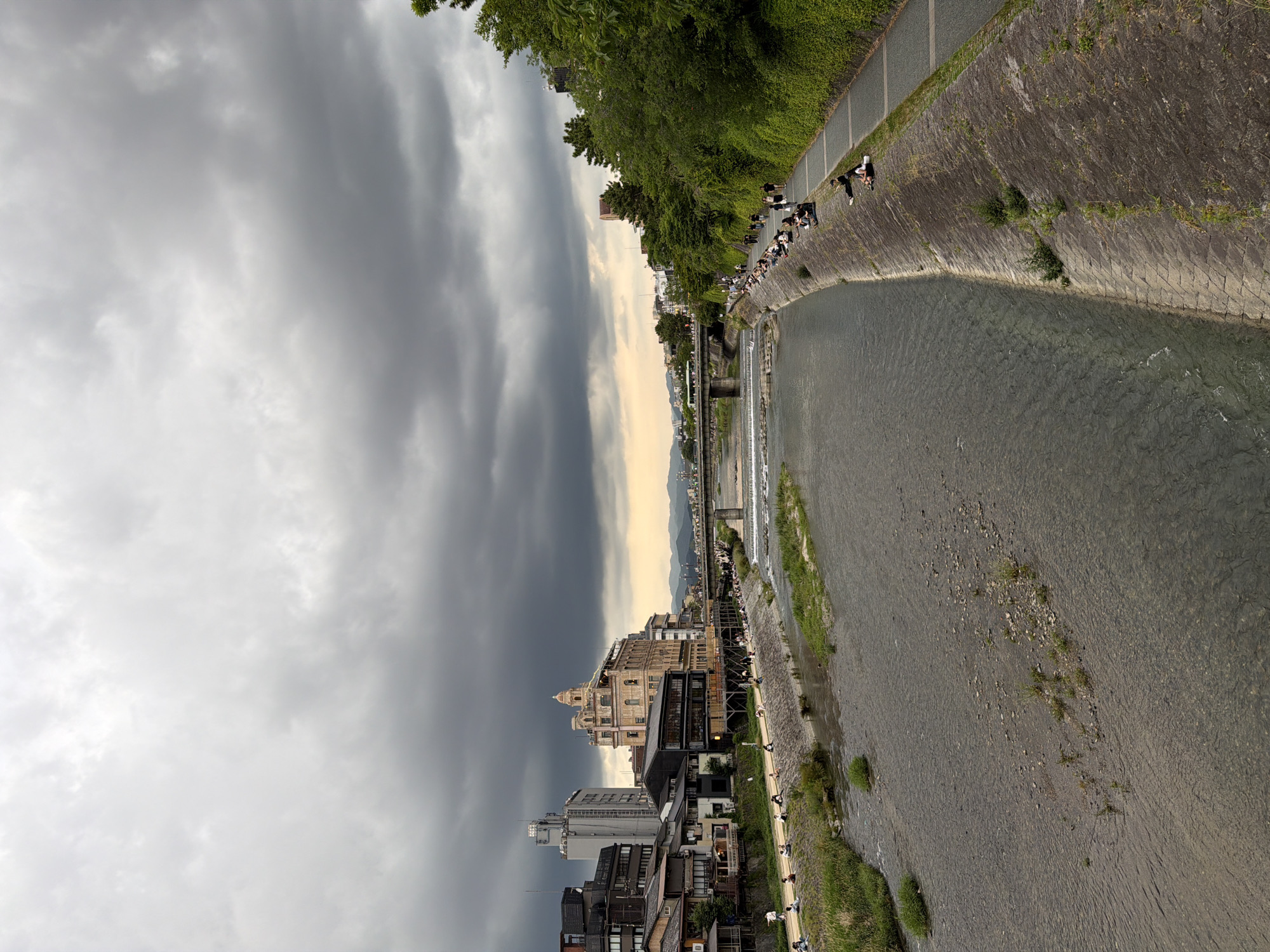
This image depicts a wide view of the Kamo River (Kamo-gawa) in Kyoto, Japan, under a heavily overcast sky. The upper two-thirds of the frame are dominated by a dense, dark grey cloud cover, with a narrow band of lighter, yellowish-grey sky visible low on the horizon in the background. The Kamo River flows from the background towards the foreground, occupying the lower third of the image. The water is a muted greenish-grey, with visible ripples and a shallow, rocky riverbed, particularly in the middle distance where small clusters of green vegetation grow directly from the riverbed. On the left bank (west bank), a paved pedestrian path runs parallel to the river. Between the path and the river's edge is a sloped, grassy embankment where approximately 20-30 individuals are seated or walking. Beyond the path, a dense array of buildings lines the river. Closer to the foreground are several traditional-style Japanese buildings with dark roofs and visible wooden elements. In the mid-ground, a prominent, ornate, light brown multi-story building with a distinctive domed roof and classical architectural features stands out. Further back, taller, more modern grey buildings are visible. A multi-arched concrete bridge spans the river in the far distance on this side. On the right bank (east bank), a steep concrete retaining wall descends to the river. Above this wall, a paved pedestrian pathway runs parallel to the river. Approximately 25-35 individuals are scattered along this path and on the sloped, grassy verge next to the concrete wall, mostly seated. Behind the pathway, a continuous and dense wall of dark green trees and shrubs forms a natural barrier, obscuring any structures beyond it. The same multi-arched concrete bridge is visible in the mid-ground, connecting to this bank. The people visible on both banks are casually dressed and appear to be engaged in leisure activities such as relaxing by the river. The overall scene suggests a late afternoon or early evening setting due to the low light and cloud conditions.
Kyoto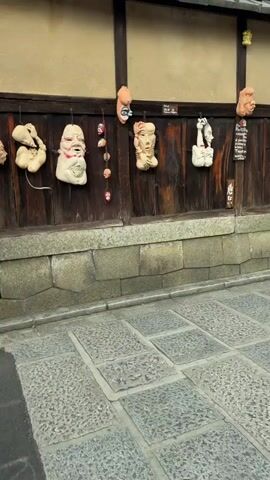
The video shows a street scene in Japan. The first shot is of a traditional wooden building with several decorative masks hanging on its exterior. The camera then pans to two women walking away from the camera, dressed in traditional Japanese kimonos. The woman on the left is wearing a light pink kimono with a ruffled obi, and the woman on the right is wearing a dark blue kimono with a floral pattern and a light-colored obi, carrying a white handbag. In the background, other people are visible, and a multi-tiered pagoda structure can be seen above the buildings. The camera then briefly shows more traditional Japanese architecture before returning to the wooden building with the masks. The masks are varied in size and design, some resembling distorted human faces, others more abstract. They are attached to the wooden wall with strings or hooks.
Kyoto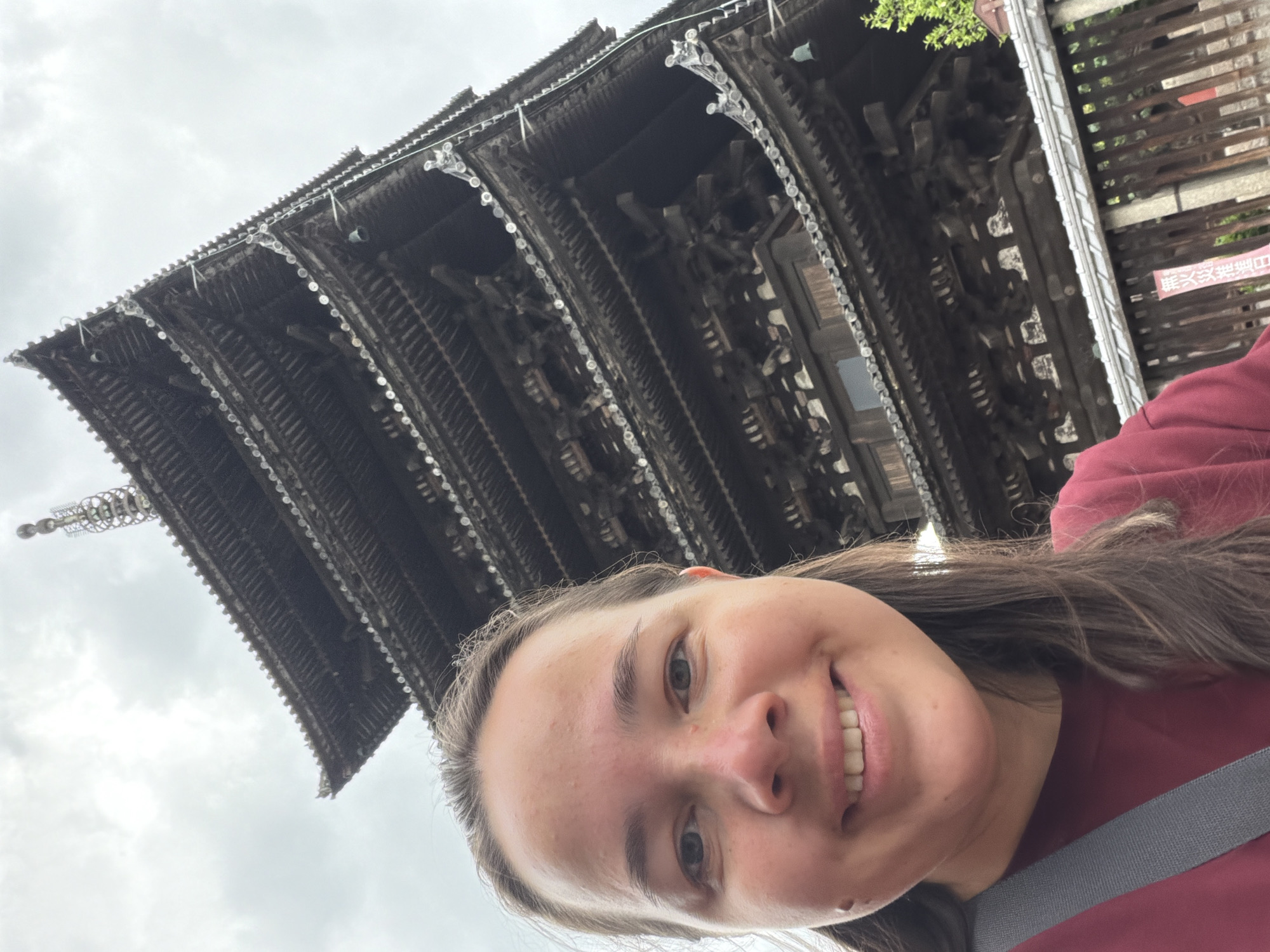
The image displays a female subject positioned in the left foreground, smiling directly at the camera. She has light skin, long brown hair, and is wearing a maroon long-sleeved shirt with a gray strap diagonally across her chest. The background is dominated by the Goju-no-to (Five-story Pagoda) of To-ji Temple, located in Minami Ward, Kyoto, Japan. The pagoda is constructed of dark wood, featuring multiple tiers with prominent eaves and a slender finial at its apex. The sky above is overcast. In the lower right, a section of a traditional wooden fence is visible, behind which a red and white banner with Japanese text and some green foliage can be seen.
Kyoto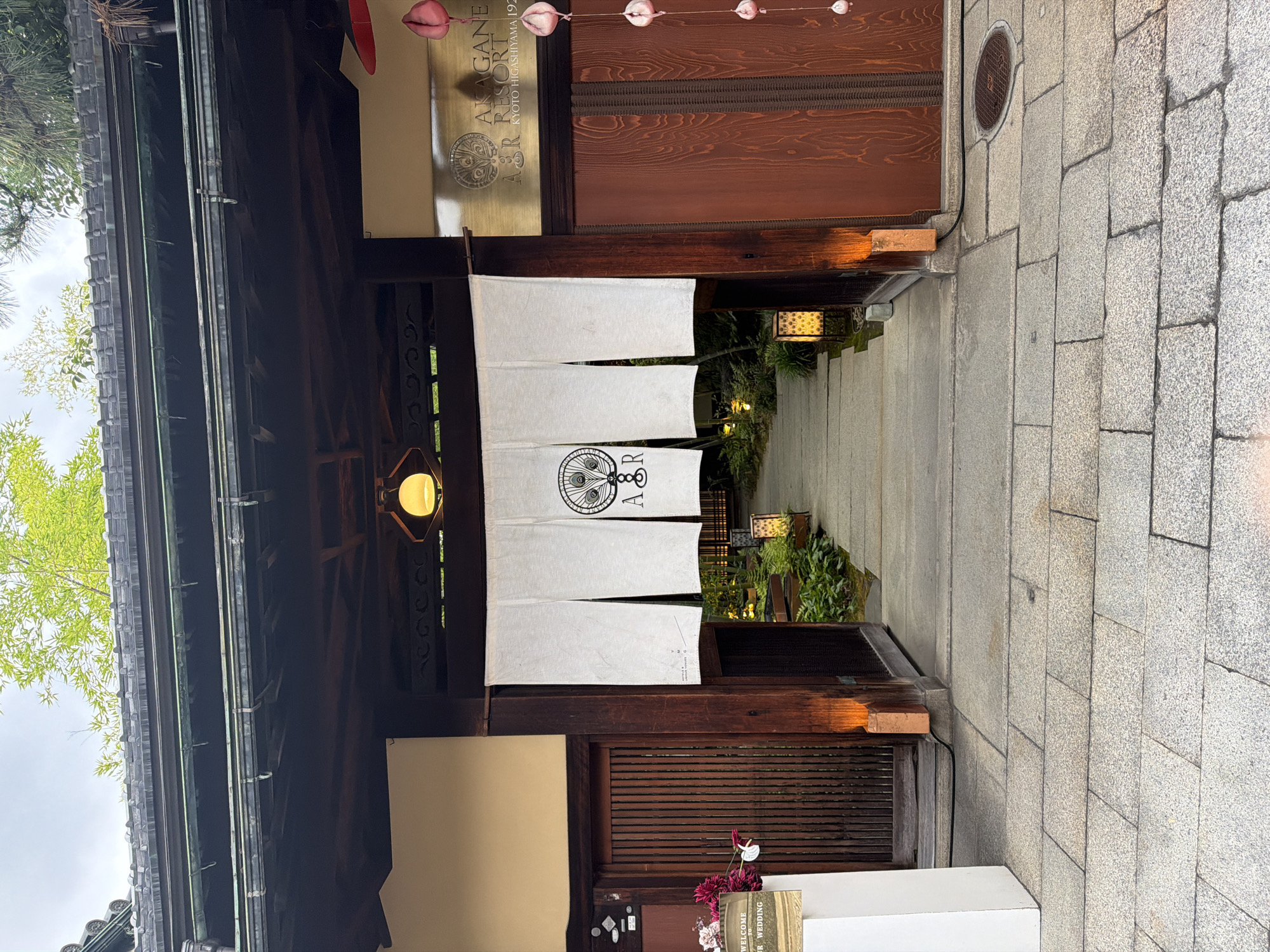
The image presents the main entrance to Akagane Resort, located in Kyoto, Higashiyama, Japan. The entrance is framed by a traditional Japanese wooden structure featuring dark brown pillars and beams, surmounted by a grey tiled roof with exposed gutters. A prominent white fabric "noren" curtain, split into four panels, hangs centrally in the open doorway, displaying a black circular logo with an "A&R" monogram and a stylized peacock feather motif. Above the noren, a single yellow spherical lantern is suspended within an octagonal wooden frame. To the right of the entrance, a horizontal gold-toned sign is mounted above a dark wooden panel, clearly stating "AKAGANE RESORT KYOTO HIGASHIYAMA 1928" alongside the "A&R" logo. A string of pink, multi-lobed decorative ornaments hangs vertically from the right side of the entrance structure. On the left side, a partially visible white sign with black text reads "WELCOME TO OUR WEDDING," positioned next to a small arrangement of dark red flowers. The forecourt leading to the entrance is paved with irregular grey stone blocks. A stone pathway extends beyond the threshold into a meticulously maintained garden, visible through the open entrance. This garden is lush with various green foliage, including tall bamboo, and is illuminated by two square, patterned ground lanterns positioned along the pathway. The background reveals an overcast sky and the upper parts of green trees. No people are visible in the scene. A circular metal manhole cover is present on the paved ground to the lower right.
Kyoto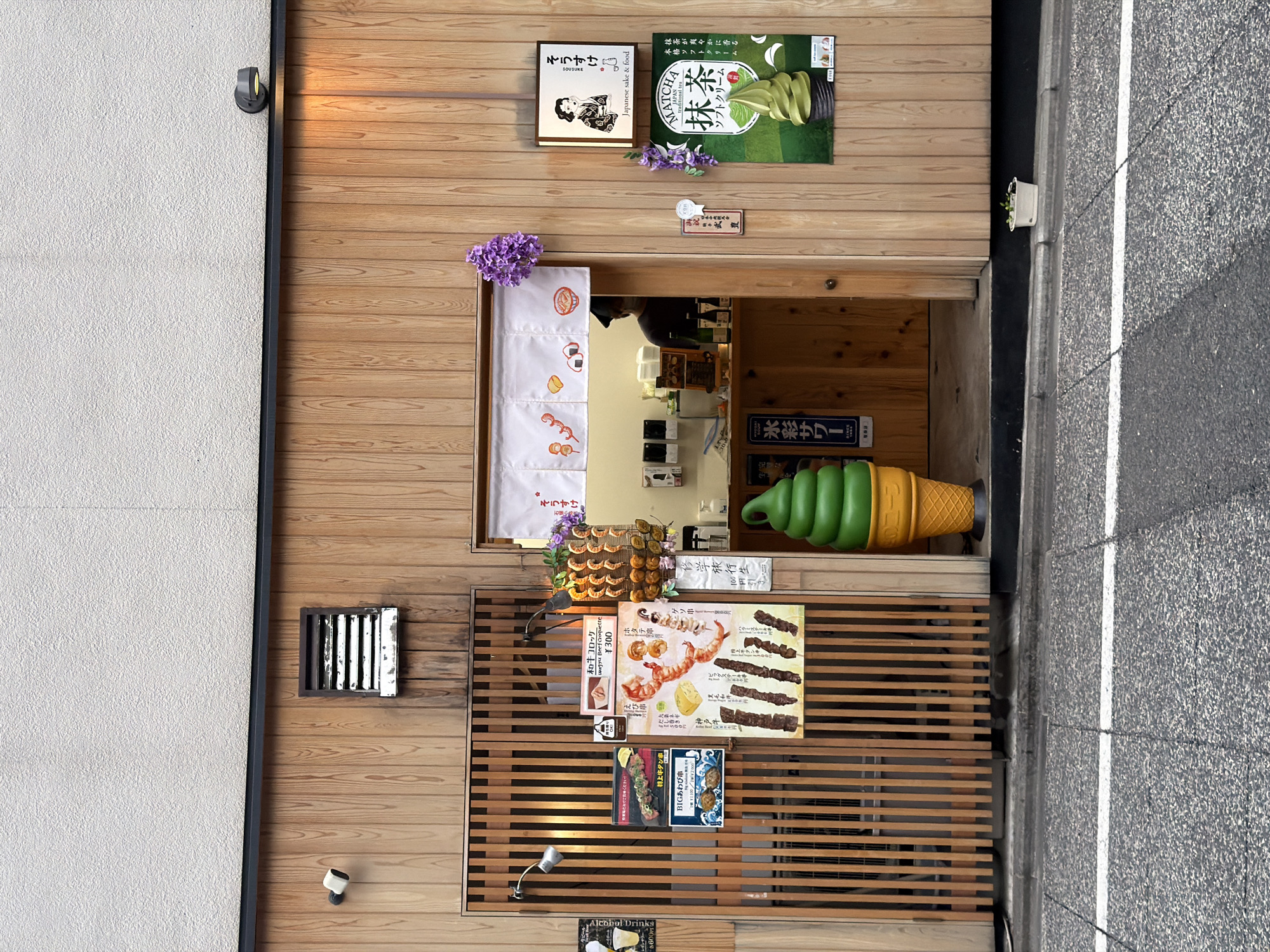
This is a street-level, full-frame photograph of a Japanese storefront, specifically a food and beverage establishment, in Kyoto, Japan. The scene depicts the facade of a building predominantly clad in light-colored vertical wooden planks. Above the wooden facade, the upper portion of the building presents a textured, off-white or light gray stucco wall, separated by a thin, dark horizontal band. On the far left of the wooden facade, a white security camera is mounted near the top. Below it, a vertical wooden slatted panel, appearing to be a partially open shutter or decorative screen, features a silver spotlight directed downwards. Adjacent to this, a cluster of posters is affixed to the wooden wall. These include a partially visible "ALCOHOL DRINK" sign, a poster advertising "BIG あわび" (abalone) with pricing, and another showcasing "特上牛串" (premium beef skewers). The most prominent poster in this section displays various skewers such as shrimp, scallops ("ホタテ串"), different cuts of meat, and cheese, alongside text mentioning "和牛コロッケ" (Wagyu Beef Croquette) for ¥300 and "神戶牛" (Kobe Beef). Towards the center, an open doorway reveals a counter inside the establishment. A person, partially visible from the back and wearing a dark cap, is behind the counter. A white 'noren' curtain, decorated with simple red illustrations of food items like dango (sweet dumplings) and onigiri (rice balls), hangs above the entrance. Clusters of artificial purple wisteria flowers adorn both sides of the 'noren'. To the right of the entrance, the wooden facade continues. A framed sign features a stylized black-and-white illustration of a Japanese woman and the text "そうすけ SOSUKE Japanese sake & food". Below this, a large, vibrant green poster advertises "MATCHA JAPAN traditional tea 抹茶 ソフトクリーム" (Matcha Soft Cream), showcasing a photorealistic image of green soft-serve ice cream in a black cup, and explicitly mentioning "宇治抹茶" (Uji Matcha), a renowned type of matcha from Kyoto Prefecture. Another cluster of artificial purple wisteria flowers hangs near this poster. A dark, modern outdoor light fixture is mounted on the upper right wooden wall, casting a warm yellow light. A large, three-dimensional statue of a green soft-serve ice cream cone, with a yellow waffle cone base marked with Japanese text ("抹茶のコーン"), stands on the sidewalk in front of the shop entrance, to the left of the doorway. It serves as a prominent visual advertisement. The ground consists of a gray asphalt sidewalk with a distinct white painted line running horizontally
Kyoto