Lộc Quý, Vietnam
30 memories from Lộc Quý, Vietnam
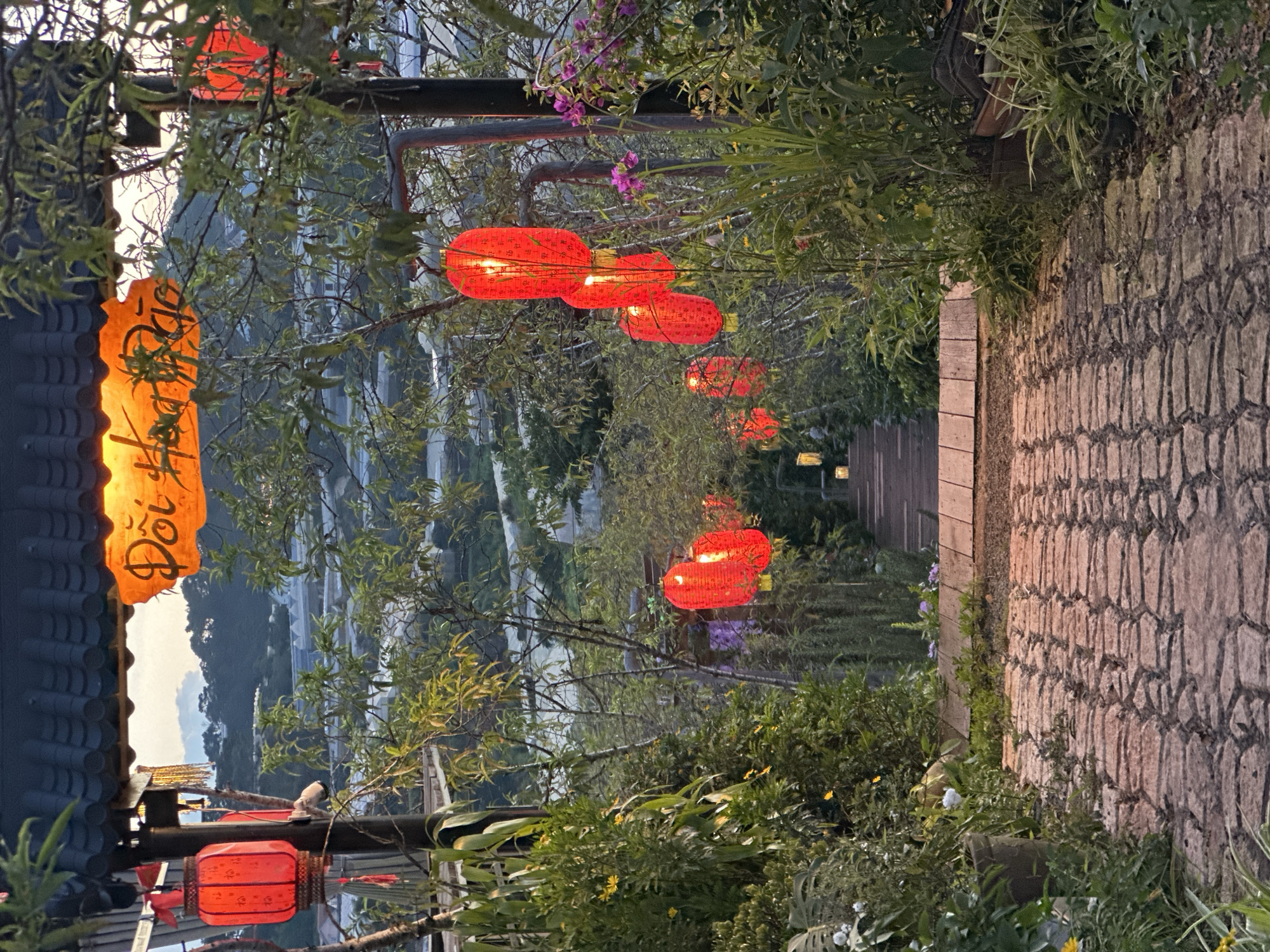
The image depicts a pathway lined with lush greenery and adorned with numerous red paper lanterns, creating a festive and inviting atmosphere. The pathway itself is paved with rough-hewn stones, suggesting an outdoor, perhaps rustic, setting. In the background, a valley unfolds with terraced landscapes, possibly rice paddies or tea plantations, hinting at a rural or mountainous region. The scene is illuminated by the warm glow of the lanterns, indicating that it is either dusk or evening. The lighting from the lanterns casts a soft, ambient light, and some are visibly lit from within. To the left of the image, a traditional-looking roofline with dark tiles is visible, and an illuminated orange paper lantern with handwritten text hangs from it. The text is in an Asian script, likely Vietnamese given the location context of Lộc Quý, Vietnam. The overall mood is serene and tranquil, with a touch of cultural charm. The time of day is suggested by the soft light and the illuminated lanterns, likely sunset or early evening. The vegetation is abundant, with trees and bushes framing the pathway and lanterns. There are no people visible in the image. The setting appears to be a scenic outdoor space, possibly a garden, a restaurant, or a pathway leading to a scenic viewpoint.
Lộc Quý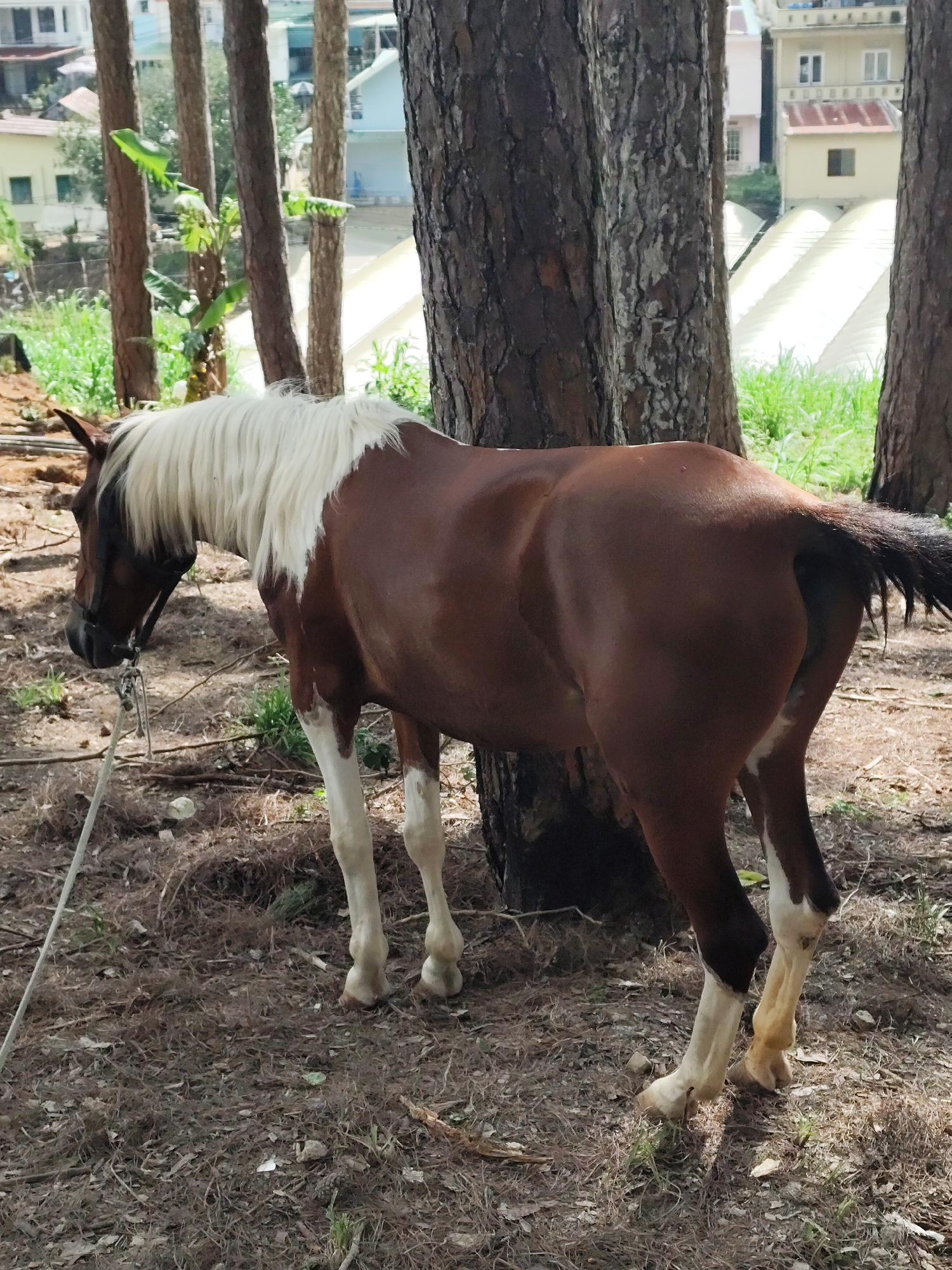
A brown and white horse stands in a wooded area with pine trees. The horse is facing left, with its head lowered. A rope is tied to the horse's bridle and extends to the left. In the background, there are buildings and lush greenery, suggesting a rural or semi-rural setting. The ground is covered in dry leaves and pine needles. The image appears to have been taken in the city of Lộc Quý, Vietnam, given the presence of pine trees common in some mountainous regions of Vietnam.
Lộc Quý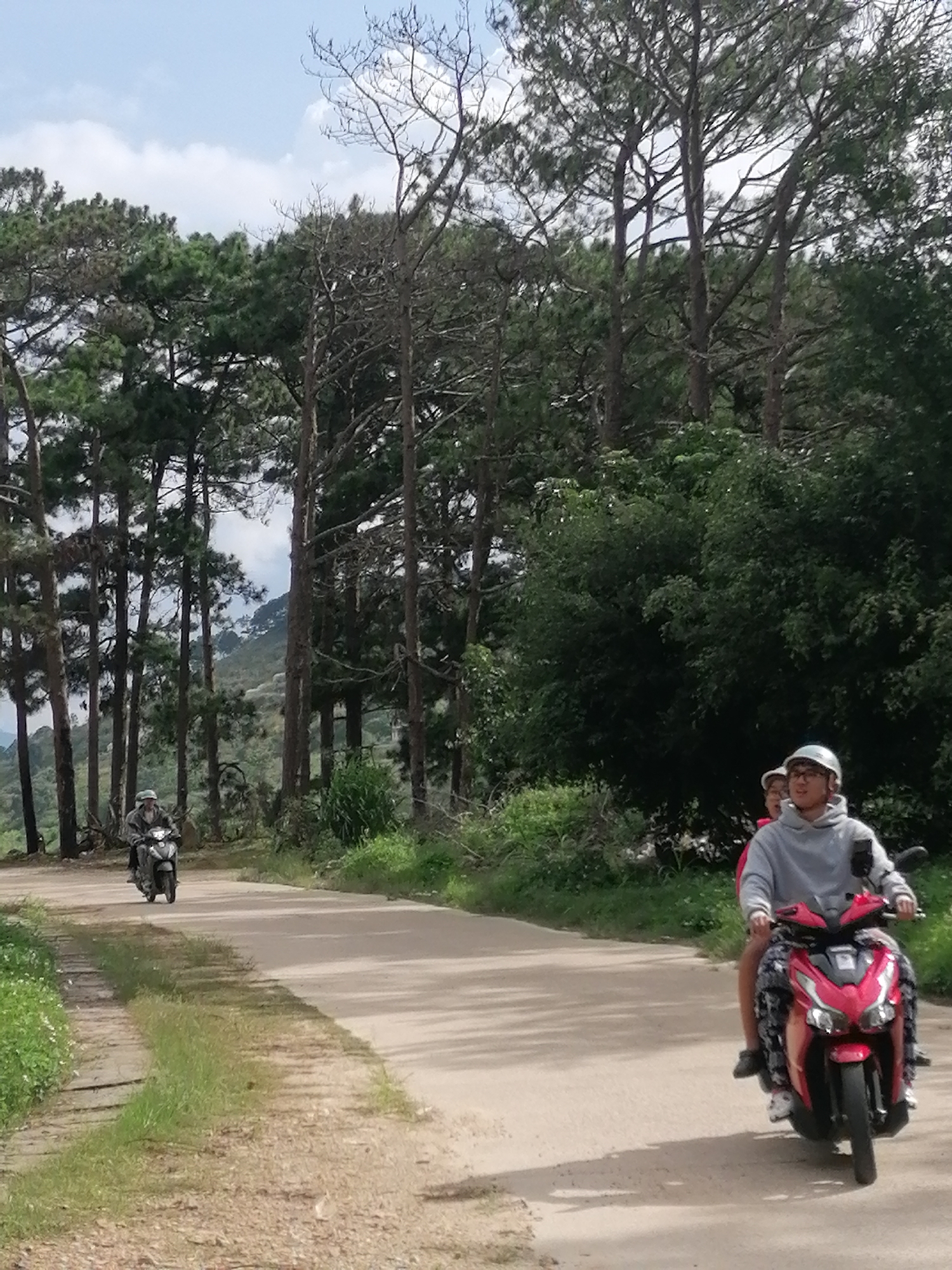
A dirt road with a paved section runs through a forested area with tall pine trees. Two motorcycles are visible. The first motorcycle, ridden by a person in a helmet and light-colored jacket, is further up the road on the paved section. The second motorcycle, a red and black scooter, is closer to the foreground and carries two people wearing helmets. The person in front is wearing a grey hoodie, and the person behind is wearing a pink top and patterned leggings. Both are looking forward. The environment is natural, with dense green foliage and clear skies. The scene appears to be a scenic route in Lộc Quý, Vietnam.
Lộc Quý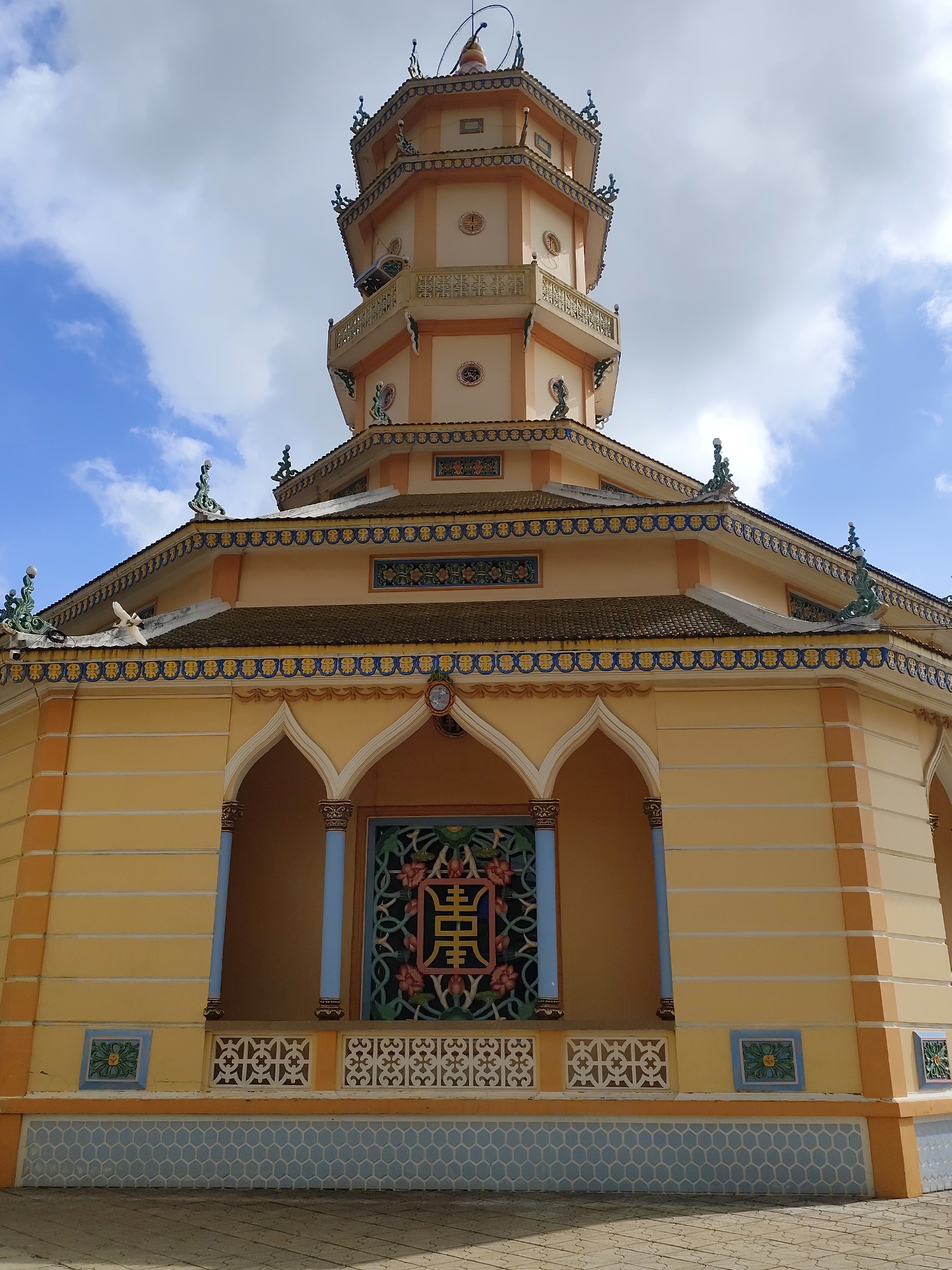
The image shows a low-angle shot of a yellow, multi-tiered pagoda with ornate architectural details. The pagoda has a pointed roof with decorative figurines and intricate trim along its edges. The facade features arched openings with colorful latticework and columns. A large, square window with a central Chinese character in a decorative frame is visible. The building is set against a backdrop of a bright blue sky with scattered white clouds. The ground in front of the pagoda is paved with square tiles. The pagoda appears to be located in a town or city, possibly a place of worship, given its design and scale. It is likely the Minh Tinh Pagoda in Lộc Quý, Vietnam, known for its distinct architecture.
Lộc Quý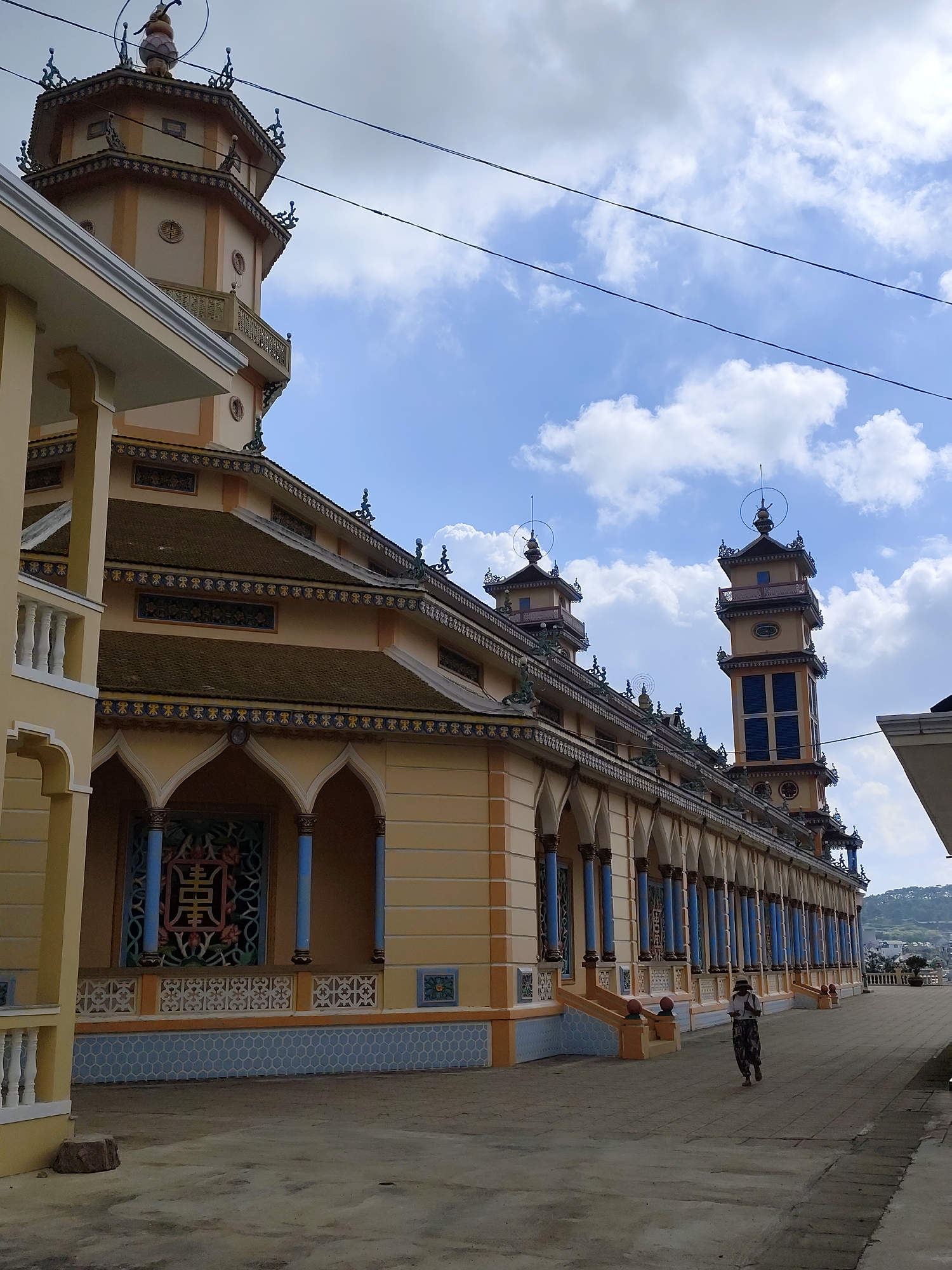
The image captures the exterior of a large, ornate yellow building with a distinct architectural style, likely a temple or pagoda, in Lộc Quý, Vietnam. The structure features multiple tiered roofs adorned with intricate decorative elements and multiple towers, one of which is tall and rectangular with blue window-like panels, while another is octagonal. The building is lined with a colonnade of blue-topped pillars supporting arched openings. Decorative screens and patterned tiles are visible on the facade. The ground in front of the building is paved. A single person, wearing a hat and patterned clothing, is walking away from the camera along the paved area. The sky is blue with scattered white clouds, and power lines are visible overhead. In the background, a hillside with scattered buildings and trees can be observed.
Lộc Quý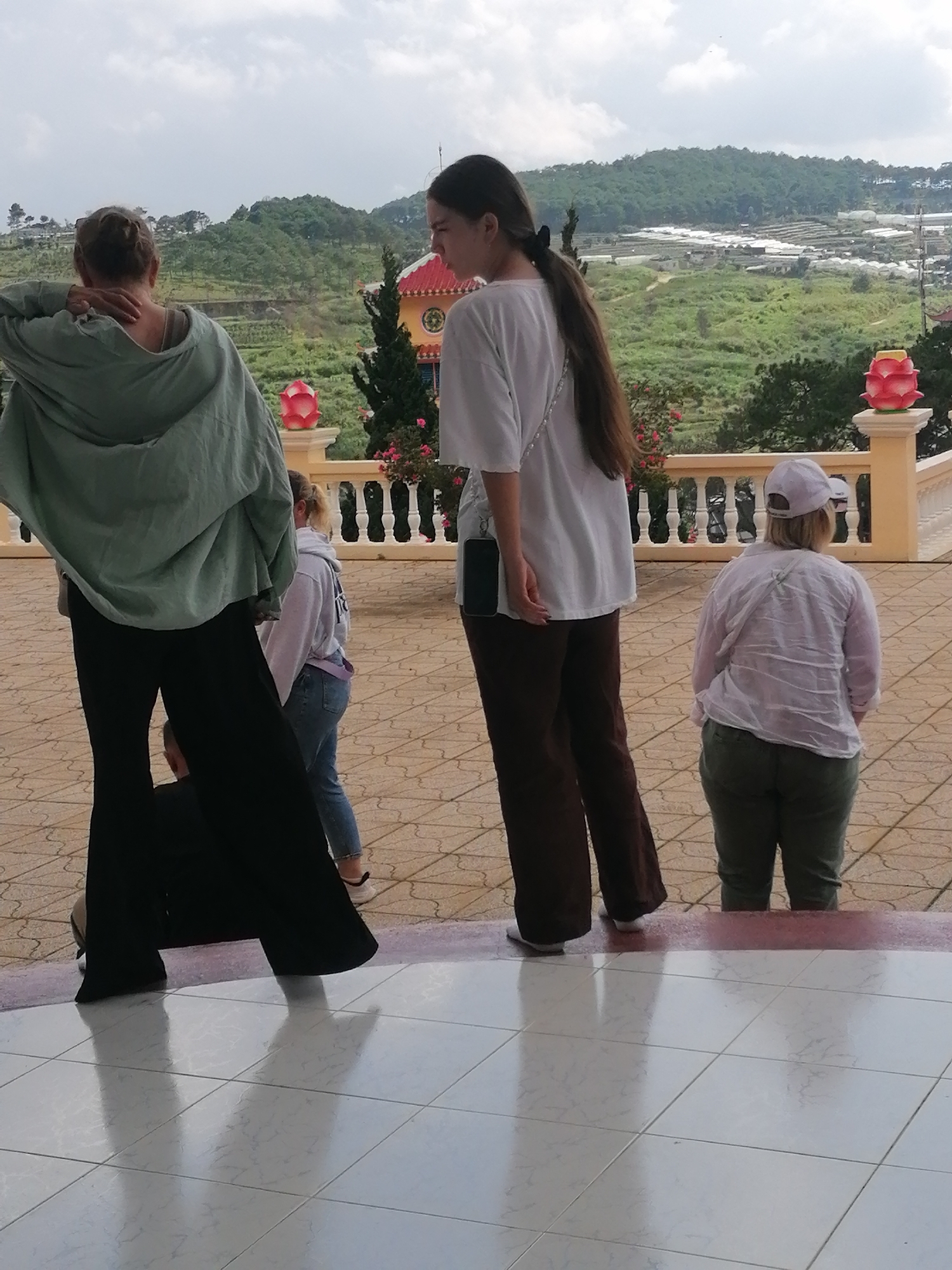
The image captures an outdoor scene with a view of rolling hills and agricultural terraces, likely in Lộc Quý, Vietnam. The foreground features a tiled walkway and steps. Four individuals are visible. On the left, a person wearing a light green hooded jacket and black flared pants stands with their back to the camera, reaching up to their neck. To their right and slightly behind, another person in a light purple hoodie and blue jeans is also seen from the back, facing away from the camera. In the center, a person in a white t-shirt and dark brown pants stands facing away, with a phone attached to their waistband. Further to the right, a person wearing a white long-sleeved shirt and green pants, with a white baseball cap, is also seen from the back. A decorative railing with vertical balusters and ornate pillars topped with pink lotus-like ornaments borders the mid-ground. The background reveals a vast landscape of green hills, patterned with what appear to be agricultural plots and greenhouses, under a cloudy sky.
Lộc Quý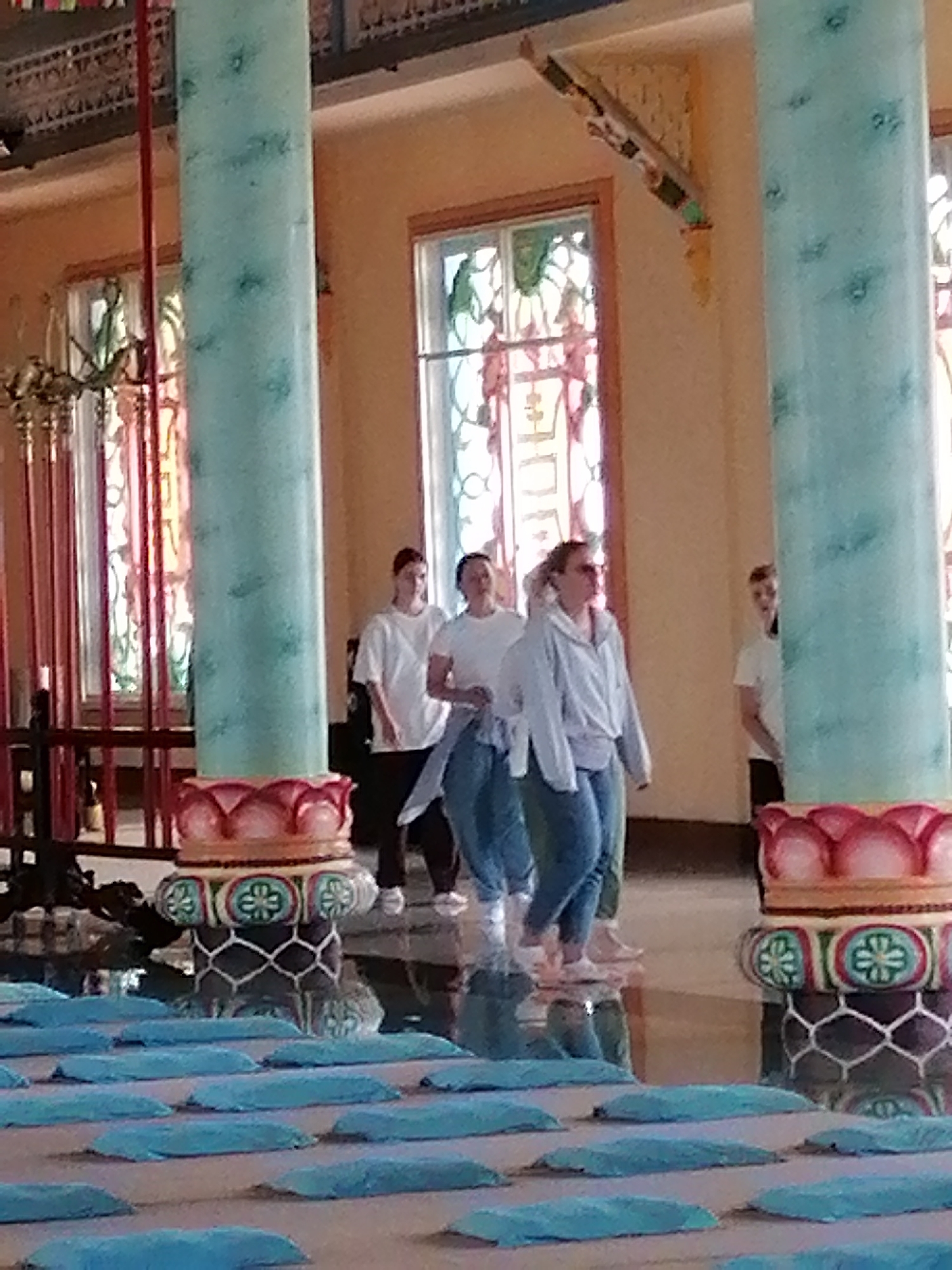
In Lộc Quý, Vietnam, inside a building with ornate pillars and stained-glass windows, a group of people, primarily young women, are walking. The women are dressed casually in t-shirts, sweatshirts, and jeans. The floor is highly reflective, mirroring the pillars and the people. In the foreground, a series of light blue cushions are neatly arranged. The overall atmosphere suggests a cultural or religious setting, possibly a temple or meditation center.
Lộc Quý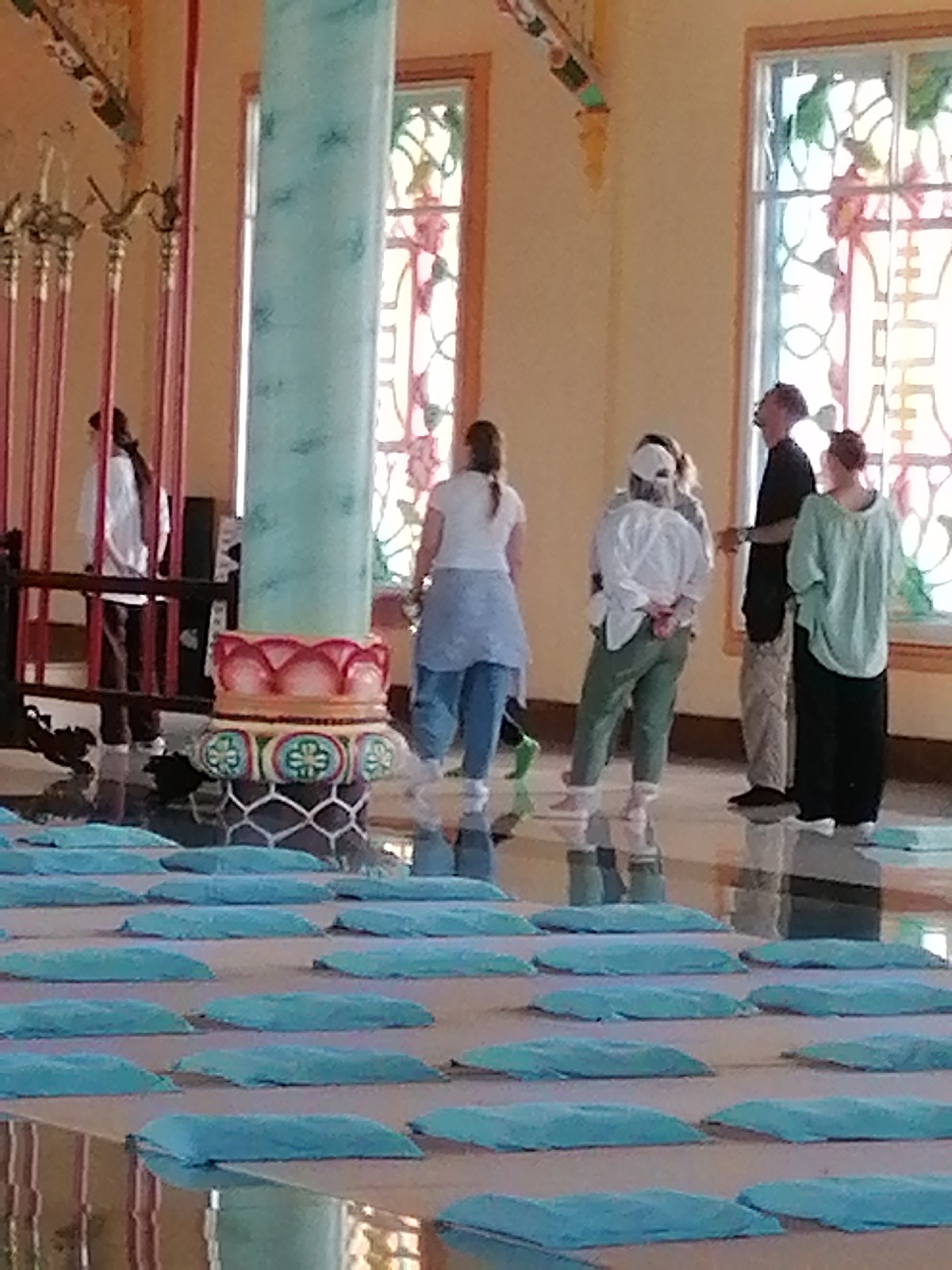
The image depicts the interior of a Buddhist temple in Lộc Quý, Vietnam. In the foreground, rows of light blue meditation cushions are laid out on the floor. In the middle ground, a large, teal-colored pillar with lotus-shaped decorative elements stands prominently. Several individuals are present in the background. One person, wearing a white shirt and dark pants, stands behind a red-barred enclosure. To the right of the pillar, three individuals are gathered: one person in a white top and green pants, another in a black shirt and light-colored pants, and a third in a light green top and dark pants. The background features tall windows with stained glass, casting colorful light into the space. The walls are a light, warm color, and decorative elements can be seen along the upper part of the walls. The floor appears to be reflective, showing a partial reflection of the individuals.
Lộc Quý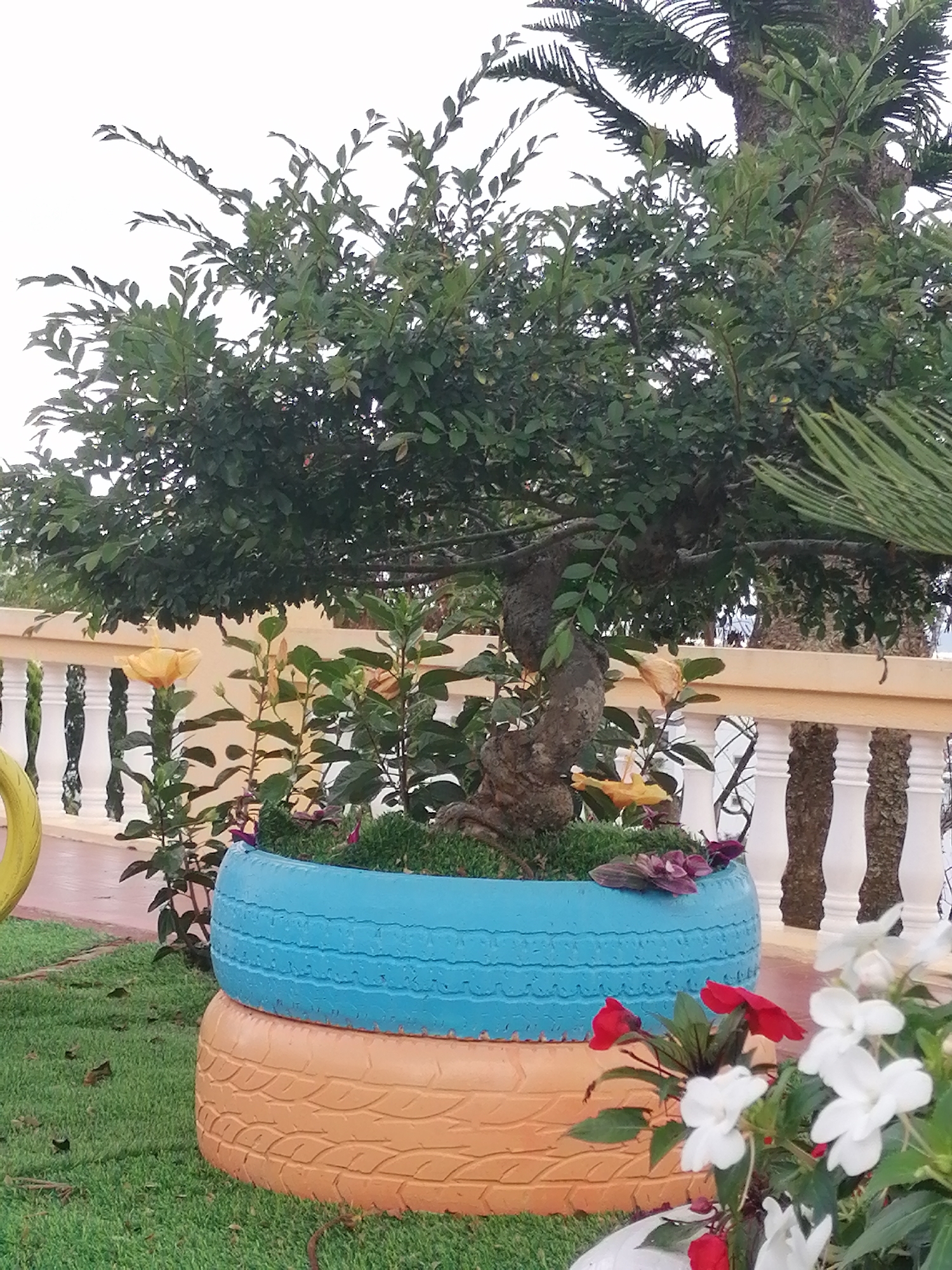
The image shows a potted bonsai tree in a garden setting. The bonsai tree is planted in two stacked tires, the bottom one painted orange and the top one painted blue. The tires are placed on a patch of green grass, with some fallen leaves scattered around. In front of the tires, there are several flowering plants with red and white blooms. Behind the bonsai tree, a white railing and a light-colored wall are visible. A palm tree is partially visible in the background, and the sky is overcast. The overall scene suggests a garden or outdoor decorative display. There are no people or animals visible in the image. The location is stated to be in Lộc Quý, Vietnam.
Lộc Quý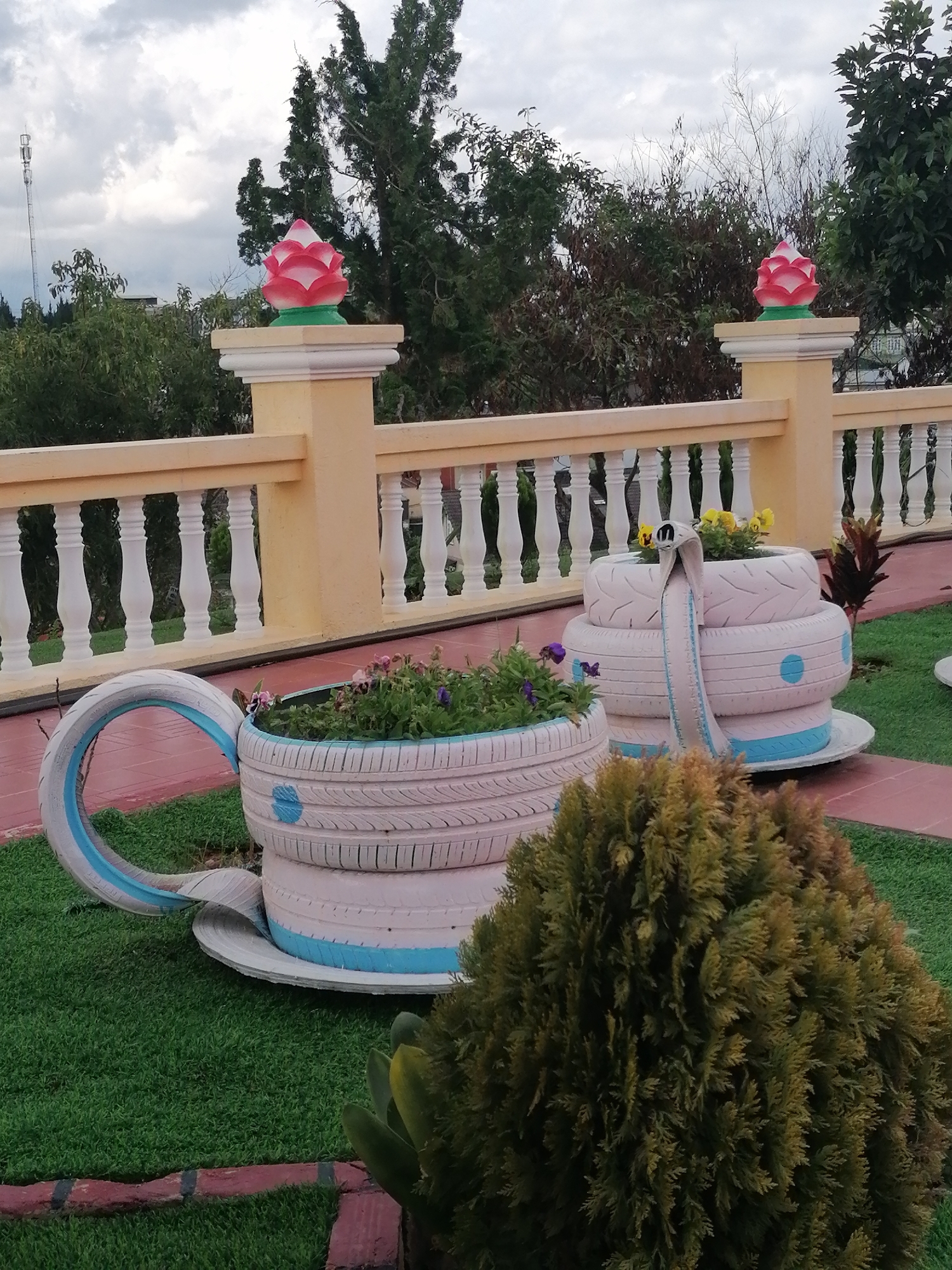
In the city of Lộc Quý, Vietnam, an outdoor scene features two large planters made from painted tires, designed to resemble teacups. The teacup planters are filled with green plants and some purple and yellow flowers. One planter, larger than the other, is made from three stacked tires and has a spout-like feature made from a tire segment. It rests on a saucer-like base, also made from a tire. The smaller planter, shaped like a teacup with a large handle made from a tire segment, contains green plants. Both planters are painted white with light blue accents, including circular patterns on the stacked planter and a stripe on the handle of the teacup planter. In the background, a beige, ornate railing with white balusters runs along a raised terrace. Beyond the railing, trees and foliage are visible under a cloudy sky. Two decorative lotus-shaped finials, one red and white with a green base, sit atop pillars supporting the railing. To the far left, a tall telecommunications tower is visible against the sky. The ground in the foreground is covered with artificial green turf, bordered by red brick. A dense green shrub is positioned in the lower right corner of the image.
Lộc Quý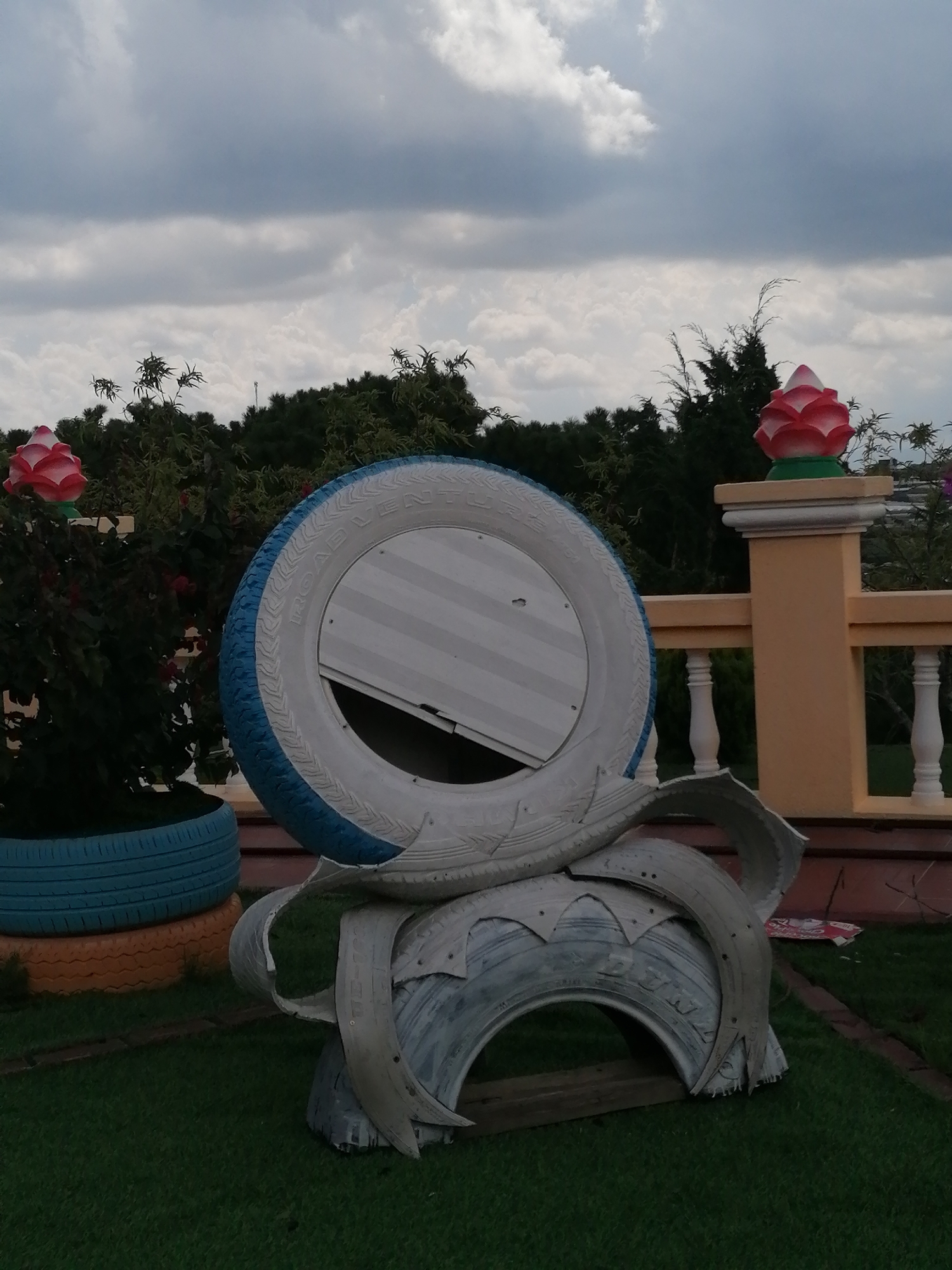
This image captures an outdoor scene in Lộc Quý, Vietnam, featuring a creative arrangement of repurposed tires. In the foreground, a large tire, painted white with a blue rim, is mounted on a structure also made from tires. The tire has a white, corrugated metal insert, and appears to be part of an art installation or seating. To the left, several stacked tires, one painted blue and another orange, form a base for plants. In the background, a fence with white balusters and a yellow pillar topped with a red and pink lotus-like ornament can be seen. Lush green trees and an overcast sky complete the environment. No people are visible in the frame.
Lộc Quý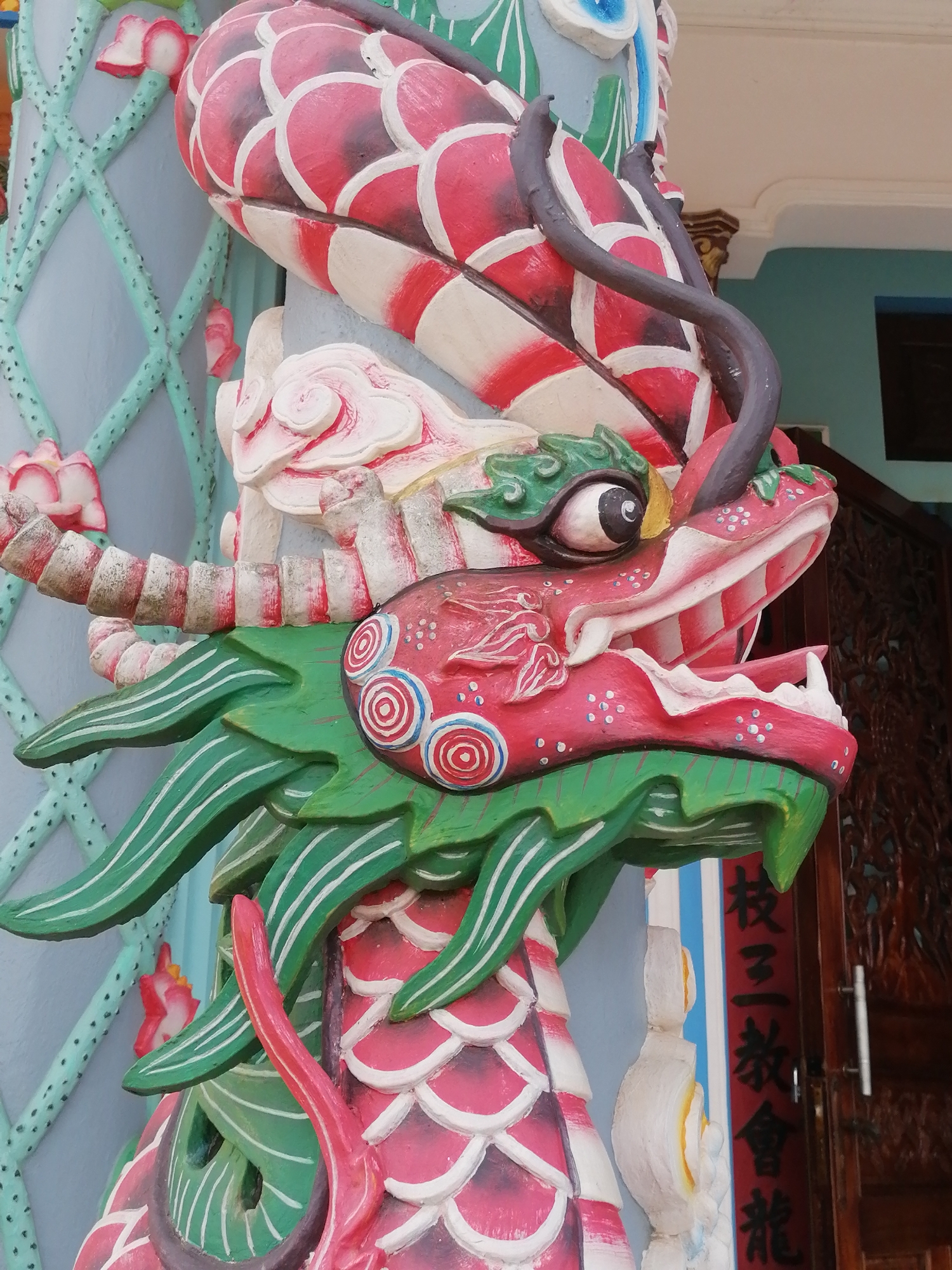
The image shows a close-up view of a colorful, decorative dragon sculpture on a pillar. The dragon is primarily painted in shades of red, pink, green, and white, with intricate details such as scales, eyes, and fangs. The dragon's head is prominently featured, with its mouth open, revealing its teeth and tongue. The pillar itself appears to be part of a larger structure, possibly a temple or shrine, with elements of traditional Asian architecture visible in the background, including a wooden door with carvings and a blue wall with a lattice pattern. There are no people or animals in the image. The location is identified as Lộc Quý, Vietnam.
Lộc Quý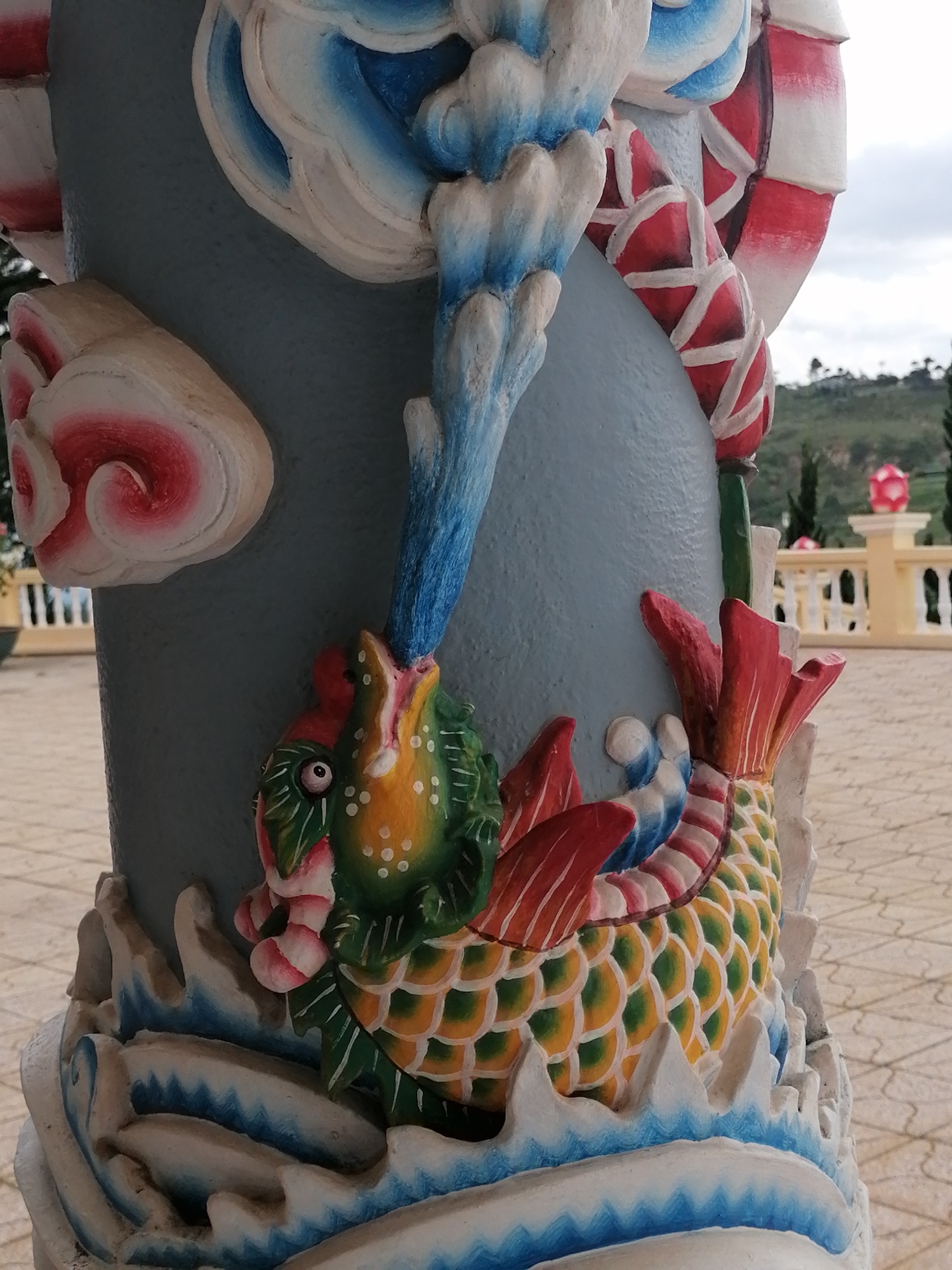
The image shows a close-up of a decorative column, likely part of a temple or shrine, in Lộc Quý, Vietnam. The column is adorned with colorful bas-relief sculptures. In the foreground, a mythical creature, possibly a dragon or fish, is depicted with scales of green and yellow, a red tail fin, and a green head with a red and white striped mouth. Above the creature, blue and white cloud-like decorations are visible, along with red and white striped bands. The background shows a light-colored tiled ground, a white railing, and a rolling landscape with trees and a pink spherical object on a pedestal. The sky is overcast.
Lộc Quý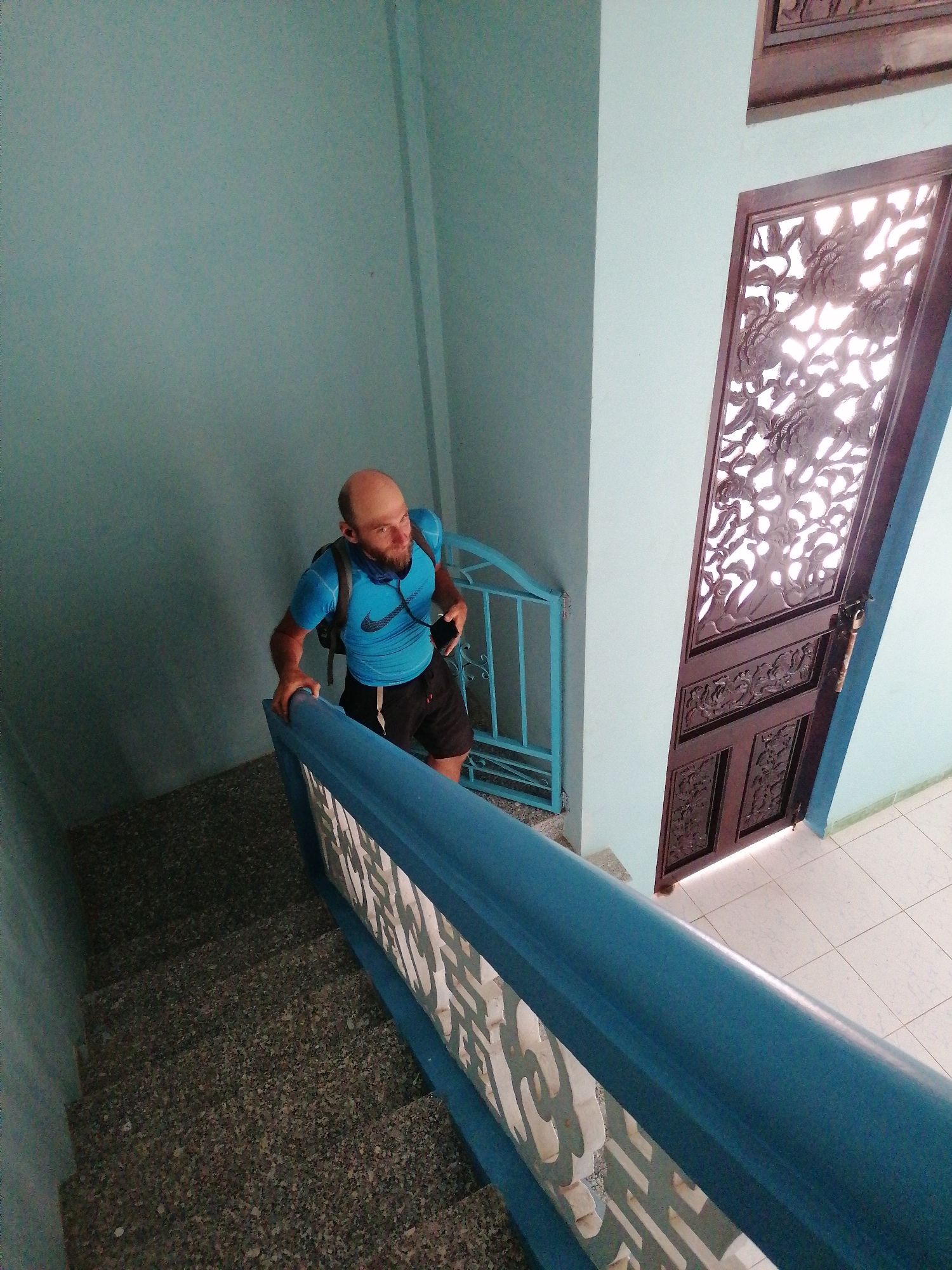
A bald, bearded man wearing a blue t-shirt, black shorts, and a black backpack walks up a granite staircase. He is holding a black smartphone in his right hand and has earbuds in his ears. The staircase has a blue railing with a decorative white insert. The walls are painted a light blue. To the right of the staircase, there is a brown wooden door with intricate carvings and a light blue metal gate. The scene appears to be an interior staircase in Lộc Quý, Vietnam.
Lộc Quý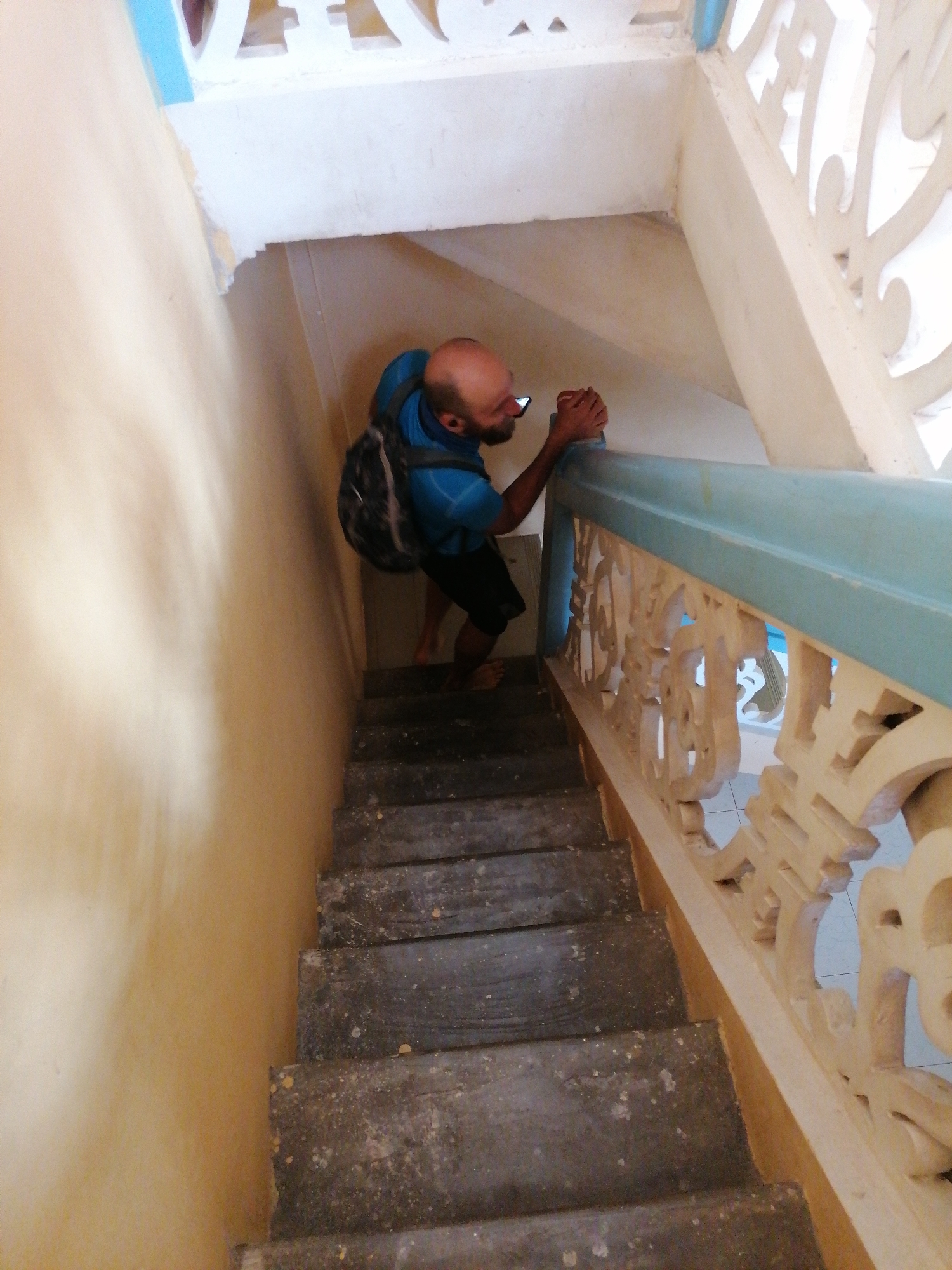
A man with a shaved head, wearing a blue t-shirt and black shorts, walks down a wooden staircase with a backpack. He is holding a smartphone in his right hand, as if taking a photo or recording a video. The staircase has a light yellow wall on the left and a decorative cream-colored railing with intricate carvings on the right. The railing is topped with a light blue trim. The man's bare feet are visible on the wooden steps. The overall environment suggests an indoor staircase within a building. The specific location within Lộc Quý, Vietnam, is not determinable from the image alone.
Lộc Quý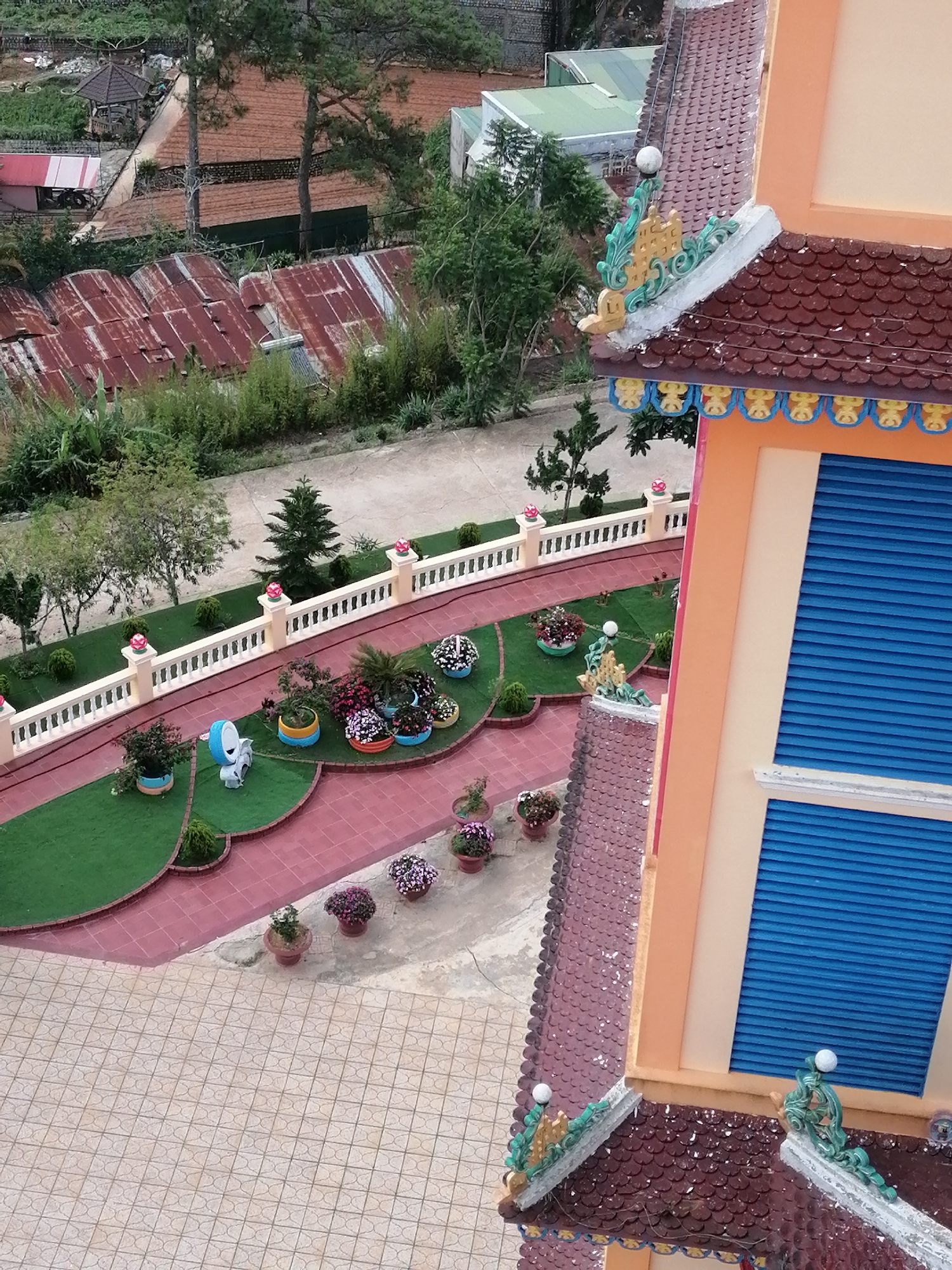
The image provides an aerial view of a temple complex in Lộc Quý, Vietnam. The foreground features the intricate, tiled roof of a temple, adorned with decorative elements in green and gold. The temple building itself is painted in light orange with large, blue-slatted windows visible. Adjacent to the temple is a paved courtyard with a repeating geometric pattern. The middle ground showcases a well-maintained garden area with artificial green turf and red tiled pathways. Several potted plants with colorful flowers are arranged along these paths, adding vibrancy to the scene. A small, white statue of an animal is also present in the garden. A white, ornate railing encloses this garden area, separating it from a road or pathway beyond. The background reveals a more rustic landscape, with sloping terrain covered in reddish-brown soil, likely agricultural fields. Several buildings with corrugated tin roofs, some appearing rusted, are scattered across this area. Tall green trees and dense foliage are interspersed throughout the landscape, suggesting a hilly or mountainous region. The overall impression is of a serene, spiritual site nestled within a semi-rural setting. No people are visible in the image.
Lộc Quý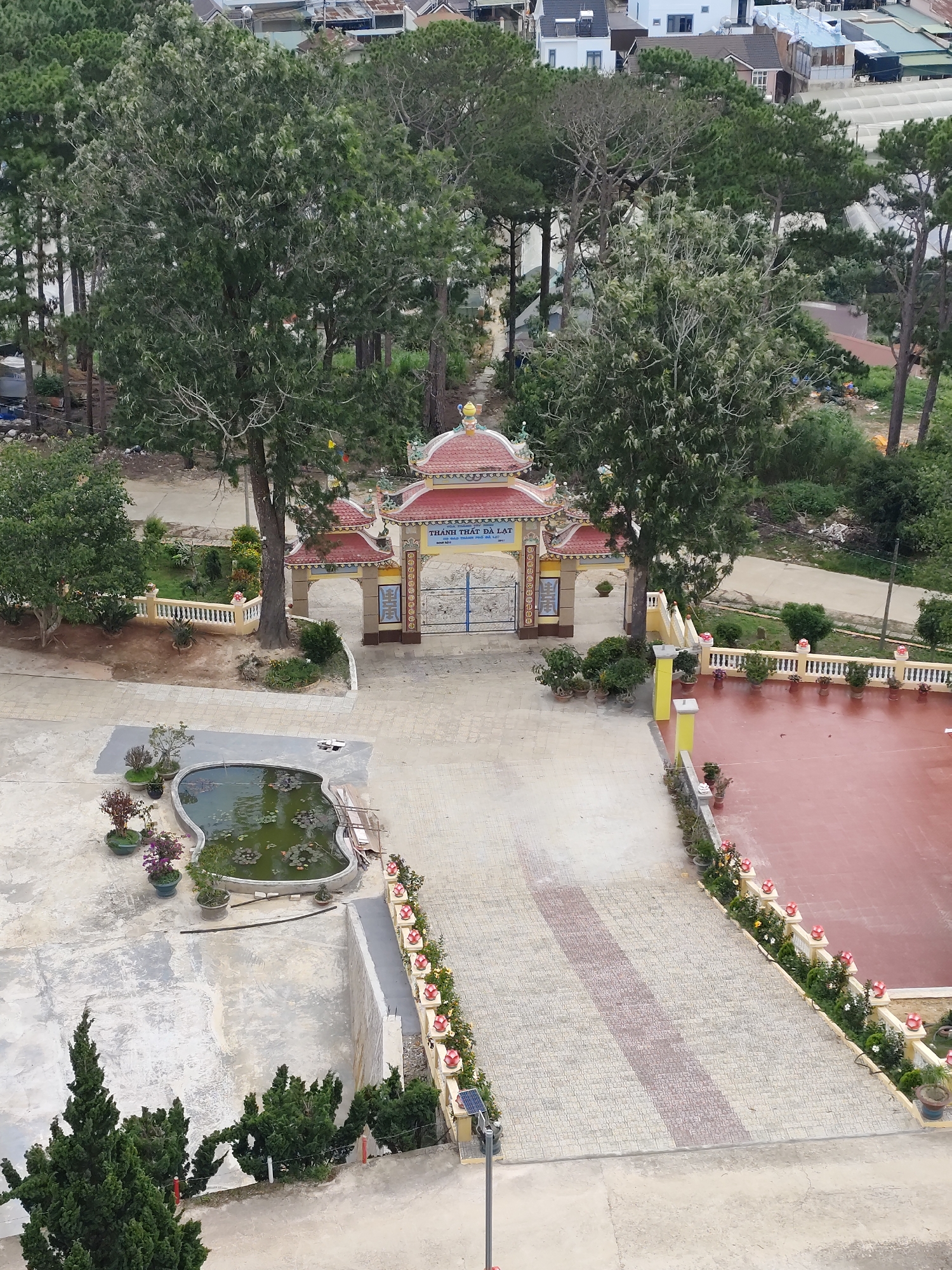
The image captures an aerial view of a temple complex in Lộc Quý, Vietnam. The central focus is a traditional temple gate with a red-tiled roof, adorned with ornate yellow and blue decorations. Beyond the gate, a courtyard is paved with patterned tiles, and a large, red-tiled area is visible to the right, likely an outdoor space for gatherings or ceremonies. To the left of the gate, a low, ornate yellow fence encloses a garden area with trees and bushes. In the foreground, a heart-shaped pond filled with green water and lotus plants adds a serene element to the scene. Various potted plants are strategically placed throughout the complex, enhancing the greenery. A tall pine tree stands prominently near the gate, casting a shadow over the paved courtyard. The surrounding environment is characterized by lush vegetation, including numerous trees and dense foliage, suggesting a semi-rural or well-landscaped urban setting. Residential buildings and greenhouses are visible in the background, indicating the presence of a community nearby. The overall atmosphere appears peaceful and well-maintained, typical of a religious or cultural site. There are no people visible in the image.
Lộc Quý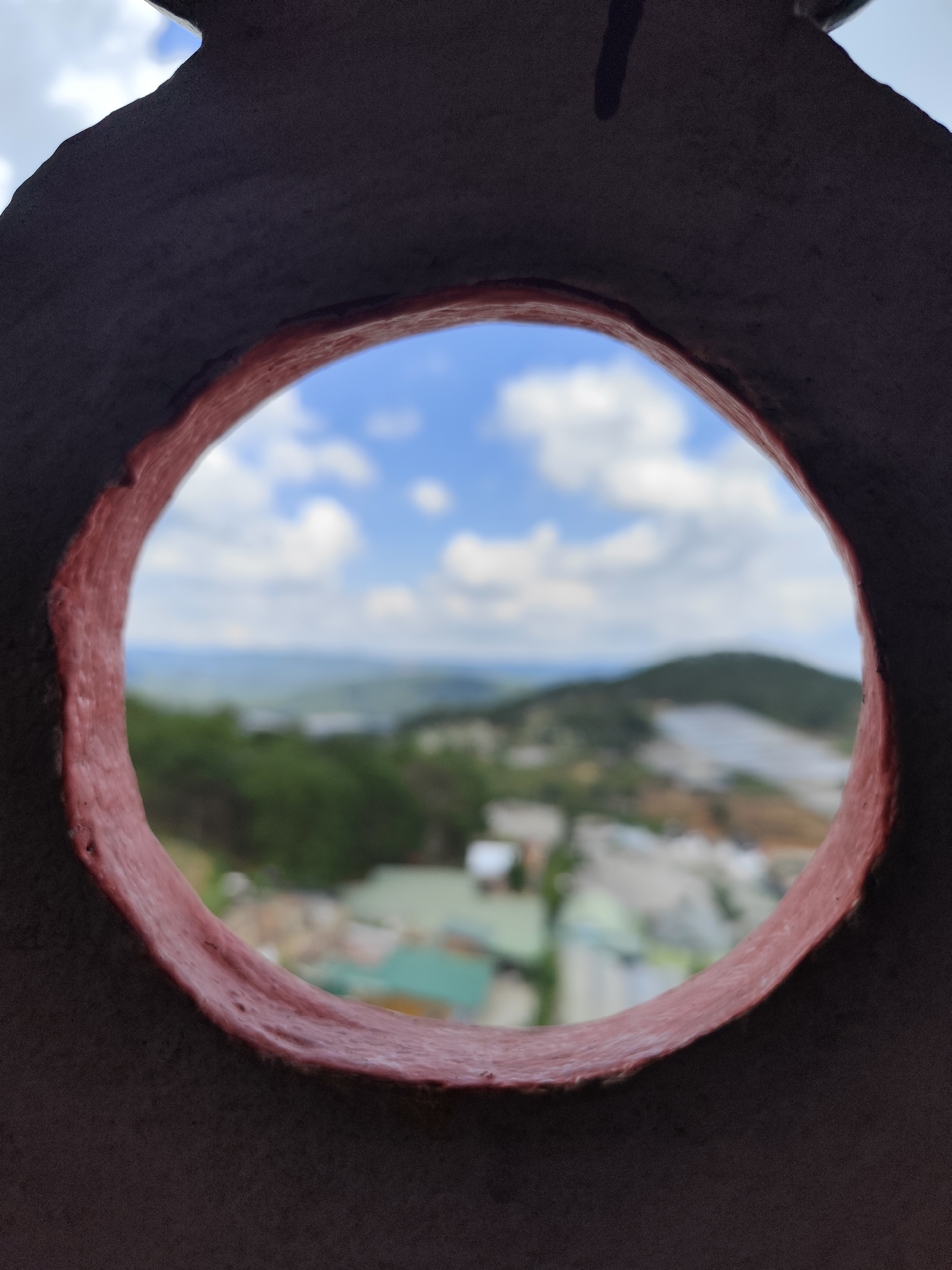
The image is a photograph taken through a circular opening in a dark, textured object, possibly a pot or a wall feature. The opening is lined with a rough, reddish-pink material. Through this opening, a blurred landscape is visible. The landscape appears to be a hillside with buildings and vegetation, set against a backdrop of a blue sky with white clouds. The location is identified as Lộc Quý, Vietnam. The focus is on the circular frame, with the distant scenery being out of focus, creating a depth-of-field effect. There are no people or animals visible in the image.
Lộc Quý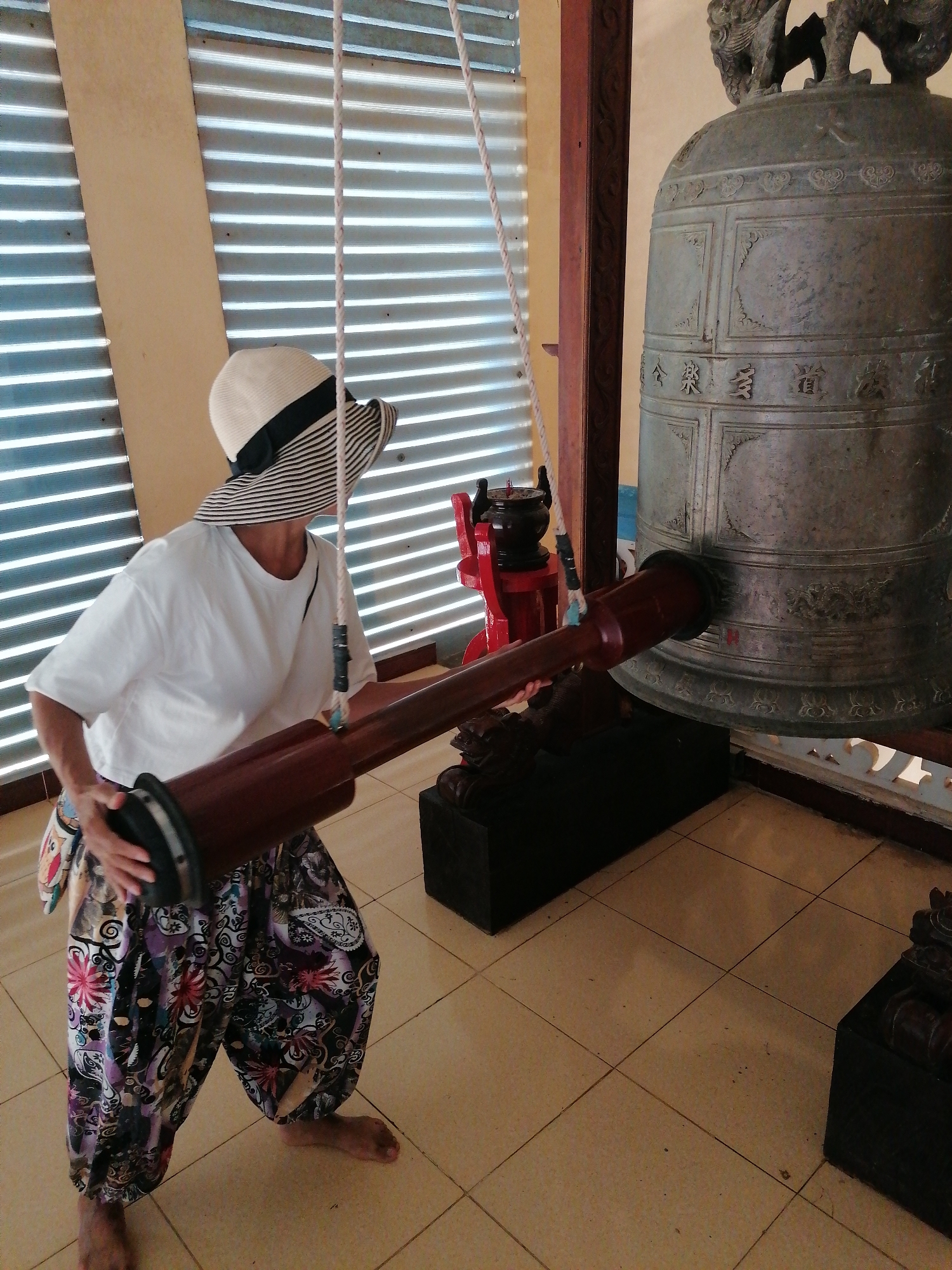
A person wearing a wide-brimmed hat and patterned pants is shown striking a large bell with a wooden mallet. The bell is ornate and appears to be made of bronze, with intricate carvings and inscriptions. The person is holding the mallet with both hands, poised to strike. The background features a wall with horizontal blinds, a wooden pillar, and a red structure with a black bowl-like object on top. The floor is tiled. The scene is likely within a temple or a similar cultural site.
Lộc Quý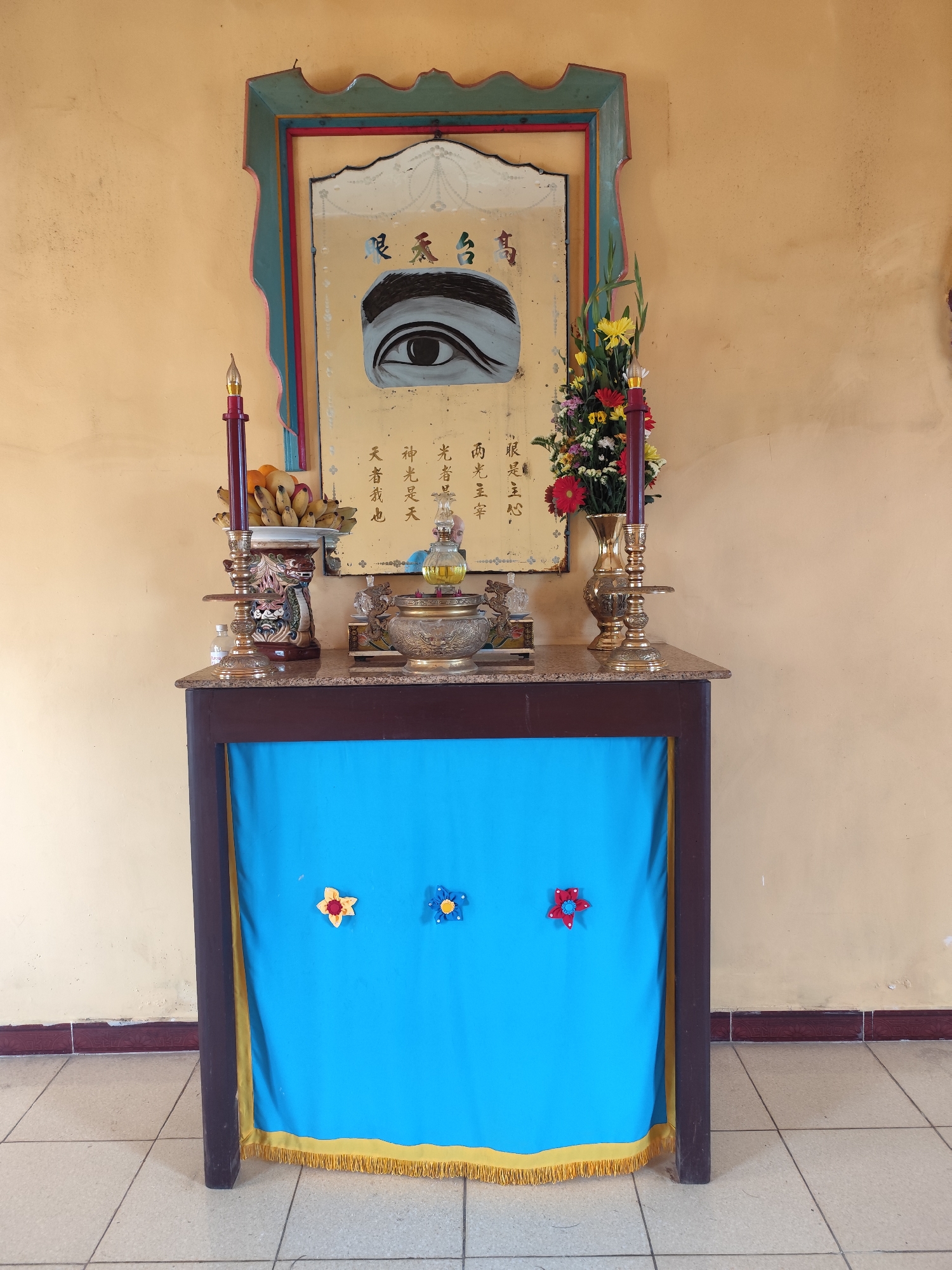
A table with a marble top is set up against a pale yellow wall. On the table, an altar is arranged with religious items. A framed painting of an eye with Chinese calligraphy is mounted on the wall above the altar. To the left of the painting is a red candle in a decorative holder, and a bowl of bananas. To the right of the painting, a vase holds a bouquet of colorful flowers. In front of the altar, the table is draped with a bright blue cloth adorned with three felt flowers: a yellow and red one on the left, a blue one in the middle, and a red one on the right. The cloth is trimmed with yellow fringe at the bottom. The floor is tiled with light-colored square tiles. The scene suggests a religious or spiritual space, possibly in the city of Lộc Quý, Vietnam, given the mention of the location.
Lộc Quý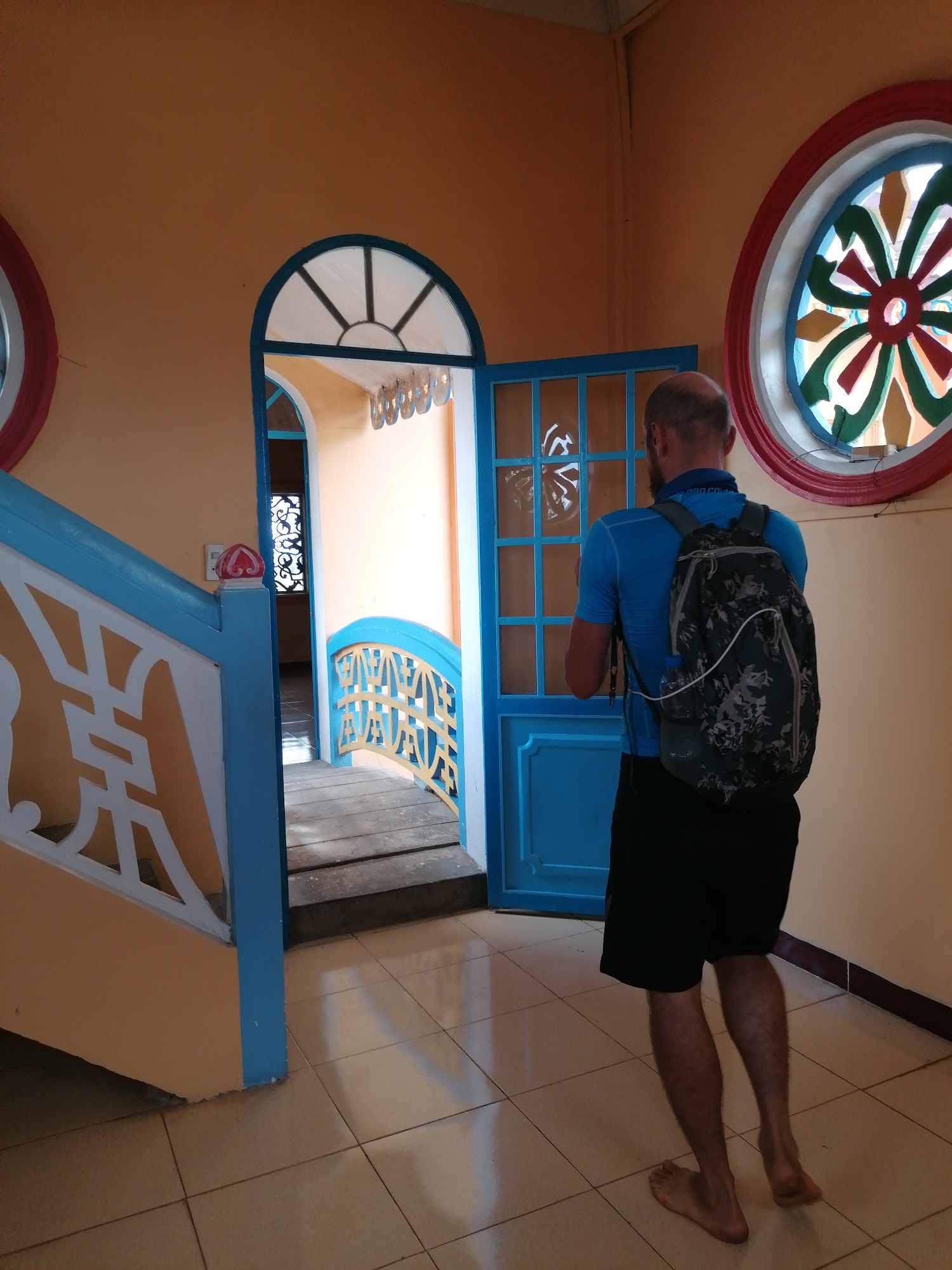
A bald man wearing a blue t-shirt and black shorts, carrying a camouflage backpack, walks barefoot through a hallway. He faces away from the camera, towards a blue doorway. The hallway has orange walls and beige tile floors. To his left, a staircase with a blue railing and white decorative accents is visible. To his right, a circular stained-glass window with red, green, and yellow panes is set into the orange wall. A smaller arched window with a blue frame is visible through the open doorway. The scene appears to be within a building in Lộc Quý, Vietnam, characterized by its colorful architecture and decorative elements.
Lộc Quý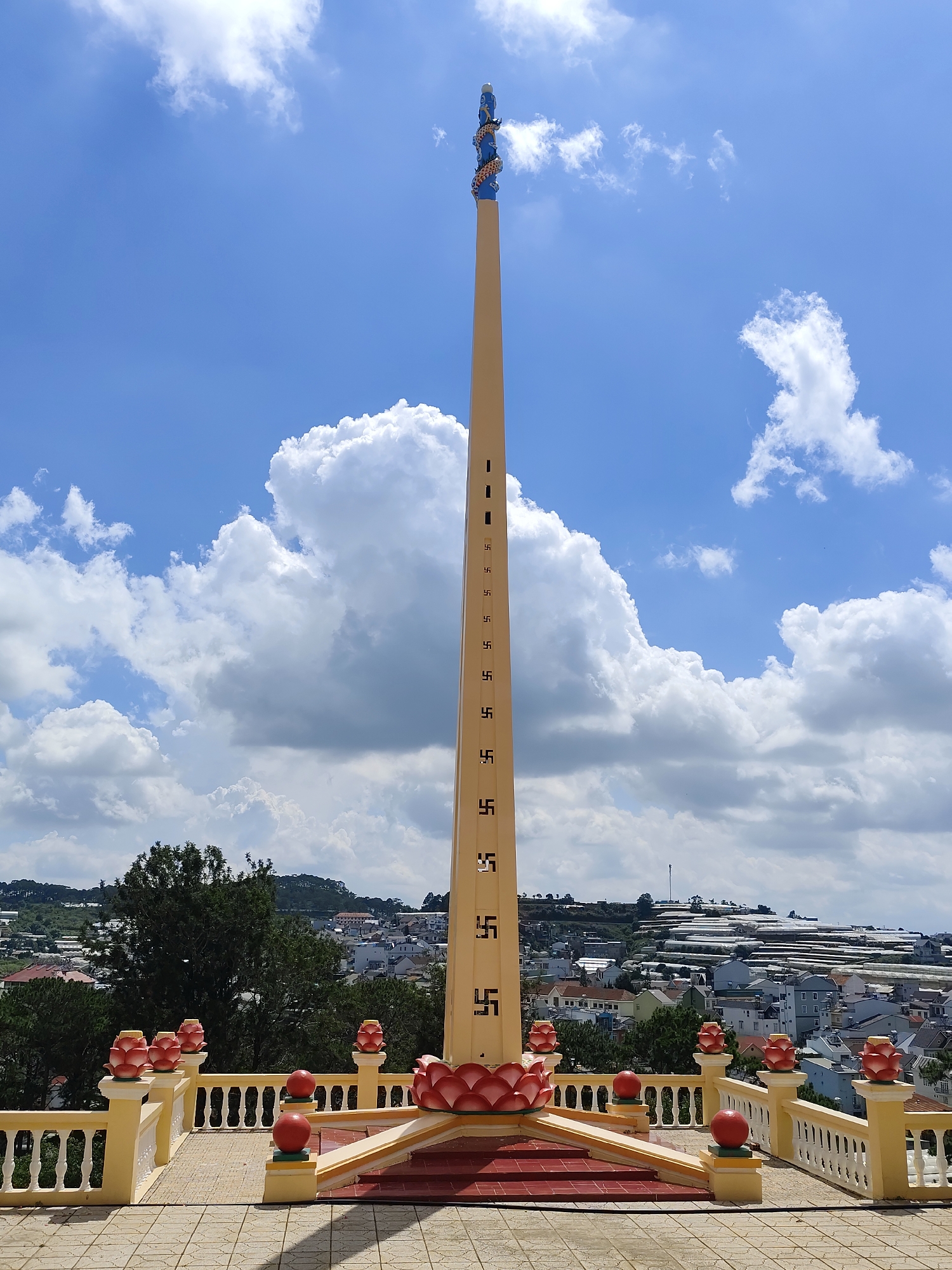
An outdoor, eye-level, medium shot captures a tall, narrow, cream-colored tower, the main subject, set against a bright blue sky filled with puffy white clouds. The tower tapers towards its peak, which is adorned with a blue and gold decorative element resembling a dragon and a small blue figure. The tower's surface is decorated with a repeating pattern of swastika symbols. In the foreground, a yellow railing with white balusters encloses a tiled platform. Decorative lotus flower sculptures and red spheres are placed along the railing. A set of red stairs with yellow trim leads up to a raised platform in front of the tower, also decorated with lotus sculptures. Behind the platform, a sprawling city unfolds with a mix of houses and buildings, many with grey or blue roofs. Green trees are scattered throughout the city, and a hillside with numerous greenhouses is visible in the distance. The scene appears to be located in the city of Lộc Quý, Vietnam, as indicated by the presence of greenhouses common in the region and the architectural style.
Lộc Quý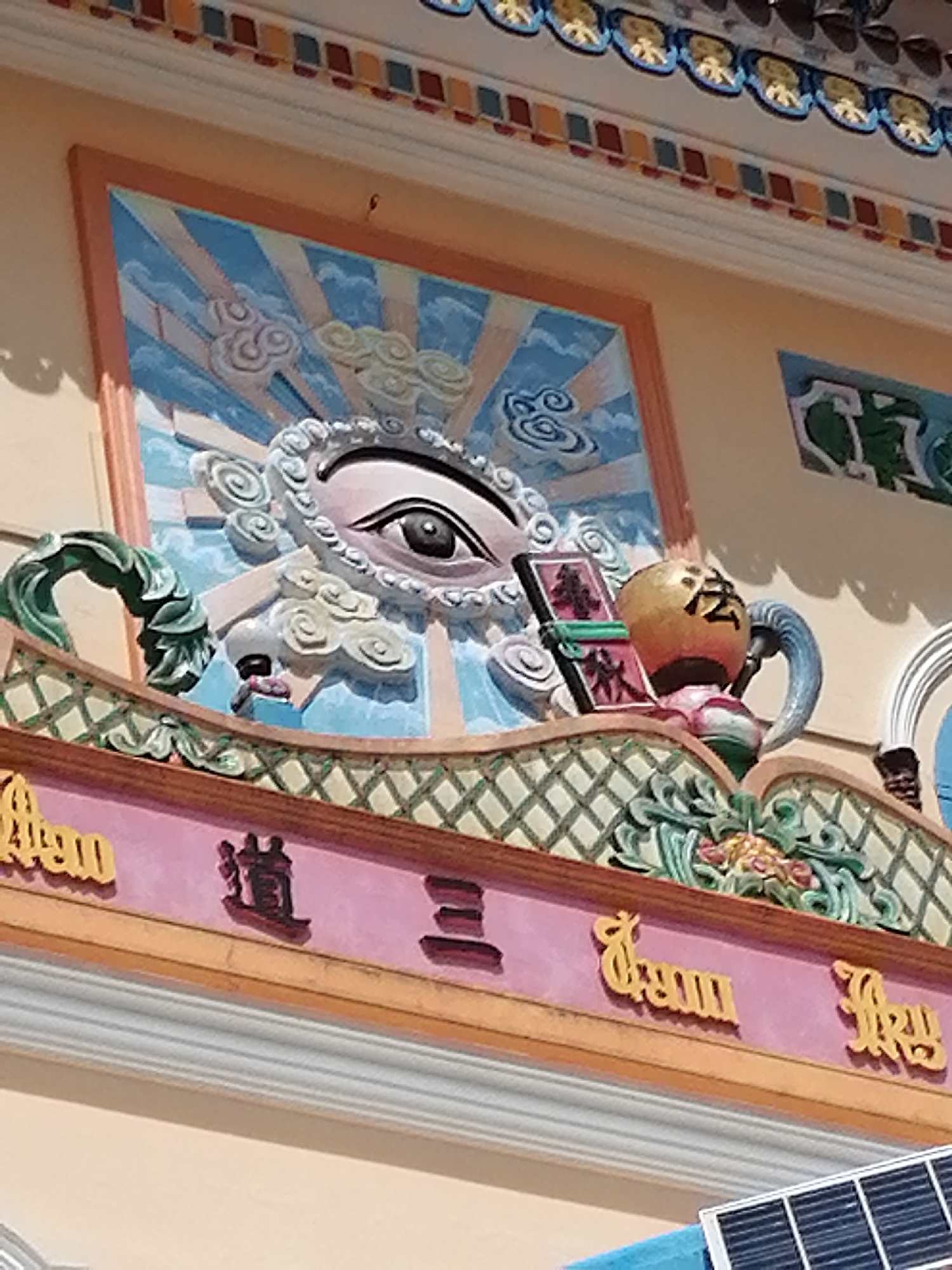
The image shows a detailed close-up of the exterior facade of a building in Lộc Quý, Vietnam. The building's architecture features intricate decorative elements, including a large, stylized eye with swirling patterns surrounding it, rendered in relief against a backdrop of blue and white rays and clouds. To the right of the eye, a golden spherical object with dark Chinese characters is visible, connected to a blue, horn-like protrusion. Below this central motif, the facade displays decorative friezes and inscriptions. A pink band runs horizontally, adorned with yellow, stylized lettering and dark, embossed characters that appear to be in Chinese or Vietnamese. The upper edge of the building has a colorful decorative border with alternating red and yellow square patterns. Green, leafy, sculpted elements are also integrated into the facade's design. The overall impression is one of ornate, possibly religious or culturally significant, architecture.
Lộc Quý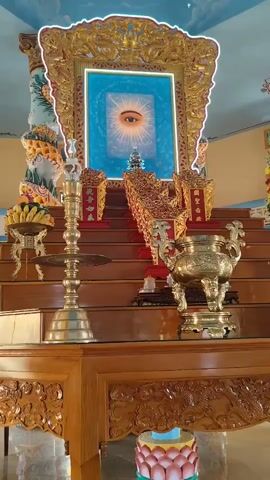
The video shows an ornate altar within a temple or shrine. The altar is tiered and made of wood, with intricate carvings. At the center of the altar, on the highest tier, is a framed image of a single eye glowing with light against a blue background, surrounded by a decorative golden frame. Below this eye image, on a lower tier, are three decorative golden structures with red accents, each displaying Chinese characters. To the left of these structures is a tall, brass-like candelabra with multiple candle holders. To the right, and slightly in front, is a large, ornate golden incense burner with dragon motifs. The background features a ceiling painted with clouds and celestial imagery. The lighting is bright, highlighting the gilded elements of the altar.
Lộc Quý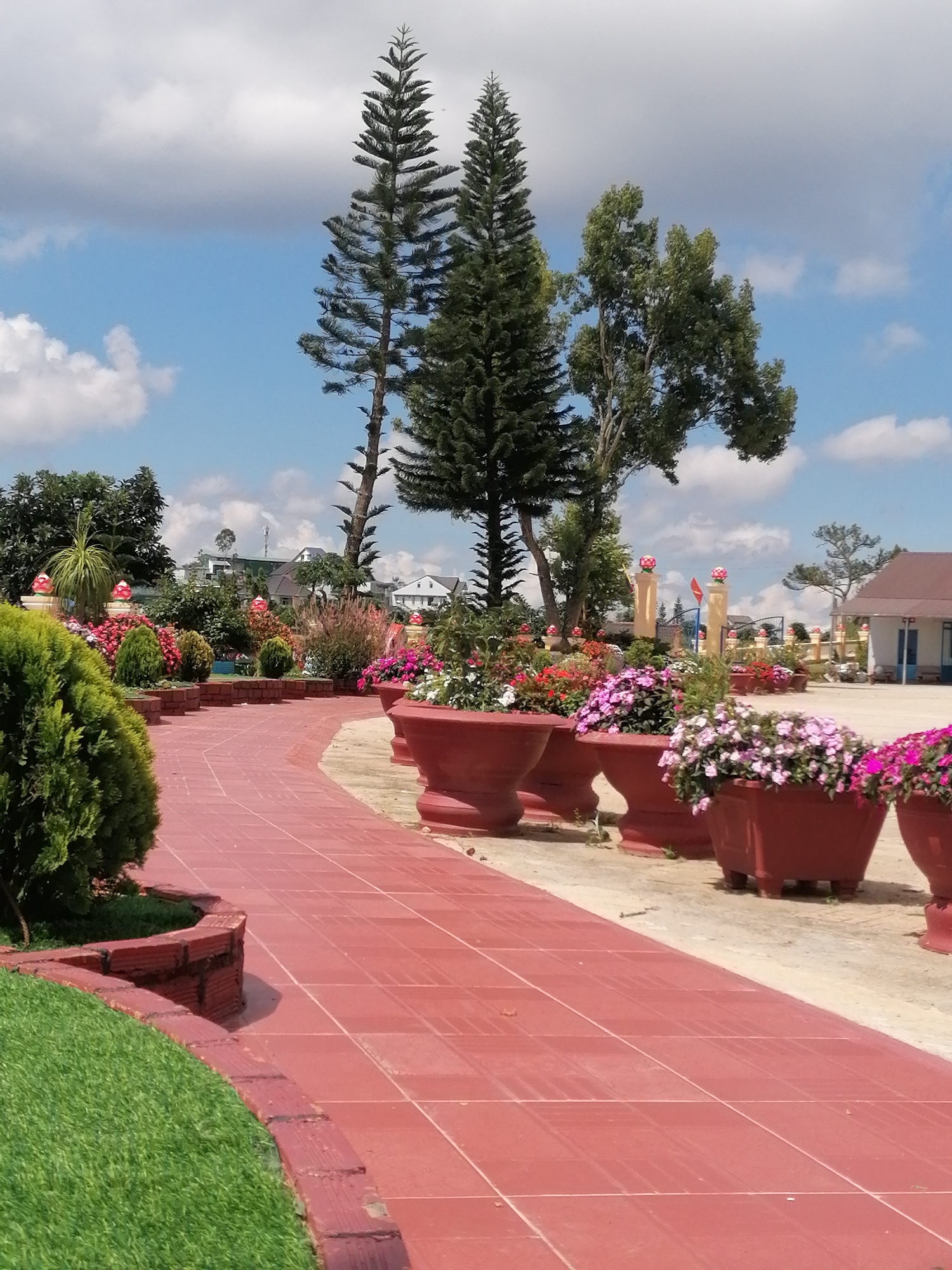
The image shows a paved walkway in what appears to be a park or garden area in Lộc Quý, Vietnam. The walkway is made of reddish-pink square tiles, laid in a grid pattern. A curved brick border separates the walkway from a section of green artificial turf on the left side of the frame. Along the right side of the walkway are several large, reddish-brown planters filled with a variety of flowers in shades of pink, white, and red. In the background, there are several tall pine trees and other deciduous trees. Beyond the trees, the scene includes buildings with light-colored walls and brown roofs, suggesting a residential or institutional area. There are also decorative pillars with red spherical ornaments on top, and a metal fence in the distance. The sky is blue with scattered white clouds. The lighting suggests it is daytime, likely midday, with bright sunshine. No people are visible in the image.
Lộc Quý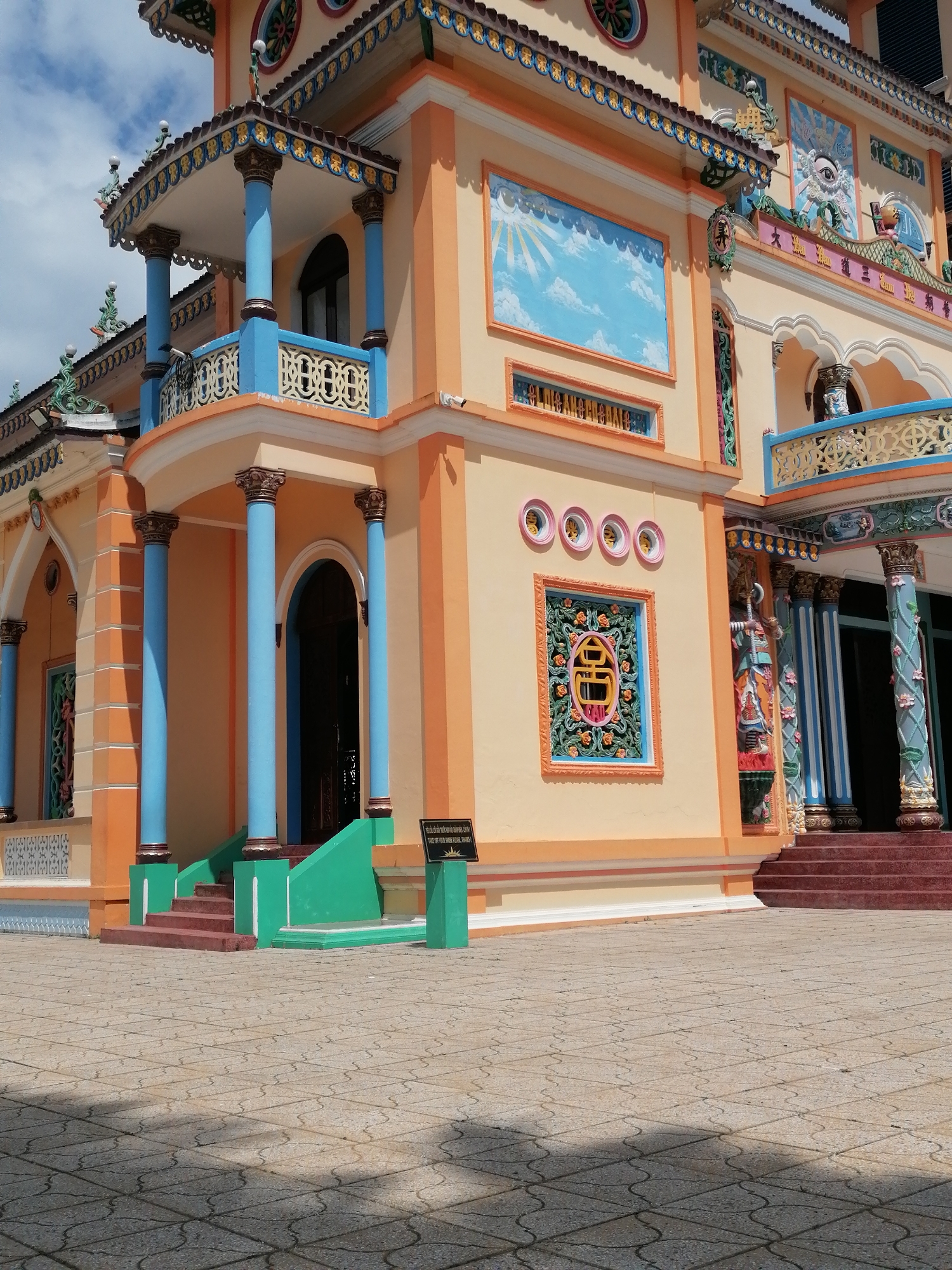
The image shows a colorful building, likely a temple, with orange and yellow exterior walls. The building features ornate decorative elements, including blue and gold trim, blue pillars, and intricate carvings. There are several windows and arched doorways. A set of red stairs leads up to an entrance flanked by blue pillars. The ground in front of the building is paved with square tiles. A black sign with white text is visible near the stairs. The sky above is blue with some white clouds. The image is taken from a low angle, looking up at the building. The context provided indicates the location is in Lộc Quý, Vietnam. No people are visible in the image.
Lộc Quý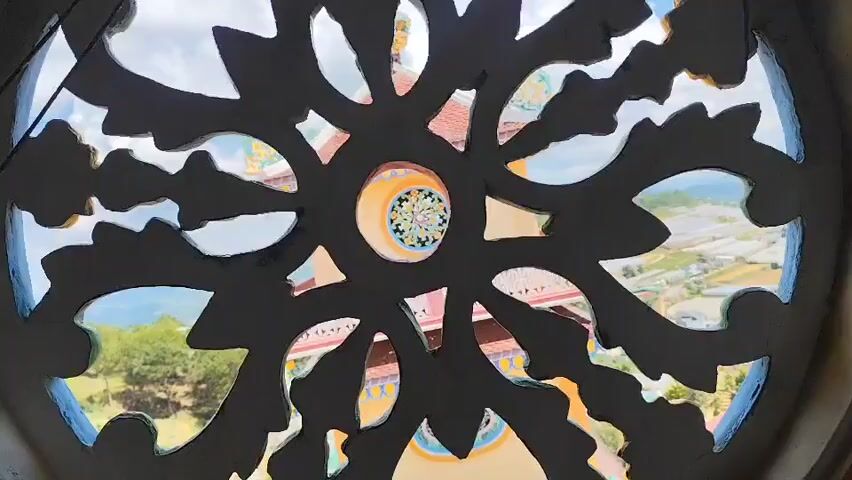
The video displays a view through a dark, intricate, sunburst-shaped cutout in what appears to be a wall or screen. The cutout reveals a landscape beyond, featuring a blue sky with white clouds, green hills, and a distant town or village with numerous greenhouses. Architectural elements of a building, possibly a temple or pagoda with colorful tiled roofs and ornate details, are visible through some of the openings in the cutout. The central part of the cutout reveals a circular, decorative element with colorful geometric patterns. The camera appears to be stationary, offering a static perspective of this scene. There are no visible people or discernible actions taking place.
Lộc Quý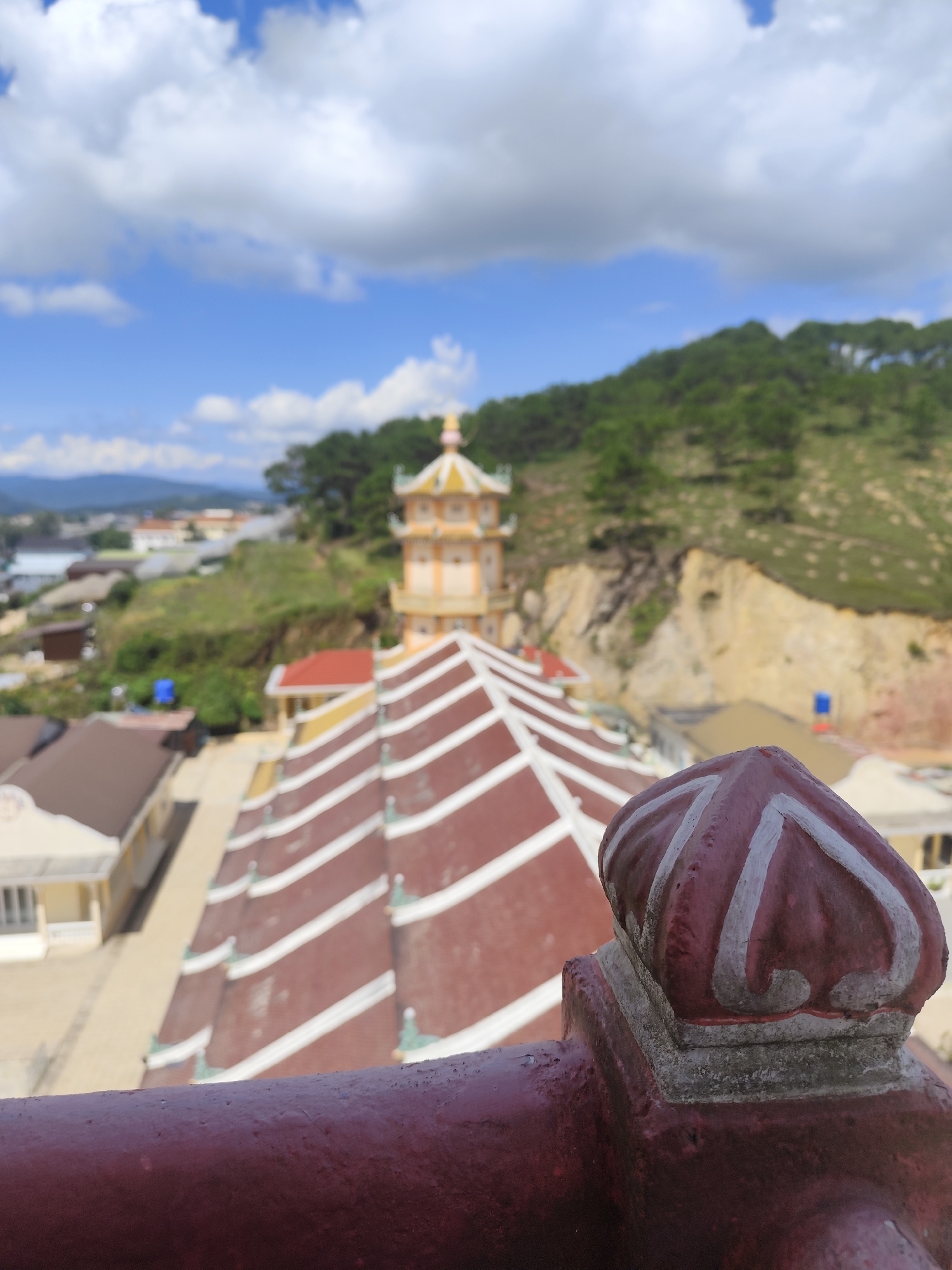
The image is a medium shot, taken from an elevated viewpoint, looking down on a temple complex and its surrounding environment. The foreground is dominated by a dark red railing and a decorative finial, which appears to be made of plaster or concrete and painted with white swirling patterns. The finial is situated on a square base. Beyond the railing, the focal point is a large, multi-tiered pagoda-like structure with a distinctive red roof adorned with white stripes. The roof has a complex, stepped design. To the left of this structure, several buildings with cream-colored walls and brown roofs are visible. In the mid-ground, a tall, yellow tower with multiple levels and a decorative yellow cap stands prominently. This tower also features architectural elements characteristic of East Asian temples. The buildings and the tower are situated on a hillside, which is covered with green trees and vegetation. The terrain appears to be uneven, with some exposed soil and rock faces visible. The background reveals a hazy cityscape with more buildings and infrastructure stretching into the distance. Further beyond the city, a range of green mountains forms the horizon. The sky above is a vibrant blue, punctuated by fluffy white clouds. The image appears to be taken in Lộc Quý, Vietnam, given the architectural style of the temple complex and the hilly, vegetated landscape often found in the region. There are no people visible in the image. The overall scene depicts a tranquil temple setting within a broader urban and natural landscape. The lighting suggests it is daytime, possibly late morning or afternoon, given the bright illumination and clear sky.
Lộc Quý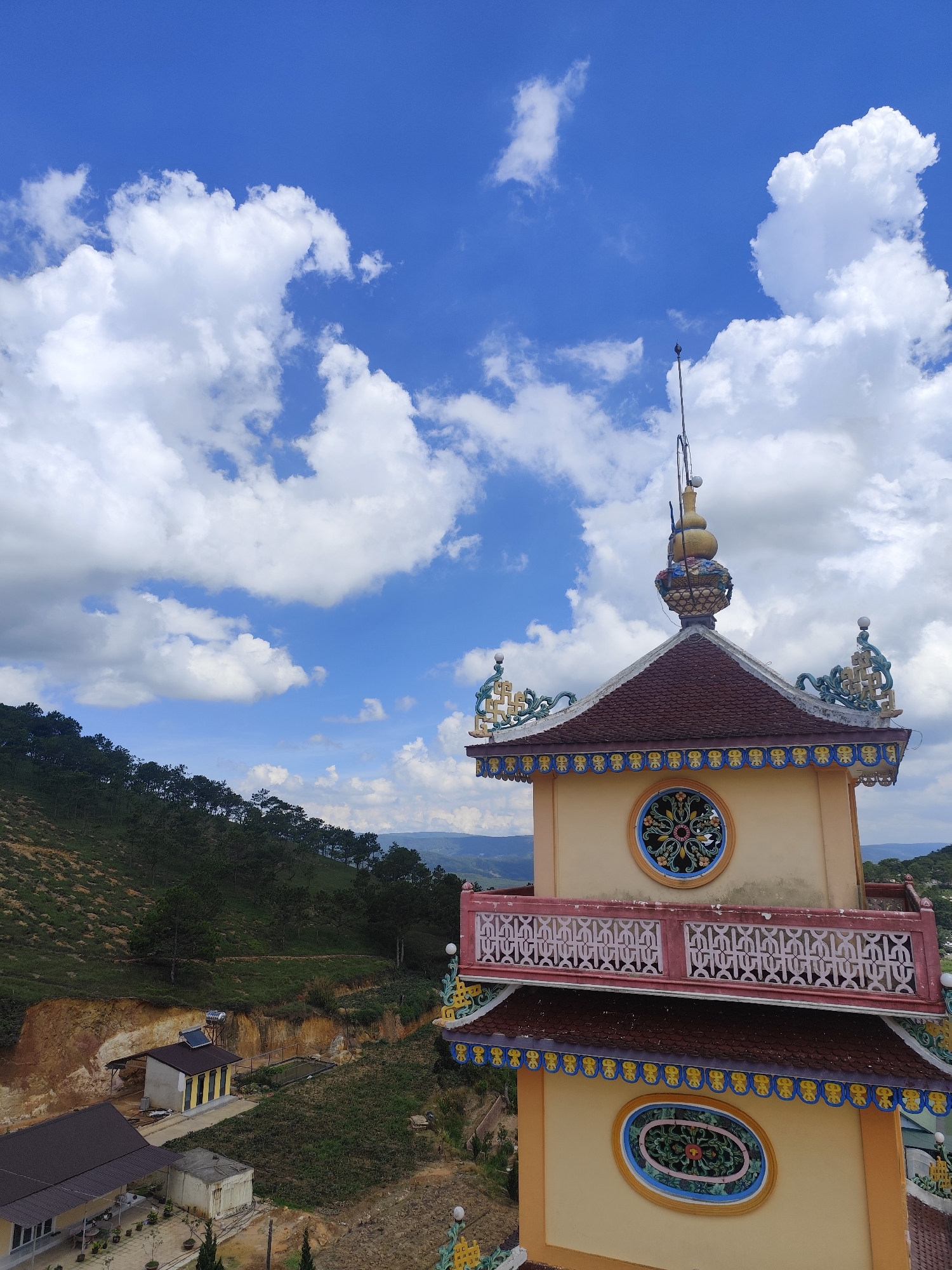
The image depicts a multi-story pagoda-like structure with ornate details, set against a backdrop of a lush green hillside dotted with trees. The pagoda features a red tiled roof with decorative yellow and blue trim. Circular stained-glass windows are visible on its facade. The sky above is a vibrant blue, adorned with fluffy white clouds. In the distance, rolling hills and mountains are discernible. In the foreground, to the left, part of a larger building with a dark roof is visible, along with a smaller structure featuring a solar panel. The scene is likely located in Lộc Quý, Vietnam, given the architectural style and the natural landscape. There are no people or animals present in the image, and no actions or interactions are occurring.
Lộc Quý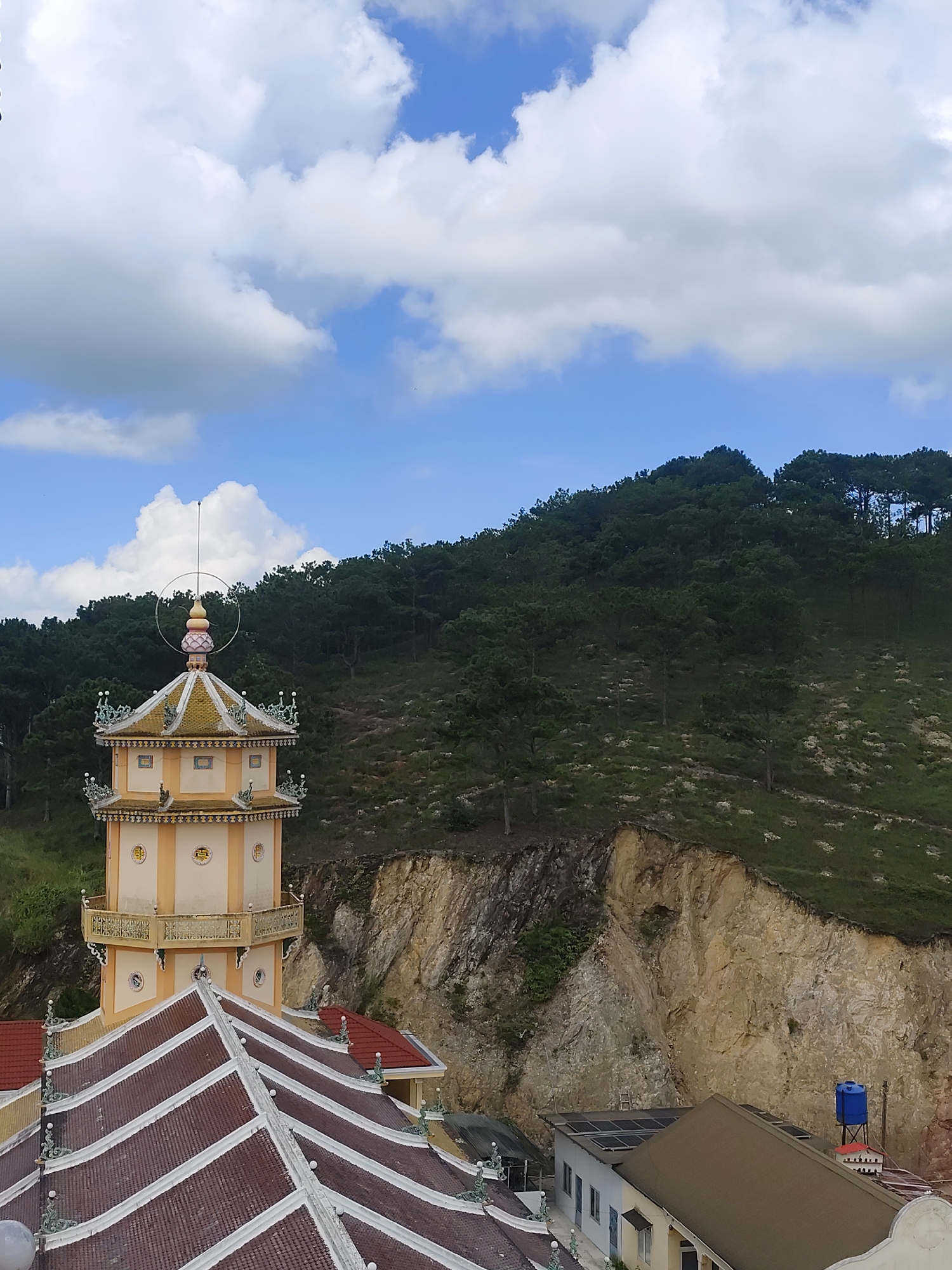
The image shows a view from an elevated position, looking towards a hillside covered in dense green trees under a bright blue sky with scattered white clouds. In the foreground, a multi-tiered, ornate tower, characteristic of Buddhist temple architecture, is visible. The tower is predominantly cream and yellow, with decorative elements and a pointed roof. Adjacent to the tower, a series of reddish-brown tiled roofs with white trim and decorative finials can be seen. Further in the background, a steep, rocky cliff face is partially visible, with some greenery growing on its slopes. At the base of the cliff, a modern building with solar panels on its roof and a blue water tank are present. The overall scene suggests a temple complex situated in a natural, hilly environment, possibly in or near Lộc Quý, Vietnam, given the architectural style and vegetation. There are no people or active interactions depicted in the image.
Lộc Quý