Lamu, Kenya
8 memories from Lamu, Kenya
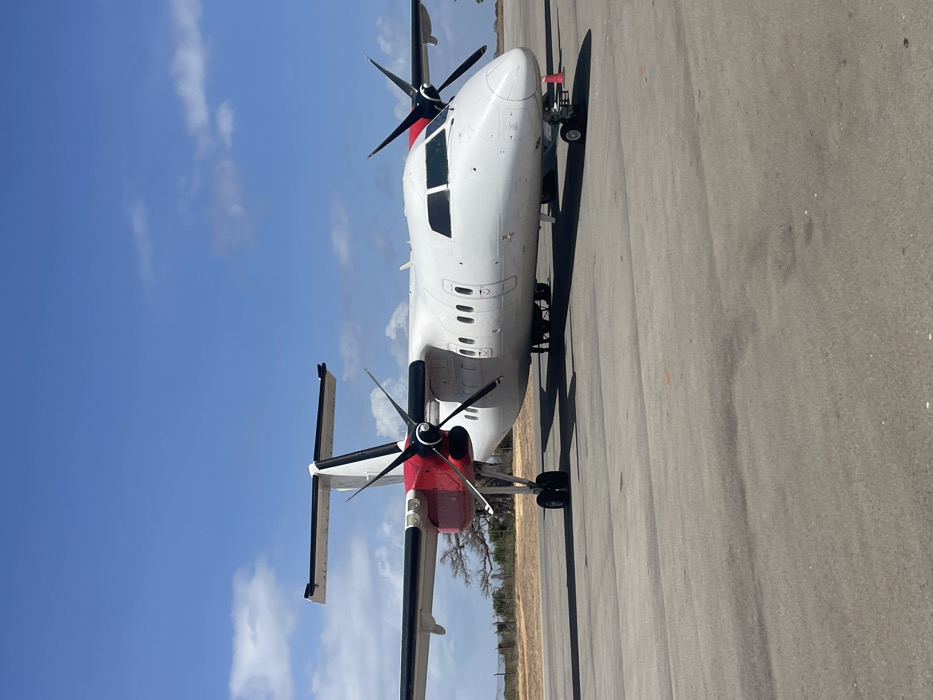
A white twin-turboprop aircraft, likely a Bombardier Dash 8 series, is parked on an asphalt tarmac at Lamu Manda Airport in Lamu, Kenya. The aircraft features a predominantly white fuselage with prominent red sections on its engine nacelles and black propellers, which are stationary. It has a high-wing and T-tail configuration. A small white ground support equipment, resembling a tow bar, is connected to the nose landing gear, and a single orange traffic cone is positioned nearby. The scene is set under a clear blue sky with scattered white cumulus clouds. In the distant background, dry, sparse vegetation and a fence line are visible along the horizon. No individuals or active operations are present in the image.
Lamu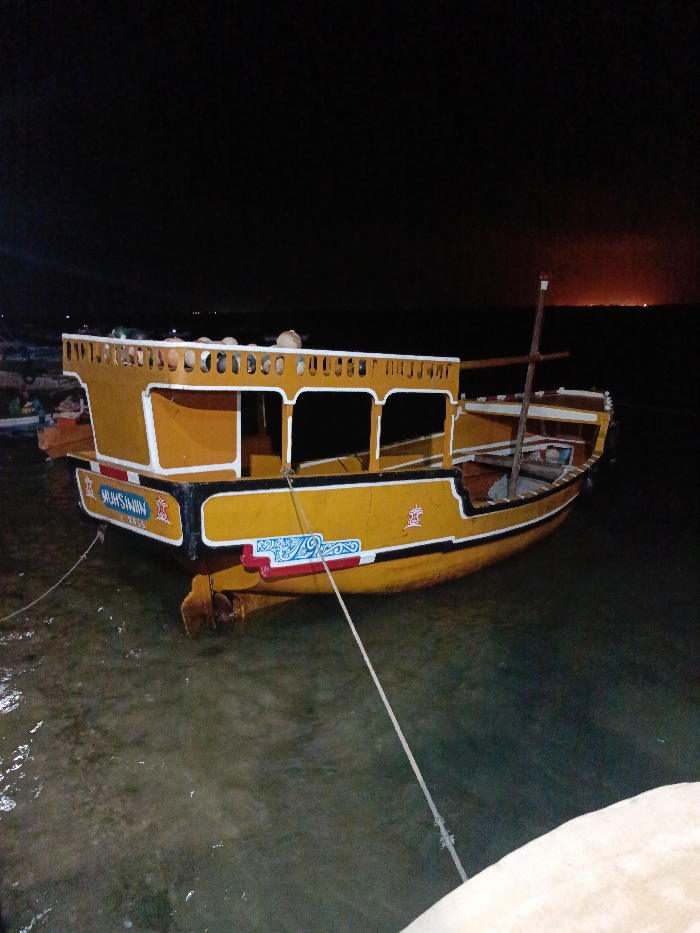
The image depicts a vibrantly painted wooden boat, predominantly yellow with black and white trim, moored in calm, shallow water at night. The boat features an elevated superstructure with ornate railings and a traditional hull design. Intricate blue and red decorative patterns are visible along its sides, adding to its distinct character. On the stern, the name "MUHSININ" is clearly inscribed in white letters, below which the registration number "L. 2835" can be seen. Ropes extend from the boat, securing it to an unseen anchor point, with one rope prominently stretching into the foreground from the right. The water reflects minimal light, appearing dark and slightly murky, with subtle ripples. The scene takes place at night, under a dark, clear sky. In the far distance, a faint reddish-orange glow illuminates the horizon, suggesting distant land or artificial light sources. The boat appears to be at rest, with no human activity directly visible on board or around it. The overall impression is one of tranquility in a coastal setting, characteristic of a fishing village or port like Lamu, Kenya. The boat's design and visible text suggest it is a working vessel.
Lamu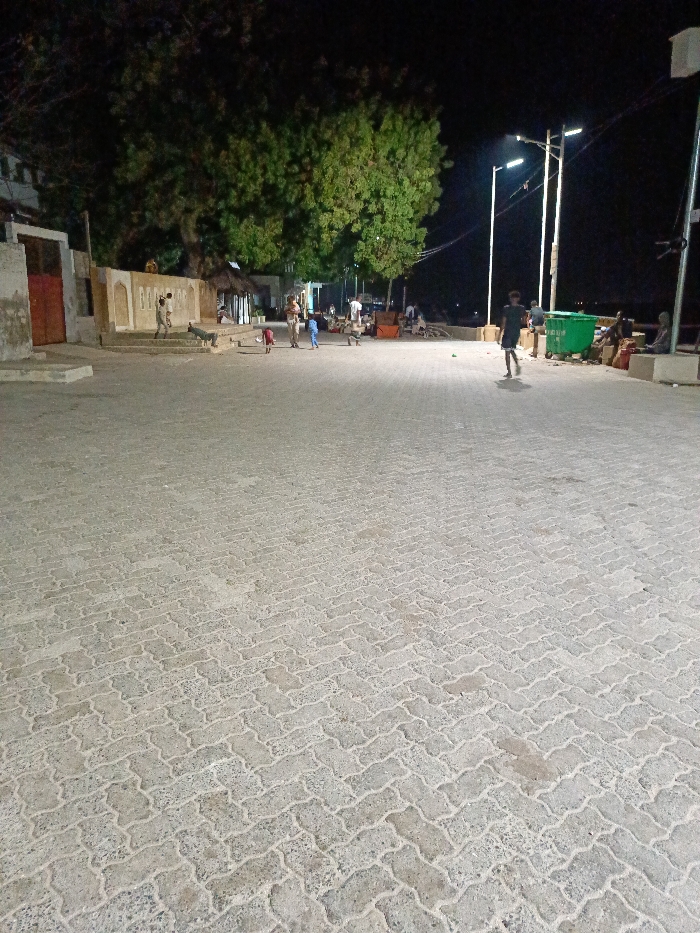
This media file captures a lively outdoor public space at night in Lamu, Kenya. The foreground is dominated by a light-colored paved surface, constructed from interlocking concrete blocks arranged in a textured, herringbone pattern. In the midground and background, various subjects are visible under the soft glow of artificial lights. A large, verdant tree with lush green foliage stands prominently on the left, brightly illuminated against the dark night sky. To its left, traditional-looking buildings with light-colored walls and a distinct reddish-brown wooden door are present. A low, ornate wall or barrier runs along the base of these structures, with a small, circular thatched-roof hut nestled beneath the tree. Several people are scattered across the scene, engaged in casual evening activities. On the left, near the ornate wall, a few individuals, including what appear to be children, are moving or standing; one child is seen bending down. In the center-right, an adult, likely a male, wearing dark shorts and a t-shirt, walks towards the viewer, casting a shadow. Further in the background, more figures are observed sitting and standing, suggesting a communal gathering or social interaction. On the far right, two tall streetlights with modern luminaires cast bright illumination over the area, next to a large green waste bin and other smaller items. A person is also seen sitting on a low wall or bench on the right side of the frame. The overall impression is a peaceful yet active nocturnal scene, depicting a community gathering spot, possibly a town square or waterfront promenade. The clear night sky and the well-lit environment indicate pleasant weather conditions. There is no decipherable text visible within the image.
Lamu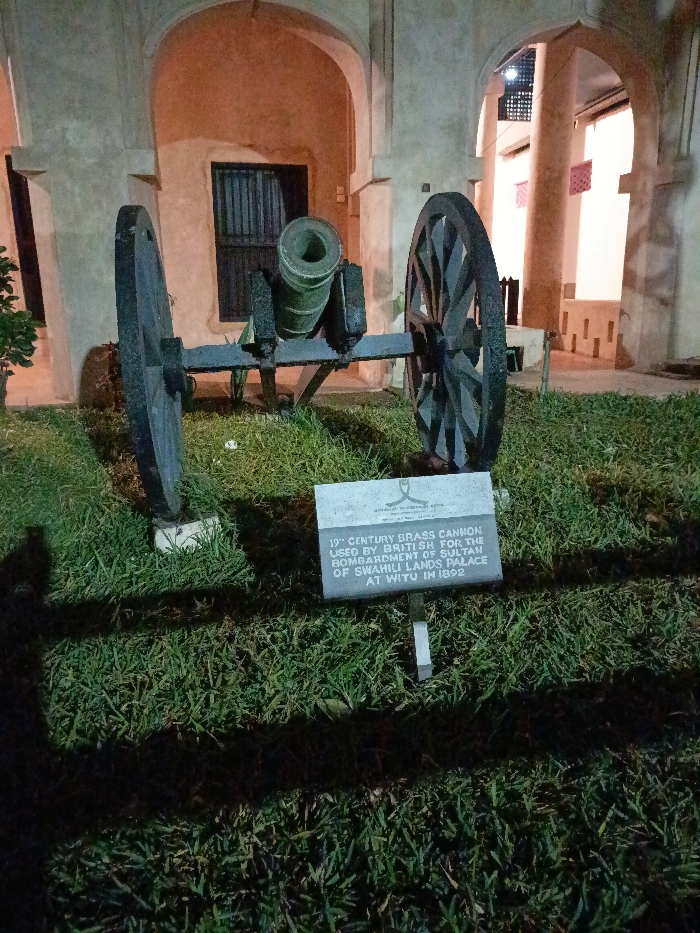
The image displays a 19th-century brass cannon set up as a historical exhibit on a patch of grass, likely in Lamu, Kenya. The cannon, weathered to a greenish hue, rests on a robust wooden carriage with two large, spoked wooden wheels. In front of the cannon, a white rectangular sign provides historical context. The visible text reads: "19TH CENTURY BRASS CANNON USED BY BRITISH FOR THE BOMBARDMENT OF SULTAN OF SWAHILI LANDS PALACE AT WITU IN 1892". This indicates the cannon's use in a significant historical event in the region. The setting appears to be a courtyard or an outdoor area of a historical building, likely at night or during very low light conditions, given the dramatic artificial lighting. Warm, orange-toned light emanates from behind the cannon, illuminating the background architecture which features light-colored walls and prominent arched doorways and pillars. These architectural elements suggest traditional Swahili or Islamic design. Long shadows are cast across the grass from the cannon and other unseen objects, further emphasizing the artificial lighting. The scene is static, depicting a preserved historical artifact on display.
Lamu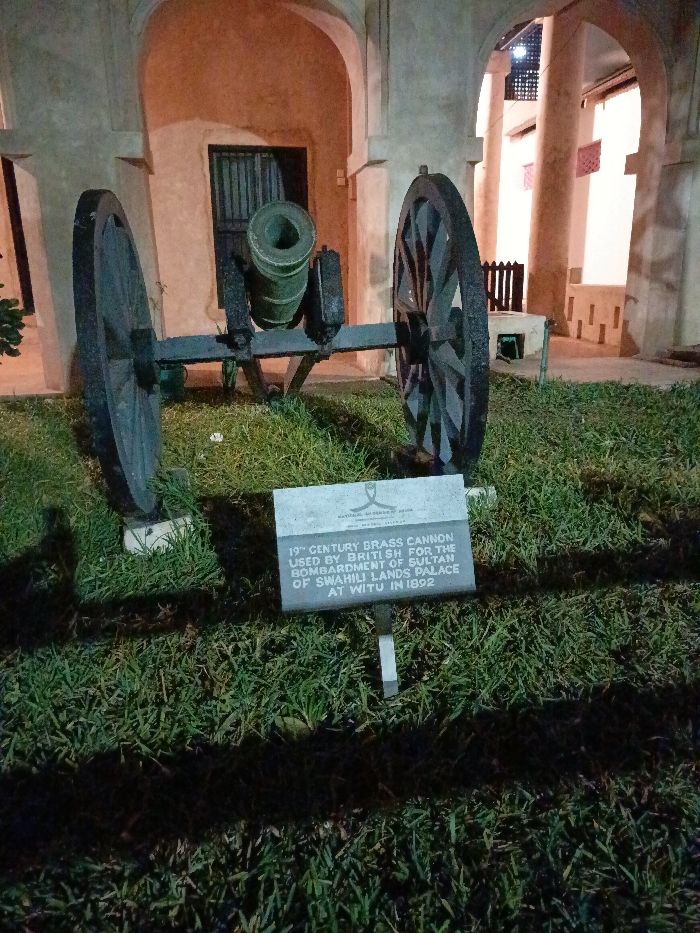
An outdoor, slightly low-angle shot captures a 19th-century brass cannon displayed on a grassy area in what appears to be the evening or night, illuminated by warm artificial light. The cannon is made of dark metal, resting on a sturdy wooden carriage with two large, spoked wheels. Its barrel points towards a building with arched doorways and pillars in the background, which is also softly lit, casting a warm glow on the stone facade. One of the background arches reveals more internal architecture, possibly leading to a courtyard or walkway. In front of the cannon, embedded in the grass, is a rectangular white sign with black text. The text reads: "NATIONAL MUSEUMS OF KENYA" (partially visible logo/text at the top) followed by "19TH CENTURY BRASS CANNON USED BY BRITISH FOR THE BOMBARDMENT OF SULTAN OF SWAHILI LANDS PALACE AT WITU IN 1892". Shadows are cast across the grass from the cannon and possibly the photographer, indicating the direction of the light source. The overall scene suggests a historical exhibit at a museum or heritage site in Lamu, Kenya, highlighting a significant colonial event.
Lamu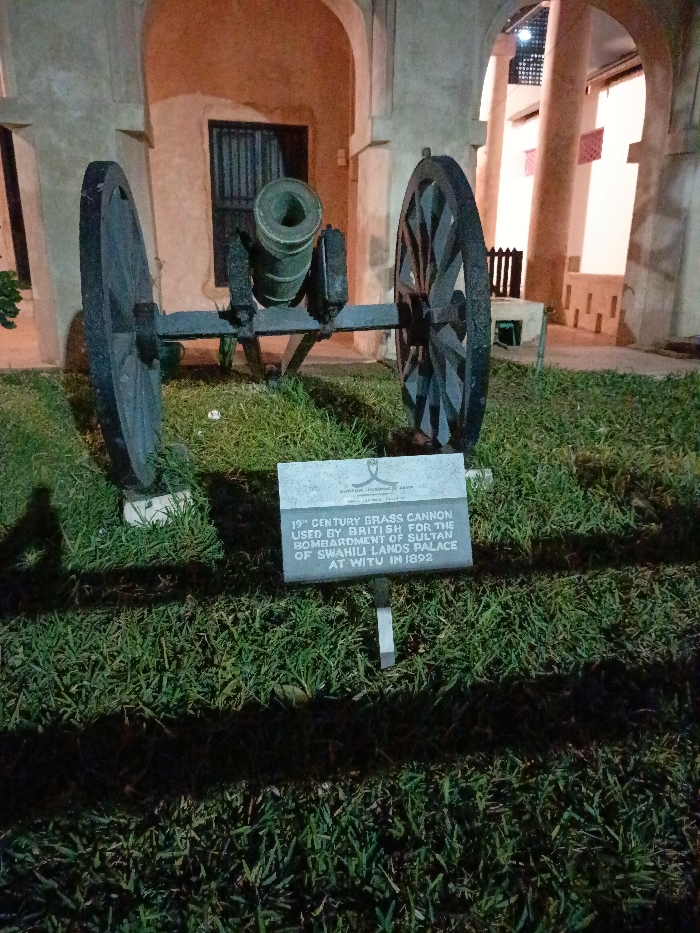
An outdoor night shot captures a historical brass cannon on a two-wheeled carriage, positioned on a patch of grass. The cannon, facing forward, is the central focus, appearing dark against the illuminated background. Behind it, arched architectural elements with pillars and what appears to be a dark window or doorway are visible, lit by warm, artificial light, casting long shadows across the grass in the foreground. In front of the cannon, a rectangular plaque stands, displaying white text on a grey surface. The text reads: "19TH CENTURY BRASS CANNON USED BY BRITISH FOR THE BOMBARDMENT OF SULTAN OF SWAHILI LANDS PALACE AT WITU IN 1892." A logo, partially visible at the top of the sign, likely belongs to "NATIONAL MUSEUMS OF KENYA." The scene suggests a historical exhibit, possibly within a museum courtyard or a historical site in Lamu, Kenya, given the reference to Swahili lands and the architectural style. The low light and long shadows indicate either evening or nighttime, creating a somewhat solemn atmosphere for the display of this historical artifact.
Lamu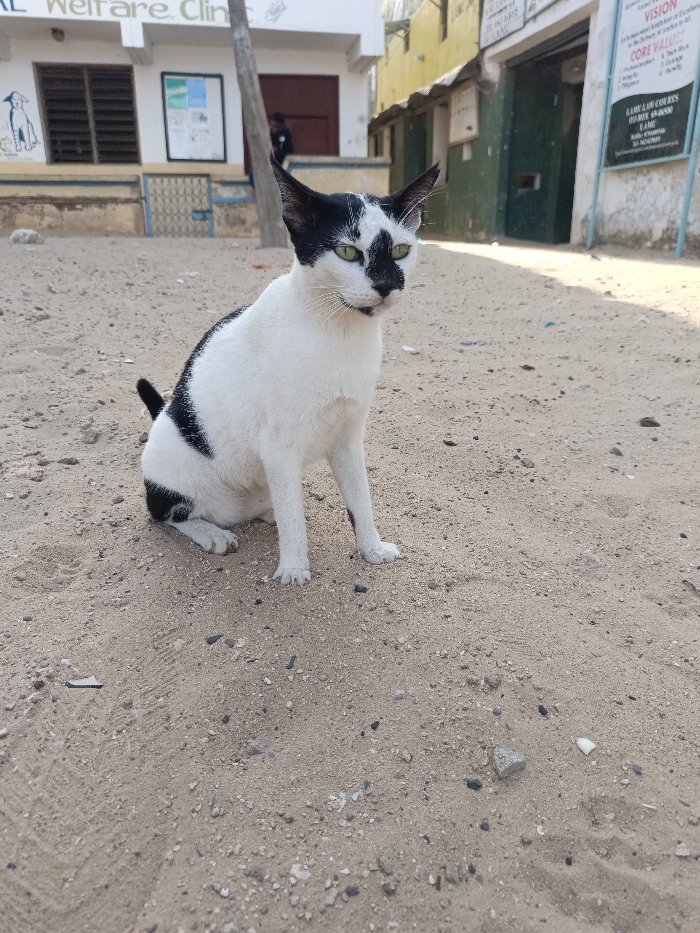
A black and white cat with vivid green eyes sits on sandy ground under bright daylight in Lamu, Kenya. The cat's fur is predominantly white, featuring distinct black markings on its ears, around its eyes and nose, and patches on its back and tail. It faces towards the right of the frame with an alert gaze. In the background, a white building on the left features a visible sign partially reading "Welfare Clinic." A vertical pole stands between the buildings. To the right, a green building displays multiple signs. One prominent vertical sign clearly shows "VISION," "CORE VALUES," and mentions "GAME LAW COURES" along with several phone numbers, including "020 8696688" and "0725 470650." The ground is a mix of sand and small pebbles, indicating an unpaved area. The clear shadows suggest a sunny day. No specific activity beyond the cat resting is visible.
Lamu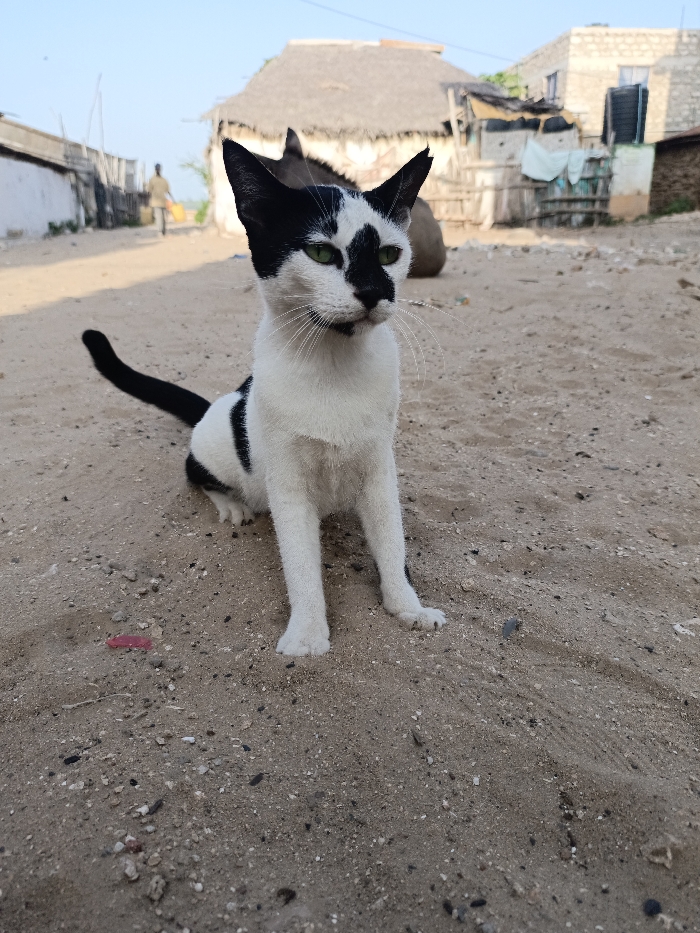
A black and white cat sits prominently in the foreground of a sandy, outdoor scene, likely in Lamu, Kenya. The cat has striking green eyes, black ears, and distinctive black patches around its eyes, on its nose, and a stripe down its back, contrasting with its otherwise white fur. Its tail is black. The cat is looking slightly to the right of the frame, with visible whiskers. The ground beneath the cat is light brown sand, speckled with small pebbles and some darker debris, including a small red object near the cat's front left paw. In the mid-ground and background, the setting appears to be a village or settlement. To the left, a simple wooden fence or structure runs along what seems to be a path. In the central background, a traditional building with a prominent thatched roof stands out. Further to the right, other rustic buildings, possibly made of stone or mud, are visible, one with a water tank on its roof. The architectural style, combined with the sandy ground, hints at a coastal or island environment, consistent with Lamu. In the far left background, a person is seen walking away from the camera, carrying an object, possibly a bucket, in their right hand. The sky is a clear, light blue, suggesting good weather. The lighting is soft, indicative of either early morning or late afternoon. No text is visible in the image.
Lamu