Malanja Depression, Tanzania
13 memories from Malanja Depression, Tanzania
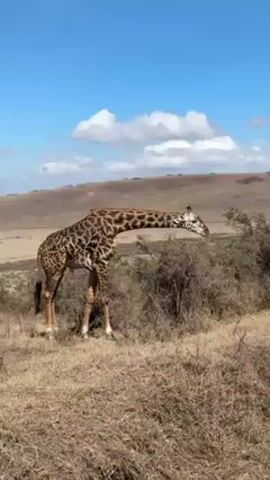
A giraffe, standing on a grassy, hilly terrain, is eating leaves from a bush. The giraffe has a dark brown and tan patterned coat. The sky is blue with scattered white clouds.
Malanja Depression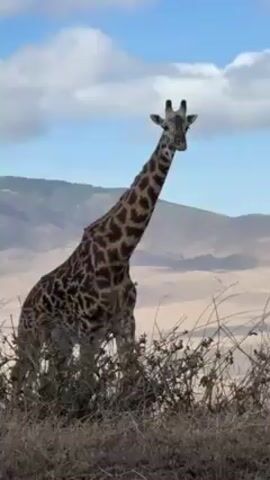
The video shows a giraffe standing on a dry grassy hill. Behind the giraffe, there is a landscape with mountains and a blue sky with scattered clouds. The giraffe is mostly standing still, occasionally moving its head.
Malanja Depression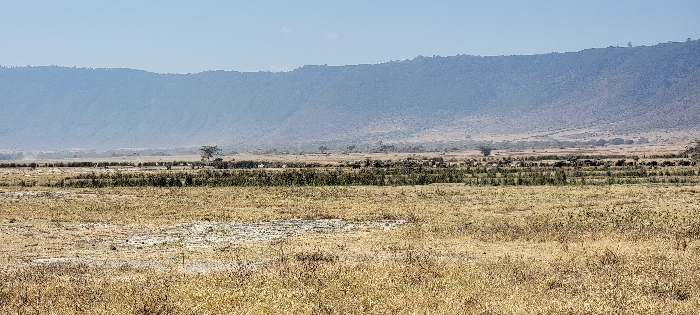
The scene depicts a wide expanse of the Malanja Depression, Tanzania, under a clear, pale blue sky. The foreground consists of dry, yellowish-brown grass and scattered low scrub, with several lighter, possibly dry mud or mineralized patches on the ground. A distinct horizontal band of denser, dark green wetland vegetation crosses the midground, behind which lies more dry grassland. Within and immediately adjacent to this green band, a large herd of numerous dark-colored ungulates, consistent with wildebeest or buffalo, is visible, distributed across the terrain. Scattered acacia-like trees punctuate the midground landscape. In the distant background, a prominent, hazy blue-grey mountain range or escarpment, appearing forested on its slopes, rises against the horizon. The lighting indicates bright daylight conditions. No human subjects or their immediate actions are discernible.
Malanja Depression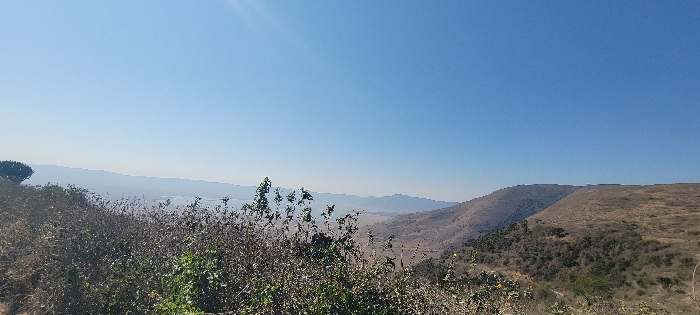
The image depicts a vast, sunlit landscape within the Malanja Depression, Tanzania. The upper two-thirds of the frame is dominated by a clear, bright blue sky, with a subtle lens flare present in the upper-left quadrant. The foreground features a dense, untamed mass of low-lying scrub brush and dry, woody vegetation, interspersed with patches of green foliage. No individuals, man-made structures, or animals are visible in this section. The midground reveals rolling hills and valleys, characterized by dry, sparse vegetation, predominantly in shades of brown and tan, indicative of a dry season or arid environment. These hills descend into a broad valley in the background where a significant body of water, likely a lake or large river, is visible as a lighter, hazy blue-grey expanse. Beyond the water, a distant line of mountains and hills stretches across the horizon, softened by atmospheric haze. The overall scene is brightly illuminated by natural daylight, emphasizing the expansive, undeveloped terrain.
Malanja Depression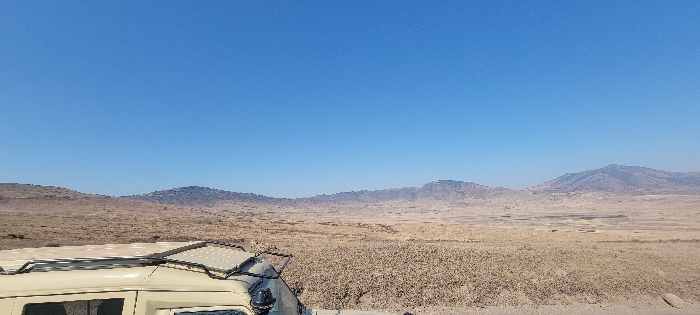
The scene depicts an expansive, arid landscape in the Malanja Depression, Tanzania, under a clear, bright blue sky. In the lower-left foreground, the upper section of a light-colored utility vehicle is visible, equipped with a black, slatted roof rack. The ground consists of vast, flat to gently rolling terrain covered with sparse, dry, light brown and tan vegetation. A lengthy chain of distant, dark, undulating hills and mountains forms the horizon line. No individuals are present, and no specific actions or interactions are depicted.
Malanja Depression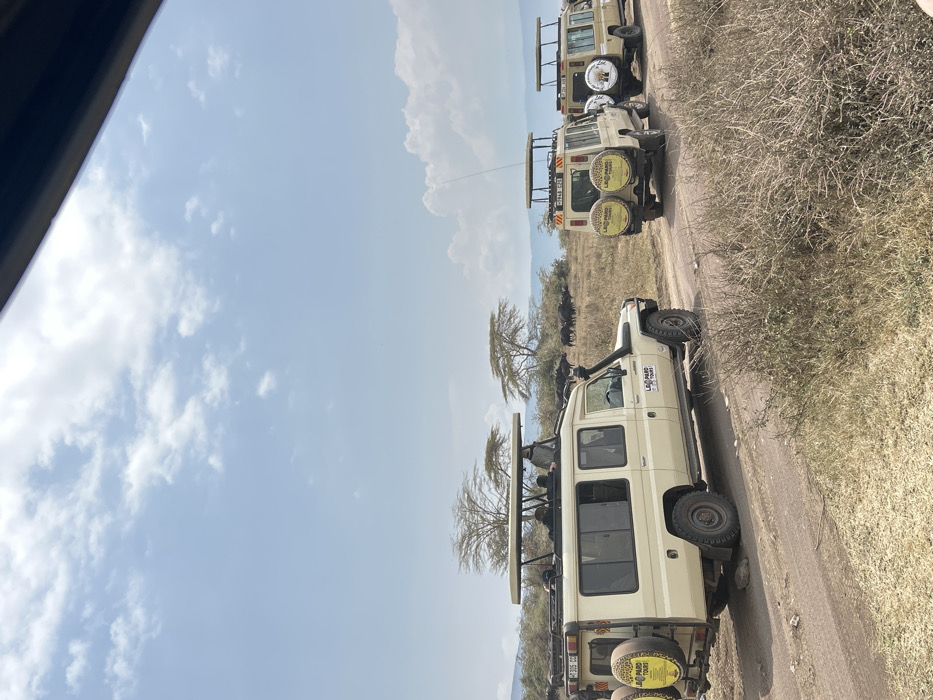
This image depicts a daytime safari scene in the Malanja Depression, Tanzania. Three beige safari vehicles, identified as modified Toyota Land Cruisers, are arranged in a convoy on a dirt track that curves slightly to the right. The sky overhead is light blue with scattered white cumulus clouds. The lead vehicle, closest to the viewer, is a "LEOPARD TOURS" branded vehicle with Tanzanian license plate T 305 CC. Its pop-up roof is raised, revealing at least three occupants visible from the chest up, seemingly observing the surroundings. Two yellow spare tire covers with "LEOPARD TOURS" logos are mounted on the vehicle's rear. A snorkel is present on its front passenger side. Following this vehicle is a second "LEOPARD TOURS" vehicle, license plate T 775 GUJ, also with two rear-mounted spare tires. A third, similar safari vehicle trails in the distance. In the middle ground, to the right of the lead vehicle and beyond the second, a herd of dark-colored Cape Buffalo is visible standing on the dry, light-brown savanna. The landscape features sparse, flat-topped acacia trees. Distant, hazy hills form the horizon line. The vehicles appear to be stationary or moving very slowly, indicative of a wildlife viewing activity.
Malanja Depression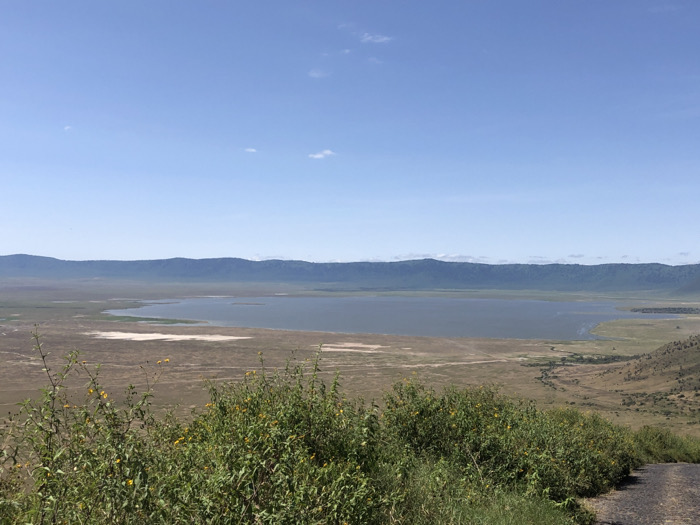
The image is a panoramic view from a hilltop overlooking a large body of water in the Malanja Depression of Tanzania. The location's coordinates are latitude: -3.158, longitude: 35.479. The foreground consists of a grassy, brushy area that slopes downward toward a dirt road in the lower right corner. The background shows a vast body of water stretching out to the horizon. Beyond the water, a ridge of hills rises up, creating a hazy outline against the bright blue sky. The sky is mostly clear with only a few wisps of white clouds. The scene appears serene and peaceful, with no people or other signs of human activity present.
Malanja Depression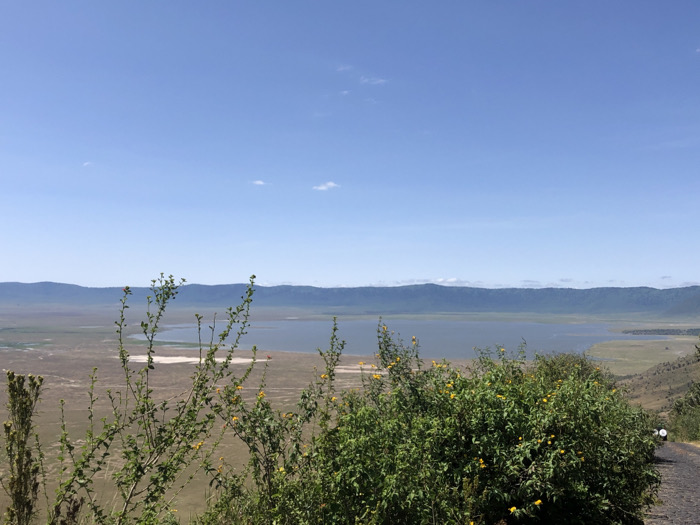
A panoramic view of the Ngorongoro Crater, located within the Ngorongoro Conservation Area in Tanzania, is captured from a vantage point on the crater rim. The image, taken from a roadside overlooking the crater, shows a clear blue sky with a few scattered clouds, overlooking a large, dry, grassy plain dotted with green shrubs and a small, shallow lake. There is a single, paved road leading up to the vantage point, a white, round object visible to the right. The image captures the beauty of the crater from a high perspective, showcasing the vastness and diversity of the landscape.
Malanja Depression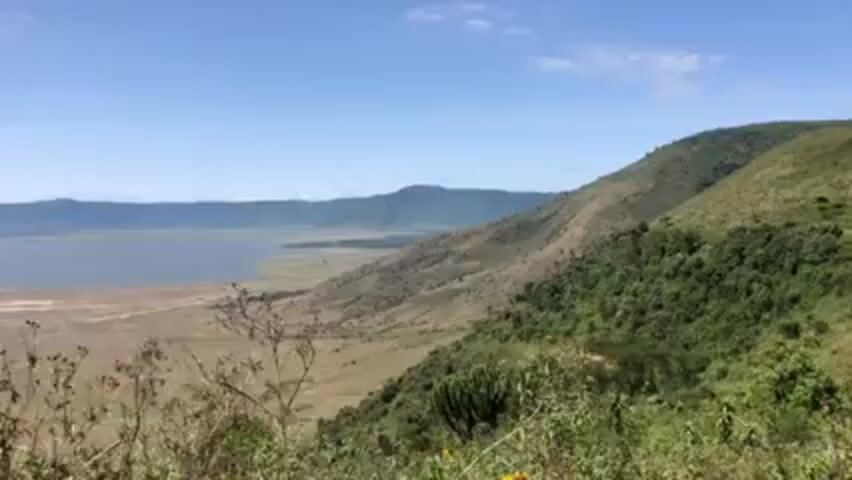
Here's a concise description of the video: The video shows a wide shot of a vast crater landscape in Africa, likely the Ngorongoro Conservation Area in Tanzania. A large, shallow lake dominates the center of the crater floor, surrounded by grassy plains and patches of woodland. The crater walls are visible in the background, rising up to meet a clear blue sky. The view is from a high vantage point, with some foreground vegetation in the lower part of the frame. The scene appears still and quiet, with no immediately visible human activity.
Malanja Depression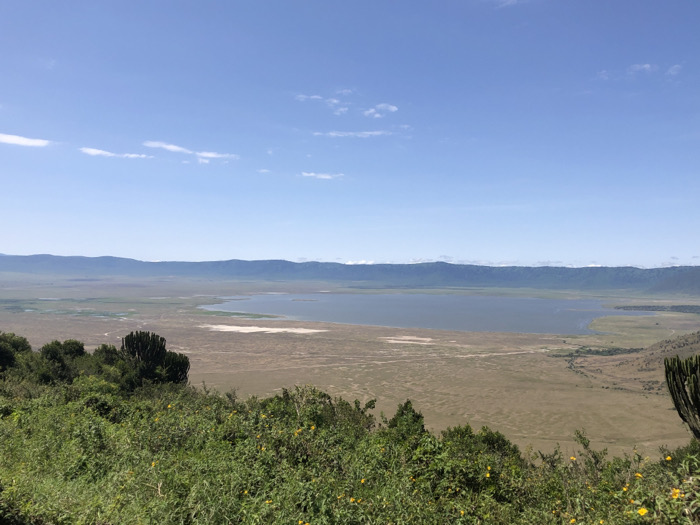
The image shows a panoramic view of the Ngorongoro Crater in Tanzania, taken from the crater rim. The crater floor is visible in the distance, with a large body of water, likely Lake Magadi, in the center. The foreground features lush vegetation, while the surrounding landscape is characterized by dry grassland. The sky is clear and blue, with only a few wispy clouds. The coordinates given place the location at a point on the crater rim.
Malanja Depression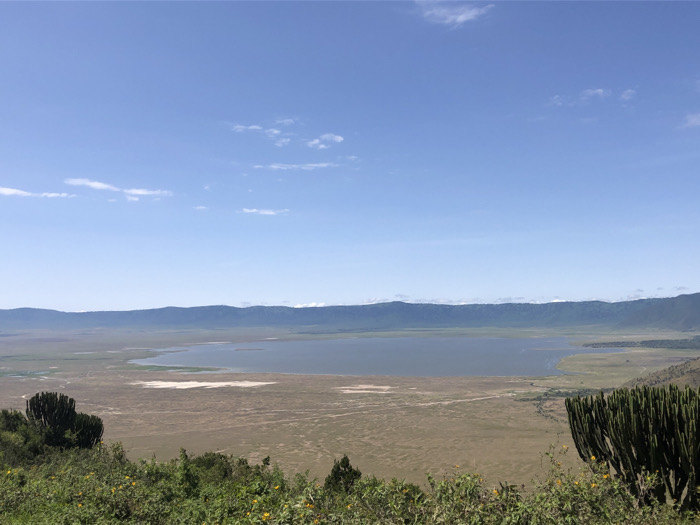
The image shows a panoramic view of a large lake with a long, shallow shoreline, situated in a broad depression, with a distant mountain range beyond the lake. The scene is located in the Ngorongoro Crater, Tanzania, at coordinates latitude -3.155, longitude 35.477. The lake is surrounded by dry grasslands, with sparse vegetation growing around the lake's edge. In the foreground, a line of tall, slender trees (possibly Euphorbia candelabrum) grows on the edge of the depression, while the foreground is covered in low-lying vegetation. The sky is clear blue, with a few wispy clouds. No people are visible in the image.
Malanja Depression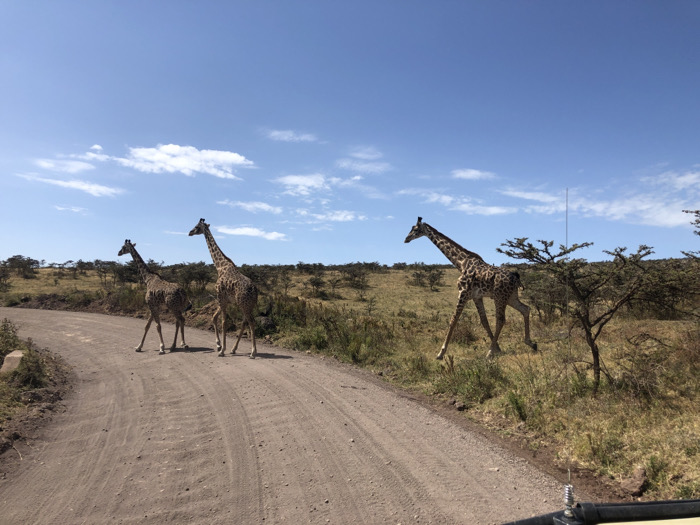
Three giraffes are walking along a dirt road in the Malanja Depression in Tanzania. They are all walking in the same direction. The giraffe on the left is smaller than the other two. The giraffe on the right is the largest. The giraffes are walking on a dirt road, surrounded by grass and trees. The sky is blue with white clouds. The coordinates of the location are latitude: -3.142, longitude: 35.44.
Malanja Depression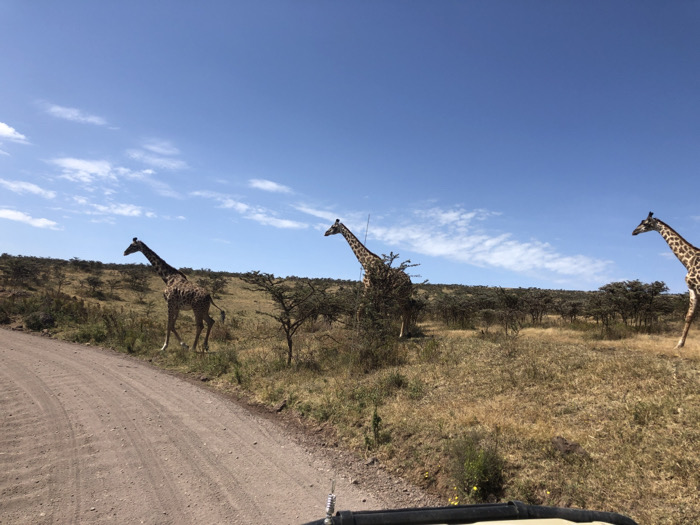
The image shows three giraffes in the Malanja Depression in Tanzania, at coordinates -3.142 latitude and 35.439 longitude. The giraffes are walking away from the camera on a dirt road. The giraffes are brown and white with long necks and legs. There is a clear blue sky with white clouds in the background. The giraffes are surrounded by dry, brown grass and small trees. The road is dusty and uneven.
Malanja Depression