Manikaran, India
30 memories from Manikaran, India
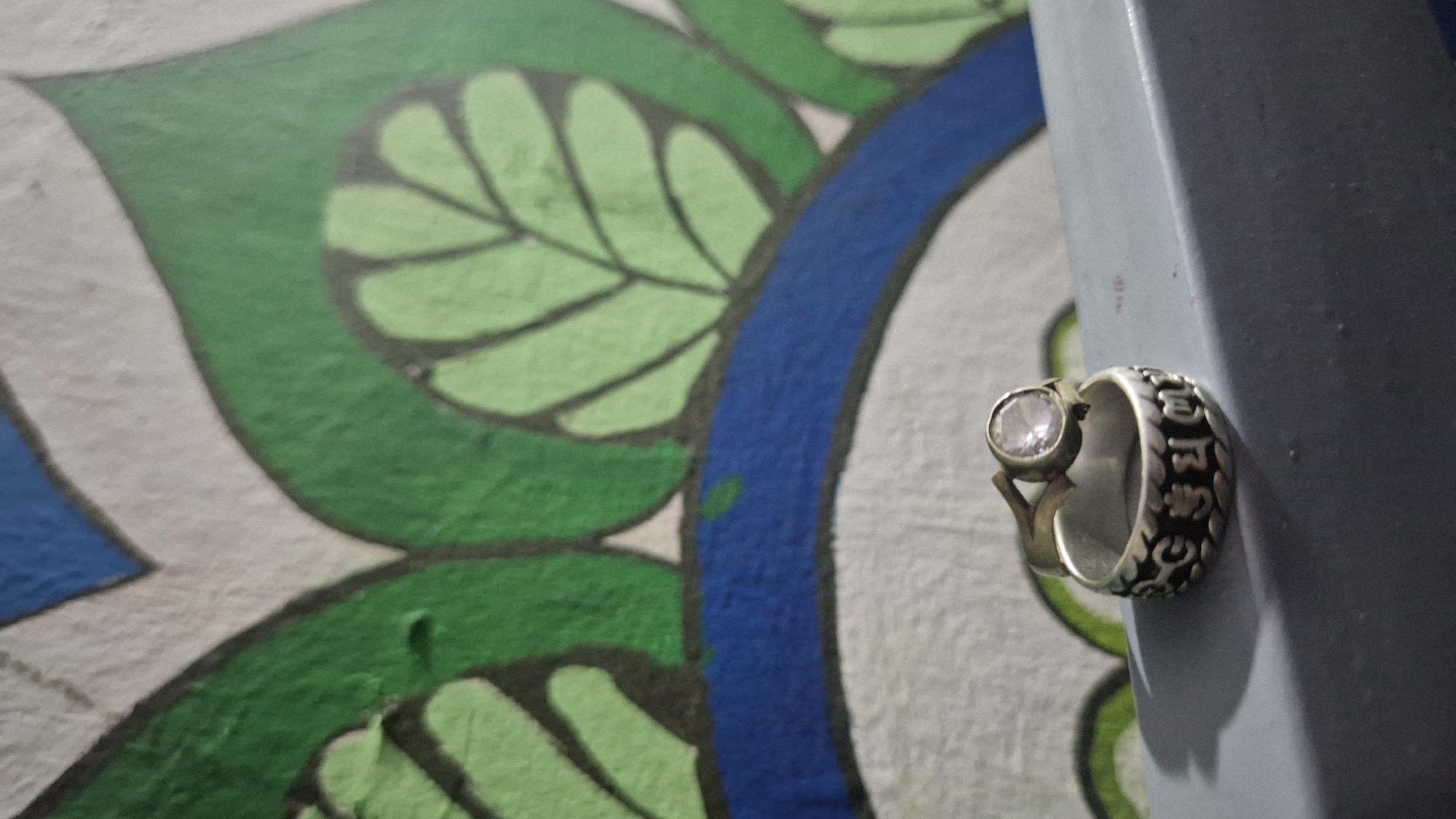
The image shows two rings resting on a grey, vertical surface. The ring on the left has a clear stone, possibly a diamond or cubic zirconia, set in a yellow gold band. The ring on the right is a silver band with intricate, darkened engravings that appear to be Buddhist or Sanskrit script. The rings are positioned in front of a wall decorated with a green and blue floral or leaf pattern. The background suggests an indoor or sheltered setting, possibly a home or a shop, given the painted wall and the object the rings are placed upon. The lighting appears to be artificial, casting shadows and highlighting the metallic sheen of the rings. The image is captured at a close-up perspective, emphasizing the details of the rings and the artwork on the wall. The overall impression is one of personal adornment and cultural artistry. Manikaran, India, is a significant pilgrimage town in Himachal Pradesh, known for its hot springs and temples, and this context might hint at the cultural significance of the rings or the artwork.
Manikaran
A ceiling fan spins rapidly against a textured, purple-painted ceiling. The fan has a white central housing and a blue, yellow, and orange decorative element. The ceiling itself shows signs of wear and tear, with patches of peeling paint and what appear to be water stains or damage. Concentric circles of various colors, including red, pink, yellow, green, and blue, are painted on the ceiling, radiating outwards from the fan, creating a visual effect that interacts with the fan's motion. The overall impression is one of a slightly dilapidated but colorful interior space.
Manikaran
A pair of black athletic shoes with white accents rests on a green carpet with black stripes. To the left of the shoes, a red car battery is connected to a red and black battery charger. Next to the battery charger is a small pink rectangular container. A white, dome-shaped object, possibly an air freshener, is located near the top left corner of the image. The scene appears to be indoors, possibly a storage area or a workshop, given the presence of the battery and charger. The lighting is dim, suggesting it might be nighttime or a poorly lit interior. There is no visible text in the image. The overall impression is one of a utilitarian space with items casually placed on the floor.
Manikaran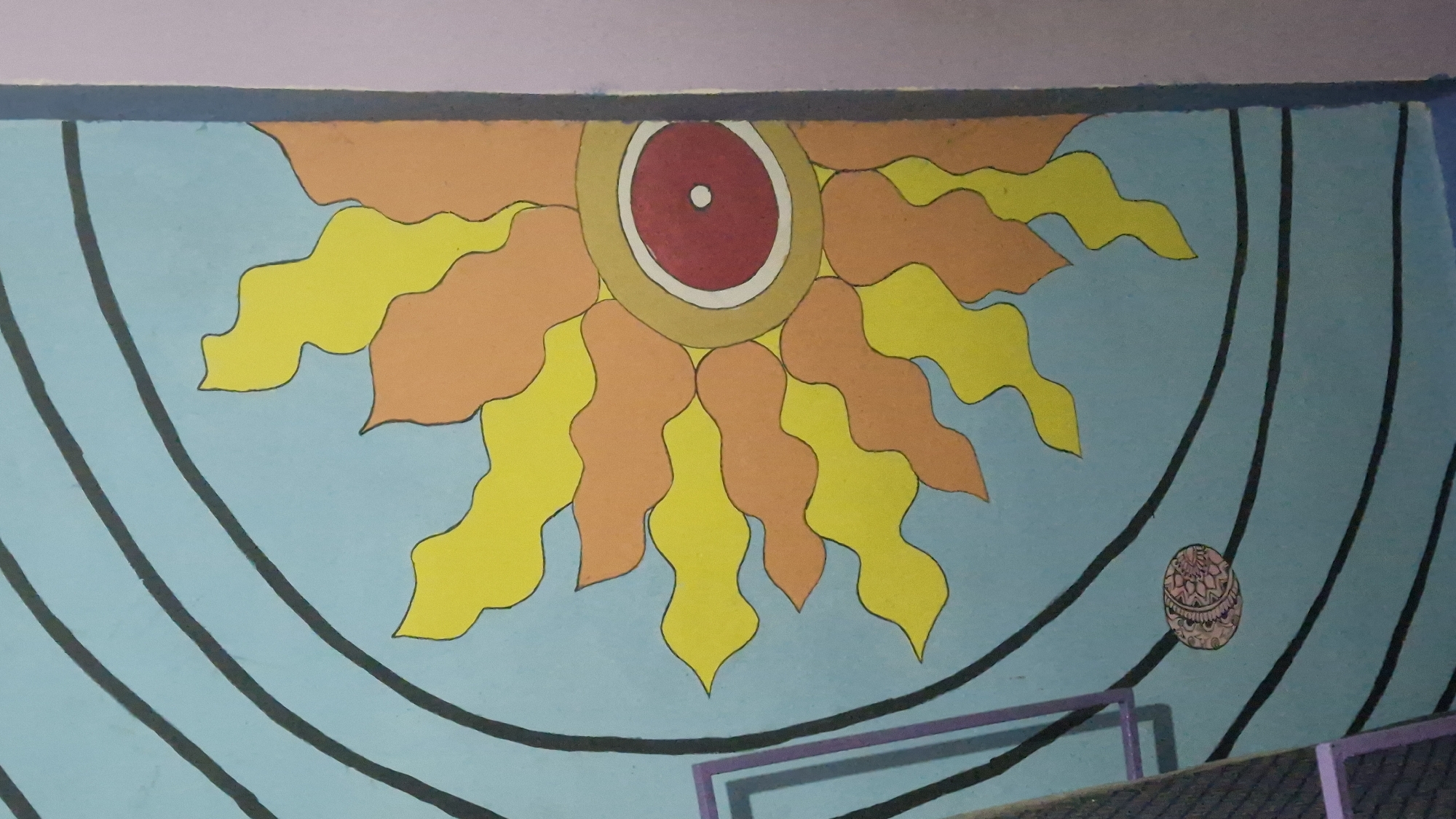
This media file features a colorful mural painted on a wall, likely indoors given the lighting and the presence of structures below that resemble furniture or a stage. The mural depicts a stylized sun at its center, with bold yellow and orange wavy rays radiating outwards against a light blue background. The sun itself has a red circular center with a white dot, surrounded by a thick white ring and a golden-brown outer ring. The background is further decorated with several dark, curved lines that sweep across the blue expanse, giving a sense of depth or movement. To the right of the sun, a small, pink, patterned circular object, resembling an ornate Easter egg or a mandala, is depicted. Below the mural, parts of what appear to be purple-framed structures and a dark net-like surface are visible, suggesting this could be a decorated wall in a recreational space, perhaps a community center or a school. The overall aesthetic is bright, cheerful, and somewhat psychedelic, evoking a warm and inviting atmosphere. The time of day and weather are not discernible from the image. There is no visible text in the media file. The location context of Manikaran, India, might imply a cultural or spiritual element to the artwork, though this is not explicitly evident.
Manikaran
The image shows a section of a wall with a mural. The mural depicts a large, stylized purple object that appears to be a mushroom or a flower, with segments of varying shades of purple outlined in black. A portion of a dark object, possibly a piece of clothing or furniture, is visible on the left side of the frame, casting a shadow that includes a small, drawn star. A light-colored metal railing runs horizontally across the lower left portion of the image, partially obscuring the bottom of the mural. Below the railing is a striped fabric, likely part of a seat or bed. The wall itself is textured and appears to be an exterior surface, likely in an outdoor urban setting. The lighting suggests it is either dusk or dawn, or an indoor space with artificial lighting. The scene is located in Manikaran, India, though no specific landmarks identifying the city are visible in this cropped image.
Manikaran
A medium shot selfie shows a man with dreadlocks and a beard, lying on his side and looking towards the camera. He is wearing a plaid shirt and a patterned scarf. The background is a wall with a colorful mural of floral or flame-like shapes in pastel colors. The image appears to have been taken in the city of Manikaran, India.
Manikaran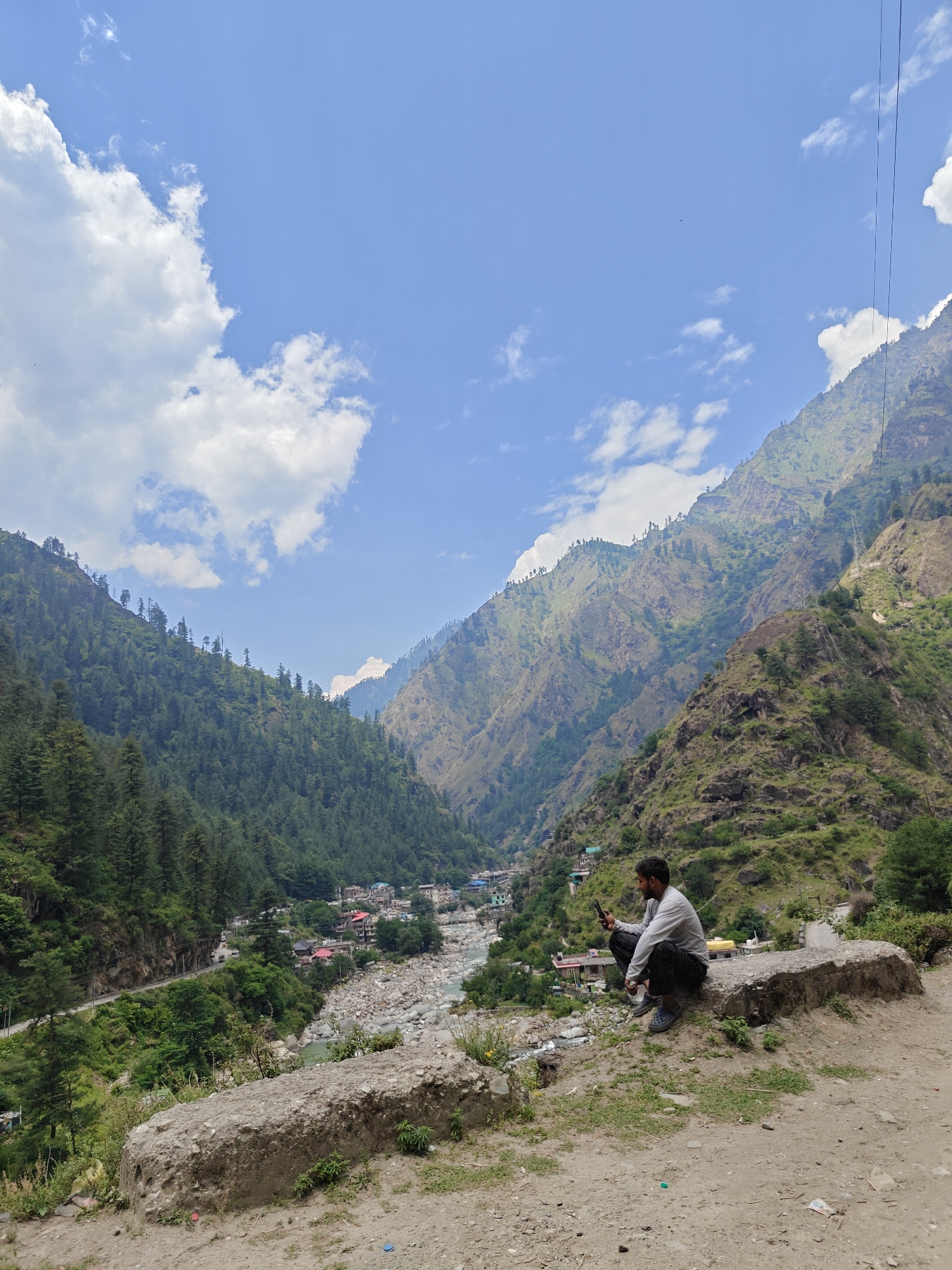
This image presents a stunning, wide-angle view of a mountainous valley, characteristic of Manikaran, India. The scene is dominated by two massive, forested mountains rising on either side, their peaks reaching towards a clear blue sky dotted with scattered white clouds. The mountainsides are densely covered with green trees, primarily coniferous, extending down to the valley floor. In the heart of the valley, a river with a light turquoise hue and a rocky bed flows through, flanked by a small town or village. The village consists of numerous buildings with varied roof colors, including red and blue, nestled along the riverbanks and climbing the lower mountain slopes. A winding road is visible on the left side of the valley, running parallel to the river. In the immediate foreground, on the right, a man is squatting on a large, rough concrete block situated on a dirt path. He is wearing a light grey long-sleeved shirt, dark pants, and blue clogs, and is holding a dark smartphone, appearing engrossed in its screen. The man's presence offers a human element to the vast landscape, suggesting a moment of rest or connection in a serene environment. The time of day appears to be sunny daytime, with bright natural light illuminating the scene. The weather is clear and pleasant. Faint utility wires are visible stretching across the upper right sky, indicating some infrastructure in the mountainous terrain. No visible text is discernible in the image.
Manikaran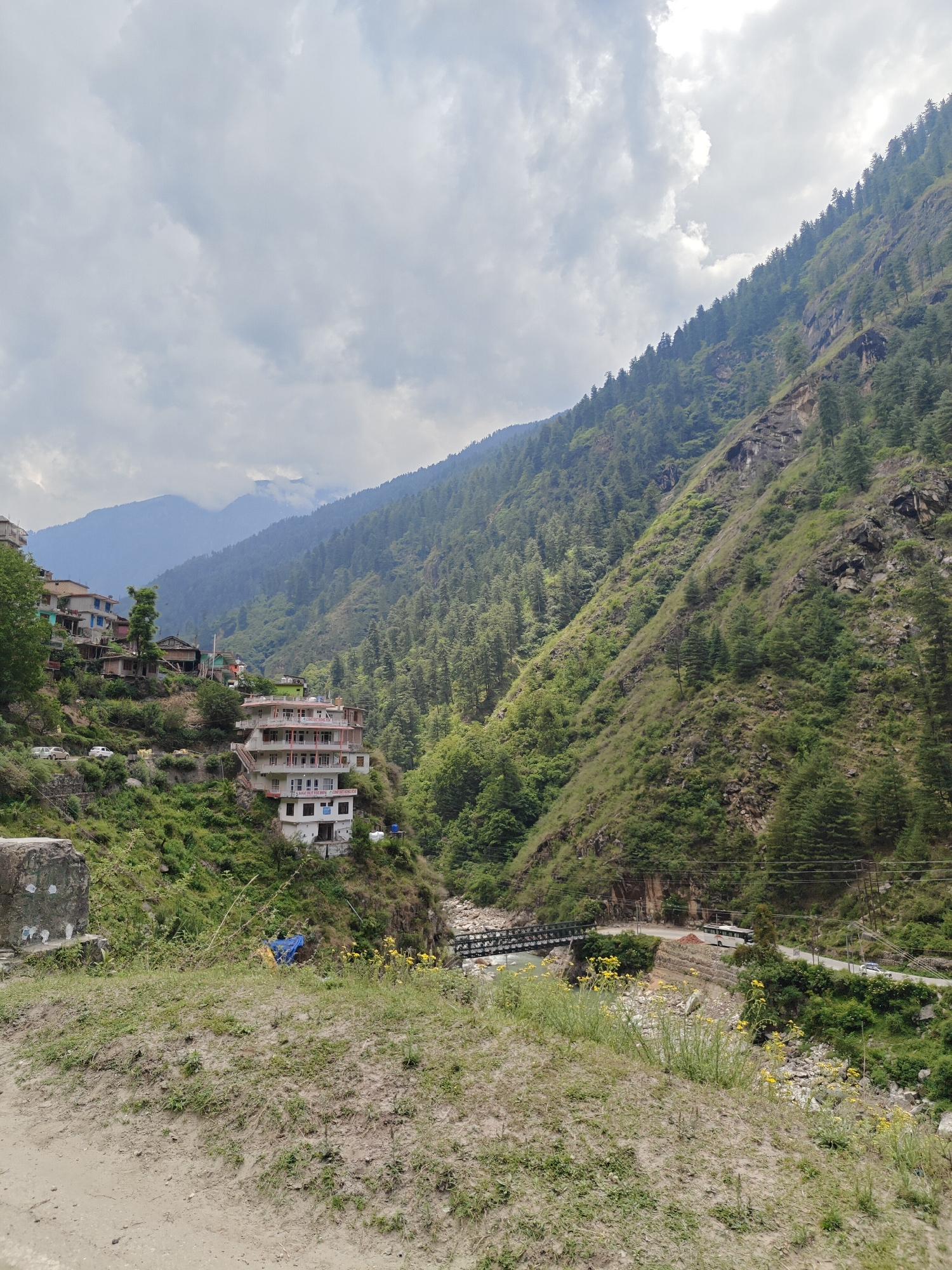
This media file captures a picturesque mountain valley scene in Manikaran, India, showcasing a blend of natural beauty and human habitation. The overall setting is dominated by towering, verdant mountains that rise steeply on both sides of a narrow valley. These slopes are densely covered with coniferous trees, primarily pines and deodars, and rocky outcrops are visible throughout. In the foreground, the ground is covered with sparse grass, dirt, and scattered yellow wildflowers. A clear, light blue-green river or stream flows through the bottom of the valley, bordered by a rocky bed. A dark green/grey metal truss bridge spans the river, and a paved road runs alongside it. On this road, a white bus is partially visible, along with a white car. Another white car is parked on a higher road segment further up the left hillside. Utility poles and lines are also seen along the road. On the left side of the valley, a hillside village is nestled into the steep terrain. Several multi-story buildings, predominantly white with red and blue accents, are constructed on the slopes. A particularly prominent four-story building, appearing to be a guesthouse or hotel, stands out in the mid-ground. Visible text on this building includes "SAMRAT RESTAURANT" on a lower sign and "SAI YOGI HOME STAY" on a banner above it. Further up the slope, more residential buildings are visible, some with colored roofs. A bright blue tarp is seen on the ground below the main guesthouse. The sky is overcast with heavy, grey clouds, suggesting a cloudy day, possibly late morning or afternoon, given the diffused natural light. No people are discernible in the image. The scene conveys a sense of tranquility and the harmonious coexistence of nature and a close-knit mountain community.
Manikaran
The video captures a scenic drive through the mountainous region of Manikaran, India. The landscape is dominated by steep, lush green mountains, densely covered with coniferous trees. The initial shot (0:00-0:01) focuses on a tall, forested mountain slope under a cloudy sky. Power lines are visible in the upper frame. From 0:01 onwards, the camera reveals a winding paved road, suggesting the perspective from a moving vehicle. On the left side of the road, several multi-story buildings and houses are nestled into the mountain slopes, forming a small settlement. Further along, more distant mountain ranges appear, partially obscured by clouds or atmospheric haze. Power lines stretch across the sky, crisscrossing the valley. The foreground features rocks, shrubs, and unpaved areas alongside the road. The sky remains overcast with prominent gray clouds throughout the video. The scene depicts a blend of rugged natural beauty with signs of human presence in the form of roads, buildings, and infrastructure. No people are visible in the video. A white sign is briefly visible on the left side of the road around 0:02, but its text is unreadable. The overall atmosphere is serene and majestic, showcasing the characteristic topography of the Himalayas.
Manikaran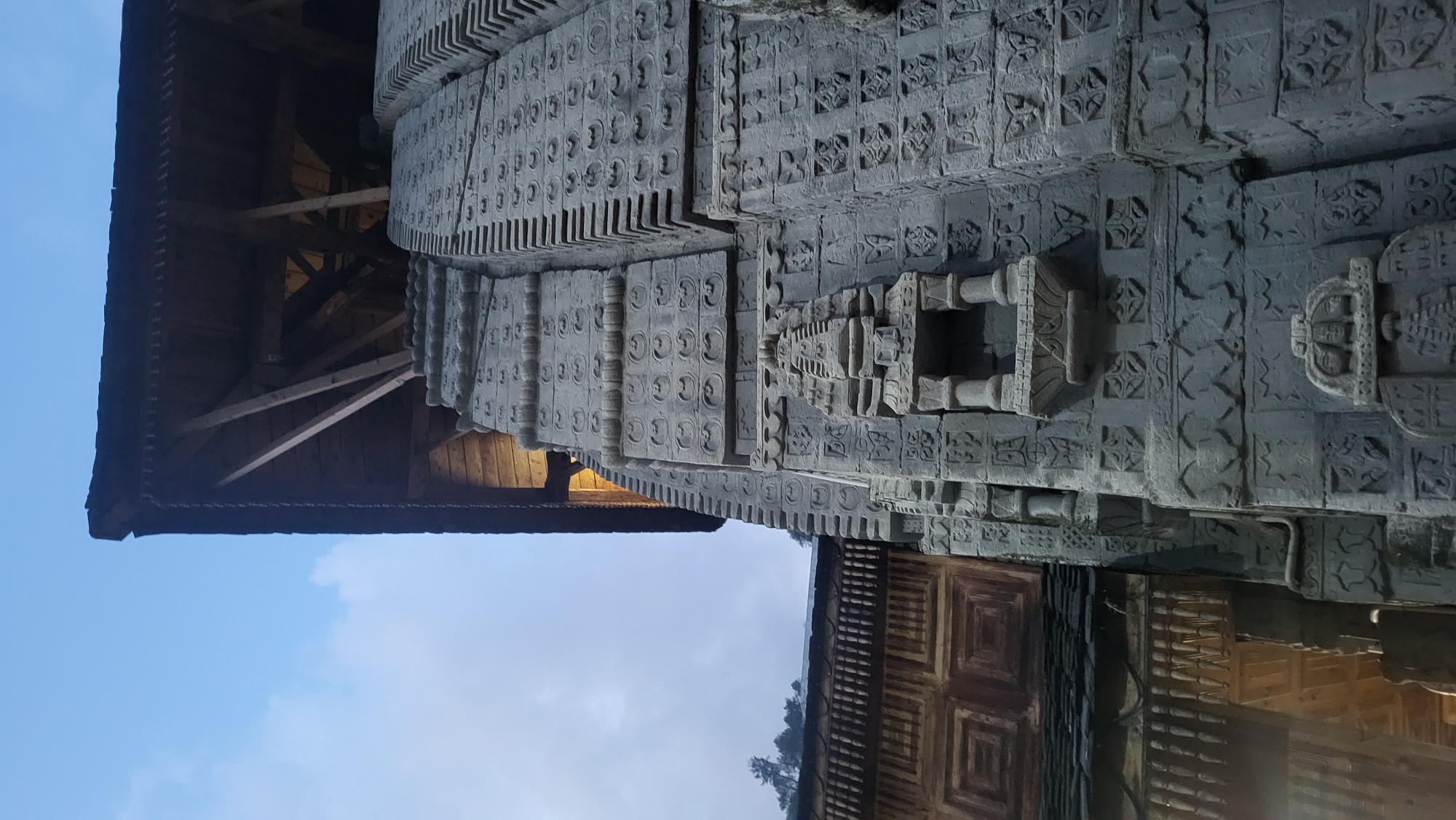
The image displays a close-up view of an ancient temple or architectural structure in Manikaran, India, showcasing intricate stone carvings and wooden elements. The main subject is a grey stone facade adorned with repeating patterns, including circular motifs, geometric designs, and ornate rectangular panels. Protruding decorative elements, possibly miniature shrines or sculptures, are integrated into the stonework. To the left and top of the stone structure, a traditional wooden roof is visible against a clear blue sky with sparse clouds. This wooden section features exposed beams and planks, suggesting an architectural style common to mountainous regions like Himachal Pradesh. Another wooden building with distinctive square paneling is partially seen in the lower right, implying a complex of structures around the main stone edifice. The scene captures the architectural detail of the site under natural daylight, likely in the late morning or early afternoon, given the soft illumination. There are no people visible, focusing solely on the craftsmanship and historical aesthetic of the buildings. No discernable text is present in the image. The intricate details of both stone and wood highlight the rich cultural and religious heritage of Manikaran.
Manikaran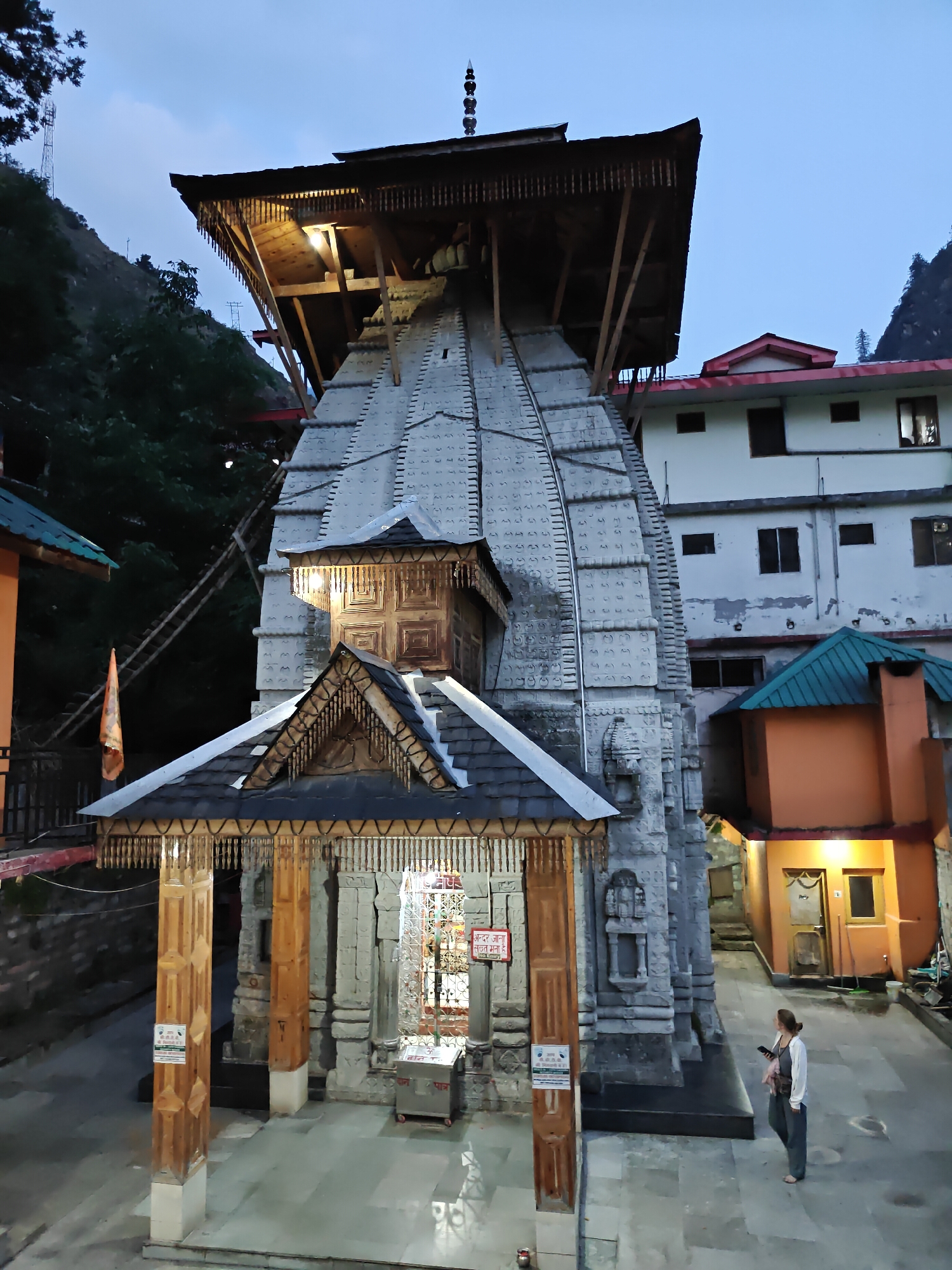
An evening view captures the ancient Shree Raghunath Temple in Manikaran, India, amidst mountainous terrain. The central subject is a multi-tiered stone temple, characterized by a grey, conical shikhara (spire) adorned with intricate carvings and vertical bands. The temple features a prominent, multi-level wooden roof structure, supported by wooden beams and featuring ornate eaves with decorative wooden elements. A distinctive pinnacle crowns the very top. Artificial lights illuminate the temple's wooden elements and main entrance, casting a warm glow. The temple's facade also includes a smaller, ornate wooden structure above the main entrance, which itself is sheltered by a sloped wooden roof supported by tall, carved wooden pillars. To the right of the temple stands a large, multi-story building with white walls and red-tiled roof sections, appearing to be a modern structure. Smaller, colorful buildings with orange walls and green roofs are also visible nearby, blending with the temple's surroundings. The background shows steep, tree-covered hills under a twilight sky, indicating either dusk or early morning. In the lower right, a woman dressed in a white shirt and dark trousers stands looking at her phone, observing the scene. The ground is paved, suggesting a courtyard or open area in front of the temple. Visible text includes a red sign near the temple entrance stating "अन्दर आना सख्त मना है" (Entry strictly prohibited) and a metal donation box with "ॐ दान पात्र" (Om Donation Box) written on it. Another white sign below the red one is present, but its text is illegible. The overall atmosphere is serene and devotional, highlighting the temple's architecture and its mountain setting.
Manikaran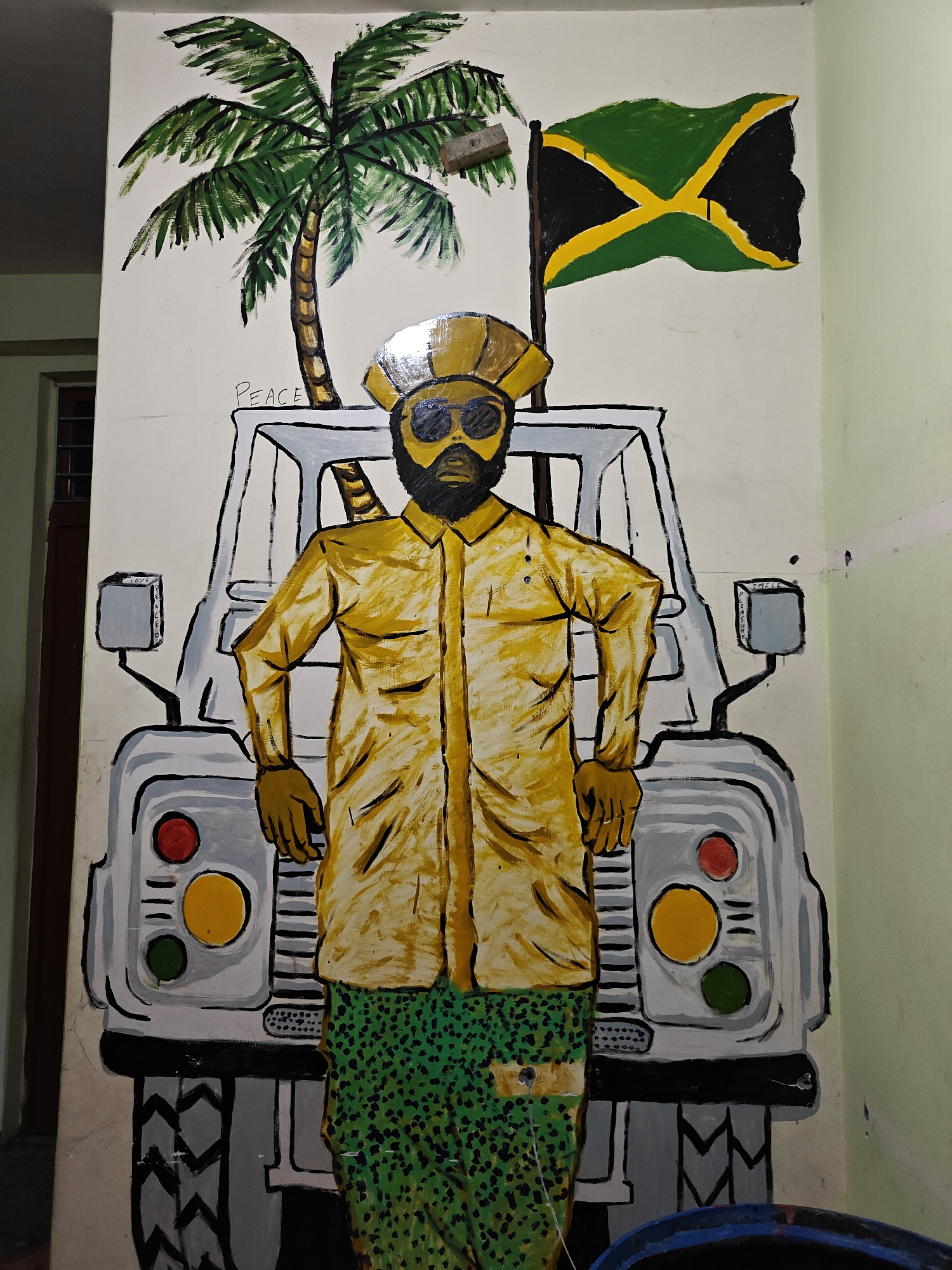
This image captures a vibrant mural painted on a white wall. The central figure is a stylized, dark-skinned man with a full black beard, wearing large round dark sunglasses and a golden-yellow head covering. He is dressed in a long-sleeved golden-yellow shirt and green pants with a black speckled pattern, standing in a confident pose with his hands on his hips. Behind the man is a light grey, boxy vehicle, reminiscent of a classic Land Rover Defender. It features round headlights in red, yellow, and green on the front, and a red taillight on the rear. The vehicle's side mirrors are also depicted. To the left of the scene, a large green palm tree adds a tropical element. On the right, a Jamaican flag, with its distinctive black, green, and yellow diagonal cross design, waves from a pole. The mural incorporates text with positive messages. "PEACE" is written in cursive above the vehicle near the palm tree. On the left side mirror of the vehicle, "LOVE" is inscribed vertically. The right side mirror displays "SMILE" horizontally and "PLEASURE" vertically below it. The painting, found in Manikaran, India, creates a static scene with strong cultural cues pointing to Jamaica or a reggae theme.
Manikaran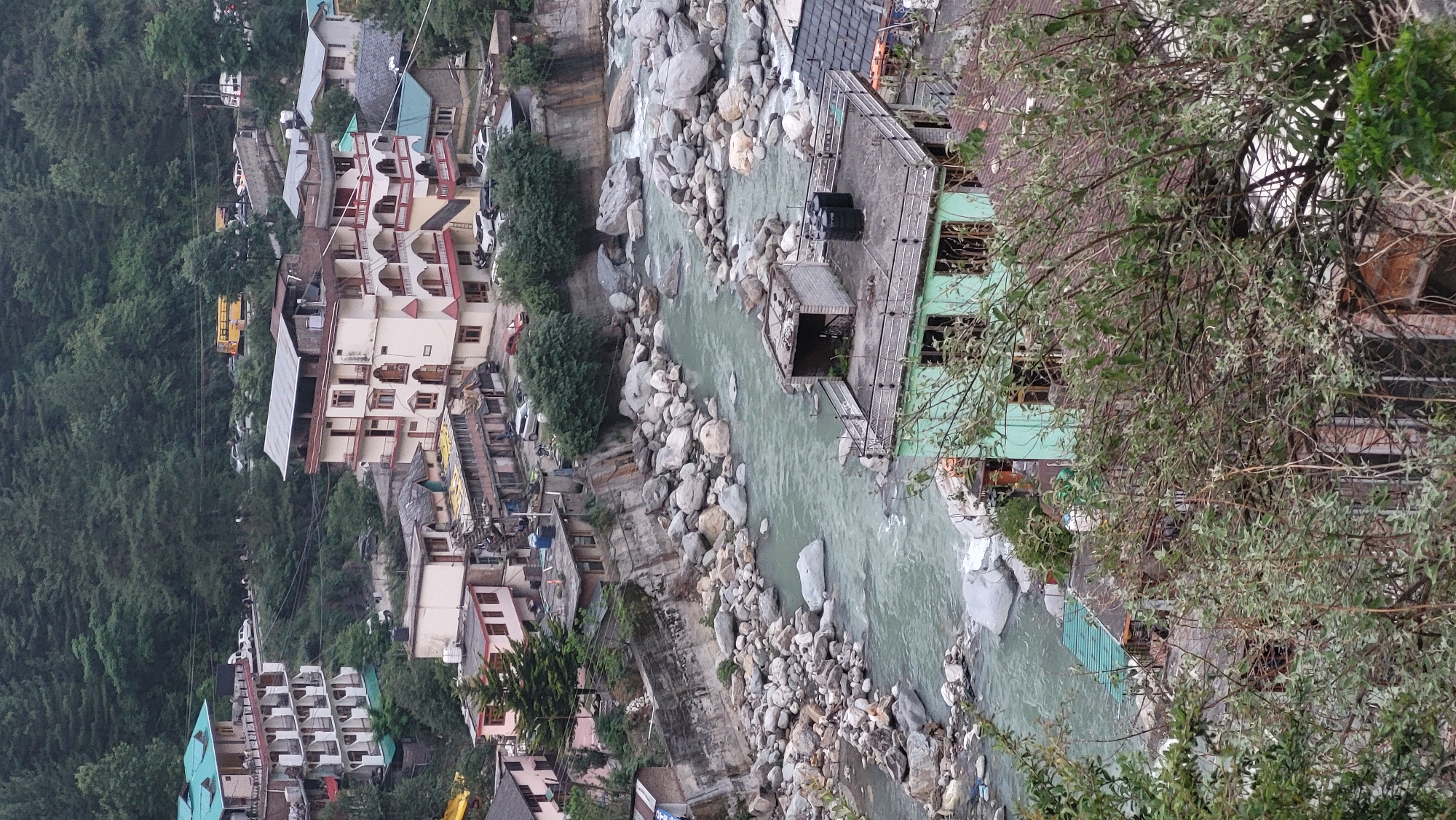
This media file captures an aerial view of a vibrant river valley town, likely Manikaran, India, as indicated by the context. The image appears to be taken from a higher vantage point, looking down into the valley. **Scene and Setting:** The main subject is a light green-grey river, flowing through a rocky bed, with numerous boulders and stones of varying sizes. The river cuts through a narrow valley, flanked by steep, densely forested hillsides. Multi-story buildings are constructed along both banks of the river and up the lower slopes of the hills. The sky appears overcast, suggesting diffused lighting, perhaps late afternoon or an overcast day. **Buildings and Structures:** On the left bank of the river, a cluster of residential or commercial buildings with light-colored facades and distinct architectural features, including arched balconies, are visible. Some cars are parked nearby. Further up the left slope, more buildings are nestled amidst the trees. On the right bank, a prominent light green building with large windows and a balcony extending over the river catches the eye. This balcony features a metal railing and holds what appear to be two black water tanks. A small structure with a dark, pitched roof is also located on a platform over the river, adjacent to the green building. Power lines or cables are strung across the valley, connecting different parts of the settlement. In the upper left background, a yellow crane or construction vehicle can be faintly seen. **Vegetation:** Lush green trees and bushes dominate the hillsides, providing a natural backdrop to the man-made structures. Some trees in the foreground, particularly on the right side, show detailed leaves and branches, partially framing the river and buildings. **Activity:** No specific human activity is discernable, but the arrangement of buildings, roads, and parked vehicles indicates a bustling town or village. **Notable Details:** The overall impression is one of a scenic mountain town built along a powerful river, characteristic of the Himalayan foothills. There is no visible text in the image.
Manikaran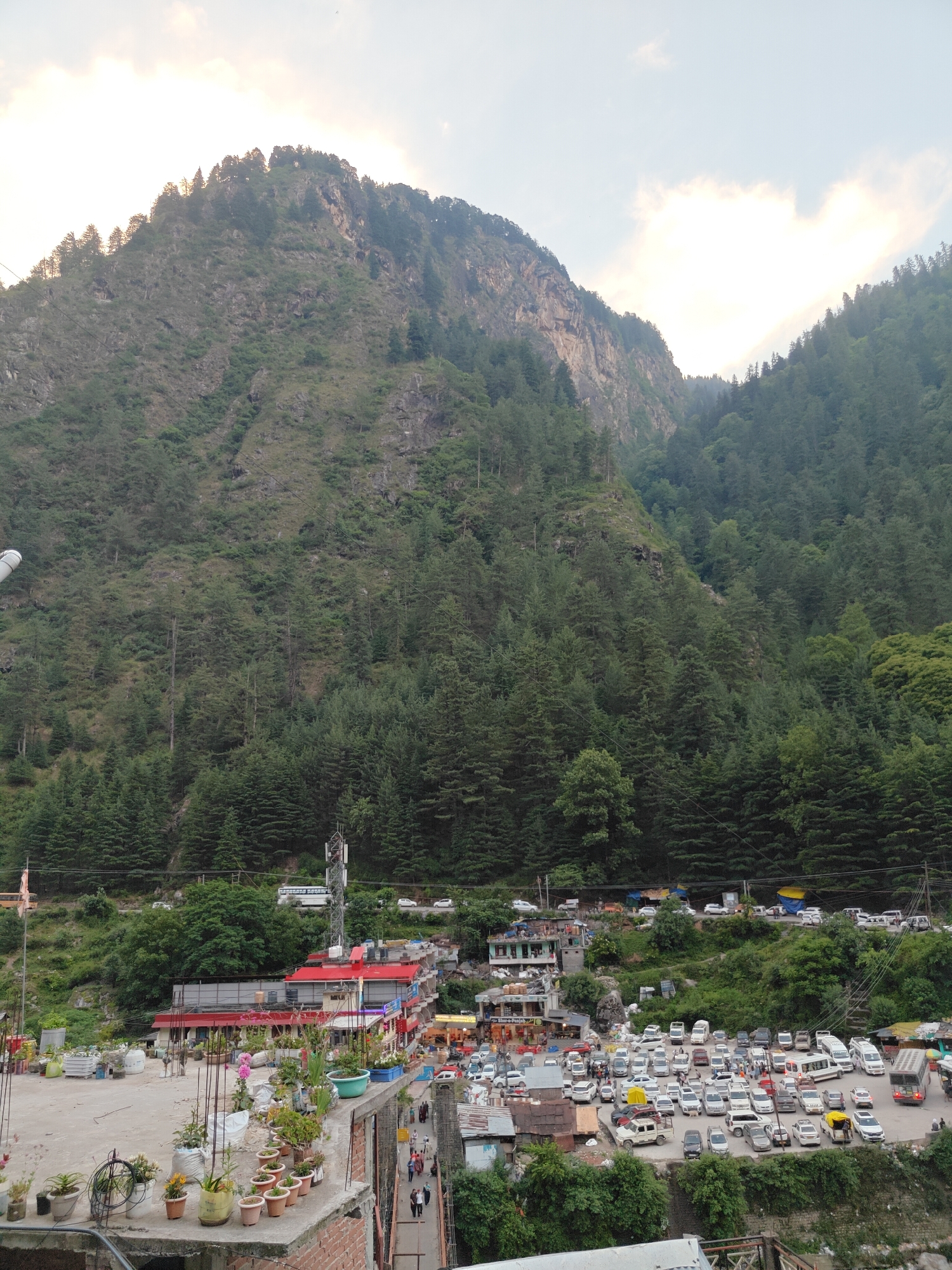
This vertical photograph presents a vibrant mountain townscape, characteristic of Manikaran, India, set within a verdant valley. Towering, rugged mountains, densely covered with coniferous trees, dominate the background, their rocky slopes rising steeply towards a cloudy sky. In the mid-ground, a bustling settlement unfolds across the valley floor. A multitude of buildings with varied architecture can be seen, some featuring distinctive red roofs. A tall communication tower stands prominently near a larger building. The area below these structures is a large, crowded parking lot, packed with numerous vehicles including cars, vans, and buses, indicating a busy hub or tourist destination. People are observed moving about among the vehicles and on a pedestrian walkway or bridge to the right, suggesting active daily life. Faintly visible on a shop sign in the parking lot area are the words "Shree-Rajesh." The immediate foreground features a rooftop adorned with a diverse collection of potted plants, some blooming with flowers like orchids, adding a touch of greenery to the built environment. Utility wires and cables stretch across the scene, connecting different parts of the settlement and traversing the mountain slopes. The time of day appears to be either early morning or late afternoon, characterized by soft, diffused light filtering through the overcast or partly cloudy sky, casting no harsh shadows. The overall scene depicts a lively town integrated closely with its dramatic natural mountain surroundings.
Manikaran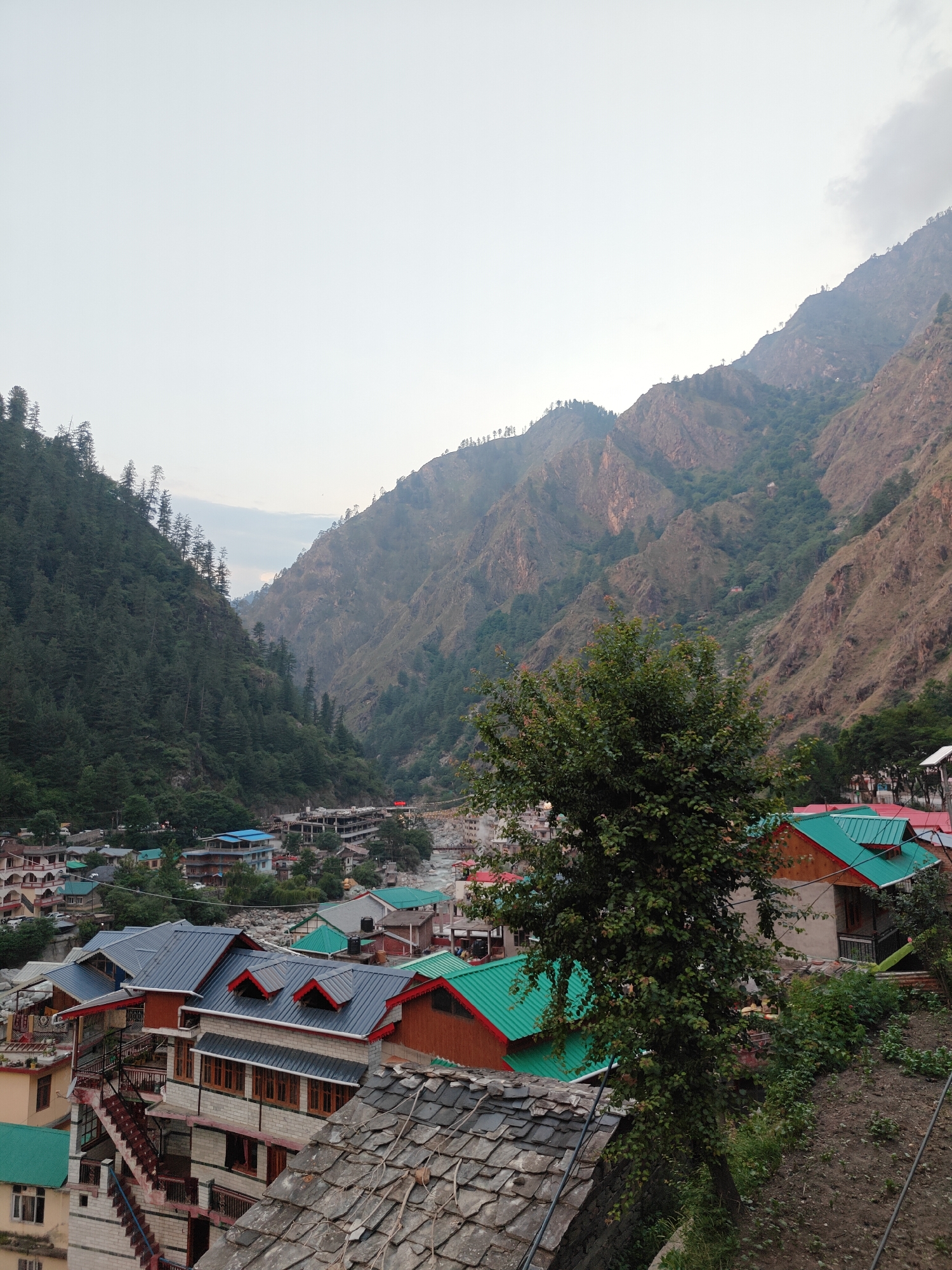
This image presents a panoramic view of Manikaran, a town nestled in a mountainous valley in India. The scene is dominated by majestic mountains on either side, sloping down towards the valley floor where the town is situated. On the left, the mountains are densely covered with lush green coniferous forests, creating a vibrant, dark green expanse that extends downwards. The mountains on the right are more rugged and rocky, with visible rock formations and patches of sparser vegetation, appearing in earthy tones of brown and grey. The town itself consists of numerous multi-story buildings, characterized by their varied architectural styles. Many roofs are distinctly colored, with a significant number featuring bright teal or emerald green metal sheeting, contrasting with others that are dark grey or blue. Some older structures in the foreground exhibit traditional grey slate tiled roofs. External staircases and balconies are visible on several buildings, indicating their multi-level construction. A prominent, leafy green tree stands in the foreground, partially obscuring some of the rooftops. In the distance, a river or stream can be seen winding through the valley, flanked by more buildings. The sky is overcast and hazy, suggesting a cloudy day, early morning, or late afternoon, as the light is soft and diffused rather than direct sunlight. The overall atmosphere is tranquil and serene, highlighting the harmonious integration of the town within the dramatic natural landscape. There are no discernible people or specific activities taking place, and no visible text in the image.
Manikaran
The video presents a panoramic view of a bustling mountain town nestled within a deep, verdant valley. The camera slowly pans from left to right, revealing the expansive landscape and the community built into it. Steep, heavily forested mountainsides, densely covered with coniferous trees, flank both sides of the valley, their upper reaches fading into an overcast, diffused sky. Below, a wide, rocky riverbed with a flowing river cuts through the heart of the town. The water appears light blue-green in some sections. Numerous multi-story buildings, characterized by varied architectural styles, line the riverbanks and climb the lower slopes of the valley. Many feature distinct pitched roofs in vibrant shades of teal-green, red, dark gray, and blue. Building facades are predominantly light-colored – beige, cream, or white, with some exposed stone or brickwork. Balconies and external staircases are common. As the camera continues its pan and slightly zooms in, a large, densely packed parking lot comes into view, filled with numerous cars, mostly white and yellow taxis, and several buses, indicating a busy area. Small figures, possibly people, can be seen on a path or street near the parking area. In the immediate foreground, power lines and utility structures are visible on rooftops. The scene depicts an active mountain community, likely a tourist or pilgrimage destination like Manikaran, India. The soft, even lighting and lack of harsh shadows suggest either early morning or late afternoon, with calm, overcast weather. No discernible text is visible in the video.
Manikaran
This image presents a panoramic view of a mountain town nestled in a deep valley, characteristic of a location like Manikaran, India. Towering mountains, densely covered with green coniferous trees, dominate the background and frame the scene on both sides. A light blue-green river flows through the bottom of the valley, winding its way past rocky banks. Numerous buildings, appearing to be multi-story houses and perhaps hotels or guesthouses, are constructed along the riverbanks and climb up the lower slopes of the mountains. These structures exhibit varied architectural styles, some with flat roofs and others with distinctive sloping roofs, often in shades of green, grey, or brown. Many buildings feature balconies, offering views of the surrounding landscape. The sky above is overcast, casting a soft, diffused light over the entire scene, suggesting either early morning, late afternoon, or a generally cloudy day. There are no people visible, and no specific activity is taking place. The overall impression is one of a serene and picturesque mountain settlement integrated with its natural, rugged surroundings. No discernible text is visible within the image.
Manikaran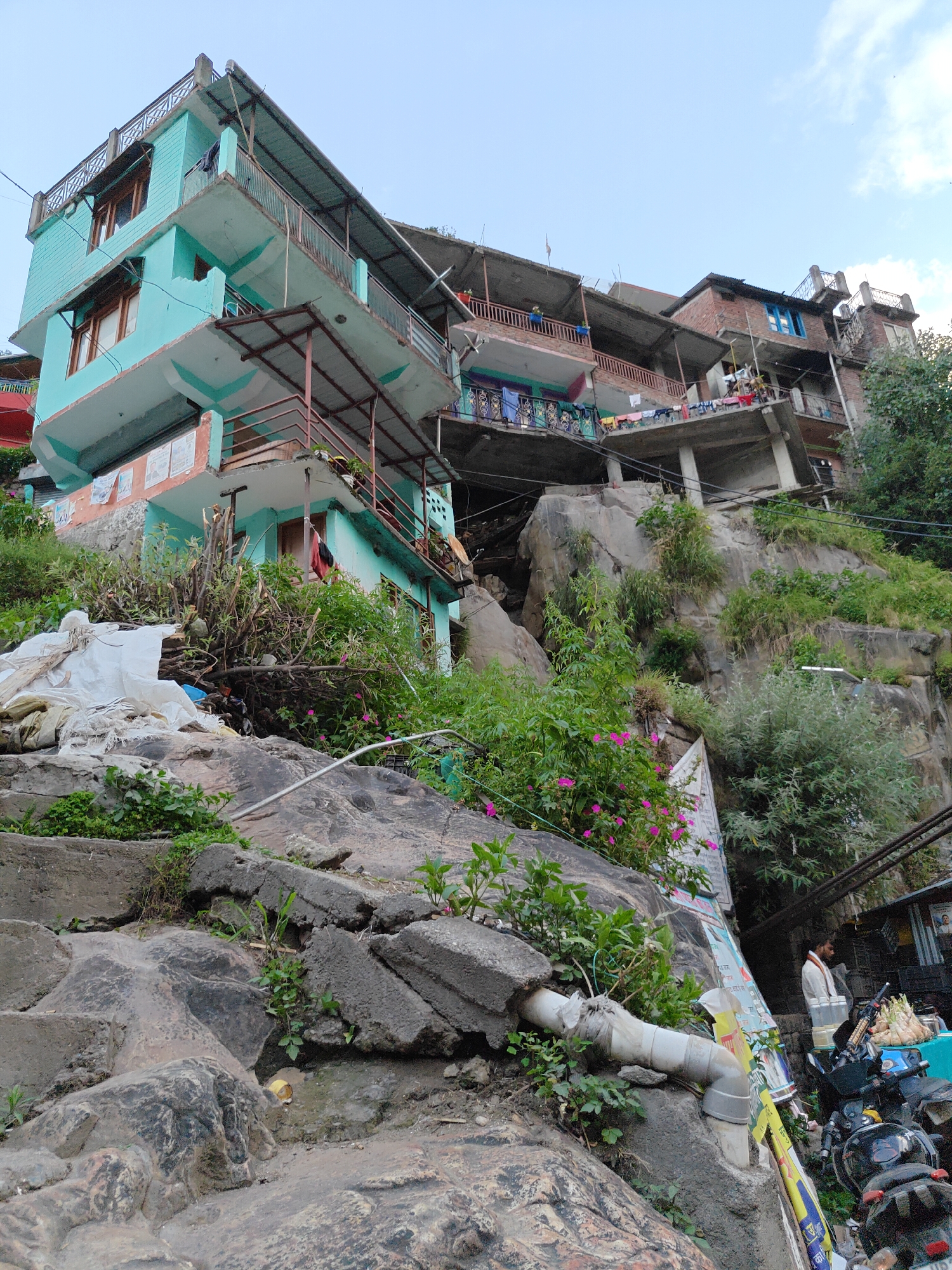
This low-angle photograph presents a dense settlement constructed into a steep, rocky hillside, characteristic of mountainous regions like Manikaran, India. Multi-story buildings are precariously built directly upon and around large, rugged grey rock formations, extending high up the incline. The foreground on the left features a prominent building painted in a vibrant turquoise hue, with multiple balconies, brown-framed windows, and metal railings. Corrugated metal awnings provide shade over some balconies. Clothes are visible hanging to dry on several balconies across different structures. Further up the hillside, other buildings, some with exposed brickwork and others painted, continue the vertical expansion. The natural landscape is an integral part of the scene, with large boulders and rock faces interspersed with abundant green vegetation, including bushes and flowering plants displaying small pink blossoms. In the lower-left, a pile of white plastic bags and debris rests on a rock. A grey PVC pipe is visible protruding from the rocky ground in the lower-right. In the bottom right corner, a man dressed in a light-colored traditional Indian outfit (likely a kurta) stands near what appears to be a small outdoor market stall or shop. Two motorcycles are parked nearby, and various containers are visible on the stall. The rock face and building walls around this area are covered with numerous posters and advertisements, featuring text in an Indian script, though specifics are illegible. The sky is clear and light blue, indicating daytime conditions.
Manikaran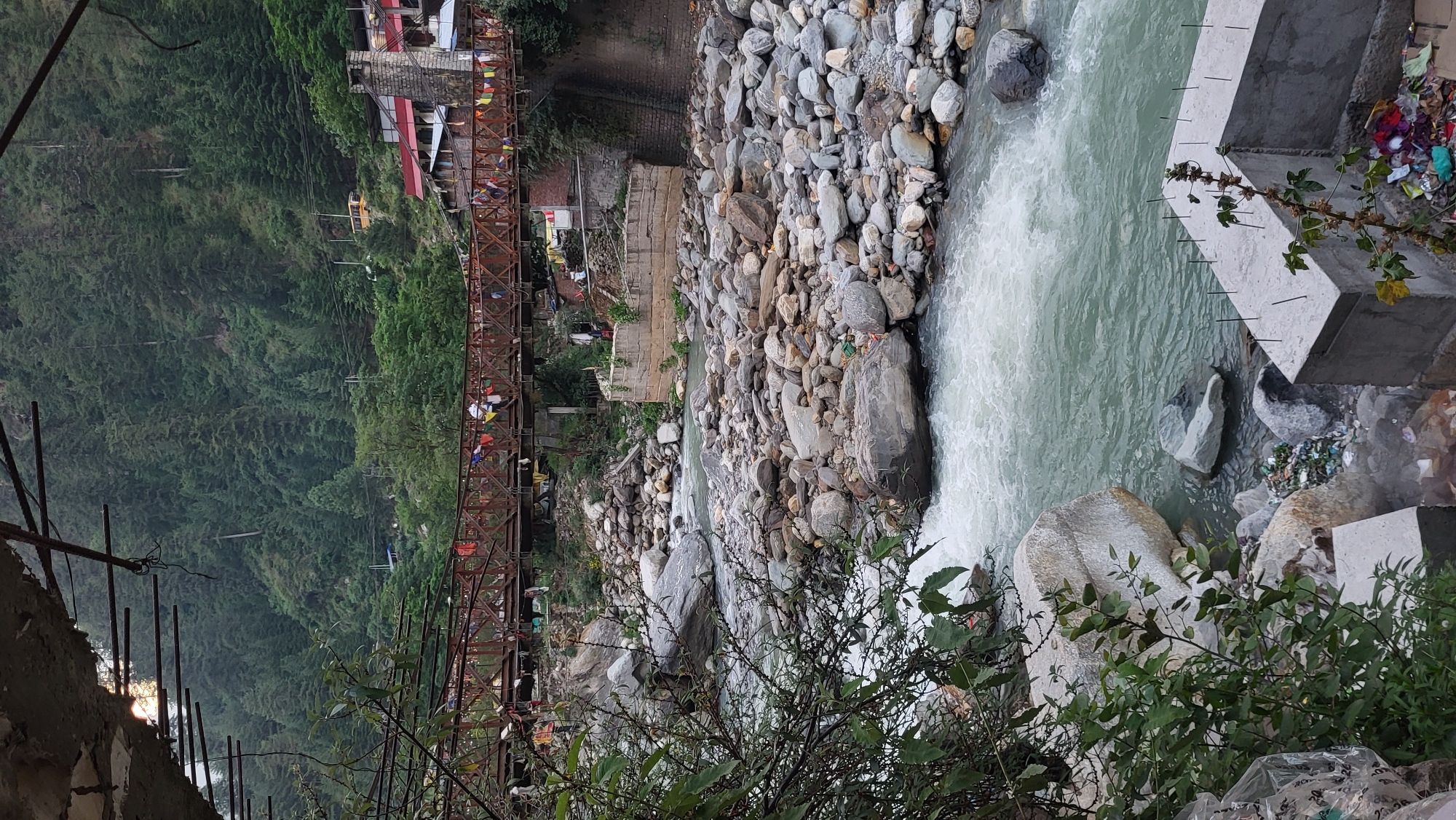
This image captures a vibrant, natural and somewhat developed riverside scene in Manikaran, India, viewed from a slightly elevated position. The main subjects are a fast-flowing river, a rustic metal bridge, and lush green mountains. The river, characterized by its light green, turbulent water and numerous large, smooth rocks lining its banks, flows from left to right across the frame. White rapids are visible where the water accelerates over submerged rocks. On the right side, a modern concrete structure, possibly part of an embankment or construction, protrudes into the river, with several metal rods sticking out horizontally from its top surface. Below this structure, and in other parts of the river bank, there is a noticeable amount of litter, including plastic bags and various debris. Spanning the river is an old, rusty-colored metal truss bridge. It appears to be a footbridge, and several people are visible crossing it or standing on it. The bridge is adorned with numerous colorful prayer flags, typical of Himalayan regions, strung along its railing. Beyond the bridge, on the far bank, are several modest buildings with brick walls and some with red roofs, nestled into the verdant hillside. These structures suggest a small settlement or village. The background is dominated by steep, densely forested mountains, covered in a canopy of green trees, indicating a rich natural environment. The sky is not visible, but the lighting suggests it is daytime, possibly overcast, given the soft, diffused light. In the foreground, on the left side, there are some metal rebar structures, possibly from an unfinished or damaged concrete wall, and some green foliage and branches partially obscure the view. There is no visible text in the image.
Manikaran
The video presents a serene panorama of a mountain river flowing through a valley. The river, characterized by its light blue-green, turbulent water, is dotted with numerous large, grey rocks. A weathered metal suspension bridge, appearing rusty, spans the river, connecting the two sides of the valley. Several people can be seen walking across the bridge. On the far bank, colorful multi-story buildings, painted in hues of red, blue, and yellow, are nestled on the hillside, suggesting a vibrant settlement. A prominent cell tower rises behind these buildings. Dense pine or conifer forests cover the surrounding mountains, which rise steeply from the riverbanks into a hazy sky. In the bottom right foreground, a concrete structure with exposed rebar indicates ongoing construction. The soft, diffused lighting suggests it is either late afternoon or early evening. The scene depicts a picturesque blend of natural ruggedness and human activity, located in Manikaran, India. No discernible text is visible.
Manikaran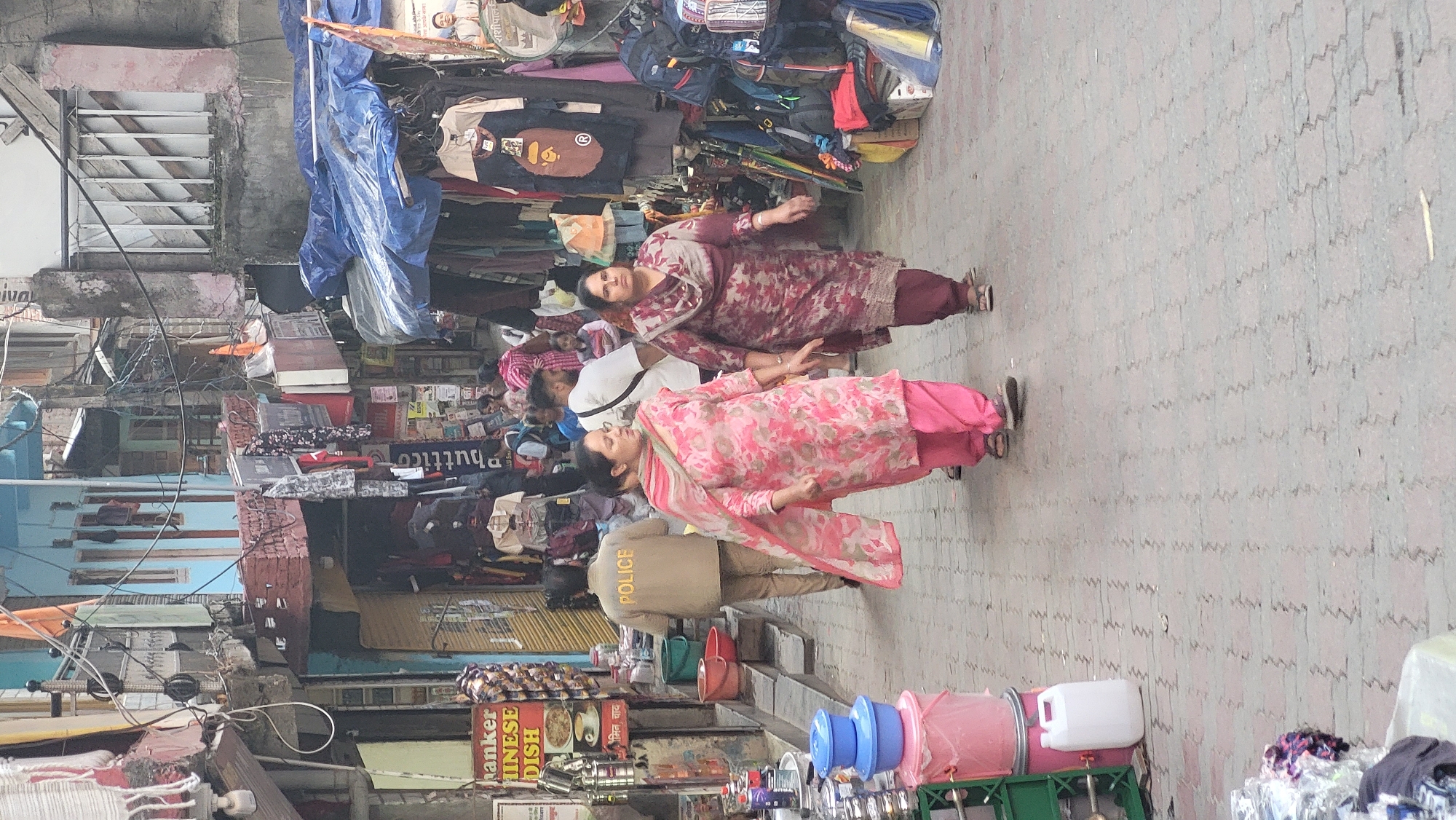
The image captures a bustling street market in Manikaran, India, with various stalls lining a narrow pathway. Two women in traditional Indian attire (salwar kameez) are prominent in the midground, walking towards the viewer's right. One wears a maroon and beige floral patterned outfit, and the other a pink floral patterned outfit with matching pants. A police officer in a beige uniform, with "POLICE" visible on his back, walks ahead of the pink-clad woman. The market stalls display a wide array of goods, including clothing items such as t-shirts (one with a distinctive monkey-face graphic) and other apparel, as well as numerous backpacks and bags of different colors and sizes. Blue tarpaulins cover some of the overhead sections of the stalls. Further along the pathway, the stalls transition to household items, with metal utensils, colorful plastic buckets, and other containers visible on the ground level. The pathway itself is paved with grey interlocking bricks. Buildings, some with weathered facades and visible windows, form the backdrop, suggesting a dense urban or semi-urban environment. Overhead, a tangle of wires and cables adds to the cluttered, lived-in feel of the street. Visible text includes "POLICE" on the officer's uniform, "hanker CHINESE DISH" on a vertical signboard, and what appears to be "BUTTICO" or a similar word on another sign. The scene depicts everyday activity in a vibrant local market, likely during daylight hours given the ambient lighting, though no strong shadows are present to indicate bright sun. The general atmosphere is one of routine commerce and pedestrian movement.
Manikaran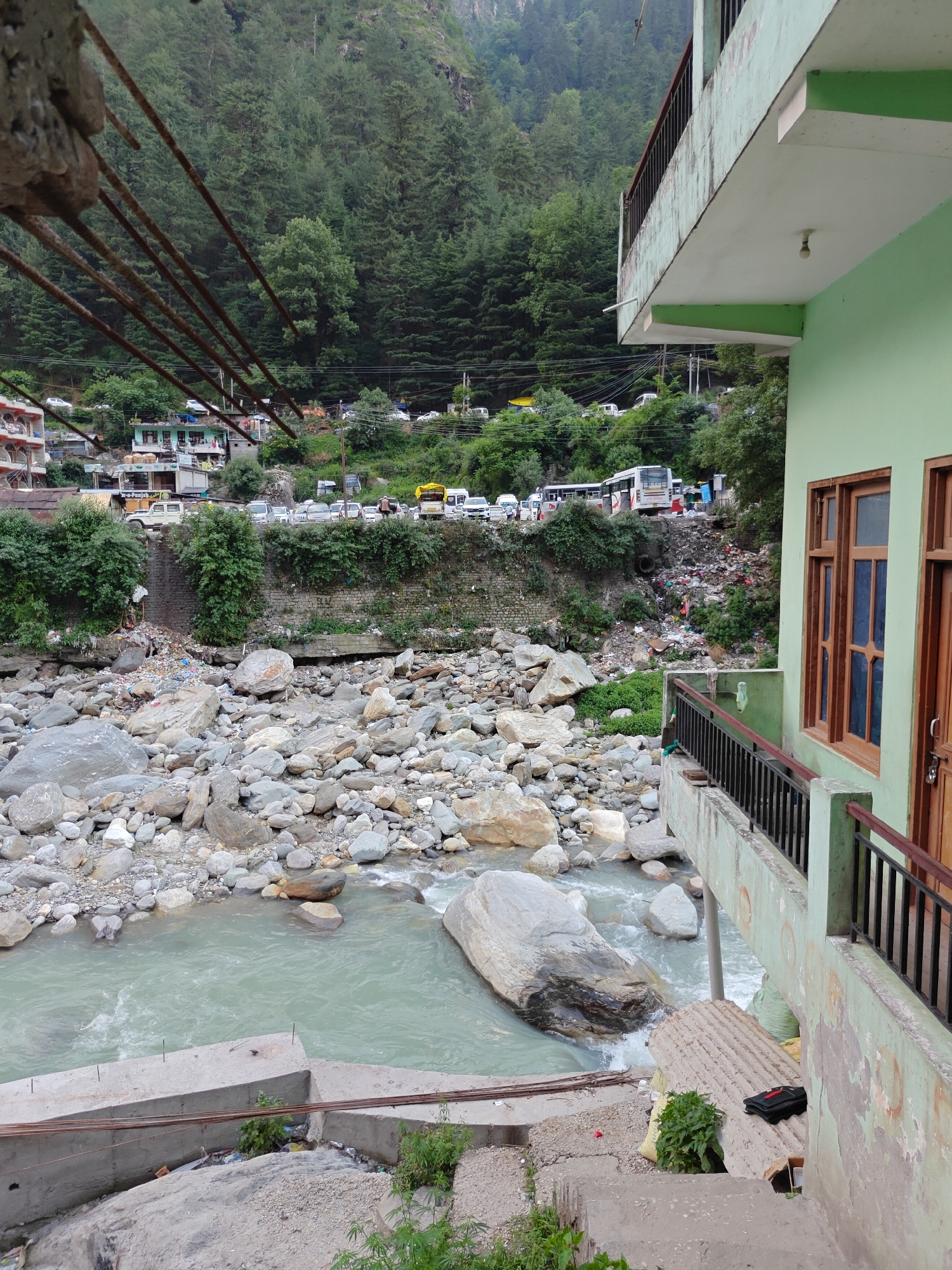
This image depicts a mountainous landscape in Manikaran, India, characterized by a river, dense forests, and human settlements. The perspective is from an elevated position, looking down towards a river and across to an opposing hillside. In the foreground, on the right, part of a light green building is visible, featuring wooden-framed windows and a concrete balcony with a black metal railing. A single light bulb hangs from the underside of the balcony. In the lower left, several rusty rebar rods protrude from a concrete structure, suggesting an unfinished construction or infrastructure. The middle ground is dominated by a river with light blue-green water, flowing over and around numerous large and small grey boulders and rocks. The water appears swift in places, creating small rapids. The river banks below the road show a concerning accumulation of trash and debris, including plastic bags and various refuse. Across the river, a winding road is bustling with activity, packed with a variety of vehicles including cars, buses, and what appears to be a white jeep with "A-O-PUNJAB" clearly visible on its side. Several multi-story buildings and other structures are built into the steep hillside alongside the road. Behind these structures, the mountain rises sharply, densely covered with dark green evergreen trees, forming a thick forest. The weather appears to be overcast, with no direct sunlight casting harsh shadows. The overall scene captures a vibrant yet somewhat cluttered mountain town, where natural beauty coexists with significant human impact and infrastructure.
Manikaran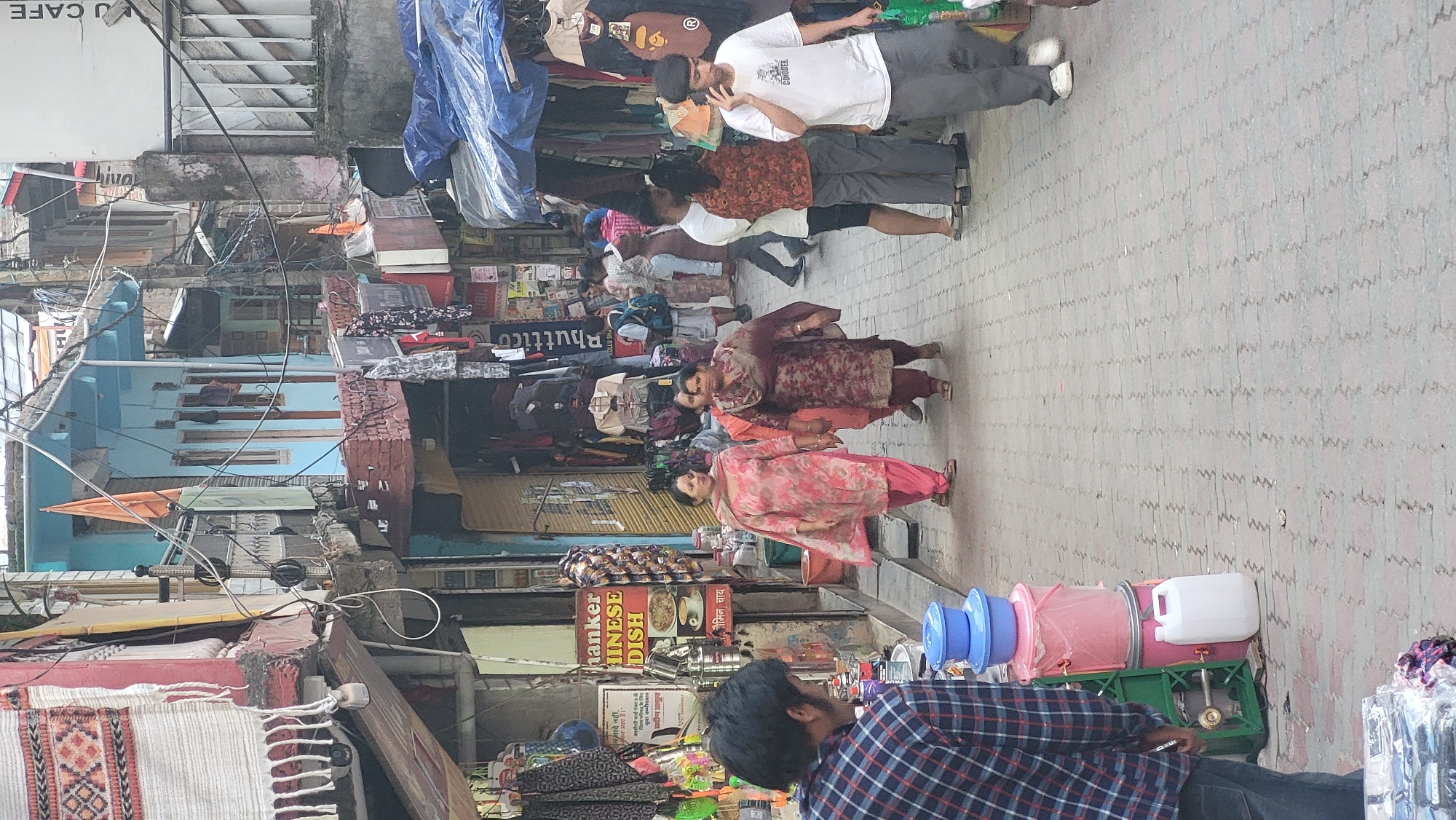
This image captures a lively daytime street scene in Manikaran, India, depicting a bustling market alley. The narrow path, paved with interlocking grey blocks, is lined with multi-storied buildings housing various shops and stalls. Numerous people are visible, engaged in daily activities like walking and browsing merchandise. In the foreground, a man in a plaid shirt is seen from behind, looking down. To his right, a vendor's setup includes stacked blue and pink plastic containers and a white jerrycan, positioned next to a green metal stand that appears to have a burner, possibly for preparing food or beverages. Further along, two women in traditional Indian attire (salwar kameez/sarees), one in a pink floral print and the other in a maroon pattern, walk towards the viewer. Behind them, several other individuals, including a man talking on a mobile phone while wearing a white "CONQUER" t-shirt, are visible amidst clothing racks and displays. The buildings show diverse architectural elements; one particularly stands out with a light blue facade. Overhead, a dense network of electrical wires crisscrosses the street. In the left foreground, patterned woven rugs or textiles are displayed. The overall impression is that of an active, everyday market environment. Visible text includes: "J CAFE," "Phuttico," "KOLLU SHA," "Live CONQUER" (on a t-shirt), and a sign advertising "Shanker CHINESE DISH" with "गैमिन, चाय" (Gamin, Chai) written below. Other partially visible text fragments include "म वादे नहीं," and "न आए है।"
Manikaran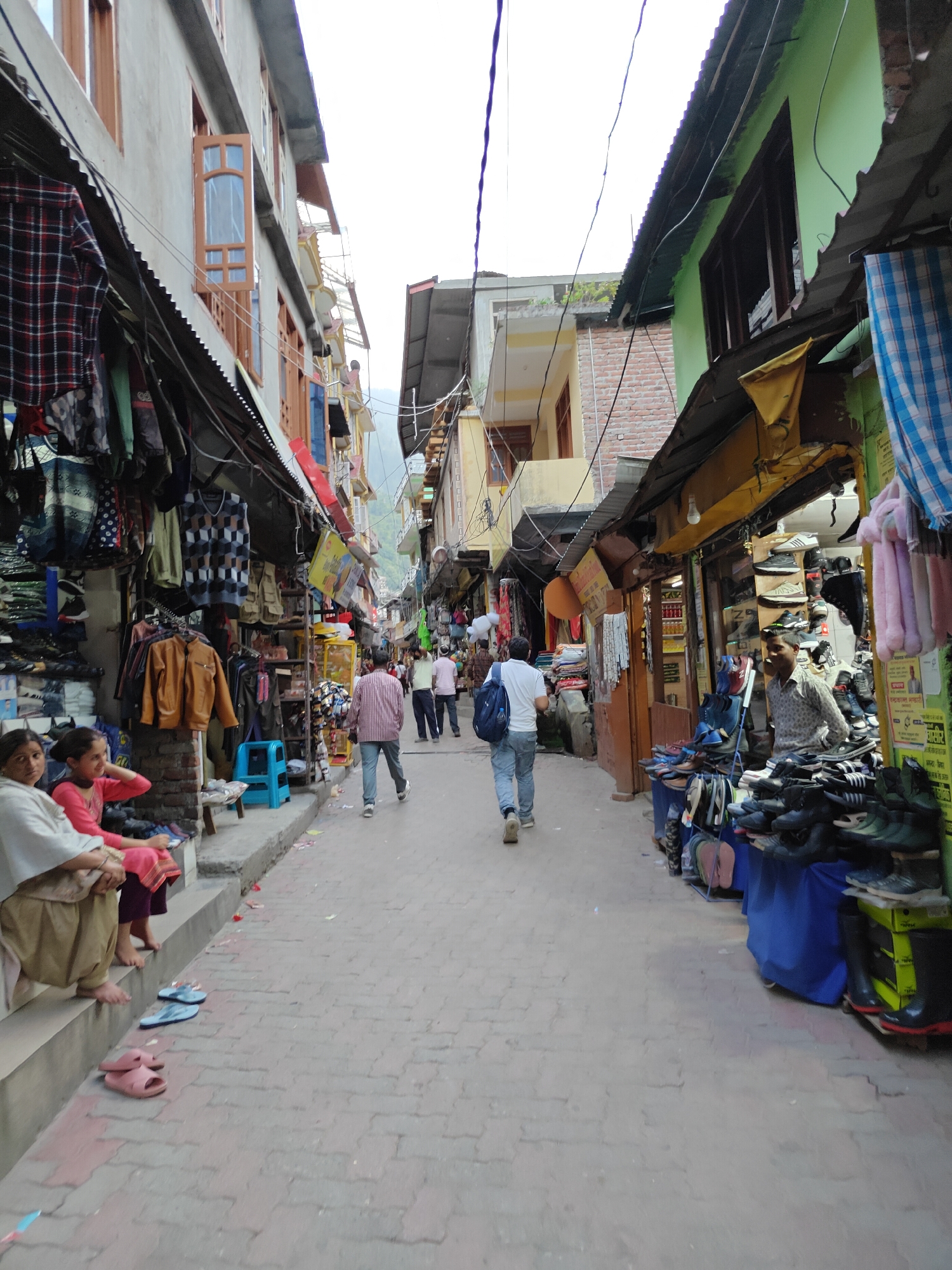
The image presents a vibrant, narrow market street in Manikaran, India, bustling with activity under an overcast sky. The street, paved with interlocking bricks, is flanked by multi-story buildings housing numerous small shops. On the left side, stores extend outward with corrugated metal awnings, displaying a variety of clothing including plaid shirts, sweaters, and leather-look jackets. In the foreground, two women and a young girl are seated barefoot on a low concrete ledge, observing the street scene. The older woman wears a light-colored shawl and beige pants, while the girl is dressed in pink. Two pairs of sandals, one light blue and one pink, rest on the pavement beside them. The right side of the street is similarly lined with shops, prominently featuring a footwear stall where a vendor is visible among piles of shoes, including sneakers, sandals, and boots, arranged on tables and the ground, partially draped with a blue tablecloth. Further down, other shops with various merchandise are discernible. Several people are walking along the street, navigating through the market. A man in a striped shirt and jeans, followed by others, walks towards the background, while another man with a white t-shirt and blue backpack is seen on the right. Power lines crisscross above the street, connecting the buildings. The architecture is characteristic of the region, with various painted facades (light grey, light green, yellow) and prominent wooden window frames, some open. The bright, overcast sky indicates daytime with soft, diffuse lighting, without harsh shadows. The scene conveys a lively, everyday market atmosphere in what appears to be a hilly or mountainous region. Text on distant signs is not clearly legible.
Manikaran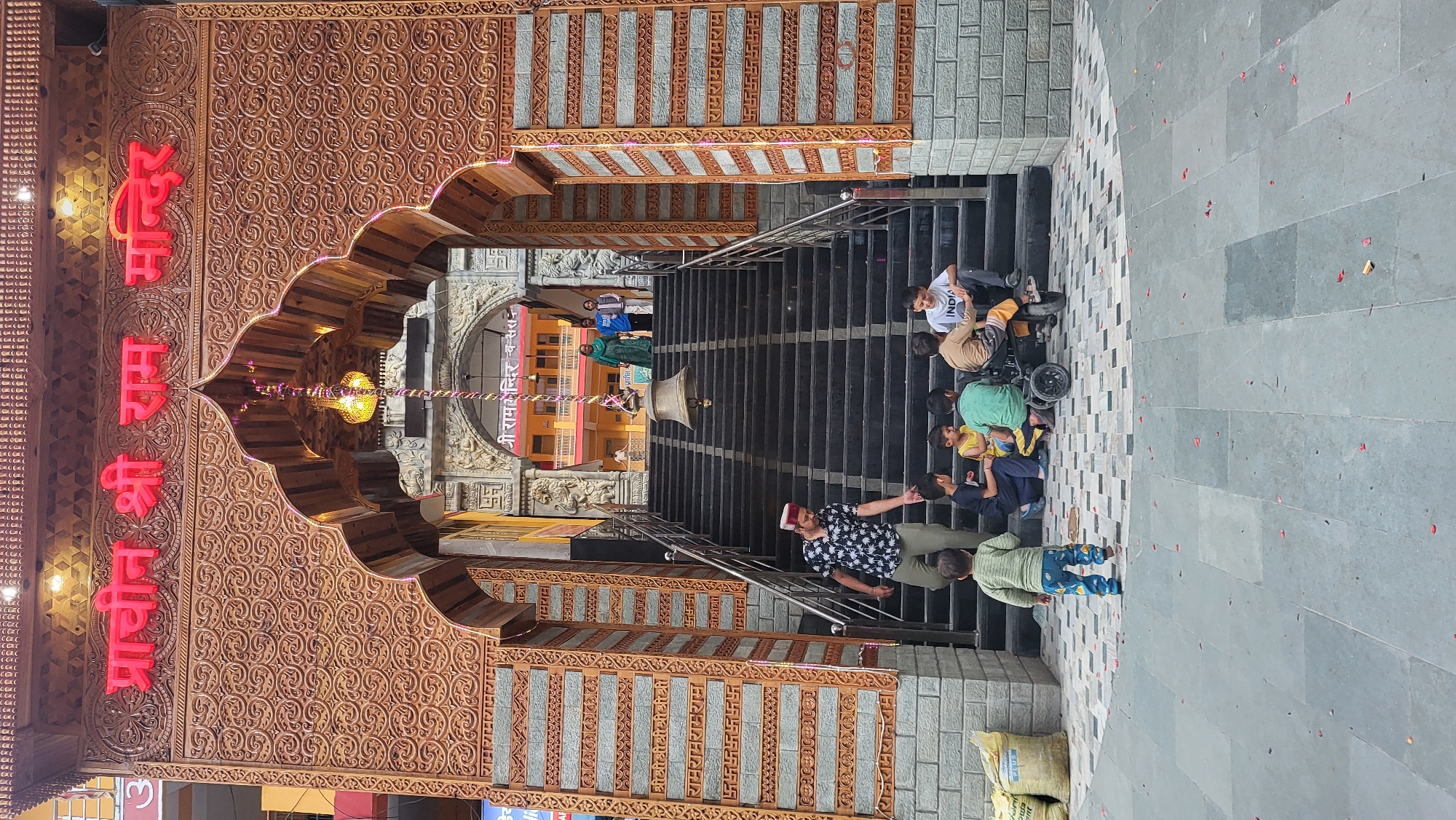
This eye-level shot captures the ornate entrance to a temple, likely in Manikaran, India, featuring a large, intricately carved wooden arch. The arch is illuminated by red neon signs that read "प्राचीन श्री राम मनि" (Prachin Shri Ram Mani) and "श्री राम मन्दिर व सरान" (Shri Ram Mandir va Saran), identifying it as an ancient Shri Ram Temple and a shelter or resting place. The wooden carvings on the arch and surrounding structures prominently display the repeated mantra "राम राम राम राम" (Ram Ram Ram Ram). Beyond the grand arch, a wide, dark grey stone staircase descends into the temple complex, flanked by stone walls adorned with carved patterns and sturdy metal railings. A large, traditional brass bell hangs suspended over the top of the stairs. Several people, including adults and children, are gathered on the steps. Some children are seated, one individual is in a wheelchair, and others are standing, suggesting a moment of rest or waiting. One boy wears a white t-shirt with "INDIA" printed on it. The ground area in front of the steps is paved with grey tiles, lightly scattered with red and yellow flower petals, indicative of a religious offering or recent celebrations. A couple of jute sacks, one bearing the label "PLUS," are visible near the bottom left corner. The scene is brightly lit by natural daylight, conveying a calm and welcoming atmosphere at the temple's entrance.
Manikaran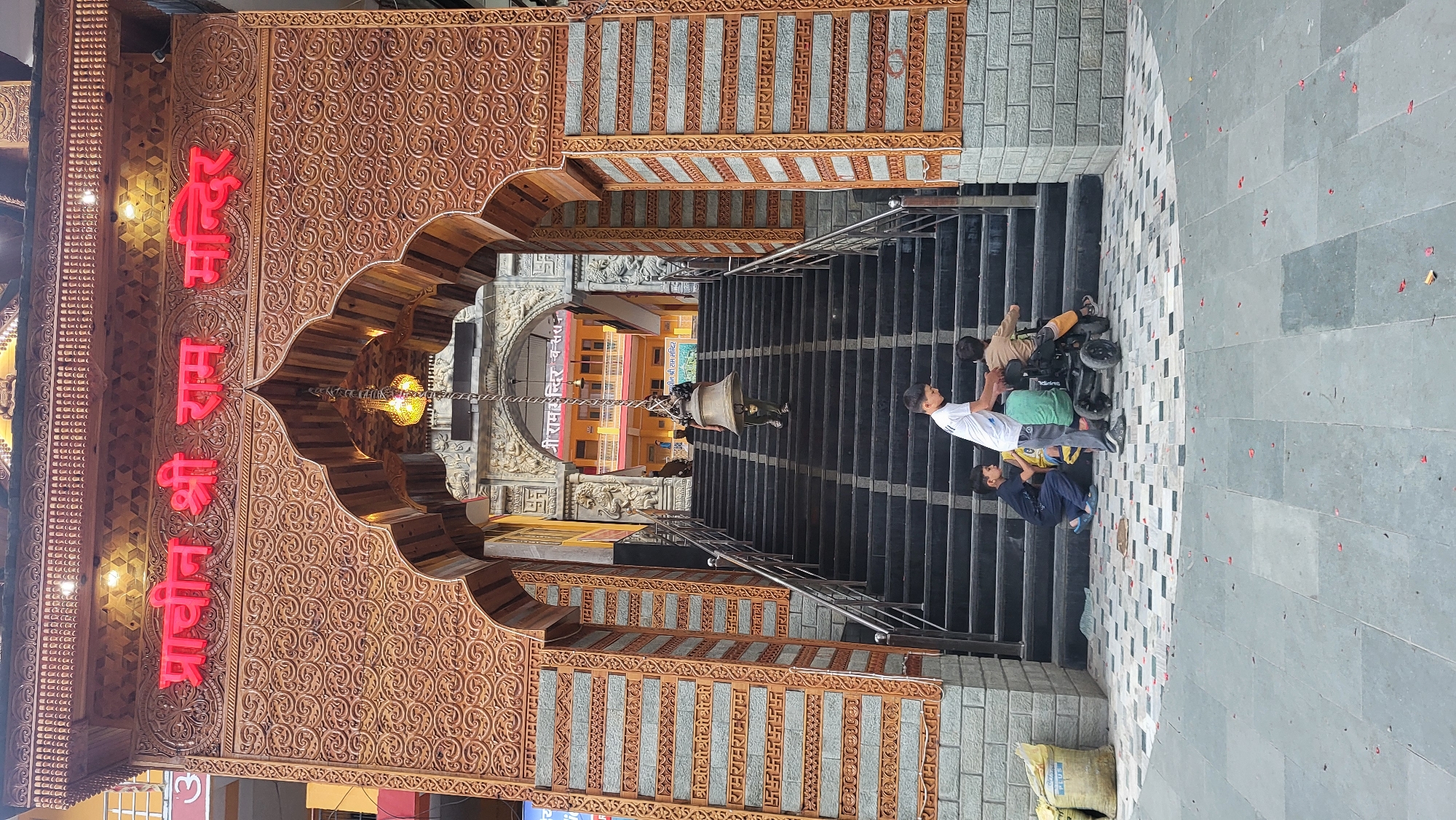
The image captures the entrance to an "Ancient Shri Ram Temple" (प्राचीन श्री राम मन्दिर) in Manikaran, India. The prominent feature is a large, ornately carved wooden archway made of warm-toned wood, featuring intricate floral and geometric patterns. Above the arch, the temple name "प्राचीन श्री राम मन्दिर" is displayed in glowing red neon letters. Below the archway, a wide set of black stairs with metal handrails leads down, presumably into the temple complex. The risers of the stairs feature panels with a repeated pattern, some of which clearly show the Hindu chant "रामराम" (Ram Ram). Several individuals, including children and young men, are seen on the stairs and at the bottom. One person in a white t-shirt appears to be interacting with a young child next to a stroller or small wheeled cart on the stairs. Another child in a yellow top and another in a blue top are also present. Beyond the stairs, in the background, another building with yellow walls and an arched entrance is visible. A large, traditional brass bell hangs from chains in front of this distant building. The ground level at the bottom of the stairs is paved with grey and light-colored square tiles, and scattered red petals or confetti are visible on the paving. The overall scene suggests a busy daytime visit to a religious site, with traditional architecture and devotional elements. A white sack is visible on the far left of the foreground.
Manikaran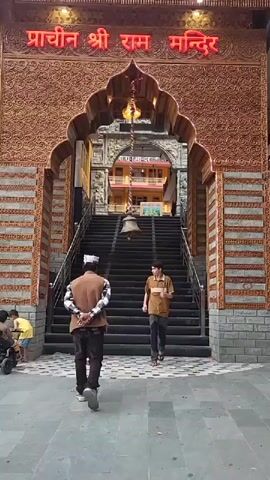
The video captures the entrance of the "Prachin Shri Ram Mandir" (Ancient Shri Ram Temple) in Manikaran, India. The temple features a grand, arched gateway adorned with intricate carved patterns, resembling terracotta or wood, and accented with brick-like stonework. A large, decorative bell hangs from the center of the archway, suspended by a chain. Above the arch, the temple's name is illuminated in bright red neon Hindi script. Beyond the main arch, a wide, dark-colored staircase ascends into the temple complex. Another, simpler archway is visible at the top of these stairs, leading further into the temple grounds. Throughout the video, several people are seen entering and exiting the temple. Two men are initially prominent in the foreground, walking towards the stairs; one wears a brown jacket and a white cap, the other a striped brown t-shirt. As the camera moves slightly, more visitors appear, including women in both traditional Indian attire (like kurtis) and casual Western clothing, along with a child playing nearby. People are steadily ascending and descending the stairs, engaging in typical temple visiting activities. The scene appears to be set during the daytime, although the neon lights on the entrance remain illuminated, adding to the visual appeal. The overall impression is that of a bustling yet peaceful religious site.
Manikaran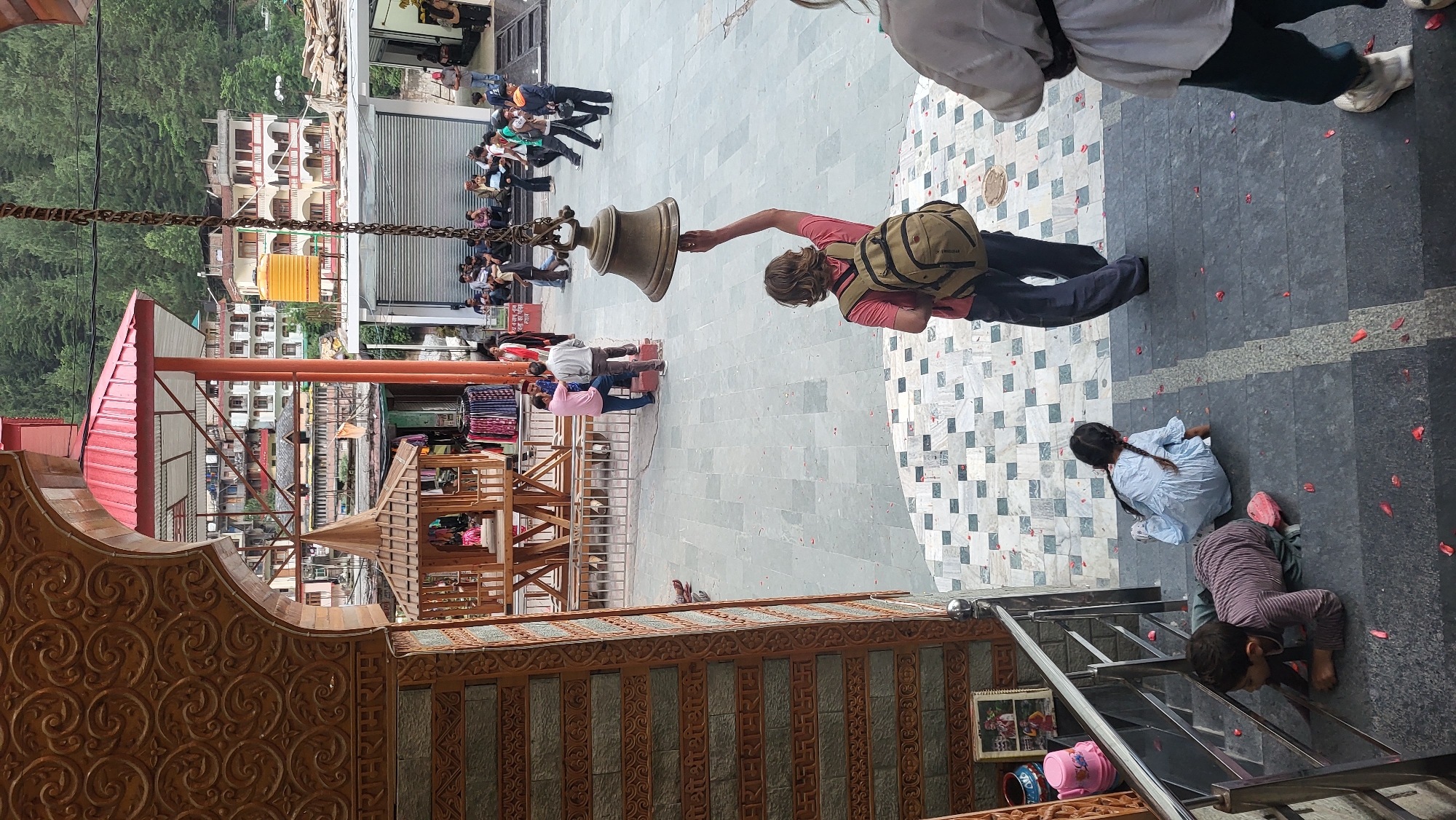
This outdoor image, taken in Manikaran, India, depicts a bustling scene at what appears to be a temple or public square in a mountainous town. The foreground features ornate, intricately carved wooden architecture, including railings and walls adorned with swirling patterns, the Hindi text "श्री राम राम राम" (Shree Ram Ram Ram), and Swastika symbols. In the midground, a person with a backpack and long hair, wearing a red/pink shirt and dark pants, is actively ringing a large, ornate brass bell suspended by chains. The ground around them is paved with grey and white square tiles, forming a checkerboard pattern in some areas, and is scattered with numerous red rose petals, suggesting a religious offering or ceremony. Several other individuals are visible in the midground and background. Some people are standing and walking, while others are gathered in groups or sitting on ledges. In the far background, behind the people, are multi-storied buildings typical of a town, some with balconies. A distinctive yellow water tank is mounted on one building, and a lush green, forested mountain or hill rises behind the town structures, emphasizing the mountainous location. In the lower right foreground (originally), two young children are present on a set of stairs. One child in a light blue dress with braided hair is kneeling or sitting on the tiled floor, while a smaller child in a striped top is further down the dark grey stairs, seemingly playing or crawling. A pink bucket and a framed picture are also visible near the stairs. The general atmosphere appears calm and active, likely during daytime given the clear natural light.
Manikaran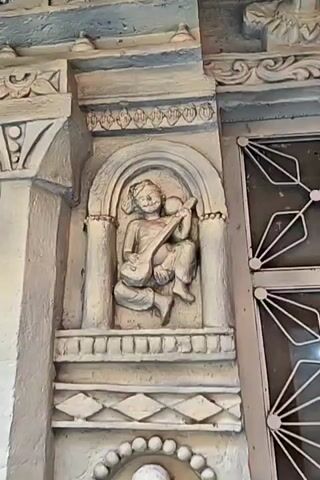
The video features a close-up of intricate stone carvings and architectural details, likely part of a temple in Manikaran, India. The carvings are predominantly light grey or white. The central focus is a pillar or doorway section with two distinct carvings. The upper carving depicts a figure seated in an alcove, playing a stringed instrument that resembles a sitar or veena. Below it, a larger carving shows a smiling, corpulent figure wearing a crown-like headdress encircled by beads, a beaded necklace, and a 'tilak' mark on its forehead. This figure holds a small pot in one hand, and another pot rests at its feet. To the left, a decorative archway adorned with vibrant yellow and red marigold garlands is visible. A man, seen from behind, walks through this archway from left to right. He is wearing a plaid vest over a light-colored shirt and pants, and a cap. On the far right, a white-framed window or door with a geometric grid pattern is partially visible. The overall scene showcases traditional Indian temple artistry, accompanied by background devotional music. There is no visible text.
Manikaran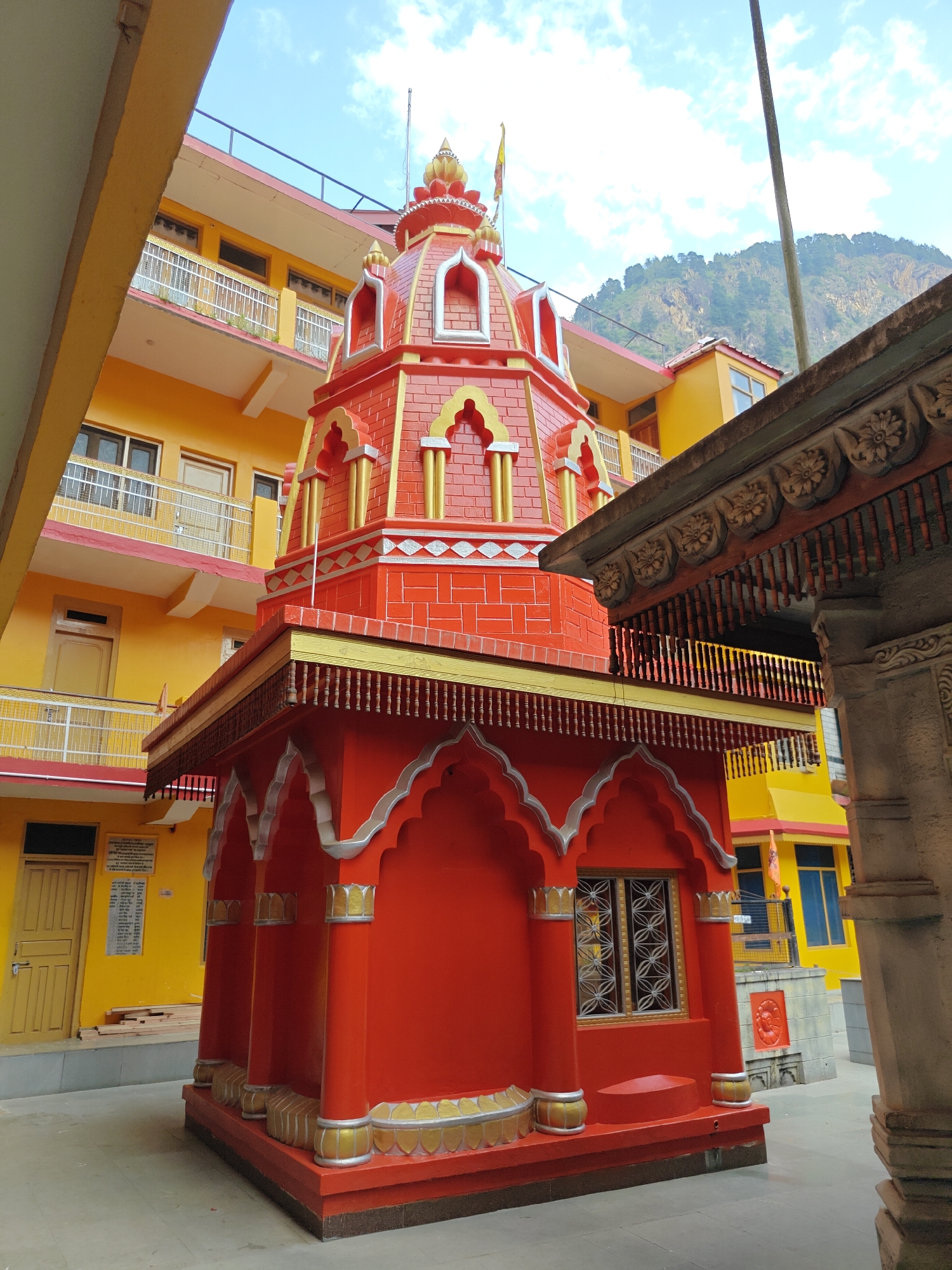
The image captures a vibrant red temple, likely Hindu, situated in a religious complex within Manikaran, India. The temple features a striking red facade with gold and silver embellishments, including a multi-tiered dome with arched decorative elements, a golden finial, and a small flag. Its base is adorned with arched alcoves and small pillars, all painted in the same bright red, gold, and silver palette. In the background, a multi-story building painted a distinct bright yellow stands, equipped with numerous balconies featuring white railings. Windows and doors are visible across its various levels. Beyond these structures, a large mountain range, partially covered with trees, rises under a clear blue sky with scattered white clouds, suggesting a sunny daytime setting. To the right, a detailed, carved stone or wooden structure with intricate floral patterns is partially visible. On the yellow building, a white sign containing text in Hindi is clearly discernible. The text reads: "श्री गुरुद्वारा श्री गुरू नानक देव जी मानिकरण साहिब" (Shri Gurudwara Shri Guru Nanak Dev Ji Manikaran Sahib) and "गुरुद्वारा समिति मानिकरण साहिब कुल्लू" (Gurudwara Committee Manikaran Sahib Kullu), followed by a list of names. This explicitly identifies a nearby Sikh Gurudwara and confirms the location as Manikaran Sahib, a significant pilgrimage site in Kullu, India. The scene is devoid of human activity, presenting a peaceful view of the architecture and natural environment.
Manikaran