Mara, Nigeria
9 memories from Mara, Nigeria
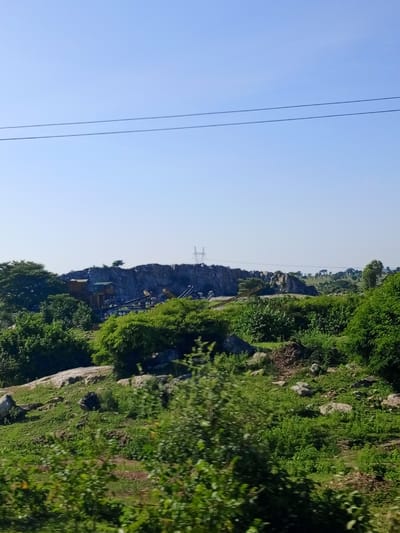
The image shows a quarry site nestled within a hilly, vegetated landscape, under a clear blue sky. In the foreground, lush green bushes and grasses cover the sloping terrain, with scattered rocks. Further back, the terrain rises to form a rocky hill face, where the quarry operations are situated. Several structures, appearing to be part of the quarry infrastructure like buildings and conveyor belts, are visible against the rock face. In the distance, more rolling hills and scattered trees can be seen, with a power pylon visible on the horizon. Two parallel power lines stretch across the upper part of the sky. The scene appears to be located in the rural outskirts of Mara, Nigeria, characterized by its natural topography and industrial activity. There are no people visible in the image.
Mara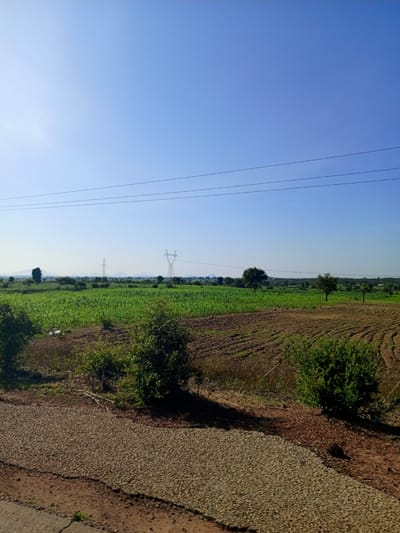
The image depicts a rural landscape under a clear blue sky. In the foreground, there is a patch of light-colored gravel and barren soil. Moving towards the midground, we see plowed fields with visible rows, interspersed with patches of green vegetation and a few scattered trees. Further in the distance, there is a large field of lush green crops, likely maize or a similar plant. Beyond the fields, several transmission towers and power lines are visible, suggesting proximity to infrastructure. The background features a hazy horizon with distant hills or mountains and more scattered trees and vegetation. The overall scene is one of agricultural land and the natural environment. There are no people or animals visible in the image. The image is an outdoor, daytime shot, possibly taken from a moving vehicle given the perspective and slight blur in some areas.
Mara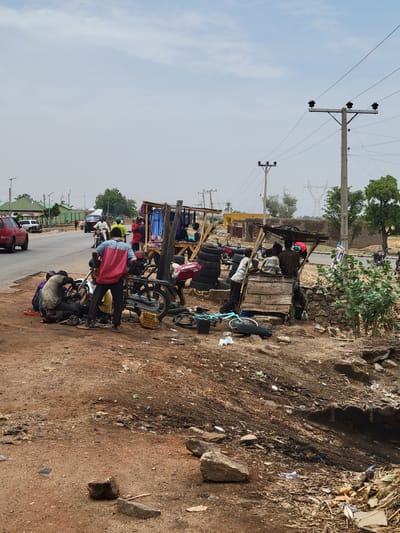
The scene depicts a roadside in Mara, Nigeria. Multiple individuals are gathered around what appears to be a makeshift repair area or small market alongside a paved road. Several motorcycles are present, with at least one individual seemingly working on a motorcycle. The environment is dusty, with dirt and debris along the roadside. There are structures, potentially small shops or stalls, constructed from wood and displaying items for sale. Utility poles and electrical wires are visible overhead. A few vehicles are present on the road, including a red car and white car. Vegetation is sparse, with a few trees in the background.
Mara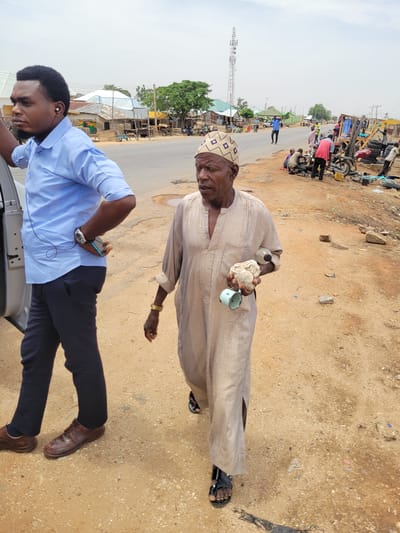
The image depicts two men in what appears to be Mara, Nigeria. An older man wearing a tan robe and patterned cap holds a white solid and a small blue cup. He also wears sandals. Beside him, a younger man in a blue shirt and black pants is leaning on what seems to be a vehicle. He has an earpiece and is looking at his phone. The ground is sandy and dusty. In the background, there is a road with people and vehicles, including motorcycles. A communication tower is visible in the distance, along with buildings and vegetation.
Mara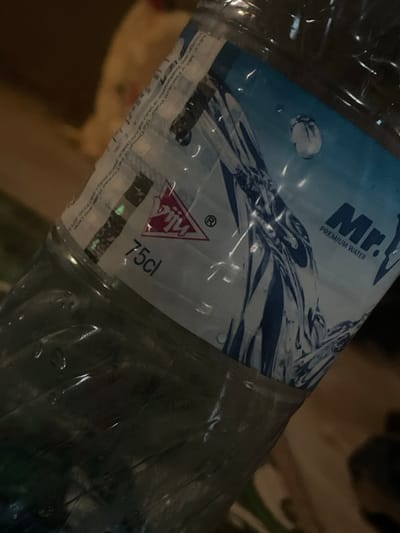
The image depicts a clear plastic water bottle, positioned diagonally and captured in a dim, indoor setting in Mara, Nigeria. The bottle features a label that identifies the product as "Mr. PREMIUM WATER" with a blue and white design showing water splashes. A red triangular logo with "Piu" and an ® symbol is visible, along with the volume "75cl" printed in black. Partially legible text on the label's left edge includes "MKV INDUSTRY" and a copyright date of "2019." The bottle's exterior exhibits multiple water droplets or condensation. The background is out of focus, showing indistinct shapes in shades of brown and beige, with a lighter object visible in the upper left quadrant. No individuals or active interactions are visible in the scene.
Mara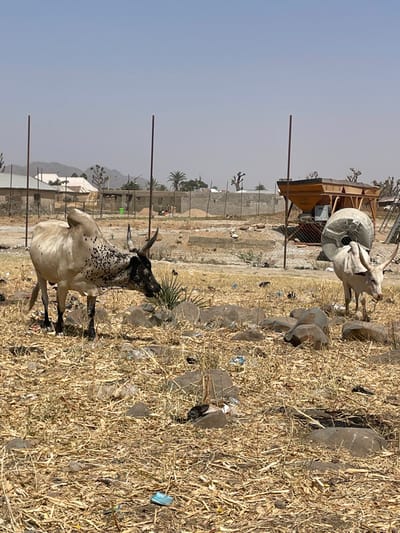
The image captures an arid outdoor environment within the city of Mara, Nigeria, under a clear sky. The ground in the foreground and midground is covered extensively with dry, light-colored vegetation, interspersed with numerous rocks and considerable litter, including plastic bottles and wrappers. Two bovines are the primary subjects. On the left, a large, light-colored bovine with a distinct dorsal hump features prominent black spots across its head, neck, and lower legs, and possesses curved dark horns. It is depicted with its head lowered, appearing to graze on a small green plant. To its right, a smaller, predominantly white bovine with long, curved horns stands with its head also lowered towards the ground. In the midground, two slender, dark metal poles rise vertically. The background reveals signs of human settlement and construction. Multiple buildings with light-colored roofs are visible, some appearing complete while others feature exposed concrete block walls and piles of sand, indicating ongoing development. To the far right in the background, a large, yellow, elevated industrial-style structure, resembling a hopper or feeder, stands next to a large, gray concrete cylinder lying on its side. Sparse trees and distant, hazy hills are visible on the horizon.
Mara
An indoor scene in the city of Mara, Nigeria, depicts a wedding ceremony involving three individuals positioned on a light-colored elevated platform. A dark-skinned woman on the left, identified as the bride, wears a white, off-the-shoulder lace wedding gown, a veil, and sparkling hair accessories. She faces a dark-skinned man on the right, identified as the groom, who is dressed in a white suit jacket, dark green trousers, a dark green ascot with a tie clip, and eyeglasses. The bride and groom are holding hands. Between and slightly behind them stands a dark-skinned man, identified as the officiant, clad in a light cream clerical vestment featuring an emblem. He holds a red-orange microphone in his right hand and a small open book in his left. The background features a blue crucifix on the left and a white candle on a stand partially visible against green drapery on the right.
Mara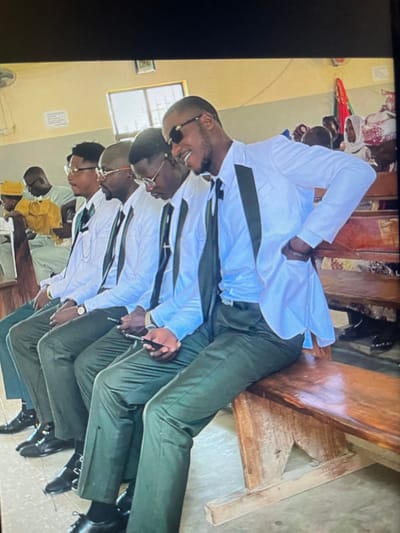
The image depicts an indoor gathering in a public hall or community center located in Mara, Nigeria. Five men, uniformly dressed in white long-sleeve shirts, dark ties, dark green trousers, and dark blazers with dark lapels, are seated in a row on a wooden bench in the foreground, facing right. The man on the far right wears sunglasses, exhibits a smiling expression, and has his right hand in his jacket pocket. The two men immediately to his left are observed looking down at smartphones held in their hands. The fourth man from the right wears eyeglasses and a wristwatch on his left wrist. The fifth man in the row, on the far left, is largely obscured. In the background, numerous individuals, including men and women, are seated on additional wooden benches. Specific attire includes light green garments, a yellow hat, a white head covering, and a colorful scarf among the background figures. The environment features light-colored walls, a multi-pane window, a partially visible ceiling fan, a framed object on a wall, and a red and green banner in the distant background. The floor appears to be concrete or tiled.
Mara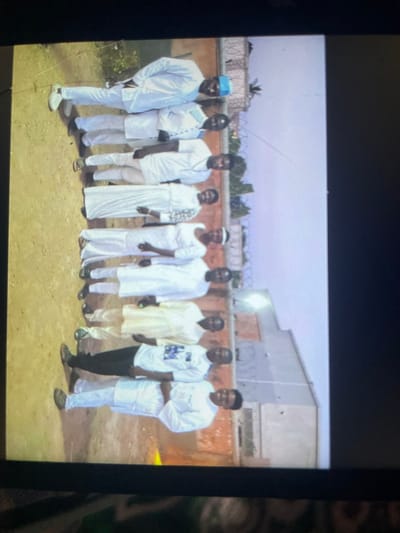
Nine adult males are depicted standing in a line, facing the observer, in an outdoor setting identified as the city of Mara, Nigeria. The majority of individuals are dressed in traditional light-colored, predominantly white, full-length garments or tunic-style outfits. One male wears a white graphic t-shirt with black trousers, and another wears a light yellow tunic over lighter trousers. A man positioned at the far left of the line wears a blue cap. The ground surface is unpaved reddish-brown soil. In the background, a light-colored wall topped with barbed wire or razor wire separates the immediate foreground from visible single-story buildings with flat roofs. Sparse green foliage is present to the left of the group. The scene is illuminated by natural daylight.
Mara