Mazarrón, Spain
15 memories from Mazarrón, Spain
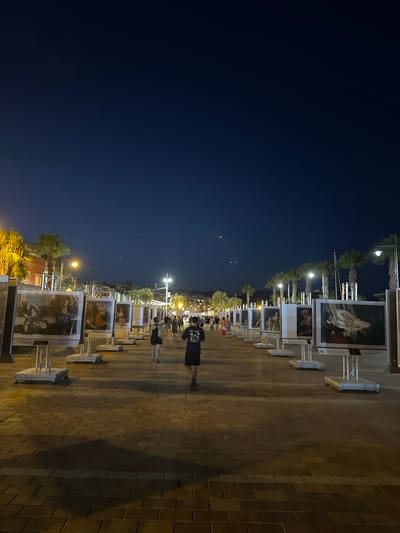
The image depicts an outdoor art exhibition at night in the city of Mazarrón, Spain, likely along the waterfront promenade. The sky is a deep, dark blue, indicating twilight or nighttime. The ground is paved with rectangular bricks, casting shadows from the exhibited artworks and palm trees. Rows of large framed artworks are displayed on stands, stretching into the distance. These artworks appear to be classical paintings, judging by the visible details. Several palm trees are planted along the sides of the promenade, some illuminated by streetlights. Buildings with lights are visible in the background, suggesting an urban environment. Several people are walking along the promenade, viewing the exhibition. In the foreground, two individuals are walking away from the camera. One is a male wearing a black t-shirt and shorts, and the other is a female in a dark dress. Further down the promenade, more people are seen walking and standing. The overall atmosphere is one of a cultural event taking place in a pleasant evening setting.
Mazarrón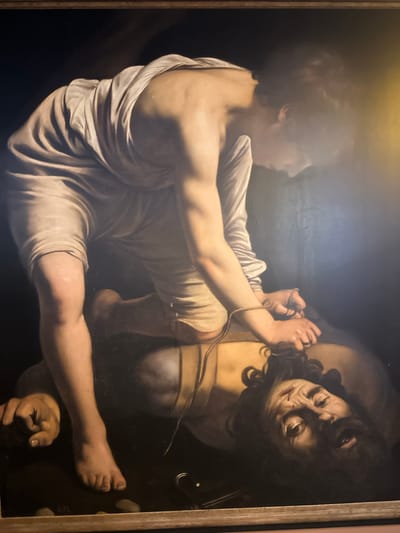
The image depicts a painting of a young man in a white robe standing over a decapitated giant. The young man's left leg is bent and placed on the giant's chest, and he is holding the giant's severed head by its hair with both hands. The giant's eyes are wide open, and his mouth is agape in a grimace. A drop of blood is visible on his forehead. The painting is lit dramatically, with the figures emerging from a dark background. The scene is interpreted as David and Goliath. The painting is located in the Iglesia de San Andrés in Mazarrón, Spain.
Mazarrón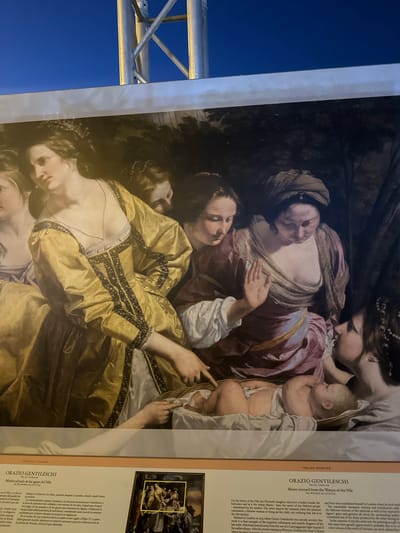
The image displays a section of a large painting, framed by a metal structure and a dark blue sky, suggesting it is outdoors. The painting depicts a biblical scene with several women gathered around a baby. The central focus is a baby lying on its back, wrapped in white cloth. To the left, a woman in a shimmering gold dress, adorned with dark, intricate trim and pearls, gazes down at the baby, with her left hand pointing towards it. Behind her, another woman in a mauve dress with a draped neckline also looks at the baby. To the right, two other women are partially visible. One in a dark head covering leans in close, her face obscured, while another woman with dark hair and a bejeweled headdress is seen in profile. The background of the painting is dark and appears to be a landscape with foliage. Below the painting is a display board with text, including titles like "PINTURA ITALIANA" and "ORAZIO GENTILESCHI," and descriptions of the artwork. The text mentions "Mazarrón, Spain," suggesting the painting is displayed or exhibited in this city.
Mazarrón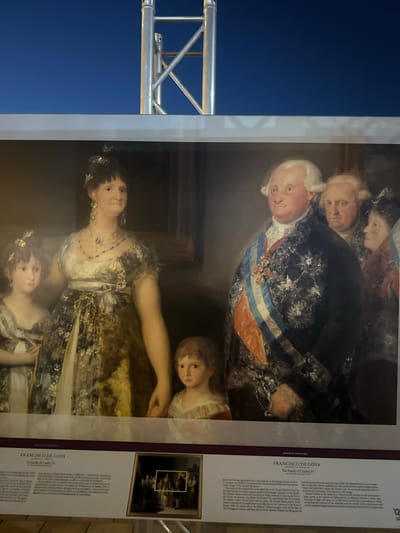
The image shows a framed reproduction of Francisco de Goya's painting "The Family of Charles IV." The painting depicts the Spanish royal family, including King Charles IV, his wife Maria Luisa of Parma, and their children and other relatives. The reproduction is displayed outdoors, with a blue sky and a metal structure visible in the background, suggesting it might be part of an exhibition or public display. Text panels with information about the painting and the artist are visible below the reproduction. The location is identified as Mazarrón, Spain, where a sign indicates "PINTURA ESPAÑOLA" (Spanish Painting). The reproduction is large, with a prominent gold frame. The painting itself is detailed, with the figures in formal attire, and Goya's characteristic use of light and shadow is evident.
Mazarrón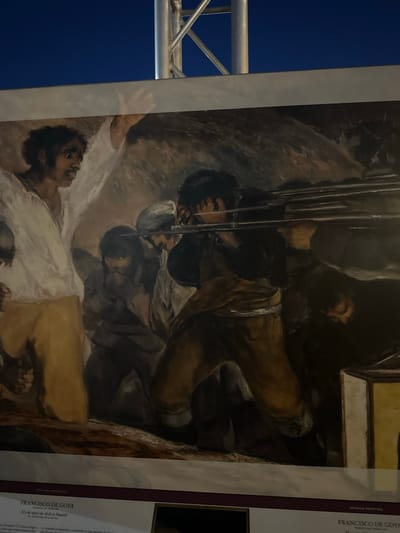
The image displays a reproduction of Francisco de Goya's painting, "The Third of May 1808 in Madrid." In the foreground, a man in a white shirt and brown pants, with his arms raised, faces a firing squad that is not fully visible. To his right, a group of men with grim expressions are preparing to be executed, some covering their faces. In the background, there is a dark, indistinct landscape. Below the painting, text identifies the artwork and the artist, Francisco de Goya, and indicates it is a "SPANISH PAINTING." There are also some Spanish inscriptions, one of which reads "FRANCISCO DE GOYA" and "El 3 de mayo de 1808 en Madrid." The reproduction is part of an exhibition displayed outdoors, indicated by a metal structure and the dark sky above. The text suggests this exhibition is located in Mazarrón, Spain.
Mazarrón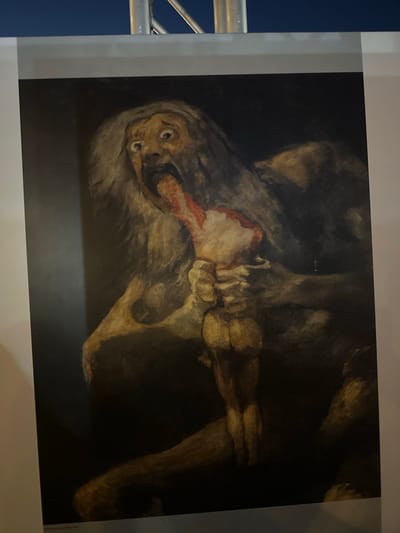
The image shows a painting depicting a monstrous, emaciated figure with long, unkempt hair, hunched over and consuming a severed limb. The figure's mouth is agape, revealing a grotesque tongue and teeth, and its eyes are wide with a manic expression. The scene is dark and atmospheric, with the figures rendered in earthy tones and heavy shadow, suggesting a nightmarish or violent subject matter. The painting appears to be on display, with a portion of a white border and a silver pole visible at the top of the frame, indicating it is likely in a gallery or exhibition. The text at the bottom of the image is partially visible and includes the words "Mazarrón, Spain." This suggests the painting is either located in Mazarrón, Spain, or is an artwork related to the city.
Mazarrón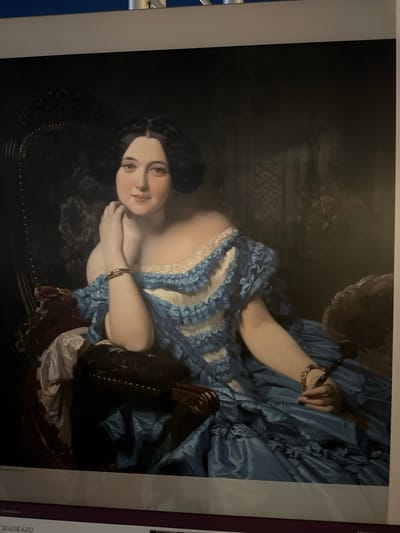
The image is a photograph of a painting depicting a woman seated in an ornate chair, dressed in a voluminous blue gown with ruffled white trim. She has dark hair styled up and is looking towards the viewer with a gentle expression. Her left arm rests on the chair, with her hand near her chin. Her right arm is extended, and she is holding a dark object, possibly a quill or a fan. A bracelet is visible on her left wrist, and another on her right wrist. The background is dark and appears to be a draped fabric or a dimly lit room with decorative elements. At the bottom of the image, text is partially visible, including "MADRAZO" and "ESPAÑOLA", suggesting the painting might be by a Spanish artist named Madrazo. There is no indication of the city of Mazarrón, Spain within the image itself.
Mazarrón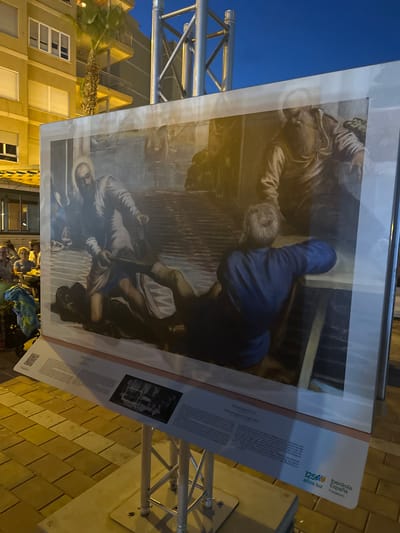
The image shows a large framed artwork displayed outdoors in Mazarrón, Spain, under a twilight sky. The artwork is a reproduction of a painting featuring several figures. In the foreground of the painting, a man with a beard, wearing a white robe, is pulling a younger man, who is lying down and wearing a blue tunic, by the legs. Another figure, with a beard and wearing a brown robe, is visible in the background. The painting depicts a scene that appears to be biblical or historical, with dramatic lighting and a subdued color palette. The artwork is mounted on a metal stand and is positioned on a tiled walkway. To the left of the artwork, there are tables and chairs set up, suggesting an outdoor seating area for a cafe or restaurant. Some people are seated at the tables, and a palm tree is visible behind them, adjacent to a building with multiple balconies and windows. The building appears to be residential or commercial, with warm lighting emanating from some of the windows. At the bottom of the artwork, a descriptive panel provides information about the painting and its artist. Text visible on this panel includes "TINTORETTO" and "125 años luz Iberdrola España Fundación". A QR code is also present on the panel. The overall scene captures an art exhibition or display integrated into the public space of the city.
Mazarrón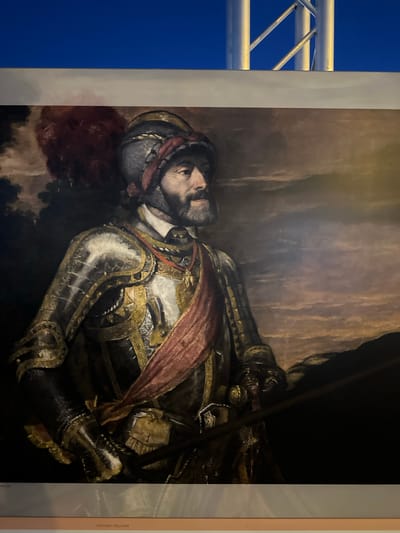
The image is a photograph of a painting displayed in a room. The painting depicts a man in ornate armor, wearing a helmet with a red plume. He has a beard and a red sash across his chest. The background of the painting is a cloudy, atmospheric landscape. Below the painting, a label reads "PINTURA ITALIANA." The room itself is dimly lit, with the top of the frame showing a blue sky and silver metal scaffolding. The overall impression is of an art exhibition. The location in Mazarrón, Spain is not discernible from the visual information provided.
Mazarrón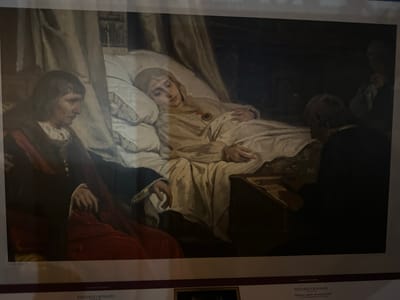
The image shows a painting of a woman lying in bed, appearing ill. She is wearing a light-colored gown and a head covering, with a medal around her neck. Two figures are attending to her. On the left, a person in dark clothing with red fabric draped over their shoulder looks down at the woman. On the right, another person, partially obscured by darkness, leans over a table next to the bed. The setting appears to be a dimly lit room with a canopy over the bed. Below the painting, text identifies the artwork as "Isabel the Catholic dictating her Will" by Eduardo Rosales. The text also indicates "SPANISH PAINTING" and mentions the city of Mazarrón, Spain, suggesting the painting may be displayed there.
Mazarrón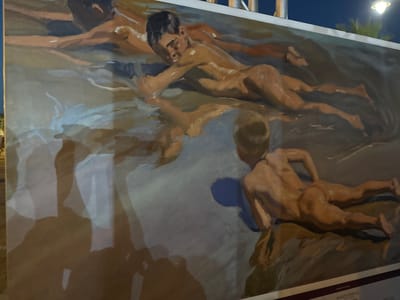
This is a painting depicting several nude male figures in what appears to be water. The figures are rendered in a loose, impressionistic style with visible brushstrokes. The lighting suggests a somewhat overcast or diffused light source, possibly late afternoon or early evening, and the reflections on the water add to the atmosphere. The colors are muted, with tones of brown, tan, blue, and gray dominating the composition. Some of the figures are partially submerged, with their bodies twisted and turned in various positions, suggesting movement or relaxation. One figure in the foreground is facing the viewer, with dark hair and a serene expression. The overall mood is tranquil and contemplative. At the top of the image, a partial view of text is visible, which reads "JOAQUIN SOROLLA" and "SPANISH PAINTING". Given the location context of Mazarrón, Spain, this painting could be a representation of a common scene in coastal Spain, perhaps swimmers or bathers enjoying the water. The style of the painting might also be influenced by the Spanish Impressionist painter Joaquin Sorolla.
Mazarrón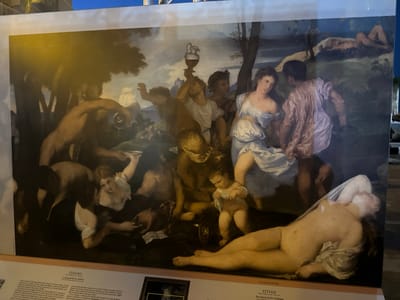
The image shows a large reproduction of Titian's painting, "Bacchanal of the Andrians," displayed outdoors in Mazarrón, Spain. The painting depicts a chaotic scene of revelry with numerous figures, both male and female, engaged in drinking, dancing, and embracing. Nudity is prevalent throughout the artwork, with many figures being scantily clad or completely undressed. The central figures include a reclining nude woman, a group of men holding a jug and cup, and a child. The background features a pastoral landscape with trees and a body of water. The reproduction is mounted on a flat surface and appears to be part of an exhibition, as suggested by the text at the bottom of the image which identifies the artwork and artist. The lighting in the image indicates it was taken at dusk or during the evening, with artificial light illuminating the reproduction.
Mazarrón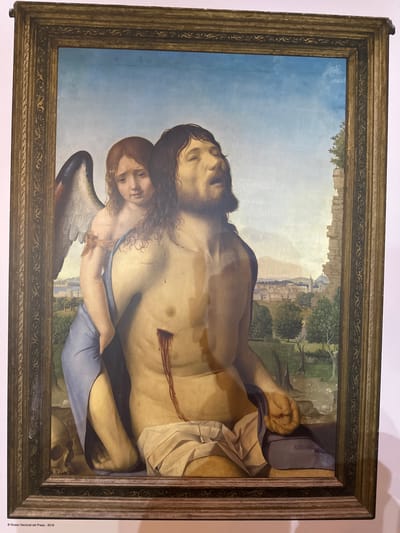
The painting depicts a scene with two central figures. The primary figure is a man, likely representing Christ, with his eyes closed and mouth open, exhibiting signs of suffering. He is depicted shirtless, revealing wounds, notably a prominent wound on his torso with dripping blood. A shroud is draped around his lower body. To his left, a winged figure, an angel, is positioned behind him, partially obscured by the man's body. The angel has a sorrowful expression and is holding the man. The background shows a landscape with trees, rocky formations, and a distant cityscape with architectural structures. The painting is housed in a decorative frame. The lower left corner of the image contains text that reads "© Museo Nacional del Prado - 2019". There is no indication of the city of Mazarrón, Spain, in the image or its associated text.
Mazarrón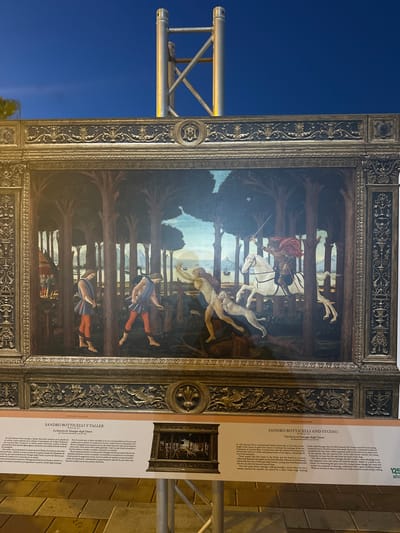
The image displays a large, ornate framed replica of a Renaissance painting set against a twilight sky. The painting depicts a scene in a dense forest with several figures. In the foreground, two young men in traditional attire, one with his head bowed and the other looking down at a stick, walk amongst tall trees. To the right, a pale, nude female figure is being pulled by a white dog, with a distressed expression and reaching arms. Behind her, a white horse with a rider in a red cloak gallops forward, the rider holding a sword aloft. In the background, a fortified structure with tents is visible on the left, and a body of water with ships and hills forms the horizon. The replica is positioned outdoors, with metal scaffolding visible behind and to the sides of the artwork. A descriptive plaque below the artwork, partly obscured by a metal support, identifies the painting as "The Story of Nastagio degli Onesti" by Sandro Botticelli and Studio, and mentions its location in the city of Mazarrón, Spain. The plaque also contains text in Italian and English describing the artwork and its narrative.
Mazarrón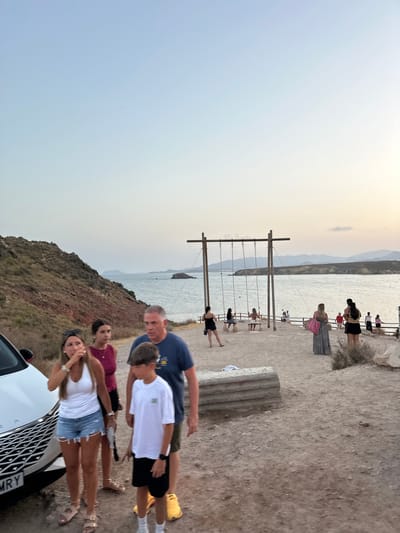
The image depicts a coastal scene at dusk in Mazarrón, Spain. In the foreground, a family of four, consisting of two adults and two children, are walking on a dirt path. The woman in front is wearing a white tank top and denim shorts, and the man beside her is in a navy blue t-shirt. Behind them, a younger woman in a maroon top and a boy in a white t-shirt and black shorts are also visible. To the left, a white car is partially visible. In the background, a scenic view of the Mediterranean Sea unfolds, with hills and mountains forming the distant coastline. A prominent feature is a large wooden swing set structure with three swings suspended over the sandy ground. Several other people are scattered around the area, some are near the swings, while others are further back along a wooden fence. The lighting suggests it is late afternoon or early evening, with a soft, hazy sky. The overall atmosphere is relaxed and recreational, indicating a popular spot for visitors.
Mazarrón