Messina, Italy
30 memories from Messina, Italy
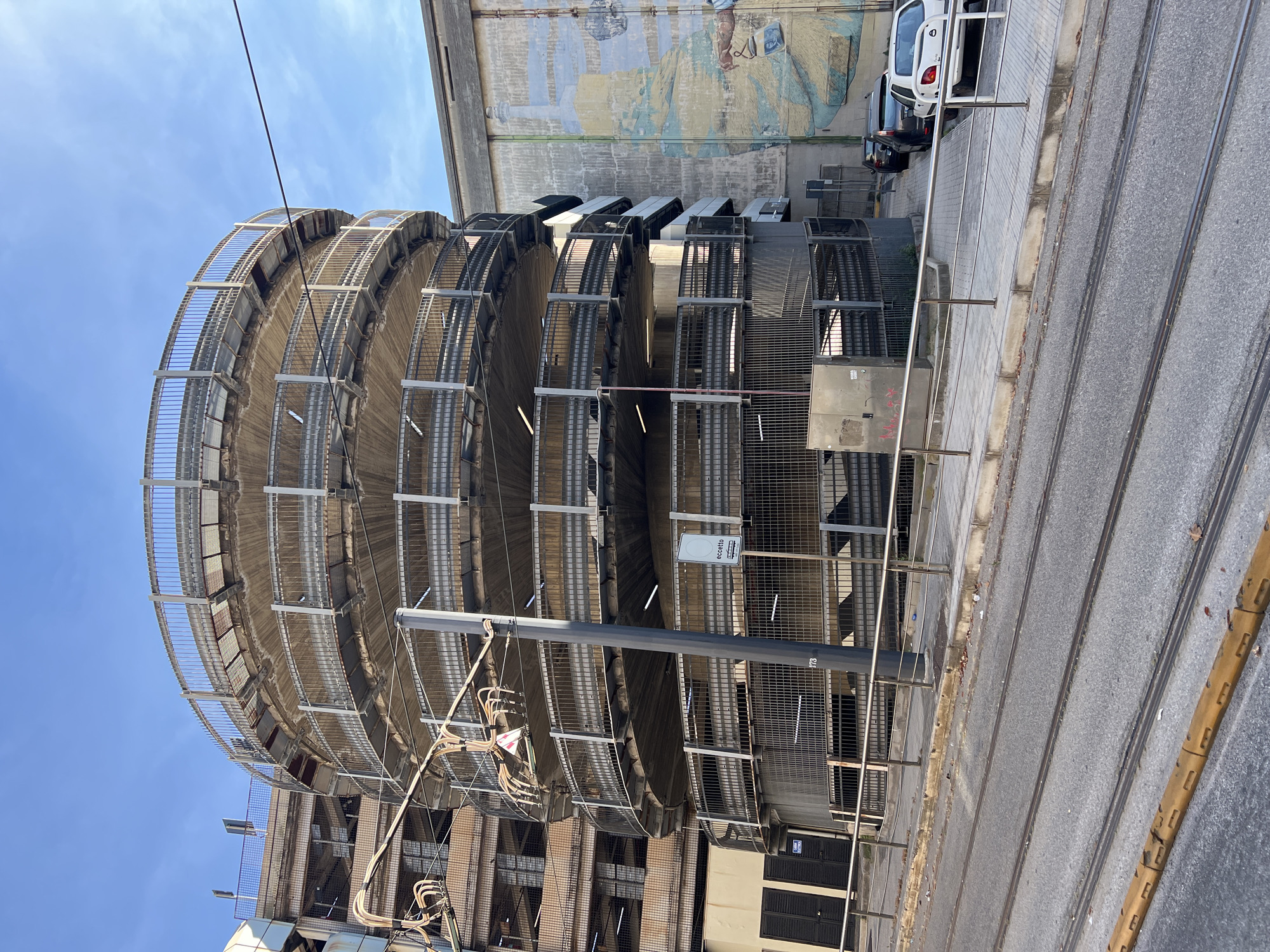
This image depicts a detailed view of the Parcheggio Cavallotti, a multi-story spiral parking garage, located in Messina, Italy, specifically along Viale San Martino. The scene is captured on a clear day under a bright blue sky with sparse clouds. In the center, the prominent feature is the concrete spiral ramp of the parking garage, characterized by its concentric circular levels and robust metal safety barriers. The concrete shows signs of age and weathering. To the left of the spiral garage, another, more conventional, multi-story concrete parking structure or building is visible, also appearing aged. Overhead electrical lines, characteristic of a tram system, extend across the upper-left quadrant, supported by a large dark grey utility pole situated on the sidewalk in the mid-ground. To the right of the spiral garage, a tall, flat building features a large, faded mural. The mural, rendered in muted blues, yellows, and greys, depicts abstract forms and a distinctive hand holding a jar in its lower right section. The foreground is dominated by two sets of parallel tram tracks embedded in asphalt, indicating a functioning tram line. A yellow, segmented road barrier or speed bump runs along the very bottom of the frame. A concrete sidewalk, bordered by a curb, runs parallel to the tracks, featuring a metal railing that extends across the mid-ground. On the sidewalk, near the base of the utility pole, a white rectangular sign with a black border displays a "no parking/stopping" symbol and the Italian word "eccetto" (except), indicating conditional restrictions. A small blue sign reading "CASSA AUTO" (Car Cashier) is visible on a dark, closed door of the building on the far left. Two vehicles are parked on a paved area to the right of the spiral garage, beyond the metal railing. A dark-colored car is partially visible behind a white, older model hatchback. No individuals are present in the scene. The overall environment suggests an urban setting with functional infrastructure and signs of routine use and age.
Messina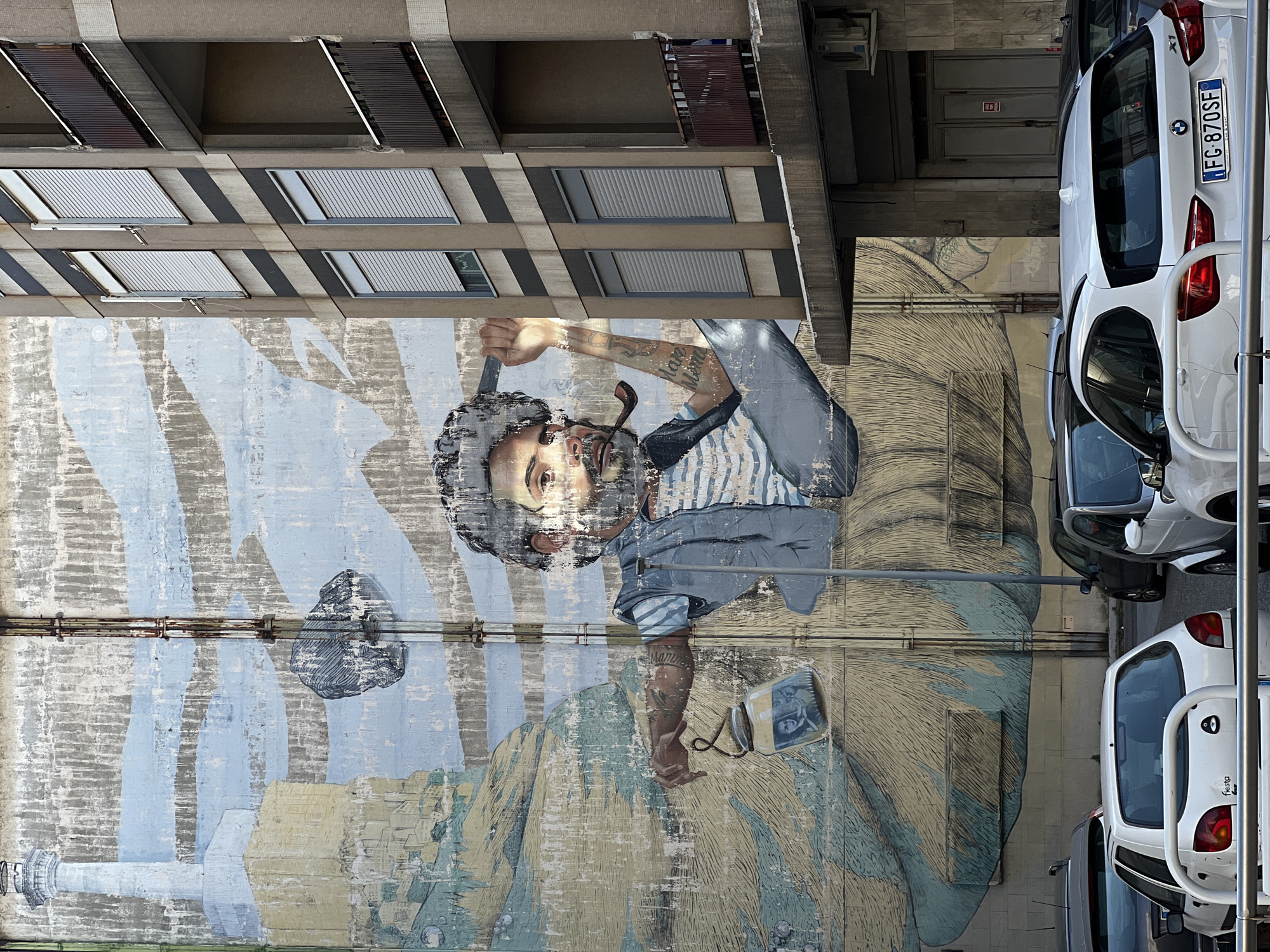
This image captures a weathered mural on a building wall in Messina, Italy, depicting a bearded man with a pipe, wearing a striped shirt and a vest. The man holds a glass jar containing two portraits of women and has a tattoo on his right forearm that reads "I love Mom." The mural's background features a lighthouse, a fortified city or structure on a cliff, and stylized blue waves. A vertical metal pipe system is mounted on the wall, partially obscuring the mural. To the right, an adjacent multi-story residential building with vertical striped panels is visible, featuring multiple windows with closed roller shutters and several balconies with dark railings. In the foreground, a parking area contains several parked cars, including a white Ford Fiesta and a white BMW X1 with an Italian license plate "FG 870SF". The mural exhibits significant peeling and fading, indicating its age and exposure to elements.
Messina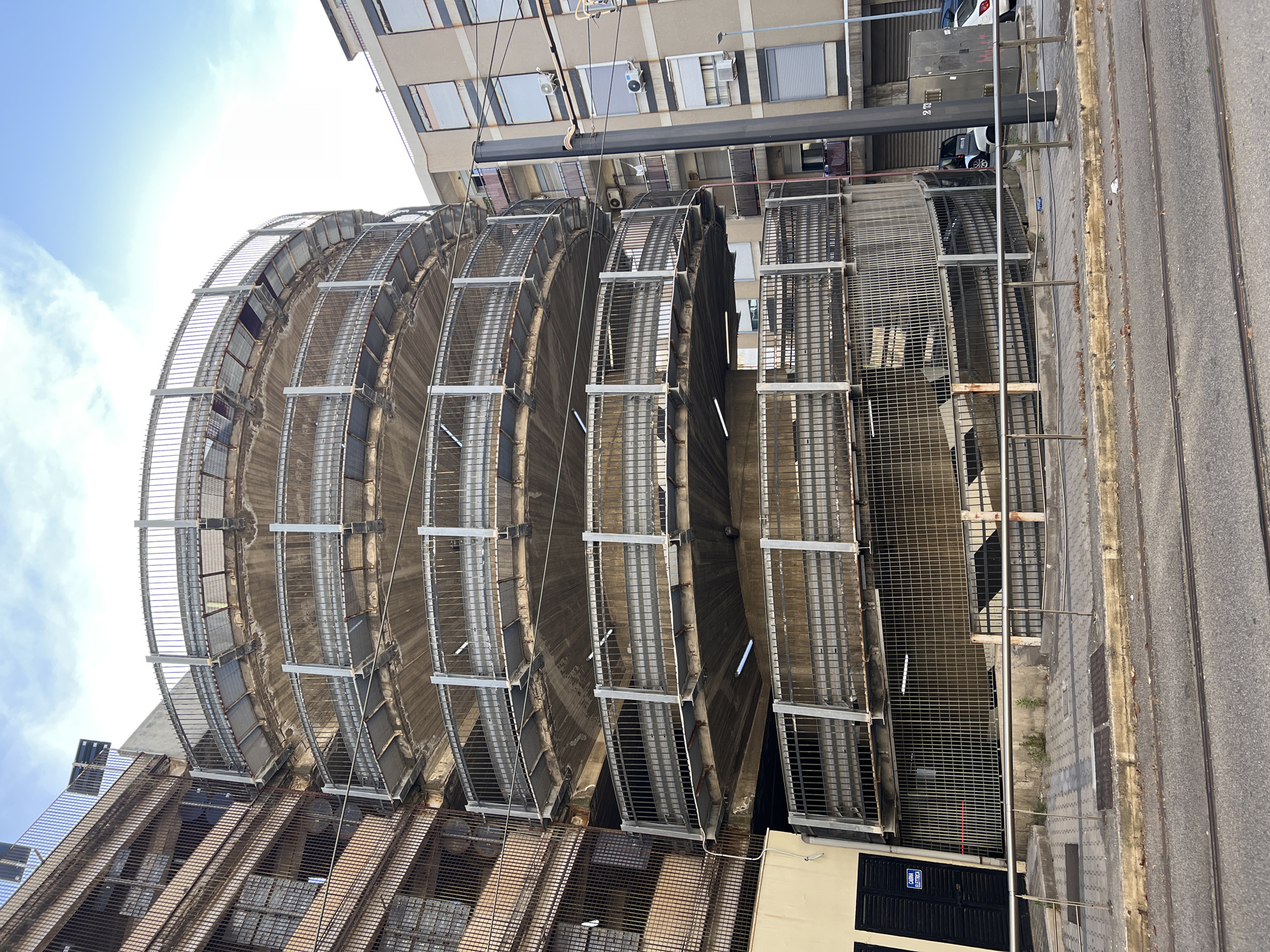
This image depicts an urban street scene in Messina, Italy, specifically featuring the **Parcheggio Cavallotti (Cavallotti Parking Garage)** near the intersection of Via Tommaso Cannizzaro and Viale Europa. The primary subject is a large, circular, multi-story spiral ramp structure, likely a parking garage, constructed from weathered concrete and metal. This structure occupies the center and left-center of the frame. It displays approximately six visible levels, each composed of a curved concrete deck and an exterior protective barrier system of horizontal metal railings and vertical metal mesh or grates. The concrete shows signs of age and discoloration, while the metal components exhibit rust and weathering. Fluorescent tube light fixtures are visible attached to the underside of several concrete decks. On a lower level, partially visible through the grate, a small, two-door vehicle (possibly a Smart car) is parked within the garage. The lowest visible level features a large access opening secured by vertical metal bars. To the left of the spiral structure stands an older, multi-story residential building with a facade of light brown brick or exposed concrete. Its numerous rectangular windows are protected by rusty, horizontal metal grates. The ground floor portion of this building, closer to the viewer, is painted a light yellow/cream color and features dark brown or black closed shutters. A blue rectangular sign with white text reading "CABINA ELETTRICA" (Electrical Cabin) is affixed to the yellow wall. Air conditioning units are visible on its exterior. To the right of the spiral structure, a more modern multi-story apartment building is visible, featuring a light beige/brown stucco facade. This building has multiple balconies with dark railings, some containing visible objects or draped textiles. Many windows are fitted with closed external roller shutters, and external air conditioning units are mounted below various windows. A tall, thick, black utility pole stands prominently in front of this building, partially obscuring it, with multiple electrical wires extending horizontally from its upper portion. In the immediate foreground, two parallel metal tram tracks are embedded in a worn, paved surface, running horizontally across the frame. Behind the tracks, a concrete sidewalk with a checkered pattern is visible, appearing somewhat discolored and uneven, with small patches of weeds growing through cracks. A low, silver-colored metal railing delineates the edge of the sidewalk. On the right side of the sidewalk, near the black utility pole, two dark gray utility boxes are present. Scattered minor debris, including
Messina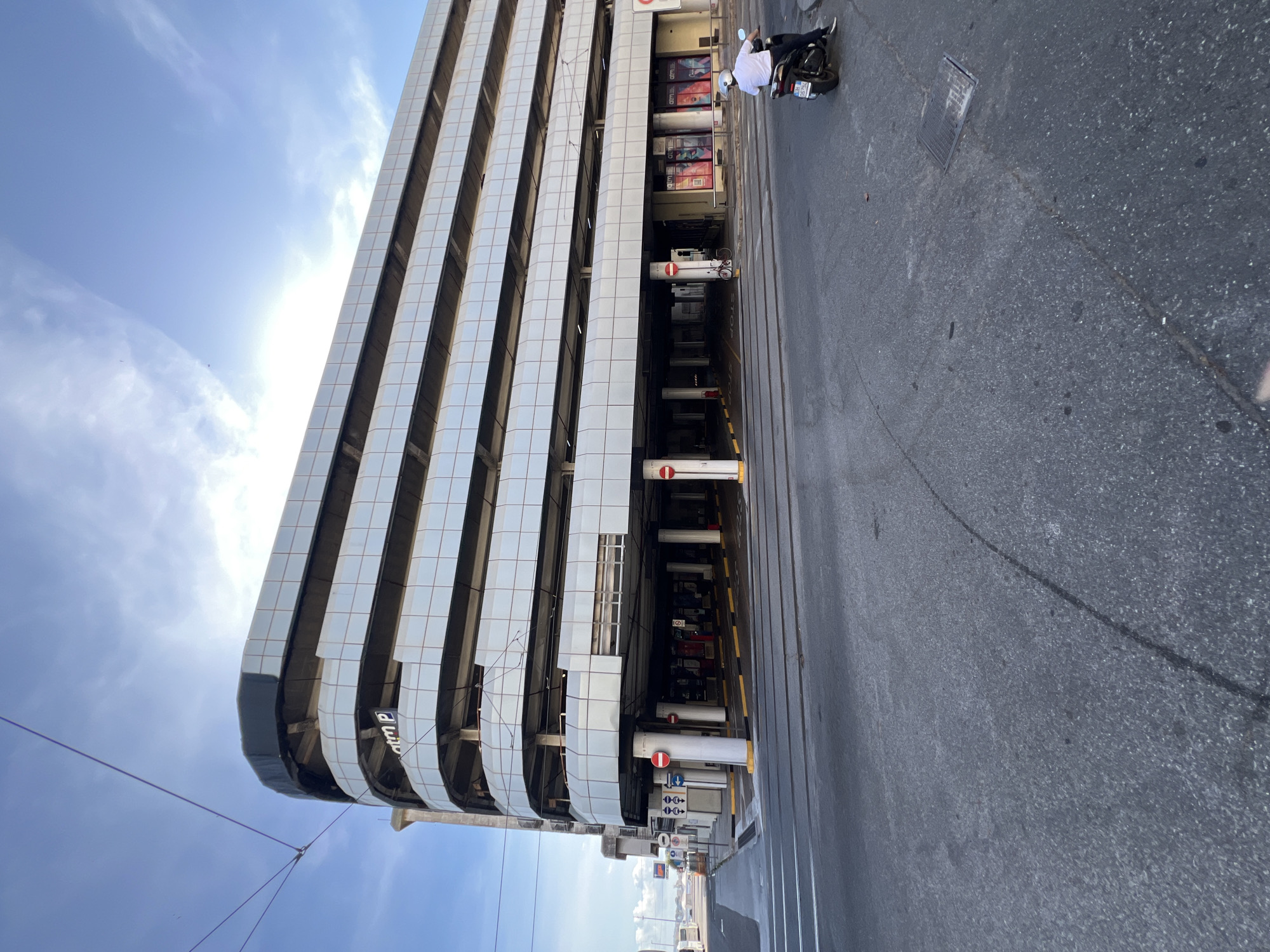
The image depicts a multi-story, curved parking garage situated on a city street in Messina, Italy. The building features an exterior clad with light-colored panels and visible dark structural elements, with some sections appearing to be under construction or renovation. A sign displaying "atm P" is visible near the top left corner, suggesting "ATM Parking." The ground floor of the structure is open, revealing multiple vehicle entry/exit bays supported by white cylindrical columns. Several red circular "No Entry" signs are posted on these columns and at the entry points, with "STOP" painted on the asphalt within the bays. Retail storefronts featuring "atm" branding are visible on the ground floor to the right of the parking entrance. The street in the foreground is asphalt, with tram tracks embedded into its surface. Overhead wires, likely for a tram or power supply, stretch across the upper left portion of the frame. On the far left, other street signs, including blue directional arrows, are visible near the corner of the building. A white bus is partially visible further down the street on the left. On the right side of the road, a person wearing a white shirt and a light-colored helmet is seated on a black scooter, facing away from the camera. The scooter's license plate, "DM 05794," is partially visible. Inside the ground floor of the parking garage, near a column, a bicycle is parked. The scene is illuminated by daylight under a clear blue sky with sparse white clouds, indicating a sunny day.
Messina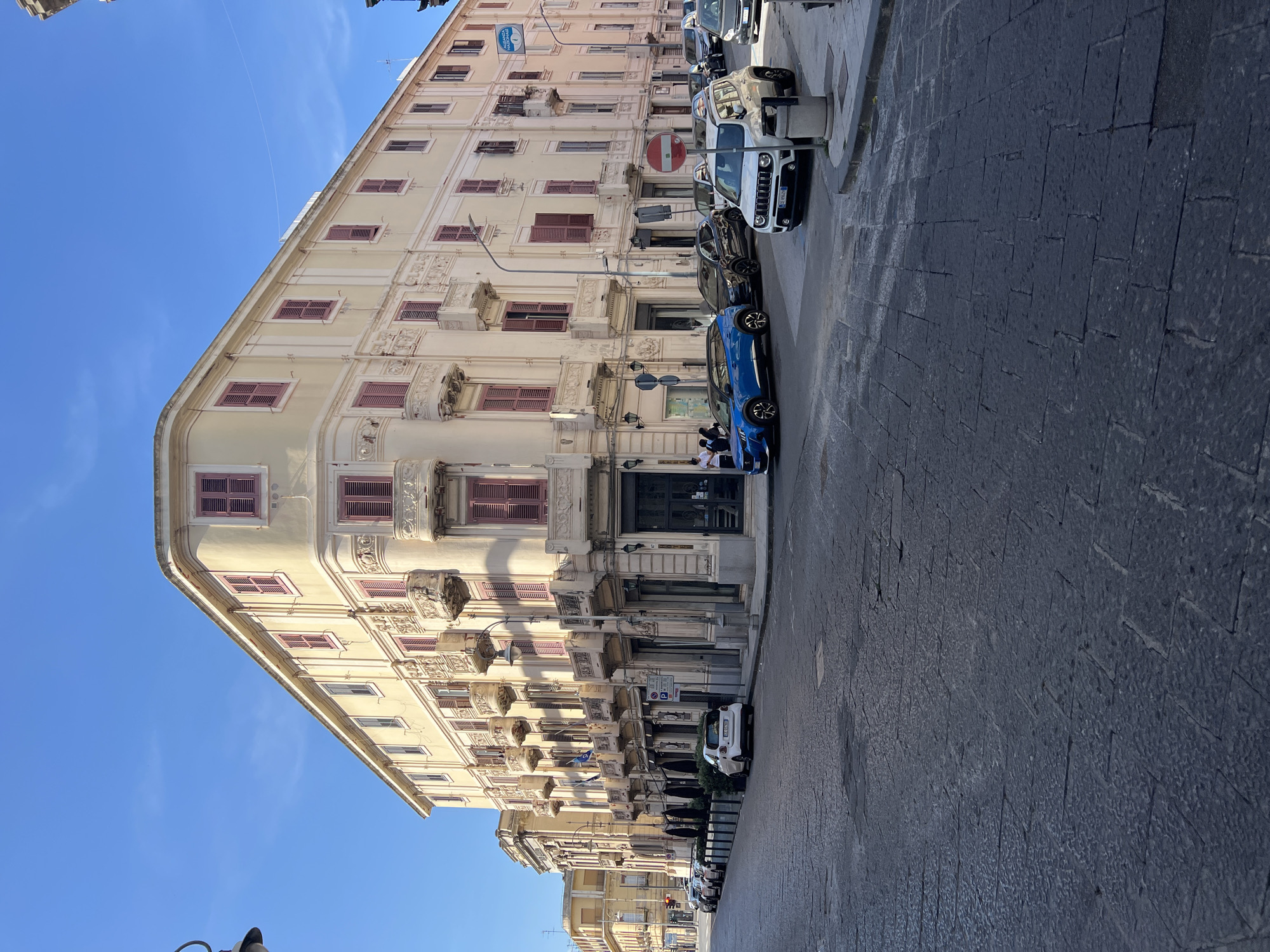
This image presents a detailed street scene in Messina, Italy, specifically focusing on the intersection involving Via Cesare Battisti 204, which is the location of the prominent corner building, the Palazzo Tremi. The central subject is a large, four-story building, painted in a light cream or pale yellow color, occupying the corner of the intersection. The building exhibits ornate architectural details, particularly on its second and third floors, which feature numerous decorative stone balconies with intricate carvings and balustrades. Each window on these floors is fitted with closed, reddish-pink wooden shutters. The ground floor of the building consists of commercial spaces with dark awnings or canopies and large windows. Above the ground floor on the right side of the building, a white circular sign with blue text "ALLIANZ NAZIONALE" is visible. The street is paved with dark grey, irregularly shaped cobblestones or flagstones, which appear worn. The scene is brightly lit by natural sunlight, casting distinct shadows and indicating clear weather under a vibrant, cloudless blue sky. Several vehicles are present in the frame: * A blue Peugeot 2008 (license plate GA 597XV) is positioned at the intersection in the foreground, facing right. * Behind the blue Peugeot, a black SUV is also at the intersection. * A white Jeep Renegade (license plate GF 696XJ) is parked at the corner curb on the right, facing right. * Behind the white Jeep, a dark-colored sedan is parked. * Further down the street on the left, a white Smart car (license plate GE 639XZ) is parked along the sidewalk, followed by several other parked cars, including a dark SUV and lighter-colored sedans. Street furniture includes: * Several black street lamp posts with multiple arms. * A blue "P" parking sign (indicating paid parking) near the white Smart car. * A prominent red circular "No Entry" traffic sign with a white horizontal bar, positioned at the corner near the white Jeep Renegade. * A grey cylindrical public waste bin is located near the "No Entry" sign. * Black bollards or stanchions line the edge of the sidewalk in front of the businesses on the left. A small group of approximately three to four individuals is visible on the sidewalk near the main entrance of the corner building, on the right side of the image, appearing to be standing or conversing. Another individual is partially obscured behind the white Smart car on the left.
Messina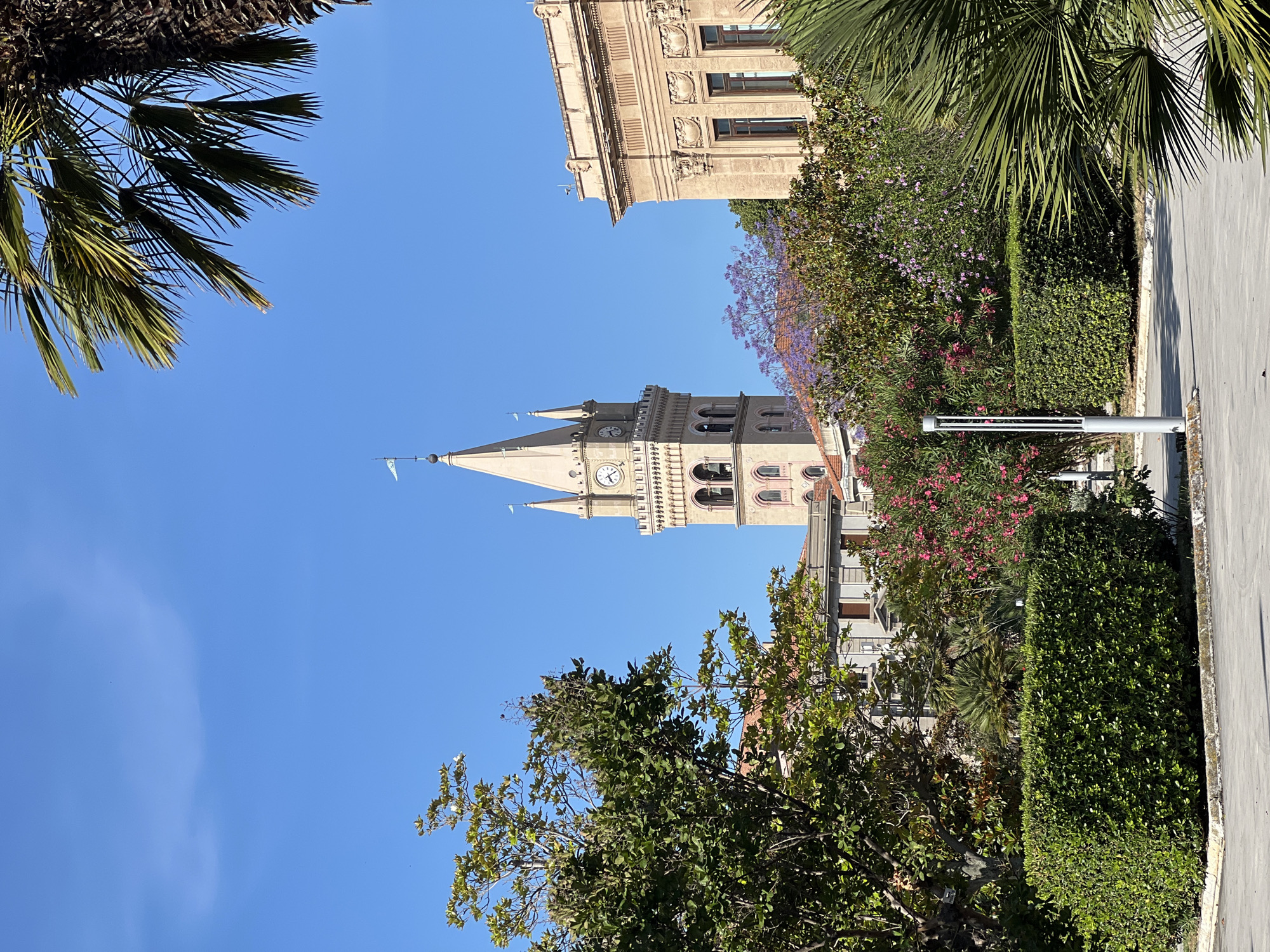
The image displays an exterior view of a prominent clock tower and surrounding urban greenery under a clear blue sky in Messina, Italy. The central subject is the **Messina Cathedral Bell Tower (Campanile del Duomo di Messina)**, a light-colored (likely sandstone or cream-hued) multi-tiered structure dominating the upper-center of the frame. It features a tall, pointed spire topped with a finial and a small, light-colored pennant or flag pointing towards the left. A smaller, pointed turret is positioned to the left of the main spire. Below the spire, a large clock face with dark Roman numerals and hands indicates approximately 10:15 or 10:20. Further down, the tower exhibits multiple arched openings (likely for bells) and intricate architectural detailing including corbelling and pilasters. To the right of the clock tower, a section of a large, classical-style building with a light brown facade, ornate cornices, and decorative relief panels is visible. It features four recessed, dark-framed windows. Other less distinct buildings with terracotta roofs are partially visible behind the foliage in the midground. The lower two-thirds of the image are filled with diverse vegetation. A large, dense green tree with broad leaves occupies the left midground, partially obscuring other buildings. Numerous bushes and trees with varying shades of green are spread across the midground. Patches of dark pink flowering bushes (possibly oleander) are visible to the right and left of a prominent rectangular, manicured hedge in the lower-center foreground. A tree with vibrant purple flowers (likely Jacaranda) is positioned between the central tree and the clock tower, slightly in front of the cathedral bell tower's base. On the far right and top right, dark green fronds of a palm tree are prominent, partially framing the scene. A smaller palm is visible in the midground to the right of the central tree. The ground in the foreground is a light gray paved surface, possibly concrete or asphalt, with a raised curb running along the bottom edge of the hedge. A modern, slender, vertical light fixture, silver-gray in color, stands to the left of the hedge. The scene is brightly lit by natural sunlight, originating from the left, casting distinct shadows on the ground and vegetation. No people are visible in the image.
Messina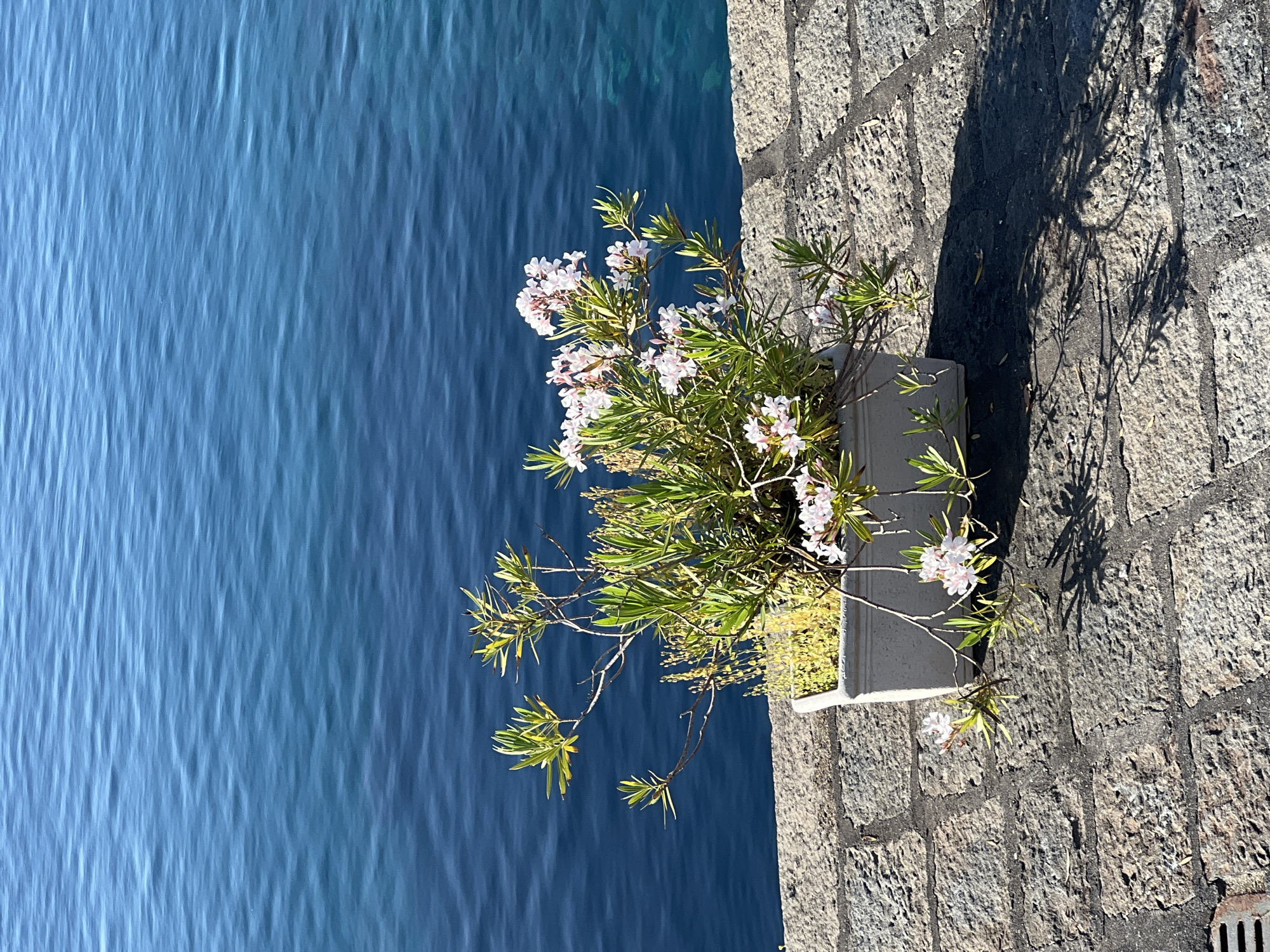
The image displays a waterfront scene in Messina, Italy, under direct sunlight. A rectangular, light gray planter occupies the lower-center, containing a flowering plant exhibiting narrow green leaves and numerous clusters of small, light pink to white blossoms, consistent with Oleander. Smaller green foliage is also visible within the planter. The planter rests upon a paved surface composed of irregularly cut, light-toned stone blocks with dark grout lines. A metallic drainage grate is partially visible in the bottom-left corner of the paved area. Defined shadows cast by the plant's branches are prominent on the stone paving to the right. The upper two-thirds of the frame are filled by a deep blue body of water, displaying consistent surface ripples. A slight shift to a lighter blue-green tone is discernible in the water in the lower-right quadrant, revealing indistinct subsurface features. No individuals are present in the scene.
Messina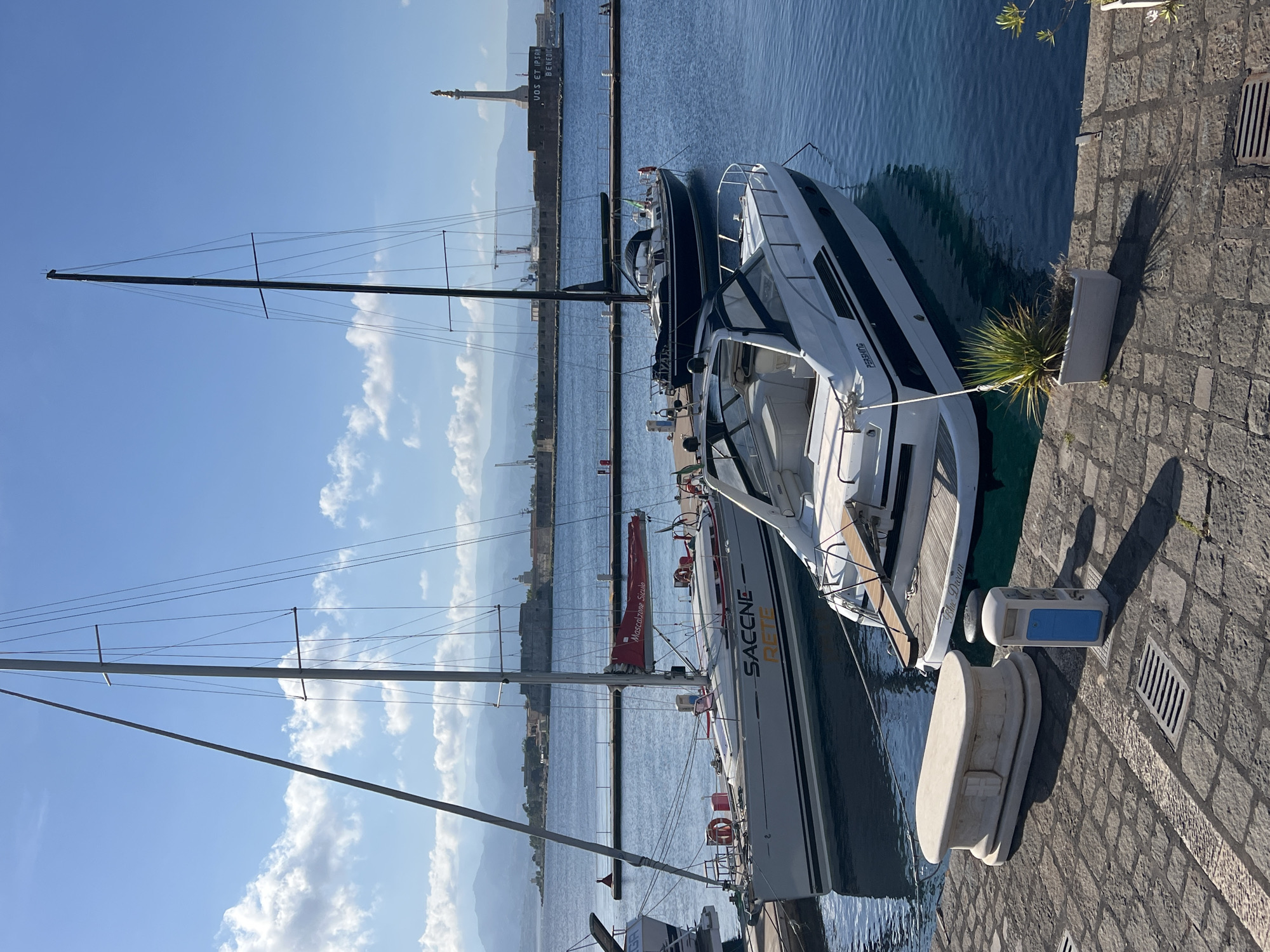
The image presents a daytime view of a marina in Messina, Italy, under a bright blue sky with scattered white cumulus clouds. In the foreground, a cobblestone quay features a large, light-colored stone bollard with an embossed cross-like design, positioned left of center. Adjacent to it on the right is a shorter, grey utility post with a blue top. A rectangular metal drain grating is set into the cobblestones in the lower-left quadrant. At the quay's edge on the lower right, a white planter holds green, spiky foliage. Three boats are moored in the calm, blue water. The closest boat, positioned in the midground on the right, is a white and black motor yacht with "PERSHING" visible on its hull and "Blue Dream" on its stern. It has a light-colored swim platform at its stern. To the left of the motor yacht, a grey monohull sailboat with black hull stripes is moored to a floating brown dock. This sailboat displays "SACCNE" and "RETE" in orange lettering on its hull, and "Mascalzone Siculo" on its red mainsail cover. Behind the motor yacht, a dark blue sailboat with a black mast and dark blue sail cover is also moored to a similar floating dock. In the background, across the blue water, a long grey breakwater is prominent. On its far-right end, a tall column supports the "Madonnina del Porto" (Madonna della Lettera) statue, with the Latin inscription "VOS ET IPSAM BENEDICIMUS" clearly visible on its base. To the left of this landmark, a large, grey, historic fortress (Forte San Salvatore) stands at the harbor entrance. Further along the distant shoreline, industrial cranes and port structures are discernible. A range of hazy blue mountains forms the horizon. Strong shadows cast by objects in the foreground indicate bright sunlight from the left. No individuals are clearly visible in the foreground or midground.
Messina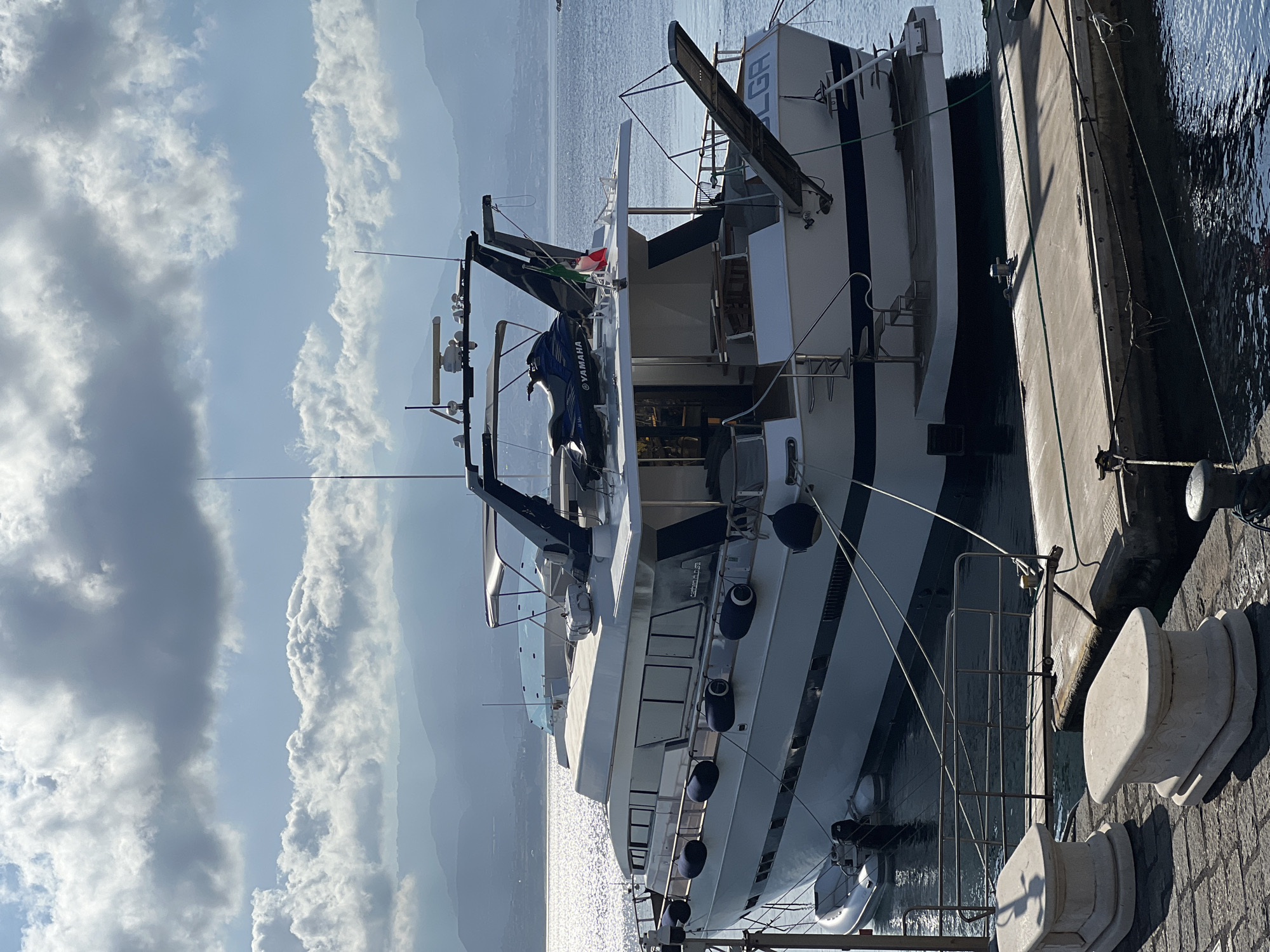
The image presents a detailed view of a large, white motor yacht, identified by the name "OLGA" on its stern, moored at a dock in a port setting, located in Messina, Italy. The yacht features a prominent blue stripe along its hull and multiple dark blue cylindrical fenders evenly spaced along its port side, which is closest to the viewer. A small, light-colored inflatable dinghy (tender) is moored alongside the yacht near its bow. On the yacht's upper deck, a blue Yamaha WaveRunner (jet ski) is secured atop the superstructure, positioned between two support arches for a canopy. A white radar dome and several communication antennas are visible on the flybridge. An Italian flag, characterized by vertical green, white, and red stripes, is displayed at the stern. A multi-step gangway, constructed of metal and wood, extends from the yacht's transom to a floating pontoon. Interior lighting is visible through the windows at the yacht's stern. In the foreground, a paved stone quay is visible, equipped with two prominent, light-colored, rectangular concrete bollards to which several mooring lines from the yacht are secured. Beyond these bollards, a dark gray floating pontoon or finger pier extends into the water, also featuring multiple mooring lines. The water in the harbor is calm, displaying a dark blue-green hue and exhibiting significant sun glint and reflections on the left side of the frame, indicating the presence of direct sunlight. In the distant background, a long range of hazy, bluish-grey mountains or hills stretches across the horizon under a sky partially covered by large, distinct white cumulus clouds interspersed with areas of clear blue. No people are discernible in the image.
Messina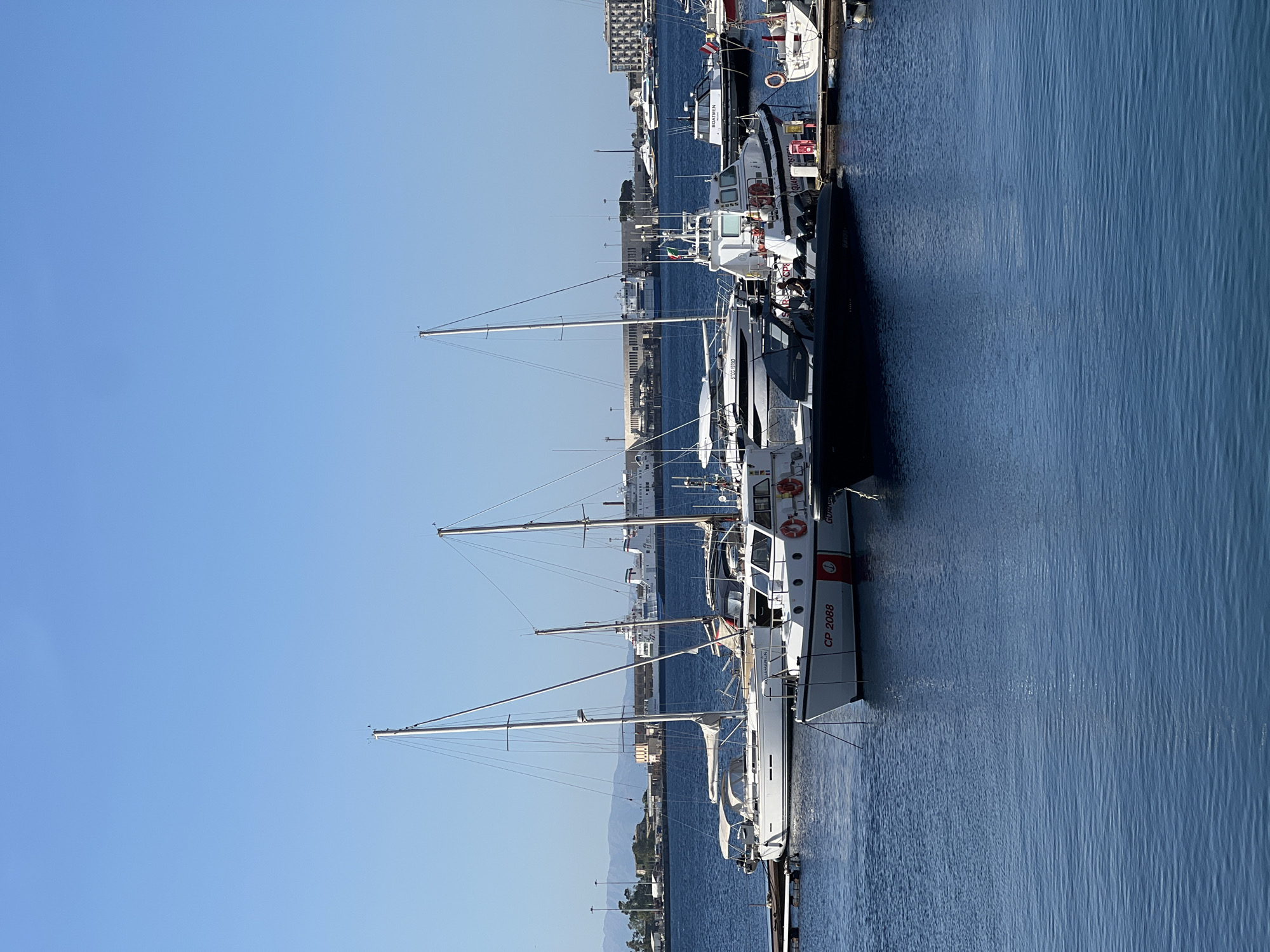
The image depicts a marina scene under a clear, bright blue sky in Messina, Italy. The foreground is dominated by calm, deep blue water with subtle ripples. Various boats are docked or moored. In the mid-ground, from left to right, there are several white sailboats with tall masts. Directly in front, a white patrol boat with the identification "CP 2088" on its bow and an emblem featuring an anchor and what appears to be a stylized lifebuoy, indicative of the Italian Coast Guard ("Guardia Costiera"), is prominently featured. To the right of "CP 2088," a larger white patrol vessel, also bearing "GUARDIA COSTIERA" on its side and an Italian flag flying from its mast, is docked. Adjacent to it, a dark grey or black rigid-hulled inflatable boat (RIB) with multiple outboard engines is visible. Other motor yachts and smaller vessels are scattered throughout the marina, some partially obscured. Docks, mooring lines, and fenders are visible securing the boats. In the background, a bustling port area is visible. On the left, distant mountains or hills frame industrial port structures, including what appear to be container cranes and administrative buildings. Several large ferry or cruise ships, one white and red, another predominantly white, are docked at the main port. To the far right, a large multi-story building, possibly a hotel or commercial structure, stands near the water's edge. No individuals are clearly identifiable or engaged in specific actions within the frame.
Messina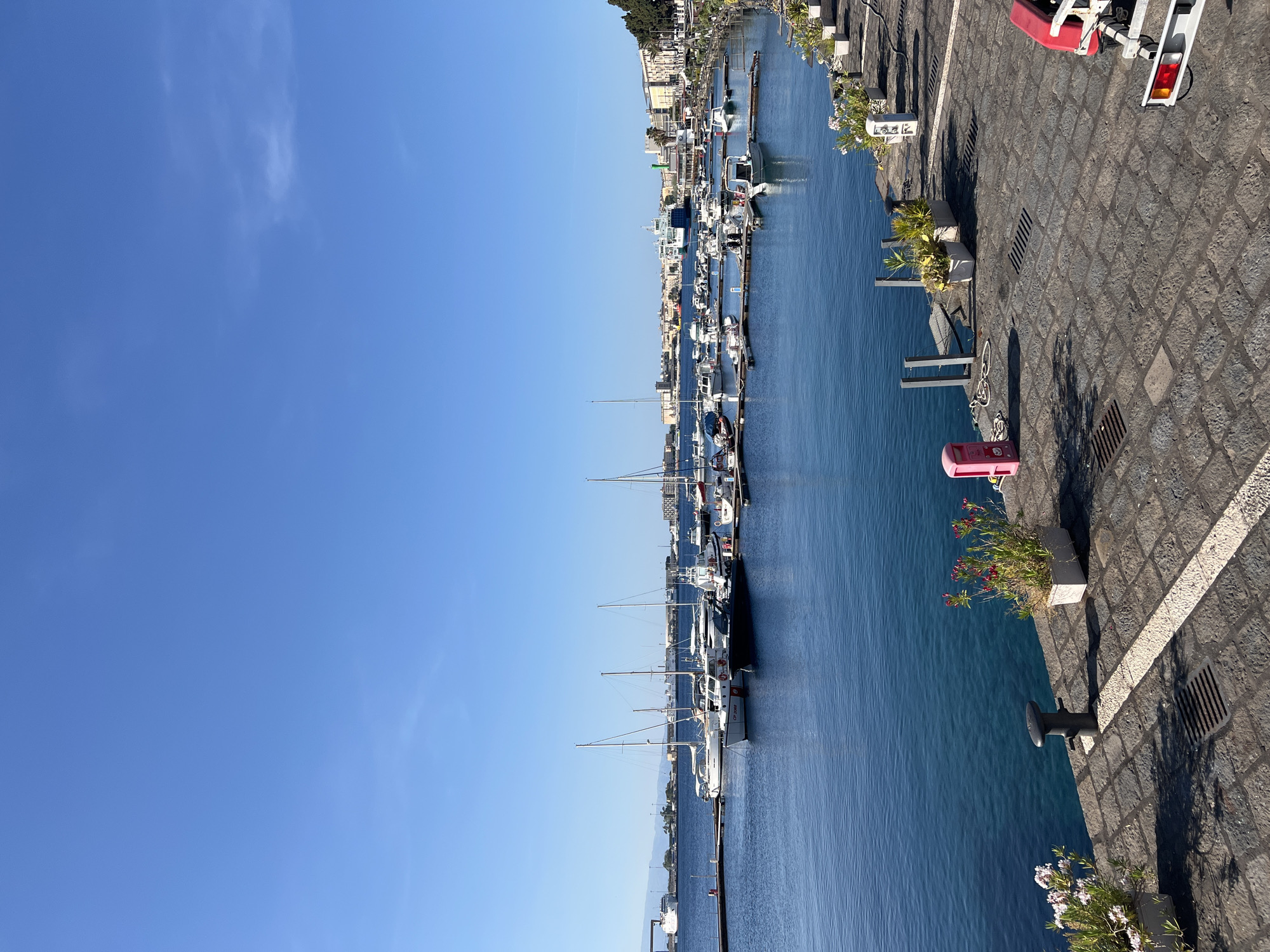
This image depicts a marina within the city of Messina, Italy, looking across a body of water toward a distant coastline. The scene is dominated by a clear, bright blue sky with minimal, wispy white clouds. In the midground, the calm, deep blue water of the marina is filled with numerous docked boats. These include several sailboats with visible masts and rigging, and various motorboats. One prominent white motorboat features the markings "CP 2098" on its hull, indicative of an Italian Coast Guard vessel. Adjacent to it is a dark-hulled motorboat. Further out in the water, larger vessels, including a white ferry and other cargo ships, are visible near an industrial port area characterized by large cranes on the distant shore. A green navigation light beacon is also visible on the water. The background shows the urban coastline of Messina to the right, with a collection of buildings, some with multiple stories, and clusters of trees. Beyond the immediate bay, a mountainous landmass, likely the Calabrian coast across the Strait of Messina, stretches across the horizon under the clear sky. In the foreground, a paved stone walkway or pier occupies the lower portion of the image, primarily on the right side. The paving consists of grey cobblestones with a prominent white stripe running diagonally across. Several dark-colored mooring bollards are affixed to this walkway. Planters containing flowering plants, displaying both red and white blossoms (resembling oleander), are spaced along the edge of the walkway. A bright pink, cylindrical object, possibly another type of bollard or a utility post, is positioned near the left edge of the foreground. Multiple metal drain grates are embedded in the paving. In the bottom right corner, a portion of a red and white vehicle trailer is visible. Shadows, cast from the left, indicate strong overhead sunlight. No individuals are distinctly visible in the immediate foreground or on the boats.
Messina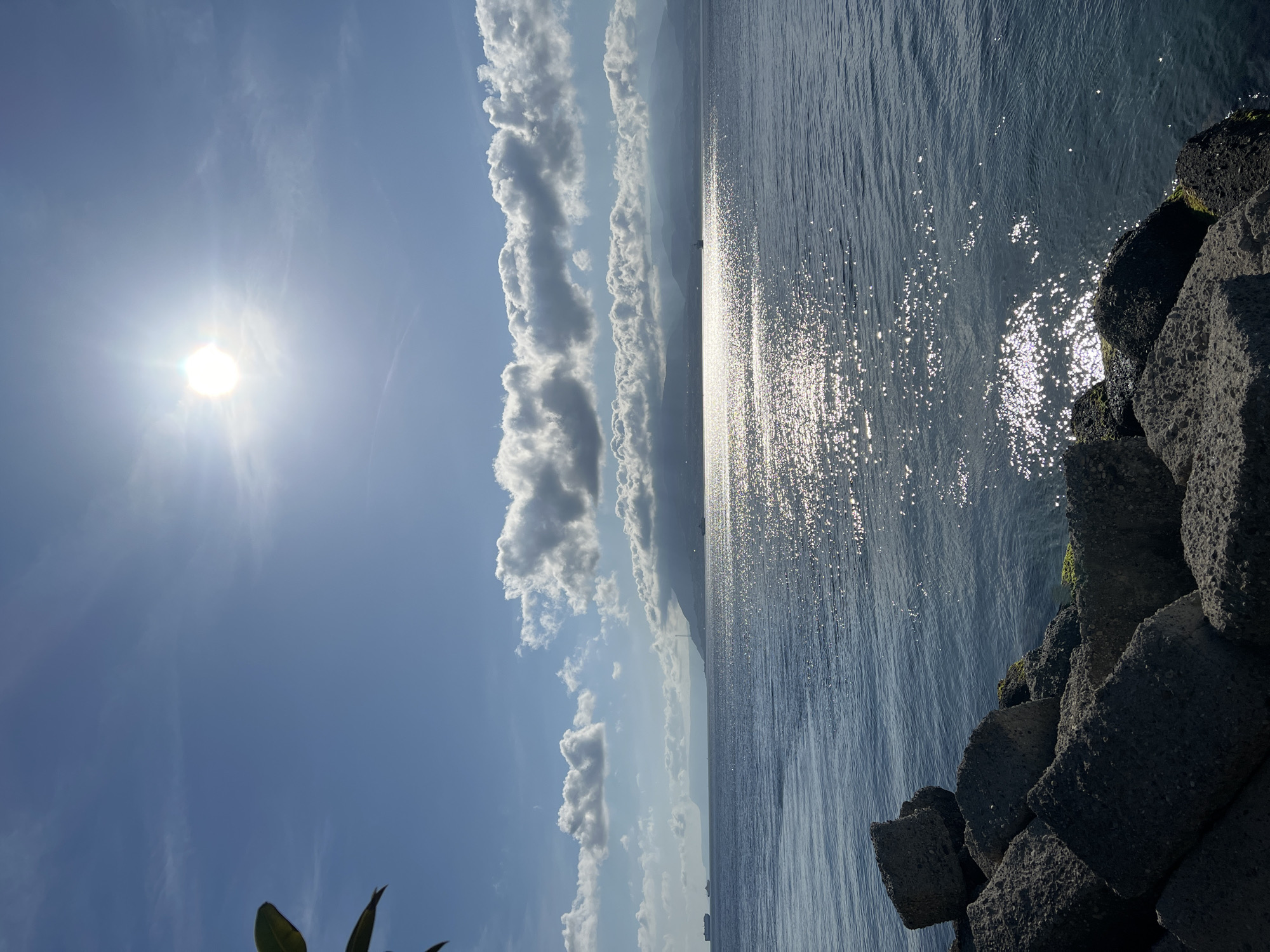
A wide-angle landscape photograph depicts a sunlit coastal scene in Messina, Italy, under a clear blue sky. The upper third of the image features a bright, circular sun in the upper-center-right, producing a strong glare and radiating light. Scattered wispy clouds are visible in the upper sky, while a more prominent, horizontal band of cumulus clouds occupies the mid-sky, positioned above a distant, hazy mountain range that stretches across the horizon. The middle and lower portions of the frame are dominated by a calm, deep blue-grey sea. The sun's intense light creates a shimmering path of thousands of small, sparkling reflections on the water's surface, extending from the horizon towards the viewer. Along the distant horizon, two large vessels, likely cargo ships or ferries, are visible on the far left. A smaller, darker vessel is silhouetted further right, closer to the sparkling sun path. In the foreground, occupying the bottom and lower-left sections of the image, is a prominent pile of large, dark grey, irregularly shaped concrete breakwater rocks, some exhibiting patches of green algae or moss. The partial view of a green leaf from an unseen plant is visible in the extreme upper-left corner of the frame. No people or animals are visible.
Messina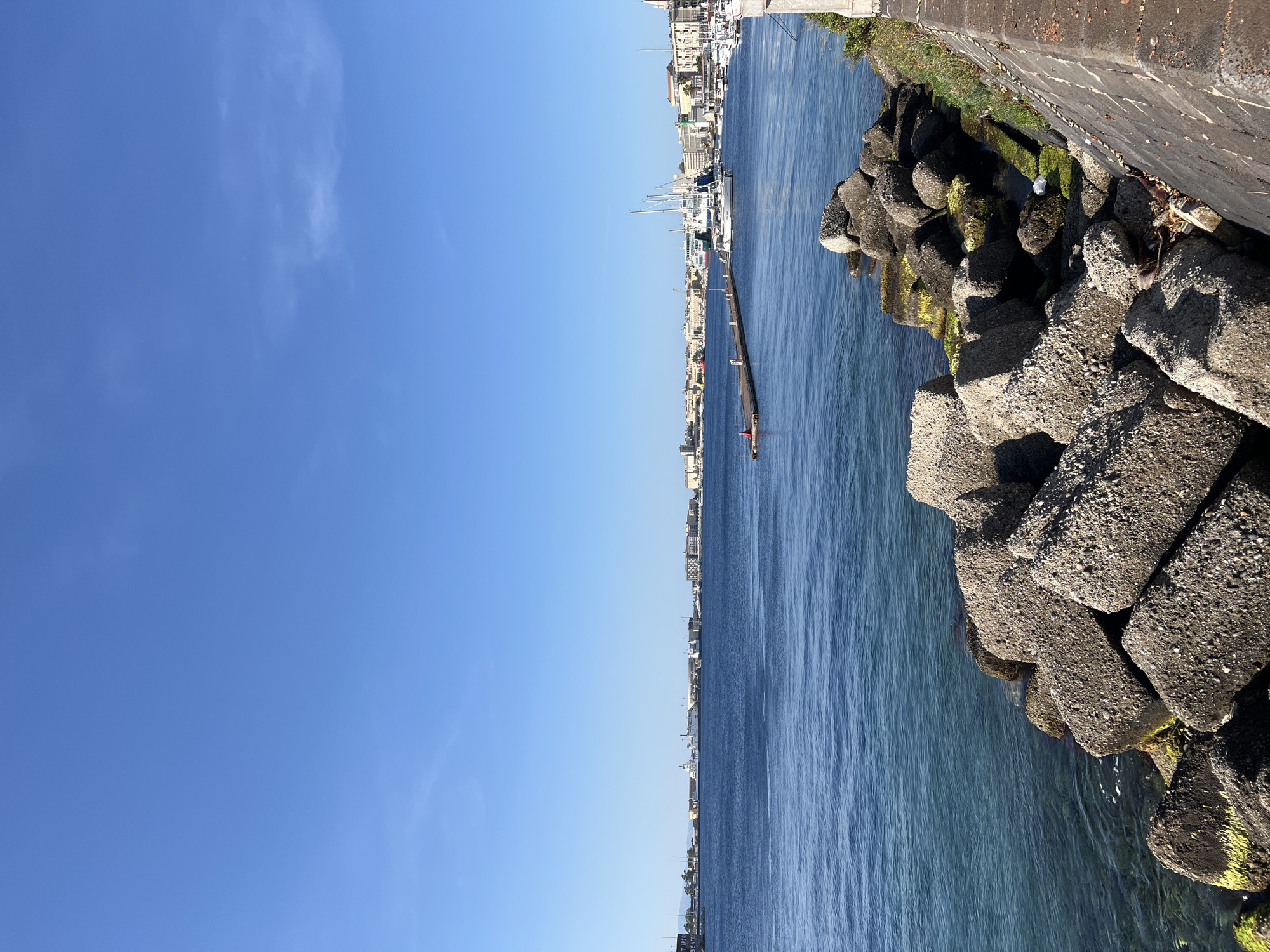
This is a panoramic view of the Port of Messina, Italy, captured on a clear, sunny day. The sky occupies the upper half of the image, presenting a uniform, bright cerulean blue with only a faint wisp of cloud visible in the upper right. The water in the harbor is a deep sapphire blue, transitioning to a clearer aquamarine near the shoreline, with gentle ripples disturbing its surface. In the immediate foreground, a rough-hewn concrete seawall or promenade runs diagonally from the bottom right corner. Along its base, sparse dry vegetation and a white plastic bag are visible. Adjacent to the seawall, a substantial breakwater is formed by numerous gray, coarse-textured concrete blocks, similar to tetrapods, stacked irregularly along the water's edge. These blocks are heavily adorned with vibrant green algae and moss where they meet the water. In the midground, a narrow, light-colored pier, likely wooden, extends horizontally into the harbor from the right, with a red cylindrical marker at its visible end. Several white-hulled recreational vessels, predominantly sailboats with their masts erect, are moored to the left of this pier and elsewhere in the harbor. The background reveals the sprawling urban landscape of Messina. A continuous line of multi-story buildings, featuring various architectural styles, colors (beige, white, ochre), and red-tiled roofs, stretches along the waterfront. A distinct white bell tower or spire rises prominently above the buildings on the right side of the cityscape. To the far left, beyond the recreational marina, an active commercial port is visible, characterized by large white and gray ships (likely ferries or cargo vessels) docked at industrial quays, accompanied by visible cranes and other port infrastructure. Distant mountains are faintly discernible on the far left horizon. No people are present in the scene. The lighting suggests midday to early afternoon, with strong, direct sunlight creating clear illumination across the landscape.
Messina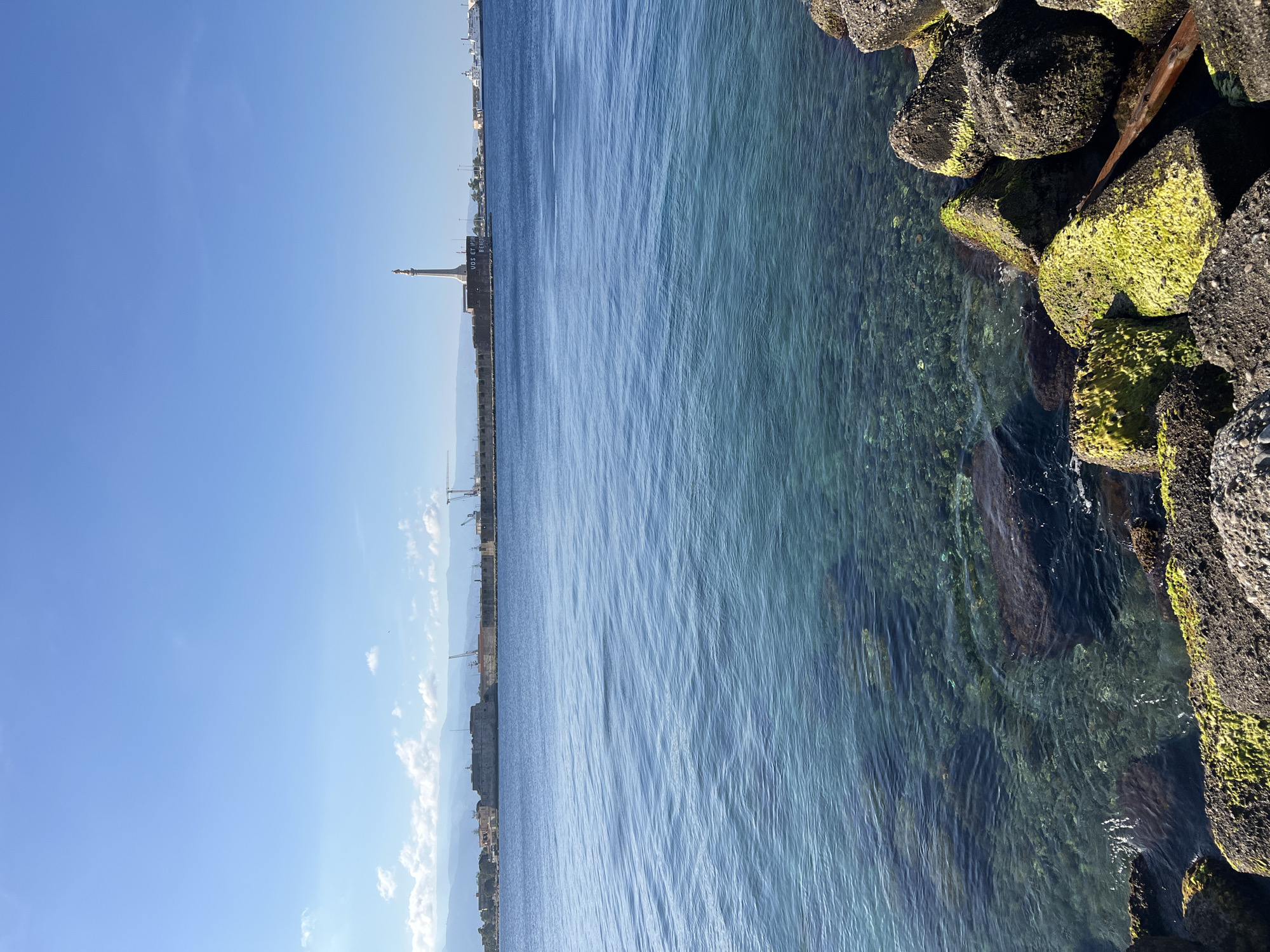
The image depicts a sunlit coastal panorama in Messina, Italy, overlooking the city and its harbor. In the immediate foreground, dark grey, angular concrete breakwater rocks, extensively covered in vibrant green moss and algae, line the bottom right edge. A piece of dark wooden debris is lodged among these rocks. The water in the mid-ground is remarkably clear, displaying a gradient of deep blue to turquoise, allowing the rocky seabed and submerged features to be distinctly visible beneath the surface. Gentle ripples texture the water. Across the water, the distant coastline reveals the city of Messina. A prominent white column, the Madonna della Lettera monument, stands tall on a fortified base at the harbor entrance. A partial inscription, "VOS ET IPSAM BENEDICIMUS," is visible on its pedestal. To the left of the monument, a large, dark, fortified structure or wall forms part of the port defenses. Further along the distant shore, industrial port infrastructure is present, including multiple yellow construction cranes, various buildings, and a large white vessel, possibly a ferry, docked at a terminal. In the far background, a range of hazy, undulating mountains and hills extends across the horizon. The sky is a clear, bright blue with a few scattered white cumulus clouds. No individuals are discernible in the scene.
Messina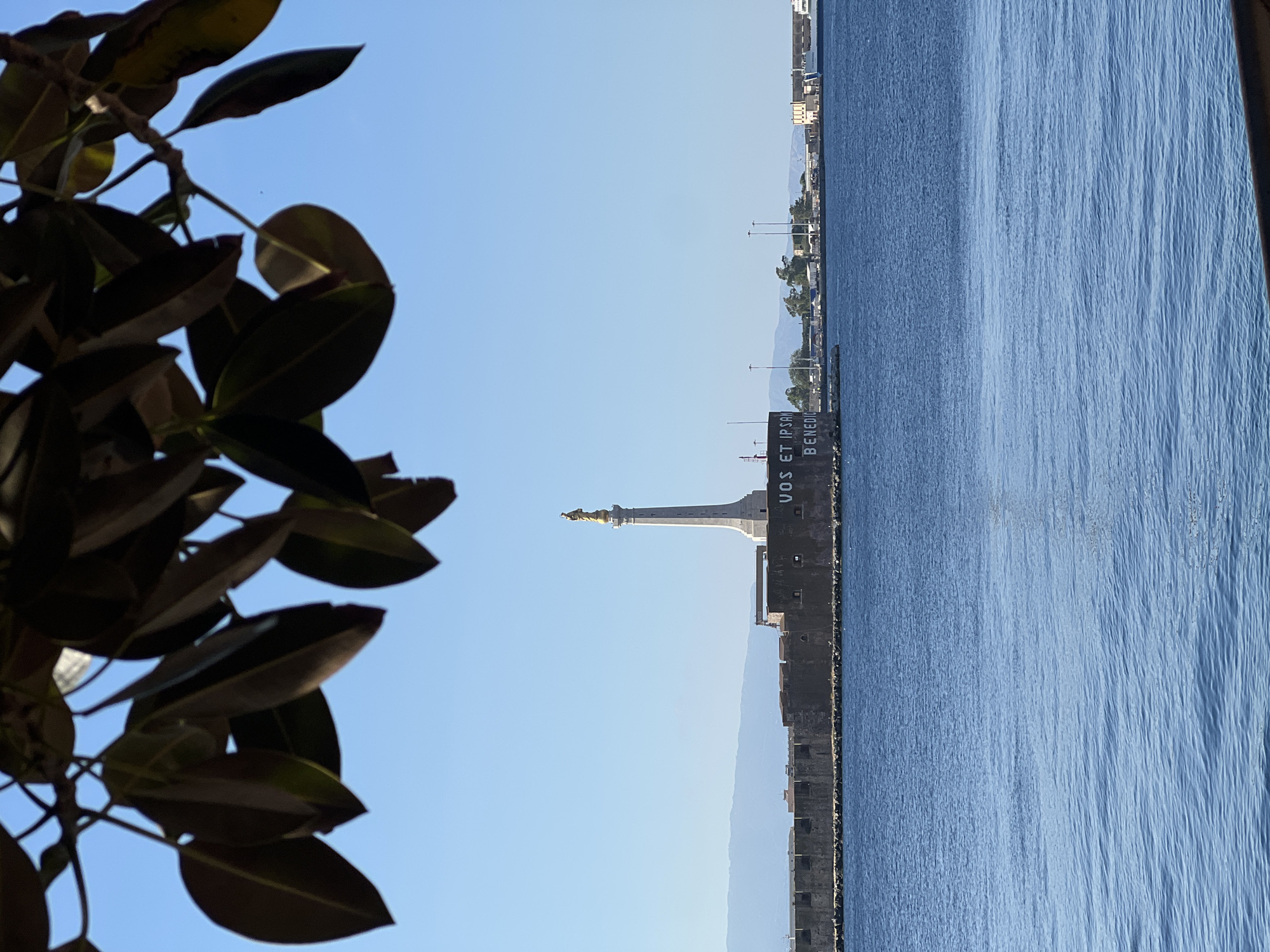
The image depicts a panoramic view of the Strait of Messina, Italy, focusing on the entrance to Messina's harbor. In the midground, the monumental column of the Madonna della Lettera is prominently featured, situated atop the historic Fort San Salvatore. The column is slender, tapering upwards, and constructed of light-colored stone or concrete. It is surmounted by a golden statue of the Madonna della Lettera, facing outwards towards the sea. Below the column, the formidable, dark grey stone or concrete fortified wall of Fort San Salvatore stretches horizontally across the scene. Large white letters are painted on a section of this wall, clearly spelling "VOS ET IPSAM BENEDICIMUS." To the right of the column and wall, various port structures, including industrial buildings, cranes, light poles, and a white vessel (possibly a ferry) docked alongside, are visible on the distant coastline. Beyond these, a range of mountains or hills can be seen on the horizon. The lower half of the image is dominated by the calm, deep blue waters of the Strait of Messina, exhibiting subtle ripples across its surface. The sky above is a clear, brilliant blue, indicating fair weather. The top of the image is framed by a cluster of dark, out-of-focus, broad leaves from an overhead tree branch, partially obscuring the sky. No individuals are visible in the scene.
Messina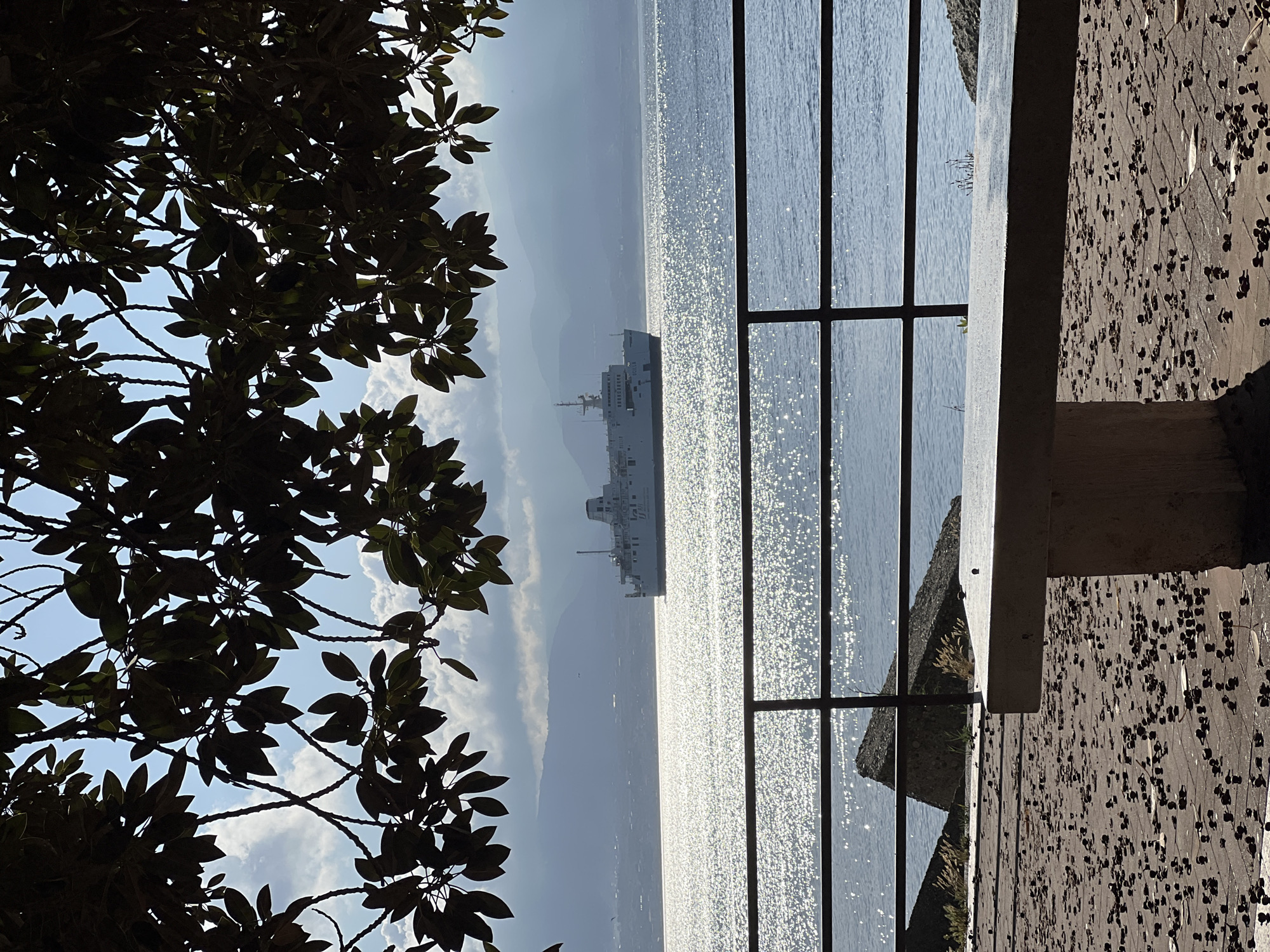
The image depicts a sunlit coastal scene, likely from a promenade in Messina, Italy, overlooking the Strait of Messina. In the immediate foreground, a paved surface, possibly composed of reddish-brown interlocking pavers, is densely covered with numerous small, dark, spherical objects resembling fallen berries or seeds. A light-colored concrete bench occupies the lower right, with only its top and side surfaces visible, casting a shadow to its right. A dark metal railing, consisting of two horizontal bars, spans the width of the mid-foreground, separating the paved area from the water. Beyond the railing, the expansive body of water, presumably the Strait of Messina, intensely reflects sunlight, creating a sparkling, glinting effect across its surface. A large, white, multi-deck ferry is positioned centrally on the water, moving from left to right. Its stern is visible, showcasing multiple levels of superstructure, visible windows, and two funnels towards the aft. Irregular concrete or rock structures are partially visible along the water's edge on the left, near the railing. In the background, a range of hazy, undulating mountains or hills extends across the horizon beneath a partly cloudy sky. The lower slopes of these distant landforms show faint, diffused outlines of urban development. Patches of bright blue sky are visible between the clouds. The top and upper sides of the image are framed by the dark, silhouetted foliage and branches of a tree, indicating the photograph was taken from beneath its canopy. The leaves are broad and ovate. The scene is illuminated by bright daylight, creating a backlighting effect that renders the foreground tree, railing, and bench in partial silhouette against the bright water and sky. No people or prominent animal life are visible.
Messina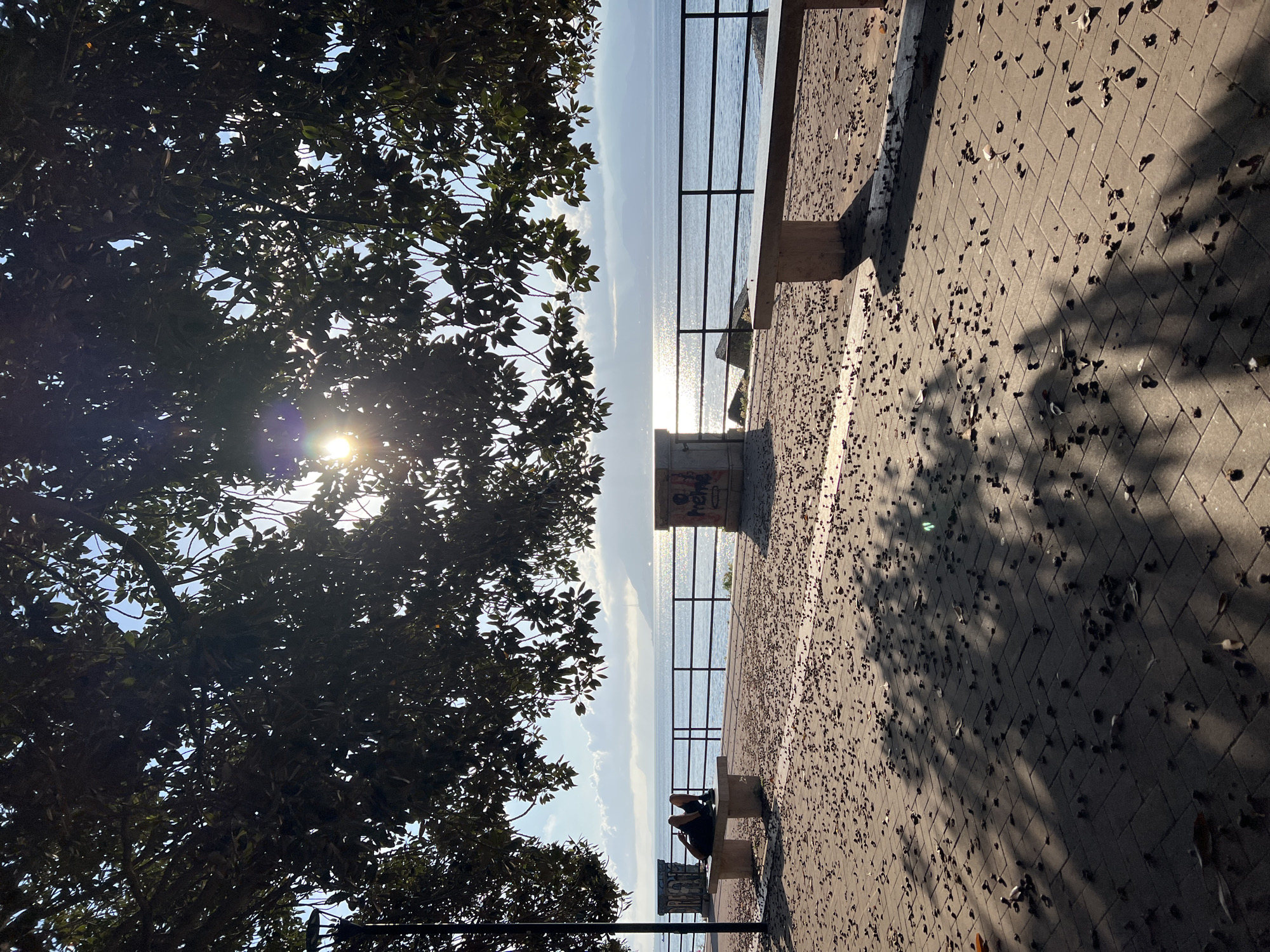
This image captures a sunlit waterfront promenade in Messina, Italy, characterized by strong backlighting from a low sun. A dense canopy of large-leafed trees occupies the upper portion of the frame, through which the sun is visible, creating a distinct sunburst effect. The ground is paved with light-colored rectangular pavers arranged in a herringbone pattern, extensively littered with numerous small, dark, round objects, likely seeds or fruits, and scattered leaves. Long, dappled shadows from the overhead foliage are cast across the pavement, extending towards the viewer. On the left side of the walkway, one individual is lying prone on a rectangular stone bench, with their dark-clad legs bent at the knees. A dark, slender lamp post stands on the far left. A black metal railing with multiple horizontal bars separates the paved area from a calm expanse of water, which reflects the sunlight as a prominent horizontal glare streak. In the middle ground, across the water, hazy mountains or landmasses are visible beneath a partly cloudy sky. Two concrete block structures are positioned along the railing; the one on the right exhibits visible graffiti including the word "Prem." A second stone bench is partially visible on the right side of the frame.
Messina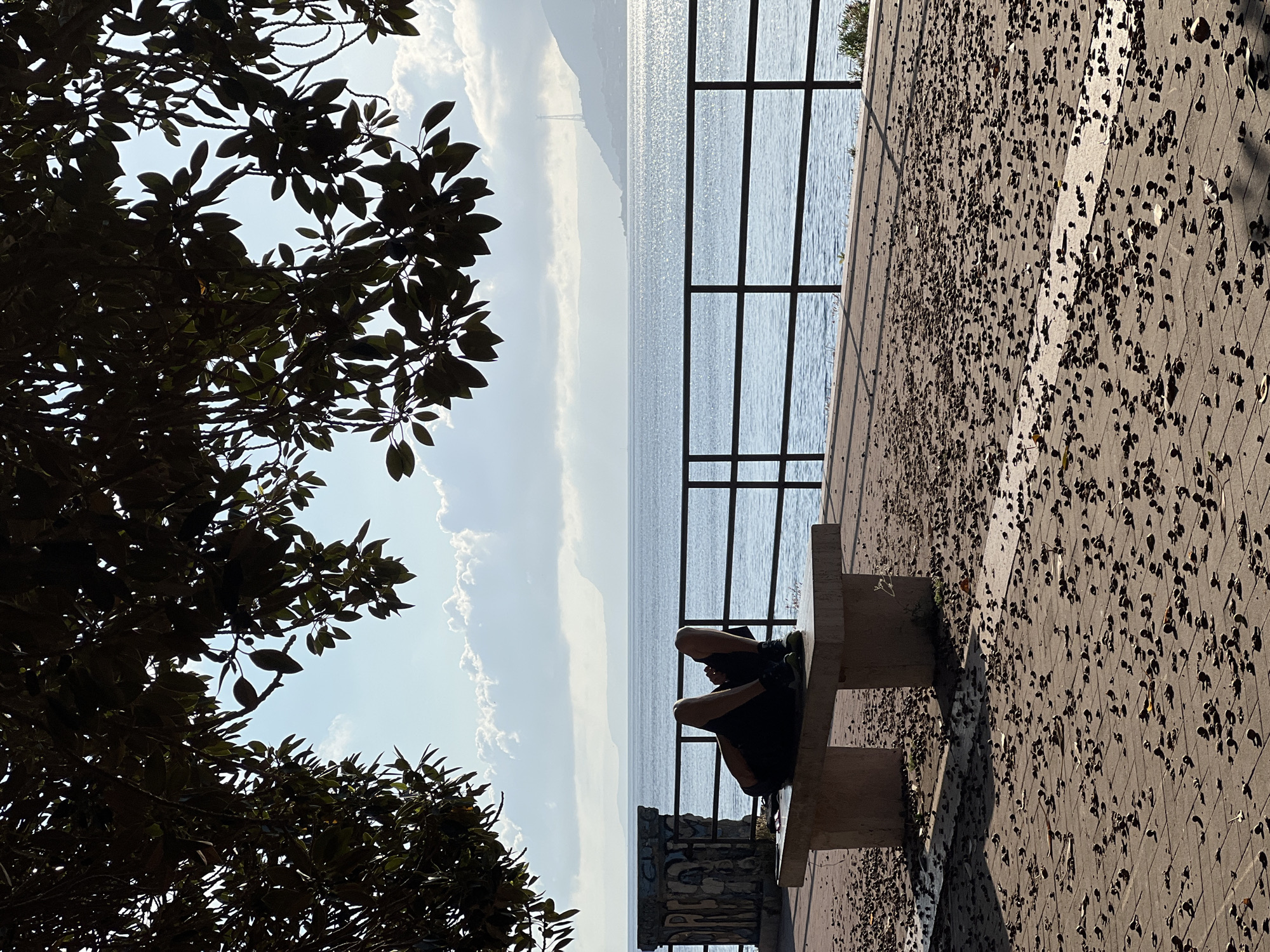
The image depicts a coastal promenade in Messina, Italy, bathed in bright sunlight, likely late afternoon or early morning, given the long shadows and low sun angle over the water. The foreground features a paved walkway composed of rectangular tiles, densely covered with numerous small, dark, possibly dried leaves or seeds. A light-colored stone bench with a rectangular base and top is situated on the left side of the walkway. On the bench, a person is reclining on their back, facing the sea, with their head propped up and legs bent at the knees. They are dressed in dark clothing, including black shorts and a black top, with visible dark shoes featuring light green accents on the soles. A dark metal railing with horizontal bars runs along the edge of the promenade, separating it from the sea. Beyond the railing, the sea appears calm with sparkling reflections of sunlight on its surface, indicating a light source behind the viewer. In the mid-distance, a hazy coastline with gently sloping hills or mountains is visible. On a prominent peak to the right, a tall, slender antenna or transmission tower stands out against the sky. The sky above is partly cloudy, with scattered white and grey clouds. Overhead, and framing the top portion of the image, is the dense, dark silhouette of a tree's canopy, heavily laden with large, ovate leaves, suggesting a broadleaf evergreen species. The tree's foliage creates a natural dark border, contrasting with the bright sky and sea.
Messina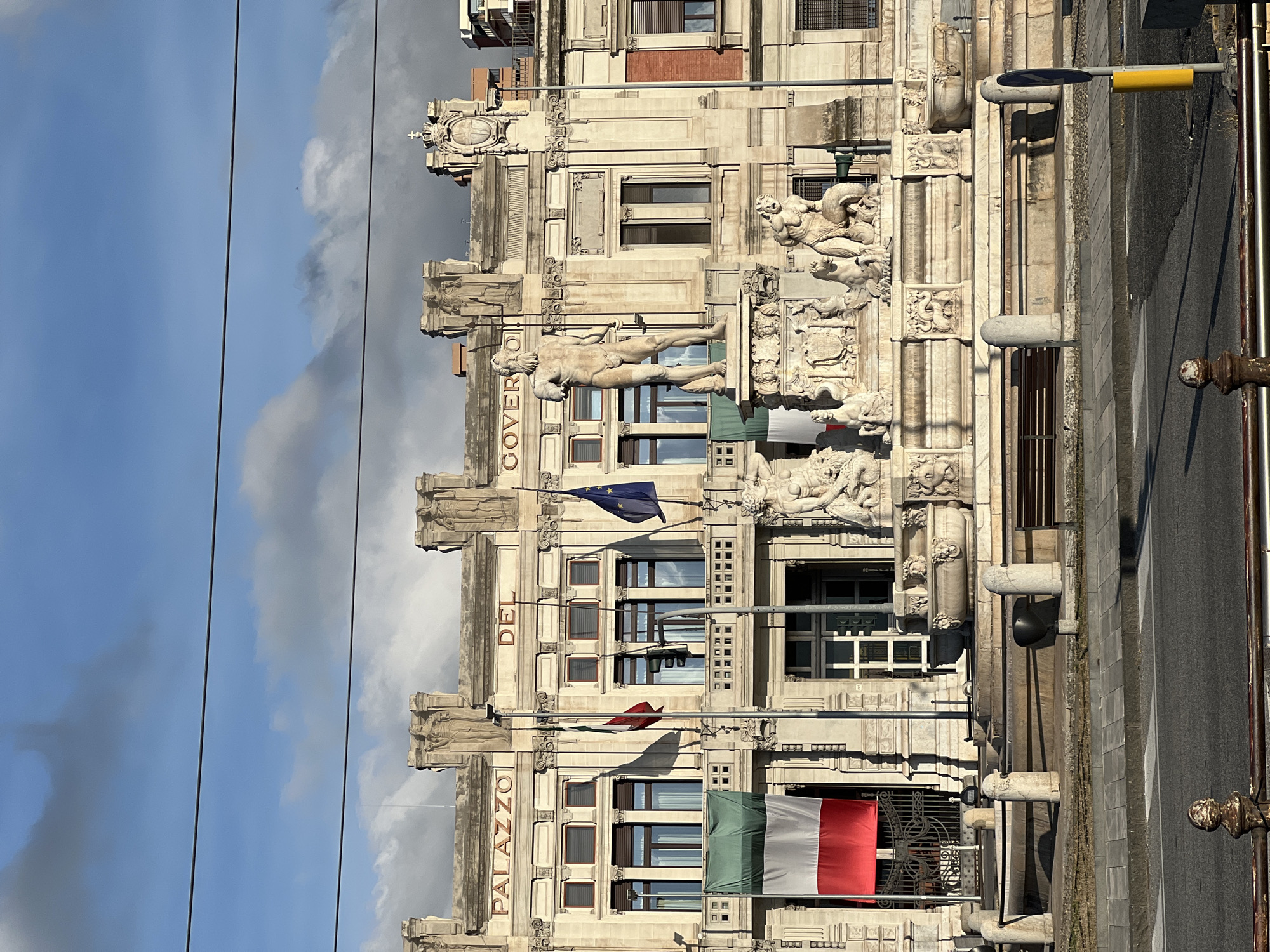
The image presents an urban scene dominated by the Palazzo del Governo and the Fountain of Neptune in Messina, Italy. The Palazzo del Governo is a multi-story, light-colored stone building with neoclassical-style architecture, featuring "PALAZZO DEL GOVERNO" inscribed in raised letters above its upper windows. The building's facade is adorned with decorative elements including pilasters, balconies, and sculpted figures, with a prominent crest visible on the upper right side. Three flags are displayed: two Italian flags (green, white, and red vertical stripes) – one flying from a pole on the left and another draped vertically from a balcony on the far left – and a European Union flag (blue with twelve yellow stars) flying from a pole on the right. A traffic light fixture is visible between the two flagpoles. In front of the building stands the elaborate Fountain of Neptune, constructed from light-colored stone. A large, nude male statue, holding a trident-like staff, dominates the center of the fountain, atop a multi-tiered base. The base features numerous sculpted figures, including mythological sea creatures, lions, and other decorative carvings, with water basins incorporated into its design. The foreground shows a paved street with a white-striped pedestrian crosswalk. A wide sidewalk separates the street from the fountain, featuring stone bollards, a brown bench, and a low metal barrier. Sunlight illuminates the scene from the right, casting distinct shadows across the fountain and street. The sky above is partly cloudy, with areas of clear blue visible between large, grey cumulus clouds. No living individuals are present in the immediate vicinity of the main subjects.
Messina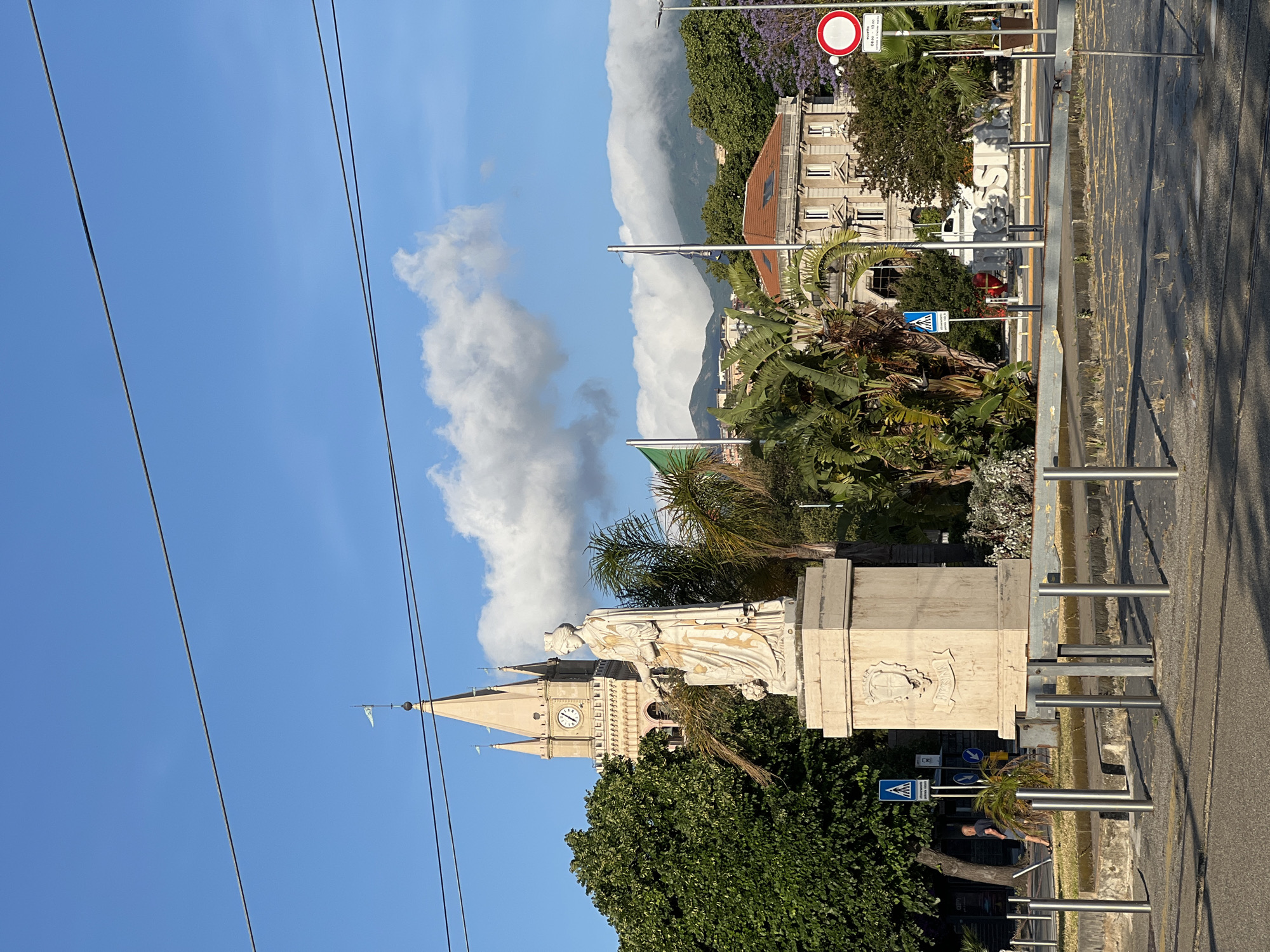
This detailed image depicts a sunlit urban square or piazza in Messina, Italy, confirmed by large white block letters spelling "Messina" in the midground. In the foreground, a paved area, possibly a former tram line or parking, features faint yellow markings and two rows of silver-colored metal bollards. Behind these, a light-colored stone pedestal supports a monumental statue. The statue portrays a regal female figure, likely a queen or empress, wearing a crown and flowing garments. She holds a small object in her left hand and extends her right hand. The pedestal's front face displays a carved escutcheon with an emblem above a banner. To the left of the statue, a large, dense green tree stands. Further left, a person in dark clothing walks on a path near a blue pedestrian crossing sign. Various other signs are visible, including a red circular sign with a white horizontal bar, signifying "No Entry" or "Stop," accompanied by a smaller white sign with black text indicating "08:00 - 13:00". The midground is rich with diverse vegetation, including tropical palm-like plants, lush green bushes, and trees with purple blossoms, indicative of Jacaranda. Two flagpoles are visible; one proudly displays a green flag, while the other holds a dark, indistinct flag. In the background, a distinctive light-colored clock tower with multiple spires and architectural detailing rises prominently. Its clock face indicates approximately 10:15 or 10:20. To the right of the tower, an elegant, multi-story building with a terracotta tiled roof is partially visible amidst the foliage. Beyond the buildings, a range of green, tree-covered mountains stretches across the horizon, partially shrouded by a thick band of white clouds that appear to rest upon their peaks. The sky is a clear, vibrant blue with scattered white, fluffy clouds. Multiple dark electrical or utility lines traverse the upper portion of the frame. The overall scene is brightly illuminated, casting distinct shadows and highlighting the architectural and natural elements.
Messina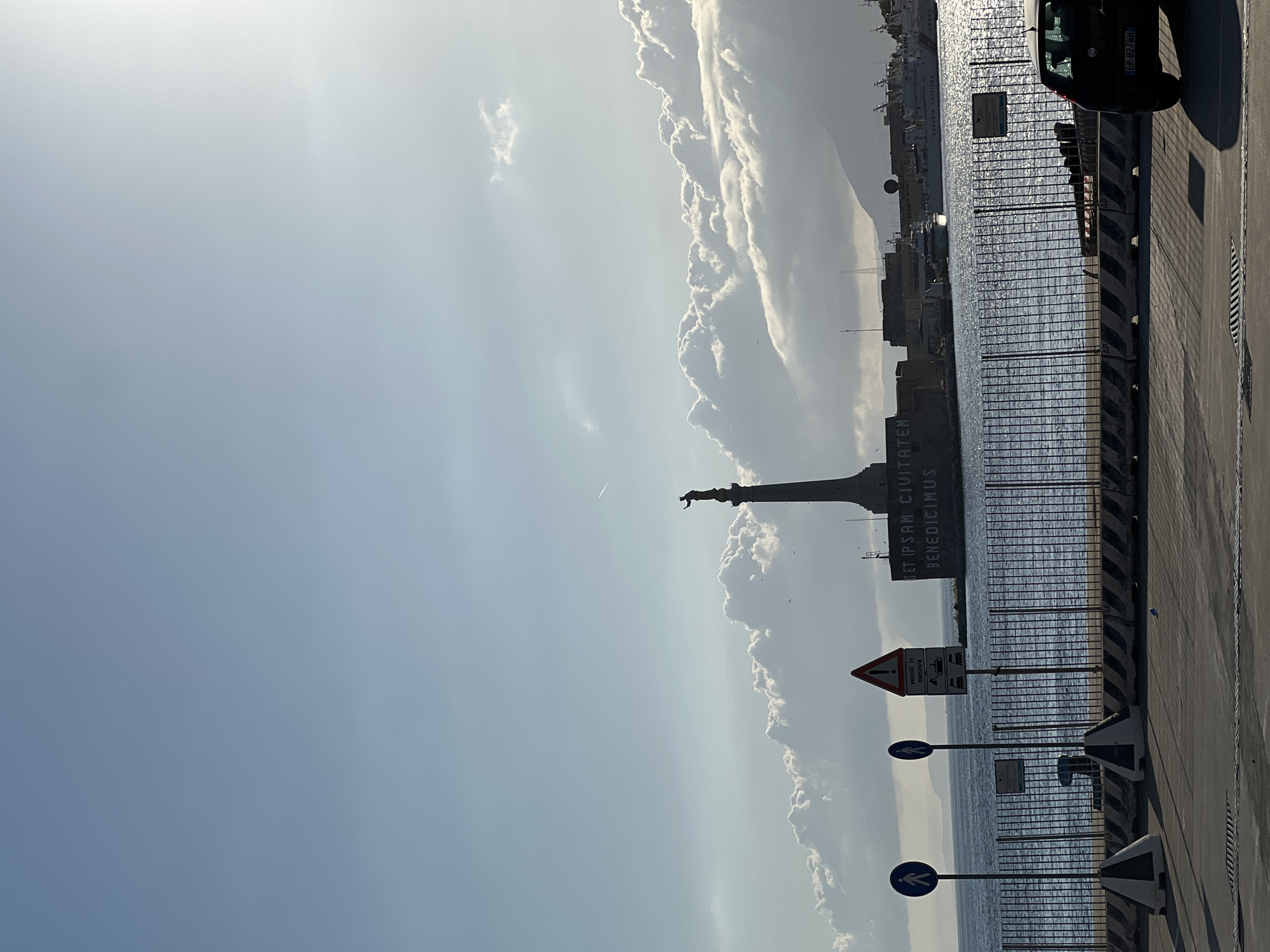
The image depicts a sunlit view of the Strait of Messina in Messina, Italy, focusing on the waterfront and the Column of the Madonna della Lettera. The upper portion of the frame is dominated by a bright blue sky with scattered, fluffy white cumulus clouds, particularly dense along the horizon line. A faint contrail from an aircraft is visible in the upper right. Sunlight intensely reflects off the water surface, creating a shimmering effect. In the midground, the Column of the Madonna della Lettera stands prominently. It is a tall, light-colored column topped with a golden statue of the Madonna, facing towards the strait with arms outstretched. The hexagonal base of the column bears the Latin inscription "ET IPSAM CIVITATEM BENEDICIMUS" (and we bless the city itself). To the right of the column, various harbor structures and a distant mountainous coastline are visible. Several ships are present in the water, including a white vessel identified as "GUARDIA COSTIERA" with "CP 923" on its hull. Small dark specks, likely birds, are scattered in the sky and above the water. In the foreground, a paved surface, likely a pier or road, is visible. It is bordered by a series of black and white striped concrete barriers and a dark metal fence separating it from the water. Three signs are mounted on poles: two blue circular pedestrian signs and one red triangular warning sign. The warning sign has a white rectangular plaque beneath it reading "veicoli in manovra" (vehicles maneuvering) with corresponding pictograms of a car, truck, and other vehicles. A dark bollard is visible near the fence. A partially visible black car, possibly a Fiat Punto, is parked on the right side of the paved area, displaying the license plate "EP 827WH". A small blue object, possibly a discarded bottle, rests on the pavement near the fence.
Messina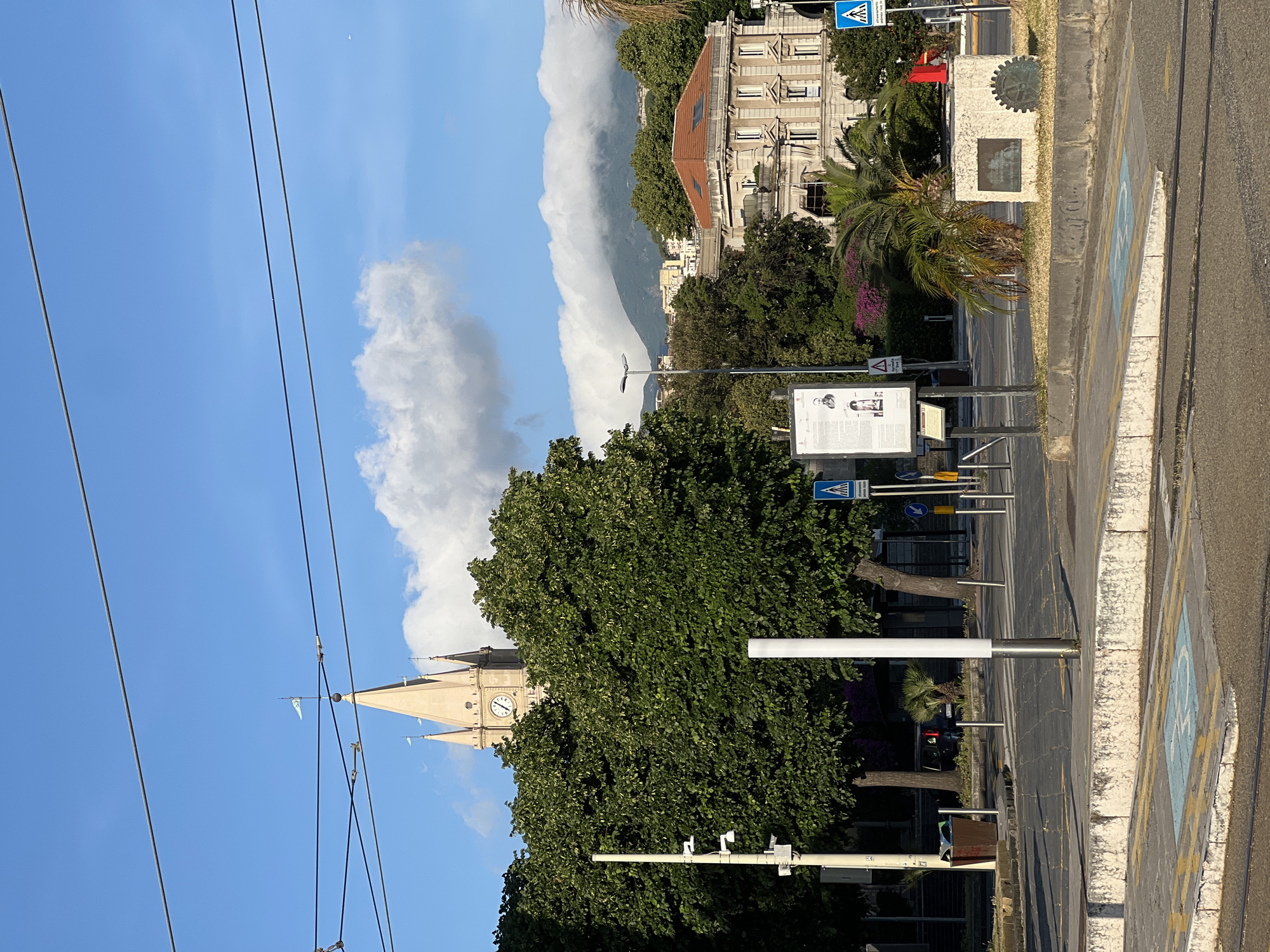
This detailed description pertains to an outdoor urban scene captured in Piazza Cairoli, Messina, Italy. The image is composed under clear daylight with a bright blue sky containing scattered white cumulus clouds. Multiple dark electrical or trolley lines stretch horizontally and diagonally across the upper portion of the frame. In the immediate foreground, a dark asphalt road with embedded tram tracks runs horizontally. This road borders a raised concrete median, part of which is painted with a blue square containing a white wheelchair accessibility symbol and yellow striped markings. The concrete median itself shows signs of weathering. Moving towards the midground, a tall, white pole on the left is equipped with several surveillance cameras or sensors. Dense green deciduous trees, with full foliage, occupy a significant portion of the midground, partially obscuring the background elements. Another white pole stands to the right of the road, further back. A central grassy island in the midground features a freestanding information panel displaying two portraits (one male, one female) and Italian text. Adjacent to this panel is a small palm tree. To its right stands a stone monument with a bronze plaque and a distinctive bronze gear wheel attached to its side, identified as the Monumento ai Caduti del Lavoro. Behind this monument, a red object, possibly a fire hydrant, is visible. Standard Italian street signs, including a blue pedestrian crossing sign and a blue directional arrow, are also present. In the background, visible above the trees, is a prominent light-colored clock tower (Torre del Municipio / Town Hall Tower of Palazzo Zanca) with a tall, pointed central spire and several smaller corner spires, each topped with a small white flag or pennant. The clock face clearly shows the time as approximately 10:10. To the right of the clock tower, partially obscured by foliage, a large, multi-story building with classical architectural features, a terracotta tiled roof, and numerous windows is visible. The distant background reveals green mountains, their upper portions obscured by a thick band of white clouds. Scattered buildings are visible on the lower slopes of these mountains. No people or animals are present in the depicted scene.
Messina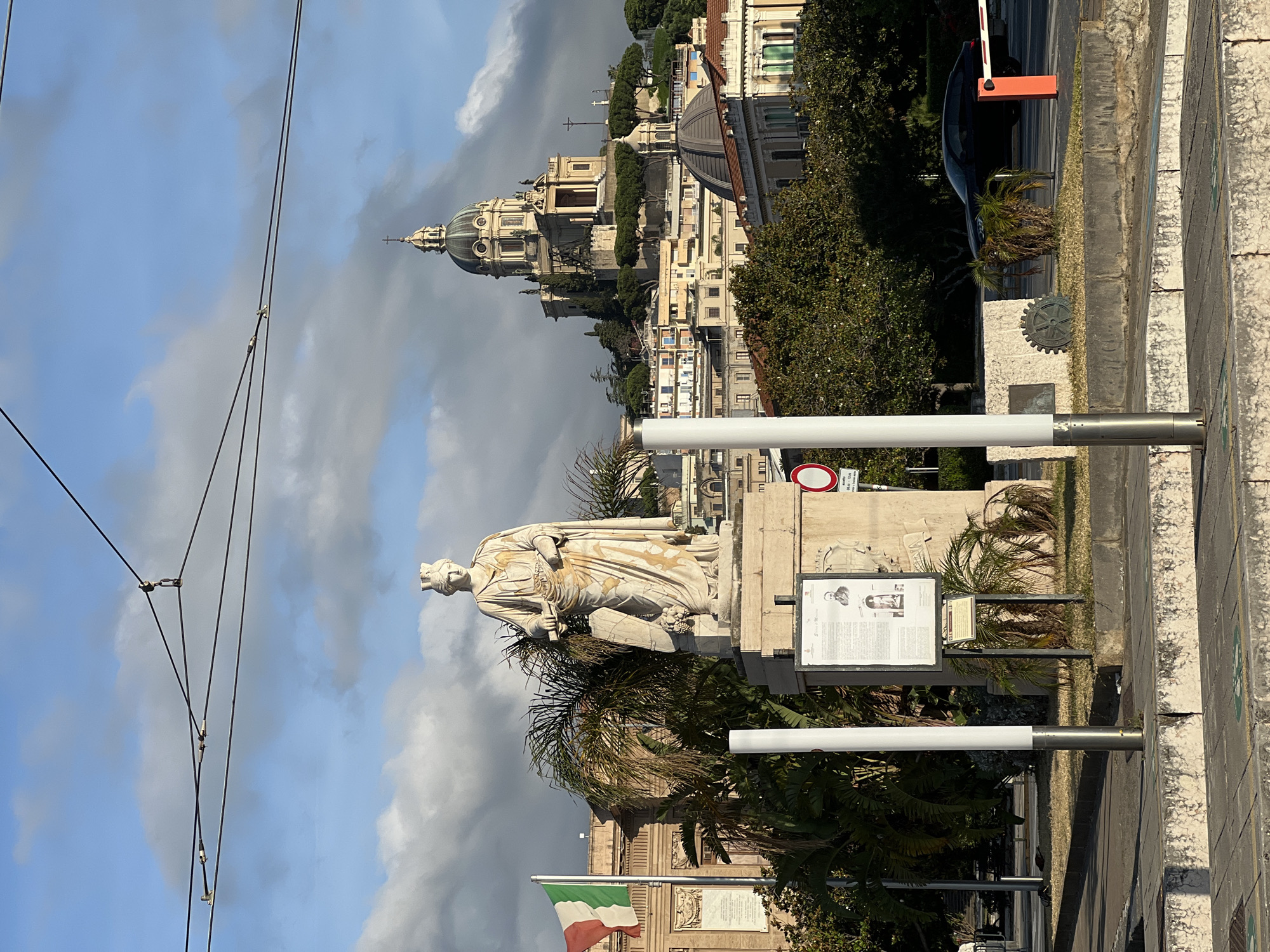
This image depicts an urban landscape in Messina, Italy, under a partly cloudy blue sky. In the midground, a prominent white marble statue of a crowned female figure stands on a multi-tiered stone pedestal. The figure is draped in classical robes, holding what appears to be a scroll or book in her left arm and possibly a branch or staff in her right hand, with a winged element or eagle at her lower left side. The statue exhibits significant vertical yellow-brown staining. To the left of the statue, an Italian flag, horizontally striped green, white, and red, flies from a flagpole. Behind the flag, a light-colored building with classical architectural elements is partially visible, set amidst lush palm trees and other green foliage. Further in the background, crowning a distant hill, is the distinct Tempio Votivo di Cristo Re (Temple of Christ the King), a large, light-colored domed church with a prominent dark-colored dome topped by a lantern and a cross. The church is surrounded by trees and a densely built urban environment cascading down the hillside. In the immediate foreground, a paved street or square features several white, cylindrical poles, some with stainless steel bases. To the right, a red and white striped traffic barrier arm is partially visible. A small landscaped area in the foreground contains sparse grass, small palm plants, and a dark circular relief sculpture resembling a gear wheel. Adjacent to the statue's pedestal, two dark-framed information boards on posts display text and monochrome images of historical figures. Overhead, several black tram or trolley power lines crisscross the upper portion of the sky. No people are visible in the scene.
Messina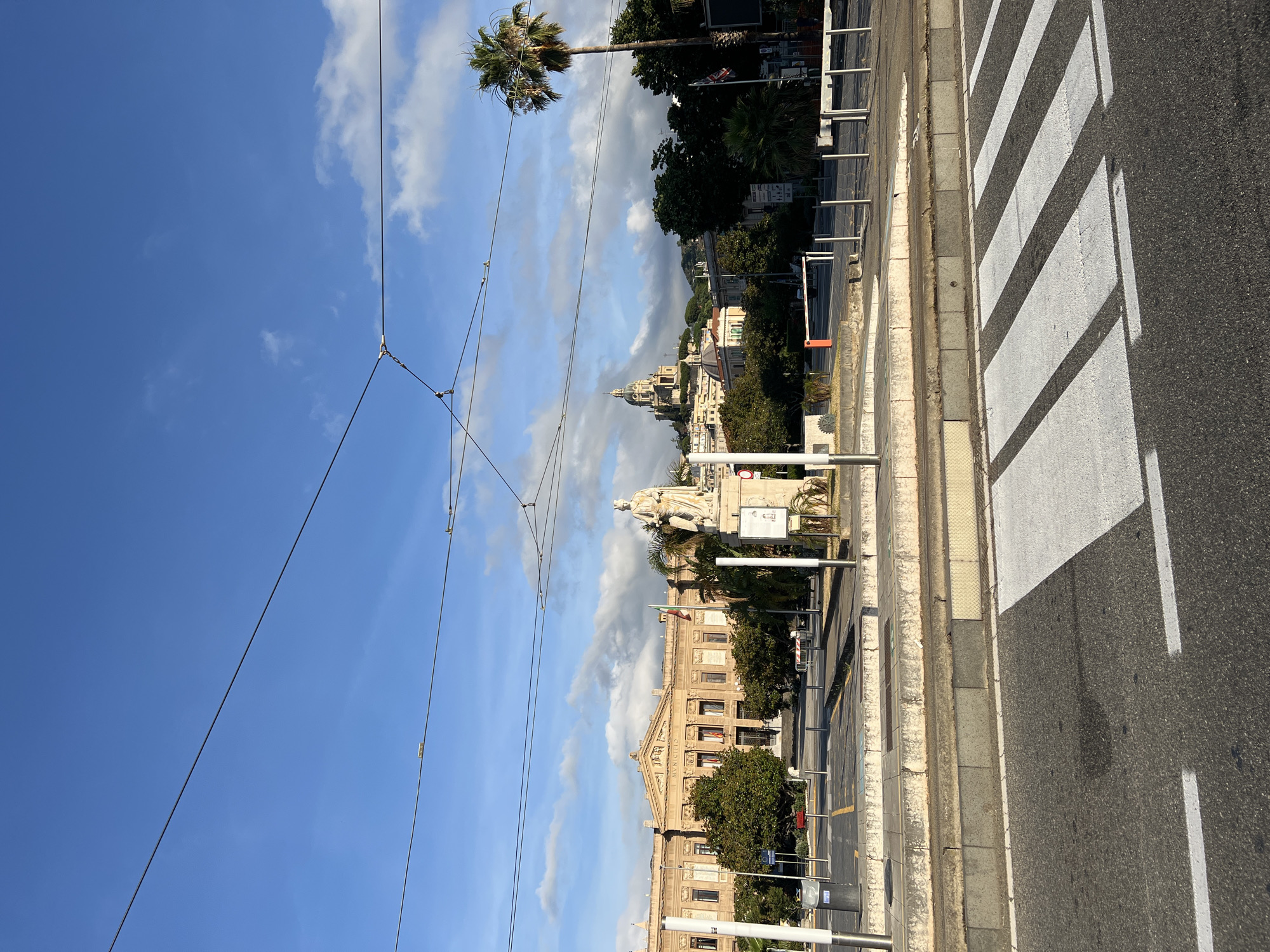
The image displays an urban landscape in Messina, Italy, captured during daytime under a partially cloudy blue sky. The perspective is from street level, looking across a multi-lane asphalt road towards a prominent building, a public square, and a hillside topped by a church. In the immediate foreground, a dark asphalt road features a solid white line at the bottom and a broad pedestrian crosswalk (zebra crossing) with five parallel white stripes, partially visible on the right side. This road is bordered by a raised concrete curb, separating it from a public median strip or square. The median strip contains a dark grey municipal trash receptacle on the left, several light-colored bollards, and patches of low-lying vegetation. Faint yellow ground markings are visible on the pavement. Dominating the midground is a large, light-tan classical-style building with a central facade featuring a portico with columns and a pediment. The word "MUNICIPIO" is clearly visible above the main entrance, identifying it as the City Hall of Messina. Italian flags are displayed from some of its windows. In front of the Municipio, slightly to the right of center, stands a white marble statue on a pedestal, depicting a robed figure, likely female, wearing a crown or headdress and holding an object. Various green trees and shrubs are planted around the statue and in front of the Municipio building. In the background, a large hill rises, crowned by a distinctive domed church or basilica with multiple towers, likely the Santuario della Madonna di Montalto, which overlooks the city. Smaller buildings are visible on the slopes of the hill below the church. To the far right, a tall, slender palm tree stands, its fronds reaching towards the upper right corner of the frame. An orange and white striped boom barrier is visible on the right side of the median, along with additional bollards and a flag, possibly the Italian flag, on a pole. Multiple dark, thin overhead wires, characteristic of tram or trolleybus infrastructure, crisscross the upper portion of the sky. No individuals are visible in the scene.
Messina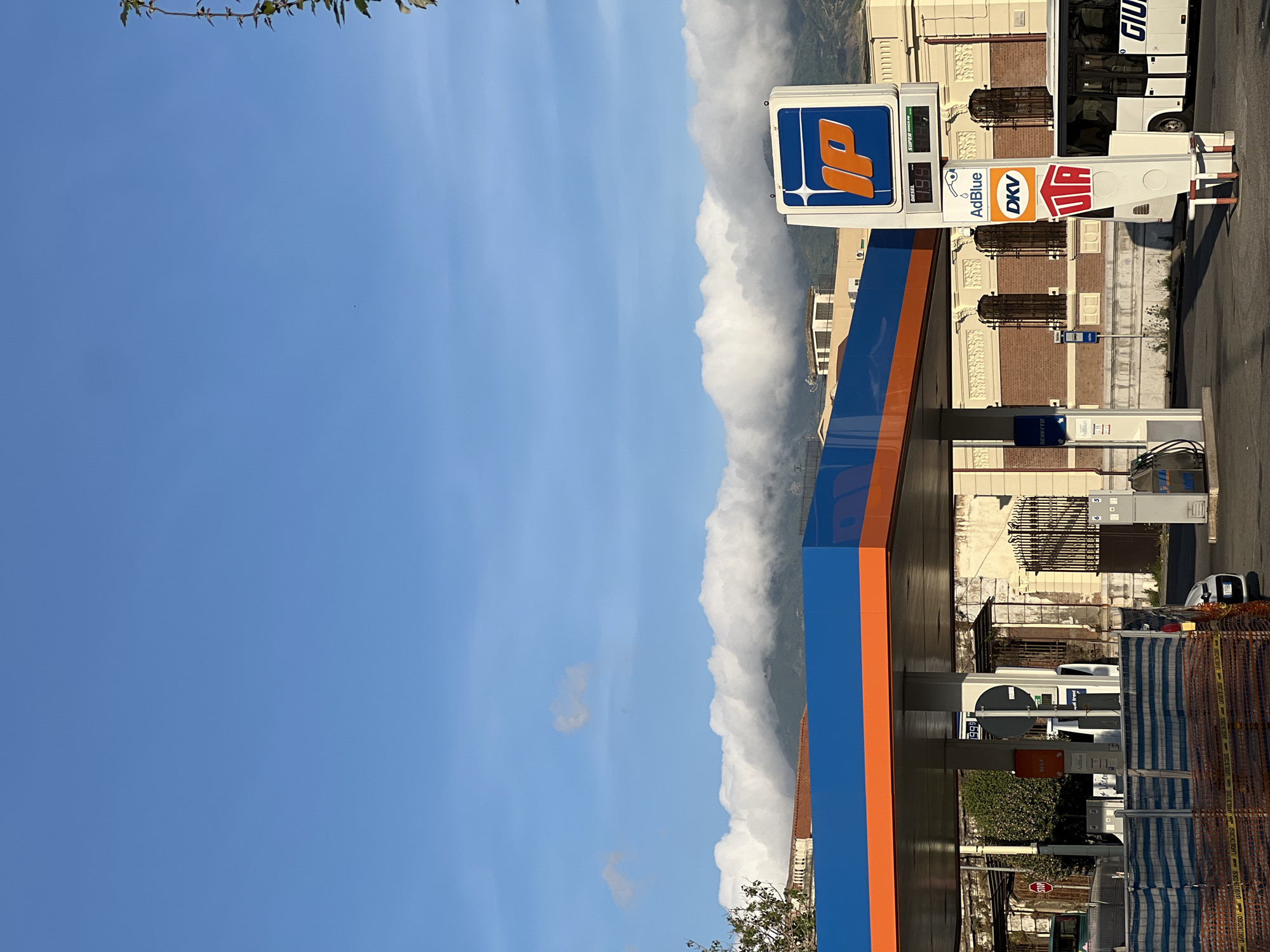
This image depicts an IP gas station located in an urban area of Messina, Italy, bathed in clear daylight. The foreground features a gas station with a distinctive blue and orange canopy supported by grey pillars, covering multiple fuel pumps. To the right of the canopy stands a tall white totem sign displaying the IP logo at its apex. Below the logo are digital readouts indicating "DIESEL 1.999" and "SUPER SENZA PIOMBO" with an accompanying price, followed by logos for AdBlue, DKV, and UTA. Behind the gas station, a prominent, multi-story brick building with classic Italian architectural elements, including arched windows with ornate iron grilles and decorative cornices, forms the immediate background. To the right of this building, a white bus is partially visible, displaying the letters "GIU" on its side. In the lower-left foreground, a white car is partially obscured by orange safety netting and barriers. The backdrop consists of a sizable mountain range, its lower sections enveloped by a horizontal band of dense, white stratocumulus clouds. Above this cloud layer, the sky is a vibrant, clear blue with a few scattered, wispy white clouds. Green foliage is visible along the left and right edges of the frame. The scene is devoid of people.
Messina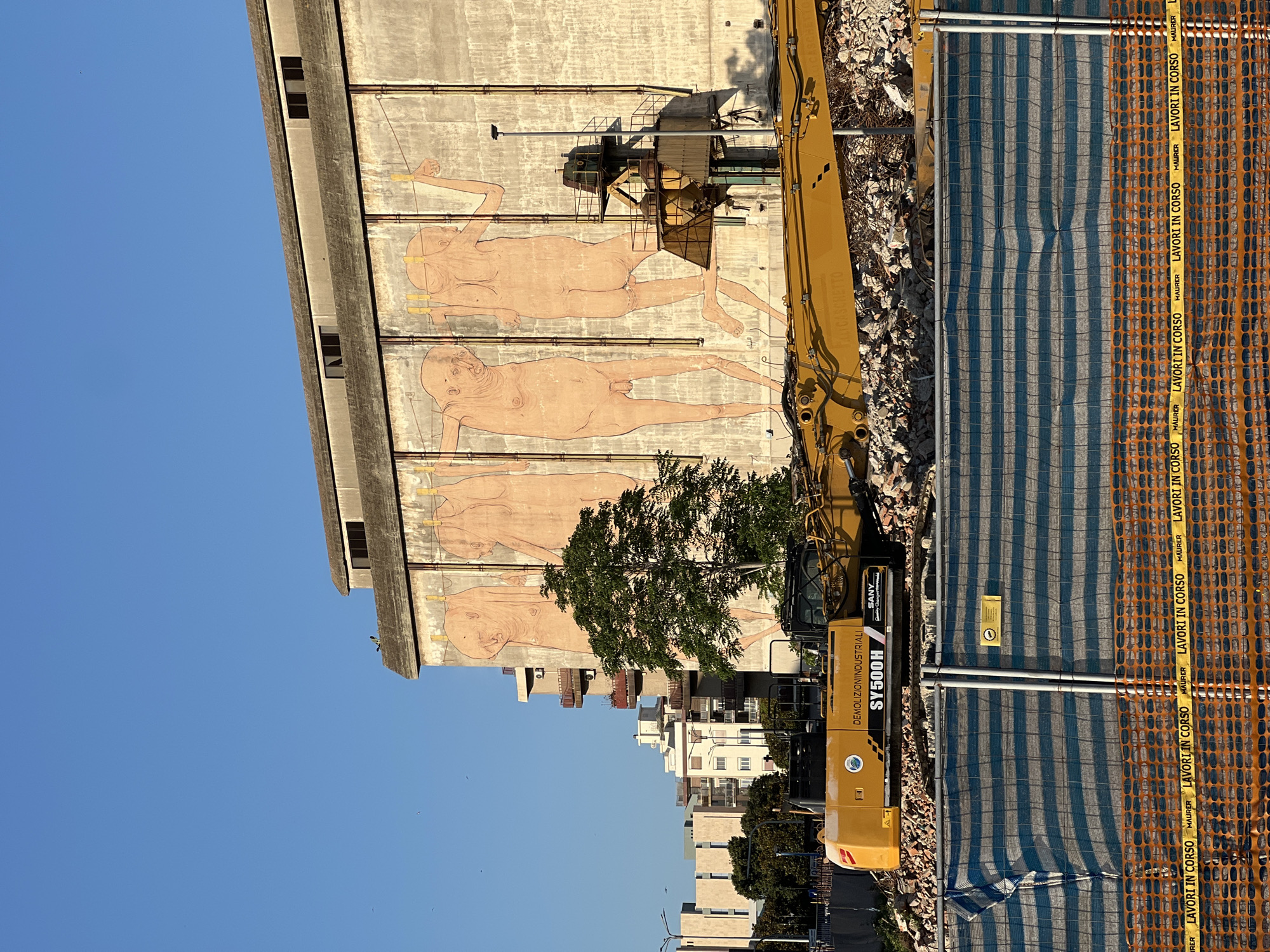
This image captures an urban landscape in Messina, Italy, under clear blue skies. The scene depicts a construction or demolition site in the foreground against the backdrop of a large building adorned with a mural, with additional residential structures visible in the distance. In the immediate foreground, a two-tiered safety barrier is present. The lower section consists of an orange plastic mesh fence with yellow warning tape running horizontally, bearing the repeated text "LAVORI IN CORSO" (Work in Progress) and "MAURER". Above this, a fence with blue and white horizontal stripes is visible. Behind these fences, a substantial pile of demolition rubble, composed of broken concrete and other debris, covers the ground. A large yellow SANY SY500H excavator is positioned on top of this rubble. The side of the excavator boom displays "DEMOLIZIONI INDUSTRIALI" (Industrial Demolitions) and "Quality Changes the World." Its track and part of the main body are visible, with the excavator arm extending towards the right. Mid-ground, a dense green tree partially obstructs the view of a large concrete building behind it. To the right of the tree, an industrial-looking structure, possibly an old processing plant, stands with multiple platforms, chutes, and support beams. Dominating the background and central to the image is a massive, multi-story concrete building, likely a former industrial structure or silo. Its facade is adorned with a large-scale mural depicting five stylized, nude figures with pale skin. These figures appear to be hanging from a horizontal line by large yellow clothespins attached to their skin, with expressions that convey distress or somberness. The figures are rendered with visible anatomical details. The building itself shows visible concrete textures, horizontal ledges, and small rectangular windows near its top. To the left of the mural building, a cluster of multi-story residential buildings with balconies and varied architectural styles can be seen. The sky above is a uniform, clear blue, with minimal atmospheric haze and no visible clouds, suggesting a sunny day. The lighting creates distinct shadows, particularly from the industrial structure and the fence posts. No people are visible in the scene.
Messina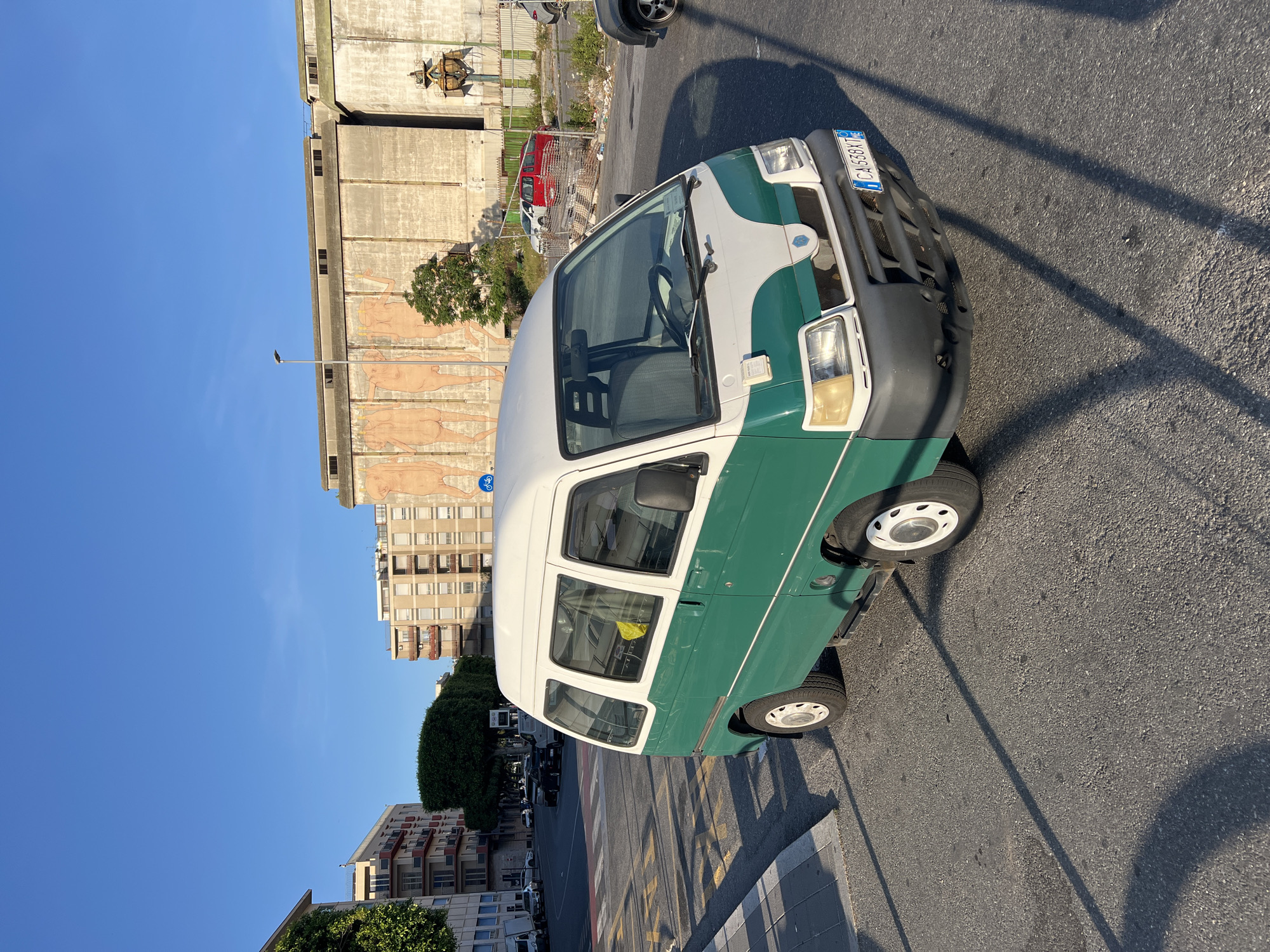
The image depicts a street scene in Messina, Italy, under a clear blue sky, with long shadows suggesting either early morning or late afternoon lighting conditions. In the foreground, a compact, two-tone utility van is parked on an asphalt road. The van is painted dark green on its lower body and white on its upper body and roof. It features a black front bumper with an integrated lower grille guard. The Italian license plate on the front of the vehicle reads "CA 538XT". A light blue, circular emblem, consistent with a Piaggio logo, is visible on the front grille. The interior of the van appears unoccupied, with a grey fabric seat visible through the windshield. To the left of the van, the asphalt road displays white-painted pedestrian crossing stripes (zebra crossing) and yellow hatched markings. Several multi-story residential buildings, characterized by balconies, line the street further down, partially obscured by green trees. Other vehicles are visible in the distance. The background is dominated by a large, multi-section concrete structure identified as the Silos Granai della Darsena (Grain Silos of the Darsena) in Messina. The extensive concrete walls of this industrial building are adorned with large-scale murals depicting stylized, anthropomorphic figures in earthy tones. To the right of the silos, an old, complex metallic industrial apparatus, consistent with a former loading or processing system, is present. An unkempt, fenced-off area containing overgrown vegetation and several parked vehicles, including a red car, is visible adjacent to the silos. A single street light pole stands between the van and the background structures. No human figures are clearly visible in the immediate vicinity of the van or the street.
Messina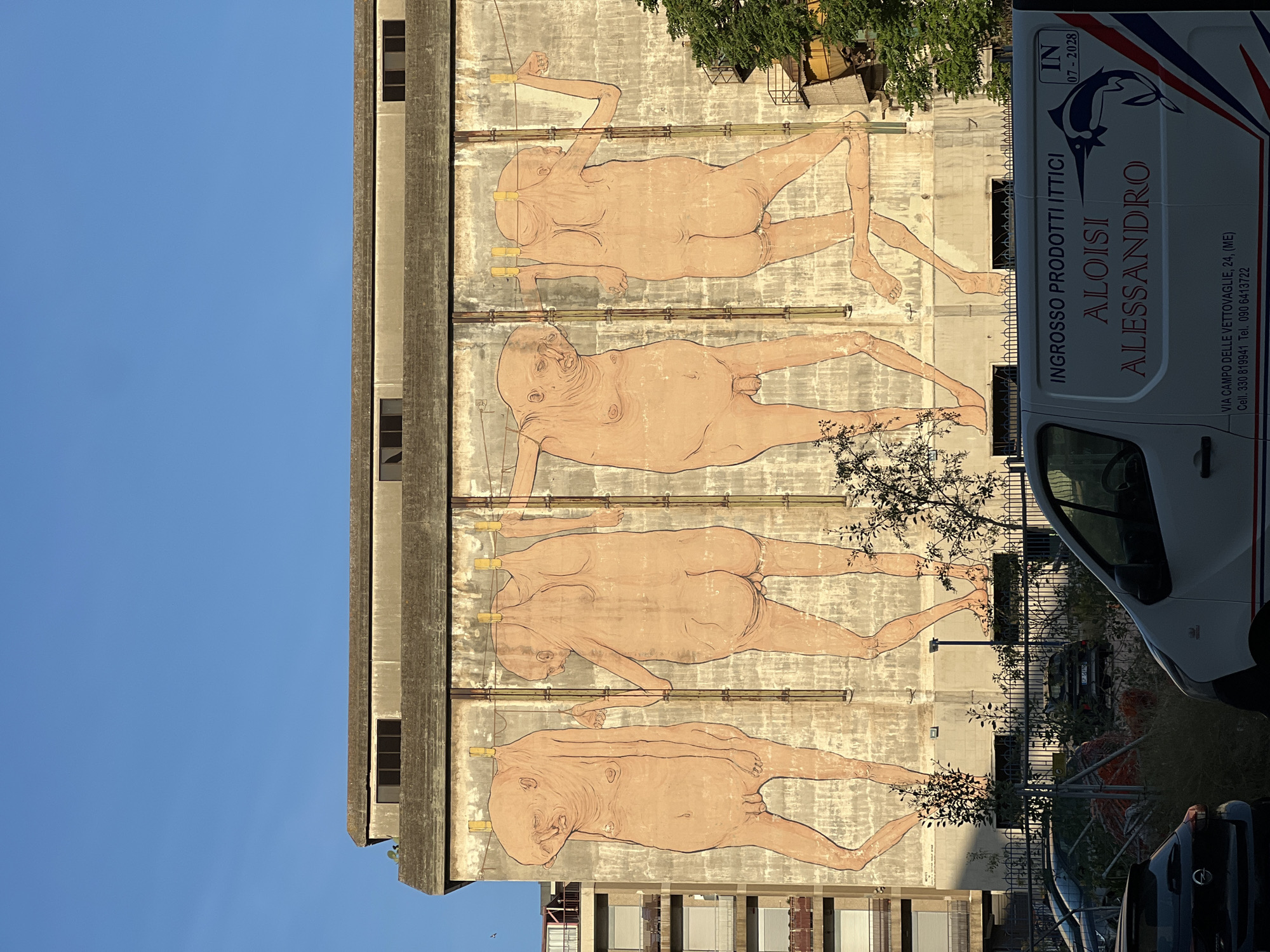
The image depicts a large, rectangular concrete building featuring a monumental mural on its facade, located at or near Via Campo delle Vettovaglie, 24, Messina, Italy. The building has a flat roof with visible upper structures and small, dark rectangular windows arranged horizontally on its upper section. The mural covers the majority of the building's facade, portraying four stylized, nude human figures rendered in a pale, flesh-toned palette with dark outlines. These figures exhibit features such as sagging skin, prominent bellies, and visible male genitalia. They are depicted interacting with a system of vertical metal beams and horizontal lines, from which they appear to be suspended or attached by large, yellow clothespins. From left to right: 1. The first figure stands facing forward, head slightly bowed, with its left arm raised and right arm lowered, its right hand seemingly grasping the left hand of the second figure. 2. The second figure is depicted with its back mostly to the viewer, looking over its right shoulder, with its left arm extended towards the first figure and its right arm hanging. It is attached to a vertical beam and horizontal line by yellow clothespins. 3. The third figure also faces away from the viewer, looking over its left shoulder, with both arms extended outwards. It is attached by yellow clothespins to a vertical beam and a horizontal line. Its legs are bent as if in motion. 4. The fourth figure, on the far right, also faces away, looking over its right shoulder, with its right arm raised and left arm lowered. It is attached by yellow clothespins to a vertical beam and a horizontal line, with one leg bent forward and the other extended backward. The lower portion of the image is occupied by urban elements. In the foreground, a white commercial van is partially visible on the right, displaying text that reads "INGROSSO PRODOTTI ITTICI" (Wholesale Fish Products), "ALOISI ALESSANDRO," an address "VIA CAMPO DELLE VETTOVAGLIE, 24, (ME)," and phone numbers "Cell. 330 819941 Tel. 090 6413722." It also has "IN 07 - 2028" along with a marlin logo. Behind the van and a metal fence, other vehicles are parked. Sparse trees and bushes are present in the foreground and mid-ground. To the left, a multi-story apartment building with balconies is visible. The sky is clear and blue. Sunlight illuminates the scene from the left, casting shadows.
Messina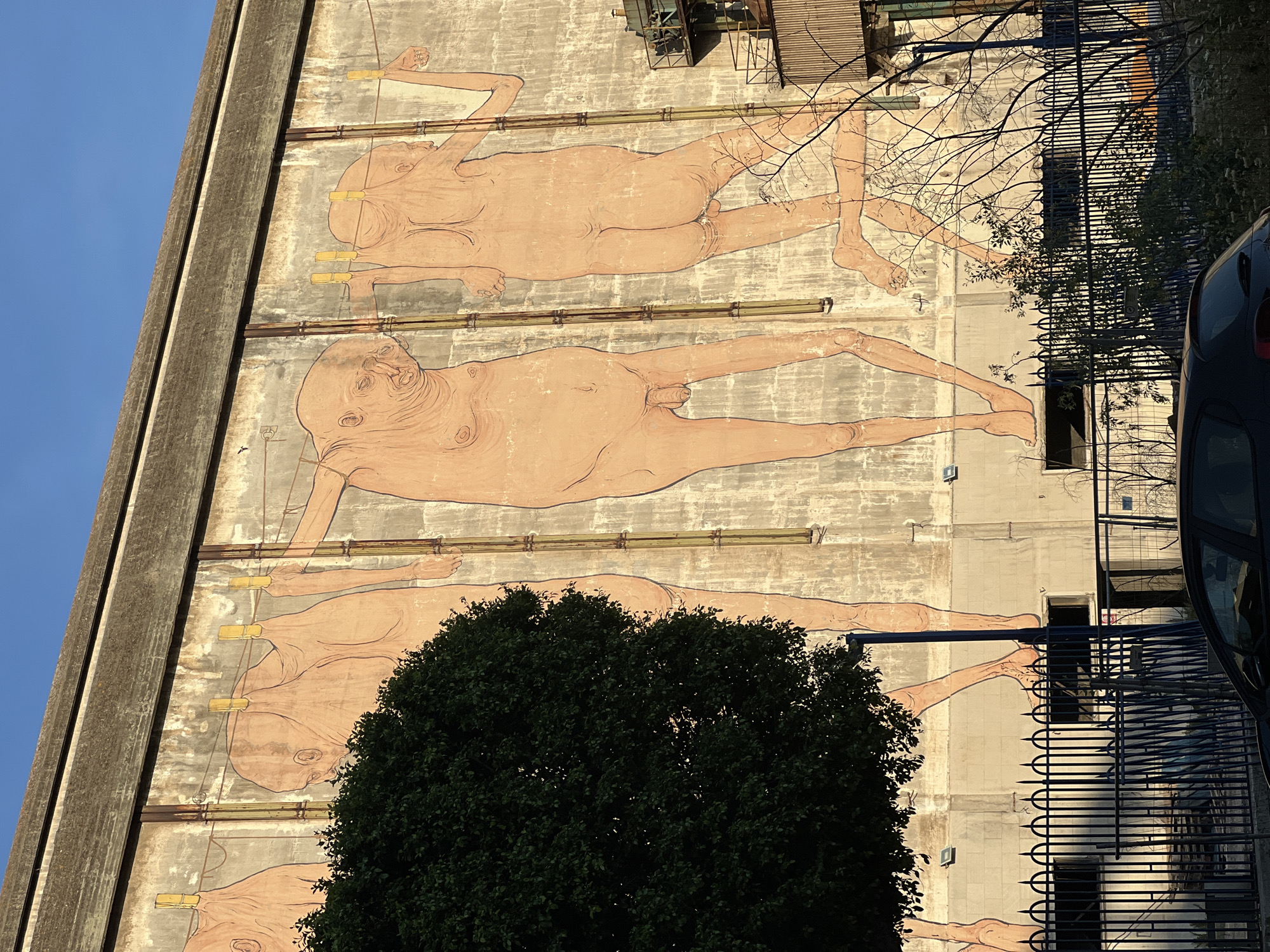
This image captures a large-scale mural painted on the side of a tall, concrete building in Messina, Italy, under a clear blue sky. The mural depicts several nude, pale-skinned human figures in various reclining or stretched poses, oriented horizontally across the vertical wall. The style of the figures appears somewhat stylized and exaggerated, with visible musculature and distinct facial features. The figures are arranged in rows, with some appearing to be partially obscured by yellow horizontal elements that run across the wall, possibly representing pipes or structural supports. One prominent figure in the middle of the image is shown with an erect penis, and another figure above it shows part of their buttocks. To the left, a dark green tree partially covers the lower section of the mural, and a dark car is visible on the right side of the image, partially obscured by a black metal fence with pointed tops. In the upper right corner, industrial-looking structures are visible on the building's rooftop, and tree branches with sparse leaves extend into the frame from the right. The lighting suggests it is daytime, possibly morning or late afternoon, given the shadows and the angle of the sunlight on the building's texture and the mural. The building itself shows signs of age and wear. No visible text is present in the mural or on the building.
Messina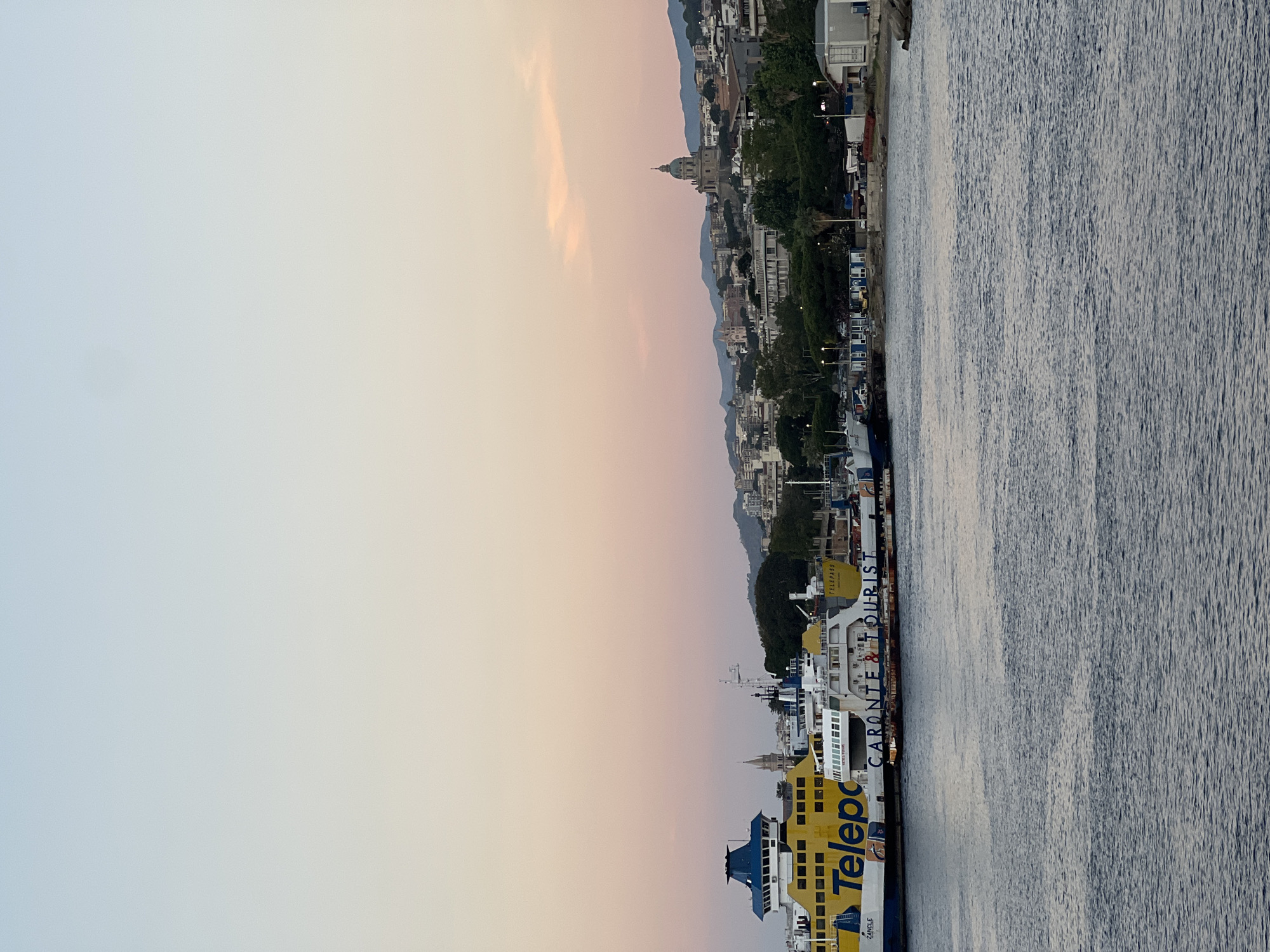
The image captures a panoramic view of the harbor and cityscape of Messina, Italy, at dusk. The sky exhibits a gradient from light blue at the top, transitioning to soft peach and pink tones towards the horizon. The foreground consists of dark, subtly rippled water of the harbor. On the left side of the frame, two large ferries are docked. The most prominent is a yellow and blue ferry, featuring "Telepass" written in large blue letters on its side and "ZANCLE" near its bow. This vessel has a distinct blue upper deck and bridge structure. Adjacent and partially obscured is a white ferry with "CARONTE & TOURIST" clearly visible on its side. Other smaller vessels are docked nearby. The mid-ground reveals a densely built-up urban area extending from the waterfront up a series of hills. A dominant feature is a large, light-colored church or sanctuary topped with a prominent green dome, situated on a central elevated position. Further to the left, a tall, slender church spire can be seen rising above the buildings. The cityscape comprises various residential and commercial structures of different heights and architectural styles, interspersed with numerous dark green trees and patches of vegetation. In the background, dark blue silhouettes of distant mountains rise against the horizon. The immediate shoreline on the right side of the image consists of a rocky or concrete edge, featuring several small, light-colored modular buildings or containers. No human figures are discernible within the scene.
Messina