Munyati, Zimbabwe
30 memories from Munyati, Zimbabwe
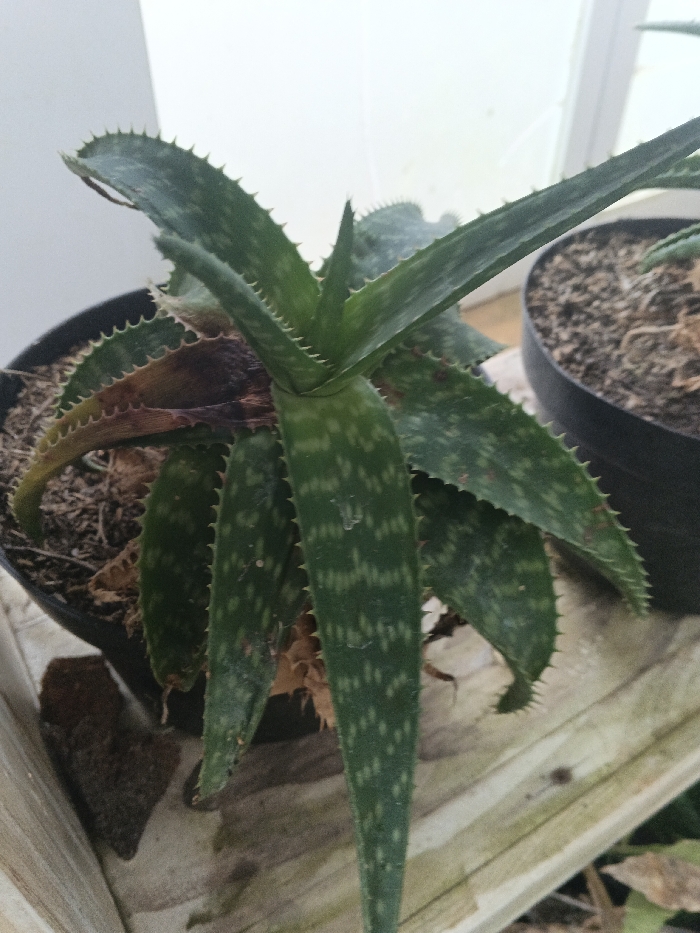
The image depicts a close-up, high-angle view of a potted succulent plant, likely an Aloe species, situated in what appears to be an indoor or sheltered outdoor environment in Munyati, Zimbabwe. The primary subject is a plant with multiple green, fleshy leaves featuring distinctive light green or white spots arranged in horizontal bands. The leaf edges are serrated with small, sharp teeth. Several lower leaves show signs of desiccation or decay, presenting brown and dried areas, particularly near the base of the plant. The plant is contained within a round black plastic pot filled with dark brown soil and dried organic material. To the right, partially visible, is another black plastic pot containing similar dark brown soil. The plants rest on a light-colored, possibly wooden or concrete, surface. A bright, light-colored background, likely a wall or window frame, is visible behind the plants. No individuals are present in the scene, and no overt actions or interactions are depicted beyond the static arrangement of the potted plants.
Munyati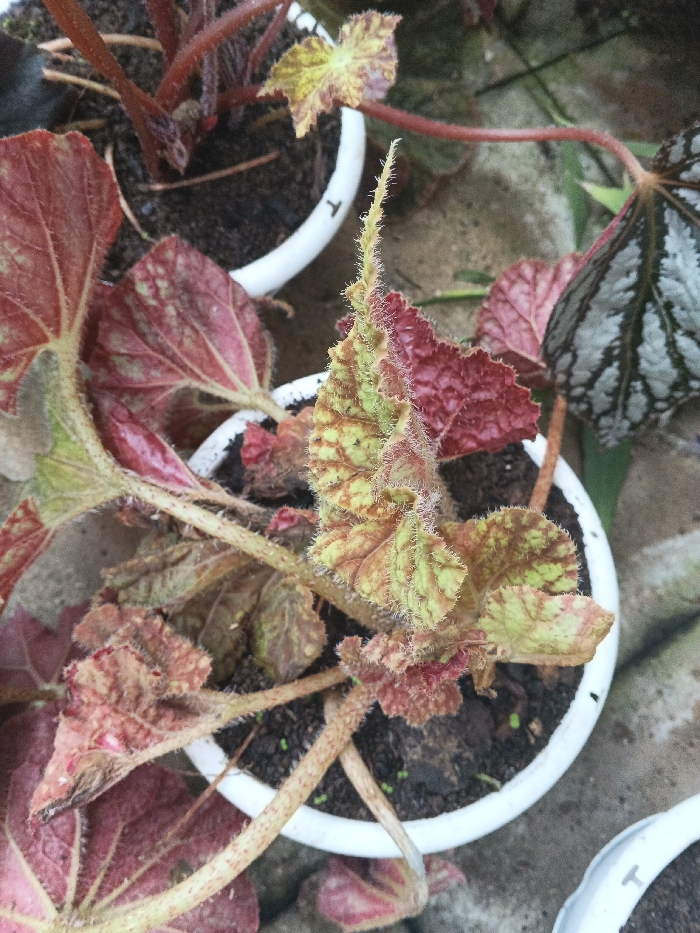
A high-angle photograph captures a close-up of multiple potted Begonia plants on a light gray concrete or paved surface, located in Munyati, Zimbabwe. The central focus is a plant in a white, circular pot filled with dark soil. This plant features densely hairy or fuzzy leaves and stems. Its foliage exhibits variegation, primarily in shades of reddish-brown, green, and yellow-green, with some leaves showing a more uniform dark red hue. A new, tightly curled leaf or shoot, heavily covered in light green and red fuzz, emerges vertically from the plant's apex. Portions of other Begonia plants, housed in identical white pots, are visible in the surrounding areas of the frame, displaying similar fuzzy textures and varied leaf patterns, including deep red and silver-green foliage. No individuals or dynamic actions are present in the scene.
Munyati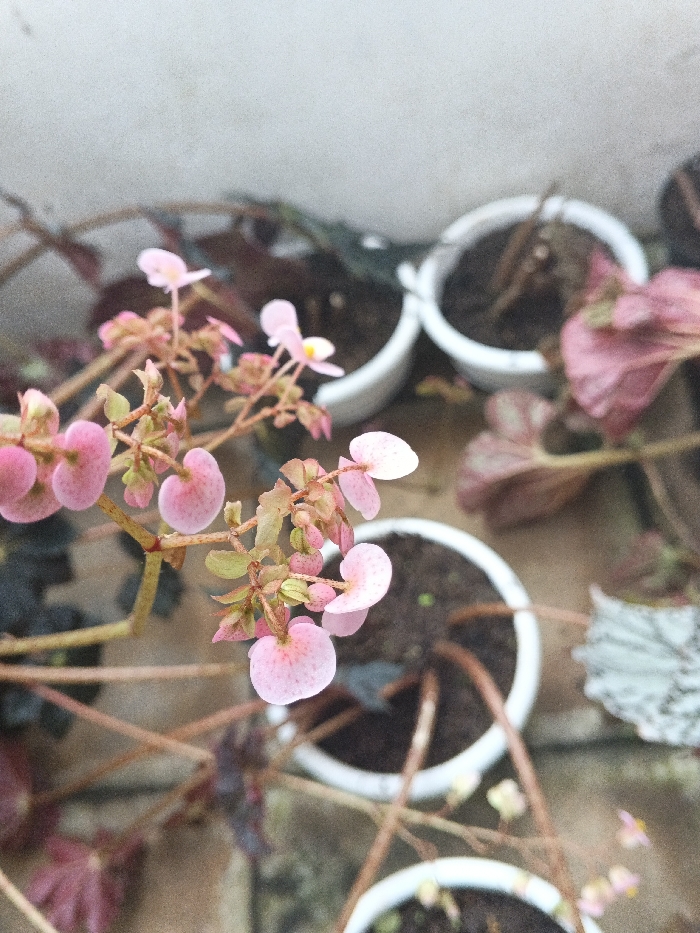
The image displays a close-up, elevated view of potted plants located in Munyati, Zimbabwe. The primary subject is a plant bearing numerous small, light pink flowers with subtle darker pink speckling, some exhibiting minute yellow centers. The plant's stems are reddish-brown and appear somewhat woody. In the midground, multiple round, white pots contain dark soil. Some pots also hold plants with broad, reddish-brown leaves, a few of which appear dried or discolored. The background consists of a textured, light gray or off-white wall, beneath which the ground surface is indistinct and mottled in shades of brown and gray. No individuals or active interactions are present in the scene.
Munyati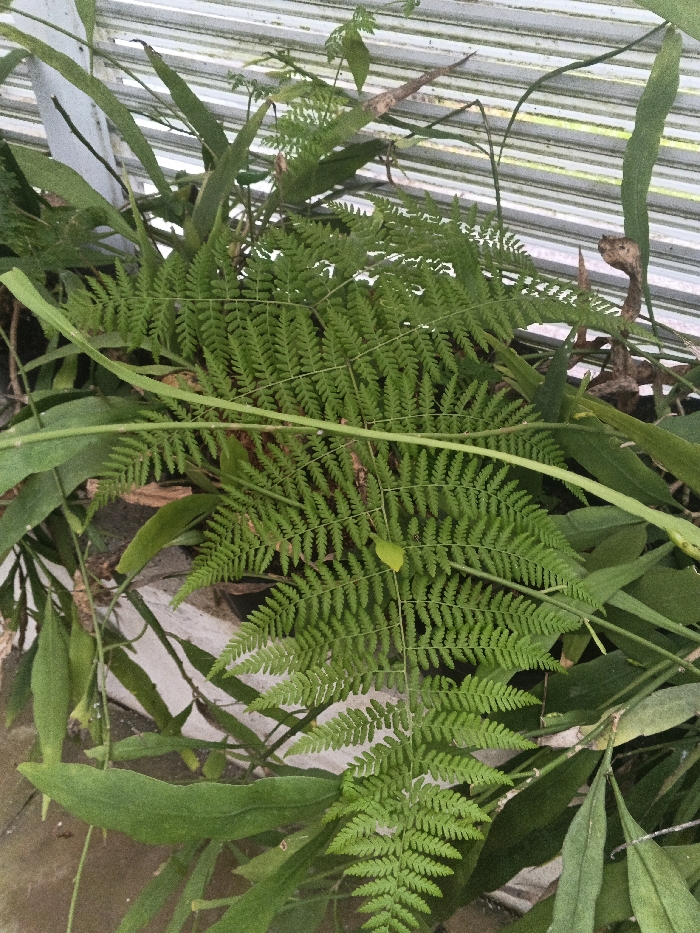
The scene is located in Munyati, Zimbabwe. The image presents a close-up, vertical view dominated by dense green plant life. A large, prominent fern plant with finely divided, compound fronds occupies the central and lower portions, displaying numerous small, ovate leaflets. Interspersed with and behind the fern are various other green plants exhibiting different leaf shapes, including broader, elongated leaves and slender stems. Some dry, brown plant material is visible amidst the vibrant foliage. In the upper background, a light-colored, horizontally corrugated structure, consistent with a metal or plastic wall or roof, is partially visible through the plant growth. No people, animals, actions, or direct interactions are present. The lighting is bright and diffuse.
Munyati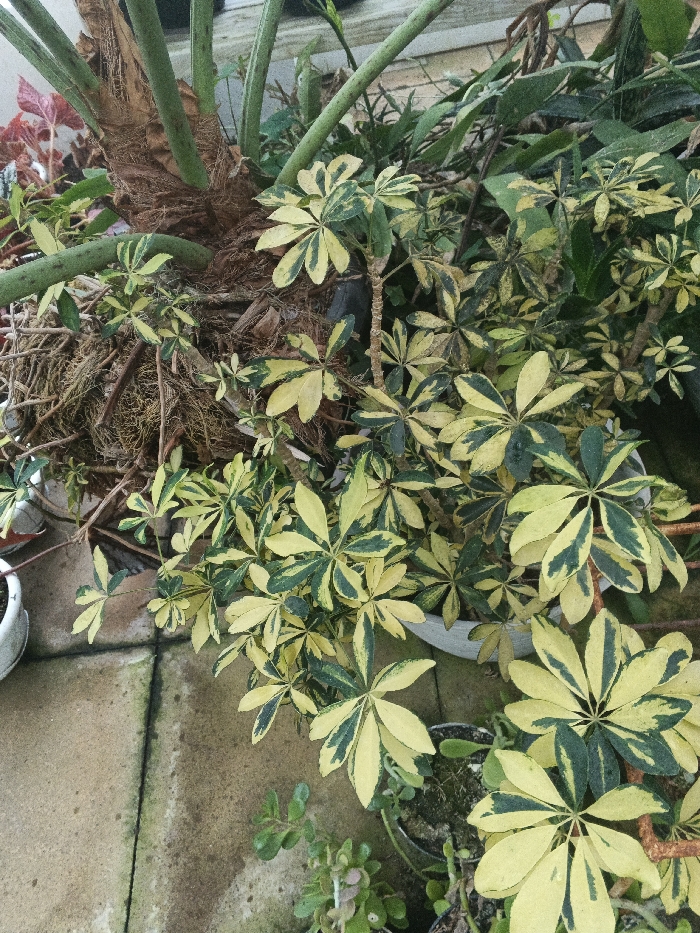
The scene, located in Munyati, Zimbabwe, presents an arrangement of plants on a paved outdoor surface. A prominent variegated Schefflera plant dominates the central and right portions, displaying numerous palmate leaves with distinct cream-yellow and dark green patterning. Its foliage is dense, and woody stems are visible. To the upper left, a larger plant with thick green stalks emerges from a fibrous, brown basal structure. Additional smaller green plants and a plant with reddish-brown foliage are interspersed throughout the composition. Multiple plant containers are observed, including partially visible light-colored pots on the left and right, and smaller dark pots at the bottom. The ground surface consists of light-colored flagstone or concrete pavers, which exhibit dark discoloration and organic growth along their seams. No human presence or dynamic actions are observed within the frame.
Munyati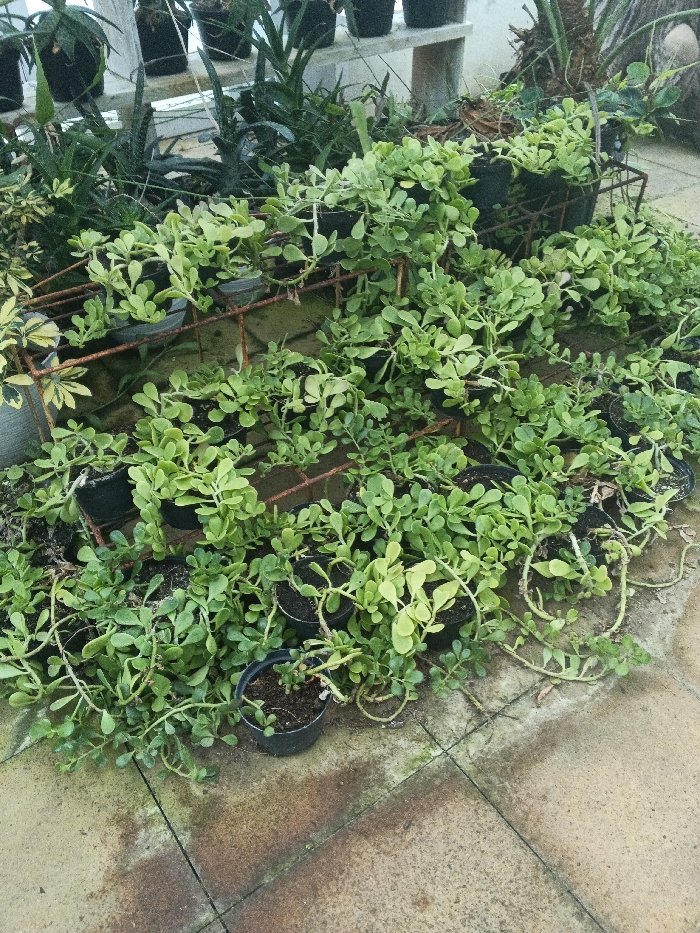
The image depicts an outdoor plant area, located in Munyati, Zimbabwe, filled with numerous small, light-green succulent plants with rounded leaves. These plants are primarily contained within black plastic pots, many of which are positioned on and spilling over a rusty, dark-orange metal grid structure, possibly a plant stand or shelving unit. Numerous pots and trailing plant stems extend beyond the metal structure, spreading directly across the surrounding paved ground. The ground consists of light-brown and grey-toned rectangular paving stones, exhibiting areas of moisture and discoloration. In the background, taller, spiky green plants, consistent with aloe or similar succulents, are visible in black pots on elevated white or light-colored shelves. No human figures or active interactions are present in the scene.
Munyati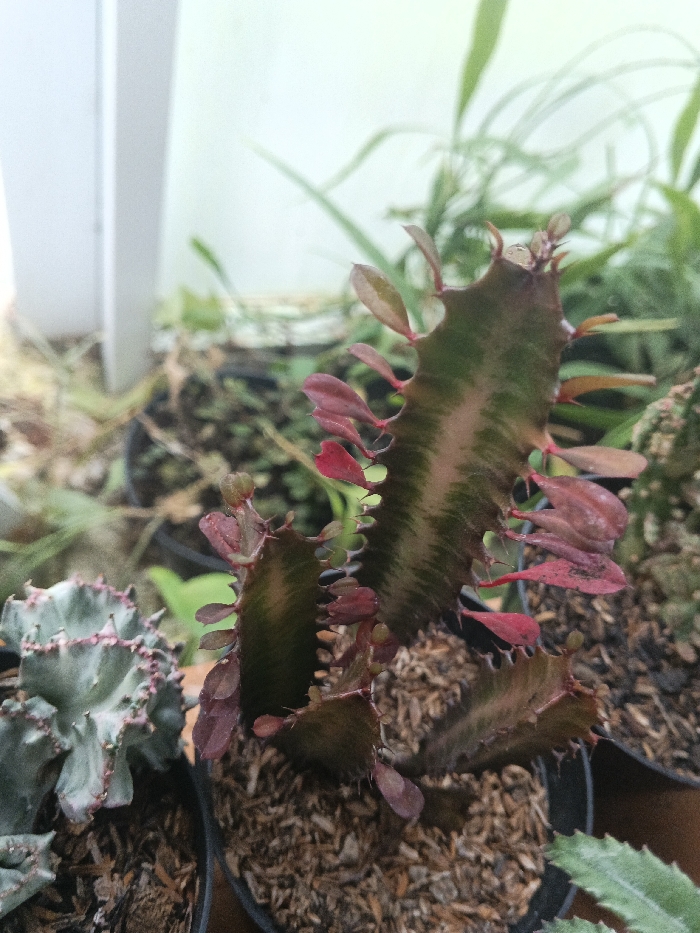
The image displays a close-up view of several potted succulents in Munyati, Zimbabwe. Dominating the center is a multi-stemmed succulent, characterized by dark green, ribbed stems with prominent reddish-brown margins and small, oval, reddish-pink leaves protruding along the ridges. This plant is situated in a black plastic pot filled with a substrate primarily composed of wood chips or bark mulch. To the left, a second succulent with a grayish-green, wavy or crested form, accented by reddish-pink tips and margins, is visible in a similar black plastic pot with the same substrate. The background is softly blurred, revealing additional green foliage, including taller, grass-like plants and other indistinct potted plants. A light-colored, vertical structure, possibly a wall or support, is present in the far left background. No people are visible, and no actions or interactions are depicted. The scene suggests a cultivated indoor or outdoor plant display.
Munyati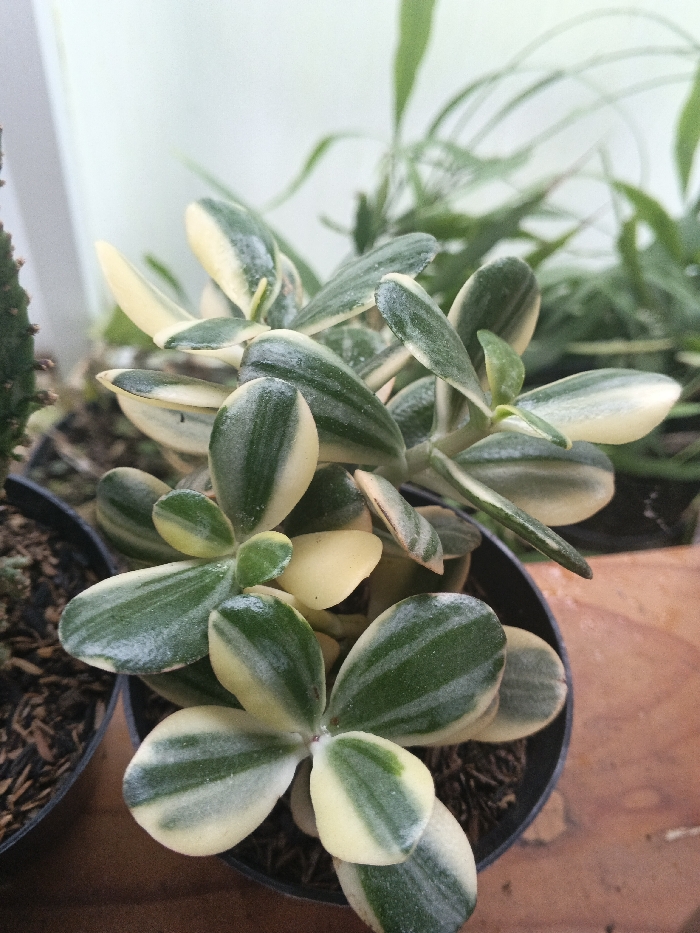
A variegated succulent plant, displaying thick, ovate leaves with prominent green stripes on a creamy yellow background, is centered in a black plastic pot. The pot contains a dark, granular growing medium. To the left, a partial view of a green cactus with visible spines is present. The background features blurred green foliage and a light-colored, possibly white, vertical surface. The black pot rests on a reddish-brown surface, visible on the lower right. The scene is uniformly illuminated by ambient light. This plant arrangement is located in the city of Munyati, Zimbabwe.
Munyati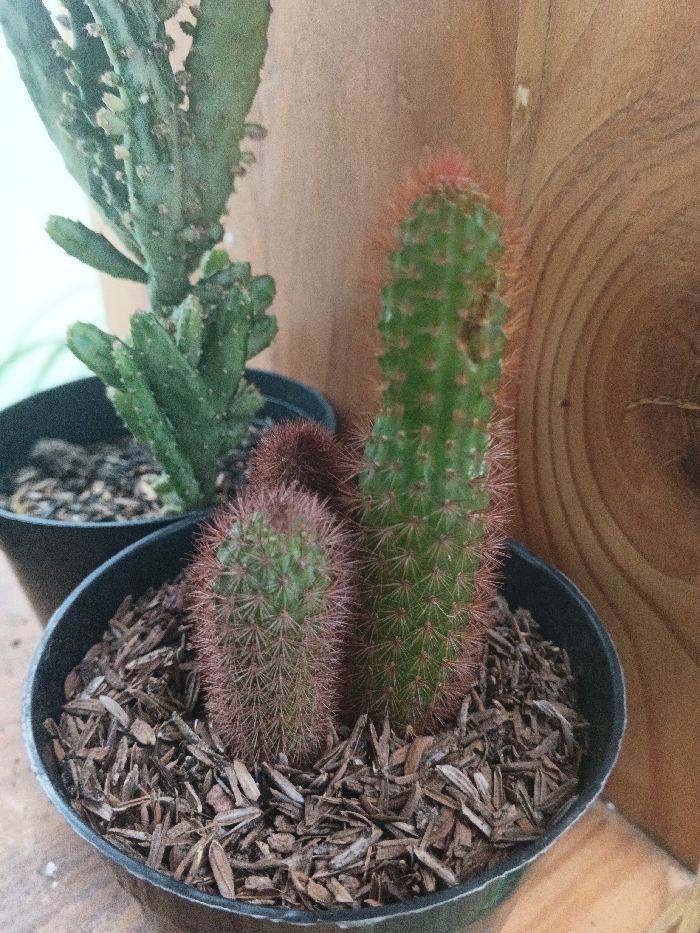
The image displays a close-up, slightly elevated view of multiple potted cacti in what appears to be an indoor or sheltered outdoor setting in Munyati, Zimbabwe. In the foreground, a black plastic pot contains three columnar cacti and is topped with a layer of light brown wood chip mulch. The prominent cactus on the right is green, elongated, and densely covered with reddish-orange spines, exhibiting minor irregularities on its surface. To its left, a shorter, stouter green columnar cactus is visible, featuring dense, darker reddish-brown spines. A smaller, dark reddish-brown, partially obscured globular or short columnar cactus is situated behind and between these two. In the background, behind the foreground pot and to the left, a portion of a second black plastic pot is visible. This pot holds a different species of cactus, characterized by lighter green, segmented, and branching stems with small, dark areoles. The soil in this pot is dark, interspersed with small light-colored aggregates. The background primarily consists of a vertical light brown wooden surface, possibly a wall or furniture, displaying distinct wood grain patterns, including a prominent circular pattern on the right side. To the far left, a blurred, light-colored area, potentially a wall or window, is visible, containing a faint, out-of-focus green linear element. No individuals are present, and no actions or interactions are depicted.
Munyati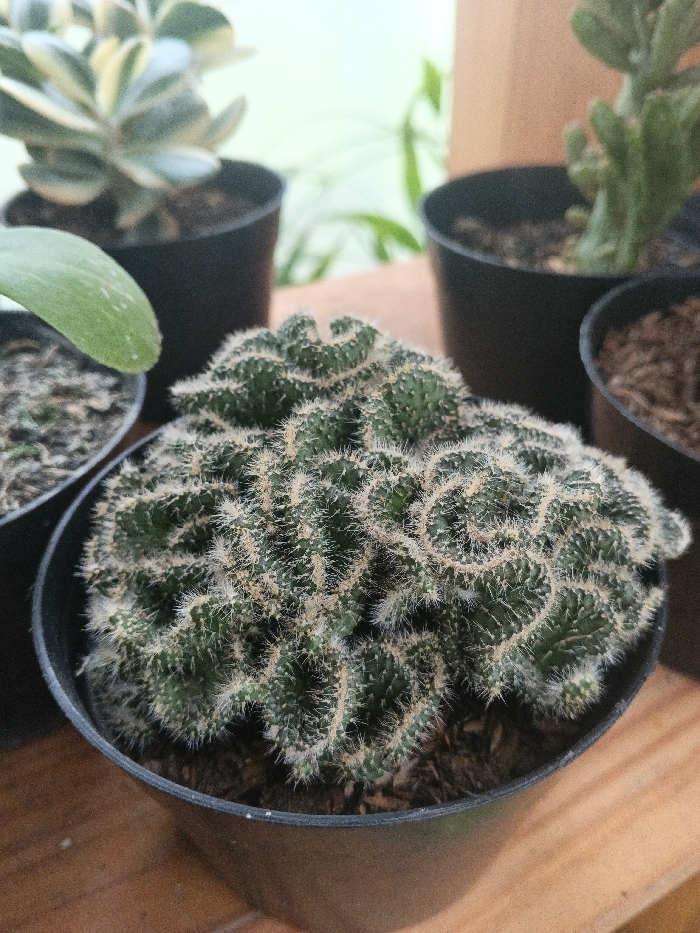
The scene depicts multiple potted plants, located in Munyati, Zimbabwe. In the foreground, a crested cactus with intricate, brain-like green growth covered in dense, short, light-colored spines is contained within a round, black plastic pot filled with dark brown soil. Surrounding this central cactus, other potted plants are visible in the blurred background and midground. To the immediate left, a portion of a smooth green leaf extends from another black pot. Towards the upper left, a variegated succulent with light and dark green leaves is present in a black pot. To the right, at least two additional green plants are partially visible in black pots. All plants rest on a light brown wooden surface, possibly a shelf or table. The background beyond the plants is softly lit, appearing as a light, out-of-focus expanse with hints of green foliage in the distance. No human subjects, animals, or specific actions are depicted.
Munyati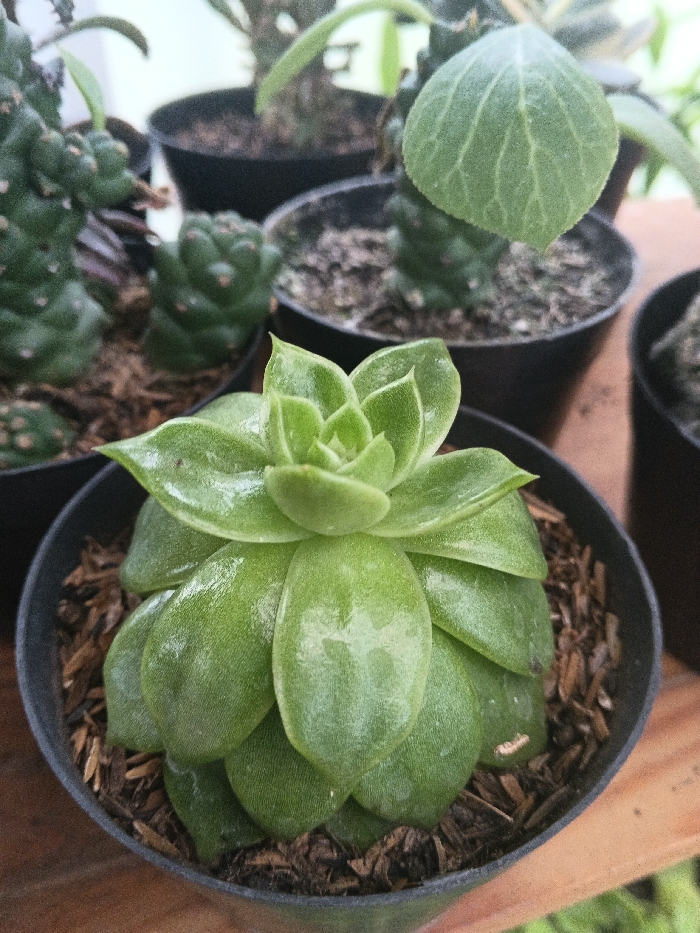
The image displays a close-up of multiple potted plants, located in Munyati, Zimbabwe. In the foreground, a vibrant green succulent plant, characterized by a rosette formation of fleshy, glossy leaves, is centered within a black plastic pot. The plant's leaves appear slightly damp. The pot's soil is dark, mixed with light brown wood chips. This pot rests on a reddish-brown wooden surface. In the blurred background, several other plants in black plastic pots are visible, including one on the left with segmented, knobby green stems, and another toward the right exhibiting a distinct, fuzzy, oval green leaf. No individuals or specific actions are depicted; the scene is static and well-lit by ambient light.
Munyati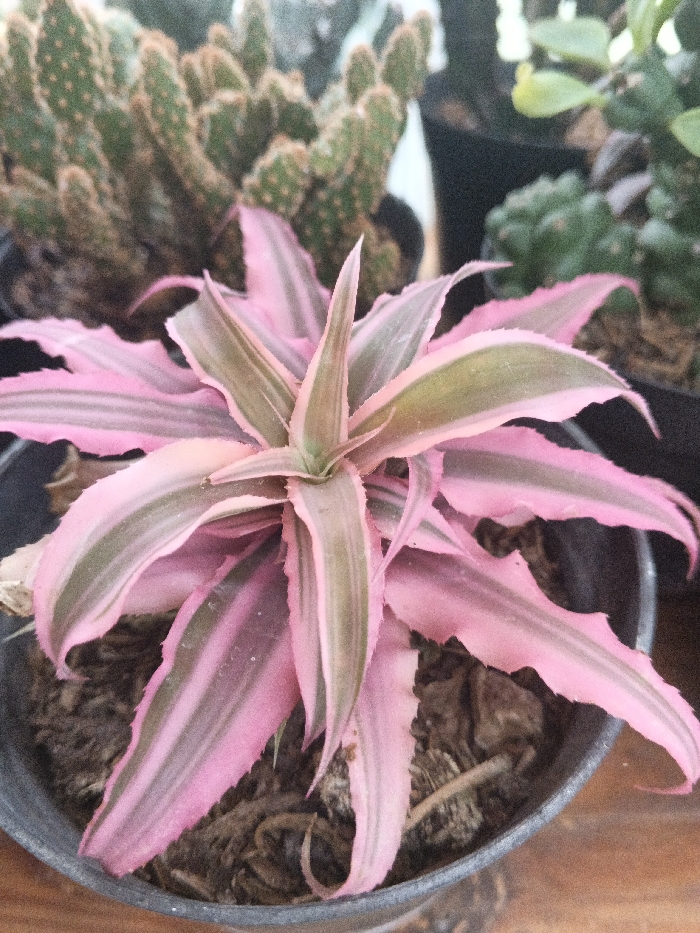
The scene is depicted as being in Munyati, Zimbabwe. The primary subject is a potted variegated bromeliad plant, possibly a Cryptanthus, centered in the frame. Its lanceolate leaves exhibit a prominent pink coloration with irregular longitudinal green stripes, arranged in a rosette formation. The leaf margins feature small, pointed serrations. The plant is situated within a dark gray or black plastic pot filled with dark, granular soil interspersed with fibrous organic material. In the blurred background, several other potted plants are visible. To the upper left, a cluster of green cactus stems, characteristic of *Opuntia microdasys* (bunny ears cactus), is present in a dark pot. To the upper right, indistinct green foliage from other potted succulent-type plants can be observed. All background plants are similarly housed in dark containers. The plants rest on a light brown, flat surface, consistent with wood, which is partially visible at the bottom of the frame. No human figures, animals, or discernible actions are depicted. The environment suggests an indoor or sheltered outdoor setting for plant cultivation or display.
Munyati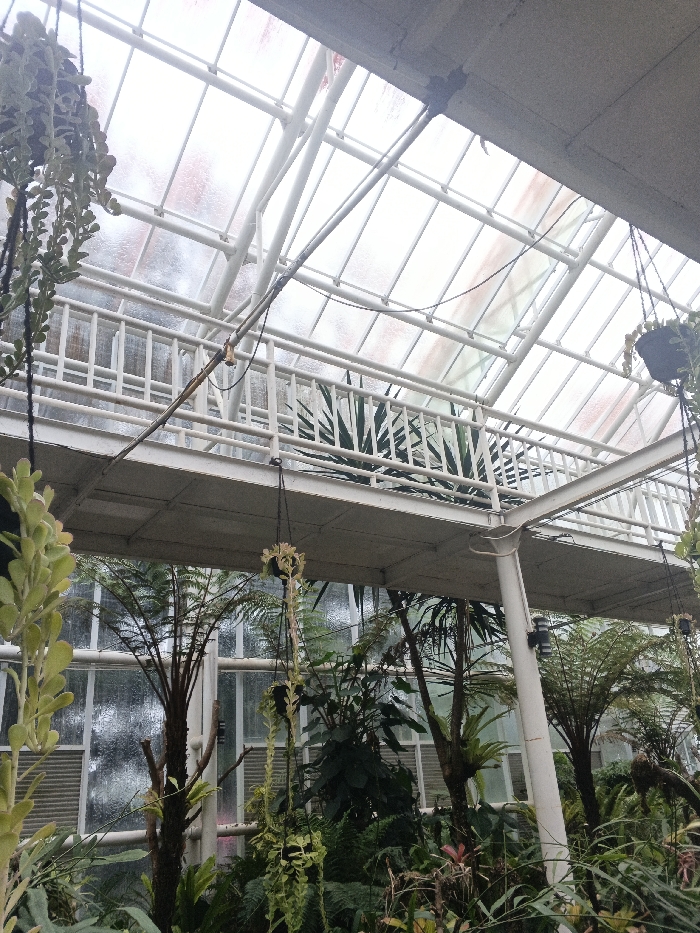
The scene depicts the interior of a large greenhouse or conservatory located in Munyati, Zimbabwe. Overhead, a sloped, translucent panel roof is supported by white metal trusses and beams, showing visible condensation or moisture on its interior surfaces. Beneath the roof, a white metal-framed elevated walkway with a balustrade traverses the space, supported by vertical columns. A metal conduit with a brass-colored fitting is affixed diagonally above the walkway on the left. The lower and mid-levels are densely populated with lush, diverse tropical and subtropical vegetation, including tall, tree-like ferns and palm-like plants with thick trunks. Numerous hanging planters with trailing green foliage are suspended from overhead structures and the underside of the walkway. Ground-level areas feature various ferns and broad-leafed plants. A white vertical support column is visible on the right, bearing a black wall-mounted fixture. No individuals are present in the image.
Munyati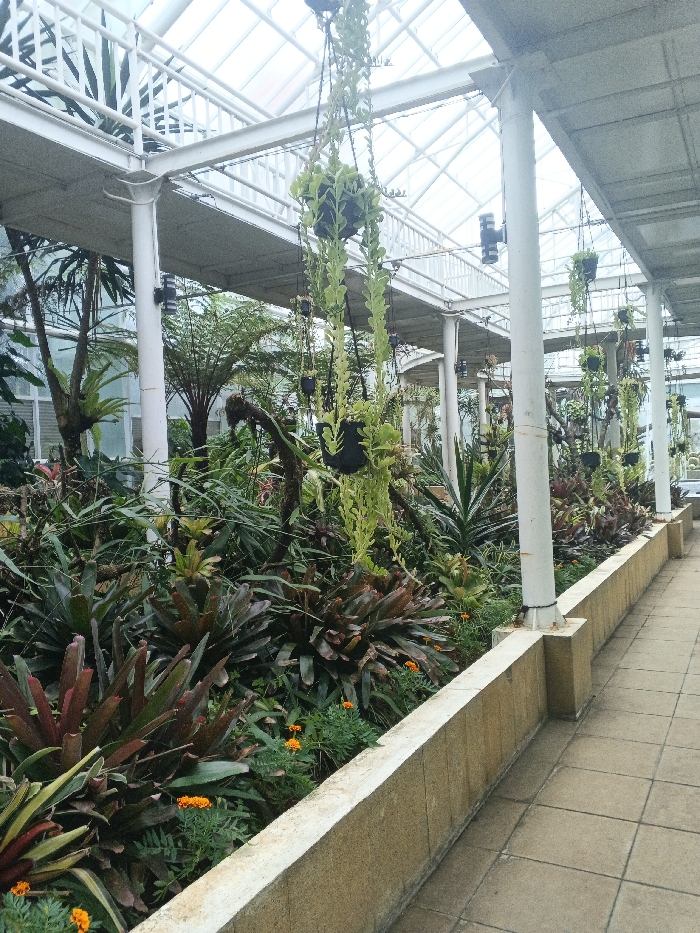
The scene depicts an interior view of a botanical garden or greenhouse located in Munyati, Zimbabwe. A tiled pedestrian pathway, composed of light brown square tiles, extends from the foreground into the background along the right side of the frame. This pathway is bordered on its left by a low, light beige concrete wall, approximately 0.5 meters high. To the left of the wall, a densely planted garden bed features a variety of tropical and subtropical vegetation. Prominent subjects include numerous bromeliads with broad, green and reddish-green leaves occupying the foreground and midground. Smaller plants with orange flowers, resembling marigolds, are interspersed at the base of the larger foliage. In the background, taller plants and fern-like trees are visible. Overhead, a white metal structural framework supports a translucent roof, allowing ambient light to illuminate the space. White cylindrical pillars extend vertically from the ground, supporting the overhead structure. Several black hanging planters, each containing long, trailing green succulent-like plants, are suspended from this framework. Black wall-mounted lighting fixtures are attached to some of the white pillars. No individuals are present in the image.
Munyati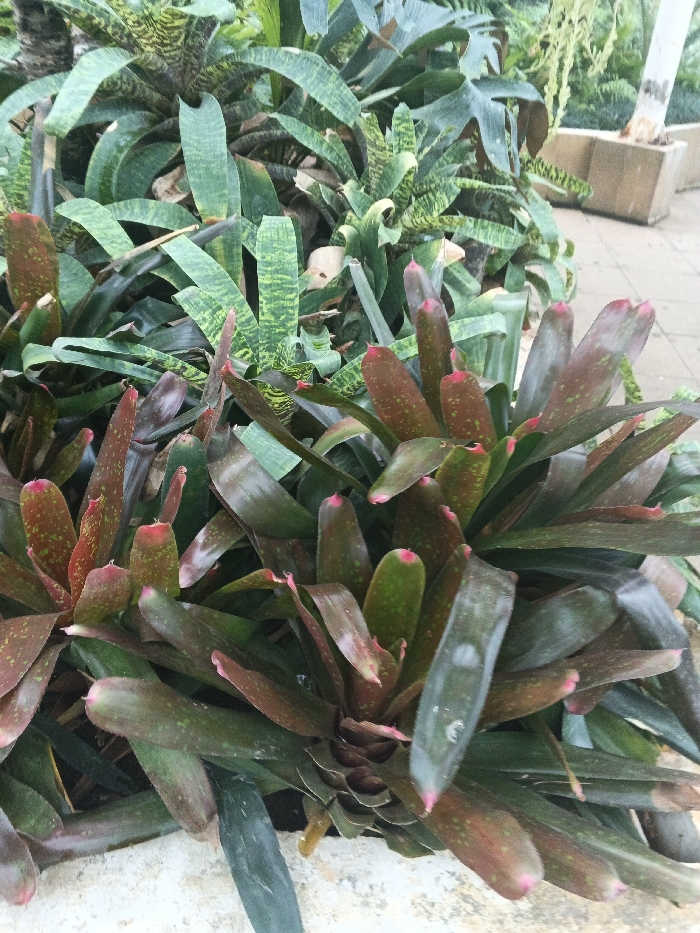
The image displays a dense botanical arrangement of tropical plants, located in Munyati, Zimbabwe. In the foreground, multiple rosettes of bromeliad-type plants are visible. These plants feature broad, strap-like leaves that are predominantly dark green, transitioning to a reddish-brown hue towards their tips. The distal ends of many leaves exhibit a distinct bright pink coloration. Some leaves also show subtle reddish-brown speckling. Behind the foreground plants, a different variety of foliage is present, characterized by lighter green leaves with prominent darker green horizontal banding or irregular stripes. The base of the plant arrangement is bordered by a light-colored, possibly concrete or tiled, surface that extends into the background. In the far background, a large, light-colored rectangular planter is visible, containing a plant with a thick, whitish, trunk-like stem. No individuals or specific actions are depicted within the frame.
Munyati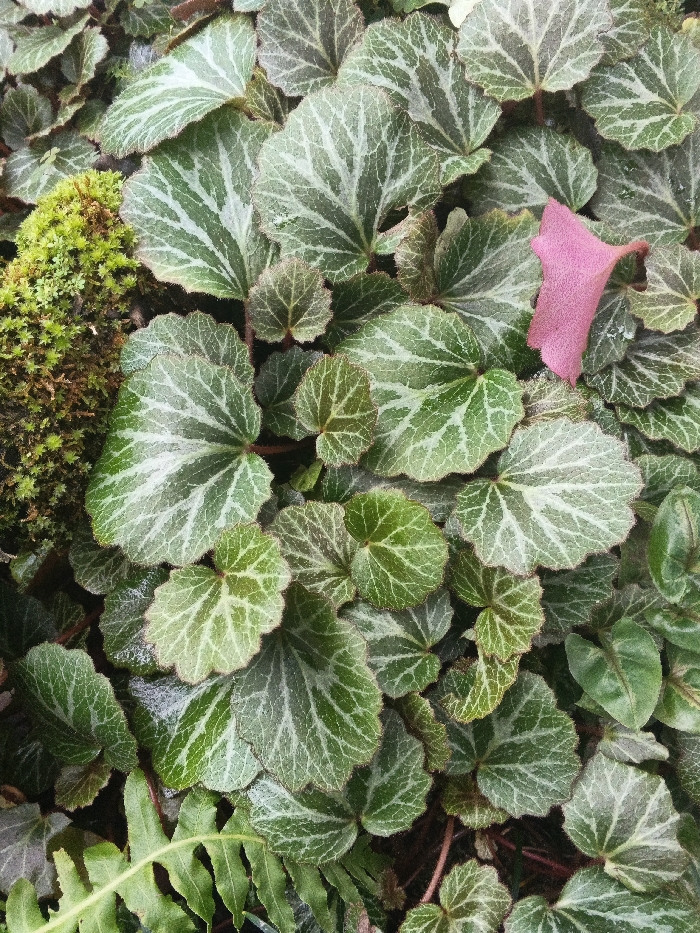
The scene displays a dense botanical groundcover, predominantly featuring numerous small, rounded leaves with dark green bases and striking silvery-white or pale green variegation along their venation. Many of these leaves exhibit slightly scalloped edges and a textured surface. In the upper-left quadrant, a compact patch of bright green, clustered moss is present. A single, detached, irregularly shaped pink leaf or petal rests on the variegated foliage in the upper-right section. Partially visible in the lower-left corner is a section of a fern frond, characterized by segmented green leaflets. No human or animal subjects are present, and no actions or interactions are depicted. The environment is natural and vegetative. This scene is located in the city of Munyati, Zimbabwe.
Munyati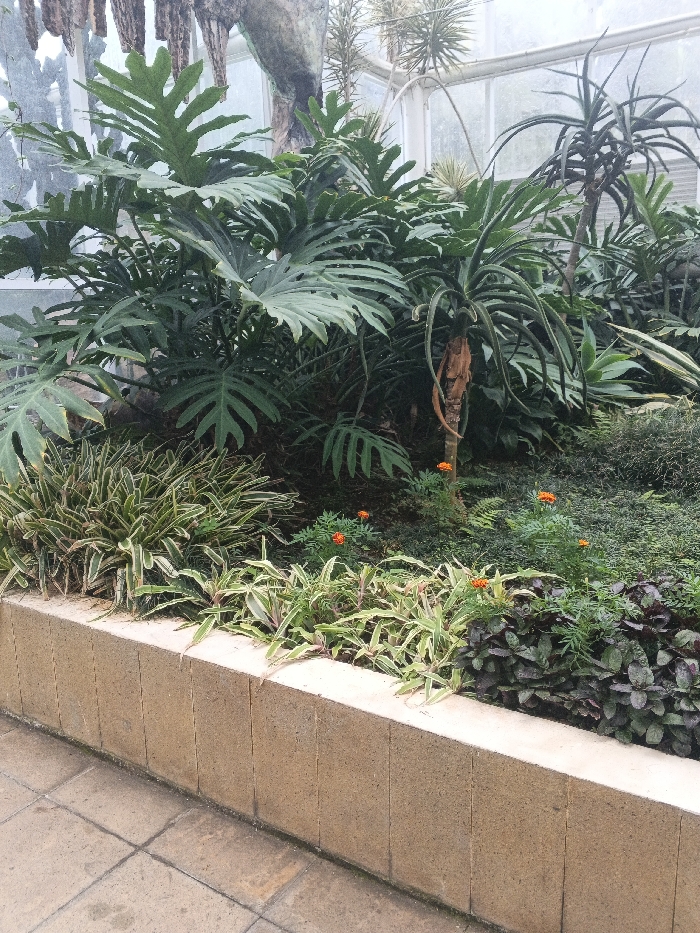
The scene depicts an indoor botanical garden or greenhouse located in Munyati, Zimbabwe. In the foreground, a tiled walkway composed of light-colored square pavers abuts a light brown, vertically segmented concrete retaining wall, approximately 0.5 meters in height. Beyond the wall, a dense arrangement of plant species occupies a raised garden bed. Varied foliage includes large-leafed tropical plants with deep green, deeply lobed leaves dominating the upper and mid-sections, alongside a tall plant with drooping, strap-like leaves and a visible fibrous trunk. Smaller variegated plants with green and cream striping are present in the lower beds, interspersed with several small flowering plants displaying bright orange blossoms. The background reveals the structural elements of a greenhouse, specifically white metal framing and clear glass panels, allowing diffuse light into the enclosure. No human presence or activity is observed within the frame.
Munyati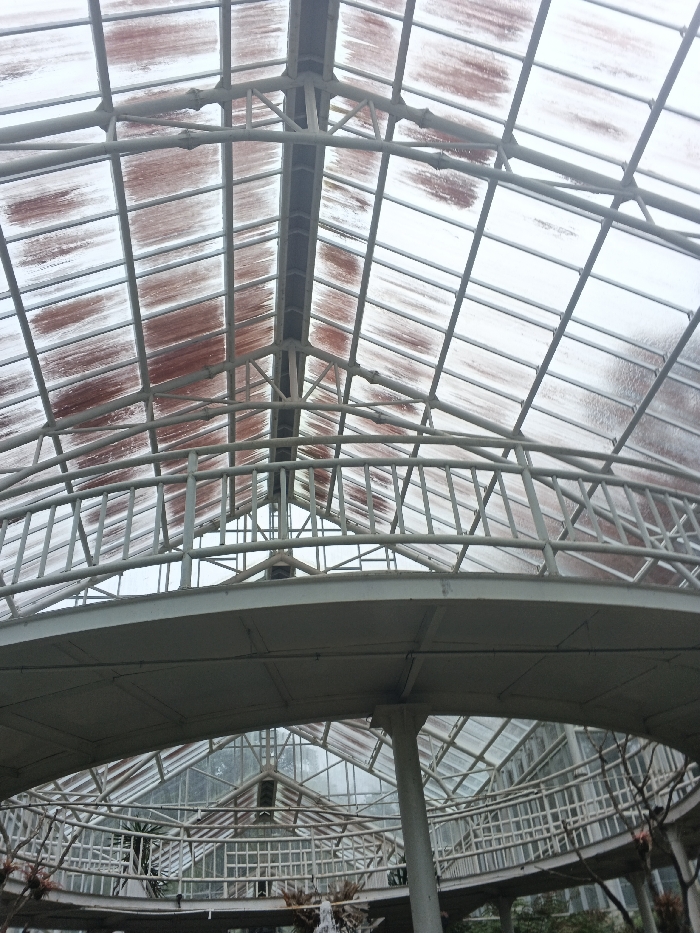
The image displays the interior of a large, multi-level conservatory or greenhouse structure, located in Munyati, Zimbabwe, viewed from a low perspective looking upwards. The dominant feature is the vaulted roof, composed of a light-colored metal grid structure, likely painted steel, supporting numerous translucent panels. These panels exhibit widespread reddish-brown streaking, consistent with rust runoff, algae growth, or accumulated dirt on the surface. Beneath the main roof, a curved, elevated walkway or balcony is visible. This walkway has a solid, light-colored underside and is bordered by a matching balustraded railing. The walkway is supported by vertical columns, one of which is partially visible on the lower right. Below and behind the walkway, additional sections of the greenhouse are discernible, featuring more glass panels and supporting frameworks. Bare branches of large plants or trees are present on the lower right, and a water feature, specifically a fountain with a visible water jet, is partially observable at the bottom center. No individuals are present within the scene.
Munyati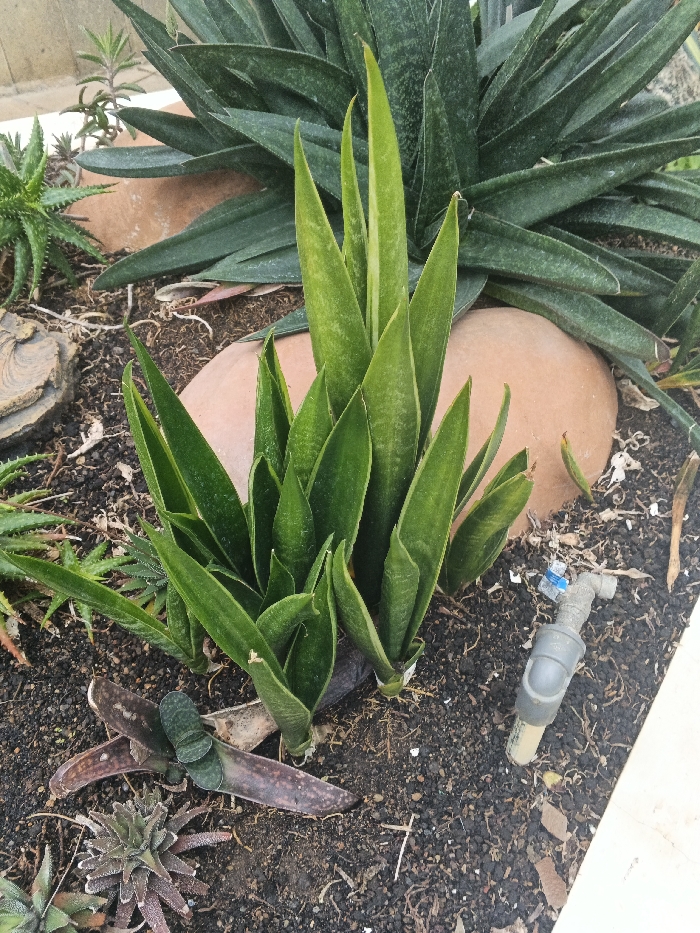
This image depicts a section of a garden bed in Munyati, Zimbabwe. The primary subject is a dense cluster of variegated green Sansevieria (snake plant) succulents, characterized by their upright, sword-shaped leaves of varying shades of green, positioned centrally. Behind this cluster, larger, darker green succulent plants with broader leaves are visible, alongside several smooth, reddish-brown rocks. To the immediate left, a spiky, lighter green succulent is present. In the lower left quadrant, the soil contains smaller succulents, including one with flattened, reddish-brown leaves and another rosette-shaped variety. The ground consists of dark, granular soil or mulch with scattered organic debris. On the right side, a small, light gray plastic tap with a blue handle is partially embedded in the soil, connected to a short segment of white piping. A light-colored tile or concrete edge forms the boundary along the bottom right. No individuals or animals are present.
Munyati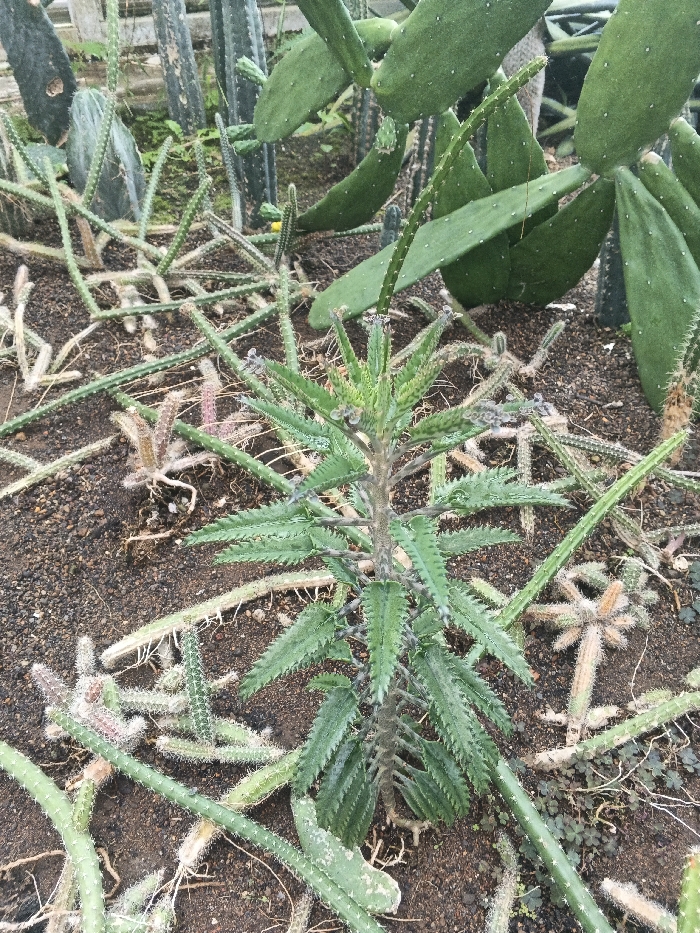
The image displays a cultivated bed of succulent and cactus plants in Munyati, Zimbabwe. In the foreground and mid-ground, dark brown, loose soil supports a dense arrangement of vegetation. A prominent, upright succulent plant, approximately 40 cm tall, occupies the central area, featuring a thick, segmented stem with spirally arranged, elongated, dark green leaves possessing sharply serrated margins and some reddish-brown mottling. Surrounding this central plant, numerous cylindrical cactus stems of varying lengths (ranging from approximately 5 cm to 30 cm) lie prostrate or partially rooted on the soil surface. These stems exhibit diverse coloration, including light green, reddish-brown, and pale beige, and many are covered with fine white or tan bristles, with visible adventitious roots forming at various points along their lengths. In the background, larger, flat, paddle-shaped green cacti are discernible on the right, alongside taller, more columnar cacti and a partially visible light-colored fence or structure towards the upper left. No human subjects or animals are present in the scene.
Munyati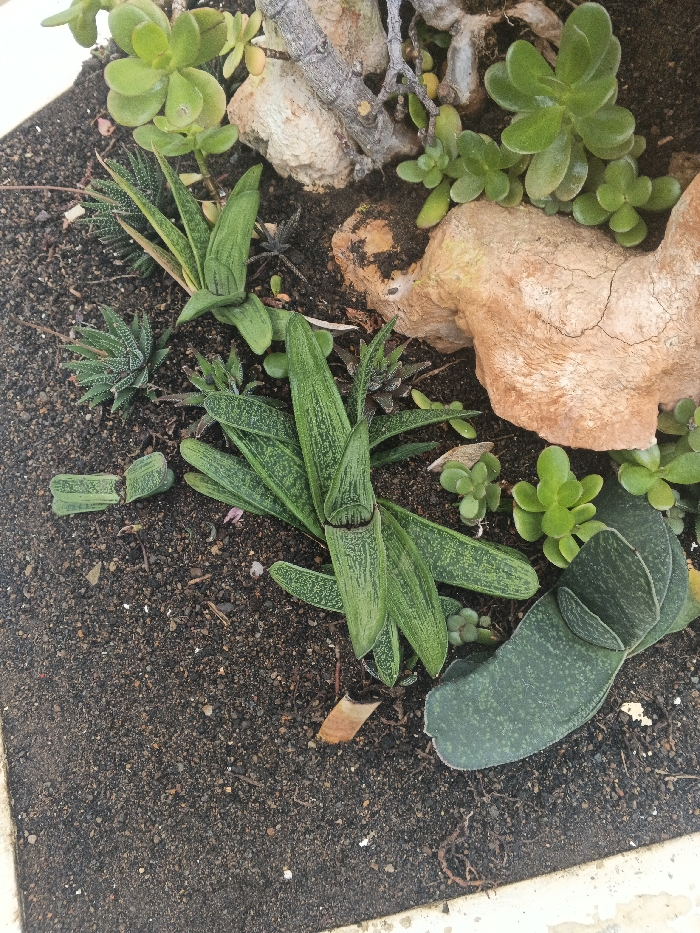
An overhead view depicts a planted succulent garden within a light-edged container in Munyati, Zimbabwe. The scene is comprised of dark, fine-grained soil, various succulent plants, and light brown rocks. Prominent plants include several *Gasteria* species with elongated, mottled green leaves, one appearing segmented in the center, and a large, flat-leaved, speckled green succulent positioned in the lower right. Smaller, spiky succulents resembling *Haworthia* are interspersed. Clusters of compact, rounded-leaf green succulents, possibly *Crassula*, are visible in the upper left. A fragmented succulent leaf lies on the soil in the lower left. Multiple light brown, textured rocks, some with visible cracks, are present in the upper right quadrant, with a small gnarled branch fragment visible behind them. The soil surface appears dry. No individuals or actions are depicted.
Munyati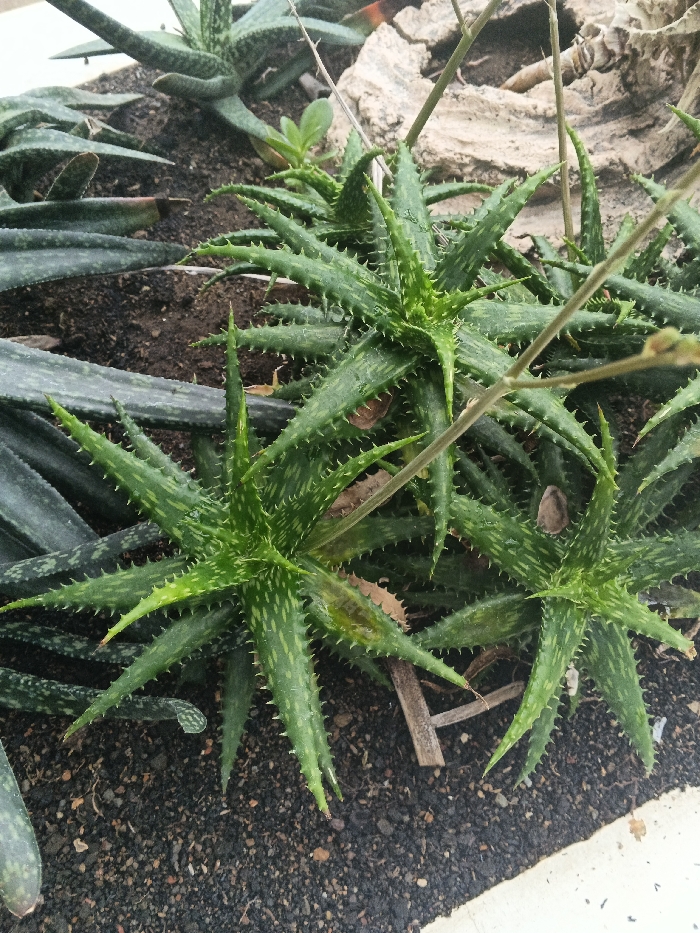
The image displays a close-up, high-angle view of several succulent plants growing in dark, granular soil. In the foreground, three prominent rosette-forming plants with pointed, green, spiky leaves are visible. These leaves exhibit lighter green variegation or spots. One plant in the lower-left foreground has a yellowish-green area on one of its inner leaves. Two thin, light brown stems rise vertically from the center-right. In the mid-ground on the left, several flatter, elongated, dark green succulent leaves, also variegated, are partially visible. The soil is dark brown to black, appearing moist and containing small aggregates. In the upper right background, a light-colored, irregularly shaped rock or concrete fragment is present. A piece of light brown debris, possibly wood, lies on the soil in the mid-right. A distinct white or light grey boundary, consistent with a concrete edge, frames the bottom and bottom-right sections of the image. No people are present, and no actions or interactions are depicted. The scene is located in Munyati, Zimbabwe.
Munyati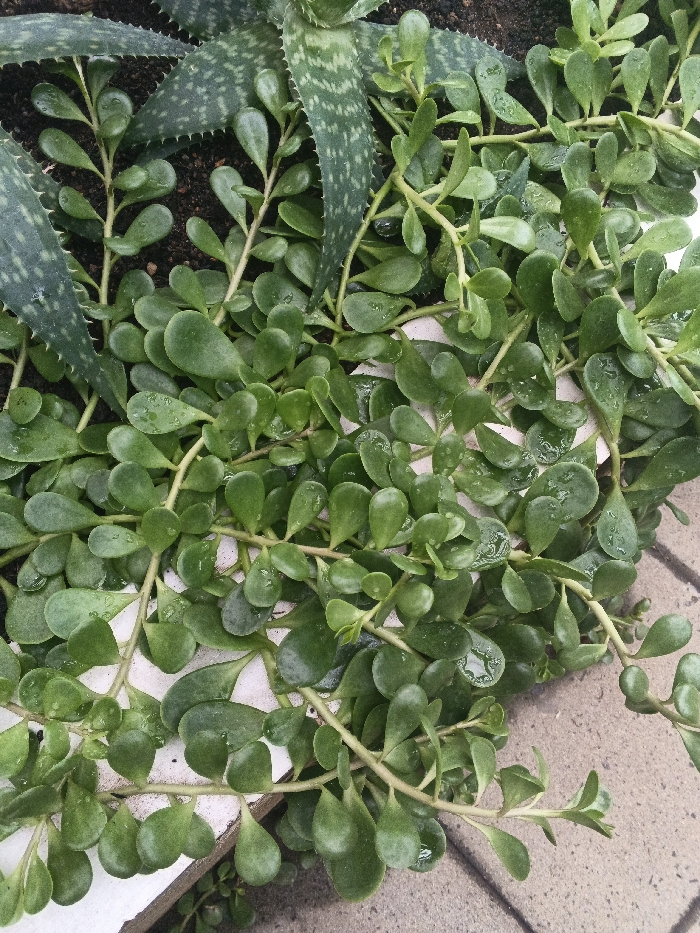
The image displays a close-up, overhead view of a plant arrangement in Munyati, Zimbabwe. The central focus is a dense cluster of a creeping succulent plant characterized by numerous small, obovate, dark green leaves, many of which bear distinct water droplets on their surfaces. Partially visible in the upper left and central-left areas are the thick, serrated, and spotted leaves of an Aloe species, emerging from dark brown soil. A white, straight-edged border, likely a planter's edge made of concrete or ceramic, runs along the left and lower left portions of the frame. To the right and bottom right, a textured light brownish-grey paved surface, consistent with concrete pavers, is visible. No people or animals are present.
Munyati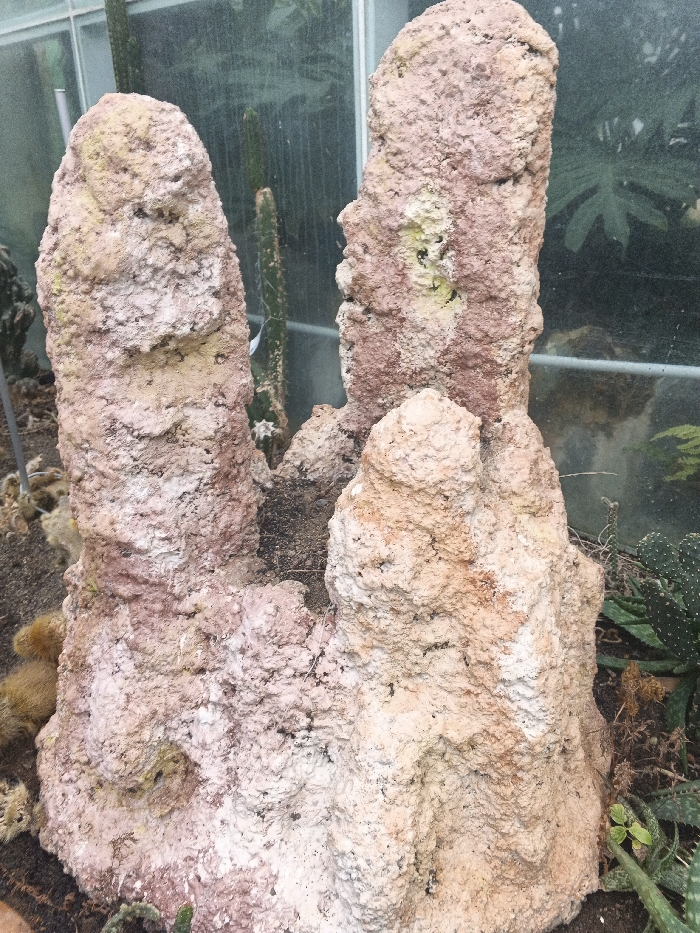
The image displays a detailed view of three large, irregularly shaped, textured formations, resembling termite mounds or porous rock structures, within an indoor horticultural display or greenhouse facility in Munyati, Zimbabwe. The structures exhibit a predominant reddish-brown and off-white coloration, with patches of pale yellow and darker soil-like material. The two most prominent formations stand vertically, flanking a smaller, central structure that emerges from the ground. All formations have a rough, uneven, and somewhat pitted surface texture. In the background, partially obscured by the formations, are glass panels and various green plants, including slender cacti and broader-leafed foliage, indicative of a controlled growing environment. Additional smaller cacti and succulents are visible on the ground level around the base of the formations. No human figures are present, and no actions or interactions are depicted. The scene is static, focusing on the artificial landscape and plant life.
Munyati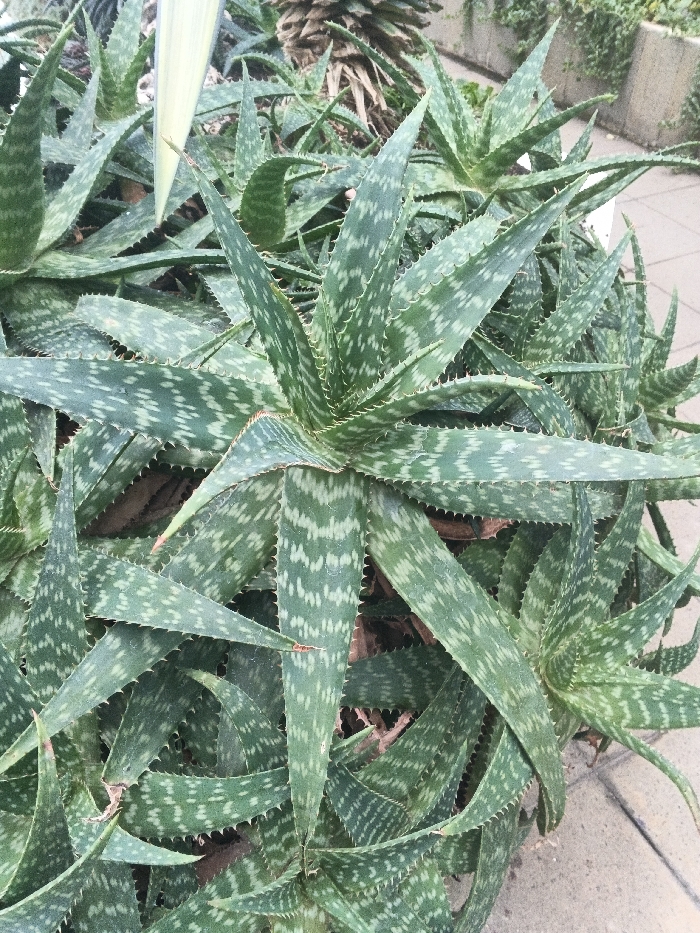
The image displays a close-up, high-angle view of a dense cluster of numerous aloe plants. The plants are characterized by thick, succulent, lanceolate leaves that are dark green with prominent, irregular light green or whitish spots and banding patterns. The edges of all visible leaves feature numerous small, sharp, light-colored spines. Multiple individual aloe rosettes are present, with their leaves fanning outwards from central points, creating a crowded and overlapping arrangement. In the upper left background, a single, lighter green, broad leaf is partially visible. The immediate ground beneath the aloes appears dark and indistinct, likely soil or organic matter. To the right and in the background, a light grey, possibly concrete or paved surface is partially visible. Further in the background, blurred vegetation is present. There are no individuals, explicit actions, or specific objects other than the plants and the general environment. The exact location within Munyati, Zimbabwe, cannot be determined from the visual information provided.
Munyati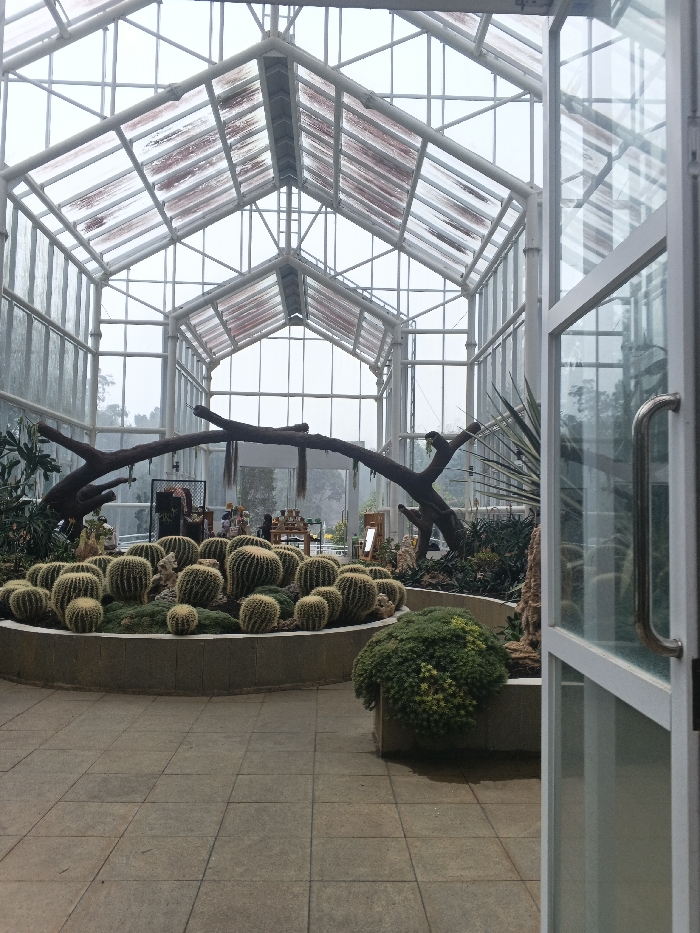
The scene depicts the interior of a large greenhouse or conservatory, located in Munyati, Zimbabwe. The structure features a white metal framework supporting a pitched glass roof and glass walls. Several glass roof panels exhibit reddish-brown discoloration or residue. The floor is paved with light grey square tiles. In the mid-ground, a prominent circular raised planter, constructed from grey stone or concrete, contains a dense cluster of spherical cacti of varying sizes. Behind this central display, a large, dark-colored, multi-branched tree trunk or root system is arranged horizontally. To the far left, a dark, open-frame structure is visible. Further in the background, several indistinct human figures are present near display tables or shelves holding various items. A white, easel-like sign or mirror stands to the right of these background displays. Additional green foliage, including tall, spiky plants, occupies the perimeter of the interior. To the immediate right in the foreground, a white-framed glass door is partially open, revealing a metallic pull handle. Adjacent to this door, a smaller, raised rectangular planter contains a dense cluster of green, spiky succulents. The exterior visible through the glass walls consists of a grey sky and distant trees. No discernible actions or interactions are clearly depicted beyond the presence of individuals in the background.
Munyati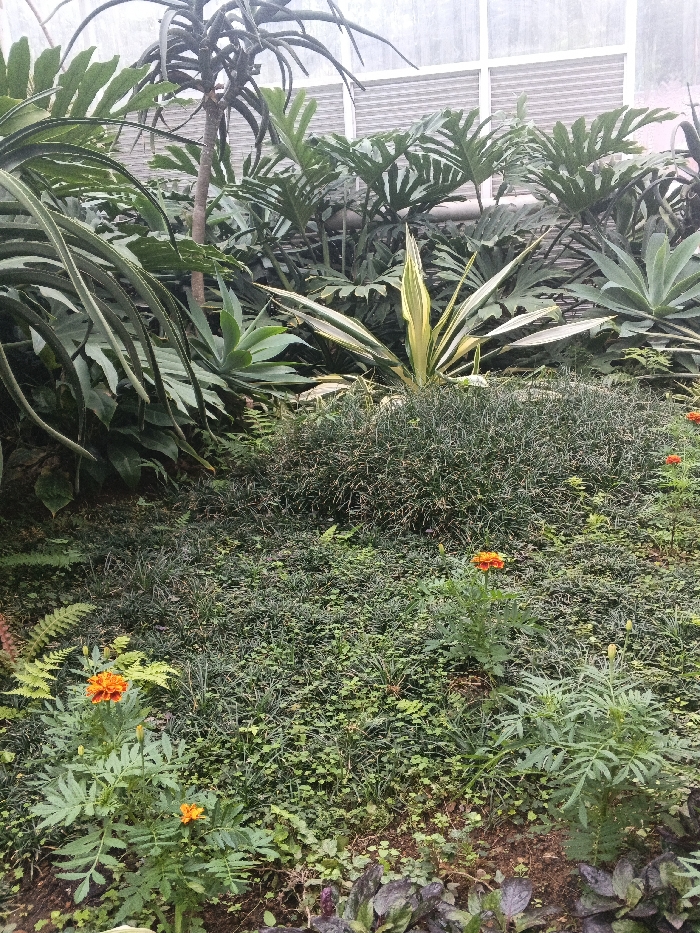
This image displays a dense botanical setting, likely within a greenhouse or cultivated garden, located in Munyati, Zimbabwe. The scene is characterized by abundant green vegetation. In the background, large-leafed plants resembling *Philodendron* are present, along with a tall, slender plant with sparse, elongated leaves, and several smooth-leaved *Agave* species. A prominent variegated succulent, featuring cream and green striped leaves, occupies the midground, surrounded by a dense, dark green, low-growing ground cover. The foreground contains additional ground cover, smaller fern-like plants, and three distinct orange-flowered plants, consistent with marigolds (*Tagetes* species). The upper background reveals a building structure with white, horizontally-aligned panels, suggesting an artificial enclosure. No human or animal subjects are visible.
Munyati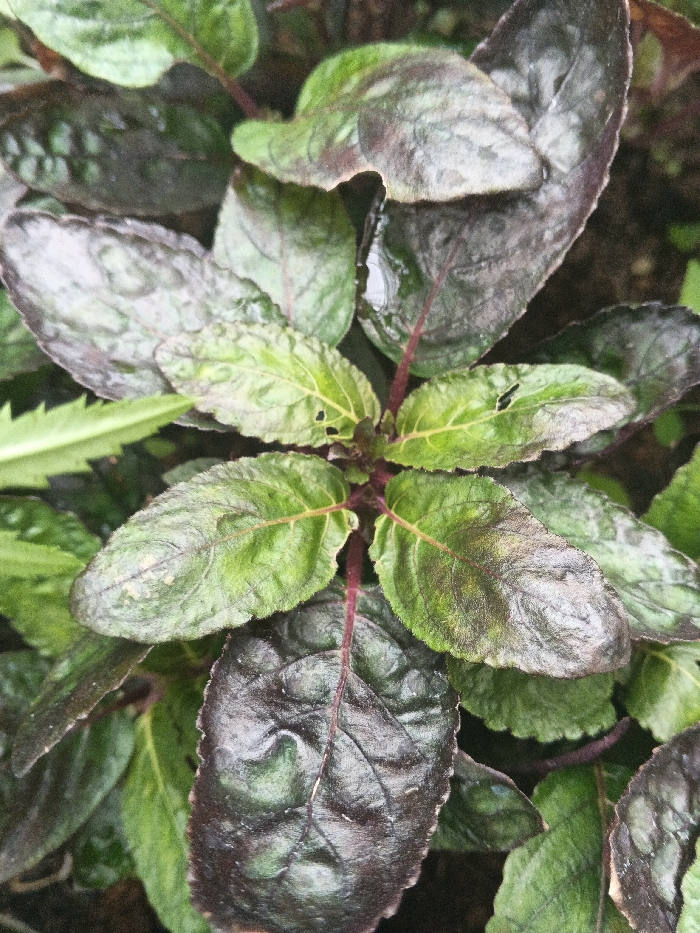
A close-up, top-down forensic view captures dense plant foliage in Munyati, Zimbabwe. The scene is dominated by numerous leaves and stems. Leaves exhibit a variable coloration ranging from dark green to deep purplish-brown, with some displaying lighter green or reddish-purple venation. Several leaves have a glossy, wet appearance, indicating the presence of water droplets on their surfaces. Small, irregular perforations are visible on multiple leaf blades, consistent with insect damage or physical abrasion. The plant's stems are distinctively reddish-purple. No people, animals, or man-made objects are present in the frame, and no discernible actions or interactions are depicted.
Munyati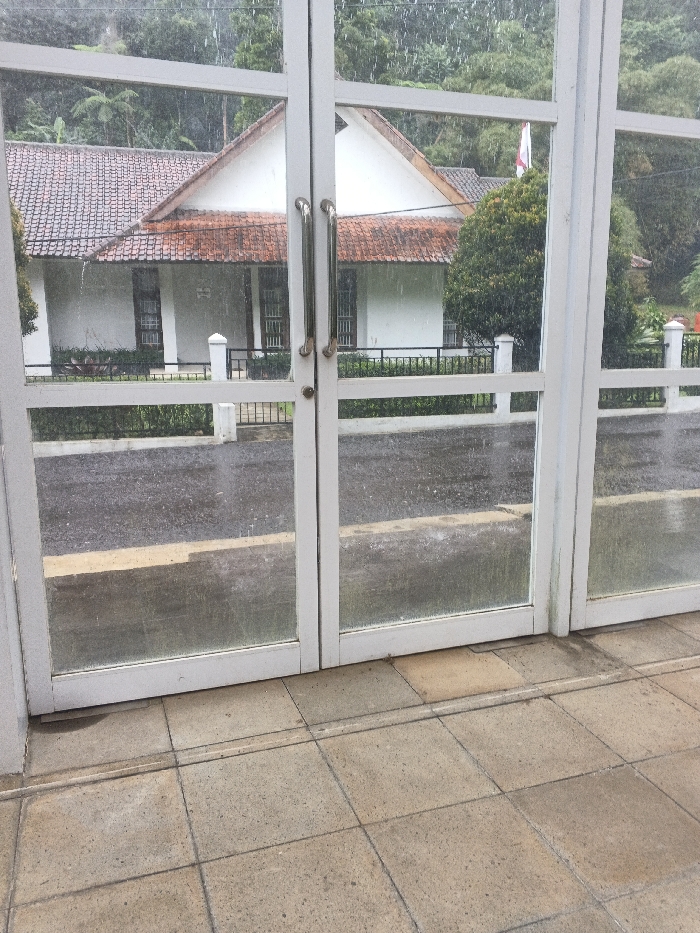
The image depicts an exterior view from inside a building in Munyati, Zimbabwe, looking through a set of white-framed glass doors or windows. The foreground consists of light brown tiled flooring. The glass panels are smudged and show visible streaks and droplets of falling rain. Beyond the glass, a wet, dark asphalt road with a yellow painted line is visible. Across the road, a black metal fence with white pillars separates the road from a property. Behind the fence, a white building with a distinctive reddish-brown tiled roof and multiple rectangular windows is situated. Green shrubs and trees are present in front of and surrounding the building. Dense green foliage and a white flag with a red emblem are partially visible further in the background, suggesting a heavily vegetated environment. No individuals are present in the scene. The weather conditions indicate active rainfall.
Munyati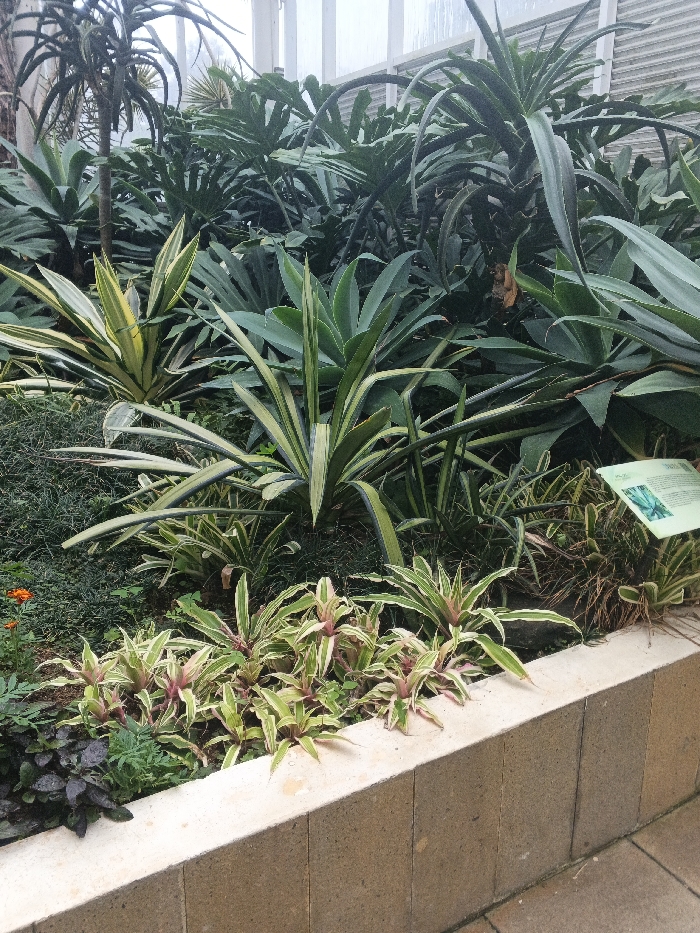
The scene depicts a meticulously maintained indoor botanical display, located in the city of Munyati, Zimbabwe. In the foreground, a light-colored, stacked block retaining wall runs horizontally, demarcating a planting area. Directly in front of this wall, to the left, are small, variegated plants featuring green, white, and reddish hues, accompanied by darker green foliage and a single orange flower. Behind the retaining wall, the mid-ground is densely populated with various succulent and foliage plants, including prominent specimens with long, sword-shaped leaves, some displaying green and yellow variegation, and others uniformly dark green. Further into the background, a lush arrangement of larger tropical plants fills the space, characterized by broad, dark green leaves, some exhibiting distinct lobed shapes. A tall, slender plant with spiky foliage rises on the left side of the frame, reaching towards a white-framed glass structure visible in the uppermost background, indicating a greenhouse or conservatory setting. On the right side, an upright light-green informational sign with text and a plant graphic is visible. No individuals are present, and no actions or interactions are occurring.
Munyati