Nagoya, Japan
30 memories from Nagoya, Japan
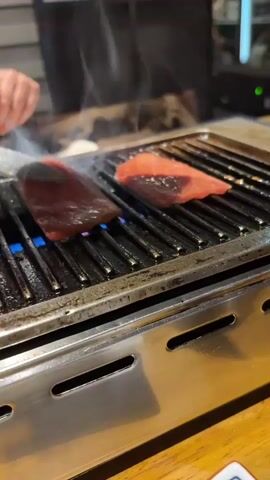
A close-up shot shows a piece of raw red meat being placed on a grill with blue flames beneath the grate. Another piece of meat, already on the grill, is sizzling and smoking. Tongs are used to maneuver the meat on the hot surface. The grill is made of stainless steel with horizontal vents. The background is out of focus, but appears to be an indoor setting with a wooden table.
Nagoya
This is a close-up shot of food being grilled on a metal grate. There are two pieces of white, raw food on the grate, and a third piece is being held by silver tongs and lowered onto the grate. Blue flames are visible beneath the grate, indicating that the grill is on. The background is dark and out of focus. The focus is on the food and the grilling process.
Nagoya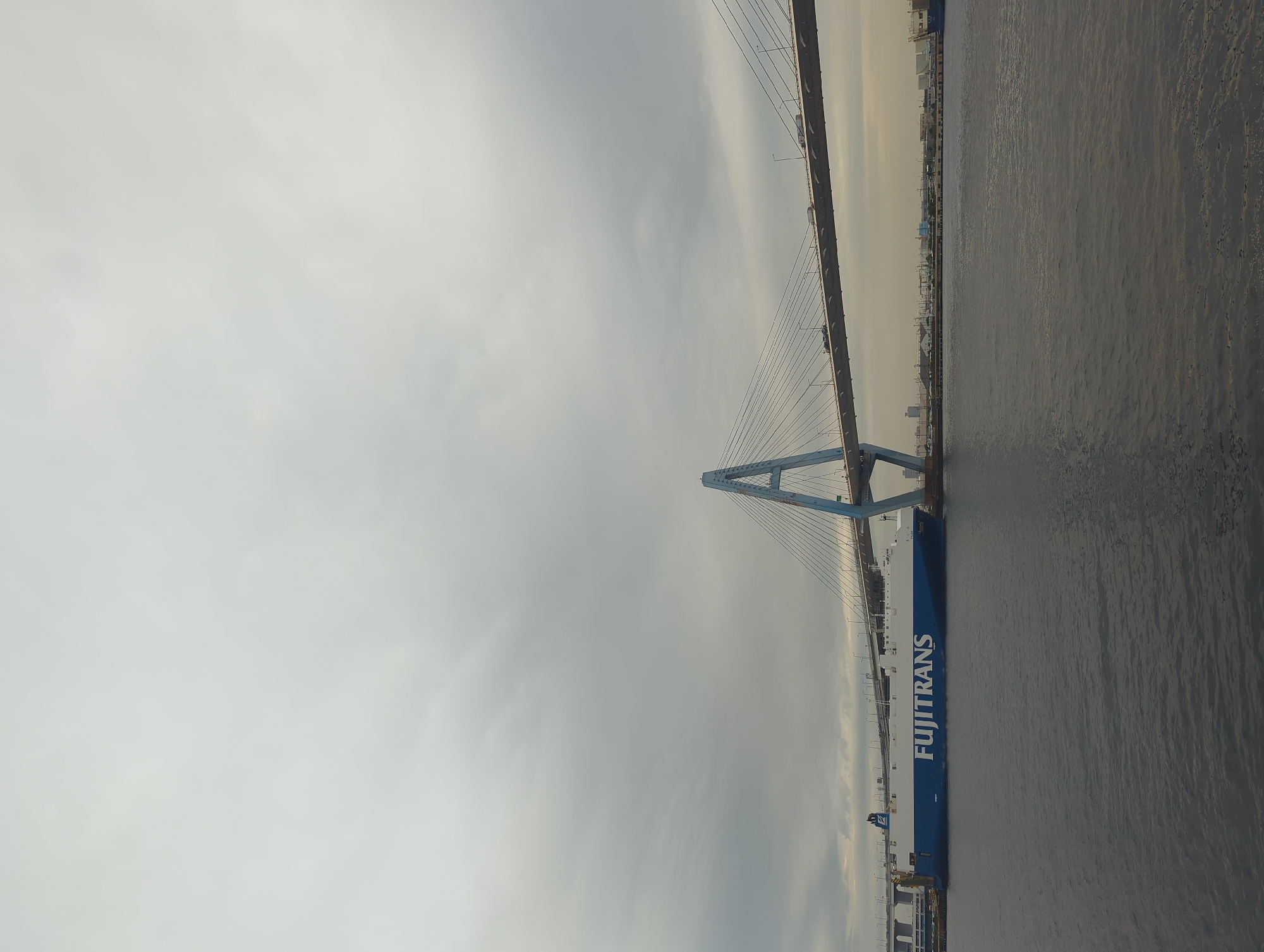
The image shows a car carrier ship named "FUJITRANS" docked in Nagoya, Japan, likely in the Port of Nagoya. The ship is large and blue and white, with "FUJITRANS" written in large white letters on its side. In the background, a large suspension bridge spans the water, with cars visible on its roadway. The sky is overcast with gray clouds. The water is dark and calm. The overall scene suggests a bustling port environment with significant industrial infrastructure.
Nagoya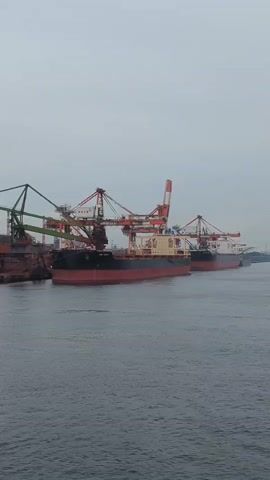
The video shows a large industrial port with several cargo ships docked. Cranes are positioned over the ships, likely for loading or unloading cargo. The port is surrounded by industrial facilities, including smokestacks emitting plumes of smoke. The water appears calm, and the sky is overcast. The scene suggests ongoing commercial activity at a busy shipping hub.
Nagoya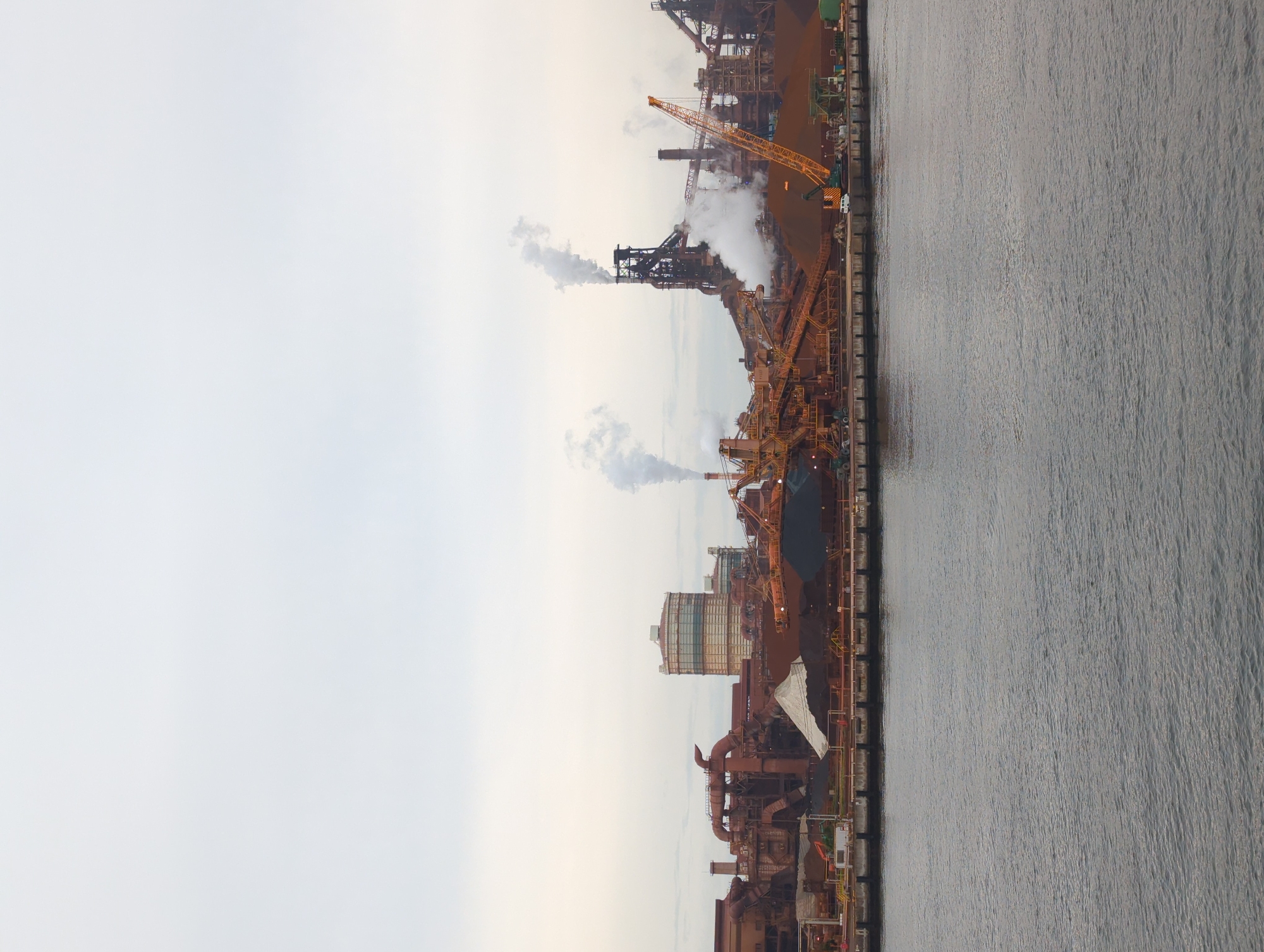
The image depicts a sprawling industrial complex situated along a body of water, likely a port, in Nagoya, Japan. The scene is dominated by large-scale industrial structures, including towering stacks, cranes, and a network of pipes and machinery, all rendered in shades of rust and metal. Several of these structures are actively emitting plumes of white steam or smoke into the overcast sky, indicating ongoing industrial processes. The time of day appears to be either early morning or late afternoon, given the diffused light and muted colors of the sky. The weather is cloudy, contributing to the somewhat somber atmosphere of the industrial landscape. The water to the right of the complex is calm, with a textured surface reflecting the subdued light. No people are visible in the image, emphasizing the scale and automation of the industrial operations. The overall impression is one of heavy industry and manufacturing, with the complex stretching along the waterfront. The location is identified as Nagoya, Japan, which is known for its significant industrial and port activities. There is no visible text in the image.
Nagoya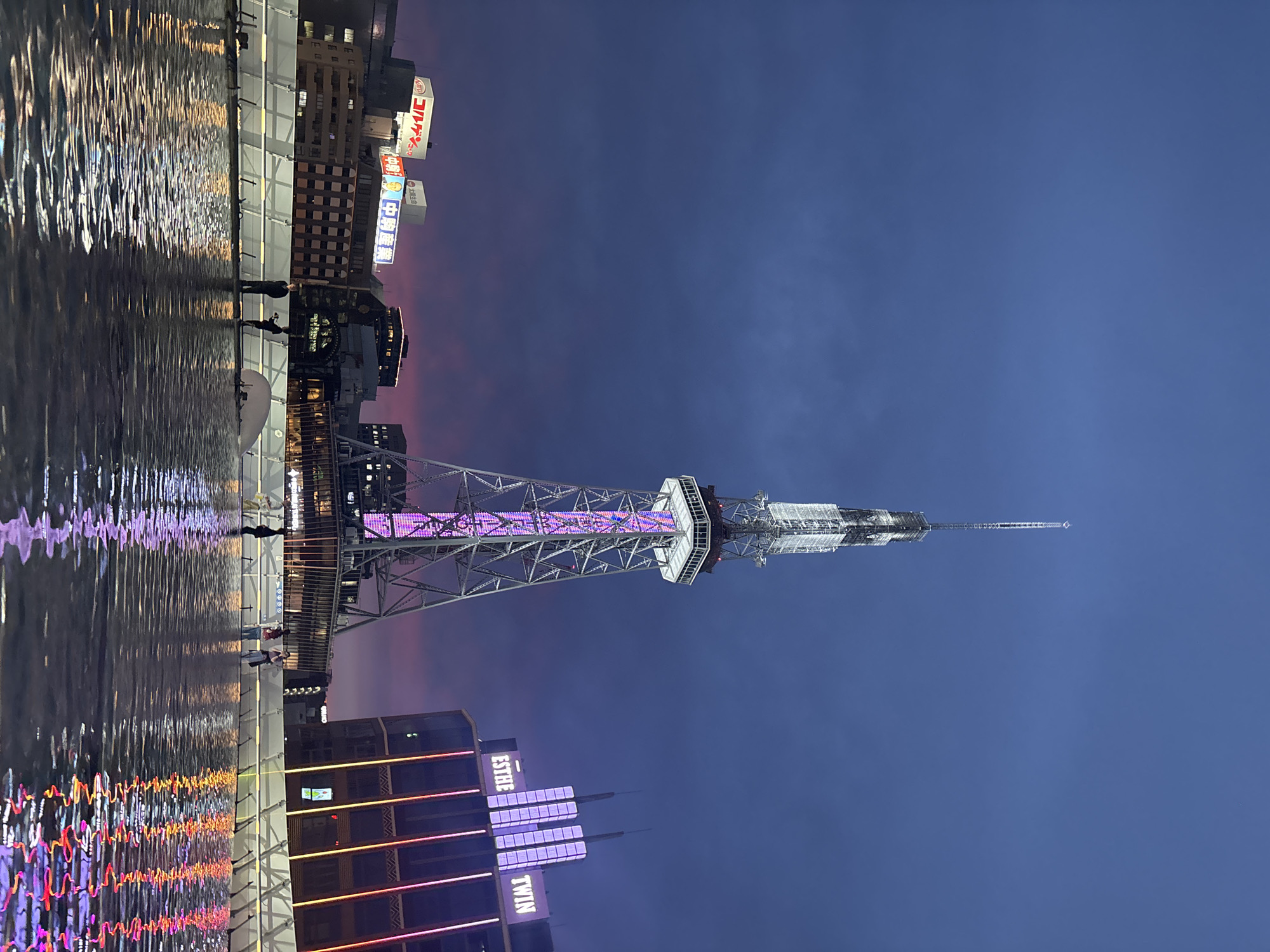
The image captures the Nagoya TV Tower and the surrounding cityscape at dusk, with a hint of pink and purple in the sky. The TV tower, a prominent landmark in Nagoya, Japan, stands tall with its lattice structure illuminated by purple lights along its central section. To the right of the tower is a modern building with "ESTHE" and "TWIN" displayed in illuminated lettering. In the foreground, a body of water reflects the lights of the buildings and the sky, with several people standing along a white barrier overlooking the water. The water's surface is rippled, creating distorted reflections of the urban landscape. Several smaller buildings with illuminated signs are visible in the background, contributing to the vibrant urban setting.
Nagoya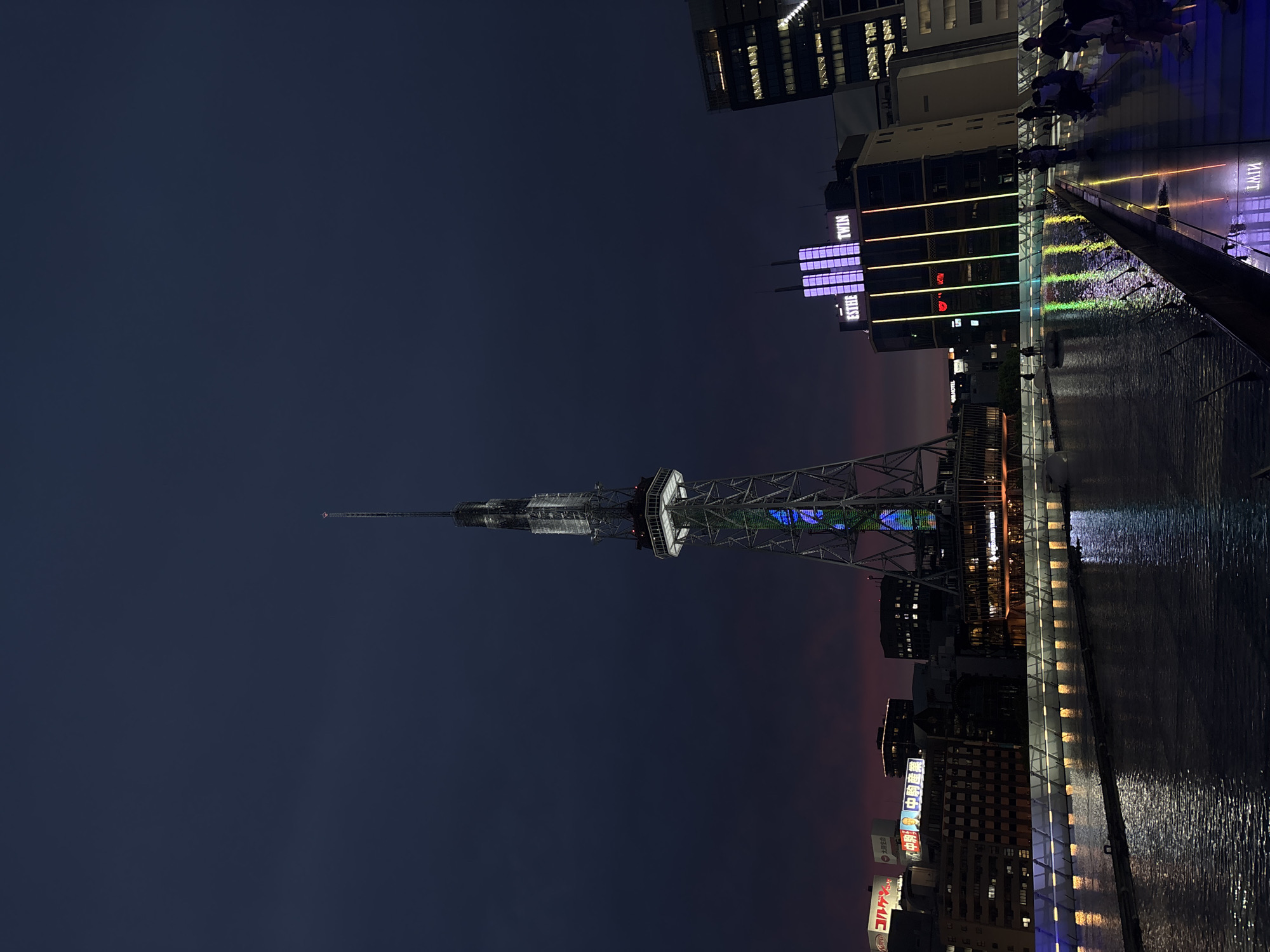
The image depicts a night scene in Nagoya, Japan, likely at the Oasis 21 complex. A tall, lattice tower, identifiable as the Nagoya TV Tower, dominates the center of the frame, illuminated with blue and green lights along its structure. In the foreground, a reflective water surface, part of Oasis 21's "Water Spaces," mirrors the surrounding lights and the twilight sky, which shows hues of deep blue transitioning to a subtle pinkish-red near the horizon. Several buildings are visible to the left and right of the tower. To the right, a modern building features illuminated vertical lines of colored lights and a purple illuminated sign reading "ESTHE TWIN". People are present, walking along the elevated walkway and near the edge of the water feature, their forms partially silhouetted against the illuminated environment. The overall atmosphere is urban and modern, with a focus on illuminated architecture and public spaces at dusk.
Nagoya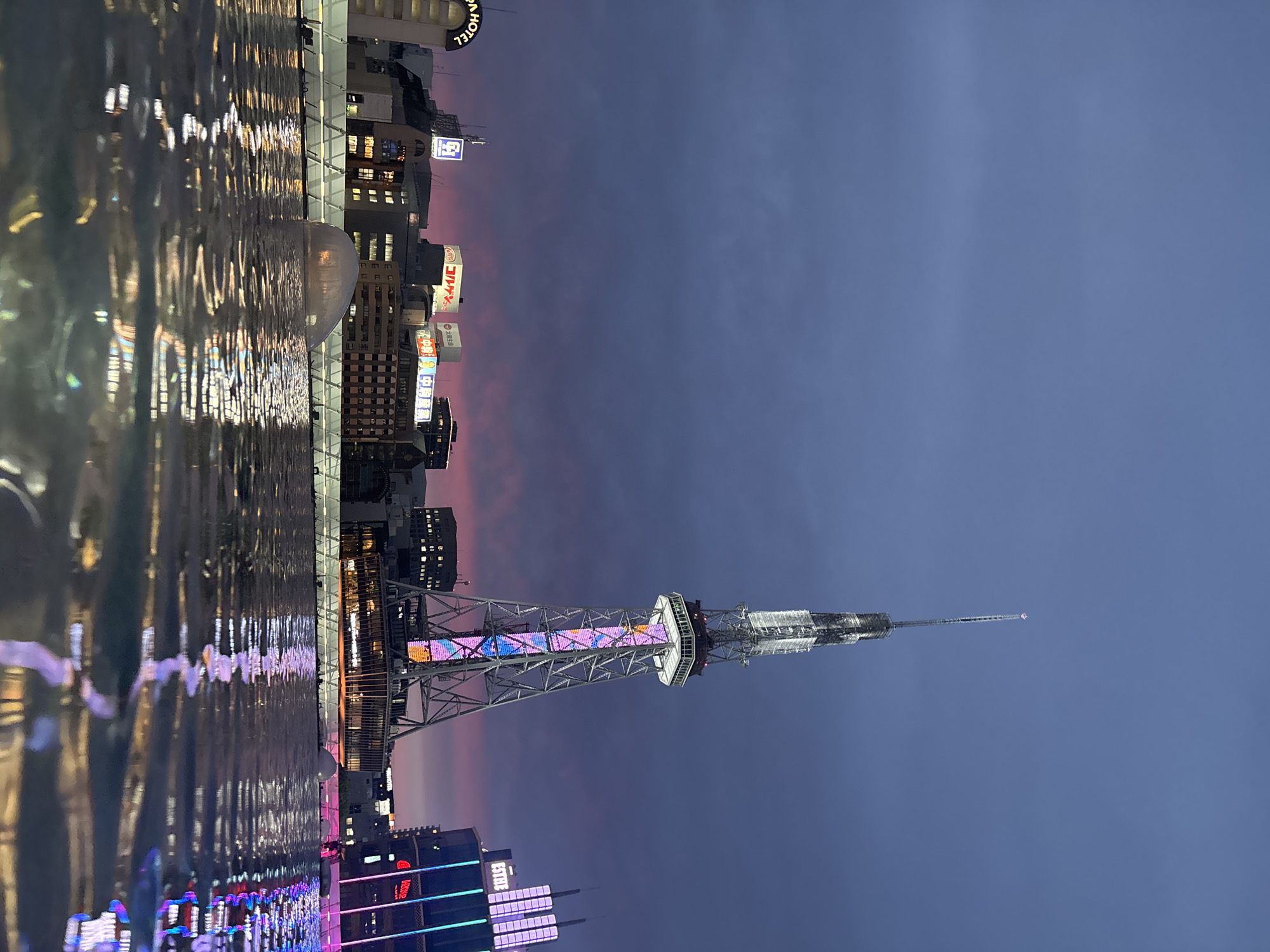
This image captures a twilight scene in Nagoya, Japan, likely from a rooftop vantage point. The most prominent feature is the Nagoya TV Tower, its lattice structure illuminated with vibrant, shifting colors. The sky is a deep indigo transitioning to a soft pink and orange horizon, indicative of a sunset or afterglow. In the foreground, a body of water, possibly a swimming pool or reflective surface, mirrors the colorful lights of the city and the tower. The ripples on the water's surface distort the reflections, creating abstract patterns of light. Behind the tower, a cityscape unfolds with various buildings. Some display illuminated signage, including "KOTSUGEN" and "DAIICHI KANKO." The architecture suggests a commercial or entertainment district. To the right of the tower, another skyscraper glows with purple and blue neon lights. There are no visible people in the immediate foreground. However, in the far right background, near the glowing skyscraper, a few figures can be faintly discerned, suggesting the presence of people in the urban environment. The overall atmosphere is one of modern urban beauty, enhanced by the dramatic interplay of natural twilight and artificial illumination.
Nagoya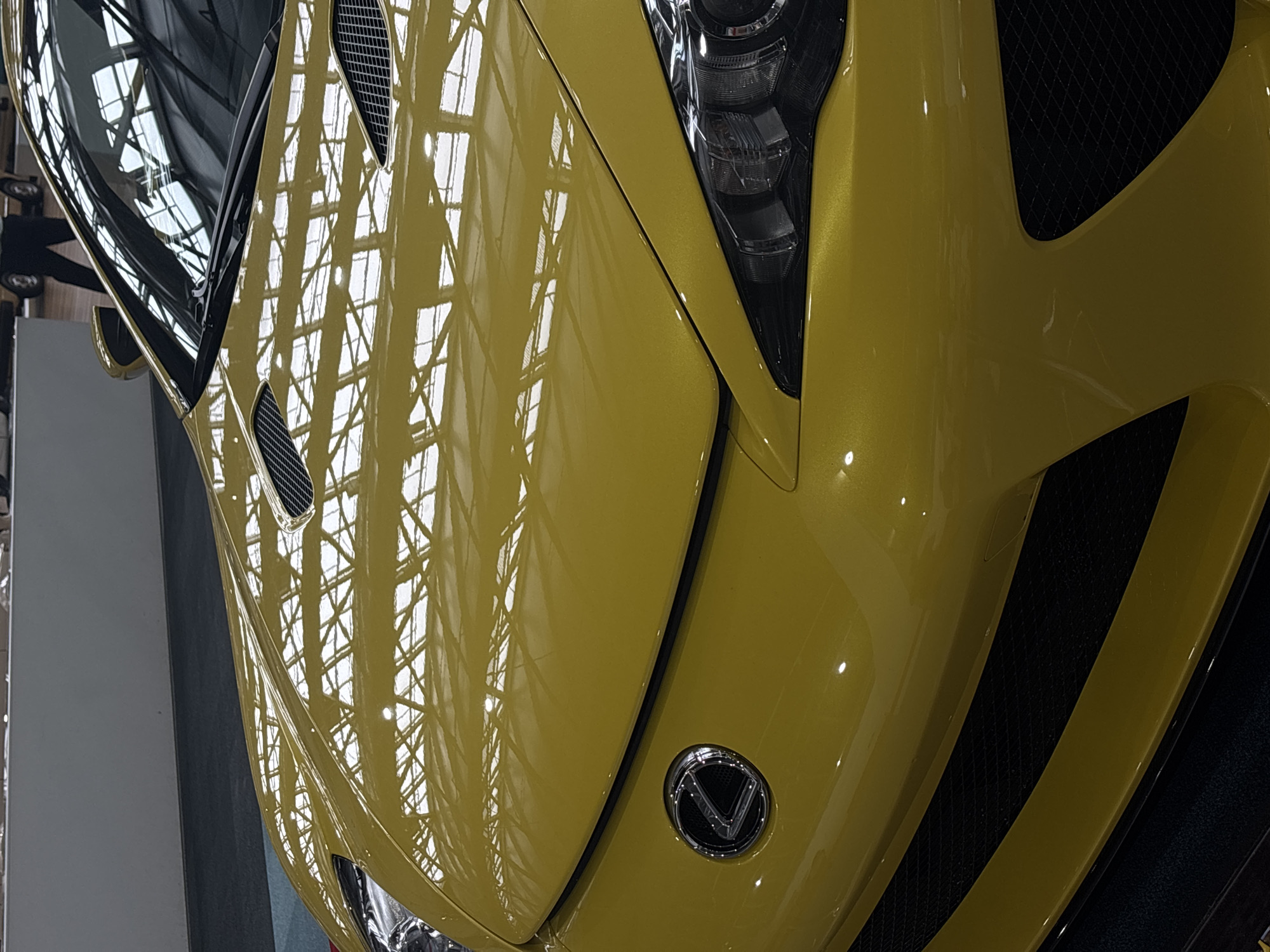
The image shows the front of a yellow Lexus LFA supercar on display at the Lexus showroom in Nagoya, Japan. The car is positioned indoors, with a reflective ceiling overhead that casts a grid-like pattern onto the car's hood. The showroom appears spacious, with a dark floor and a lighter wall visible in the background. A person, likely an employee or visitor, is partially visible in the upper right portion of the image, their silhouette reflected on the car's windshield. The car's design features prominent headlights, a distinctive Lexus emblem on the hood, and aggressive vents. The lighting is bright, emphasizing the car's metallic paint finish.
Nagoya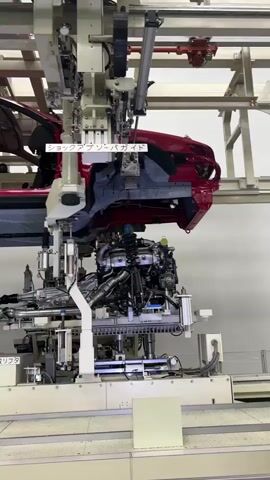
A robotic arm is installing a shock absorber onto a car engine assembly. The engine assembly is suspended from above. The car body is partially visible at the top of the frame. Text overlays read "ショックアブソーバガイド" which translates to "Shock Absorber Guide". The environment appears to be a factory floor.
Nagoya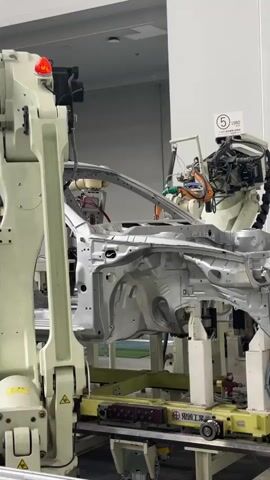
The video shows an automated car manufacturing process. Several industrial robotic arms are positioned around the chassis of a car. The chassis is mounted on a platform that appears to be moving along a production line. The robotic arms are equipped with various tools and appear to be engaged in assembly or welding operations on the car's frame. The environment is a brightly lit factory floor with large white walls and industrial equipment. There are no people visible in the video. The robots are the primary actors, moving precisely and efficiently to construct the vehicle. The focus is on the mechanical and automated nature of the car manufacturing process.
Nagoya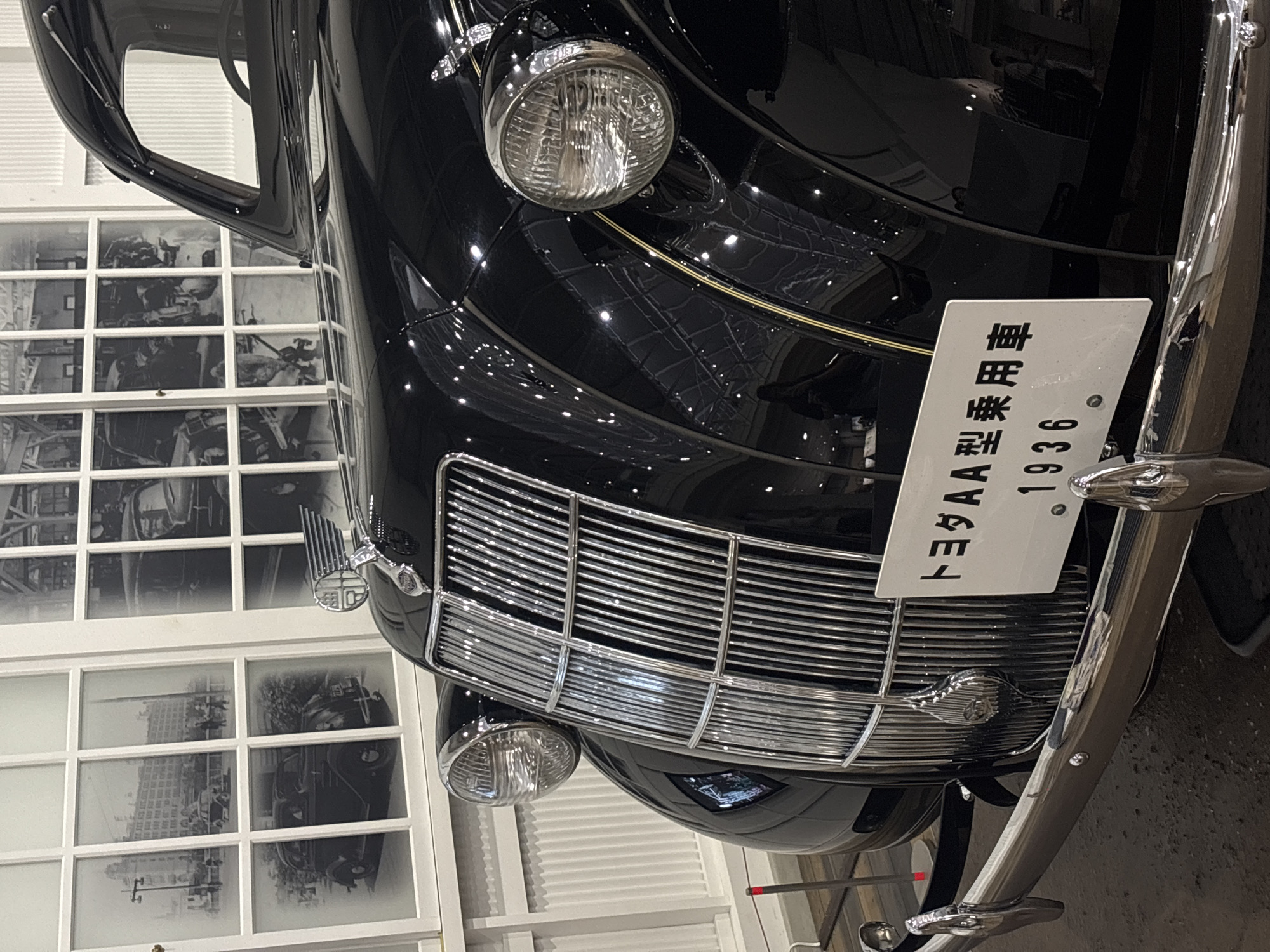
The image shows the front of a black vintage Toyota AA passenger car from 1936, displayed at the Toyota Commemorative Museum of Industry and Technology in Nagoya, Japan. The car features a prominent chrome grille, two round headlights, and a hood ornament. A license plate with Japanese text and "1936" is attached to the front bumper. Behind the car, a wall with large windows displays historical black and white photographs of early automobiles and factory scenes, offering a glimpse into automotive history. The environment appears to be an indoor exhibition space with controlled lighting, highlighting the car's polished surface.
Nagoya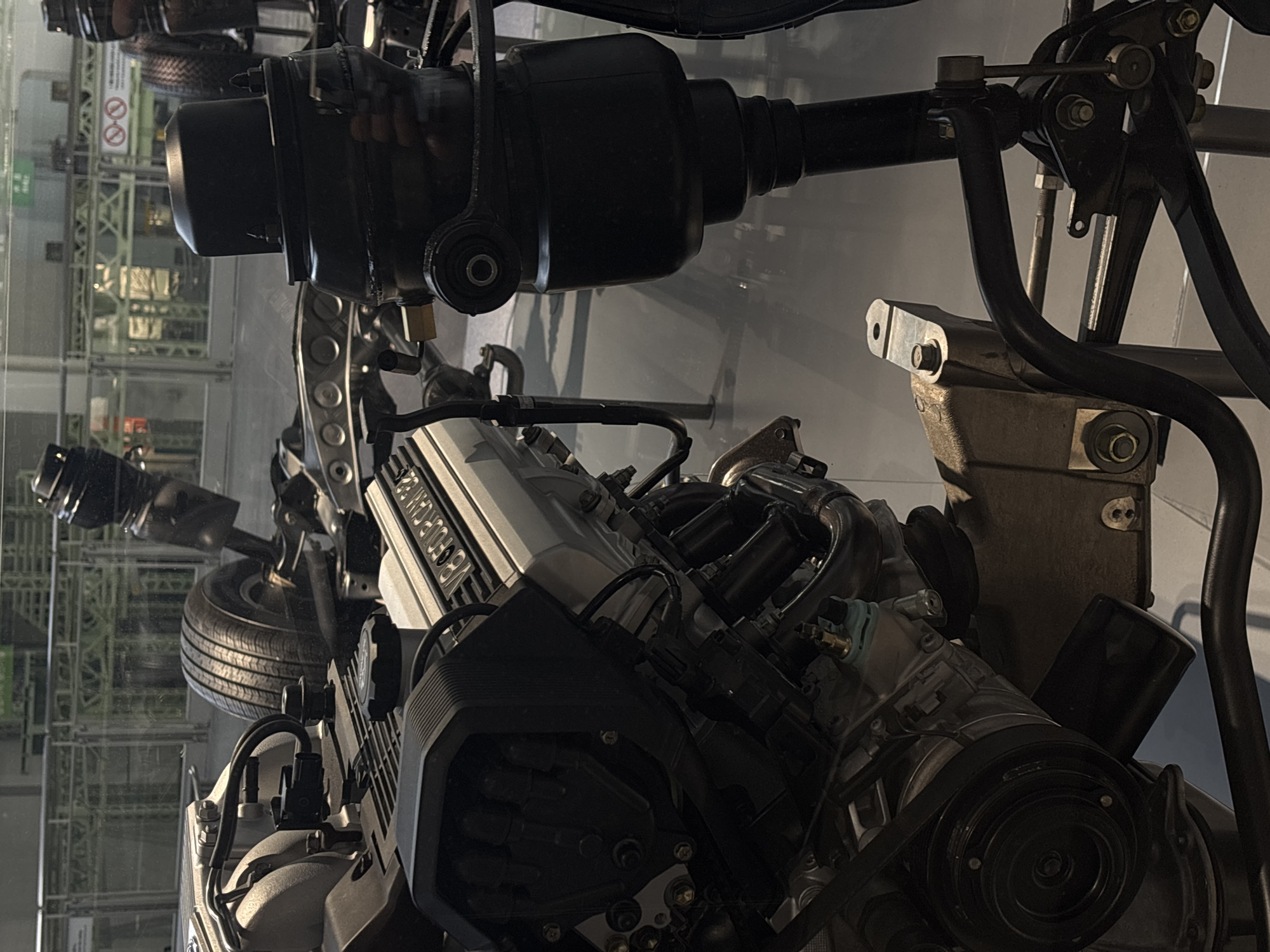
The image displays a V8 engine with "V8 FOUR CAM 32" text visible on its silver casing. The engine is mounted on a chassis, with a tire and suspension components also visible. The scene appears to be an exhibit within a museum or exhibition space, suggested by the polished floor and glass barrier in the foreground. In the background, there are industrial-style structures and some signage, possibly indicating a factory or a science museum. The overall lighting is artificial and somewhat dim, with reflections on the glass suggesting an indoor environment. Based on the context of automotive exhibits and the presence of such engines, this scene is likely located at the Toyota Commemorative Museum of Industry and Technology in Nagoya, Japan.
Nagoya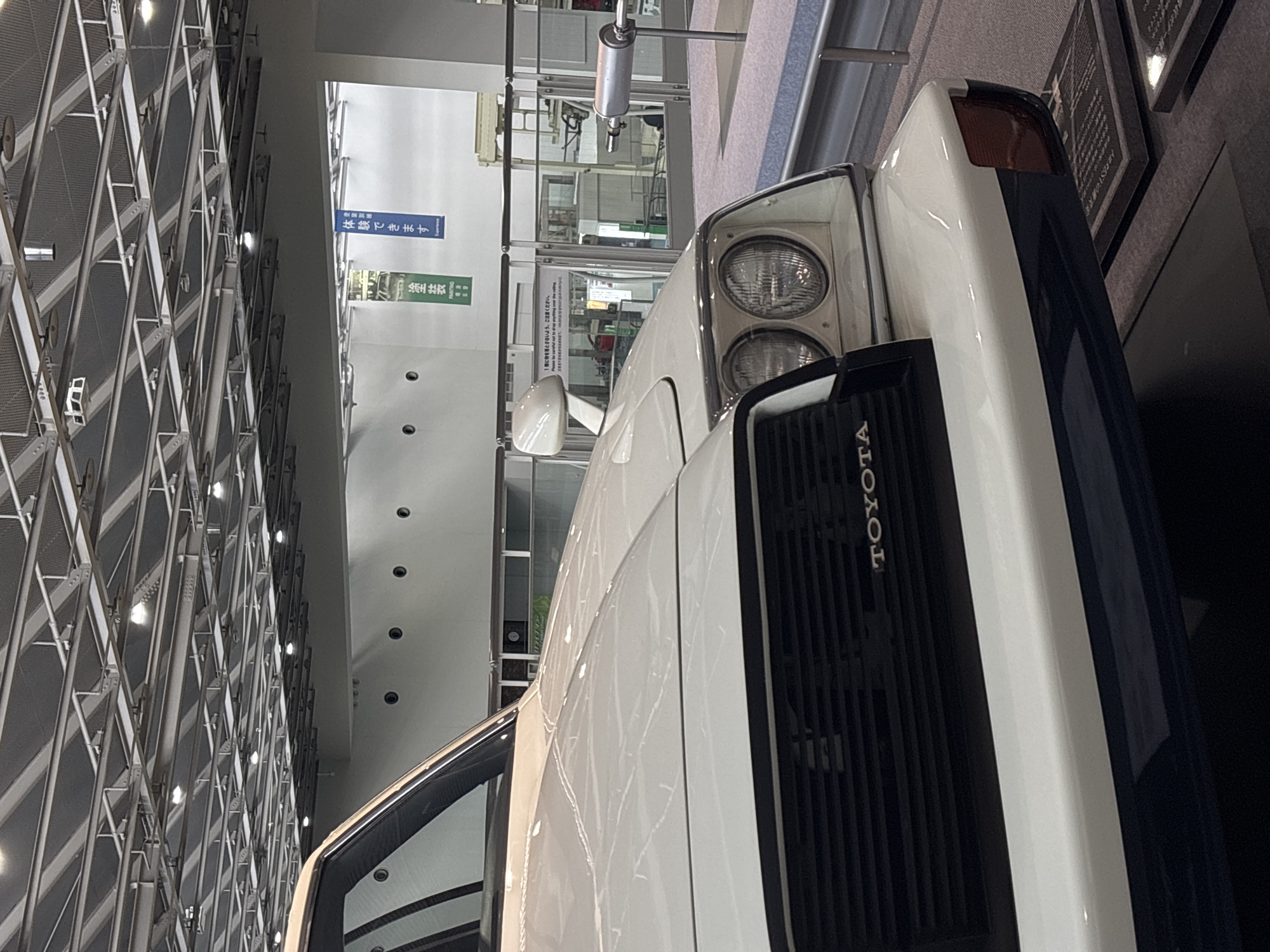
The image shows a close-up of the front of a white Toyota car on display. The car has a black grille with the "TOYOTA" logo visible. The headlights are round and dual. A dark blue bumper is visible below the white body. In the background, there are metal beams and lights on the ceiling of what appears to be an indoor exhibition hall. Two vertical banners hang in the background; one is green and reads "PAINTING" and the other is blue and reads "Experience." There is also a metal railing and a display of what looks like car parts, including an exhaust pipe. The scene appears to be a museum or exhibition, potentially related to automotive history. The exact location in Nagoya, Japan cannot be determined from the image alone, but the presence of Japanese text on the banners and the style of the car suggest it is likely in Japan.
Nagoya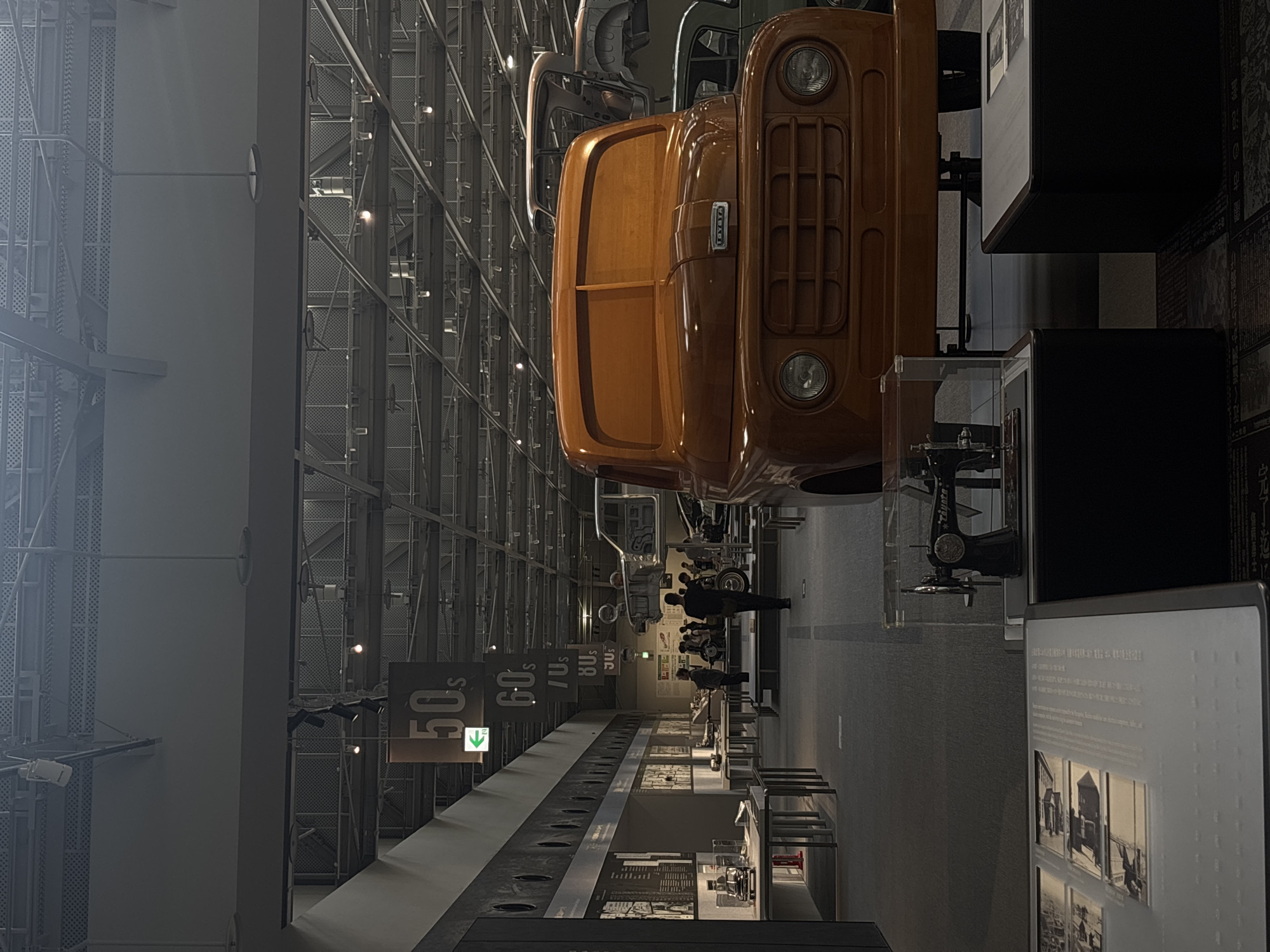
The image depicts the interior of the Toyota Commemorative Museum of Industry and Technology in Nagoya, Japan, with a focus on the automotive exhibits. In the foreground, a large, orange wooden model of a truck, likely a historical Toyota model, dominates the right side of the frame. To the left of the truck, a sewing machine is displayed under a glass case on a black pedestal. In the background, other vehicle chassis and historical exhibits are visible, alongside a group of visitors observing the displays. Overhead, the museum's industrial ceiling structure with exposed beams and lighting is apparent. Signs indicating "50s" and "60s" hang from the ceiling, marking different exhibit sections. The environment is well-lit, showcasing the various artifacts and the architectural features of the museum.
Nagoya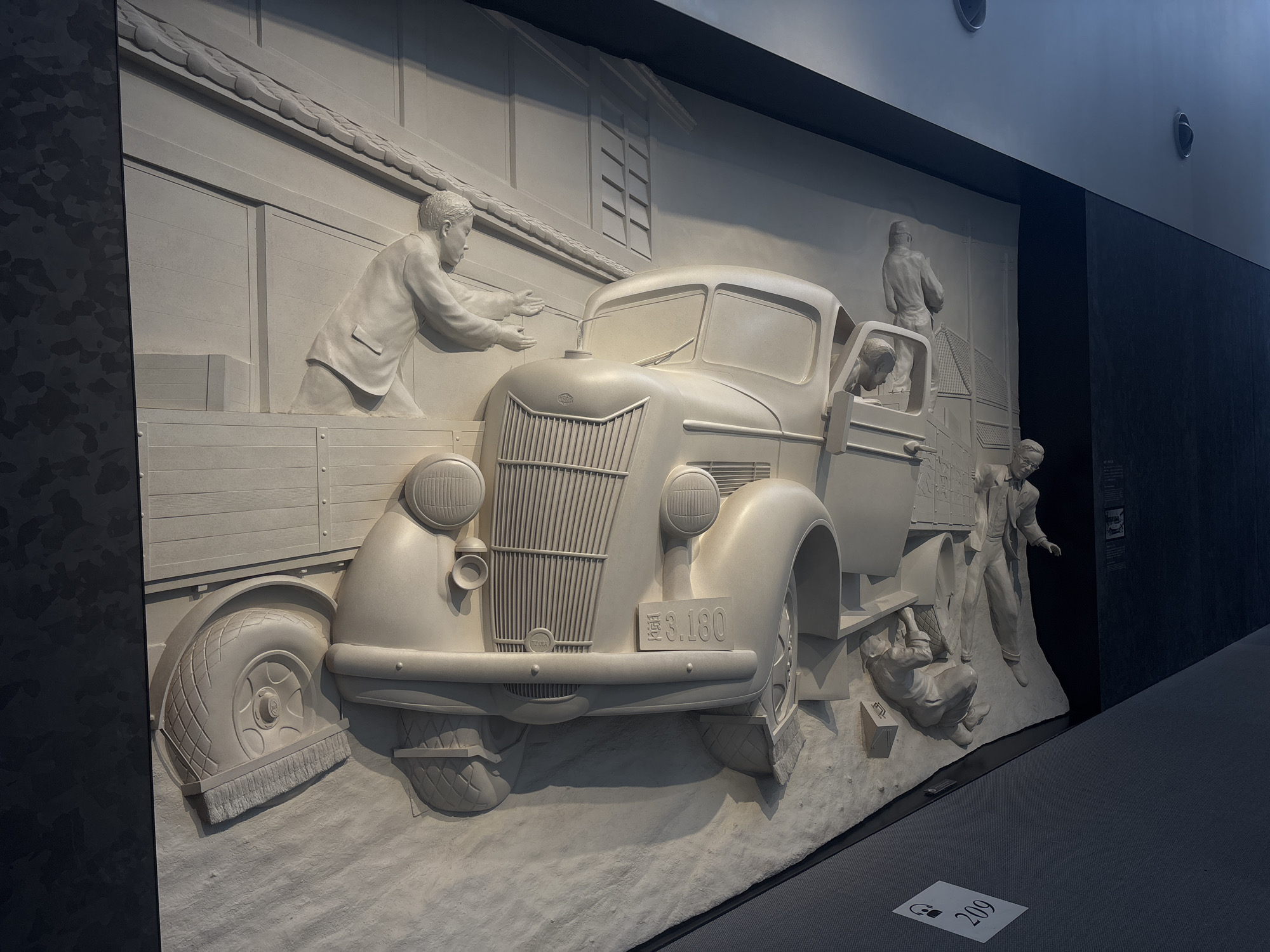
This image depicts a large, three-dimensional bas-relief sculpture, likely in a museum or exhibition space. The sculpture is rendered in a light-colored material, possibly plaster or stone, and is mounted on a dark wall. The scene portrays a historical moment involving a vintage truck and several figures. The central focus is a light-colored truck, reminiscent of a mid-20th-century model, with a prominent grille and rounded headlights. A license plate on the front reads "S.3.180" in English and possibly Japanese characters. The truck has an open cab with figures inside and around it. On the left side of the sculpture, a man in a suit is leaning over the truck's bed, appearing to be loading or unloading something. His hands are extended towards the truck. In the truck's cab, a figure is visible, looking outwards. Another figure stands behind the truck, facing away from the viewer, possibly directing or overseeing the operation. To the right of the truck, another man in a suit is leaning down, appearing to be working on the truck's tire or wheel, with a small suitcase next to him. The background of the sculpture depicts architectural elements, possibly a building with a tiled roof and windows, suggesting an urban or industrial setting. The ground beneath the truck and figures is rendered in a textured, uneven manner, suggesting a natural or rough terrain. The sculpture is illuminated by artificial lighting, casting shadows that enhance the three-dimensional effect and highlight the details of the figures and the vehicle. The overall presentation is clean and well-maintained, indicative of a public exhibition. The provided hint that this is in Nagoya, Japan, suggests this sculpture might be related to the industrial history of the city, possibly commemorating transportation or early automotive development in Japan. The license plate format, with English characters and numbers, might be a stylistic choice to represent a historical period or a specific event.
Nagoya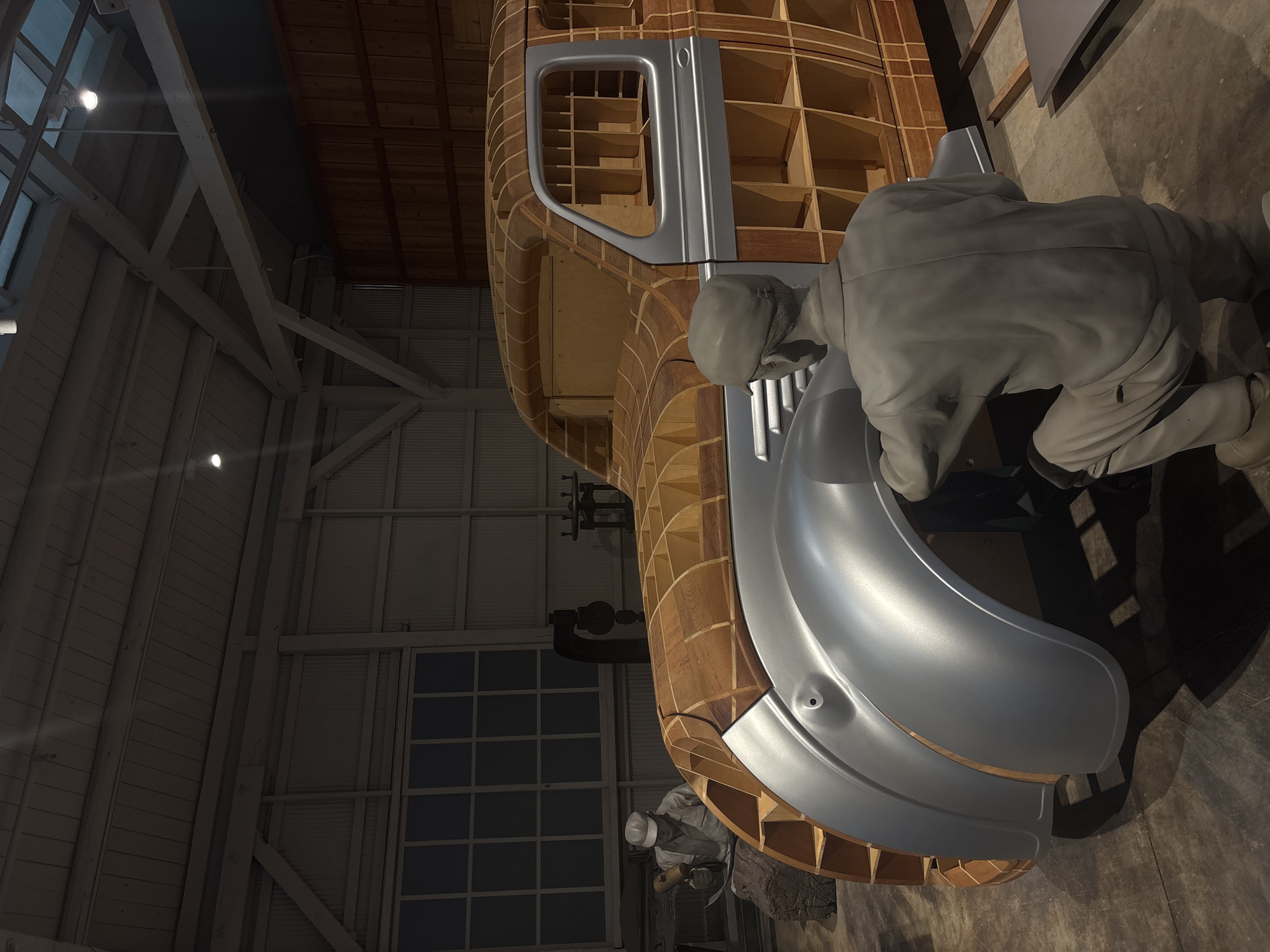
This image depicts a diorama in the Toyota Commemorative Museum of Industry and Technology in Nagoya, Japan, illustrating the automobile manufacturing process. In the foreground, a gray, life-sized mannequin of a man is kneeling and appears to be working on the fender of a car body. The car body itself is under construction, with a wooden frame visible beneath a partially completed silver exterior. Further in the background, another mannequin of a man in a cap is seated and holding a tool, suggesting assembly or shaping work. The environment is an indoor workshop setting, with a concrete floor, corrugated metal walls, and a wooden beamed ceiling with exposed lighting. Large windows with a grid pattern are visible on the back wall, and industrial machinery is present in the mid-ground. The lighting is dim, with spotlights illuminating the main subjects.
Nagoya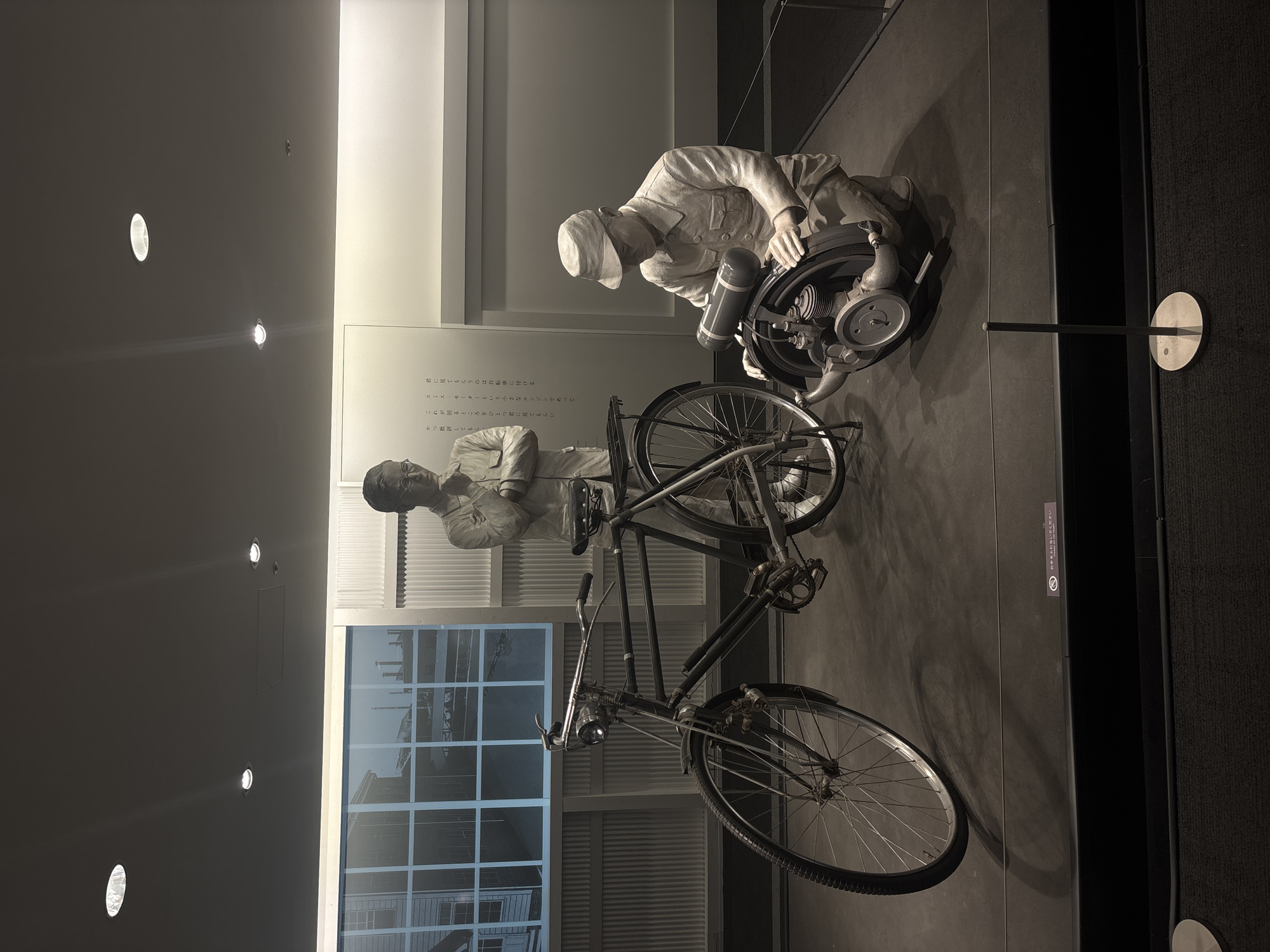
This image depicts a diorama inside a museum, likely in Nagoya, Japan, showcasing historical industrial or technological development. Two life-sized mannequins, sculpted in a monochromatic, realistic style, are the central subjects. On the left, a mannequin stands upright, dressed in a simple uniform with rolled-up sleeves, wearing glasses, and with his chin resting on his hand in a contemplative pose. Beside him is a vintage bicycle. On the right, a second mannequin, also in a uniform and wearing a cap, is kneeling and appears to be working on a small engine or mechanical device. The engine is mounted on a stand and features visible pipes and a circular component. The mannequins and the bicycle are placed on a dark, elevated platform. Behind them, a stylized backdrop features a large window with a grid pattern, revealing an image of industrial buildings or factory structures. To the right of the window, a textured wall with vertical ridges is visible, and further to the right, a plain light-colored wall. The lighting in the scene is subdued, emanating from spotlights on the ceiling, creating distinct shadows on the platform. A thin rope barrier runs in front of the display, and a small sign with Japanese text and an icon is attached to the edge of the platform. The overall atmosphere is one of historical preservation and exhibition.
Nagoya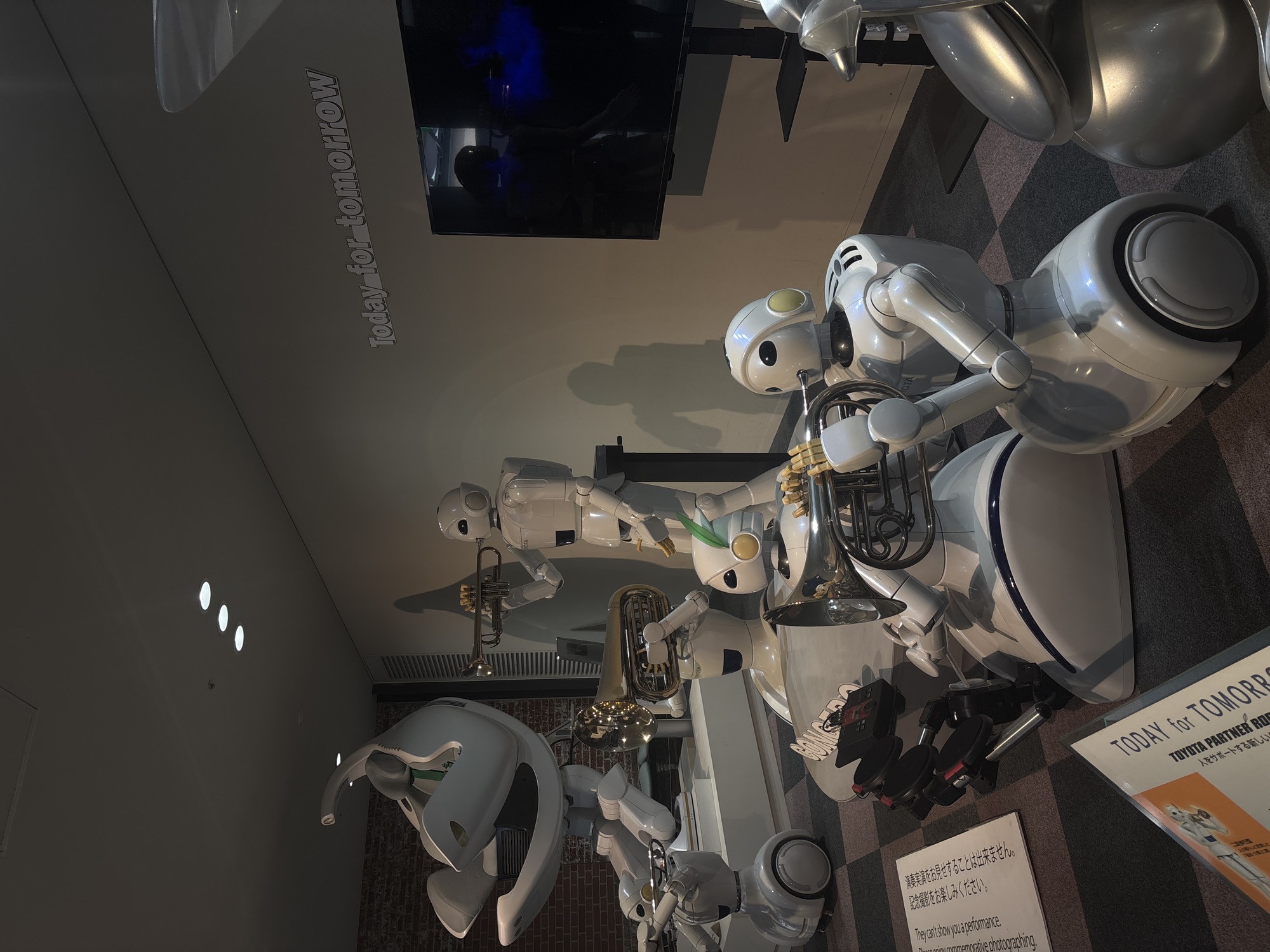
The image depicts an indoor exhibition featuring several white, humanoid robots with musical instruments, likely in the city of Nagoya, Japan. In the foreground, a robot with a large tuba-like instrument is positioned prominently. To its left, another robot holds a smaller trumpet, and further back, a third robot plays a trumpet. A larger, more complex robot structure is visible on the left side of the image, partially obscuring the background. In the background, a large screen displays reflections of people. The robots are arranged on a checkered floor. A sign with Japanese text is visible in the lower left quadrant, and another sign with the text "TODAY FOR TOMORROW" is visible in the lower right. The overall atmosphere suggests a technology or robotics exhibition.
Nagoya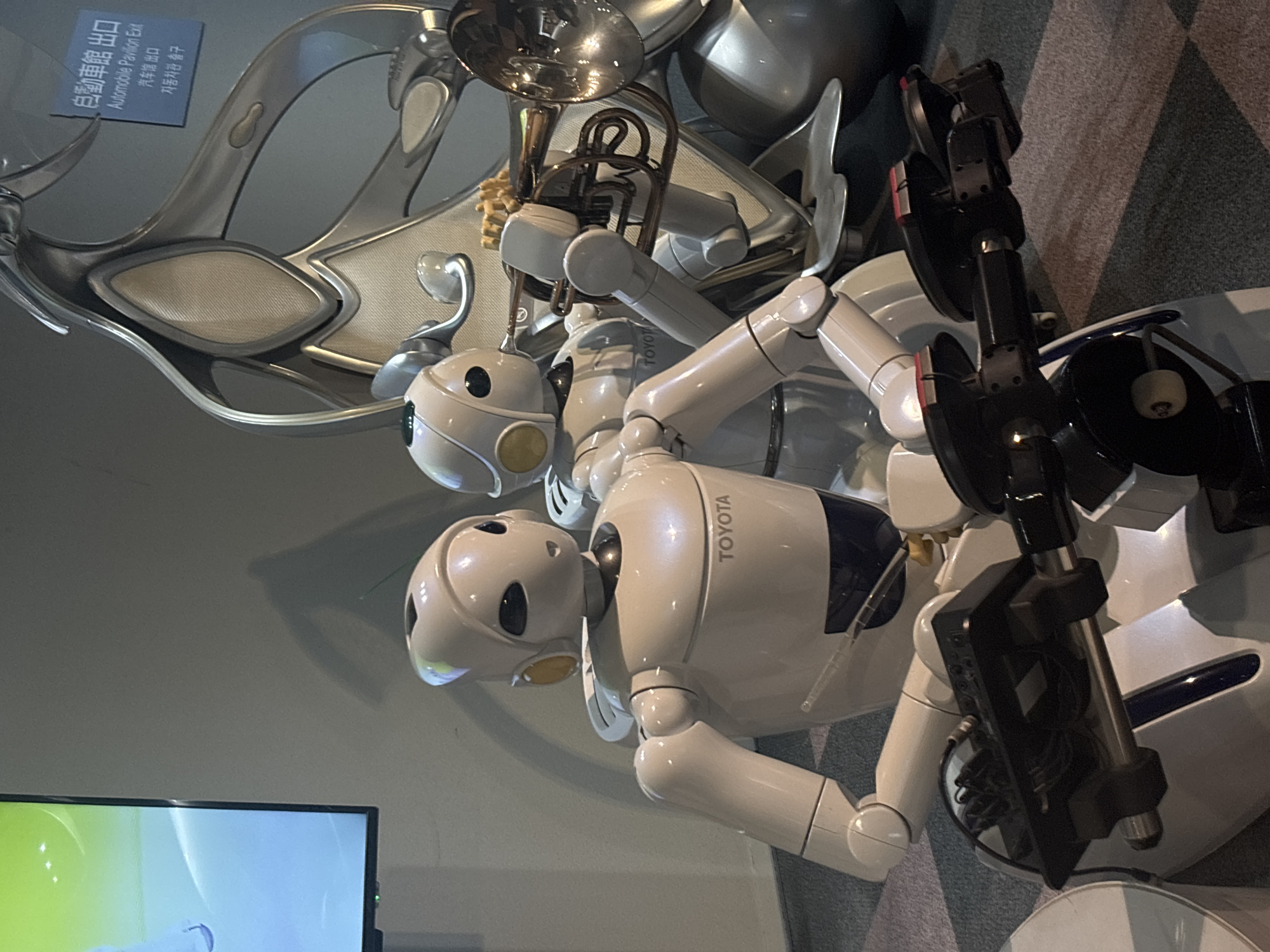
This is a medium shot photograph of two white robots, one slightly taller than the other, seated on what appears to be a display platform with a vehicle-like structure. The taller robot is on the left and has the word "TOYOTA" printed on its chest. This robot is posed as if controlling a vehicle with handlebars. The robot on the right, slightly behind and to the right, is playing a brass instrument, possibly a trumpet. Both robots have large, expressive eyes and circular yellow accents on the sides of their heads. The background is a gray wall with a sign in the upper right corner that reads "自動車館出口" and "Automobile Pavilion Exit" in English, along with other characters. The environment suggests an exhibition or museum setting, possibly at the Toyota Automobile Museum in Nagakute, Aichi Prefecture, Japan, which is near Nagoya. The lighting is artificial, and the overall scene is clean and well-lit.
Nagoya
The video shows a television screen displaying a white robot playing a trumpet. The robot on the screen is wearing a blue band around its neck and is positioned in front of a dark background. In the foreground, a white robot with a Toyota logo on its chest is seated. Another white robot is partially visible to the right. The robots are in what appears to be an exhibition or museum setting, with a wall featuring the word "tomorrow" in white text.
Nagoya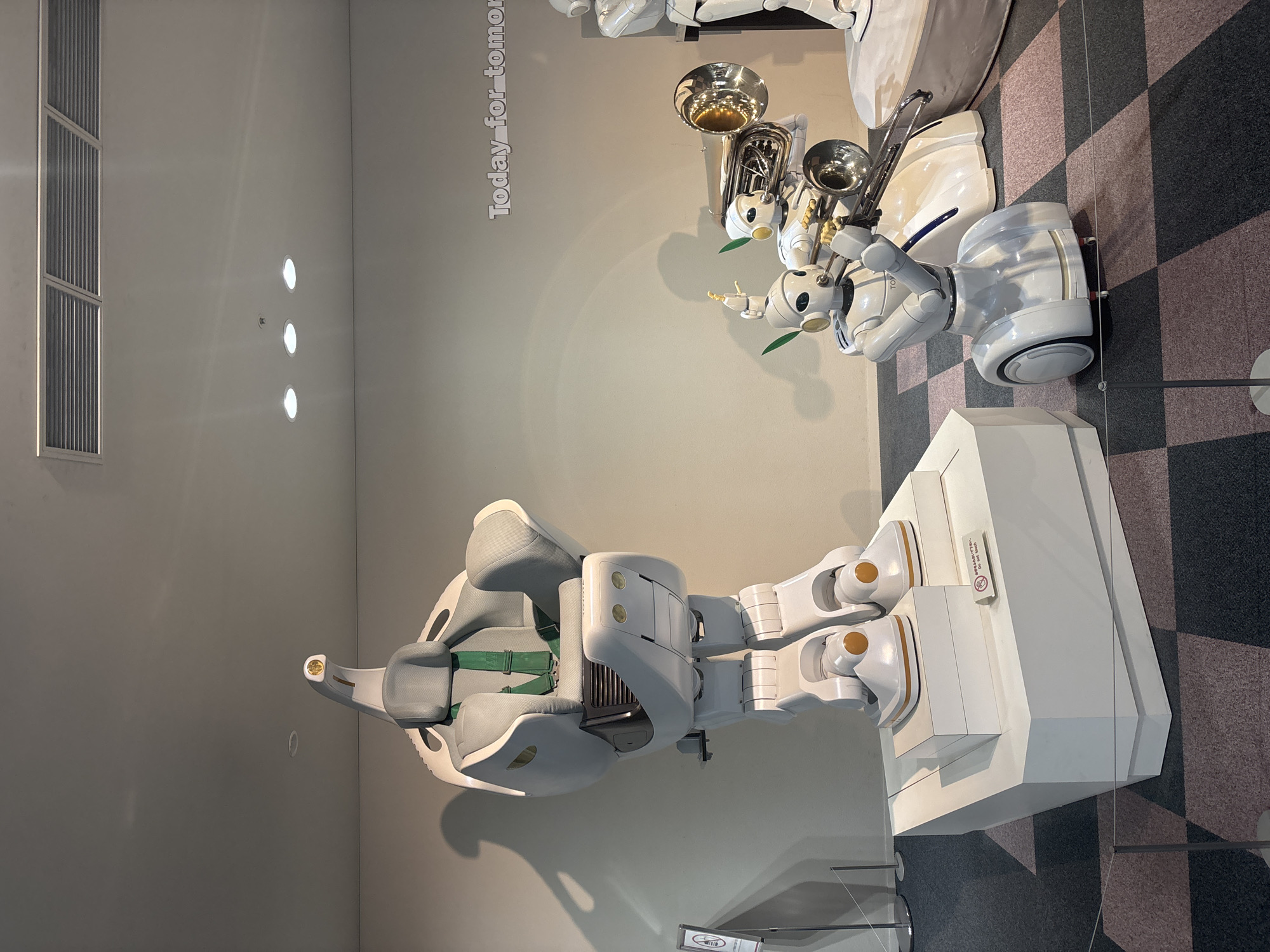
The image captures an exhibition featuring robots in Nagoya, Japan, likely at the Miraikan (National Museum of Emerging Science and Innovation) given the nature of the exhibits. The central focus is a large, white, chair-like robot with a grey seat and green restraints, resembling a high-tech, possibly interactive, vehicle. To its right, two smaller, humanoid robots are prominently displayed. One robot, positioned closer to the viewer, is playing a brass instrument, likely a trombone or tuba, with its arms extended. Another robot is partially visible behind it, also with brass instruments. The robots are situated on a checkered floor with a pattern of dark gray and pinkish-purple squares. In the background, a light beige wall displays the text "Today for tomorrow" in a stylized font. Several white pedestals or display bases support the robots. A sign that reads "Do not touch" in Japanese and English is visible on the base of the large robot. The overall environment appears to be an indoor exhibition space, well-lit with overhead lighting.
Nagoya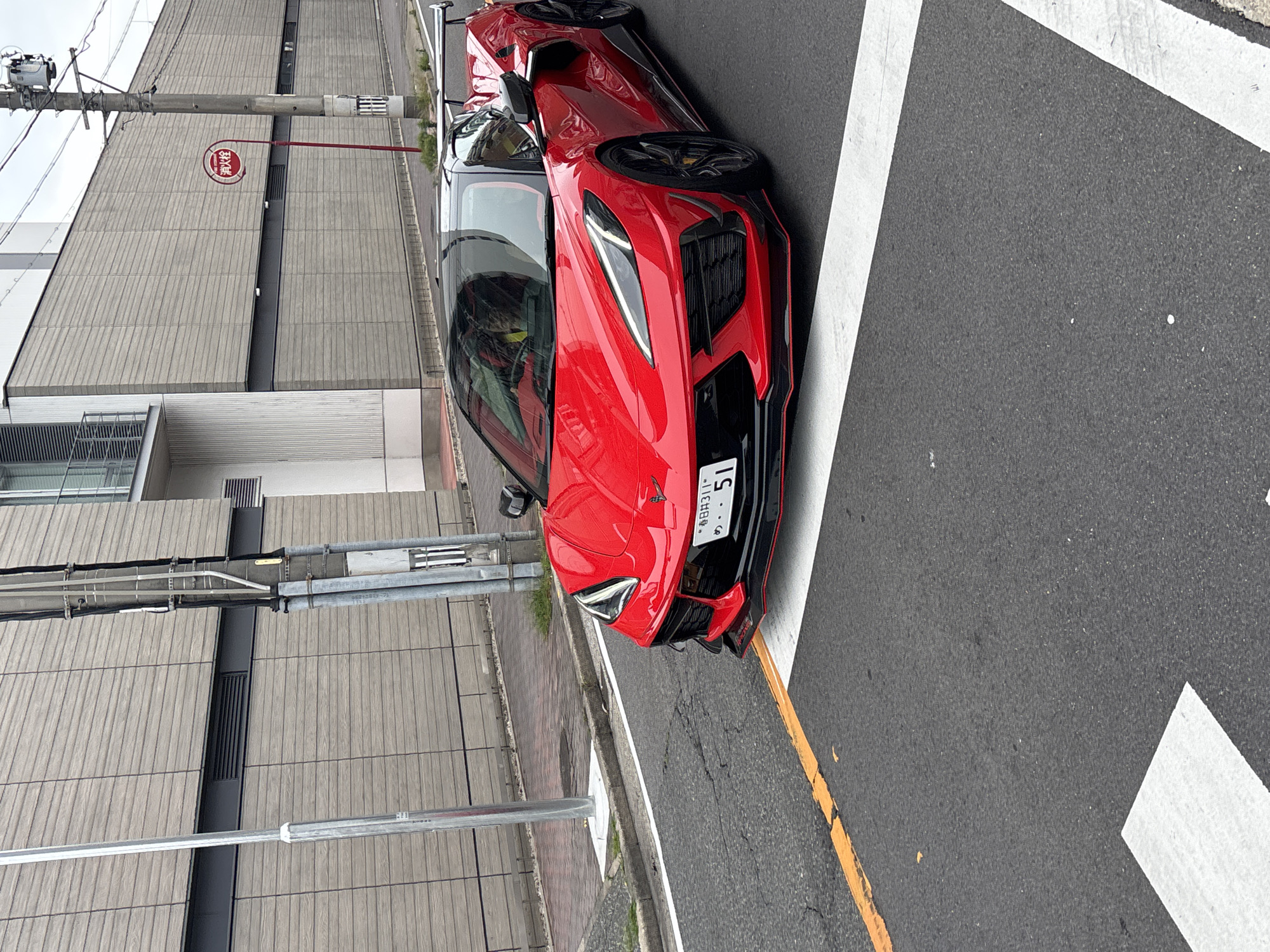
A bright red Chevrolet Corvette C8 is parked on a street in Nagoya, Japan. The car is angled towards the viewer, with its front end slightly to the left. The license plate is visible and reads "名古屋311 51". The car has a black roof and black accents, including a prominent rear spoiler. It is positioned on asphalt pavement marked with white pedestrian crossing lines and a yellow line. In the background, a modern building with horizontal wooden-like siding is visible. A utility pole stands to the right of the car, and a red and white fire alarm sign is mounted on it. The sky is overcast. The scene appears to be a typical urban street in Japan.
Nagoya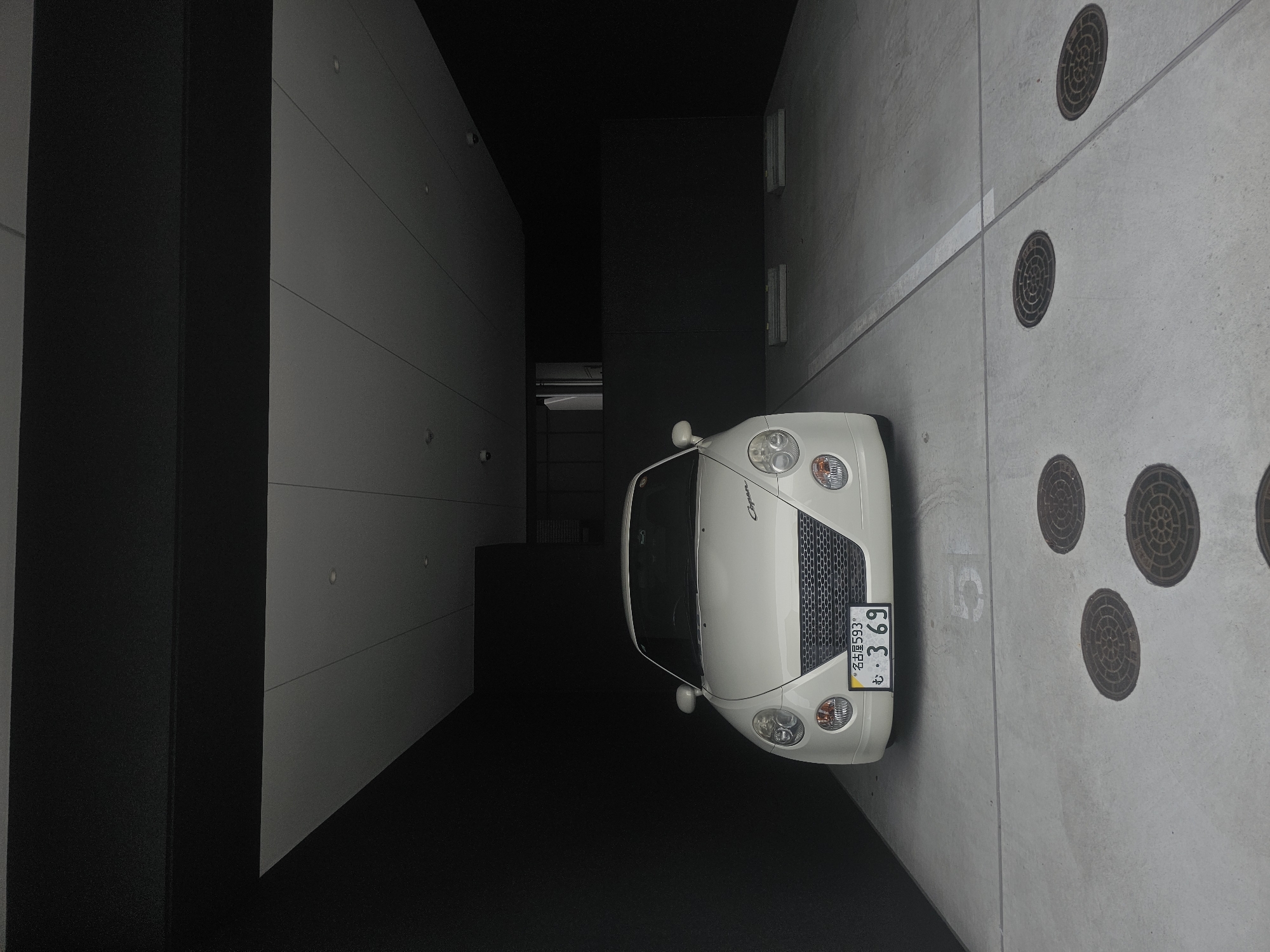
A white Daihatsu Copen convertible is parked in a covered parking garage. The car has a black honeycomb grille and a license plate that reads "Nagoya 593" and "む・3 69". The parking garage has a concrete floor with several circular manhole covers and white parking lines. The walls of the garage are dark gray.
Nagoya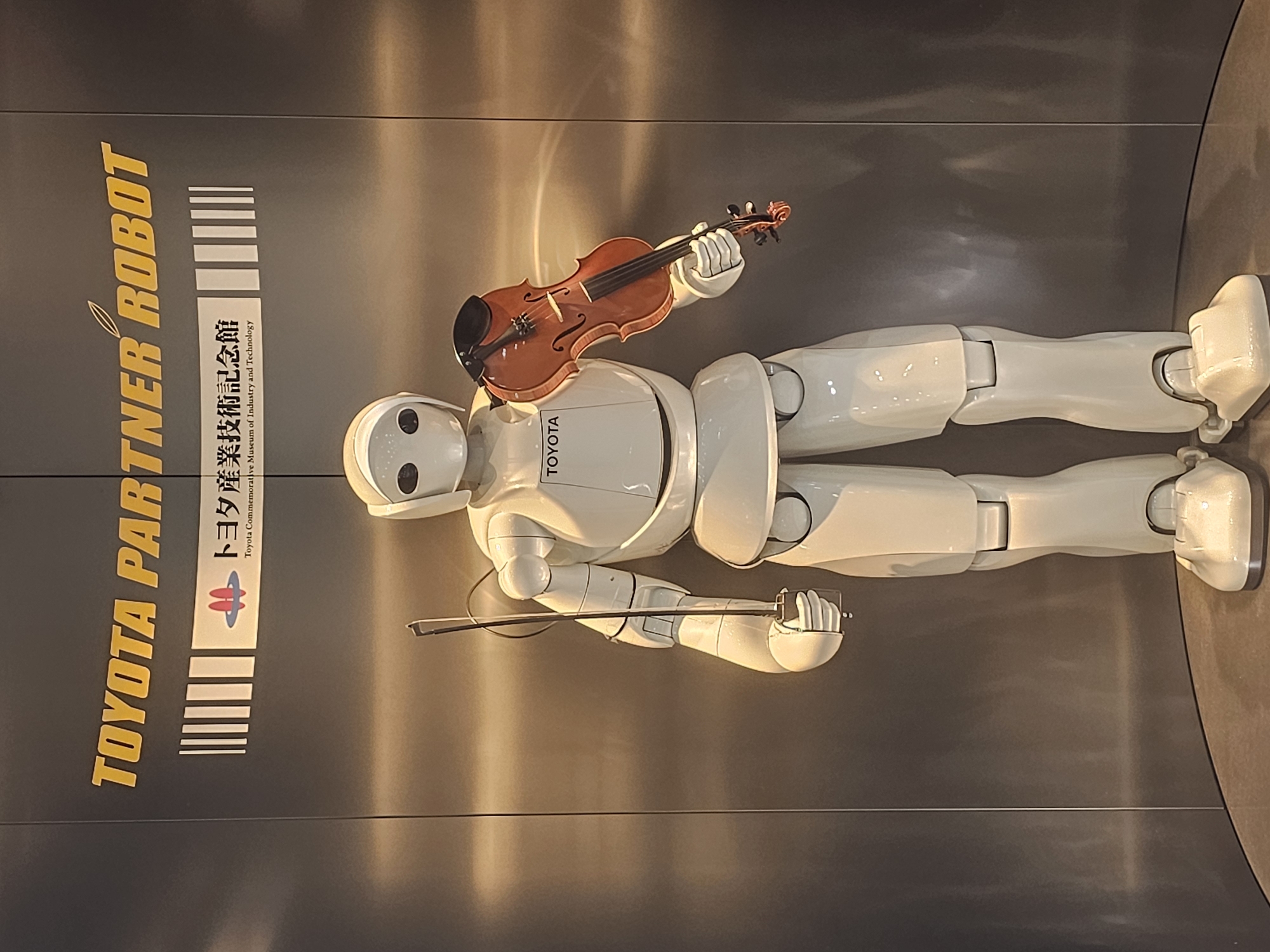
The image depicts a full-body view of a white, humanoid robot standing upright, holding a violin and a bow. The robot has a smooth, featureless head with two dark eye-like sensors. It is dressed in a white, segmented body suit, with visible joints at the shoulders, elbows, waist, knees, and ankles. The violin is positioned across the robot's chest, held by its right hand, while the bow is held vertically in its left hand, near the robot's side. Above the robot, a large sign with yellow text reads "TOYOTA PARTNER ROBOT". Below this, a smaller sign with Japanese text and the Toyota logo reads "トヨタ産業技術記念館" (Toyota Commemorative Museum of Industry and Technology). The background is a metallic, reflective surface that appears to be part of an indoor exhibition space. The lighting is somewhat warm, casting reflections on the robot and the background. This robot is located at the Toyota Commemorative Museum of Industry and Technology in Nagoya, Japan. The museum is dedicated to showcasing the history of the Toyota Group's manufacturing and technological innovations.
Nagoya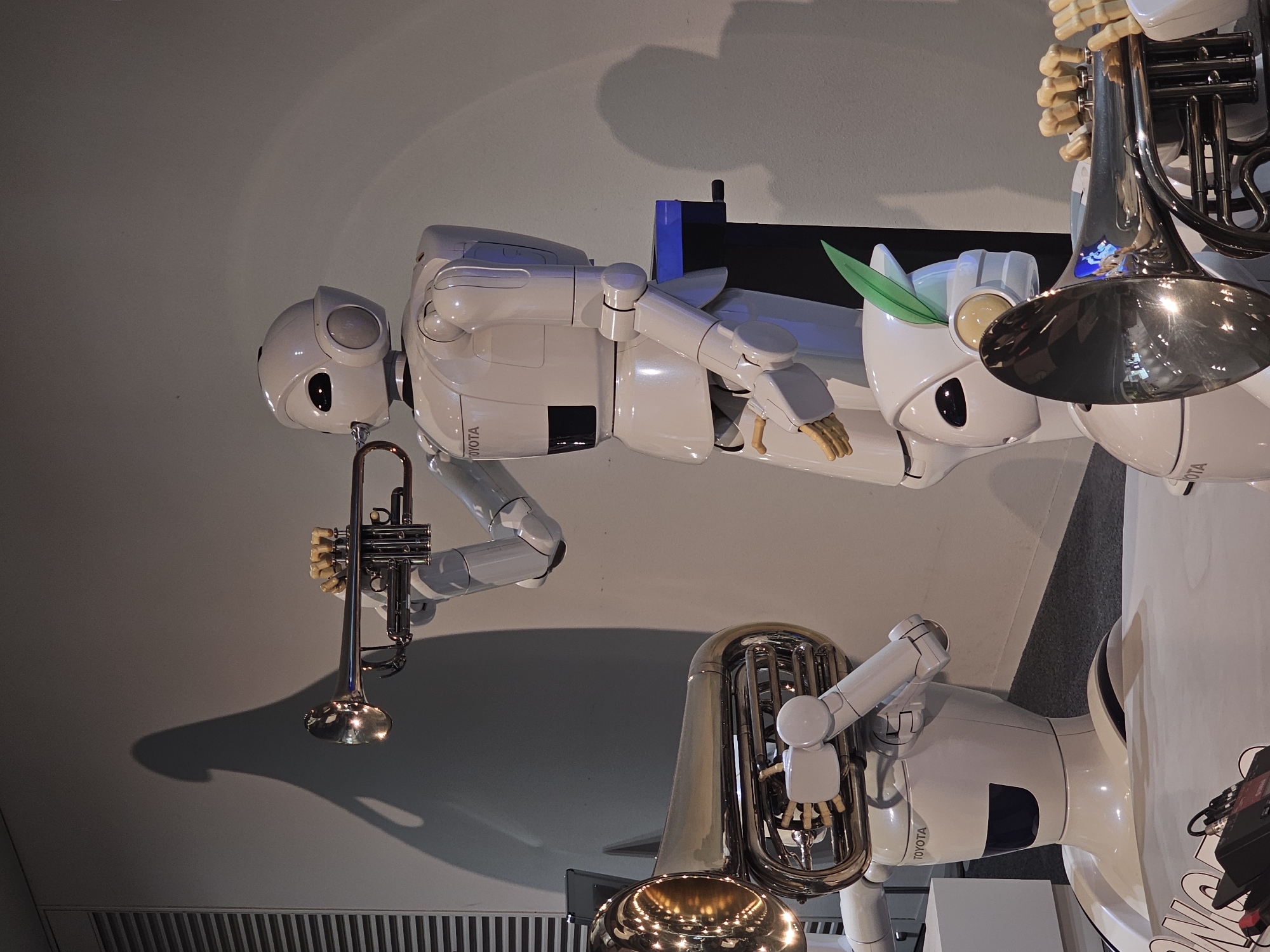
In a museum setting in Nagoya, Japan, three humanoid robots are depicted with musical instruments. The robot in the foreground left holds a tuba, its robotic arms supporting the instrument. A second robot, positioned centrally, plays a trumpet, its hands on the valves and its mouth near the mouthpiece. A third robot, partially visible in the background right, also appears to be holding a musical instrument. The robots are white and sleek, with visible joints and articulated hands. They are positioned on a floor that appears to be carpeted, with a plain gray wall as the backdrop. The lighting casts shadows on the wall, adding depth to the scene. The robots are branded with the "TOYOTA" logo.
Nagoya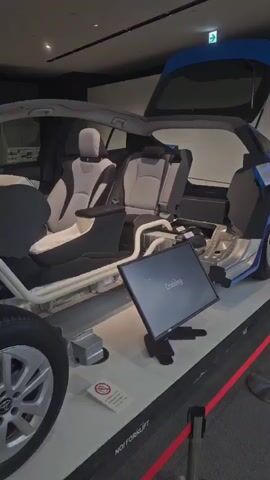
The video shows a cutaway display of a blue Toyota Prius car, with its hood and trunk open, revealing its internal components. The seats are visible inside the car, along with various mechanical parts in the engine bay and under the car. A monitor displaying the word "Cruising" is positioned in front of the car. The display is roped off with red tape, suggesting it is part of an exhibition or museum. The lighting is artificial, typical of an indoor environment.
Nagoya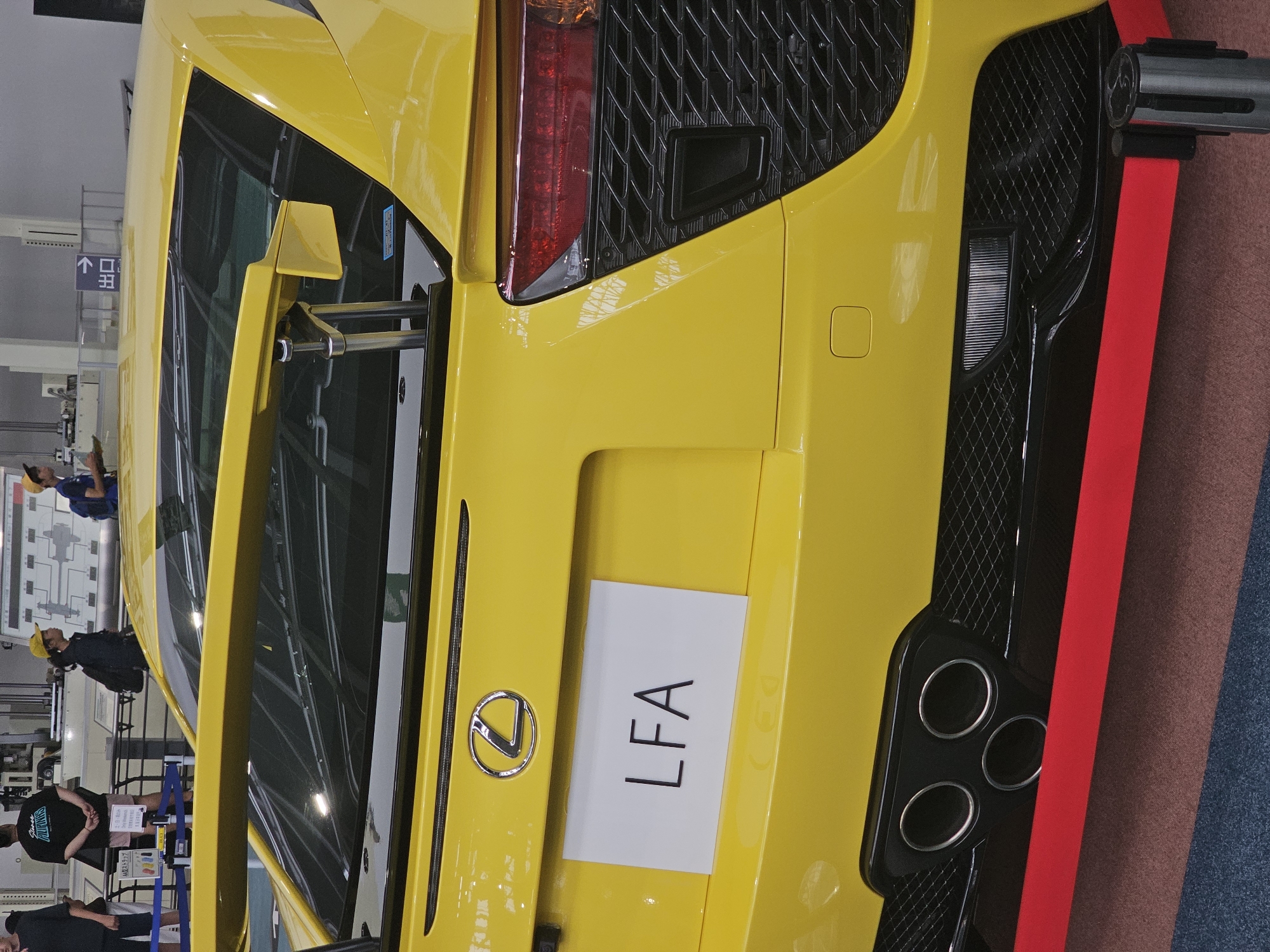
A bright yellow Lexus LFA sports car is parked indoors, likely at an automotive exhibition or dealership. The rear of the car is prominently displayed, showing its distinctive triple exhaust pipes, a large rear spoiler, and the "LFA" badge on a white plate. The car is cordoned off with a red velvet rope barrier. In the background, several people are visible, some wearing casual clothing and others in uniforms, suggesting an event setting. The environment appears to be a convention center or exhibition hall, with industrial-style flooring and overhead lighting. The automotive context of Nagoya, Japan, is implied by the presence of a Lexus, a Japanese luxury vehicle brand, and the overall presentation of a sophisticated automobile.
Nagoya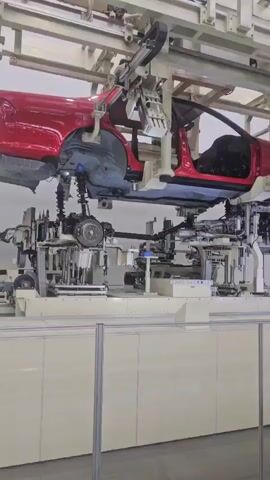
A red car body is suspended from an overhead conveyor system in a factory. Below the car body, a complex assembly of robotic arms and machinery is in operation. The machinery appears to be working on the underside of the car, potentially installing or inspecting components such as the suspension and exhaust system. The environment is a well-lit industrial setting with visible structural elements and support beams of the factory.
Nagoya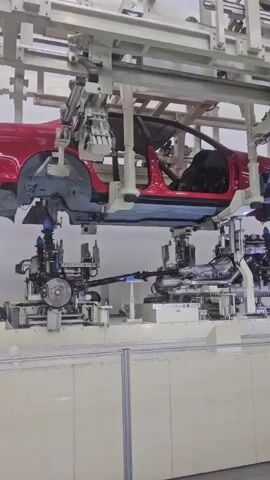
A car chassis is suspended from a robotic assembly line. The chassis is red and appears to be partially assembled. Below the chassis, robotic arms are attaching components to the underside of the vehicle. The scene is well-lit and appears to be a factory or manufacturing facility. The assembly line is moving, as evidenced by the slight blur in the video.
Nagoya