Nara, Japan
30 memories from Nara, Japan

A medium shot shows a man sitting cross-legged on the ground, wearing a green t-shirt, a colorful patterned jacket, and tan pants, with some paint splatters. He holds up a black and white drawing of a cartoon character. To his left, several colorful drawings are displayed. To his right, a child in a black outfit and pink boots stands, partially visible. A white sign with red Japanese text and "I CAN DRAW ANYTHING YOU SAY" is in the foreground. In the background, there's a water feature, a curved railing, and a woman walking with an umbrella. A large building with a green banner is behind the railing.
Nara
A woman in a black rain jacket with the hood up is speaking into the camera as rain falls, creating water droplets on her jacket. She has dark hair, light skin, and a small mole on her left cheek. Her right hand is near her head, adjusting her hood. The background shows blurred greenery and other people walking.
Nara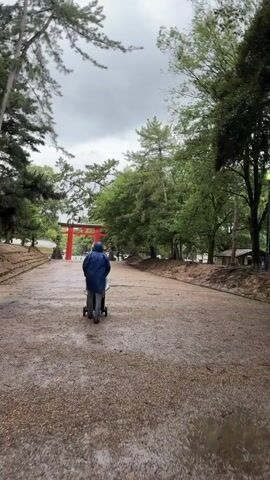
A low-angle, back-facing shot shows a person in a blue rain jacket pushing a stroller down a wide dirt path in a park on a cloudy day. Trees with green leaves line both sides of the path. A red torii gate is visible in the distance.
Nara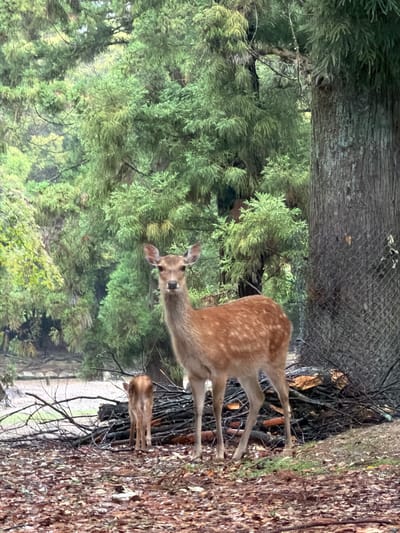
An adult sika deer and its fawn are present in a woodland area in Nara, Japan. The adult deer stands centrally, directly facing the viewer, displaying a light brown coat with distinct white spots across its back and flanks, dark eyes, and forward-oriented ears. The fawn is positioned immediately behind the adult, facing away from the viewer, showing its smaller hindquarters and slender legs. Both animals stand on ground densely covered by fallen brown leaves and scattered patches of green moss. The background consists of numerous green coniferous trees and dense foliage, indicating a heavily wooded environment. On the far right, a large tree trunk with rough, dark bark is visible, alongside which runs a section of dark chain-link fencing. A pile of cut logs and branches rests on the ground behind the deer, adjacent to the fence and large tree. The scene is illuminated by diffused natural light.
Nara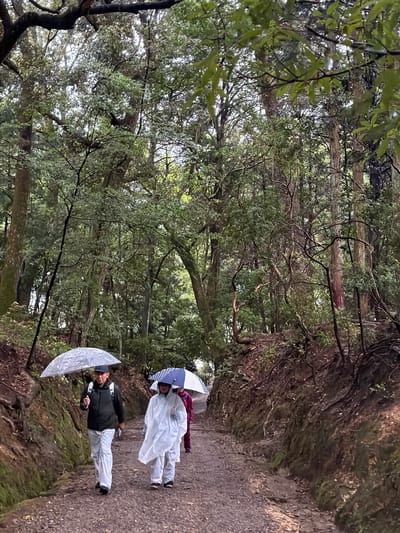
Three individuals walk along a damp, unpaved dirt path through a dense, verdant forest in Nara, Japan. The path is flanked by elevated banks of soil and exposed tree roots, covered in moss and various green foliage. In the foreground, an adult male, likely Asian, walks towards the right. He wears a dark jacket, light pants, a dark baseball cap, and a dark backpack. He holds a large, clear or translucent umbrella with a faint white pattern. To his immediate right and slightly behind him, an adult person, gender obscured by a white, full-body rain poncho, also walks towards the right, holding a blue and white patterned umbrella. Further to the right and partially obscured by the second person, a third adult, wearing a dark pink or maroon rain jacket, follows, holding a white umbrella. The overhead canopy of tall, leafy trees is dense, with various species showing green foliage and darker branches. The lighting is diffused, suggesting an overcast sky or deep shade within the forest. The ground of the path appears reddish-brown and textured with small stones and fallen leaves. The overall scene depicts a group traversing a forested trail during or after rainfall.
Nara
The image depicts two individuals in a dense forest in Nara, Japan, captured from a selfie perspective. In the immediate foreground, a female with dark hair, wearing a black hooded rain jacket with the hood up, smiles directly at the camera. Her face shows freckles, and her clothing appears wet. Behind her, slightly to the right and in the mid-ground, a male wearing a blue hooded rain jacket with the hood up pushes a wheeled transport device. This device, possibly a stroller or cart, is covered by a clear plastic rain cover secured with black straps. Blurred contents, possibly soft items or clothing in blue, pink, and beige, are visible through the transparent cover. The forest ground is covered with damp, fallen leaves, visible tree roots, and earthy debris. Numerous trees with varying bark textures populate the background, indicating a natural, wet, and wooded environment under diffused lighting conditions.
Nara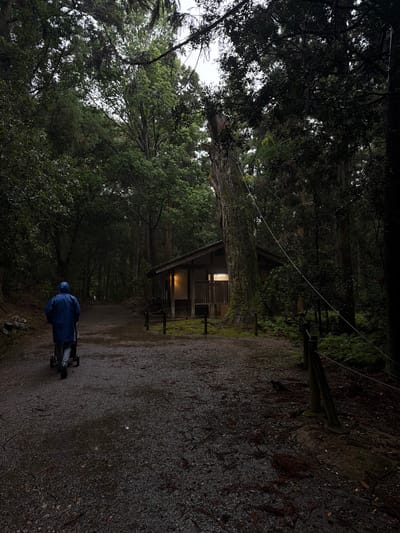
The image depicts a solitary individual walking on a damp gravel path through a dense, ancient forest in Nara, Japan, likely within the Kasugayama Primeval Forest or near Kasuga Taisha Shrine. The person, seen from behind, wears a blue hooded rain jacket and light pants, pushing a dark two-wheeled cart. To the right of the path, a single-story traditional Japanese building with a dark roof and light-colored walls is nestled at the base of a massive, moss-covered tree. Warm yellow light emanates from a window or opening on the building's facade. A simple rope fence lines the path on the right, and a diagonal white cable extends from the mid-right foreground into the upper left background. The forest is characterized by tall, dark-trunked trees with dense green foliage, creating a dim, overcast ambiance with glimpses of a pale sky through the canopy. The ground is wet, featuring puddles, scattered leaves, moss, and ferns.
Nara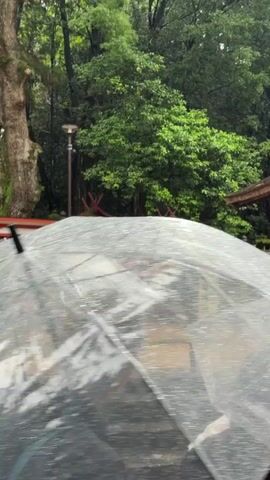
The video shows a first-person perspective of a person walking with a clear umbrella on a rainy day. The camera pans from left to right, revealing a path leading to a Japanese shrine surrounded by lush green trees. Several red torii gates and stone lanterns are visible, along with wooden plaques with pink ribbons. Two people holding umbrellas are seen walking in the distance.
Nara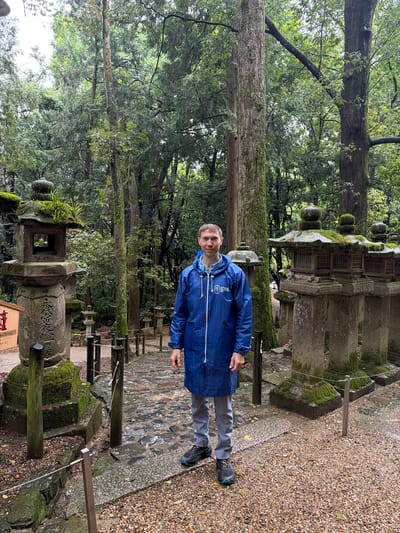
The image depicts a man standing on a path within the grounds of Kasuga Taisha Shrine in Nara, Japan, amidst numerous moss-covered stone lanterns and dense forest. The central figure is an adult male with light brown, short hair, positioned facing the viewer. He is wearing a blue, knee-length rain jacket with a white logo on the left chest, light grey pants, and dark athletic shoes with teal accents. The ground beneath him is a mix of wet, uneven paving stones and light brown gravel, suggesting damp conditions or recent rain. To the man's left, in the foreground, stands a large, tall stone lantern (tōrō) heavily covered in moss, particularly on its tiered roof and base. Vertical Japanese characters are inscribed on its main column, clearly showing "春日大社" (Kasuga Taisha) and "常夜燈" (Jōyatō - perpetual light). Small green plants grow from the top of this lantern. Partially visible behind it is a red and white wooden sign. To the man's right, a cluster of three smaller, moss-covered stone lanterns stands on stone bases, each featuring a latticed section for light. Further into the background, additional stone lanterns are visible along a winding path. The entire scene is enveloped by a dense, lush forest featuring tall, straight tree trunks and a canopy of green foliage, indicating a humid, temperate environment. The light appears diffused, consistent with an overcast sky. Wooden and metal posts with thin wires line portions of the path, acting as a low barrier.
Nara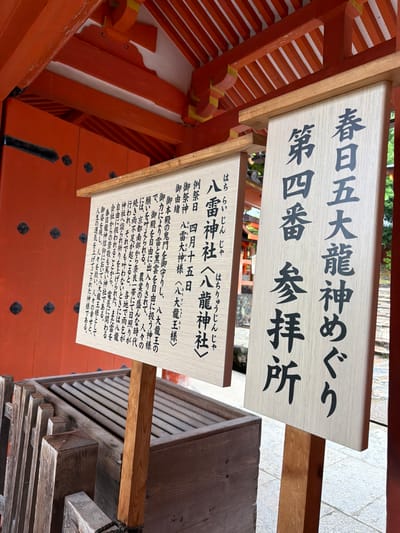
The image displays a detailed view of a worship area at the Hachirai Shrine (八雷神社), which is part of the Kasuga Taisha Shrine complex in Nara, Japan. Two prominent wooden signs with black Japanese characters stand in the foreground. The larger sign on the right identifies the location as the "Fourth Worship Place" (第四番 参拝所) for the "Kasuga Five Great Dragon Gods Pilgrimage" (春日五大龍神めぐり). The smaller sign on the left provides information about the Hachirai Shrine, identifying the enshrined deity as the "Eight Dragon God" (八龍神様), with smaller text detailing its origin and significance, including the regular festival date of April 15th. Behind the signs, vibrant orange-red traditional Japanese architectural elements, including structural beams and intricate ceiling components, are visible. In the lower left, a wooden offering box with horizontal slats on its lid is partially visible behind a low wooden railing, resting on a light grey, paved surface. The scene is devoid of people.
Nara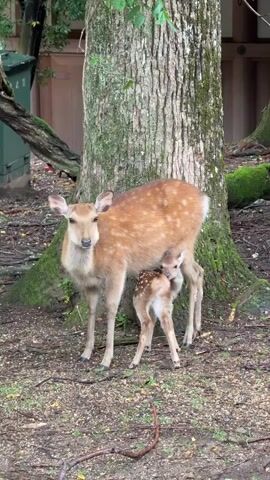
A video shows a brown deer with white spots on its back standing next to a large tree trunk. A smaller deer, also brown with white spots, stands underneath the larger deer, appearing to nurse. The ground is covered in dirt and fallen leaves. In the background, there's a green trash can and some light brown buildings. The scene appears to be outdoors.
Nara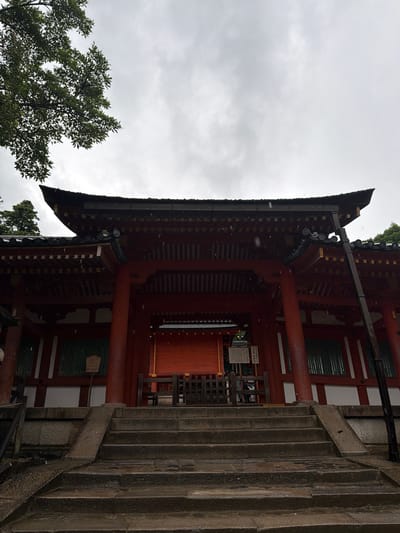
A low-angle, eye-level photograph captures the exterior of a traditional Japanese temple or shrine building, specifically identified as a structure within the Kasuga Taisha Shrine complex in Nara, Japan, on an overcast day with light precipitation. The central subject is a multi-tiered, vermillion-red wooden structure with a dark, tiled roof featuring distinct upturned eaves. The roof's underside reveals intricate dark wooden beams and brackets, interspersed with small, golden rectangular decorative accents. The main body of the building comprises thick, round vermillion pillars supporting the roof and framing the entrance. Sections of the lower wall are painted white, while windows or screens to the sides of the central entrance are characterized by dark, vertical slatted coverings. A set of weathered, irregular stone steps, wet and glistening from rain, leads directly up to the main entrance. A stone ramp runs parallel to the left side of the steps. The entrance itself appears to be a recessed area, partially obscured by a wooden barrier or railing. An unreadable informational sign on a stand is positioned to the left of the entrance. A dark, slender pole, possibly a lamppost or utility fixture, is visible on the far right, extending from the ground to beyond the roofline. The sky is a uniform, light grey, indicative of heavy cloud cover. Rain or fine precipitation is discernible as small white specks against the dark roof and red building. A large section of a deciduous tree with dense green foliage occupies the upper left quadrant of the frame, extending over the building's roof. Another tree is partially visible behind the roof on the far right. The overall scene suggests a damp, quiet atmosphere. No individuals are clearly visible or identifiable.
Nara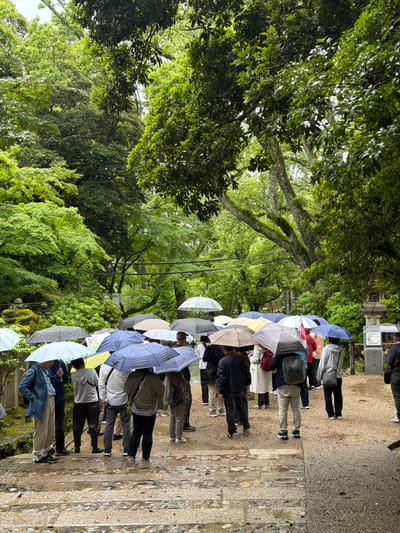
The image depicts a crowded outdoor scene on a rainy day at Kasuga Taisha in Nara, Japan. A large group of approximately two dozen individuals, predominantly adults, are visible, many holding open umbrellas of various colors including shades of blue, grey, white, yellow, and red. They are standing or walking on a wet, light-colored stone and gravel path, which shows puddles and reflections from the rain. The path features a distinct transition from rough-hewn, irregular stone steps on the left to a finer gravel surface on the right. The individuals are dressed in casual attire. The environment is lush and green, dominated by dense foliage and tall trees with light-colored, moss-covered trunks that create a canopy overhead. The background is filled with verdant trees, indicating a forest or park setting. On the far right, a traditional stone lantern and a wooden signpost with Japanese text, clearly indicating "春日大社" (Kasuga Taisha), are visible on the side of the path. The overall lighting is soft and diffused, characteristic of an overcast or rainy day. The presence of numerous umbrellas confirms precipitation.
Nara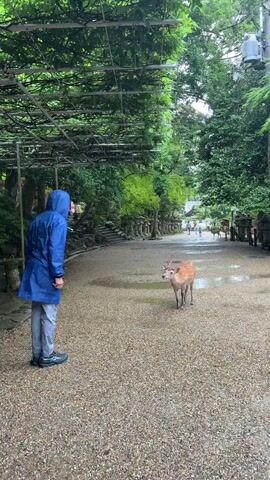
A person in a blue raincoat stands on a gravel path, facing a deer. The person bows to the deer, and the deer bows back. Other deer are visible in the background, and trees line both sides of the path.
Nara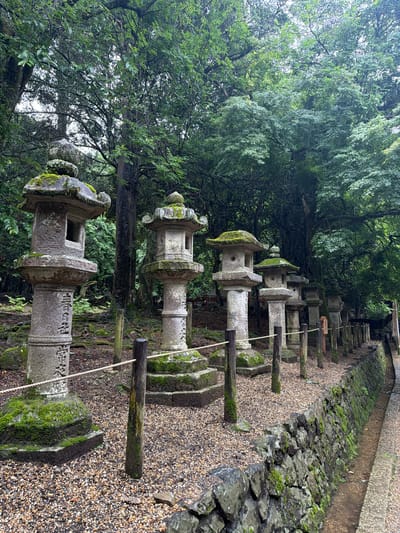
This image captures a historical pathway lined with ancient stone lanterns within the forested grounds of Kasuga Taisha Shrine in Nara, Japan. Approximately seven traditional Japanese stone lanterns, known as *tōrō*, are arranged in a linear formation, receding diagonally from the left foreground towards the right mid-ground. Each lantern is constructed from grey stone, exhibiting significant weathering and heavy coverage of vibrant green moss, particularly on their tiered roofs and bases. The largest lantern in the immediate foreground on the left features visible Japanese characters carved into its pillar, identifying the location as "春日神社" (Kasuga Jinja - Kasuga Shrine) and including "常夜" (Jouya - eternal light). A low barrier, consisting of wooden posts connected by a thick, light-colored rope, runs parallel to the line of lanterns, separating them from the adjacent ground. The ground surface is composed of small, light-colored gravel or pebbles. To the right of the gravel path, a sturdy stone retaining wall, also extensively covered in green moss, borders a narrow, shallow concrete channel, possibly for drainage or a small water flow. The entire background is filled with a dense, lush green forest composed of tall broadleaf trees, their canopies creating a diffuse, overcast lighting condition. Tree roots are visible protruding from the forest floor, which is also covered in moss and leaf litter. No individuals are present in the scene.
Nara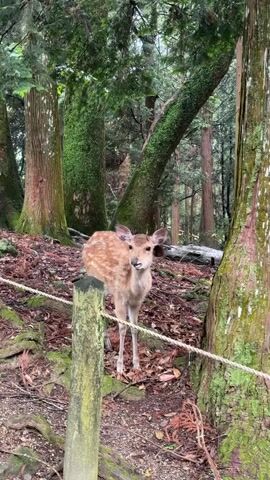
A fawn stands still in a forest, facing the camera. It has light brown fur with white spots. Large trees with moss-covered trunks and branches surround the fawn. The ground is covered with fallen leaves and dirt. A rope barrier stretches across the foreground, attached to a wooden post on the left and a tree on the right. The fawn occasionally moves its mouth and twitches its ears. Bird chirps are heard in the background.
Nara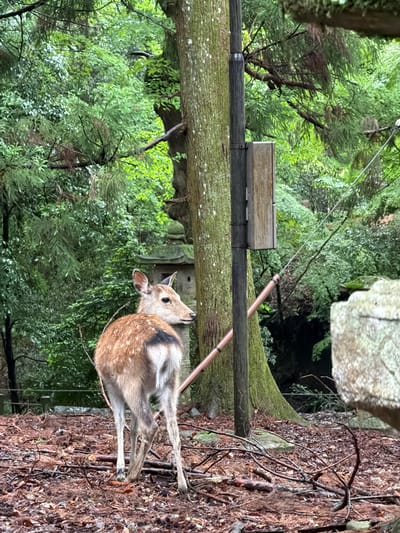
The image depicts a sub-adult Sika deer, *Cervus nippon*, standing on a forest floor in Nara, Japan. The deer is positioned with its back mostly towards the viewer, its head turned sharply 90 degrees to its right, looking horizontally. Its coat is light brown, featuring faint white spots on its flanks and a prominent black streak on its white rump patch. Two small, rounded protuberances are visible on its head where antlers might develop or be present in a nascent stage. The forest floor is densely covered with reddish-brown deciduous leaves, dried conifer needles, and scattered twigs and branches. A dark grey utility pole, equipped with a rectangular, light-brown wooden enclosure and metal bands, stands vertically on the left side of the frame, partially obscured by a large tree trunk. Another large tree trunk, covered in green moss, frames the right side of the image. In the mid-ground, behind the deer's head, the cap and upper sections of a grey stone lantern are visible. A reddish-brown pipe with black bands extends diagonally downwards from behind the utility pole, secured by a thin grey cable that runs towards the right. The background consists of dense, verdant foliage from various trees, illuminated by diffused natural light, suggesting overcast conditions. No people are visible.
Nara
A woman and a male deer with antlers are captured in a selfie-style photograph in Nara, Japan. The woman, positioned on the left, smiles directly at the camera. Her dark hair is damp, and she wears a black rain jacket covered in water droplets. To her right, a Sika deer faces the camera, its reddish-brown fur visible, with prominent dark antlers. In the background behind the woman, a red Japanese vending machine offers various canned beverages, including "Red Bull" and "Lemon" drinks, with prices displayed in Yen. Payment options like Alipay+ are visible. To the right of the vending machine and behind the deer, a light-colored, horizontally corrugated metal roll-down shutter is visible. The ground appears to be wet concrete or asphalt.
Nara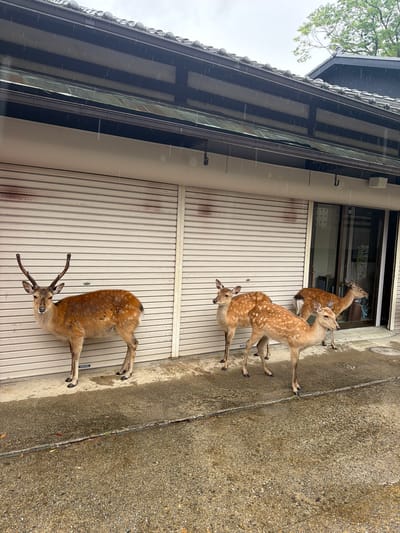
This outdoor image depicts four Sika deer (*Cervus nippon*) sheltering from rainfall under the eaves of a building in the city of Nara, Japan. The sky overhead is overcast, and rain streaks are visible against the dark roof and building facade, as well as on the wet concrete ground below. On the far left, a mature male Sika deer with distinct brown antlers stands facing forward, looking directly towards the viewer. Its coat is reddish-brown with subtle white spotting, and it stands beside a light-colored, corrugated metal roller shutter that extends across the majority of the building's front. To the right of the male deer, three smaller Sika deer, appearing to be females or juveniles, are positioned closer to a glass storefront door. The deer closest to the foreground has a lighter, more pronounced spotted coat and is looking to its right, out of the frame. Slightly behind and to its left, another deer of similar size and coloration is partially visible, looking generally towards the viewer. The third smaller deer is positioned further back, near the glass door, and is looking to its right. The building features a traditional dark-tiled Japanese roof with rounded ridge tiles and a prominent dark gutter system. Below the main roofline, a dark green, slightly worn awning or protective sheet is visible. The lower section of the building consists of three light-colored, horizontally corrugated roller shutters, with the rightmost section replaced by a reflective glass door and window. The ground is a wet, textured concrete surface with a noticeable crack or seam running horizontally across the mid-ground. Small flecks of debris or vegetation are present within this crack. In the upper right background, a portion of a tree with green foliage is visible against the grey sky, beyond the building's roofline. No human figures are present in the scene.
Nara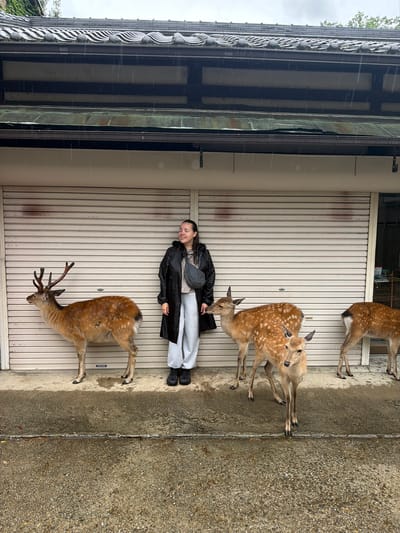
The image depicts a rain-soaked outdoor scene in Nara, Japan, featuring a female individual surrounded by five Sika deer positioned in front of a traditional Japanese building with closed storefronts. Heavy rainfall is evident from visible water streaks against the building's upper sections and the thoroughly saturated concrete ground, which displays visible cracks and wet patches. The sky is overcast. A single female individual stands centrally in the frame. She has dark hair, a light complexion, and is captured in a moment of a closed-eye smile. Her attire consists of a black rain trench coat, light grey sweatpants, and black athletic shoes. A grey sling bag is worn across her chest. Her left hand is resting on the side of a fawn standing immediately to her left. Five Sika deer are present, all with wet coats. On the far left, an adult male deer with prominent antlers, brown fur, and faint spots stands facing left. Adjacent to the female individual's left side is a fawn, distinct with brown fur and white spots, also facing left, with which the female is interacting. A second fawn, similarly spotted, stands directly in front of the female, facing slightly towards the viewer. A third fawn, partially obscured behind the second, has its head visible, also facing the viewer. On the far right, a fifth deer, either an adult or subadult, stands with its hindquarters facing the viewer, its head extending beyond the right edge of the frame. The background consists of a two-story building with traditional Japanese architectural elements. The upper level features a dark, ridged, tiled roof with a visible gutter system, followed by dark wooden horizontal beams and lighter recessed panels. Below this, a bronze-green metal canopy or flashing with another gutter runs horizontally. The lower section of the building comprises light-colored, ribbed metal roll-down shutters, suggesting closed storefronts or garage doors. Small metal hardware, including hooks and chains, is visible below the lower gutter. Green foliage is partially visible above the roofline on the upper left.
Nara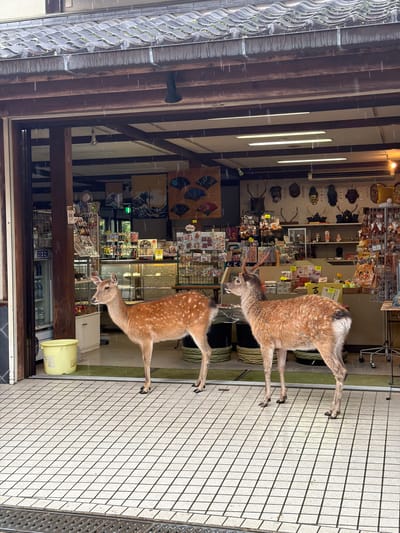
Two Sika deer are positioned on a white tiled sidewalk in front of an open-front retail establishment in Nara, Japan. It is actively raining, with visible streaks of water falling from the sky and dripping from the tiled roof and gutter. The deer on the left is a lighter brown with prominent white spots and a white underside, facing slightly left towards the shop interior. The deer on the right is a darker brown, possesses small antlers, exhibits white spots on its haunches, and faces right, also observing the shop. Both deer stand calmly. Above the shop entrance, a dark, wavy-tiled roof with a metal gutter is visible, shedding rainwater. Beneath the roof are dark wooden structural beams. The shop's interior is brightly illuminated by overhead fluorescent lights and spotlights, revealing a diverse array of merchandise on shelves and display racks. Items include packaged goods, plush toys (some deer-themed), and cultural artifacts such as mounted antlers and various masks displayed on the back wall. A print resembling "The Great Wave off Kanagawa" and decorative fans are also visible on the back wall. A "BEER" refrigerator is visible on the far left inside the shop. A yellow plastic bucket is situated on the sidewalk near the left side of the entrance. The sidewalk features white square tiles with dark grout lines, and a metal grate runs along the bottom edge of the frame.
Nara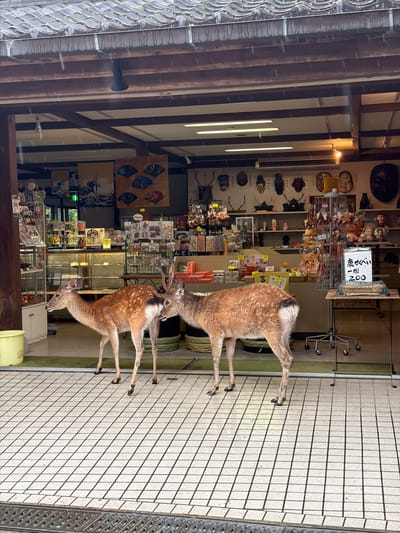
Two Sika deer stand at the open entrance of a souvenir shop in Nara, Japan, during a light rain shower. The deer on the left, a spotted reddish-brown, faces left, while the deer on the right, a darker brown with small antlers, has its head positioned near the rear flank of the left deer. The shop interior features exposed wooden beams and a wide array of merchandise: shelves on the left display packaged goods and small items, while the back wall is adorned with various traditional Japanese masks, mounted deer antlers, decorative fans, and framed prints resembling Hokusai's "The Great Wave off Kanagawa." On the right, a metal rack holds plush toys, and a small table presents a white sign in Japanese characters that reads "鹿せんべい" (Shika Senbei, deer crackers) and "一個 200" (one piece 200 yen), with a woven basket containing the crackers below. The ground outside the shop entrance is paved with white square tiles with dark grout, leading to a green mat inside. Overhead, a traditional grey tiled roof with a gutter shows signs of weathering and moss. No people are visible in the scene.
Nara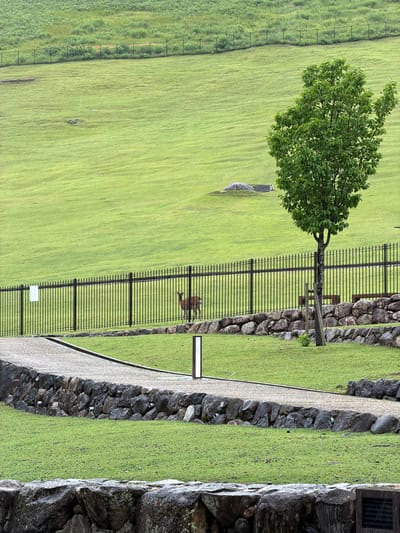
This image depicts an outdoor landscape within the city of Nara, Japan, characterized by expansive green areas and constructed elements. In the foreground, a curved gravel pathway with a dark border ascends from the lower-left, leading towards the center-right of the frame. This path is bordered on its right side by a stone retaining wall, which incorporates several small, light-colored circular features, possibly drain outlets or embedded lights. To the right of the pathway, a vertical, rectangular light fixture stands on a patch of green grass. A second, lower stone wall, partially visible, runs across the bottom of the frame. The midground features a black metal fence with vertical pickets, running horizontally across the scene. Behind this fence, on the right, a brown sika deer is visible, facing left. To the left of the deer, also behind the fence, is a white rectangular sign affixed to the fence. A small, leafy green tree with a visible wooden support stake stands just in front of the fence, to the right of the pathway, rooted in a grassy area bordered by a stone wall. Partially visible beyond the fence near the tree are what appear to be wooden benches. The background consists of a vast, undulating green grassy hill that dominates the upper portion of the image. Towards the middle of this hill, a large, rounded grey boulder is present, with what appears to be a section of dark steps or a structure behind it. Further back and higher up, another black metal fence stretches horizontally across the landscape, delineating the edge of the manicured grass from an area of denser, taller green vegetation. The overall lighting suggests an overcast day, and the grass appears damp.
Nara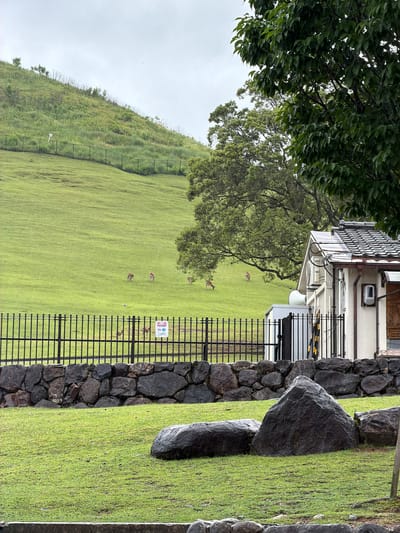
This image depicts a verdant, hilly landscape in Nara, Japan, likely within Nara Park, under an overcast sky. In the immediate foreground, several large, dark, wet boulders rest on a patch of short, bright green grass. Directly behind this, a retaining wall constructed of irregular, dark boulders spans the width of the frame. Above the stone wall, a black metal fence with vertical bars runs horizontally across the mid-ground. Attached to this fence on the right side is a white rectangular sign displaying Japanese text and pictograms, indicating warnings or instructions, likely pertaining to the deer. Behind the fence, a bright green, well-maintained grassy slope ascends towards the background. Seven Sika deer (Cervus nippon) are visible on this slope; two smaller deer are closer to the fence on the left, and five larger deer are distributed further up the slope, appearing to graze or stand. On the far right, partially obscured by a large, leafy green tree, is a small, single-story building with light-colored walls and a distinctive dark, patterned tiled roof. The building features an outdoor mechanical unit, exposed electrical conduits, a speaker or horn, and yellow-and-black striped barriers near an entrance or gate. In the upper background, the grassy slope continues, becoming steeper and covered with wilder grasses, shrubs, and sparse trees. Another black wire fence runs along the contour of this upper hillside. The sky above is uniformly light grey, indicating heavy cloud cover. No human subjects are present.
Nara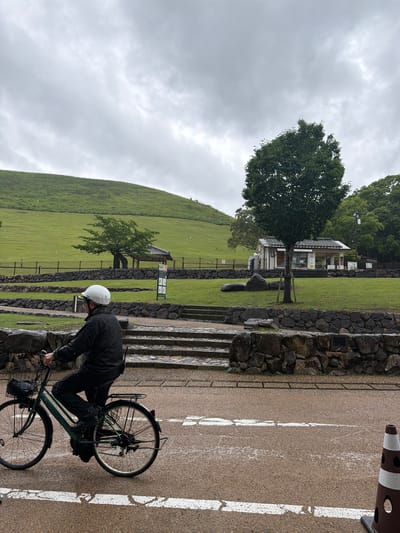
This image depicts a park-like scene in Nara, Japan, under an overcast and rainy sky. In the foreground, a person is cycling from left to right on a wet, light-brown paved road. The individual is an adult male, wearing a white hard hat or helmet, a black rain jacket, and dark pants. He is seated on a dark teal-green commuter bicycle equipped with a front basket and a rear rack. Water droplets are visible on the road surface, indicating recent or ongoing rain. A brown and white striped traffic cone is partially visible at the bottom right. The midground features a terraced landscape with multiple layers of dry-stacked stone walls and stone steps. Beyond these walls, well-maintained green grass covers rolling terrain. A black metal fence runs along the top of one of the stone walls, separating the road from the park area. Several deciduous trees with dense green foliage are scattered throughout the grassy areas. In the center-right midground, a small, single-story building with white walls and a dark tiled roof is visible, partially obscured by a tree in the foreground. This building appears to be a small facility, possibly an information center or restroom, with openings on its facade. Further to the left, another open-sided pavilion-style structure with a dark roof is situated on the grass. An informational sign with graphic illustrations stands on the grassy area near the stone steps. The background is dominated by a large, smooth, bright green hill covered in short grass. Faint, white speckles visible against the green hillside and darker elements throughout the image suggest light rainfall or mist. Small, indistinct shapes, possibly deer, are discernible on the distant green slope. The sky is uniformly light gray with heavy cloud cover, confirming the overcast weather. The overall environment suggests a well-maintained public park or natural preserve.
Nara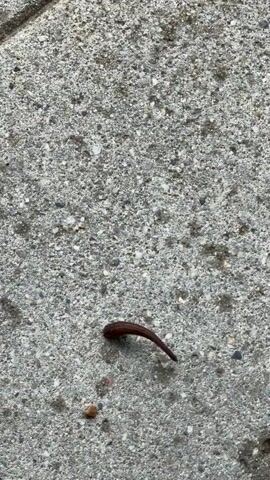
A slug, dark brown in color, is positioned on a gray concrete surface. The slug appears to contract and then extend its body multiple times, performing movements similar to an inchworm. Small pebbles and specks of dirt are scattered across the concrete surface. The video is shot from a top-down perspective, capturing the slug's movements as it progresses across the textured ground.
Nara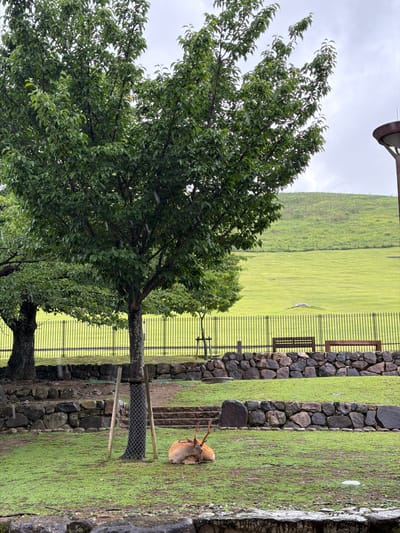
This image, captured in Nara, Japan, depicts a park-like environment under an overcast sky, possibly experiencing light rain, evidenced by faint white streaks in the air. In the immediate foreground, a dark, wet, textured surface, possibly concrete or large rocks, is visible. Directly behind this, a male deer with prominent antlers is lying on the green, sparsely vegetated grass. The deer, light brown with subtle white spots, rests on its left side, facing slightly right with its head turned towards the viewer. To the left of the deer, a tree trunk is wrapped in protective mesh and supported by two wooden stakes. Further left, another mature tree trunk is visible. Behind the deer, a low wall constructed from various dark, irregular stones delineates a change in elevation. Above this, a sloped area of green grass leads to a second, taller stone wall. Beyond this wall, a black metal fence with vertical bars separates the foreground park from a vast open field. Two wooden park benches are visible behind the fence on the right side. The midground is dominated by large, deciduous trees with dense green foliage, obscuring much of the park's interior. Small white specks are discernible against the dark leaves and ground, suggesting precipitation. The background features an expansive, gently sloping, bright green grassy hill, characteristic of well-maintained parkland, extending upwards towards the horizon. The sky is uniformly light grey and cloudy. On the far right, a partial view of a dark, metallic structure, likely a lamp post or architectural element, is visible against the sky. No human figures are present in the scene.
Nara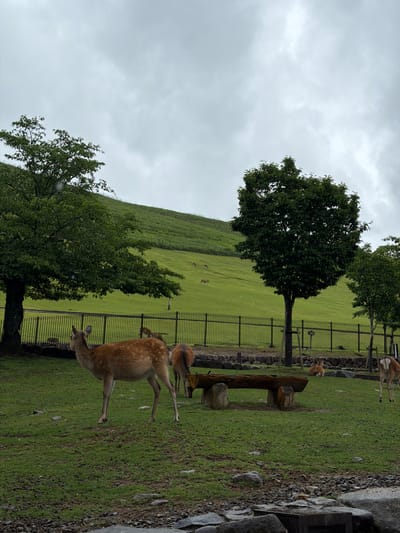
This image depicts a natural park setting, specifically identifiable as Nara Park in Nara, Japan, due to the presence of numerous Sika deer (Cervus nippon). The scene is captured under a uniformly overcast, light-grey sky, suggesting a cloudy day. In the foreground, a prominent Sika deer stands facing left, its head slightly turned to reveal its left ear and a portion of its face. This deer has reddish-brown fur with distinct white spots and a lighter underside. To its immediate right, the hindquarters and tail of another deer are visible, facing away from the viewer, near a rustic wooden bench constructed from a log supported by two tree stumps. The immediate ground is covered in green grass, interspersed with patches of dirt and scattered grey rocks. A black metal fence, comprising multiple vertical bars and horizontal railings, stretches across the midground, separating the foreground from a gently sloping, expansive green hillside. Two deciduous trees with dense green foliage are positioned near this fence; a larger tree on the left and a smaller, more slender one to the right. Beyond the fence, the vibrant green grass of the hillside extends upward. Multiple other Sika deer are scattered across this distant hillside, appearing smaller due to perspective, some actively grazing. The overall impression is one of a spacious, animal-friendly park.
Nara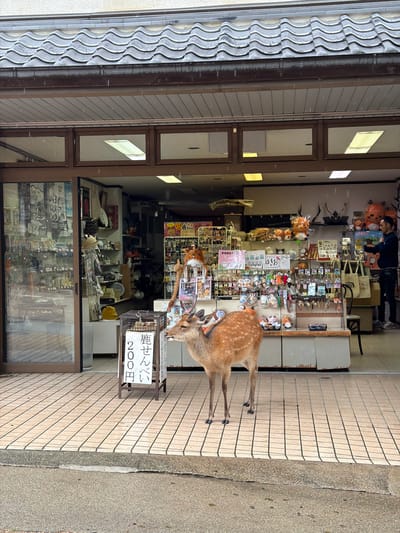
A sika deer stands on a tiled sidewalk in front of an open souvenir shop in Nara, Japan, during what appears to be light rain. The fawn-colored deer, with visible antlers and a red band around its neck, is positioned centrally in the lower half of the frame, facing right with its head slightly turned towards the viewer. To its left is a white A-frame sign displaying "鹿せんべい 200円" (Deer Crackers 200 Yen) in Japanese characters, confirming the location and purpose of the crackers. The shop, housed in a building with a dark, wavy-tiled roofline, has an open entrance. Its interior is brightly lit, showcasing numerous shelves and display racks filled with various souvenirs, including plush toys, keychains, and other trinkets, many of which appear to be deer-themed. On the far right inside the shop, a man in a dark blue shirt and jeans stands, appearing to arrange items on a display. The shop's left side features glass display cases and shelves with more merchandise. The tiled sidewalk transitions into a darker, wet asphalt street in the foreground. Subtle streaks of water or rain droplets are visible in the air and on surfaces throughout the image.
Nara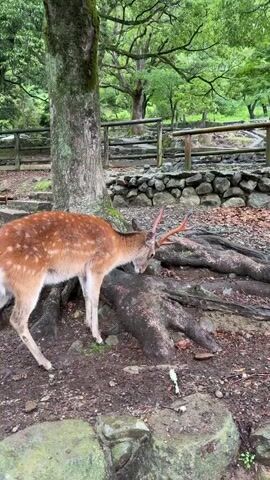
A sika deer with antlers scratches its face on the roots of a tree in a forest. The deer is brown with white spots and has a light-colored belly. It is standing on dirt and rocks, with green moss on some of the rocks. There are many trees in the background, and a wooden fence can be seen behind the deer. A stone wall is also visible in the distance. The deer continues to rub its face on the tree roots, moving its head back and forth. The video ends with the deer still scratching its face.
Nara