Nongkhiao-Nua, Laos
5 memories from Nongkhiao-Nua, Laos
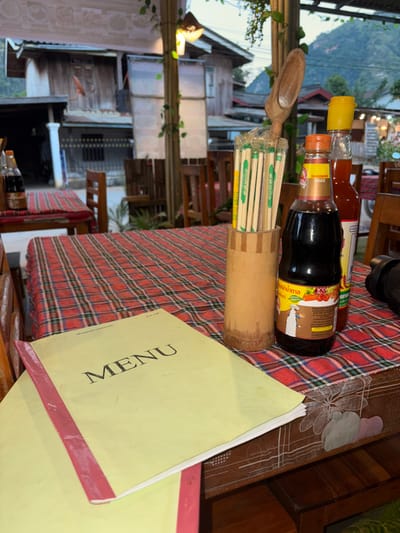
The image depicts an unoccupied dining table at an outdoor or semi-outdoor restaurant in Nongkhiao-Nua, Laos. The table is covered with a red and blue plaid tablecloth over a wooden surface. On the table, two yellow menus with pink bound edges are present, with the top menu displaying "MENU" in black lettering. A cylindrical bamboo holder stands beside the menus, containing multiple individually plastic-wrapped chopsticks and a wooden spoon-like utensil. To the right of the utensil holder are two condiment bottles: a large, dark brown bottle labeled "SEASONING SAUCE" with a white label featuring a chef graphic, and a taller, slender bottle with a yellow cap containing a reddish liquid. A dark object, possibly a camera lens, is partially visible on the far right edge of the table. In the mid-ground, additional wooden tables with similar plaid tablecloths and wooden chairs are visible, suggesting more seating within the establishment. Support pillars for the restaurant structure are present, adorned with artificial green vines and a hanging light fixture emitting a warm, yellowish glow. The background reveals an older, two-story wooden building with a corrugated metal roof and a satellite dish attached to its facade. Beyond this building, lush green mountains rise under an overcast or twilight sky, indicating a mountainous setting. No individuals are present or engaged in any actions within the frame.
Nongkhiao-Nua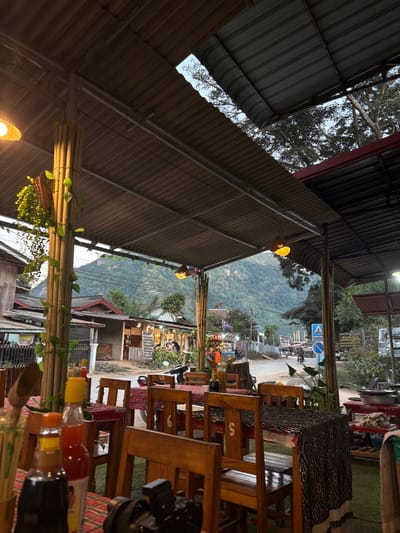
The image depicts a semi-open-air restaurant or eatery patio in Nongkhiao-Nua, Laos, at what appears to be late afternoon or early evening. The scene is viewed from a low angle within the establishment. The foreground features multiple wooden tables with matching wooden chairs. Several tables are covered with red and white checkered tablecloths, while others have dark, patterned fabric. On the closest table to the viewer, a black camera body with a lens is partially visible, alongside three condiment bottles: one with a red cap, one with an orange cap, and a dark brown bottle. A cylindrical holder containing chopsticks or skewers is also present. The restaurant structure consists of a corrugated metal roof supported by steel beams and columns clad in bamboo poles. Green vining plants are wrapped around these bamboo columns. Yellow, basket-style pendant lights are illuminated and hang from the roof structure. Gaps in the roof system reveal a bright sky and the canopy of trees overhead. Beyond the immediate restaurant seating, a paved street runs through the town. Buildings, primarily single-story structures with corrugated metal roofs, line both sides of the road. Lighting is visible within some of these buildings. A white scooter is parked on the left side of the street. Several indistinct human figures are visible on the street; one is near the scooter, and others are further in the distance. On the right side of the road, a blue rectangular road sign with a white arrow pointing left is visible, accompanied by a smaller white rectangular sign below it. In the far background, a range of large, green, tree-covered mountains rises prominently under a bright, possibly overcast, sky. The overall scene suggests a quiet, rural town setting.
Nongkhiao-Nua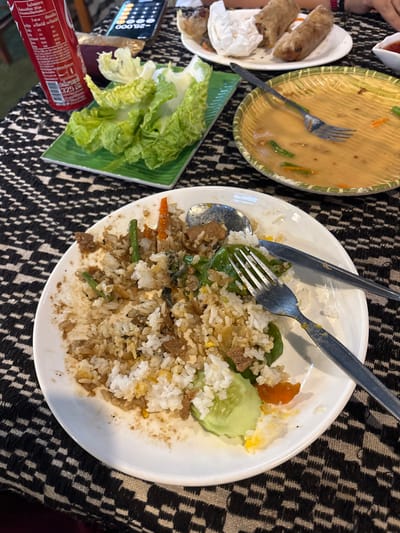
The image captures a tabletop dining scene in Nongkhiao-Nua, Laos, likely post-meal. In the foreground, a white oval plate displays remnants of fried rice, containing white rice grains, brown meat pieces, green beans, orange carrot fragments, and a cucumber slice. A silver spoon and fork rest on the plate. To the left, a green rectangular plate holds several fresh green lettuce leaves. Behind it, a red 325 ml Coca-Cola can, bearing Lao text, stands upright. A dark-colored smartphone with an illuminated screen displaying numerical digits is positioned behind the soda can. To the right, a round, shallow bamboo-weaved plate with a green rim contains a small amount of pale yellow sauce, a single silver fork, and a few pieces of green beans and carrots. In the upper right background, a white round plate holds two partially consumed spring rolls and a crumpled white napkin. A human hand with a red wristband is visible in the top right corner. The table is covered by a black and white geometric patterned tablecloth.
Nongkhiao-Nua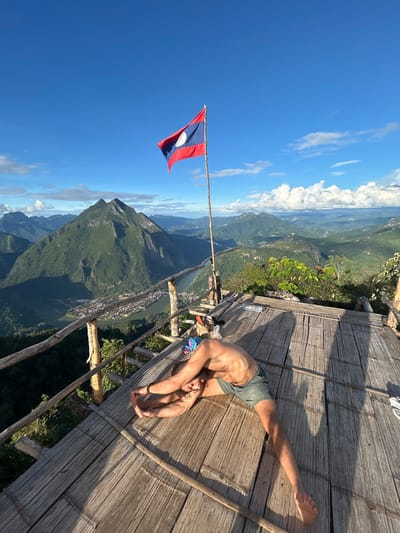
An elevated outdoor viewpoint in Nongkhiao-Nua, Laos, is depicted under clear blue skies with scattered white clouds and bright sunlight. In the foreground, a barefoot adult male, shirtless and wearing olive-green shorts, performs a deep yoga or stretching pose on a rustic bamboo-slat platform. He is bent forward over his extended right leg, with his left leg bent and foot near his groin, and his hands are clasped or holding his right foot. To the upper left of the frame, a Lao national flag, featuring horizontal red, blue, and red stripes with a central white disk, flies from a tall, slender wooden pole. A simple, rough-hewn wooden railing borders the platform along the steep drop-off. The extensive background showcases a mountainous landscape with lush green peaks, including a prominent, distinctive mountain directly across the valley. The Nam Ou River is visible winding through the valley below, with the town of Nongkhiao-Nua situated along its banks.
Nongkhiao-Nua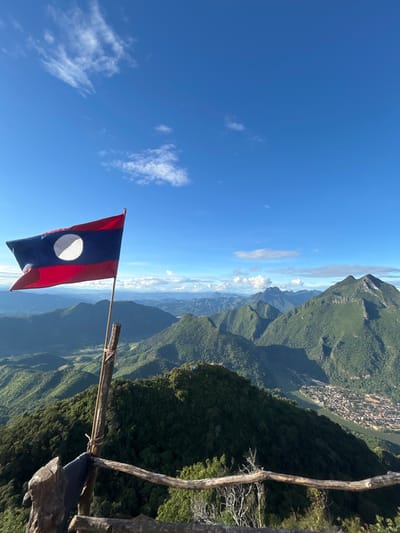
A forensic examination of the image reveals a high-angle panoramic view from a mountainous vantage point in Nongkhiao-Nua, Laos. In the mid-left foreground, the national flag of Laos, displaying red, blue, and red horizontal stripes with a central white disc, is attached to a bamboo pole. The pole is secured to a rough-hewn wooden post, which forms part of a rudimentary wooden railing or fence extending across the lower portion of the frame. The background presents a vast, undulating landscape dominated by densely forested green mountains and peaks, receding into the distance under a clear, bright blue sky adorned with sparse white cumulus clouds. To the far right, nestled in a valley among the mountains, a town or village settlement, consistent with Nongkhiao-Nua, is visible alongside a winding body of water, likely the Nam Ou River. The structures within the settlement appear as concentrated clusters of buildings. No individuals are discernible within the scene. The lighting indicates natural daylight, casting distinct shadows on the mountainous terrain.
Nongkhiao-Nua