Oświęcim, Poland
30 memories from Oświęcim, Poland
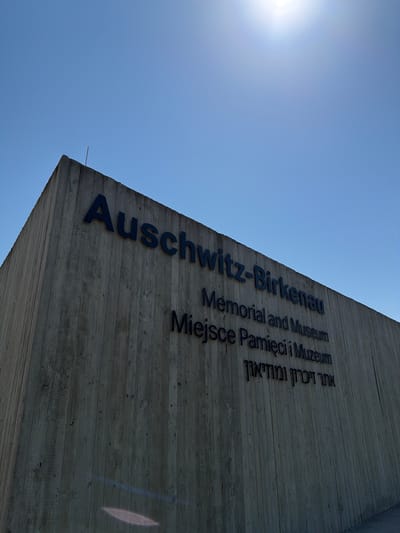
This media file shows the exterior of the Auschwitz-Birkenau Memorial and Museum in Oświęcim, Poland. The image is taken from a low angle, looking up at a stark concrete wall inscribed with text. The sky is a bright, clear blue, with the sun's glare visible in the upper left corner, suggesting it is daytime and likely a sunny day. The concrete wall is textured, showing the imprints of the wooden planks used during its construction. Dark, raised letters are affixed to the wall, spelling out "Auschwitz-Birkenau" in English. Below this, there are lines of text in other languages: "Memorial and Museum", "Miejsce Pamięci i Muzeum" (Polish for "Place of Memory and Museum"), and Hebrew text. The overall impression is one of solemnity and historical significance. The minimalist and imposing architecture, combined with the clear sky, creates a stark contrast that emphasizes the weight of the site's history. There are no people visible in the frame, focusing the attention entirely on the structure and its inscription. The image conveys a sense of presence at a place of profound historical importance.
Oświęcim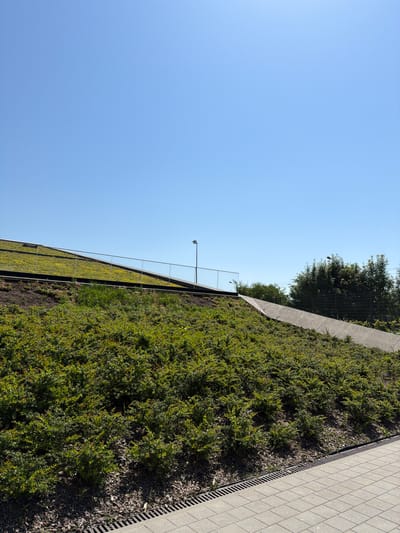
The image depicts an outdoor scene under a clear blue sky, featuring a sloped area covered in lush green bushes. In the background, a modern structure with a green roof is visible, bordered by a glass railing and a concrete walkway. A streetlamp stands on the green roof. Further back, a line of trees and a wire fence can be seen. The foreground shows a paved area with a drainage grate. The overall impression is one of a well-maintained urban park or landscaped area. The specific location of Oświęcim, Poland is not identifiable from the visual information presented in the image itself.
Oświęcim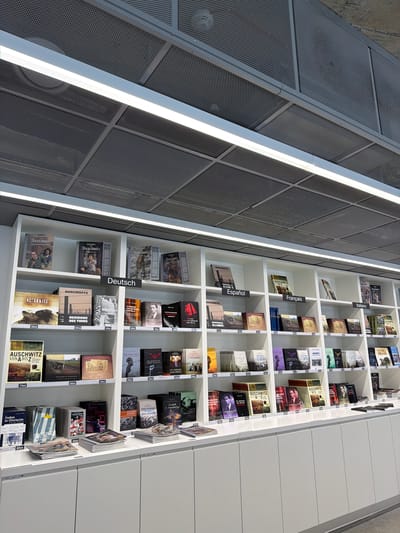
This is a high-angle, wide shot of a wall of bookshelves filled with books, primarily about Auschwitz. The bookshelves are white and neatly organized, with many books displayed vertically and some horizontally. The books appear to be in various languages, indicated by labels such as "Deutsch," "Español," "Français," and "Italiano." The cover art on many of the books features historical photographs or illustrations related to the Auschwitz concentration camp, with titles like "Auschwitz," "Residenz des Todes," and "Zurück in Auschwitz." Some books also have prices visible, indicated by "zł" (Polish Złoty). To the left of the bookshelves, a textured, grey metallic wall with a grid pattern is visible, running parallel to the bookshelves. Two long, bright white fluorescent lights are mounted vertically along the edge of this metallic wall, illuminating the scene. The overall impression is of a library or museum exhibit dedicated to the history of Auschwitz, likely located in or near Oświęcim, Poland, as suggested by the presence of the Polish currency and titles referencing the location. The lighting creates a clean and somewhat sterile atmosphere, emphasizing the educational and somber nature of the displayed material.
Oświęcim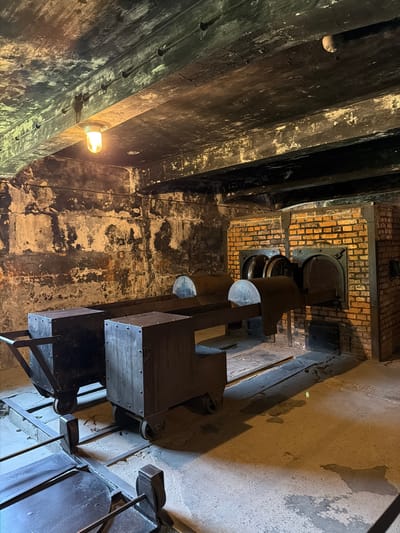
The image depicts the interior of a crematorium. In the center, a large, dark metal oven with a circular opening is visible, set against a brick wall. Above it, another opening in the brickwork suggests a chimney or ventilation system. To the left of the oven, heavy wooden beams line the ceiling, showing signs of age and wear. A single, yellow-tinted light bulb is mounted on one of these beams, casting a warm glow. The walls are rough and discolored, with peeling plaster and dark stains, hinting at the grim history of the location. In the foreground and to the right, portions of other metal machinery are visible, including what appears to be a conveyor belt system or a cart with wheels. The overall atmosphere is somber and stark, conveying a sense of historical significance and the heavy weight of the past. The image is taken from a low angle, looking upwards, emphasizing the imposing nature of the machinery and the structure. No people are visible in the frame. The lighting is dim and artificial, suggesting the scene is indoors and potentially at any time of day. The location is identified as Oświęcim, Poland, strongly implying a connection to Auschwitz.
Oświęcim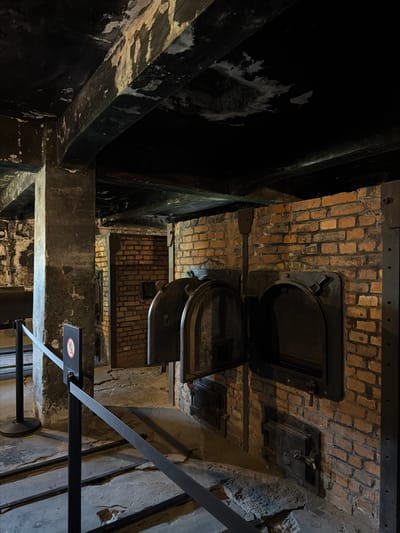
This image depicts the interior of a crematorium, likely at the Auschwitz-Birkenau concentration camp in Oświęcim, Poland. The scene is dark and industrial, with rough-hewn brickwork and heavy metal structures dominating the view. The perspective is from below, looking upwards at the crematorium ovens. The central focus is on a large, dark metal oven with multiple doors, set into a brick wall. Above it, another, more open cavity is visible, suggesting the burning chamber. The brickwork shows signs of age and soot, indicative of intense heat and use. Below the ovens, heavy wooden beams and metal supports form a structural framework. To the right, a black metal railing with a warning sign is visible. The sign displays a red circle with a diagonal line through it, over an image of a person, conveying a "no entry" or "restricted access" message. The overall atmosphere is somber and chilling, evoking the horrific history associated with such facilities. The lighting is dim, with light sources only hinted at in the upper parts of the image, casting deep shadows. There are no people visible, emphasizing the sterile and functional nature of the space. The textures of the worn brick, rough concrete, and dark metal contribute to the oppressive and grim ambiance. The presence of the crematorium ovens and the warning sign strongly suggest a historical site related to mass atrocities.
Oświęcim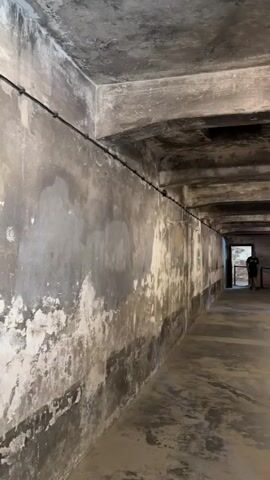
This video shows the interior of a dimly lit, austere room with concrete walls and a low, exposed concrete ceiling. The walls are stained and appear weathered, with patches of peeling paint. Several bare light bulbs are suspended from the ceiling, casting a stark illumination. The floor is also concrete and shows signs of wear. Two individuals are visible in the mid-ground, walking away from the camera. One person is wearing a dark t-shirt and shorts, while the other is wearing a light-colored t-shirt and pants. They appear to be visitors to the location. In the background, there is a doorway with a barred gate, and further down the hallway, another person can be seen. The overall atmosphere of the scene is somber and stark, suggesting a place with a significant historical context. The environment is characteristic of a former detention facility or prison, given its stark, utilitarian design and the evident signs of age and disrepair. The location is identified as Oświęcim, Poland, which is widely known as the site of the Auschwitz-Birkenau concentration and extermination camp. The video captures the interior of a structure within this historical complex. No text is visible in the video.
Oświęcim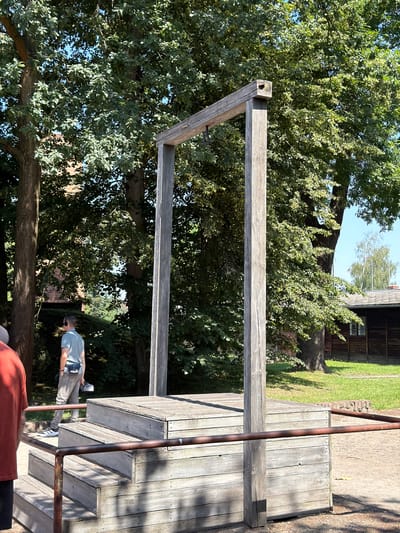
A person wearing a light blue t-shirt and grey pants with a fanny pack around their waist stands on a wooden platform. They are looking down at something in their hand. The platform has wooden steps leading up to it, and is supported by metal posts. In the background, there are trees with green leaves, a wooden building with a window, and a grassy area. The sun is shining, casting shadows on the wooden structure. The scene appears to be outdoors on a sunny day. The location appears to be a historical site, given the wooden structures and the context of Oświęcim, Poland, which is known for the Auschwitz-Birkenau Memorial and Museum. The person's posture and the general ambiance suggest a contemplative or observational mood.
Oświęcim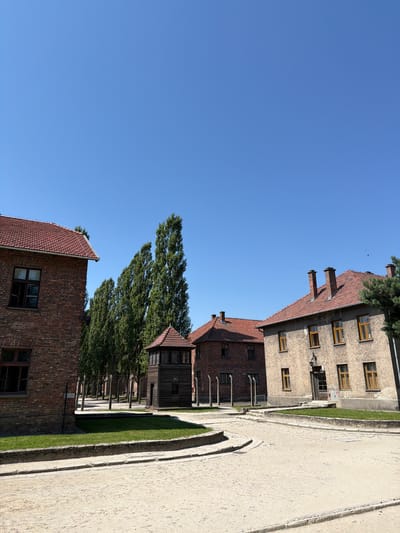
The image displays a street scene in Oświęcim, Poland, featuring a row of historic brick and stucco buildings under a clear blue sky. The buildings have red tile roofs and numerous windows, some with shutters. One building is constructed of light-colored stucco with multiple floors and many windows. Adjacent to it is a darker brick building with a red tile roof. Further down the street, another brick building with a red tile roof is visible, with a wooden structure also in view. Trees with green foliage line the street between the buildings. A paved walkway runs alongside the buildings, separated by a strip of grass. The scene appears to be set during the daytime, with bright sunlight casting shadows, suggesting fair weather. There are no people or specific activities depicted in the image. The overall impression is of an historical site with well-preserved architecture. There is no visible text in the image.
Oświęcim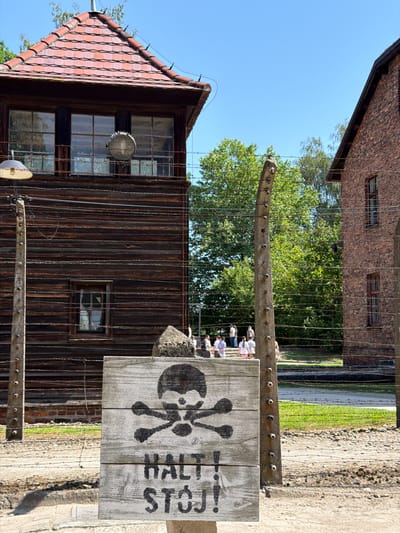
The image shows a wooden sign with a skull and crossbones symbol and the text "HALT! STEH!" (German for "Halt! Stand!") painted on it. The sign is weathered and appears to be made of several planks of wood nailed together. It is mounted on a wooden post, and in the background, there are barbed wire fences and brick buildings. The scene suggests a historical site, possibly a former prison or concentration camp. The sky is clear and blue, indicating a sunny day. The overall impression is somber and historically significant.
Oświęcim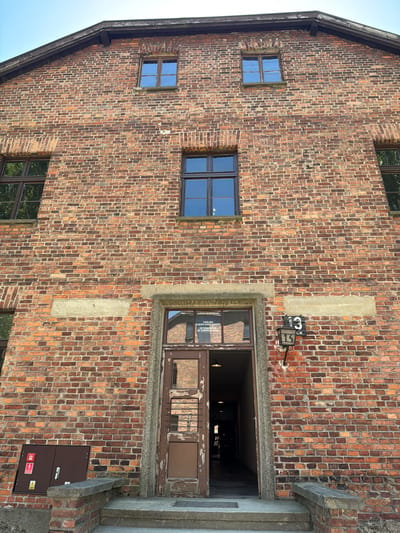
The image shows a close-up of a weathered brick building, likely an old industrial or institutional structure. The building has a dark, sloped roofline on the left, with a wooden fascia. Several windows are visible; some are small and square with multiple panes, reflecting the sky, while others are larger and rectangular, featuring darker frames and panes that reflect the interior and exterior of the building. One prominent doorway is open, revealing a dark interior with some barred elements. The brickwork is a mix of reddish-brown and darker shades, showing signs of age and wear. There are also sections of lighter-colored plaster or concrete integrated into the wall. A small, dark brown electrical box with warning symbols and labels is mounted on the brickwork near the open doorway. Above the doorway, a sign with a black background and white numbers "3" and "13" is attached to the wall, possibly indicating a room or section number. The overall impression is one of a historic, possibly utilitarian building with a sense of history. The lighting suggests it is daytime, with clear skies. The context of Oświęcim, Poland, suggests this could be a building within the Auschwitz-Birkenau Memorial and Museum complex, given the architectural style and the somber atmosphere often associated with such locations.
Oświęcim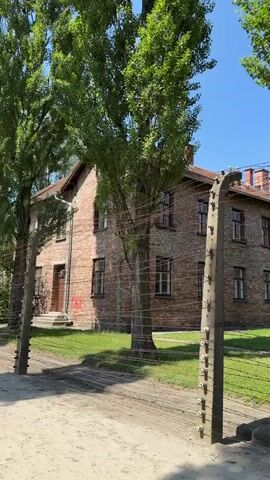
This media file shows a view of a brick building with multiple windows and a red-tiled roof, likely a historical site. The building is surrounded by a fence made of barbed wire and supported by concrete posts. A tall tree with lush green foliage stands in front of the building, casting shadows on the ground. The scene is set outdoors under a clear blue sky, suggesting a sunny day. The ground appears to be a dirt path or road, with wooden planks in front of the building and a grassy area. The building itself is constructed of red brick, and some of the windows are barred, hinting at a past that may have involved confinement. There are visible house numbers above the entrance, with one reading "23". A red sign is also affixed to the wall near the entrance. The overall atmosphere is somber, evoked by the presence of the barbed wire fence and the stark architecture, which is often associated with former concentration camps or prisons. The time of day appears to be daytime, given the strong sunlight and shadows. The location is Oświęcim, Poland, which is famously known as the site of the Auschwitz concentration camp.
Oświęcim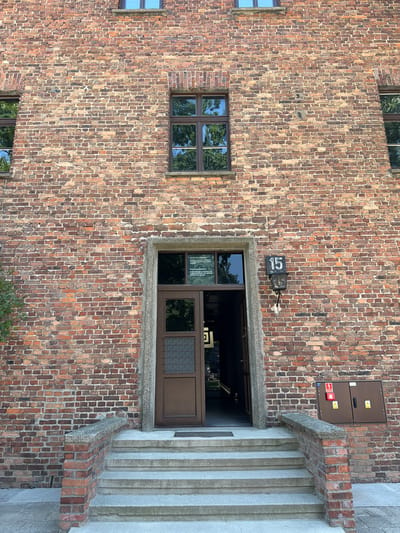
This media file is a photograph of the exterior of a brick building, likely part of a historical site given the location context of Oświęcim, Poland. The building's facade is constructed from a variety of red and brown bricks, laid in a stretcher bond pattern. Several windows are visible, some appearing to be modern with dark frames and glass reflecting trees. One prominent window is larger and has a dark frame with multiple panes, some of which are frosted or textured. Above this window, a dark sign with the number "15" in white digits is mounted on the brick wall, along with what appears to be a small black box with a handle. Further to the right, a concrete staircase with vertical grooves leads upwards alongside the brick wall. Above the large window, a metal cabinet with two doors is mounted on the wall. This cabinet has warning symbols and what looks like a fire alarm. The scene suggests an outdoor setting with daylight, though the time of day and specific weather conditions are not definitively discernible. There is no visible indication of people or any specific activity taking place. The overall impression is one of a historical and possibly somber location, indicated by the brick architecture and the presence of the numbered sign.
Oświęcim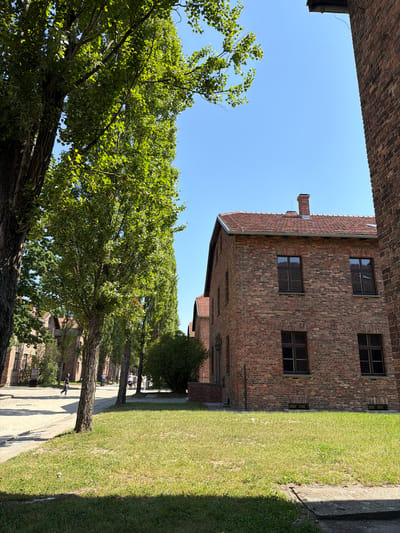
The image depicts a street scene in Oświęcim, Poland, likely within the grounds of the former Auschwitz-Birkenau concentration camp. The architecture features brick buildings with red tile roofs, characteristic of the period and location. Tall, leafy trees line a paved walkway, casting shadows on the grassy areas. In the background, several people are walking along the path, some appearing to be tourists or visitors, given their attire and demeanor. The sky is clear and blue, indicating fair weather. The overall atmosphere is one of historical significance, with the preserved buildings and trees evoking a sense of the past.
Oświęcim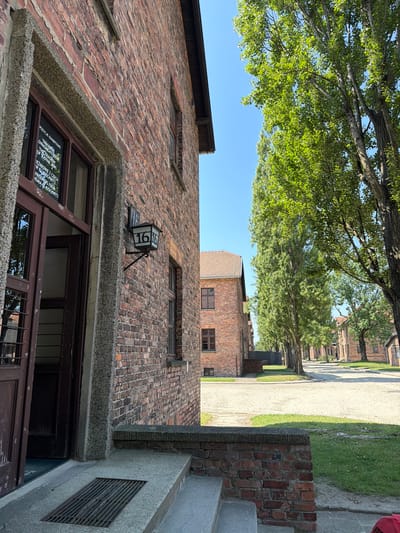
This is a photograph taken in Oświęcim, Poland, showing the exterior of brick buildings that appear to be part of a historical site. Tall trees with lush green foliage cast shadows on a light-colored pathway. The sky is a clear blue, suggesting daytime and fair weather. The foreground is dominated by a large brick building with a rough concrete trim around a dark-framed window. Reflected in the window, text is visible, partially obscured by the glass. The visible text includes "POZYCJE EXHIBITIONS," "TRAGEDDA OWACKICH Z DOW," "THE TRAGEDY OF SLOVAK JEWS," "IĘŻNIOWIE Z CZECH W KLAUSCHWITZ," "PRISONERS FROM HEMIA AT AUSCHWITZ." A square metal sign with the numbers "166" is attached to the brick wall above the window, mounted on a dark metal arm. In the background, a row of similar brick buildings stretches into the distance, lined by more trees and a grassy area. The overall impression is one of a historical memorial or museum site, with elements suggesting a past event of significance. The scene is still, and the lighting indicates it is likely midday.
Oświęcim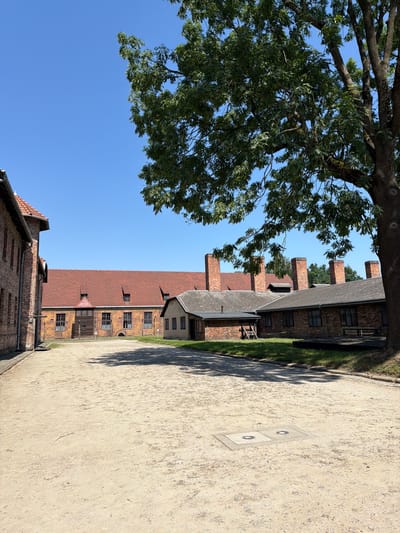
This is an outdoor, eye-level, medium shot, taken on a sunny day. A large, leafy tree branch extends into the frame from the upper left corner, casting shadows on the scene below. The ground is covered in light-colored gravel. To the right of the gravel path, a series of red-brick buildings with tiled roofs are visible. The buildings have numerous windows and chimneys. The sky is clear and blue. The overall scene appears to be a historical site, possibly a former camp or institution, given the stark architecture and the well-maintained but somewhat somber atmosphere. There is no visible text in the image.
Oświęcim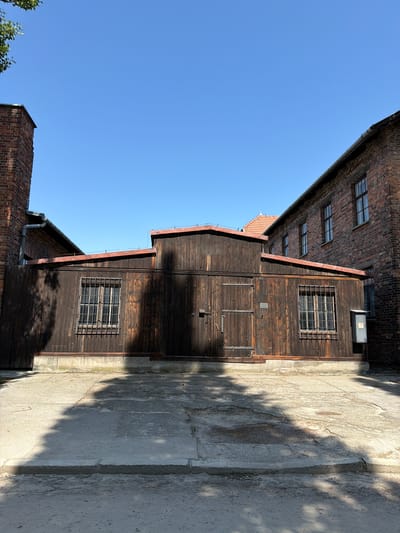
This is an outdoor, eye-level, medium shot of a rustic wooden building with a brick building partially visible to the left, set against a clear blue sky. The wooden structure has several windows with metal bars, suggesting security or confinement. Its dark wood is weathered and shows vertical planking. The brick building is older, with visible rows of bricks and multiple windows. The scene is illuminated by bright sunlight, casting strong shadows across the concrete ground on the right, indicating a sunny day. The overall impression is one of historical significance, possibly a former prison or industrial site. There are no people visible in the frame. The location context of Oświęcim, Poland, suggests this could be a building within the Auschwitz-Birkenau Memorial and Museum. No text is visible in the image.
Oświęcim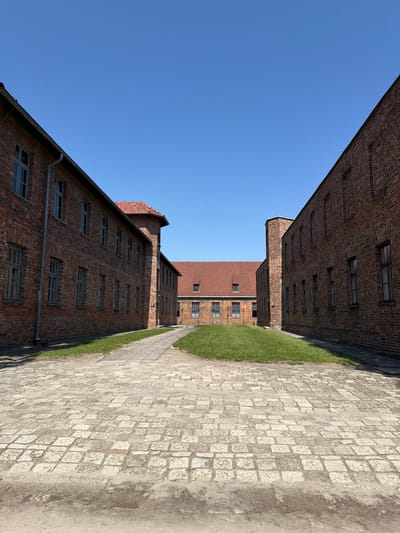
The image shows a perspective view of two brick buildings on a clear, sunny day. The buildings are constructed from red brick and have multiple windows with dark frames. The architectural style suggests they might be old industrial buildings or part of a historical complex. The ground in front of the buildings is paved with rough, grey cobblestones, and a strip of neatly mown green grass runs alongside the paving. The scene is viewed from a low angle, looking upwards towards the sky, which is a vibrant, cloudless blue. The perspective is slightly tilted, giving a sense of depth and scale to the buildings. The sunlight casts distinct shadows, indicating it is likely daytime. There is no visible text in the image. The overall impression is one of historical architecture in a well-maintained outdoor setting under clear skies.
Oświęcim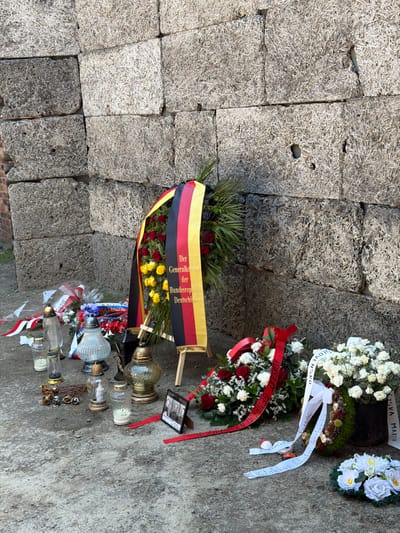
The image depicts a memorial scene, likely at a solemn historical site given the location context of Oświęcim, Poland. The primary subjects are several wreaths of flowers, arranged on a coarse, stony surface. The wreaths are elaborate, with a mix of white, red, and yellow roses, along with greenery and decorative elements like pinecones. Some wreaths are adorned with ribbons, some of which bear visible text. One prominent ribbon, draped across a large wreath, displays text in German: "Der Generalkonsul der Bundesrepublik Deutschland" (The Consul General of the Federal Republic of Germany). Other ribbons have text in what appears to be Slovak, including "SLOVENSKO" and potentially names or dedications. In addition to the floral tributes, there are several glass memorial lanterns, some containing candles, placed on the ground amongst the wreaths. A small framed photograph, containing multiple portraits, is also visible. The overall setting appears to be outdoors, with rough, hewn stone blocks forming a backdrop or part of the memorial structure. The lighting suggests it is daytime, possibly overcast or with diffused sunlight. The atmosphere conveyed is one of respect and remembrance. The arrangement of the wreaths and lanterns indicates a formal commemoration or tribute.
Oświęcim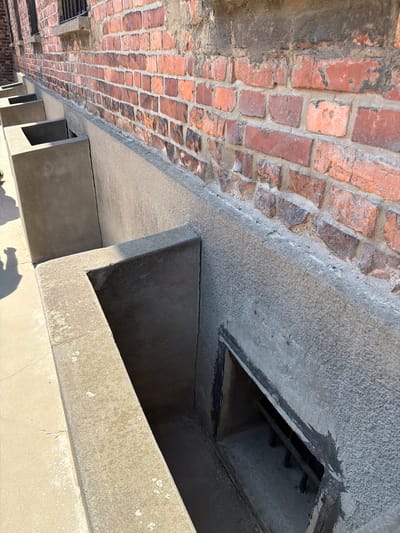
The image shows an angled view of a section of a brick wall and a concrete structure. The brick wall, likely old, is made of reddish-brown bricks with visible mortar. To the right of the brick wall is a concrete overhang or ledge, which appears to be a functional element of the structure. Below this overhang are several rectangular openings or alcoves within the concrete. The scene appears to be outdoors, as suggested by the natural lighting and shadows cast on the concrete surfaces. The sun is casting a strong light, creating distinct shadows that indicate it is likely daytime. The concrete exhibits signs of age and weathering, with some discoloration and surface texture variations. There are no people or specific activities depicted. The focus is on the architectural elements. The location cues, such as the brickwork and concrete construction, suggest an industrial or historical site. Given the context of Oświęcim, Poland, it is possible this is part of an existing structure at a historical memorial or museum site. No text is visible in the image.
Oświęcim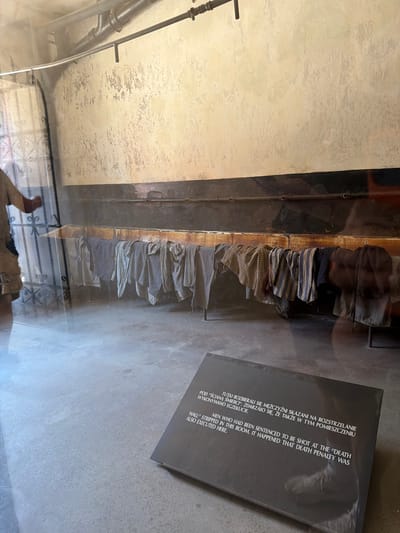
This media file depicts a somber exhibit, likely within a museum or memorial. The primary subjects are a collection of tattered clothing items, hung on metal rods against a dark, distressed wall. These garments, primarily striped shirts and trousers, appear old and worn, suggesting a historical context of hardship and possibly imprisonment. In the foreground, a dark-colored plaque with text in both Polish and English is visible, leaning against a textured floor. The text on the plaque reads: "TUTAJ ROZBIERALI SIĘ MĘŻCZYŹNI SKAZANI NA ROZSTRZELANIE POD 'ŚCIANĄ ŚMIERCI', ZDARZAŁO SIĘ, ŻE TAKŻE W TYM POMIESZCZENIU WYKONYWANO EGZEKUCJE" and "MEN WHO HAD BEEN SENTENCED TO BE SHOT AT THE 'DEATH WALL' STRIPPED IN THIS ROOM. IT HAPPENED THAT DEATH PENALTY WAS ALSO EXECUTED HERE." This inscription clearly indicates the location is associated with executions and the suffering of men, placing it within a historical context of significant human tragedy. The setting appears to be indoors, with a plain, textured wall on the left and a polished concrete floor. The lighting is subdued, contributing to the serious and reflective mood of the scene. The overall impression is one of remembrance and a testament to past atrocities, likely related to events at Auschwitz-Birkenau, given the mention of "Oświęcim, Poland" in the location context. There is a reflective surface, possibly glass or a polished material, obscuring parts of the scene, suggesting the items are protected for display.
Oświęcim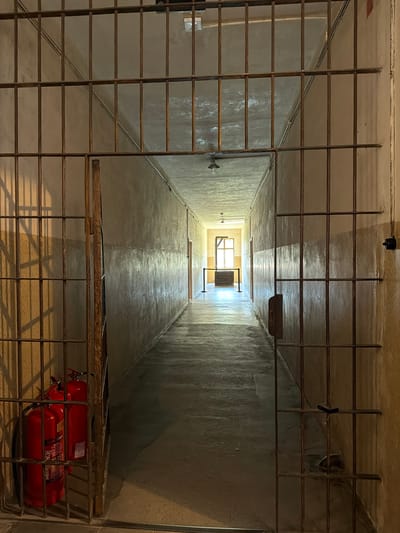
This image shows an upward view of a narrow, tall interior space, possibly a ventilation shaft or a confined stairwell, with metal grating in the foreground. The walls are rough and textured, illuminated by light filtering from a window at the top. The scene appears to be indoors, with a stark, utilitarian aesthetic. Prominently featured in the lower right of the frame, behind the grating, are two red fire extinguishers. They are cylindrical and appear to be standard fire safety equipment. Above the fire extinguishers, there's a wooden plank or beam, also behind the grating, and further up, a dark object is affixed to the wall. The metal grating is a recurring element, creating a layered effect and suggesting a secure or enclosed environment. Sunlight streams in from the square window at the very top, creating patterns of light and shadow on the walls. The overall impression is one of confinement and a focus on infrastructure rather than human presence. The image lacks any indicators of time of day or specific weather conditions, but the enclosed nature of the space suggests it is within a building. The location context of Oświęcim, Poland, and the stark, potentially historical architecture hinted at by the raw materials and functional design, might evoke associations with such sites. No discernible text is visible on the walls or objects, except for labels on the fire extinguishers which are too blurry to read.
Oświęcim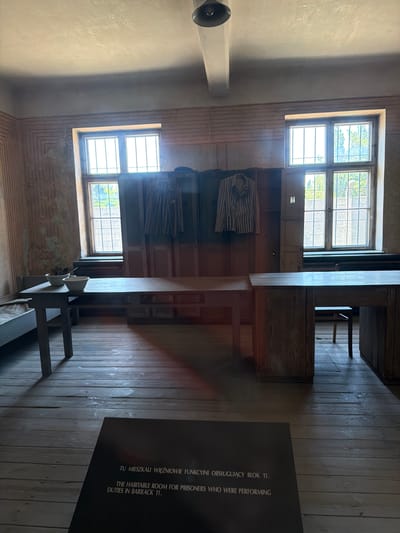
This image depicts the interior of a room, likely a former barrack, in Oświęcim, Poland. The room has wooden plank walls and flooring, with a large window featuring a grid of panes. Two striped shirts, characteristic of prisoner uniforms, are hanging on a wall. In the foreground, a dark informational plaque is visible with text in both Polish and English. The text reads: "TU MIESZKALI WIĘŻNIOWIE FUNKCYJNI OBSŁUGUJĄCY BLOK 11." and "THE HABITABLE ROOM FOR PRISONERS WHO WERE PERFORMING DUTIES IN BARRACK 11." This suggests the room served as living quarters for prisoners performing essential duties within Block 11, a significant part of the Auschwitz concentration camp complex. The overall impression is one of somberness and historical reflection, likely taken during daylight hours, given the natural light filtering through the window. The setting evokes a sense of the past, highlighting the harsh living conditions and the historical context of the location.
Oświęcim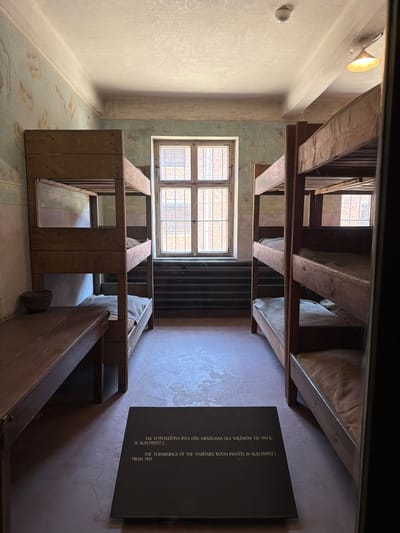
The image depicts the interior of a room at the Auschwitz-Birkenau Memorial and Museum in Oświęcim, Poland. The room contains two sets of wooden bunk beds, each with two levels, arranged along the walls. The beds are sparsely furnished with thin mattresses covered in a light-colored fabric, presumably to represent the conditions of the time. On the left side of the room, a long wooden table or bench is positioned in front of a bunk bed. A woven basket sits on the table. The walls of the room have a faded, textured finish, suggesting the passage of time and wear. A large, multi-paned window with metal bars is visible in the background, offering a glimpse of the exterior. The floor is a smooth, muted color with some visible cracks. In the foreground, a dark, angled informational plaque is placed on the floor. The plaque bears text in both Polish and English, indicating that it provides information about the room's furnishings and its use by inmates in Auschwitz I from 1941. The overall impression is one of starkness and austerity, reflecting the historical context of the location. A light fixture is visible hanging from the ceiling, and a smoke detector is mounted near the ceiling. The scene is lit by natural light from the window and possibly artificial light from the fixture.
Oświęcim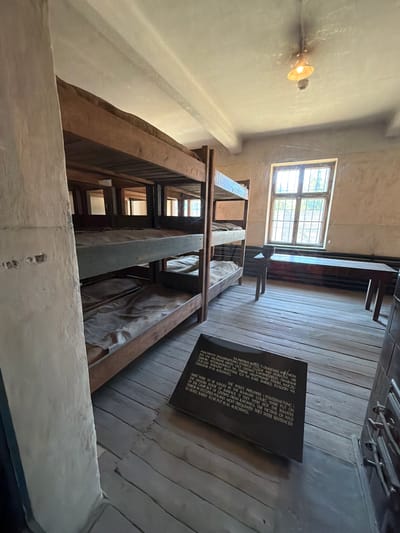
The image depicts the interior of a former barracks at the Auschwitz-Birkenau Memorial and Museum in Oświęcim, Poland. The room contains several tiered wooden bunks, each with a thin mattress covered in a light-colored fabric. The walls are bare and appear to be made of plaster. A barred window is visible on the right side of the room, letting in natural light. A simple wooden table and bench are positioned near the window. A plaque with text, written in both Polish and English, is placed on the floor in the foreground, providing historical information about the location. The overall impression is one of austerity and historical significance.
Oświęcim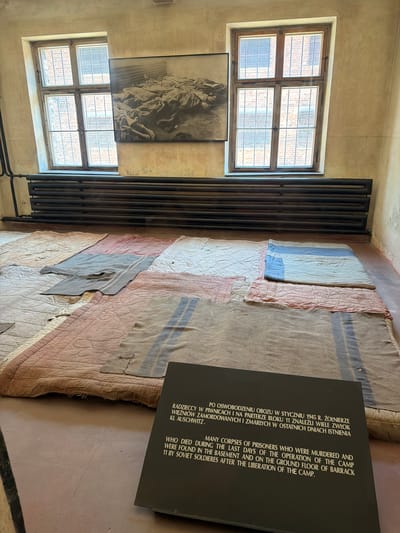
The image shows a room within a building in Oświęcim, Poland, likely part of the Auschwitz-Birkenau Memorial and Museum. The room has two tall, multi-paned windows with bars on the exterior, revealing brick walls behind them. Below the windows are dark, ribbed radiators. The floor is covered with a patchwork of blankets and quilts in various muted colors, including pink, beige, and grey. Some of these textiles show signs of wear, with rips and frayed edges. On the wall, above the radiators and spanning between the windows, is a framed black-and-white photograph depicting a pile of emaciated bodies. In the foreground, a black informational plaque is positioned on the floor, angled towards the viewer. White text on the plaque, in both Polish and English, describes the discovery of murdered prisoners' corpses in the basement and on the ground floor of Barrack 11 after the camp's liberation by Soviet soldiers in January 1945. The English text reads: "MANY CORPSES OF PRISONERS WHO WERE MURDERED AND WERE FOUND IN THE BASEMENT AND ON THE GROUND FLOOR OF BARRACK 11 BY SOVIET SOLDIERS AFTER THE LIBERATION OF THE CAMP."
Oświęcim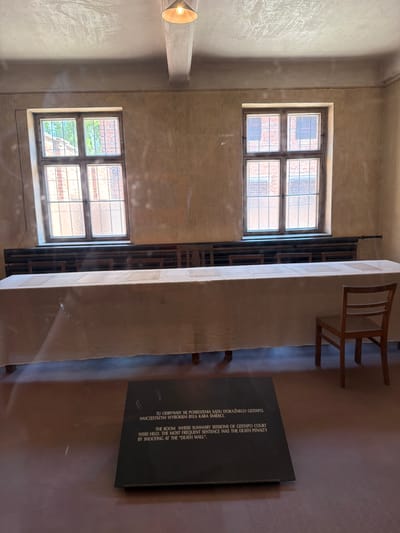
This image depicts an interior scene, likely within a historical site or museum, given the presence of informational text. The room appears sparsely furnished with two windows, each divided into four panes. The walls are a neutral, textured color, and a simple wooden chair and a long, covered table are visible. The lighting suggests it could be daytime, with natural light entering through the windows. A prominent feature is a dark plaque with text inscribed in both Polish and English. The text describes the room as a place where summary sessions of a Gestapo court were held, and the most frequent sentence was the death penalty by shooting at the "Death Wall." This suggests the location is a site of historical significance related to World War II and the Holocaust, likely Auschwitz-Birkenau, given the context provided. The overall atmosphere is somber and reflective, conveyed through the starkness of the environment and the historical information presented. The image is oriented vertically, with the top of the scene on the left. No people are visible in the frame.
Oświęcim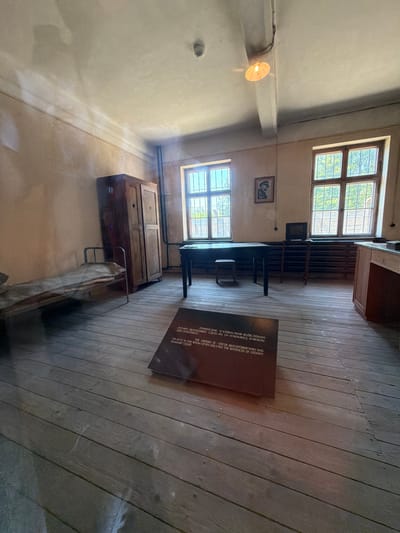
The image depicts a room furnished as it might have been in the Auschwitz-Birkenau concentration camp in Oświęcim, Poland. The room contains a simple wooden bed with a thin mattress, a tall wooden wardrobe, a desk with a chair and a small monitor, and two large, barred windows. The floor is made of wooden planks, and the walls are a pale, textured color. On the floor in the foreground, there is a dark, angled plaque with text in Polish and English. The lighting appears to be from a single overhead bulb and natural light from the windows. The overall impression is one of stark austerity and historical preservation.
Oświęcim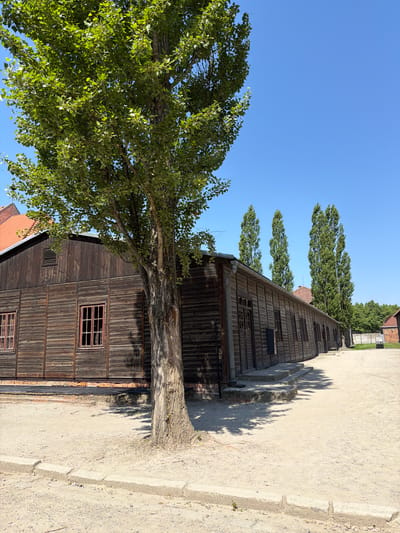
This is a vertically oriented, low-angle, outdoor photograph taken on a clear, sunny day in Oświęcim, Poland. The scene depicts a row of old, dark wooden buildings, likely barracks or storage facilities, with the aged wood showing vertical plank construction. These buildings have red-framed windows with barred panes, suggesting a historical, perhaps somber, context. One building has a red tile roof visible. A large tree with green foliage dominates the left side of the frame, its trunk and branches arching over the wooden structure. The tree's shadow is cast onto the light-colored, gravelly ground and the side of one of the buildings, indicating the time of day is likely late morning or early afternoon, with the sun positioned high in the sky. In the background, several tall, slender trees with dense green foliage stand in a line, and beyond them, more distant buildings and trees are visible. The overall impression is one of historical preservation and quietude. The clear blue sky and bright sunlight contrast with the weathered, dark appearance of the buildings. There is no discernible text in the image.
Oświęcim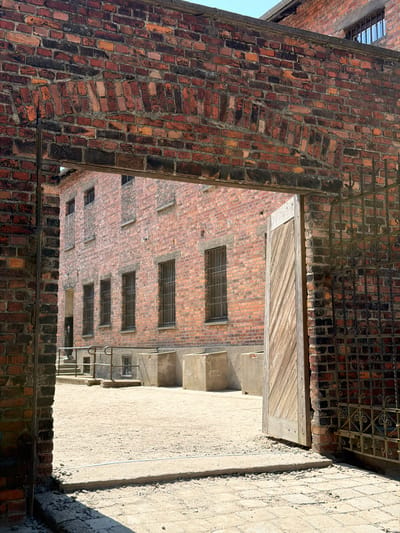
This media file depicts an outdoor scene of old brick buildings with metal-barred windows. The perspective is looking through an archway or opening in a brick structure, revealing a courtyard or alleyway between buildings. The architecture suggests an industrial or historical setting, possibly a former prison or factory. The buildings are constructed with weathered red bricks, and some have a rough, concrete-like exterior. The sky is visible in the upper left corner, indicating it is daytime, likely sunny due to the shadows. The overall mood is somber and perhaps a bit eerie, given the presence of barred windows and the aged, imposing structures. There is a wooden plank structure visible above the opening, and some metal railings on the right side of the scene. No people or text are visible in the image. The location is Oświęcim, Poland.
Oświęcim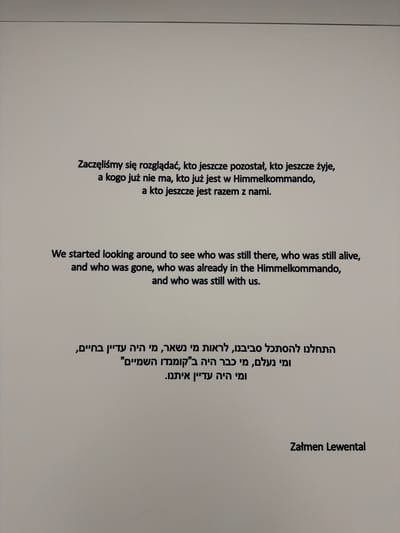
The image displays a light gray wall with black text printed on it. The text is presented in three languages: Polish, English, and Hebrew. The Polish text reads: "Zaczęliśmy się rozglądać, kto jeszcze pozostał, kto jeszcze żyje, a kogo już nie ma, kto już jest w Himmelkommando, a kto jeszcze jest razem z nami." The English text reads: "We started looking around to see who was still there, who was still alive, and who was gone, who was already in the Himmelkommando, and who was still with us." The Hebrew text reads: "התחלנו להסתכל סביבנו, לראות מי נשאר, מי היה עדין בחיים, ומי נעלם, מי כבר היה ב"קומנדו השמייים" ומי היה עדיין איתנו." Below the Hebrew text, the name "Zalmen Lewental" is printed. The image does not contain any information or visual cues to indicate a specific location within the city of Oświęcim, Poland. The scene is static and consists only of the text on the wall.
Oświęcim