Oba-Ile, Nigeria
30 memories from Oba-Ile, Nigeria
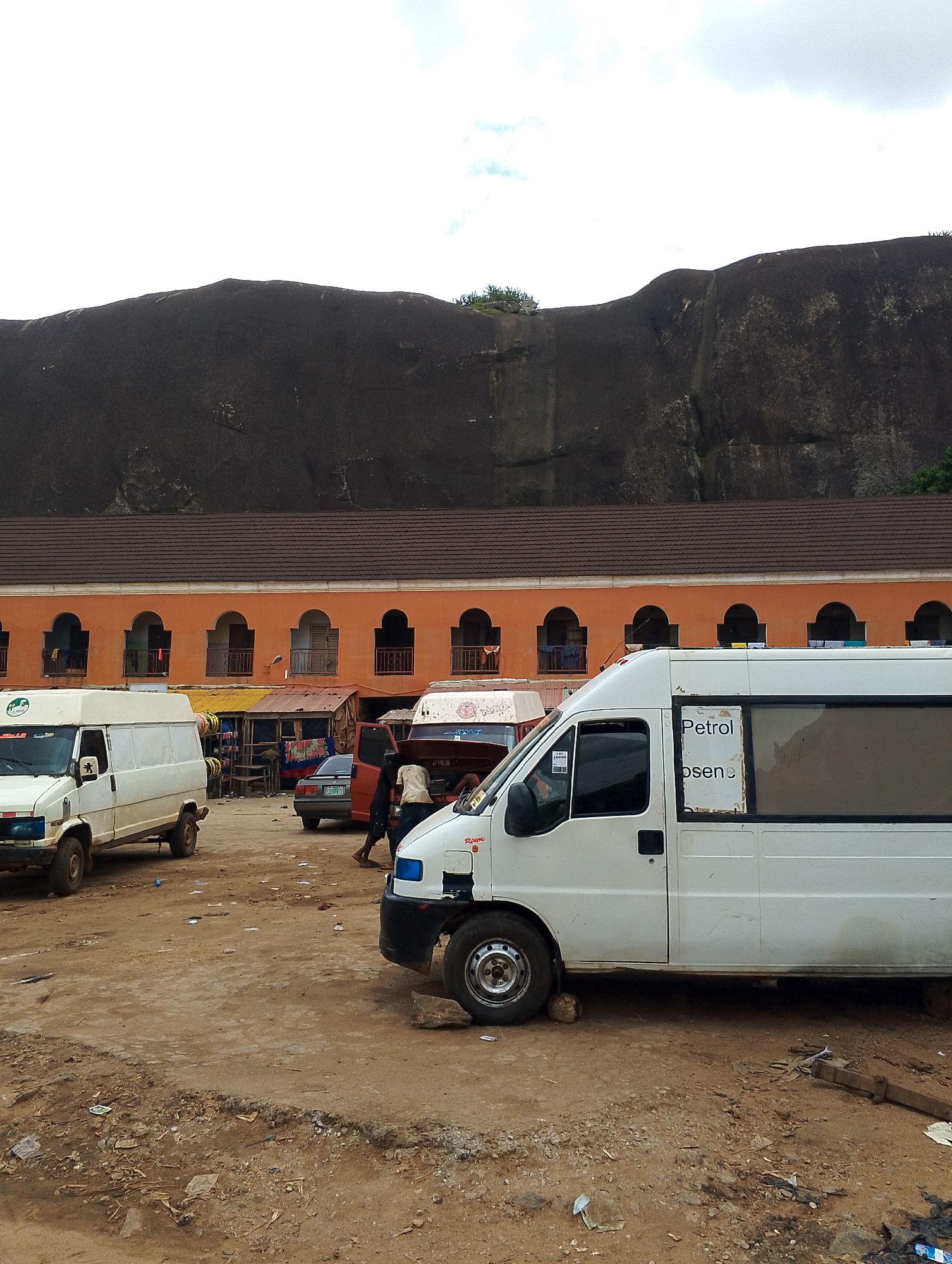
The image depicts a street scene in Oba-Ile, Nigeria, with a prominent large rock formation in the background. In the mid-ground, an orange building with arched windows and a tiled roof runs horizontally across the frame. In front of the building, several vehicles are visible, including white vans and a car. One white van in the foreground has the word "Petrol" and some illegible text visible on its side. People are seen interacting with the vehicles, with one person appearing to work on the open hood of a vehicle. The ground is unpaved and appears dusty and littered with debris. The sky is overcast.
Oba-Ile
The video shows a street scene in a developing area, likely in Africa. The road is dirt, with several parked cars including a silver sedan, a pink sedan, a white van, and a blue SUV. Pedestrians are walking along the street, some dressed in traditional patterned clothing. There are several small shops or stalls along the side of the road, with corrugated metal roofs. The sky is cloudy, and power lines run along the top of the frame. In the distance, a hill or elevated area can be seen, with buildings on top. A large truck is parked further down the road.
Oba-Ile
From a moving vehicle, the video shows an outdoor scene. The camera passes a gas station with a blue and white canopy and then captures a glimpse of a red dump truck. The environment then shifts to a dusty road lined with small wooden shops and stalls under various umbrellas. People are seen walking and riding a motorcycle on the road. The sky is overcast.
Oba-Ile
The video shows a pile of large, hollow woven cylinders lying on a dirt road beside a patch of green plants. Behind the plants is a concrete wall with graffiti on it, reading "MATO FOR GOVERNOR" and "TRM 2024". The camera appears to be moving, likely from a passing vehicle.
Oba-Ile
This image captures two individuals, an adult female and a child, in a close-up, diagonal portrait, likely taken indoors in Oba-Ile, Nigeria. Both subjects have dark skin and are looking towards the camera. The adult, positioned slightly behind and above the child, wears a pink top and has dark hair styled in dreadlocks or braids. Her expression is neutral to thoughtful. A thin chain is visible around her neck. Her arm is gently placed around the child, with one hand resting near the child's eye. The child, in the foreground, wears a yellow garment with black and white patterned sleeves. A small, light-colored piece of food, possibly a banana or plantain, is held in their mouth. The child has wide, dark eyes and a neutral expression. The background is dark and indistinct, suggesting an intimate indoor setting with subdued lighting, possibly indicating evening or a room with limited natural light. The overall scene conveys a sense of warmth and closeness between the two individuals. There is no visible text in the image.
Oba-Ile
An overhead portrait-style shot captures a person with medium-brown skin and dreadlocks looking directly at the camera. The person's head is tilted slightly, and their expression is neutral. They have dark eyes and full lips. A small, clear or silver stud piercing is visible on the left side of their nose. Their dreadlocks are a mix of dark and lighter brown hues, with some strands falling across the forehead and around the face. The person is wearing a pink, ribbed top, which features a horizontal striped texture. A thin gold chain is visible around their neck, resting on the fabric of the shirt. The background consists of lush green foliage and tree branches, indicating an outdoor setting, possibly in a garden or natural area. The sky in the upper right portion of the image is bright and appears overcast or hazy white. The lighting suggests it is daytime. The image hints at a location like Oba-Ile, Nigeria, given the natural outdoor environment. No visible text is present in the image.
Oba-Ile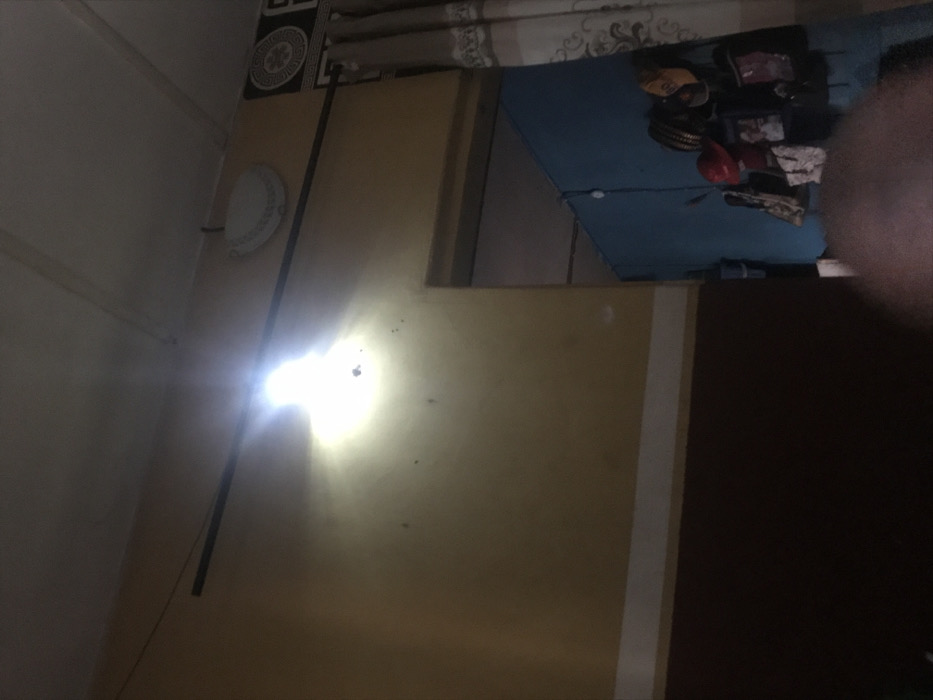
The image displays an interior room located in Oba-Ile, Nigeria. The visible wall is painted in two horizontal sections: an upper pale yellow and a lower dark brown, separated by a thin white stripe. A single, intensely bright, unshielded light source is affixed to the upper left portion of the pale yellow wall, generating significant glare. A dark, thin horizontal bar is mounted across the upper wall section. Near the ceiling on the right, a circular, flush-mounted light fixture is present. An open doorway to the right leads into an adjacent room, revealing a distinct blue wall adorned with multiple hanging objects, including hats, bags, and framed items. A patterned curtain with a dark border partially obscures the view into this adjacent room. The ceiling is light-colored with visible structural beams. The immediate foreground is blurred and dark, without discernible features. No individuals or specific actions are identifiable within the scene.
Oba-Ile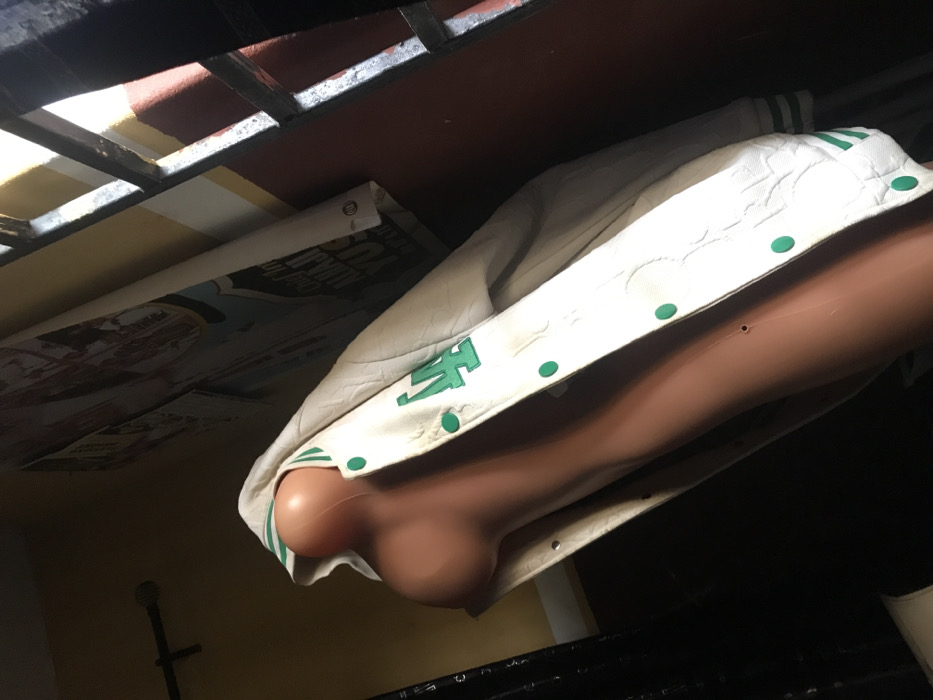
The scene is an interior location in Oba-Ile, Nigeria. A light brown, headless, armless female mannequin torso is positioned diagonally, ascending from the lower left to the upper right of the frame. A white varsity jacket, featuring green trim, green snap buttons, and green embroidered lettering (likely 'LA') on the left chest, is draped open over the mannequin torso. The upper left background shows a yellow-tan wall section with a dark horizontal rod. The upper right background displays a window secured by dark metal bars, bordering a reddish-brown wall section. Natural light enters primarily from this window. Behind the mannequin, a vertical white fabric banner with dark text, including "CHEF" and "MILK," is visible on the wall, alongside a partially obscured, faded poster. The overall illumination is dim. No individuals are present.
Oba-Ile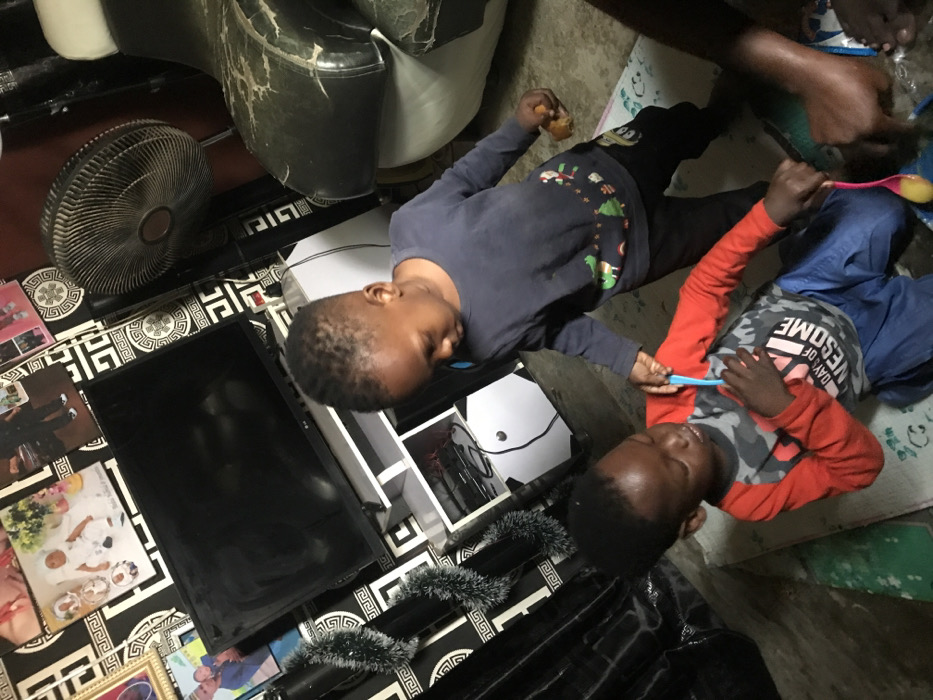
This image depicts an indoor residential scene in Oba-Ile, Nigeria. The background features a wall covered in black and white geometric pattern wallpaper, adorned with multiple framed photographs of individuals and families. A black LG flat-screen television is positioned above a white entertainment stand containing various electronics and cables. To the right of the television, a dusty standing fan is visible. Further right, a dark-colored armchair with significant wear and peeling upholstery is present. Dark fabric drapes with a festive tinsel garland hang on the left. The floor is light-colored and partially covered by mats. In the foreground, two young Black males are present, along with the visible hands of a third individual. A younger child is positioned kneeling or sitting on the floor, wearing a red long-sleeve shirt over a grey camouflage t-shirt that reads "DAYS OF AWESOME," and blue trousers. This child holds a pink spoon, dipping it into a blue bowl containing a yellowish food substance. Standing behind and slightly to the left of this child is an older boy, dressed in a navy blue long-sleeve shirt with colorful graphics and black trousers. He holds a small, light-brown, irregular-shaped snack in his left hand, and a blue spoon in his right hand, positioned near the shoulder of the kneeling child. On the far right, two dark-skinned hands are visible, interacting with the blue bowl, one appearing to support it while the other's finger points towards the contents. The children appear focused on the food and their interaction.
Oba-Ile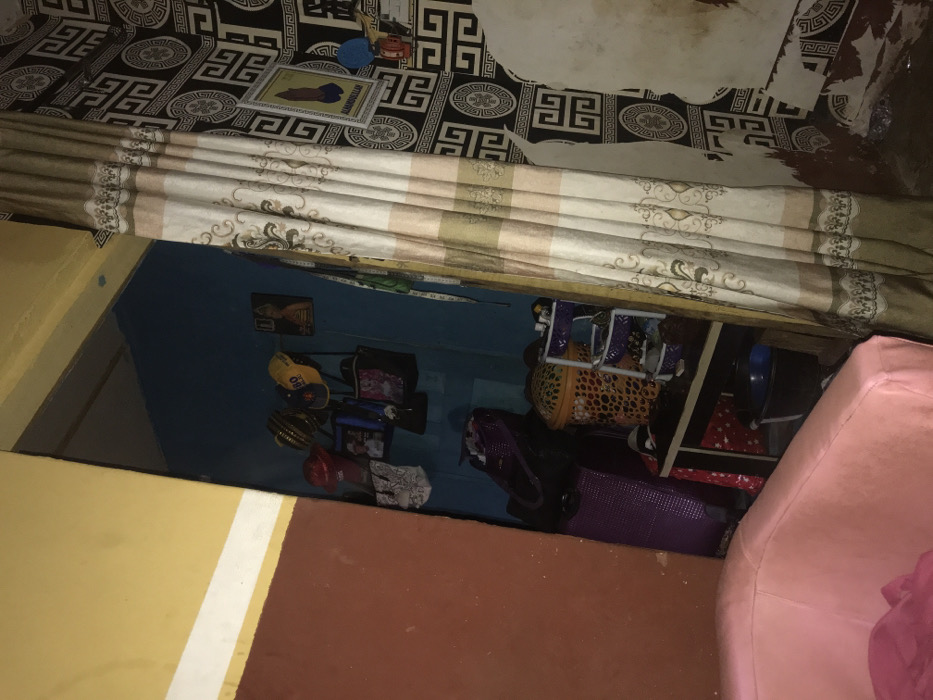
The scene depicts an interior space, likely residential, located in Oba-Ile, Nigeria. The perspective is from one room looking into an adjacent, smaller room through an open doorway, with another section of the originating room visible on the right. In the foreground, to the lower left, a portion of a pink upholstered armchair or sofa is visible, partially covered by pink fabric. The wall immediately behind this furniture piece features a horizontal division: a reddish-brown lower section, a thin white stripe, and a yellowish-orange upper section. The open doorway leads into a room with solid blue-painted walls. Hanging on the blue wall are several items: three caps or hats (one yellow, one red, one striped), a framed photograph, and at least four bags of varying designs (including white with black patterns, black with pink patterns, and blue). On the floor or stacked within this inner room are a tall, purple, possibly luggage-style container; a large, orange, perforated laundry basket; and a smaller, multi-tiered purple shelving unit holding various small objects. A dark-colored table or counter is partially visible, with a dark blue bucket situated on the floor beneath it. To the right of the doorway, a striped, floor-length curtain with a beige, white, and brown ornate pattern is pulled aside. It partially obscures a wall covered in black and white geometric pattern wallpaper. On this patterned wall, a white-framed picture with a yellow background features a dark silhouette of a person and the text "ALHAMDULILLAH". Below this frame, several small items resembling key holders or decorative elements are attached to the wall. The lower portion of this wall displays an irregular, lighter-colored patch, suggesting damage, peeling, or an unfinished section over a reddish-brown base. No individuals are present in the image.
Oba-Ile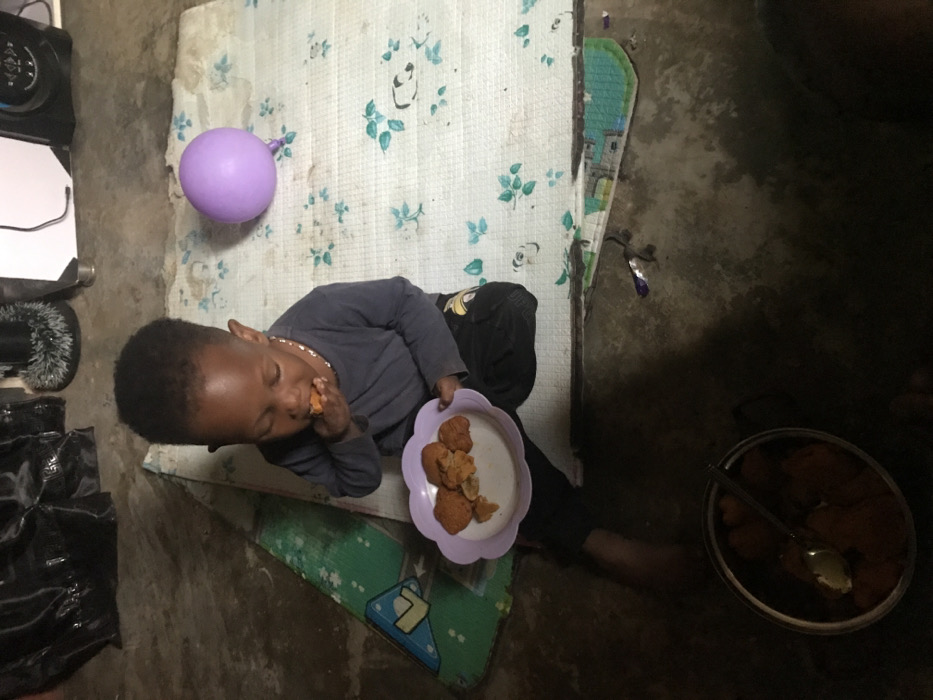
An image taken in Oba-Ile, Nigeria, depicts a young child seated on the floor indoors. The child, a toddler with dark skin and short dark hair, is wearing a dark grey long-sleeved shirt, dark pants, and a light-colored beaded necklace. They are sitting cross-legged on a light-colored foam mat adorned with green floral and panda designs. The child holds a light purple, fluted-edge plate containing several irregularly shaped, fried food items. One piece of food is held to the child's mouth with their right hand, indicating active consumption. Visible around the child's mouth are food crumbs. To the child's right, on the mat, lies a partially deflated purple balloon. In the background, a black plastic bag, a dark speaker-like object, and a white rectangular object are discernible. In the lower left foreground, a metal pot containing more of the fried food items, along with a metal spoon, rests on the concrete floor. The floor is concrete and appears discolored in areas, with another segment of green patterned matting visible to the child's left. Lighting is dim, creating visible shadows.
Oba-Ile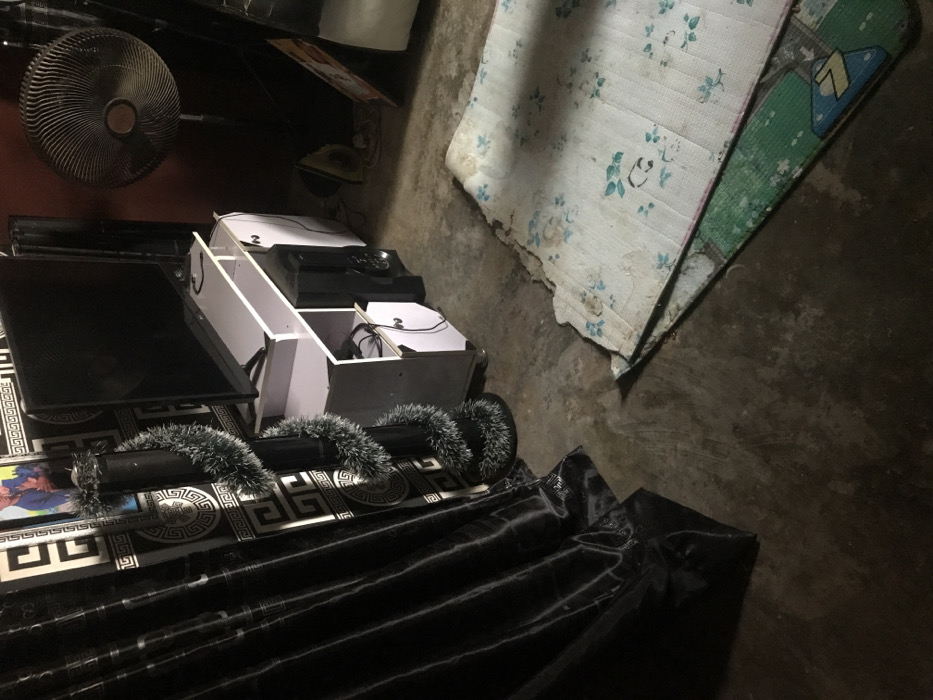
The scene depicts an interior room in Oba-Ile, Nigeria, characterized by dim lighting. In the mid-ground, a black flat-screen television rests on a white, multi-shelf entertainment unit. Below the television, cables are visible on an open shelf. A black speaker unit is positioned to the right of the TV stand. Behind the television setup, the wall is covered with black and white geometric patterned wallpaper, on which a framed picture of two individuals is mounted. To the left of the entertainment unit, a tall, slender object, possibly another speaker or support column, is wrapped with a shaggy grey and white tinsel-like decoration. Further to the left, dark, pleated curtains are drawn. On the right side of the image, a brown standing fan with a circular grill cover is situated against a reddish-brown wall. Below the fan, a dark clothes iron with a yellow cord is on the floor. A portion of a large white appliance or cabinet is visible in the far right background. The floor is composed of unpolished concrete. In the foreground, two overlapping rectangular floor mats are present. The top mat is predominantly white with a light blue floral pattern, showing significant wear, soiling, and a torn edge. A second mat, patterned in green and other colors, is partially visible beneath the first. No individuals are visible within the frame.
Oba-Ile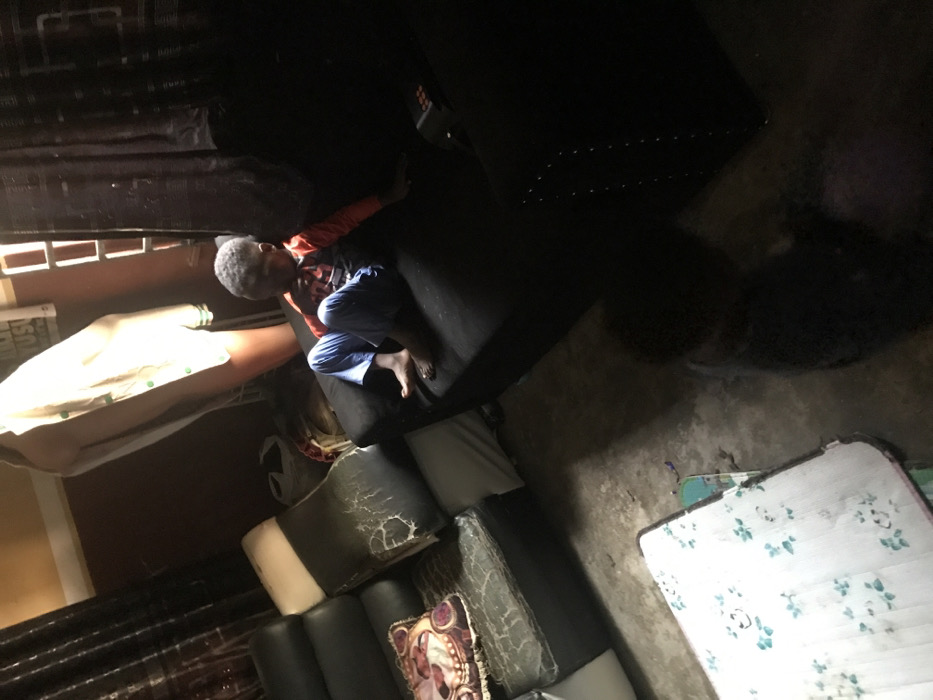
This image depicts an interior scene in Oba-Ile, Nigeria, possibly a living area, characterized by dim lighting and a worn appearance. The background wall is dark reddish-brown. A window on the right side, partially obscured by dark, patterned curtains, allows natural light into the room. A light-colored garment, possibly a jacket with green accents, hangs on a stand or hook against the back wall. In the center-right, a young male child, barefoot, sits on a dark-colored sofa. He wears a long-sleeved shirt, red on top and dark below, paired with blue trousers. His left hand is near his mouth or chin, and his gaze is directed downwards. A small electronic device with red buttons rests on the right armrest of this sofa. To the left, a section of a black faux leather sofa shows significant wear, with cracked and peeling upholstery revealing a lighter material underneath. A patterned cushion, featuring brown, red, and beige hues, rests on this sofa. The floor appears to be a concrete or hard surface, showing some dirt or debris. In the lower foreground, partially obscured and heavily shadowed, another young child is visible, possibly sitting on the floor or a low surface. Only their head and upper body, dressed in dark attire, are discernible. A low table or surface, covered with a white cloth featuring a light green floral pattern, is positioned in the lower-left foreground, partially out of frame.
Oba-Ile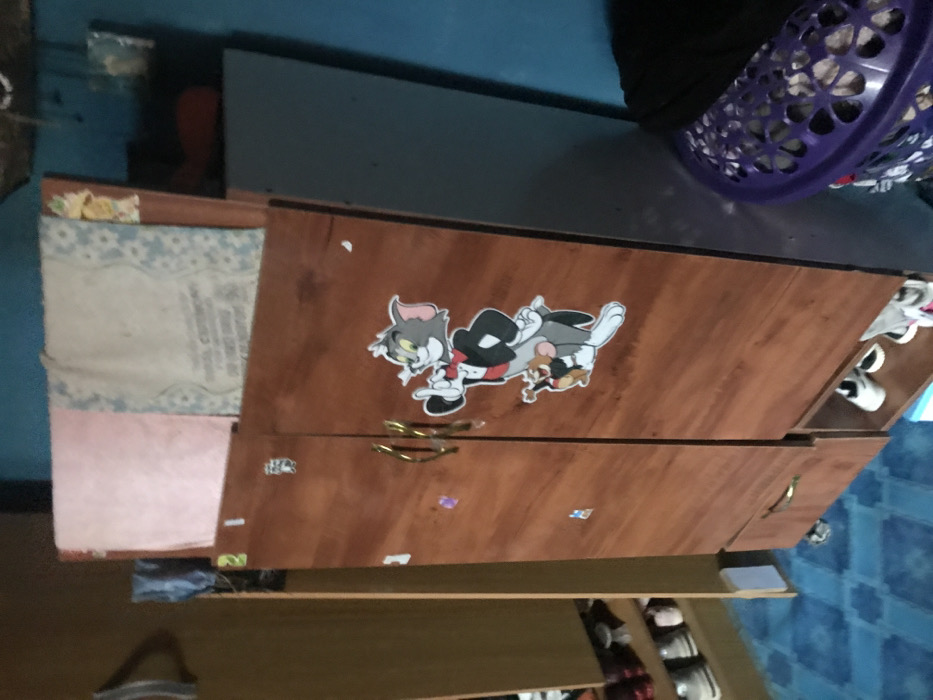
An interior scene in Oba-Ile, Nigeria, depicts a wooden two-door wardrobe positioned centrally. The wardrobe is constructed of a brown material, featuring golden-colored arched handles on its main doors and horizontal pull handles on two lower drawers. A large sticker depicting the cartoon characters Tom (in a tuxedo) and Jerry is affixed to the right main door, with several smaller, indistinct stickers present on both doors. The wardrobe appears to be mobile on small wheels. On its top surface, a folded pink fabric, a beige patterned fabric with text, and another patterned fabric are arranged. To the immediate left, a section of a light-brown wooden cabinet or shelving unit is visible, displaying multiple pairs of shoes on shelves. To the right of the wardrobe, a wall painted a solid blue is present, and a purple perforated plastic basket containing laundry or other items occupies the lower right foreground. Behind the wardrobe, a grey cabinet or partition is partially visible, with a red object observed on a surface above it. The floor is covered with blue and lighter blue patterned tiles. No individuals are present in the frame.
Oba-Ile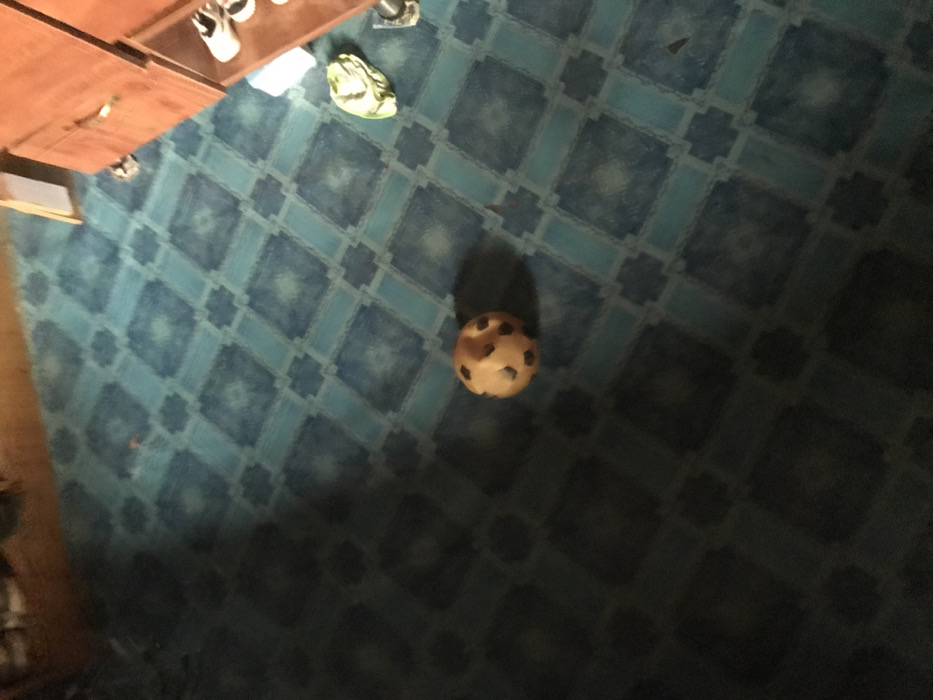
An indoor scene in Oba-Ile, Nigeria, depicts a floor partially covered by blue and teal patterned linoleum or tiles. A distinct shadow line diagonally bisects the floor from upper-left to lower-right, creating a darker foreground and a brighter background. A small, light brown, spherical object with dark spots, resembling a worn ball or cookie, rests on the shadowed portion of the floor, casting a shadow to its lower-left. In the upper-right quadrant, a multi-tiered, light brown wooden cabinet or shelving unit is visible. On one of its shelves, two white shoes are present. Below the shoes, on the floor, a crumpled light green fabric object is situated. Part of a dark metal furniture leg or stand is also visible in the lower-right. No individuals are present.
Oba-Ile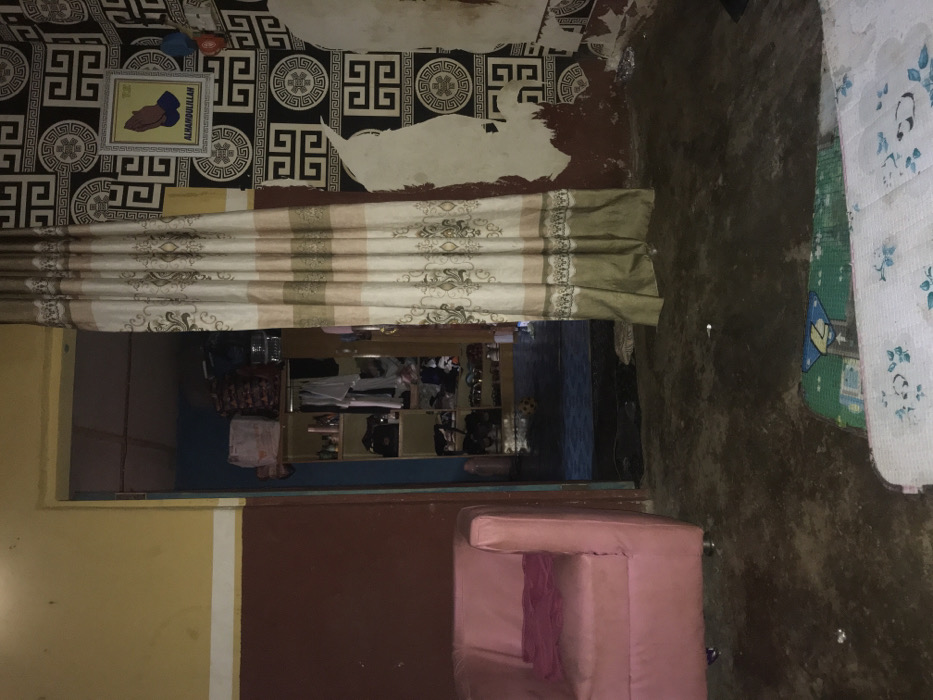
This image depicts an interior residential scene in Oba-Ile, Nigeria. The view is from one room looking into another through a doorway. The foreground room features a two-tone wall on the left, with a yellow upper section separated by a white horizontal stripe from a dark red lower section. A pink, upholstered armchair with a pink cloth draped over it is positioned against this wall. The floor is a dark, unpolished surface, likely concrete, with some scattered debris and two patterned floor mats partially visible in the bottom foreground: one green with geometric shapes and another white with a floral design. A wide doorway centrally frames the view into an adjacent room. A multi-patterned curtain, predominantly beige, brown, and white with decorative motifs, hangs vertically to the right of this doorway, partially obscuring the view. The room beyond the doorway has blue walls and contains an open shelving unit heavily loaded with miscellaneous items, including clothes, shoes, and containers. A small, multi-colored ball is visible on the floor of the second room. The right wall of the foreground room is partially covered with black and white patterned wallpaper featuring a geometric Greek key design. A significant portion of this wallpaper or paint is peeling away, revealing the dark red substrate beneath. A framed picture depicting clasped praying hands and the word "ALHAMDOULLILLAH" hangs on this wall. Below the frame, two small, colorful balloons are partially visible near the floor. No individuals are present in the scene. The lighting is ambient and somewhat dim.
Oba-Ile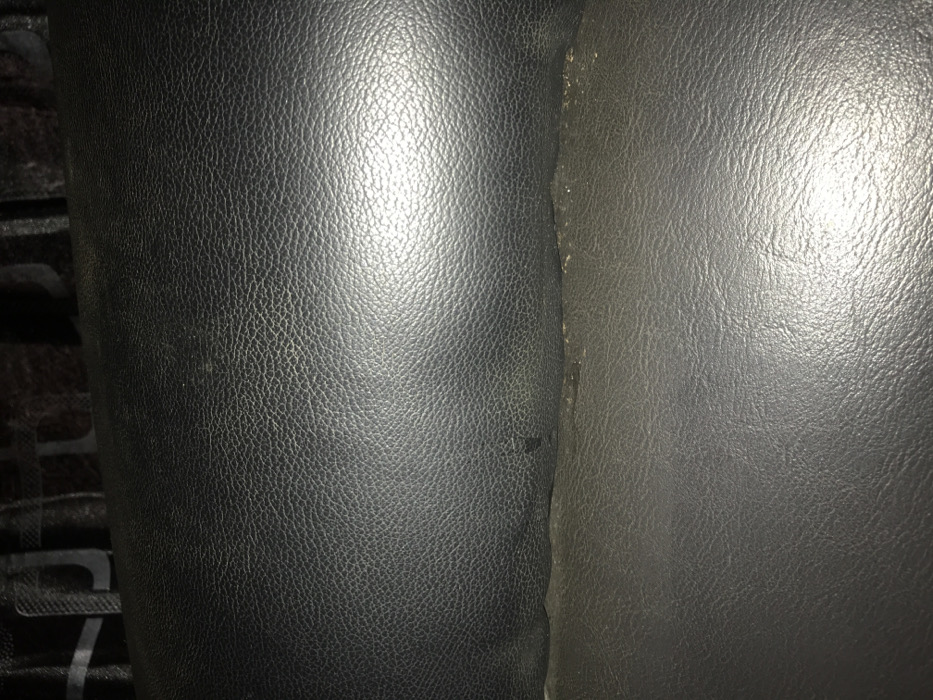
The scene is observed in Oba-Ile, Nigeria. The image depicts a close-up view of two distinct sections of dark, textured material, consistent with synthetic leather or vinyl upholstery, likely comprising parts of a seat or furniture. The upper section displays a fine pebbled grain and exhibits reflections from an ambient or artificial light source. A horizontal seam or crevice, showing minor wear and discoloration, separates this upper section from a lower section of similarly textured material. The lower section also reflects light, indicating a smooth yet textured surface. The background directly above the upper material is dark, out of focus, and shows faint, indistinct patterns, possibly a grille or woven fabric. No individuals, discernible objects other than the upholstery, or specific actions are present within the frame. The immediate environment is an interior space with visible lighting.
Oba-Ile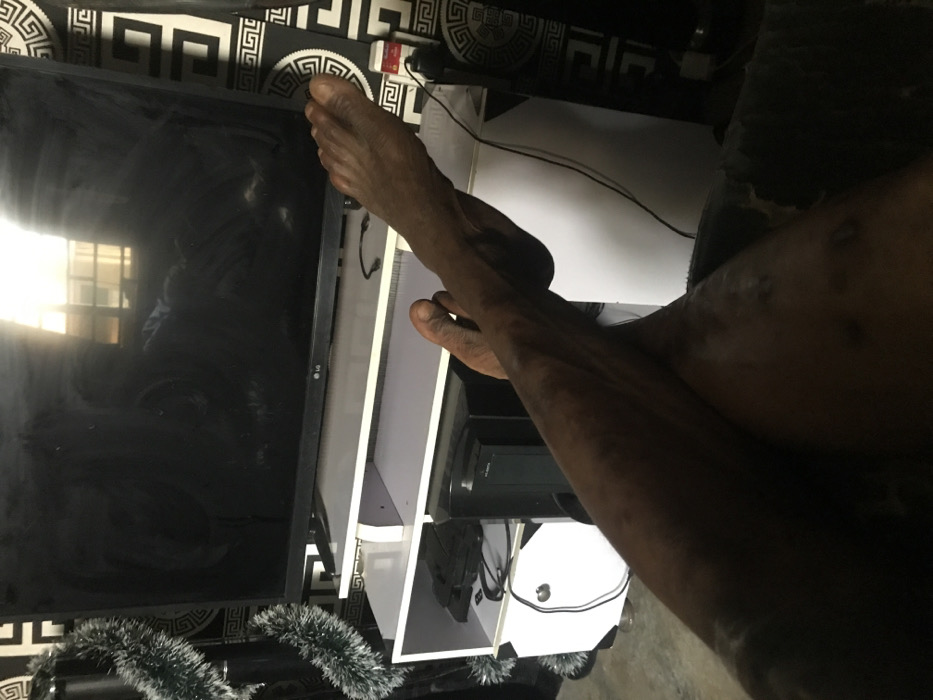
In an indoor setting in Oba-Ile, Nigeria, a close-up, low-angle shot captures the bare legs and feet of an individual, crossed at the ankles, resting in the foreground on what appears to be an upholstered surface. The subject's dark-toned skin exhibits visible scarring or marks on the shins. In the background, a large, dark-screened LG television is positioned on a white, multi-tiered stand. The television screen reflects a bright window with horizontal panes. On the lower shelf of the white stand, a black electronic device, resembling a CPU tower, is visible alongside a black bag and several cables. The wall behind the television and stand features a black and white geometric patterned wallpaper. To the left of the television, a vertical element decorated with a green and white tinsel-like garland is present.
Oba-Ile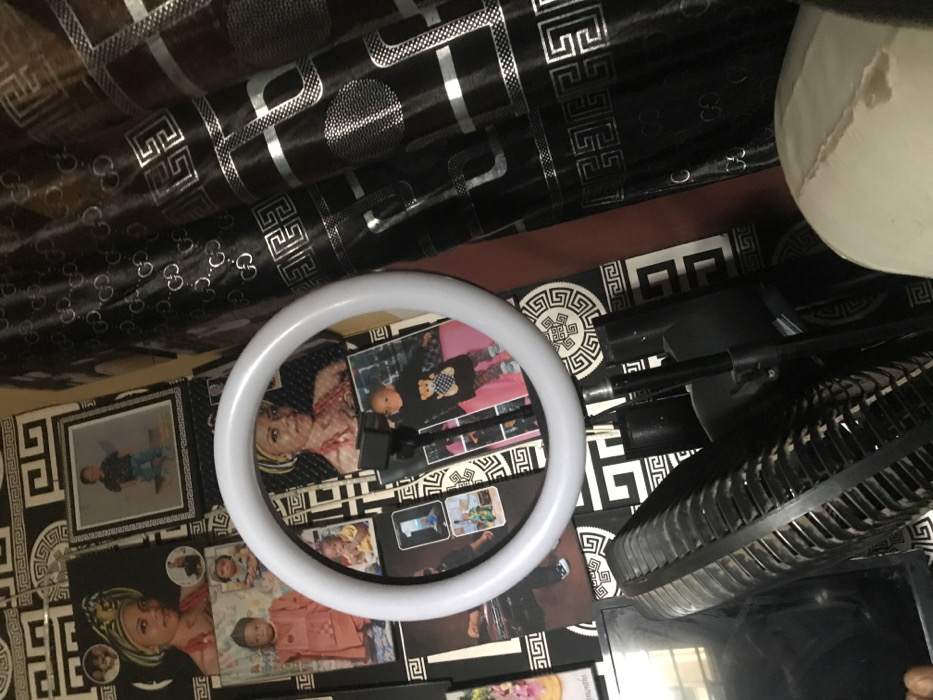
This image presents an indoor scene located in Oba-Ile, Nigeria. The foreground is dominated by a white circular ring light, mounted on a black stand. Behind the ring light, a wall is densely covered with photographs and a black and white geometric Greek key patterned wallpaper. Numerous unframed and framed photographs depict young children in various poses and attire, including one child in a traditional garment and another in a black top with a teddy bear design. A prominent adult female, wearing a headwrap and traditional jewelry, is featured in multiple photographs. To the right, several rolls of black material with silver "GC" brand-like logos and repeating geometric patterns are stacked vertically. In the lower left quadrant, the dusty grill of a black electric fan is partially visible. Additional black stand components are present beneath the ring light's mounting point. A small portion of a light-colored object, possibly upholstery, is visible in the lower right corner.
Oba-Ile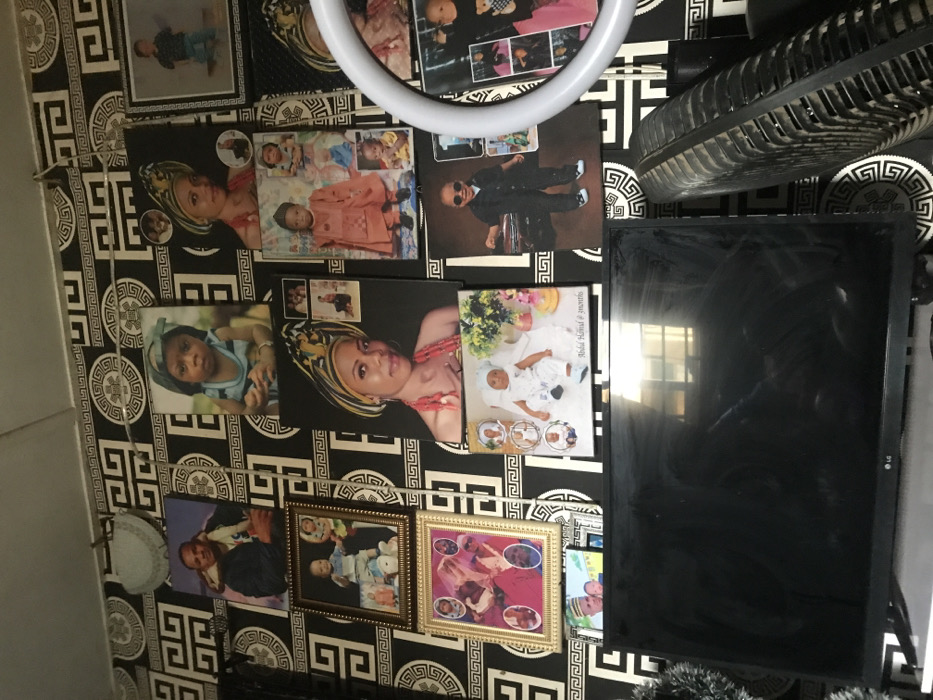
The image displays an interior wall within a residence in Oba-Ile, Nigeria, densely covered with various framed and unframed photographic prints and canvases. The wall is adorned with black and white wallpaper featuring a repeating geometric pattern composed of interlocking lines and circular medallions. Numerous portraits of individuals are mounted on the wall. These include multiple adult females, often depicted wearing traditional Nigerian headgear (gele) and beaded necklaces, some of these prints incorporating smaller inset photographs of children or alternative poses. Portraits of adult males and numerous children and babies are also visible. Specific examples include a baby in a white outfit with "Abdul Hafeez @ 3months" inscribed below, a child in traditional attire, and a child wearing a suit and sunglasses. Several photographs are enclosed in ornate gold-colored frames, while others are canvas prints. A light-colored, semi-circular decorative object is affixed to the upper left portion of the wall, and a horizontal wire with small clips is suspended across the upper wall section. Positioned beneath the wall display is a black LG flat-screen television, whose screen exhibits smudges and reflects an overhead light source or window. To the right of the television, the gridded, dusty back of a black electric fan is partially visible, angled upwards. A green, tinsel-like decorative element is partially observable to the left of the television.
Oba-Ile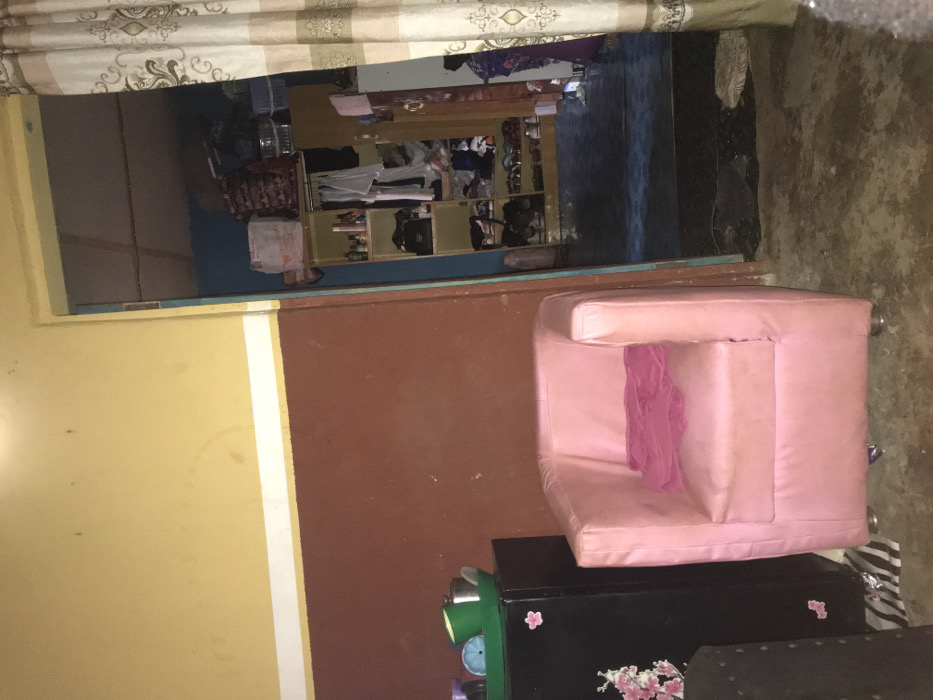
An interior view in Oba-Ile, Nigeria, depicts two adjoining rooms. The foreground room features a bi-color wall, with an upper yellow section and a lower reddish-brown section, separated by a white horizontal stripe. The concrete floor is soiled. A black compact refrigerator or cabinet stands on the left, adorned with pink floral stickers. On its top rests a green plastic tray containing various containers, including a blue plastic sieve. To the right of the refrigerator is a pink single armchair, over which a folded red or pink fabric is draped. The armchair is supported by four metallic legs. Beneath the refrigerator, a black and white patterned mat is visible. An open doorway on the right leads to a second room. A striped curtain, beige and white, partially obscures the doorway on the right. The second room has blue walls and a darker floor, possibly tiled. A wooden shelving unit or wardrobe dominates the left side of this room, containing numerous items including bottles, bags, and shoes on shelves, and various garments hanging from a rail. Additional bags and containers are stacked on top of the shelving unit. The ceiling of this inner room reveals exposed wooden beams. No individuals are present in either room, and no actions or interactions are occurring.
Oba-Ile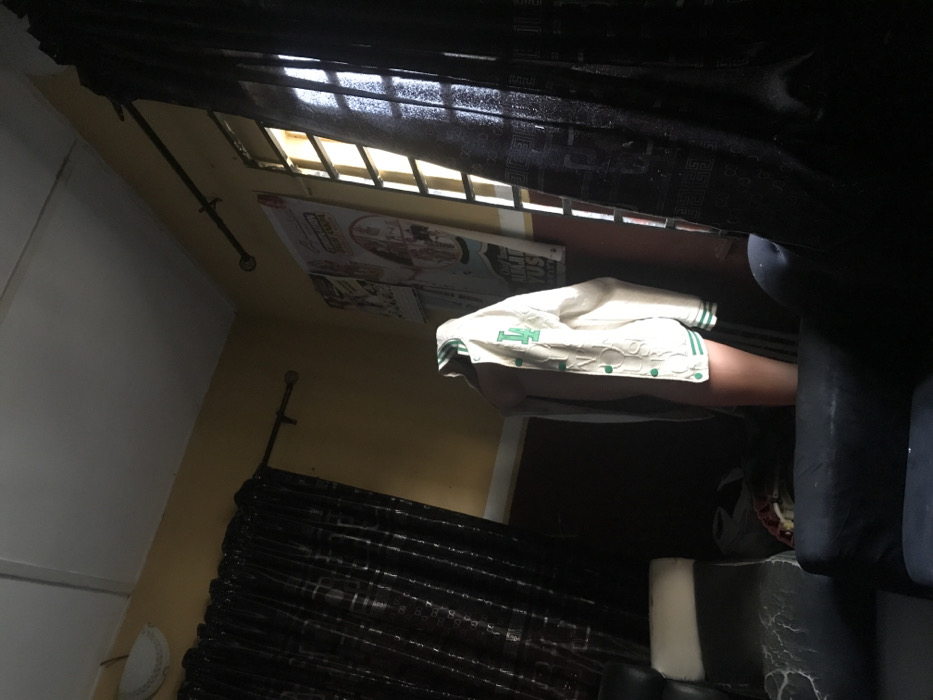
The image depicts an indoor scene within a room located in Oba-Ile, Nigeria. A standing human figure is positioned centrally, partially obscured by shadows, wearing an open, cream-colored varsity-style jacket with green trim, green buttons, and a prominent green "LA" emblem on the left chest. The figure's head is not visible, appearing to be covered or obscured by the jacket's hood, and bare legs of light skin tone are visible below the jacket. The room features light brown/tan walls, a white ceiling with a visible beam, and a white decorative light fixture in the upper left corner. Two windows are present; the left is mostly covered by a dark, checkered curtain, while the right window, partially covered by a matching curtain, reveals bright exterior light filtered through vertical metal grilles. Dark curtain rods with finials are mounted above both windows. Two light-colored posters are affixed to the wall between the windows. Furniture includes a black armchair or sofa in the left foreground with visible wear and a white armrest, and a dark-colored sofa armrest in the right foreground. The room is dimly lit, with strong backlighting from the right window creating deep shadows. No discernible actions or interactions beyond the figure standing are visible.
Oba-Ile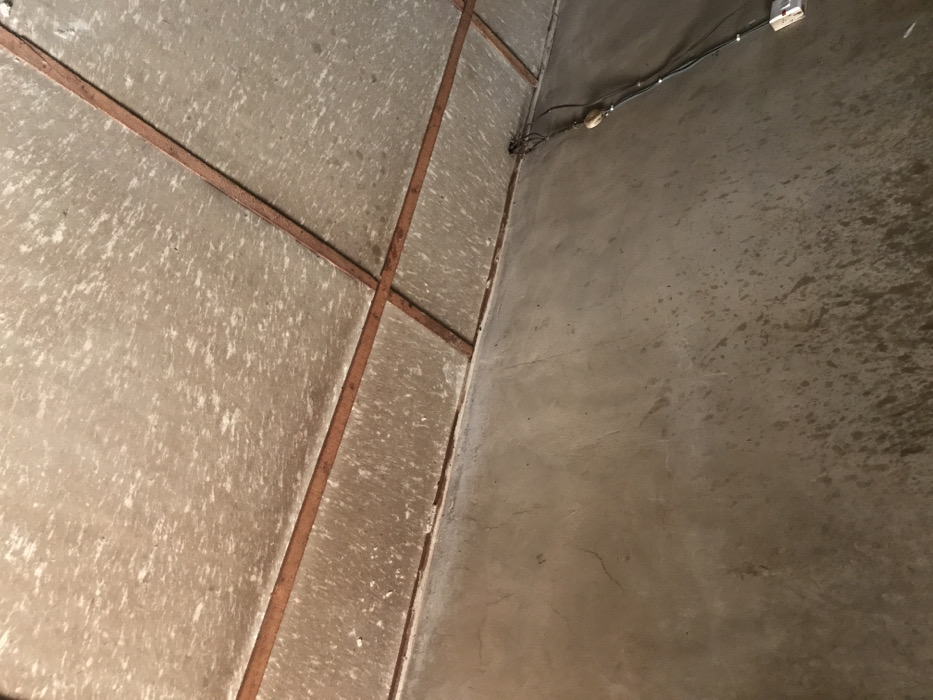
The image displays an interior corner of a room, likely a utilitarian space such as a storage area or a basement, situated in Oba-Ile, Nigeria. No people are present in the scene. The surface on the left side of the frame consists of light grey or beige panels, possibly made of concrete or a similar material, which are separated by dark reddish-brown strips arranged in an irregular grid pattern. These panels feature a prominent mottled texture with white speckled areas, suggesting either an uneven paint job, dried water stains, or a specific textured finish. The surface on the right is a plain, untextured wall of light grey, characteristic of concrete or plaster. Along the upper section of this wall, near the corner, black electrical wires are visibly routed. A white electrical outlet or switch is mounted on this wall, connected to the wiring, and a smaller, light-colored electrical component or fastener is also attached nearby. The plain wall shows areas of darker discoloration or dampness, particularly towards the bottom right quadrant of the image. The overall setting appears functional rather than decorative, with visible electrical installations. There is no specific activity occurring, and no text is visible anywhere in the image. The lighting suggests an indoor environment, with no cues for the time of day or external weather conditions.
Oba-Ile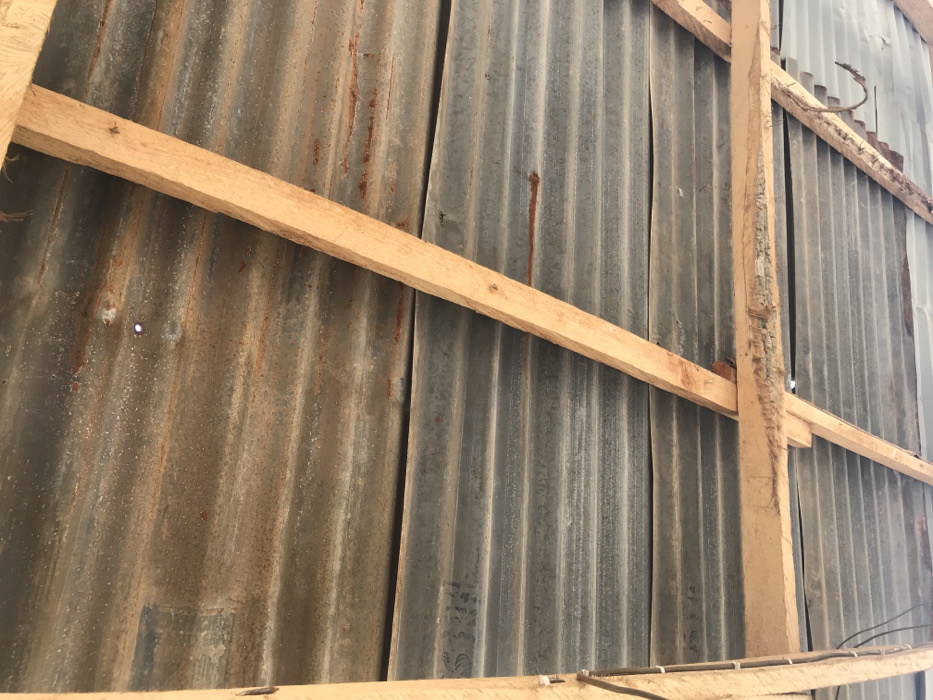
The image displays the underside of a roof structure situated in Oba-Ile, Nigeria. No individuals are present. The primary roofing material consists of corrugated metal sheets, exhibiting a mottled grey and oxidized reddish-brown coloration from extensive rust and weathering. These sheets are supported by an exposed framework of light-brown wooden beams, some displaying rough-cut surfaces and splintering. A distinct circular aperture in an upper corrugated sheet allows a visible point of external light to penetrate. Black insulated electrical wiring is secured vertically along a wooden beam on the left side of the frame. A single bent, rusted metallic object, consistent with a hook or fastener, is partially visible in the lower right quadrant.
Oba-Ile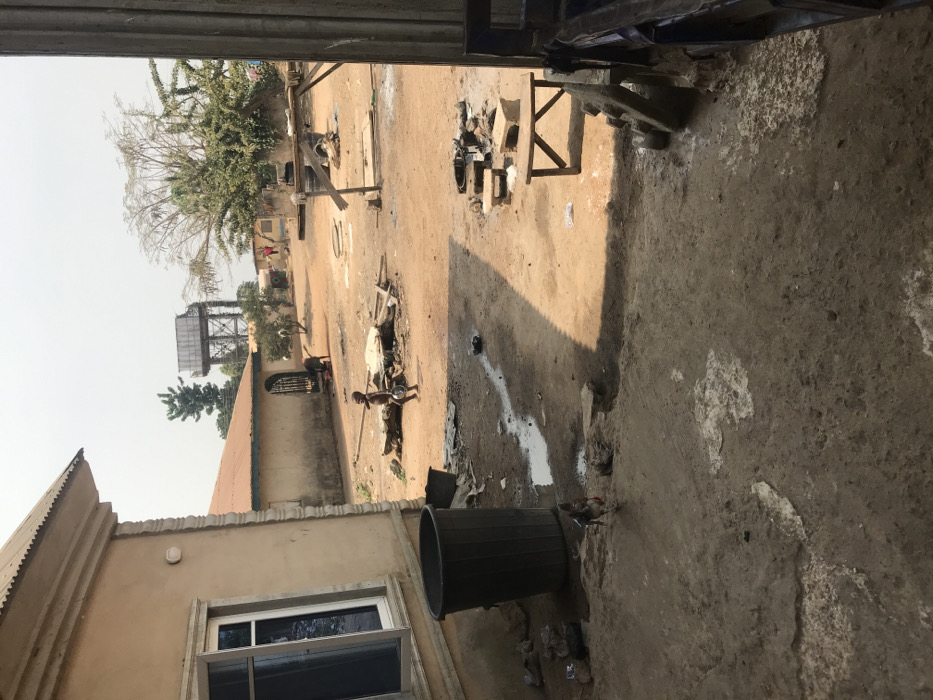
The image depicts an unpaved outdoor communal area in Oba-Ile, Nigeria, under a hazy daylight sky. In the immediate foreground left, the side of a light-colored building with a light brown tiled roof is visible, featuring a partially open white-framed window. Adjacent to this building, a large, dark grey fluted plastic refuse bin stands on a concrete patch. A small, multi-colored chicken walks on the concrete near the bin. The ground transitions from concrete to packed dirt/sand, marked by several puddles and damp streaks. A young child, barefoot and wearing light-colored shorts, walks leftward across the dirt mid-ground, holding a small, light-colored bowl or dish in their left hand. Around the child and extending into the mid-ground, scattered debris, including wooden planks, various scraps, and small containers, are present. Further into the mid-ground, to the left, another single-story building with a darker, possibly green corrugated metal roof and a dark, ornate metal gate is visible. Near this building, a person, dark-skinned, is partially visible in a bent-over posture. Towards the right mid-ground, a low, rough wooden bench and other makeshift wooden structures are situated amongst additional debris. In the background, a tall metal water tower with a tank is prominent, positioned to the left of a large, sparsely leafed tree. Other distant low-rise buildings are visible, with faint figures potentially present near them. The overall impression is of a lived-in, utilitarian space with elements of both established structures and informal arrangements.
Oba-Ile
The image depicts a textured, beige-toned wall surface. Varying shades of tan and gray are present across the composition. The left section exhibits a rougher, more porous texture, while the center and right areas show a smoother, slightly weathered appearance. A curved, dark brown object occupies the upper right corner, potentially indicating an adjacent structure or feature. The lighting is uneven, casting shadows and highlighting surface irregularities.
Oba-Ile
A blurred, low-lit image reveals a motorcycle parked on a paved surface, possibly a road or parking lot. The rear of the motorcycle is visible, featuring a red taillight and a partially visible tire. The overall darkness and lack of focus make details difficult to discern. There are lights in the upper left corner, but they are too blurry to make out anything.
Oba-Ile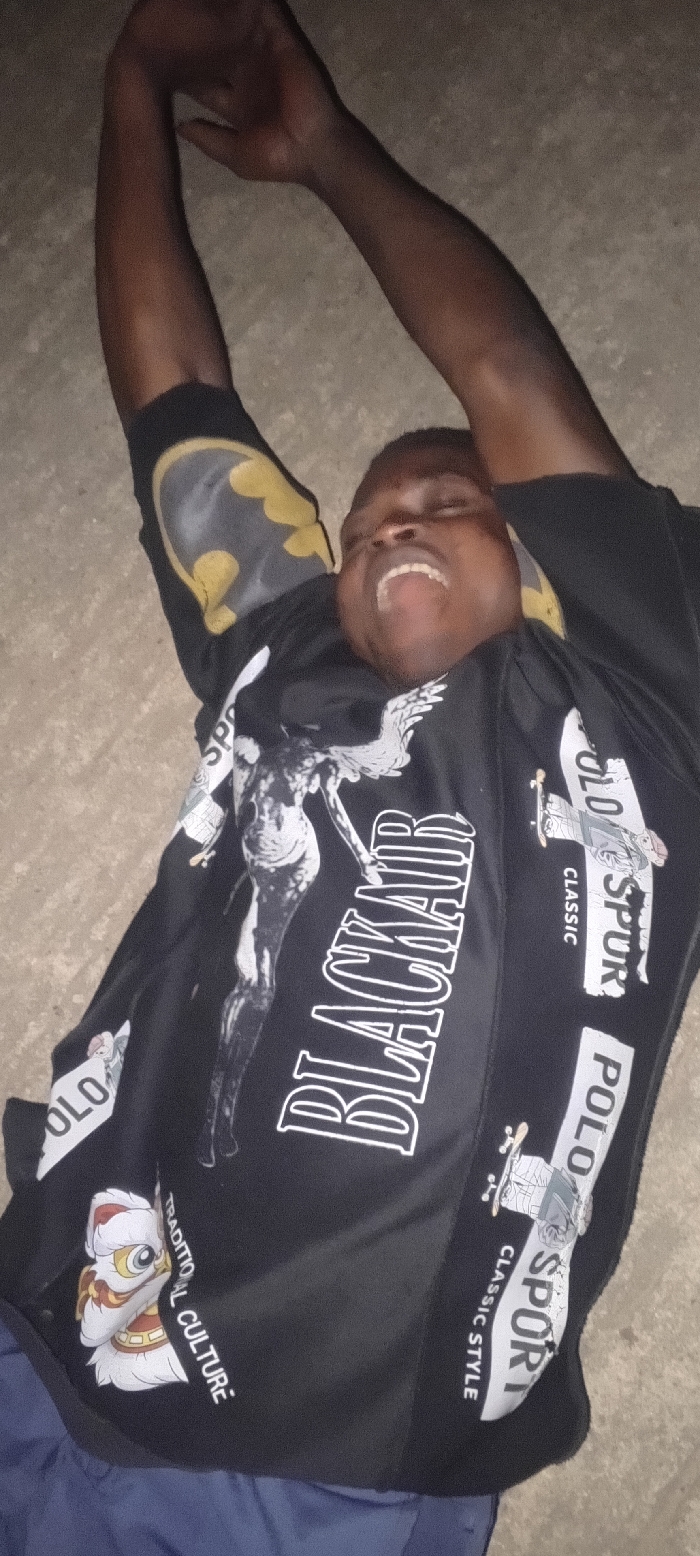
A person lies on a grey surface, face upwards with their arms raised. The person is wearing a black t-shirt with various graphic designs, including a "BLACK AIR" print, "POLO" text, a Batman logo on the sleeve, and a lion figure. The person's mouth is open, revealing their teeth. The overall lighting is dim.
Oba-Ile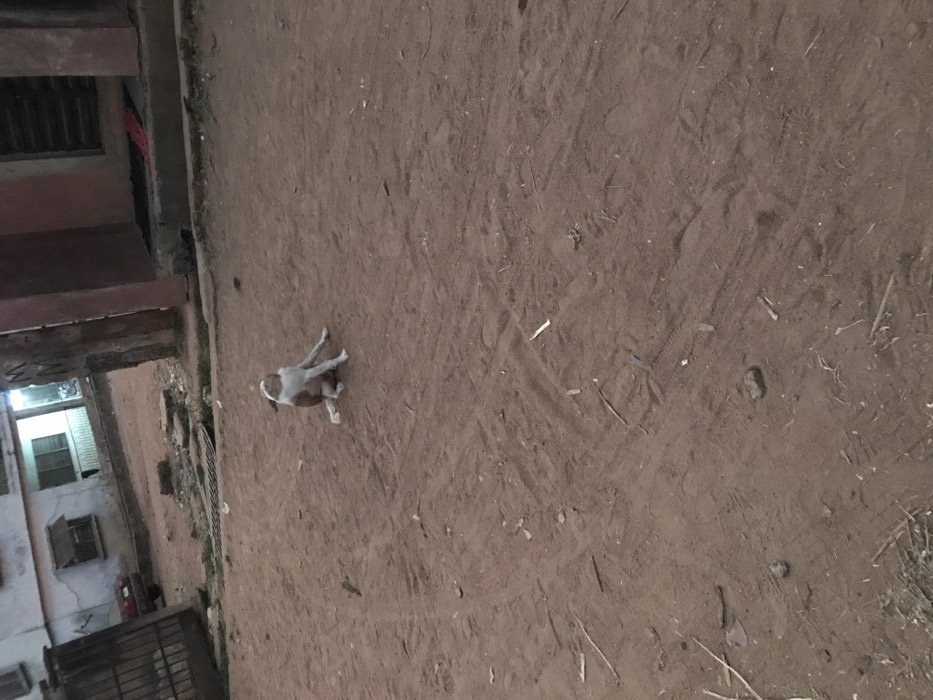
A dog rests on a dirt surface adjacent to a building. The building, with its windows and architectural details, is partially visible to the left. The dirt area covers the majority of the frame, displaying various textures and minor debris. The dog is lying on its side, seemingly relaxed. The composition offers a perspective from slightly above, capturing both the built environment and the natural ground.
Oba-Ile
A ground-level view reveals a dirt surface scattered with small pebbles, twigs, and plant debris. The soil appears dry and compacted, exhibiting subtle variations in tone. A portion of a gray stone or concrete structure occupies the upper right corner of the frame, partially obscuring the earth beneath. Some scattered blades of grass occupy the bottom right corner. The composition is dominated by earthy hues, creating a muted and natural aesthetic.
Oba-Ile