Oberschleißheim, Germany
30 memories from Oberschleißheim, Germany
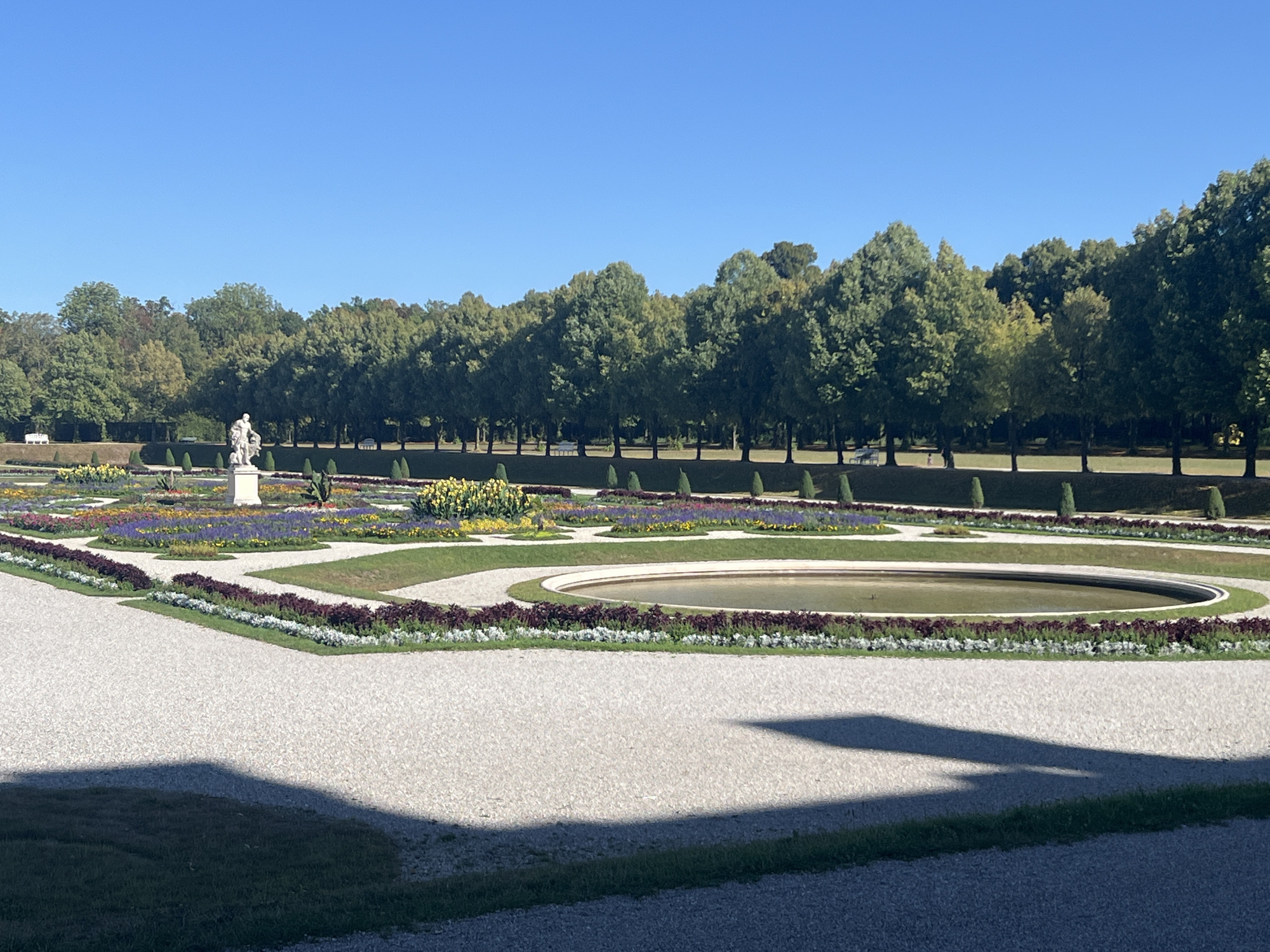
The image depicts a formal garden with a clear blue sky overhead. In the foreground, a gravel path leads towards a circular fountain. The fountain is surrounded by a low-lying flowerbed featuring a mix of purple and white flowers. Beyond the fountain, a larger, elaborately designed garden area is visible, characterized by geometric flowerbeds in various colors including purple, yellow, and pink, with a central white pedestal and sculpture. A line of mature trees with green foliage forms a backdrop to the garden, stretching across the horizon. Several white benches are placed along the treeline. The garden appears well-maintained and is part of the grounds of Schleißheim Palace in Oberschleißheim, Germany. No people are clearly visible in the scene. The lighting suggests it is daytime.
Oberschleißheim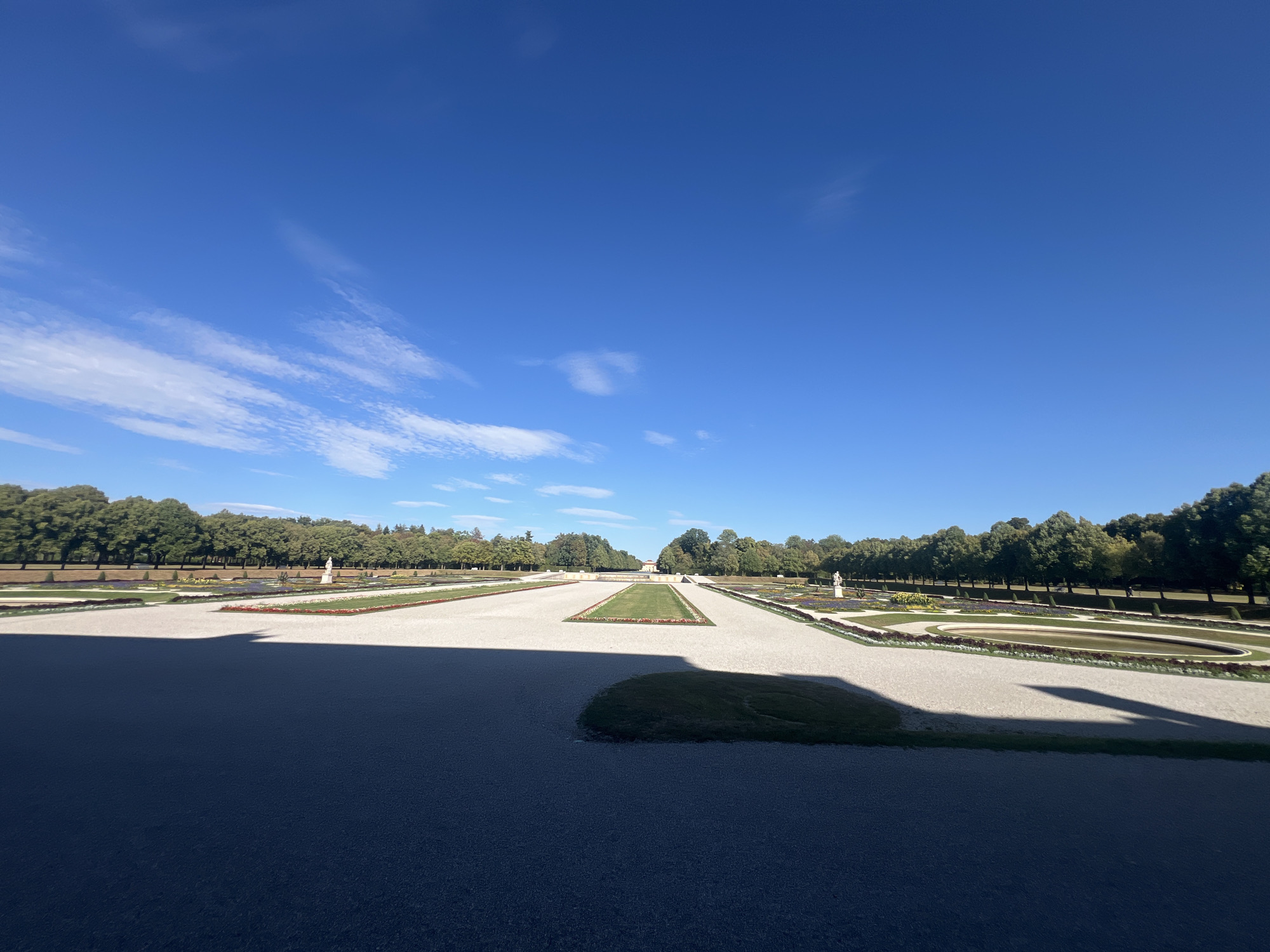
This is an outdoor, eye-level, wide-angle shot of the Nymphenburg Palace gardens in Oberschleißheim, Germany. The foreground is dominated by a dark, textured paved area casting a long shadow from an unseen structure. Beyond this, a wide expanse of light-colored gravel paths leads to manicured garden beds filled with colorful flowers and neatly trimmed green grass. In the middle ground, a long, rectangular body of water, likely a canal or pond, reflects the clear blue sky. A single white statue stands on a pedestal to the right of the water feature. The background features a dense line of mature green trees that form a natural border. The sky is a vibrant, cloudless blue with a few wispy white clouds scattered across the upper portion of the frame. There are no people visible in the image. The scene is peaceful and serene, suggesting a well-maintained public park or estate.
Oberschleißheim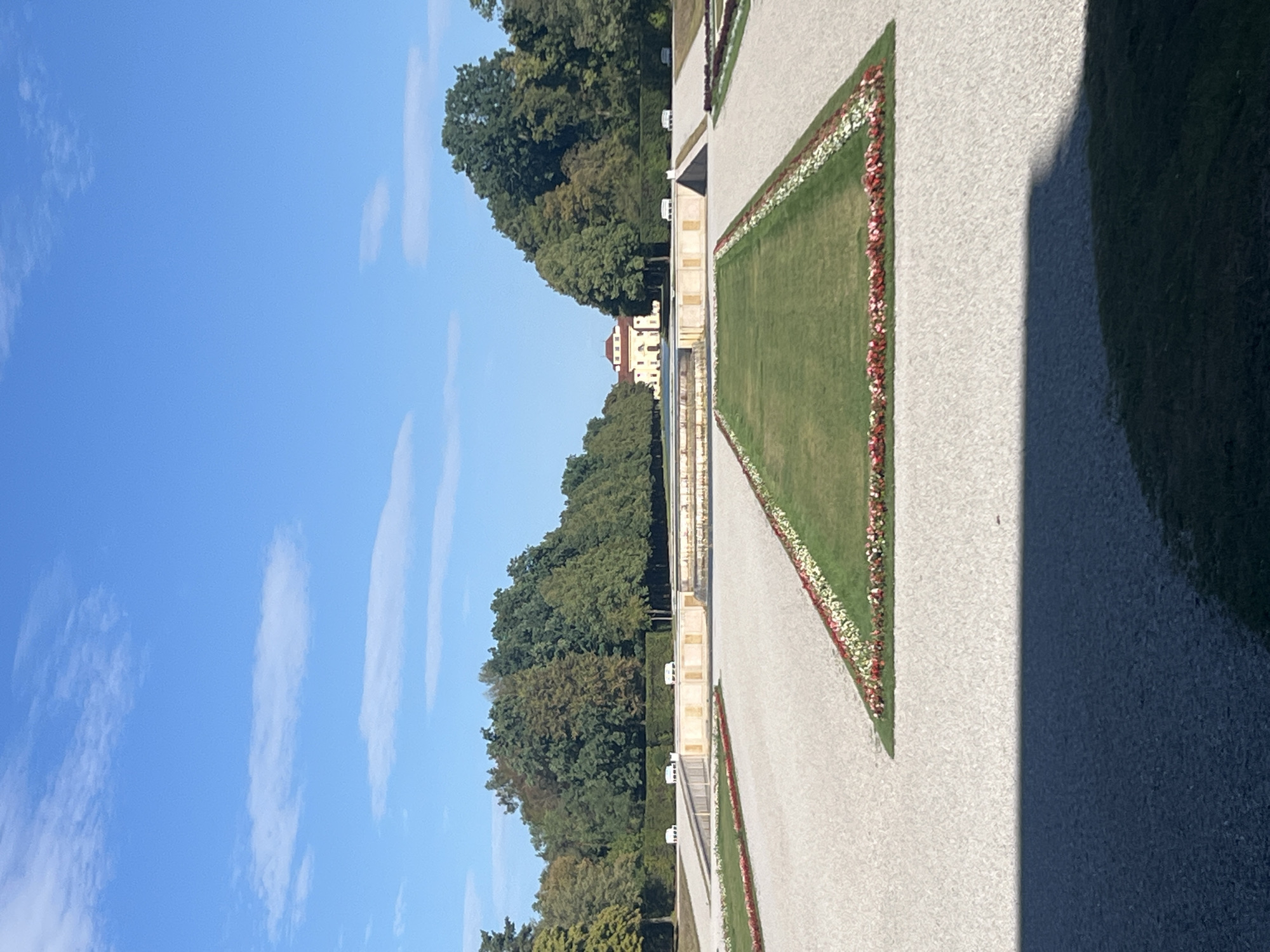
This is a vertical, eye-level, outdoor, full-shot photograph of a formal garden in front of a palace. The sky is bright blue with scattered white clouds. In the distance, a long, rectangular fountain runs horizontally across the frame. Beyond the fountain, a yellow palace with a red roof stands nestled among mature trees. In the foreground, a diamond-shaped lawn is bordered by flower beds of red and white blooms. Gravel paths flank the lawn and lead towards the fountain. The area is set within a park with a dense line of trees bordering the background. No people or animals are visible. The scene suggests a sunny day in a well-maintained historical park.
Oberschleißheim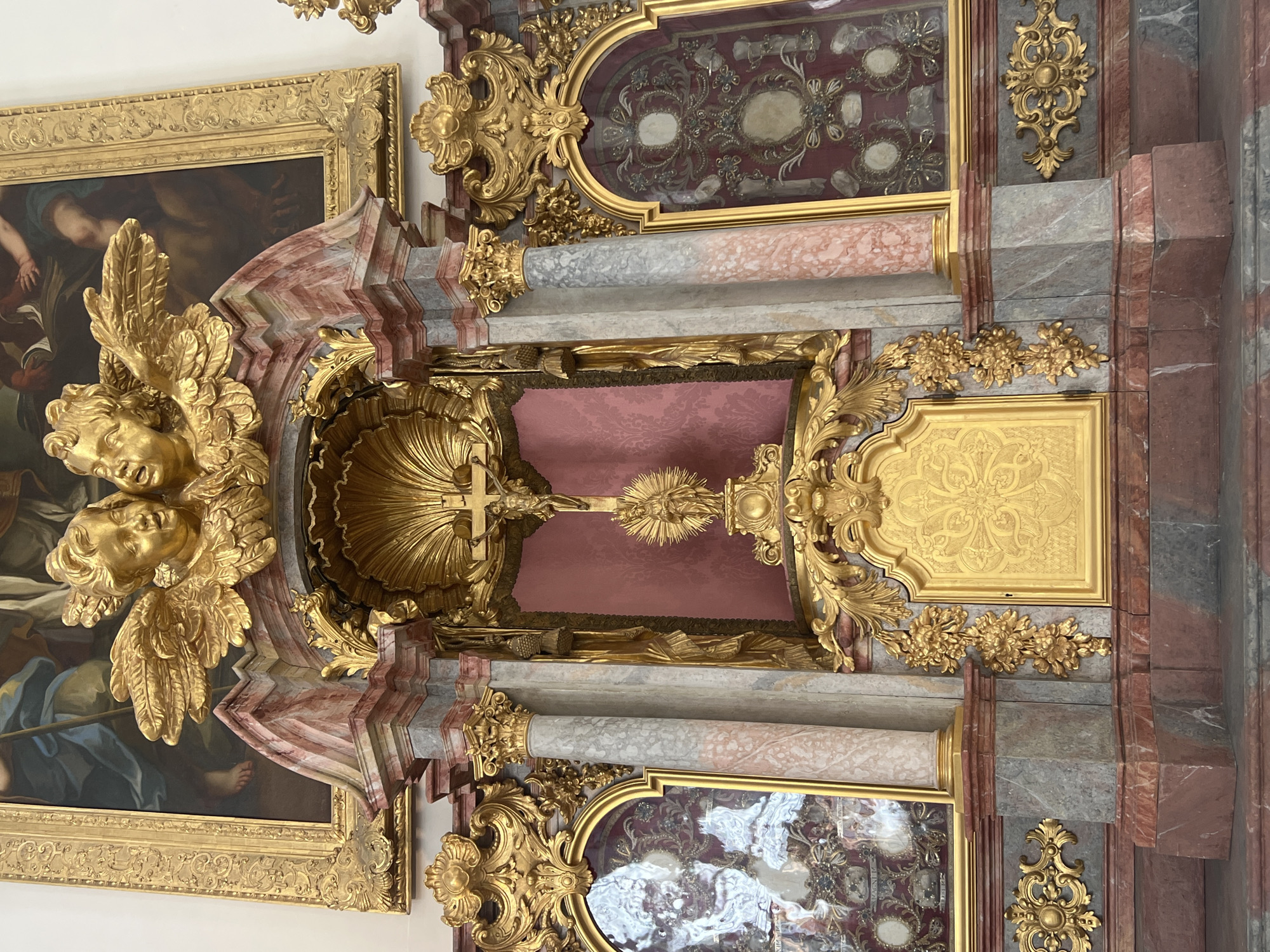
The image shows a close-up view of an ornate altar within a church in Oberschleißheim, Germany. The altar is richly decorated with gold ornamentation and features a central crucifix with a statue of Jesus. Flanking the crucifix are two framed displays with religious imagery. The altar is constructed with marble and intricate gold details, and above it, a painting in a gilded frame is partially visible. Two golden cherubs with wings are perched at the top of the altar structure. The overall impression is one of opulence and religious devotion.
Oberschleißheim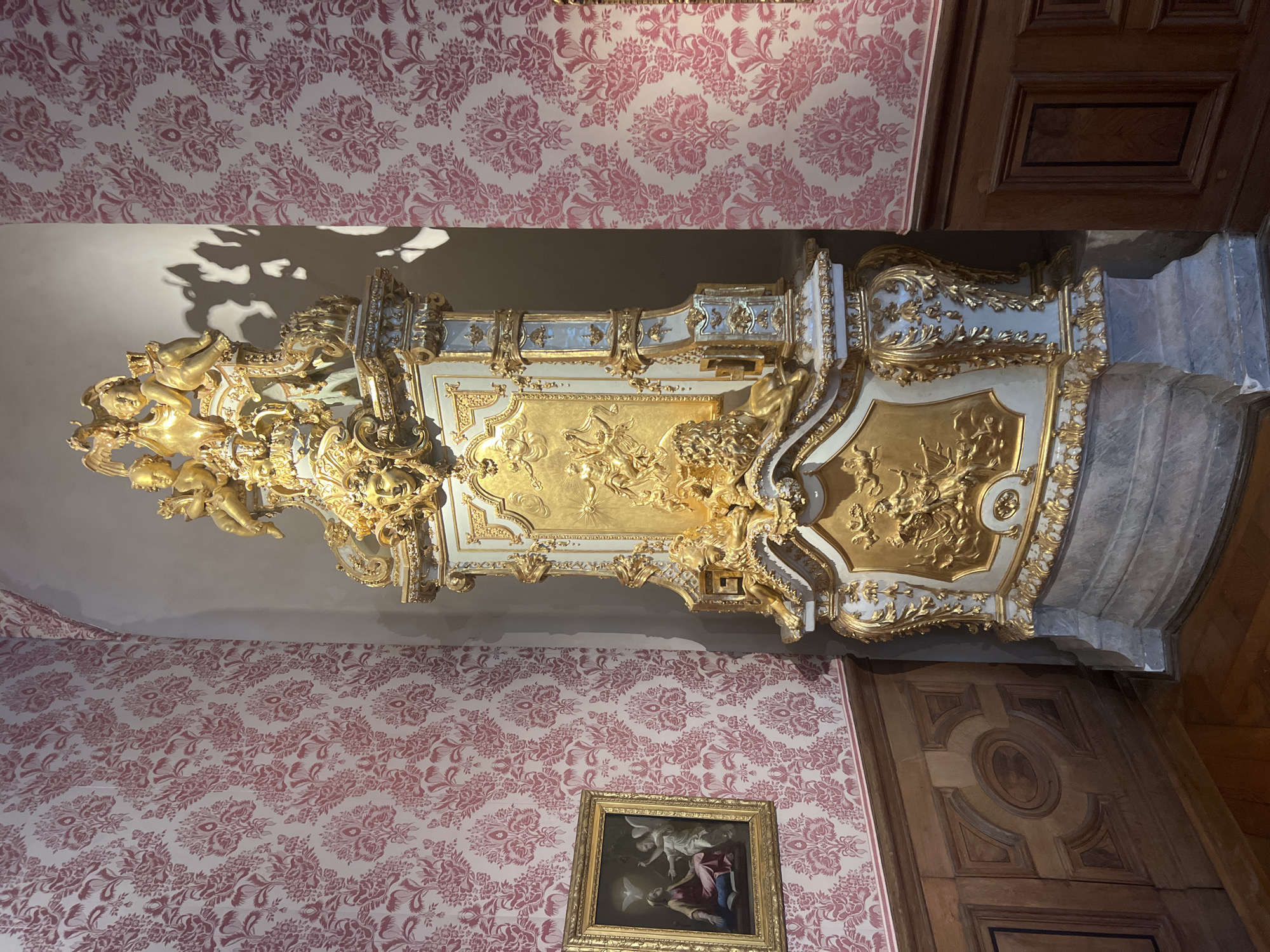
The image shows a highly ornate, gilded stove in a room with pink damask wallpaper. The stove is the central subject, featuring intricate sculptural details, including cherubs at the top and relief scenes on its body. To the left of the stove, a framed painting depicting religious figures hangs on the wall. The lower part of the walls is paneled with dark wood. This scene is located in the interior of the Lustheim Palace in Oberschleißheim, Germany.
Oberschleißheim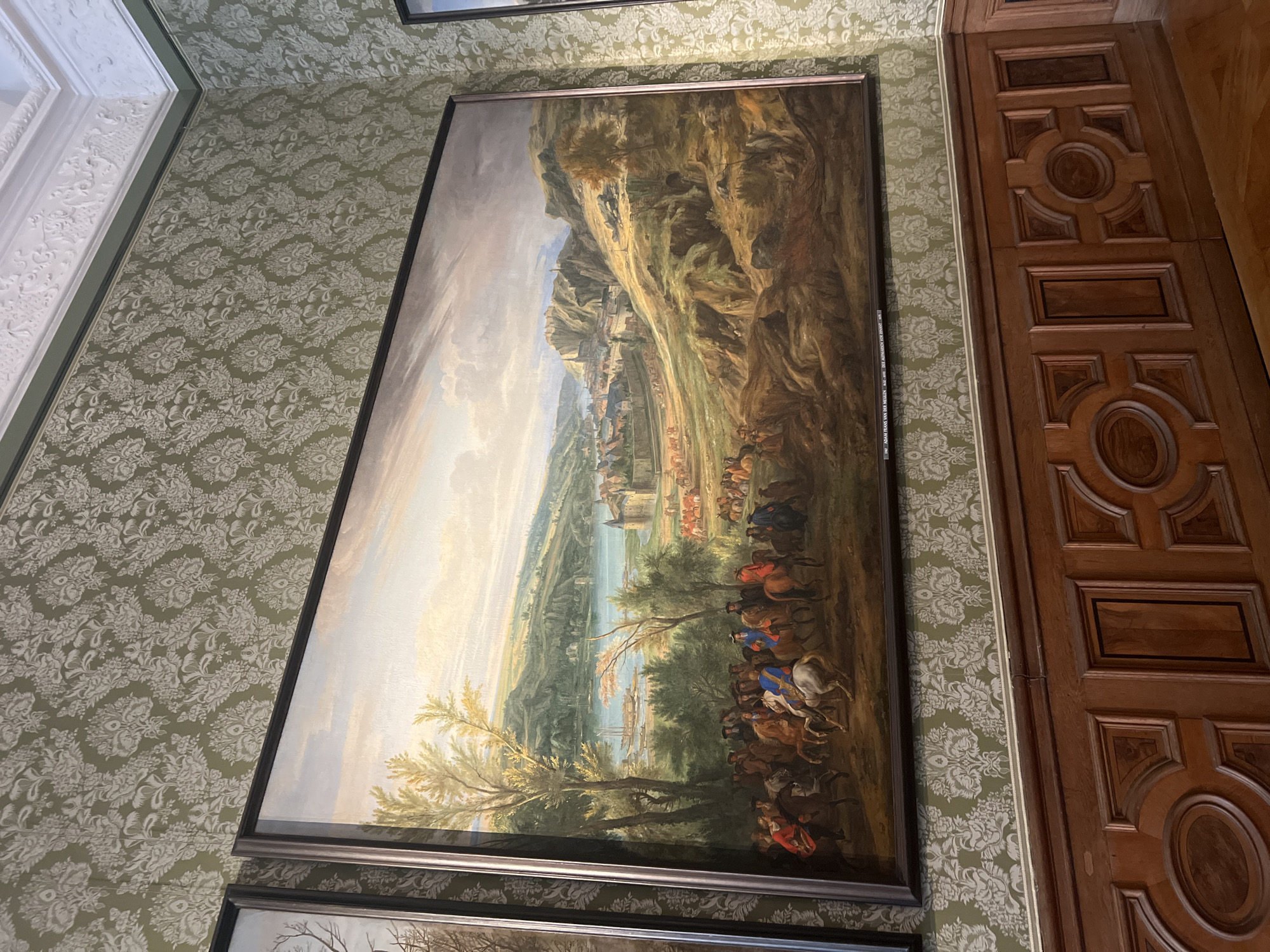
A painting hangs on a wall with green damask wallpaper. The painting depicts a landscape with a city in the distance, a river or lake, and a group of people on horseback in the foreground. The artwork is displayed in the New Palace in Oberschleißheim, Germany. The wall is adorned with ornate white molding at the top. Below the painting, there is a wooden paneled wainscoting with intricate carvings and inlay work. The floor appears to be made of polished wood.
Oberschleißheim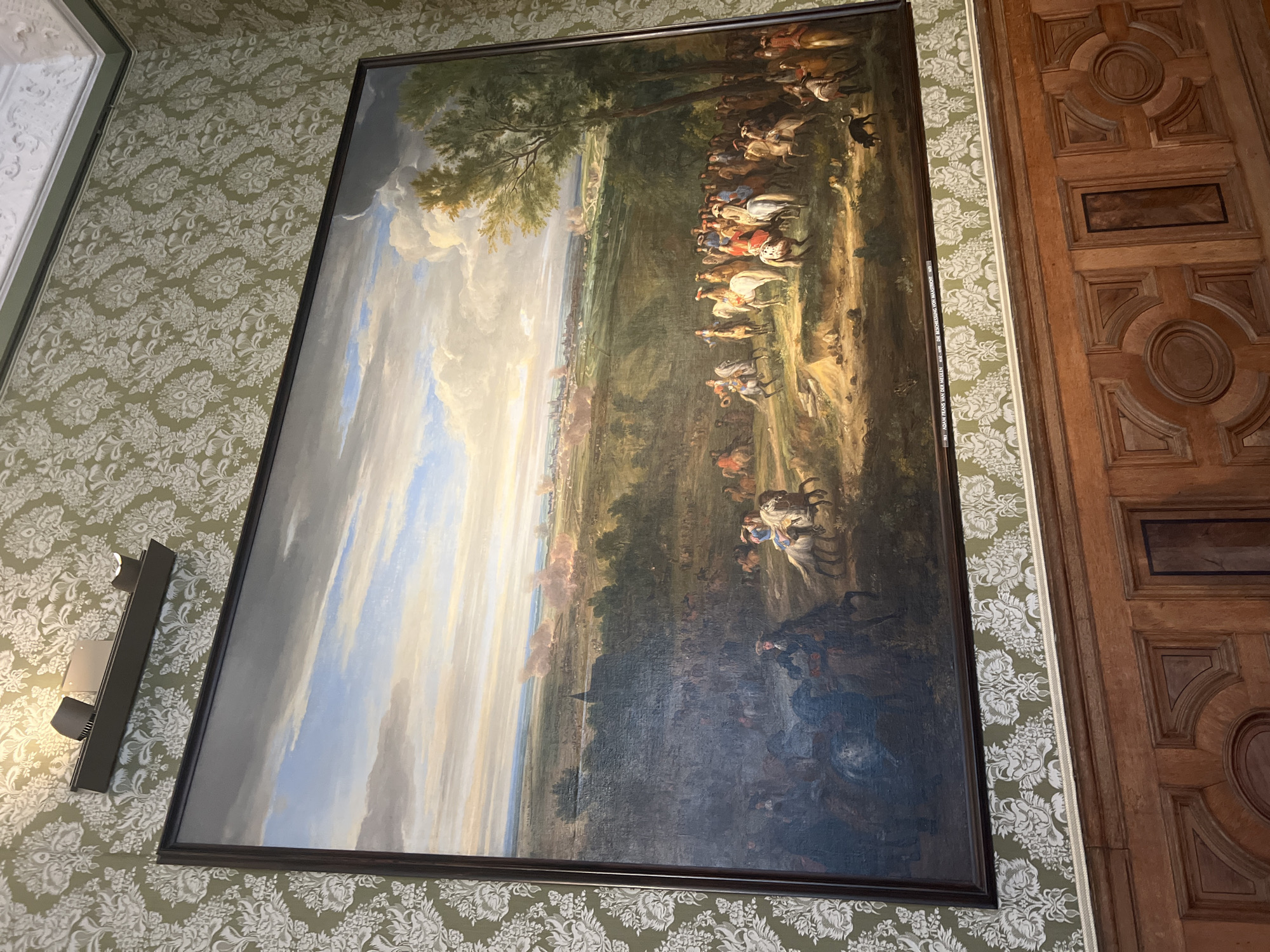
The image depicts a large, framed oil painting hanging on a wall with green damask wallpaper. The painting is a landscape scene with a battle taking place in the background and a group of people on horseback in the foreground. Smoke plumes rise from the distant battlefield, suggesting a conflict. In the foreground, several figures in historical attire are mounted on horses. Some are conversing or looking towards the distance. A few dogs are also visible in the foreground. The painting has a dark, wooden frame. Below the painting, a wooden paneled wall is visible, featuring decorative carvings. Above the painting, a lighting fixture with two adjustable spotlights is mounted on the wall. This painting is located in the Neues Schloss (New Palace) in Oberschleißheim, Germany. The painting is identified by a small plaque at the bottom which reads "793 ADAM FRANS VAN DER MEULEN 1632-1690 DIE BESCHIESSUNG VON MAASTRICHT 1673". This indicates the painting is "The Bombardment of Maastricht" by Adam Frans van der Meulen, completed in 1673.
Oberschleißheim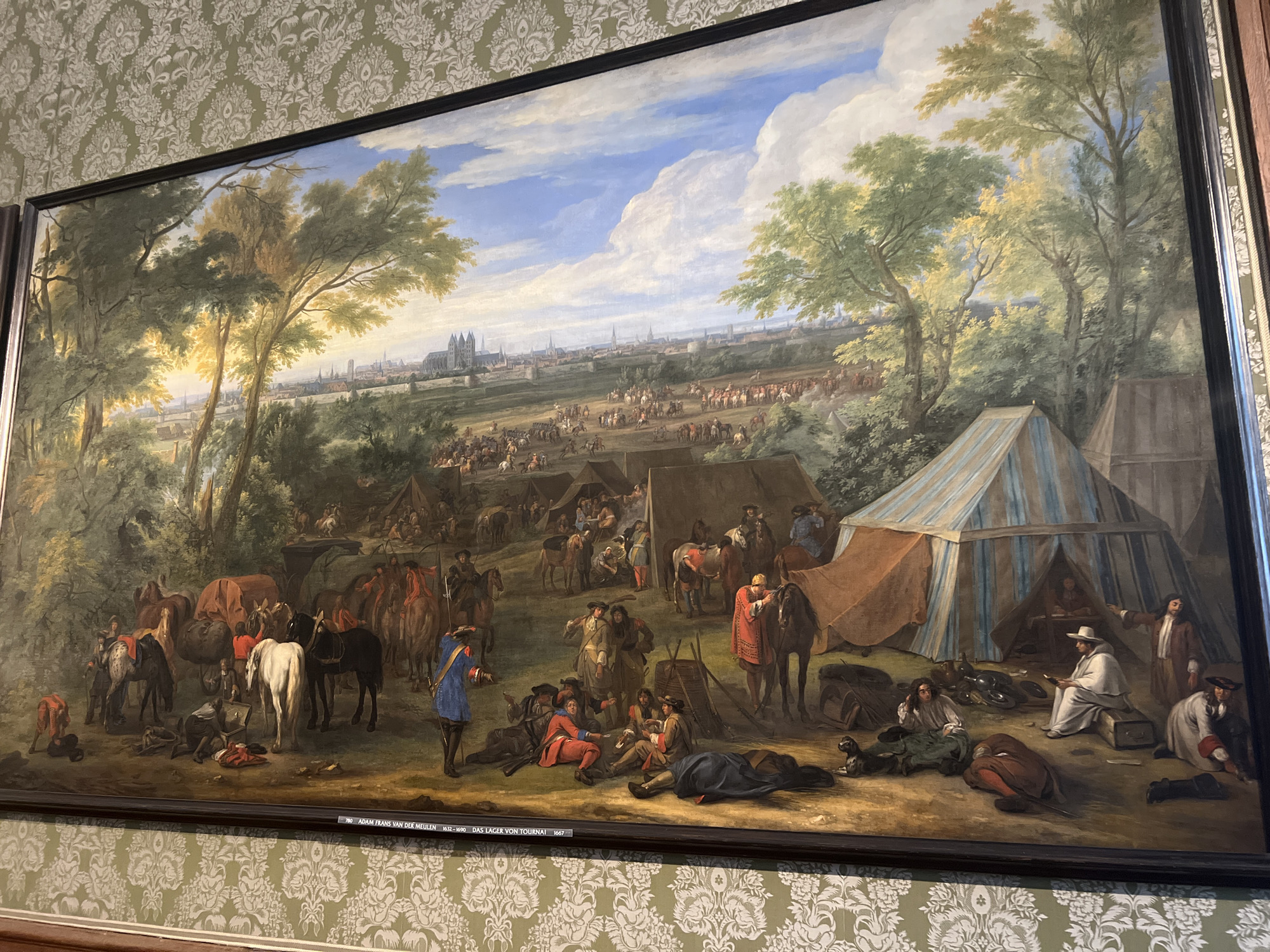
This is a detailed oil painting on canvas, depicting a bustling encampment with a city visible in the background. The foreground is populated by numerous figures, both standing and seated, engaged in various activities. Horses are a prominent feature, with several tethered or being tended to. Tents, some striped and others of plain fabric, are set up, suggesting a temporary settlement. In the middle ground, a large gathering of people and horses are seen moving towards the city in the distance. The city itself is characterized by numerous buildings with spires and towers, indicative of a historical European urban landscape. The sky is a mix of blue and white clouds, suggesting a daytime scene. The painting is housed in a dark wooden frame and is displayed against a green damask wallpaper. A label beneath the painting reads: "780 ADAM FRANS VAN DER MEULEN 1632-1690 DAS LAGER VON TOURNAI 1667". This indicates the artwork is "The Camp of Tournai" by Adam Frans van der Meulen, painted in 1667. The artwork is located in the Neues Schloss Schleißheim (New Schleissheim Palace) in Oberschleißheim, Germany.
Oberschleißheim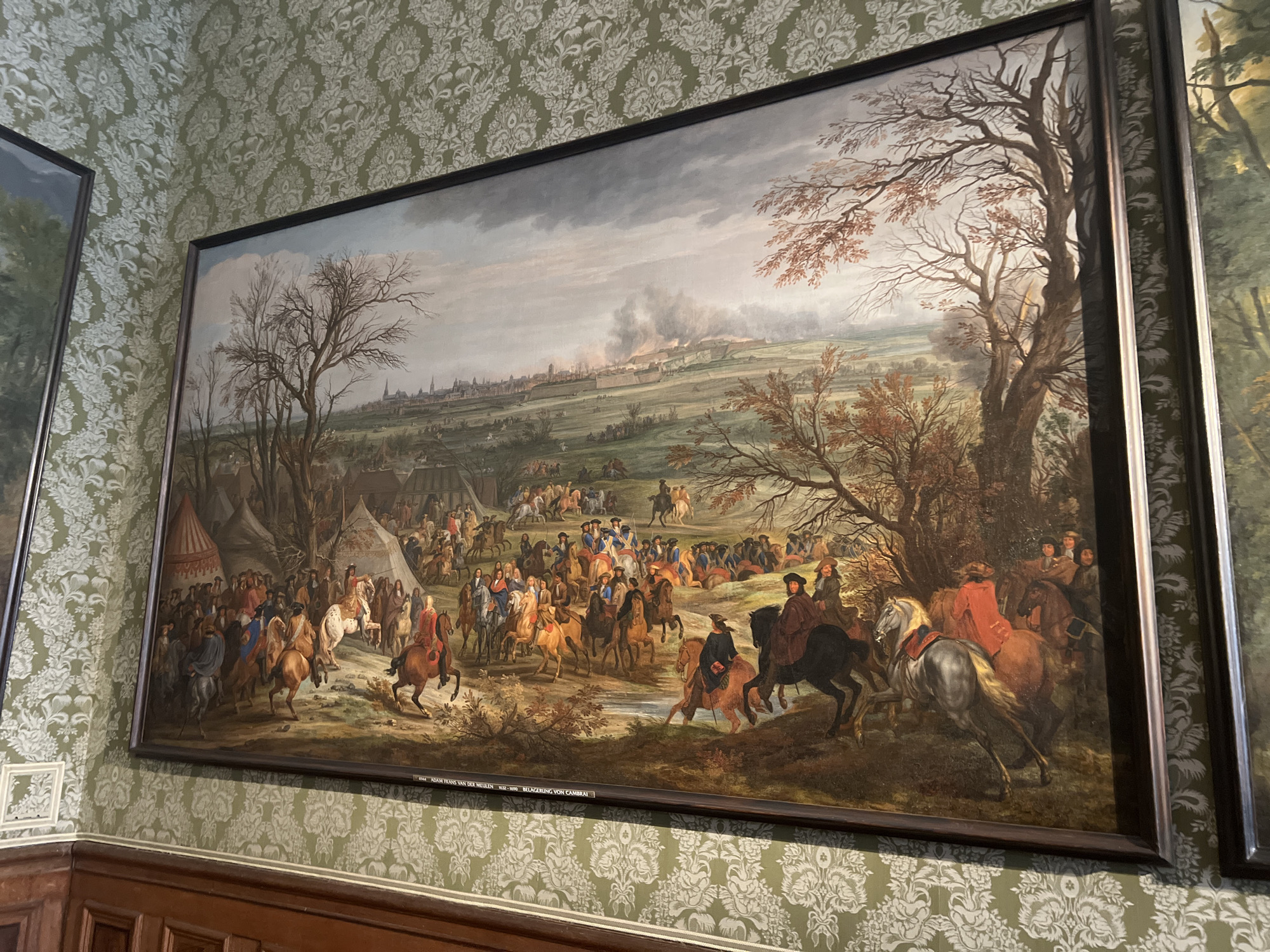
The image displays a large, framed oil painting hanging on a wall adorned with green damask wallpaper. The painting depicts a historical scene with numerous figures on horseback and on foot, set against a landscape with a fortified city in the background. Smoke is rising from the city, suggesting a battle or siege. Several tents are pitched in the foreground, with groups of people gathered around them. The style of the painting appears to be from the Baroque period, characterized by its detailed rendering of figures, horses, and the landscape. The painting is identified by a plaque at the bottom as "1694 ADAM FRANS VAN DER MEULEN. 1632-1690 BELAGERUNG VON CAMBRAI." This indicates the painting is by Adam Frans van der Meulen and depicts the siege of Cambrai. The painting is located in the city of Oberschleißheim, Germany, specifically within the Neues Schloss (New Palace).
Oberschleißheim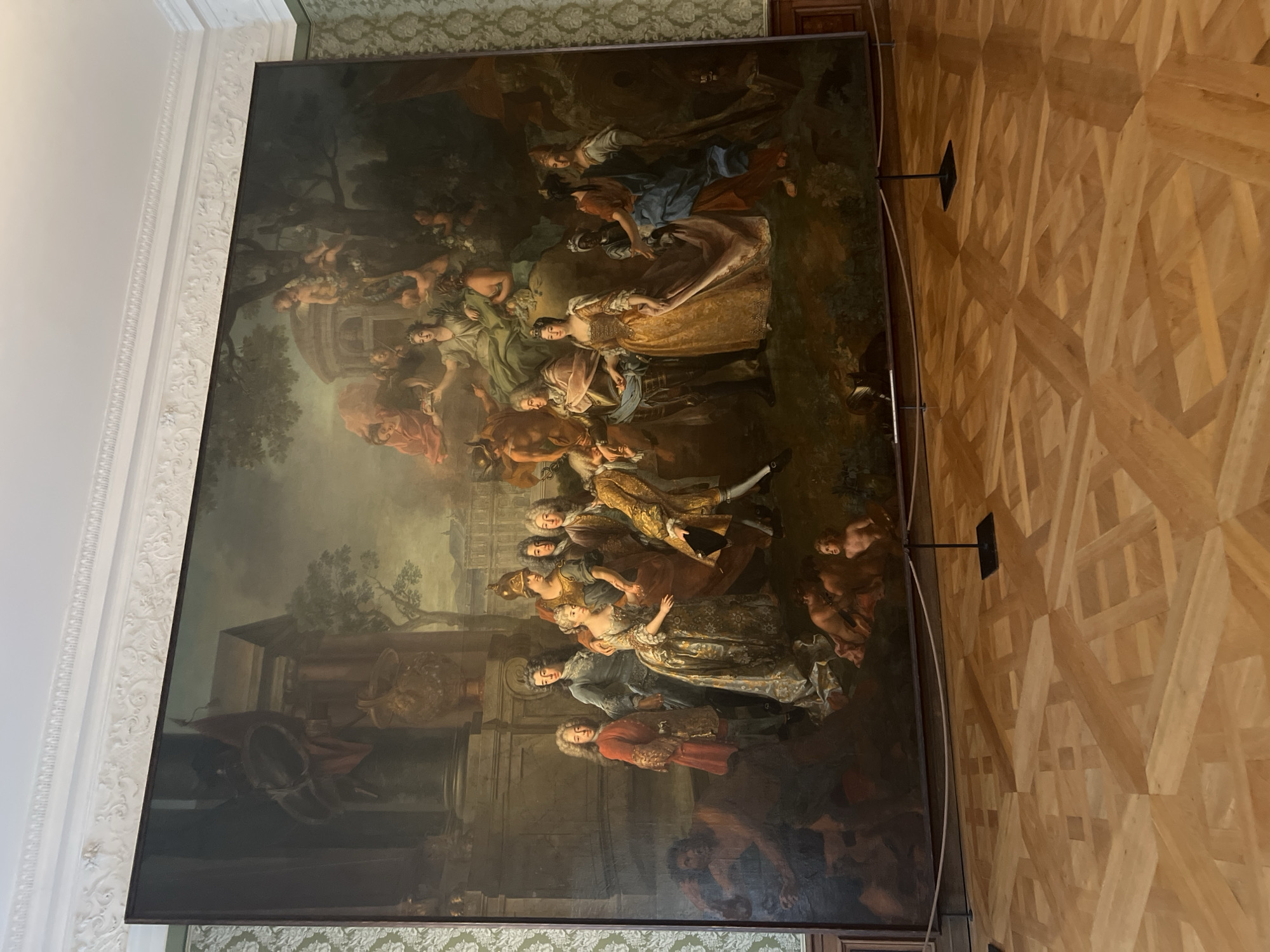
The image shows a large, ornate painting displayed in a museum setting. The painting itself depicts a grand gathering of people in elaborate historical clothing, set against a backdrop of architectural elements and lush greenery. Several figures are dressed in opulent gowns and suits, with powdered wigs and elaborate hairstyles. Some figures appear to be engaged in conversation or observation, while others are interacting with each other in a seemingly formal manner. In the foreground, there are figures in more rustic attire, suggesting a contrast between social classes. The painting's style appears to be from the Baroque or Rococo period, characterized by its rich colors, dramatic lighting, and intricate details. The painting is hung on a wall adorned with patterned wallpaper, and the room features a highly polished wooden floor with a distinctive parquet pattern. The ceiling above the painting is decorated with intricate white molding. The painting is secured with wires and stands on the floor, with stanchions and ropes set up in front of it, indicating it is a display for public viewing. This painting is located in the Grand Hall (Großer Saal) of the Lustheim Palace (Schloss Lustheim) in Oberschleißheim, Germany, which is part of the larger Schleissheim Palace complex. The Lustheim Palace is known for its opulent interiors, including its Baroque art collection.
Oberschleißheim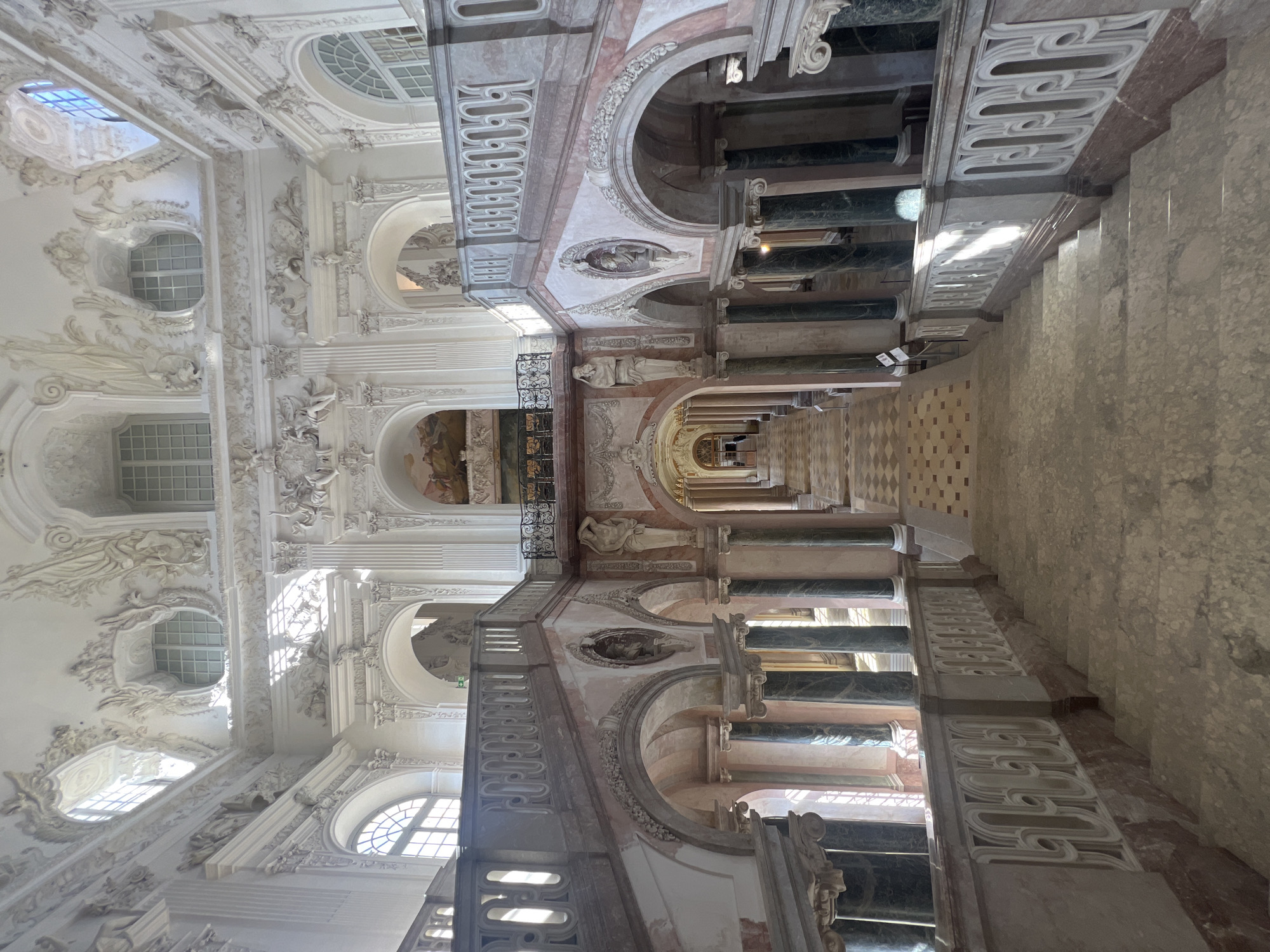
The image depicts the grand staircase and interior of the New Palace in Oberschleißheim, Germany. The architecture is baroque, characterized by ornate white stucco decorations, marble columns with green veining, and grand arched openings. Sunlight streams through large windows, casting distinct shadows on the marble stairs and decorative elements. The staircase is flanked by ornate marble balustrades. In the background, a long, checkered-tiled corridor leads into the palace, with arched doorways and further ornate architectural features visible. There are no people visible in the image.
Oberschleißheim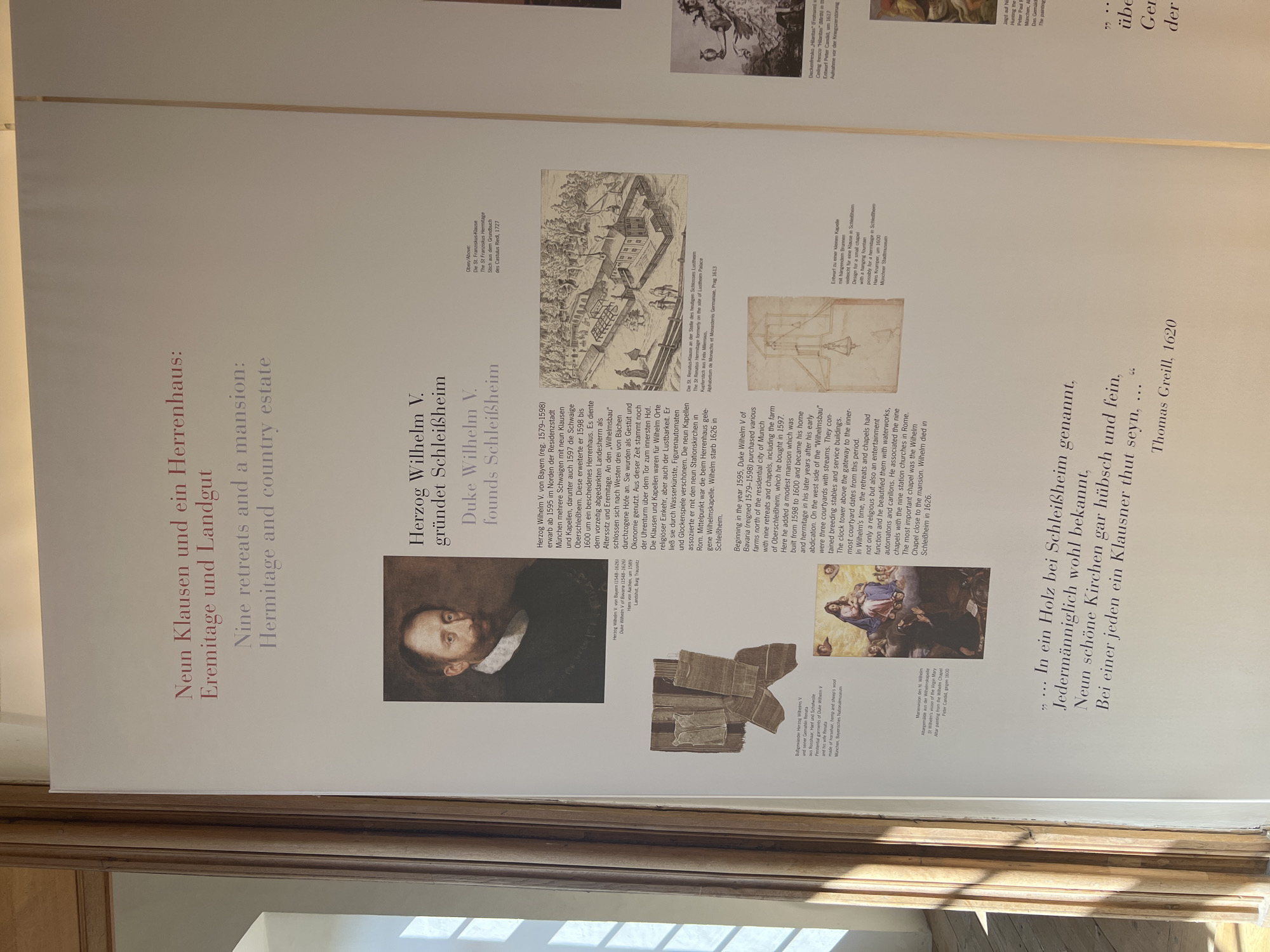
The image shows a large display board with text and images in German and English. The title of the display is "Neun Klausen und ein Herrenhaus: Eremitage und Landgut" (Nine retreats and a mansion: Hermitage and country estate). The display details the establishment of a hermitage and estate by Duke Wilhelm V of Bavaria in Schleißheim. The central image on the display is a portrait of Duke Wilhelm V. To the right of the portrait, there is an illustration of the hermitage buildings with a central house and surrounding structures, described as "Die St. Franziskus-Klausen an der Stelle des heutigen Schlosses Lustheim" (The St. Francis Hermitage on the site of the present Lustheim Palace). Below this, there is a sketch of a small chapel. The text describes how Duke Wilhelm V acquired the estate in 1598 and built a hermitage with nine retreats and chapels by 1600. The display also mentions that he added a modest mansion which became his home and was later expanded into Lustheim Palace. The hermitage included a clock tower, the most important of the chapels, and was built as a religious retreat, not just a secular entertainment function. The text notes that the Duke died in Schleißheim in 1626. Further down the display, there is a quote in German by Thomas Greill, dated 1620, about a place in Schleißheim. Images also depict what appear to be religious vestments and a painting of the Madonna and Child. The environment appears to be an indoor exhibition space, possibly in a museum or historical site.
Oberschleißheim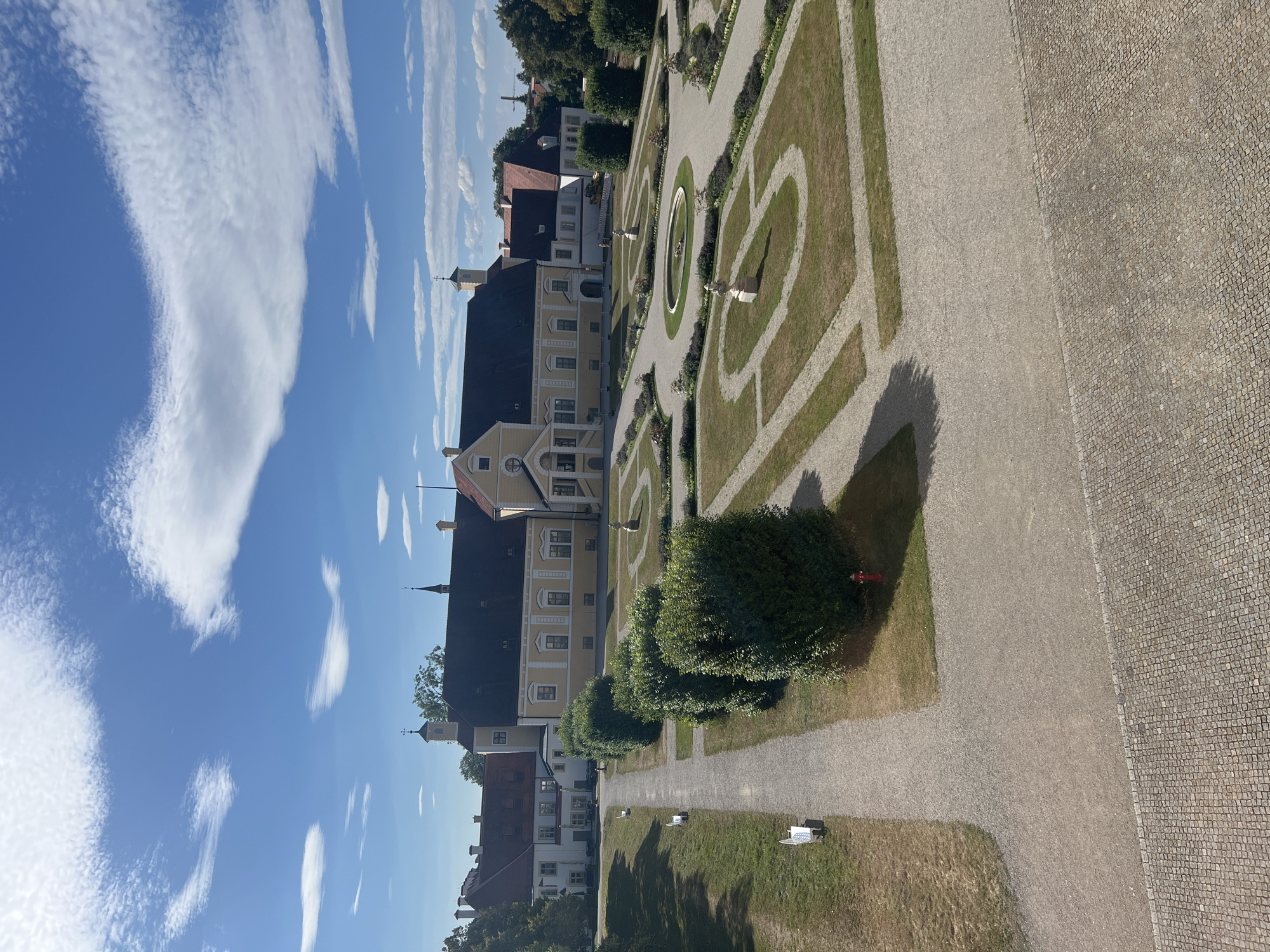
The image depicts an aerial view of Schleißheim Palace in Oberschleißheim, Germany, on a sunny day with scattered clouds. The palace itself is a large, yellow, two-story building with a red-tiled roof. It has numerous windows and architectural details typical of Baroque and Rococo styles. In front of the palace is a formal garden with manicured hedges, gravel paths, and flower beds. There are several sculptures and a small fountain within the garden. A gravel path leads from the foreground towards the palace, flanked by a row of trimmed green bushes and white benches. To the left of the path is a grassy area. In the background, more buildings with red roofs and trees are visible. The ground in the immediate foreground is paved with cobblestones. The scene appears to be peaceful and well-maintained, suggesting it is a tourist attraction or a well-preserved historical site.
Oberschleißheim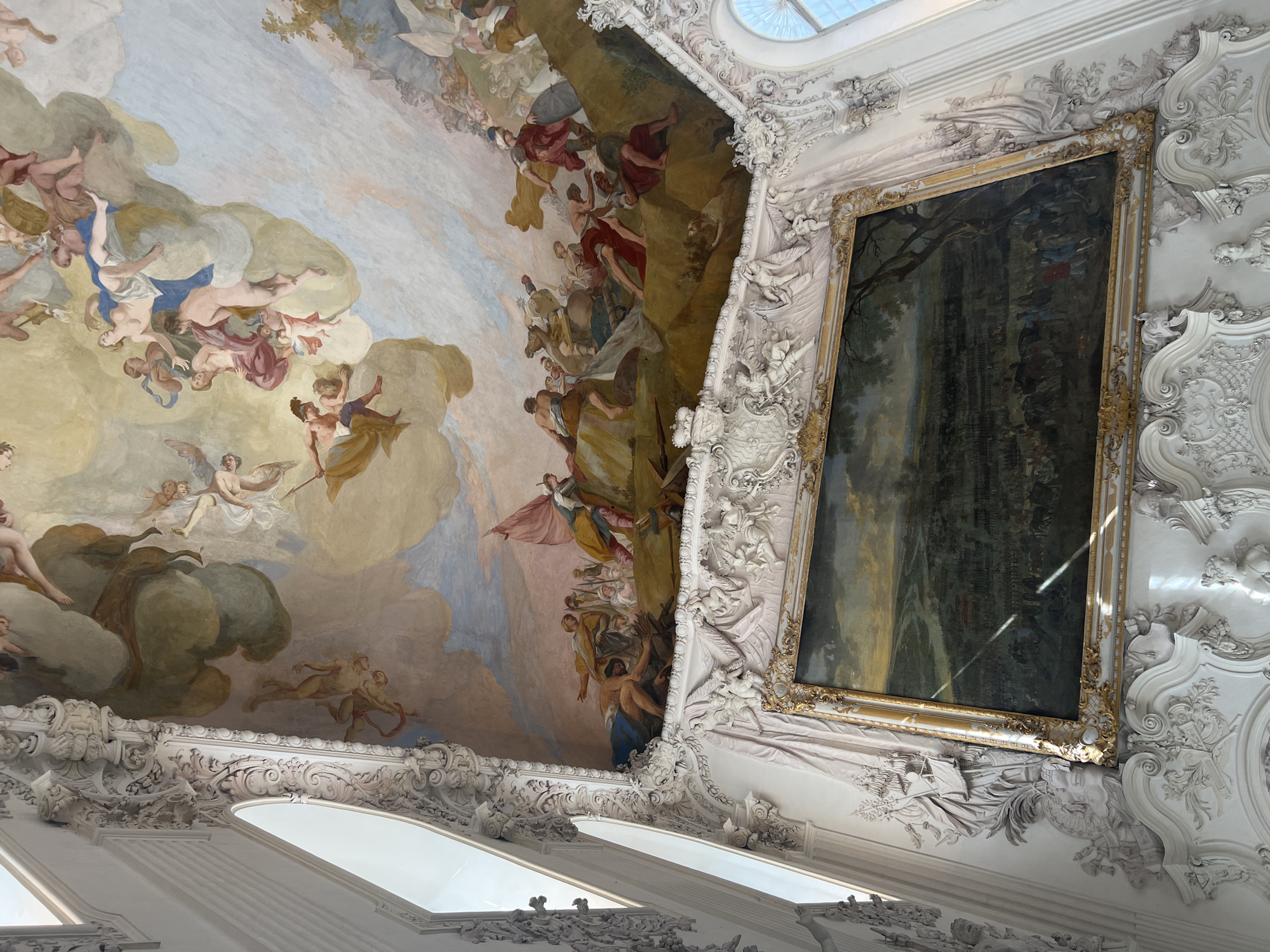
This image depicts the interior of a grand hall, likely a palace, in Oberschleißheim, Germany. The focal points are an ornate ceiling fresco and a large framed painting on the wall. The ceiling fresco is a vibrant and detailed scene filled with mythological or allegorical figures. Numerous nude and draped figures, rendered in pastel colors, are depicted in mid-air amidst swirling clouds. Some figures are engaged in dynamic poses, appearing to interact or ascend, while others seem to be falling. The fresco covers a vast expanse, suggesting a significant architectural space. Below the fresco, a large, rectangular painting with a gilded frame hangs on the wall. This painting appears to be a historical or battle scene, depicting a large gathering of figures and possibly a landscape or cityscape in the background. The colors in this painting are darker and more subdued than the ceiling fresco. The surrounding architecture is equally elaborate, characterized by white stucco ornamentation. This includes intricate moldings, decorative reliefs featuring cherubs and floral motifs, and fluted pilasters. Tall, arched windows with white panes are visible on the left and right sides of the hall, allowing natural light to illuminate the space. The perspective of the photograph suggests the viewer is looking upwards towards the ceiling and then down at the painting on the wall, indicating a high-ceilinged room.
Oberschleißheim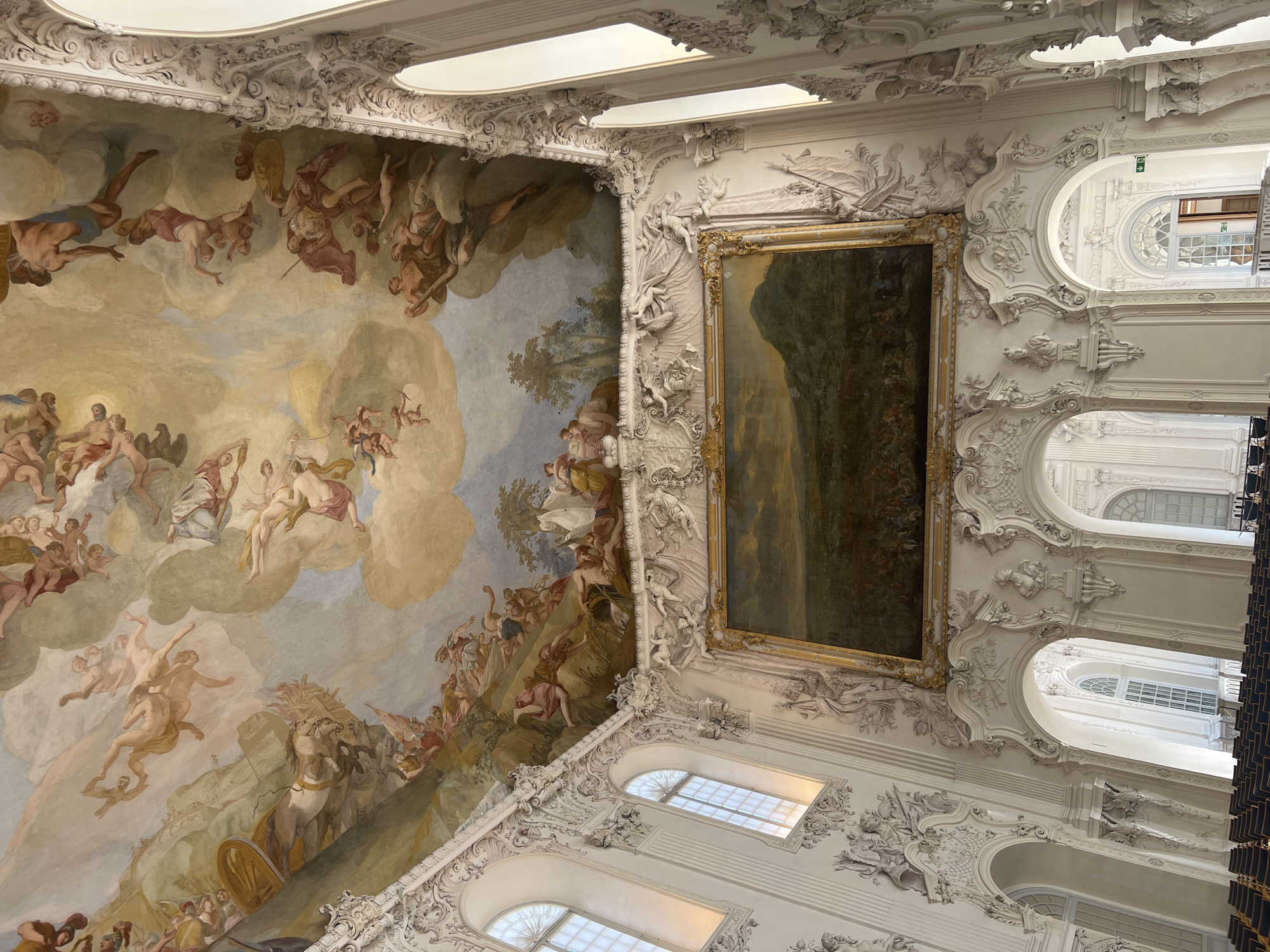
The image shows the interior of the Kaisersaal (Imperial Hall) in the Neues Schloss (New Palace) in Oberschleißheim, Germany. The hall features a grand frescoed ceiling depicting mythological scenes and figures. Below the ceiling, an ornate, gilded frame surrounds a large painting on the wall, which appears to be a landscape or historical scene with many figures. The walls are richly decorated with white stucco ornamentation, including putti, garlands, and architectural elements like arches and columns. Tall, arched windows with multiple panes are visible on the left and right sides of the hall, letting in natural light. In the foreground, rows of dark blue seating are arranged, suggesting the hall is used for performances or events. The overall impression is one of opulent Baroque architecture and art.
Oberschleißheim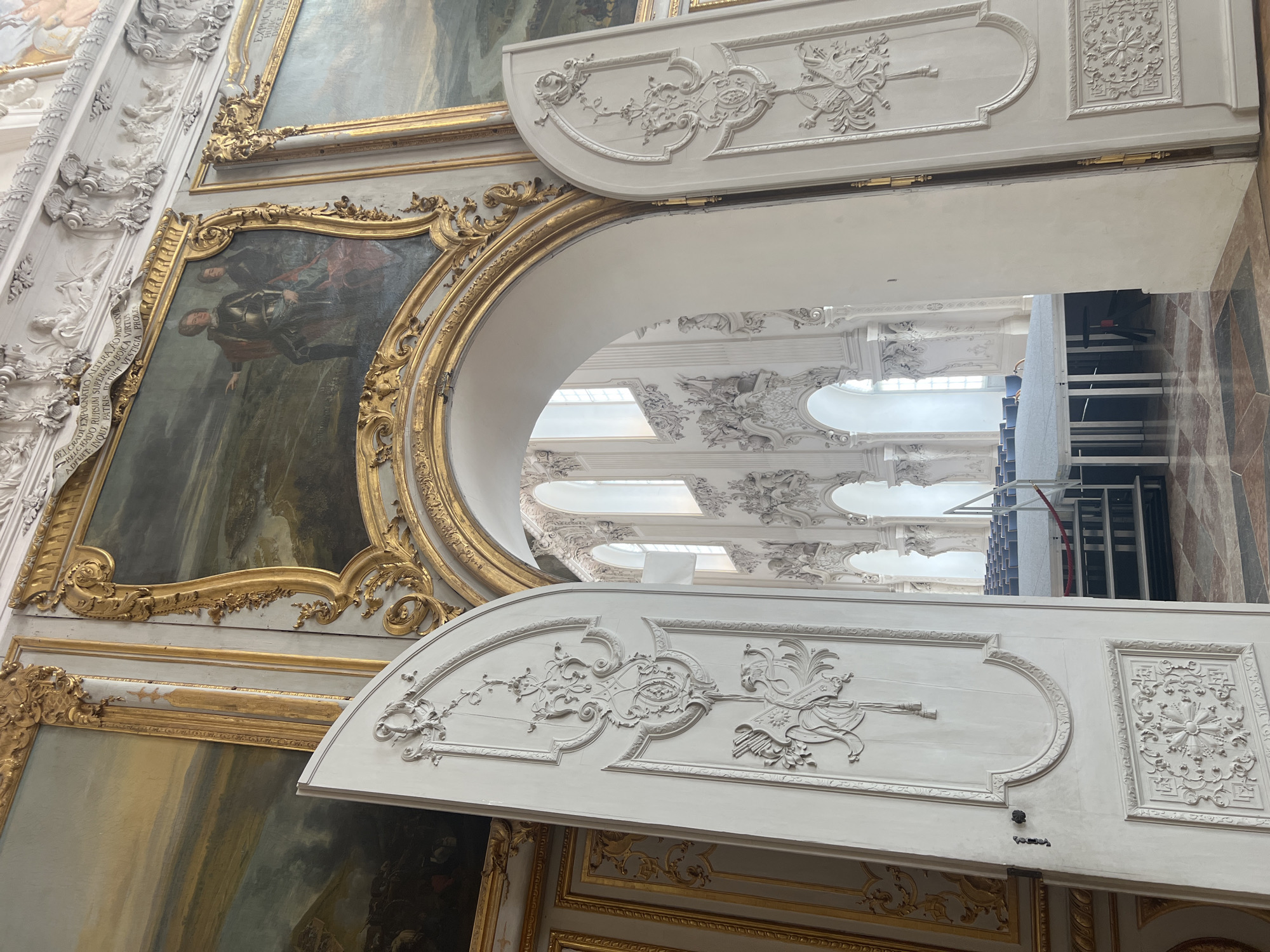
The image shows a view through a pair of ornate white double doors, open inwards, into a large, richly decorated hall. The doors are adorned with intricate relief carvings and have a classical architectural style. The hall beyond features high arched windows, elaborate stucco work on the walls, and large paintings in gilded frames along the upper walls. A stage with tiered seating is visible in the background, suggesting the hall might be used for performances or events. The floor is paved with marble tiles in a geometric pattern. The overall impression is one of grandeur and historical significance, characteristic of Baroque or Rococo architecture. This scene is located within the Schleißheim Palace complex in Oberschleißheim, Germany, specifically likely within the New Schleißheim Palace (Neues Schloss Schleißheim).
Oberschleißheim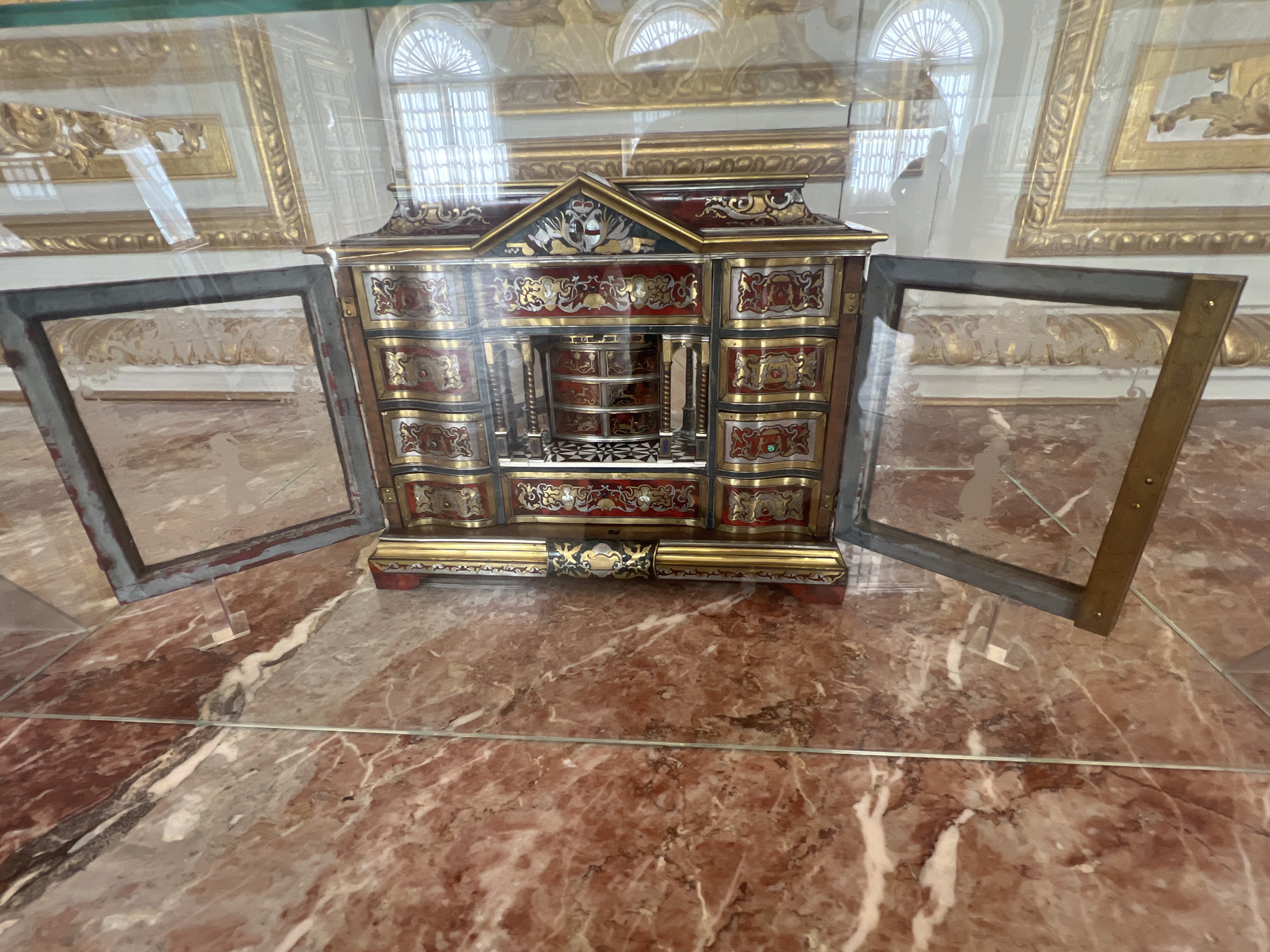
In Oberschleißheim, Germany, within the opulent halls of Schleissheim Palace, an intricately decorated cabinet is displayed on a reddish-brown marble floor. The cabinet, made of dark wood with ornate gold and red inlays, features multiple small drawers and a central tiered compartment. It is enclosed within a glass display case, with the front doors of the case standing open, revealing the cabinet and its reflection on the polished floor. The background shows gilded wall decorations and arched windows, typical of the palace's baroque architecture. The lighting is bright, highlighting the details of the cabinet and the surrounding environment.
Oberschleißheim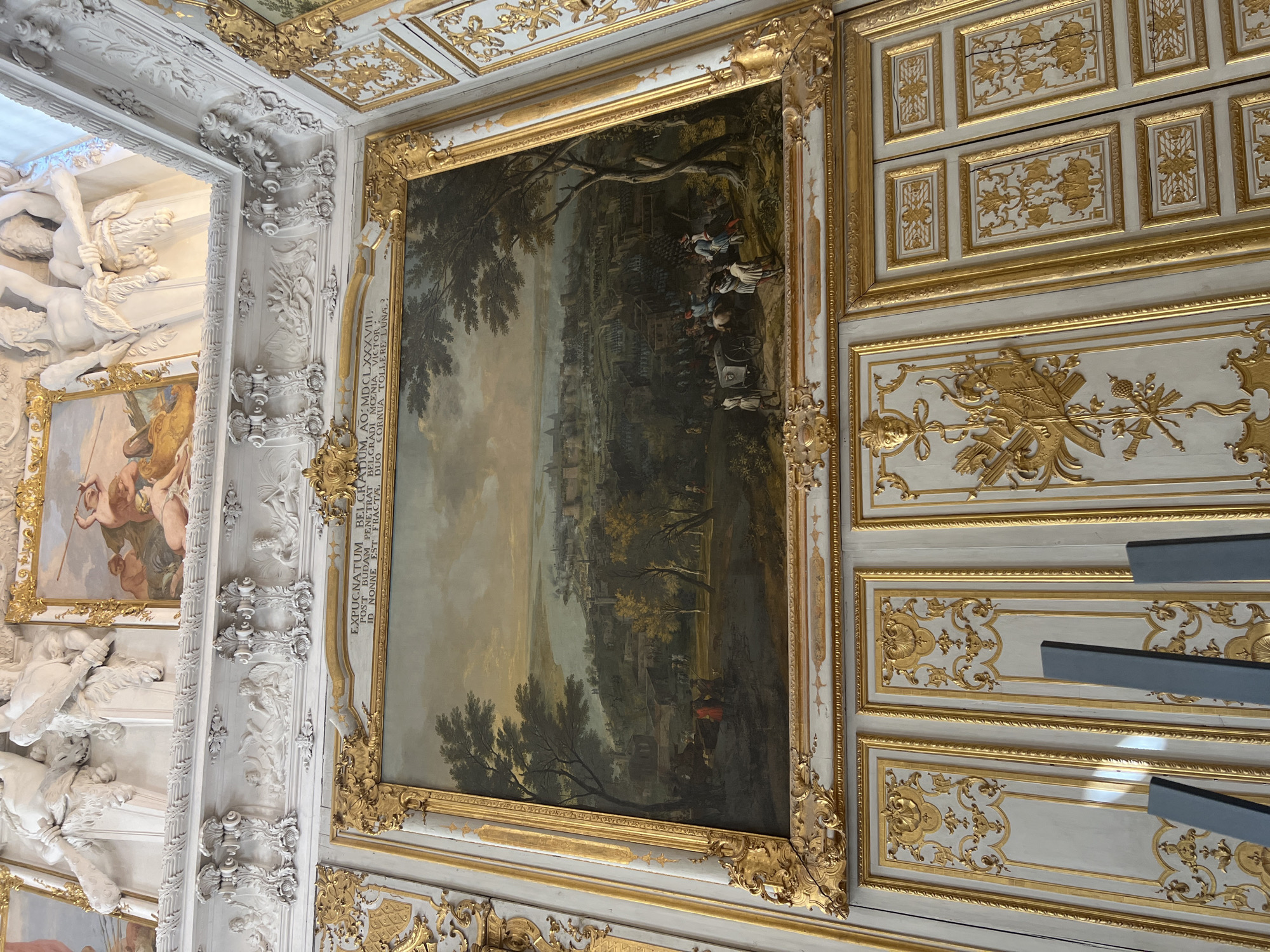
The image shows an ornate interior room, likely a palace or museum, with gilded architectural details and a large historical painting. The painting, framed in elaborate gold, depicts a panoramic landscape with a city in the distance and figures in the foreground. Above the painting, there are further decorative elements, including sculpted figures and smaller framed artworks. The walls are adorned with intricate gilded paneling featuring classical motifs. This scene is located in the Grand Hall of Schleissheim Palace, in Oberschleissheim, Germany. The room's opulent design suggests it is part of a significant historical or cultural site.
Oberschleißheim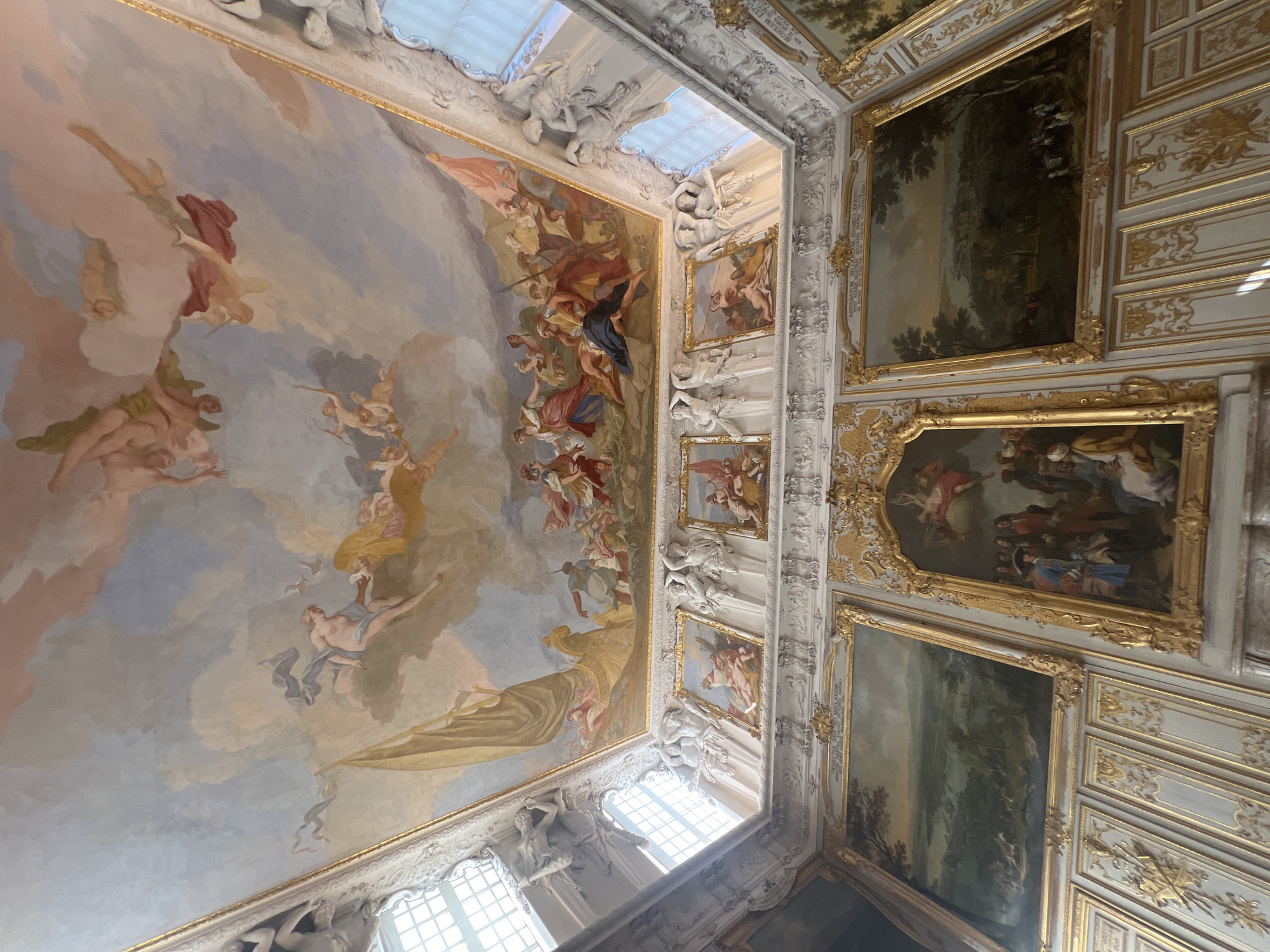
The image shows the ceiling and upper walls of a grand hall in the Neues Schloss (New Palace) in Oberschleißheim, Germany. The ceiling is adorned with a vibrant fresco depicting mythological figures in the sky, painted in soft pastel colors against a blue and white cloudy backdrop. The fresco features numerous nude and draped figures, some with wings, interacting in a dynamic composition. Below the ceiling fresco, the walls are lined with framed paintings and ornate stucco decorations. The paintings are set within elaborately gilded frames and appear to be a mix of historical scenes and landscapes. Some paintings depict figures in period attire engaged in various activities, while others present panoramic views of natural settings. The stucco work consists of intricate reliefs, including sculptural figures and decorative motifs, all in white against a lighter background, accented with gold trim. Natural light streams in from large, multi-paned windows on the left and right sides of the hall, illuminating the ornate details of the room and casting subtle shadows. The overall impression is one of opulent Baroque or Rococo architecture and art.
Oberschleißheim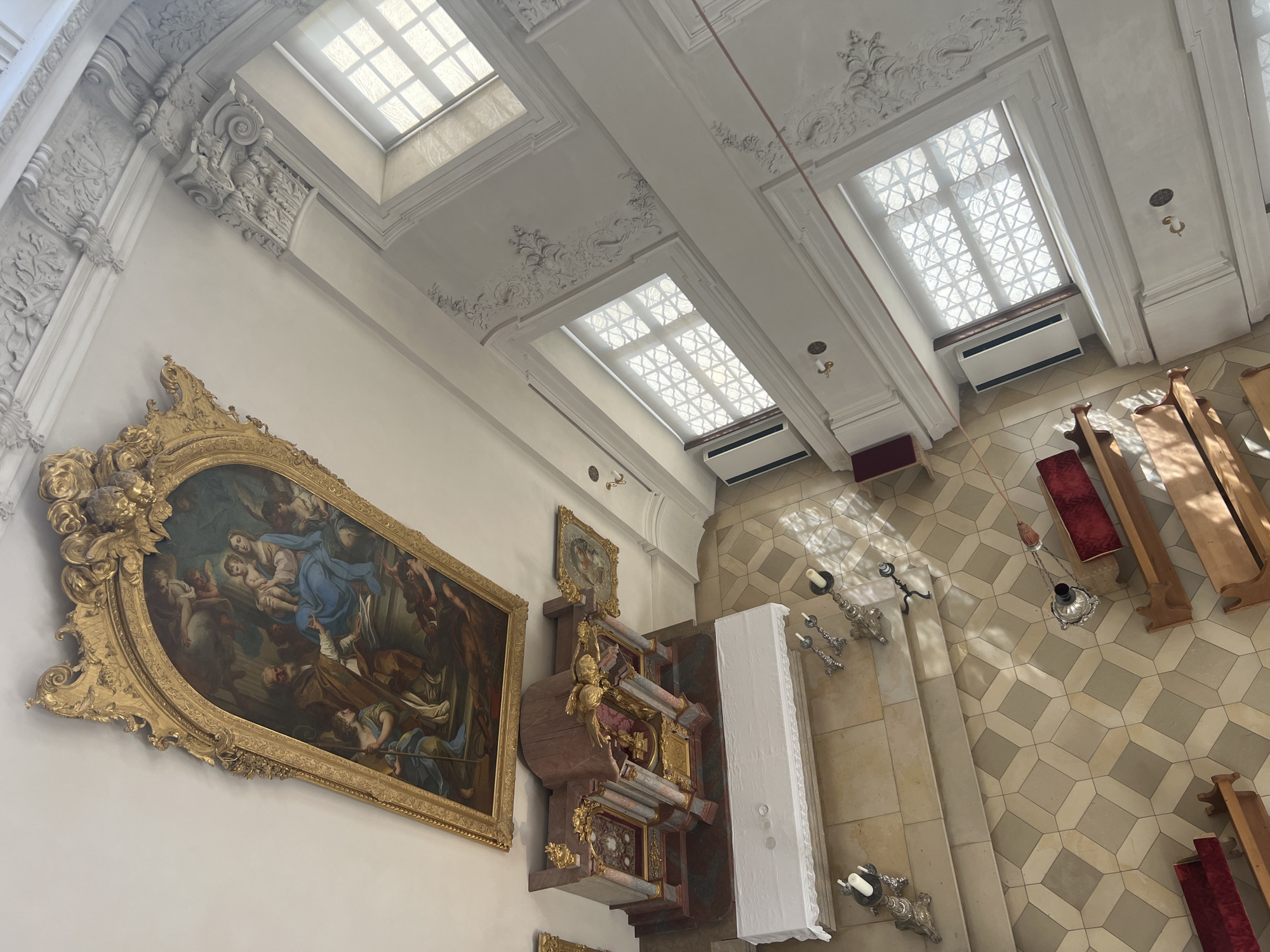
The photograph provides an overhead view of the interior of the St. Georgen church in Oberschleißheim, Germany, looking towards the altar area and surrounding architecture. Dominating the upper portion of the image is a large, ornate gold-framed painting depicting a religious scene, likely the Madonna and Child with Saints, suspended from the ceiling. Below this, a richly decorated altar with gold and marble accents is visible, covered partially by a white cloth. The floor is tiled in a geometric pattern of beige and gray squares. Several wooden pews, some with red velvet cushions, are arranged in the foreground and to the right. On the left side of the altar area, a set of stone steps leads up. Various decorative elements, including candlesticks, are placed on the floor and steps. The walls are white and feature intricate stucco work, particularly around the windows and cornices. Two large windows with ornate grilles are visible on the right side, allowing natural light to filter into the space. The overall impression is one of opulent Baroque or Rococo church architecture. No people are visible in the frame.
Oberschleißheim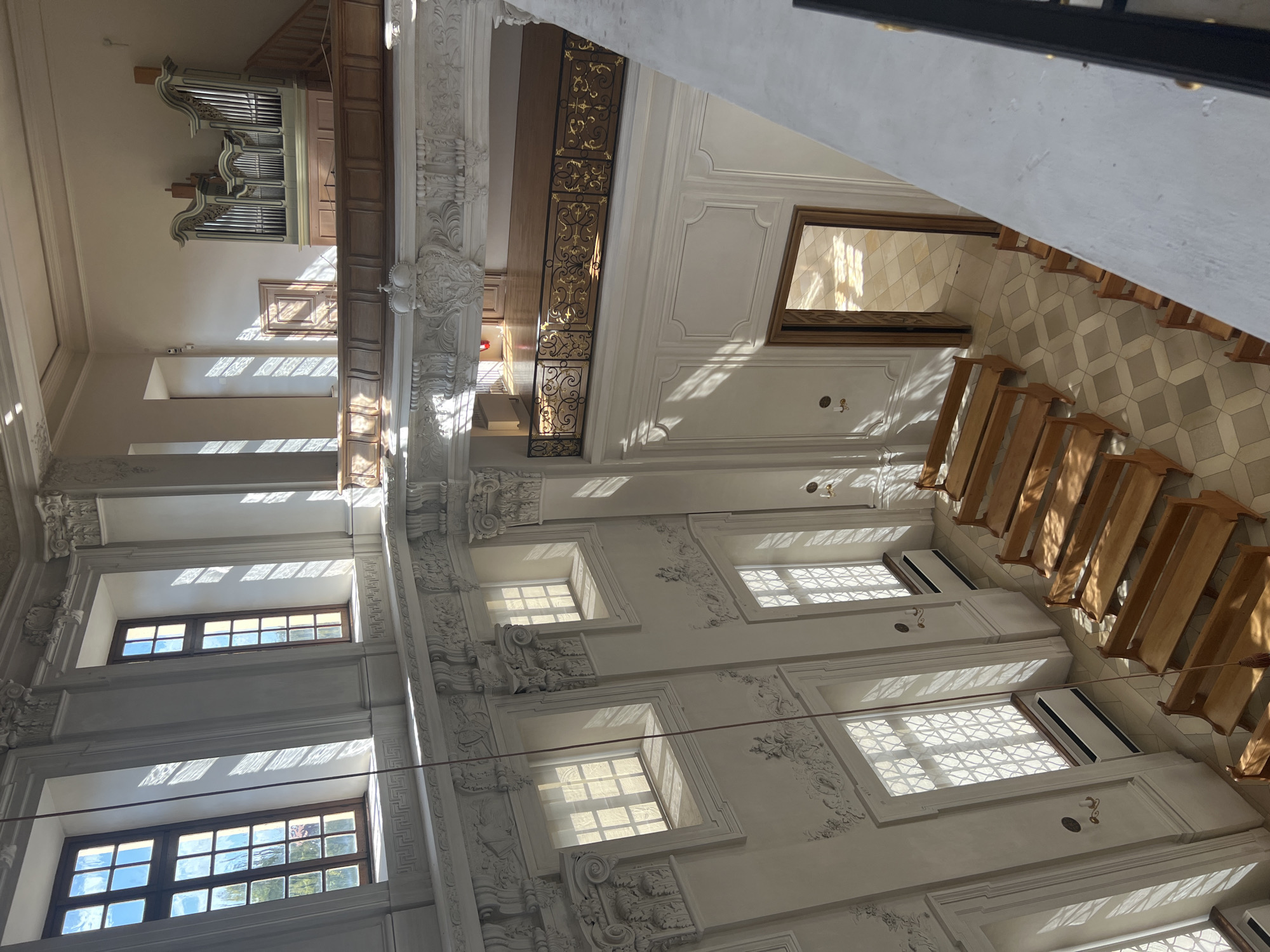
This is an interior, high-angle shot of a church or chapel in Oberschleißheim, Germany, likely part of the Schleißheim Palace complex. The space features light-colored walls with ornate white molding and decorative columns. Multiple large, rectangular windows with wooden frames and grilles are visible on the upper levels, allowing sunlight to stream in and cast patterned shadows on the walls and floor. Below, rows of simple wooden pews are arranged on a floor with a geometric tile pattern in shades of beige and gray. The pews are empty. On one wall, a large wooden door is ajar, revealing another tiled area beyond. In the upper right of the image, a pipe organ with light-colored pipes and a wooden casing is situated against the wall. A wooden balcony with a decorative golden railing spans across part of the upper level. The overall impression is of a well-maintained, sunlit historical interior.
Oberschleißheim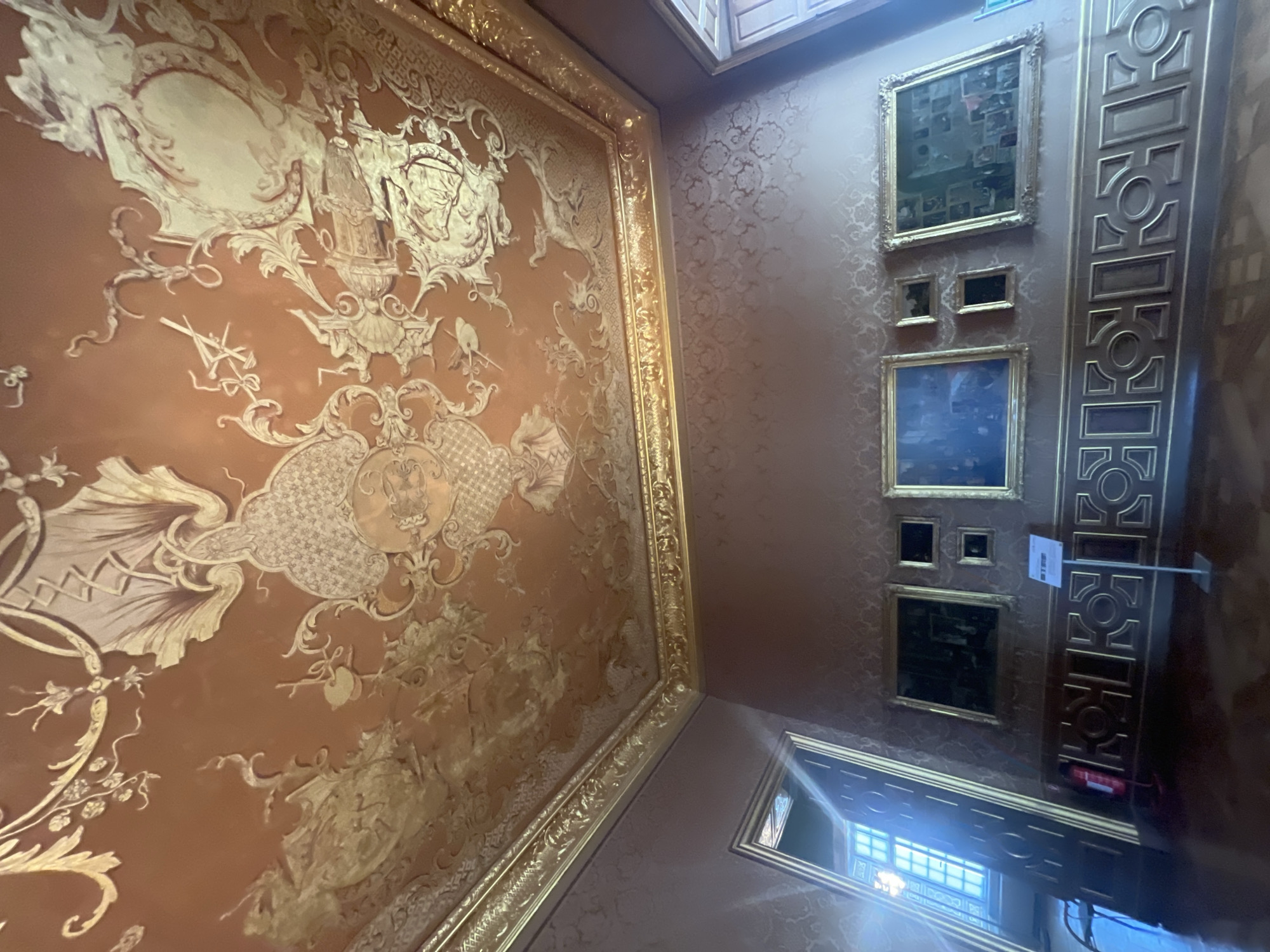
The image depicts an interior of a room, likely within a palace or grand residence, characterized by opulent decor. The ceiling is adorned with intricate gold ornamentation against a reddish-brown background, featuring scrolling motifs, crests, and what appear to be allegorical figures or mythical creatures. The walls are covered in a textured damask wallpaper in a muted rose or brown hue, also featuring a repeating pattern. Along one wall, a series of framed paintings are displayed above a decorative gold frieze that runs along the lower part of the wall. This frieze consists of a repeating geometric pattern with circular and rectangular elements. Visible objects include a fire extinguisher mounted on the wall to the left, a metal sign on a stand in front of the frieze, and what appears to be a door or large opening on the far left, leading to a well-lit area with a window featuring many panes. The floor is a polished dark wood. Based on the context of similar images and architectural styles, this room is likely located within the New Schleissheim Palace (Neues Schloss Schleißheim) in Oberschleißheim, Germany, which is part of the Schleissheim Palace complex. The detailed stucco work and gilded decorations are characteristic of the Baroque and Rococo styles prevalent in the palace. There are no people visible in the image.
Oberschleißheim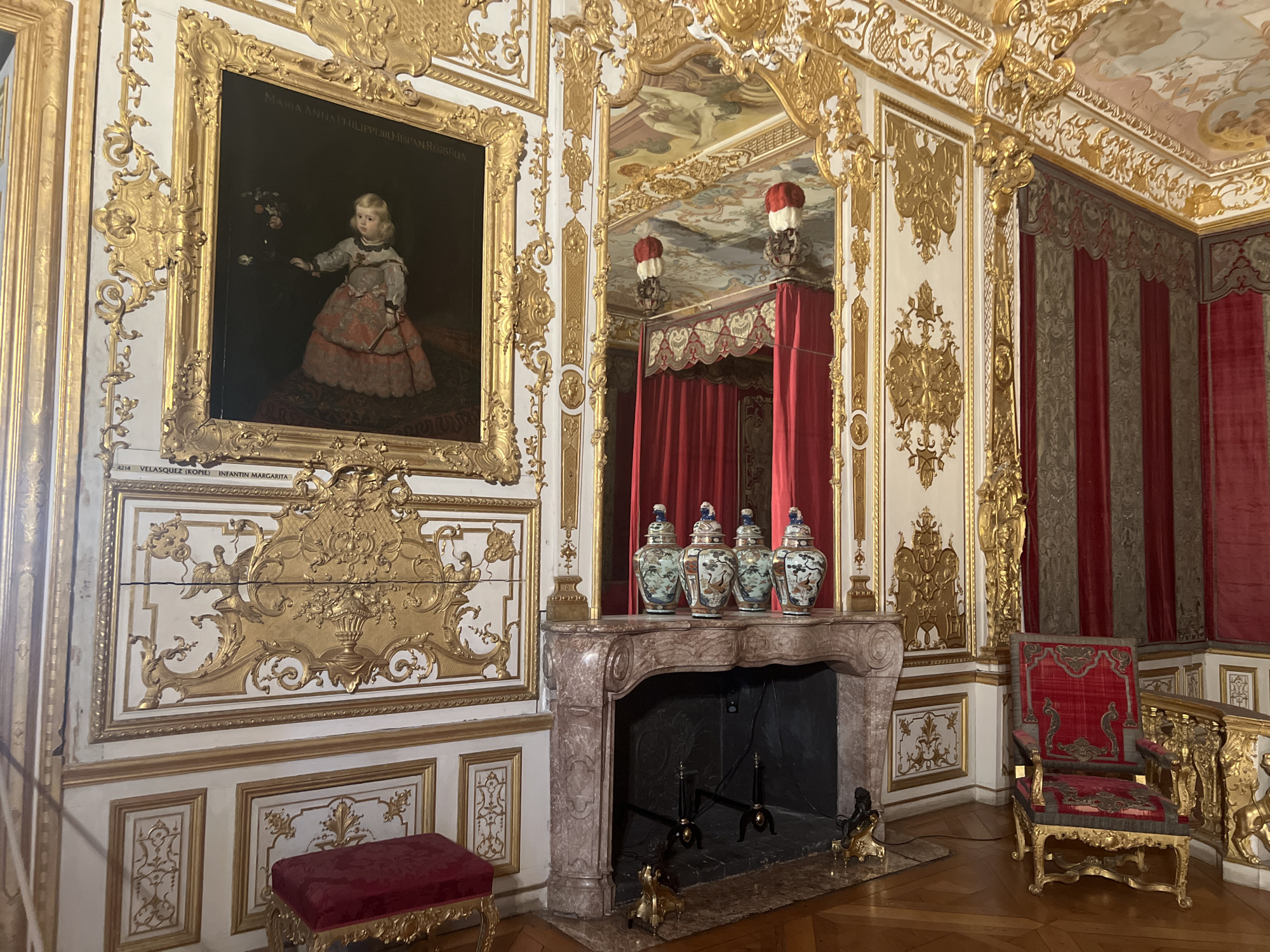
The image depicts an opulent interior of a room, likely a palace or grand residence, in Oberschleißheim, Germany. The room is adorned with intricate golden ornamentation on the walls and ceiling, reflecting a Baroque or Rococo style. To the left, a large framed painting hangs on the wall, depicting a young child in elaborate attire. In the center of the room, a marble fireplace with ornate carvings serves as a focal point, topped with a row of decorative ceramic vases. Red velvet drapes frame a bed or alcove in the background, visible in a mirror that reflects the opposite side of the room and the ceiling's painted frescoes. To the right, a richly upholstered red armchair with golden accents sits on the polished wooden floor, adjacent to a gilded railing. The overall impression is one of extreme luxury and historical significance.
Oberschleißheim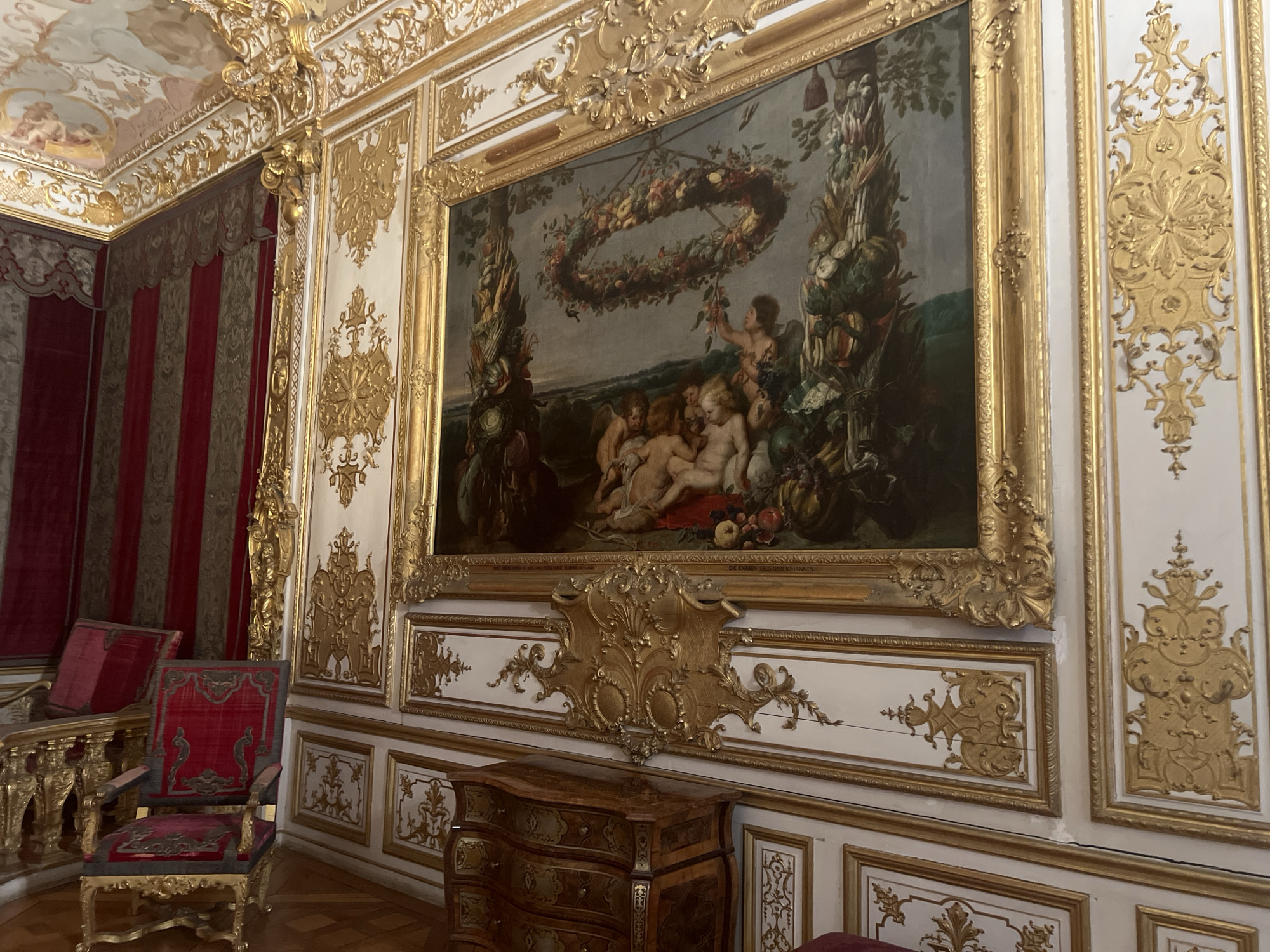
The image depicts an opulent interior within the New Schleißheim Palace in Oberschleißheim, Germany. The scene is dominated by an ornate, gilded rococo-style room. A large, framed painting hangs prominently on the wall, depicting cherubs adorning a garland of fruit and vegetables. The painting is surrounded by elaborate gold trim and ornate decorative panels. To the left of the painting, red velvet draperies with vertical stripes are visible, partially obscuring another section of the room. Two red upholstered chairs with gilded frames are positioned in the foreground on the left. On the right side of the painting, more gilded decorative panels are mounted on the white walls. Below the painting, a small, ornate wooden chest of drawers with intricate marquetry is visible. The floor is made of polished wood planks. The ceiling, visible in the upper left corner, features painted frescoes with putti and is also adorned with gilded decorations. The overall impression is one of extreme wealth and elaborate artistry characteristic of Baroque or Rococo palace interiors.
Oberschleißheim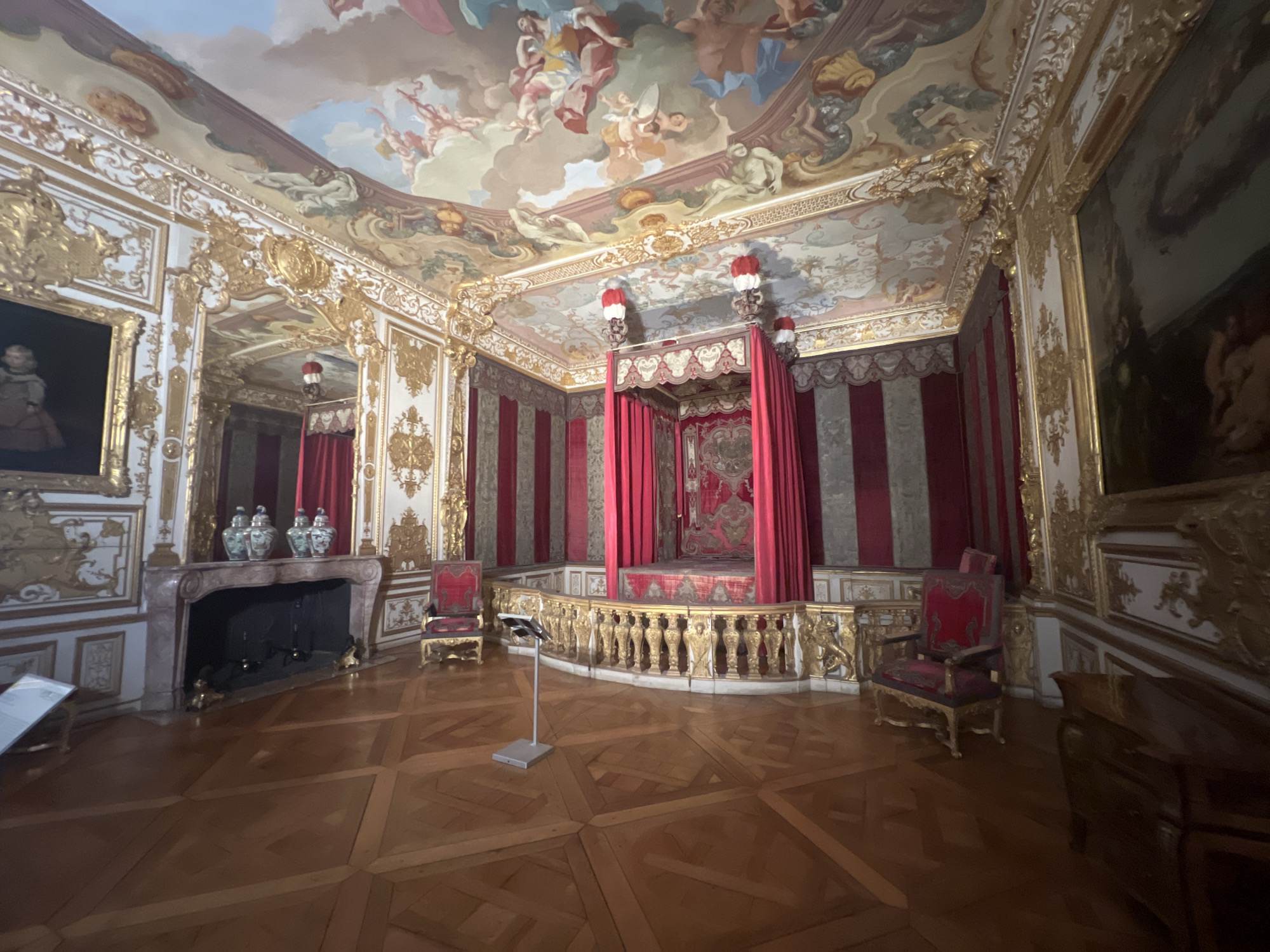
This image depicts the Audience Chamber in the New Palace of Schleissheim, located in Oberschleißheim, Germany. The chamber is opulently decorated with gilded moldings, striped red and grey drapery, and a richly painted ceiling featuring mythological scenes. A grand four-poster bed with red curtains is the focal point of the room, raised on a platform surrounded by a golden balustrade. Two ornate red chairs with gilded accents are positioned on either side of the bed. To the left of the bed, a marble fireplace with a mantelpiece adorned with decorative vases is visible. The floor is made of polished wooden parquet. The lighting suggests daytime. There are no people visible in the image.
Oberschleißheim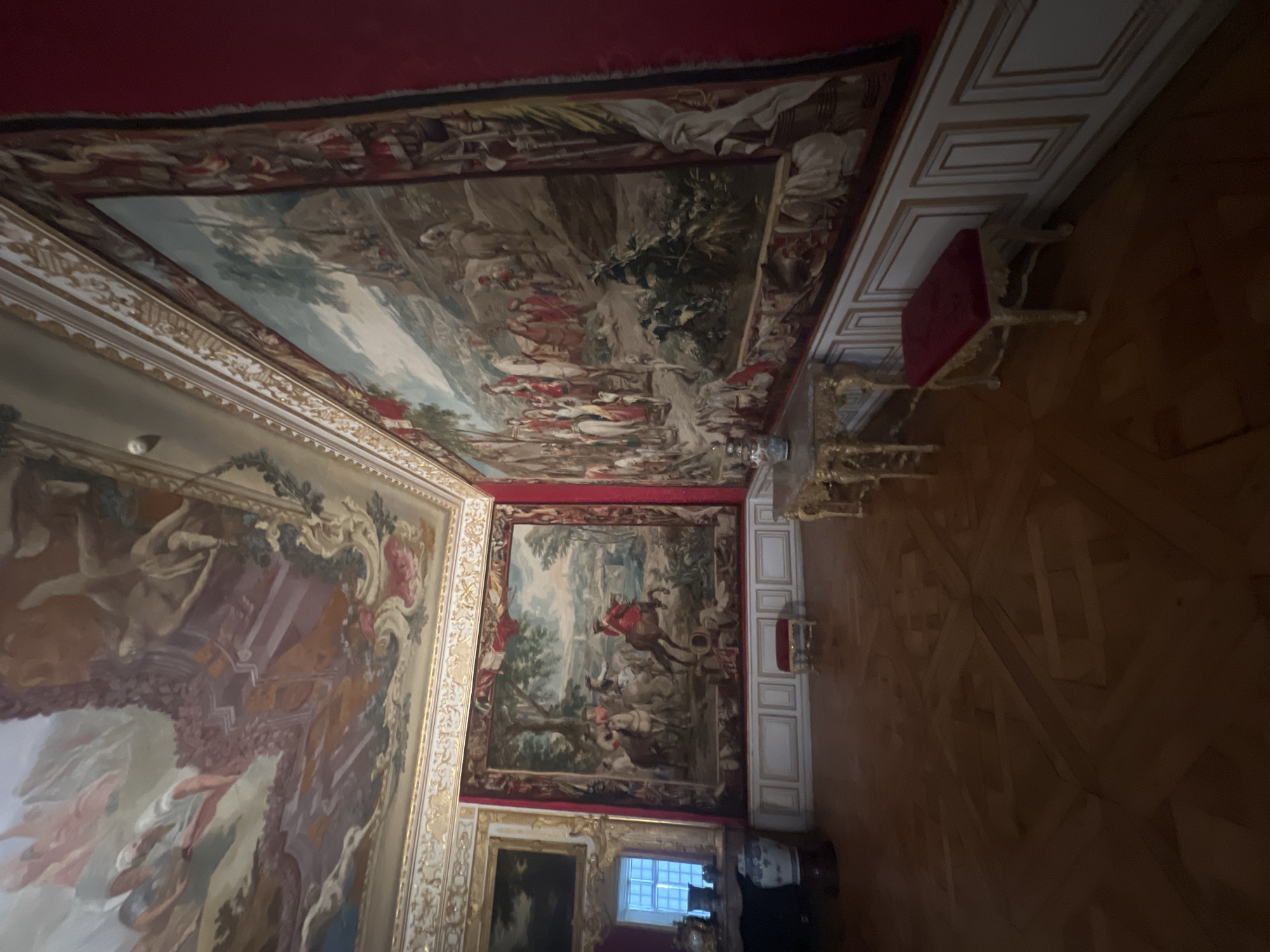
This is an indoor scene in a grand, ornate room, likely part of a palace or museum, located in Oberschleißheim, Germany. The room features high ceilings with elaborate frescoes depicting mythological or allegorical scenes, rendered in soft pastel colors. The walls are predominantly a deep red, adorned with large, detailed tapestries that showcase historical or pastoral scenes with figures and horses. The flooring is a polished parquet with a geometric pattern. The room contains several pieces of antique furniture, including two small, red-upholstered stools with gilded legs, a gilded table with ornate carvings and a white vase on it, and another table with a vase. On the left side of the image, a large, blue and white porcelain vase stands on a dark pedestal. A framed painting hangs on the wall near a window with multiple panes, letting in natural light. The architectural details include decorative moldings and panels along the lower walls, also in white and gold. The overall impression is one of opulence and historical significance.
Oberschleißheim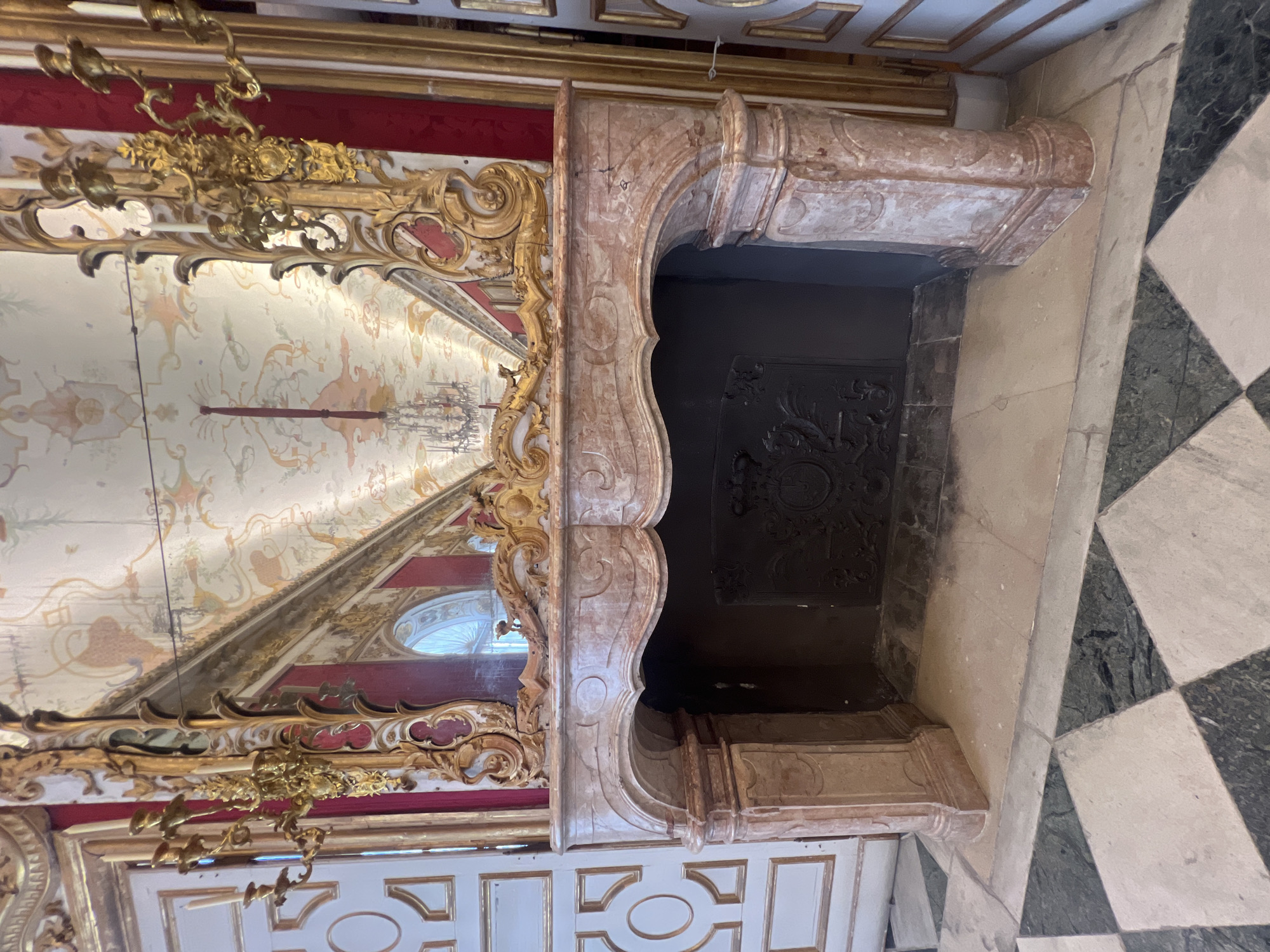
The image shows a grand fireplace in a richly decorated room, likely part of a palace or stately home. The fireplace is made of pinkish marble with ornate carvings. Above it is a large, gilded mirror framed with intricate golden scrolls, reflecting a high ceiling adorned with elaborate frescoes and a chandelier. The walls feature red drapes and decorative panels, and a gilded candelabra is visible on the left. The floor is tiled in a diamond pattern of black and white squares, with some areas of green marble. This scene is located in the New Schleißheim Palace in Oberschleißheim, Germany.
Oberschleißheim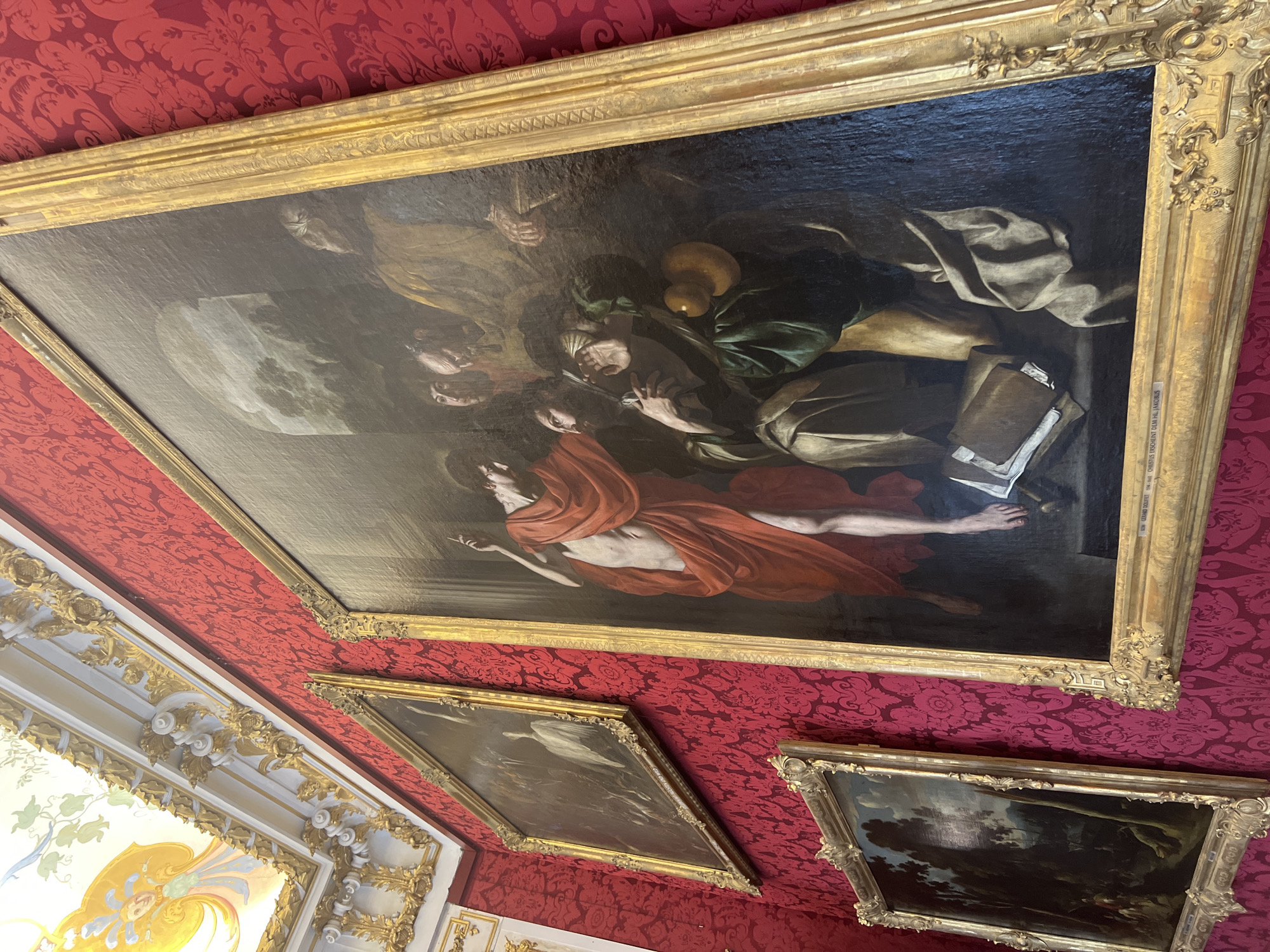
The image shows an opulent room with red patterned wallpaper and ornate gold trim on the walls and ceiling. Three framed paintings are visible on the wall. The largest painting in the foreground depicts a religious scene, likely a biblical event, with a central figure in a red cloth reaching out to a man in a green garment. Several other figures are present in the background. To the left of this large painting, a second, smaller painting shows a landscape scene with figures and animals. Further to the left and higher up, a third painting displays a bird in a dark, wooded setting. The ceiling above is decorated with intricate gold moldings and a fresco of a winged figure. The overall impression is of a richly decorated art gallery or a formal living space within a historical building. The location is the Schleissheim Palace, in Oberschleissheim, Germany, specifically in the New Palace (Neues Schloss).
Oberschleißheim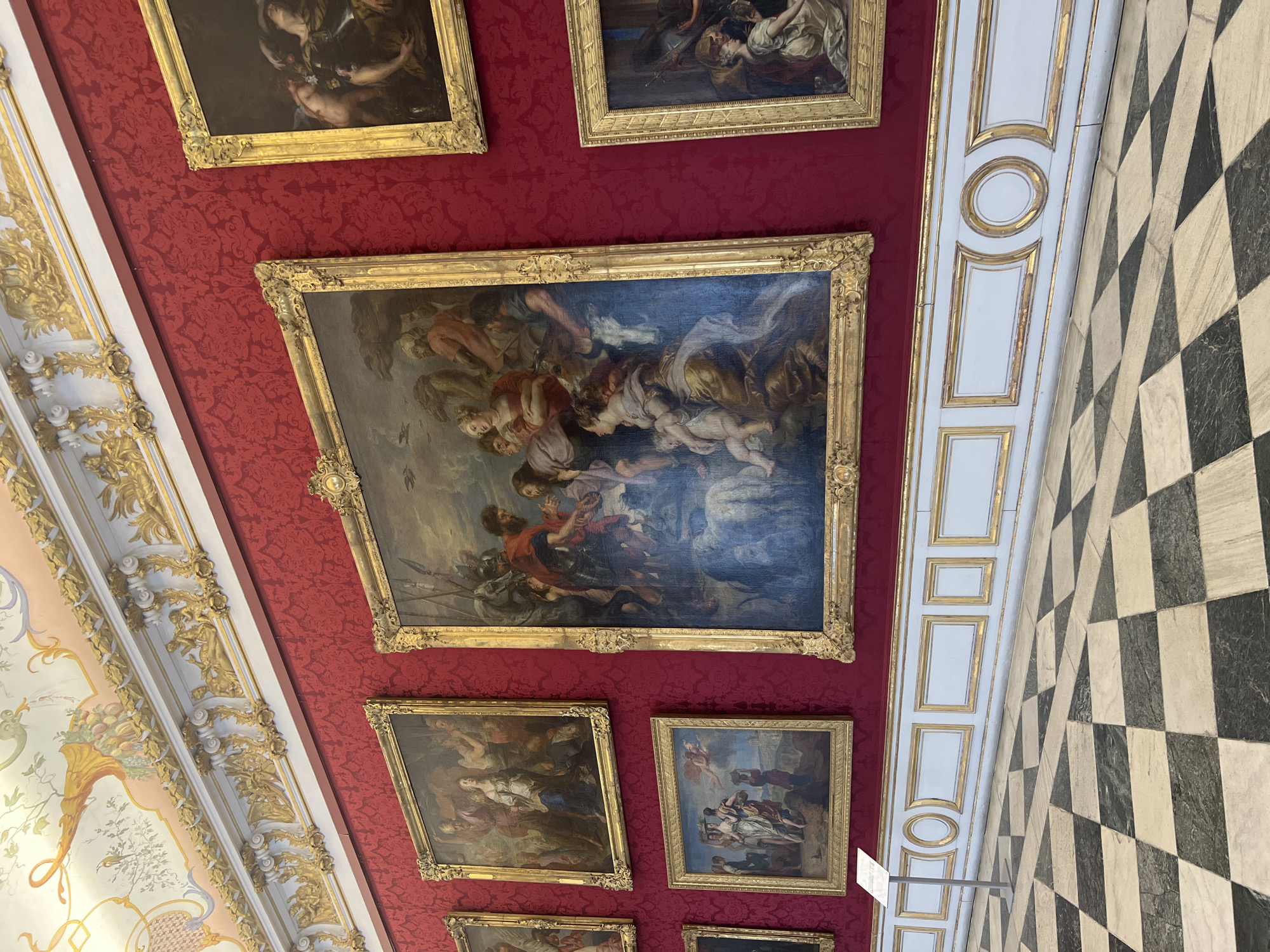
This image depicts a grand hall, likely within a palace or museum, in Oberschleißheim, Germany. The room features a richly decorated red damask wallpaper adorning the walls, accented by elaborate golden moldings and intricate ceiling frescoes. A series of large, ornate framed paintings hang on the wall, showcasing what appear to be historical or religious scenes with multiple figures. The paintings are displayed in a salon-style arrangement, with one particularly large canvas dominating the center. In the foreground, a striking black and white checkered marble floor extends across the hall. A simple white display stand is positioned in front of one of the paintings. The lighting suggests an indoor setting, possibly illuminated by natural light filtering in from unseen sources, highlighting the opulent details of the architecture and artwork.
Oberschleißheim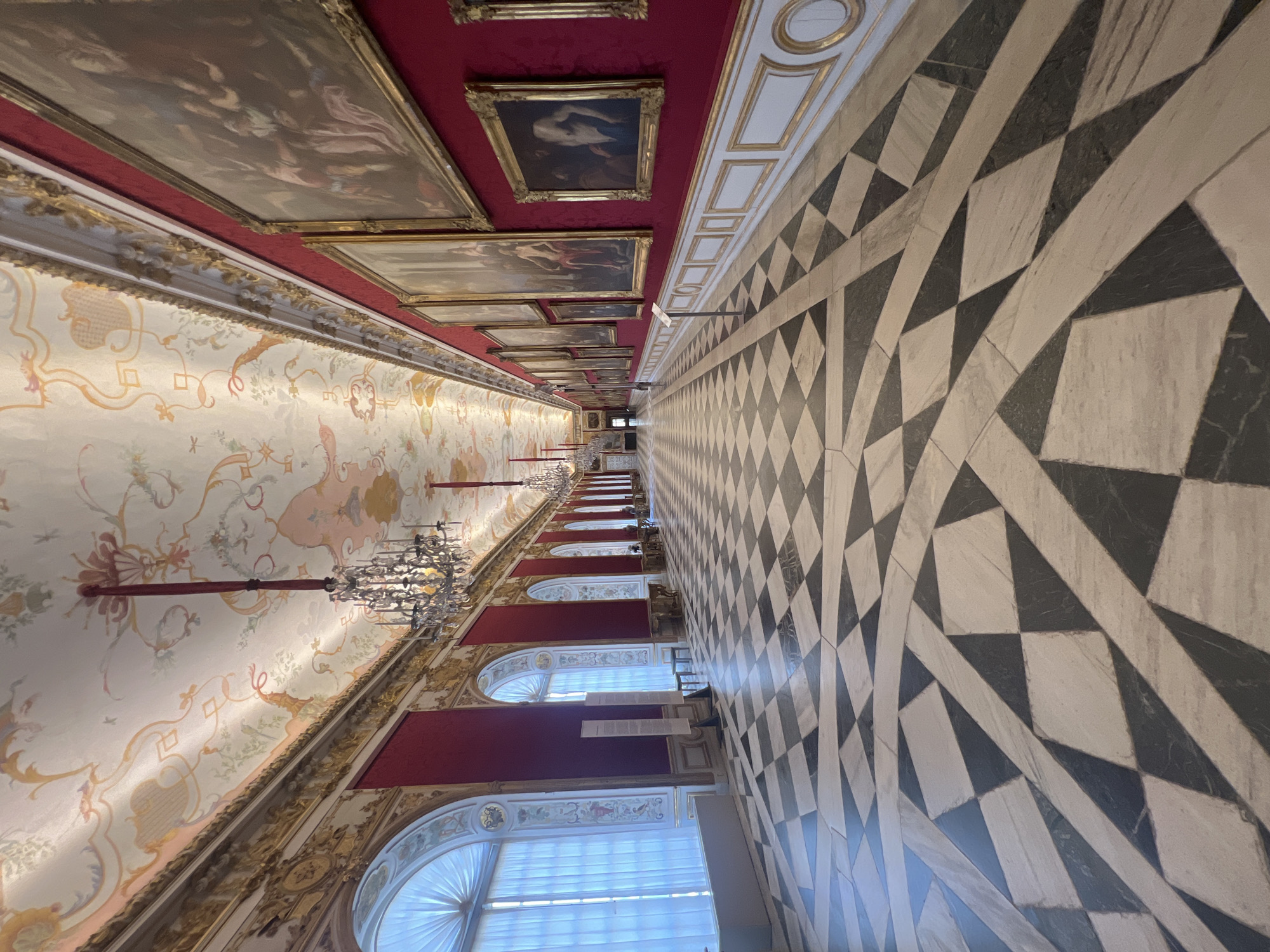
The image depicts the Great Hall of the New Schleißheim Palace in Oberschleißheim, Germany. The hall is a long, ornate corridor with a black and white checkered marble floor. The walls are a deep red and adorned with numerous framed paintings. The ceiling is intricately decorated with frescoes and gold trim, and several crystal chandeliers hang from it. Large arched windows with white translucent curtains line the left side of the hall, letting in natural light. The hall appears to be empty of people, with the exception of a few figures visible in the distance at the far end of the corridor. The overall impression is one of grandeur and historical significance.
Oberschleißheim