Oklahoma City, United States
15 memories from Oklahoma City, United States

A close-up, dimly lit video shows a person with dark skin and short, curly dark hair. The individual is wearing a white t-shirt and looking directly into the camera with a serious expression. The background appears to be a plain, light-colored wall.
Oklahoma City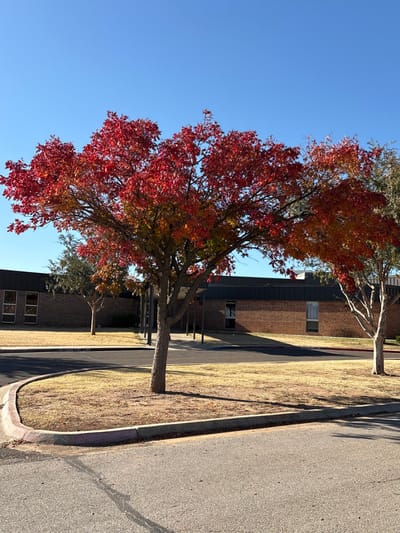
The scene depicts an outdoor view in Oklahoma City, United States, featuring a building and autumn trees under a clear blue sky. In the foreground, an asphalt paved surface, likely a driveway or parking lot, curves to the left, bordered by a concrete curb. This curb separates the pavement from an area of dry, light brown grass. A prominent deciduous tree with dense, bright red-orange fall foliage stands centrally in the midground, its trunk having rough, grayish-brown bark. Behind this tree and slightly to the left, a smaller tree with greenish-brown leaves is visible. To the right, another deciduous tree displaying similar red-orange autumn leaves is partially framed. The background is dominated by a single-story institutional building constructed with reddish-brown bricks. The building features multiple rectangular windows with dark frames and a dark-colored, flat or low-slope roof. A covered entrance or walkway extends from the building's facade towards the center-left. The upper portion of the image shows a clear, cloudless blue sky. No individuals, animals, or specific actions are present within the frame. Shadows are cast on the ground, indicating natural daylight conditions.
Oklahoma City
The image displays a solid orange background. White, sans-serif text is centered horizontally, reading "Me being born." No discernible people, objects, actions, or specific environmental features are present. The location in Oklahoma City, United States, is not discernible from this image.
Oklahoma City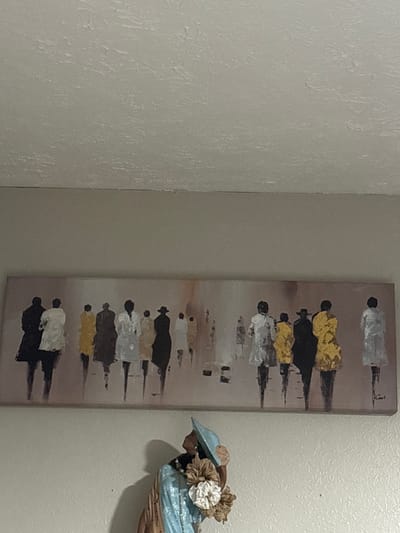
The image displays an indoor scene in Oklahoma City, United States, featuring a wall adorned with artwork and a figurine. The upper portion of the frame shows a light-colored, textured popcorn ceiling meeting a light beige, smooth wall. Centrally positioned on the wall is a large, rectangular, horizontally oriented abstract painting. This painting depicts numerous stylized human figures, appearing elongated and in motion, rendered with minimal detail against a muted beige and light brown background. The figures are clothed in varying colors, including black, white, light gray, yellow, and light brown; some wear hats. The artist's signature, "Cool," is visible in the bottom right corner of the canvas. Partially visible in the lower-center foreground is a decorative figurine depicting an African American woman from the bust up. She wears a light blue broad-brimmed hat, a light blue top with a textured surface, and a necklace, accessorized with light-colored, possibly fabric, floral embellishments near her right shoulder.
Oklahoma City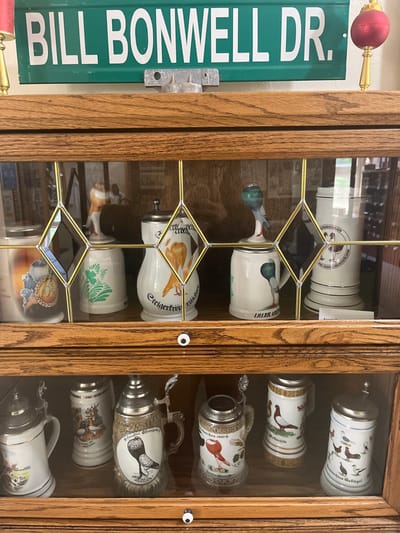
This interior image displays a wooden display cabinet featuring a collection of ceramic and stoneware steins, predominantly adorned with pigeon and fowl imagery, some bearing German text. Positioned above the cabinet is a green rectangular street sign with white lettering, clearly reading "BILL BONWELL DR." The sign is mounted on a light-colored wall using a metal bracket. The cabinet, appearing to be made of oak, has glass doors with decorative leaded-glass patterns in a brass tone. The upper shelf contains various steins, including one with a standing figure, another with a prominent blue pigeon figure serving as a lid, and additional pieces with painted birds and German inscriptions such as "Erigerer Vollgucker" and "UILER KOPF." The lower shelf houses several traditional steins, most featuring hinged metallic lids and ornate handles. Designs on the lower steins include detailed pigeons, and text like "Zuchtschau 1987-G" and "Welt Schild" is visible. Small white circular knobs adorn the cabinet doors. Faint reflections in the glass panels suggest an indoor environment, with a partial reflection of a person in a white garment visible in the upper left section. A red spherical ornament with a gold base is partially visible on the right side of the frame, near the top. The presence of the "BILL BONWELL DR." street sign, combined with the extensive collection of pigeon-themed steins, indicates the likely location is the Oklahoma City Pigeon Club, situated on Bill Bonwell Drive in Oklahoma City, United States. No direct human subjects or actions are depicted; the scene is a static display of collectibles.
Oklahoma City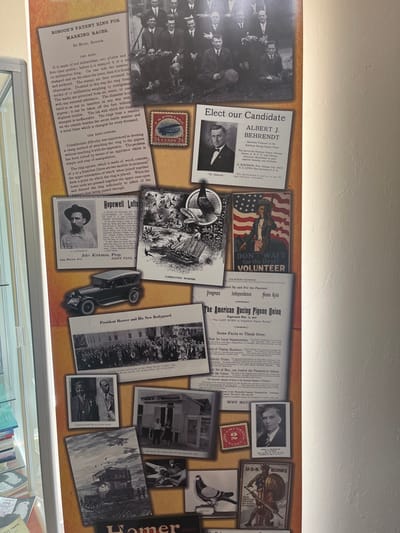
This image depicts a vertical museum exhibit display board, approximately 2 meters in height, located within the American Racing Pigeon Union headquarters in Oklahoma City, United States. The board, mounted on a cream-colored wall, is densely covered with historical documents and photographs, predominantly in monochrome or sepia tones, affixed to a brown background. Visible content includes: * A large vintage group photograph at the top center showing approximately two dozen men, some holding pigeons, dressed in formal attire outdoors. * A textual document on the top left titled "ROBOOR'S PATENT RING FOR MARKING RACES," detailing pigeon identification bands and a ring-opener. * A campaign-style document on the mid-right titled "Elect our Candidate ALBERT J. BEHRENDT," featuring a portrait of the identified Secretary-Treasurer of the American Racing Pigeon Union. * An illustration titled "LIBERATING HOMERS" depicting multiple pigeons flying from release baskets, positioned mid-center. * A wartime poster on the mid-right featuring Uncle Sam pointing, with the text "DON'T WAIT FOR THE DRAFT VOLUNTEER." * A photograph at the lower mid-left shows a crowd of people, including "Pigeon Fanciers and Ladies," gathered in front of the White House, dated October 1930, titled "President Hoover and His New Bodyguard." * A large textual document on the lower center-right is titled "The American Racing Pigeon Union," with sections like "Progress" and "Some Facts to Think Over." * A photograph of a single pigeon labeled "A Champion" is visible on the lower right, adjacent to a "U.S.A. BONDS LIBERTY" war poster depicting an Indigenous American figure with a shield and spear. * Other visible elements include portraits of individuals such as Jake Kirkman and John S. Buchanan, a black vintage automobile, illustrations of pigeon-related transportation (e.g., a pigeon loft on a truck), and various historical postage stamps, including a 24-cent airmail stamp. A glass display case containing books is partially visible on the left side of the frame. The scene is illuminated from an overhead light source, casting a vertical shadow on the wall to the right.
Oklahoma City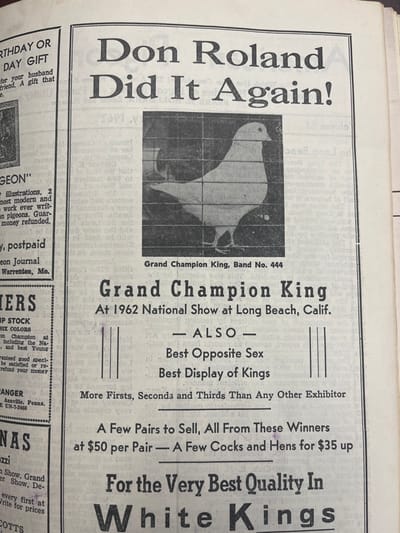
This image displays a photograph of an aged, off-white printed page from a periodical, likely a specialized journal or magazine, viewed at a slight angle. The dominant content is a large advertisement for "Don Roland" and his pigeons, occupying the majority of the right column. The advertisement features a black-and-white halftone photograph of a plump, white King pigeon, labeled "Grand Champion King, Band No. 444," facing right within a dark rectangular frame. The pigeon appears to be standing on a gridded surface, possibly the bottom of a cage. The headline above the image reads, "Don Roland Did It Again!" Text below the pigeon's photo indicates it was "Grand Champion King At 1962 National Show at Long Beach, Calif." Further text lists additional achievements: "Best Opposite Sex," "Best Display of Kings," and "More Firsts, Seconds and Thirds Than Any Other Exhibitor." The advertisement also states, "A Few Pairs to Sell, All From These Winners at $50 per Pair — A Few Cocks and Hens for $35 up," concluding with "For the Very Best Quality In White Kings" (partially visible). The left column of the page contains fragments of other advertisements or articles, also related to pigeons. Visible text includes "PIGEON" and "on Journal Warrenton, Mo.," suggesting the publication originates from Warrenton, Missouri. Another partial advertisement mentions "Annville, Penna." There is no information within the image indicating a location in Oklahoma City, United States. The overall environment depicted is a flat, two-dimensional printed page, characterized by typical paper aging and minor handling wear. No specific individuals are visible, but Don Roland is identified as the breeder and seller. The content is an advertisement for the sale of championship-winning show pigeons.
Oklahoma City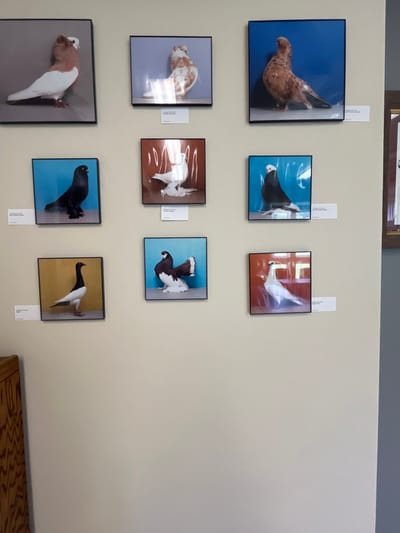
The image displays an interior wall in Oklahoma City, Oklahoma, United States, featuring nine framed photographs of domestic pigeons. The wall is painted a uniform light beige. The photographs are arranged in a three-row by three-column grid. Each black-framed photograph depicts a single pigeon against a solid, contrasting background (shades of gray, blue, gold, or reddish-brown), showcasing various pigeon breeds with distinct plumage patterns, colors (including white, brown, black, and bi-colored), and physical characteristics. Small, white informational labels are affixed to the wall directly below each frame; discernible text on some labels includes 'Chicago IL, USA' and 'Oklahoma City, OK, USA', indicating potential origins or exhibition details of the depicted birds. A light-colored wooden cabinet or furniture piece with vertical paneling is partially visible in the lower-left foreground. A narrow section of a dark gray wall or door frame is present along the right edge of the image. No individuals are visible. The scene presents a static display, consistent with an exhibition or collection.
Oklahoma City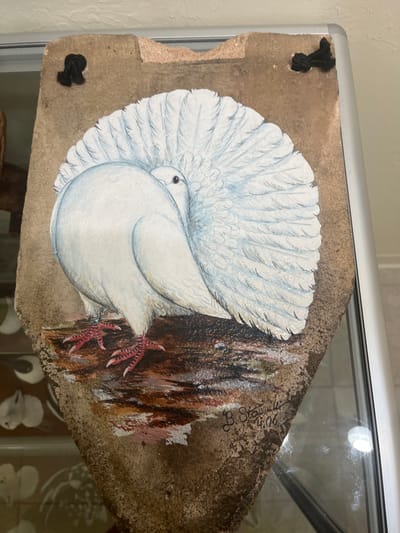
The scene displays a piece of artwork in an indoor setting. The artwork is a painting on an irregularly shaped, earthy-brown, textured substrate, possibly a piece of rock or similar natural material. The top edge of the substrate is rough and uneven, with two dark, raised fasteners, one on the upper left and one on the upper right. The central subject of the painting is a white fantail pigeon with a large, fanned tail, rendered in white and subtle light blue hues for its feathers. The pigeon is depicted from a slightly rear-right perspective, with its head turned to the left, revealing one dark eye. Its feet are red with visible claws, and a silver band is present on its left leg. The bird stands on a dark brown, textured surface, suggestive of a log or uneven ground. In the lower right quadrant of the painting, a signature "B. Strouse" (or similar) and the date "4-06" (April 2006) are handwritten. The artwork is positioned vertically, and its right side is bordered by a silver-colored frame and glass, indicating it is likely within a display case or cabinet. Reflections are visible on the glass surface. The background consists of a light-colored wall or ceiling. No individuals are present in the frame. No specific geographic landmarks or identifiers are discernible within the image to determine a precise location in Oklahoma City, United States.
Oklahoma City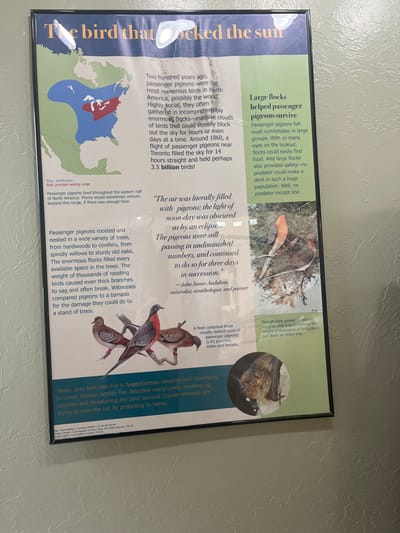
A framed informational poster is mounted vertically on a light-colored, textured wall. The poster, titled "The bird that flocked the sun," primarily details the Passenger Pigeon and includes a small section on gray bats. Its design features a map of North America indicating the bird's historical distribution, multiple text sections describing its characteristics and flock behavior, an illustration of three Passenger Pigeons (juvenile, male, female) perched on a branch, and a circular photograph of a gray bat. Reflections on the poster's surface, particularly at the top and center-right, partially obscure content. Small text at the bottom edge identifies the content source as the Oklahoma City Zoo and Botanical Garden, placing the scene within Oklahoma City, United States. No individuals are visible.
Oklahoma City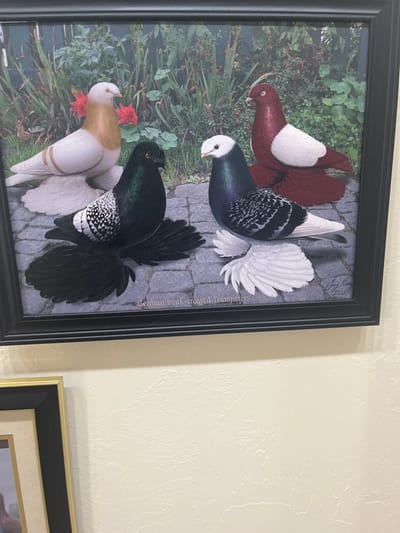
The image displays a framed print or painting of four German Beak-crested Trumpeter pigeons, mounted on a light-colored, textured wall. The pigeons are depicted in an outdoor garden setting with a cobblestone ground and green foliage with red flowers in the background. From left to right, the pigeons exhibit distinct colorations: one tan and white; one dark green/black with white speckled wings and large dark tail feathers; one white-headed with dark blue/purple plumage, white speckled wings, and large white tail feathers; and one dark red/maroon with white wings. The print includes the title "German Beak-crested Trumpeters" at the bottom center and a signature "Jenny Romaine 2018" at the lower right. A partial view of another framed picture, featuring a gold and black frame, is visible at the bottom left. The wall shows a subtle textured finish. No specific identifying architectural or environmental features are present to determine a precise location within the city of Oklahoma City, United States.
Oklahoma City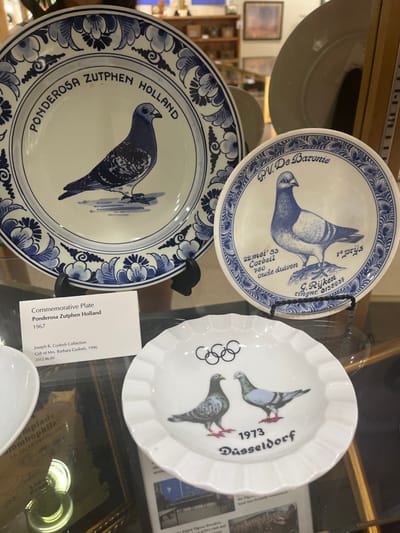
The image displays three commemorative plates and a small dish, all featuring pigeons, meticulously arranged within a glass display case. The scene is located at the American Pigeon Museum & Library in Oklahoma City, Oklahoma, United States. The largest plate, positioned on the left, is circular, predominantly white, with intricate blue Delftware-style patterns along its border. The central design depicts a detailed dark blue racing pigeon. Above the pigeon, the plate is inscribed with "PONDEROSA ZUTPHEN HOLLAND." To the right, a smaller, circular white plate is visible, also adorned with blue decorative borders. It features a single blue racing pigeon and contains several Dutch inscriptions, including "P.V. De Baronie," "22 mei '83," "Corbeil," "760 oude duiven," "1e prijs," "C. Rijken," and a numerical sequence. In the foreground, a small, white, fluted-edge dish or ashtray is presented. This item features five black Olympic rings at the top, two multi-colored pigeons (one darker, one lighter grey-blue), and the text "1973 Düsseldorf" below them. A rectangular white informational label, positioned below the large plate, identifies it as a "Commemorative Plate / Ponderosa Zutphen Holland / 1967" and indicates it is part of the "Joseph R. Gydosh Collection," gifted by Mrs. Barbara Gydosh in 1996, with the accession number "2012.46.00." All items are supported by small black display stands. Reflections on the glass surface reveal additional exhibition materials, including documents and framed objects, beneath the primary display. The background is blurred, showing the interior of a museum exhibit hall with shelves and other display elements.
Oklahoma City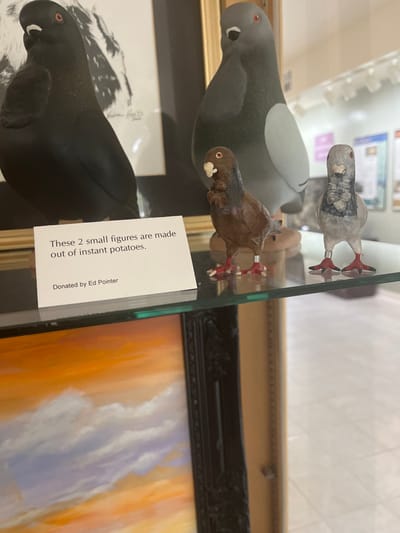
The image depicts an indoor museum display featuring various pigeon figures. In the foreground, on a clear glass shelf, are two small, hand-crafted pigeon figures: one brown on the left and one light gray on the right. Both small figures feature red feet and silver leg bands. A white rectangular sign on the glass shelf states, "These 2 small figures are made out of instant potatoes. Donated by Ed Pointer." Behind the glass shelf, two larger pigeon sculptures are visible: a solid black one on the left facing left, and a gray and white one on the right facing right. A framed black and white artwork is partially visible behind the black figure. Below the glass shelf, a portion of a framed painting, depicting a sky with orange and purple clouds, is visible. The background shows blurred elements consistent with a museum or gallery setting, including informational posters on walls. The scene is located at the American Racing Pigeon Union Hall of Fame Museum in Oklahoma City, Oklahoma, United States. No people are visible, and the scene is static.
Oklahoma City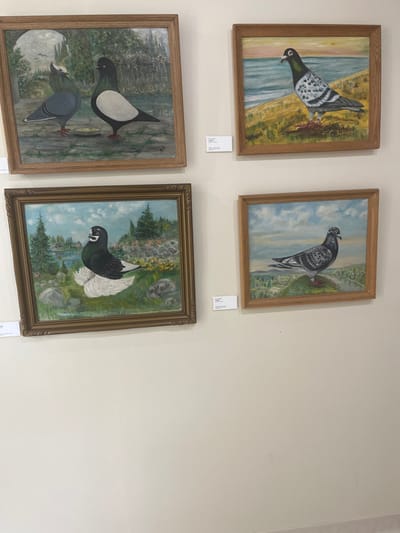
This image presents a static indoor scene within an art exhibition space, specifically located in Oklahoma City, United States; the exact address is unidentifiable from the visual data. Four framed paintings, each depicting one or more pigeons in a natural landscape, are mounted on a smooth, light cream-colored wall. The paintings are arranged in a 2x2 grid pattern. The top-left, top-right, and bottom-right paintings are enclosed in simple light brown wooden frames. The bottom-left painting is enclosed in a more ornate, gold-toned frame. Specific details of the depicted subjects in the paintings are as follows: 1. **Top-Left Painting:** Features two pigeons, one primarily grey and one black with a prominent white breast, standing on a grey stone path near a small, light-colored dish. Lush green foliage and a stone archway form the background. 2. **Top-Right Painting:** Depicts a single grey and white pigeon with a dark head, standing on a grassy, sandy bank overlooking a large body of blue water under a sky with orange and yellow hues. 3. **Bottom-Left Painting:** Shows a single black pigeon with a distinct white breast and fluffy white tail feathers, resting on green grass among rocks and sparse yellow flowers. Pine trees and a distant body of water are visible under a blue sky. 4. **Bottom-Right Painting:** Features a single grey and white pigeon standing on a verdant hill. A panoramic view of a valley with a winding river and scattered green trees extends into the background under a blue sky with white clouds. Three small, white, rectangular information plaques with black text are affixed to the wall: one positioned horizontally between the top two paintings, one vertically below the top-right painting, and one vertically to the right of the bottom-left painting. No individuals or active interactions are visible within the frame. The environment is well-lit, consistent with an indoor gallery setting.
Oklahoma City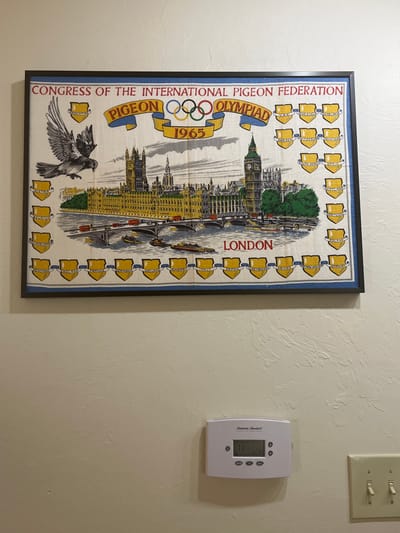
An indoor photograph captures a framed textile art piece, an American Standard thermostat, and a dual-toggle light switch plate mounted on a textured, light-colored wall. The framed art, positioned in the upper portion of the image, features an illustrated scene of London, including the Houses of Parliament, Big Ben, and the River Thames with bridges, red double-decker buses, and boats. A grey pigeon in flight is depicted on the left side of the artwork. Text within the art piece reads "CONGRESS OF THE INTERNATIONAL PIGEON FEDERATION," "PIGEON OLYMPIAD 1965," and "LONDON." The border of the artwork includes multiple yellow shield-shaped crests, each bearing the name of a country such as U.S.A., Sweden, Belgium, and England. Below the framed art, a white American Standard digital thermostat is mounted, displaying "71" as the temperature and "AUTO" for the mode. To the right of the thermostat, an off-white light switch plate with two toggle switches is visible. The wall surface is consistently textured. There are no individuals or discernible actions visible. The scene provides no identifying characteristics to specify a precise location within the city of Oklahoma City, United States.
Oklahoma City