Olomoda, Nigeria
30 memories from Olomoda, Nigeria
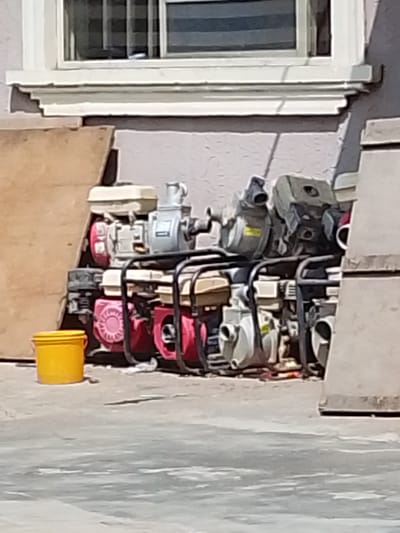
In Olomoda, Nigeria, a collection of portable water pumps is arranged outdoors against a light purple wall, partially obscured by a large piece of plywood. A bright yellow bucket sits on the concrete ground in the foreground to the left. The pumps are stacked in two visible rows, with metal frames supporting them. The upper row consists of at least three pumps, each with a silver engine and a light-colored tank, and some red components. The lower row features more pumps with similar engine and tank designs, predominantly showing red and pink color accents. Above the pumps, a section of a building is visible, featuring a white-trimmed window with dark blinds and a decorative white ledge. The overall scene suggests a storage area or an outdoor marketplace in Olomoda.
Olomoda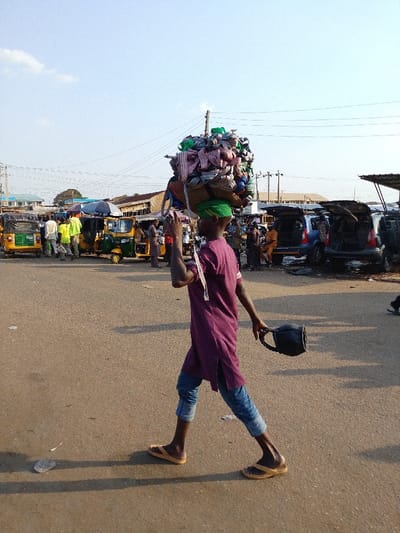
A man carries a large bundle of items on his head, walking across a paved area in what appears to be a bustling marketplace. He wears a green cap, a long purple shirt, and cuffed jeans, along with sandals. In his hand, he carries a black container with a handle. The background features auto-rickshaws, cars with open trunks, and people milling about, suggesting a busy scene. Overhead wires and light-colored buildings are also visible.
Olomoda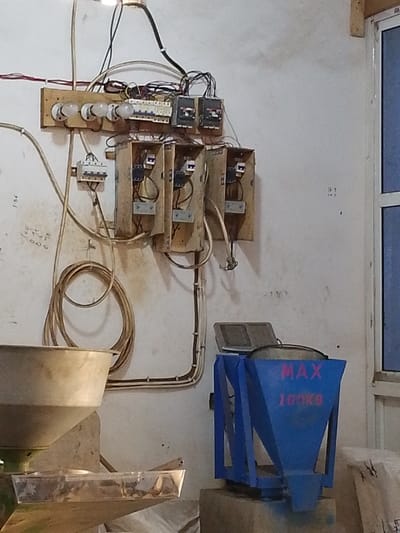
The image depicts an indoor industrial or workshop scene in Olomoda, Nigeria. A white wall serves as the background for various electrical and mechanical components. Mounted prominently on the upper wall is a complex electrical setup. A wooden board supports three exposed incandescent light bulbs with ceramic bases, a row of multiple circuit breakers, and additional electrical switches or relays. Numerous exposed electrical wires, some bundled and others running individually, connect these components. Below the wooden board, four open, rectangular electrical enclosures are visible, each containing internal electrical contactors or relays. To the left of these, a smaller, encased electrical switch is independently mounted. A neatly coiled section of electrical cable hangs vertically below the main electrical array. Handwritten numerical markings, such as "150", are visible on the wall to the left of the coiled cable. In the lower left quadrant, a large, light-colored metal funnel, likely part of a processing machine, is visible. Beneath its spout, a transparent tray contains granular material. In the lower right, a blue industrial hopper or feeder machine, marked with "MAX 100KG" in red lettering, sits on a concrete base. This machine incorporates a digital display unit on its upper surface. More handwritten numerical notations, including "16-1" and "16-3", are present on the white wall behind this machine. A portion of a window with a white frame and blue-tinted glass is visible along the right edge of the frame. No individuals are present in the scene, and no overt actions or interactions are occurring.
Olomoda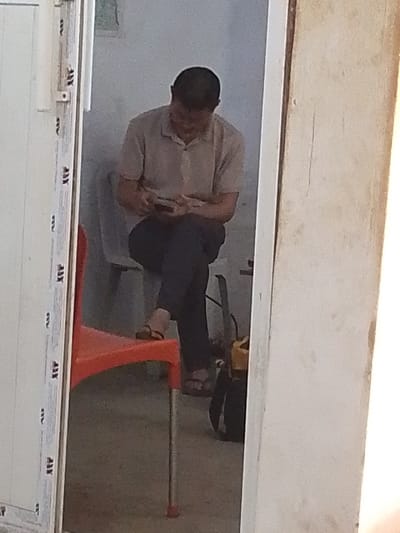
The image depicts an indoor scene in Olomoda, Nigeria, viewed through a doorway or opening. A single adult male, with short dark hair, is seated on a light-grey plastic chair, facing downwards. He wears a light-beige short-sleeved polo shirt, dark trousers, and dark open-toed sandals. His legs are crossed at the ankles, and he holds a dark-colored mobile phone in both hands, actively engaged with the device. The immediate foreground on the left shows a partial view of an unoccupied red plastic chair with a silver-colored leg. To the right of the seated individual, on the floor, is a black backpack or bag featuring a yellow strap or accent. The walls of the room are light-colored, possibly white or light grey, and a faint, blurry image or object is visible on the wall behind the seated person. The doorframe on the left is white PVC with repetitive "AW" or "AX" markings, while the doorframe or wall section on the right appears to be a lighter, off-white, slightly textured surface.
Olomoda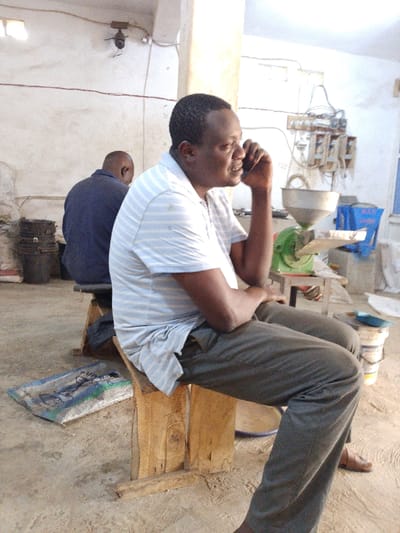
The scene is set indoors in Olomoda, Nigeria, within what appears to be a processing or workshop environment. Two adult males are present. In the foreground, a dark-skinned male, wearing a light blue and white striped short-sleeve polo shirt and dark gray trousers, sits on a rudimentary wooden bench. He is actively holding a dark-colored mobile phone to his right ear, engaged in a conversation. His left arm is bent, with his hand resting on his left thigh. He wears dark sandals. Behind him and slightly to the left, a second dark-skinned male, bald and wearing a dark blue short-sleeve shirt, sits facing away from the camera on a similar wooden bench. The background consists of light-colored, possibly off-white, walls displaying visible wear and exposed electrical wiring. Multiple white electrical boxes and switches are mounted on the wall in the mid-ground. To the right, a green and silver machine, identifiable as a grinder or mill with a funnel-shaped hopper, rests on a small wooden table. A blue plastic container is positioned behind this machine, and a white bucket with a handle is on the floor nearby. On the left side of the image, several black buckets are stacked, and white sacks are partially visible. The floor is made of concrete, and a blue and white woven mat or bag lies on it near the foreground male's feet.
Olomoda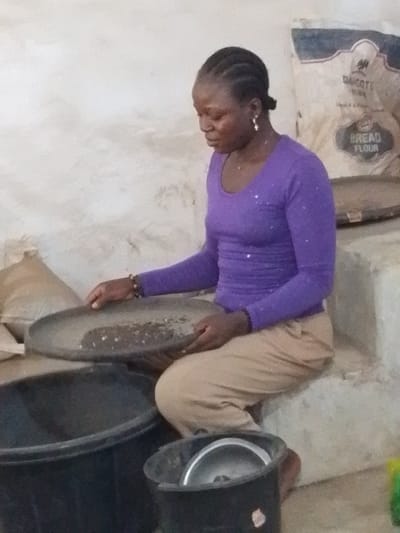
An adult female is depicted seated on a concrete ledge in an indoor setting in Olomoda, Nigeria. She has dark skin, braided hair, and wears a purple long-sleeved shirt and light brown trousers. She holds a dark, flat winnowing pan with both hands, containing a mixture of light granular material and dark specks, indicative of a sifting process. A large black plastic bucket is positioned below the pan to the left, and a smaller black bucket containing a metallic lid or bowl is to the right. In the background, a large sack marked 'DANGOTE BREAD FLOUR' rests against a rough, light-colored wall, alongside a smaller, lighter-colored sack.
Olomoda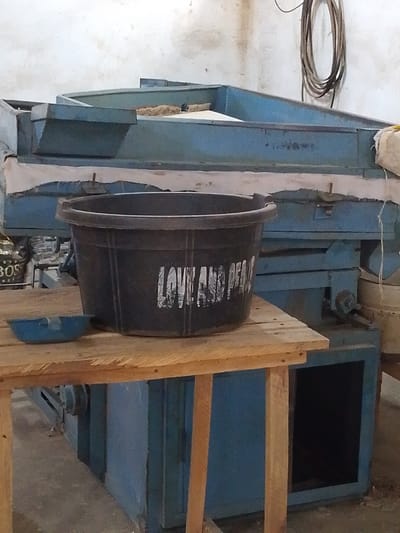
The scene depicts an industrial indoor environment in Olomoda, Nigeria, featuring a large, blue processing machine dominating the background. This multi-level machine has chutes and appears to handle a fibrous, light brown material on its upper surface. A light-colored fabric or tarp is draped across the front of the machine. In the midground, a simple wooden table with visible plank construction holds a large, dark plastic bucket bearing the white inscription "LOVE AND PEACE" on its side. To the left of the bucket on the table, a small, light blue, shallow bowl is present. The background wall is light-colored with some discoloration, and coiled cables or hoses hang from it in the upper right. A partial view of a bag with "BOS" text is visible behind the table to the left. No individuals are present, and no actions or interactions are depicted. The floor is a concrete surface.
Olomoda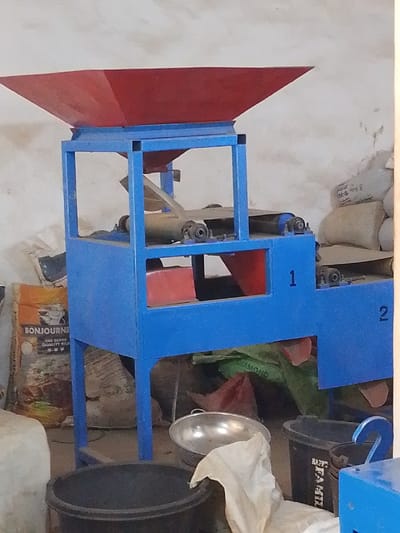
The scene portrays an indoor facility in Olomoda, Nigeria, dominated by a functional-looking industrial processing machine. The machine is constructed with a blue metal frame, supporting a large, red, inverted pyramidal hopper at its uppermost section. Below the hopper, the machine's body integrates various mechanisms, including visible conveyor belts, rollers, and internal red chute components, indicative of a material handling or processing function. The blue frame is sequentially marked with the numbers "1" and "2" on its lower right side. The machine is positioned against a light-colored, textured wall, likely concrete or plaster, showing minor surface imperfections. The floor, partially visible, appears to be a light, possibly concrete, surface. Numerous sacks and containers are arranged around the machine. To the immediate left, an orange-brown sack with "BONJOURNE" and "FINE SUPER QUALITY RICE" printed on it is visible. Behind and to the right of the machine, several large, off-white or beige sacks, presumably filled with bulk material, are stacked. A green sack marked "DIAMOND" and a red sack are also present on the floor. In the foreground, multiple black plastic buckets or bins are visible, one of which partially displays "HAPPY FAMIL." A reflective metal bowl, possibly aluminum, rests on the floor, partly obscured by a crumpled white cloth. A white container, possibly plastic, is partially visible on the far left. No individuals are present within the frame, and no actions or interactions are depicted in the static environment.
Olomoda
A woman wearing a purple long-sleeved shirt and khaki pants is sitting on a low concrete step indoors. She is barefoot and sifting something in a large, shallow metal pan. Underneath the pan is a large black bucket. Next to her is another black bucket with a lid. A woman wearing a dark shirt and purple pants is sitting next to her on a wooden stool. Bags of flour are stacked on the concrete step behind the woman doing the sifting. The setting appears to be a small, simple room.
Olomoda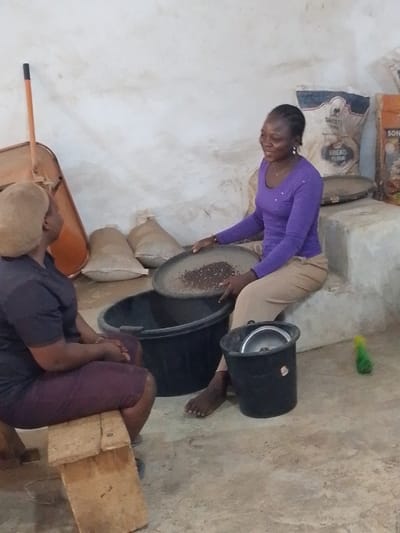
In Olomoda, Nigeria, an indoor scene depicts two women engaged in a processing activity. The woman on the right, wearing a purple long-sleeved top and light brown trousers, sits barefoot on a low concrete ledge. She holds a large, flat, circular metal sieve containing dark granular material over a black plastic tub on the floor. Her expression is a smile directed towards the woman on the left. The woman on the left, wearing a dark short-sleeved top and a dark maroon skirt, is seated on a wooden bench, facing the first woman. Her head is covered with a light brown wrap. Between them, on the floor, is the black plastic tub, and a smaller black bucket containing a metal bowl is near the first woman's feet. The background consists of a plain, light-colored wall. Against the wall, a wheelbarrow is visible on the left, several burlap sacks are on the floor, and two large white sacks labeled "DAGOTE BREAD FLOUR" and another with "BOM" are stacked on the right. A green plastic bottle lies on the floor to the far right. The concrete floor shows minor scuffs and marks.
Olomoda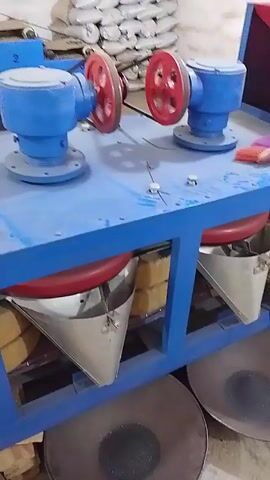
The video shows a machine with rotating blue and red components on a blue frame. Underneath are two metal funnels feeding into two circular pans containing a dark material. The machine appears to be processing something, possibly separating or mixing materials. The environment looks like a workshop or industrial setting, with a concrete floor.
Olomoda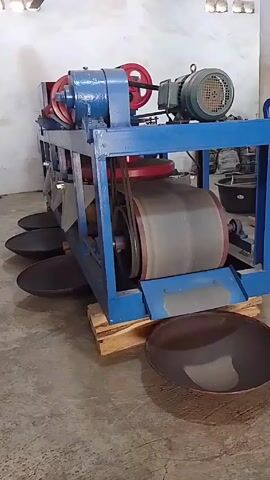
The video shows a stationary machine, primarily blue in color, with a large gray roller that spins. The machine is sitting on a wooden pallet on a concrete floor. A motor is visible on top of the machine. Several dark, round pans are placed around the base of the machine. The background shows a white wall and additional equipment.
Olomoda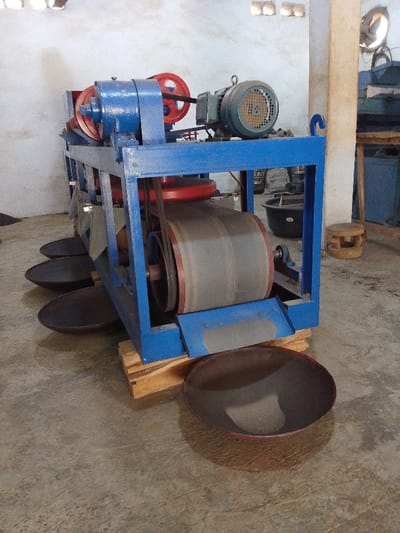
The image depicts an indoor industrial setting within Olomoda, Nigeria, featuring a large, blue-painted processing machine. The machine, constructed with a square-tube metal frame, is equipped with multiple red pulleys, black drive belts, and large, dark grey cylindrical rollers. An electric motor, with a green casing and a protective grille, is mounted atop the frame, connected via a belt to the primary drive mechanism. The machine's base rests on several stacked wooden planks or pallets. Positioned on the concrete floor directly beneath the machine's lower sections are at least five dark, shallow, circular metal pans or trays, likely intended to collect processed material. The background reveals light-colored walls, with three rectangular openings high on the left wall and a vertical support column on the right. Other background elements include a small, light-colored wooden stool, a dark tub or container, and indistinct objects further back. No individuals are present in the scene, and the machine appears to be stationary. The floor is a dusty, light grey concrete.
Olomoda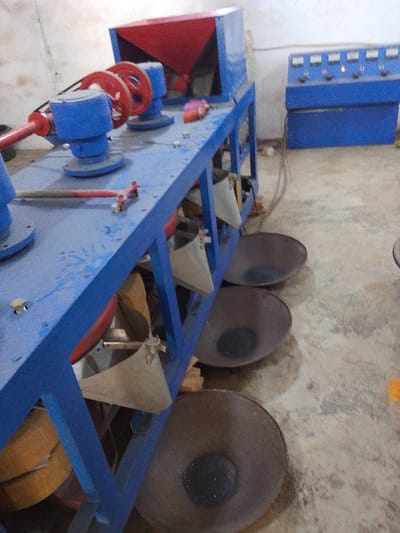
This forensic image details an industrial processing facility in Olomoda, Nigeria. The central subject is a long, blue-framed machine. Its upper structure incorporates a red hopper, multiple red pulleys, and associated blue cylindrical bearing housings. A red-handled tool rests on the machine's frame. Below the machine's operational surface, six light-colored fabric chutes descend into corresponding dark, shallow, circular collection pans on the concrete floor. Each pan contains a conical accumulation of dark granular material. In the background, a blue control panel unit is mounted on a raised platform, featuring five visible gauges and knobs; one indicator illuminates with a faint yellow light. The environment consists of light-colored walls and a stained concrete floor. No personnel are present.
Olomoda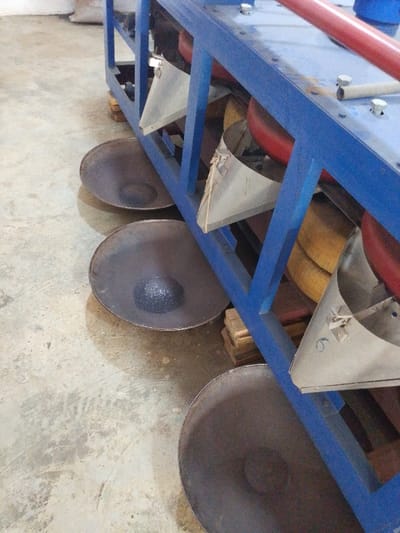
The image displays an industrial processing scene located in Olomoda, Nigeria. A prominent blue metal framework, consistent with heavy machinery, occupies the right and central portions of the frame. This structure is positioned on a light-colored concrete floor, with stacked wooden blocks visible beneath it, possibly for support or leveling. Below the blue framework, three dark, shallow, circular metal pans are arranged in a diagonal line on the floor. The middle pan contains a small, distinct conical pile of dark, granular or crystalline material. The other two visible pans are empty. Attached to the blue framework are multiple inverted, silver-colored conical or pyramidal funnels, designed to direct material downward. One of these funnels features a faint numeral "6" inscribed near its base. Behind these funnels and integrated within the blue framework, several large, red, cylindrical objects are partially visible, alongside coiled sections of yellow or brown material, possibly hoses or belts. The concrete floor exhibits scuff marks and minor discoloration, indicating an active industrial environment. In the blurry background, an indistinct white sack is partially visible. No individuals are present in the depicted scene.
Olomoda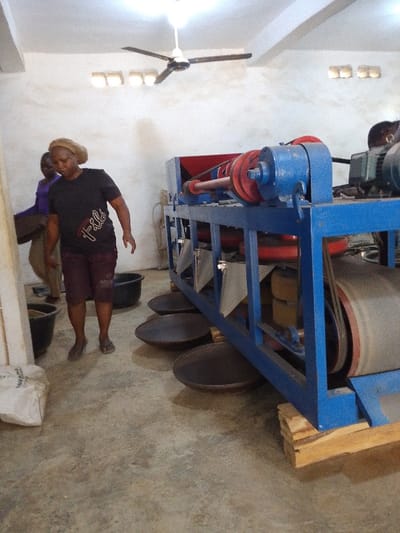
The image depicts an indoor industrial workspace in Olomoda, Nigeria, containing a large processing machine and three individuals. The room features a concrete floor, light-colored walls with some discoloration, and a white ceiling from which a black three-bladed ceiling fan and a bright light fixture are suspended. Two small rectangular openings are visible high on the far wall. Dominating the mid-ground is a robust industrial machine, primarily constructed with a blue metal frame, featuring red pulleys, black belts, and a red hopper on its top left. A conveyor belt is visible on the right side of the machine. The machine rests on wooden planks, elevating it from the floor. Beneath the machine, arranged on the floor, are five dark, shallow, circular metal pans, seemingly positioned to collect output. An engine or motor assembly is visible on the upper right side of the machine, suggesting mechanical operation. To the left of the machine, two dark plastic buckets or basins are on the floor. A white sack, partially visible on the far left, bears some obscured English text. Three individuals are present. In the center-left foreground, a person wearing a light-colored head covering, a dark t-shirt with "Fila" written in white, dark shorts, and light-colored flip-flops, walks towards the right, looking downwards. Their left arm is bent, and the right arm is slightly extended. Partially obscured behind this individual, another person, wearing a purple shirt and light-colored trousers, appears to be carrying a dark, flat object. A third individual is partially visible on the far right, positioned behind the machine, with only their head and upper torso discernible, suggesting engagement with the machinery.
Olomoda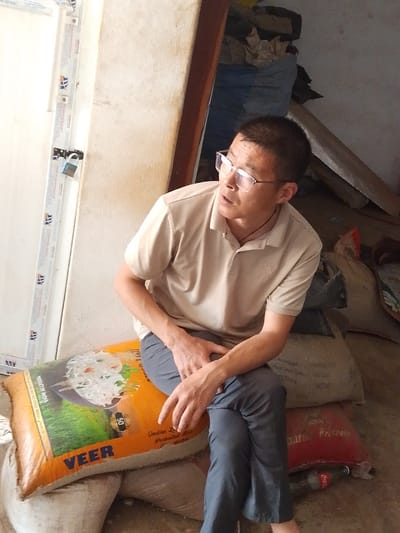
This image depicts a male individual seated indoors in Olomoda, Nigeria. The man, with short dark hair and wearing clear-framed glasses, a light tan polo shirt, and dark grey trousers, is positioned in the lower center, looking towards the upper right. His hands are resting on his lap. He is seated on a stack of sacks; the uppermost visible sack is orange, branded "VEER Indian Long Grain Parboiled Rice Product of India", and displays an image of cooked rice. To the immediate left of the man is a white door frame with a visible blue padlock secured to it. The background and right side of the frame reveal a dimly lit storage area containing numerous stacked sacks of varying colors (light-colored, blue, and red), along with a discarded plastic bottle visible on a concrete floor. The environment suggests a storeroom or a retail space for bulk goods.
Olomoda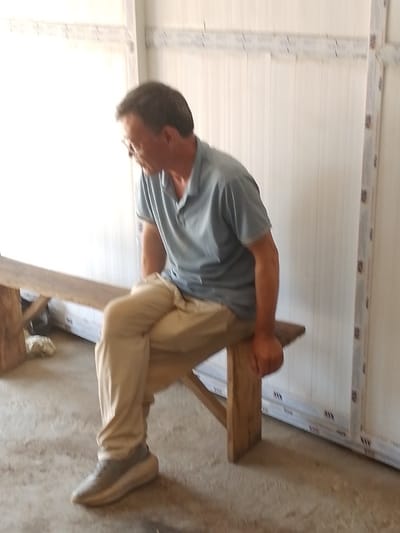
A middle-aged male is seated on a rustic wooden bench indoors in Olomoda, Nigeria. He wears a light blue short-sleeved polo shirt, khaki trousers, light-colored sneakers, and glasses. The man leans slightly forward, looking downwards and to his left, with his left leg crossed over his right. His right hand rests on his right knee. The background consists of a light-colored, vertically paneled wall with white framing elements, some featuring "WW" markings. The floor is concrete.
Olomoda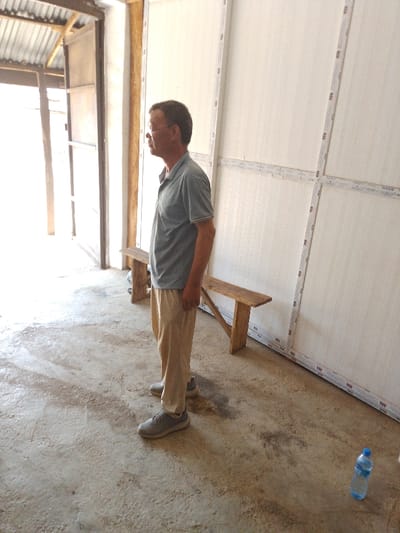
In Olomoda, Nigeria, an adult male stands in profile, facing left, within an interior space. He is wearing a light blue-grey short-sleeved polo shirt, light beige trousers, and grey athletic shoes. He has short dark hair and wears glasses. His hands are positioned at his sides. The floor is rough concrete with visible dirt and irregular dark stains. To the right, a wall is composed of multiple light-colored panels framed by white strips, creating a grid pattern. Two simple wooden benches with angled supports are placed against this panelled wall behind the man. To the left, a brightly lit open doorway or passageway reveals an exterior view, including a corrugated metal roof section and wooden structural elements. A blue plastic water bottle with a white cap is visible on the concrete floor in the lower right foreground. No direct actions or interactions are depicted.
Olomoda
An adult male, appearing to be of East Asian descent, is seated on a stack of sacks within what appears to be an indoor or semi-enclosed, utilitarian space. He wears a light beige polo shirt, dark trousers, and green flip-flops, with clear-framed glasses. His arms are folded, and he is looking towards the right side of the frame. He sits on a light-colored sack, with an orange sack marked "VEER" partially visible beneath his legs. To his right, a pile of assorted sacks includes a grey sack and a red sack displaying the word "Brothers"; a plastic Coca-Cola bottle is visible partially obscured beneath the red sack. To his left, a plastic water bottle with a blue cap rests on the concrete floor. The background on the left features a brightly illuminated white wall or partition with white vertical framing, and a wooden bench is positioned further left. A brown structural pillar is visible on the right, with various objects, possibly metal poles, leaning against it. Faint handwritten text "Accepted" is visible on a surface in the upper right quadrant of the image. The specific location within Olomoda, Nigeria, cannot be determined from the visual evidence presented.
Olomoda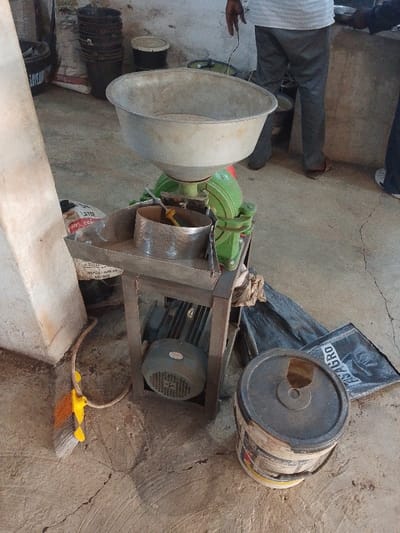
This image depicts an indoor scene in Olomoda, Nigeria, featuring a grain or feed grinding machine as the central subject. The machine comprises a large, silver-colored conical hopper atop a green-painted main body, which connects to a metal framework supporting an electric motor at its base. A perforated metal sieve component is visible on a flat tray section of the machine, with a yellow-handled tool resting inside it. Two individuals are partially visible in the background, primarily from the waist down. One person, on the left, wears dark trousers and sandals, with their right arm and hand extended over the grinding machine. Another person, on the right, wears dark trousers and white shoes. They are standing behind the machine, observing the process or awaiting operation. The environment consists of a light-colored concrete floor with visible cracks and stains. A concrete pillar or support structure is positioned on the left side of the frame. In the background, against a light-colored wall, multiple dark-colored buckets are stacked, and a white bucket with a lid is also present. Adjacent to the grinding machine, a large white bag with red lettering, indicating "50kg" and "LAYER FEED 20%", is partially visible. On the floor to the right, a black woven sack labeled "FISAGRO" is spread out. Further right, a white bucket with a multi-colored label, topped with a dark lid featuring a large irregular opening, stands on the floor. A broom with a yellow handle and brown bristles leans against the concrete pillar on the left, connected by a beige electrical cord that runs towards the machine. The scene suggests an active processing or manufacturing area.
Olomoda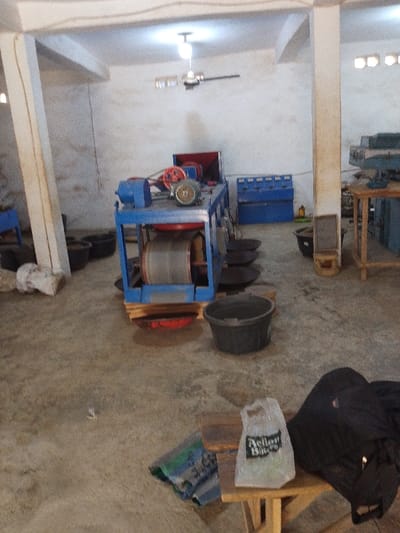
The image depicts the interior of an industrial workshop or processing facility located in Olomoda, Nigeria. The concrete floor is visible, and the walls are light-colored. Exposed concrete pillars support the ceiling, where a single incandescent bulb illuminates a ceiling fan. The central subject is a blue industrial machine, likely a trommel or processing unit, positioned on wooden pallets. It features a red input hopper at the top, a blue electric motor, a grey/silver electric motor with red pulleys and drive belts, and a large cylindrical mesh drum. Below the drum, a red collection pan is situated on the floor. Around the central machine, several dark-colored plastic buckets are present, some appearing to contain material. To the right of the machine, approximately five dark, shallow, circular pans are arranged on the floor. In the background, a blue multi-compartment cabinet is visible. Further right, a wooden workbench or table holds additional equipment. In the foreground, a small wooden stool supports a white plastic shopping bag with the "Action Bitters" logo and a folded black jacket. A green and blue mat or tarp lies on the floor near the stool. Near a left-side pillar, a white sack rests on the floor. No individuals are present in the scene, and no active processes are underway.
Olomoda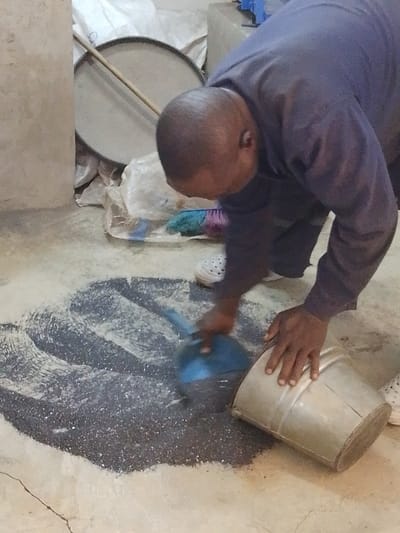
In an indoor setting within Olomoda, Nigeria, a dark-skinned adult male is depicted actively scooping a dark, granular material from a cracked concrete floor. The man, with a close-cropped haircut, wears a dark blue long-sleeved shirt, dark pants, and white slip-on shoes. He is bent forward, using a blue plastic scoop held in his left hand to gather the material. His right hand rests on the rim of an overturned, silver-colored metal bucket, positioned to collect the scooped contents. The dark granular material, intermixed with lighter dust, is spread in an irregular pattern on the floor. In the background, against a light-colored wall or pillar, are white sacks, a large circular flat metal object with a wooden handle leaning against it, and a multi-colored brush on the floor.
Olomoda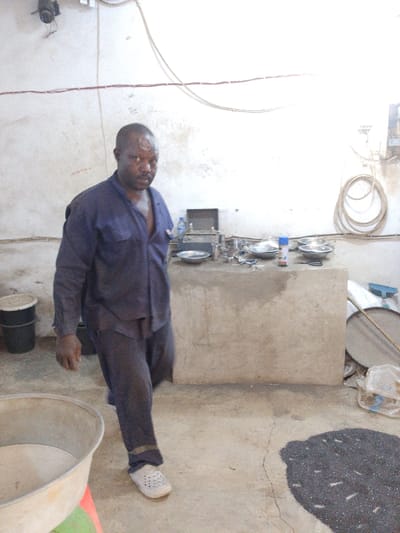
An interior scene in Olomoda, Nigeria, depicts a workspace or processing facility. A dark-skinned adult male, wearing a blue long-sleeved shirt and matching trousers with white crocs, walks towards the viewer from the center-left, maintaining eye contact with the camera. His shirt is partially unbuttoned. The environment features light-colored, possibly concrete, walls with exposed electrical conduits and wires running horizontally. In the upper left, a wall-mounted light fixture or fan is visible. To the left foreground, a large, light-colored metal basin rests on a red and green support. Behind the man, to his left, two black buckets are stacked. On the right side of the image, a concrete block structure or bench serves as a workstation. Upon it are several silver metallic bowls, a clear plastic water bottle, a blue spray can, and what appears to be a compact scale or analytical device along with various small tools and components. Behind the bench, a coiled off-white hose or cable hangs on the wall, near exposed electrical components. The concrete floor shows a dark, granular material, possibly seeds or charcoal, spilled in a irregular pile on the right side. Nearby, a large circular sieve or screen with a wooden handle, a plastic bag containing unidentified items, and a blue-handled tool are present. The overall lighting suggests an indoor setting, likely from overhead fixtures.
Olomoda
The image depicts a bustling street scene in Olomoda, Nigeria, under a bright, hazy sky. In the foreground, a partial view of a person wearing a plaid shirt is visible on the left. Centered in the mid-ground is a dark-skinned woman, facing right with her mouth slightly ajar. She wears a light purple headwrap, a matching embroidered long-sleeved shawl, and a long purple skirt, complemented by white, elongated, oval-shaped earrings. Behind the woman, a dark blue sedan and a black sedan are visible on the reddish-brown unpaved or dirt street. Further down the street, a dark blue minivan, possibly a Mazda Premacy, is parked with its hood open, and a satellite dish is mounted on its roof; a person in a dark brown/khaki outfit attends to its rear. Another vehicle with an open hood is partially visible on the far right. A row of single to two-story commercial buildings forms the background, featuring various shop signs including "OLAS" and "Nume," with merchandise displayed behind glass. Overhead power lines and a utility pole traverse the upper frame. A vehicle's side-view mirror occupies the bottom right corner, reflecting indistinct features.
Olomoda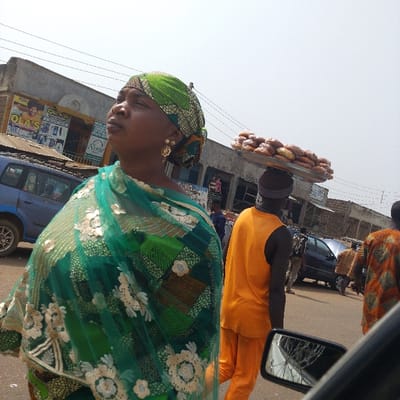
The image depicts a vibrant street scene in Olomoda, Nigeria, under a bright, clear sky. In the left foreground, a woman with dark skin is shown from the chest up, looking slightly upward and to the right. She wears a green patterned headwrap and a green patterned garment, layered with a sheer green fabric adorned with white floral embroidery. Gold-colored hoop earrings are visible on her ears. To her left, the front portion of a blue car is parked. In the midground, a man with dark skin walks away from the camera, balancing a large, round silver tray piled with numerous light brown baked goods on his head. He is dressed in an orange tank top and matching orange trousers, with a dark band around his head. Other individuals are partially visible further down the street, including one on the far right wearing an orange and brown patterned garment. The background features a street lined with single to two-story buildings, some with corrugated metal roofs and visible signage, including "OLAS" and a partial "Nimi" sign. Overhead electrical wires are strung across the scene. Vehicles are present on the street, suggesting an active commercial area.
Olomoda
The image depicts an urban street scene in Olomoda, Nigeria. In the foreground, a woman faces forward, wearing a broad, light-colored woven straw hat over a white hijab and a dark, patterned garment. A silver-colored pendant hangs from her neck. She holds a black plastic bucket in her left hand, which contains multiple bottled beverages with colorful caps (red, green, yellow, blue) and some with dark liquid. A sticker with text and a man's portrait is affixed to the bucket. Her right hand, partially visible, holds folded currency. In the mid-ground to the left, a man in a brown jacket and dark trousers stands with both hands on his head, positioned near a parked blue van and the front wheel of a motorcycle. The background features several multi-story concrete buildings, some with visible shopfronts and merchandise. A yellow and red sign bearing the text "OLA'S" is visible on one building. To the right, a blue car is parked, and an additional figure is partially visible further back. The ground appears to be a paved road, and the sky is overcast or brightly lit.
Olomoda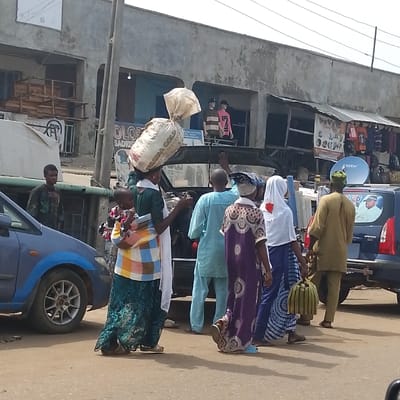
The image captures a bustling street scene in Olomoda, Nigeria, under bright daylight with visible shadows. In the foreground, a woman in a green top and a long patterned skirt walks from right to left, carrying two large white sacks on her head and a child strapped to her back with a colorful fabric carrier. Ahead of her, a group of five individuals, mostly with their backs to the viewer, are moving or standing. This group includes a man in a light blue tunic, a woman in a purple patterned dress, a woman in a white headscarf and blue patterned skirt carrying a green striped bag, and a man in a light brown tunic and green cap. On the far left, a man in a dark patterned shirt stands beside a partially visible blue sedan. Vehicles populate the street: a blue sedan on the left, a dark-colored vehicle centrally positioned behind the pedestrians, and a blue car on the far right displaying a "2026" sticker with a political portrait and a satellite dish mounted on its rear. The background features two-story concrete buildings, some with visible wear, housing various shops. Merchandise, including clothing displayed on mannequins and hangers, is visible in the storefronts. Overhead electrical wires and poles traverse the scene.
Olomoda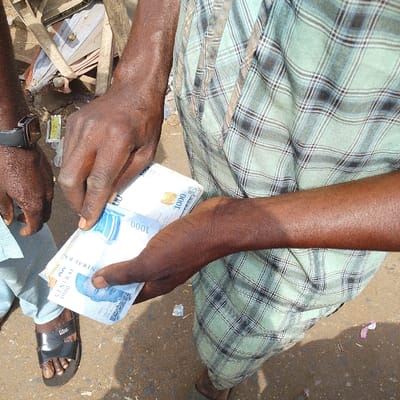
This image captures an outdoor scene in Olomoda, Nigeria, depicting a financial interaction between two individuals in daylight. The central figure, with dark skin, is prominently visible from the mid-torso downwards, wearing a light green and dark plaid patterned long-sleeved garment or wrapped fabric. Their hands are actively handling a stack of Nigerian 1000 Naira banknotes, indicating counting or an exchange. The banknotes clearly display "CENTRAL BANK" and the "1000" denomination. To the left, a second individual, also with dark skin, is partially visible. Their left arm, adorned with a black wristwatch, and their left foot, wearing a black flip-flop branded "Dior," are discernible. The ground beneath the individuals appears to be an unpaved or dirt surface, with scattered refuse, including crumpled papers and small pieces of debris. In the upper left background, indistinct discarded materials, possibly remnants of market stalls or construction debris, are present.
Olomoda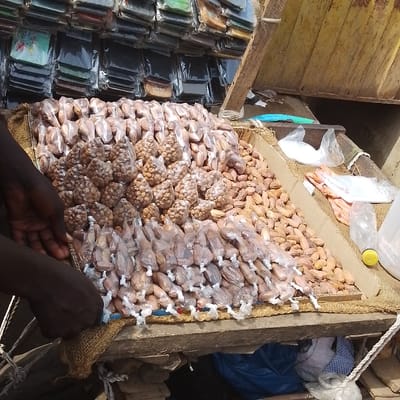
An elevated view captures a market stall in Olomoda, Nigeria, displaying various packaged goods. The primary subject is an inclined wooden surface, covered with burlap, laden with brown, nut-like items. A large quantity of these items are loose, forming a heap, while others are individually packaged in small, clear plastic bags tied with white string, arranged in orderly rows. A central pile consists of larger, irregularly shaped items, also clear-bagged. Two dark-skinned hands are visible on the left, positioned as if arranging the merchandise on the stall. To the right of the main display, a small pile of white granular substance is contained within a clear plastic bag, alongside a larger white plastic bag and an empty clear plastic water bottle with a yellow cap. Above these items, a bright blue object rests on a wooden support. The background features a vertical display wall, lined with numerous small, flat, rectangular items, individually sealed in clear plastic, resembling phone cases or wallets, stacked in rows. The stall structure consists of rough wooden planks. Beneath the main display, a blue plastic bag and other indeterminate objects are visible, resting on an uneven surface.
Olomoda