Ouderkerk aan de Amstel, Netherlands
30 memories from Ouderkerk aan de Amstel, Netherlands
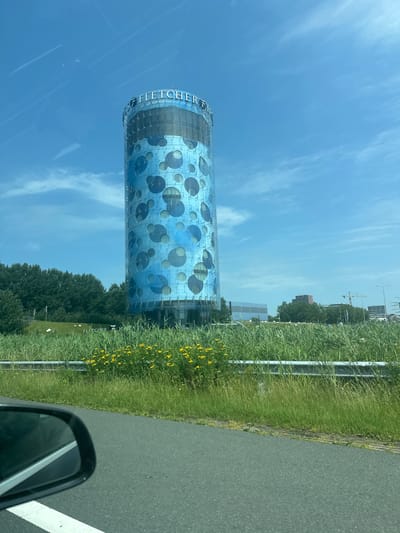
The image shows a cylindrical building with a blue facade featuring large circular patterns, located in Ouderkerk aan de Amstel, Netherlands. The building has "FLETCHER HOTELS" signage at the top. In the foreground, there is a road with a white line marking and a car's side mirror. A grassy embankment with yellow flowers separates the road from the building, and beyond the building, trees and other structures are visible under a blue sky with scattered clouds.
Ouderkerk aan de Amstel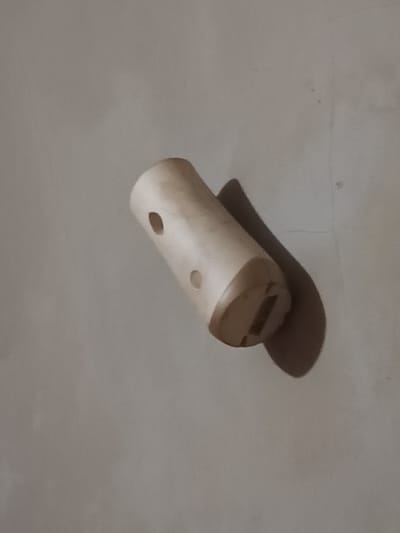
A small, cylindrical, light-brown wooden object sits diagonally against a mottled, pale-grey background. The object has two small, dark, circular holes on its side. One end has a darker-brown cap-like structure with a rectangular slot in its center. A distinct shadow of the object is cast on the background.
Ouderkerk aan de Amstel
A close-up, high-angle shot captures a tabby cat's head and upper body. The cat exhibits brown, black, and tan patterned fur. Its prominent, round eyes possess golden-amber irises with dilated pupils, reflecting a discernible light source. A pink nose and a dense array of long, white whiskers are visible below the eyes. The cat's gaze is directed forward, occupying the central focus of the image. The immediate background is blurred, showing a reddish-brown surface at the top and a light-colored, possibly tiled, floor beneath. The scene is located indoors in Ouderkerk aan de Amstel, Netherlands.
Ouderkerk aan de Amstel
A domestic short-haired tabby cat is depicted resting on a light-colored tiled floor within an indoor environment in Ouderkerk aan de Amstel, Netherlands. The cat displays a brown, grey, and black striped coat, prominent white whiskers, and amber eyes with vertically slit pupils. Its head is oriented to the left, gazing off-camera, while its front paws are curled beneath its body. The background consists of a dark reddish-brown wooden surface, showing discernible grain and shadowed areas, consistent with furniture or wall paneling. The scene is illuminated, highlighting the cat's left profile.
Ouderkerk aan de Amstel
A tabby cat is observed lying on a tiled floor in Ouderkerk aan de Amstel, Netherlands. The feline's back is presented towards the viewer, with its head turned to the left in profile. Its fur exhibits a pattern of dark grey and brown stripes, and its long, bushy tail extends directly rearward. The floor consists of light-colored square tiles with dark grout lines. A dark brown wooden surface is partially visible along the right edge of the frame. The area is illuminated by indoor lighting, casting a soft shadow of the cat to its right.
Ouderkerk aan de Amstel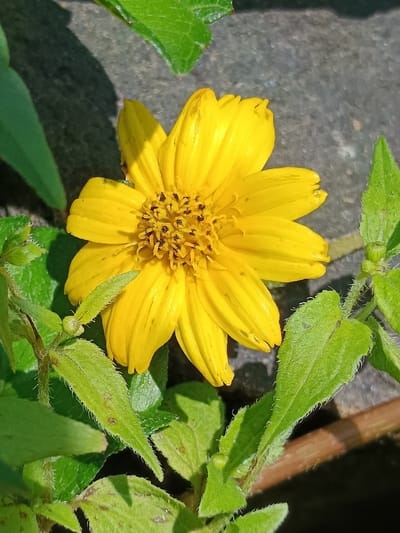
A single yellow flower, resembling a daisy or coreopsis, is centrally positioned. It features approximately ten bright yellow petals, some exhibiting minor imperfections or dark specks. The flower's center is composed of numerous small, dark brown or black disc florets. Surrounding the flower are several green leaves with serrated edges and visible hair-like structures, some appearing out of focus. The background is dark and indistinct, suggesting an outdoor setting with uneven ground or a wall. Direct sunlight illuminates the scene from the upper left, casting shadows beneath the leaves and on parts of the petals. No people, animals, or artificial objects are present. No specific actions or interactions are depicted. The precise location within Ouderkerk aan de Amstel, Netherlands, cannot be determined from the visual evidence in the image.
Ouderkerk aan de Amstel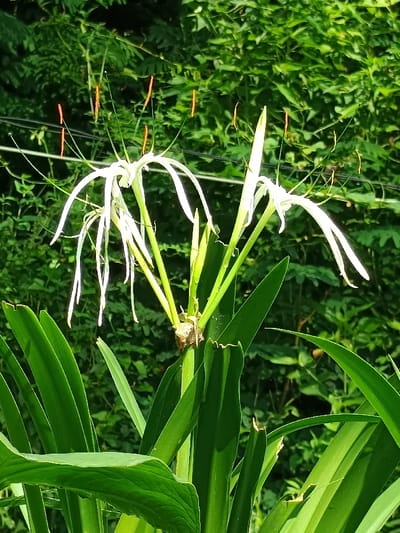
The scene, located in Ouderkerk aan de Amstel, Netherlands, displays a close-up of a plant featuring three prominent white flowers. These flowers, consistent with the Hymenocallis genus, exhibit multiple long, slender white perianth segments and extended green filaments topped with reddish-orange anthers. The flowers are supported by thick, vibrant green stems. Broad, elongated, dark green, strap-like leaves form the base of the plant, occupying the lower half of the frame. The background consists of a dense, out-of-focus expanse of various lighter green foliage. No human subjects, animals, or artificial objects are present. The environment appears natural and is illuminated by ambient daylight.
Ouderkerk aan de Amstel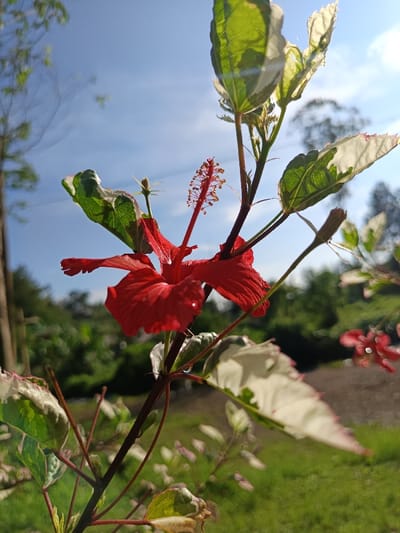
A vibrant red hibiscus flower, featuring five distinct petals and a prominent stamen column with yellow anthers, is in sharp focus, positioned slightly left of the frame's center. A single water droplet rests on a lower red petal. The flower is attached to a dark stem with multiple green leaves, some displaying white variegation along their margins. Smaller undeveloped leaves and buds are also visible on the stem. The scene is outdoors, brightly illuminated by direct sunlight from the upper right, which creates a lens flare. The background is shallowly focused, showing blurred green foliage, a patch of green grass, and a darker ground surface. A second, out-of-focus red flower is present in the lower right background. The upper portion of the image reveals a clear blue sky. No specific architectural or geographical landmarks are discernible to precisely identify a location within Ouderkerk aan de Amstel, Netherlands; the environment appears to be a garden or natural outdoor setting.
Ouderkerk aan de Amstel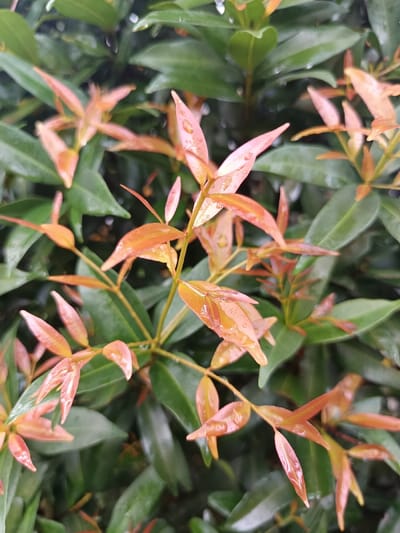
The image displays a close-up, vertical-orientation view of a plant featuring a dense arrangement of foliage. The foreground exhibits numerous developing leaves in shades of reddish-orange and peach, transitioning to a deeper green for the more mature leaves in the midground and background. Small, clear water droplets are visible on the surfaces of many leaves, particularly on the prominent reddish-orange ones, suggesting recent rainfall or dew. The leaves are ovate with slightly pointed tips. The background is softly blurred, showing a continuation of green foliage, indicating a shallow depth of field. No other subjects, individuals, or discernible man-made objects are present. This scene is located in Ouderkerk aan de Amstel, Netherlands.
Ouderkerk aan de Amstel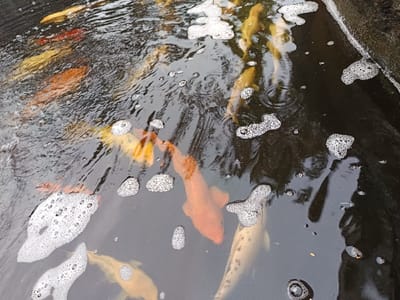
This image captures a top-down view of a pond in Ouderkerk aan de Amstel, Netherlands, populated by multiple koi fish. The water is dark and somewhat opaque, exhibiting numerous clusters of white foam and individual bubbles on its surface, along with distinct ripples. Approximately ten or more koi fish are visible beneath the water, varying in color; predominant hues include golden yellow, deep orange, and lighter, cream-colored individuals with dark spots. The fish are oriented in various directions, swimming or idling, with some contributing to the surface disturbances. A dark, non-reflective pond lining or edge is discernible along the upper right and lower right perimeter of the frame. No human figures or other significant objects are present.
Ouderkerk aan de Amstel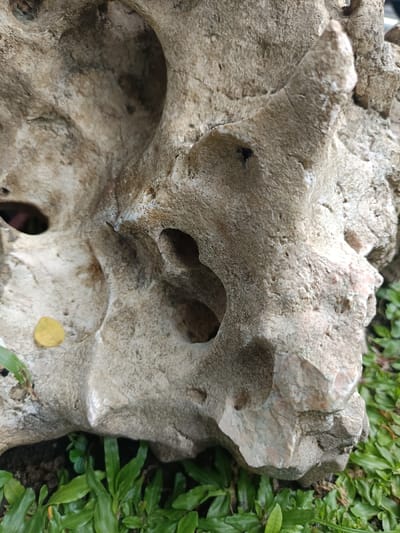
A close-up, detailed image captures a large, irregularly shaped, porous rock resting on a bed of green ground cover in Ouderkerk aan de Amstel, Netherlands. The rock exhibits a variegated coloration of beige, off-white, and light brown hues, with localized grey and subtle pinkish tones. Its surface is extensively weathered, characterized by a rough texture, numerous deep cavities, smaller holes, and sharp, jagged edges. Prominent features include a large, deep, amorphous cavity located in the upper-left quadrant and an elongated, narrower cavity situated in the mid-right. A single, small, yellow, ovate leaf is resting on a relatively flat surface of the rock in the lower-left. A minute dark speck is visible within a small crevice near the center-right. The rock's base is surrounded by a dense, vibrant green, low-growing grass or ground flora, with darker soil visible beneath the foliage in certain areas. Natural daylight illuminates the scene, casting subtle shadows that emphasize the rock's intricate texture and depth. No human subjects, animals, or artificial structures are present or engaged in any activity within the frame.
Ouderkerk aan de Amstel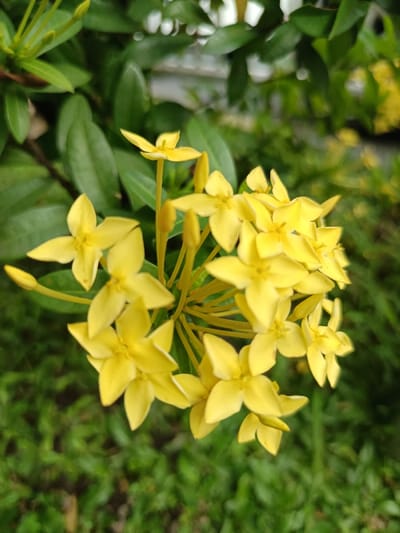
A close-up, high-angle view depicts a dense cluster of bright yellow flowers, likely from the *Ixora* genus, in various stages of bloom and bud. Each individual flower features four distinct, elongated petals. Several unopened yellow flower buds are also visible, interspersed among the fully open blossoms. The flowers are supported by slender, yellow-green stems. Behind and around the floral cluster, the plant's dark green, ovate leaves are clearly visible. The background is an indistinct, heavily blurred mosaic of green foliage and shadowed areas, typical of an outdoor garden or natural setting. There are no discernible architectural features, specific landmarks, or individuals present. The precise location within Ouderkerk aan de Amstel, Netherlands, cannot be determined from the visual information provided.
Ouderkerk aan de Amstel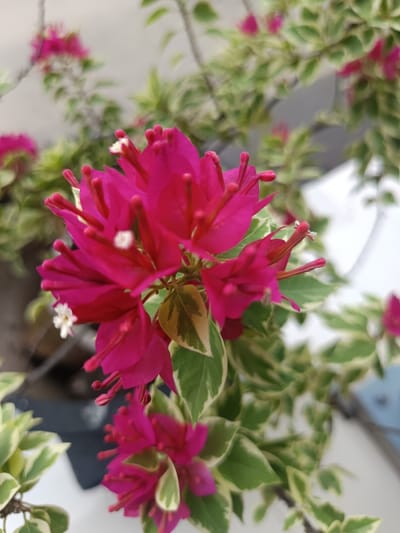
This image, captured in Ouderkerk aan de Amstel, Netherlands, presents a focused close-up of a blooming Bougainvillea plant. The primary subject is a dense cluster of vibrant fuchsia-pink bracts, with small, white, tubular true flowers emerging from their centers. Surrounding this central cluster are numerous variegated leaves, characterized by dark green centers and irregular creamy-white margins. Additional, less distinct clusters of fuchsia-pink bracts and variegated foliage are visible in the blurred foreground and background, indicating a larger plant structure. The background appears uniformly light-colored and out of focus. No human subjects or discernible artificial objects are present.
Ouderkerk aan de Amstel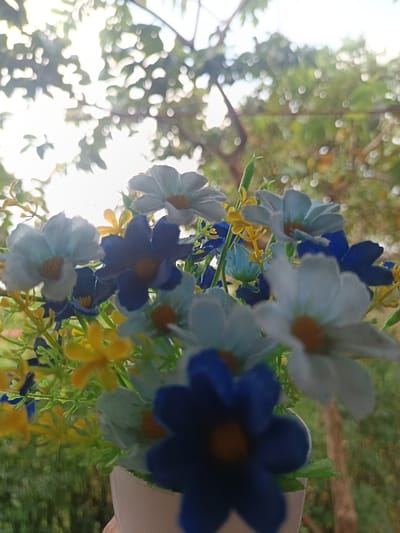
A close-up photograph, taken from a low angle, depicts an arrangement of artificial flowers held in a white container, set outdoors in Ouderkerk aan de Amstel, Netherlands. The bouquet features numerous small fabric flowers in white, light blue, dark blue, and yellow, each with an orange or yellow center. The white container is partially visible at the bottom center of the frame. The background is heavily blurred, displaying green foliage and tree branches, with bright natural sunlight filtering through, creating prominent bokeh effects. No identifiable individuals are present.
Ouderkerk aan de Amstel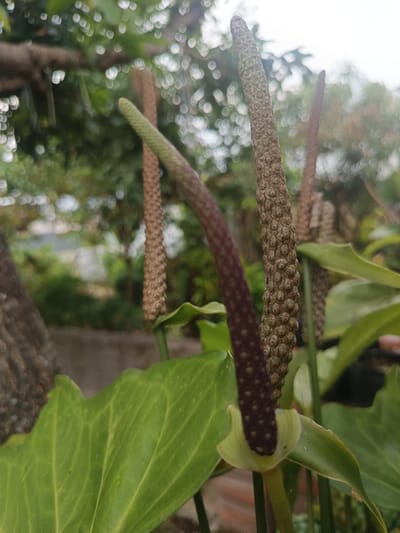
The image displays a close-up, upward-angled view of several Anthurium plant spadices and associated foliage in an outdoor environment. The foreground features a prominent, thick, cylindrical spadix on the right, brown in color with a highly textured, bumpy surface, consistent with developing fruit. To its left, a slender, curving spadix is visible, transitioning from a light green tip to a darker purplish-brown body with a finer texture. Both foreground spadices emerge from light green, cup-shaped spathes and are supported by visible green stems. Large, glossy green leaves with distinct veins are present in the lower left quadrant and partially visible behind the central spadix. The background is heavily blurred, displaying indistinct shapes of green foliage, tree trunks, and soft, circular bokeh highlights, indicating diffuse natural light. No individuals or animals are present. Actions and interactions are absent as the scene is static. The depicted environment is a garden or natural setting. Due to the lack of specific landmarks or contextual information within the image, the precise location within Ouderkerk aan de Amstel, Netherlands, cannot be determined.
Ouderkerk aan de Amstel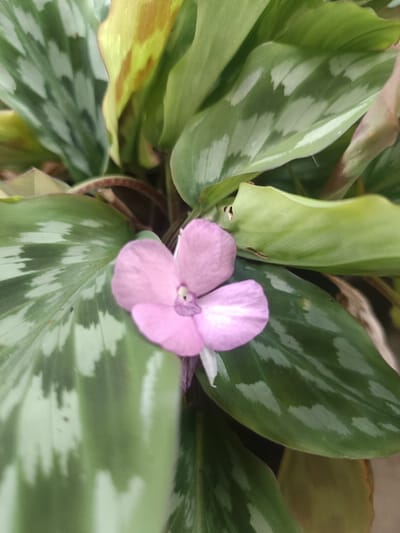
A close-up, top-down view depicts a plant with a single, four-petaled flower, pink to light purple in color, centrally located with a darker purple stigma. The flower is positioned slightly below the image's vertical center. Surrounding the blossom are multiple broad, ovate leaves characterized by a dark green base color and distinct lighter green or silvery-white variegation in a patterned formation. Some leaves exhibit minor browning or yellowing along their edges, and one leaf displays small holes. Dark reddish-brown leaf stems are partially visible at the base of the foliage. The background is composed of out-of-focus green leaves of the same plant. The scene is located in Ouderkerk aan de Amstel, Netherlands.
Ouderkerk aan de Amstel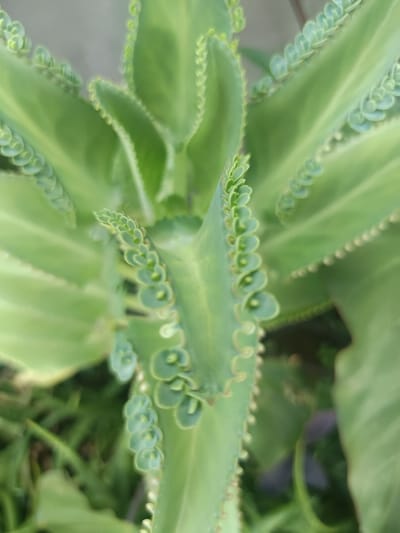
The image depicts a detailed, close-up, top-down view of a *Kalanchoe daigremontiana* plant, commonly known as Mother of Thousands, situated in Ouderkerk aan de Amstel, Netherlands. The plant features multiple prominent, light to medium green, thick, succulent leaves with distinctly scalloped margins. Along the edges of these leaves, numerous small, circular plantlets are visible, each exhibiting nascent root structures, characteristic of the plant's viviparous reproductive method. The central and upper portions of the plant, including several leaves and their plantlets, are sharply in focus. The background and lower periphery of the image are softly blurred, indicating a shallow depth of field. The lighting is diffuse, illuminating the plant evenly without harsh shadows, highlighting the texture and variations in green coloration across the foliage. No other subjects, human activity, or specific environmental structures are discernible within the frame beyond the plant itself.
Ouderkerk aan de Amstel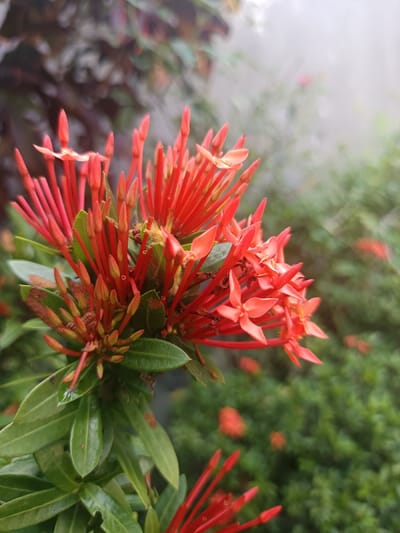
The image displays a close-up, shallow-depth-of-field photograph of vibrant red flowers and buds belonging to a flowering plant, likely an Ixora species. In the foreground, multiple clusters of bright red blossoms are visible. Individual flowers feature four petals arranged in a star pattern, with elongated tubular structures extending from their centers. Numerous unopened, pointed red buds are clustered among the open flowers, particularly prominent on the left and central areas. The plant exhibits dark green, ovate leaves with visible venation, some displaying minor brown discoloration or spots. The background is significantly blurred, showing indistinct masses of green foliage and hints of additional red floral shapes further in the distance. The upper-left background includes darker, possibly reddish-brown foliage. A diffused, bright area occupies the upper-right background, suggesting ambient light. No human subjects, animals, or specific man-made objects are discernible. The visual information within the image does not provide sufficient detail to ascertain the specific location of Ouderkerk aan de Amstel, Netherlands.
Ouderkerk aan de Amstel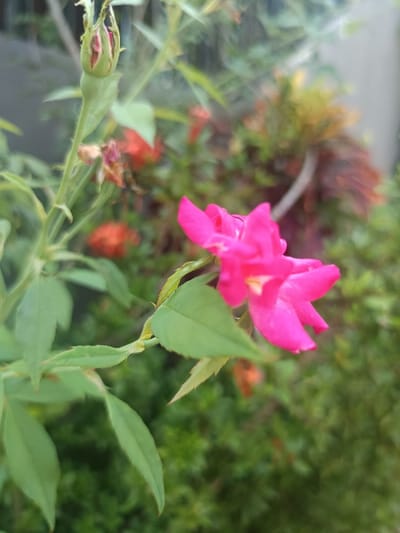
A close-up photograph depicts a single fuchsia-pink rose in partial bloom, positioned in the mid-right portion of the frame. The rose exhibits five visible petals and a lighter, possibly yellow-white, central pistil/stamen area. To the upper left, a tightly closed rosebud, primarily green with hints of red showing through, is attached to a separate stem. Both the blooming rose and the bud display green, serrated leaves along their stems. Some dried, reddish-brown foliage is present behind the rosebud. The background is significantly out of focus, rendering various green shrubs and indistinct reddish-orange floral elements as blurred shapes. A faint, light-colored vertical surface is observable in the upper-right background. No human figures or specific human activity are discernible. The scene is located in Ouderkerk aan de Amstel, Netherlands.
Ouderkerk aan de Amstel
The image displays a close-up, head-and-shoulders portrait of a single feline subject, identified as a cat, likely within an indoor setting. The cat possesses predominantly white or very light-colored fur that appears matted, unkempt, and possibly sparse around the face. Numerous dark specks, indicative of dirt, debris, or skin conditions, are visible on its fur, particularly around the ears, nose, and eyes. Both ears are pointed. The cat's eyes have yellowish-green irises; the left eye (viewer's right) is open, while the right eye (viewer's left) appears partially closed or squinted. Evidence of ocular discharge or crusting is present around both eyelids. Its nose is pinkish and also shows some dark discoloration. Long, white whiskers extend from both sides of its muzzle. The cat's expression is direct, appearing somewhat intense or unwell as it gazes toward the viewer. The background is extremely out of focus, showing indistinct light-colored shapes against a darker area, consistent with an interior environment. The lighting is frontal, highlighting the cat's face. The image provides no visual evidence to confirm its location within the city of Ouderkerk aan de Amstel, Netherlands.
Ouderkerk aan de Amstel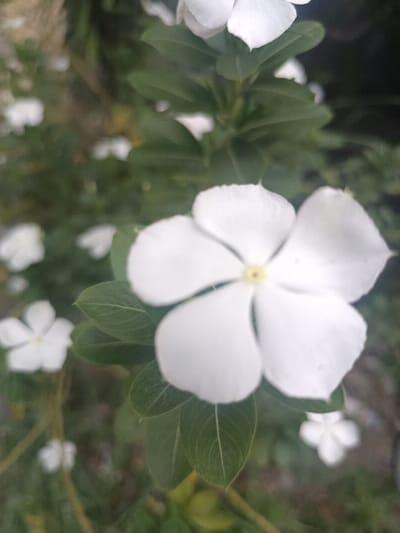
The scene depicts a close-up, shallow-depth-of-field photograph of flowering plants, reportedly located in Ouderkerk aan de Amstel, Netherlands. The primary subject is a single white flower, centrally positioned and in sharp focus. This flower possesses five distinct, ovate white petals symmetrically arranged around a small, bright yellow circular center. Surrounding the central bloom are multiple dark green, ovate leaves, some partially in focus. Numerous other white flowers and green foliage are visible in the blurred foreground and background, indicating a natural outdoor environment, likely a garden or shrubbery. No human subjects, artificial objects, or discernible actions or interactions are present. The lighting is diffuse and consistent with ambient natural daylight.
Ouderkerk aan de Amstel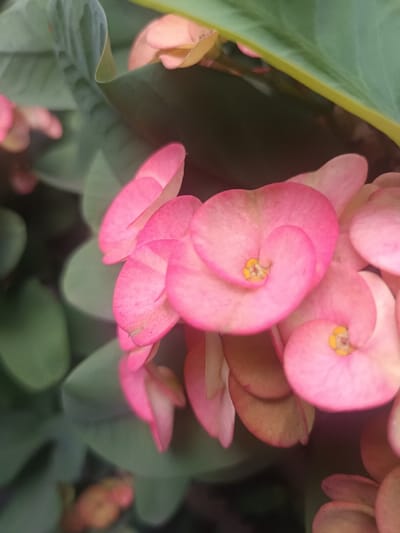
This image captures a close-up, high-angle view of multiple pink *Euphorbia milii* (Crown of Thorns) flowers, located in Ouderkerk aan de Amstel, Netherlands. The foreground and mid-ground are occupied by clusters of small, heart-shaped to roundish pink floral bracts. Some bracts exhibit a vibrant pink coloration, transitioning to a lighter pink or off-white hue towards their base. Several prominent bracts feature distinct, small, yellow reproductive structures centrally located within them. The background consists of dark green, ovate leaves, partially visible and in varying degrees of soft focus, indicating a natural plant environment. No human subjects, actions, or specific interactions are discernable within the frame. The scene is illuminated by diffused light.
Ouderkerk aan de Amstel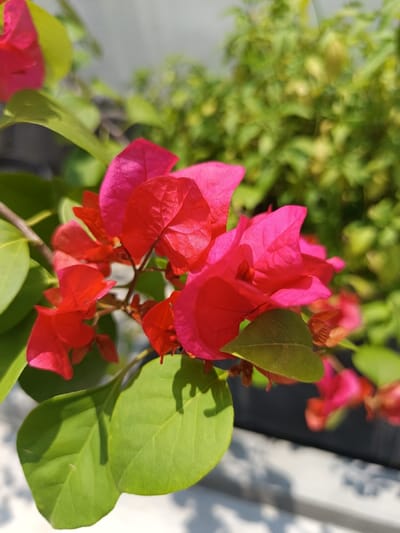
This image depicts a close-up of a Bougainvillea plant, located in Ouderkerk aan de Amstel, Netherlands. The central subject is a cluster of vibrant fuchsia-pink and reddish-pink bracts, some partially overlapping, exhibiting visible vein structures. These bracts are surrounded by several oval-shaped green leaves, which show variations in shade and texture. A prominent, well-defined green leaf occupies the lower left quadrant, casting a distinct shadow onto a lighter, textured surface below. Another large green leaf is visible in the upper left, partially obscured. The plant's stems are thin and reddish-brown, supporting the foliage and bracts. Strong, direct sunlight illuminates the scene from an unseen source, creating bright highlights on the bracts and leaves and casting sharp shadows. The background is an out-of-focus arrangement of lighter green foliage, suggesting additional plant life, and a blurred, dark horizontal element, likely the rim of a planter or container, positioned above a mottled gray and white surface. No people or animals are present.
Ouderkerk aan de Amstel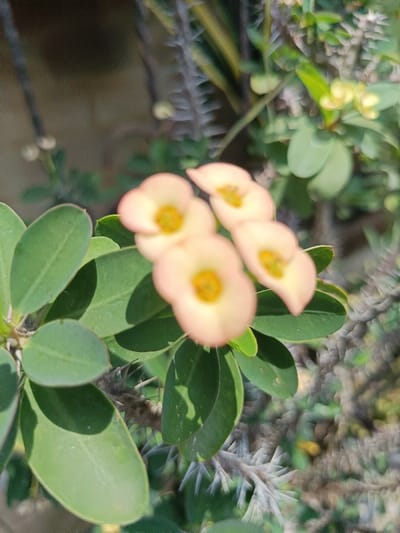
This image displays a close-up, top-down perspective of a flowering plant, specifically identified as a Crown of Thorns (*Euphorbia milii*), likely located outdoors in Ouderkerk aan de Amstel, Netherlands. The central subjects are four small, light peach to pale pink flowers, each possessing a distinct yellow center, arranged in a cluster towards the upper right of the frame. Below and surrounding these flowers are multiple oval-shaped, dark green leaves, some exhibiting shadows consistent with direct sunlight. The plant's stems are visible, characterized by numerous sharp, greyish-white thorns. The background is significantly blurred, featuring indistinct green foliage and a lighter, out-of-focus surface in the upper left portion of the image. No people, animals, or discernible man-made objects are present. The scene is illuminated by natural light.
Ouderkerk aan de Amstel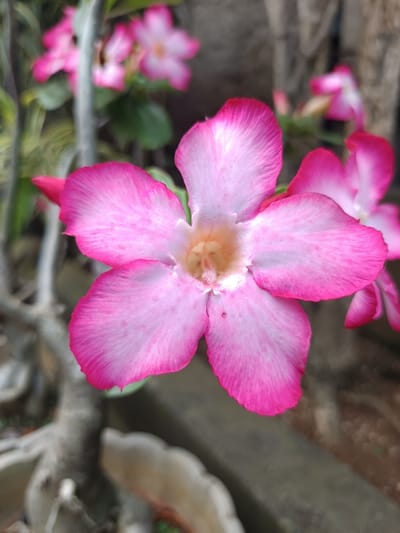
The image displays a close-up, shallow-depth-of-field photograph centered on a single Adenium obesum (desert rose) flower. This prominent flower features five petals, transitioning from vibrant fuchsia pink at their outer edges to a paler pink and white towards the central, slightly yellowed pistil and stamens. Minor dark specks are visible on some petals. In the blurred background, several other Adenium obesum flowers with similar pink hues are discernible, along with out-of-focus green foliage and gnarled, grayish-brown plant stems. The lower-left foreground shows a blurred portion of a light-colored, possibly scalloped, ceramic or plastic pot. A dark, textured, vertical surface, resembling wood or concrete, forms the background behind the flowers, particularly on the right side. Natural, diffused lighting illuminates the scene. No people, actions, or interactions are depicted. The specific location in Ouderkerk aan de Amstel, Netherlands, cannot be determined from the visual information provided within the image.
Ouderkerk aan de Amstel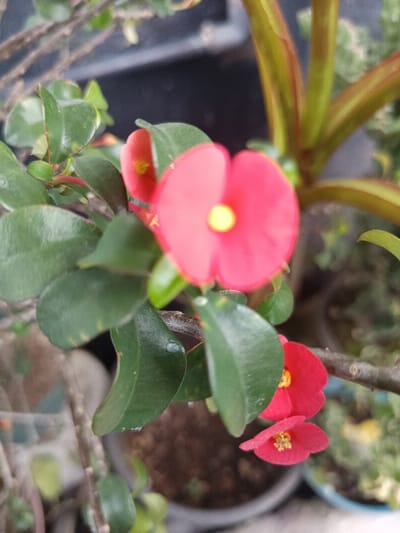
The image presents a close-up, high-angle view of a blooming plant identified as a Crown of Thorns (Euphorbia milii), situated in Ouderkerk aan de Amstel, Netherlands. The central focus is on several vibrant red to fuchsia-colored flowers, which are technically bracts, each featuring a distinct yellow center. One large flower is prominently positioned in the upper center, partially out of focus, while two smaller, sharper flowers appear below and to the right. Numerous elliptical, dark green leaves with visible vein patterns are distributed along the plant's branches. The stems are woody and brownish. The plant is potted in dark brown soil within a dark-colored container. The background is largely out of focus, revealing blurred outlines of other potted plants and containers, consistent with a garden or patio environment. Natural light illuminates the scene uniformly. No human figures or discernible interactions are present.
Ouderkerk aan de Amstel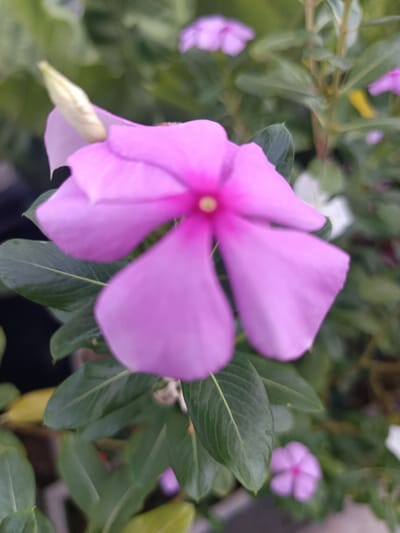
The image presents a close-up, vertical-orientation view of a single, vibrant purple-pink five-petaled flower, likely a Madagascar Periwinkle (Catharanthus roseus), in full bloom. The flower's center exhibits a darker, more vivid pink "eye" surrounding a small, yellowish reproductive structure. To the upper left of the main flower, a light green, un-opened flower bud is visible. The primary subject is sharply focused, demonstrating a shallow depth of field. Surrounding the prominent flower are multiple dark green, elliptical leaves with visible venation, some in focus and others blurred. The background consists of heavily blurred green foliage and several other out-of-focus purple-pink flowers, indicating a plant with multiple blooms. No human figures or discernible man-made objects are present. The scene is static, capturing the natural environment of the flora. The specified location is Ouderkerk aan de Amstel, Netherlands.
Ouderkerk aan de Amstel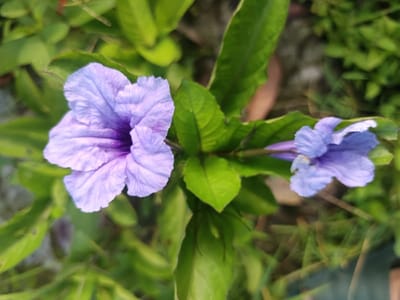
The image displays a close-up, overhead view of two Ruellia simplex (Mexican petunia) flowers amidst green foliage, observed in Ouderkerk aan de Amstel, Netherlands. The primary flower, located in the upper-left quadrant, is a trumpet-shaped bloom with five distinct, slightly undulating petals exhibiting a light lavender-purple coloration, transitioning to a deeper purple within its throat. To the right, a second, smaller Ruellia flower of similar appearance is partially visible, oriented horizontally and partially obscured by surrounding green leaves. The foliage consists of vibrant green, elongated leaves, some displaying natural variations. The background is a soft-focus blur of additional green vegetation and indistinct brown-earth tones. The scene is uniformly illuminated by natural light, producing no discernible shadows. No individuals, animals, or man-made objects are present in the frame.
Ouderkerk aan de Amstel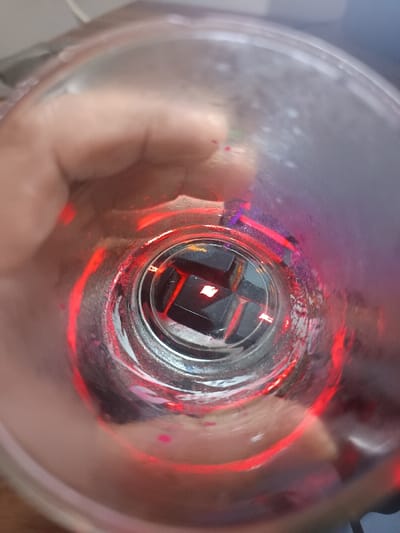
The image displays a top-down, interior view of a translucent, cylindrical container, likely a cup, held by a human hand. The container's inner surface exhibits dried residues of a red substance, with minor traces of purple or pink, and appears smudged. At the bottom of the container, several small, dark, cuboid objects are visible, consistent in appearance with mechanical keyboard switches. One of these switches is distinctly illuminated from within, emitting a bright reddish-orange light that strongly reflects off the interior walls of the container in radial streaks. A human hand, with light skin pigmentation, is visible on the exterior of the container, grasping it from the left side of the frame. The background external to the container is out of focus and non-descript, preventing specific environmental or geographic identification. The location in Ouderkerk aan de Amstel, Netherlands, cannot be determined from the visual evidence.
Ouderkerk aan de Amstel
The image displays a direct, top-down, interior view of a transparent, cylindrical vessel, likely made of glass or clear plastic. The vessel's interior surface exhibits multiple small, irregularly shaped pink-red smudges or residue particles, primarily visible on the left and right inner walls. The circular base of the vessel is visible at the bottom center, appearing light-colored and out of focus. The top portion of the frame shows blurred human fingers, suggesting a hand is holding or otherwise interacting with the vessel from above. The vessel appears largely empty. No specific details regarding the broader environment or a precise location within the city of Ouderkerk aan de Amstel, Netherlands, are discernible from this image.
Ouderkerk aan de Amstel