Pátzcuaro, Mexico
30 memories from Pátzcuaro, Mexico
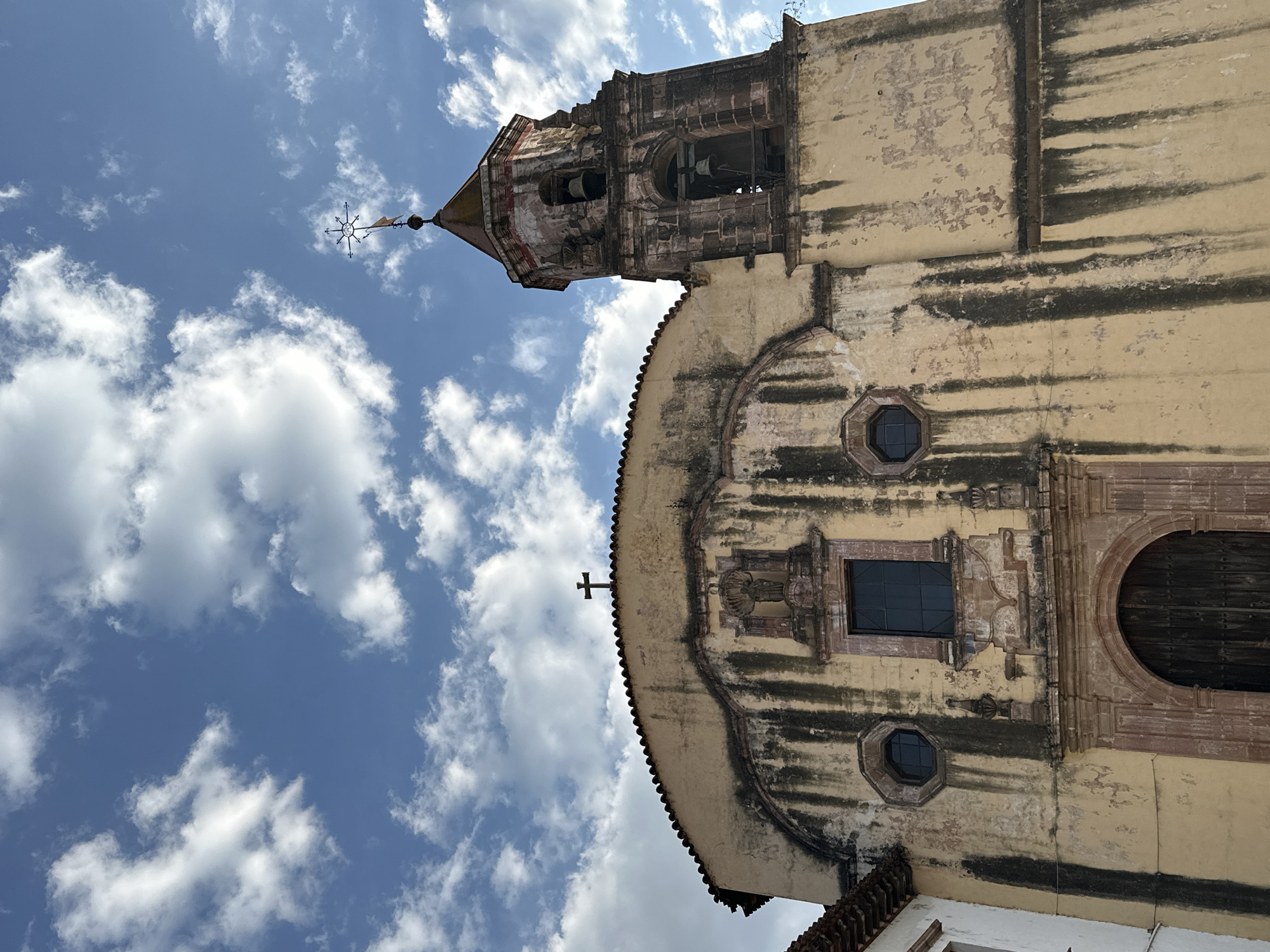
An upward-angled medium shot depicts the historic facade of a weathered, light-yellow church in Pátzcuaro, Mexico, against a backdrop of a partly cloudy, bright blue sky. The church's facade features an aged texture with noticeable wear, as evidenced by dark vertical streaks indicating water damage. Architectural details include an arched doorway on the lower right, rectangular and octagonal windows, and decorative carvings. A smaller cross is mounted above one of the windows. The top of the church culminates in a bell tower with openings to reveal visible bells inside, surmounted by a metal cross. White cumulus clouds fill the sky.
Pátzcuaro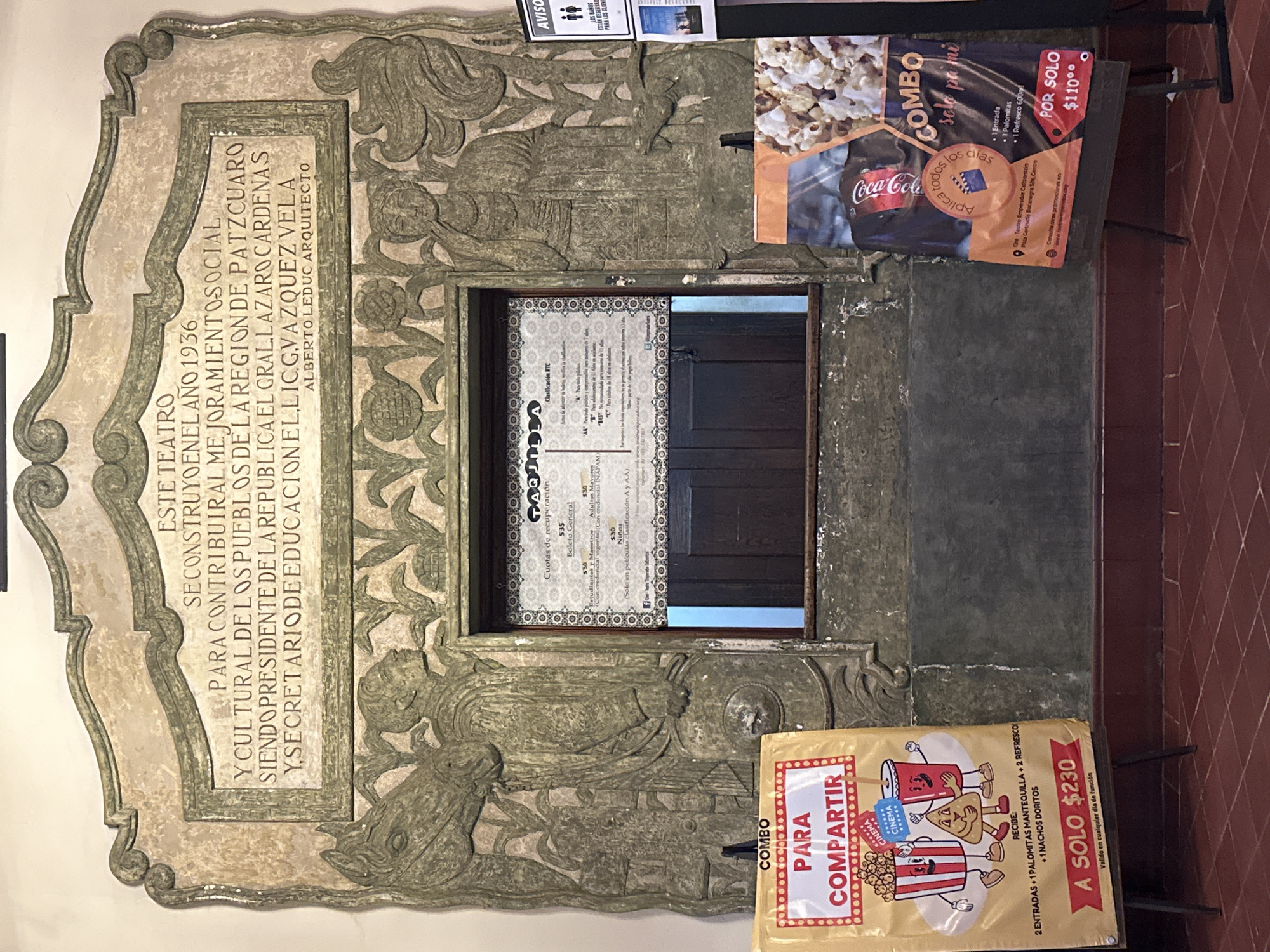
This image captures the entrance area of the Teatro Emperador Caltzontzin, located in Plaza Gertrudis Bocanegra S/N, Centro, Pátzcuaro, Mexico. The focal point is a large, elaborate sculpted stone edifice framing a closed ticket booth. The upper section of the stone structure features a carved plaque with Spanish text. It states that the theater was constructed in 1936 to contribute to the social and cultural improvement of the Pátzcuaro region, under President Lázaro Cárdenas and Secretary of Education Lic. G. Vázquez Vela, with Alberto Leduc as the architect. Below the plaque, two intricate stone relief carvings flank the rectangular ticket window. The carving on the left depicts a stylized male figure standing beside a horse's head and neck, holding a circular object, amidst foliage. The carving on the right shows a female figure with prominent headwear or hair, holding an item, with foliage and a serpentine or aquatic creature at her base. The ticket window itself is dark, featuring two closed wooden panels. Inside the frame above the window, a "TAQUILLA" (Ticket Office) sign is visible, detailing "Cuotas de recuperación" (Recovery fees) at $35 for general, students/seniors, and children, along with RTC film classifications. The floor is covered in reddish-brown terracotta tiles. Two advertising posters on black easels stand in the foreground. The yellow poster on the left advertises a "COMBO PARA COMPARTIR" (Combo to Share) for $230, illustrated with cartoon popcorn, soda, and nachos, listing two tickets, butter popcorn, two sodas, and Doritos nachos. The dark poster on the right promotes a "COMBO solo pa' mi" (Combo just for me) for $110, showing popcorn and a Coca-Cola logo, detailing one ticket, popcorn, and a 600ml soda. A partially visible white sign on the far right displays "AVISO" and restroom symbols. No individuals are present in the scene.
Pátzcuaro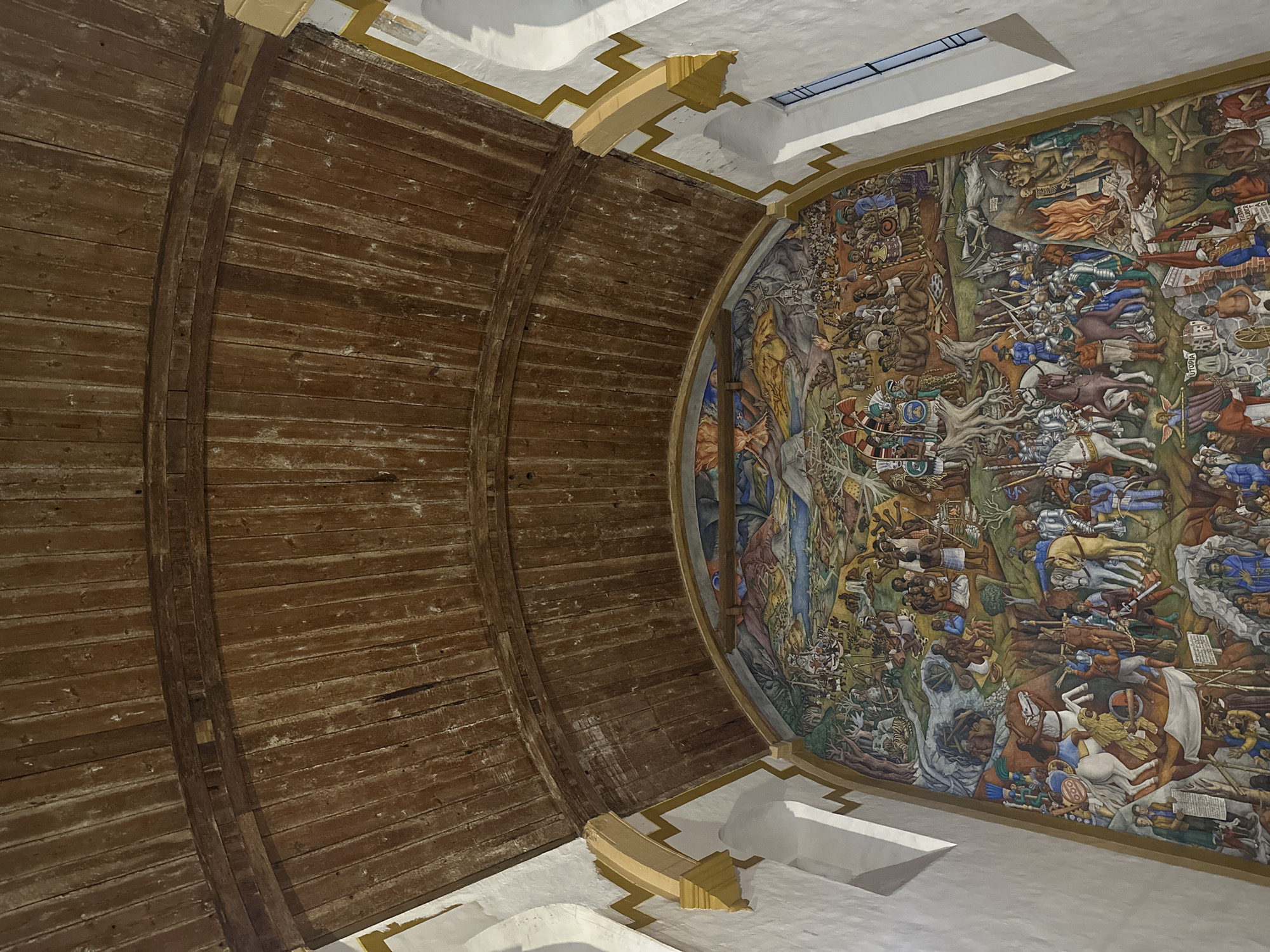
The image displays an interior view of the library within the Museo de Artes e Industrias Populares, located in Pátzcuaro, Michoacán, Mexico. The perspective is oriented upward, showcasing a prominent mural on an arched wall, surmounted by a distinctive wooden ceiling. The ceiling is a barrel vault constructed from numerous aged, dark brown wooden planks exhibiting visible grain and areas of lighter wear. A horizontal wooden support beam crosses the arch near its apex. Flanking the mural, the walls are finished in white stucco, featuring decorative yellow architectural trim with stepped, chevron-like patterns and curved supports. A tall, narrow, multi-pane window is visible on the right wall. The central feature is a large, colorful mural, identified as Juan O'Gorman's "The History of Michoacán." It spans the entire arched wall, depicting a complex historical narrative. The upper section portrays a landscape with blue water bodies, green terrain, and a fiery sky or volcanic eruption in the background. Indigenous figures are engaged in activities such as hunting, with a jaguar visible in the upper left. The mid-section of the mural is dominated by scenes of the Spanish Conquest. Armored Spanish conquistadors on horseback, wielding swords and lances, are depicted in conflict with indigenous Purépecha warriors. The indigenous figures wear feathered headdresses and carry round shields and spears. Acts of violence are illustrated, including falling figures and a scene in the lower right showing individuals on a pyre, accompanied by a skeletal figure symbolizing death. The lower section of the mural features various figures, including laborers, individuals in traditional dress, and a figure holding a book, likely representing historical or intellectual figures. A banner inscribed with "UTOPIA" is also present. The mural employs a rich color palette of greens, blues, reds, browns, and ochres. The scene is illuminated by a combination of interior lighting and natural light from the window on the right, casting subtle shadows on the adjacent white wall.
Pátzcuaro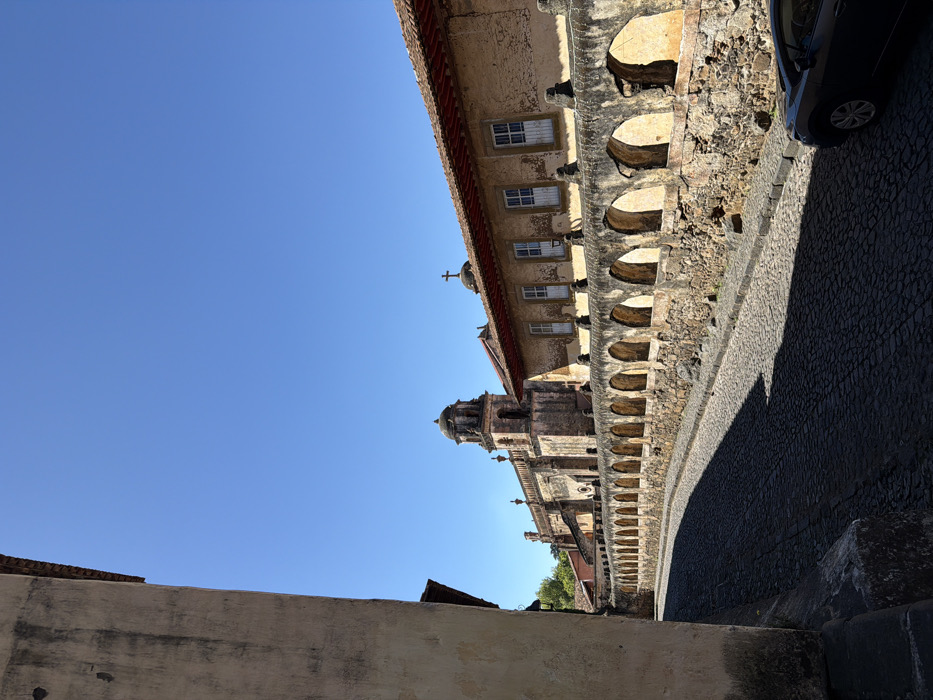
The image displays an outdoor scene dominated by historical architecture under a clear blue sky. The photo appears to be taken with a vertical orientation (portrait mode) but rotated 90 degrees counter-clockwise, making the sky appear on the left and the ground on the right. In the mid-ground and extending into the background, a long, multi-story building with a textured, light-colored facade (possibly stucco or aged stone) stretches horizontally across the frame. The upper part of this building features multiple small, rectangular windows with white frames. Below these windows, a series of arched openings or alcoves form a lower level or a retaining wall-like structure, also made of rough-hewn stone or aged material. The roofline of this building, visible at the top, has a reddish-brown tiled appearance. A small cross can be seen on one of the roof peaks towards the center of the image. Further in the background, behind the main building and slightly to the left, a more ornate structure with a domed tower or steeple is visible, suggesting a church or a similar grand edifice. This structure also appears to be made of stone and shows signs of age. In the foreground, on the right side of the image (which would be the bottom if correctly oriented), a dark-colored, possibly paved or cobbled street or pathway is present. A significant portion of this ground is covered in deep, elongated shadows, indicating a bright sunny day with the sun positioned to the left of the scene. Part of a dark-colored car, specifically its front bumper, wheel, and side, is visible parked on the street in the upper right corner of the frame. The sky, occupying the entire left half of the image, is a vibrant, cloudless blue. In the immediate foreground, at the very bottom left, a low, light-colored concrete or stone wall is partially visible, suggesting the viewpoint is slightly elevated or looking over another structure. The overall impression is one of a historic town or city, likely in a sunny climate, characterized by aged stone buildings and traditional architecture. No text is visible in the image.
Pátzcuaro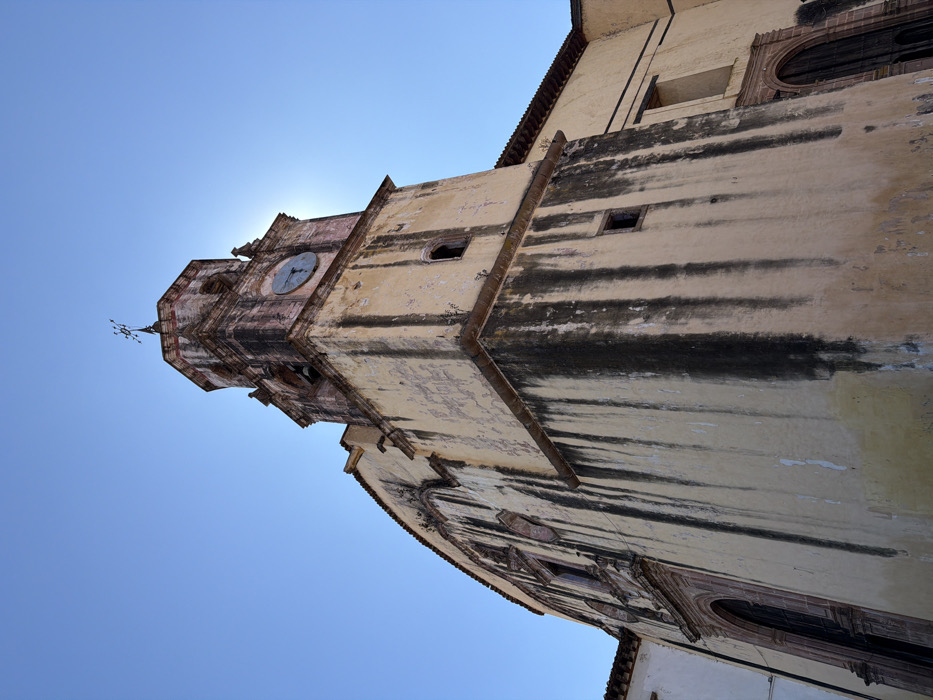
The image captures a low-angle perspective of an old, grand architectural structure, likely a church or a historical building, set against a vast, clear blue sky. The building appears to lean significantly towards the right, giving the composition a dynamic and somewhat tilted feel, suggesting the photo was taken while looking sharply upwards. The central feature is a prominent square tower, possibly a bell tower, topped with a small, ornate cross or weather vane. Below this, a circular clock face is visible on one side of the tower, though the exact time is not clearly discernible. The tower and the adjacent main body of the building are constructed from a light-colored material, possibly stucco or stone, which has aged considerably. Dark, irregular streaks and patches are prevalent across the surfaces, indicating significant weathering, dirt, or water damage accumulated over time. These dark stains run both horizontally and vertically, creating a textured and somewhat weathered appearance. The main building extends to the right of the tower, showcasing more of the light-colored walls and dark streaking. Portions of a terracotta-colored tiled roof are visible along the top edges of both the tower and the main structure. Several small, dark, rectangular or arched openings, possibly windows or vents, are scattered across the building's facade. On the far right, a larger arched window with dark bars or a grille can be seen, hinting at more elaborate architectural details further along the building. The sky is a vivid and uniform clear blue, occupying the upper and left portions of the frame. The sun is positioned directly behind the tower, creating a bright halo or lens flare effect that slightly obscures the very top edge of the tower but intensely illuminates the scene, highlighting the textures and colors of the building. This strong backlighting suggests a sunny day, likely mid-morning or afternoon. There are no people, vehicles, or discernible text visible in the image. The overall impression is one of ancient architecture standing majestically under a bright, open sky.
Pátzcuaro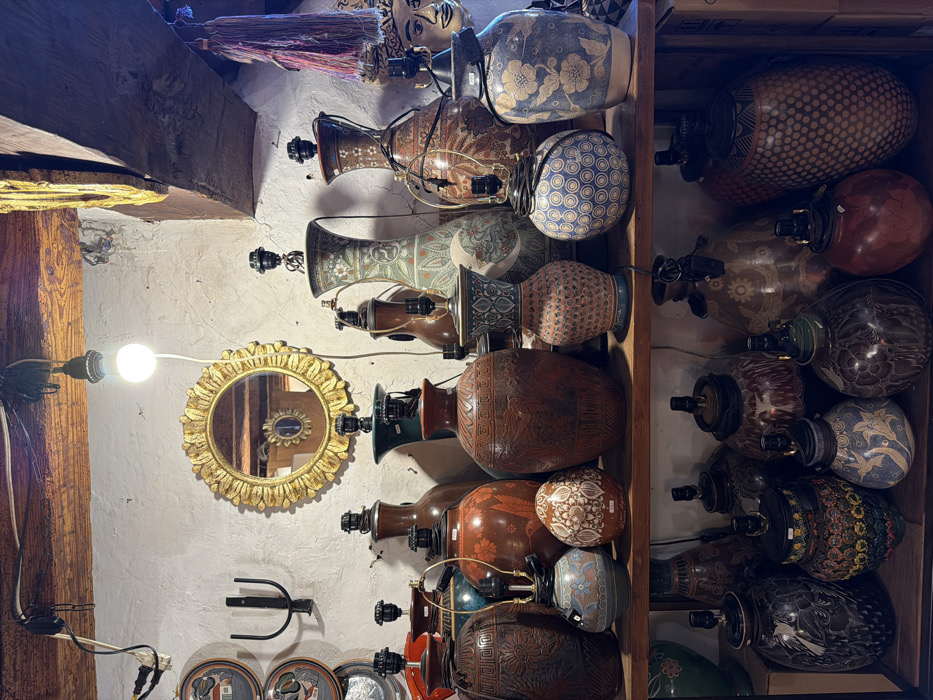
This image captures an indoor scene, likely a workshop, retail space, or storage area for decorative items, particularly lamp bases. The photo is oriented vertically, with what would normally be the left side of a room becoming the top, and the floor/shelving area becoming the right side. The primary focus of the image is a dense collection of ceramic or pottery lamp bases, displaying a remarkable variety of shapes, sizes, colors, and intricate patterns. These lamp bases are arranged in several rows along what appears to be a wall display on the left side of the frame (when viewed in correct orientation) and packed into a wooden shelving unit on the right side. On the left side of the image (which would be the upper wall and ceiling in a correctly oriented view), a bright, exposed incandescent light bulb hangs from a wire, providing direct illumination to the scene. Below it, a circular mirror with a ornate, golden, sunburst-like frame is mounted on the textured white wall. A reflection of another smaller mirror is visible within it. Further down this wall, a black metal decorative hook or sconce is attached. In the bottom left corner, several round pottery plates with painted designs are partially visible. The lamp bases themselves are diverse: * Some are tall and slender, reminiscent of traditional vases. * Others are more squat, globular, or cylindrical. * Colors range from blues, greens, browns, and reddish-orange hues to lighter cream and off-white tones. * The patterns include elaborate floral motifs, geometric designs (dots, concentric circles, diamond patterns, zigzags), textured surfaces, and sometimes abstract or organic shapes. * Each lamp base is fitted with a black electrical socket at its top, often with black wires trailing, indicating their function as lamp components. To the right side of the image (which would be lower or floor-level shelving), a wooden shelving unit is filled with more of these decorative lamp bases. They are closely packed, some standing upright, many lying on their sides, showcasing an even greater abundance of designs and textures. In the top left corner of the image (which would be the upper left wall/ceiling corner), several decorative items are visible: * A cluster of colorful fabric tassels or fringes in shades of red, pink, and purple hangs from a wooden beam. * Next to them, a stylized decorative mask or head, possibly made of wood or papier-mâché, with painted features, is also present. Exposed rough-hewn wooden beams traverse parts of the background, suggesting structural elements of the building. The walls are an off-white or light gray color with a visibly rough, textured finish, possibly stucco or plaster. The overall lighting is bright and direct from the visible bulb, creating some shadows and highlights on the numerous objects. No people or visible text are present in the image. The scene offers a rich visual catalog of artistic pottery and lamp designs, hinting at a place of craftsmanship or retail for unique home decor.
Pátzcuaro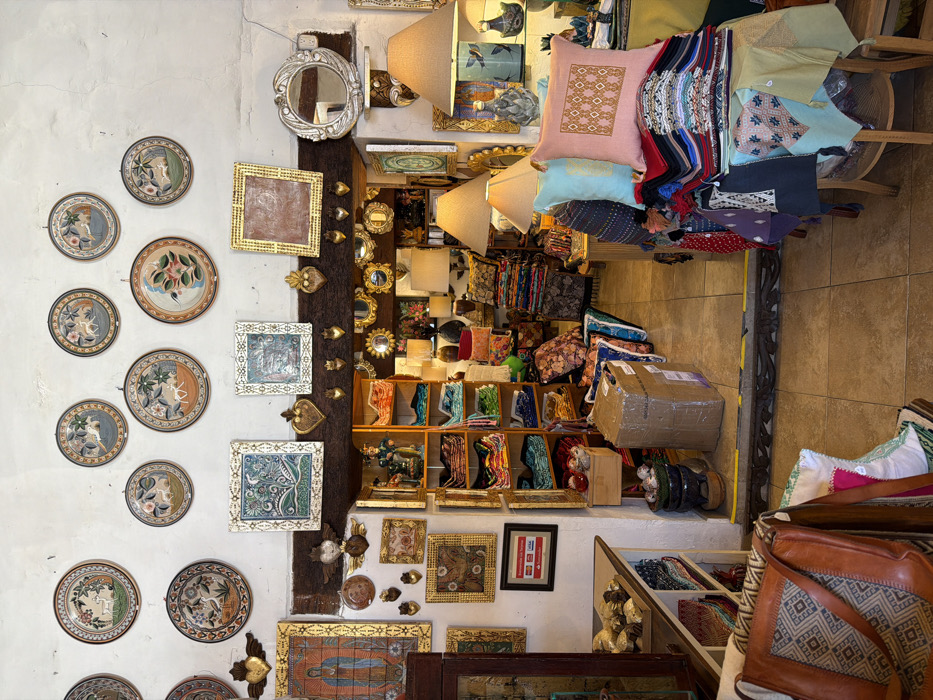
This image captures the interior of a richly decorated artisanal shop, filled with various handcrafted goods and home decor items. The perspective is slightly angled downwards, looking into a densely packed retail space. The image is vertically oriented (if viewed in its original state) but depicts a horizontal scene if rotated clockwise by 90 degrees, revealing a wall on the left, display shelves and tables in the center, and a tiled floor on the right. On the left side, a light-colored, possibly white or off-white, plastered wall serves as a backdrop for numerous decorative ceramic plates. These plates, predominantly round, are arranged in an informal grid pattern and feature intricate hand-painted designs, often depicting classical or mythological figures (like women's profiles), botanical motifs, and floral patterns in earthy tones with touches of blue, green, and orange. Some square and rectangular framed items, one a reddish-brown with a golden frame and others with blue and white intricate tile-like designs, are also hung on this wall. Near the top, a silver-colored, ornate mirror with a carved frame reflects a portion of the shop's interior. A prominent, thick dark wooden beam runs vertically down the wall, separating the plastered section from the main display area. This beam is adorned with several small, golden, heart-shaped decorative pieces, along with a larger, more elaborate heart-shaped carving. The central part of the shop is a vibrant display of merchandise. Two lamps with light-colored, bell-shaped fabric shades emit a warm glow, illuminating the diverse collection of goods. Shelves and tables are heavily laden with items. A stack of colorful cushions and pillows is visible, including a prominent pink pillow with a delicate golden geometric pattern and a light blue one underneath. Other pillows feature stripes, floral designs, and various patterns. Below the lamps and pillows, several wooden shelves hold an array of small sculptures or figurines. These appear to be elongated, stylized forms, possibly human or animal, rendered in various vibrant colors like teal, green, orange, and blue. Interspersed among these are numerous small, ornate, gold-framed mirrors of different shapes (round, oval, rectangular), adding a touch of antique charm. Other framed artworks, including one at the lower center depicting what appears to be a religious figure in blue and gold, are also displayed. A small green figurine, possibly a frog or monster, can be spotted on one of the shelves. Towards the mid-right, a brown cardboard box, sealed with tape, sits on a shelf or surface, somewhat out of place amidst the artistic goods. Below it, more shelves are filled with neatly folded textiles, fabrics, and possibly clothing items in a variety of patterns and colors. The right side of the image reveals a light brown or beige tiled floor. A wooden chair or small table, partly visible in the far right, is draped with colorful textiles and more pillows. In the bottom right corner, a large leather bag with an embroidered or woven patterned panel suggests that accessories are also sold here. A dark, intricately carved wooden element, possibly part of a doorway or large furniture, stands against the tiled floor. The overall impression is that of a cozy, slightly cluttered, but well-curated shop specializing in handcrafted goods, home decor, and possibly fashion accessories, with a rich, inviting atmosphere created by the warm lighting and abundance of unique items. No discernible text is clearly visible in the image.
Pátzcuaro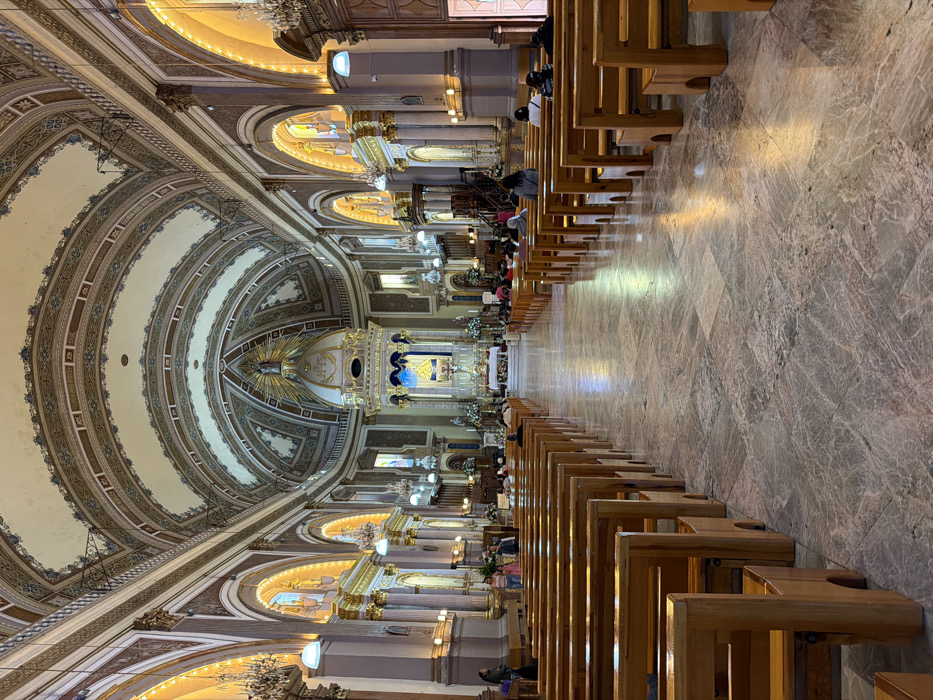
The image displays the ornate interior of a grand church or cathedral, viewed from a side aisle looking towards the main altar. The image is oriented sideways and needs to be rotated 90 degrees counter-clockwise for correct viewing. The architecture is rich and detailed, characteristic of classical or baroque styles. A dominant feature is the elaborately decorated vaulted ceiling, painted in shades of cream and off-white, adorned with intricate patterns, moldings, and borders in brown and gold tones. Large, sweeping arches span the nave, also featuring detailed relief work. Along the upper walls, above the side aisles, are arched alcoves or windows emitting a soft, warm, golden light, suggesting either stained glass or concealed artificial lighting. Below these arches, substantial pillars or pilasters, often topped with golden capitals and decorative elements, line the nave, separating the central space from the side areas. Between these pillars, smaller ornate altars or devotional niches can be seen, each typically featuring statues and gilded accents. At the far end of the church, the highly ornate main altar stands as the focal point. It features a large, gilded reredos (altar screen) with what appears to be a statue of a figure (possibly the Virgin Mary or a saint) at its apex, surrounded by a radiant sunburst or halo design. Below this, a prominent structure, possibly a tabernacle or another devotional display, is decorated with vibrant blue and gold accents. The floor is made of polished marble tiles, displaying a mix of grey, beige, and off-white tones with natural veining. The smooth surface reflects the warm lighting from above, creating bright, elongated streaks. Rows of light-colored wooden pews are neatly arranged in the aisles, extending towards the altar. These pews have simple designs with straight backs and integrated kneelers. Scattered throughout the pews are several individuals, mostly seated or kneeling, appearing to be engaged in prayer or quiet contemplation. Their forms are largely indistinct, but their presence suggests a solemn and reverent atmosphere. The overall lighting in the church is warm and inviting, highlighting the golden details and intricate carvings throughout the space. The ambiance is one of grandeur, reverence, and peace. No discernible text is visible in the image.
Pátzcuaro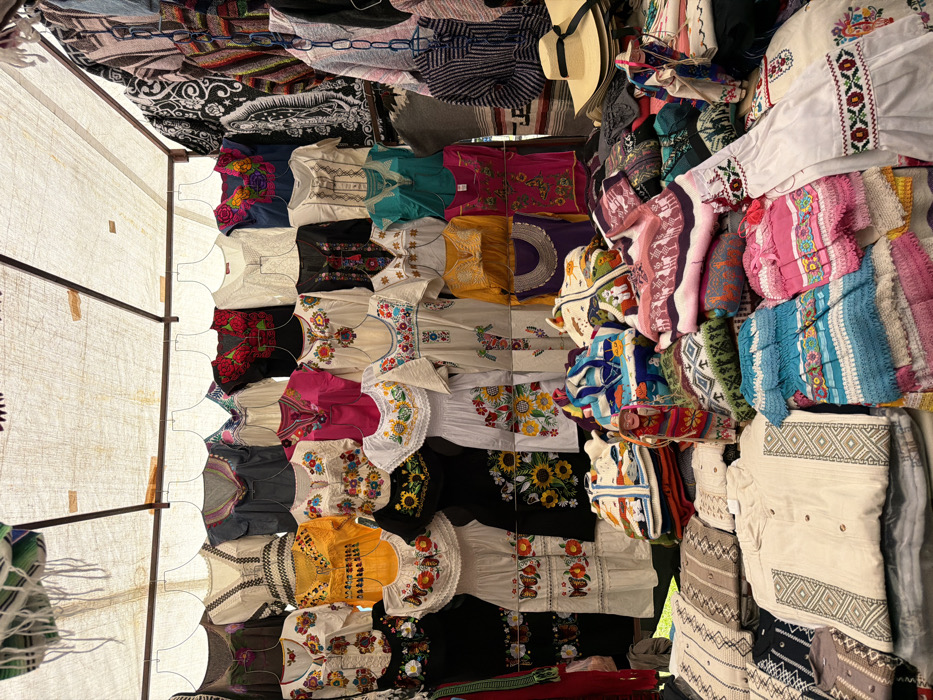
This image captures a vibrant and densely packed market stall, overflowing with a wide array of colorful textiles and traditional clothing. The scene is viewed from slightly below, looking up into what appears to be a covered booth, possibly under a tent or awning. Overhead, a light-colored, possibly off-white or beige, fabric canopy stretches across the top and left side of the frame, providing shade. Support poles for this canopy are visible on the left. The primary focus of the image is the extensive collection of garments, mostly blouses and dresses, arranged on hangers and stacked in piles. On the left and center, numerous blouses are displayed on hangers. These garments feature rich, intricate embroidery in various styles. Many are white, black, or colored (pink, blue, yellow, green) with vibrant floral patterns, including sunflowers, roses, and other blossoms, executed in bright reds, yellows, blues, and greens. Other blouses show geometric embroidery or abstract designs around the necklines and sleeves. The styles suggest traditional Mexican or Latin American folk attire, such as huipiles. Towards the upper right, several items are hanging or draped, including blankets or shawls with striped patterns and dark fabrics featuring white, intricate designs. A light-colored straw hat with a dark band is also visible, hanging in this section. On the right side of the stall, large piles of folded textiles are neatly stacked. These appear to be thicker woven garments, possibly sweaters, ponchos, or blankets, showcasing a diverse range of patterns and textures. Colors include various shades of pink, purple, blue, green, and cream, often with complex geometric motifs or stylized animal patterns woven into the fabric. Additionally, there are several cream-colored tunics or shirts with distinct geometric embroidery along the front and hems. The bright, natural lighting suggests it is daytime. No people are visible in the frame, and no discernible text appears on any of the items or in the background. The overall impression is one of a bustling and colorful artisan market, rich in cultural textile traditions.
Pátzcuaro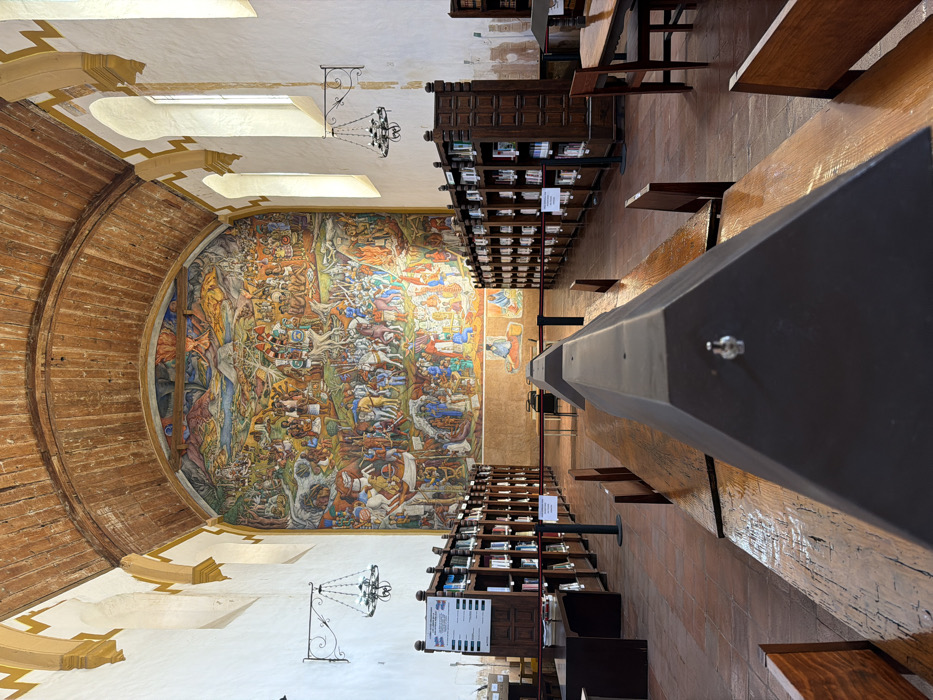
The image depicts the interior of a large, high-ceilinged room, possibly a library, archive, or historic hall, characterized by its impressive architecture and a monumental mural. The room is oriented such that a vast, colorful mural covers a significant portion of the left wall, while rows of dark wooden bookshelves line the right side, receding into the distance. The mural is highly detailed and vibrant, portraying a dynamic and complex scene. It features numerous figures, including men on horseback, warriors, and other individuals, engaged in what appears to be a historical battle or a significant narrative event. The artwork is rich in color, utilizing shades of red, blue, green, and various earthy tones. Above the mural, a striking architectural feature is visible: a large, curved wooden structure, possibly part of a vaulted ceiling or a large archway, constructed from horizontal planks with a warm, reddish-brown tone and visible wood grain. Higher up, the walls are painted a light color (white or cream) and are adorned with decorative, yellowish-gold trim or molding. Several rectangular openings, which appear to be skylights or recessed windows, are set into the upper sections, allowing natural light to illuminate the space. A classic wrought-iron chandelier with multiple arms hangs from the ceiling. On the right side of the room, multiple rows of dark wooden bookshelves or display cases extend far into the background. These shelves are filled with books or other items. Small white signs are attached to the front of many shelves. While most text on these signs is illegible due to distance, one sign clearly reads "NO FOTOGRAFIAS," indicating a no-photography policy. Another sign visible on a shelf includes the word "ESPAÑOL," possibly denoting a language section. Interspersed among the dark bookshelves, or running parallel to them, are long, lighter-toned wooden tables or benches. In the immediate foreground on the right, a large, dark, polygonal beam or structural element runs horizontally across the lower part of the frame. This beam has visible metallic fasteners (screws or bolts) and appears to be made of dark metal or painted wood. The floor of the room is covered with reddish-brown tiles, likely terracotta, arranged in a grid pattern. The overall lighting is bright, suggesting daytime, with ample natural light complementing the interior's historical ambiance. No people are visible in the scene. The architecture and the mural suggest a setting with historical or cultural significance, possibly in a Latin American or Spanish colonial context.
Pátzcuaro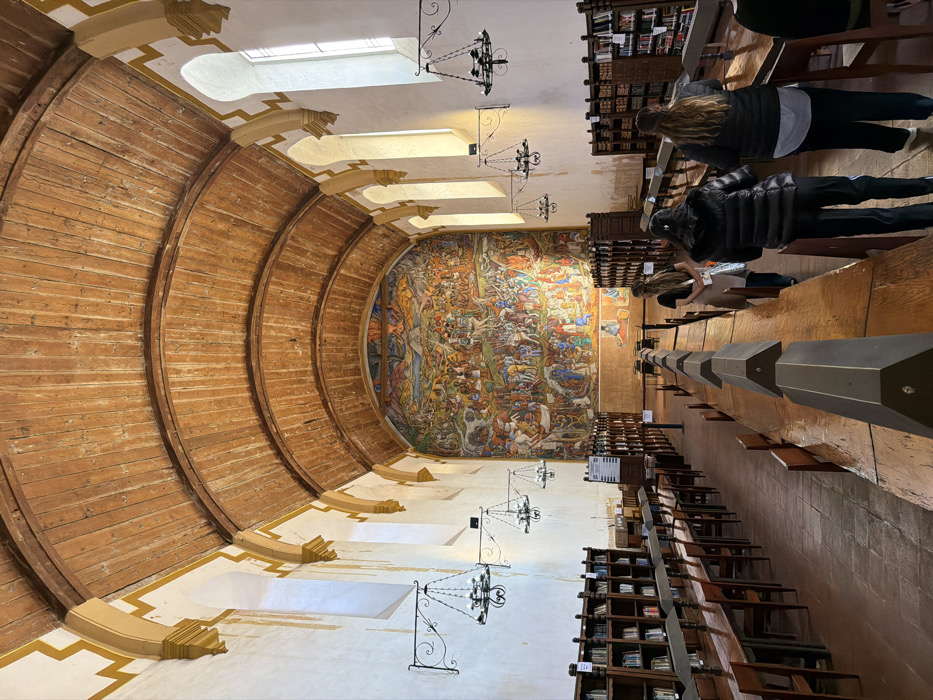
The image displays a grand, historic interior space, likely a library, archive, or a significant hall within a public building, illuminated by natural light during the daytime. The perspective is tilted, but describing it as if oriented correctly: To the left, a large, impressive curved wall or ceiling section dominates the space, constructed from numerous horizontal wooden planks that create a deep, ribbed, and visually compelling arc. Beneath this wooden structure, a light-colored wall is decorated with ornate, possibly gilded or yellow-painted, geometric patterns, featuring prominent corbels that jut out, providing structural or decorative support to the wooden curve above. High on this wall, several rectangular windows or skylights allow ambient light to flood the room. Across the room, on what appears to be the far wall, a vast and vibrant mural is the focal point. This colorful artwork depicts a complex, densely populated scene, possibly historical or allegorical, featuring numerous figures engaged in battles, processions, or other significant events. The mural's palette includes rich earth tones, blues, and reds, contributing to its dramatic impact. From the ceiling, several ornate black wrought-iron chandeliers hang, adding a touch of antique elegance to the setting. On the right side of the image, multiple rows of tall, dark wooden bookshelves are visible, neatly filled with numerous books, indicating an extensive collection. In front of these bookshelves, long, sturdy wooden tables or benches extend into the distance. Several individuals, mostly seen from behind or in partial profile, are present among these tables and bookshelves. They appear to be adults, dressed in casual attire, including jackets and pants, suggesting they are either browsing the collection, studying, or observing the magnificent mural and the architecture of the hall. Their postures suggest calm engagement with their surroundings. The overall atmosphere conveys a sense of historical significance, scholarly pursuit, and artistic beauty. No legible text is visible within the image.
Pátzcuaro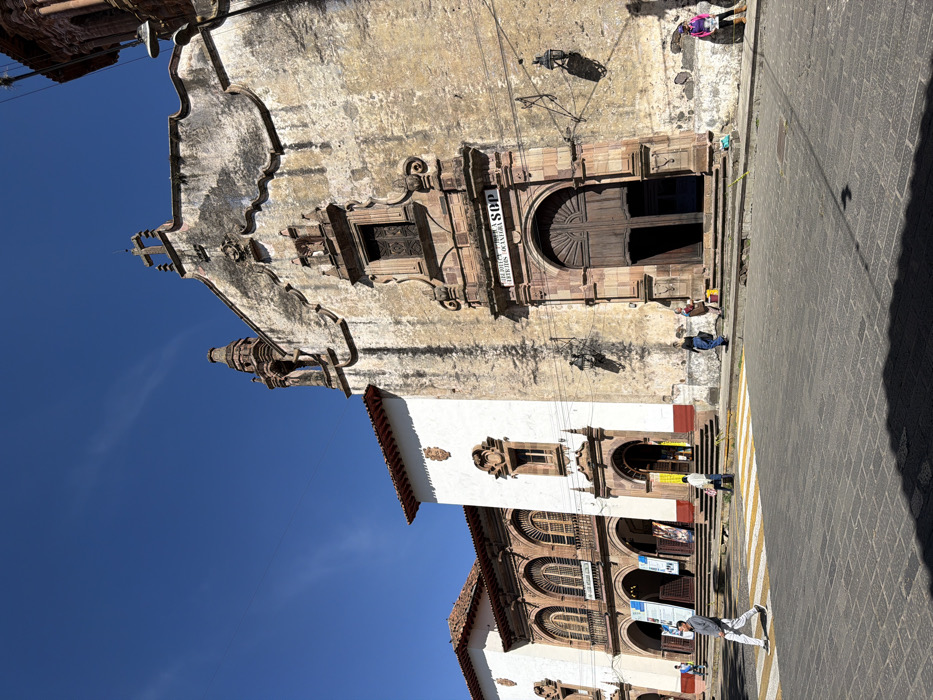
A vertical outdoor shot captures a building's facade under a clear blue sky. The architecture features aged stone, a prominent arched wooden door, and decorative window frames. People are visible on the steps and sidewalk, adding a sense of scale. Cobblestone paving and shadows indicate the time of day, possibly late morning.
Pátzcuaro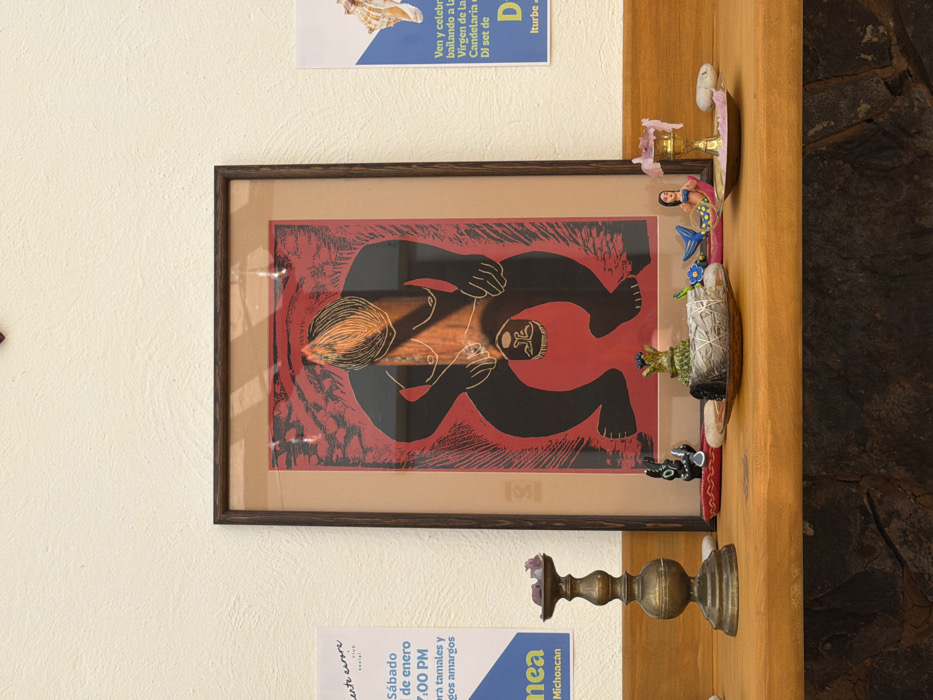
The image displays an indoor scene featuring a framed piece of art, various decorative objects on a wooden shelf, and two printed notices on a light-colored wall. Centrally placed on the light, textured wall is a dark-brown framed artwork. The artwork itself is a striking graphic print, possibly a woodcut or linocut, depicting two stylized, solid black figures against a vivid red background patterned with black textures. One larger figure, which appears to be a woman with distinct hair or a headdress, is shown embracing or holding a smaller, infant-like figure. The overall impression of the art is one of connection or nurturing. Reflections are visible on the glass covering the print, suggesting a light source in the room. To the right of the framed art, a wooden shelf or ledge holds an assortment of small decorative items. These include a colorful mermaid figurine with a blue tail, a bundle of white material (possibly sage or palo santo) tied with string, a small green succulent-like plant, and a black figurine that resembles an animal. Further to the right on the shelf, a brass or bronze candlestick holder with a melted purple candle stub is visible, along with other small, indistinct objects like stones or shells. The wooden shelf itself has a light, natural finish. The wall on which the art and notices are displayed is a uniform light cream or off-white color with a subtle texture. To the far right of the wooden shelf, a section of a rough, dark stone wall is visible, providing a contrasting background texture. Two printed notices are affixed to the light wall. One, partially visible above the framed art, is on a blue background and contains text such as "Ven y celebra," "bailando a la Virgen de la Candelaria," "DJ set de," and "Iturbe." Another partially visible notice, also on a blue background, is located below the framed art and includes phrases like "ente eurore," "Sábado de enero," "7:00 PM," "tamales y," "gos amargos," and "Michoacan." These notices appear to be advertisements or announcements for local events.
Pátzcuaro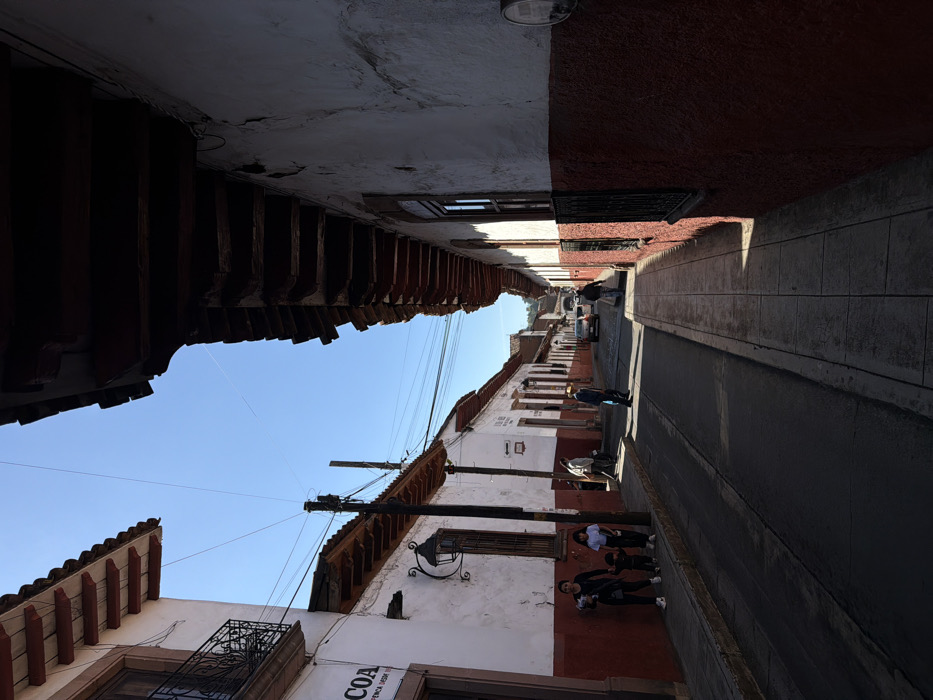
A narrow street stretches between buildings, their walls a mix of white and red. A staircase protrudes from one side. People stand by the wall on the right. Overhead, a bright blue sky is visible between the buildings. Power lines crisscross above. The street is shadowed on one side, revealing details in the textured walls.
Pátzcuaro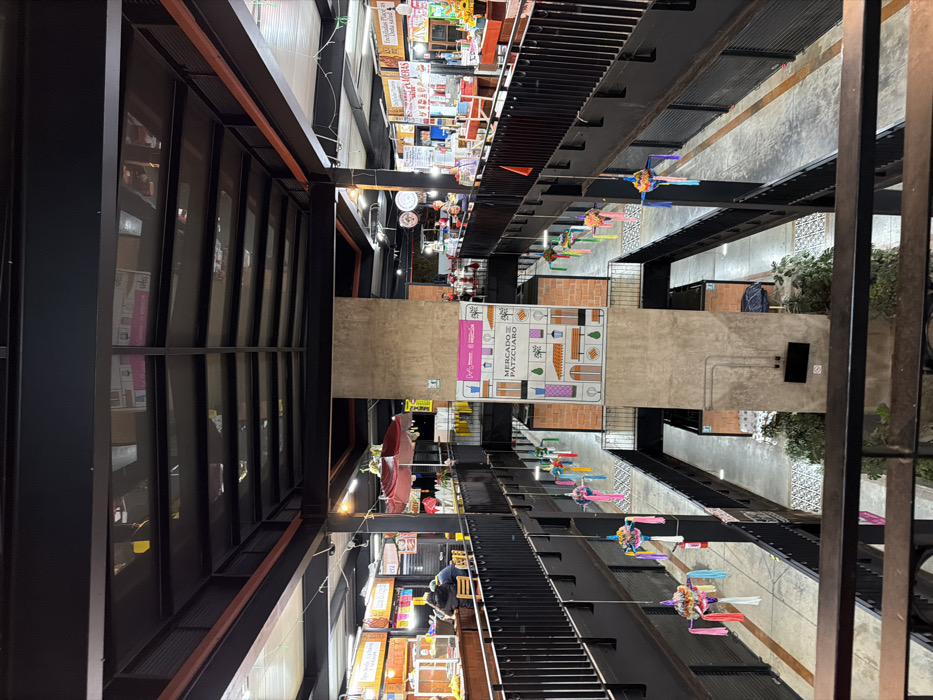
The image is of a covered market. There are colorful stalls and signs with food and other products. The market is decorated with bright paper flowers and ribbons, creating a festive atmosphere. Metal beams and a grid-like structure support the roof, casting shadows on the stalls below. There are windows on the left. A large sign labeled "MERCADO DE PATZCUARO" hangs in the middle of the market.
Pátzcuaro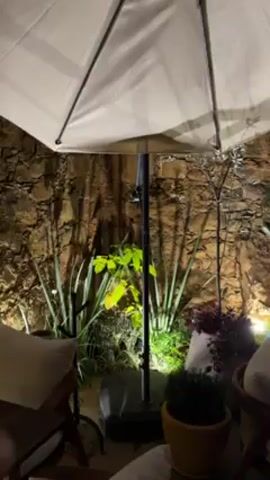
The video shows an outdoor seating area at night, likely a restaurant or bar. There are several tables and chairs arranged under large umbrellas. The area is lit with small, warm lights and there is a stone wall with plants behind the seating. No people are visible. The camera slowly pans across the scene.
Pátzcuaro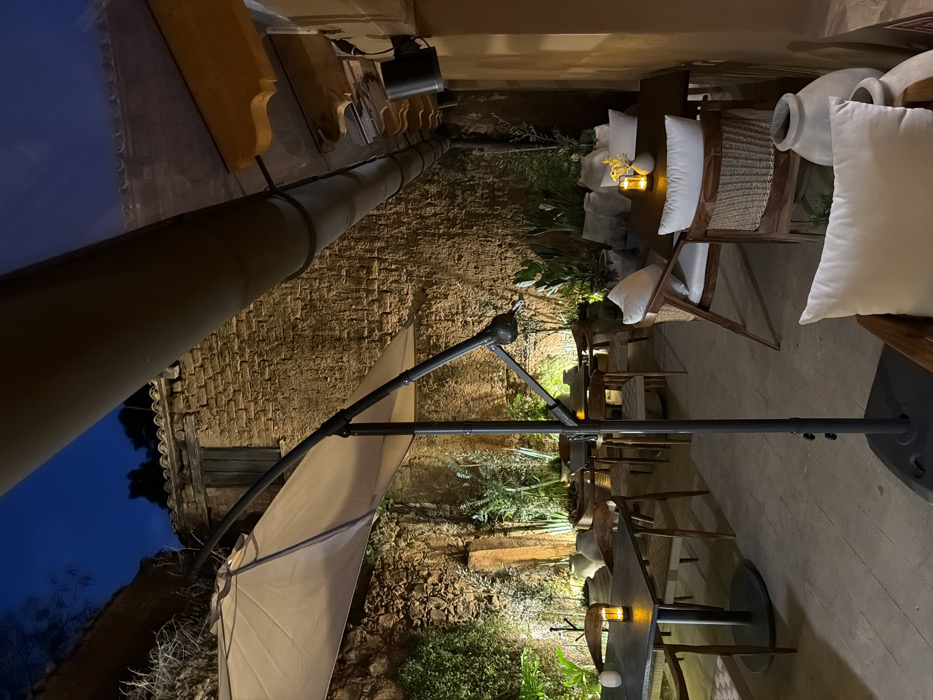
An outdoor dining area is illuminated by strategic lighting, highlighting stone walls and lush greenery. The setting features a long table with chairs, accented by white cushions and decorative elements, possibly candles or small lights. A large umbrella extends over part of the space, offering shade. The scene has a warm and inviting atmosphere, suggesting an evening setting with a combination of natural textures and ambient lighting.
Pátzcuaro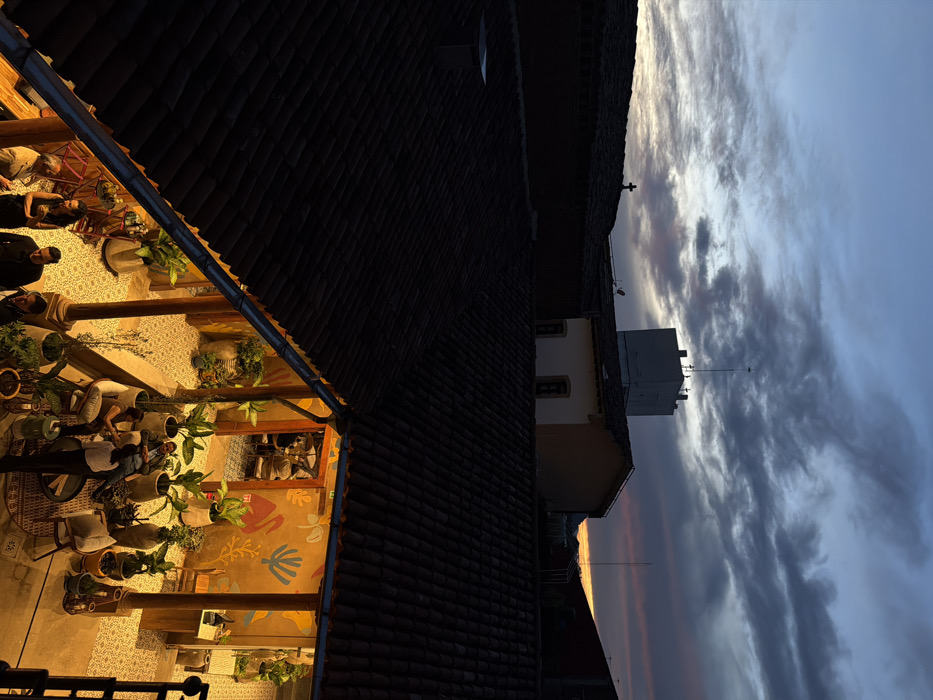
An elevated view of a courtyard gathering beneath a tiled roof, illuminated with warm light amid potted plants and patterned flooring. Adjacent, a dark, tiled rooftop leads to a building with a white structure. The sky features a gradient of colors, from dusky orange near the horizon to a pale blue speckled with clouds.
Pátzcuaro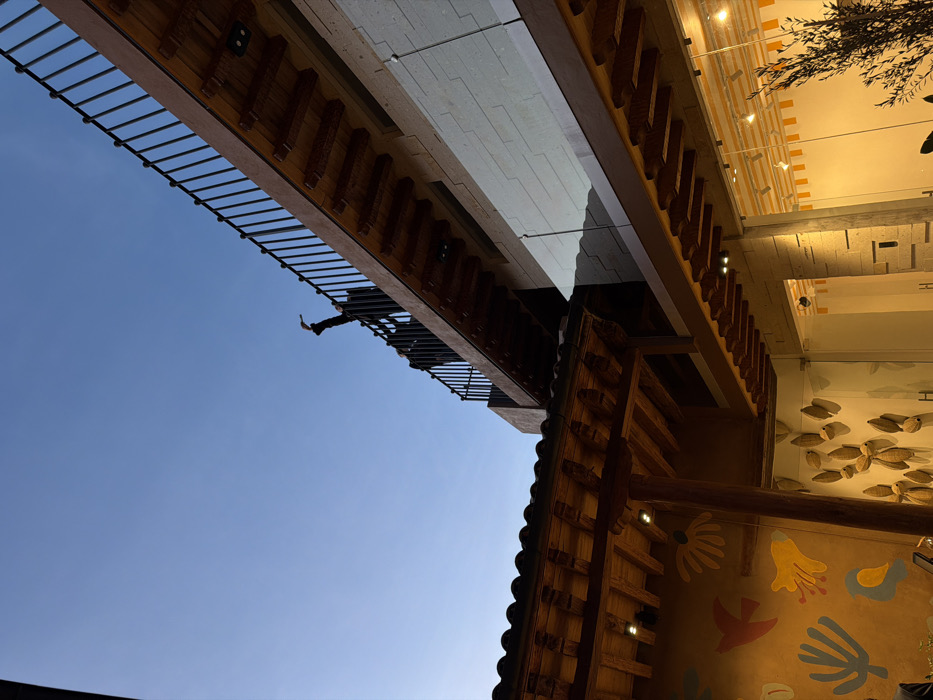
A low-angle shot captures two adjacent buildings against a blue sky. The left building features a dark, brown facade with a metal balcony railing, and a person extends an arm over the railing. The building on the right exhibits a brown wooden structure with dark roof tiles and a wall painted with colorful, abstract floral and avian designs. Above the right building is a brightly lit interior space with decorative elements resembling fish.
Pátzcuaro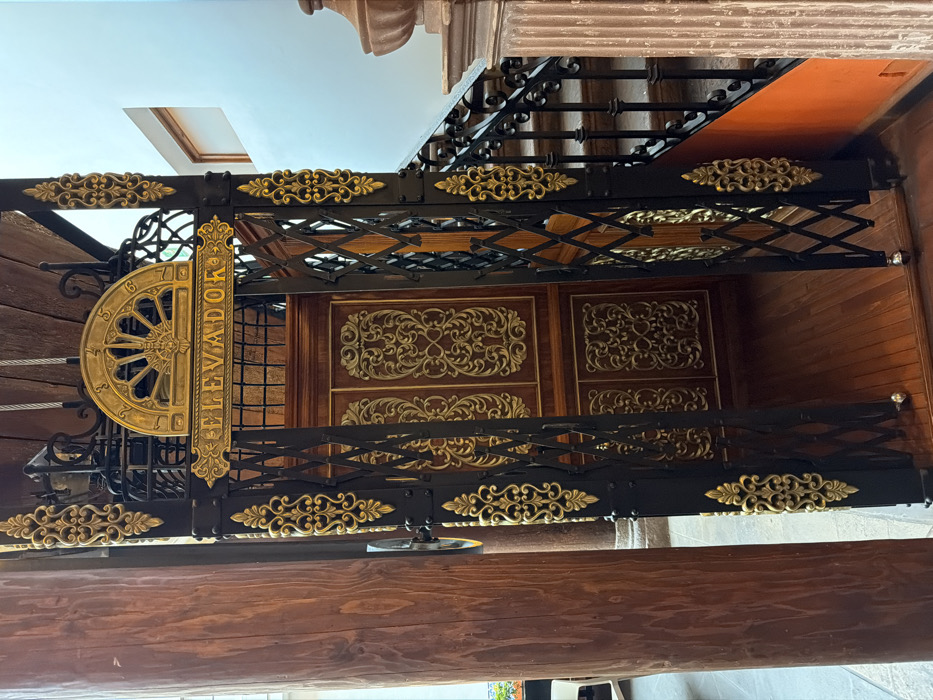
An ornate elevator gate, featuring gold filigree on black metal, spells out "ELEVADOR" vertically on its side. Intricate gold designs adorn the gate's bars, which form a lattice pattern. The elevator itself has dark wood panels with gold detailing. A half-circle wheel mechanism sits beside the lettering. Stairs are visible behind the elevator, leading upwards, adding to the historical feel.
Pátzcuaro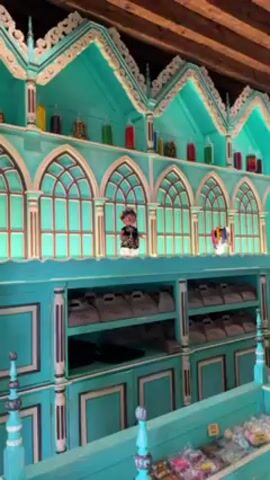
The video depicts the interior of a candy store with a unique, vibrant teal and cream color scheme. The store features elaborate, custom-built shelving units that resemble miniature gothic cathedrals, complete with arched windows and decorative trim. These shelves are stocked with a variety of candies, presented in jars and wrapped packages. A female employee wearing a white uniform and cap stands behind a counter, presumably assisting customers. Another female customer, dressed in a white top and black pants, is seen browsing the candy selection at one of the shelves. The camera pans around the store, showcasing the detailed interior design, including a wooden beamed ceiling and patterned tile floor.
Pátzcuaro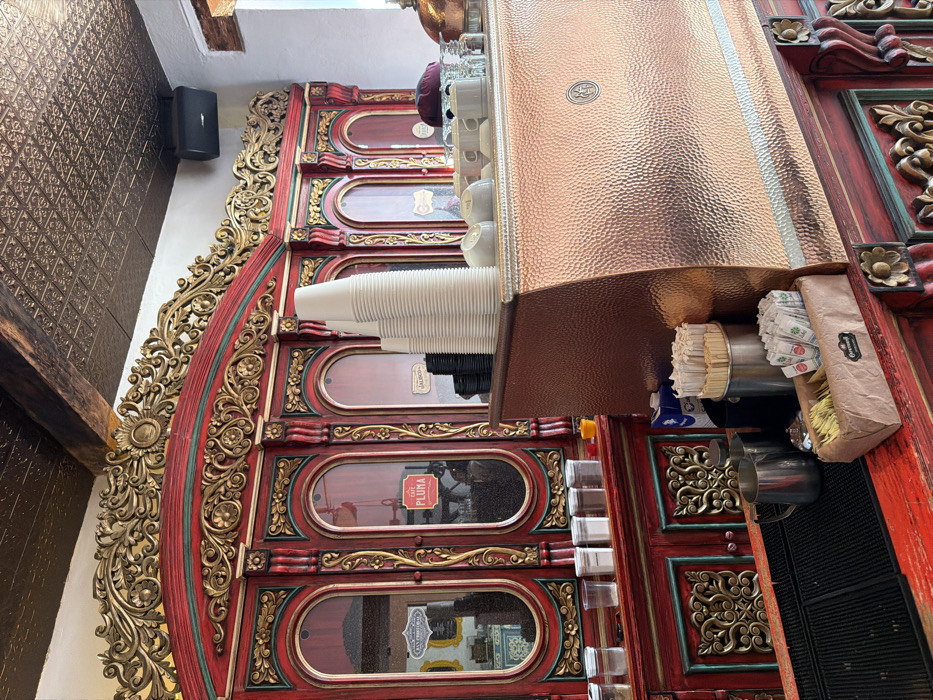
An ornate, partially visible dark-red and gold cabinet features multiple glass-windowed sections and decorative trim. A stack of white disposable cups sits atop the cabinet, with a metallic copper dispenser alongside. Additional items, including sugar packets, stirrers, and containers, are affixed to the cabinet's side. The cabinet is positioned against a wall with textured, brown-toned wallpaper, and a black speaker is visible in the upper-left corner.
Pátzcuaro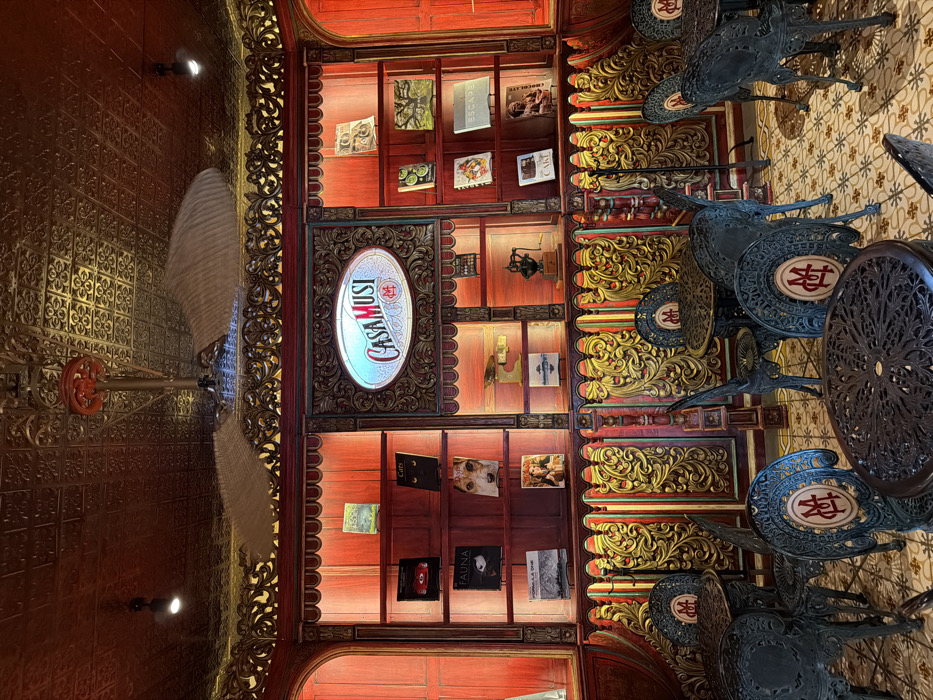
The interior features a cabinet display showcasing books and decorative items under warm lighting, framed by ornate wood detailing. Ceiling panels create a patterned backdrop. Vintage cast-iron tables and chairs sit on a tiled floor. A large fan hangs from the ceiling. The "Casa Musi" logo is prominently displayed within the cabinet.
Pátzcuaro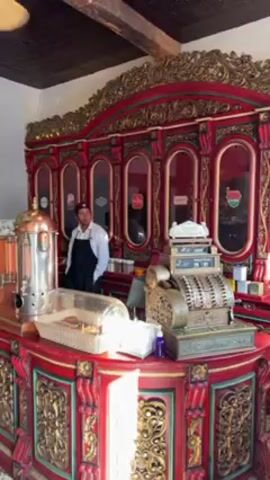
The video shows the interior of what appears to be a coffee shop or cafe with a vintage aesthetic. A person in a white shirt and black apron stands behind a highly ornate, red and gold counter. On the counter are a copper coffee urn, a display of pastries, and an antique cash register. The background features a red and gold display case with glass windows, possibly containing coffee or tea. The camera pans to the right, showing a tiled floor, another section of the counter with a coffee machine and cups, and a doorway with a person standing in it. The camera continues to pan, revealing a "Souvenir" shelf stocked with jars, followed by a vintage-looking piece of machinery stirring something in a copper vessel. The overall ambiance is old-fashioned and decorative.
Pátzcuaro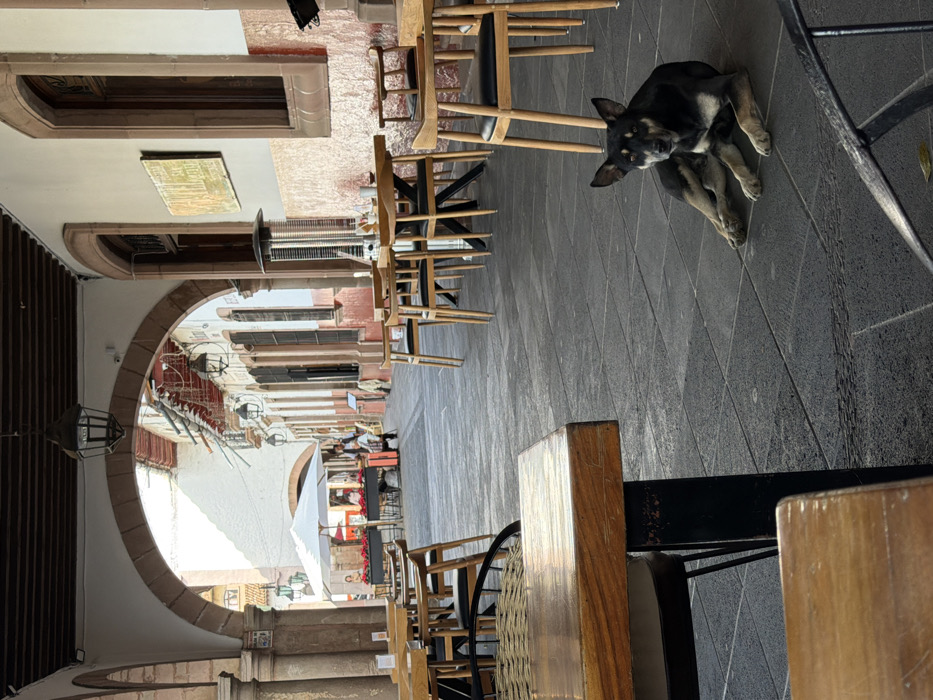
The photo shows an outdoor courtyard with tables and chairs, extending through an arched doorway. A black and brown dog sits on the tiled floor near some chairs. The courtyard appears to be within a building, with windows and architectural details visible along its length. The perspective is slightly rotated, giving a tilted view of the scene. The lighting is bright, suggesting a daytime setting.
Pátzcuaro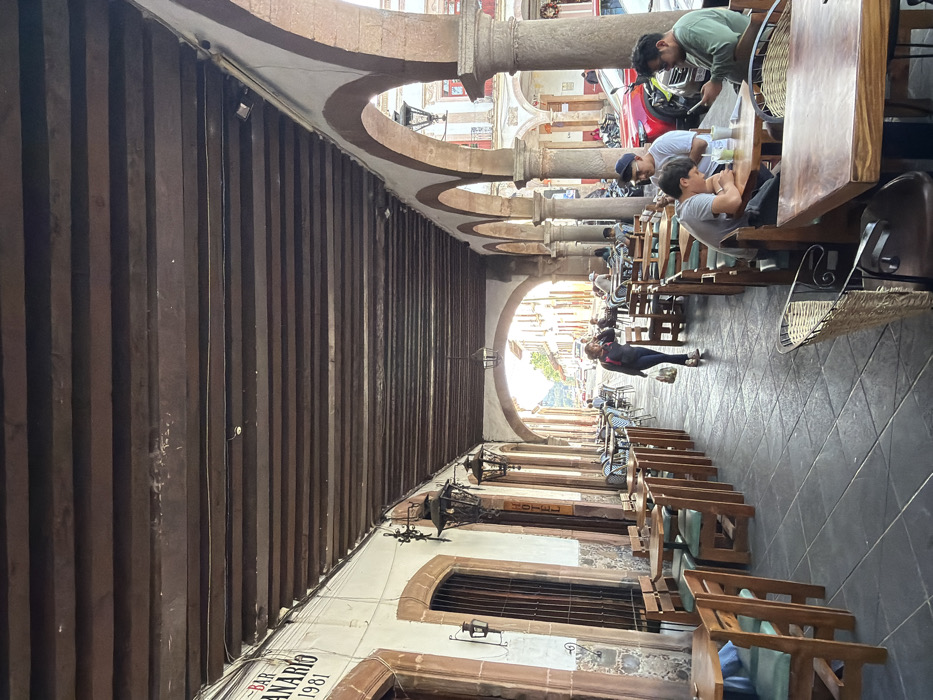
An outdoor corridor displays a series of arches along the top. The left side features a dark, wooden structure with vertical planks. Tables and chairs line the right side of the corridor, where a group of people are seated near the top of the image. A person walks along the corridor further down, while more seating arrangements are visible in the distance leading to the open end with daylight.
Pátzcuaro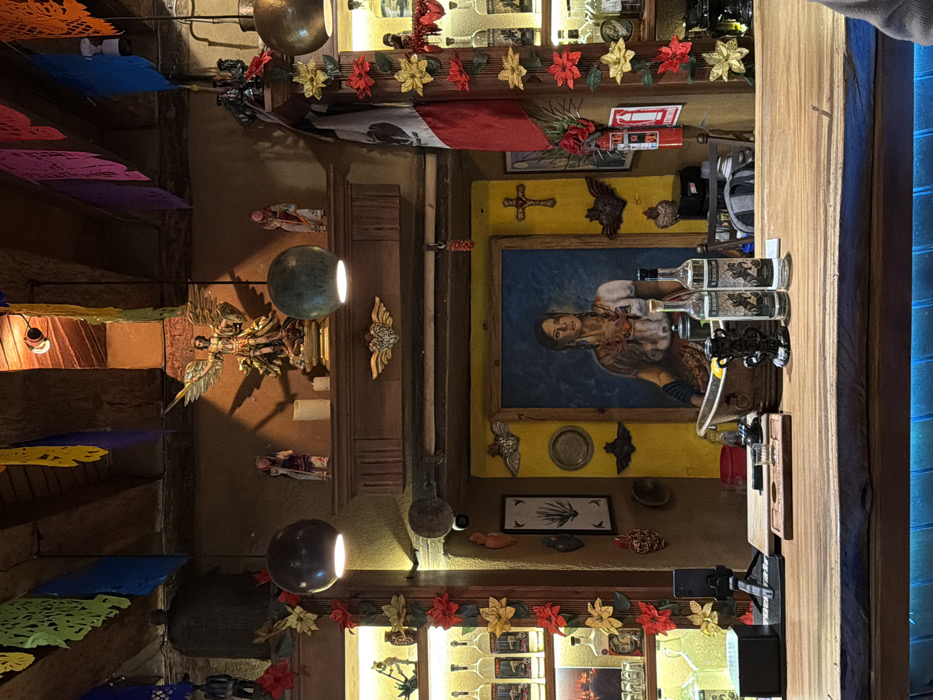
Mexican restaurant interior features colorful papel picado hanging from the ceiling. A Mexican flag is draped above a display of liquor bottles with poinsettia garlands. A painting and various religious artifacts adorn the wall, illuminated by two spherical light fixtures. A wooden bar dominates the right side of the frame.
Pátzcuaro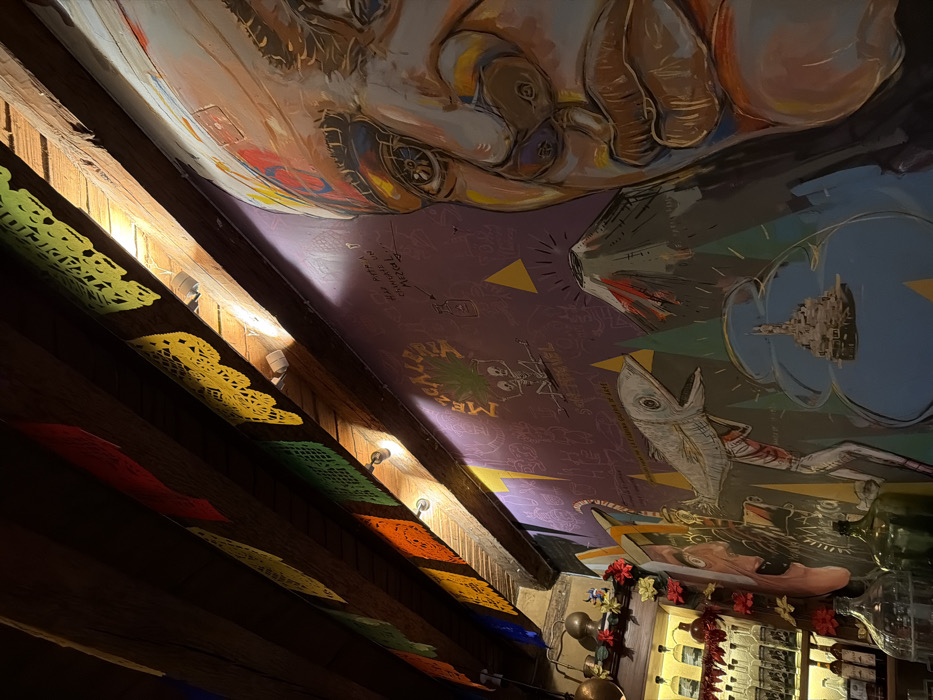
The image captures an interior view, likely a restaurant or bar, characterized by a vibrant and eclectic decoration scheme, primarily featuring a large, colorful mural on the ceiling. The photograph is taken from a low angle, looking upwards and diagonally across the room. The most striking feature is the ceiling mural, which appears to cover a significant portion of the overhead space. In the upper right section of the image, a large, stylized face dominates, possibly that of a man or a mythical figure, with bold brushstrokes and earthy tones. The face has prominent eyes, a nose, and lips, and appears to be looking down. Moving across the ceiling, the mural transitions to a purple background filled with various drawings and text. A central element here is the word "MEZCAL" written in green, accompanied by a stylized plant resembling an agave, and a skeletal figure below it. Other details on the purple background include small sketches, geometric yellow triangles, and an illustration of what appears to be an erupting volcano or mountain. Further along this section, a distinctive fish-like creature is depicted, standing upright or moving on two legs, with its mouth open and internal structures (possibly bones or muscles) visible. The overall style of the mural is artistic and somewhat surreal, blending figurative and abstract elements. To the left and bottom of the image, a series of wooden beams runs diagonally, suggesting a structured ceiling or canopy. Strung between these beams are colorful paper cut-out decorations, characteristic of "papel picado," in hues of yellow, green, red, orange, and blue. Small, recessed lights are visible along the beams, casting light onto the decorations and the ceiling. In the bottom right corner, a section of what appears to be a bar or shelf area is visible. It features several bottles, some empty and clear, alongside festive red decorative elements, possibly chili strings or garlands. Brass-colored bells or ornamental objects are also hanging in this area. The lighting in the image suggests an indoor setting, possibly in the evening, with the small lights on the beams contributing to the ambient illumination. The tilted perspective of the photo adds dynamism to the scene, emphasizing the elaborate ceiling art and decorations.
Pátzcuaro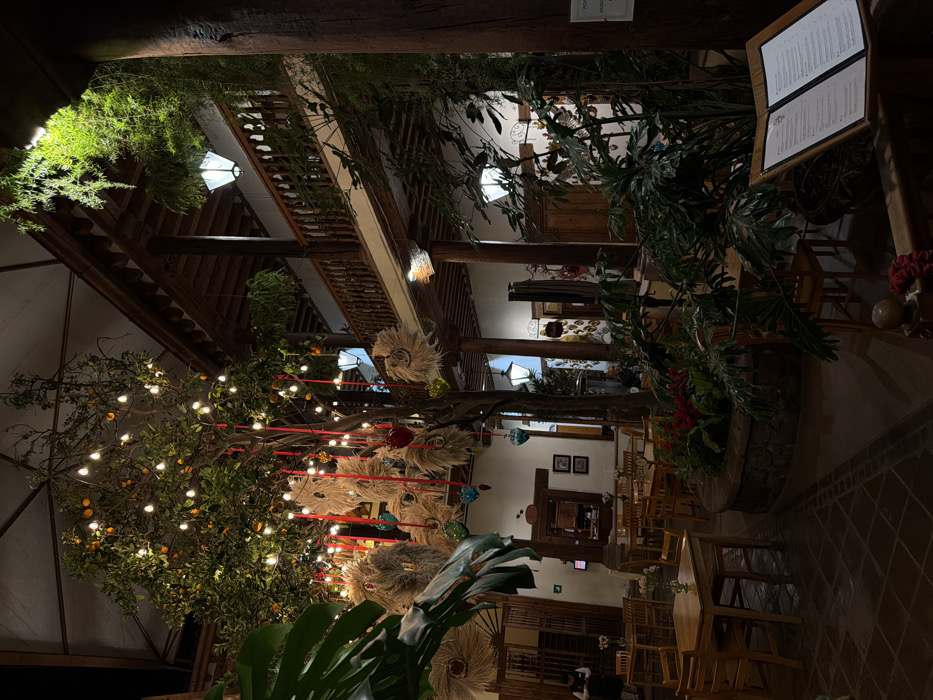
An ornate interior of a building shows two stories with exposed wood beams and plants. Straw decorations hang among bare branches and red ribbons decorated with lights. A large menu is displayed near plants in pots. Tables and chairs are arranged on a tile floor. Lights hang from the ceiling.
Pátzcuaro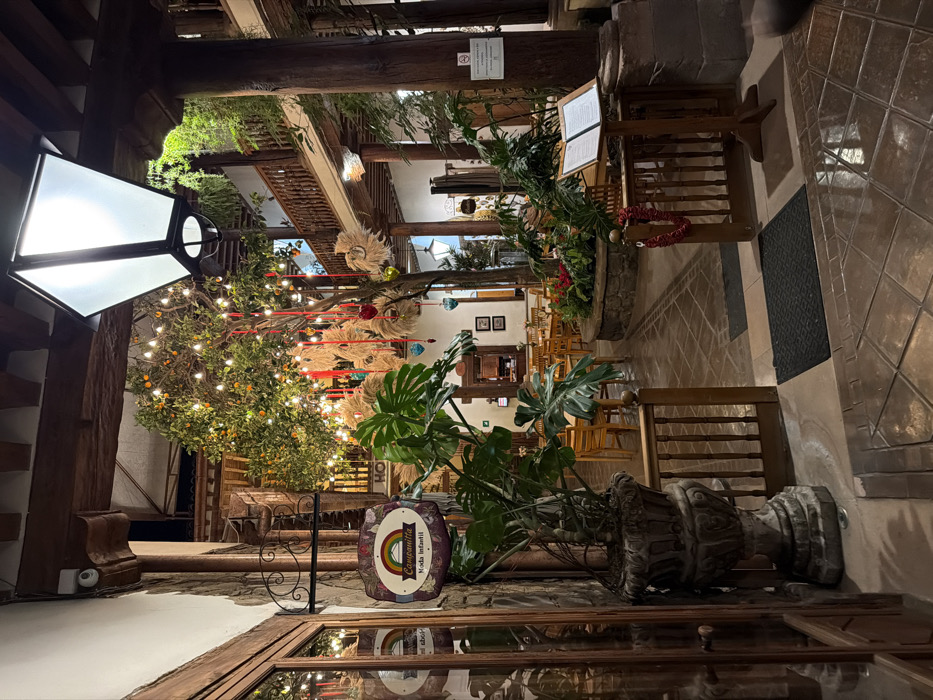
An ornately decorated interior space is visible. A white-lit, boxy lamppost is mounted on a wood beam. A leafy, lighted tree stands near a small sign bearing the words "compania infantil". Various decorations are suspended from the ceiling. Tables and chairs populate the background, while stone-tiled floors lead further into the space. Lush plants in large, decorative pots add to the ambiance.
Pátzcuaro