Padua, Italy
30 memories from Padua, Italy

The image shows the interior of a Ford Transit van, facing forward, with a partial view of the dashboard and steering wheel. A large touchscreen infotainment system is prominent, displaying a navigation map with a Google Maps interface and a YouTube Music widget. The van is parked in what appears to be an outdoor lot, possibly a commercial or industrial area, with several other vehicles and trucks visible in the background. Sunlight suggests it is daytime. The vehicle is equipped with a manual transmission, indicated by the gear shift knob with R, 1, 3, 5, and 2, 4, 6 markings. A set of keys with a keychain is hanging from the ignition. The general setting suggests a logistical or delivery hub. While the image is set in Italy, a specific location within the city of Padua is not explicitly identifiable from the visual cues, though the presence of Italian text on the navigation screen and the brand of trucks in the background could suggest a connection to Italian logistics.
Padua
The image is a promotional advertisement for a furniture store called "Mondo Convenienza," featuring a modern kitchen design. The kitchen has light-colored cabinets, a wooden countertop, and a tiled backsplash with a geometric pattern. Appliances like a microwave, oven, and blender are visible, along with decorative items on the shelves and countertop. In the foreground, there is a wooden breakfast bar with two stools. The advertisement also displays text with brand logos and promotional messages, including "DOLCE Casa" and "Mondo Convenienza," along with a price of "1.070€." There is a hashtag "#oppo A74" at the bottom left, and the words "Fioriscono le offerte" are prominently displayed. The advertisement is likely intended for distribution in a city, but no specific location in Padua, Italy, is identified within the image itself.
Padua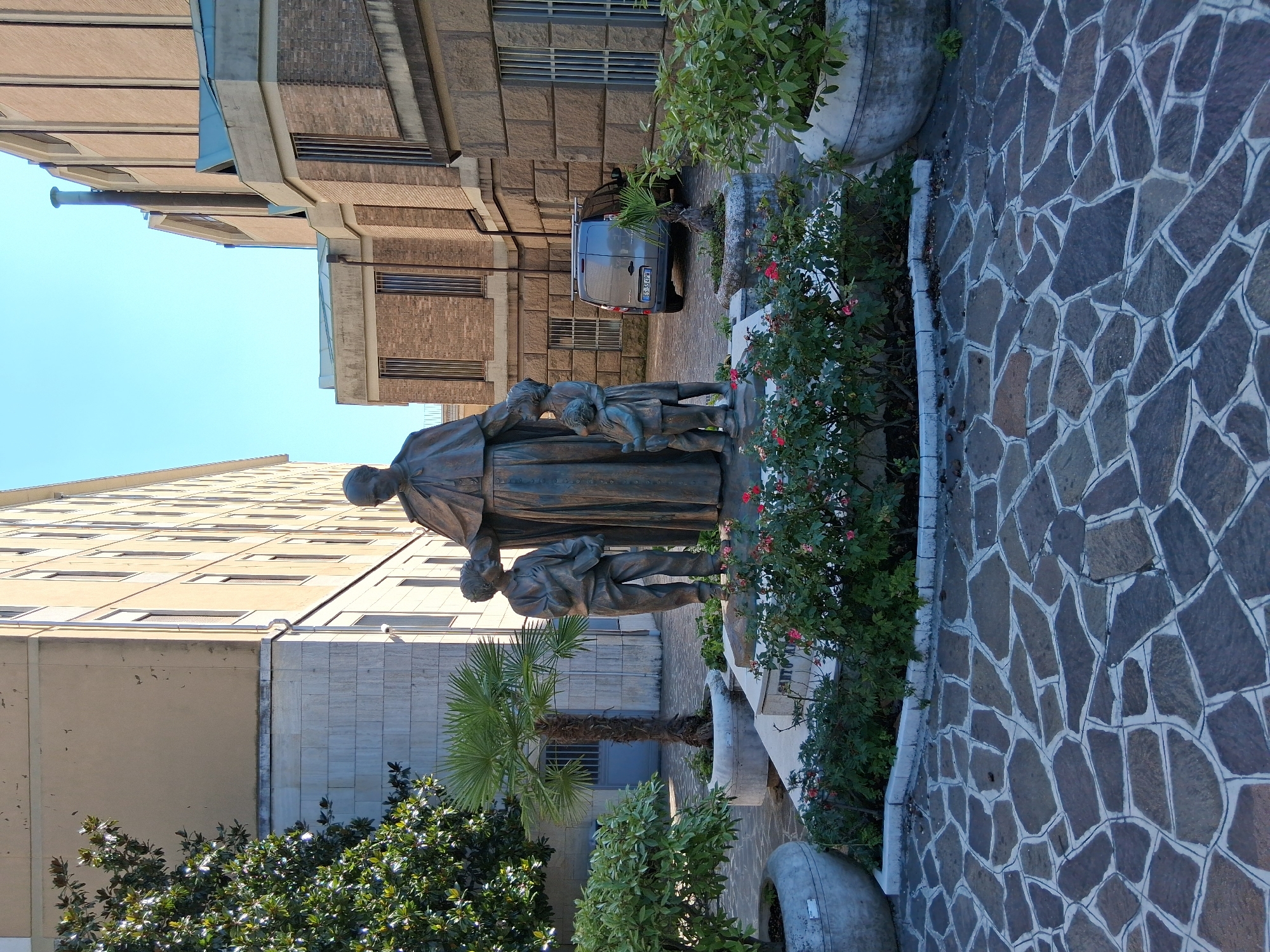
This is a full-shot, eye-level, outdoor, daytime photograph of a bronze statue of a robed male figure with two children, one on each side, in a courtyard setting. The statue is positioned in the foreground, centrally framed, on a raised platform surrounded by a flower bed. The male figure, possibly a priest or religious figure, stands tall with one hand resting on the head of the child to his right. The child on his left holds a book. The children appear to be looking up at the man. The courtyard is paved with irregular, flat stones of various shades of gray and brown, set with white grout. To the left of the statue, a large, grey, circular planter contains a leafy green shrub. Further left, a palm tree in a similar planter stands tall. Behind the statue and flower bed, a beige, multi-story building with numerous windows occupies the left side of the frame. To the right of this building, a brick structure with a flat roof and metal-framed windows is visible. In the background, a dark grey van is parked. Further to the right, another brick building with a more modern architectural style featuring large windows and a blue roof section is present. The sky is clear and blue. The location is identified as being in Padua, Italy, likely within the grounds of a religious or educational institution given the presence of religious iconography and the architectural style of the buildings. Specifically, this image depicts the exterior of the Collegio Gregorianum in Padua, Italy.
Padua
An elderly woman with gray hair and glasses is sitting on a wooden bench, facing away from the camera. She is wearing a yellow shirt with a pattern of hot air balloons and light blue patterned pants. She is holding a dark blue object in her hands and appears to be folding or manipulating it. To her right, on the bench, is a brown oval object, a green plastic bag, and other items. Behind her, a window is covered with a light-colored, decorative curtain, and a radiator is visible to the right. The scene is indoors, with natural light coming from the window.
Padua
The video shows a park area with green trees and a grassy ground scattered with dry leaves. In the background, there are colorful structures that appear to be playground equipment. Sunlight filters through the leaves, casting shadows on the ground. A young sapling supported by three wooden stakes is visible in the middle ground. The scene is peaceful and appears to be a typical park setting on a sunny day.
Padua
A video shows a park scene on a sunny day. Several pigeons are scattered across a grassy lawn littered with fallen leaves. In the background, trees provide shade, and further back, playground equipment and buildings can be seen. The camera perspective is low, looking across the grass towards the trees and playground.
Padua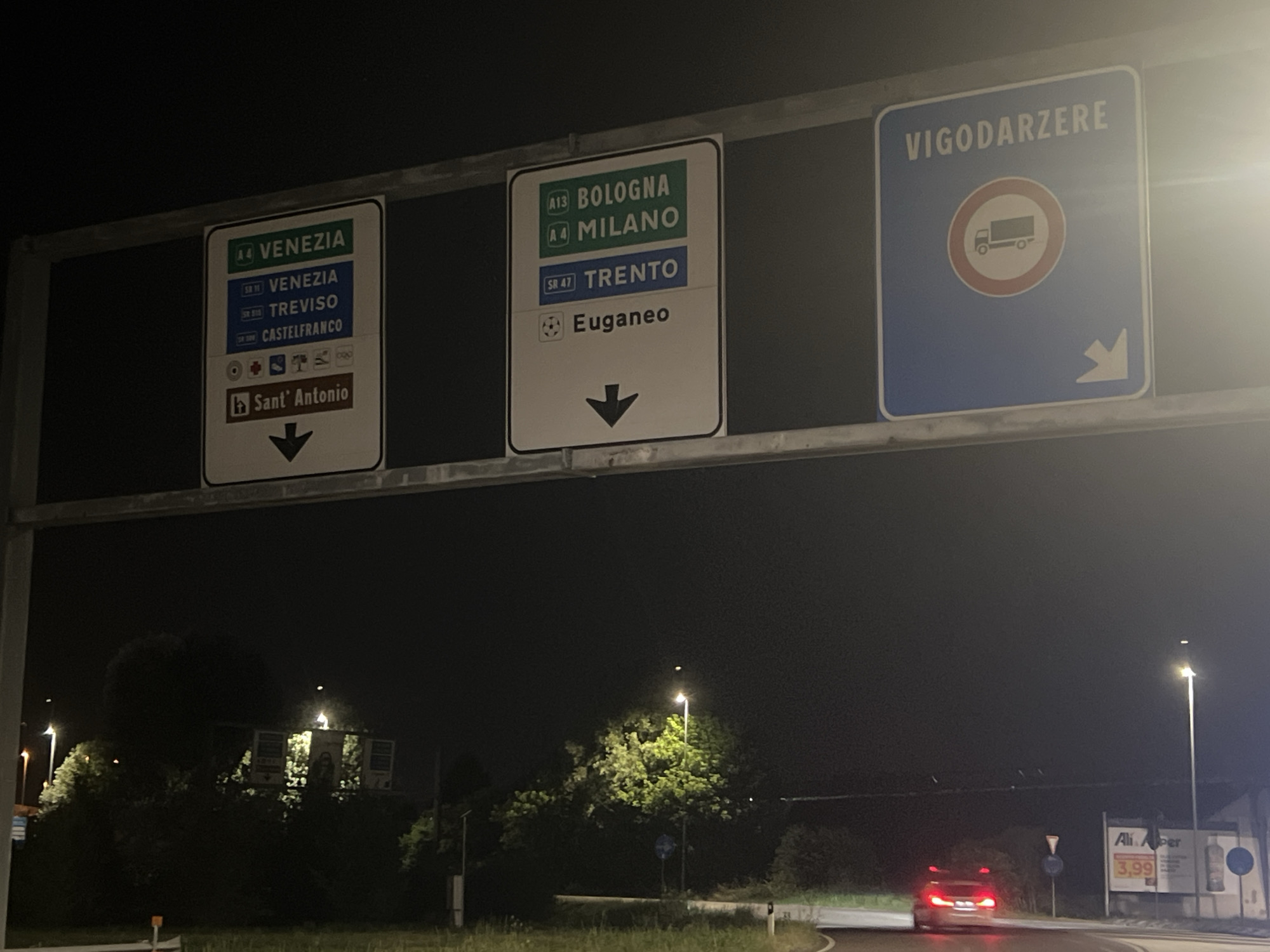
The image shows an overhead highway gantry with three signs at night. The leftmost sign is green and white, indicating "VENEZIA" (Venice) and listing "TREVISO" and "CASTEFFRANCO" with icons for hospital and town. The middle sign is also green and white, indicating "BOLOGNA" and "MILANO" (Milan), with "TRENTO" and "Euganeo" (likely a town or region) below. The rightmost sign is blue and white, displaying "VIGODARZERE" with a circular prohibition sign showing a truck and a downward arrow indicating a right turn. The signs are illuminated by streetlights and the headlights of a car visible in the distance. The surroundings are dark, with trees and vegetation visible along the side of the road. A bright streetlight illuminates the foliage in the middle ground. In the far right, a billboard advertising "Ali Super" with a price of "3,99" is visible. The scene appears to be a highway intersection or a point where different routes diverge. The presence of Italian city names suggests the location is in Italy, and specifically in the region of Padua.
Padua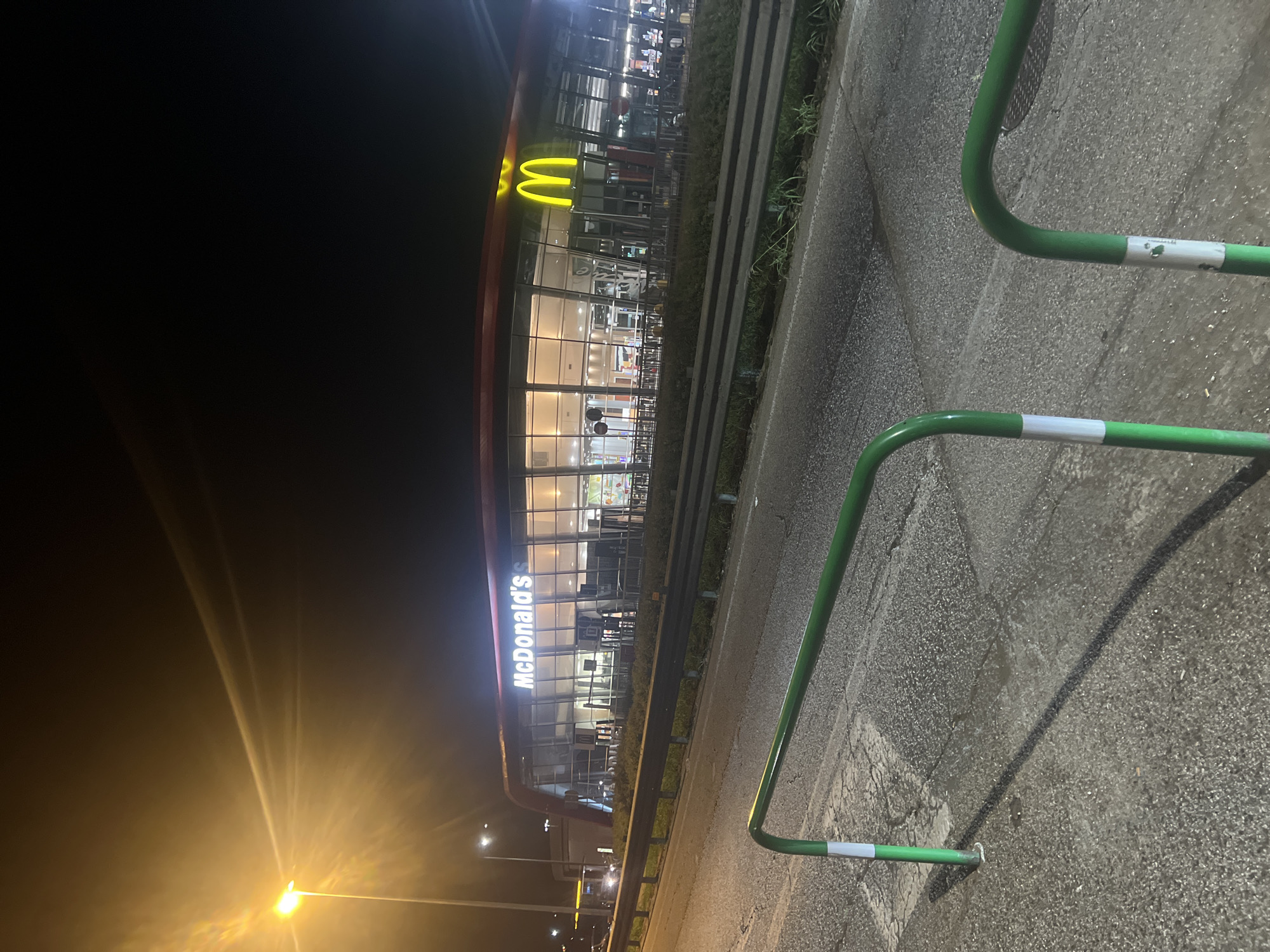
A night-time exterior shot of a McDonald's restaurant in Padua, Italy. The restaurant features a modern, curved architectural design with large glass windows that illuminate the interior. A prominent yellow "M" logo is visible on the facade, as well as the "McDonald's" text. In the foreground, a green metal barrier with white accents runs across the frame, separating the viewer from a paved area and a grassy verge. A lamppost with a bright light is visible to the left of the McDonald's, casting a strong yellow glow and lens flare across the dark sky. The ground appears wet, possibly from rain, and reflects the surrounding lights. No people are clearly visible.
Padua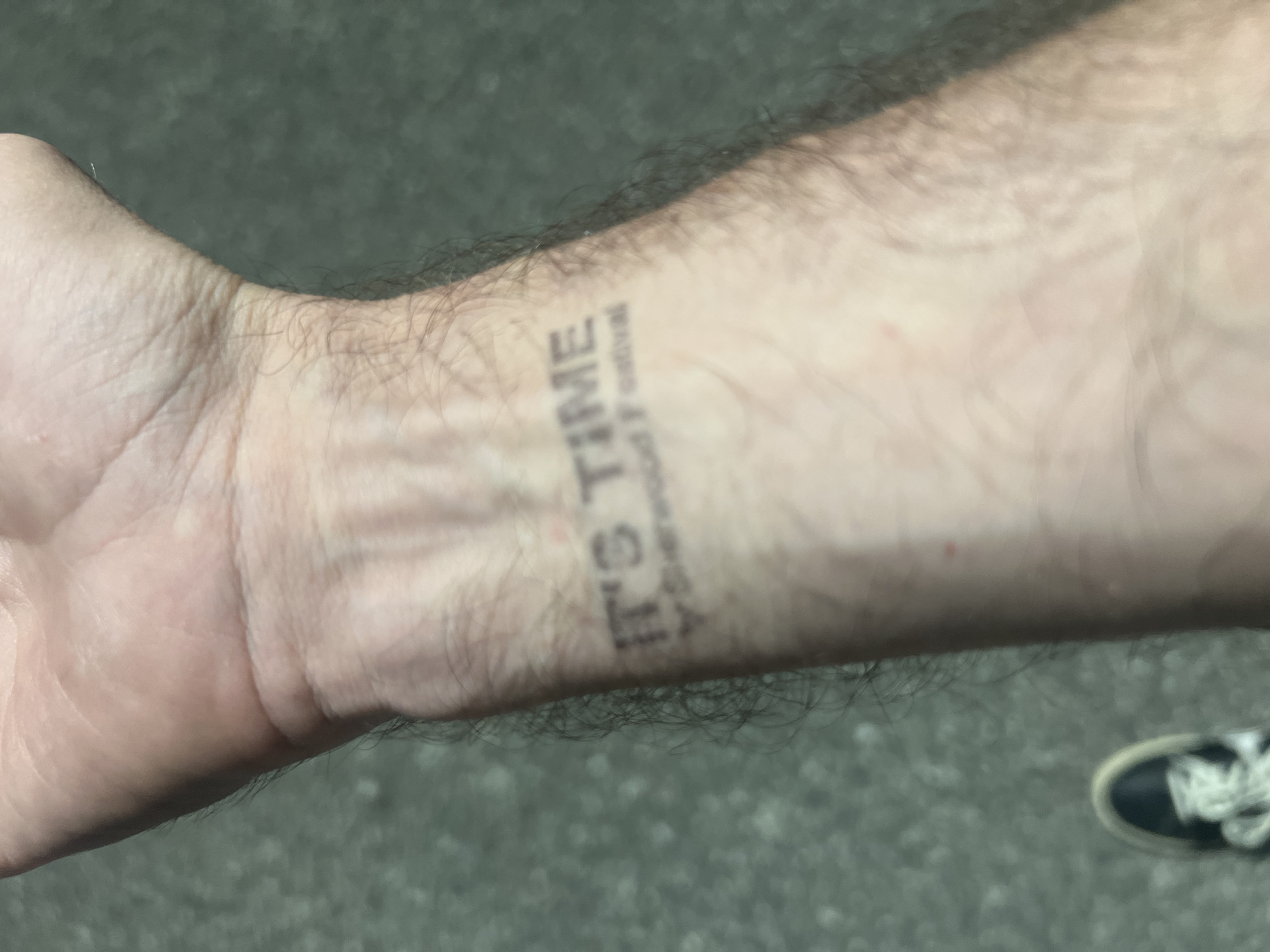
A close-up, eye-level shot shows a person's forearm and wrist with a tattoo on it. The tattoo is in dark ink and reads "IT'S TIME" above smaller text that is partially obscured but appears to say "Sherwood Festival". The skin is fair and covered in fine hairs. The background is a mottled gray and green surface, possibly asphalt or concrete, with a blurred athletic shoe visible in the lower left corner. The image is not located in Padua, Italy.
Padua
A wide shot of an outdoor concert at sunset. A large crowd of people are seated on a grassy hill facing a stage in the distance. The sun is setting behind the stage, casting a warm orange glow across the sky. Lights are visible on the stage, and it appears to be a band performing. The people on the hill are casually dressed, and many are sitting on blankets or directly on the grass. The overall atmosphere seems relaxed and festive.
Padua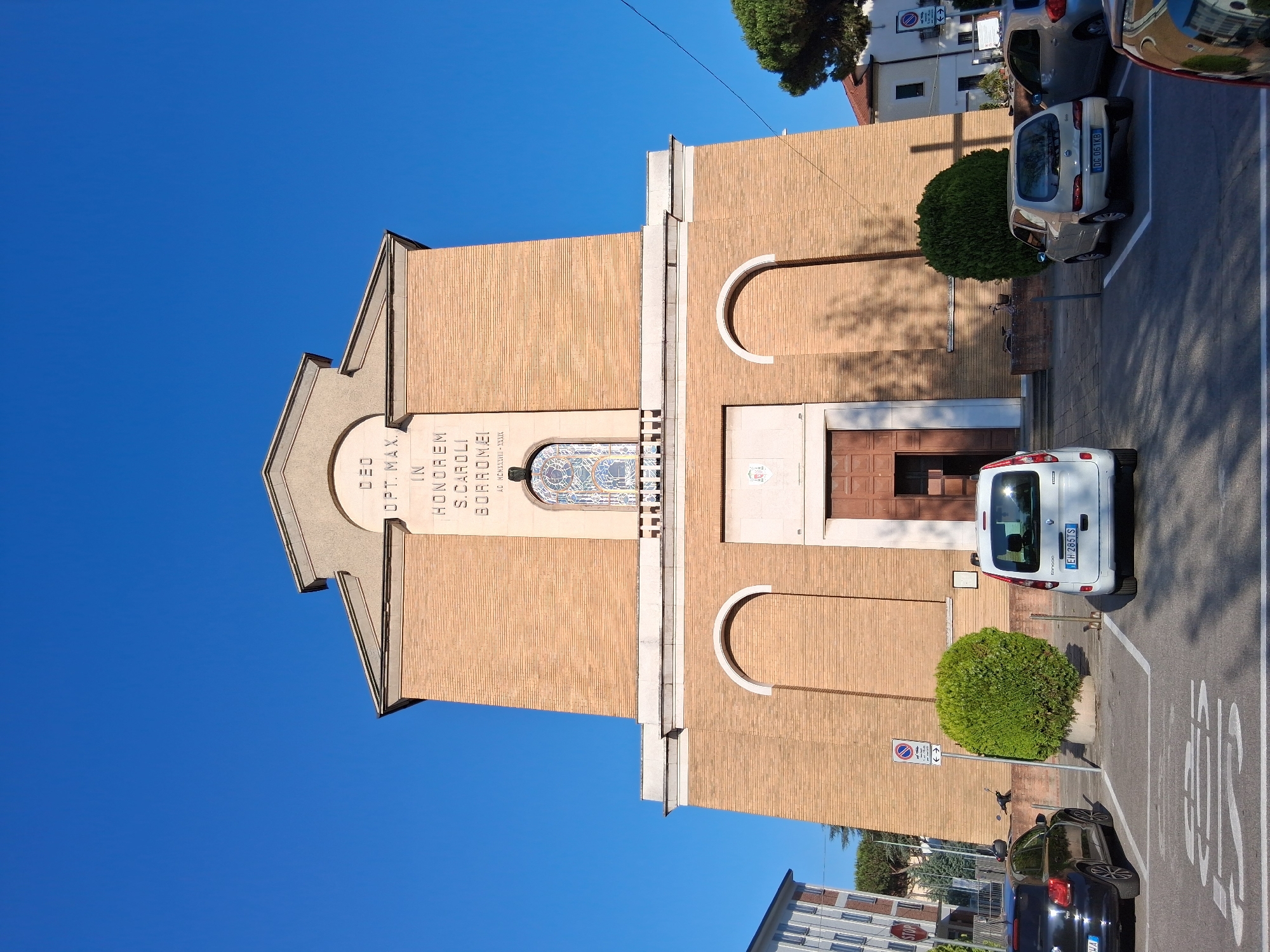
The image shows the facade of a brick church on a clear, sunny day. The church has a large arched entrance with a wooden door and a stained-glass window above it. Inscriptions are visible above the window. There are two arched alcoves on either side of the main entrance. In front of the church, there is a parking lot with several cars. To the left, there is a modern building and a stop sign. To the right, there is a tall green tree and part of another building. The location is the Chiesa di San Leopoldo Mandic in Padua, Italy.
Padua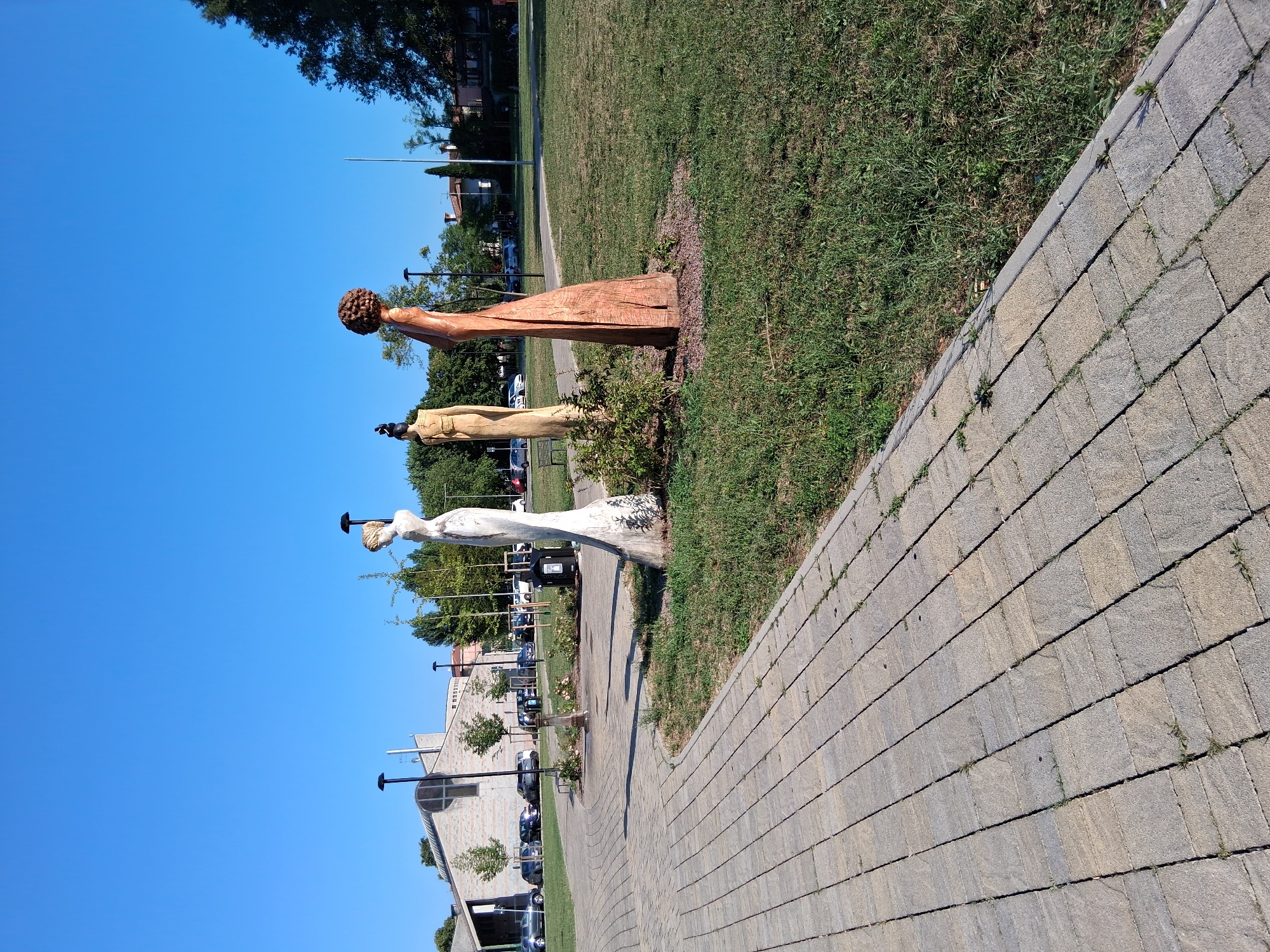
The image shows a sunny outdoor scene with a paved walkway in the foreground. Three abstract wooden sculptures of figures stand in a grassy area behind the walkway. The figures are tall and slender, with stylized heads. To the left, a modern building with a distinctive curved roof is visible, which appears to be a church. Cars are parked in front of the building, and trees and lampposts are scattered throughout the area. The sky is clear and blue. The scene is located in Padua, Italy.
Padua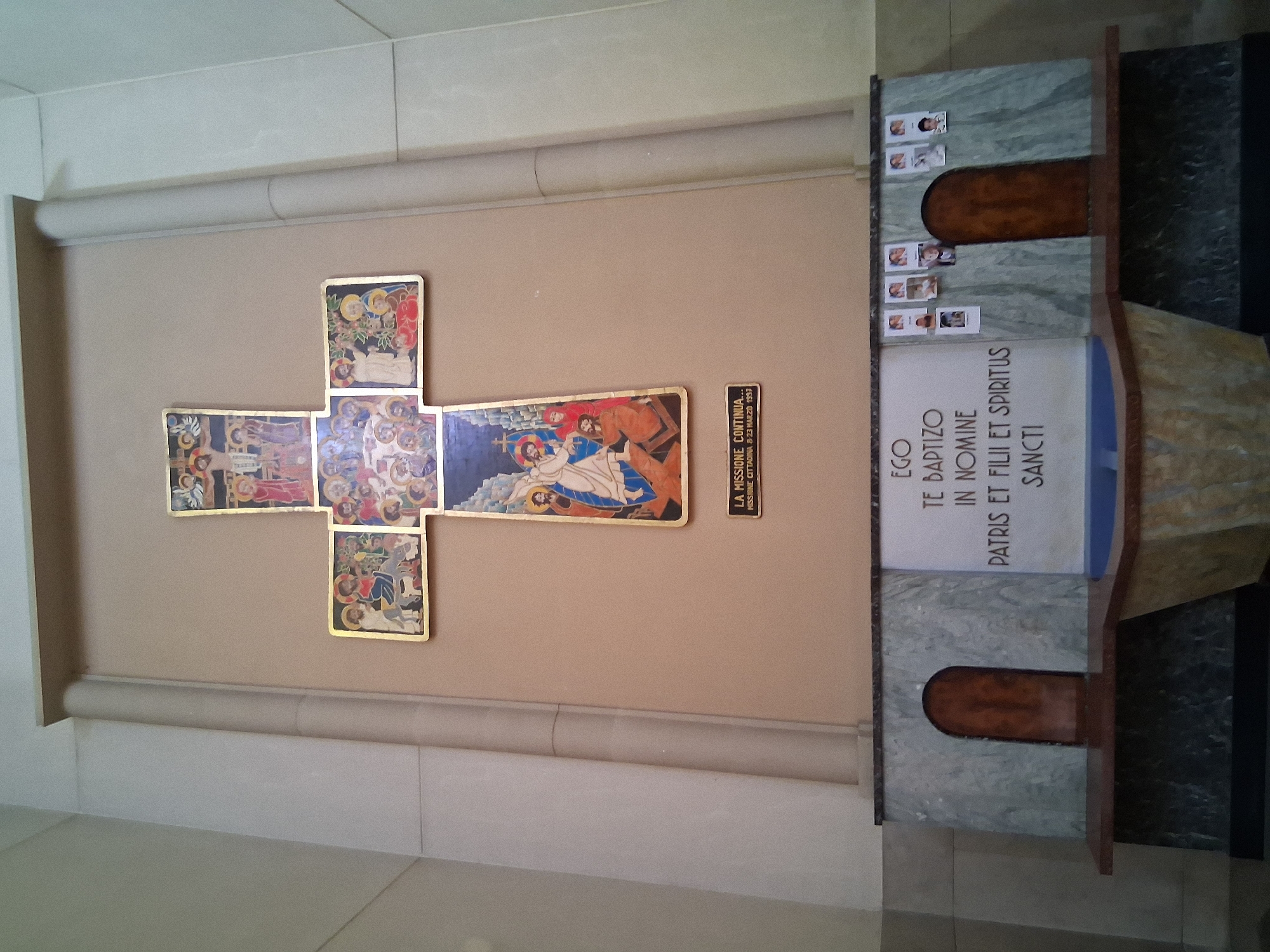
The image shows a large, ornate cross mounted on a plain, light brown wall in what appears to be a religious building, possibly a church. The cross is decorated with multiple small, rectangular panels depicting religious scenes in a vibrant, stylized manner, framed by gold leaf. The central panel at the top shows a depiction of Jesus on the cross. Below this, various other scenes are depicted, including what looks like the Last Supper, Jesus with children, and other figures. At the bottom of the cross, a small, dark plaque with white lettering is affixed to the wall. Below the cross, there is a marble-clad structure with a dark, reddish-brown surface on top, forming a sort of altar or display area. In the center of this structure, a white panel with dark, stylized lettering reads "EGO BAPTIZO IN NOMINE PATRIS ET FILII ET SPIRITUS SANCTI". Above this text, and to the right, several small, rectangular photographs of children are pinned to the marble. There are two recessed, arched wooden openings on either side of the central white panel. The overall impression is of a place of worship, likely a baptismal font area, given the text and the photographs of children. The style of the cross and the marble suggests a traditional, possibly historical, setting. The background walls on either side of the cross are a lighter beige color and have subtle vertical column details. The location in Padua, Italy, is identified as the Church of San Gaetano (Chiesa di San Gaetano) through external information. This particular area with the baptismal font is located within the church.
Padua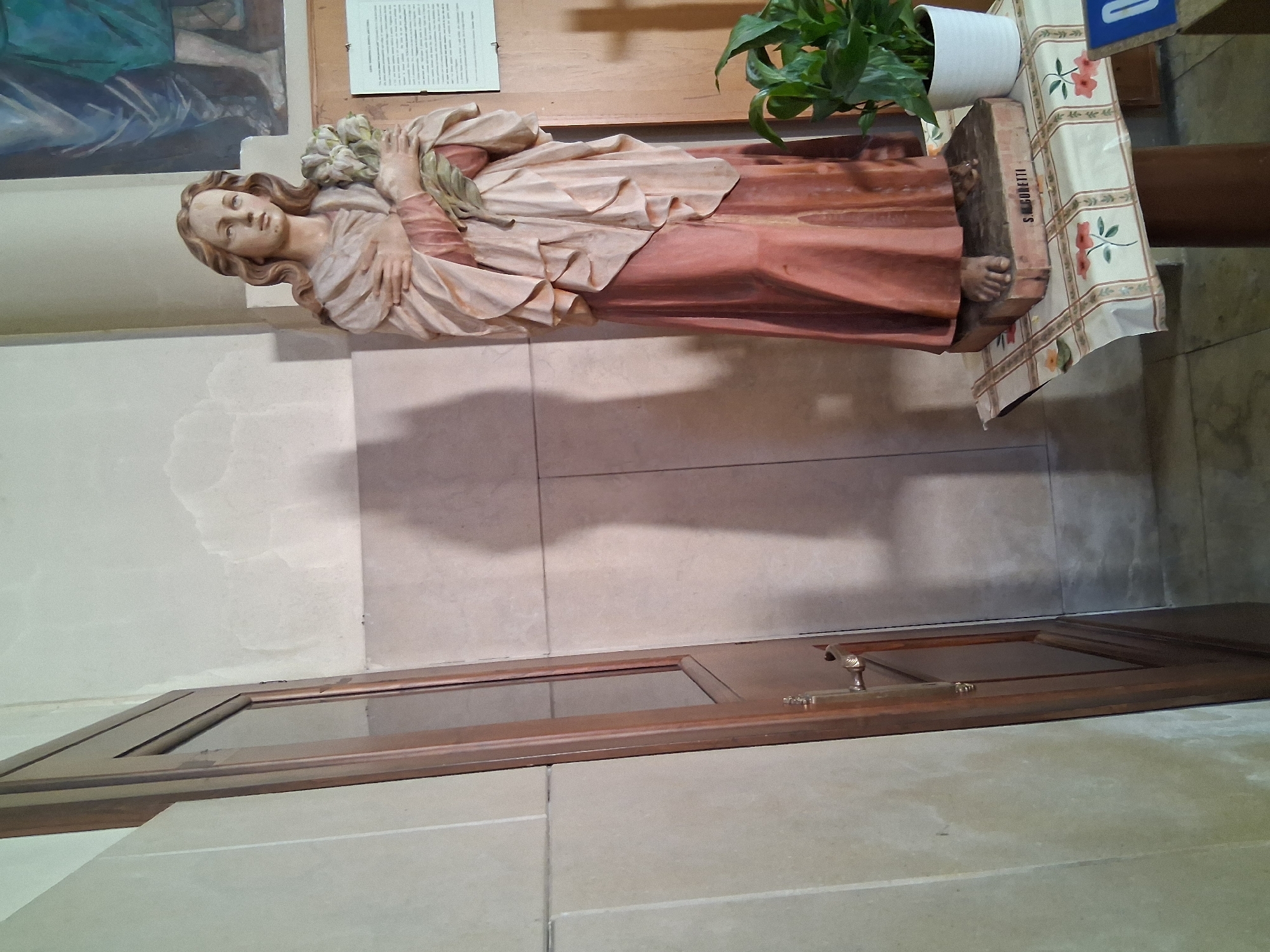
The image depicts a full-length statue of a young woman, likely a saint, dressed in a long, draped robe in shades of pink and peach. She holds a bouquet of lilies in her arms, and her gaze is directed upwards. The statue is made of wood and stands on a brick base with the inscription "S. MARIA GORETTI" visible. The statue is placed on a pedestal covered with a tablecloth featuring a floral pattern. To the right of the statue, a green potted plant sits in a white ceramic pot. In the background, a large oil painting, partially visible, shows figures in blue and green robes. The walls are a neutral tone with visible imperfections, and a wooden door with a glass pane and brass hardware is situated to the left of the statue. This scene is located within the Sanctuary of Saint Maria Goretti in the Minor Basilica of Saint Anthony of Padua, in Padua, Italy. The presence of the statue of Saint Maria Goretti, along with the inscription on her base and the context of the Minor Basilica of Saint Anthony, strongly indicates this specific location.
Padua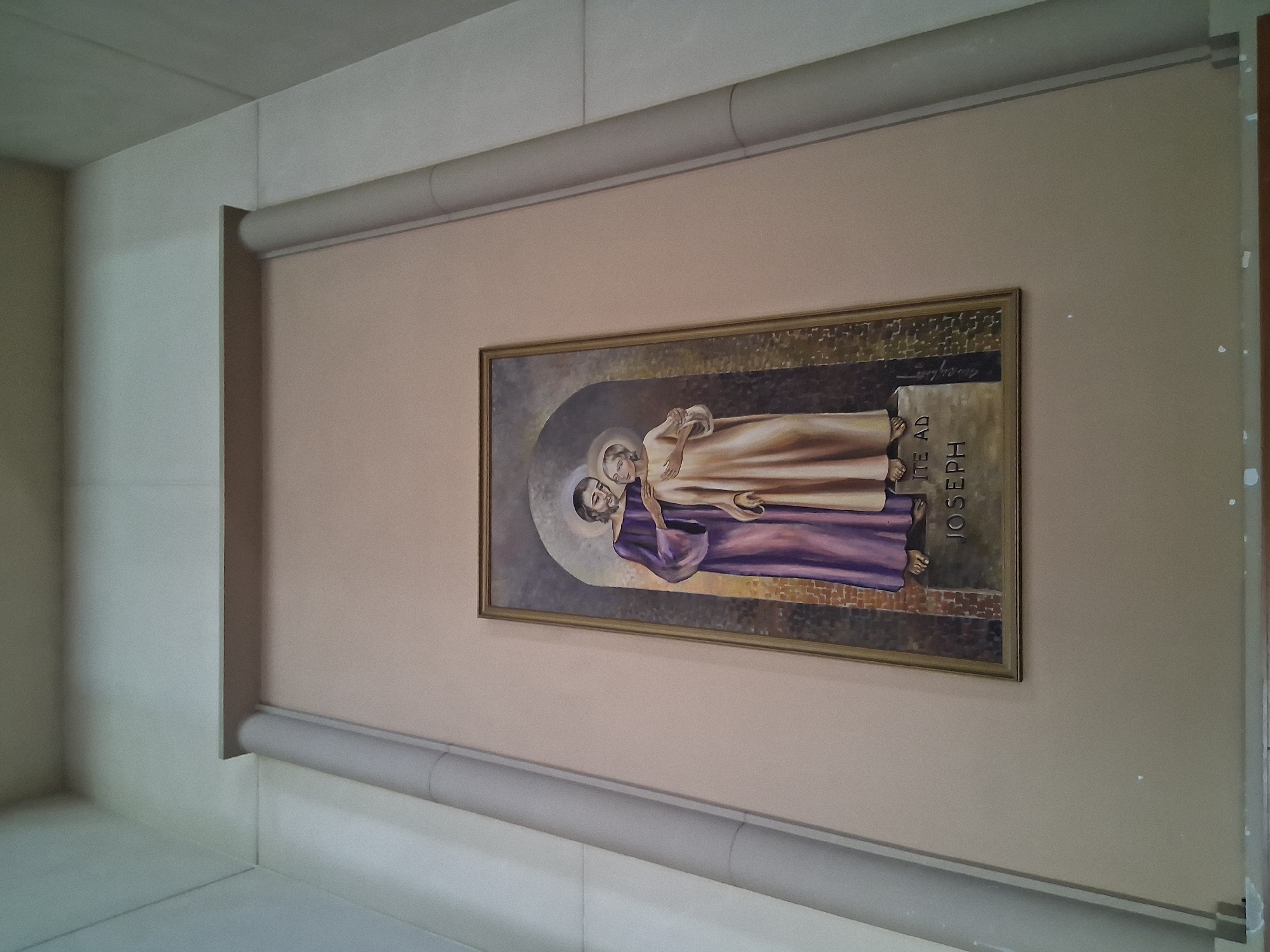
This is a full-body, eye-level shot of a painting of Saint Joseph and the infant Jesus, prominently displayed on a light tan wall in what appears to be a church or a similar religious building. The painting is framed in gold and depicts Saint Joseph, clad in a purple robe, gently embracing and looking down at the infant Jesus, who is wearing a light-colored garment and has a halo. The background of the painting features an arched opening and a textured, mosaic-like pattern. The text "ITE AD JOSEPH" is visible below the figures in the painting. The wall is flanked by tall, fluted columns, and the overall architecture suggests a grand, sacred space. The lighting is soft and diffused, illuminating the painting and its surroundings.
Padua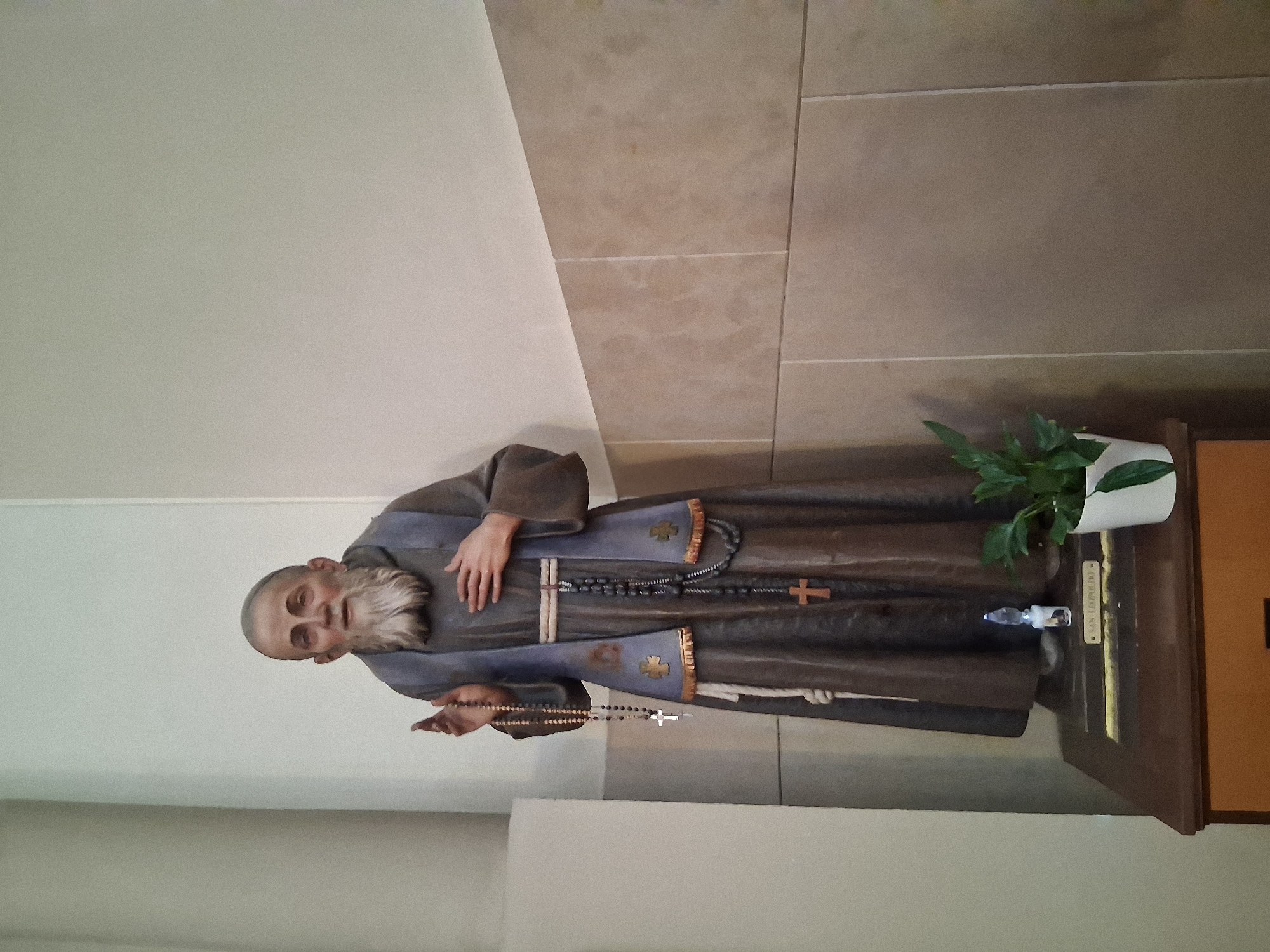
A full-body statue of Saint Leopold Mandić is depicted in a religious setting, likely a church or shrine. The statue is life-sized and represents the saint as an elderly man with a bald head, a long white beard, and a serene expression. He is wearing a brown monastic robe with a blue scapular adorned with golden trim and embroidered crosses. In his right hand, he holds a rosary, with the beads cascading down to his left hand, which rests on his chest. A second, larger rosary hangs around his neck. The statue stands on a dark wooden pedestal. On the pedestal, a small, clear glass votive lamp is placed in front of the statue, and a plaque with the inscription "SAN LEOPOLDO" is visible. To the right of the statue, a potted green plant with broad leaves sits on the pedestal. The background consists of a plain, light-colored wall on the left and a tiled wall with large, rectangular beige tiles on the right, separated by vertical grout lines. The lighting is soft and diffuse, illuminating the scene without harsh shadows. The location is identified as the Basilica of Saint Anthony of Padua in Padua, Italy, a popular pilgrimage site.
Padua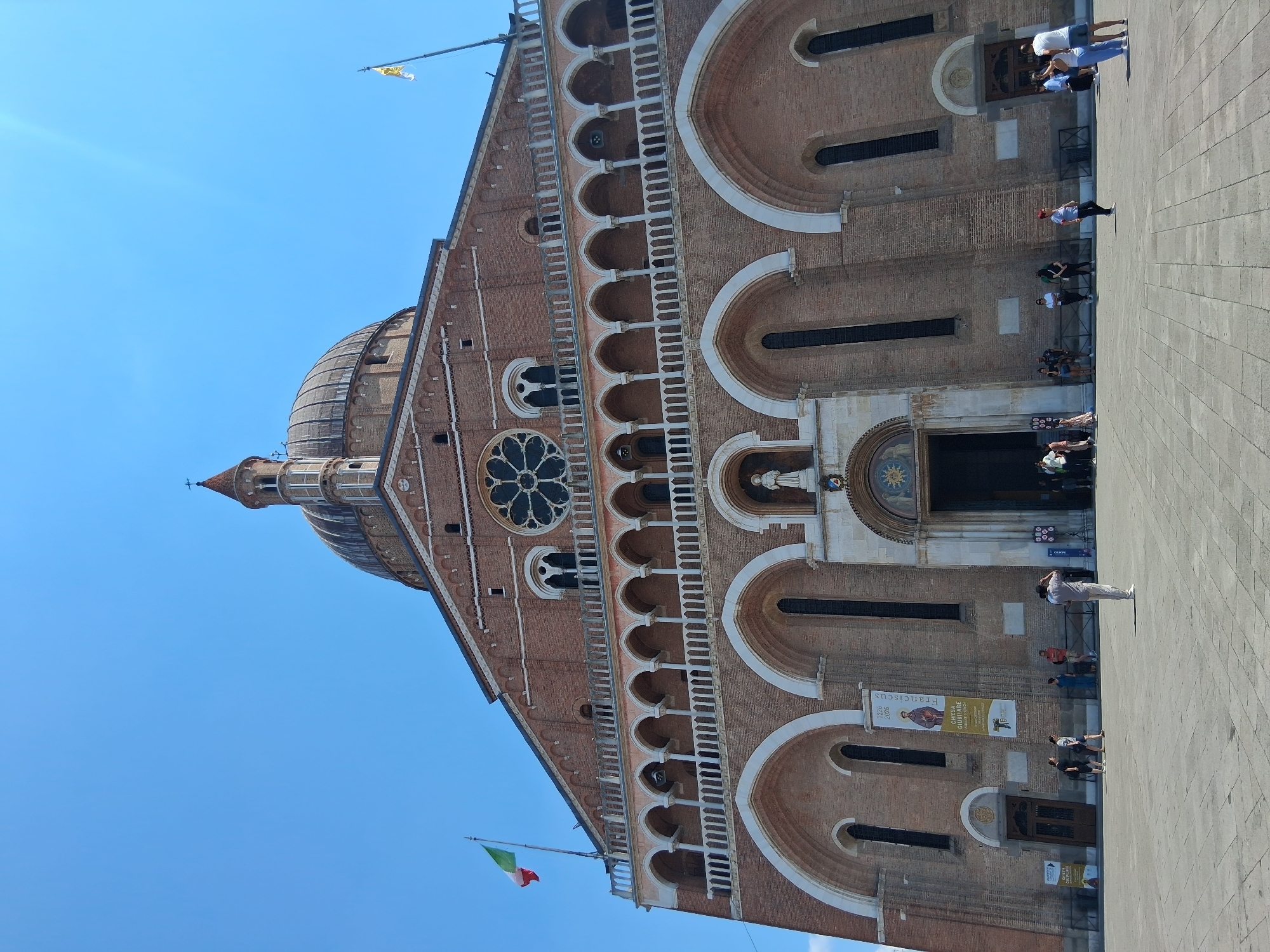
The image shows a wide-angle, low-angle shot of the Basilica di Sant'Antonio da Padova in Padua, Italy, under a clear blue sky. The facade of the basilica is constructed of red brick and features multiple arched entrances, windows, and a large rose window. A dome and a slender tower with a cross on top are visible rising from the structure. Two flags fly on poles to the left and right of the main facade. In front of the basilica is a large, paved piazza. Several people are present in the piazza, some walking, others standing and observing the basilica. One person in the foreground is taking a photo with their phone. Banners are hanging on the facade of the basilica. The overall impression is of a sunny day at a prominent religious and tourist landmark.
Padua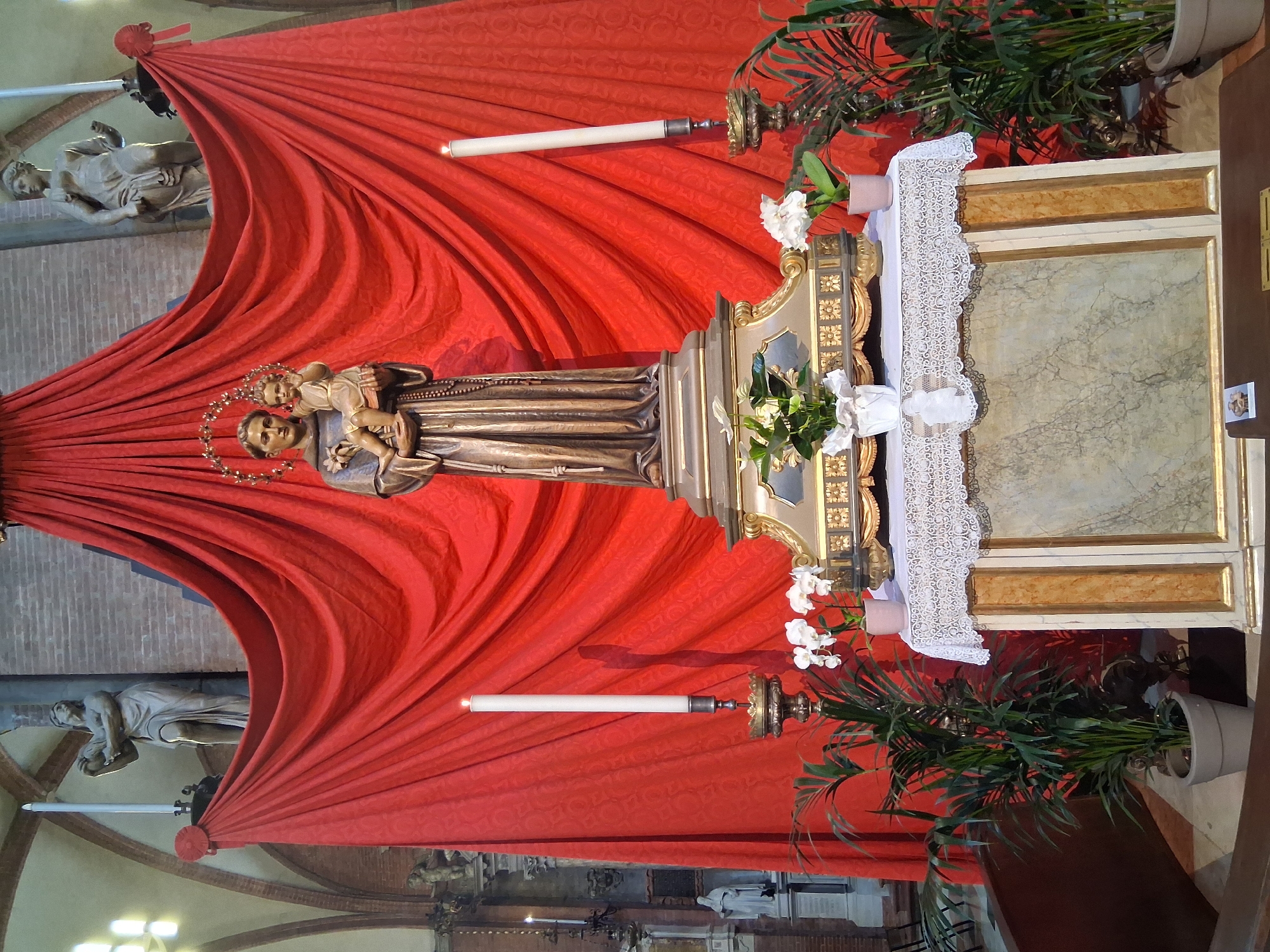
The image depicts an altar within a church, likely the Basilica of Saint Anthony of Padua in Padua, Italy, given the prominent statue. The focal point is a statue of Saint Anthony of Padua holding the Christ Child, dressed in a brown Franciscan habit and a halo. The statue is positioned on an ornate golden and grey pedestal. The altar itself is draped with a red fabric backdrop, which is ornately pleated and covers the majority of the background. Two tall white candles in ornate candelabras flank the central statue, one on each side. In front of the pedestal, a white lace tablecloth is spread over a marble-fronted altar structure, adorned with potted white orchids and other greenery. Above and behind the red drapery, two stone statues are partially visible, one on the left and one on the right, suggesting the grandeur of the church architecture. In the foreground, to the left and right of the altar, are large potted plants, likely palms, adding a touch of natural greenery to the scene. A small printed image is visible on a dark surface in the lower foreground. The lighting suggests an indoor environment, likely illuminated by artificial sources.
Padua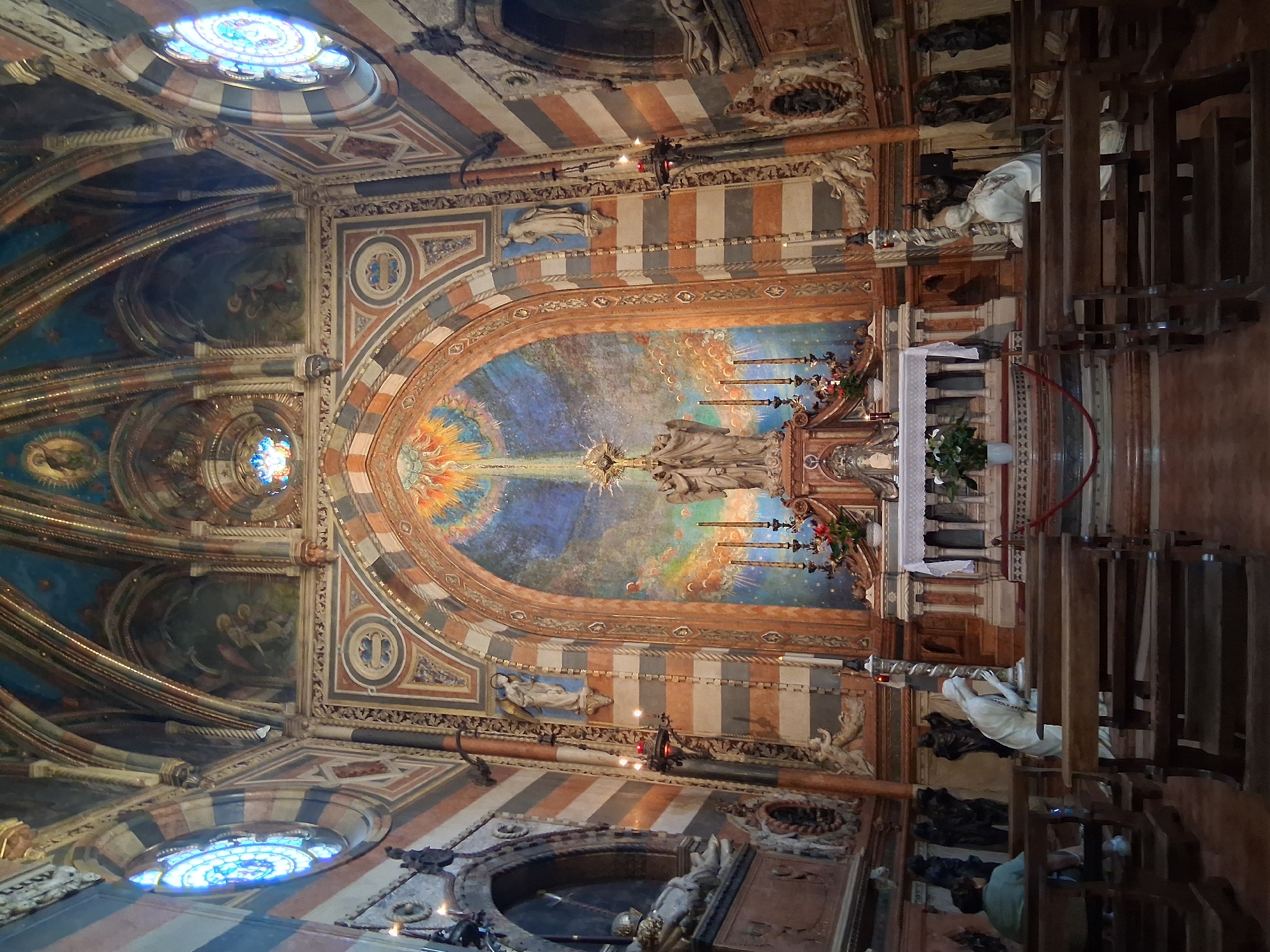
The image depicts the interior of the Scrovegni Chapel in Padua, Italy. The chapel is ornately decorated with frescoes and architectural details. In the foreground, several rows of wooden pews are visible, some occupied by individuals. To the right, a white statue of a kneeling figure is positioned near the pews. The central focus of the image is the altar area, which is adorned with a large fresco above it, depicting a celestial scene with figures and a beam of light. Statues of religious figures are present on either side of the altar. The walls and ceiling of the chapel are intricately painted with religious scenes and decorative patterns. Stained-glass windows with blue and white patterns are visible on the upper left and right sides of the image. The overall impression is one of solemnity and religious reverence.
Padua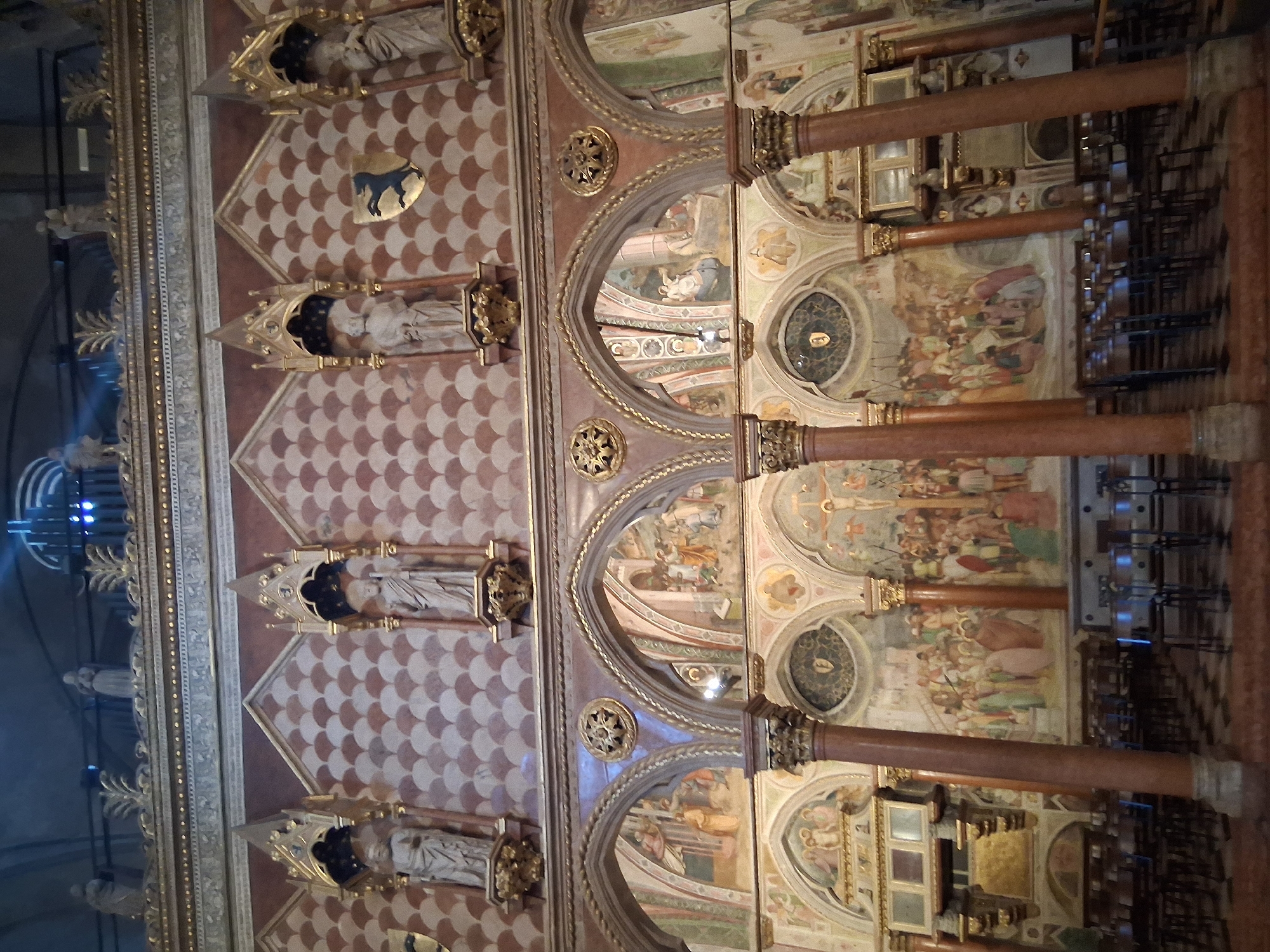
The image depicts the interior of the Scrovegni Chapel in Padua, Italy. The chapel's walls are adorned with frescoes by Giotto, which are a significant masterpiece of Western art. The frescoes illustrate scenes from the lives of Joachim and Anne, the life of the Virgin Mary, and the life and passion of Jesus Christ. The image captures a section of the lower walls and arches, featuring rows of seated figures depicted in various biblical narratives. The artwork is characterized by vibrant colors, realistic portrayal of human emotions, and a sense of dramatic storytelling. The architectural elements of the chapel, such as the columns and arches, are also visible, contributing to the overall grandeur of the space. The lighting suggests an indoor environment, likely with natural light filtering in from unseen sources.
Padua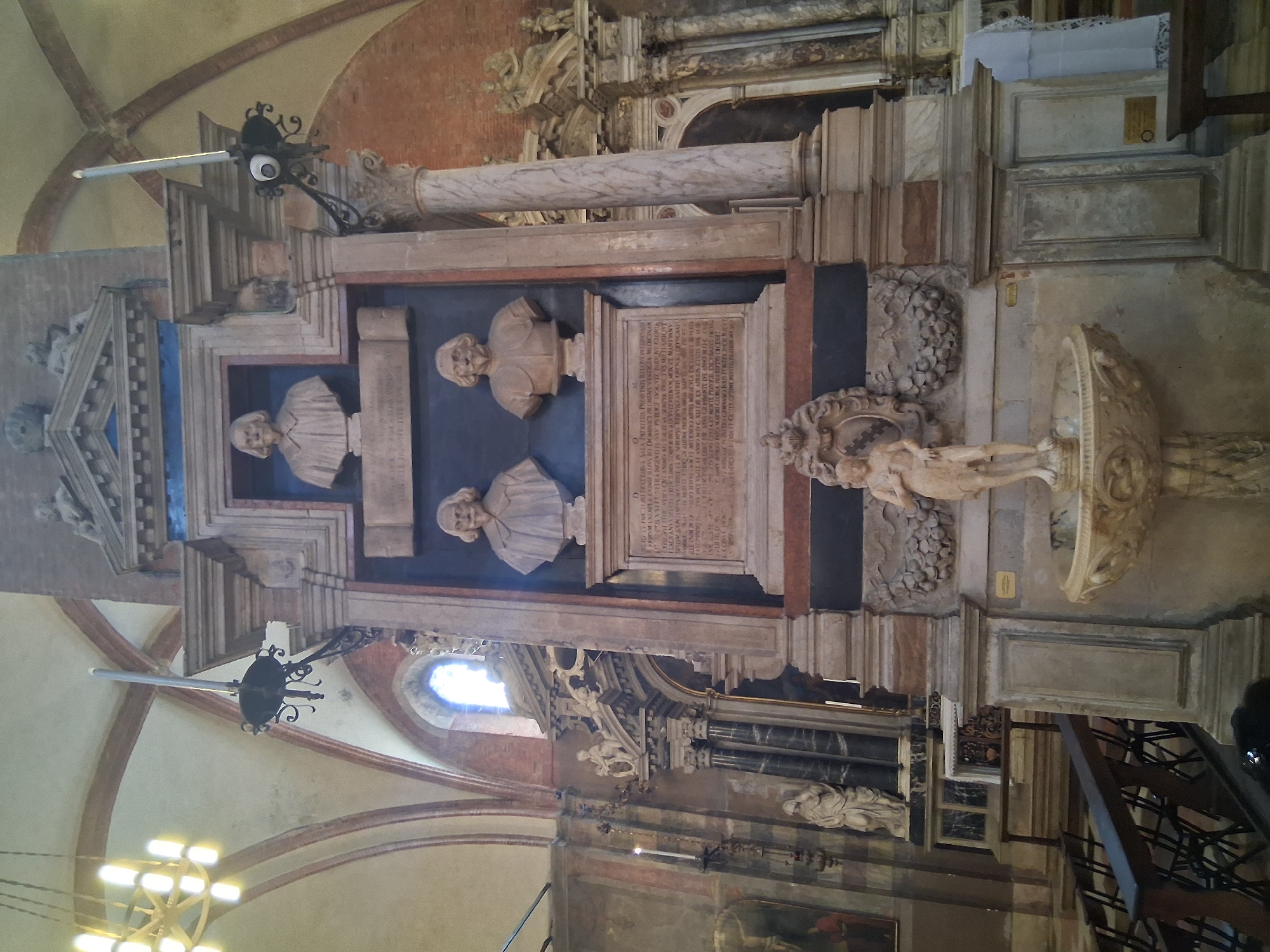
The image depicts a view inside a church, specifically the Basilica of Saint Anthony in Padua, Italy. The central focus is a large, ornate monument, likely a tomb or memorial, with several sculpted busts and intricate architectural detailing. The monument features at least three sculpted busts of men, one at the top and two below. A smaller, naked statue of a figure stands on a fountain at the base of the monument. The monument is flanked by large marble columns. In the background, architectural elements of the church are visible, including arched ceilings with exposed brickwork, stained glass windows, and other religious artworks and fixtures such as a chandelier and wall sconces with candles. The scene appears to be captured during daylight, with light streaming in from a window. There are no people clearly visible in the immediate foreground, but the presence of benches suggests this is an area accessible to visitors.
Padua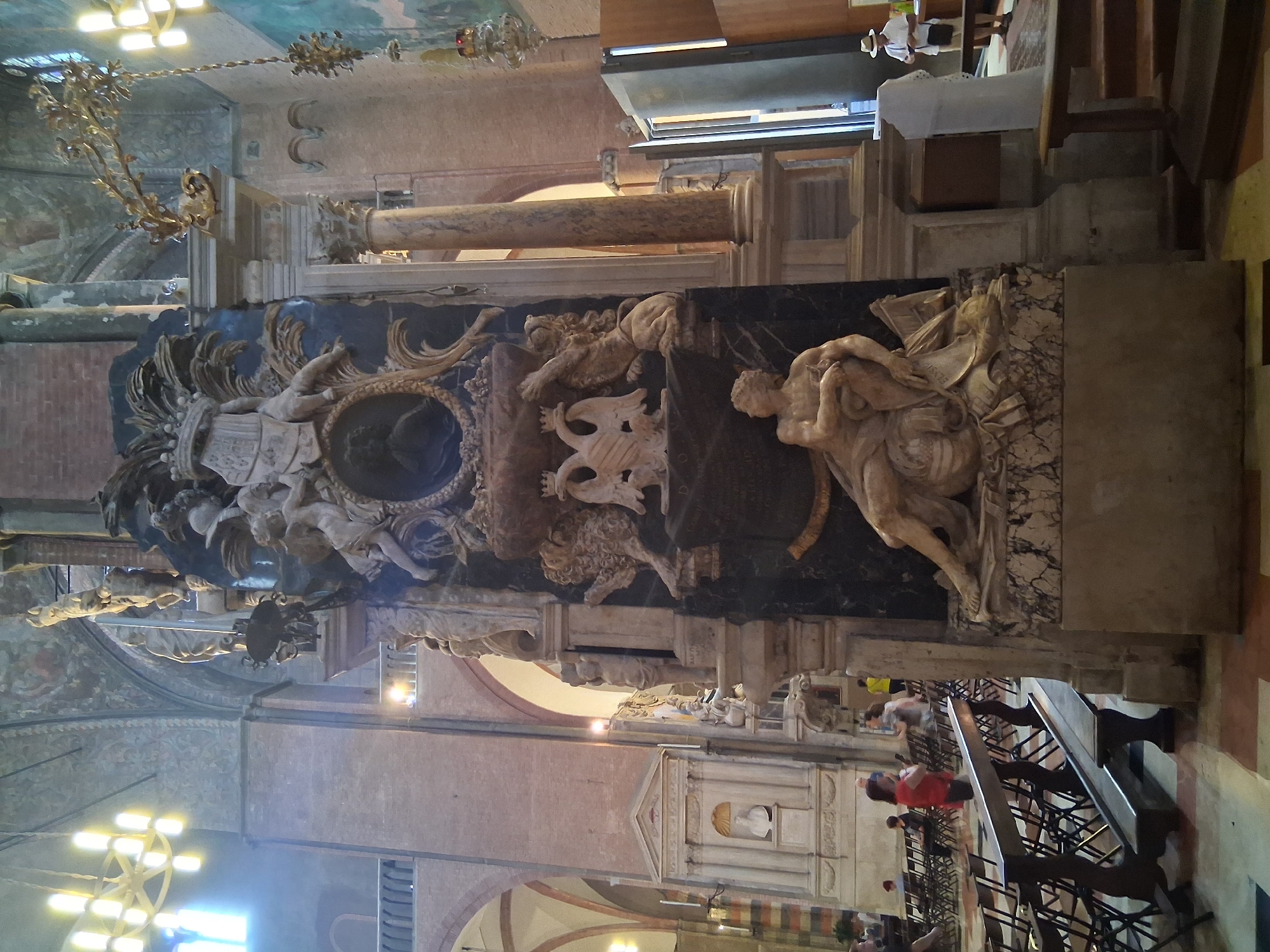
The image shows the interior of a grand church in Padua, Italy. The focal point is a large, ornate monument with intricate sculptures, including figures of cherubs, an eagle, a lion, and a reclining male figure at the base. The monument is made of marble and dark stone, with detailed carvings and a coat of arms at the top. The church features high ceilings with painted frescoes, arched windows, and large columns. In the foreground, there are rows of dark wooden pews and benches. Several people are visible in the background, some appearing to be tourists or visitors, with one person wearing a white shirt and a straw hat standing near an open doorway on the right side of the image. The lighting suggests it is daytime, with natural light entering from the windows and artificial lighting from chandeliers. The overall impression is one of historical significance and architectural grandeur.
Padua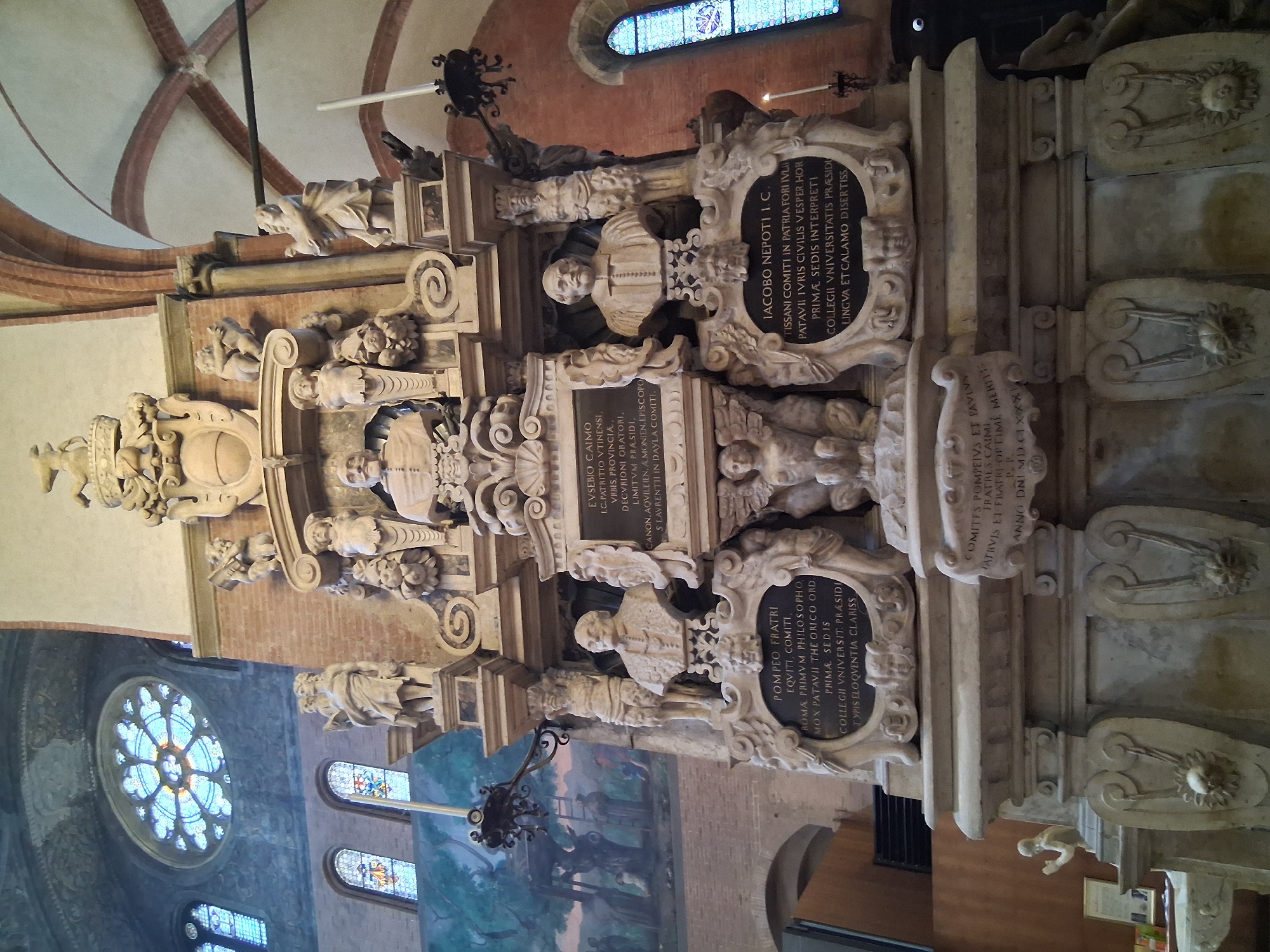
The image shows a grand Baroque tomb monument in the Basilica di Sant'Antonio in Padua, Italy. The monument is made of white marble and is highly ornate, featuring multiple statues, busts, and inscriptions. In the center, there are two busts of men, one on the left and one on the right. Between them, there is a relief sculpture of an angel holding a shield. Above the busts, there is a larger sculpture of a coat of arms topped with a figure. Flanking the central monument are columns with carved figures. The monument is set against a brick wall, with a large mural painting of figures in a landscape on the left side of the image. In the background, a rose window and stained-glass windows of the basilica are visible. The scene is well-lit, suggesting it is daytime inside a church.
Padua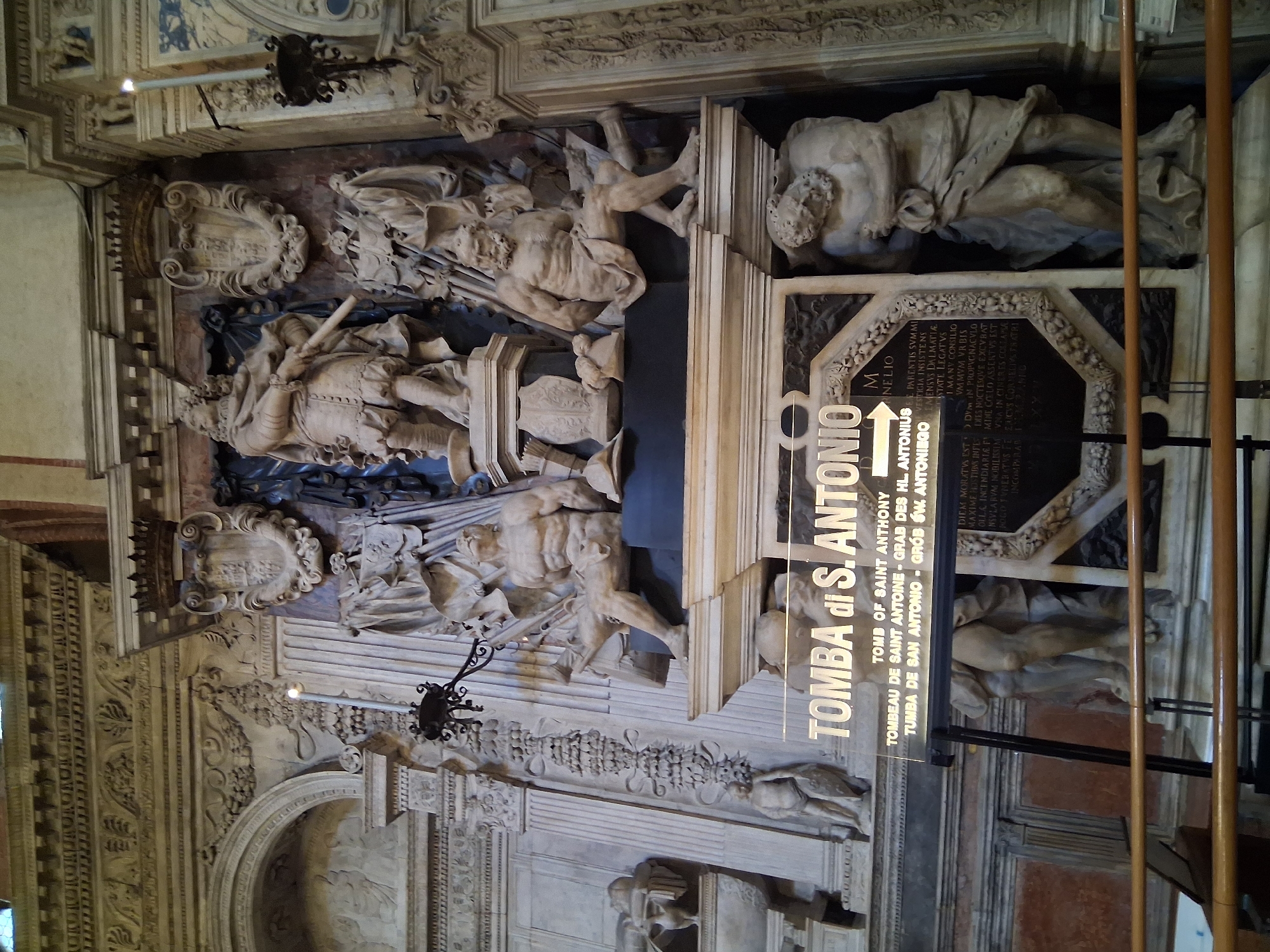
The image shows the tomb of Saint Anthony of Padua, located in the Basilica of Saint Anthony in Padua, Italy. The tomb is a large, elaborate monument adorned with sculptures. At the center of the monument is a statue of a man in armor, holding a sword. Flanking this central figure are statues of muscular men, some seated and some standing. Below the main sculptural group, a sign reads "TOMBA di S. ANTONIO" with translations in several languages. The monument is set against a backdrop of ornate architectural detailing, including a coat of arms and a crown. There are also candles and lamps visible, suggesting this is an interior religious setting. The overall impression is one of grandeur and religious significance.
Padua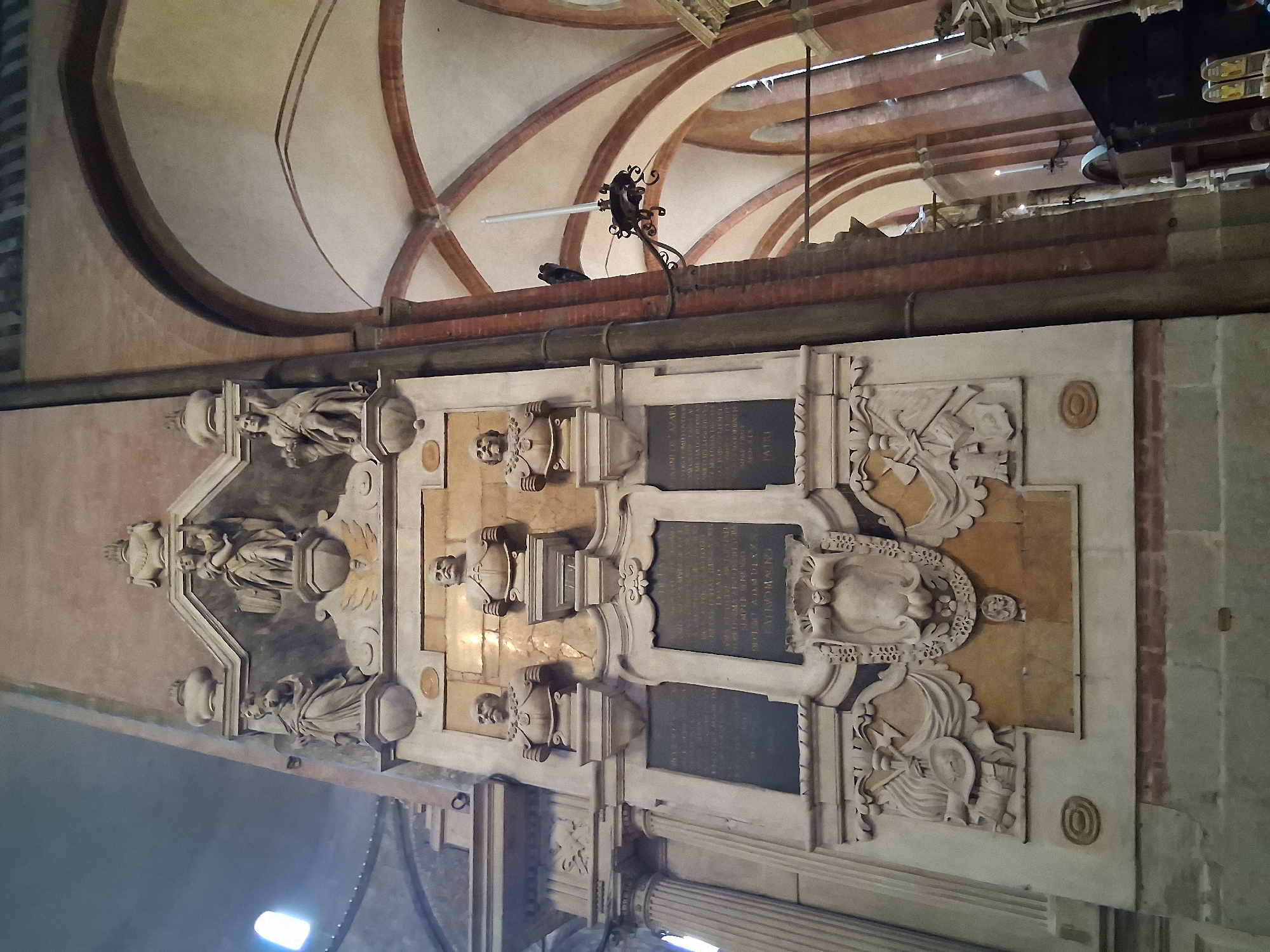
The image shows a monument inside a church in Padua, Italy. The monument is made of stone and features several statues and inscriptions. On the left side of the monument, there are two statues of women, one holding a child and the other holding a book. Above them, there are two more statues, possibly of religious figures. In the center of the monument, there are three busts of men, each with a plaque below it. The busts are made of stone and are highly detailed. The plaques below the busts are inscribed with text, but it is difficult to read in the image. The monument is decorated with intricate carvings and ornamentation. The church interior is visible in the background, with arched ceilings and brick walls. There is a candelabra hanging from the ceiling on the right side of the image. The lighting in the church is dim, with some natural light coming from a window on the left side of the image.
Padua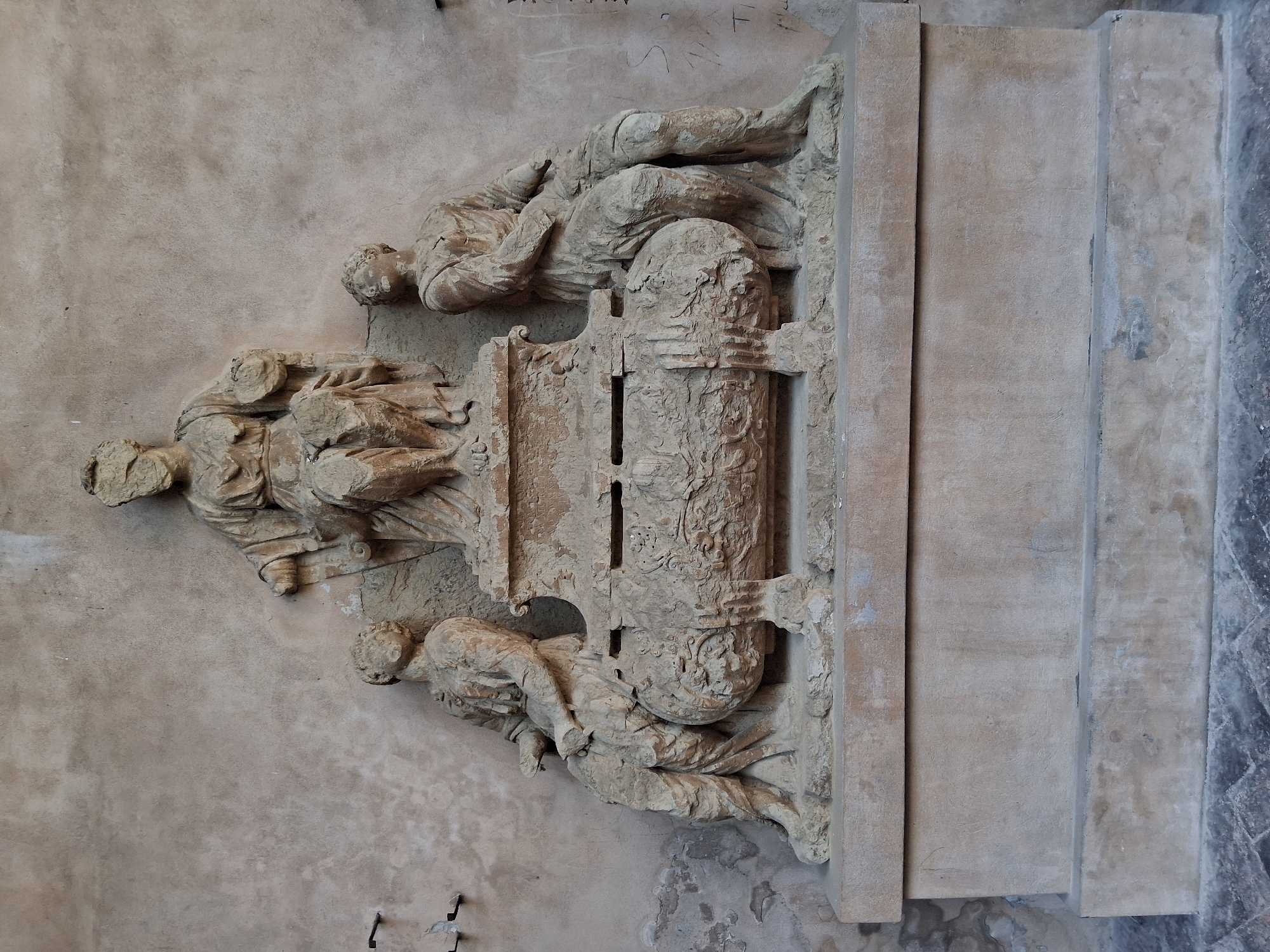
This is a close-up, medium shot, full-frame image of an ancient stone relief sculpture mounted on a textured, weathered wall. The sculpture is a funerary monument depicting three figures. A central, seated female figure, likely a personification, is flanked by two standing male figures. All figures are carved from stone and appear aged and worn, with some damage and missing parts. The central figure is adorned with drapery and holds an object in her lap. The figures are positioned above a large, ornate sarcophagus-like structure, which itself rests on a stone pedestal. The wall behind the sculpture is a muted, earthy tone with visible imperfections and a rough texture. The lighting is even, suggesting it might be an overcast day or the sculpture is in a shaded area. The overall impression is one of antiquity and solemnity. This monument is located in the Scrovegni Chapel in Padua, Italy.
Padua![This image shows a bronze bust of a man in religious attire, likely a friar, mounted on a light-colored rectangular plaque against a textured, beige wall. The bust is dark green and depicts the man with a stern expression, holding a book in his left arm and a key in his right hand. Below the bust is a reddish-brown stone tablet with an inscription. The plaque behind the bust has a geometric pattern of raised lines that converge towards the center. The wall surrounding the plaque exhibits signs of age and wear, with cracks and discoloration.
This sculpture is located in the **Basilica of Saint Anthony of Padua, Italy**, specifically in the cloister. The inscription on the tablet reads: "P. FRANC. CANTORIO VALLOTTI 1697-1780 / MINOR CONVENTUAL / XXX ANNI INSIGNE MAESTRO / DELLA MUSICALE ANTONIANA / [illegible] 1994". This identifies the subject as Father Francesco Antonio Vallotti, a Franciscan friar and organist who lived from 1697 to 1780, and notes his significant role in the Antonian musical tradition. The tablet also commemorates 30 years of his service. The date "1994" likely refers to the year the monument was erected or rededicated.](https://firebasestorage.googleapis.com/v0/b/patr-3a75e.appspot.com/o/uploads%2Fimage_picker_1cc55340-937a-4d6c-9.jpg?alt=media)
This image shows a bronze bust of a man in religious attire, likely a friar, mounted on a light-colored rectangular plaque against a textured, beige wall. The bust is dark green and depicts the man with a stern expression, holding a book in his left arm and a key in his right hand. Below the bust is a reddish-brown stone tablet with an inscription. The plaque behind the bust has a geometric pattern of raised lines that converge towards the center. The wall surrounding the plaque exhibits signs of age and wear, with cracks and discoloration. This sculpture is located in the **Basilica of Saint Anthony of Padua, Italy**, specifically in the cloister. The inscription on the tablet reads: "P. FRANC. CANTORIO VALLOTTI 1697-1780 / MINOR CONVENTUAL / XXX ANNI INSIGNE MAESTRO / DELLA MUSICALE ANTONIANA / [illegible] 1994". This identifies the subject as Father Francesco Antonio Vallotti, a Franciscan friar and organist who lived from 1697 to 1780, and notes his significant role in the Antonian musical tradition. The tablet also commemorates 30 years of his service. The date "1994" likely refers to the year the monument was erected or rededicated.
Padua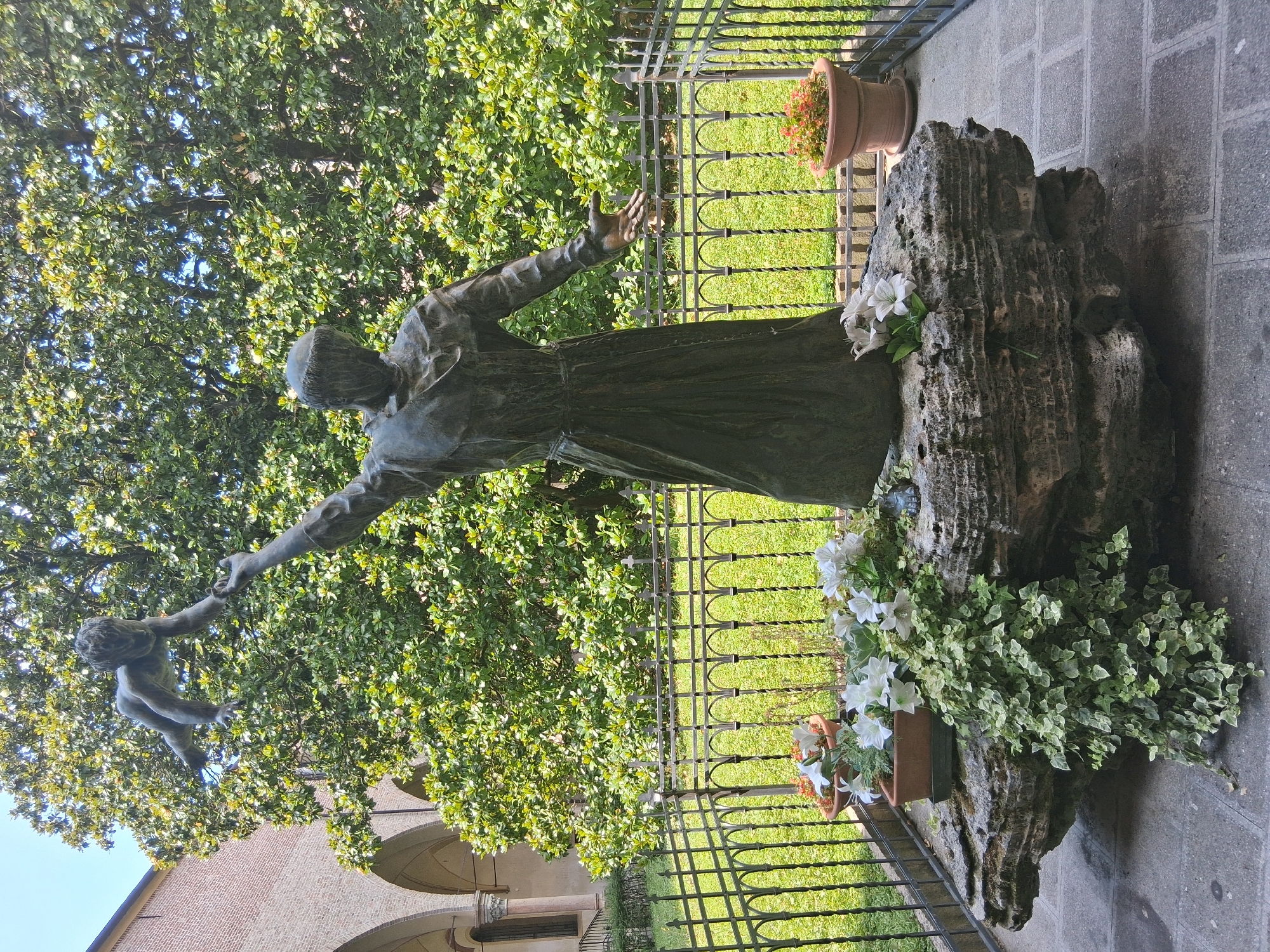
A bronze statue of a robed figure is depicted in a courtyard in Padua, Italy. The figure, likely a friar based on the habit, is holding a baby aloft with its left arm, while its right hand is outstretched with an open palm. The statue stands on a large, rough-hewn stone, which is adorned with potted plants and a cascading ivy vine. A decorative metal fence surrounds the statue, behind which a grassy lawn and lush green trees are visible. In the background, an arched building with brickwork and columns suggests an ecclesiastical or historical setting. The sky above is clear and blue, indicating a sunny day.
Padua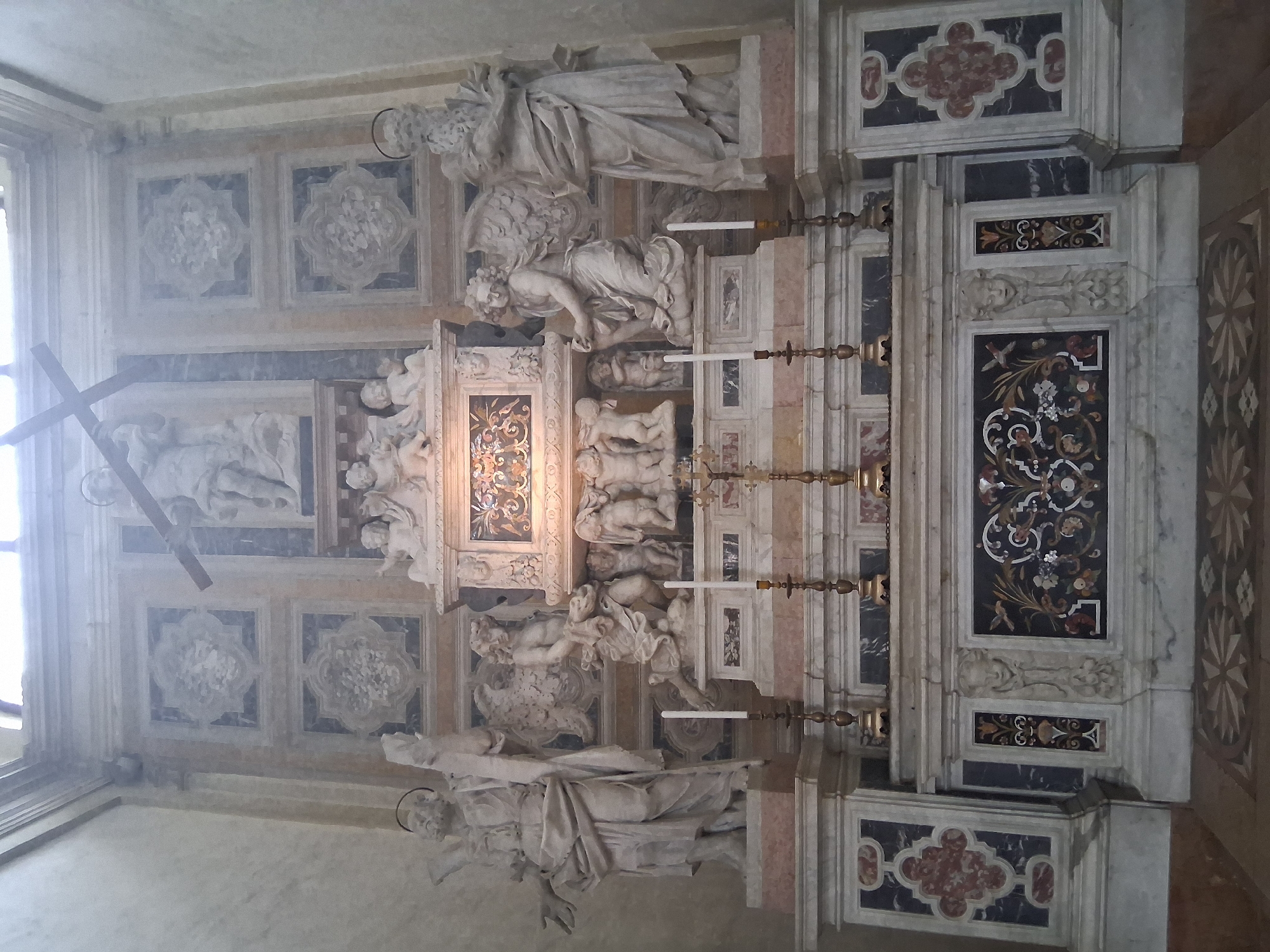
The image depicts a richly decorated altar within a church, located in Padua, Italy. The altar is a multi-tiered structure made of marble and adorned with intricate sculptures and decorative elements. At the top, a cross is prominently displayed, seemingly held by a sculpted figure of Jesus. Flanking the altar are large marble statues of saints. Below these, a central sculpted scene features cherubic figures and angelic beings. The lower portion of the altar displays detailed mosaic work with floral motifs and geometric patterns. Two tall candlesticks with lit candles stand before the altar. The surrounding architecture suggests a religious space with ornate paneling on the walls.
Padua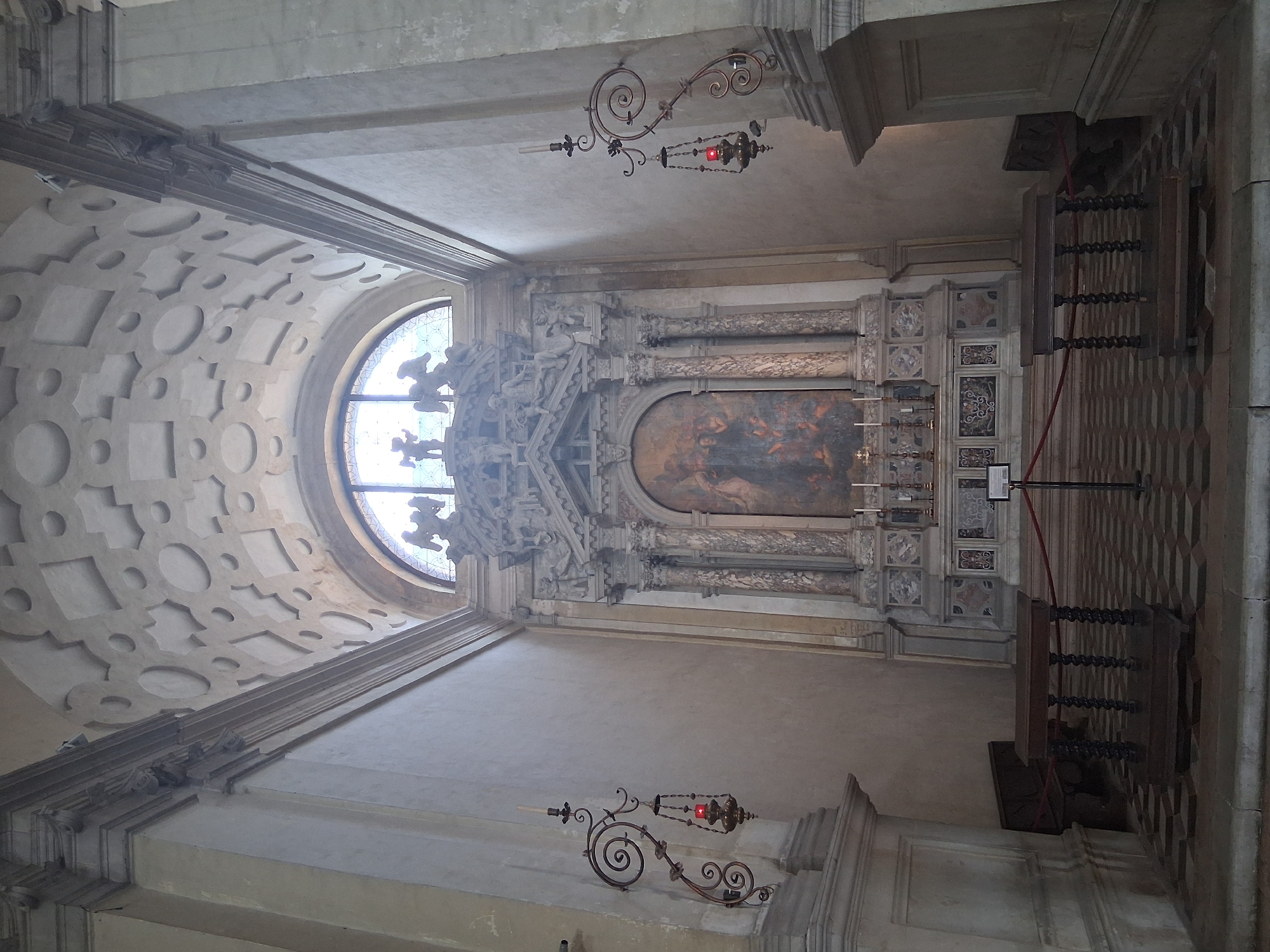
The image depicts the interior of a church in Padua, Italy. The central focus is an ornate altar with a large painting above it. The altar is flanked by columns and features intricate carvings and decorative elements. Above the altar, a semicircular window allows natural light to enter the space. The ceiling is decorated with a complex geometric pattern of recessed squares and circles. On either side of the altar, there are benches for seating, and decorative wall sconces with lamps are mounted on the walls. The floor is tiled in a checkerboard pattern.
Padua