Pamukkale, Turkey
30 memories from Pamukkale, Turkey
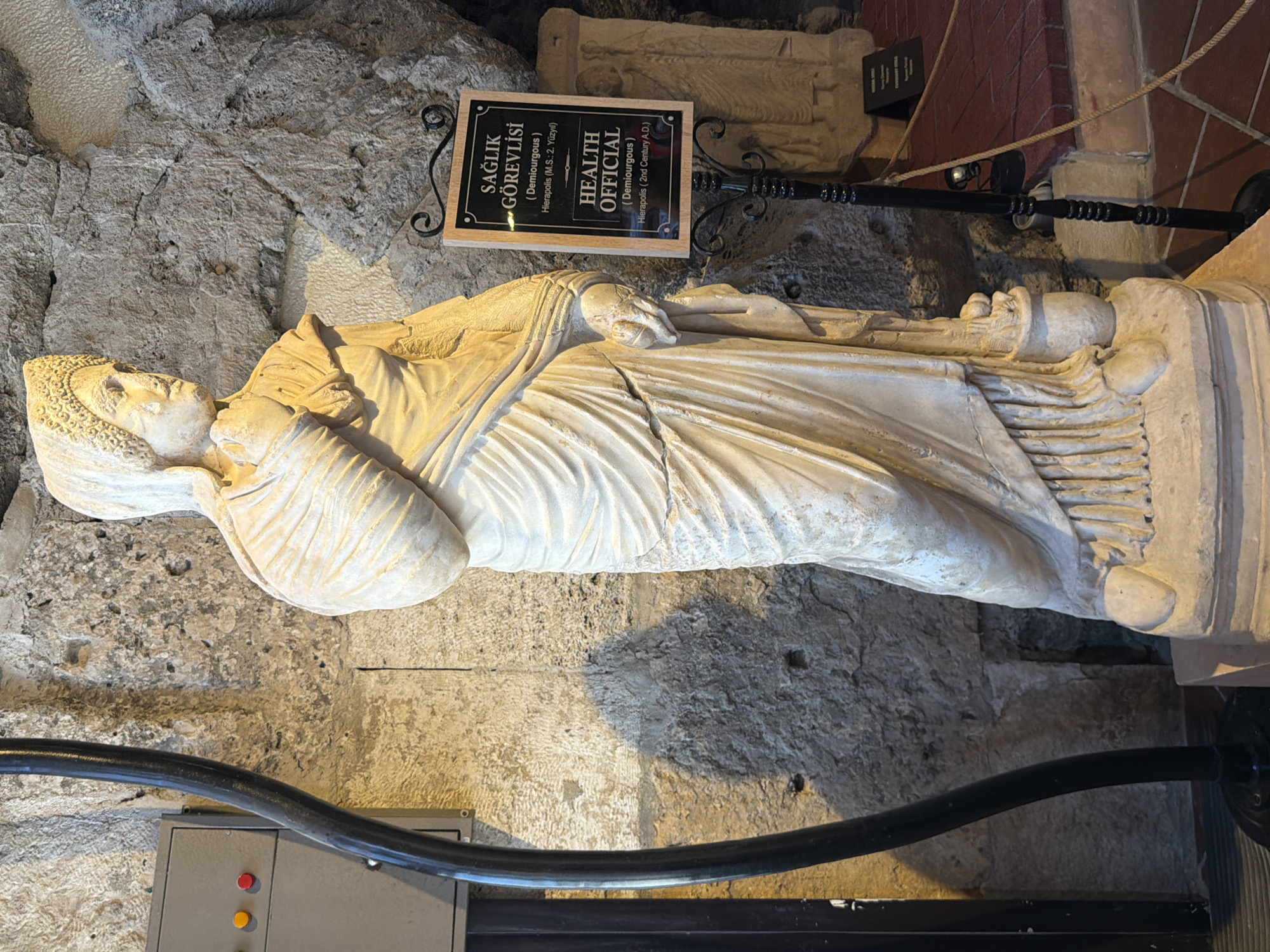
A full-body, standing marble statue of a woman is positioned in the foreground, facing to the right. The statue depicts a figure draped in flowing robes, with her left hand holding what appears to be a scroll or document. Her right hand is raised to her chin, with her fingers resting there. She wears a headdress that resembles a woven cap adorned with small beads or pearls. The statue stands on a tiered pedestal. To the right of the statue, a black metal signpost supports a wooden plaque with black text. The plaque is divided into two sections. The top section, in Turkish, reads "SAĞLIK GÖREVLİSİ (Demiurgous Hierapolis (M.S.:2. Yüzyıl)". The bottom section, in English, reads "HEALTH OFFICIAL (Demiurgous) Hierapolis (2nd Century A.D.)". Behind the statue and signpost, the environment consists of rough-hewn stone walls, characteristic of ancient architecture. A thick, black, curved pipe runs vertically along the left side of the image, in front of the stone wall. Further in the background, to the right of the main statue, another, smaller stone relief is visible, depicting two figures. The floor is paved with terracotta tiles. The lighting suggests an indoor museum setting, likely within the archaeological site of Hierapolis in Pamukkale, Turkey, given the inscription on the sign.
Pamukkale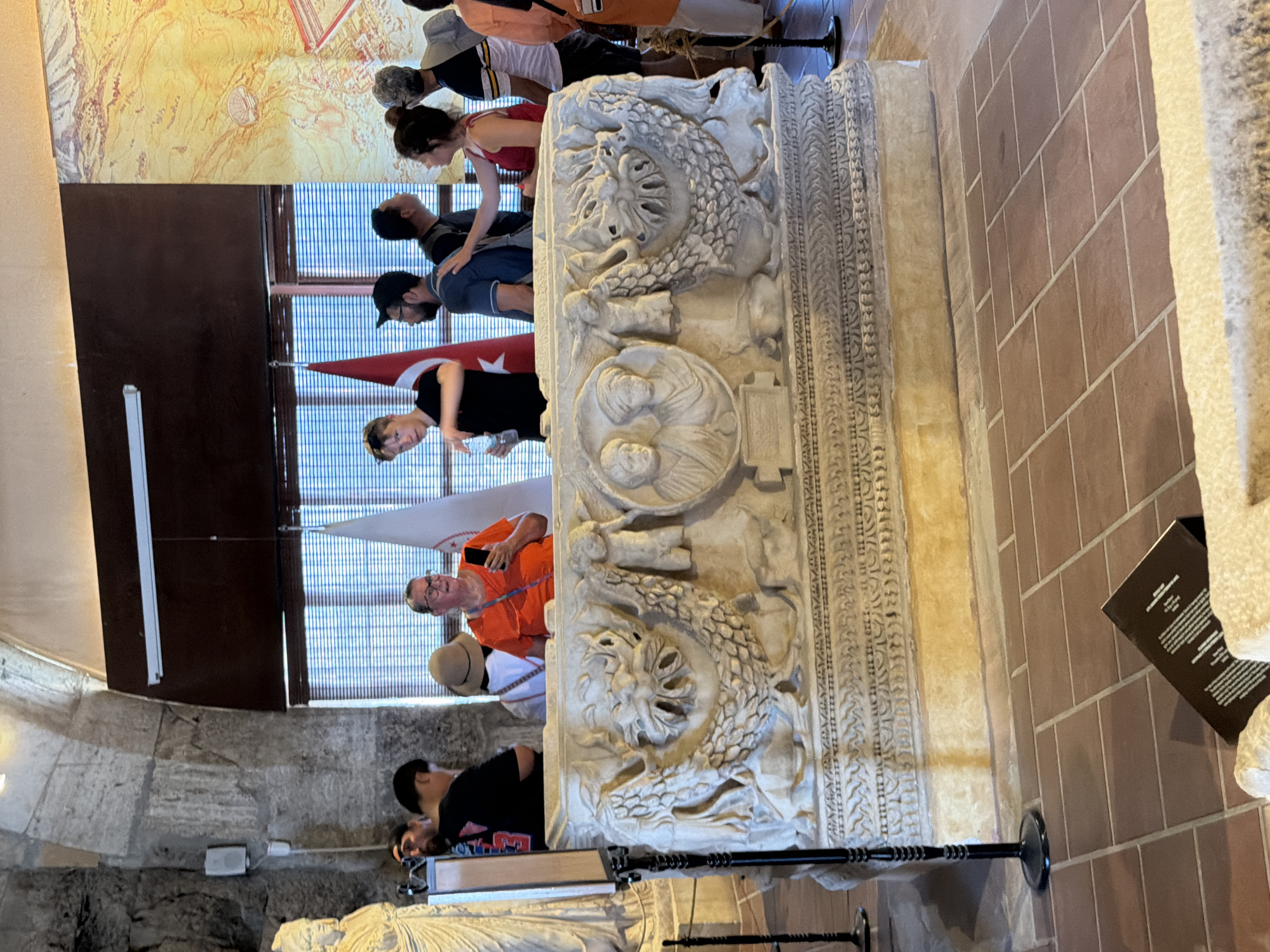
The image depicts the interior of a museum or historical site, possibly in Pamukkale, Turkey, given the context of such artifacts often found in the region. In the foreground, a large, ornate stone sarcophagus is prominently displayed. The sarcophagus features intricate carvings, including what appear to be dragon-like creatures on its sides and a circular relief with two faces on the front, flanked by angelic figures. The sarcophagus rests on a raised platform covered in yellow plaster. The floor is tiled with reddish-brown square tiles. Several people are gathered around the sarcophagus, observing the artifact. In the mid-ground, a woman in an orange shirt is holding a mobile phone, looking at it. To her left, a young man in a black t-shirt holds a water bottle. Other individuals, men and women, are visible in the background, engaged in conversation or viewing the exhibits. Behind the sarcophagus, national flags, one red with a white crescent and star, are displayed. The architectural style of the building, with its arched ceilings and stone walls, suggests an ancient or historical structure. The background also includes a large, colorful mural or tapestry depicting a landscape.
Pamukkale
A young person is taking a selfie in a geothermal pool in Pamukkale, Turkey. The person is wearing a light-colored baseball cap and dark sunglasses, which reflect palm trees and the sky. They are partially submerged in clear, green water, with ripples from movement visible on their skin and shoulders. A silver chain with a cross pendant is visible around their neck. In the background, other people are relaxing in the water, and a stone wall with fencing and lush vegetation, including palm trees, lines the edge of the pool. The sky is clear and blue.
Pamukkale
In Pamukkale, Turkey, a young person wearing a white cap and sunglasses is taking a selfie in a clear, shallow body of water. The water reflects a blue sky, palm trees, and other swimmers. The person is wearing a silver cross necklace. In the background, there are stone structures, stairs leading into the water, and lush green trees. Several other people are visible in the water and on the stairs, some swimming and others standing. The sun is shining brightly, creating a warm and inviting atmosphere.
Pamukkale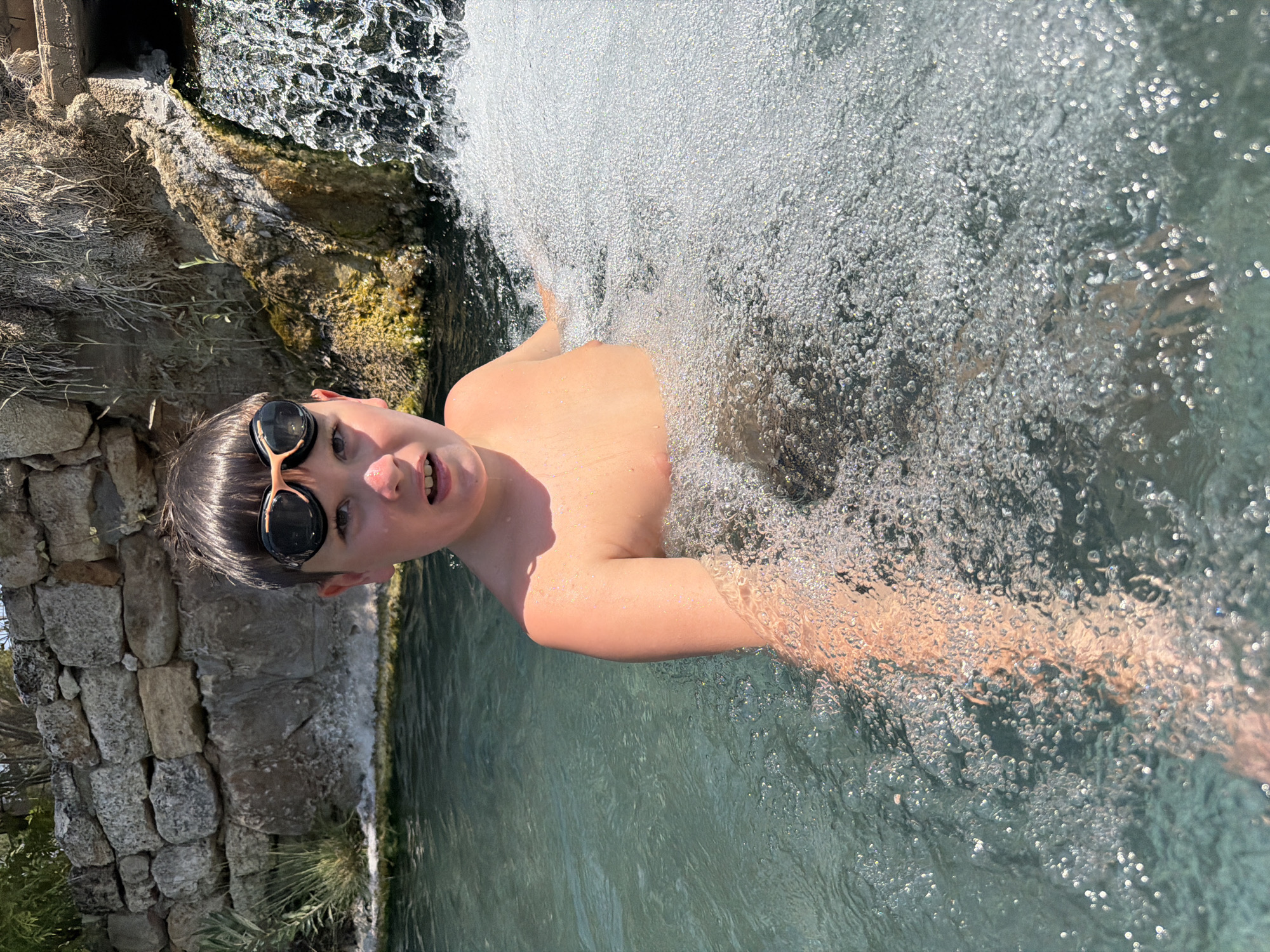
This is a medium shot, portrait-oriented photograph of a young boy in a pool of clear, turquoise water, with a waterfall cascading in the background. The boy is wearing black and orange swimming goggles and is looking at the camera with a playful expression, his mouth slightly open. He is shirtless and his skin is flushed, suggesting he has been in the water for a while. The setting appears to be a natural hot spring, given the context of Pamukkale, Turkey, known for its travertine terraces and thermal waters. The water in the pool is calm and reflective, with a gentle ripple. The waterfall behind the boy is frothy and white, creating a dynamic contrast with the still water in the foreground. The background also shows some rocky, textured elements of the natural landscape. The lighting suggests it is daytime, with the sun casting bright highlights on the water and the boy's skin, indicating a sunny day. The overall mood of the photograph is one of joy and recreation, capturing a moment of carefree fun in a beautiful natural setting. There is no visible text in the image.
Pamukkale
In Pamukkale, Turkey, on a sunny day, a young person in a light-colored baseball cap and sunglasses is taking a selfie in a pool with palm trees and a blue sky in the background. The person is wearing a silver chain with a cross pendant. In the background, a woman in a dark swimsuit is in the pool, and other people are visible. The setting appears to be a resort or a water park, with lounge chairs and an outdoor seating area.
Pamukkale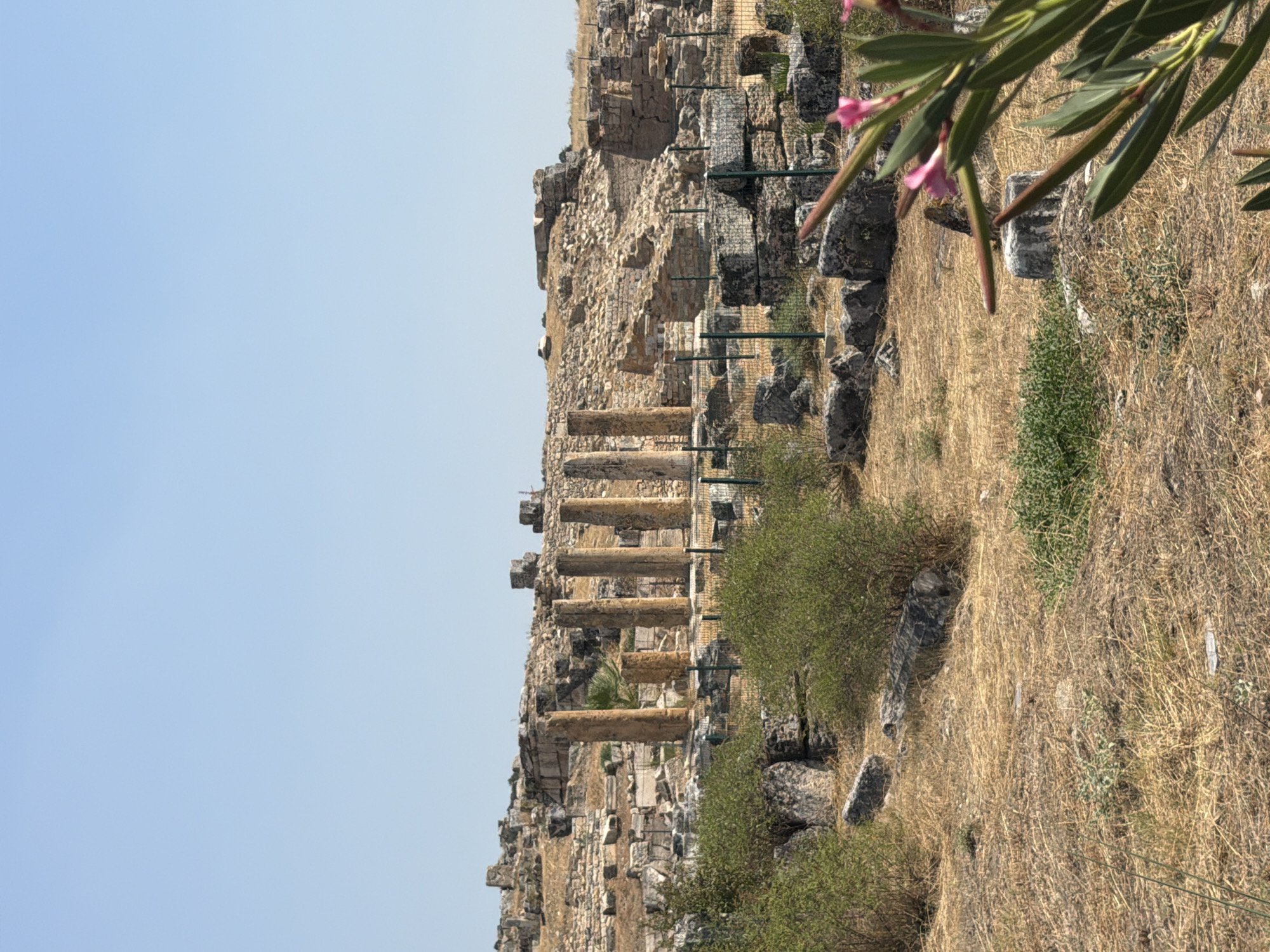
The image shows the ruins of Hierapolis, a UNESCO World Heritage site in Pamukkale, Turkey. In the background, a line of ancient stone columns stands against a clear blue sky. The surrounding area is a landscape of dry, golden grass, scattered rocks, and overgrown green bushes. The foreground is partially obscured by a flowering plant with pink blossoms. The ruins are fenced off, suggesting a preserved archaeological site.
Pamukkale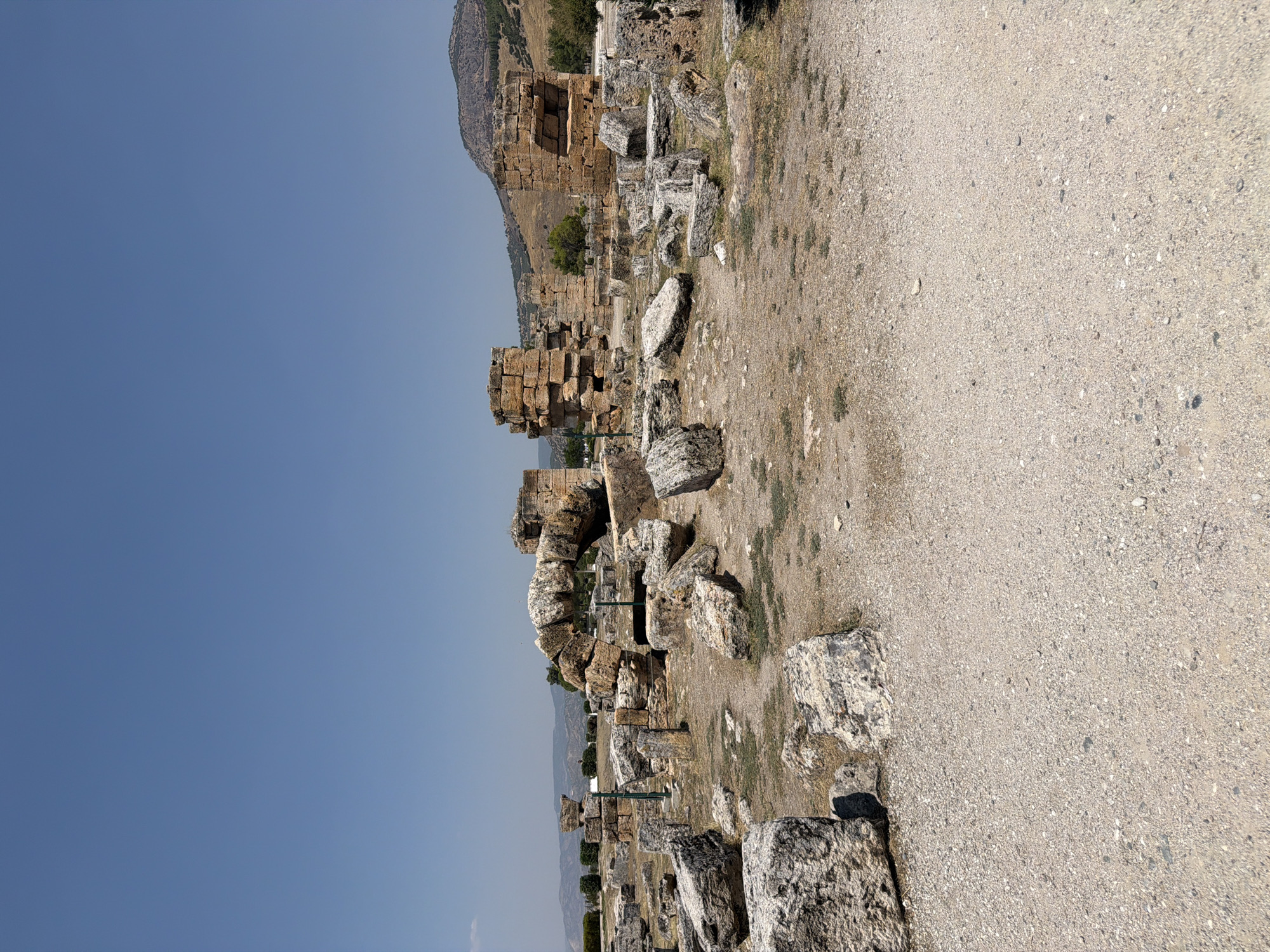
The image depicts the ruins of an ancient structure in Pamukkale, Turkey. The scene is characterized by scattered large stone blocks and fallen masonry, suggesting a historical site. A notable feature is a partially intact arched structure made of large, irregular stones, supported by upright stone pillars. In the background, more ruins, including rectangular stone structures resembling walls or columns, are visible. The ground is covered with gravel and patches of dry grass. The sky is clear blue, and distant hills with sparse vegetation can be seen. There are no people present in the image.
Pamukkale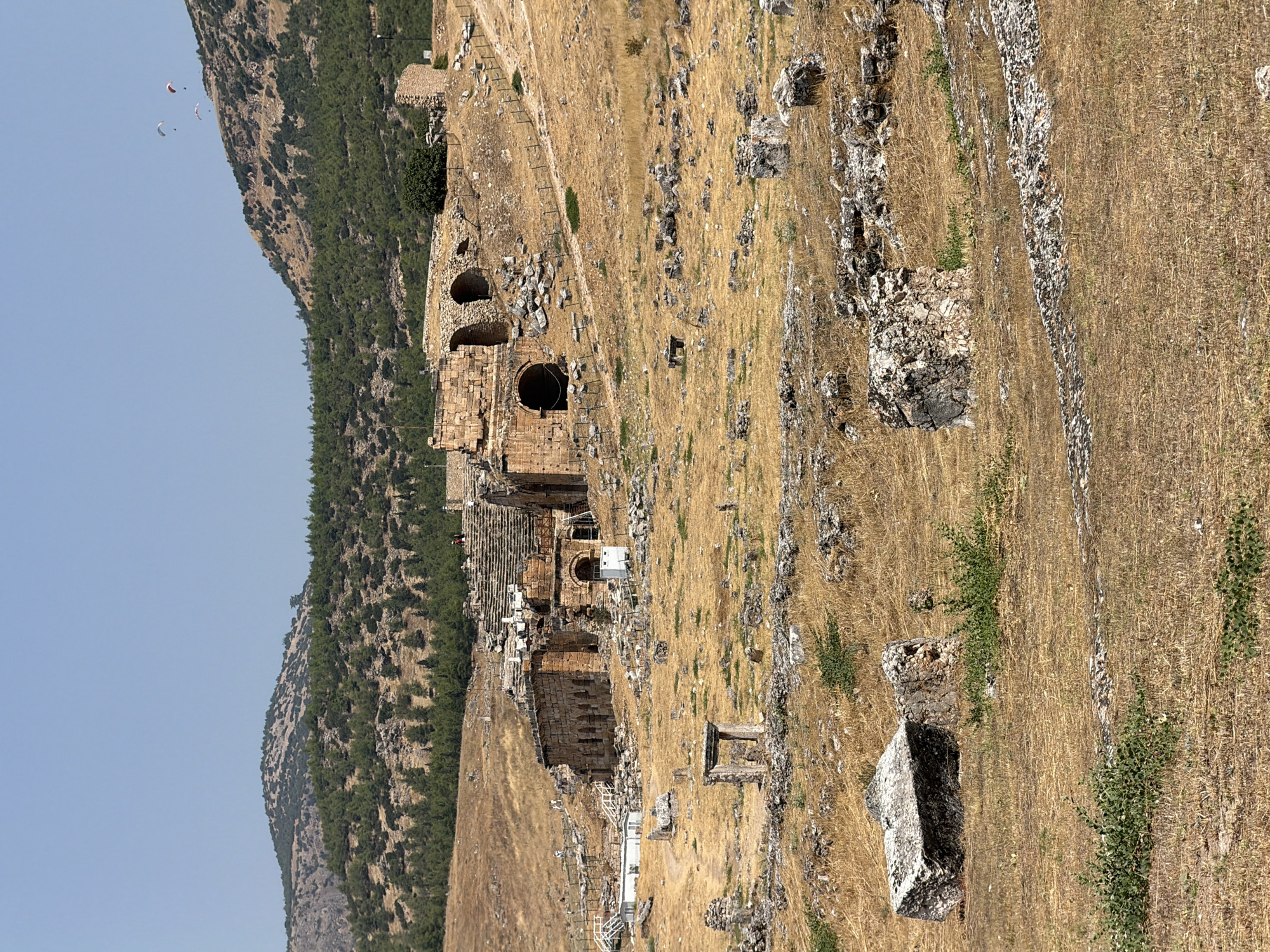
The image depicts a view of the ancient city of Hierapolis, located in Pamukkale, Turkey. The foreground is dominated by dry, golden-brown grasses and scattered ancient stone ruins, including large blocks and fragments. In the middle ground, the ruins of a large stone structure, likely a theater or amphitheater, are visible. This structure features arched openings and tiered seating arrangements, with some sections appearing partially collapsed. Several modern white structures and white railings with stairs are also present, indicating areas that have been preserved or are accessible to visitors. A dirt path winds through the ruins. In the background, a hillside covered with green trees rises, leading to a mountain range under a clear, pale blue sky. Several paragliders are visible in the sky above the mountains. The overall impression is of an archaeological site set within a natural, arid landscape.
Pamukkale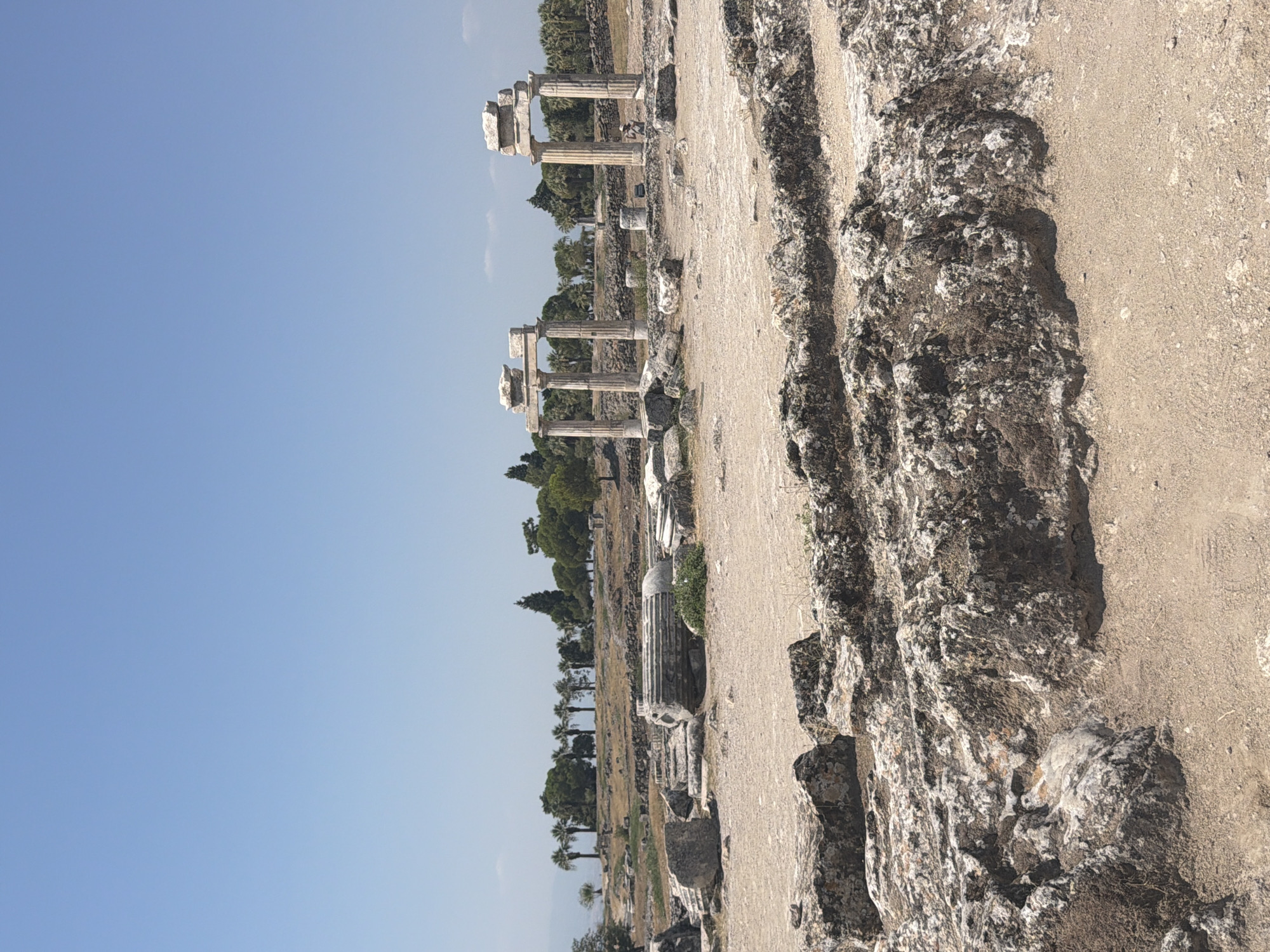
This is a sunny, outdoor photograph taken at the Hierapolis archaeological site in Pamukkale, Turkey. The foreground is dominated by rough, textured rocks and sandy ground, suggesting a dry, arid environment. In the middle ground, remnants of ancient structures are visible, including a large, fallen stone column and the foundations of buildings. Further back, a pair of ancient doorways or archways, constructed with large stone columns topped by lintels, stand as prominent features. A person, wearing a hat and a light-colored shirt, is standing near the right-hand archway, observing the ruins. The background features a line of palm trees and other greenery, with a clear blue sky above. The overall scene depicts a well-preserved ancient site under a bright, sunny sky.
Pamukkale
A video shows a landscape with mountains in the distance, a valley with trees and fields, and a road in the foreground. The sky is blue with some clouds. The camera is moving, likely from a vehicle, giving a dynamic view of the scenery. The foreground is a dirt and rocky surface, suggesting the path of movement.
Pamukkale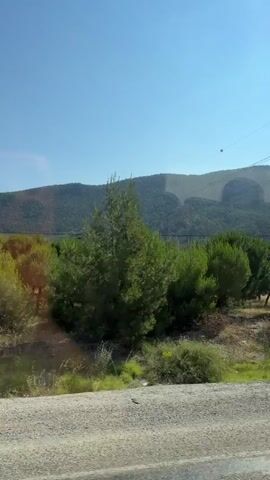
A vertical, eye-level shot from a moving vehicle shows a landscape under a clear blue sky. In the foreground, a dirt road runs horizontally across the bottom of the frame. To the left and right of the road are patches of dry grass and sparse vegetation. A short, thin, white pole stands in the middle left of the frame. Beyond the road, a cluster of green trees dominates the middle ground, with a few taller, more distant trees and foliage visible behind them. In the background, a large, hazy, tree-covered hill or mountain range stretches across the horizon. Several power lines with large insulators are visible against the sky, running diagonally from the upper left to the upper right of the frame. One small, dark object, possibly a bird or debris, is visible near the power lines in the upper middle of the frame. The sun appears to be shining from the right, casting shadows. The scene suggests a rural or natural environment during the daytime.
Pamukkale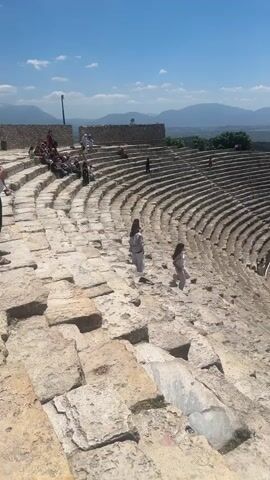
This media file captures a wide-angle view of an ancient amphitheater in Pamukkale, Turkey. The scene is bathed in bright sunlight, indicating a clear, warm day, likely mid-morning or early afternoon given the shadows. The sky is a vibrant blue with scattered white clouds, and in the background, distant, hazy mountains form a picturesque backdrop. The amphitheater itself is the central focus, constructed from weathered, light-colored stone. Its tiered seating curves in a vast semi-circle, with rows of steps ascending towards the upper levels. The architecture suggests a historical site, likely a well-preserved ancient Roman or Greek theater. Wooden barriers are visible along some of the pathways and edges of the seating area, indicating that it is a tourist attraction. Several people are scattered throughout the amphitheater. In the foreground, two women in casual clothing are walking down the stone steps. Further back, groups of tourists are seen seated or walking on the various levels of the seating area. Some individuals are also visible near the stage area, which is partially visible at the bottom right of the frame. The people appear to be casually exploring and enjoying the historical site. The overall atmosphere is one of serene exploration and appreciation for ancient history. The bright sunlight and clear sky contribute to a positive and inviting mood. The surrounding landscape, with its dry, earthy tones and distant greenery, adds to the sense of being in a historical and scenic location. No visible text is present in the media file.
Pamukkale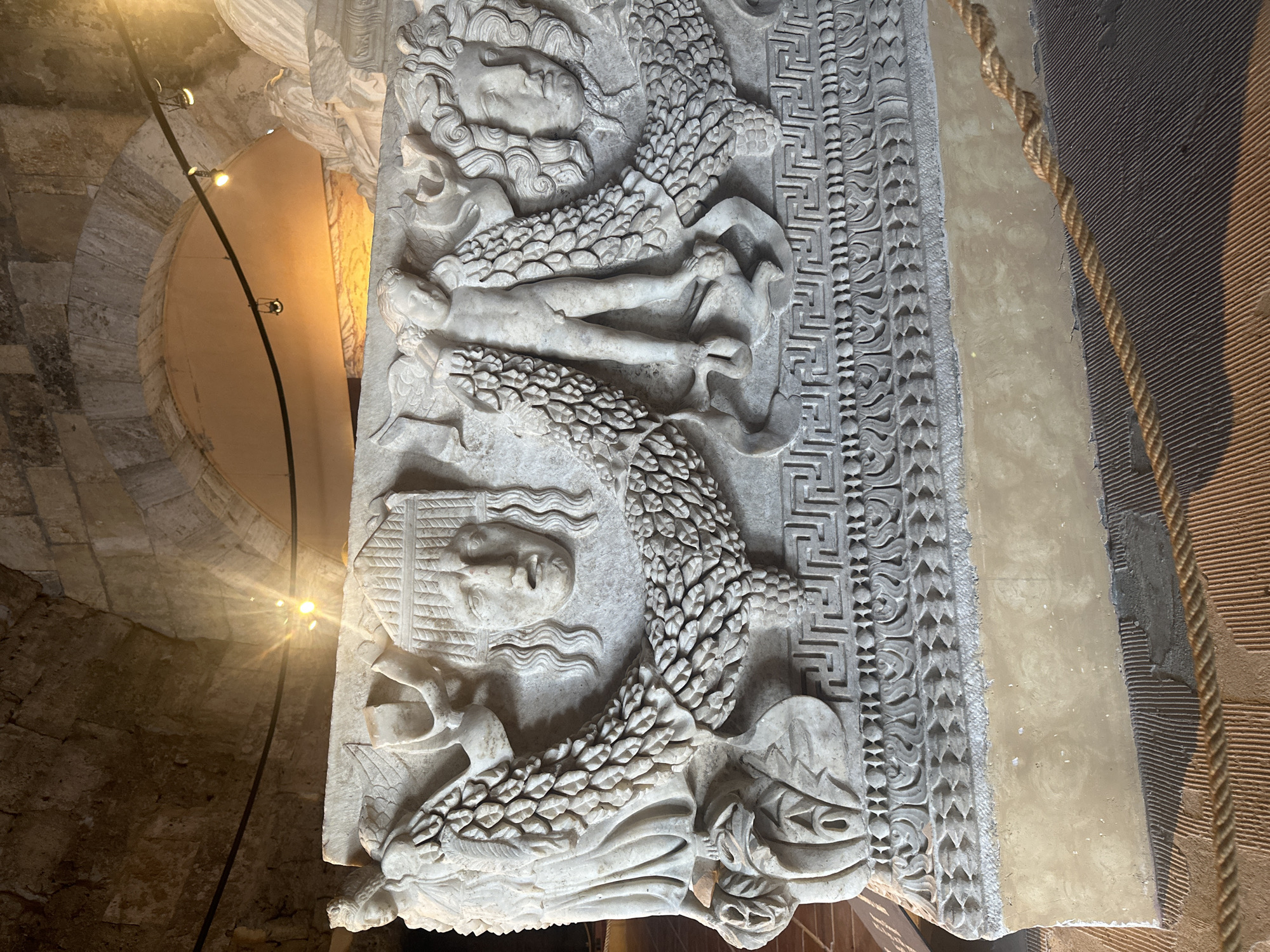
The image shows a close-up view of a carved stone sarcophagus. The sarcophagus is ornate and features relief sculptures of figures and decorative patterns. On the left, there is a winged female figure, possibly a representation of Nike, the Greek goddess of victory, holding a wreath. To the right of this figure are two prominent faces, one appearing to be a stern, possibly Gorgon-like, visage with a headdress, and another more serene face with curly hair. Between these figures are garlands or drapery, also rendered in relief. A smaller, nude figure, possibly a cupid or putto, stands with one foot on a bird or other creature. The base of the sarcophagus is decorated with a Greek key (meander) pattern and other friezes. The sarcophagus is made of light-colored stone and appears to be housed within a museum or historical site, with visible stone architecture and lighting in the background. The floor appears to be made of textured tiles. The scene is observed from a slightly elevated angle, with a rope barrier in the foreground. This sarcophagus is located in the Hierapolis Archaeological Museum in Pamukkale, Turkey.
Pamukkale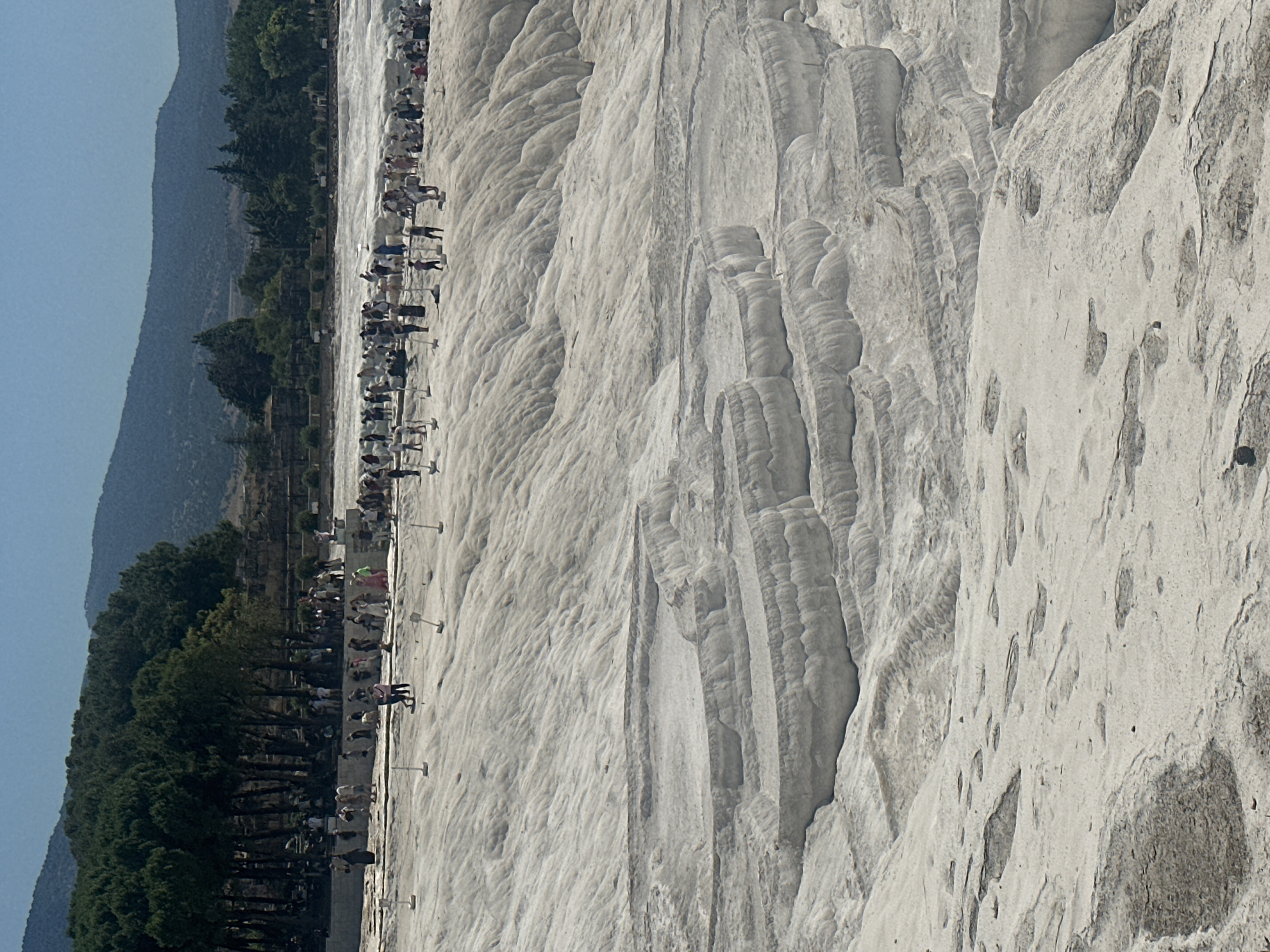
The image depicts the travertine terraces of Pamukkale, Turkey, a UNESCO World Heritage site. A multitude of people, dressed in casual attire, are walking along the white mineral formations, which are characteristic of this geothermal area. The terraces appear as cascading pools of water, formed by mineral-rich hot springs flowing down the slope. The textures of the travertine are varied, with smooth, flowing surfaces interspersed with more rugged, textured areas. In the background, lush green trees line the edge of the terraces, creating a stark contrast with the white landscape. Beyond the trees, hazy mountains rise, suggesting a vast, natural setting. The sky is a clear, bright blue, indicating a sunny day. The time of day appears to be midday or early afternoon, given the brightness and the shadows cast by the people and the landscape features. The activity taking place is primarily tourism, with visitors exploring and enjoying the unique geological formations. The people are seen walking, posing for pictures, and interacting with the environment. The overall mood seems relaxed and awe-inspired, as people experience the natural beauty of Pamukkale. There are small white poles or markers along the path, likely for guidance or safety. The mineral deposits have created a surreal, almost otherworldly landscape, with the white calcium carbonate deposits reflecting the sunlight. The image captures a vibrant scene of human activity within a remarkable natural environment.
Pamukkale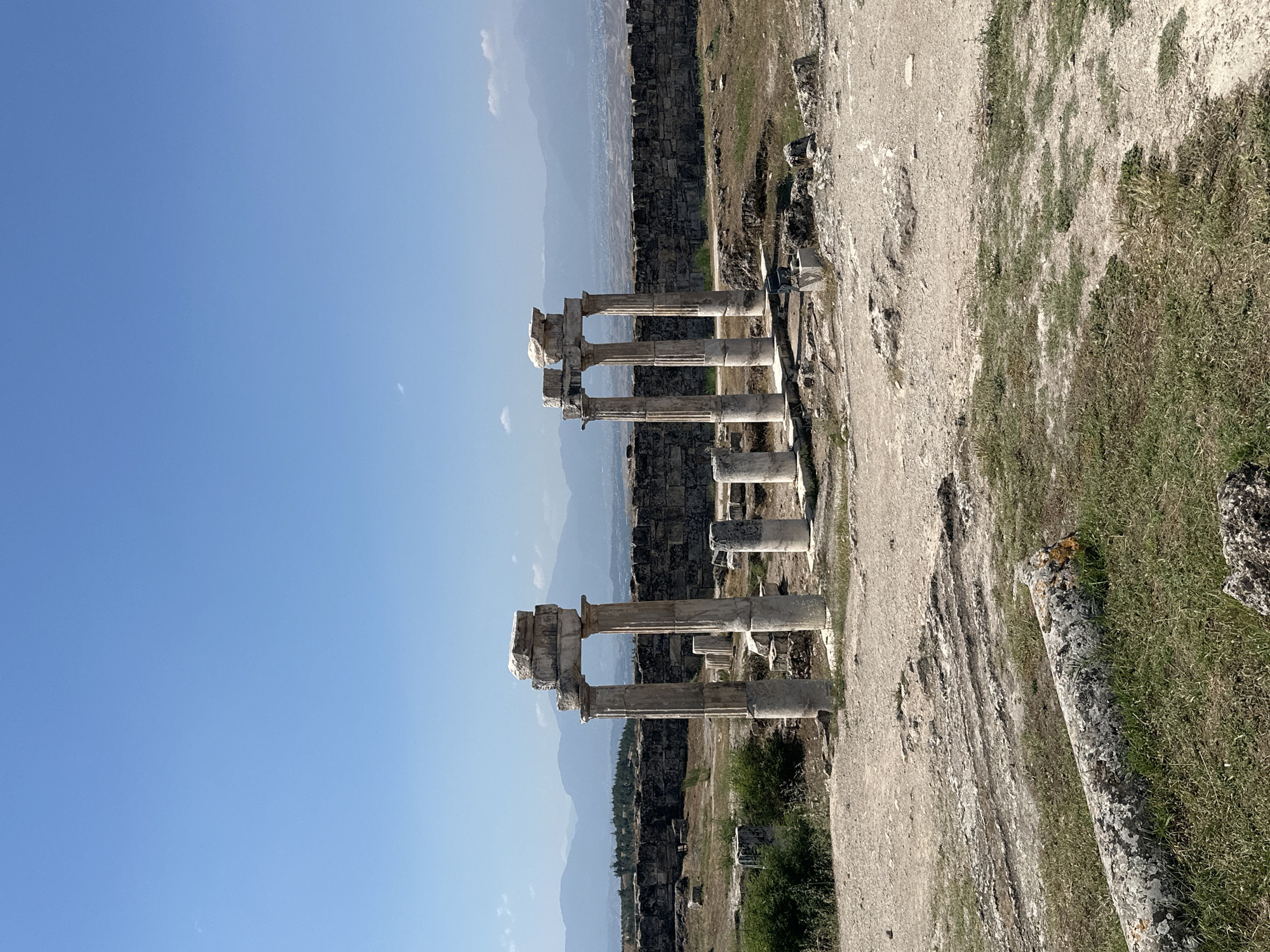
This image depicts the ancient ruins of Pamukkale, Turkey, under a clear blue sky. The scene is dominated by stone columns, some intact and others broken, remnants of a past civilization. In the foreground, a pathway made of worn stone is visible, with patches of dry grass and vegetation growing alongside it. The columns, weathered and aged, stand in rows, hinting at the grandeur of the original structures. Their bases are embedded in the earth, and their capitals display intricate carvings, though time has taken its toll. In the background, a stone wall made of large, rough-hewn blocks forms a backdrop to the ruins. Beyond the wall, a hazy landscape of rolling hills and mountains stretches into the distance, bathed in the soft light of what appears to be late afternoon or early morning. The overall atmosphere is one of historical significance and peaceful decay. The clear sky and warm light suggest pleasant weather, perfect for exploring such a site. There are no people visible in the image, emphasizing the solitary nature of the ancient ruins. The location cues, such as the distinctive Roman-style columns and the mountainous backdrop, strongly suggest Pamukkale, known for its thermal travertines and ancient Hierapolis. The image captures a moment of quiet contemplation amidst the remnants of history, inviting the viewer to imagine the life that once thrived in this place.
Pamukkale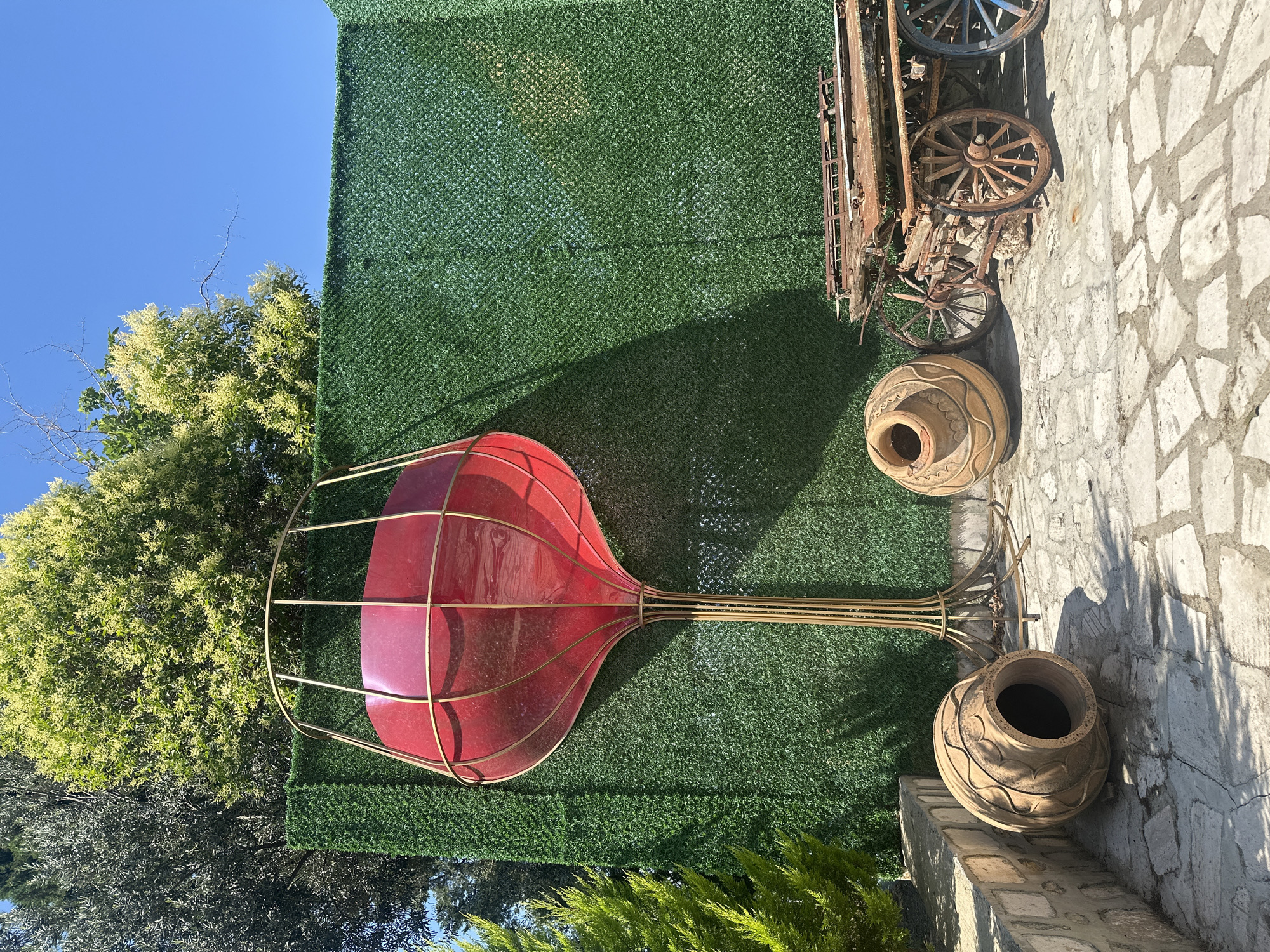
This image captures an outdoor scene in Pamukkale, Turkey. Dominating the center is a large, stylized red glass wine goblet, approximately 8-10 feet tall, supported by a golden metal frame. It is positioned in front of a textured green fence made of artificial grass. To the left of the goblet, a small evergreen bush is visible, and further left, a stone wall forms a raised planter. On the ground in front of the fence are several decorative objects. Two large, clay amphorae are present; one lies on its side to the left, its opening facing the viewer, and the other stands upright to the right of the first, displaying decorative carvings. To the right of the standing amphora is an antique wooden cart with metal-reinforced wheels, appearing weathered and rustic. The ground surface is paved with irregular flagstones. In the background, mature trees with green and light-colored foliage are seen against a clear blue sky. The lighting suggests a bright, sunny day, casting distinct shadows from the goblet and trees onto the fence and ground. No people are present in the scene.
Pamukkale
A first-person perspective video shows feet stepping into shallow pools of clear, mineral-rich water with a white, textured ground. The camera pans to reveal a wider landscape of white terraced pools with people bathing and walking around them. In the background, a town and mountains can be seen under a clear blue sky.
Pamukkale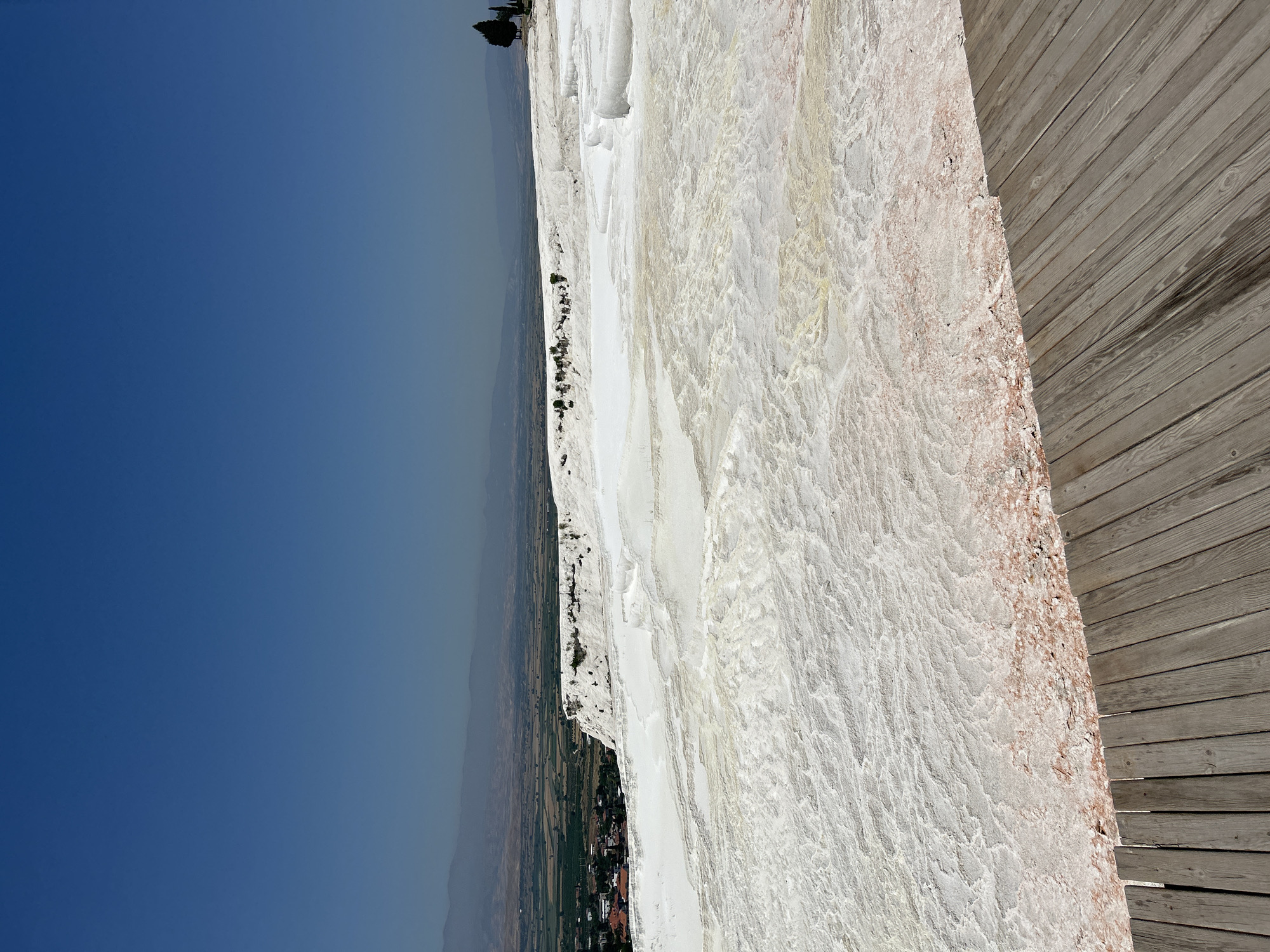
The image captures a panoramic view of the travertine terraces in Pamukkale, Turkey. The foreground features a weathered wooden walkway constructed from horizontal planks. Beyond the walkway, the iconic white travertine formations stretch out, characterized by their rippled, layered textures and shallow pools of water. Subtle hues of yellow and pink are visible on the travertine, indicating mineral deposits. In the mid-ground, a village with red-tiled roofs nestles at the base of the white terraces, hinting at the proximity to human settlements. Further in the background, a fertile plain dotted with agricultural fields extends towards a hazy mountain range under a clear, deep blue sky. The scene is bathed in bright sunlight, suggesting it was captured on a clear day. There are no people or animals visible in the image.
Pamukkale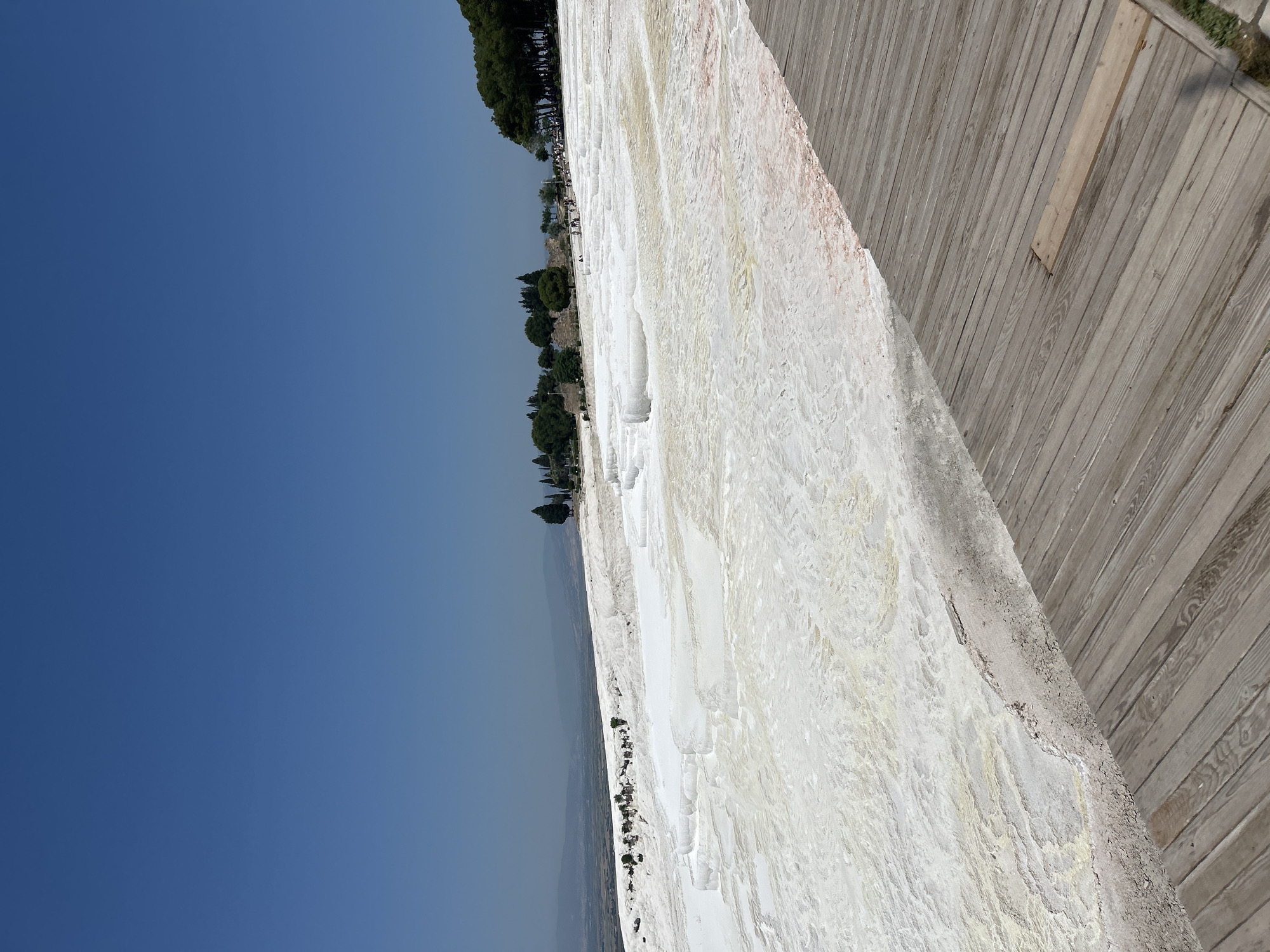
The image depicts the travertine terraces of Pamukkale, Turkey. The foreground features a weathered wooden boardwalk. Beyond the boardwalk, vast white travertine terraces, formed by mineral-rich thermal waters, dominate the landscape. These terraces exhibit a textured, layered appearance with some areas showing yellowish or pinkish discoloration. In the middle ground, a few scattered trees and ancient ruins are visible, suggesting the historical significance of the site. Several individuals, appearing as small figures from this distance, are present on the terraces, walking amongst the formations. The background shows a hazy, mountainous landscape under a clear, bright blue sky. The scene is characteristic of the natural wonder of Pamukkale, known for its thermal pools and white mineral deposits.
Pamukkale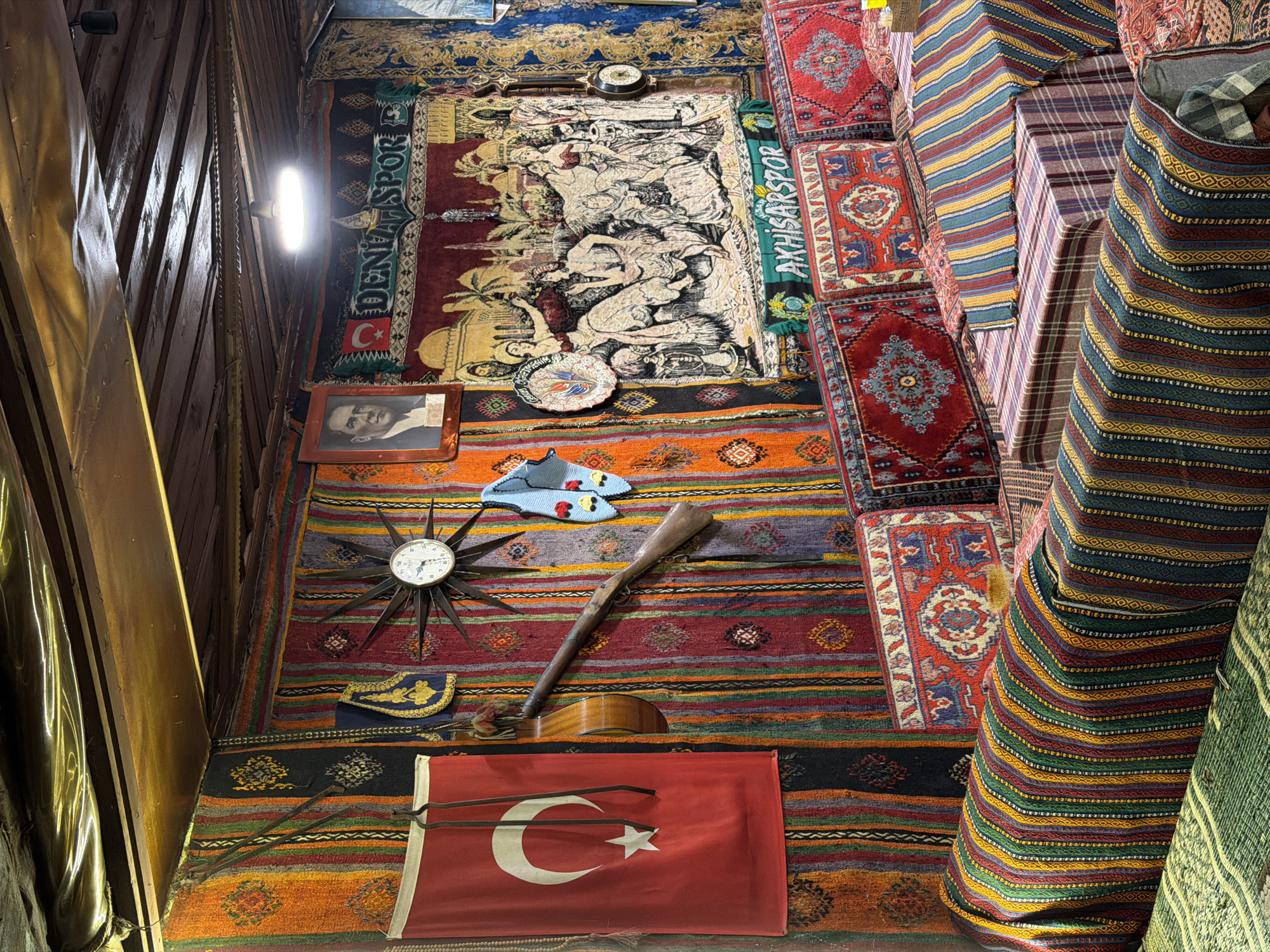
The image depicts an interior space in Pamukkale, Turkey, characterized by a dense collection of textiles and cultural artifacts covering the walls. A Turkish flag is prominently displayed near the bottom, positioned above the image. Above it is a stringed instrument, partially obscured by a long, brown, wooden object that resembles a rifle. A starburst clock is mounted on the wall next to a pair of blue slippers. A framed portrait hangs on the left. Banners, carpets, and other patterned fabrics create a visually rich backdrop. A bright light source illuminates the scene from the upper left. The walls appear to be made of wood paneling.
Pamukkale
A stream of water flows between white, textured rock formations. The water is clear and turbulent, reflecting light as it rushes by.
Pamukkale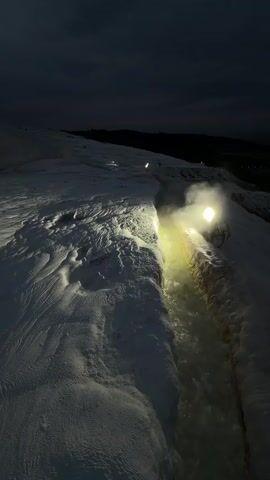
The video shows a narrow, shallow stream of water flowing through a white, rocky landscape at night. A bright light source illuminates the stream, creating a hazy effect as steam rises from the water. The surrounding terrain is uneven and textured, resembling a frozen or mineral-covered surface. The sky is dark, and the overall atmosphere is dimly lit.
Pamukkale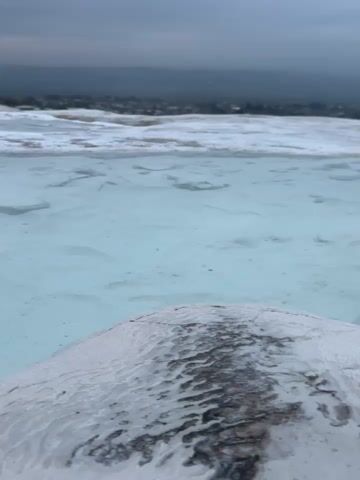
The video shows a body of clear, turquoise water atop a white, textured surface, likely travertine terraces. The water is shallow, revealing the underlying terrain. In the background, a hazy, gray sky contrasts with a distant green landscape dotted with a small settlement of buildings. The perspective is from a slightly elevated position, looking down at the water and out towards the horizon. The general atmosphere is serene, despite the overcast sky.
Pamukkale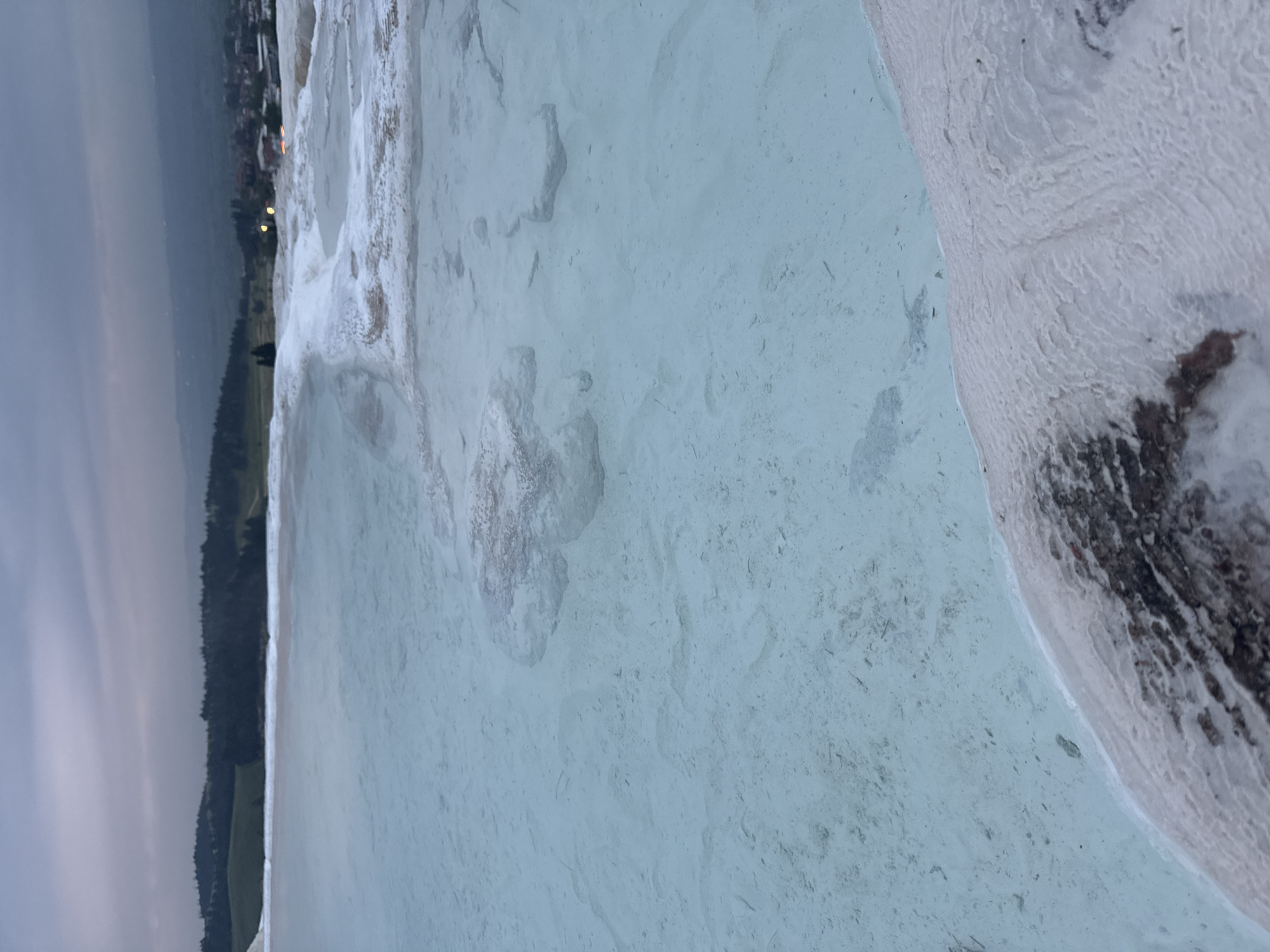
The image depicts a travertine terrace filled with pale blue water in Pamukkale, Turkey. The terrace is composed of white calcium carbonate deposits. A portion of the hillside covered with dark green trees is visible on the left. In the distance, at the top of the hill, a town with sparse lighting is present. The sky is overcast.
Pamukkale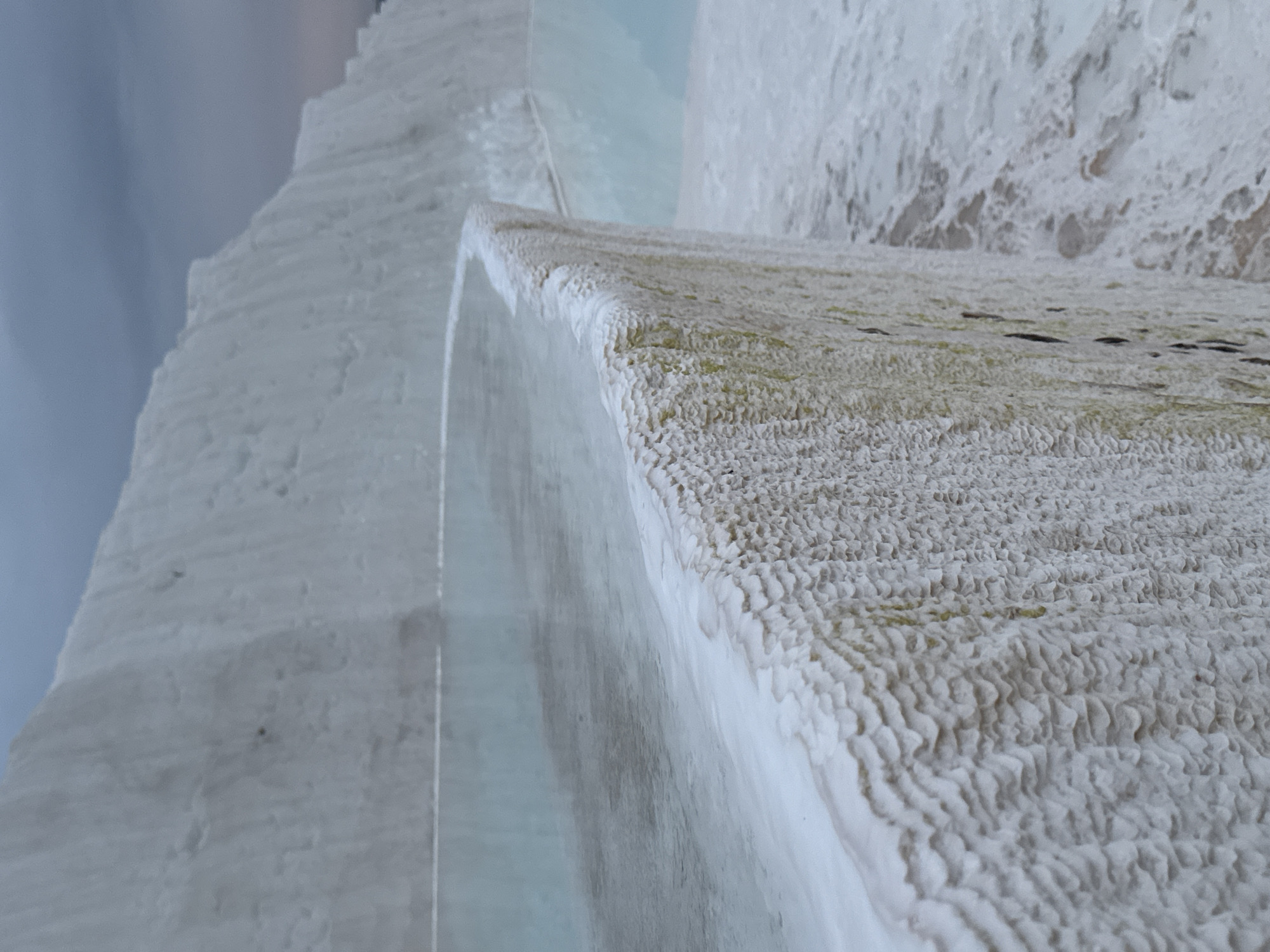
The image shows a close-up of the travertine terraces in Pamukkale, Turkey. The terraces are formed by the deposition of calcium carbonate from the hot springs. The terraces are white and textured, with shallow pools of water. The image is taken from a low angle, looking up at the terraces. The sky is visible in the background, and it is a light blue color.
Pamukkale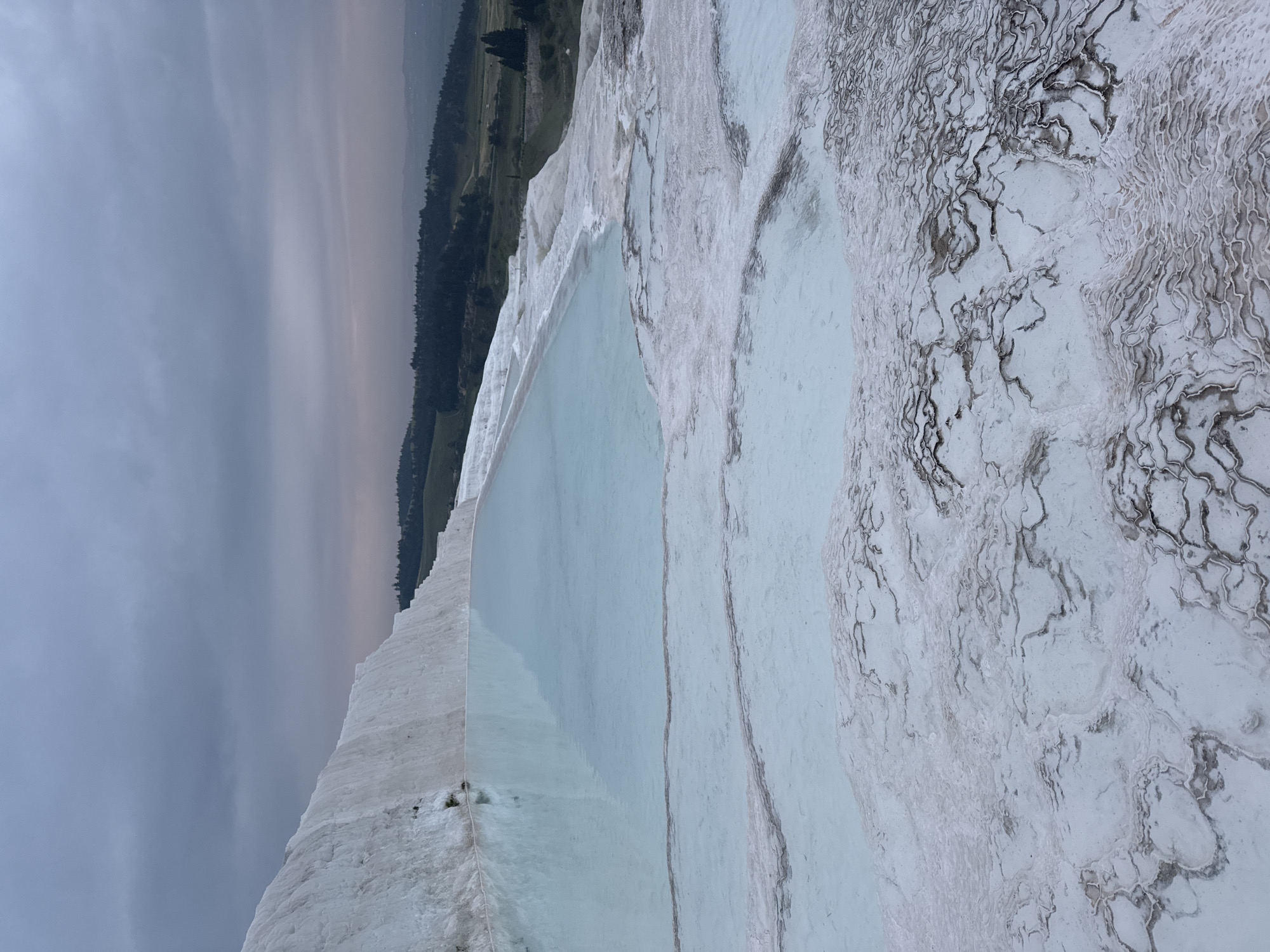
This image depicts Pamukkale, Turkey, specifically the travertine terraces. The terraces, formed by mineral-rich thermal waters, appear white and layered, with pools of clear turquoise water visible. In the background, a dark green forested area meets the sky, which is overcast with a blend of grey and pink hues. The image appears to be taken from a high vantage point, showcasing the scale and unique geological formations of Pamukkale.
Pamukkale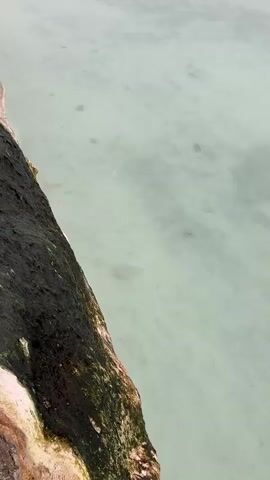
A vertical shot looks out over white stone terraces with light blue-green pools of water. The pools reflect the sky and contain dark figures that could be underwater rocks. People stand or walk in the pools and on the white stone. The edge of a dark rock or tree trunk with green moss or lichen is in the left foreground. The background shows green hills under a cloudy sky.
Pamukkale
A man is submerged in water, looking at the camera. A lot of particles are floating in the water around him. The water is relatively clear, and some green underwater vegetation is visible in the background. The man has a beard and short hair.
Pamukkale
The video shows a man in a pool. He is looking at the camera and talking, then goes underwater, showing the bottom of the pool. The bottom of the pool is rocky and green. A ladder is also visible at the bottom.
Pamukkale