Pescara, Italy
8 memories from Pescara, Italy
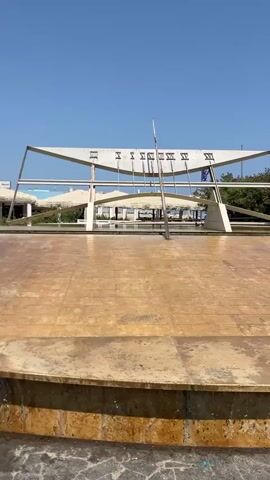
A horizontal video captures a sundial in an outdoor setting under a clear blue sky. The sundial is a prominent feature, with its gnomon (the part that casts the shadow) angled upwards and the hour markers displayed in Roman numerals. The sundial is mounted on a modern, angular metal structure. In the foreground, there is a circular, slightly sloped, weathered concrete or stone area, possibly part of a fountain or plaza. Water is seen trickling down the side of this circular platform, suggesting a water feature. In the background, there are some buildings with awnings and trees. The overall impression is a sunny day at a public space.
Pescara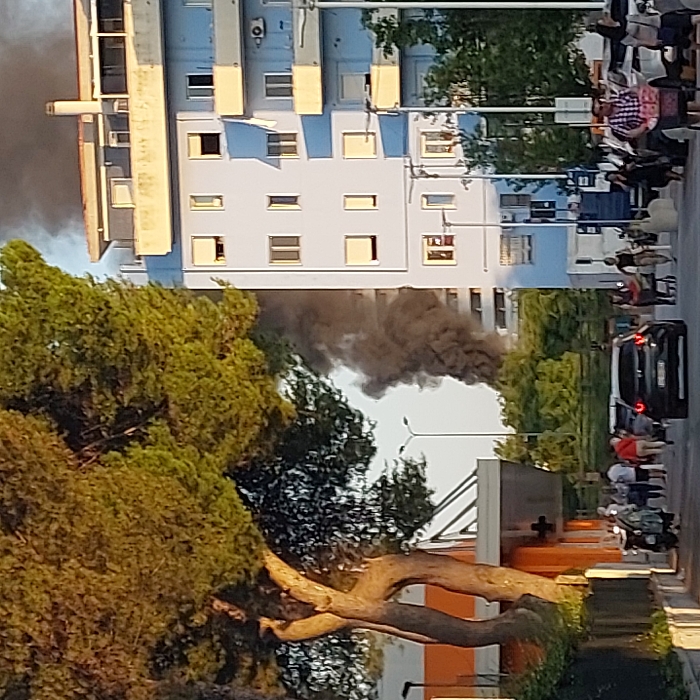
The image captures an urban street scene in Pescara, Italy, under daylight conditions, dominated by evidence of a structural fire. In the foreground on the left, a large, mature tree with a robust, textured trunk and dense green foliage partially obscures the view. Behind this tree, a portion of an orange-colored building with a white roof and a visible white cross emblem on its facade is present. The midground features a paved street or road. A dark-colored car is positioned on this road, facing away from the viewer. Numerous pedestrians are visible on both the street and the sidewalk, walking in various directions; some appear to be in small groups, while one individual on the far right is depicted pushing a shopping cart. In the background, a prominent multi-story building, light blue in color, stands on the right side of the frame. This building features multiple windows, some with exterior shades. A dense, dark gray to black column of smoke is actively billowing upwards from behind or within this light blue structure, rising well above its roofline, indicating an active fire. Additional green trees and foliage are visible in the background between the buildings. Multiple streetlights on tall poles are also scattered throughout the scene.
Pescara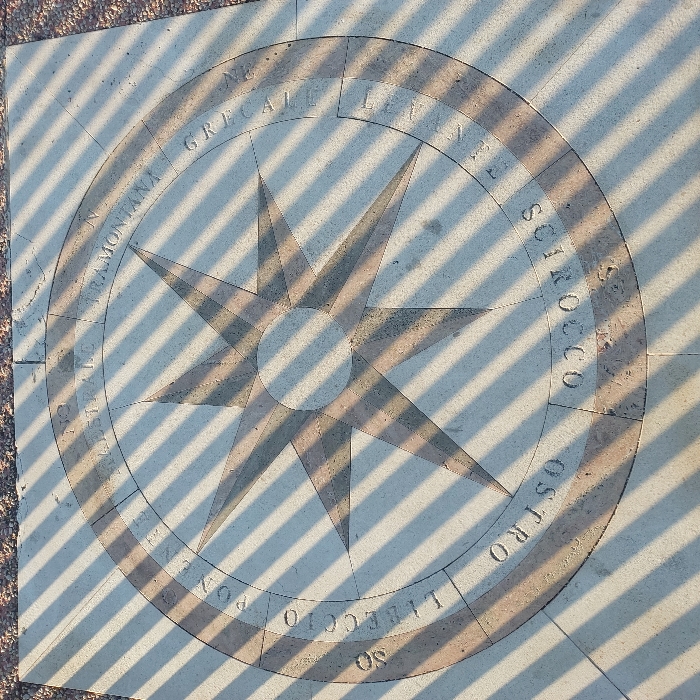
The image displays a large, circular stone compass rose inlay, approximately two meters in diameter, embedded in a light-colored, textured paved ground surface. This installation is located on the Lungomare Giacomo Matteotti in Pescara, Italy. The compass rose design features an eight-pointed star at its center, composed of alternating lighter and darker, possibly reddish-brown, stone segments. An outer circular band is inscribed with the Italian names of the eight principal winds and their corresponding directions: "TRAMONTANA" (North), "GRECALE" (Northeast), "LEVANTE" (East), "SCIROCCO" (Southeast), "OSTRO" (South), "LIBECCIO" (Southwest), "PONENTE" (West), and "MAESTRALE" (Northwest). No people are visible. The scene is illuminated by direct sunlight, casting numerous distinct, parallel diagonal shadows from an unseen overhead structure across the entire compass rose and the surrounding pavement.
Pescara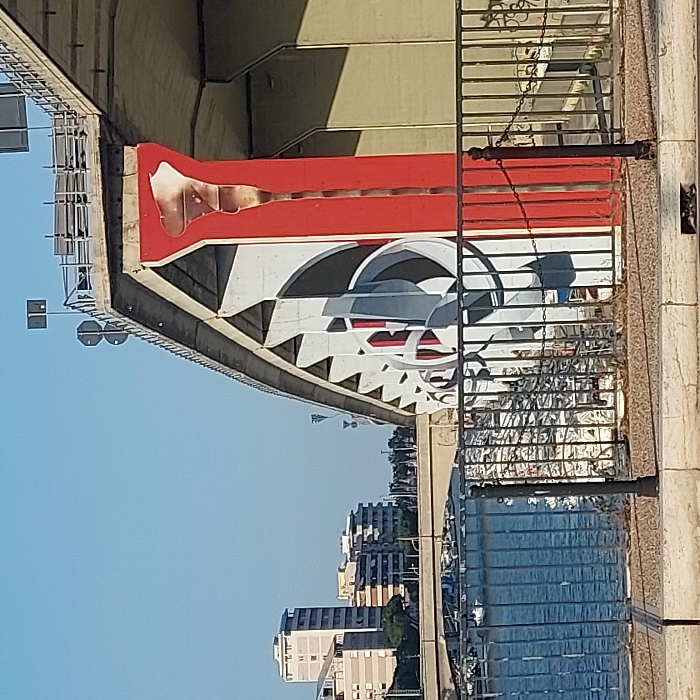
The image depicts a concrete vehicular bridge, identified as Ponte Risorgimento, spanning the Fiume Pescara in Pescara, Italy. The scene is viewed during daylight from the riverbank, looking towards the bridge's underside and piers. The bridge's support structures are the primary subjects. The closest pier on the right is painted a solid red, featuring a prominent, vertically oriented, stylized white form resembling a calla lily or an elongated drop, with subtle brown internal striations. To the left, a series of adjacent concrete piers display large-scale, abstract geometric murals in black, white, and grey, with occasional red accents, forming repeating patterns along the bridge's length. The underside of the bridge deck is visible above the piers, constructed of light grey concrete. In the midground, the Fiume Pescara appears as a calm, blue body of water reflecting the sky. Several small boats are partially visible moored in the river further downstream. Beyond the river, the urban landscape of Pescara is discernible, comprising several multi-story buildings of varying heights and pale colors, consistent with residential or commercial structures. A lower, smaller bridge is also visible in the distance across the river. In the foreground, a dark metal railing with vertical bars and a top rail extends horizontally across the lower portion of the frame, acting as a barrier between the viewer's position and the river. Faint graffiti is present on the lower section of the railing. Below the railing, a strip of dry, light-brown earth or gravel transitions to a paved surface, which includes a curb and a visible storm drain grate. The sky is clear and light blue, indicating fair weather conditions. No individuals are present in the depicted scene.
Pescara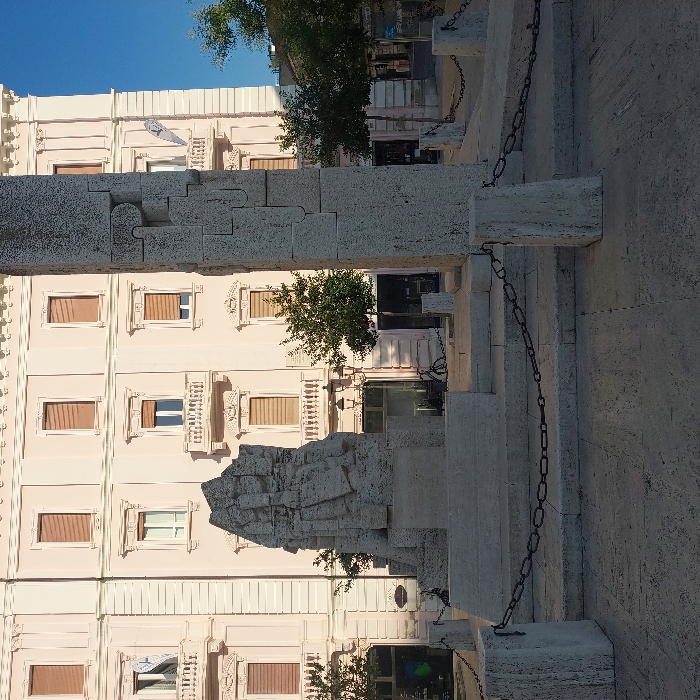
The image captures an urban scene in Piazza Garibaldi, Pescara, Italy, under a clear blue sky. In the mid-ground, two distinct stone monuments are visible. To the left, the Monumento ai Caduti (War Memorial) is a prominent, large, rough-hewn stone structure with a jagged, naturalistic form, set upon a multi-tiered plinth of smoother, lighter-colored stone steps. To the right, partially cropped, stands a tall, rectangular column, identified as a component of La Nave di Cascella monument. This column is constructed from large, interlocking light-colored stone blocks, some featuring puzzle-piece-like shapes. The foreground consists of a light-colored, textured paved ground. Several hexagonal stone bollards are positioned around the base of the monuments, connected by dark metal chains, forming a perimeter barrier. No individuals are present within the frame. In the background, a multi-story building with a light pink or salmon-colored facade dominates. This building features numerous windows, many fitted with closed light brown external shutters. White architectural elements, including window frames, cornices, and decorative balcony balustrades, adorn the facade. Laundry, specifically a white garment, is visibly hanging from a balcony on the far left of the building. A white banner displaying a blue logo is affixed to the upper right section of the building's facade. Several small to medium-sized green trees are interspersed between the monuments and the background building. A black bicycle is parked near a lamppost to the left of the Monumento ai Caduti.
Pescara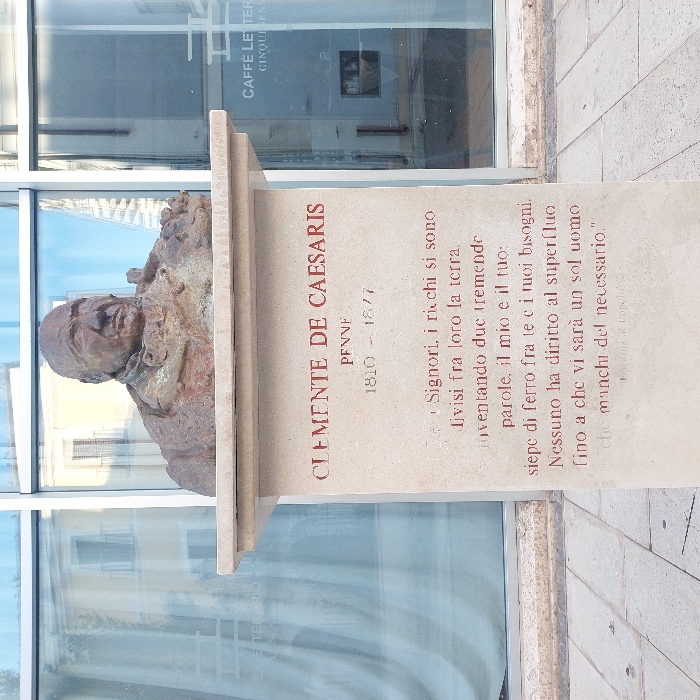
A weathered bronze bust of Clemente De Caesaris, depicting an older man with a balding head and formal attire, stands prominently on a light-colored stone pedestal. The pedestal's front face is inscribed in red capital letters with "CLEMENTE DE CAESARIS," followed by "PENNE" and the life dates "1810 - 1877." Below the dates, a quote in Italian is carved, translating to: "For the Lords, the rich have divided the earth among themselves, inventing two tremendous words, mine and yours: an iron fence between you and your needs. No one has the right to superfluity as long as there is even one man who lacks the necessary." This is followed by "Pastor di Popolo." The statue is situated outdoors on a paved plaza with light-colored square tiles. Behind the statue is a modern building featuring large, reflective glass windows. The windows reflect an older building with balconies and the sign for "CAFFÈ LETTERARIO CINQUE SENS." The scene is brightly lit by natural light. This monument is located in Piazza Emilio Alessandrini, Pescara, Italy.
Pescara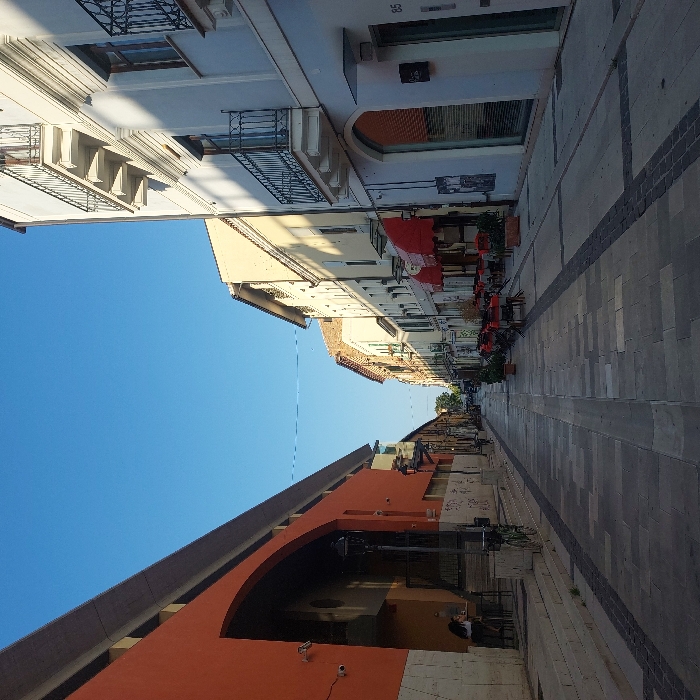
The image depicts a pedestrian street in Pescara, Italy, specifically in the Pescara Vecchia district, with the prominent orange Ex Aurum cultural center on the left. The scene is illuminated by clear daylight under a blue sky. The street is paved with light-colored rectangular flagstones interspersed with darker patterned pavers. On the left, the multi-story orange building features a large, dark arched recess accessed via steps; two security cameras are visible on its exterior. Two individuals are seated at a table on a raised platform within this recess, engaged in an unidentifiable activity. Several bicycles are parked nearby the steps. On the right, a row of multi-story buildings, primarily white, cream, and light blue, lines the street. Multiple ground-floor establishments display red retractable awnings over outdoor dining areas containing numerous empty tables and chairs. Upper floors feature balconies with black wrought-iron railings. The building on the immediate right is marked with the number '85' near its entrance. Black street lamps are visible at intervals. The street itself is largely devoid of pedestrian movement.
Pescara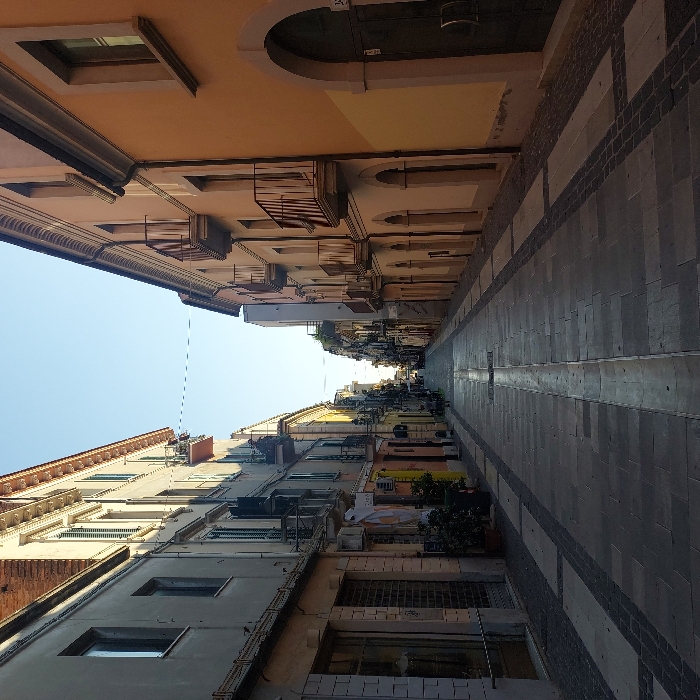
The image presents a ground-level view of a pedestrian street, identified as Corso Manthonè in Pescara, Italy, extending into the distance under a clear, light blue sky. The scene is illuminated by natural light, suggesting early morning or late afternoon, with sunlight primarily hitting the upper sections of the buildings and casting long shadows across the pavement. On the left, multi-story buildings, predominantly light grey and beige, feature various windows, some with closed green or light-colored shutters, and several balconies with dark metal railings. The ground floor exhibits commercial facades, some with security roller shutters lowered, and potted plants are visible near entrances. On the right, buildings appear in shades of orange and light yellow, also multi-story, with multiple windows and balconies featuring dark metal railings. Arched entrances are present on the ground level, some fitted with dark double doors; a faded building number is discernible near one such entrance. The street itself is paved with an intricate pattern of light grey and darker patterned flagstones, creating a distinct central pathway and bordered sections. A prominent, lighter-colored strip runs down the center of the main pedestrian area. The street appears largely devoid of human activity; a single, highly indistinct figure is faintly visible in the far distance. Overhead, a thin, dotted line stretches horizontally across the street between the buildings.
Pescara