Piedrahíta, Spain
30 memories from Piedrahíta, Spain

A white ceramic plate, positioned on a dark brown, reflective wooden surface, displays six small bread slices. Each slice is topped with a white creamy spread and a dense cluster of thin, off-white to grayish, noodle-like strands, identified as *gulas* (imitation baby eels) or *angulas* (baby eels). The food items are the sole subjects of the image. No individuals, actions, or specific identifying architectural or environmental features pointing to Piedrahíta, Spain, are discernible within the frame.
Piedrahíta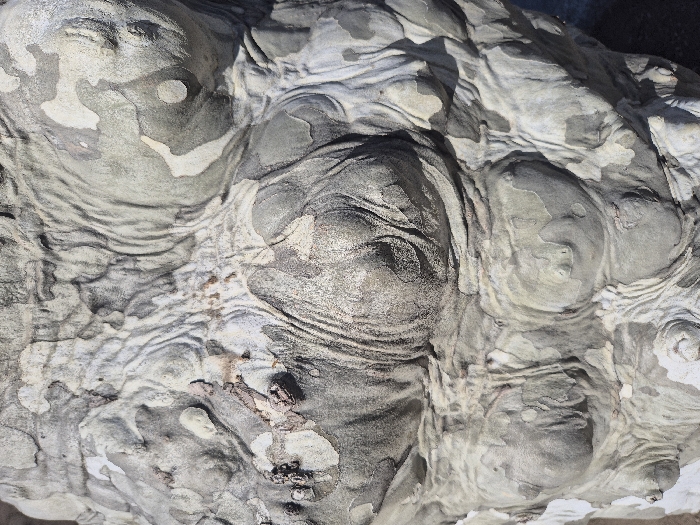
A close-up, high-resolution forensic image captures the textured bark of a tree trunk, identified as being in the city of Piedrahíta, Spain. The trunk exhibits significant burls and protuberances, giving it a heavily convoluted and irregular surface. The bark displays a mottled pattern of light gray, dark gray, and off-white patches, consistent with the shedding bark of a plane tree. Deep fissures and wrinkles are evident between the rounded masses. Direct sunlight illuminates the scene from an implied upper-left direction, creating distinct shadows that accentuate the three-dimensional texture of the bark. No individuals, actions, or distinct environmental features beyond the tree trunk are discernible.
Piedrahíta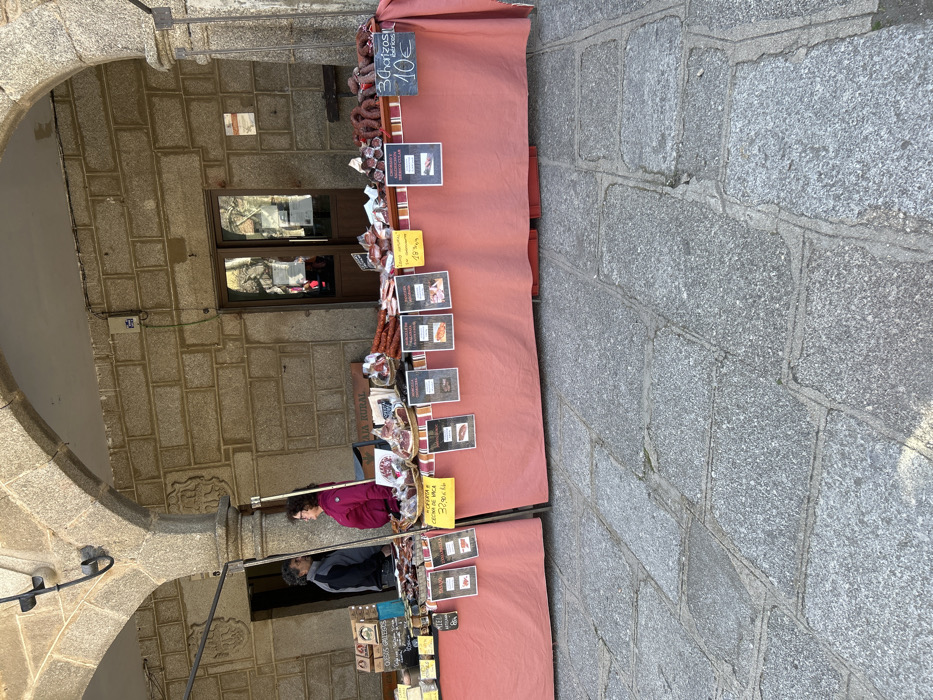
A market scene is depicted in Piedrahíta, Spain, set under a stone portico featuring two rough-hewn granite arches and pillars. The background reveals a building wall constructed from similar granite blocks, with a brown double-door entrance reflecting trees. A white electrical box is mounted left of the door. The foreground consists of an irregular grey stone slab pavement. Two market stalls, covered with reddish-orange fabric, are laden with products. The left stall displays cheeses, jars, and packaged goods, with a visible sign for "QUESOS GALLEGOS." The right stall features a variety of cured meats, including numerous dark red sausages and packaged hams. Prominent yellow and white signs indicate prices and product names in Spanish, such as "OFERTA ½ CECINA DE VACA 32,90€ Kg" and "3 Chorizos Ibéricos 10€." Behind the stalls, a male with grey hair in a dark grey and black jacket faces right, while a female with dark curly hair in a pink top faces left. Both individuals appear to be conversing, positioned to attend the market stalls. Natural sunlight illuminates the scene, casting shadows on the ground.
Piedrahíta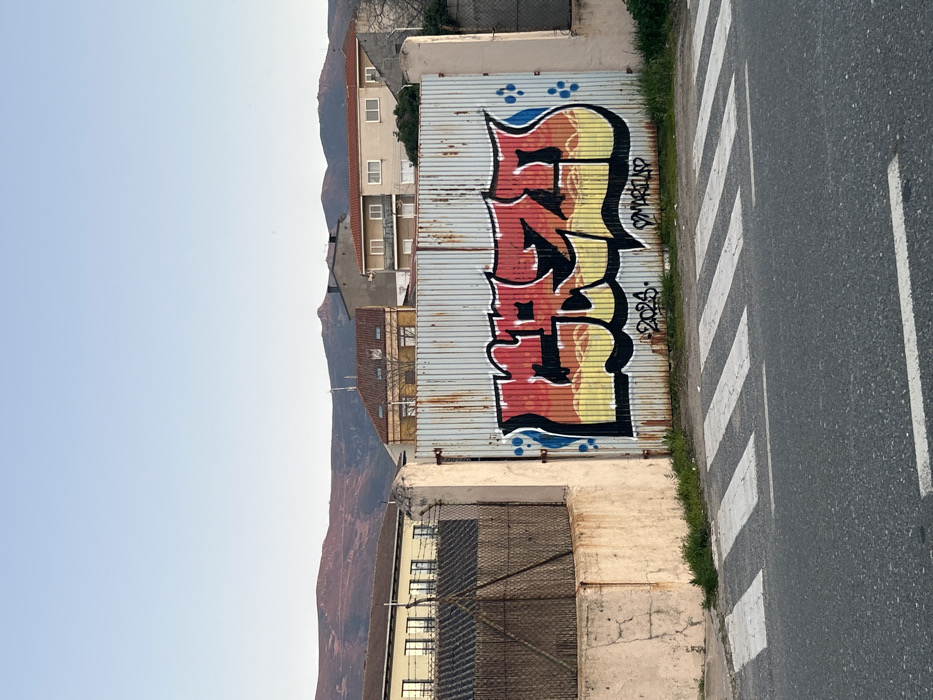
The image depicts a street scene in Piedrahíta, Spain, at what appears to be either dawn or dusk, indicated by the clear, pale blue sky and the warm light on distant mountains. In the immediate foreground, an asphalt road with a faded white pedestrian crosswalk extends horizontally. Above the crosswalk, a small strip of green vegetation grows at the base of a low, light-colored concrete wall, which transitions into a chain-link fence topped with barbed wire on the left side of the frame. Dominating the midground is a large, corrugated metal gate, heavily rusted with a light blue-grey base peeking through extensive brown and orange discoloration. This gate is adorned with a prominent graffiti tag, featuring stylized, bubble-like letters filled with a gradient transitioning from red and orange at the top to yellow at the bottom, outlined in black with a thin white border. Small blue paint drips or dots flank the left and right edges of the graffiti. Legible text "2024." is visible below the graffiti on the left, and "SMARTIEVS" (or similar) on the right. The gate is supported by robust, light-colored concrete pillars on either side, with only the left pillar fully visible. In the background, a cluster of buildings comprises various architectural styles typical of a Spanish town. To the far left, a multi-story structure with a light-colored facade and numerous windows is visible. Behind the gate, several houses feature terracotta-tiled roofs, light-colored walls, and multiple windows and balconies. Beyond the urban structures, a range of mountains, illuminated with a warm, reddish-brown hue, stretches across the horizon under the clear sky. No individuals or active interactions are present in the scene.
Piedrahíta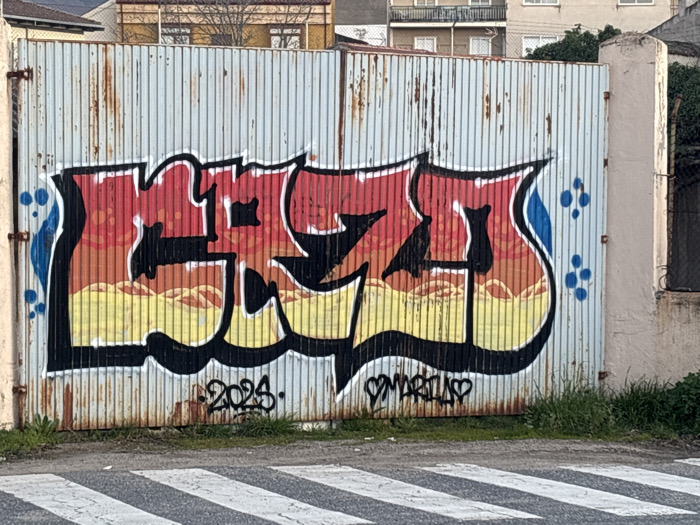
The image depicts a corrugated metal gate in Piedrahíta, Spain, featuring prominent graffiti art. The gate, appearing weathered and light blue, exhibits significant rust discoloration, particularly along its lower edge and seams. It consists of two panels, hinged on the left. A large, stylized graffiti piece spans the gate, rendered with black outlines, a white inner border, and a fill gradient from red at the top, transitioning to orange in the middle, and yellow at the bottom. The letter fills incorporate wavy, cloud-like patterns. Blue droplet shapes and dots accent the far left and right edges of the artwork. Below the main graffiti, "2023." is tagged on the left, and "♡MARTIAS♡" is tagged on the right. In the foreground, a narrow strip of dirt with sparse green vegetation separates the gate from a paved road. The road surface displays white diagonal stripes, indicative of a pedestrian crossing. Behind the gate, multi-story buildings, possibly residential, are partially visible along with some bare tree branches. No individuals or active elements are present in the scene.
Piedrahíta
The image displays an outdoor scene in Piedrahíta, Spain, during twilight hours. The sky occupies the upper two-thirds of the frame, exhibiting a color gradient from light blue-grey at the top to warm orange-yellow at the horizon. A small, dark, irregular speck is visible in the upper right quadrant of the sky. The lower third of the image features silhouetted elements. On the left, an undulating dark landform, likely a hill, is present, topped with sparse, dark vegetation. Extending across the central midground is a horizontal dark barrier, resembling a wall or structure, topped with multiple coils of barbed or concertina wire. To the far right, a dark silhouette of a building, featuring a sloped roof and a chimney, is partially visible. The immediate foreground is a dark, undefined horizontal strip. No individuals are present in the scene. No discernible actions or interactions are occurring.
Piedrahíta
A circular, dark-colored pan, characteristic of a paella pan, is centrally positioned and filled with an orange-red rice dish, likely located in Piedrahíta, Spain. The rice grains are uniformly cooked and coated in a vibrant, viscous sauce. Small, indistinct, darker fragments, possibly vegetables or other ingredients, are visible throughout the rice. The surface of the dish exhibits a moist, reflective sheen. The pan rests on a light-colored, possibly wooden, table surface. The background is out of focus, revealing blurred elements, including a light-colored object in the upper right quadrant and a dark, indistinct bar along the bottom edge of the frame. No individuals are present, and no specific actions are depicted.
Piedrahíta
A sun-drenched, wide-angle landscape photograph depicts a rural area near Piedrahíta, Spain, under a clear, bright blue sky. The upper right portion of the image is dominated by a brilliant sun, emitting a prominent starburst flare. Reflections consistent with an interior vehicle element, possibly a rearview mirror or overhead light, are visible in the upper left quadrant. Three dark, parallel power lines stretch horizontally across the middle-upper section of the sky. The midground features an expansive, irregular field or pasture with dry, light brown and green vegetation, possibly fallow or recently harvested. Scattered deciduous trees, some appearing bare and others with sparse light green or yellow foliage, are distributed across this field. Thin, dark fence posts are visible vertically in the immediate foreground, suggesting a property boundary. In the background, a range of dark, undulating hills and mountains extends across the entire horizon line, with the farthest peaks on the right partially obscured by atmospheric haze. No individuals or animals are present, and no explicit actions are depicted.
Piedrahíta
The image presents a rural landscape viewed from a moving vehicle, indicated by reflections on the upper left quadrant and the immediate foreground elements. The lowest portion of the frame shows a dark asphalt road surface with a white lane line visible on the right. A prominent curved shadow, consistent with a vehicle's undercarriage, is cast on the road and extends onto a portion of the guardrail. A light-colored, multi-bar metal guardrail runs horizontally across the lower mid-frame, supported by dark vertical posts. Beyond the guardrail, a field of dry, brownish-green grass and vegetation extends. This field is bordered by a dense line of deciduous trees, predominantly bare or with sparse brown foliage, stretching across the mid-ground. In the background, a range of dark, undulating mountains is visible, rising against a clear, bright blue sky that occupies the upper two-thirds of the image. No individuals or specific actions are discernible. The scene is located in the vicinity of Piedrahíta, Spain.
Piedrahíta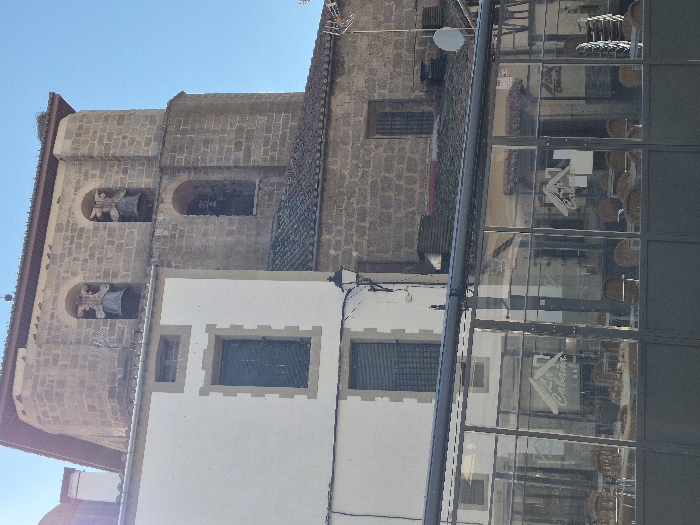
A sunlit urban scene in Piedrahíta, Spain, features architectural elements and a commercial establishment under a clear blue sky. Dominating the background is a multi-tiered stone church tower, constructed from light brown blocks. It displays three visible arched bell openings, each containing a large metal bell, with the upper two featuring decorative supports. A bird's nest is visible on the tower's upper right cornice, and small birds perch along its roofline. To the left of the tower, a two-story building with a white stucco facade and tan stone trim is prominent. It presents two vertically aligned windows, both fitted with closed dark green louvred shutters. A black street lamp with a single light fixture extends from the facade between the two main windows. In the foreground, a commercial establishment, identified as "La Cabaña" by white script signage, is enclosed by a clear glass and dark metal barrier. Visible through the glass are multiple empty light-colored wicker-style tables and chairs, some stacked on the right side, indicating an outdoor dining area. Reflections of the surrounding buildings and sky are visible on the glass panels. To the right of the white building, behind the foreground establishment, another building constructed of stone blocks with a tiled roof and a dark gridded window is partially visible. A small white satellite dish is mounted on its roof. The scene is brightly illuminated by natural sunlight, casting distinct shadows. No individuals are present.
Piedrahíta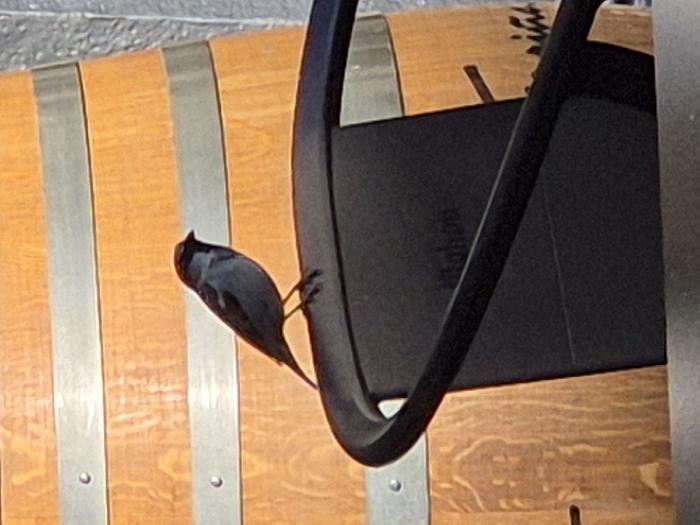
The image displays an outdoor scene in Piedrahíta, Spain. A male House Sparrow, identifiable by its grey crown, chestnut nape, and black bib, is perched on the curved, black plastic backrest of a chair, facing right. The word "Mahou" is faintly visible on the chair's backrest. Behind the chair, a large wooden barrel with horizontal metal bands secures its light-brown staves. The text "Piedrahíta" is partially discernible on the barrel. The scene is illuminated by daylight.
Piedrahíta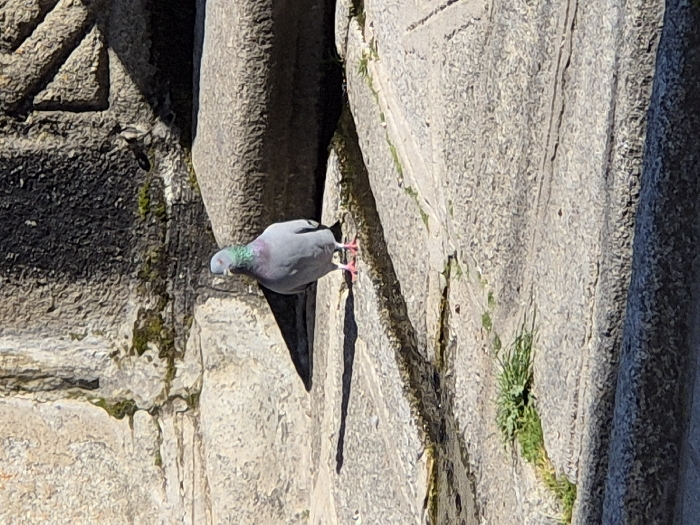
A single rock dove (pigeon), predominantly grey with iridescent green and purple neck plumage, stands on light-colored stone paving in Piedrahíta, Spain. The bird's feet are pinkish-red, and it faces slightly to the viewer's left. In the background, large, rough-hewn stone blocks with dark stains and green moss growth are visible. The ground consists of uneven stone slabs with cracks containing small clumps of green grass. A thin, wet line or stream of water is present across the paving, flowing from the left. A darker stone step or border is in the immediate foreground. Strong shadows indicate direct sunlight from the left.
Piedrahíta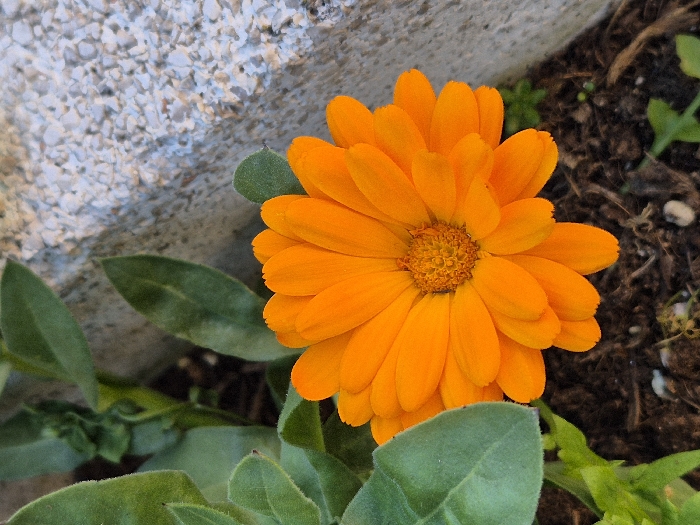
The image captures a close-up of a single, vibrant orange flower, likely a marigold, centered in the frame. The flower displays numerous tightly packed orange petals surrounding a darker orange, textured center. It is rooted in dark brown soil, interspersed with small green leaves and plant debris. To the upper right, a light gray, granular concrete or stone surface forms a textured background element. Additional green foliage is visible on the left side of the frame, partially obscuring the soil. The scene is illuminated by natural light. This flora is situated in Piedrahíta, Spain. No individuals or specific actions are depicted.
Piedrahíta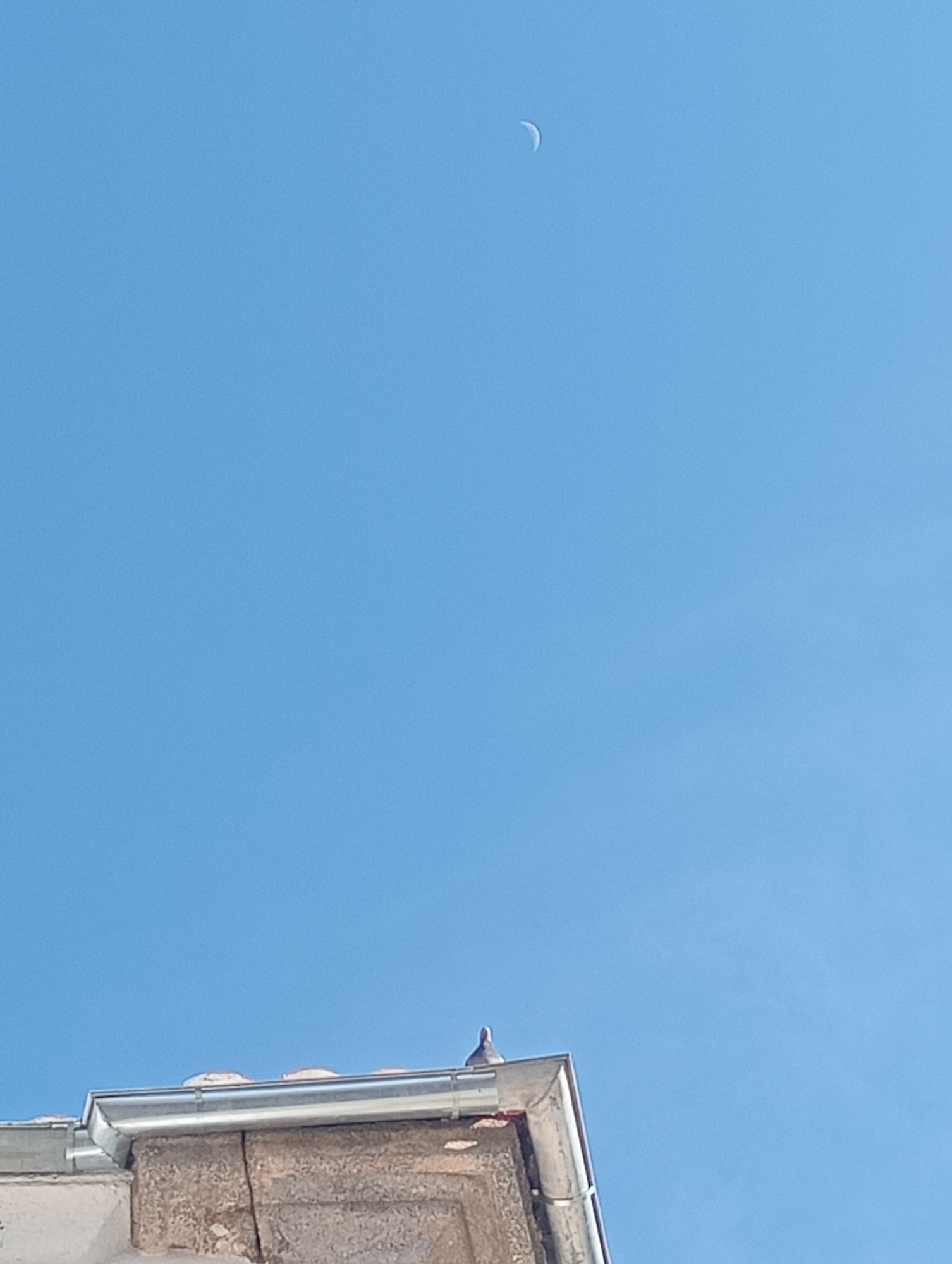
A daytime scene in Piedrahíta, Spain, is depicted under a clear, bright blue sky. A distinct white crescent moon is visible in the upper-left quadrant. The lower portion of the frame shows the upper corner of a building, featuring a terracotta-tiled roof with a prominent metallic rain gutter. Below the gutter, a weathered, textured wall, likely stone or stucco, is visible. A single, dark-colored pigeon is perched atop the roof's edge at the corner, partially obscured by the roofline and gutter.
Piedrahíta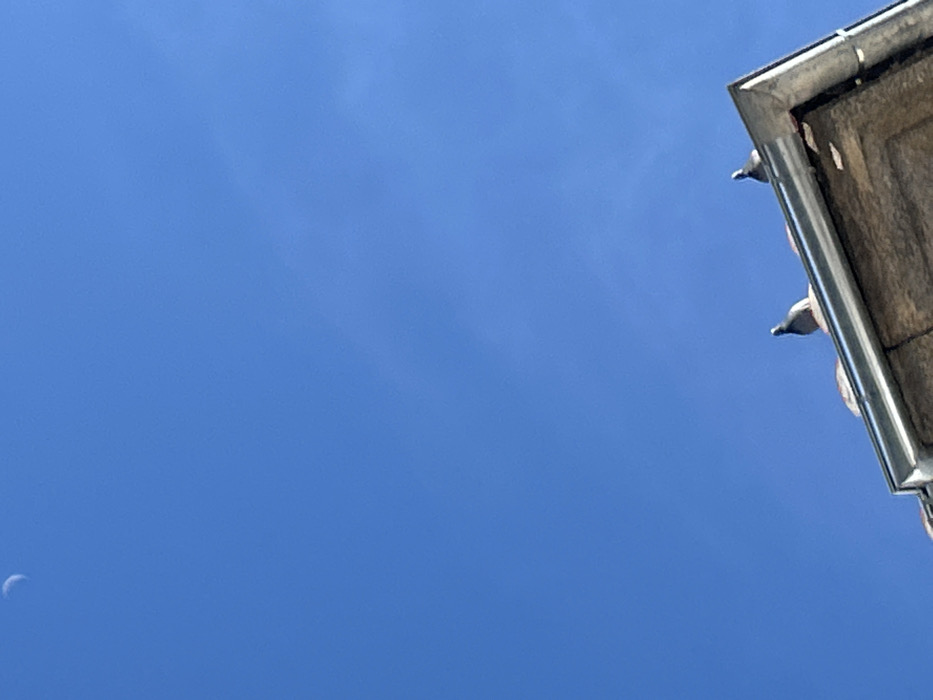
The image provides an upward-angled view of a building in Piedrahíta, Spain, under a clear, bright blue sky. In the upper left quadrant of the sky, a slender crescent moon is visible. The lower third of the frame captures the corner of a building's roof, featuring a metallic rain gutter. Behind the gutter, partially visible orange-brown terracotta roof tiles support two grey pigeons. One pigeon is positioned to the left, and the second is further right, both facing towards the right side of the frame. The underside of the eave, appearing as textured stone or concrete, is visible below the gutter. No human subjects or interactions are present.
Piedrahíta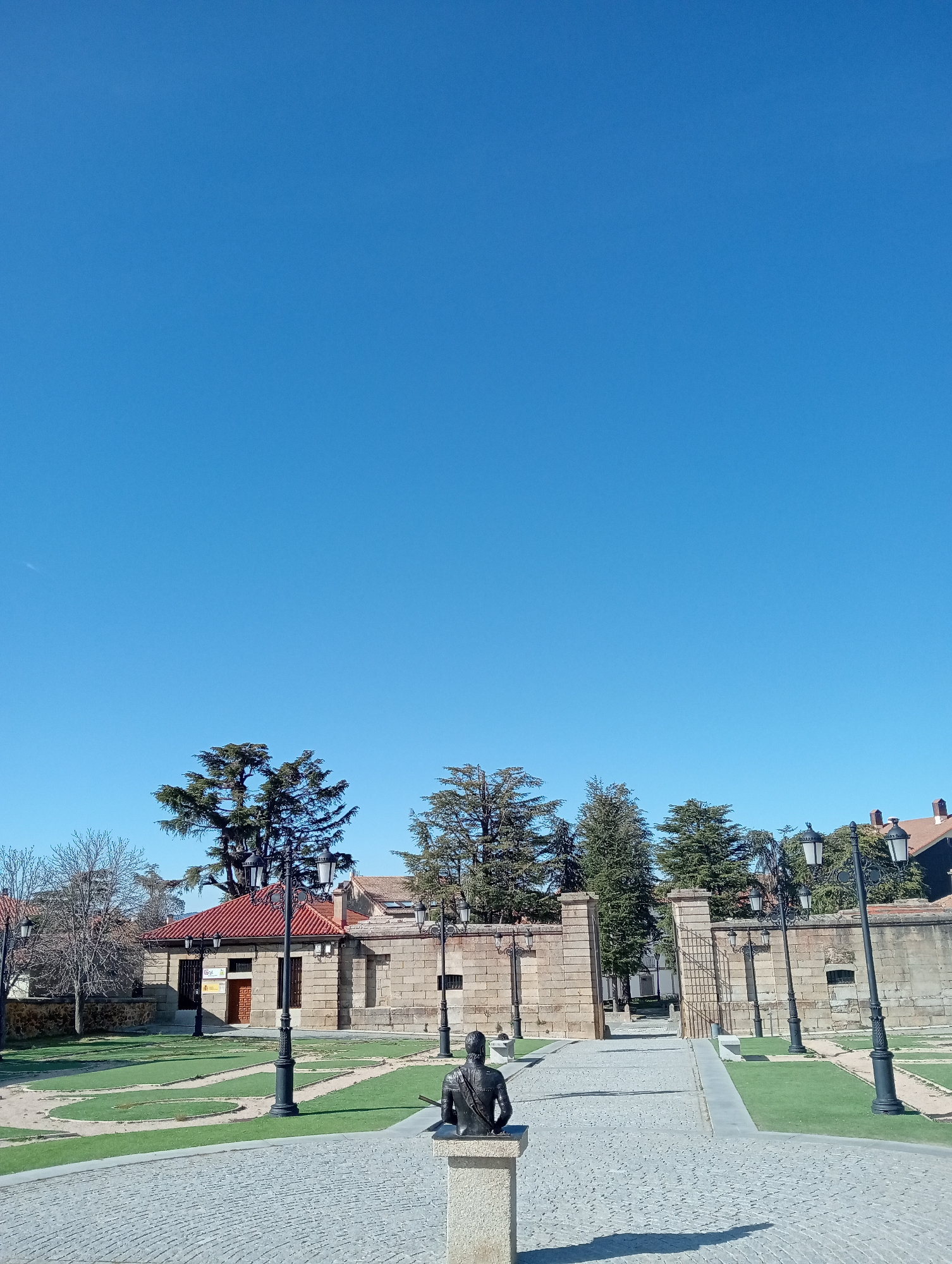
The image depicts a static outdoor scene in Piedrahíta, Spain, under a clear, bright blue sky. A bronze bust of a figure, viewed from behind, sits atop a light-colored stone pedestal in the immediate foreground, casting a shadow onto the cobblestone path it faces. This path extends centrally and slightly to the right, composed of small, light-grey paving stones. To the left and right of the central path are manicured lawns interspersed with curved pathways of dirt or gravel. Several black, ornate streetlights, each featuring multiple lanterns, are symmetrically placed along these pathways and the main cobblestone route. In the midground, on the left, stands a stone building with a prominent terracotta tiled roof, a wooden door, and two visible signs. Bare-branched deciduous trees are visible further left, behind a low stone wall. In the midground, stretching from center-left to right, is a substantial stone wall, likely part of an older edifice, which features a prominent arched gateway with a metal gate structure in the center. Beyond these structures, in the background, additional buildings with terracotta roofs and dense green coniferous trees are visible. The overall scene is devoid of human presence or overt action, characterized by architectural and natural elements under strong daylight illumination.
Piedrahíta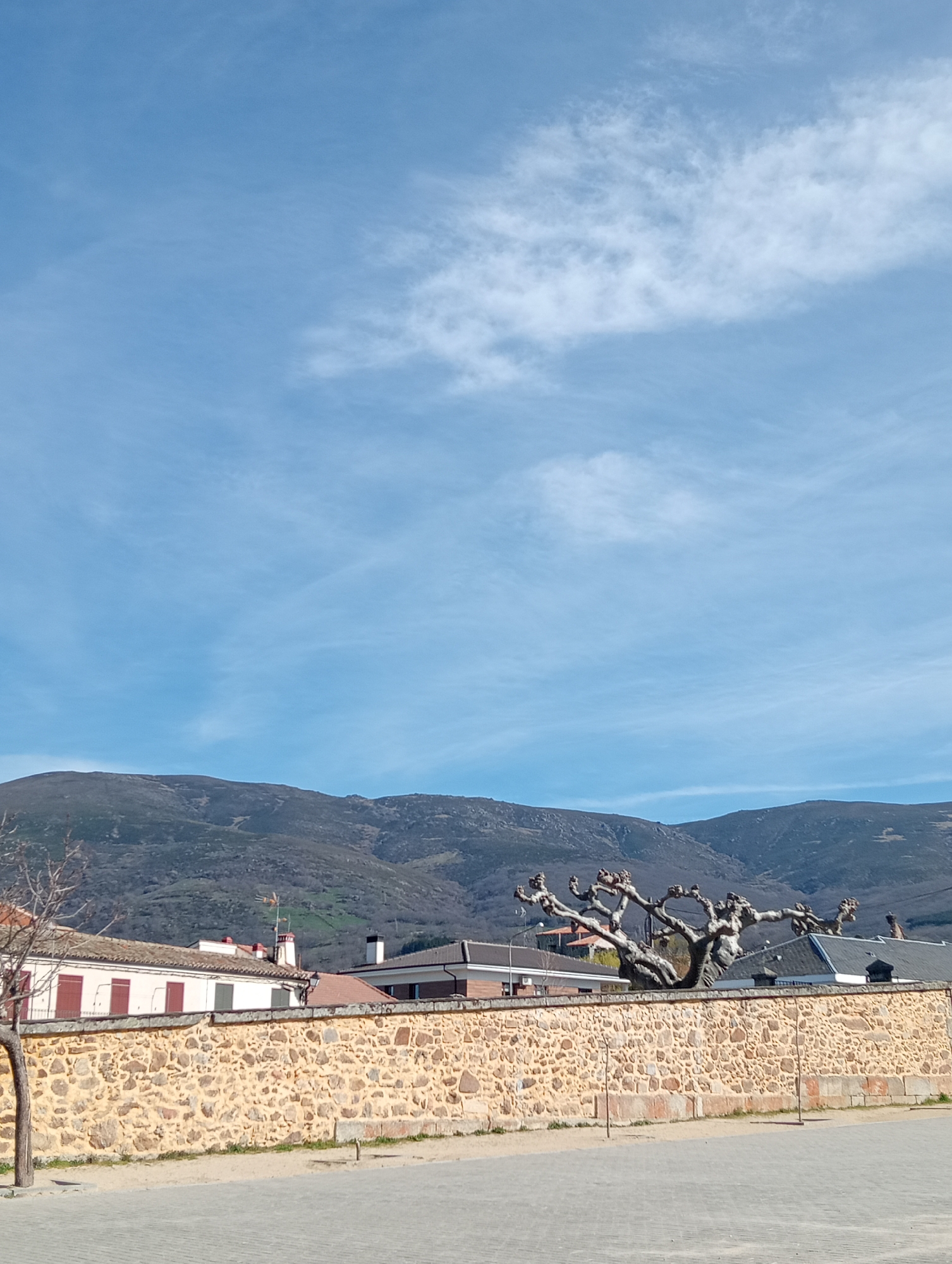
The scene depicts a static, outdoor environment in Piedrahíta, Spain, under a clear, light blue sky with scattered wispy white clouds. In the foreground, a light gray paved surface, possibly a plaza or street, occupies the bottom quarter of the frame. This paving transitions into a narrow strip of bare, sandy ground immediately preceding a substantial stone wall. The wall is constructed from irregularly shaped, light brown and tan stones. Behind the stone wall, several structures are visible. These include buildings with white facades, terracotta-tiled roofs, and some feature dark red window shutters. Exposed chimneys are present on several rooftops, along with a television antenna on one. A large, prominent deciduous tree, devoid of leaves, with a thick, gnarled trunk and twisted, bare branches, extends upwards from behind the wall on the right side of the image, appearing to grow over the rooftops of the buildings. A slender, bare tree trunk is partially visible on the far left, bordering the paved area. The midground is dominated by a range of dark, rolling mountains, appearing sparsely vegetated or treeless, stretching across the horizon beneath the sky. No individuals or dynamic actions are present in the image.
Piedrahíta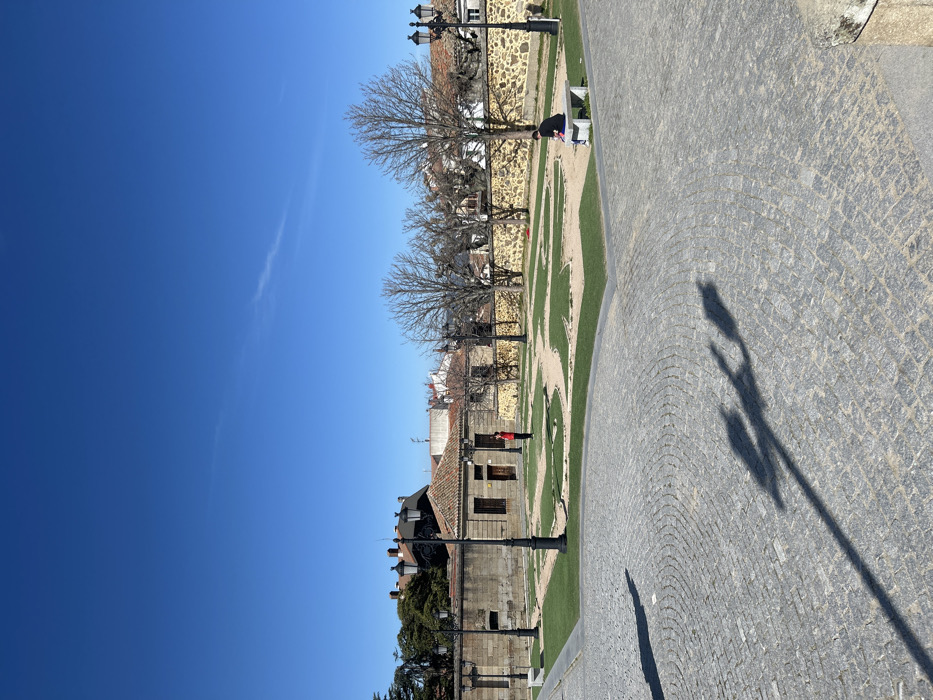
The image displays a sunny public square in Piedrahíta, Spain. The foreground is paved with grey cobblestones arranged in a fan pattern, marked by long shadows from streetlights and an unidentifiable source. The midground features a rectangular garden containing patterned sections of green grass separated by sandy paths. Black, ornate street lamps with two lanterns are situated around the garden perimeter and on the surrounding pavement. One person, dressed in a red top and dark pants, stands in the garden's left section, facing right. Another person, in dark clothing, is seated on a stone bench on the right side of the garden, facing left. Behind the garden, a low stone wall precedes several buildings with terracotta tiled roofs and light-colored facades. Bare deciduous trees and some evergreen foliage are visible in the background against a clear blue sky with minimal cloud cover.
Piedrahíta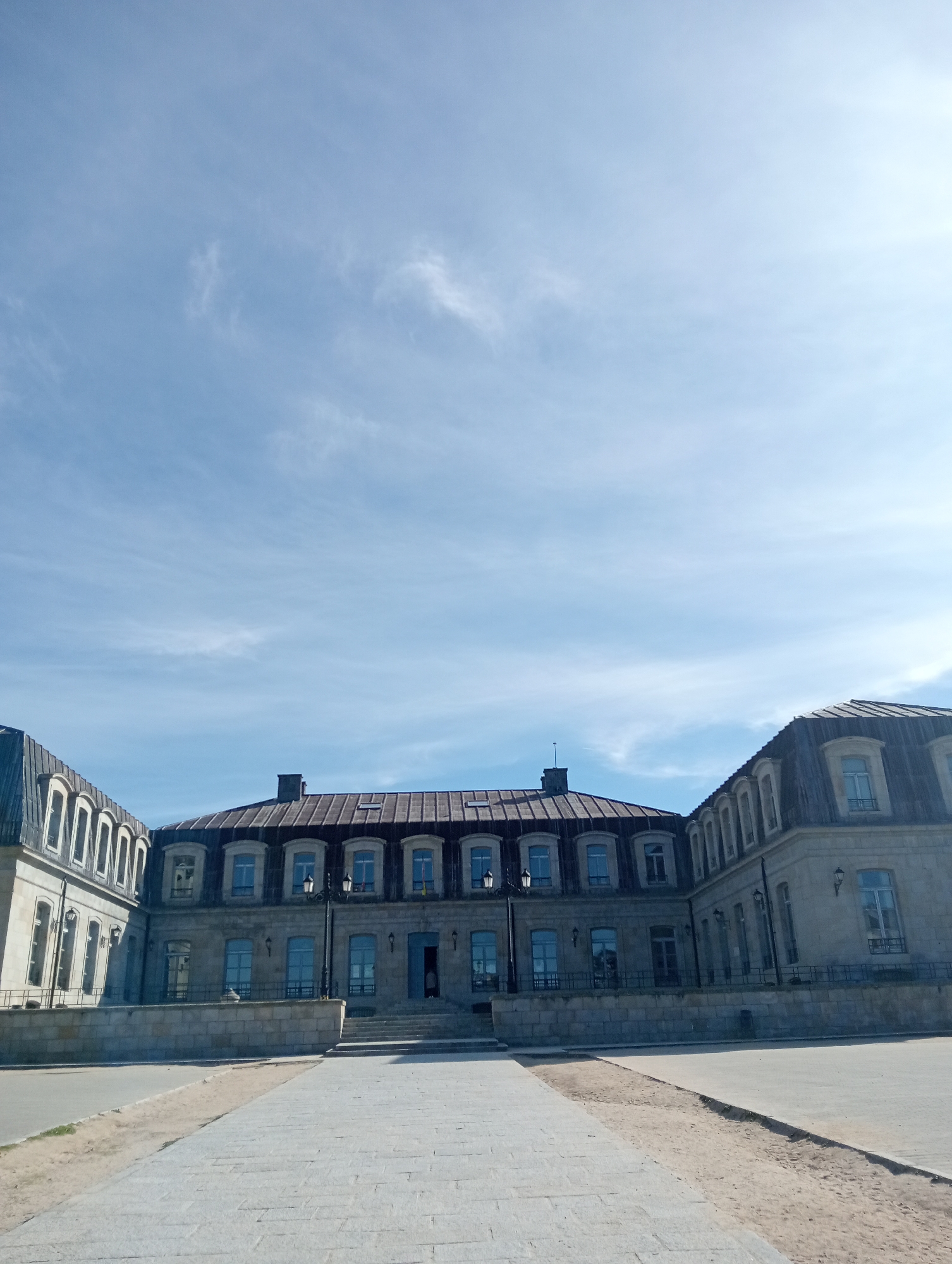
The image displays the Palacio de los Duques de Alba in Piedrahíta, Spain, under a clear blue sky with sparse, wispy white clouds. The grand, U-shaped stone building occupies the midground, its central section and two wings extending towards the viewer. The façade is constructed of light grey stone, featuring numerous rectangular windows with light-colored frames, some equipped with dark iron railings. The central entrance is accessed by a series of stone steps. The building is topped with dark, steeply pitched mansard roofs, likely of slate or metal, punctuated by multiple dormer windows and at least two visible chimneys. Two ornate black lampposts are positioned directly in front of the building's central section. The foreground consists of a wide paved area with light grey rectangular paving stones forming a path leading directly to the palace steps. This path is flanked by sections of bare, sandy earth. A low stone wall acts as a barrier separating the paved area from the building's base. No individuals or vehicles are present in the scene.
Piedrahíta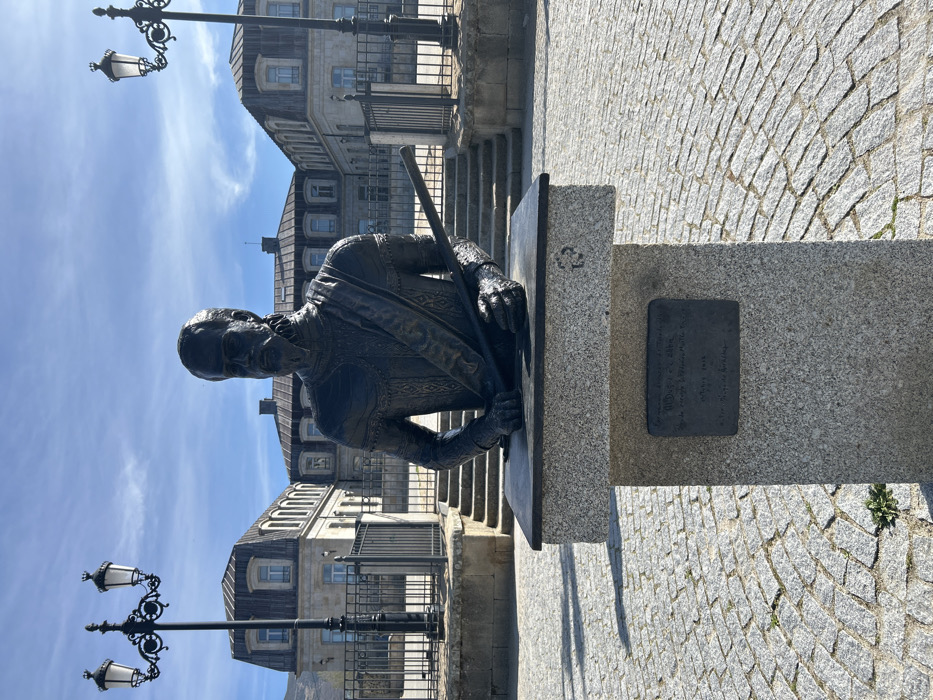
A bronze bust of a male figure, depicting a beard and mustache, clad in period armor with a sash across the chest, and holding a thin rod, stands centrally on a light grey granite pedestal. An inscribed dark rectangular plaque on the pedestal's front face displays text including "Piedrahíta," "Duque de Alba," and "Octubre 2018." The bust is located in front of the Palacio de los Duques de Alba in Piedrahíta, Spain. The foreground is paved with light grey cobblestones, with minor vegetation growth. Behind the bust, a black metal fence and ascending stone steps lead to the palace entrance. Two ornate, three-lamp black streetlights are positioned on either side of the bust, beyond the fence line. In the background, two wings of the large, light grey stone palace are visible, characterized by multiple windows and dark mansard roofs. A mountainous landscape is present on the far left horizon. The scene is illuminated by direct sunlight under a clear blue sky with sparse wispy clouds.
Piedrahíta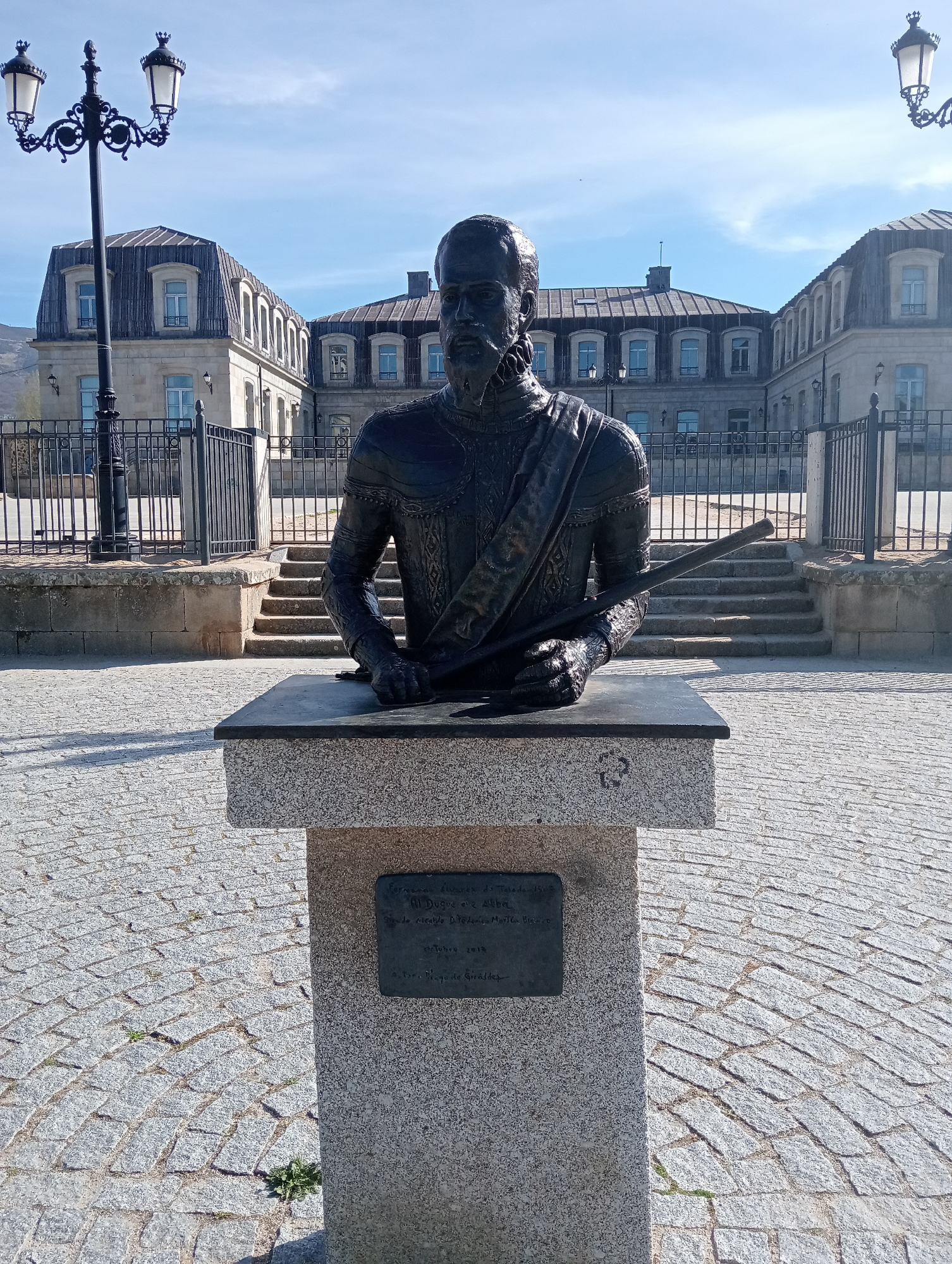
A bronze bust of Fernando Álvarez de Toledo y Pimentel, the 3rd Duke of Alba, is centrally positioned on a light gray speckled granite pedestal in a public square in Piedrahíta, Spain. The bust depicts a male figure with a beard and mustache, attired in a decorated doublet and a diagonal sash. His hands rest on a dark rectangular surface atop the pedestal, with his right hand holding a rod or rolled document. A dark rectangular plaque on the pedestal's front identifies the subject and indicates an installation date of October 2019. The ground is paved with light gray cobblestones arranged in an arched pattern, with sparse weeds visible. In the background, a large stone building, consistent with the Palacio de los Duques de Alba, features multiple windows and a dark mansard roof with dormers. This building is separated from the foreground by a black metal fence and stone steps. Two ornate black lampposts with multiple lanterns are visible on either side of the statue. The scene is brightly lit by direct sunlight, casting distinct shadows.
Piedrahíta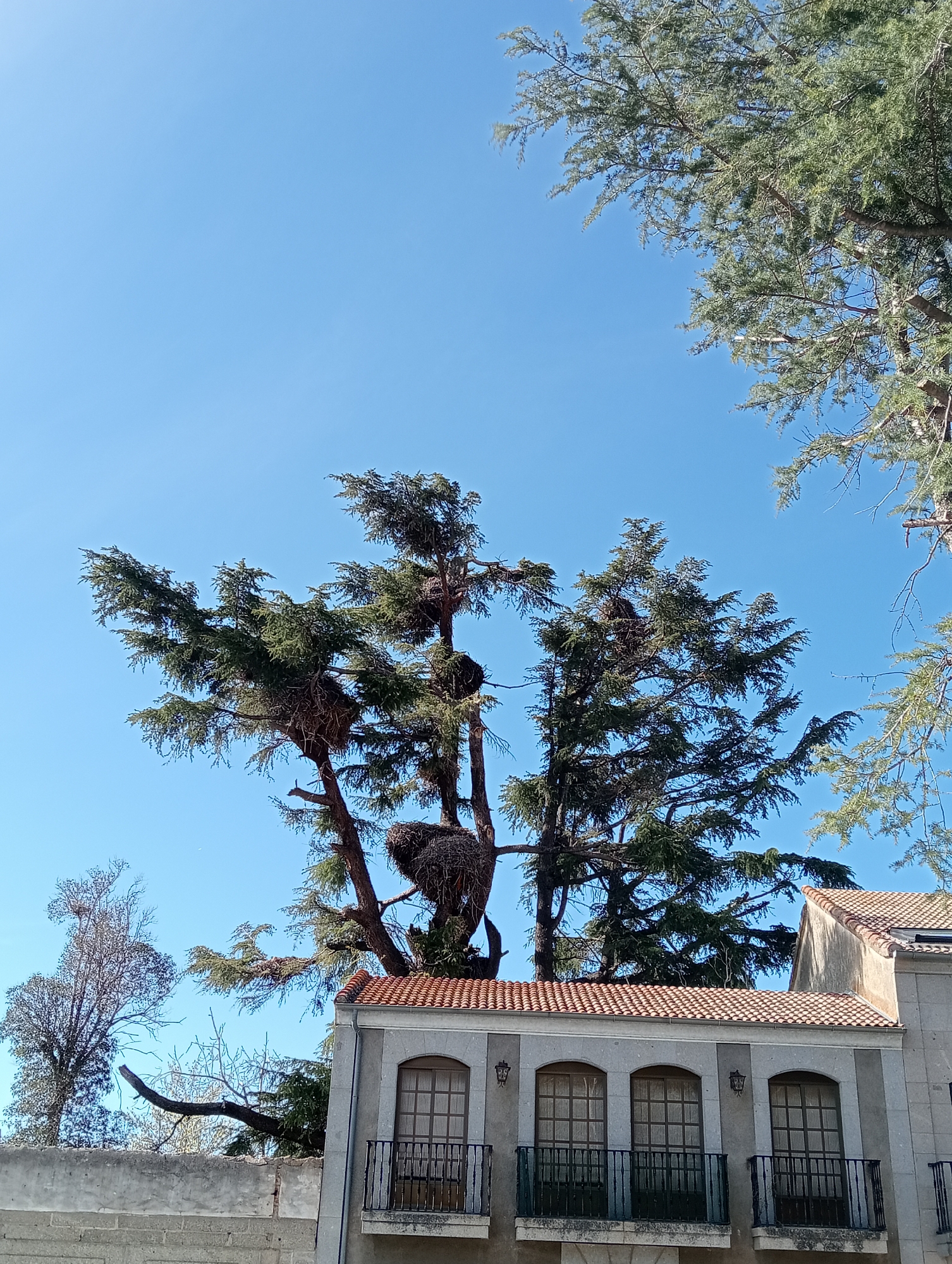
The image depicts a clear, cloudless blue sky dominating the upper two-thirds, above a scene in Piedrahíta, Spain. Multiple tall coniferous trees with dense green foliage are prominent in the central and upper-right portions. Within the upper branches of these trees, several large, bulky avian nests, characteristic of storks, are distinctly visible; at least four significant nests are present in the central cluster of trees. To the far left, a deciduous tree with bare branches is partially seen. In the lower right quadrant, a multi-story building with a reddish-brown terracotta tiled roof is present. The visible upper facade of this building is a light grey or stone color, featuring at least three arched windows with dark frames. Beneath each window is a small, black wrought-iron balcony. Two wall-mounted lanterns are affixed to the facade between the windows. A concrete block wall, appearing unfinished, is visible in the lower-left foreground, partially obscuring the base of the bare-branched tree. No people or specific actions are discernible.
Piedrahíta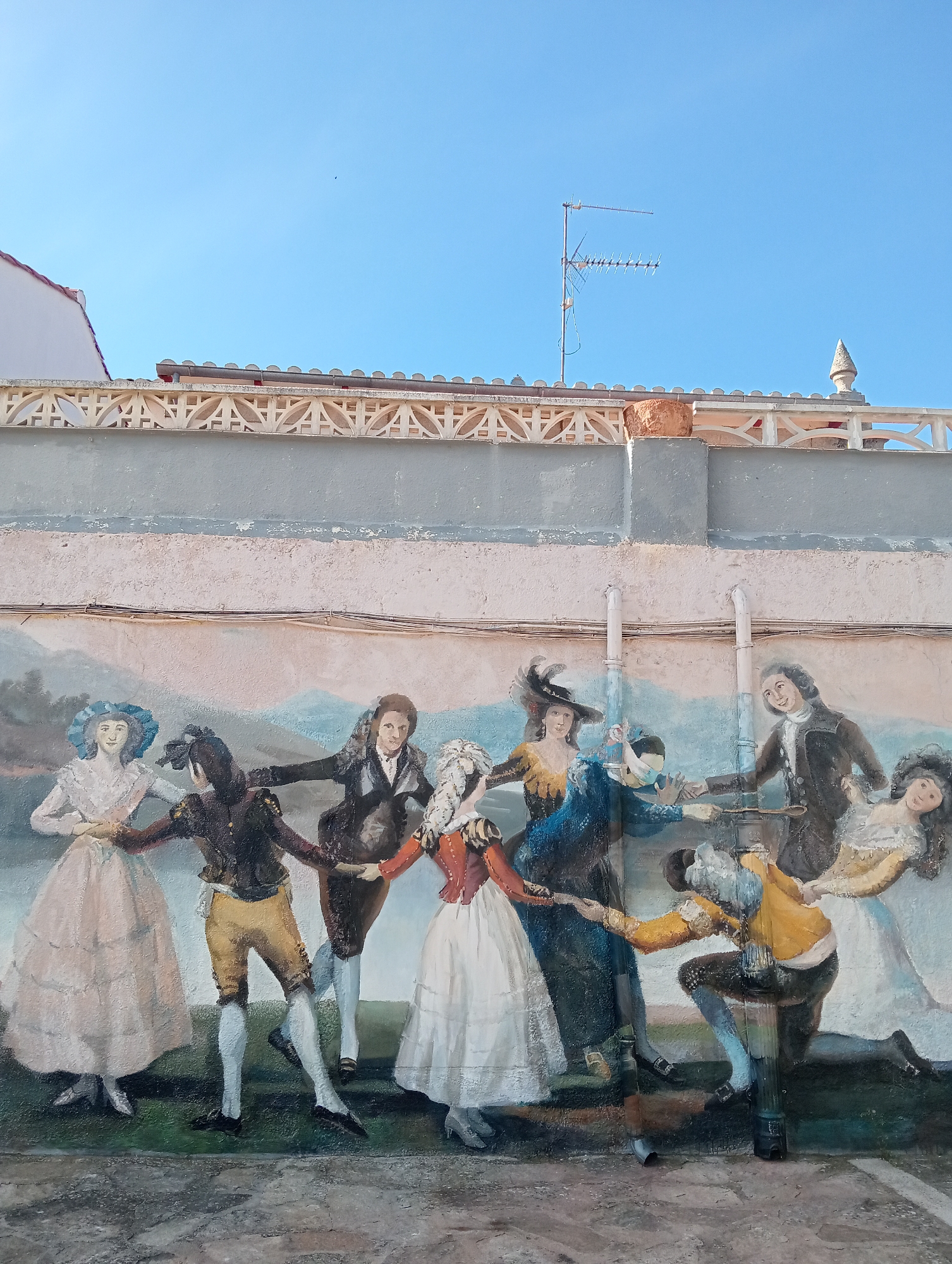
This image displays an exterior wall mural in Piedrahíta, Spain, beneath a clear blue sky. The mural depicts nine figures, both male and female, in 18th or 19th-century period attire, engaged in a circular dance while holding hands. Their expressions suggest engagement or joy. The painted background features distant rolling hills and a green foreground. Two white PVC drainpipes run vertically down the wall, partially overlaying the mural; one figure on the lower right incorporates a pipe into their posture, appearing to kneel with an arm wrapped around it. Above the mural, the wall transitions to a decorative concrete railing with geometric cutouts, topped by a tiled roof, a television antenna, and a finial. Horizontal electrical cables are visible across the wall above the artwork. The ground level comprises textured, weathered paving.
Piedrahíta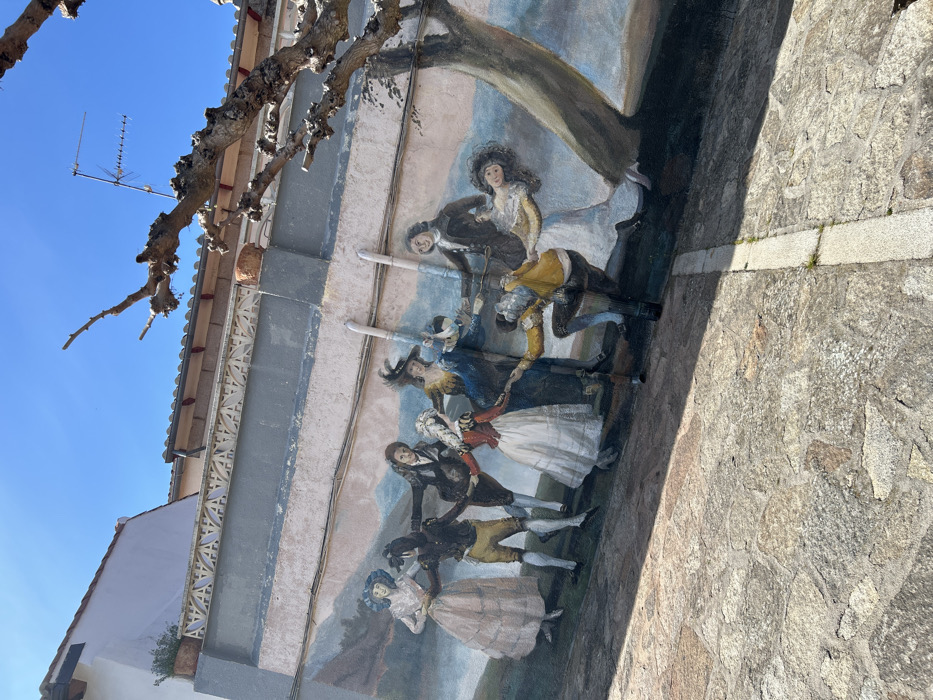
A large mural depicting eight figures in 18th-century attire engaged in a circular dance dominates the wall of a building in Piedrahíta, Spain. The figures, four men and four women, are rendered in a style reminiscent of Goya's tapestry cartoons, with vibrant clothing including feathered hats, flowing dresses, breeches, and jackets. A painted landscape with rolling hills and a light blue sky serves as the background for the dancers. Two white vertical pipes are affixed to the wall, passing through the center of the mural and partially obscuring two figures. Above the mural, the building wall features a grey-blue horizontal band, topped by a decorative white railing with a geometric pattern, suggesting a balcony or terrace. A light-colored building with a sloped tile roof is visible behind the railing, with a terracotta pot containing a small green plant situated on the railing to the left. A television antenna is mounted on a rooftop in the upper right section of the image. In the foreground, the ground is paved with irregular, light-colored flagstones, displaying a distinct straight line of lighter pavers running from the lower center towards the mid-right. A bare-branched, gnarled tree with an unpainted trunk and branches extends from the upper right, partially obscuring the top right portion of the mural. The base of this real tree appears to blend seamlessly with a painted tree trunk on the mural. The scene is illuminated by direct sunlight, casting distinct shadows on the ground and parts of the mural from the top left.
Piedrahíta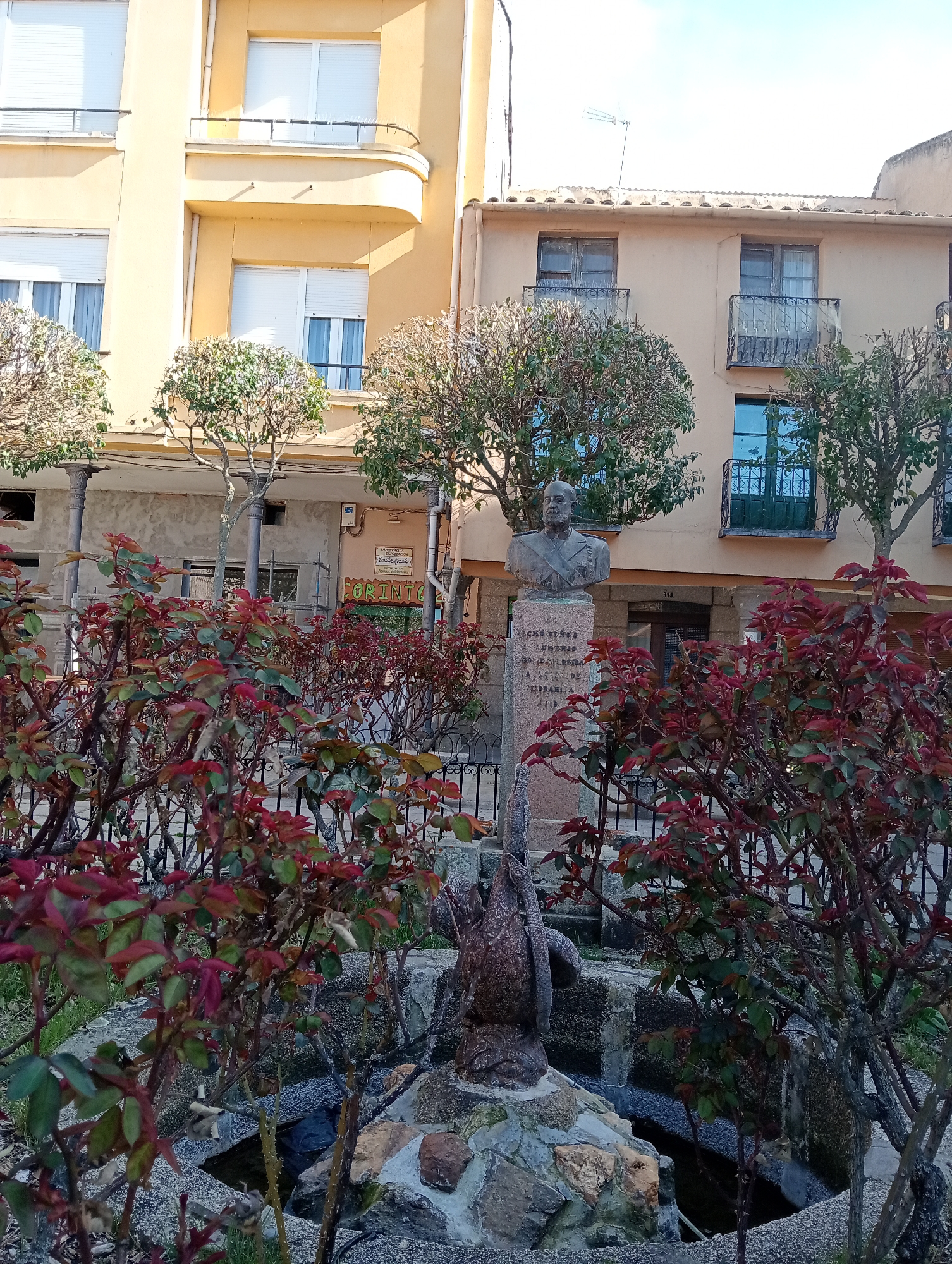
The image displays a public space in Piedrahíta, Spain, under bright daylight. A bronze bust of a bearded male figure, wearing a military-style uniform with epaulets and a sash, stands on a light gray stone pedestal. The pedestal bears an inscription in Spanish, including the names "REINA" and "PIEDRAHITA." Surrounding the monument is a low, circular planter or fountain structure built from irregular stones and concrete, filled with rose bushes displaying prominent red and green leaves. A dark, gnarled, abstract sculptural element, possibly organic, rises from the base of this structure. A low black metal fence encloses the immediate area around the planter. In the background, a three-story, light yellow building on the left features multiple rectangular windows, some with closed white roller shutters, and a curved second-floor balcony with a dark railing. A partially obscured commercial sign is visible on its ground floor. To the right of the monument, a two-story, light beige building presents traditional windows with dark iron balconies. The address number "310" is affixed above a dark entrance door. An adjacent building section to the right exhibits an exposed concrete facade with visible scaffolding and a partial "CORINTO" sign. Sparse deciduous trees with minimal foliage are distributed between the monument and the buildings. No individuals are present in the scene.
Piedrahíta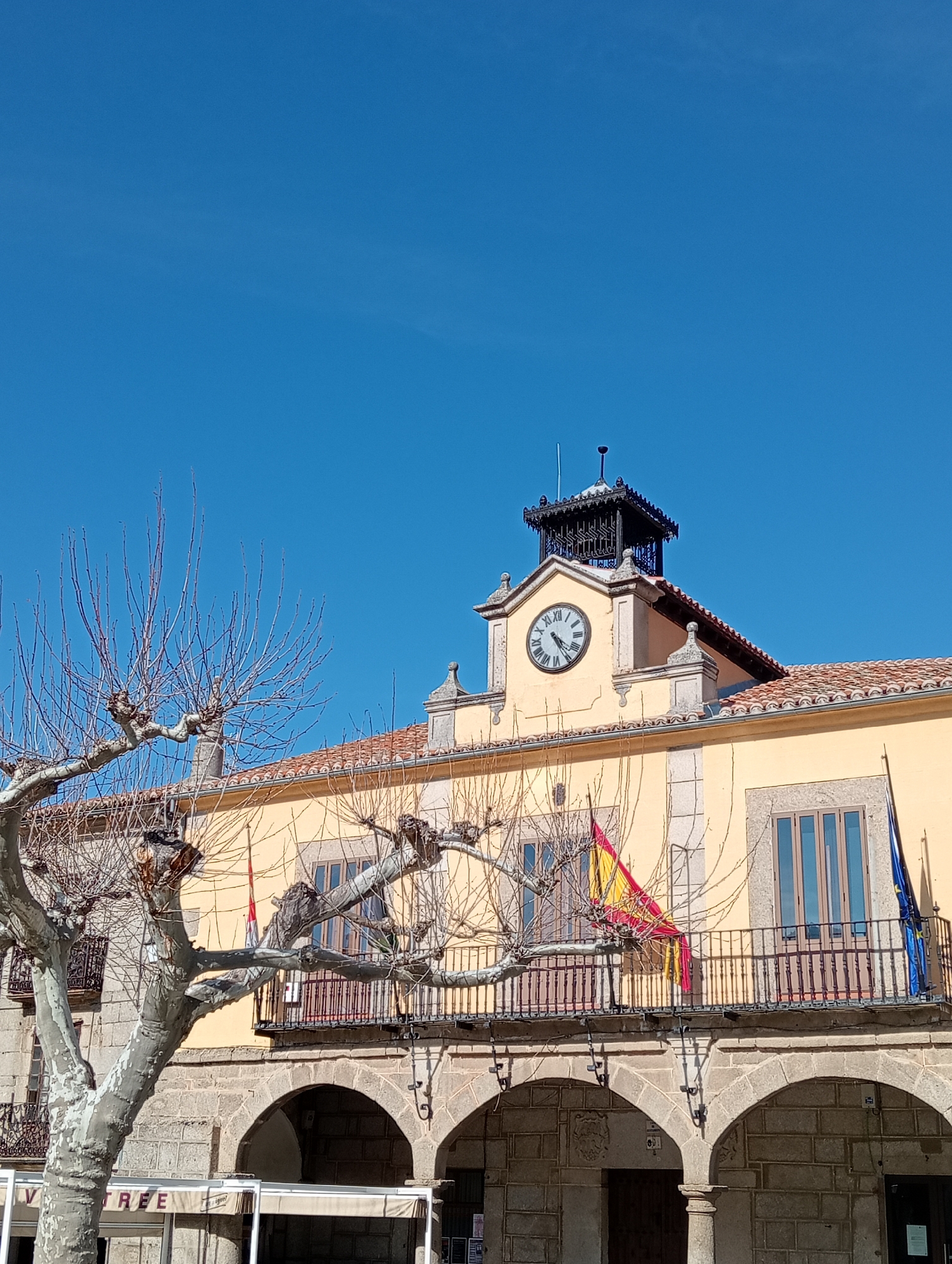
The image depicts the Ayuntamiento (Town Hall) building in Piedrahíta, Spain, under a clear blue sky on a sunny day. The multi-story structure features a pale yellow facade with a red-tiled roof. A central clock tower rises above the roofline, displaying a white clock face with black Roman numerals indicating approximately 10:55. Above the clock is an ornate, dark-colored, open belfry or lantern structure with a pointed finial. Below the clock tower, a long balcony with a black wrought-iron railing spans the upper floor. Two flags are draped over this railing: the Spanish national flag (red, yellow, red horizontal stripes) on the left, and the European Union flag (blue with a circle of twelve yellow stars) on the right. The ground floor of the building features a series of stone arches forming a portico, with the base of stone columns visible. Hints of commercial establishments, including a white awning, are present beneath the arches on the left side. In the left foreground, a large, leafless deciduous tree with mottled grey and white bark and numerous bare branches partially obscures the building. No people are visible in the scene.
Piedrahíta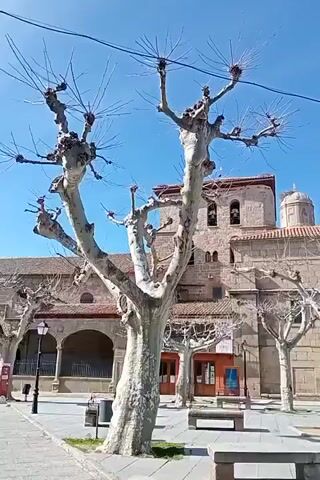
The video shows a plaza in front of a stone building, possibly a church. The building has a red-tiled roof and a bell tower. In the foreground are several bare trees, their branches pruned in a distinctive way. There are stone benches and a trash can in the plaza. The sky is blue and clear. The camera is static, providing a clear, steady view of the scene.
Piedrahíta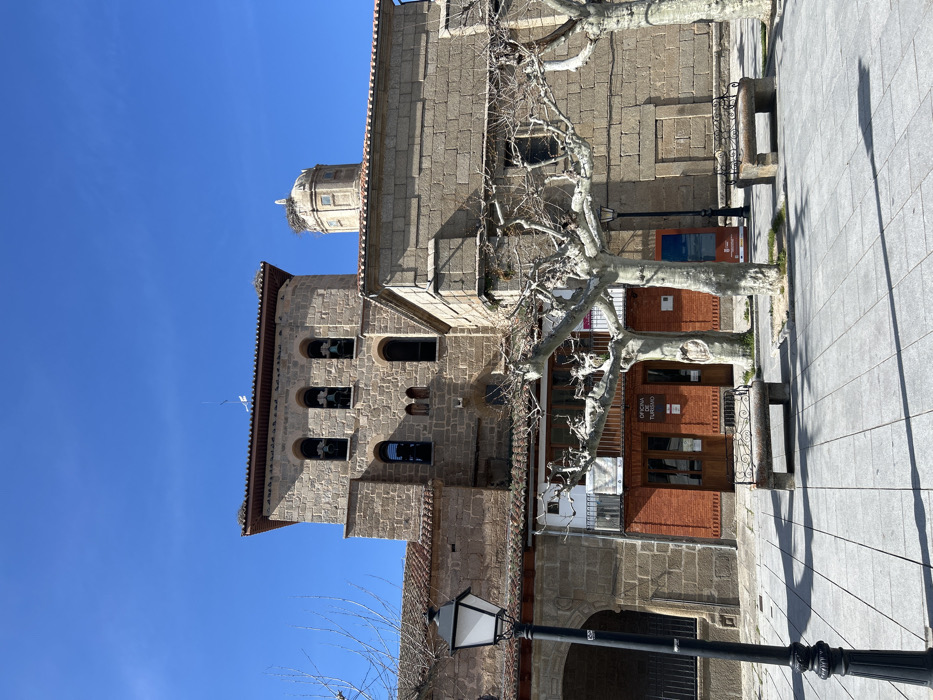
The image displays a clear daytime scene of a public plaza bordering a historic stone building complex in Piedrahíta, Spain. The central structure is a multi-story edifice constructed from rough-hewn, light brown and grey stone blocks. A prominent square bell tower rises on the left, featuring a reddish-brown tiled roof and three visible arched openings, each housing a bell. To the right of the bell tower, a lower section of the building includes a domed cupola topped with a large, visible stork's nest. Below the bell tower, a two-story extension is visible, with a red brick ground floor containing a doorway and a sign reading "Oficina de Turismo" (Tourist Office), surmounted by an upper level featuring a white balcony railing. The plaza floor consists of light grey square paving stones. Several deciduous trees with bare, gnarled branches are interspersed across the plaza, planted within square cutouts in the pavement. Two traditional black lampposts with white luminaires stand upright in the foreground and midground. At least two stone benches with ornate black metal backs are positioned on the plaza. Long shadows are cast across the paved surface, indicating direct sunlight. The sky above is clear and bright blue, devoid of clouds. No individuals or active subjects are present in the scene.
Piedrahíta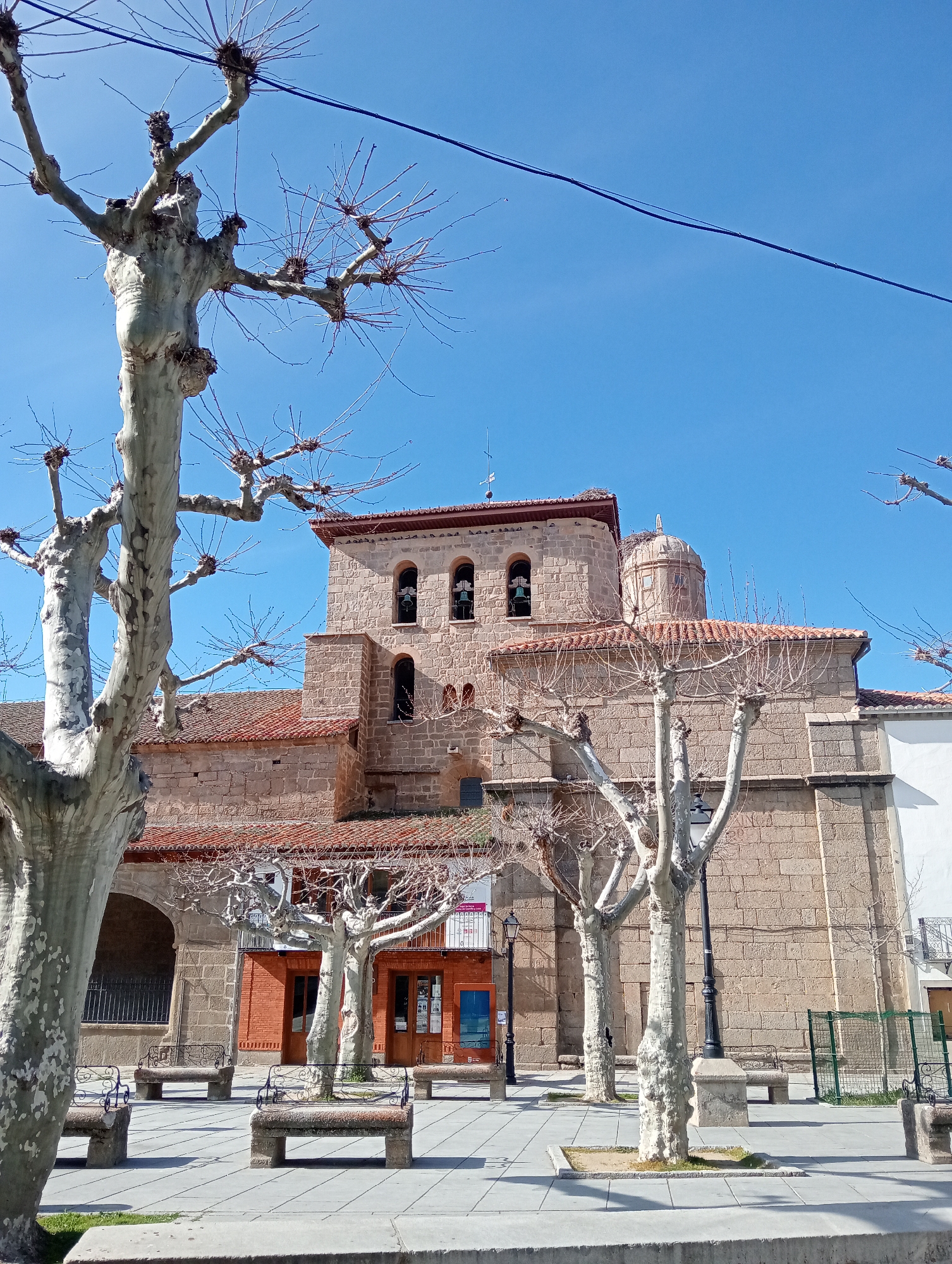
The image presents a forensic view of a public square in Piedrahíta, Spain, dominated by a large stone ecclesiastical structure under a clear, bright blue sky. The primary building, likely a church, is constructed from light brown sandstone blocks with a terracotta tile roof. It features a prominent bell tower on the left with three arched belfry openings, two of which contain bells. To the right of the tower, a circular dome with a small finial is visible. A substantial bird's nest, consistent with a stork's nest, rests on the roof of the bell tower, near a thin metal antenna or lightning rod. The foreground is a paved plaza composed of uniform grey square tiles. Numerous pollarded trees, characterized by their light grey, mottled bark and bare, knotty branches, are distributed across the plaza, casting distinct shadows. Several stone benches with dark, ornate metal backrests are situated on the paved surface. Two black, decorative streetlights stand among the trees. To the left, an arched entrance or passage is integrated into the stone building. A structure with a reddish-brown brick facade and dark wooden doors is partially visible behind the trees in the middle ground, while a section of a white building with a small balcony and a green metal fence appears on the far right. A single dark, thin cable traverses horizontally across the upper portion of the sky. The scene is devoid of human figures or discernible activity.
Piedrahíta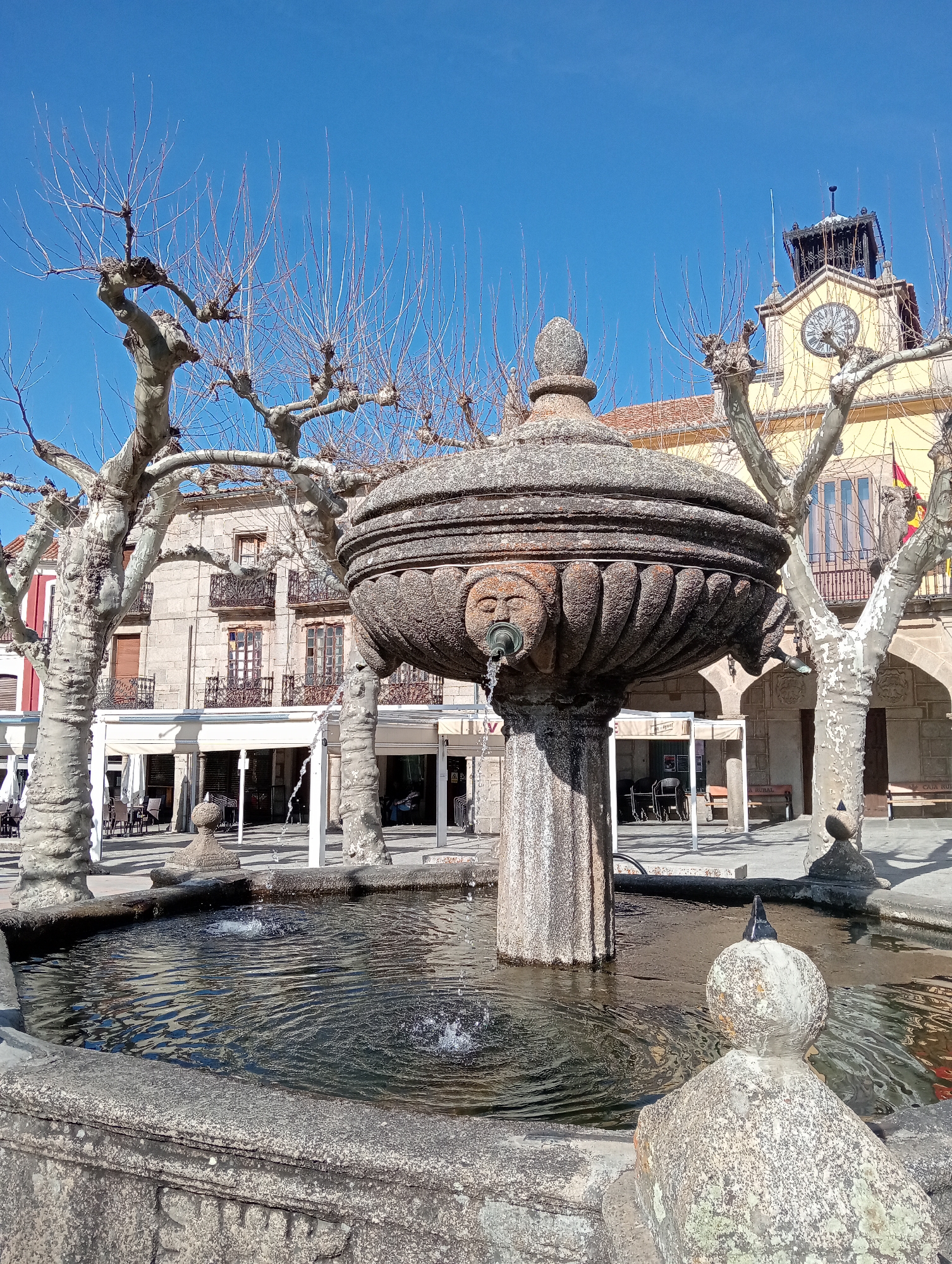
The image displays the Plaza de España in Piedrahíta, Spain, under a clear blue sky. A weathered, two-tiered stone fountain occupies the center foreground. The upper basin, adorned with fluted carvings and a carved facial effigy, spouts water from a metal pipe into the octagonal lower basin, creating ripples and small splashes. Several mature, bare, pollarded trees with mottled grey bark and gnarled branches frame the scene. In the background, to the right, is a prominent light yellow building, characteristic of a town hall, featuring arched ground-floor entrances, balconies with black wrought iron railings, and a central clock tower with a circular clock face and a dark metal belfry. Spanish flags are affixed to a balcony on this building. To the left, a multi-story stone building with balconies and red shutters stands adjacent to an area with white awnings covering outdoor seating and tables. The square's surface is paved. No individuals are distinctly visible. The scene is brightly lit by natural sunlight.
Piedrahíta