Pombia, Italy
5 memories from Pombia, Italy

In a seat-back pocket on what appears to be public transport, a Coca-Cola bottle with a black cap and a Pringles can are placed. The Coca-Cola bottle is partially filled with a dark liquid and has a red label. The Pringles can is blue with the Pringles logo featuring a caricature of a man with a mustache. The seat-back pocket is made of gray mesh material. In the foreground, a person's lap is visible, covered by striped pants featuring alternating navy blue and white stripes. The background is a plain, light-colored surface, possibly the back of a seat. The image does not contain any information or visual cues to identify its specific location in the city of Pombia, Italy.
Pombia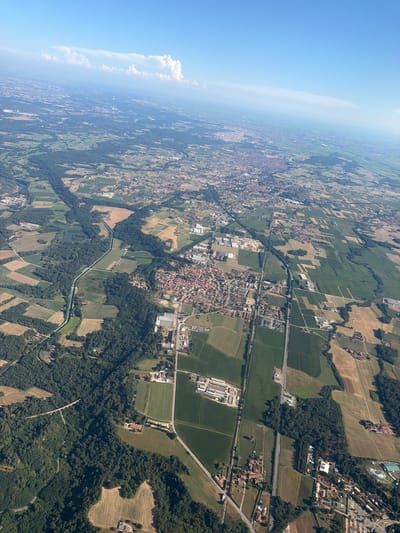
This is an aerial photograph of a rural landscape in Pombia, Italy, likely taken from an airplane. The image shows a patchwork of agricultural fields, forests, and a small town with red-tiled roofs. A canal or river runs through the center of the frame, bordered by trees. In the distance, a hazy horizon and a clear blue sky suggest fair weather. The overall scene depicts a tranquil, agrarian environment.
Pombia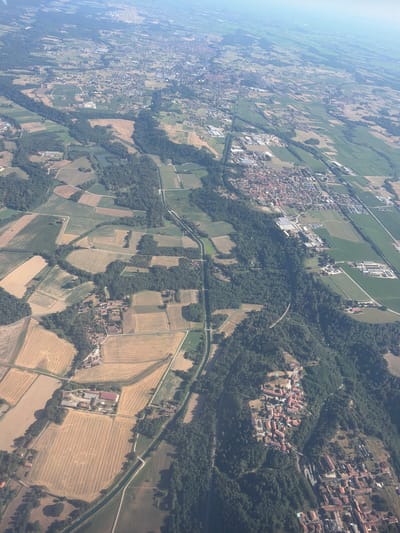
This is an aerial photograph taken from a high altitude, likely from an airplane. The image shows a vast agricultural landscape in Pombia, Italy, with a mix of cultivated fields, forests, and scattered settlements. The sun appears to be high in the sky, suggesting it is midday. The weather seems clear, with good visibility. The dominant subjects are the agricultural fields, which are varied in color and texture, indicating different crops and stages of cultivation. Some fields show straight rows of crops, while others are covered in what appears to be harvested hay, bundled into small, round bales. Patches of dense green forest are interspersed throughout the landscape, creating a striking contrast with the lighter tones of the fields. Several small towns and hamlets are visible, characterized by clusters of red-tiled roofs. These settlements are nestled within the agricultural land and surrounded by trees. One notable settlement is situated on a slightly elevated area, surrounded by greenery. A man-made waterway, likely a canal, runs through the scene, bordered by trees. Roads and smaller paths crisscross the landscape, connecting the settlements and fields. There are no visible people or specific objects that stand out in terms of human activity, other than the general signs of agricultural production and the presence of human settlements. The overall scene depicts a rural, European countryside bathed in bright sunlight. There is no visible text in the image.
Pombia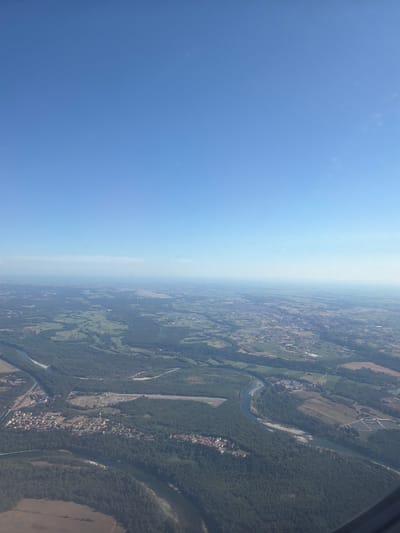
The image is an aerial view, taken from an airplane, of a vast landscape under a clear blue sky. The scene is dominated by a winding river that meanders through a densely forested area. On the left bank of the river, a small town or village is visible, characterized by a cluster of red-tiled roofs. Further in the distance, the landscape opens up to reveal agricultural fields and scattered settlements, with a hazy horizon suggesting a large urban area or the edge of a plain. There are no people or specific actions depicted in the image. The environment is natural with human settlements integrated into the landscape.
Pombia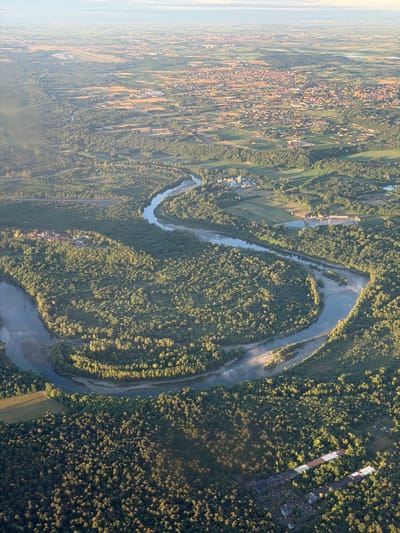
This aerial photograph presents a vast landscape combining natural features with human development, indicative of the region around Pombia, Italy. The primary subject is a wide, light blue river, likely the Ticino, which meanders significantly through the scene, flanked by extensive, dense green forests. Patches of lighter sand or gravel banks are visible along the river's edges. To the left of the main image, and more distinctly in the first crop, a large residential area spreads across the landscape. Numerous houses with reddish-brown roofs are clustered together, forming a town or village. Adjacent to and interspersed with these settlements are various agricultural fields, appearing as rectangular patches of green and yellow, suggesting cultivated land. Several man-made structures are visible within the forests. In the second and third crops, long, narrow buildings with light-colored roofs, possibly industrial facilities, warehouses, or large greenhouses, can be seen. One crop also shows a straight, dark line cutting through the landscape, which could be a road or a railway line. The image suggests a time of day during the golden hour, either late afternoon or early morning, evidenced by the long shadows cast by trees and structures, and the warm, golden light illuminating parts of the terrain. The sky appears clear, though a light atmospheric haze is visible, particularly towards the horizon on the left. No specific human activity is discernible from this high-altitude perspective, nor is any visible text present. The scene conveys a sense of natural beauty and the subtle integration of human habitation within it.
Pombia