Priekulė, Lithuania
30 memories from Priekulė, Lithuania
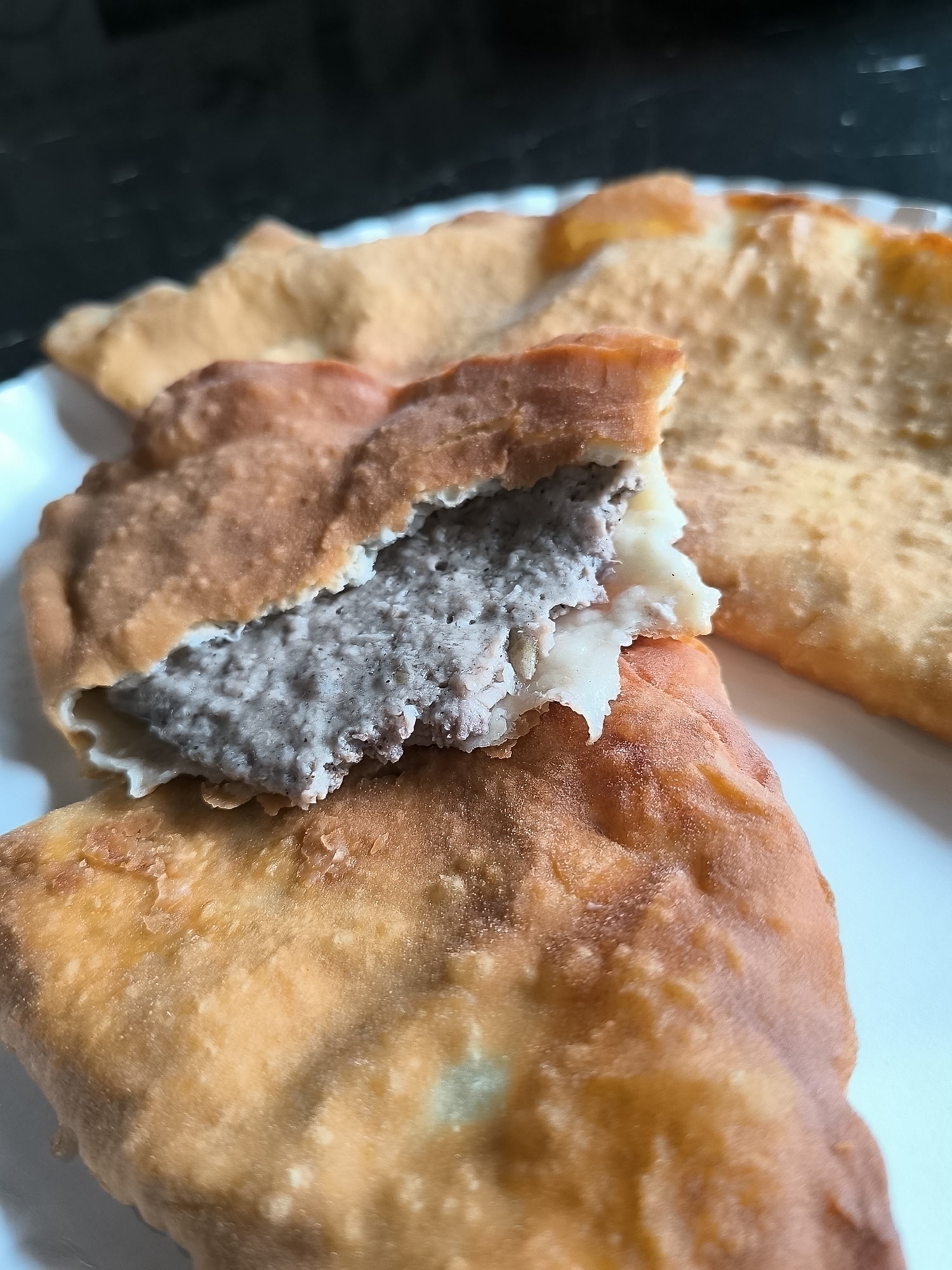
A close-up shot captures several golden-brown, deep-fried pastries on a white plate, likely chebureki. One pastry in the foreground is broken open, revealing a dense, greyish, granular filling, consistent with minced meat. The pastry exterior is textured from frying, exhibiting a crispy, slightly bubbly appearance. The edges of the pastries show a distinctive crimped pattern. Two other intact pastries are partially visible in the background, out of focus, further emphasizing the main subject. The background is dark and blurred, suggesting an indoor setting. There are no people, visible text, or explicit location cues within the image. The scene presents the food ready for consumption or as a culinary display.
Priekulė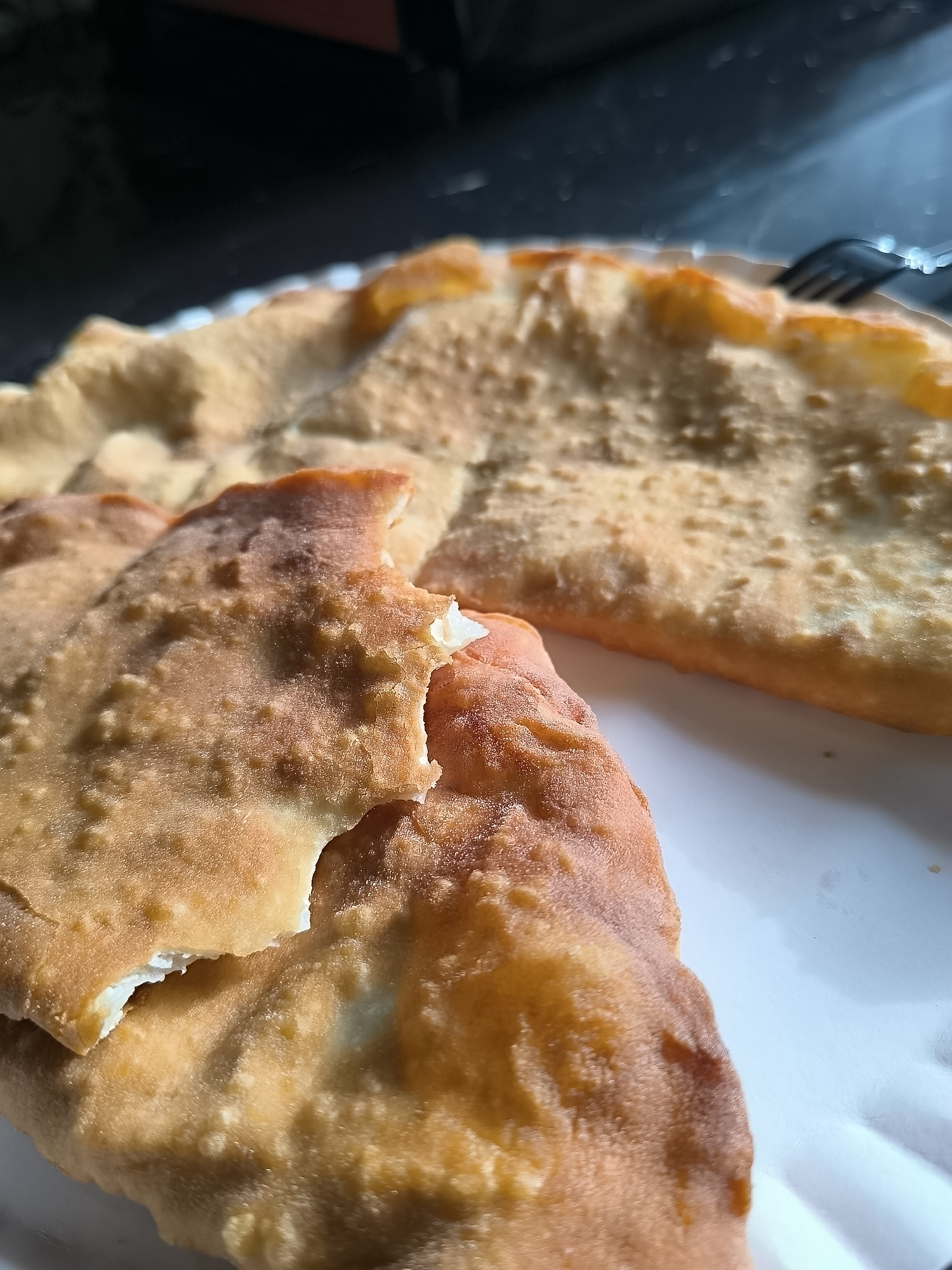
A close-up shot captures several golden-brown, fried pastries, likely a type of savory turnover such as *chebureki*, arranged on a white plate. The foreground features a partially broken pastry, revealing its lighter, flaky interior. The surfaces of the pastries are visibly textured with numerous small bubbles, suggesting a crispy exterior from frying. Another larger pastry is positioned further back on the plate, slightly out of focus. In the upper right background, a dark, out-of-focus fork is visible, indicating the pastries are prepared for eating. The lighting is bright, creating highlights and shadows that emphasize the food's texture and warmth. The background is dark and blurred, providing minimal environmental context beyond the immediate setting of the meal. The scene depicts a daytime meal or snack. No text is visible in the image. While the provided context indicates Priekulė, Lithuania, there are no specific visual cues within the image to confirm this location.
Priekulė
A close-up shot shows a golden-brown, fried pastry, possibly a cheburek, resting on a white plate. The pastry is cut in half, revealing a light-colored, minced meat filling. The flaky, crispy texture of the dough is visible. Bright light illuminates the dish from the side, casting shadows on the plate and highlighting the details of the pastry. A dark, reflective surface is visible in the background. Around the 0:04 mark, a black fork gently pushes into the cut, further separating the two halves of the pastry. The scene focuses entirely on the food, presenting it as an appetizing meal.
Priekulė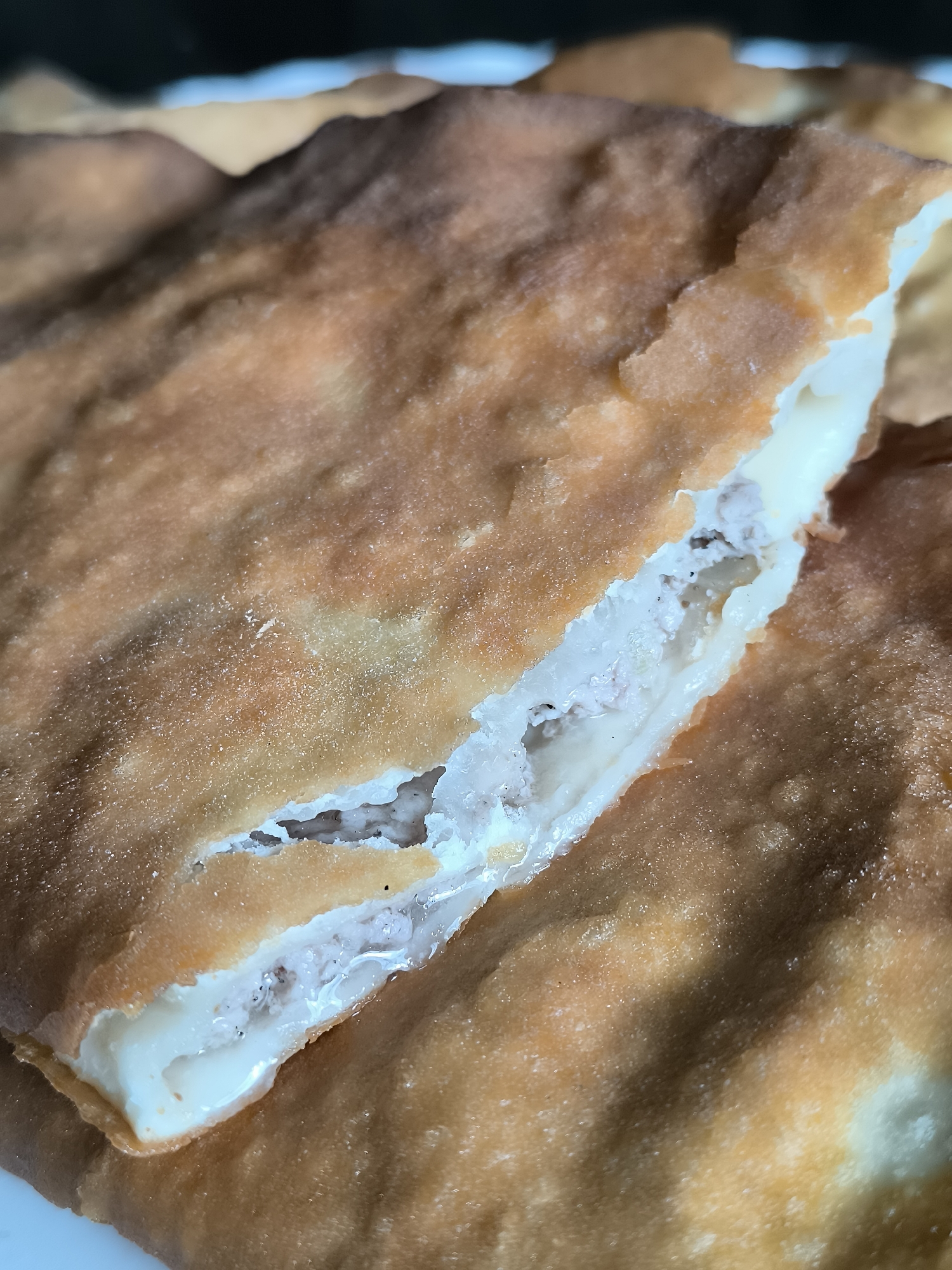

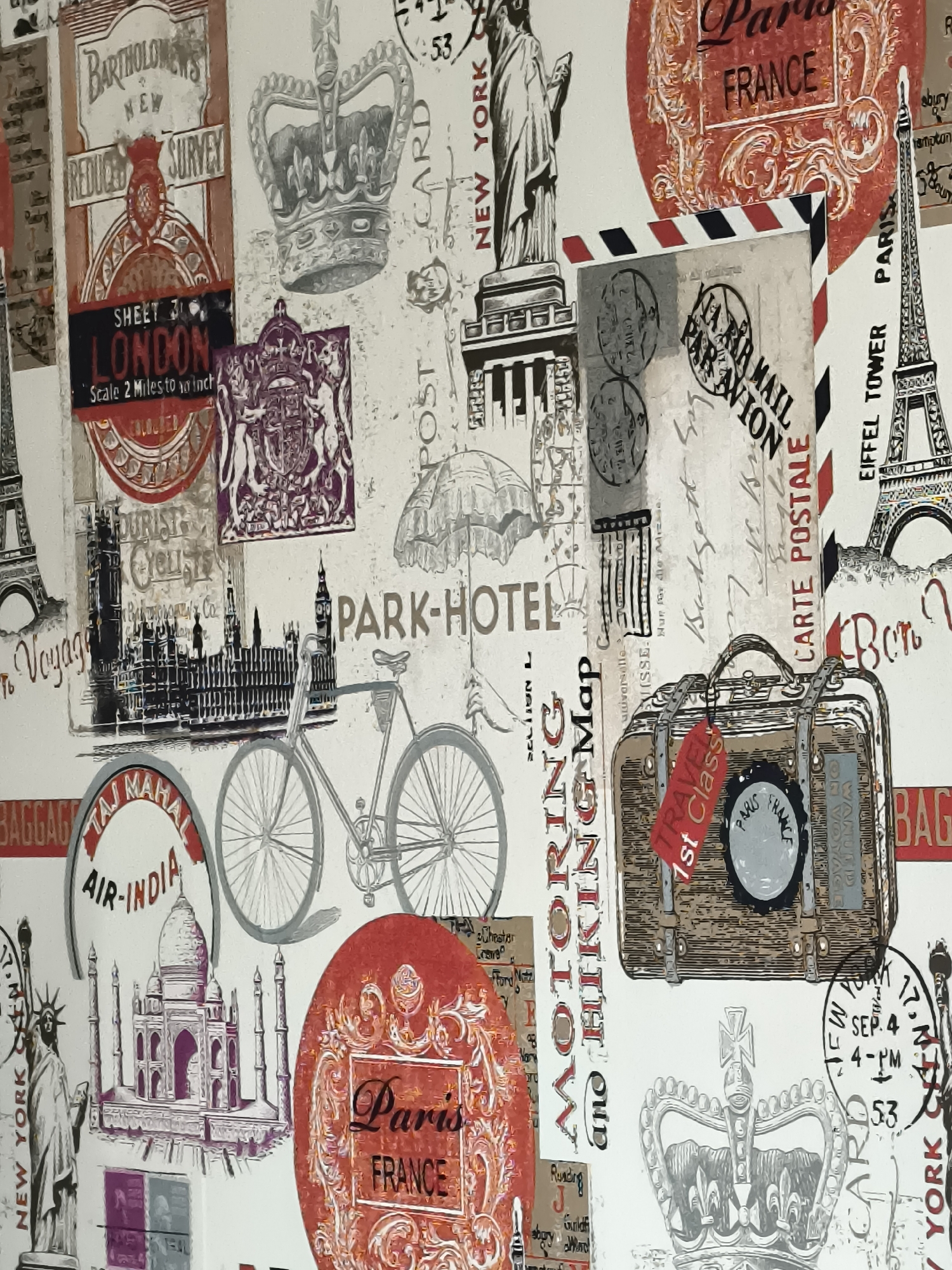
The video features two golden-brown, freshly fried pastries, possibly chebureki, displayed on a white, ridged paper plate. The plate rests on a dark, speckled countertop. In the background, there is a light-colored wallpaper or print with vintage travel-themed illustrations and text. Visible text on the wallpaper includes "PARK-HOTEL", "BON VOYAGE", and "PARIS". The illustrations include a red vintage car, bicycles, and the Eiffel Tower. The camera slowly pans across the pastries, providing a close-up view. No people are visible in the scene.
Priekulė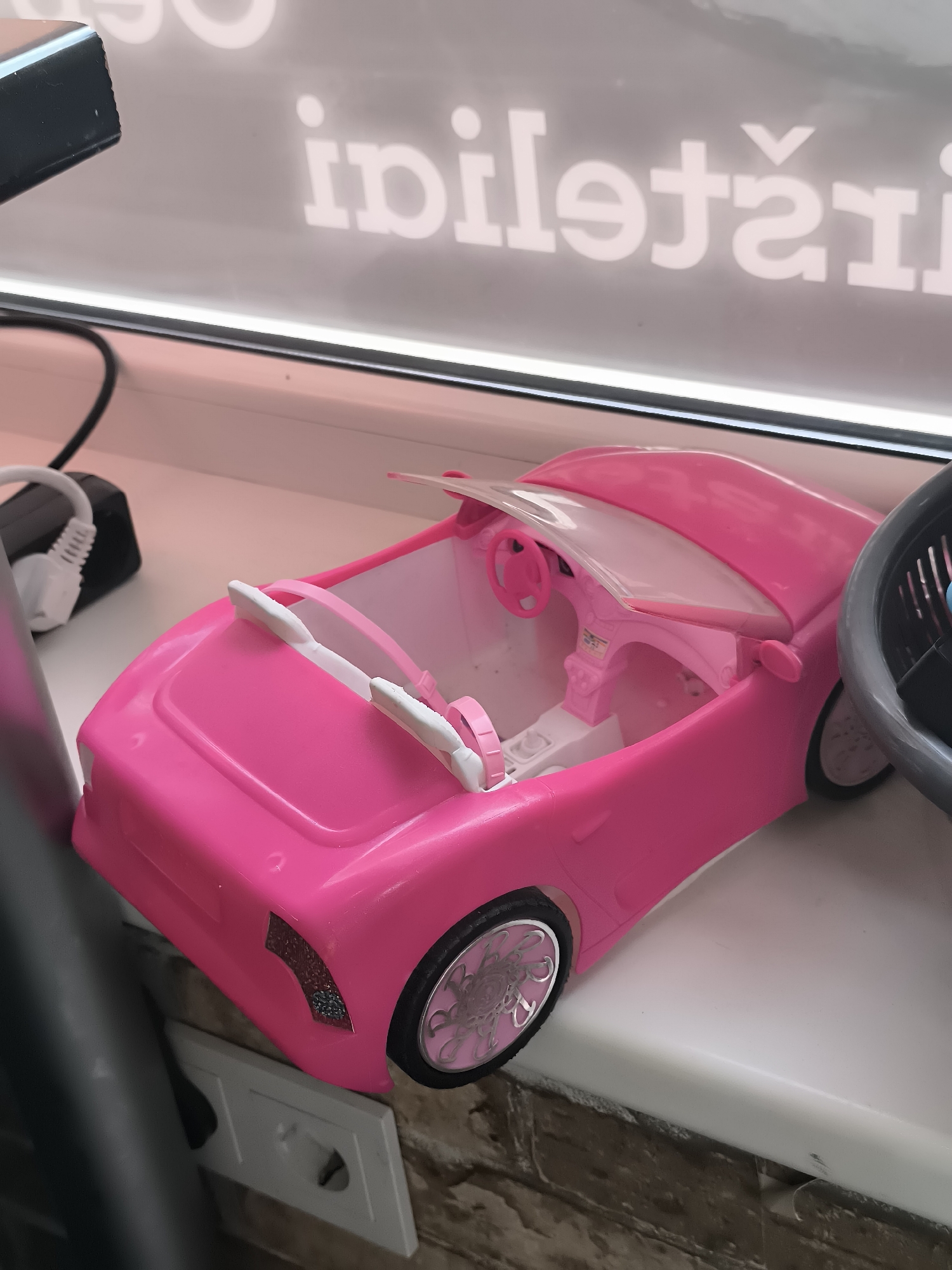
The media file features a bright pink toy convertible car, likely a Barbie car, positioned on a white window sill. The car has an open top, revealing a light pink interior with a steering wheel and dashboard details. The wheels are black with shiny silver-pink hubcaps. To the left of the car, a white power plug is connected to a black adapter or charger, with a black cable running from it. Partially visible on the far left and right are dark gray or black objects, possibly parts of other items or equipment. The scene is indoors, next to a window, as indicated by the reflected text on the glass surface behind the toy car. No specific activity is occurring; the objects are static, suggesting a display or storage arrangement. The ambient light implies it is daytime. The most notable detail is the mirrored text displayed on the window, rendered in white letters against the glass. Visible fragments of this mirrored text include "ipi" and "ilėžāri". The presence of the characters `ė` (e with dot), `ž` (z with caron), and `ā` (a with macron) strongly indicates that the language is Lithuanian, aligning with the provided location context of Priekulė, Lithuania. The full message conveyed by the mirrored text is not entirely legible.
Priekulė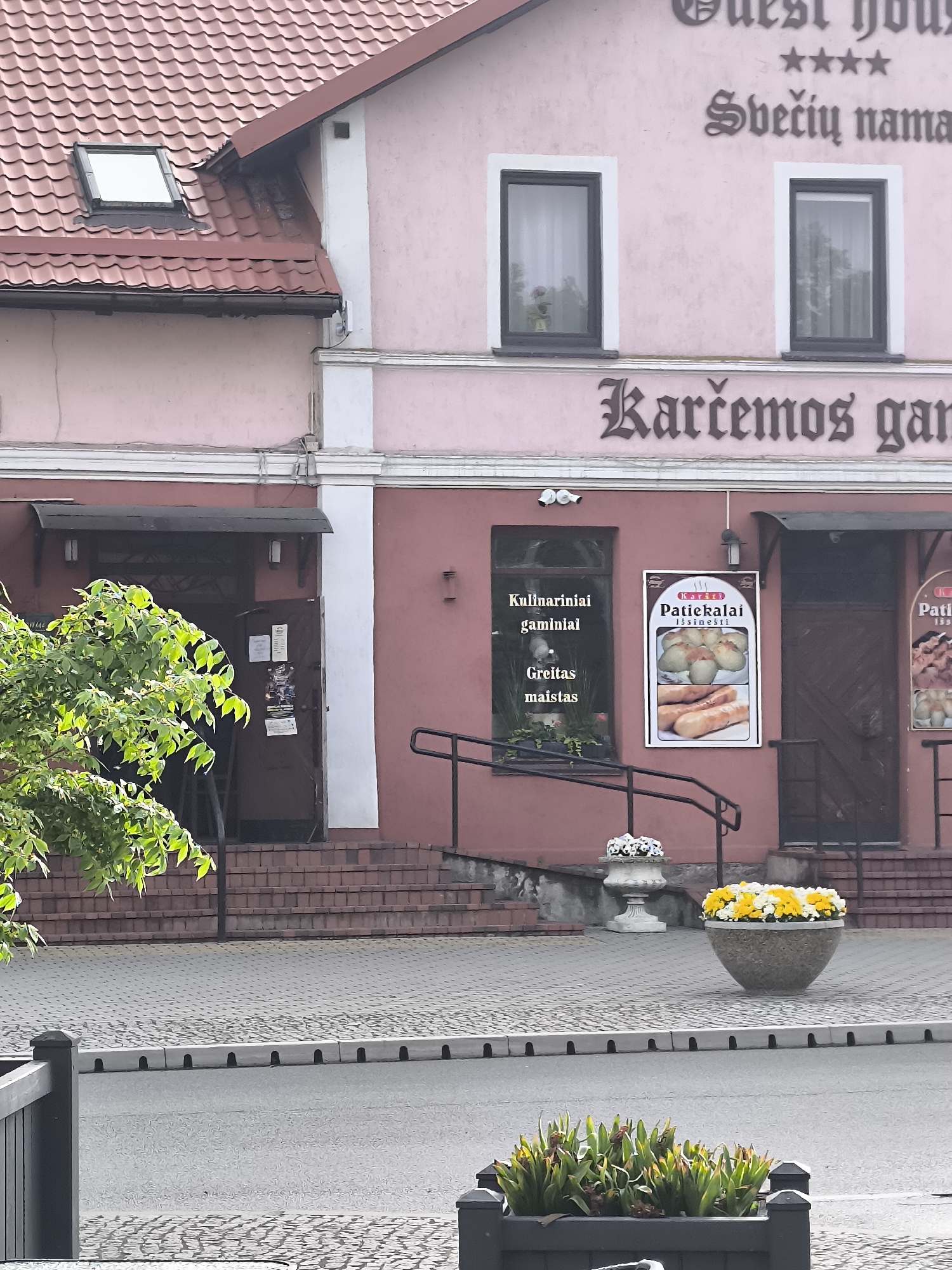
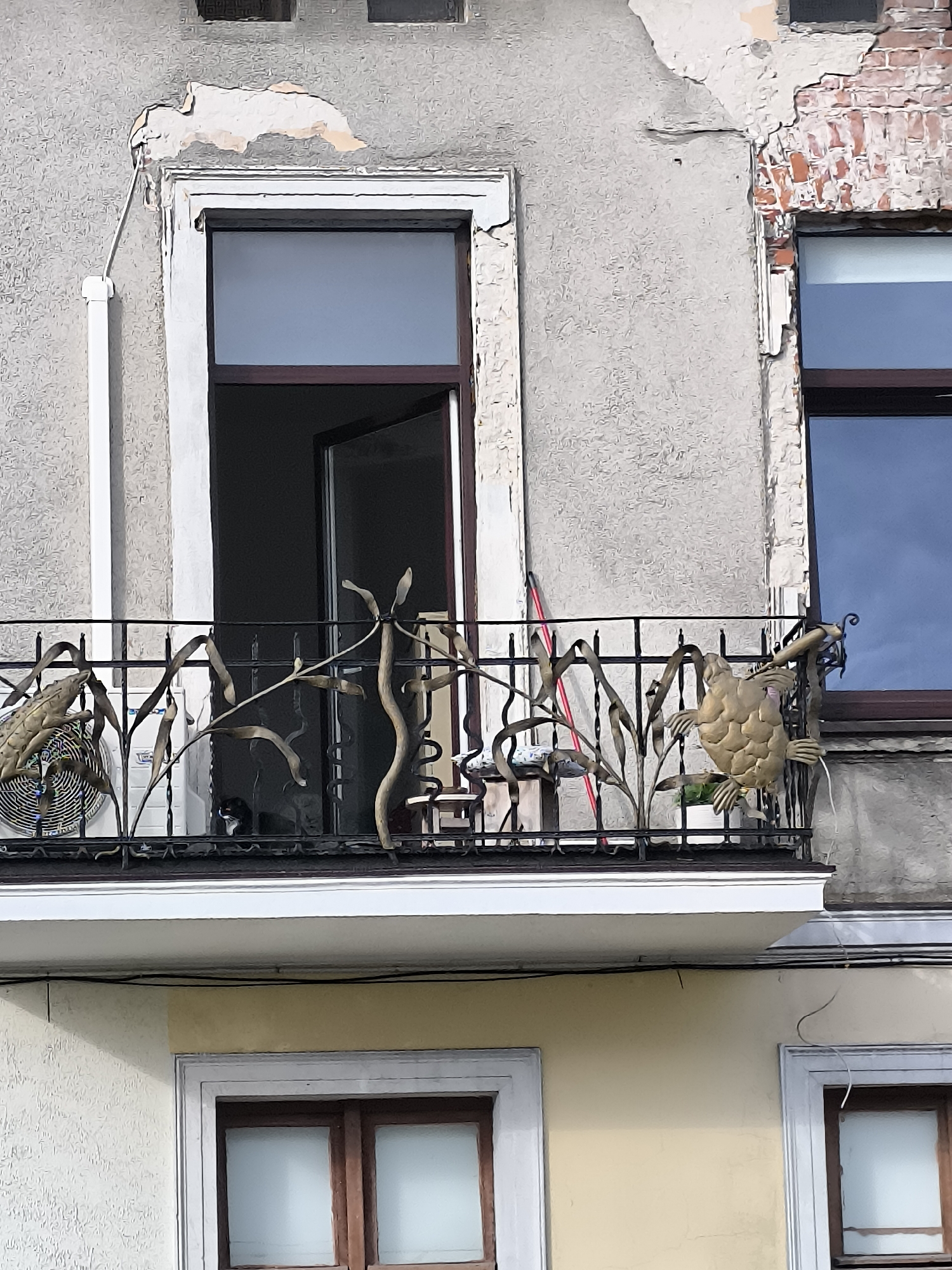
This media file presents a close-up view of the facade of an older building in Priekulė, Lithuania, primarily focusing on a small balcony. The upper floor of the building is characterized by textured gray stucco, which shows significant signs of age with large patches of peeling paint exposing red brickwork underneath, especially towards the right. A white downspout or conduit runs down the left side of this upper section. A dark-framed balcony door or window on the upper floor is open, revealing a dark interior. Adjacent to it, a closed window with a matching dark frame reflects a bright blue sky. Directly beneath, a small balcony is prominent, featuring an ornate black wrought iron railing. This railing is embellished with intricate golden-bronze decorative elements, including stylized organic forms resembling plant stems or leaves, and a large, scaly, turtle-like or fish-like creature on the right side. Objects visible on the balcony include a white outdoor air conditioning unit with a visible fan on the left. Towards the center, partially obscured by the railing, a small black animal, possibly a cat or dog, is sitting near a chair. A red stick or pole leans against the wall on the right, next to a small white potted plant. Below the balcony, the lower section of the building is painted a light yellow or cream color. It features two closed windows with light brown frames and white or frosted glass panes. Black electrical wires are horizontally strung between the upper and lower floors. The image appears to be taken during the daytime under bright conditions. No people are visible, and there is no discernable text.
Priekulė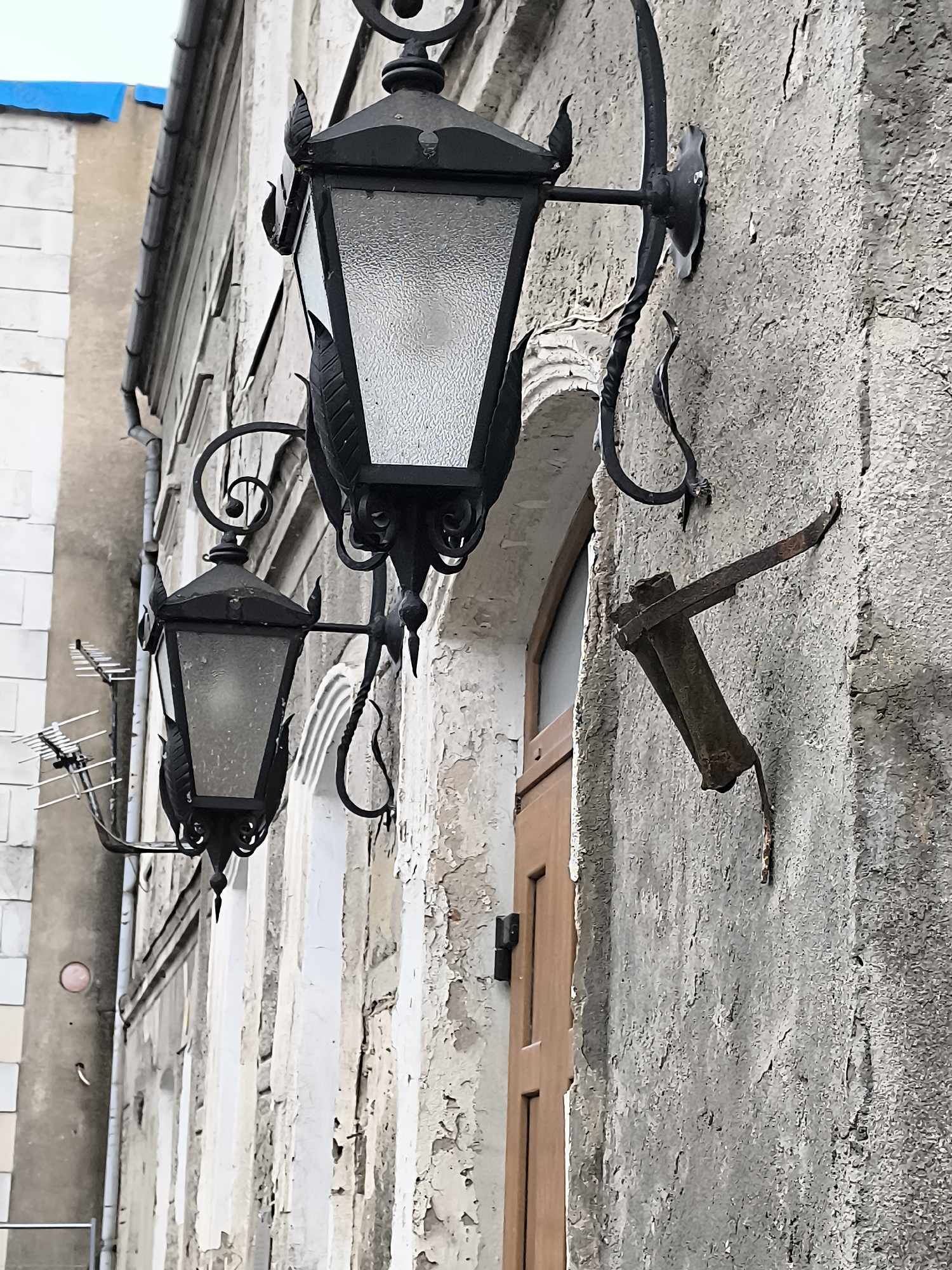
The image presents a close-up, low-angle view of a weathered building exterior in Priekulė, Lithuania, captured during daylight hours, likely overcast given the soft, diffused light. Two ornate black metal street lamps, or lanterns, are prominently affixed to the textured, grey stucco-like wall. The larger lamp, positioned higher and to the right, displays intricate scrollwork and textured glass panels, with a light bulb dimly visible within. Below and to its left, a smaller, similarly designed lantern is mounted. The building's wall exhibits significant signs of age and wear, with extensive peeling white paint revealing the rough grey substrate and numerous cracks. To the right of the larger lamp, a rusty, angular metal object, possibly a defunct bracket or fixture, juts out from the wall. A dark, arched wooden doorway is partially visible between this rusty object and the larger lamp. On an adjacent building to the far left, a multi-element television antenna is visible, alongside a gutter and downspout. A bright blue tarp covers a distant rooftop in the upper left background. No people or specific activities are depicted, and there is no visible text. The scene evokes a strong sense of historical architecture and urban decay.
Priekulė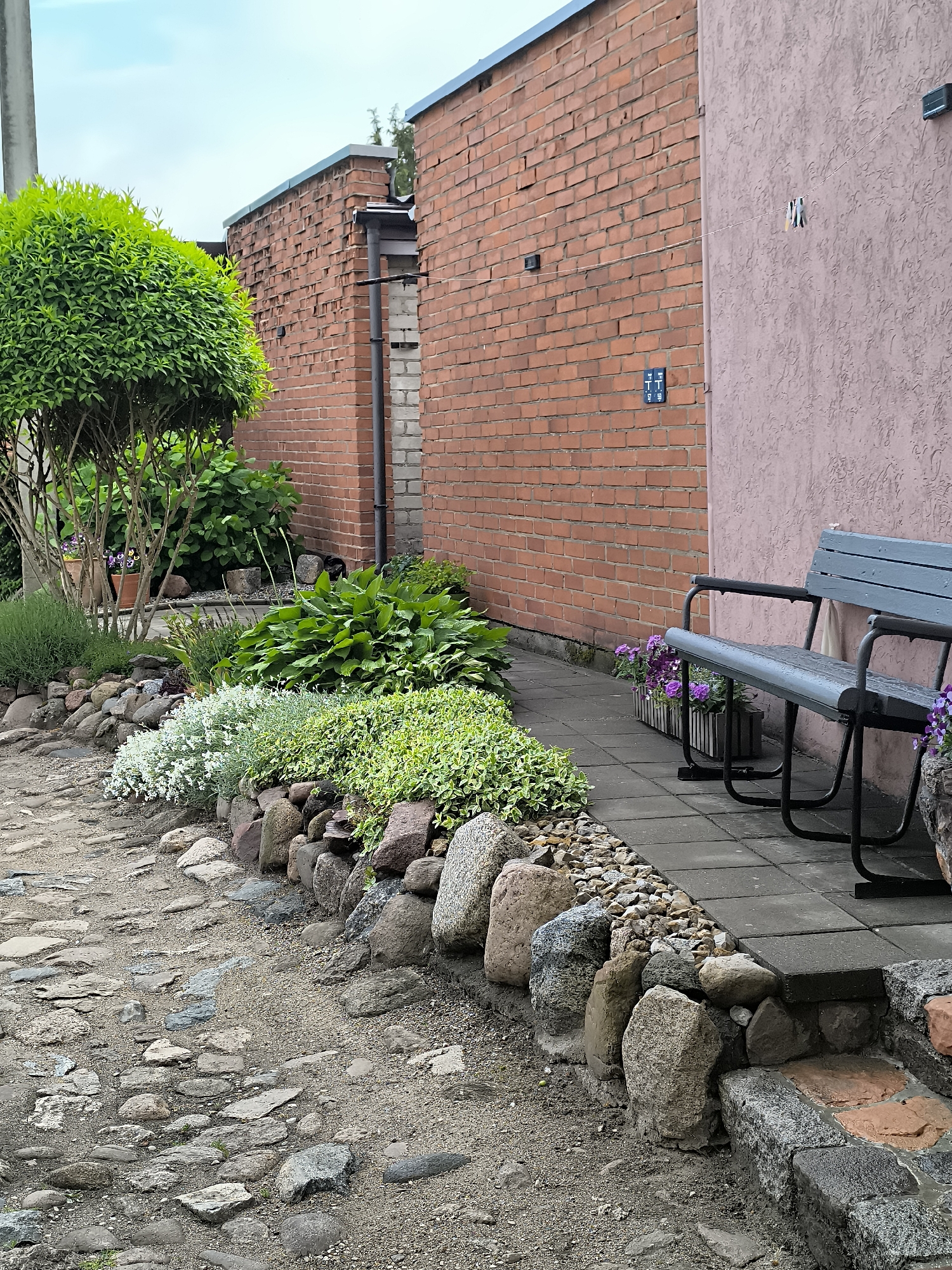
This media shows a tranquil garden path located in Priekulė, Lithuania, framed by a vibrant green bush on the left and two distinct building walls on the right. The scene is devoid of people, focusing on the landscape and architectural elements. In the foreground, a textured cobbled path, made of various sizes of stones and interspersed with gravel, curves slightly to the left. Bordering this path on the right is a decorative arrangement of large, rounded stones, which retain a diverse planting bed. This bed features lush green hostas, a sprawling ground cover with small white flowers, and another variegated green ground cover. Lavender and other small plants are also visible among the rocks. Beyond the rock-lined garden bed, a paved walkway of square grey pavers leads towards a dark grey wooden bench with a black metal frame, positioned against a light pink stucco wall. Flower boxes filled with purple petunias or pansies are placed beneath the bench. The building on the right has two distinct sections: a red brick wall on the left and a light pink stucco wall on the right. A dark grey drainpipe runs vertically along the brick wall. On the brick wall, a small blue plaque with white text is visible, displaying "TT" at the top and numbers "204" and "205" below. Above this plaque, a small black utility box is mounted. A thin wire, likely a clothesline, stretches from this brick wall to another black utility box mounted on the pink stucco wall, with a few clothespins attached to it. The top of the brick wall is capped with a light grey coping. The time of day appears to be overcast daytime, with soft, even light and no harsh shadows. The surfaces of the bench and pavers suggest they might be slightly damp, possibly from recent rain. The overall impression is one of a well-maintained and peaceful outdoor space.
Priekulė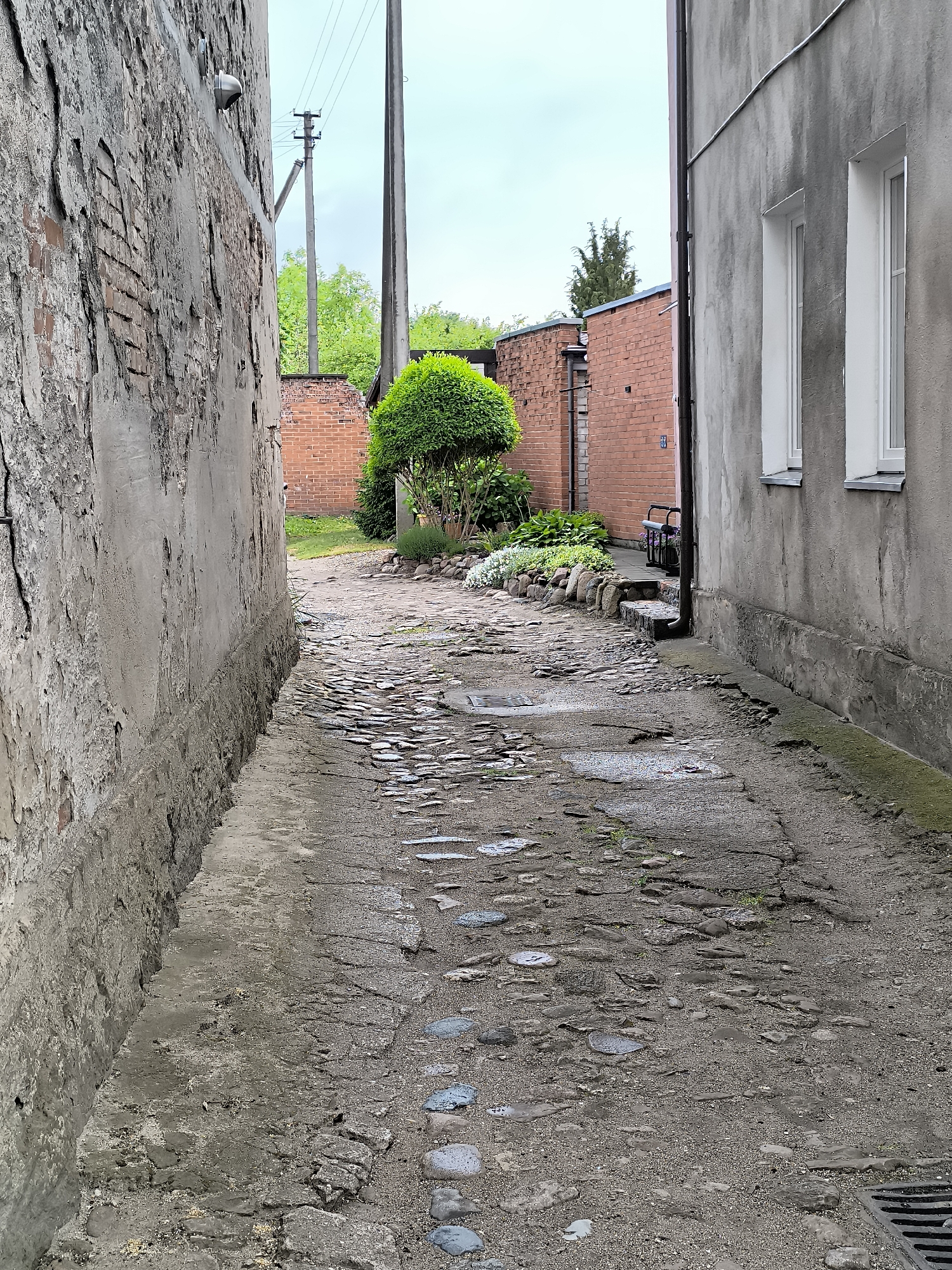
The image presents a narrow, rustic alleyway in Priekulė, Lithuania, characterized by its old, weathered architecture and damp, uneven ground. No people are visible. On the left, a tall, sturdy building wall shows significant signs of age, with large sections of its plaster exterior having peeled away, revealing the reddish brickwork beneath. A small, light-colored fixture is mounted high on this wall. The base of the wall exhibits rough, textured concrete. On the right, another building stands with a grey, somewhat mottled, stucco-finished facade featuring two distinct white-framed windows. A dark drainpipe runs down its side. Further into the alley, behind this building, a lower red brick wall encloses a small, verdant garden space. This garden is adorned with various green plants, including a sculpted bush, and is bordered by natural stones. A glimpse of what appears to be a dark metal bench or seating arrangement is visible amidst the plants. The ground forms a well-worn path, a mix of uneven cobblestones, gravel, and packed dirt. Several small puddles reflect the overcast sky, indicating damp conditions, possibly from recent rain. Towards the foreground on the right, a metal grate drain cover is partially visible. In the background, beyond the buildings and dense foliage, utility poles with overhead lines are silhouetted against a soft, pale, and cloudy sky. Green trees are also visible, hinting at natural surroundings beyond the immediate urban structures. The scene is illuminated by daylight, suggesting an overcast day given the diffused light and absence of harsh shadows. No clear text is visible in the image. The overall impression is one of quiet, aged charm.
Priekulė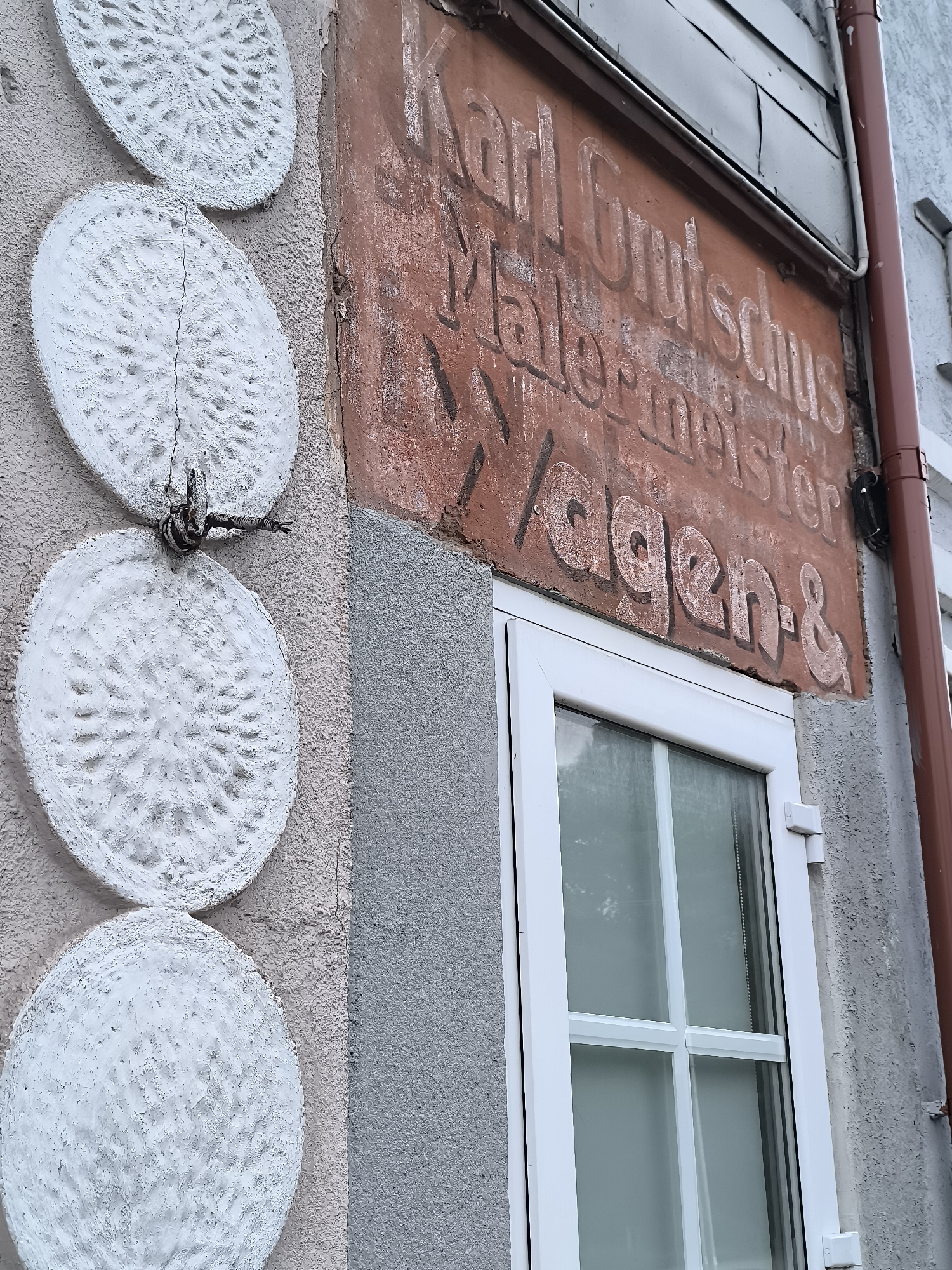
This close-up, angled photograph captures a section of a building's exterior in Priekulė, Lithuania, displaying a mix of historic and renovated elements. On the left, a textured, light-grey wall features four vertically stacked, circular white decorative reliefs, each intricately patterned in a floral or mandala design. One of these reliefs has a visible crack, and a small, dark, twisted object (possibly a wire or dried plant) is attached to the wall between two of the circles. To the right, an older, reddish-brown section of the wall reveals a weathered sign with raised, light-colored letters. The text, in German, reads: "Karl Grutschus," followed by "Maler-meister" (Master Painter), and then "Wagen-&." This indicates a former business, likely a painting and possibly vehicle repair or finishing shop (e.g., "Wagen- & Lackiererei" for wagon and paint shop), run by Karl Grutschus. Below the historic sign, a newer, smooth grey plastered wall section meets a modern, white-framed window with multiple panes. A dark grey horizontal gutter runs above the sign, and a reddish-brown vertical downspout is visible on the far right. Above the gutter, dark, possibly metal or slate, siding panels are present. The image, taken in daylight, portrays a building that has seen changes over time, preserving a piece of its historical identity.
Priekulė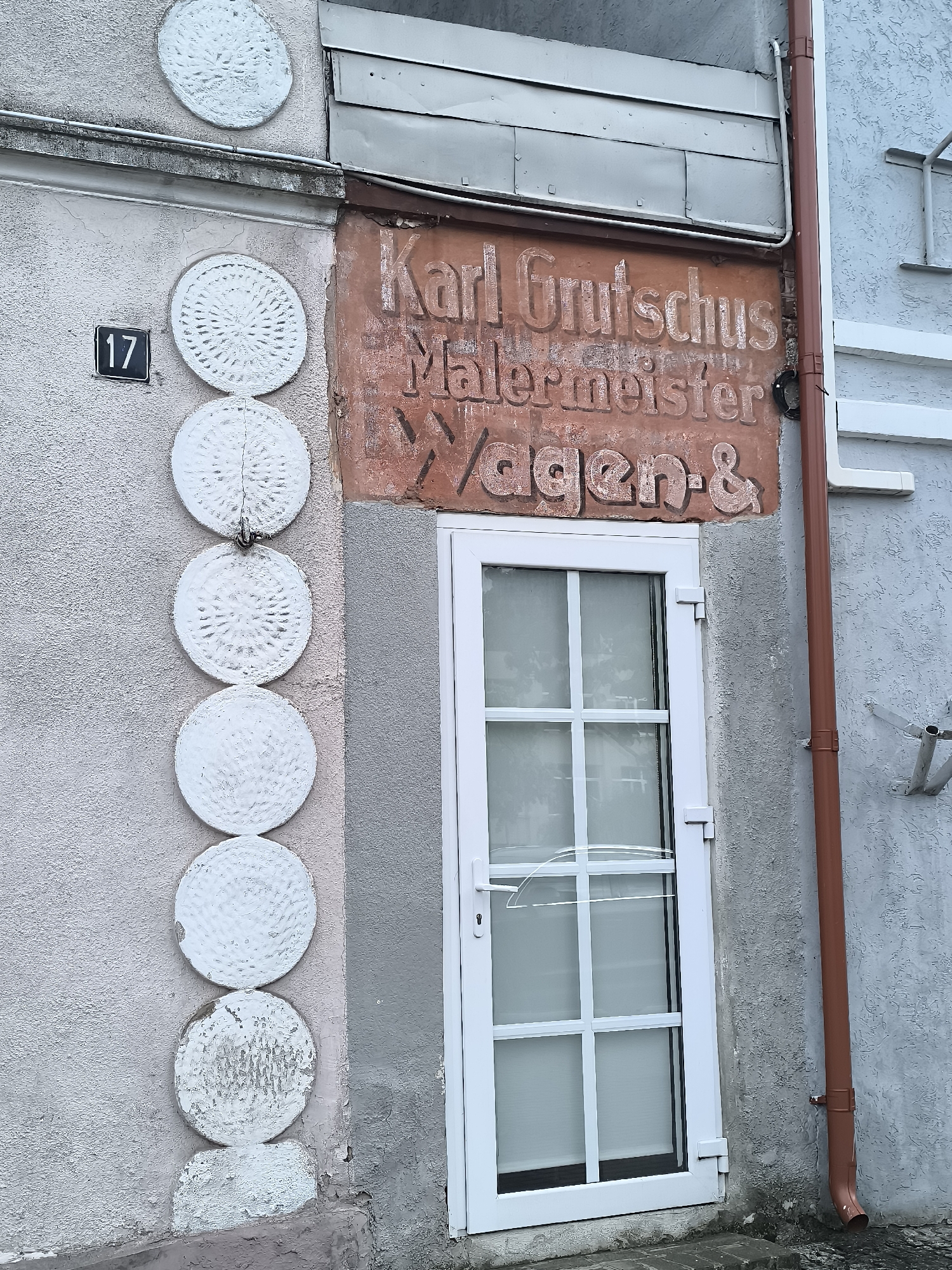
This image provides a detailed view of a building facade in Priekulė, Lithuania, featuring a mix of historical and contemporary elements. The left side of the frame shows a section of a light pinkish-gray textured stucco wall with the black house number "17" affixed near the top. Below this, a vertical column of approximately six round, white, textured decorative elements, resembling ornate medallions or large doilies, are mounted to the wall, some exhibiting visible cracks and weathering. At the center, an aged, reddish-brown wall section displays a faded business sign with raised white letters. The clearly visible German text reads "Karl Grutschus" and "Malermeister," translating to "Master Painter." Below this, the partial word "Wagen &" ("Wagon &" or "Car &") is also discernible, suggesting the business may have been involved in painting vehicles or wagons. Directly beneath the old sign, a modern, white-framed door with multiple glass panes and a white handle is installed, its glass reflecting some light from the exterior. To the right, a section of a light blueish-gray textured stucco wall is visible, with a prominent brown downspout running vertically along its edge and the central reddish wall. A gray metal flashing or canopy extends across the top of the old sign area. The scene depicts a daytime setting, likely under diffuse light, emphasizing the varied textures and historical layers of the building.
Priekulė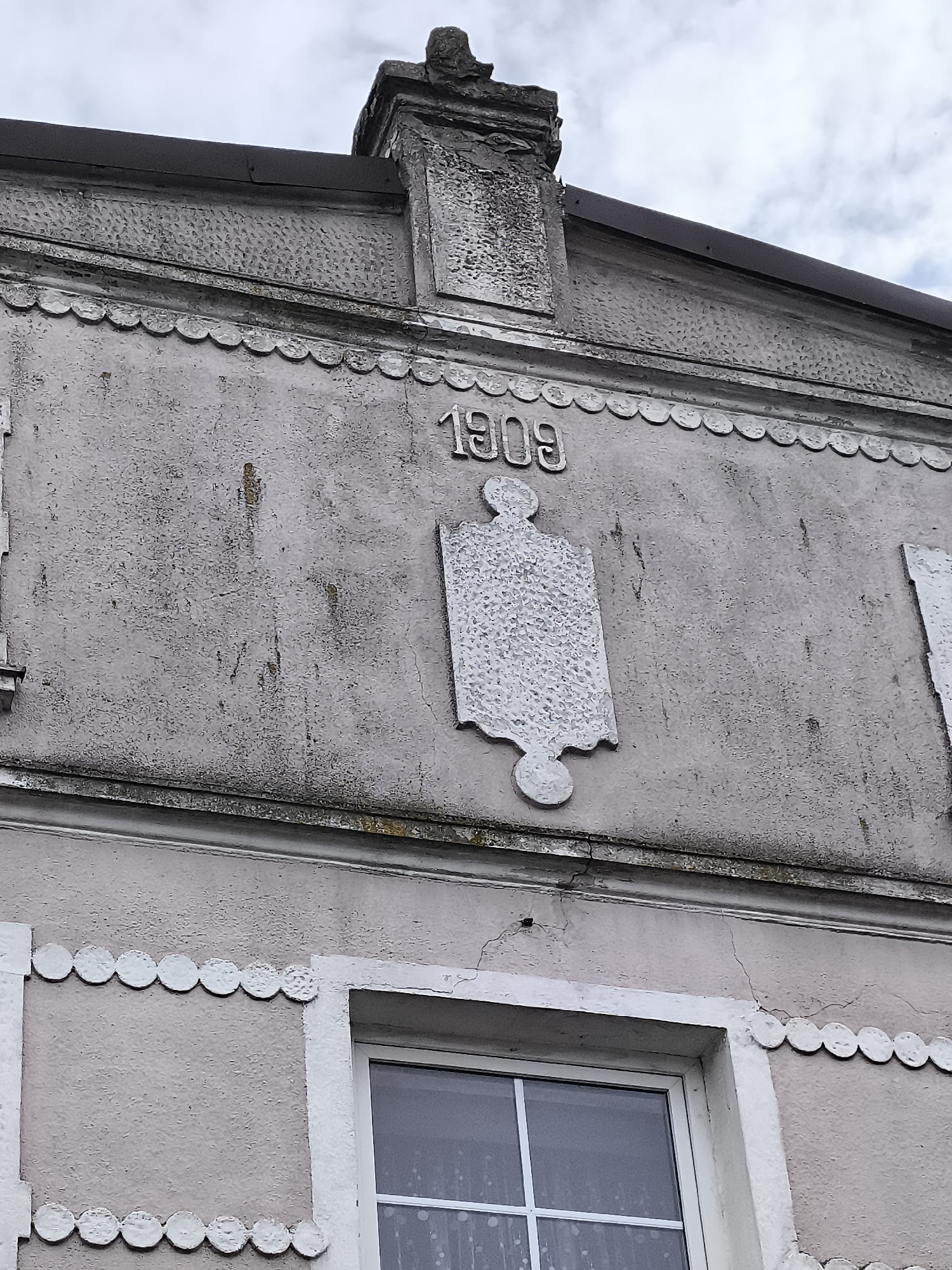
This close-up image captures the upper facade of an old building in Priekulė, Lithuania, under an overcast sky. The building exterior is primarily a weathered, pale pinkish-beige stucco with white decorative relief elements. A prominent feature is the year "1909," embossed or carved into the facade, indicating the building's construction or renovation date. Directly below the date is a large, central decorative plaque or shield. This plaque has a distinct shape, wider at the top and bottom with rounded extensions, and features a heavily textured, possibly pebbled, surface. Below the main upper section, a horizontal band of scalloped, coin-like relief trim separates the upper facade from the lower part, which includes a window. Similar scalloped trim also frames the upper and side edges of a white-framed window visible in the bottom right of the image, through which white curtains are discernible. The facade exhibits significant signs of age and wear, including numerous cracks, discoloration, and areas where the surface appears to be peeling or crumbling. Above the scalloped trim, there is a section with a finer, repeating textured pattern, and the very top of the facade features a heavily weathered, almost dilapidated, ornate architectural element, possibly part of a gable or pediment. The overall impression is one of historical architecture that has endured over a century.
Priekulė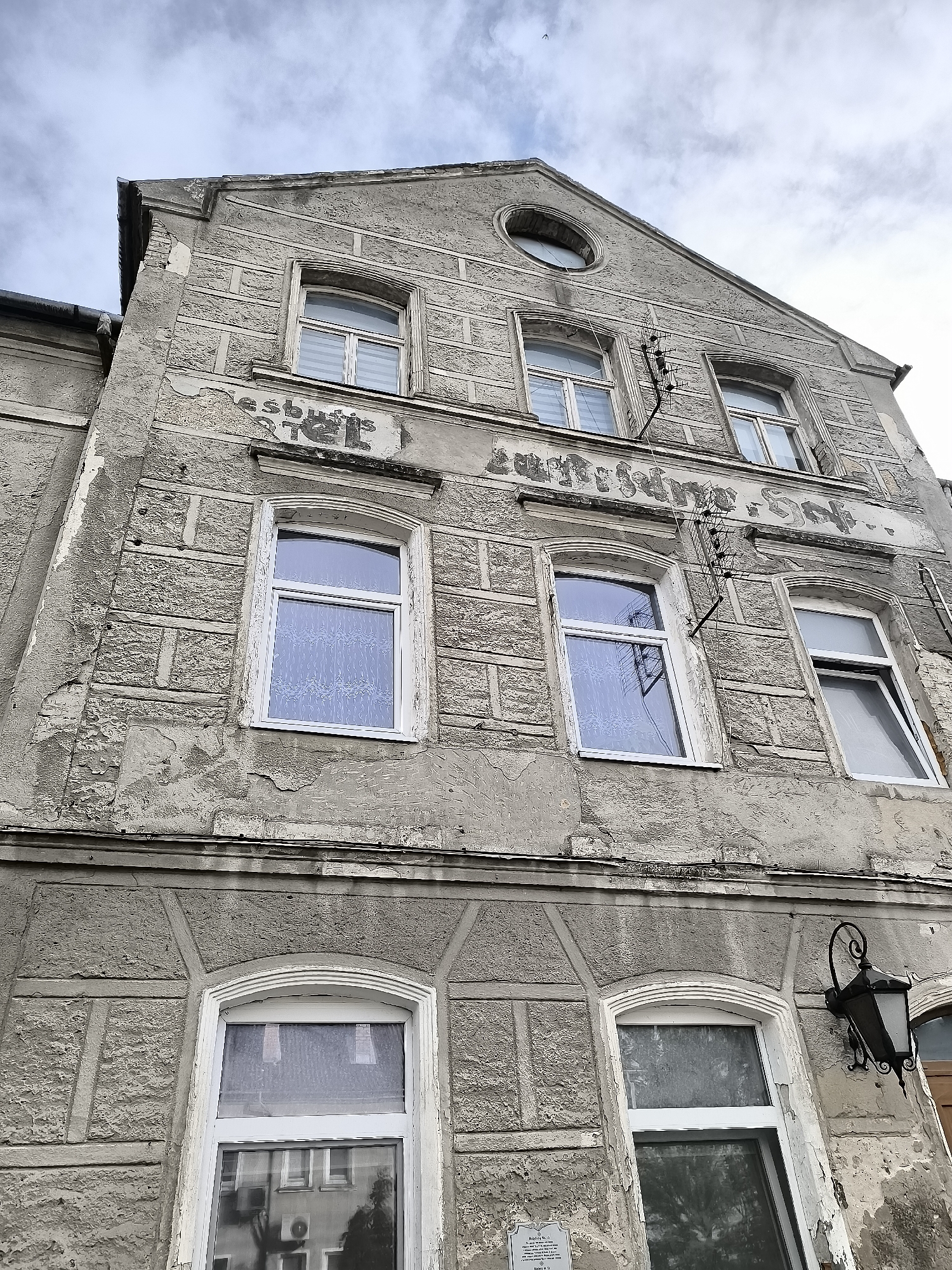
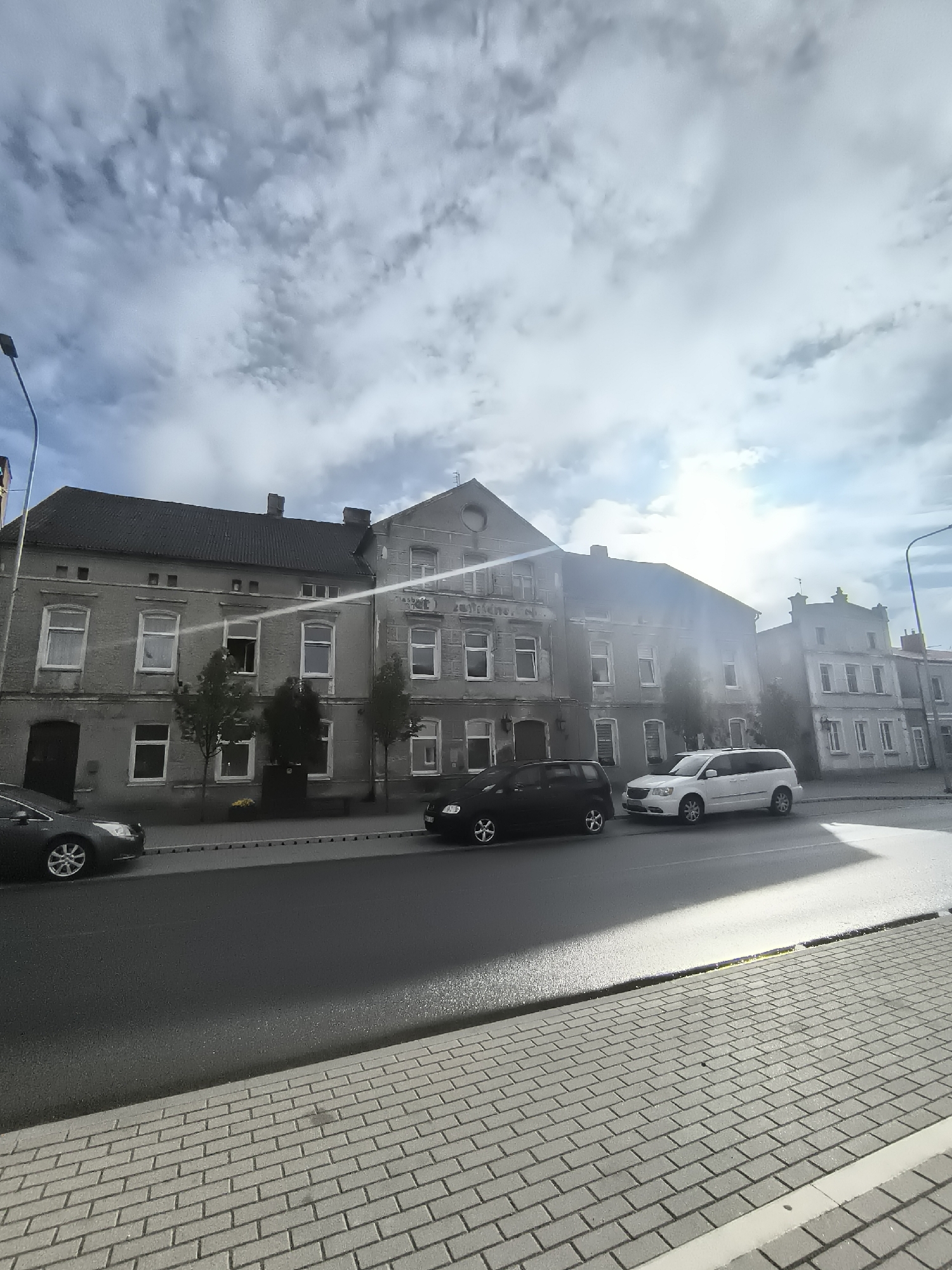
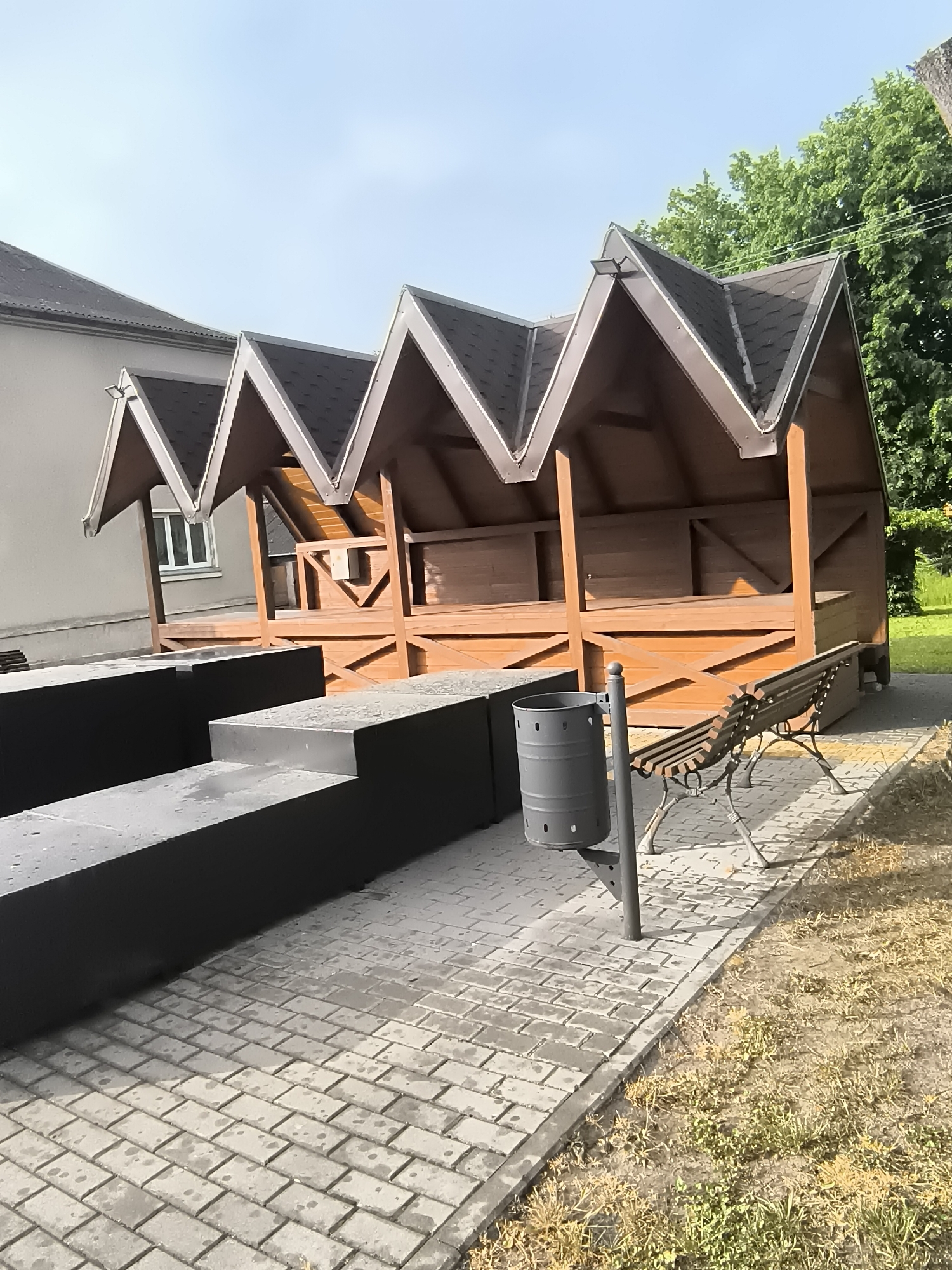
This outdoor scene in Priekulė, Lithuania, captures a quiet public area featuring a row of three distinct wooden shelters or gazebos. These structures are characterized by their striking zig-zagging dark brown roofs, which are shingled, and light brown wooden frames. Each gazebo is open-sided, with wooden railings and benches within, suggesting a place for relaxation or gathering. In the foreground, a series of dark grey, rectangular planters or low walls are arranged in a tiered fashion, running parallel to the gazebos. Adjacent to these, a grey paved walkway made of interlocking bricks stretches across the midground. To the right of the paving, a dark grey cylindrical trash can is mounted on a pole. Further right, a traditional park bench with a slatted wooden seat and back, supported by ornate dark metal legs, is positioned on the paving. Behind the gazebos, a light-colored, possibly stucco, building with a dark roof and a single visible window is present. Green trees and foliage are visible in the background, especially to the right, indicating a natural green space nearby. The sky above is clear and light blue, suggesting a bright and sunny day, likely morning or early afternoon, as evidenced by the distinct shadows cast on the paving and structures. No people or specific activities are visible, lending a peaceful and deserted atmosphere to the scene. There is no visible text in the image.
Priekulė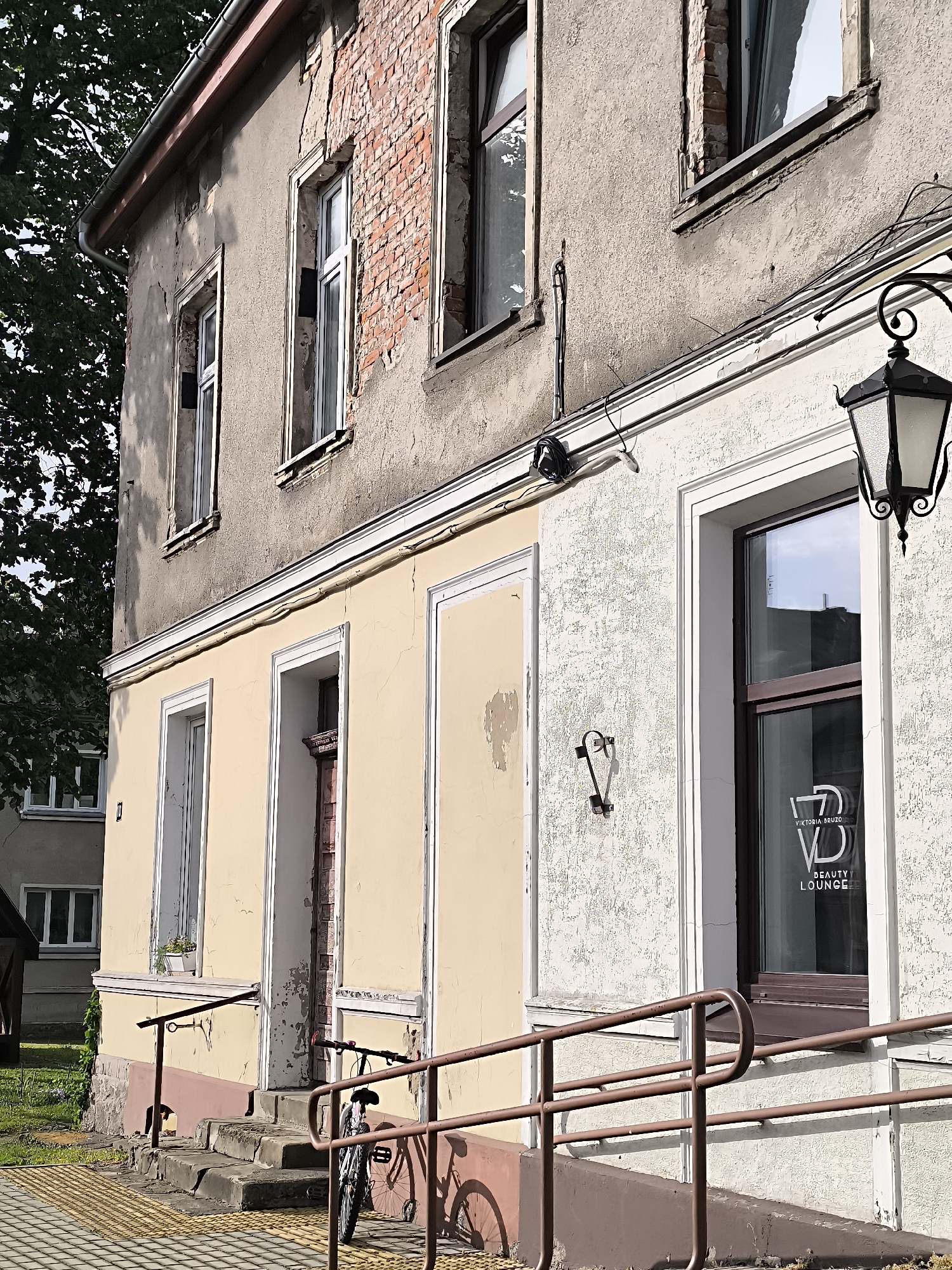
The image captures the facade of a two-story building in Priekulė, Lithuania, under bright daylight. The building exhibits a striking contrast between its upper and lower floors. The upper floor is severely weathered, with cracked grey stucco revealing patches of red brickwork around dilapidated windows, some appearing broken. A metal rain gutter runs along the top left. The ground floor, in contrast, is better maintained, featuring a light yellow and white painted facade with white trim around windows and entrances. Peeling paint and some cracks are still visible, indicating age. On the far right, a large window displays text: "VIKTORIA DRUZO" and "VD BEAUTY LOUNGE", indicating a business. An ornate black street lamp hangs above this window. To the left of this window, a decorative metal bracket is affixed to the wall. An entrance with stone steps and metal railings is visible, alongside a brown accessibility ramp also equipped with metal railings. A black bicycle is parked upright near the steps. Another ground-floor window to the left of the main entrance has a small potted plant on its sill. Lush green trees and foliage are visible on the left side of the image, partially obscuring a smaller building in the background. The sunlight casts clear shadows, suggesting a sunny day, likely morning or afternoon. No people are visible in the scene. The overall impression is one of an aged, somewhat neglected building whose ground floor has been partially revitalized for commercial use.
Priekulė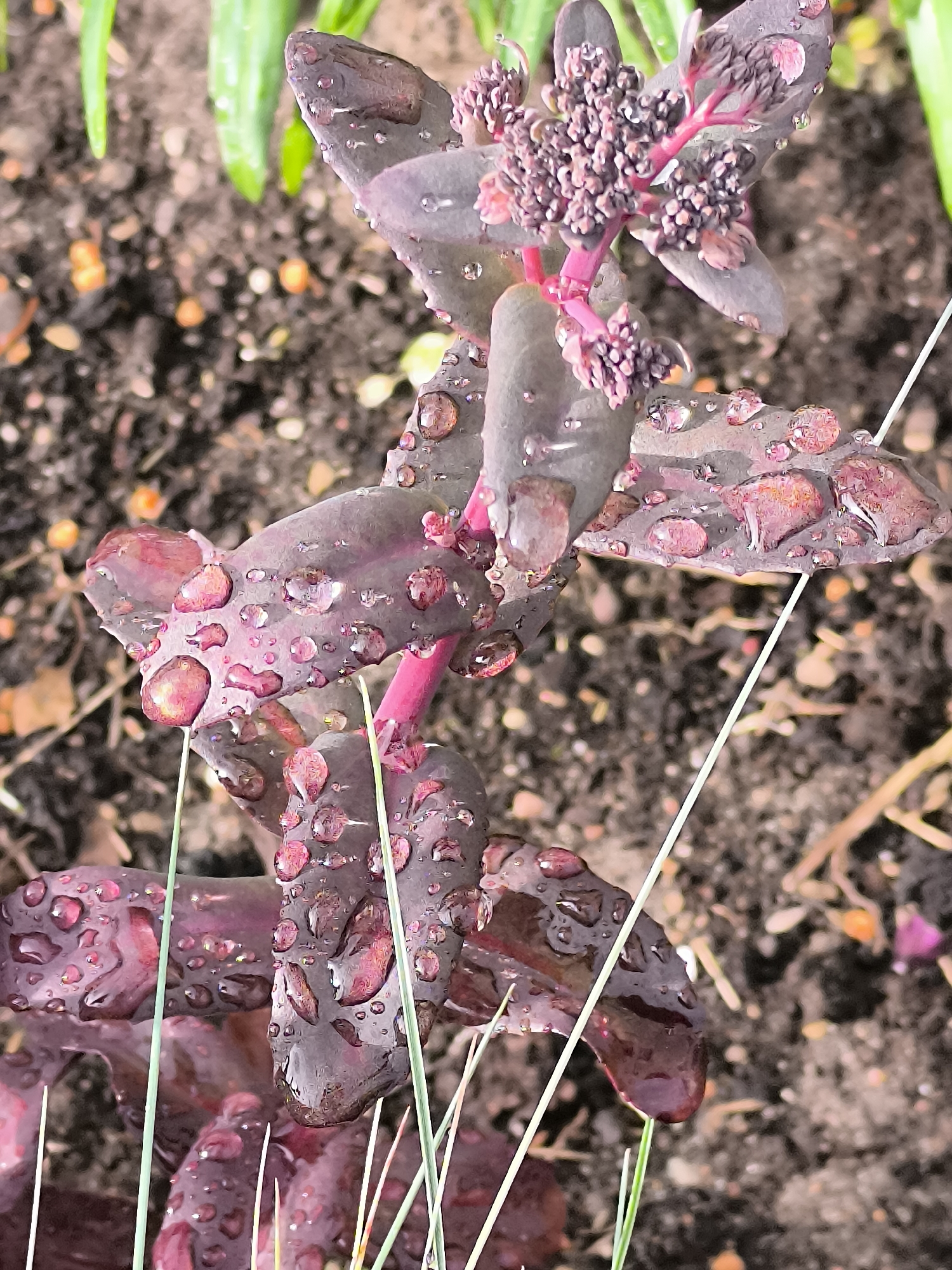
A close-up outdoor photograph captures a plant with dark, purplish-red leaves and developing flower buds, heavily adorned with clear water droplets. The plant, likely a type of succulent, is the central focus, its robust leaves and clustered buds glistening with moisture. Numerous water droplets of various sizes cling to the surfaces, reflecting ambient light and suggesting recent rain or dew. The background is softly blurred, showing dark brown soil interspersed with small, lighter-colored specks, possibly pebbles or dried plant material. In the upper portion of the background, out-of-focus bright green plant stems are visible, adding a subtle touch of contrasting color. Several thin, light green, grass-like blades stretch vertically through the frame in the foreground and midground, partially obscuring parts of the main plant. The image portrays a serene, static scene in a garden or natural setting in Priekulė, Lithuania. The lighting appears to be natural daylight, creating gentle reflections without harsh shadows. There is no activity taking place, nor is any text visible. The composition emphasizes the intricate details of the water droplets and the rich, deep hues of the plant's foliage.
Priekulė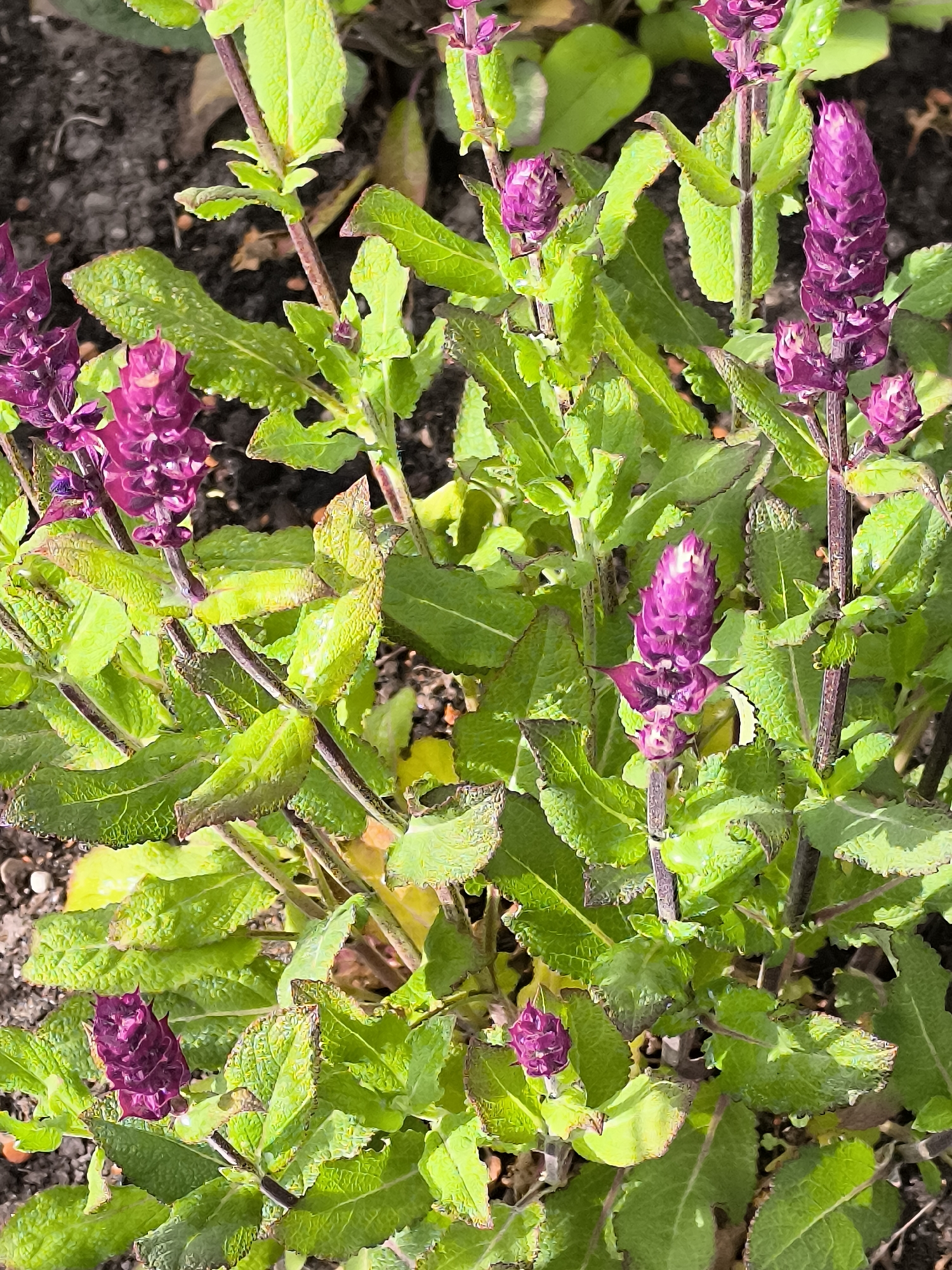
The image presents a close-up, overhead view of a vibrant flowering plant, likely situated in a garden or natural outdoor environment in Priekulė, Lithuania. The primary subjects are the plant's distinctive purple flower spikes and its lush green foliage. Several prominent, elongated flower spikes, colored in a vivid purple or magenta hue, are scattered throughout the frame. These inflorescences are densely packed with small, possibly hooded florets or bracts, giving them a textured, almost scaly appearance. Some spikes are fully formed and robust, while others appear as smaller, developing buds emerging from the leaf axils. The plant's leaves are a rich green, often with lighter green or yellowish highlights indicating bright illumination. They are ovate to oblong with distinctly serrated or toothed edges and a textured, slightly puckered surface that reveals prominent venation. Some leaf margins display subtle reddish or brownish tints. The leaves grow oppositely along sturdy, greenish-brown stems, which exhibit a somewhat quadrangular cross-section. The background consists of dark, nutrient-rich soil, providing a clear contrast to the brightly lit plant. The lighting conditions suggest a sunny or brightly overcast daytime, highlighting the plant's textures and colors. No specific activity or event is taking place, and there is no visible text. The overall impression is of a healthy, floriferous plant in full bloom.
Priekulė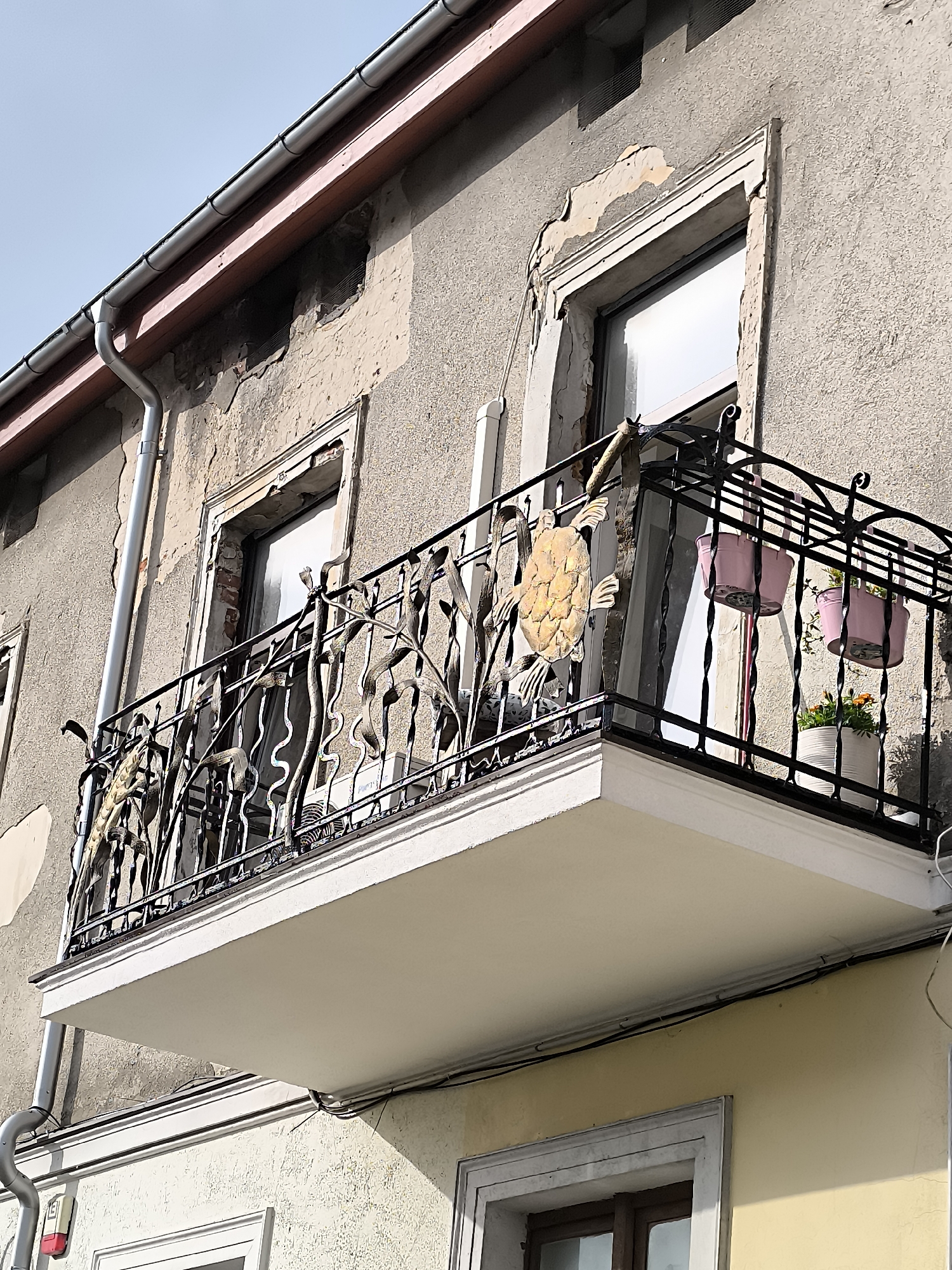
The image depicts the facade of an aging building in Priekulė, Lithuania, under bright, clear daylight. The upper portion of the building features a light gray, textured stucco exterior with significant signs of wear, including peeling paint and exposed brickwork around the windows and below the roofline. A modern, silver-gray gutter system is affixed to the eaves and extends vertically down the left side of the wall. A striking black metal balcony projects from the upper floor, distinguished by its ornate, organic, plant-like scrollwork railings. Integrated into the left side of the railing is a decorative golden figure resembling a turtle with a distinct shell pattern. On the right side of the balcony, two pink flower pots hang from the railing, while a white pot containing orange flowers rests on the balcony floor. A small, white outdoor air conditioning unit is also visible on the balcony floor, near the right window, with faint text "PART" discernable on its casing. Two windows are visible on the upper floor, one partly obscured by the balcony. These windows feature modern glass but are set within decaying plaster frames. The lower visible section of the building has a smoother, pale yellow facade, with a third window featuring a wooden frame at the bottom of the image. Electrical or communication wires run horizontally along the wall beneath the balcony. No human activity is present in the scene, which emphasizes architectural details and signs of age.
Priekulė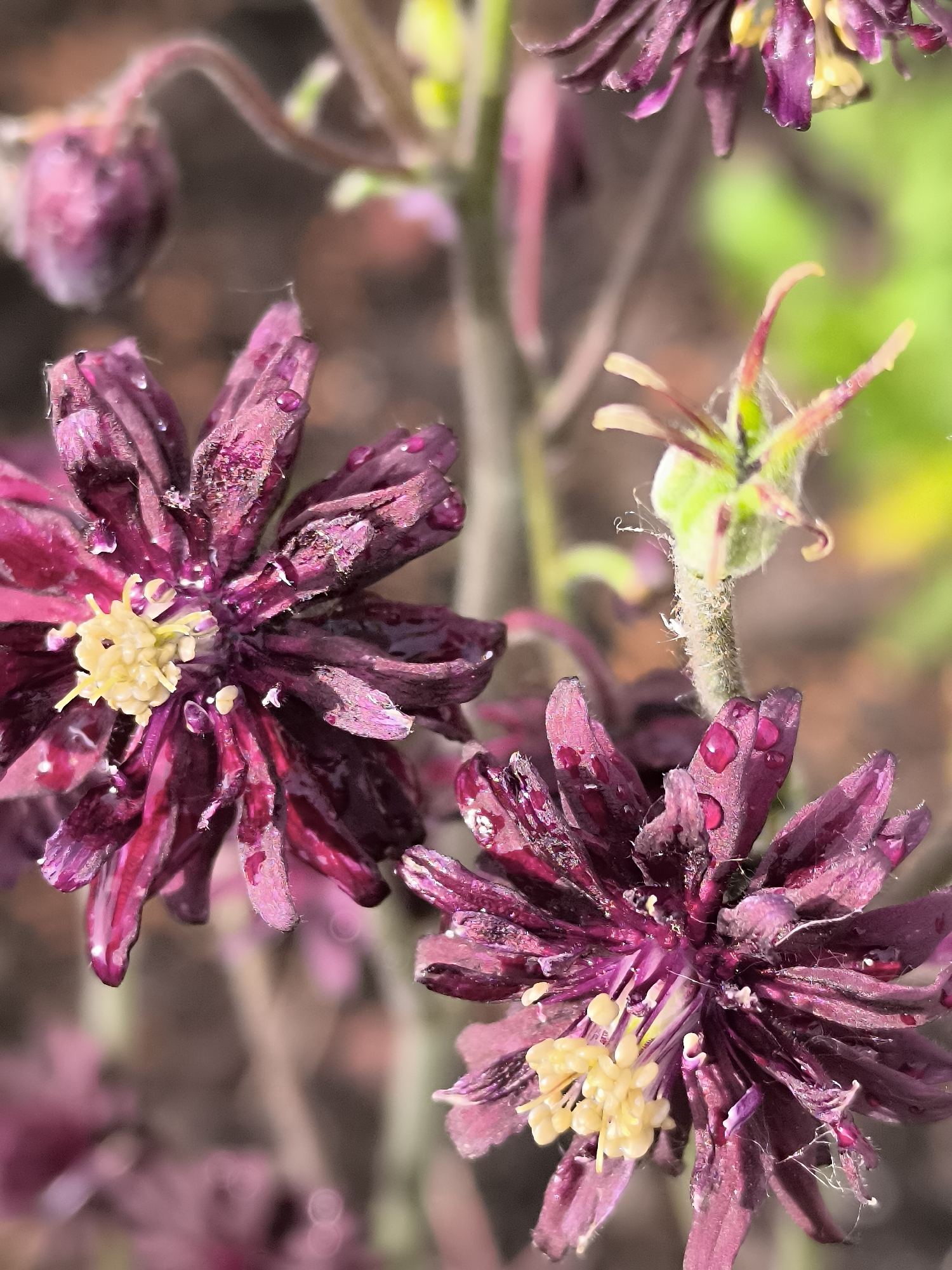
This close-up vertical photograph features two dark purplish-red flowers, likely Columbines (Aquilegia), in an outdoor setting in Priekulė, Lithuania. The flowers are the primary subjects, presented in sharp focus against a soft, blurred background of greens, browns, and lighter purplish hues. Both prominent flowers are adorned with numerous small, glistening water droplets on their textured petals, suggesting recent rain or morning dew. Each flower displays a dense cluster of bright yellow stamens at its center, providing a vivid contrast to the deep magenta and dark purple petals. The petals themselves have a somewhat ruffled or intricate appearance. In the upper left of the image, a blurry, undeveloped bud with a similar purplish hue can be seen. Towards the upper right and center, another floral element, possibly a developing seed pod or a fading bloom, shows delicate green and reddish-brown structures with fine, fuzzy textures. The overall lighting indicates it is daytime. No text is visible in the image.
Priekulė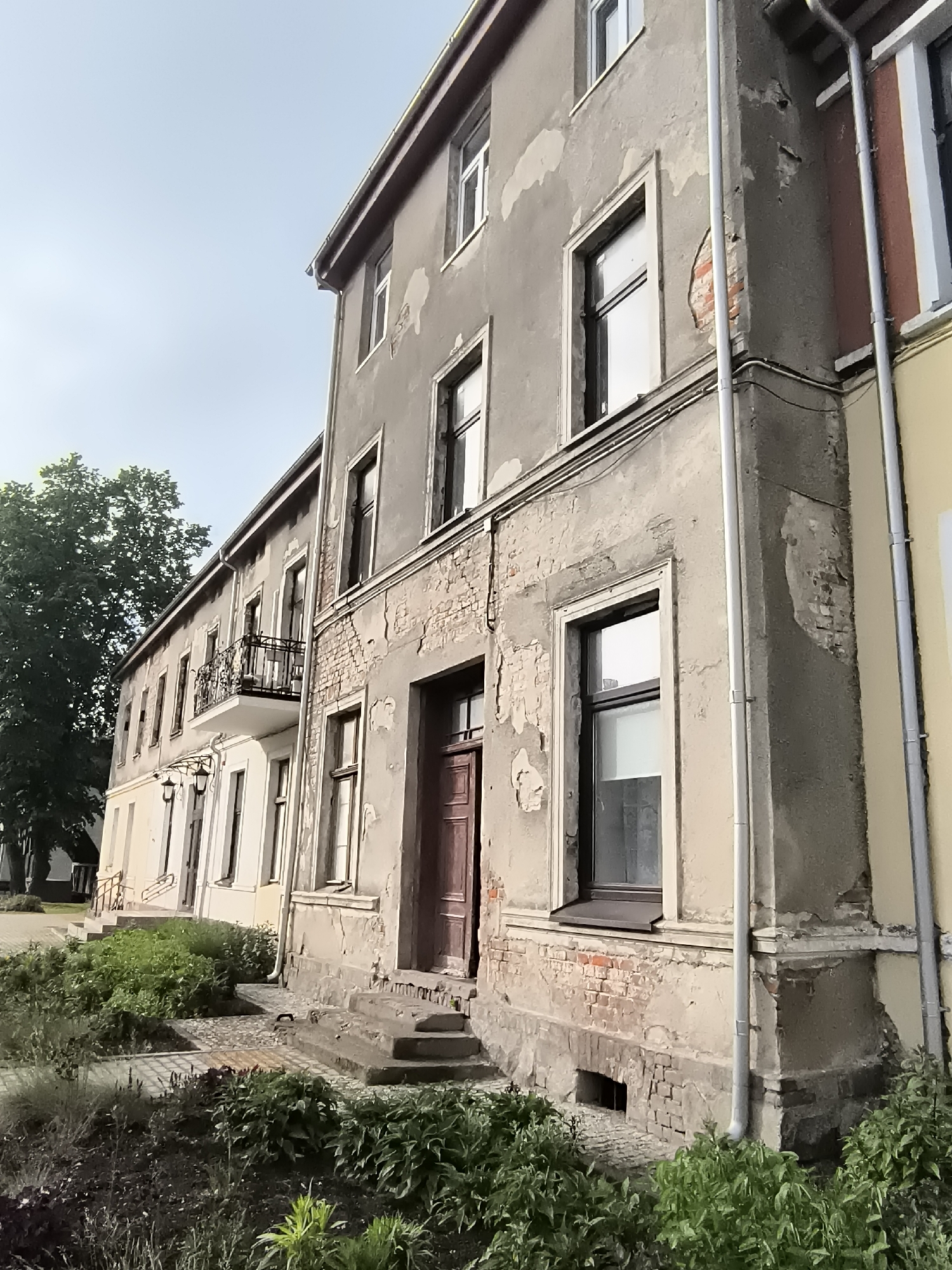
The image presents a daytime view of a row of weathered, multi-story buildings in Priekulė, Lithuania, under a clear, pale blue sky. The closest building, dominating the right foreground, features a grey, stuccoed facade that is significantly cracked and peeling, exposing reddish-brown brickwork underneath, particularly around its windows and foundation. This building has several rectangular windows with dark frames and a dark wooden entrance door accessed by concrete steps. A metallic downspout runs vertically along its right side, where it meets an adjacent building with a lighter, yellowish facade. Further down the street, another similar building is visible, also exhibiting signs of age and peeling plaster. A small, wrought-iron balcony with an ornate railing extends from the second floor of this building. In the immediate foreground, garden beds filled with various green bushes and plants, including some with purple flowers suggesting lavender, add a touch of lushness to the scene. Paving stones are visible around the base of the buildings and pathways. A large, mature tree with dense green foliage stands to the far left, partially obscuring the distant end of the street. The light is soft and diffused, indicating either morning or late afternoon. No people or specific activities are visible, presenting a quiet, static urban landscape. There is no discernible text in the image.
Priekulė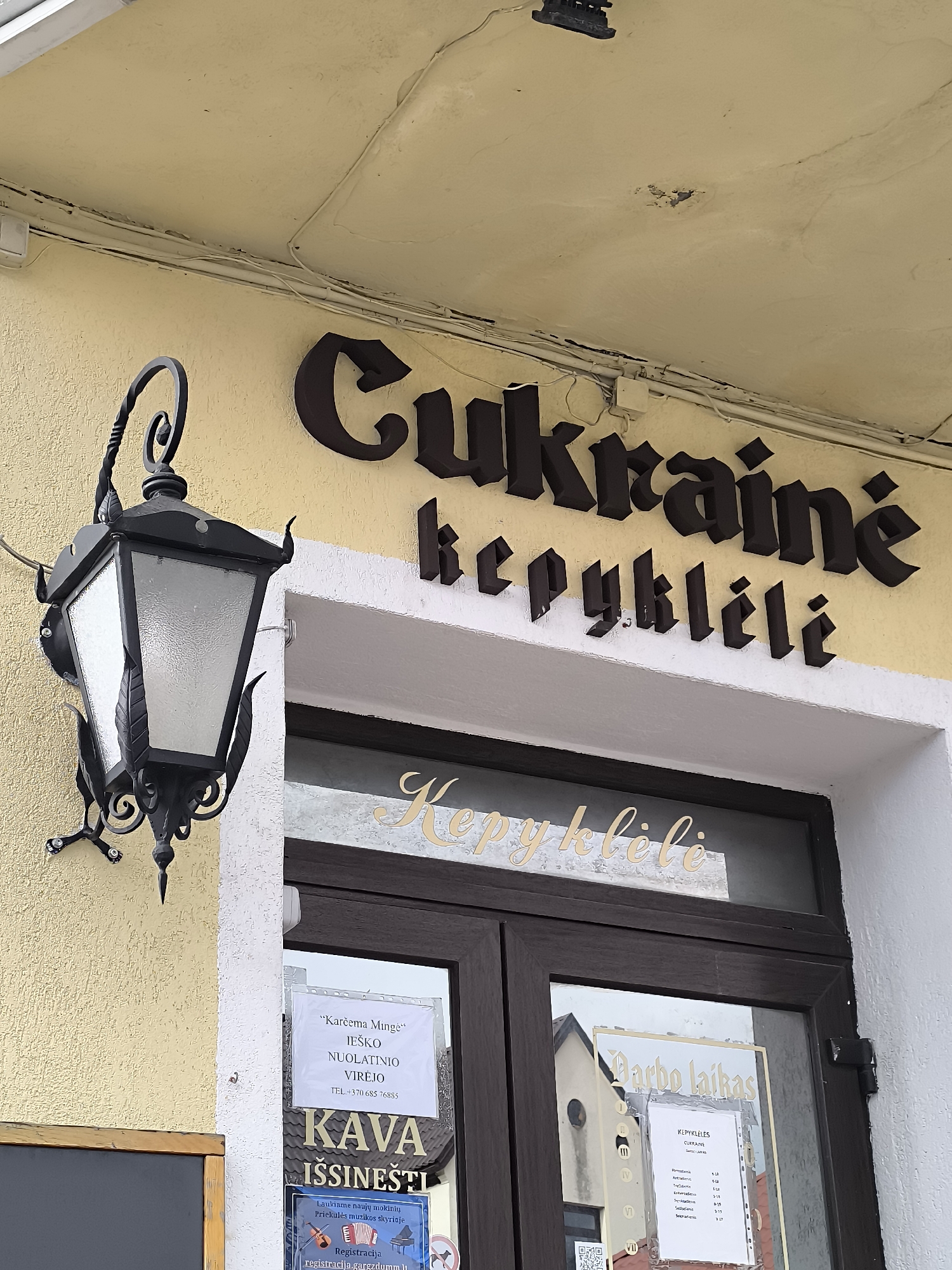
The image captures the exterior facade of a building, likely a bakery or confectionery, identified as "Cukrainė kepyklėlė" in Priekulė, Lithuania. The building features a textured, pale yellow stucco wall, with a white painted trim outlining the recessed entrance. An ornate, black wrought-iron lantern with textured glass panes is mounted to the left of the entrance, adding a classic touch. Above the entrance, the name "Cukrainė" (Confectionery/Sweet shop) is displayed in prominent, dark, gothic-style dimensional letters, with "kepyklėlė" (bakery) written below it in a similar font. An off-white overhang extends above the signage and entrance, showing visible utility wires and conduits running across its surface. The entrance consists of dark brown framed glass double doors. Several notices are taped to the glass doors. On the left door, a sign from "Karčema Mingė" (Inn Mingė) announces it is "IEŠKO NUOLATINIO VIRĖJO" (LOOKING FOR A PERMANENT COOK) with a contact number (+370 685 76885). Below this, another sign advertises "KAVA IŠSINEŠTI" (COFFEE TO GO). Further down, a partially visible poster invites new students to "Priekulės muzikos skyriuje" (Priekulė's music department) for registration. On the right door, a sign titled "Darbo laikas" (Working hours) for "KEPYKLĖLĖS CUKRAINĖ" lists opening times, with Friday indicated as ending at 15:00 and Saturday at 17:00. Another lighter-colored, cursive "Kepyklėlė" sign is visible within the entrance's glass panel, partially obscured by the working hours. The scene appears to be set during the daytime, with an absence of direct harsh sunlight, suggesting an overcast day or shaded area. No people are visible in the image.
Priekulė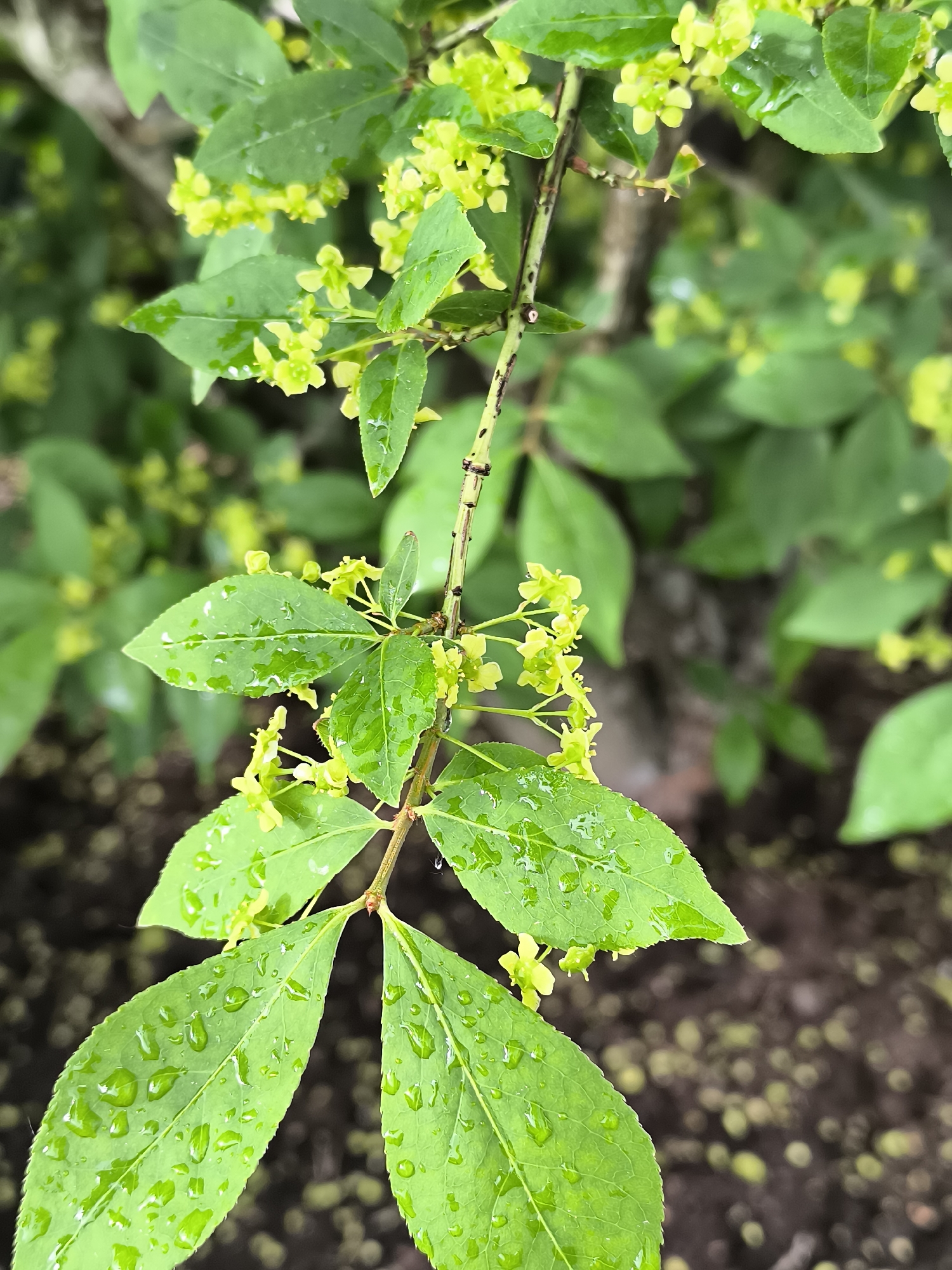
This close-up shot features a vibrant plant branch adorned with fresh green leaves and numerous small, delicate, light green to yellowish flowers. Water droplets glisten on the surface of the leaves, indicating recent rain or heavy dew. The slender, brownish stem supports oval-shaped leaves that appear healthy and lush. Clusters of tiny, star-like flowers emerge from the leaf axils and along the stem, contributing to the overall verdant and blooming appearance of the plant. The natural lighting suggests it is daytime, likely a soft, overcast day or shortly after a rain shower, which enhances the vividness of the greens and yellows. The background is softly blurred, creating a bokeh effect that draws attention to the sharp details of the foreground branch. Hints of additional green foliage and darker, indistinct ground cover are visible in the background. The scene conveys a sense of natural freshness and tranquility, characteristic of an outdoor garden or natural setting in Priekulė, Lithuania. No text is visible in the image.
Priekulė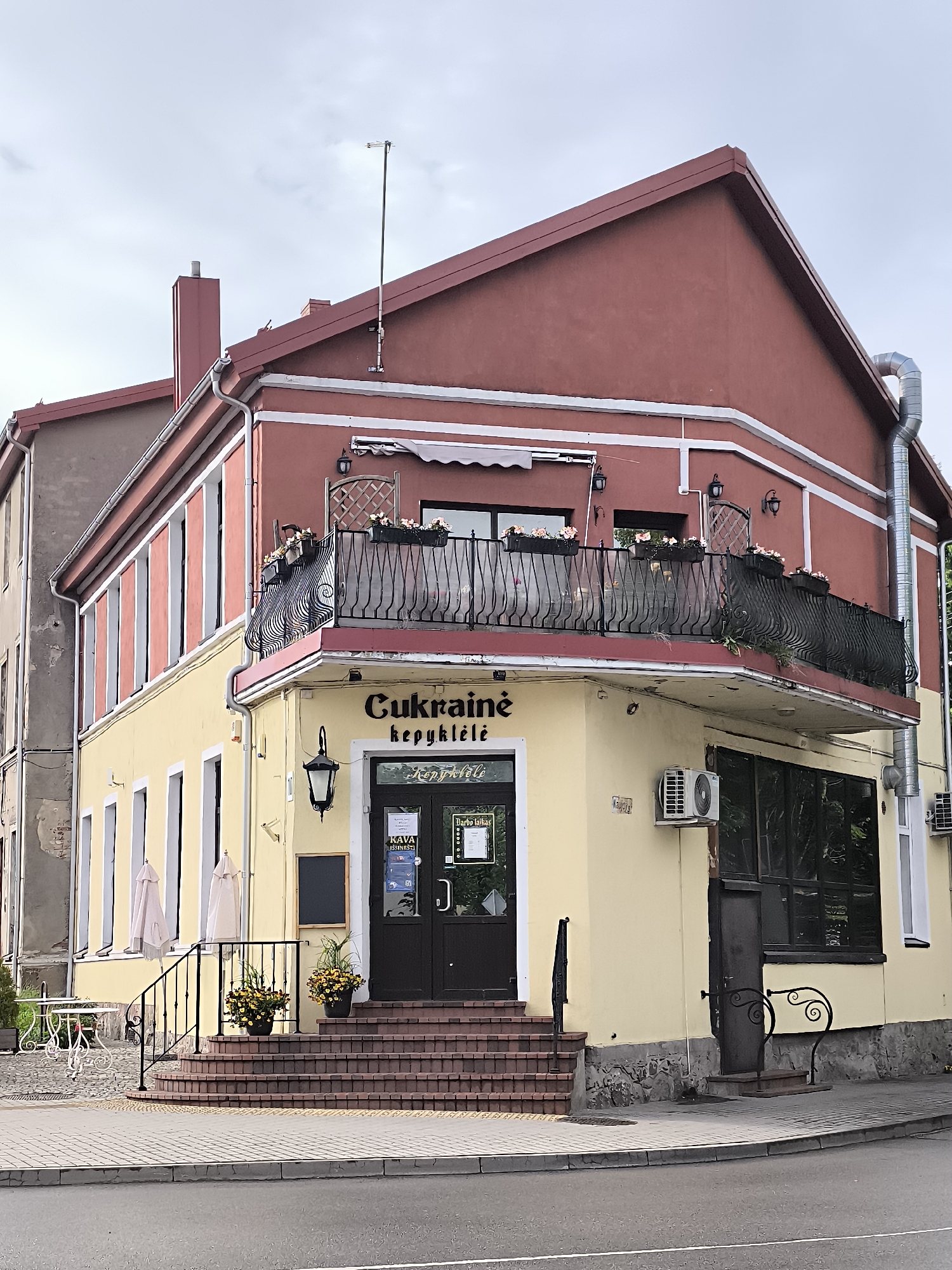
The image depicts a two-story corner building, likely a commercial establishment, under an overcast sky in Priekulė, Lithuania. The ground floor is painted a light yellow, contrasting with the reddish-brown upper floor and roof. The building's main entrance is situated at the corner, featuring dark double doors accessible via brick steps flanked by a black metal handrail. Two large flower pots with yellow and green plants sit on either side of the steps. To the left of the entrance, an outdoor seating area with two white tables and folded white umbrellas is visible. To the right, the yellow wall features a dark-paned window, another dark door, and a decorative black metal railing or bench. An air conditioning unit is mounted on this wall. The upper floor showcases an ornate black metal balcony wrapping around the corner, decorated with flower boxes holding pink flowers. A white awning is partially visible above the balcony. The reddish-brown facade has several windows with white trim. A large, corrugated silver ventilation pipe runs vertically up the right side of the building. The reddish-brown roof features a chimney and a thin TV antenna extending upwards. Visible text on the signage includes "Cukrainė kepykliėlė" (Confectionery Bakery) above the main entrance. Smaller signs on the door read "KAVA" (Coffee), "ISINES-1", and "Darbo laikas" (Working hours). The scene is devoid of people, giving a quiet impression. The ground is paved with light grey sidewalk blocks, and a street is visible at the bottom of the frame.
Priekulė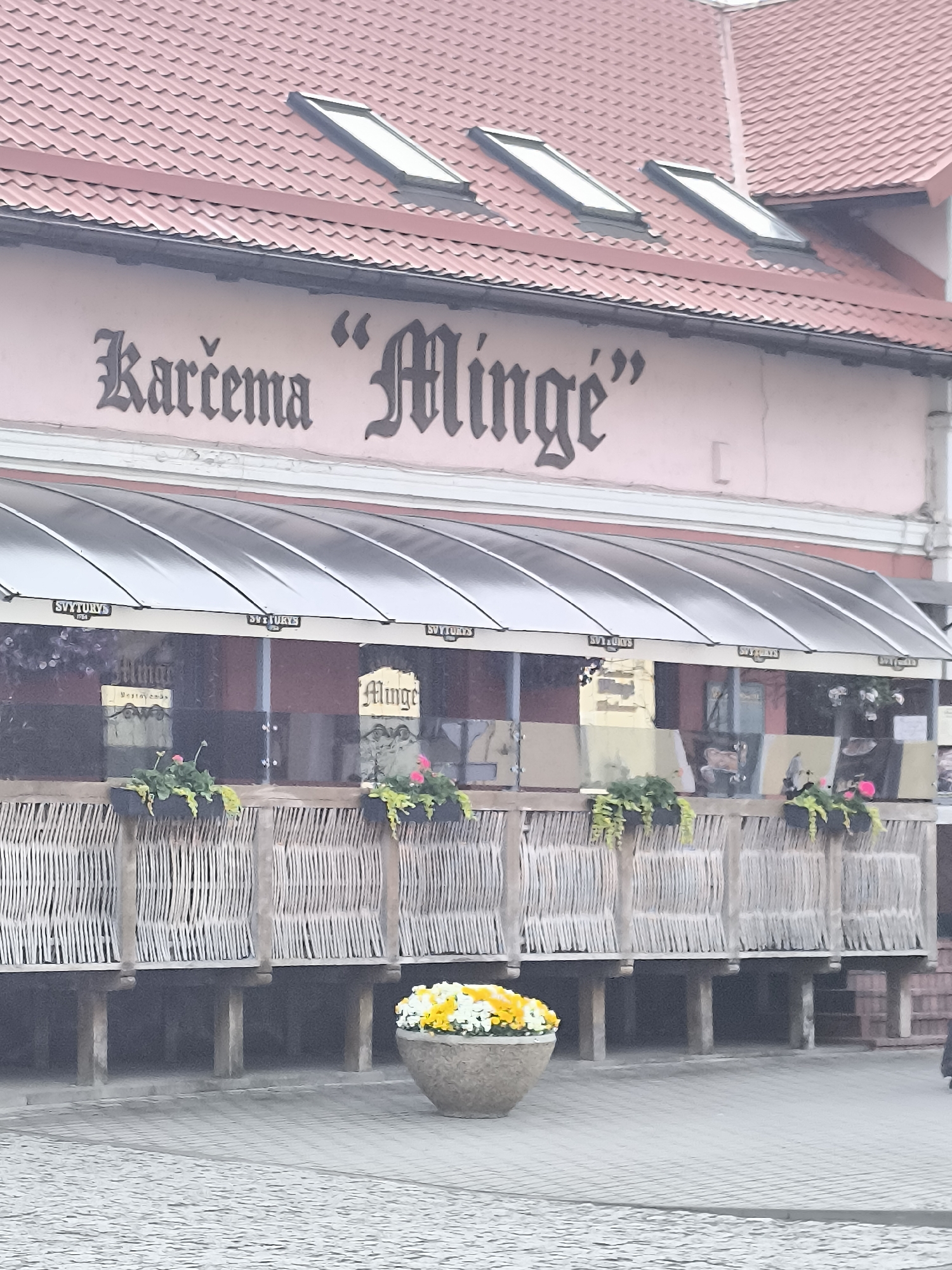
The image captures the exterior of a building in Priekulė, Lithuania, identified as "Karičema "Mingė"" by a large sign above its entrance. The building features a red tiled roof with three prominent skylights. Below the main sign, a grey, slightly translucent awning extends over an outdoor seating area or terrace. The terrace is enclosed by a woven wooden fence or railing, adorned with flower boxes containing green foliage and pink blossoms. Behind the railing, glass panels reveal glimpses of the establishment's interior, where smaller signs also display "Mingė" and partially visible words like "Veselia" and "Veseliai" (likely referring to celebration). The awning itself is branded with "SVYTURYS 1784" in several places, indicating a partnership with a Lithuanian brewery. In the foreground, a large, ornate stone planter filled with vibrant yellow and white flowers sits on a paved area, suggesting a pedestrian zone or sidewalk. The scene is brightly lit, indicating daytime, with no people visible, conveying a quiet, inviting atmosphere. The overall impression is that of a traditional tavern or restaurant ready for patrons.
Priekulė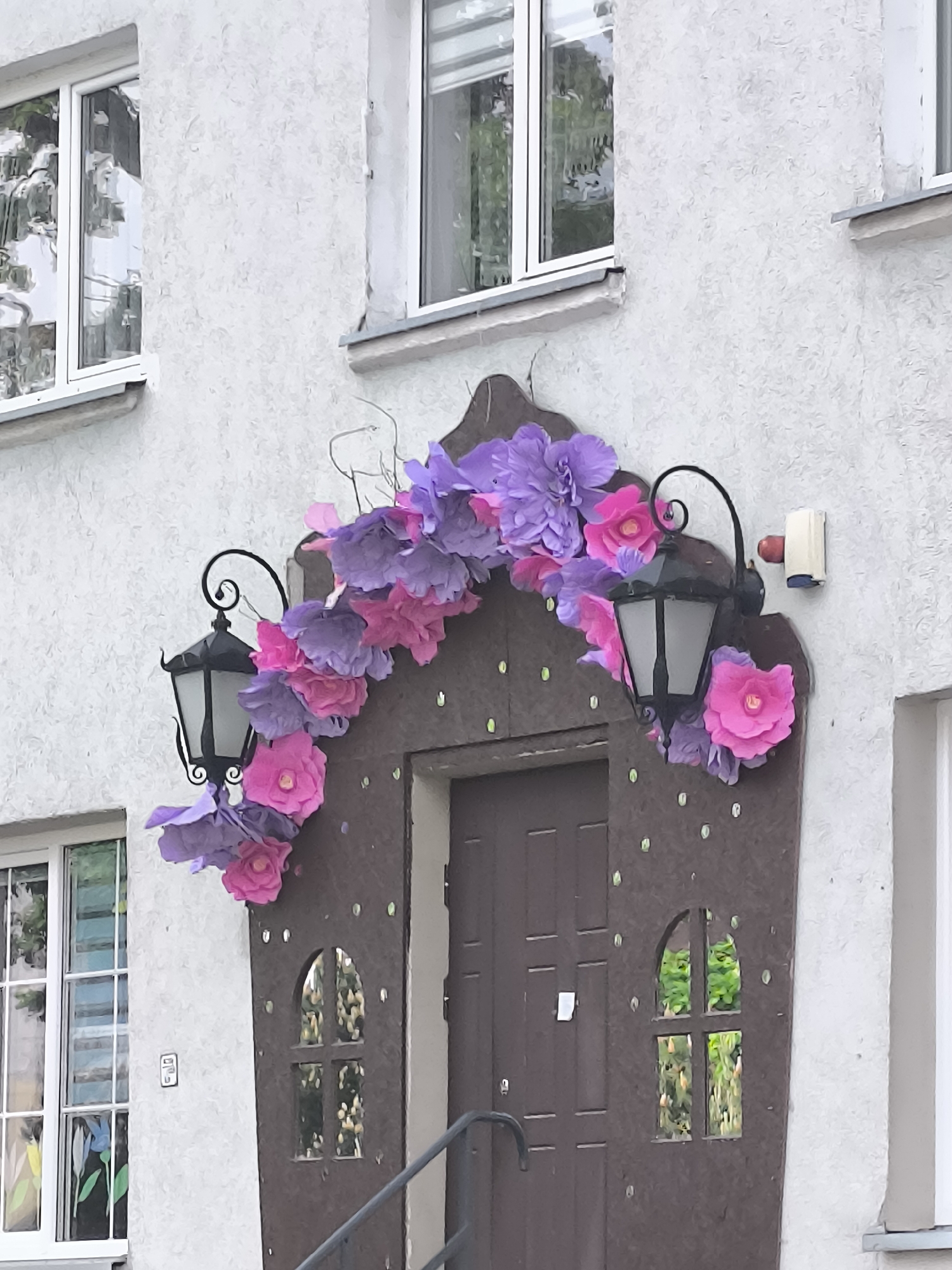
The media file captures a uniquely decorated building entrance in Priekulė, Lithuania, bathed in natural daylight. A dark brown, irregularly shaped archway, resembling a whimsical cottage or fairy-tale house, frames a dark brown, paneled door. This distinctive archway is lavishly adorned with numerous large, handmade paper flowers in vibrant shades of pink and purple, creating a cheerful and inviting display. Two black, ornate wall lanterns with glass panes are mounted on either side of the archway, nestled amongst the colorful floral decorations. Above the right lantern, a small, light-colored security or intercom device is visible on the wall. The building's exterior features a light grey, textured stucco finish. Several white-framed windows are visible; those on the upper left and lower left clearly reflect green foliage and the sky. The whimsical archway itself incorporates small, cutout "windows" that also reflect greenery. Small, bright dots are scattered across the dark brown surface of the archway, adding to its fantastical character. A metal handrail is partially visible in the bottom right foreground, suggesting steps leading to the entrance. No people or discernible text are visible in the image. The scene evokes a sense of enchantment and creative expression under soft, natural light, likely on an overcast day.
Priekulė