Puchły, Poland
7 memories from Puchły, Poland
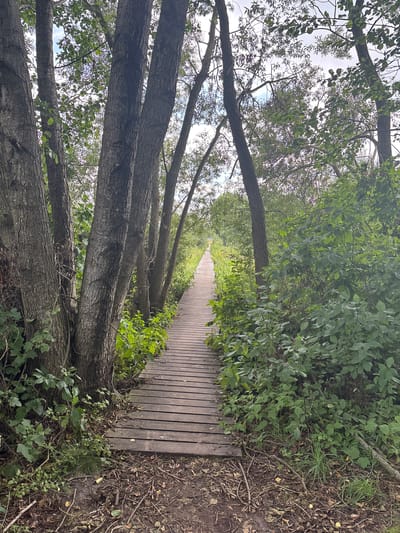
A wooden boardwalk curves through a dense forest in Puchły, Poland. The boardwalk is made of weathered planks and is bordered on the left by a cluster of thick tree trunks and on the right by lush green foliage. The path recedes into the distance, framed by the overhanging branches of trees. The ground along the path is covered with fallen leaves and twigs, indicating a natural, unmanicured environment. The sky above is overcast with some hints of blue peeking through the canopy. The scene suggests a peaceful, natural setting ideal for walking or contemplation.
Puchły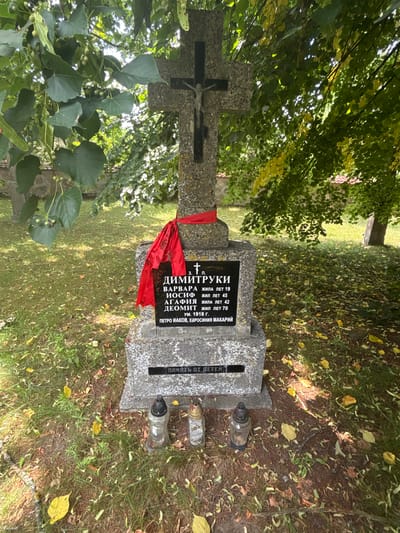
This is a close-up, eye-level shot of a tombstone in the village of Puchły, Poland. The tombstone is made of grey granite with a black plaque in the center. The plaque has text in Cyrillic script, indicating a burial of individuals with the surname "Димитруки" (Dimityuki). The text lists names such as "Варвара" (Varvara), "Иосиф" (Iosif), "Агафия" (Agafiy) and "Деомит" (Deomit) along with their lifespans in years. Below this, it mentions "Петро Иаков, Евфросиния Макарий" (Petro Iakov, Efrosinia Makariy) and a year "1918 г." (1918). A red ribbon is tied around the upper part of the tombstone, and a crucifix is affixed to the top of the stone. In front of the tombstone, three candle holders, two glass and one metal, are placed on the ground amidst fallen leaves and grass. The background shows trees with green and yellowing leaves, and a partially visible stone wall and another tombstone to the right, suggesting it is a cemetery. The lighting is natural, coming from above and to the right, creating some shadows.
Puchły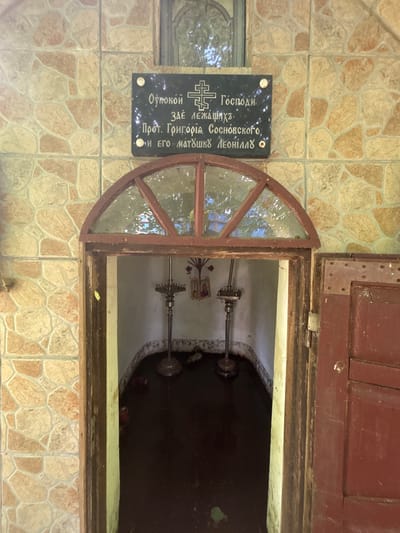
The image shows an exterior view of a small, niche-like structure with a wooden frame and a semicircular glass window above an open doorway. The walls surrounding the niche are tiled with irregular, light-colored stones. Above the tiled wall, a black rectangular plaque with white Cyrillic lettering and a cross is affixed. The plaque reads "Покой Господи. Зде лежащих. Прот. Григорія Сосновского, и его матушкѣ Леонидѣ." The doorway leads into a dark interior where two ornate, metallic candle holders stand on the floor. Between the candle holders, a small icon is visible. The floor of the interior appears to be dark and wet. A weathered red wooden door is hinged to the right of the entrance. The setting is in the village of Puchły, Poland.
Puchły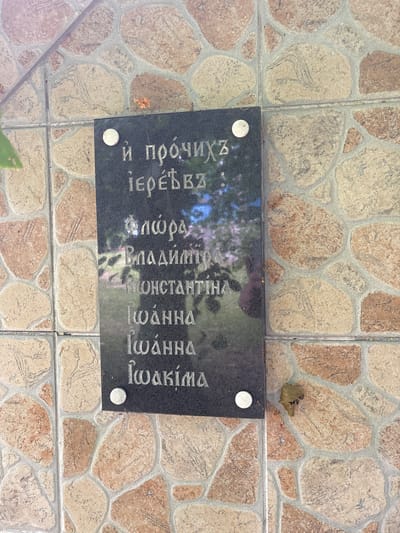
A black plaque with engraved text is affixed to a tiled wall. The text is in a Slavic script, likely Old Church Slavonic or a similar language. The plaque is mounted on a wall covered in irregularly shaped tiles in shades of beige, tan, and pinkish-brown, with grey grout. The lighting suggests it is daytime, with some dappled sunlight and shadows. A small, dried brown leaf is visible on the wall to the right of the plaque. The text on the plaque appears to be a list of names or titles. The first line reads, "и прочиихъ". The second line reads, "іере́въ:". Subsequent lines appear to list names: "Флώра", "Владиміръ", "Константина", "Іωάνна", "Іωάνна", and "Іωакіма". While the image itself does not provide direct information about the city of Puchły, Poland, similar plaques with such inscriptions are commonly found in Orthodox Christian churches or cemeteries. Puchły is known for its historical Orthodox church, the Church of the Transfiguration. Therefore, it is highly probable that this plaque is located at or near this church, serving as a memorial or record.
Puchły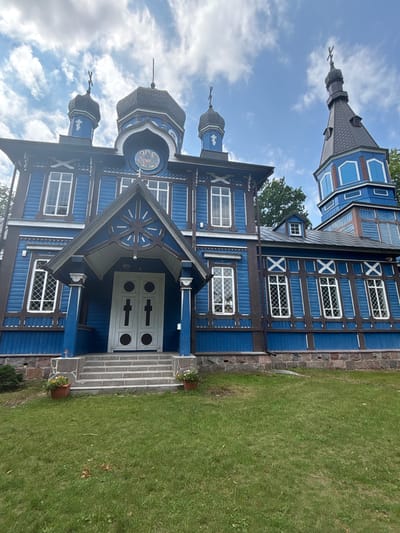
The image shows a bright blue wooden church with dark brown trim, located in Puchły, Poland. The church features multiple domes topped with crosses, and a prominent bell tower to the right. The facade of the church is adorned with decorative wooden carvings and features large, white-framed windows. A covered entrance with double doors, also painted white, is approached by a set of stone steps. Two potted plants with yellow and white flowers sit on either side of the steps. The church is surrounded by a green lawn, and the sky above is partly cloudy. The perspective of the photo is from a low angle, looking up at the structure.
Puchły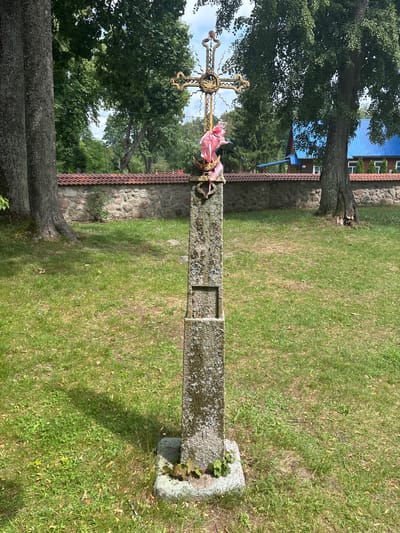
The image depicts a weathered stone monument with a decorative metal cross at its apex, situated in an outdoor setting that appears to be a cemetery or churchyard in Puchły, Poland. The stone base of the monument is rough-hewn and moss-covered, with a visible square indentation on its front. A bright pink ribbon is tied around the cross, suggesting a recent adornment. Behind the monument, a low stone wall with a terracotta tile roof runs horizontally across the frame. Beyond the wall, a building with a bright blue roof is visible, likely a church or another structure associated with the location. Large trees with lush green foliage frame the scene, with their trunks on the left and right sides of the image. The ground is covered in green grass, interspersed with fallen leaves and small wildflowers. The sky above is partly cloudy, with patches of blue peeking through. The overall impression is one of a tranquil, perhaps historical, rural site.
Puchły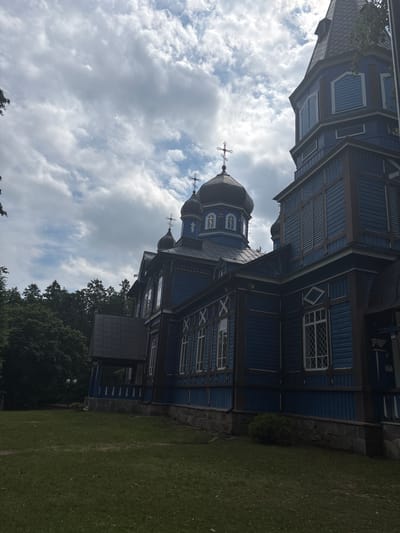
The image shows an exterior view of the Orthodox Church of the Nativity of the Blessed Virgin Mary in Puchły, Poland. The church is made of wood and is painted blue with dark brown trim. It has multiple onion domes topped with crosses. The church is situated on a grassy area with trees in the background. The sky is cloudy. The perspective is from the side of the church, looking up towards the domes and spire. The building's architecture features decorative window frames and horizontal wooden siding. The base of the church appears to be made of stone. There is a porch or entryway visible on the left side of the building.
Puchły