CM:

ATTN

Get the app

Rio De Janeiro, Brazil

30 memories from Rio De Janeiro, Brazil
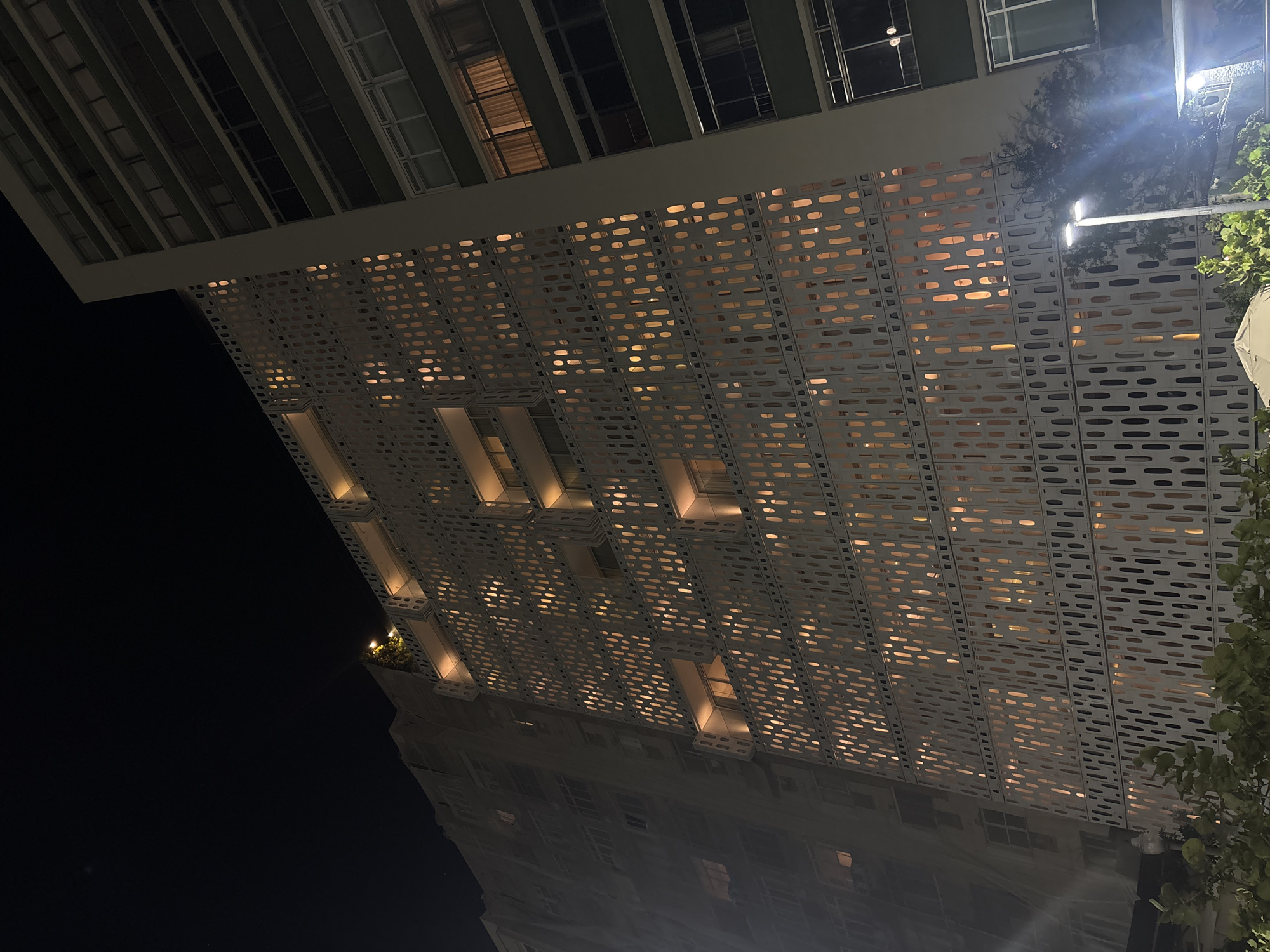
The image shows the facade of a building in Rio de Janeiro, Brazil at night. The building features a distinctive white, perforated concrete screen with an intricate, repeating pattern of oval shapes. Through these openings, warm yellow light emanates from within the building, illuminating the facade. Some windows and balconies are visible behind the screen. To the right of this building, another taller, darker building with a green facade and numerous windows is partially visible. The sky above is dark, indicating nighttime. In the foreground, lush green foliage and a modern street lamp are present. The overall impression is one of modern architecture and urban nighttime ambiance.

The image shows the facade of a building in Rio de Janeiro, Brazil at night. The building features a distinctive white, perforated concrete screen with an intricate, repeating pattern of oval shapes. Through these openings, warm yellow light emanates from within the building, illuminating the facade. Some windows and balconies are visible behind the screen. To the right of this building, another taller, darker building with a green facade and numerous windows is partially visible. The sky above is dark, indicating nighttime. In the foreground, lush green foliage and a modern street lamp are present. The overall impression is one of modern architecture and urban nighttime ambiance.

Rio De Janeiro
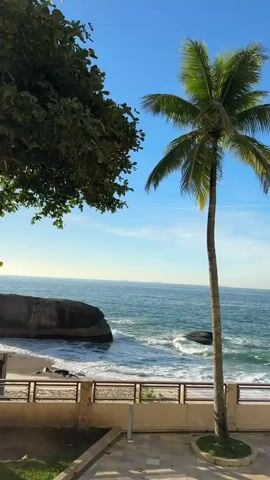
The video opens with a wide shot of an ocean scene on a clear, sunny day, featuring several tall palm trees in the foreground. Waves crash against a rocky shore, visible beyond a light-colored paved area with a railing. Distant land formations are visible on the horizon under a bright blue sky. The camera then pans slightly to the right, maintaining the view of the ocean and two prominent palm trees. Finally, the camera zooms in on the crown of one palm tree, revealing multiple clusters of green coconuts hanging amidst its vibrant green fronds.

The video opens with a wide shot of an ocean scene on a clear, sunny day, featuring several tall palm trees in the foreground. Waves crash against a rocky shore, visible beyond a light-colored paved area with a railing. Distant land formations are visible on the horizon under a bright blue sky. The camera then pans slightly to the right, maintaining the view of the ocean and two prominent palm trees. Finally, the camera zooms in on the crown of one palm tree, revealing multiple clusters of green coconuts hanging amidst its vibrant green fronds.

Rio De Janeiro
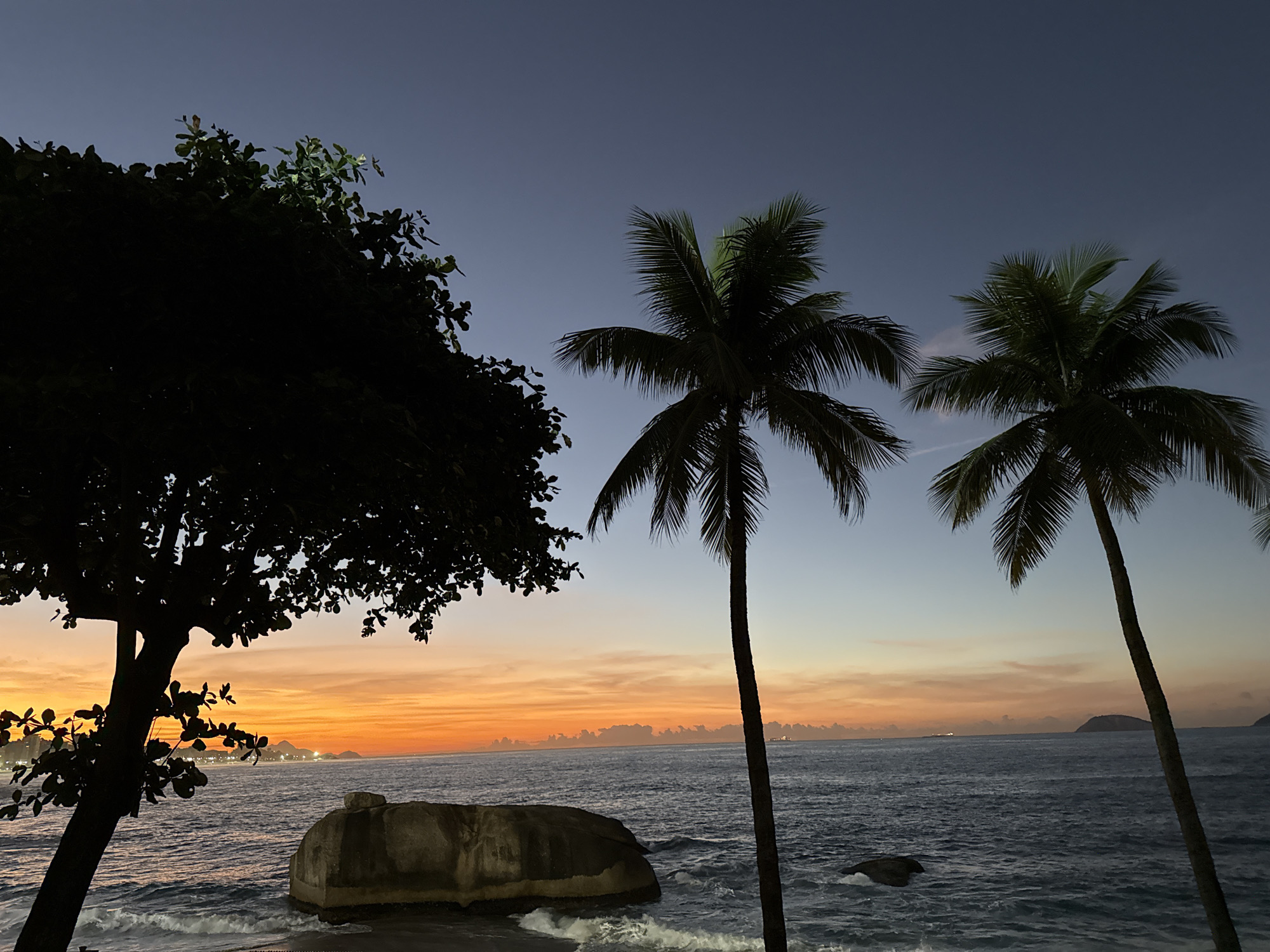
The image displays a coastal scene at dusk, characterized by a vibrant sunset gradient in the sky. The upper sky is a deep twilight blue, transitioning to orange and yellow hues at the horizon, where subtle dark clouds are present. In the immediate foreground, a large, dark tree with distinct foliage is silhouetted on the left. To the right, two tall palm trees with visible fronds are silhouetted against the sky. The midground features a dark blue ocean with visible waves breaking, showing white foam near the shore. A large, light-colored rock formation is situated in the water on the left, with waves washing around its base. On the distant horizon to the left, a cityscape is visible, marked by numerous illuminated buildings and the dark silhouettes of hills or mountains. To the right on the horizon, dark landmasses or islands are silhouetted. No individuals are visible in the scene. The distinct geographical features, including the mountains, city lights, and coastal setting at sunset, strongly indicate the location as Ipanema Beach in Rio de Janeiro, Brazil, likely looking towards the west (towards Leblon and Vidigal/Dois Irmãos mountains).

The image displays a coastal scene at dusk, characterized by a vibrant sunset gradient in the sky. The upper sky is a deep twilight blue, transitioning to orange and yellow hues at the horizon, where subtle dark clouds are present. In the immediate foreground, a large, dark tree with distinct foliage is silhouetted on the left. To the right, two tall palm trees with visible fronds are silhouetted against the sky. The midground features a dark blue ocean with visible waves breaking, showing white foam near the shore. A large, light-colored rock formation is situated in the water on the left, with waves washing around its base. On the distant horizon to the left, a cityscape is visible, marked by numerous illuminated buildings and the dark silhouettes of hills or mountains. To the right on the horizon, dark landmasses or islands are silhouetted. No individuals are visible in the scene. The distinct geographical features, including the mountains, city lights, and coastal setting at sunset, strongly indicate the location as Ipanema Beach in Rio de Janeiro, Brazil, likely looking towards the west (towards Leblon and Vidigal/Dois Irmãos mountains).

Rio De Janeiro
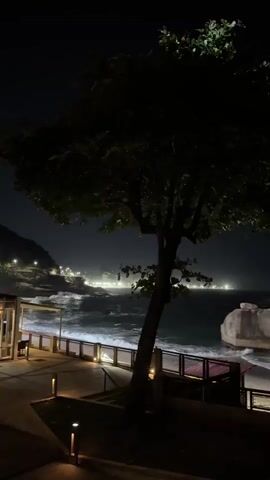
The video displays a nighttime coastal scene. A dark, leafy tree is silhouetted in the foreground on the left. To the right, a path with low ground lights and a railing overlooks the ocean. Waves crash against the shore and a large, light-colored rock partially submerged in the water. As the camera pans right, a tall palm tree becomes visible, also in silhouette. In the distance, numerous lights from a town or city illuminate the horizon, and a bright moon is visible in the dark sky. The sound of ocean waves is audible throughout the clip.

The video displays a nighttime coastal scene. A dark, leafy tree is silhouetted in the foreground on the left. To the right, a path with low ground lights and a railing overlooks the ocean. Waves crash against the shore and a large, light-colored rock partially submerged in the water. As the camera pans right, a tall palm tree becomes visible, also in silhouette. In the distance, numerous lights from a town or city illuminate the horizon, and a bright moon is visible in the dark sky. The sound of ocean waves is audible throughout the clip.

Rio De Janeiro
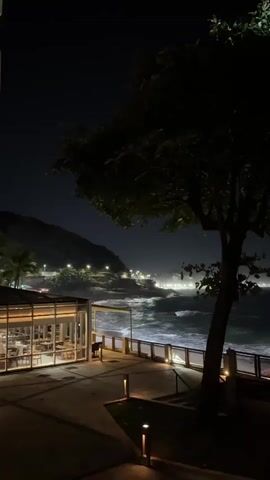
The video captures a night scene from a slightly elevated perspective overlooking a coastal area. In the foreground, a tree with dark foliage is prominent on the right. To the left of the tree, there's a modern building with large glass windows, showcasing an interior with tables and chairs, possibly a restaurant or cafe, illuminated by warm lights. Further left, a tall, white multi-story building with balconies is visible. In the midground, beyond the building with glass windows, a dark concrete or paved walkway extends along the coast, with several illuminated ground lights. A low fence or railing separates the walkway from the ocean. The ocean is active with white-capped waves crashing against the shore. In the background, a dark landmass or hill is visible, dotted with numerous bright streetlights or building lights, indicating a populated area along the coastline. The sky is dark, suggesting night. The overall impression is a vibrant yet serene nocturnal coastal landscape.

The video captures a night scene from a slightly elevated perspective overlooking a coastal area. In the foreground, a tree with dark foliage is prominent on the right. To the left of the tree, there's a modern building with large glass windows, showcasing an interior with tables and chairs, possibly a restaurant or cafe, illuminated by warm lights. Further left, a tall, white multi-story building with balconies is visible. In the midground, beyond the building with glass windows, a dark concrete or paved walkway extends along the coast, with several illuminated ground lights. A low fence or railing separates the walkway from the ocean. The ocean is active with white-capped waves crashing against the shore. In the background, a dark landmass or hill is visible, dotted with numerous bright streetlights or building lights, indicating a populated area along the coastline. The sky is dark, suggesting night. The overall impression is a vibrant yet serene nocturnal coastal landscape.

Rio De Janeiro
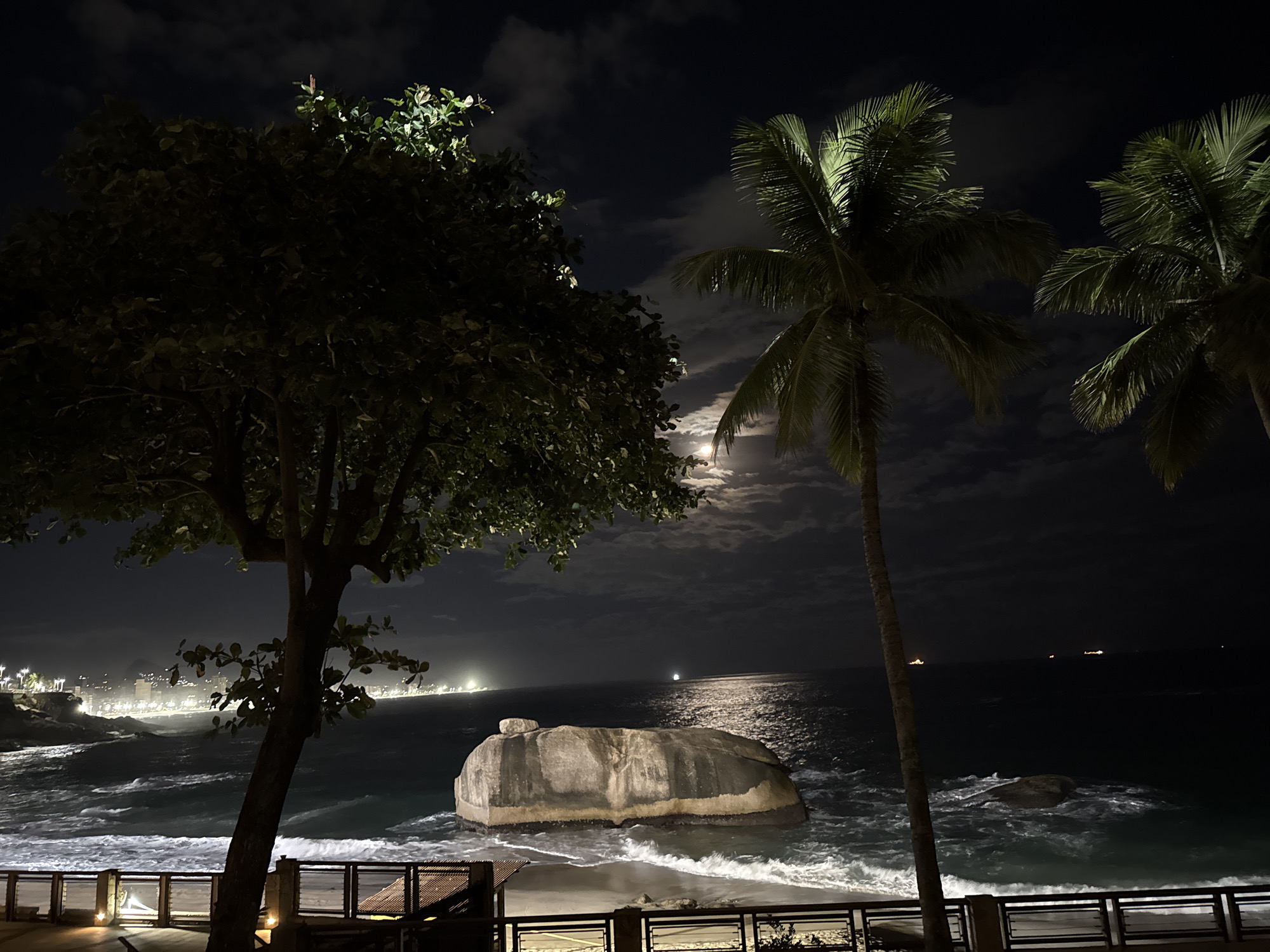
This detailed image depicts a nocturnal coastal scene from an elevated vantage point in Rio de Janeiro, Brazil, specifically overlooking Arpoador Beach. The dark sky is partially covered by scattered clouds, revealing a prominent full moon positioned toward the center-right, casting a distinct path of light across the ocean surface.

In the immediate foreground, a wooden and metal railing system with integrated ground-level illumination forms a boundary, suggesting a promenade or viewing platform. To the left, a large, dark-foliage tree with multiple trunks occupies the lower-left quadrant, its upper leaves artificially illuminated. On the right, two tall palm trees frame the right side of the image, their fronds also illuminated by an unseen light source.

The middle ground features the dark waters of the Atlantic Ocean, exhibiting moderate wave activity. A large, distinctively shaped grey rock formation, identified as Pedra do Arpoador, is situated in the water near the shoreline, with waves breaking around its base. Patches of sandy beach are visible at the water's edge.

In the distant background, to the left, a vibrant line of artificial lights delineates the urban coastline, characteristic of Ipanema or Leblon. Several faint, isolated lights, likely from vessels, are scattered across the dark ocean horizon further out. No human figures are present in the image.

This detailed image depicts a nocturnal coastal scene from an elevated vantage point in Rio de Janeiro, Brazil, specifically overlooking Arpoador Beach. The dark sky is partially covered by scattered clouds, revealing a prominent full moon positioned toward the center-right, casting a distinct path of light across the ocean surface. In the immediate foreground, a wooden and metal railing system with integrated ground-level illumination forms a boundary, suggesting a promenade or viewing platform. To the left, a large, dark-foliage tree with multiple trunks occupies the lower-left quadrant, its upper leaves artificially illuminated. On the right, two tall palm trees frame the right side of the image, their fronds also illuminated by an unseen light source. The middle ground features the dark waters of the Atlantic Ocean, exhibiting moderate wave activity. A large, distinctively shaped grey rock formation, identified as Pedra do Arpoador, is situated in the water near the shoreline, with waves breaking around its base. Patches of sandy beach are visible at the water's edge. In the distant background, to the left, a vibrant line of artificial lights delineates the urban coastline, characteristic of Ipanema or Leblon. Several faint, isolated lights, likely from vessels, are scattered across the dark ocean horizon further out. No human figures are present in the image.

Rio De Janeiro
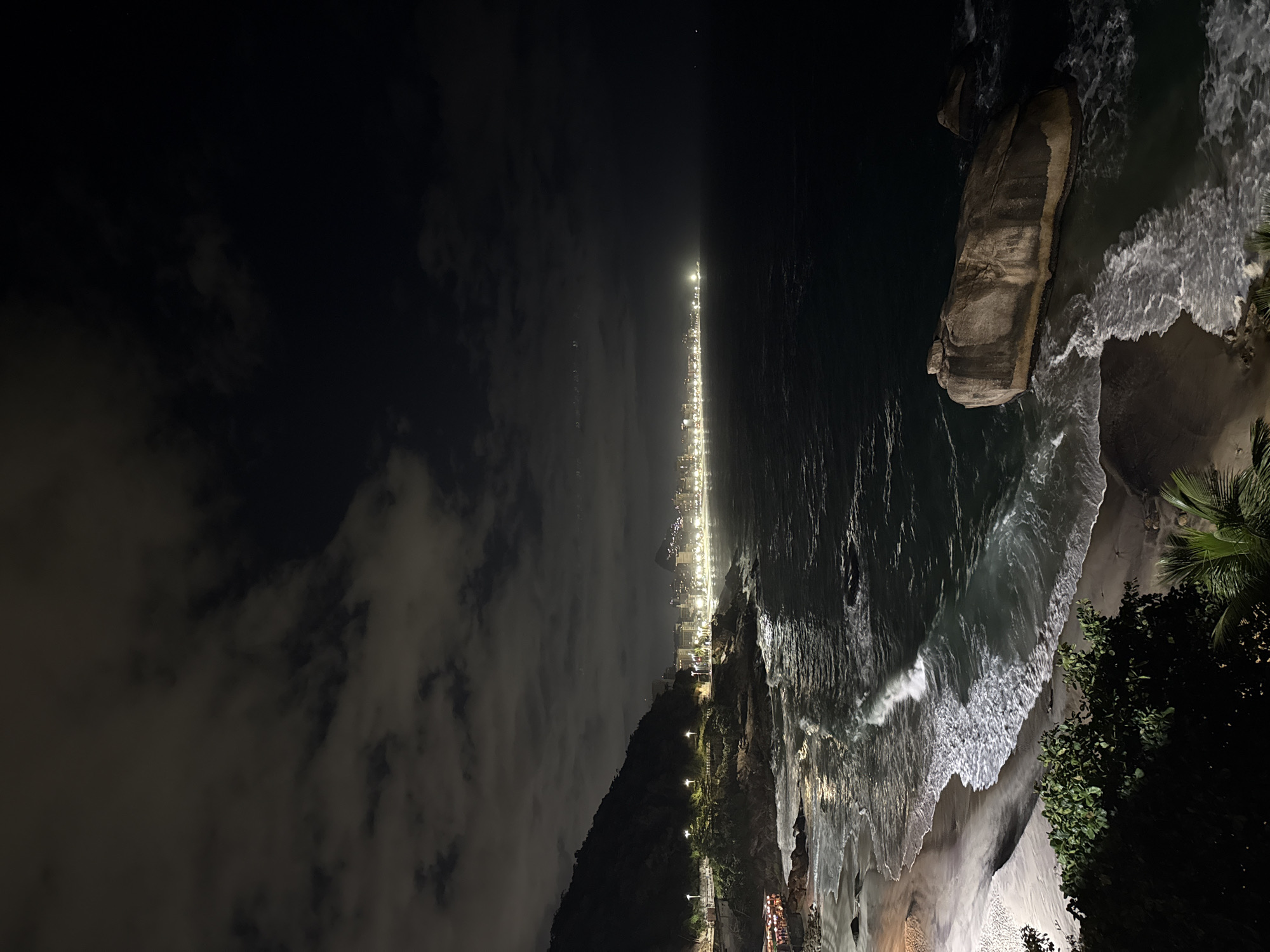
The image captures a nighttime, elevated view along a coastal stretch of Rio de Janeiro, Brazil. The sky is dark with scattered, illuminated clouds reflecting city lights from below.

On the left, a steep, dark, tree-covered hillside descends towards the ocean. A winding, brightly lit road or pathway, marked by numerous streetlights, snakes along the lower slope of this hill, transitioning into a coastal thoroughfare. Below this road, near the water's edge, a cluster of brightly lit structures, possibly restaurants or establishments, are visible.

In the mid-ground, a continuous and dense strip of illuminated buildings, likely multi-story structures, extends along the distant coastline, signifying a major urban area. These city lights stretch horizontally across the horizon, gradually fading into the distance and atmospheric haze.

The ocean occupies the right and lower sections of the frame. Its surface is dark, with breaking waves producing white foam that reflects the ambient light, particularly near the shore. A sandy beach is visible in the lower left, where waves recede and advance. Several dark rock formations are present in the water. Most notably, a large, elongated, light-colored rock formation sits prominently in the lower right, partially submerged and surrounded by breaking waves. Dark foliage from trees or bushes is visible in the immediate foreground at the bottom of the image. No identifiable individuals are visible in the scene. The overall scene suggests a vantage point looking along the South Zone coastline, likely from an area such as Avenida Niemeyer, towards neighborhoods like Leblon and Ipanema.

The image captures a nighttime, elevated view along a coastal stretch of Rio de Janeiro, Brazil. The sky is dark with scattered, illuminated clouds reflecting city lights from below. On the left, a steep, dark, tree-covered hillside descends towards the ocean. A winding, brightly lit road or pathway, marked by numerous streetlights, snakes along the lower slope of this hill, transitioning into a coastal thoroughfare. Below this road, near the water's edge, a cluster of brightly lit structures, possibly restaurants or establishments, are visible. In the mid-ground, a continuous and dense strip of illuminated buildings, likely multi-story structures, extends along the distant coastline, signifying a major urban area. These city lights stretch horizontally across the horizon, gradually fading into the distance and atmospheric haze. The ocean occupies the right and lower sections of the frame. Its surface is dark, with breaking waves producing white foam that reflects the ambient light, particularly near the shore. A sandy beach is visible in the lower left, where waves recede and advance. Several dark rock formations are present in the water. Most notably, a large, elongated, light-colored rock formation sits prominently in the lower right, partially submerged and surrounded by breaking waves. Dark foliage from trees or bushes is visible in the immediate foreground at the bottom of the image. No identifiable individuals are visible in the scene. The overall scene suggests a vantage point looking along the South Zone coastline, likely from an area such as Avenida Niemeyer, towards neighborhoods like Leblon and Ipanema.

Rio De Janeiro
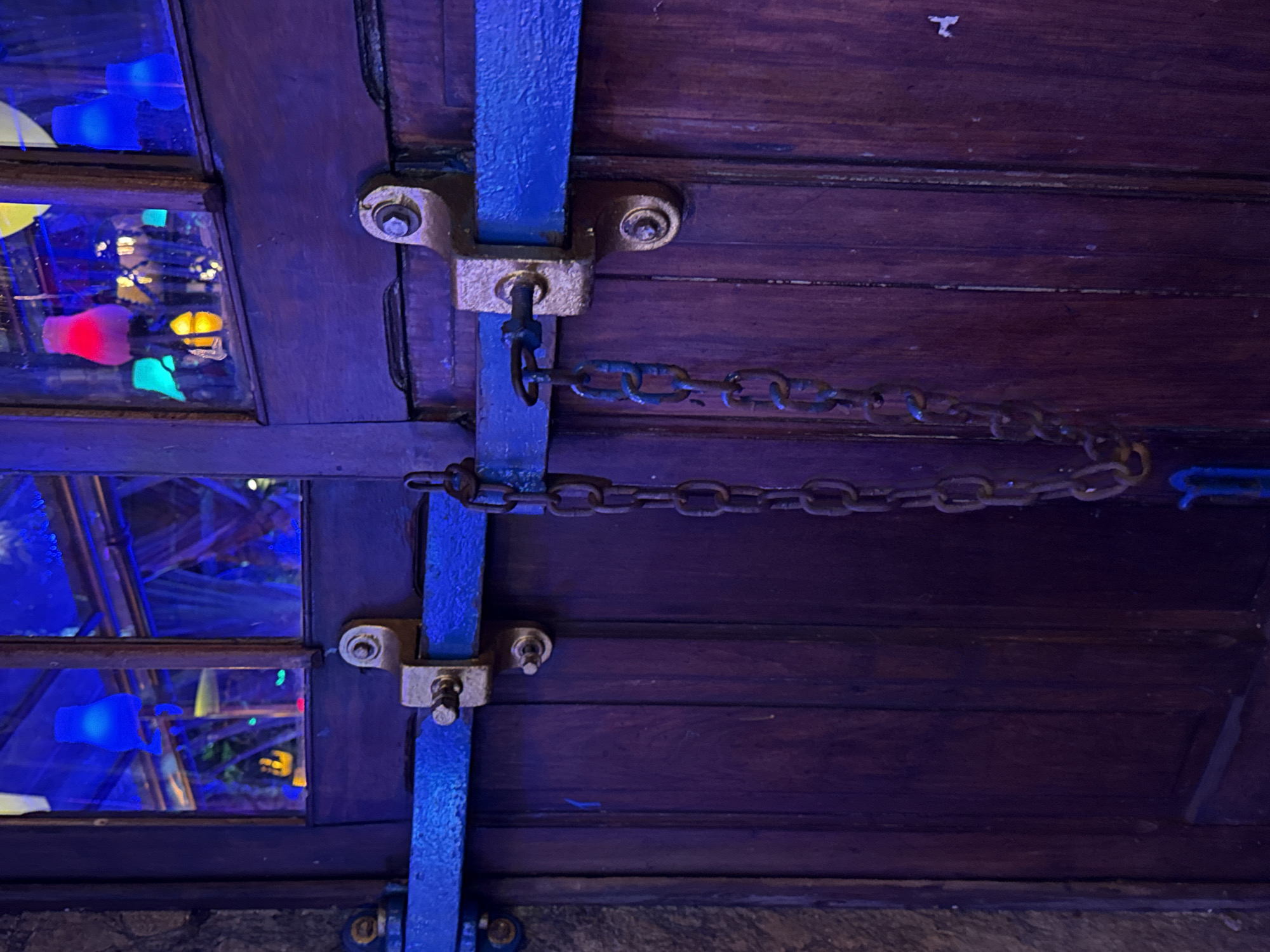
This image depicts the exterior of a dark-stained wooden double door, illuminated by a deep blue and purple ambient light, located in Rio de Janeiro, Brazil. A horizontal blue metal security bar spans the upper portion of the doors, affixed by two visible gold-toned metal brackets bolted into the wood. A rusted metal chain hangs vertically from the right side of this blue bar, connected by a metal ring. Above the security bar, the upper panels of the door feature multi-paned windows, through which an interior space is visible. This interior is illuminated by various colored light sources, appearing as distinct lamps or lanterns, including prominent blue, pink, yellow, and green lights. A textured, possibly stone, wall is visible on the far left edge of the frame. No human subjects or active events are present.

This image depicts the exterior of a dark-stained wooden double door, illuminated by a deep blue and purple ambient light, located in Rio de Janeiro, Brazil. A horizontal blue metal security bar spans the upper portion of the doors, affixed by two visible gold-toned metal brackets bolted into the wood. A rusted metal chain hangs vertically from the right side of this blue bar, connected by a metal ring. Above the security bar, the upper panels of the door feature multi-paned windows, through which an interior space is visible. This interior is illuminated by various colored light sources, appearing as distinct lamps or lanterns, including prominent blue, pink, yellow, and green lights. A textured, possibly stone, wall is visible on the far left edge of the frame. No human subjects or active events are present.

Rio De Janeiro
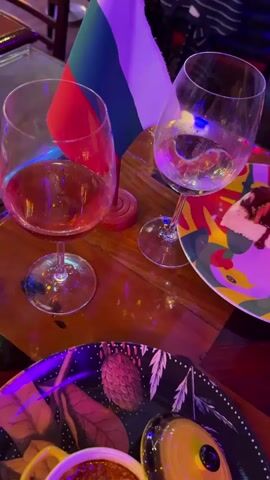
A video displays a close-up of a dining table in a dimly lit setting illuminated with purple and blue light. Two wine glasses are visible; the left one contains a reddish liquid, and the right one holds a clear liquid. Between the glasses, a small Russian flag on a wooden stand is positioned. To the right, a colorful plate with a stylized rooster design holds a slice of cheesecake topped with chocolate sauce and sliced strawberries. A partially visible dark-patterned plate with a small yellow bowl containing food is in the bottom left. A person's hand holding a mobile phone is briefly seen in the background. The camera pans from a general view of the table to a close-up of the cheesecake.

A video displays a close-up of a dining table in a dimly lit setting illuminated with purple and blue light. Two wine glasses are visible; the left one contains a reddish liquid, and the right one holds a clear liquid. Between the glasses, a small Russian flag on a wooden stand is positioned. To the right, a colorful plate with a stylized rooster design holds a slice of cheesecake topped with chocolate sauce and sliced strawberries. A partially visible dark-patterned plate with a small yellow bowl containing food is in the bottom left. A person's hand holding a mobile phone is briefly seen in the background. The camera pans from a general view of the table to a close-up of the cheesecake.

Rio De Janeiro
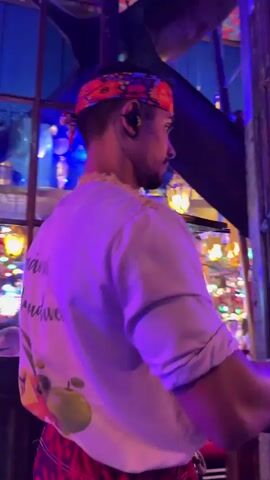
A man with a patterned headband and an earbud initially stands in profile, holding a rectangular object. He then turns to face the camera, smiling, as he presents a wooden serving tray holding a black hot plate with two sizzling pieces of cooked meat. He wears a light-colored shirt with prints and a dark apron with a red and black floral pattern. The background is a dimly lit restaurant or bar environment with various colorful neon lights, including blue and purple hues.

A man with a patterned headband and an earbud initially stands in profile, holding a rectangular object. He then turns to face the camera, smiling, as he presents a wooden serving tray holding a black hot plate with two sizzling pieces of cooked meat. He wears a light-colored shirt with prints and a dark apron with a red and black floral pattern. The background is a dimly lit restaurant or bar environment with various colorful neon lights, including blue and purple hues.

Rio De Janeiro

The video captures a close-up, panning shot of a buffet display in what appears to be a restaurant. The camera begins by focusing on a three-tiered wooden tray laden with various food items like bread and nuts, positioned on a glass surface. Below the glass, several bottles of condiments such as ketchup, mustard, and mayonnaise are nestled in ice, alongside numerous small white bowls filled with different sauces or dips. To the left of the frame, a pair of metal tongs with red handles rests on a white plate. As the camera pans upwards and to the left, it reveals a wall densely decorated with an eclectic assortment of decorative plates and other ornamental objects, including a white rocking horse figurine, a small guitar, and various colorful dishes of different sizes and designs. Blue lighting illuminates parts of the wall and the buffet area, adding to the ambiance. A small bottle of hand sanitizer is also visible on a wooden surface near the wall decorations. The video ends with a view of the intricate wall decor.

The video captures a close-up, panning shot of a buffet display in what appears to be a restaurant. The camera begins by focusing on a three-tiered wooden tray laden with various food items like bread and nuts, positioned on a glass surface. Below the glass, several bottles of condiments such as ketchup, mustard, and mayonnaise are nestled in ice, alongside numerous small white bowls filled with different sauces or dips. To the left of the frame, a pair of metal tongs with red handles rests on a white plate. As the camera pans upwards and to the left, it reveals a wall densely decorated with an eclectic assortment of decorative plates and other ornamental objects, including a white rocking horse figurine, a small guitar, and various colorful dishes of different sizes and designs. Blue lighting illuminates parts of the wall and the buffet area, adding to the ambiance. A small bottle of hand sanitizer is also visible on a wooden surface near the wall decorations. The video ends with a view of the intricate wall decor.

Rio De Janeiro

A video shows a buffet table from a high angle. There are several large metal pots filled with food on the table. Each pot has a serving spoon or tongs inside. Some of the pots are covered with metal lids. The food includes what appears to be curries and rice dishes. Above the table, there are brass bells and decorative lamps that illuminate the food. In the background, other buffet tables and people are visible. The overall setting looks like a restaurant or an event with a festive atmosphere.

A video shows a buffet table from a high angle. There are several large metal pots filled with food on the table. Each pot has a serving spoon or tongs inside. Some of the pots are covered with metal lids. The food includes what appears to be curries and rice dishes. Above the table, there are brass bells and decorative lamps that illuminate the food. In the background, other buffet tables and people are visible. The overall setting looks like a restaurant or an event with a festive atmosphere.

Rio De Janeiro
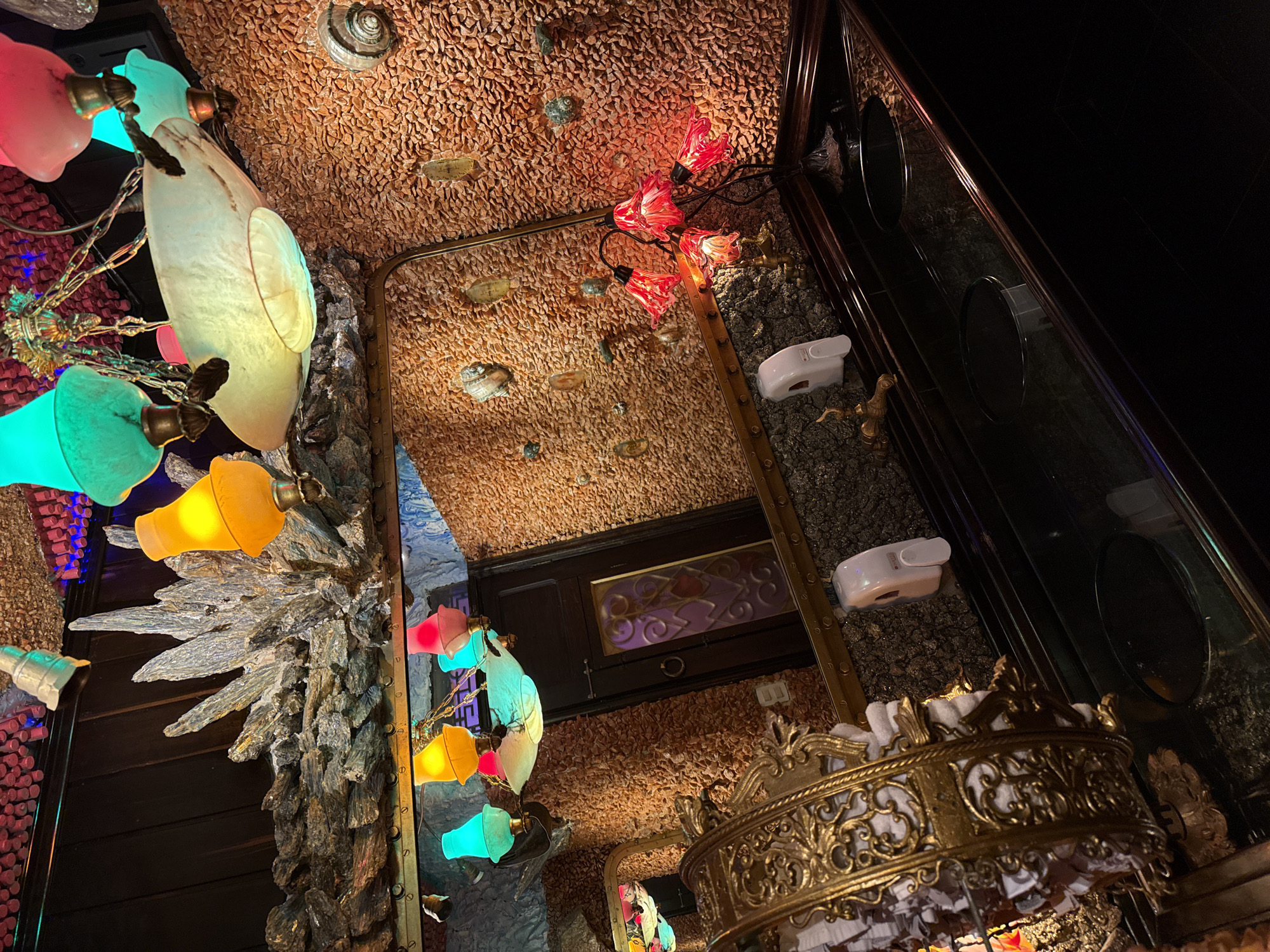
This image depicts the interior of a highly decorated restroom at Gero Restaurant in Ipanema, Rio de Janeiro, Brazil. The walls are textured with a mosaic of numerous small, light brown pebble-like stones, into which various marine shells, including at least one spiral conch, and polished, translucent stone fragments are embedded.

Above a dark, polished counter, a large rectangular mirror is mounted, reflecting the upper part of the room. The reflection shows a dark wooden door with an ornate, possibly stained-glass panel featuring purple patterns. Above the mirror, rock formations resembling coral and geological spikes protrude from the wall. Several chandeliers with multiple arms hold colored glass lampshades in hues of yellow, green, pink, and light blue. A large, flat, shell-shaped light fixture is also visible among these.

The dark counter features multiple circular sink basins, at least two of which are visible. White, wall-mounted soap dispensers are positioned above the counter. Ornate, golden-toned faucets or water spouts are present. On the far left, an elaborate golden-brass towel dispenser with intricate scrollwork holds white rolled towels. On the right side of the counter, a multi-branched lamp with five red, flower-shaped glass shades provides localized illumination. The overall environment is dimly lit, emphasizing the intricate and themed decor. No people are visible.

This image depicts the interior of a highly decorated restroom at Gero Restaurant in Ipanema, Rio de Janeiro, Brazil. The walls are textured with a mosaic of numerous small, light brown pebble-like stones, into which various marine shells, including at least one spiral conch, and polished, translucent stone fragments are embedded. Above a dark, polished counter, a large rectangular mirror is mounted, reflecting the upper part of the room. The reflection shows a dark wooden door with an ornate, possibly stained-glass panel featuring purple patterns. Above the mirror, rock formations resembling coral and geological spikes protrude from the wall. Several chandeliers with multiple arms hold colored glass lampshades in hues of yellow, green, pink, and light blue. A large, flat, shell-shaped light fixture is also visible among these. The dark counter features multiple circular sink basins, at least two of which are visible. White, wall-mounted soap dispensers are positioned above the counter. Ornate, golden-toned faucets or water spouts are present. On the far left, an elaborate golden-brass towel dispenser with intricate scrollwork holds white rolled towels. On the right side of the counter, a multi-branched lamp with five red, flower-shaped glass shades provides localized illumination. The overall environment is dimly lit, emphasizing the intricate and themed decor. No people are visible.

Rio De Janeiro
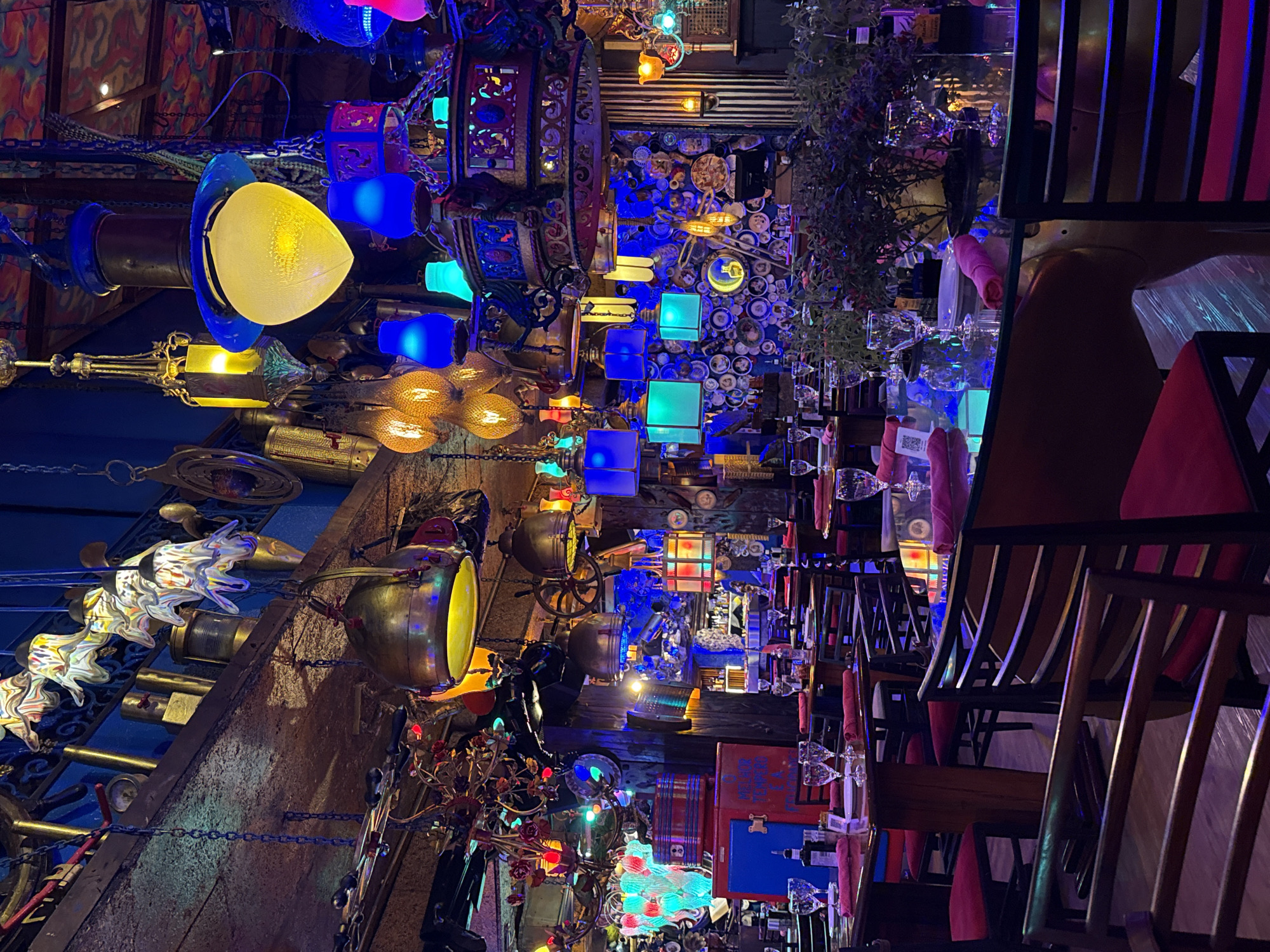
This image captures the interior dining area of Aprazível Restaurante, located in the Santa Teresa neighborhood of Rio de Janeiro, Brazil. The scene is characterized by a maximalist, eclectic decor featuring a dense arrangement of varied lighting fixtures and repurposed objects.

Numerous pendant lamps and chandeliers illuminate the space with diverse colors including yellow, blue, green, red, pink, and white. Fixtures range from clear, ornate glass lamps shaped like inverted flowers to simple square lanterns in solid blue and green, and large metallic bell-shaped lights. A prominent, multi-tiered chandelier on the right features intricate blue and gold detailing. Chains are frequently utilized to suspend these lights and other decorative elements.

The walls are densely decorated. A significant section on the mid-right wall is covered in a mosaic of white and patterned circular plates, small mirrors, and other small artifacts. Overhead structures and shelves display a collection of metallic containers, old tools, gears, and various antique or industrial-style objects. A large, dark wooden pillar is visible in the mid-left foreground. The ceiling features dark, exposed beams and sections covered with a colorful, patterned fabric or painted material.

The dining setup includes multiple tables, both rectangular and square, with dark wooden bases and either wooden or glass tops. Each visible table is set with clear stemware, white plates, and folded pink cloth napkins. Dark-framed chairs with red upholstered seats and backs are positioned around the tables. Some tables feature small potted plants as centerpieces. No individuals are present in the dining area, suggesting the photograph was taken during non-operational hours or a quiet period. The environment combines rustic, industrial, and bohemian aesthetics through its extensive and colorful ornamentation.

This image captures the interior dining area of Aprazível Restaurante, located in the Santa Teresa neighborhood of Rio de Janeiro, Brazil. The scene is characterized by a maximalist, eclectic decor featuring a dense arrangement of varied lighting fixtures and repurposed objects. Numerous pendant lamps and chandeliers illuminate the space with diverse colors including yellow, blue, green, red, pink, and white. Fixtures range from clear, ornate glass lamps shaped like inverted flowers to simple square lanterns in solid blue and green, and large metallic bell-shaped lights. A prominent, multi-tiered chandelier on the right features intricate blue and gold detailing. Chains are frequently utilized to suspend these lights and other decorative elements. The walls are densely decorated. A significant section on the mid-right wall is covered in a mosaic of white and patterned circular plates, small mirrors, and other small artifacts. Overhead structures and shelves display a collection of metallic containers, old tools, gears, and various antique or industrial-style objects. A large, dark wooden pillar is visible in the mid-left foreground. The ceiling features dark, exposed beams and sections covered with a colorful, patterned fabric or painted material. The dining setup includes multiple tables, both rectangular and square, with dark wooden bases and either wooden or glass tops. Each visible table is set with clear stemware, white plates, and folded pink cloth napkins. Dark-framed chairs with red upholstered seats and backs are positioned around the tables. Some tables feature small potted plants as centerpieces. No individuals are present in the dining area, suggesting the photograph was taken during non-operational hours or a quiet period. The environment combines rustic, industrial, and bohemian aesthetics through its extensive and colorful ornamentation.

Rio De Janeiro
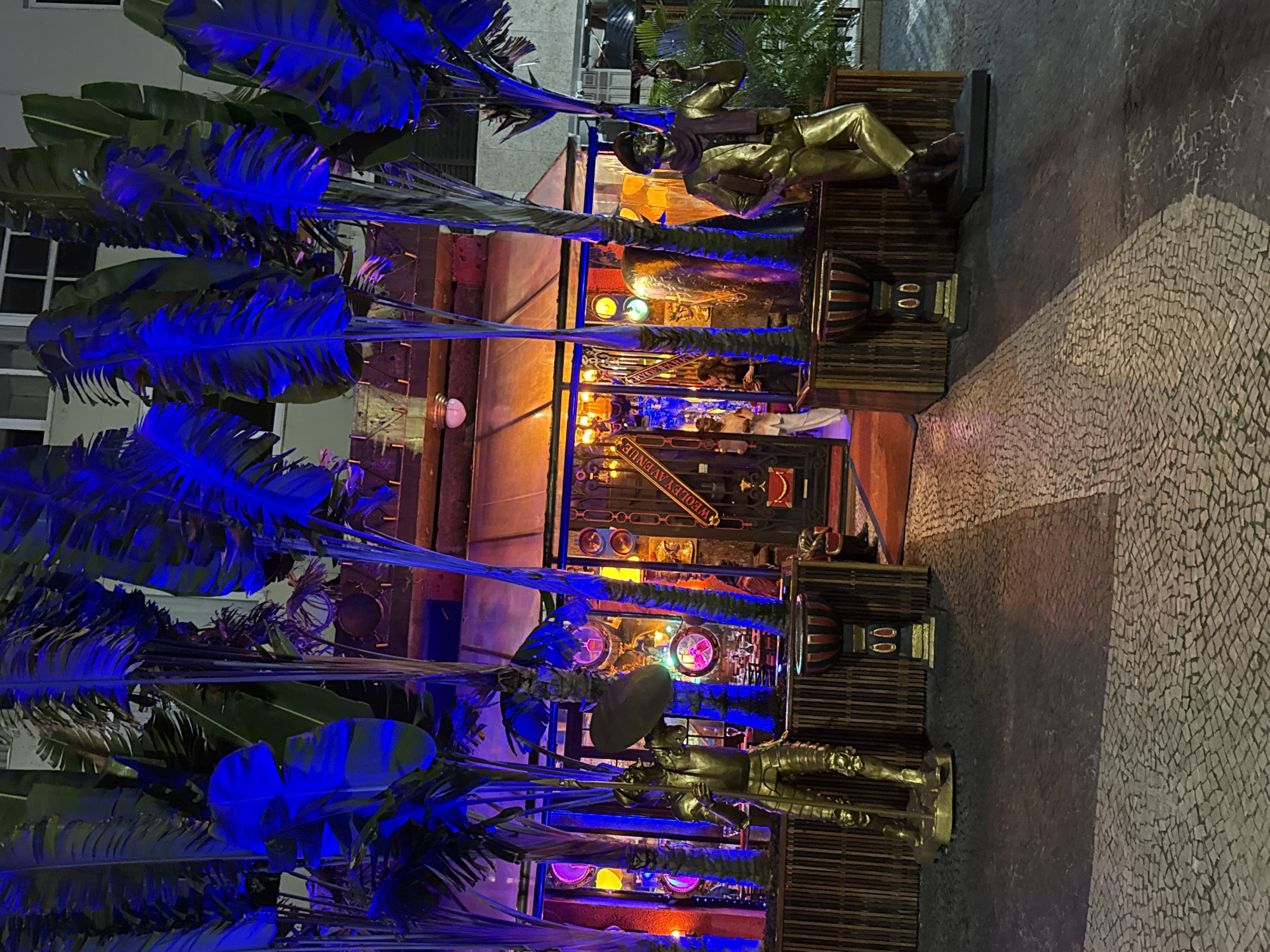
This detailed image captures an eclectic storefront at night in Rio de Janeiro, Brazil. The foreground features Portuguese cobblestone pavement, transitioning to a darker, uniformly paved area directly in front of the establishment. The entrance is flanked by numerous tall, palm-like plants, likely Traveler's Palms, which are intensely illuminated from below by bright blue lights, causing their large leaves to glow vividly.

Two life-sized golden statues stand on dark bases, positioned in front of a low, slatted wooden fence or planter box that runs along the facade. On the left, a golden knight statue is depicted in full armor, holding a vertical spear in its left hand and a round shield in its right hand. On the right, another golden statue portrays a man wearing a beret, a maroon-colored scarf, and a long coat; he holds a small, dark object (possibly a pipe) in his raised right hand and a flat object, resembling a book or notepad, in his left hand. In front of each statue, a dark, ornate goblet-shaped planter with gold and red accents is visible.

The building's entrance, visible between the plants, features a prominent dark metal gate with decorative scrollwork. Above the gate, a horizontal rectangular sign clearly displays the text "WEOLEY AVENUE." The interior of the establishment, visible through glass panels and an open archway, is brightly lit with a warm, amber glow, complemented by various multicolored lights (red, blue, yellow, green) and circular illuminated decorative elements on the walls. Inside, tables and chairs are discernible. Two individuals are present near the entrance: one person in light-colored clothing is partially visible on the left side of the doorway, and another person in dark clothing stands further inside to the right. A multi-story building with windows is partially visible in the blurred background above the storefront.

This detailed image captures an eclectic storefront at night in Rio de Janeiro, Brazil. The foreground features Portuguese cobblestone pavement, transitioning to a darker, uniformly paved area directly in front of the establishment. The entrance is flanked by numerous tall, palm-like plants, likely Traveler's Palms, which are intensely illuminated from below by bright blue lights, causing their large leaves to glow vividly. Two life-sized golden statues stand on dark bases, positioned in front of a low, slatted wooden fence or planter box that runs along the facade. On the left, a golden knight statue is depicted in full armor, holding a vertical spear in its left hand and a round shield in its right hand. On the right, another golden statue portrays a man wearing a beret, a maroon-colored scarf, and a long coat; he holds a small, dark object (possibly a pipe) in his raised right hand and a flat object, resembling a book or notepad, in his left hand. In front of each statue, a dark, ornate goblet-shaped planter with gold and red accents is visible. The building's entrance, visible between the plants, features a prominent dark metal gate with decorative scrollwork. Above the gate, a horizontal rectangular sign clearly displays the text "WEOLEY AVENUE." The interior of the establishment, visible through glass panels and an open archway, is brightly lit with a warm, amber glow, complemented by various multicolored lights (red, blue, yellow, green) and circular illuminated decorative elements on the walls. Inside, tables and chairs are discernible. Two individuals are present near the entrance: one person in light-colored clothing is partially visible on the left side of the doorway, and another person in dark clothing stands further inside to the right. A multi-story building with windows is partially visible in the blurred background above the storefront.

Rio De Janeiro
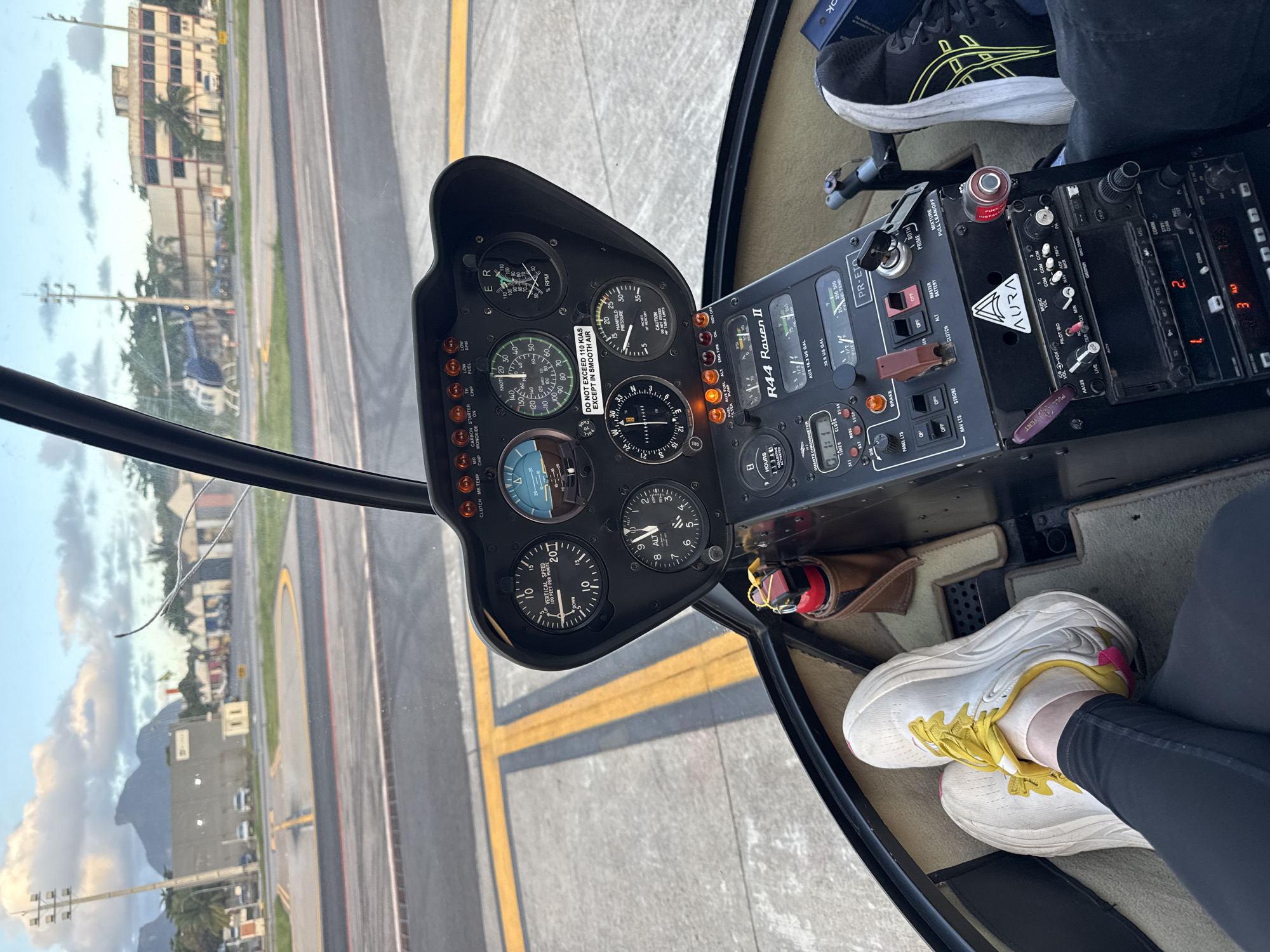
The video displays an aerial view from the interior of a helicopter cockpit, looking out over a coastal city at what appears to be sunset or sunrise. In the immediate foreground, the helicopter's instrument panel is visible, featuring various gauges, switches, and a digital display. Below the instrument panel, two pairs of feet are present, one wearing white sneakers with yellow laces and the other wearing black sneakers with white soles. Through the cockpit windows, a sprawling cityscape extends along a curved coastline with a sandy beach adjacent to a large body of water. Numerous buildings with light-colored roofs are densely packed across the urban area. In the distance, several large, green, tree-covered mountains are visible, with one prominent peak and a lake nestled behind it. The sky is partly cloudy, with warm orange and yellow hues on the horizon contrasting with the grey clouds above.

The video displays an aerial view from the interior of a helicopter cockpit, looking out over a coastal city at what appears to be sunset or sunrise. In the immediate foreground, the helicopter's instrument panel is visible, featuring various gauges, switches, and a digital display. Below the instrument panel, two pairs of feet are present, one wearing white sneakers with yellow laces and the other wearing black sneakers with white soles. Through the cockpit windows, a sprawling cityscape extends along a curved coastline with a sandy beach adjacent to a large body of water. Numerous buildings with light-colored roofs are densely packed across the urban area. In the distance, several large, green, tree-covered mountains are visible, with one prominent peak and a lake nestled behind it. The sky is partly cloudy, with warm orange and yellow hues on the horizon contrasting with the grey clouds above.

Rio De Janeiro
This image captures the interior view from the co-pilot's seat of a Robinson R44 Raven II helicopter, identified by the registration "PR-ETO" visible on the avionics stack. The helicopter is stationary on an asphalt apron with yellow markings.

Two individuals are present in the cockpit, evidenced by their legs and feet. The person in the co-pilot's seat, from whose perspective the photo is taken, wears white athletic shoes with prominent yellow laces and black pants. The pilot's left foot, wearing a black athletic shoe with white and yellow accents, is partially visible near the flight controls.

The instrument panel displays various gauges: an altimeter showing approximately 200 feet, a vertical speed indicator at zero, an airspeed indicator at 0 knots, an RPM gauge, and a manifold pressure gauge indicating approximately 5 inches of mercury. Warning lights for "CLUTCH," "MR TEMP," "CARBON MONOXIDE," "LOW FUEL," and "LOW RPM" are visible but unlit. Below the main panel, an avionics stack features an "AURA" brand audio panel, communication radios, and navigation equipment. A red fire extinguisher is secured in a brown leather holder to the left of the avionics. The helicopter's interior floor is carpeted in a light beige tone.

Beyond the helicopter's windshield, an airfield environment is visible. In the mid-ground, multiple light-colored buildings, characteristic of airport hangars or facilities, line the perimeter. A blue and white helicopter is parked on the apron to the left. Tropical vegetation, including palm trees, is scattered throughout the scene. In the distant background, under a partly cloudy sky, prominent and distinctly shaped mountains, including a rugged peak resembling Pedra da Gávea, dominate the landscape. A tall utility pole stands on the left side of the frame.

Forensically, the "PR-ETO" registration indicates a Brazilian-registered aircraft. The unique mountainous backdrop, particularly the formation resembling Pedra da Gávea, in conjunction with the registration, identifies the location as Jacarepaguá Airport (Aeroporto de Jacarepaguá - Roberto Marinho) in Rio de Janeiro, Brazil, with the Tijuca Forest National Park mountains in the background. The helicopter appears to be powered on but not in flight, likely undergoing pre-flight procedures or preparing for taxi.

This image captures the interior view from the co-pilot's seat of a Robinson R44 Raven II helicopter, identified by the registration "PR-ETO" visible on the avionics stack. The helicopter is stationary on an asphalt apron with yellow markings. Two individuals are present in the cockpit, evidenced by their legs and feet. The person in the co-pilot's seat, from whose perspective the photo is taken, wears white athletic shoes with prominent yellow laces and black pants. The pilot's left foot, wearing a black athletic shoe with white and yellow accents, is partially visible near the flight controls. The instrument panel displays various gauges: an altimeter showing approximately 200 feet, a vertical speed indicator at zero, an airspeed indicator at 0 knots, an RPM gauge, and a manifold pressure gauge indicating approximately 5 inches of mercury. Warning lights for "CLUTCH," "MR TEMP," "CARBON MONOXIDE," "LOW FUEL," and "LOW RPM" are visible but unlit. Below the main panel, an avionics stack features an "AURA" brand audio panel, communication radios, and navigation equipment. A red fire extinguisher is secured in a brown leather holder to the left of the avionics. The helicopter's interior floor is carpeted in a light beige tone. Beyond the helicopter's windshield, an airfield environment is visible. In the mid-ground, multiple light-colored buildings, characteristic of airport hangars or facilities, line the perimeter. A blue and white helicopter is parked on the apron to the left. Tropical vegetation, including palm trees, is scattered throughout the scene. In the distant background, under a partly cloudy sky, prominent and distinctly shaped mountains, including a rugged peak resembling Pedra da Gávea, dominate the landscape. A tall utility pole stands on the left side of the frame. Forensically, the "PR-ETO" registration indicates a Brazilian-registered aircraft. The unique mountainous backdrop, particularly the formation resembling Pedra da Gávea, in conjunction with the registration, identifies the location as Jacarepaguá Airport (Aeroporto de Jacarepaguá - Roberto Marinho) in Rio de Janeiro, Brazil, with the Tijuca Forest National Park mountains in the background. The helicopter appears to be powered on but not in flight, likely undergoing pre-flight procedures or preparing for taxi.

Rio De Janeiro

This image captures an outdoor helicopter base or helipad during either sunrise or sunset, situated within the metropolitan area of Rio de Janeiro, Brazil, against a backdrop of prominent mountains. In the immediate foreground left, two individuals stand adjacent to a dark-colored helicopter; one person, partially obscured, is near the fuselage, while the other, wearing a high-visibility yellow-green vest over dark clothing, interacts with the open cockpit door. The ground transitions from a dark asphalt surface in the very foreground to a lighter gray paved area marked with a distinct curved yellow line. Further right on the paved surface, a red Robinson R44 helicopter, clearly displaying the registration 'PR-MPT' on its tail boom, is parked. Behind it, a grey helicopter is also stationary, and multiple additional helicopters are visible in the distant background. The sky is partly cloudy with stratocumulus formations, exhibiting a mix of golden hues from the low sun and cooler gray-blue tones. The sun is a strong, bright source on the horizon, creating significant glare and silhouetting a range of large, verdant mountains. Patches of bright green grass are visible bordering the paved sections of the airfield.

This image captures an outdoor helicopter base or helipad during either sunrise or sunset, situated within the metropolitan area of Rio de Janeiro, Brazil, against a backdrop of prominent mountains. In the immediate foreground left, two individuals stand adjacent to a dark-colored helicopter; one person, partially obscured, is near the fuselage, while the other, wearing a high-visibility yellow-green vest over dark clothing, interacts with the open cockpit door. The ground transitions from a dark asphalt surface in the very foreground to a lighter gray paved area marked with a distinct curved yellow line. Further right on the paved surface, a red Robinson R44 helicopter, clearly displaying the registration 'PR-MPT' on its tail boom, is parked. Behind it, a grey helicopter is also stationary, and multiple additional helicopters are visible in the distant background. The sky is partly cloudy with stratocumulus formations, exhibiting a mix of golden hues from the low sun and cooler gray-blue tones. The sun is a strong, bright source on the horizon, creating significant glare and silhouetting a range of large, verdant mountains. Patches of bright green grass are visible bordering the paved sections of the airfield.

Rio De Janeiro
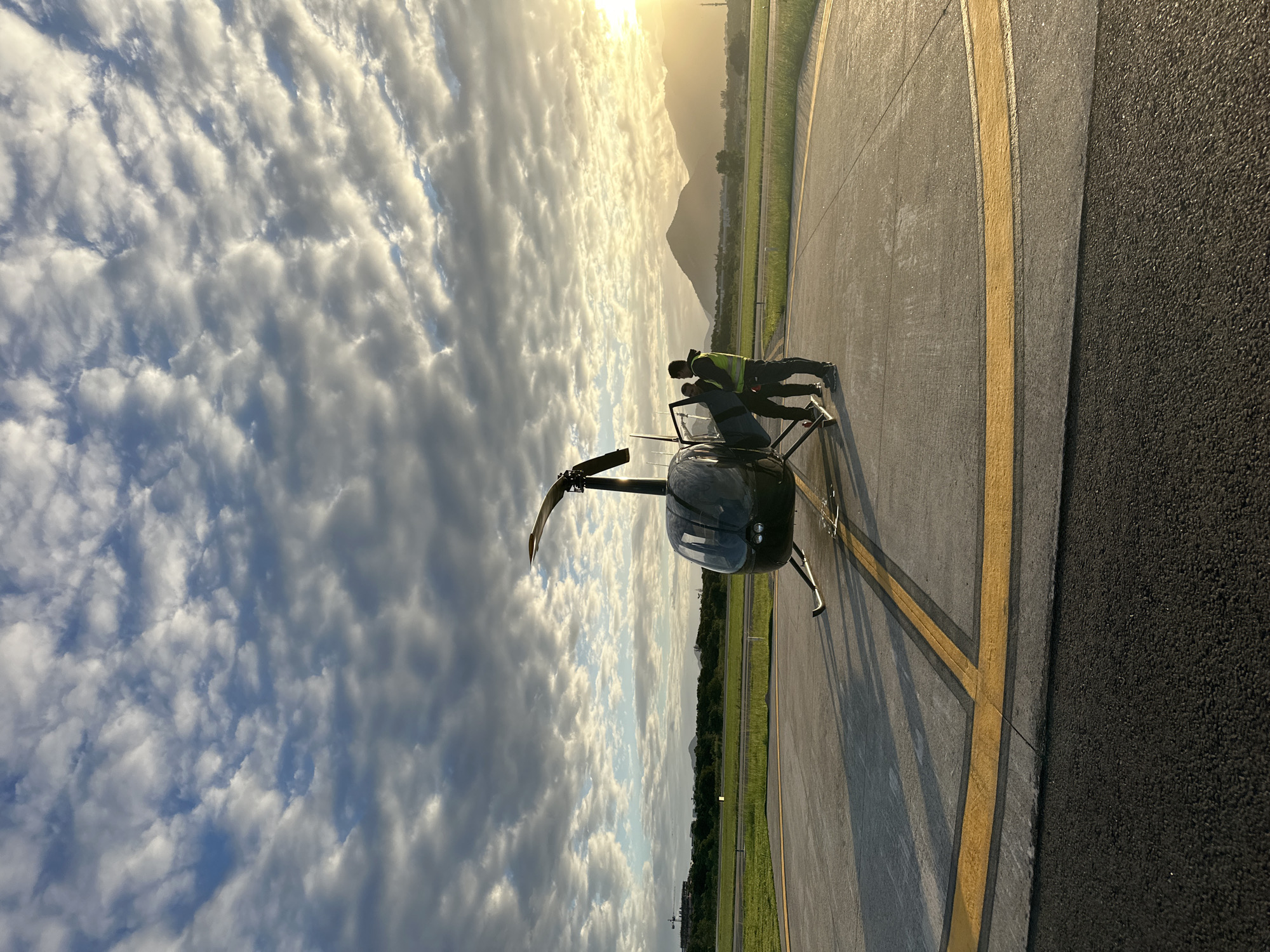
The image depicts a helicopter on a helipad during either sunrise or sunset, characterized by strong backlighting from the low sun on the right horizon, casting long shadows. Two adult males are present near the dark-colored Robinson R44 helicopter, which is stationary on the concrete helipad marked with yellow lines. One male, wearing dark clothing, is partially inside the helicopter's cockpit, with the door open. The second male, wearing a dark top and a bright yellow-green high-visibility vest, stands outside the open door, facing towards the helicopter.

The environment comprises a concrete helipad transitioning to an asphalt foreground, bordered by green grass. Beyond the airfield, a dense line of green vegetation is visible, followed by several undulating mountains in the background, characteristic of the landscape in Rio de Janeiro, Brazil. A construction site with a crane is partially visible on an elevated area on the far left. The sky is partially covered with scattered cumulus or stratocumulus clouds, illuminated by the golden light of the low sun on the right, contrasting with cooler blue and grey tones elsewhere. The scene's specific mountainous backdrop points to a location within the metropolitan area of Rio de Janeiro, likely an airfield such as Jacarepaguá.

The image depicts a helicopter on a helipad during either sunrise or sunset, characterized by strong backlighting from the low sun on the right horizon, casting long shadows. Two adult males are present near the dark-colored Robinson R44 helicopter, which is stationary on the concrete helipad marked with yellow lines. One male, wearing dark clothing, is partially inside the helicopter's cockpit, with the door open. The second male, wearing a dark top and a bright yellow-green high-visibility vest, stands outside the open door, facing towards the helicopter. The environment comprises a concrete helipad transitioning to an asphalt foreground, bordered by green grass. Beyond the airfield, a dense line of green vegetation is visible, followed by several undulating mountains in the background, characteristic of the landscape in Rio de Janeiro, Brazil. A construction site with a crane is partially visible on an elevated area on the far left. The sky is partially covered with scattered cumulus or stratocumulus clouds, illuminated by the golden light of the low sun on the right, contrasting with cooler blue and grey tones elsewhere. The scene's specific mountainous backdrop points to a location within the metropolitan area of Rio de Janeiro, likely an airfield such as Jacarepaguá.

Rio De Janeiro
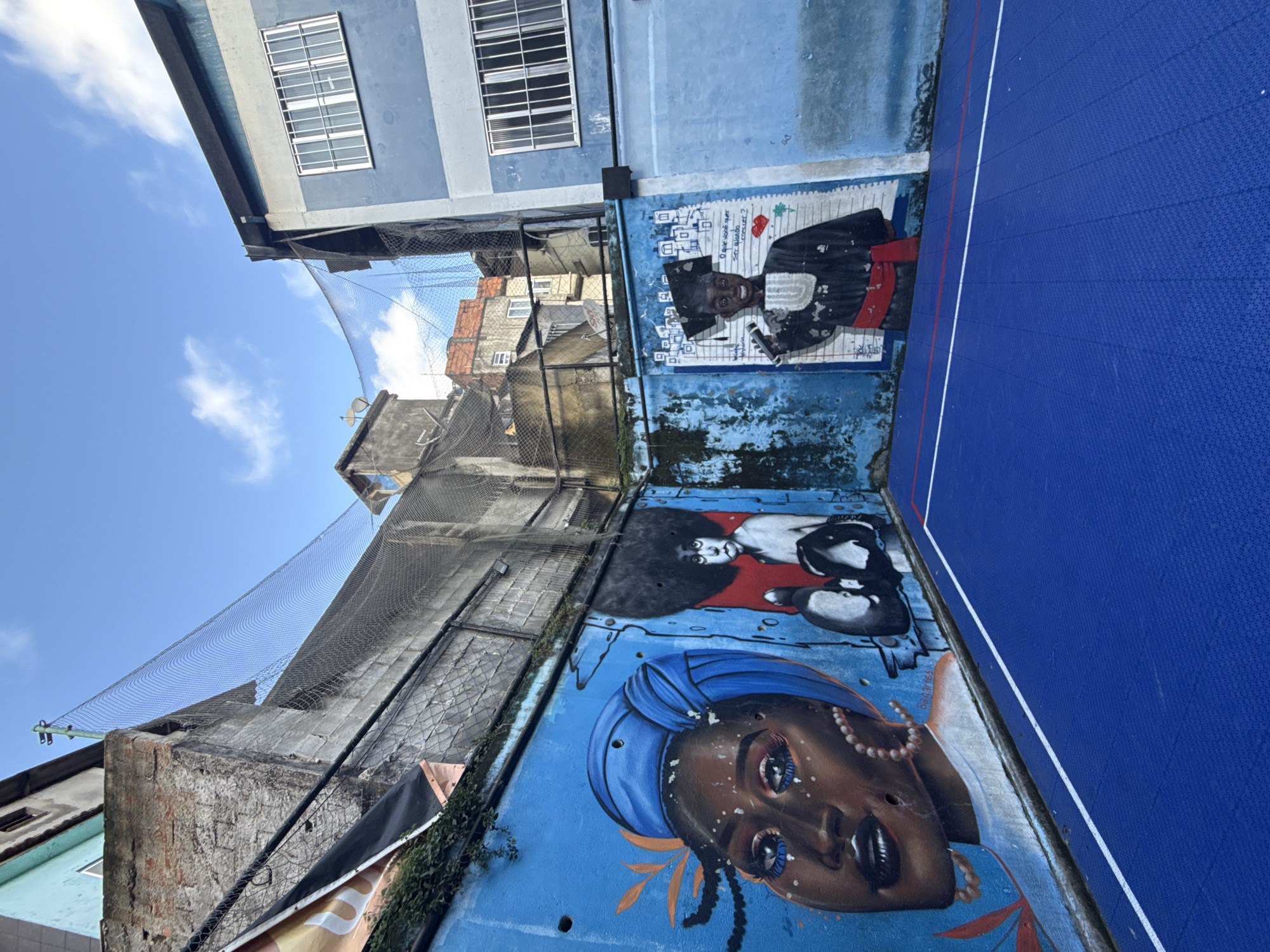
This image captures an outdoor community sports court within a favela in Rio de Janeiro, Brazil. The foreground features a bright blue modular sports court surface with white and red demarcation lines. Surrounding the court are walls painted blue, adorned with three distinct murals.

On the left wall, a large mural depicts a Black woman from the chest up, with dark skin, a blue headwrap, large pearl hoop earrings, and intricate blue and white makeup. Orange leaf-like designs frame her head. Adjacent to this, a second mural portrays a person with an afro hairstyle, shirtless, wearing boxing gloves, set against a red background. The wall section between the murals and on the right shows wear, including peeling paint and some holes. On the right wall, a third mural features a young Black individual in a graduation cap and gown, holding a microphone. The background of this mural includes stylized architectural drawings and Portuguese text, notably "O que você quer ser quando crescer?" (What do you want to be when you grow up?).

Above the walls, a dark mesh safety net spans the area, held by poles and connected to surrounding structures. In the background, a dense urban landscape of multi-story buildings is visible under a clear blue sky with scattered white clouds. Buildings vary in color, including light green, grey, brick red, and shades of blue. The building on the far right is blue and light blue, with multiple windows fitted with white security bars. Various architectural elements like ledges, satellite dishes, and exposed brickwork are present on the background structures.

This image captures an outdoor community sports court within a favela in Rio de Janeiro, Brazil. The foreground features a bright blue modular sports court surface with white and red demarcation lines. Surrounding the court are walls painted blue, adorned with three distinct murals. On the left wall, a large mural depicts a Black woman from the chest up, with dark skin, a blue headwrap, large pearl hoop earrings, and intricate blue and white makeup. Orange leaf-like designs frame her head. Adjacent to this, a second mural portrays a person with an afro hairstyle, shirtless, wearing boxing gloves, set against a red background. The wall section between the murals and on the right shows wear, including peeling paint and some holes. On the right wall, a third mural features a young Black individual in a graduation cap and gown, holding a microphone. The background of this mural includes stylized architectural drawings and Portuguese text, notably "O que você quer ser quando crescer?" (What do you want to be when you grow up?). Above the walls, a dark mesh safety net spans the area, held by poles and connected to surrounding structures. In the background, a dense urban landscape of multi-story buildings is visible under a clear blue sky with scattered white clouds. Buildings vary in color, including light green, grey, brick red, and shades of blue. The building on the far right is blue and light blue, with multiple windows fitted with white security bars. Various architectural elements like ledges, satellite dishes, and exposed brickwork are present on the background structures.

Rio De Janeiro
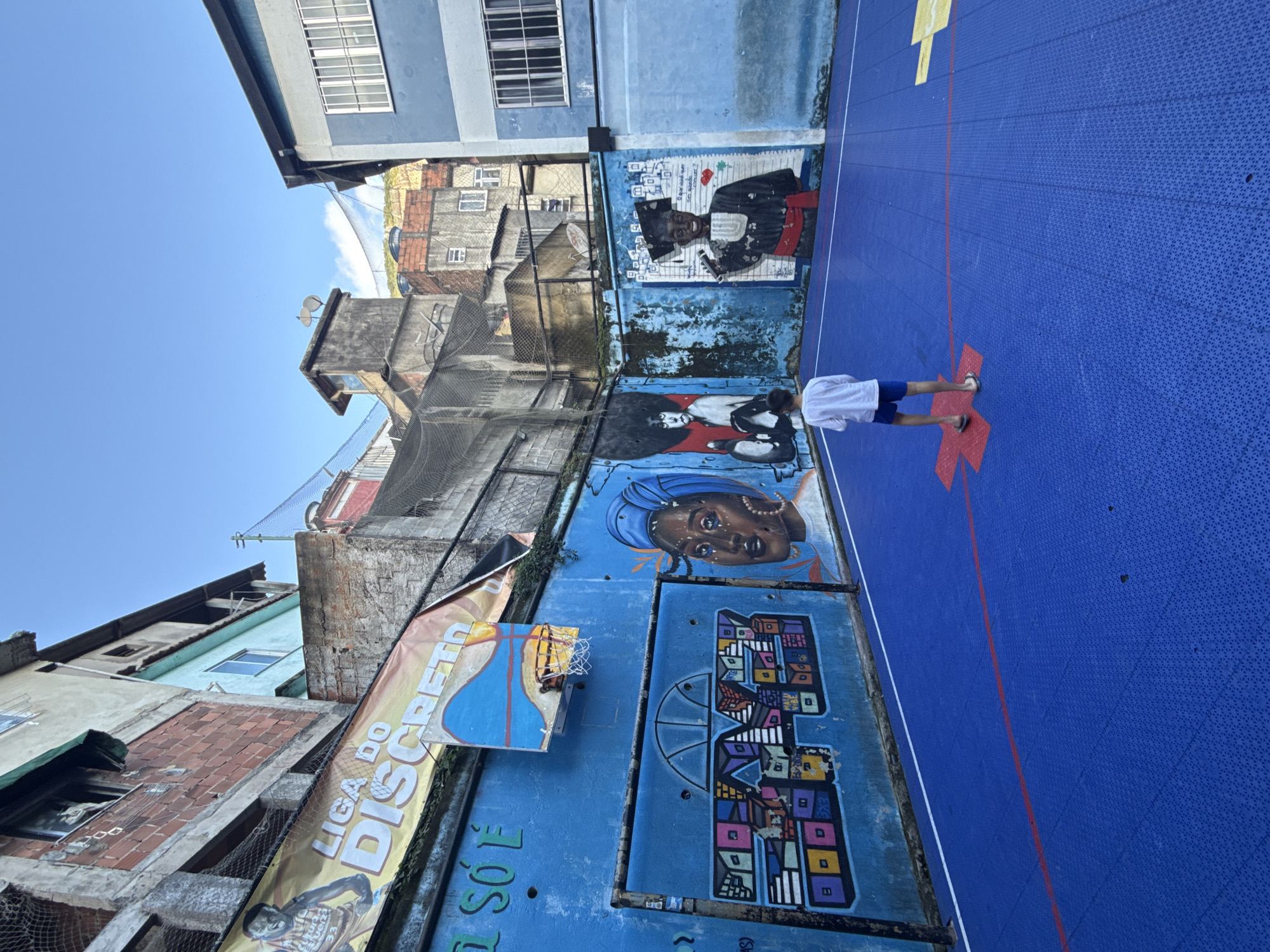
This image depicts an outdoor sports court located within a favela in Rio de Janeiro, Brazil. The court features a bright blue modular tiled surface with red and white demarcation lines, and a red and yellow cross-shaped marking. A single male child, dressed in a white t-shirt, blue shorts, and flip-flops, stands with his back to the viewer in the foreground, facing the court's perimeter wall.

The perimeter walls are painted blue and adorned with extensive murals. On the left wall, a mural displays colorful, geometric representations of stacked houses, adjacent to a large portrait of a woman with dark skin, wearing a blue headwrap and jewelry. Above this section, a basketball hoop with a custom-painted backboard, depicting a landscape, is affixed to the wall. Above the hoop, a yellow banner stretched across the upper wall reads "LIGA DO DISCRETO" and features an illustration of a basketball player. The right wall contains multiple large murals, including a portrait of a person with an afro hairstyle and boxing gloves (partially obscured by the child), and another portrait of a young person in a black graduation cap and gown, holding a microphone, with text inscribed alongside.

Surrounding the court, multi-story residential buildings, constructed from exposed brick and concrete, rise irregularly, characteristic of favela development. These buildings are painted in various tones including grey, blue, and light green, featuring numerous windows, some with metal grates. Black netting is stretched above and between several structures, likely for safety or as a ball barrier. A clear blue sky is visible overhead, with distant hills and additional buildings, including rooftop water tanks, discernable on higher ground.

This image depicts an outdoor sports court located within a favela in Rio de Janeiro, Brazil. The court features a bright blue modular tiled surface with red and white demarcation lines, and a red and yellow cross-shaped marking. A single male child, dressed in a white t-shirt, blue shorts, and flip-flops, stands with his back to the viewer in the foreground, facing the court's perimeter wall. The perimeter walls are painted blue and adorned with extensive murals. On the left wall, a mural displays colorful, geometric representations of stacked houses, adjacent to a large portrait of a woman with dark skin, wearing a blue headwrap and jewelry. Above this section, a basketball hoop with a custom-painted backboard, depicting a landscape, is affixed to the wall. Above the hoop, a yellow banner stretched across the upper wall reads "LIGA DO DISCRETO" and features an illustration of a basketball player. The right wall contains multiple large murals, including a portrait of a person with an afro hairstyle and boxing gloves (partially obscured by the child), and another portrait of a young person in a black graduation cap and gown, holding a microphone, with text inscribed alongside. Surrounding the court, multi-story residential buildings, constructed from exposed brick and concrete, rise irregularly, characteristic of favela development. These buildings are painted in various tones including grey, blue, and light green, featuring numerous windows, some with metal grates. Black netting is stretched above and between several structures, likely for safety or as a ball barrier. A clear blue sky is visible overhead, with distant hills and additional buildings, including rooftop water tanks, discernable on higher ground.

Rio De Janeiro
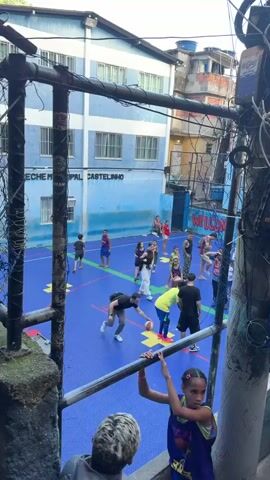
From an elevated viewpoint, an outdoor multi-sport court with a blue modular tiled surface and yellow and green markings is visible, surrounded by buildings. Approximately 15 to 20 individuals, mostly children and young adults, are present on the court. Many are holding or dribbling basketballs, some in athletic attire. An adult male in a yellow shirt and blue shorts is interacting with a younger male in a black shirt in the center of the court. In the background, a light blue building with "CRECHE MUNICIPAL CASTELINHO" written on its facade stands behind the court, and a "WELCOME" sign is visible on a wall at the far end. Other residential structures, some appearing worn, rise beyond the court. In the foreground, a metal fence and a utility pole dense with numerous black wires partially obscure the view. Two young individuals are positioned in the bottom right of the frame, looking up towards the camera.

From an elevated viewpoint, an outdoor multi-sport court with a blue modular tiled surface and yellow and green markings is visible, surrounded by buildings. Approximately 15 to 20 individuals, mostly children and young adults, are present on the court. Many are holding or dribbling basketballs, some in athletic attire. An adult male in a yellow shirt and blue shorts is interacting with a younger male in a black shirt in the center of the court. In the background, a light blue building with "CRECHE MUNICIPAL CASTELINHO" written on its facade stands behind the court, and a "WELCOME" sign is visible on a wall at the far end. Other residential structures, some appearing worn, rise beyond the court. In the foreground, a metal fence and a utility pole dense with numerous black wires partially obscure the view. Two young individuals are positioned in the bottom right of the frame, looking up towards the camera.

Rio De Janeiro
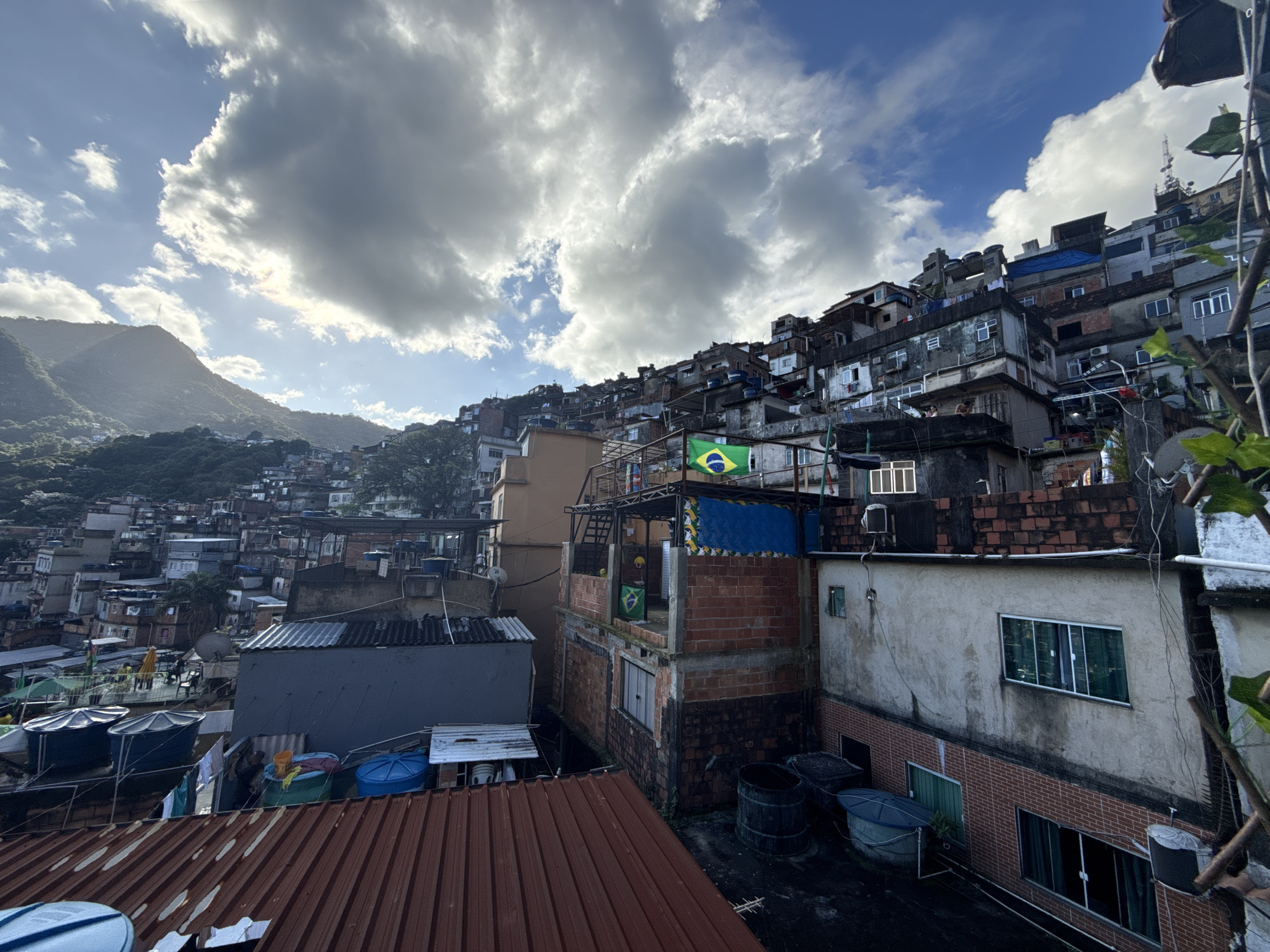
The image displays a panoramic view of a densely populated hillside favela in Rio de Janeiro, Brazil. The sky is partially overcast with large grey and white cumulus clouds, revealing patches of blue sky and bright sunlight shining from the upper left, partially obscured by clouds. In the background to the left, lush green mountains rise, topped by a slender communication tower.

The favela is characterized by numerous multi-story buildings constructed from a mix of raw exposed red brick, light-colored stucco, and weathered concrete. These structures are built closely together, cascading down the steep slope. Many rooftops are flat concrete surfaces, serving as platforms for multiple large, blue, cylindrical water storage tanks and clotheslines with drying laundry. Other roofs are made of corrugated metal, some showing signs of rust.

Two Brazilian flags are visible on a prominent brick building: one larger, horizontally displayed flag featuring green, yellow, and blue, and a smaller one vertically positioned below it. Multiple satellite dishes are affixed to various buildings. On a lower balcony or rooftop, two human figures are discernible. Green vegetation is present in the immediate foreground on the right, framing the scene, and covers the distant mountains.

The image displays a panoramic view of a densely populated hillside favela in Rio de Janeiro, Brazil. The sky is partially overcast with large grey and white cumulus clouds, revealing patches of blue sky and bright sunlight shining from the upper left, partially obscured by clouds. In the background to the left, lush green mountains rise, topped by a slender communication tower. The favela is characterized by numerous multi-story buildings constructed from a mix of raw exposed red brick, light-colored stucco, and weathered concrete. These structures are built closely together, cascading down the steep slope. Many rooftops are flat concrete surfaces, serving as platforms for multiple large, blue, cylindrical water storage tanks and clotheslines with drying laundry. Other roofs are made of corrugated metal, some showing signs of rust. Two Brazilian flags are visible on a prominent brick building: one larger, horizontally displayed flag featuring green, yellow, and blue, and a smaller one vertically positioned below it. Multiple satellite dishes are affixed to various buildings. On a lower balcony or rooftop, two human figures are discernible. Green vegetation is present in the immediate foreground on the right, framing the scene, and covers the distant mountains.

Rio De Janeiro
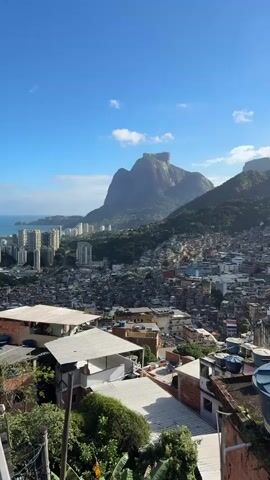
A high-angle, vertical shot captures a bustling city nestled amongst verdant mountains under a bright blue sky with scattered clouds. The foreground reveals a densely packed residential area with numerous rooftops and a blue water tank labeled "FORTLEV" on the right. In the midground, the city stretches out, filled with countless buildings and structures, some appearing as favelas climbing the hillsides. The background is dominated by majestic mountains, with a prominent, flat-topped peak visible on the left and other rugged peaks extending to the right. A glimpse of the ocean can be seen in the far left background, beyond a cluster of modern high-rise buildings. The camera slowly pans to the right, revealing more of the sprawling cityscape and the dramatic mountain landscape.

A high-angle, vertical shot captures a bustling city nestled amongst verdant mountains under a bright blue sky with scattered clouds. The foreground reveals a densely packed residential area with numerous rooftops and a blue water tank labeled "FORTLEV" on the right. In the midground, the city stretches out, filled with countless buildings and structures, some appearing as favelas climbing the hillsides. The background is dominated by majestic mountains, with a prominent, flat-topped peak visible on the left and other rugged peaks extending to the right. A glimpse of the ocean can be seen in the far left background, beyond a cluster of modern high-rise buildings. The camera slowly pans to the right, revealing more of the sprawling cityscape and the dramatic mountain landscape.

Rio De Janeiro
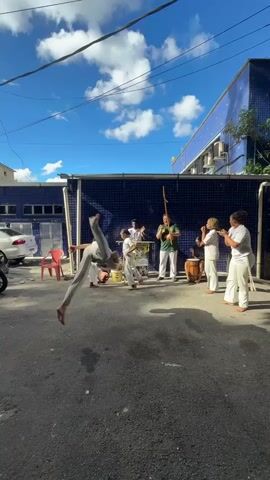
A medium, outdoor, daylight shot shows a capoeira group with nine people on a paved street. The street is partially shaded, and bright sunlight is visible on the street and on the buildings in the background. The street is paved in asphalt. A building to the left, which has a partially visible white car parked in front of it, is blue with white horizontal stripes and a large window. A building to the right, which also has a partially visible white car parked in front of it, is white. A person in the foreground, wearing a white shirt and grey pants, is doing a handstand, with their legs in the air and their head near the ground. Another person, wearing a white shirt and white pants, is standing behind them and looking at the camera. A person in the mid-ground, wearing a green shirt and white pants, is holding a berimbau. Another person, wearing a white shirt and white pants, is standing behind them and playing a drum. Other people are in the background, some wearing white shirts and white pants, and some wearing white shirts and white pants and doing capoeira moves.

A medium, outdoor, daylight shot shows a capoeira group with nine people on a paved street. The street is partially shaded, and bright sunlight is visible on the street and on the buildings in the background. The street is paved in asphalt. A building to the left, which has a partially visible white car parked in front of it, is blue with white horizontal stripes and a large window. A building to the right, which also has a partially visible white car parked in front of it, is white. A person in the foreground, wearing a white shirt and grey pants, is doing a handstand, with their legs in the air and their head near the ground. Another person, wearing a white shirt and white pants, is standing behind them and looking at the camera. A person in the mid-ground, wearing a green shirt and white pants, is holding a berimbau. Another person, wearing a white shirt and white pants, is standing behind them and playing a drum. Other people are in the background, some wearing white shirts and white pants, and some wearing white shirts and white pants and doing capoeira moves.

Rio De Janeiro
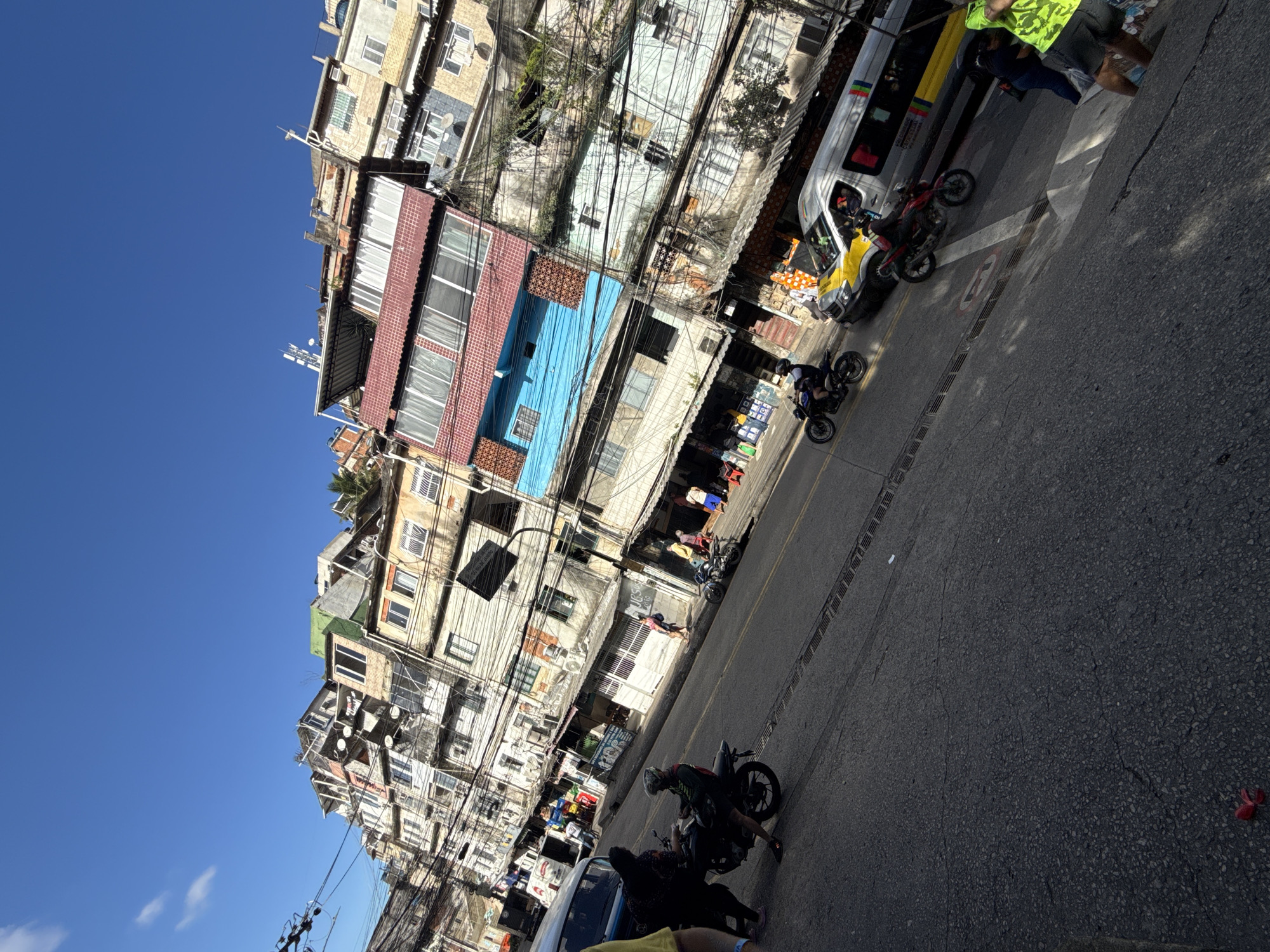
The image depicts a bustling street scene in a densely populated, informal urban settlement characteristic of a *favela* in Rio de Janeiro, Brazil. The photograph is taken from a slightly elevated, oblique angle, looking down a street lined with buildings and under a clear blue sky. The upper portion of the frame is dominated by a bright, cloudless blue sky, with a few faint wispy white clouds visible in the upper left. Below the sky, a dense cluster of multi-story buildings, exhibiting varied construction styles and materials, ascends a hillside. The buildings are painted in a range of colors including white, beige, light blue, reddish-brown, and green. Numerous exposed electrical and communication wires are intricately strung between utility poles and across building facades, forming a dense, chaotic network throughout the midground. Several buildings feature windows, some with protective grates or curtains, and some rooftops display satellite dishes or antennas. The asphalt road, visible in the midground and foreground, is marked by double solid yellow lines. Cracks and wear are evident on the dark grey pavement, and a metal grate or storm drain crosses the road horizontally. A small, crumpled red object lies on the asphalt in the lower-left foreground. Several vehicles and people populate the scene. On the far left, a light-colored car is partially visible. Three motorcycles are in motion or stopped on the road: one dark-colored motorcycle with a rider in a helmet on the left, another dark motorcycle further down the road, and a red motorcycle positioned next to a silver passenger van. This silver van, marked with yellow accents and a multi-colored stripe (red, yellow, green, blue), suggests its use as a public transport vehicle. Multiple individuals are present throughout the frame. In the left foreground, a person in a yellow shirt stands next to the blue car, while another person in dark clothing stands near the dark motorcycle. A rider in a green vest and helmet operates the motorcycle on the left. On the right sidewalk, several pedestrians are visible, including a person in a light pink shirt walking, and another person in a bright yellow-green vest partially visible in the far right foreground. Other people are dispersed along the sidewalks, near storefronts on the right side of the street. These street-level establishments feature open doorways and display various items, with one visible sign bearing the text "JC SUA OBRA". The entire scene is brightly

The image depicts a bustling street scene in a densely populated, informal urban settlement characteristic of a *favela* in Rio de Janeiro, Brazil. The photograph is taken from a slightly elevated, oblique angle, looking down a street lined with buildings and under a clear blue sky. The upper portion of the frame is dominated by a bright, cloudless blue sky, with a few faint wispy white clouds visible in the upper left. Below the sky, a dense cluster of multi-story buildings, exhibiting varied construction styles and materials, ascends a hillside. The buildings are painted in a range of colors including white, beige, light blue, reddish-brown, and green. Numerous exposed electrical and communication wires are intricately strung between utility poles and across building facades, forming a dense, chaotic network throughout the midground. Several buildings feature windows, some with protective grates or curtains, and some rooftops display satellite dishes or antennas. The asphalt road, visible in the midground and foreground, is marked by double solid yellow lines. Cracks and wear are evident on the dark grey pavement, and a metal grate or storm drain crosses the road horizontally. A small, crumpled red object lies on the asphalt in the lower-left foreground. Several vehicles and people populate the scene. On the far left, a light-colored car is partially visible. Three motorcycles are in motion or stopped on the road: one dark-colored motorcycle with a rider in a helmet on the left, another dark motorcycle further down the road, and a red motorcycle positioned next to a silver passenger van. This silver van, marked with yellow accents and a multi-colored stripe (red, yellow, green, blue), suggests its use as a public transport vehicle. Multiple individuals are present throughout the frame. In the left foreground, a person in a yellow shirt stands next to the blue car, while another person in dark clothing stands near the dark motorcycle. A rider in a green vest and helmet operates the motorcycle on the left. On the right sidewalk, several pedestrians are visible, including a person in a light pink shirt walking, and another person in a bright yellow-green vest partially visible in the far right foreground. Other people are dispersed along the sidewalks, near storefronts on the right side of the street. These street-level establishments feature open doorways and display various items, with one visible sign bearing the text "JC SUA OBRA". The entire scene is brightly

Rio De Janeiro
The image displays a beach scene in Rio de Janeiro, Brazil, captured under a partly cloudy sky. In the extreme foreground, a blurred plant with green and yellow variegated leaves and multiple branches partially obscures the left side of the frame. The midground features a sandy beach with a beach volleyball net spanning horizontally across the scene. To the left of the net, a shirtless male wearing black shorts stands, facing right, holding a multi-colored volleyball. Another shirtless male, also in dark shorts, is partially visible on the far right, facing left. Further in the background, several indistinct human figures are distributed across the sand, with two beach umbrellas (one purple, one white) also discernible. The background shows the ocean with visible white waves breaking near the shoreline, beneath a sky characterized by scattered white and grey clouds.

The image displays a beach scene in Rio de Janeiro, Brazil, captured under a partly cloudy sky. In the extreme foreground, a blurred plant with green and yellow variegated leaves and multiple branches partially obscures the left side of the frame. The midground features a sandy beach with a beach volleyball net spanning horizontally across the scene. To the left of the net, a shirtless male wearing black shorts stands, facing right, holding a multi-colored volleyball. Another shirtless male, also in dark shorts, is partially visible on the far right, facing left. Further in the background, several indistinct human figures are distributed across the sand, with two beach umbrellas (one purple, one white) also discernible. The background shows the ocean with visible white waves breaking near the shoreline, beneath a sky characterized by scattered white and grey clouds.

Rio De Janeiro
This image captures a vibrant daytime scene along Copacabana Beach in Rio de Janeiro, Brazil. The perspective is tilted counter-clockwise, offering an upward-looking view from a mosaic sidewalk towards the beach, ocean, and sky.

In the immediate foreground, a patterned sidewalk constructed from dark grey and light grey/white cobblestones forms swirling geometric designs. Two large, cylindrical planters are situated on this sidewalk; the closest is a yellowish-beige, and the one behind it is a pale teal/mint green. Both planters contain small, leafy green plants with some yellow-tinged leaves and exposed mulch. To the left, a partial view of a dark wooden table with a crumpled white paper on its surface is visible.

A prominent white kiosk with a beige awning dominates the midground. The name "BACIO DI LATTE" is displayed on the kiosk's facade in silver/white letters with a pink neon outline, indicating an ice cream or gelato shop. Inside the kiosk, several individuals are present; one person in a white shirt and dark pants stands at the counter, facing inward, while another person in a dark shirt is partially visible further inside. To the left of the kiosk, a group of people, including two individuals in blue uniforms with yellow hard hats, appear to be engaged in an activity or work. A woman in a white long-sleeved top and white pants is seen bending over near this group.

Extending from the kiosk towards the right, a string of decorative Edison-style light bulbs is suspended. A tall metal pole equipped with multiple square light fixtures and a security camera is visible against the sky, positioned near the kiosk's awning.

The background reveals the expansive sandy beach, populated with numerous colorful beach umbrellas and lounge chairs. The calm blue ocean meets the horizon on the right, with a distant mountain range discernible under a partly cloudy sky. Several birds are seen flying high in the sky, which features a mix of bright blue and scattered white clouds. The overall scene depicts a typical busy day at a Brazilian beachfront, centered around the "Bacio di Latte" kiosk.

This image captures a vibrant daytime scene along Copacabana Beach in Rio de Janeiro, Brazil. The perspective is tilted counter-clockwise, offering an upward-looking view from a mosaic sidewalk towards the beach, ocean, and sky. In the immediate foreground, a patterned sidewalk constructed from dark grey and light grey/white cobblestones forms swirling geometric designs. Two large, cylindrical planters are situated on this sidewalk; the closest is a yellowish-beige, and the one behind it is a pale teal/mint green. Both planters contain small, leafy green plants with some yellow-tinged leaves and exposed mulch. To the left, a partial view of a dark wooden table with a crumpled white paper on its surface is visible. A prominent white kiosk with a beige awning dominates the midground. The name "BACIO DI LATTE" is displayed on the kiosk's facade in silver/white letters with a pink neon outline, indicating an ice cream or gelato shop. Inside the kiosk, several individuals are present; one person in a white shirt and dark pants stands at the counter, facing inward, while another person in a dark shirt is partially visible further inside. To the left of the kiosk, a group of people, including two individuals in blue uniforms with yellow hard hats, appear to be engaged in an activity or work. A woman in a white long-sleeved top and white pants is seen bending over near this group. Extending from the kiosk towards the right, a string of decorative Edison-style light bulbs is suspended. A tall metal pole equipped with multiple square light fixtures and a security camera is visible against the sky, positioned near the kiosk's awning. The background reveals the expansive sandy beach, populated with numerous colorful beach umbrellas and lounge chairs. The calm blue ocean meets the horizon on the right, with a distant mountain range discernible under a partly cloudy sky. Several birds are seen flying high in the sky, which features a mix of bright blue and scattered white clouds. The overall scene depicts a typical busy day at a Brazilian beachfront, centered around the "Bacio di Latte" kiosk.

Rio De Janeiro
A person skimboards on a breaking wave at a beach. The individual, wearing dark shorts, is positioned on a skimboard, riding the white foam of a wave that breaks from left to right. In the foreground, shallow water ripples on the sandy shore. The ocean extends into the background, where several small boats are visible on the distant horizon beneath a heavily overcast sky.

A person skimboards on a breaking wave at a beach. The individual, wearing dark shorts, is positioned on a skimboard, riding the white foam of a wave that breaks from left to right. In the foreground, shallow water ripples on the sandy shore. The ocean extends into the background, where several small boats are visible on the distant horizon beneath a heavily overcast sky.

Rio De Janeiro
The video shows a beach with waves gently crashing on the sandy shore. In the background, there's a body of water and a lush, green mountain under a cloudy sky. The horizon appears to be tilted diagonally, suggesting the video might have been filmed with the camera at an angle.

The video shows a beach with waves gently crashing on the sandy shore. In the background, there's a body of water and a lush, green mountain under a cloudy sky. The horizon appears to be tilted diagonally, suggesting the video might have been filmed with the camera at an angle.

Rio De Janeiro