Roatán, Honduras
7 memories from Roatán, Honduras
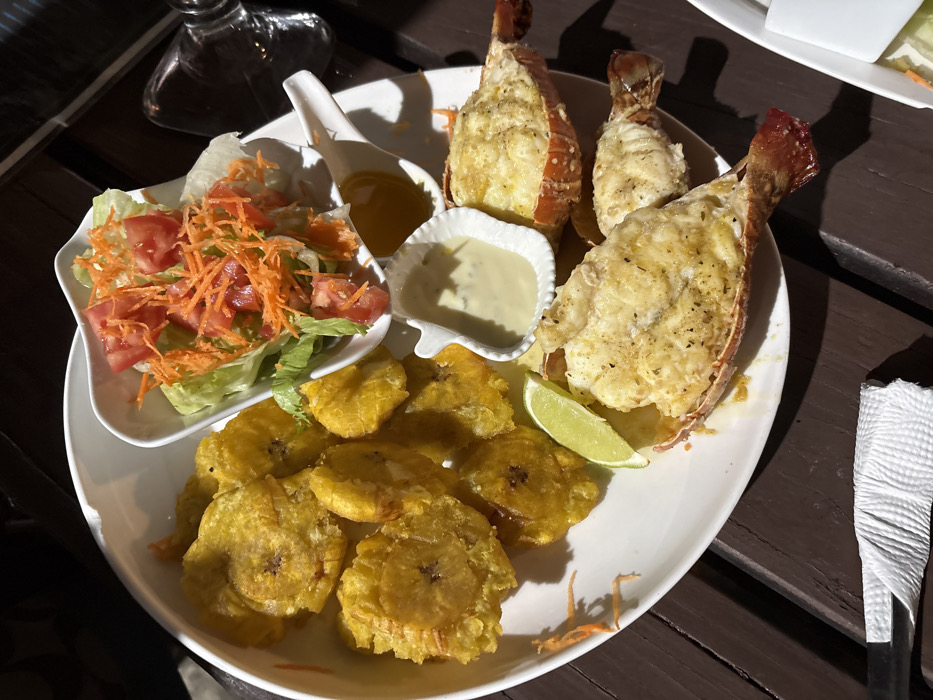
This image depicts a prepared meal presented on a large white oval plate, set on a dark brown wooden slatted table, likely in an outdoor dining environment at night in the city of Roatán, Honduras. The plate holds several components: numerous golden-yellow fried plantains (tostones) occupying the left side; three cooked lobster tails, split lengthwise with white meat and a lightly browned, possibly cheesy, topping, positioned on the right; a bright green lime wedge placed among the food items. Accompanying the main dishes are two small white, shell-shaped condiment bowls: one containing a creamy, pale yellow sauce, and another holding a translucent amber liquid. A separate small white, boat-shaped bowl, also resting on the main plate, contains a mixed green salad composed of lettuce, diced red tomatoes, and shredded orange carrots. In the lower-left foreground, a white paper napkin is wrapped around a dark object, possibly cutlery. A blurred glass object is partially visible in the upper-right background. No people are visible.
Roatán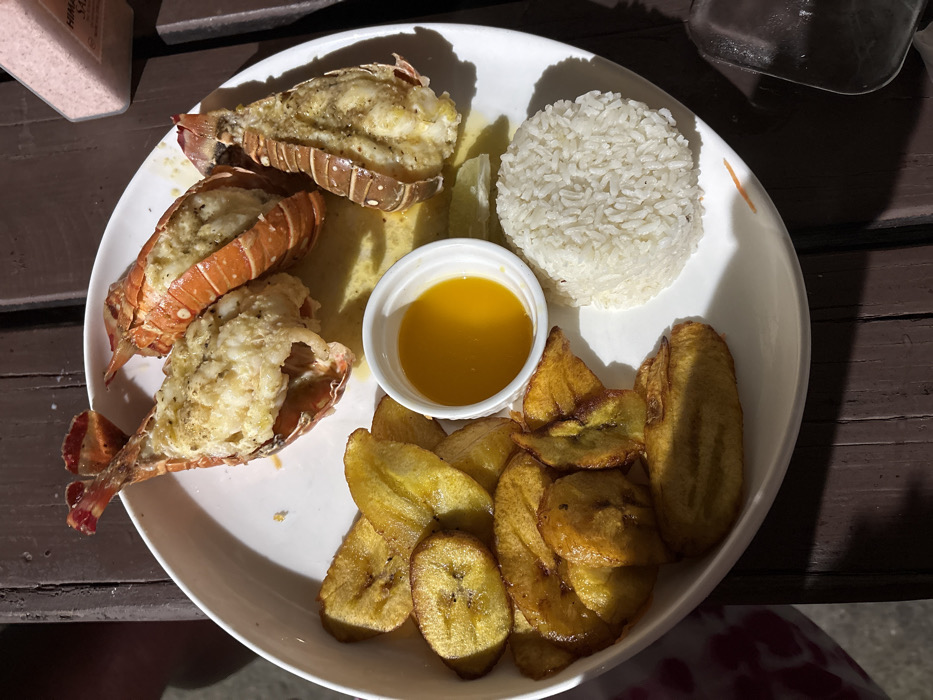
The image displays a white oval dining plate positioned on a dark brown wooden surface. The plate contains a meal consisting of three cooked lobster tails, split lengthwise with exposed white meat, arranged across the upper right portion. A pile of golden-brown fried plantain slices occupies the left side of the plate. In the lower right quadrant, a small mound of white rice is present. Centrally located between the lobster and plantains is a small white ramekin filled with a yellow-orange sauce. A single lime wedge is visible near the lobster and rice. To the upper right of the plate, partially visible, is a clear container labeled "Himalayan Salt" with pink contents. A dark shadow indicating overhead lighting is cast across the table and parts of the plate. The precise location within Roatán, Honduras, is not discernible from the image content, beyond a general dining environment. No people are visible; the image focuses solely on the food and immediate table setting.
Roatán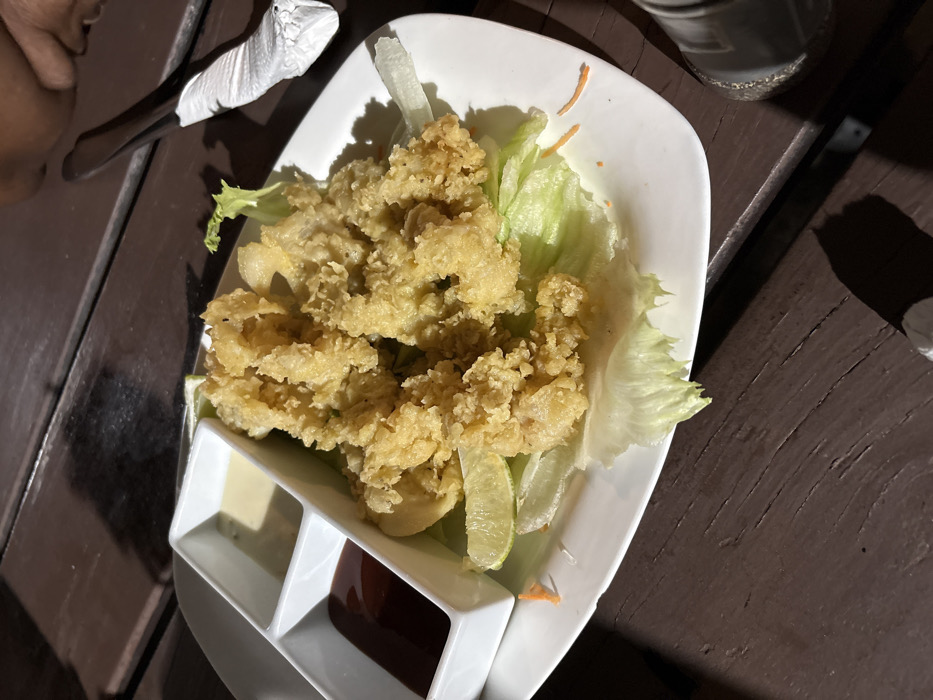
This image captures a close-up, dimly lit scene at a restaurant table in Roatán, Honduras, likely during evening hours. The central subject is a white, oval-shaped plate holding a substantial portion of golden-brown, breaded, and fried calamari rings and tentacles. The fried calamari rests on a bed of light green lettuce leaves, garnished with two fresh lime wedges and a few shredded orange vegetable pieces. To the upper left of the calamari, a white rectangular dish with three compartments contains three distinct sauces: a dark red/brown sauce, a creamy off-white sauce, and a light green sauce. The plate is positioned on a dark brown wooden table, exhibiting visible grain and horizontal plank lines. In the upper right corner, a silver utensil, possibly a fork or knife, is partially visible, wrapped in a crumpled white paper napkin. A dark-skinned arm or hand is faintly visible in the top right. The rim of a dark, textured condiment dispenser is partially visible in the lower right. Strong shadows are cast from the plate and objects, suggesting a direct artificial light source from the upper left.
Roatán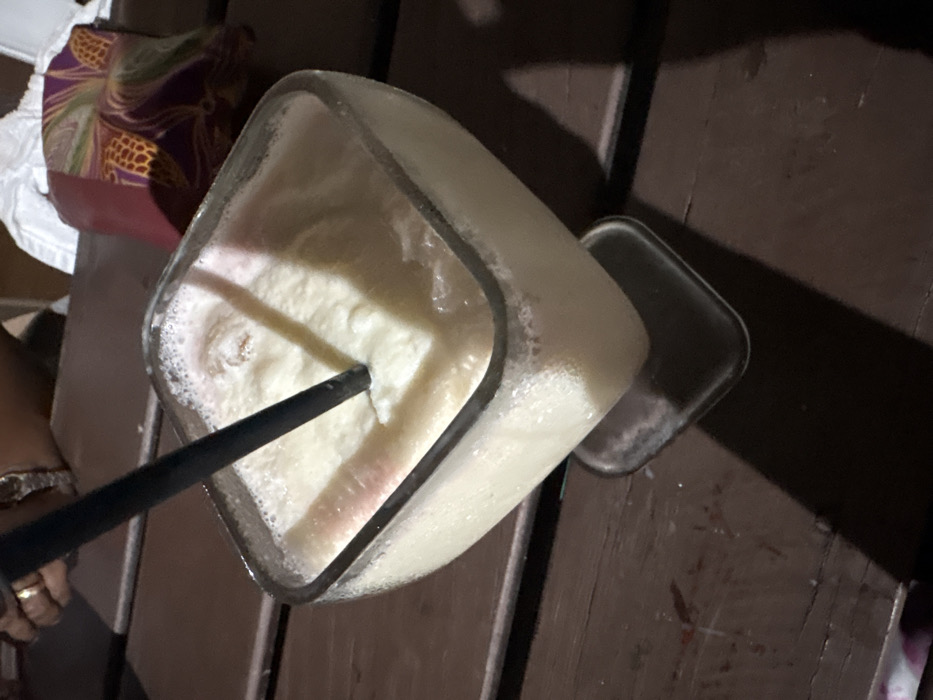
A high-angle photograph depicts a clear, stemmed glass filled with a frothy, opaque, off-white beverage exhibiting subtle pinkish coloration. A black plastic straw is inserted into the drink, angled towards the upper left. Condensation is visible on the exterior of the glass. The glass is positioned on a dark brown, horizontally-slatted wooden table surface. In the upper left background, a human hand is visible, wearing a gold ring on the fourth finger and a metallic wristwatch, resting on the table. In the upper right background, a reddish-purple object patterned with repeating gold pineapple motifs is partially visible, adjacent to a crumpled white fabric. The scene is dimly lit, suggesting an evening or indoor setting. This environment is consistent with a casual dining establishment or bar, a type of venue found in the city of Roatán, Honduras; however, specific geographical identifiers within Roatán are not present in the image.
Roatán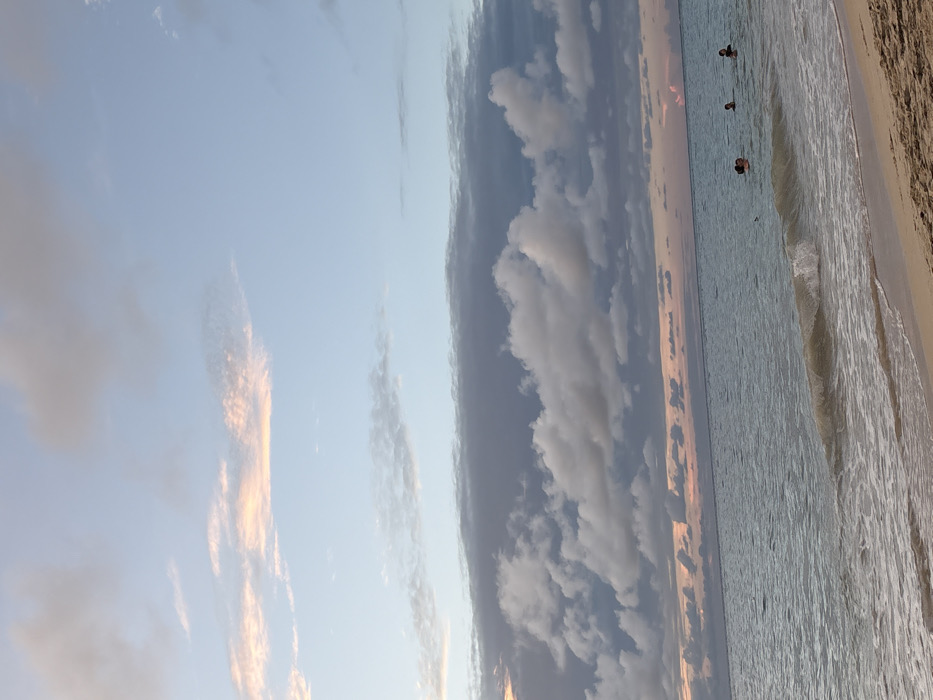
The image displays a beach scene in Roatán, Honduras, under dusk conditions. The sky transitions from a light blue at the zenith to a prominent horizontal band of dense, dark grey clouds mid-frame, with lighter grey cumulus clouds beneath. A subtle orange-pink luminescence is visible along the distant horizon. The ocean is a calm, light blue-grey, with small, white-foamed waves breaking at the shoreline. Three individuals are observed in the water, partially submerged with their heads and upper torsos visible. One individual is situated towards the left-center, while two others are grouped together further to the right. The immediate foreground consists of a strip of light brown sand, appearing wet near the water's edge.
Roatán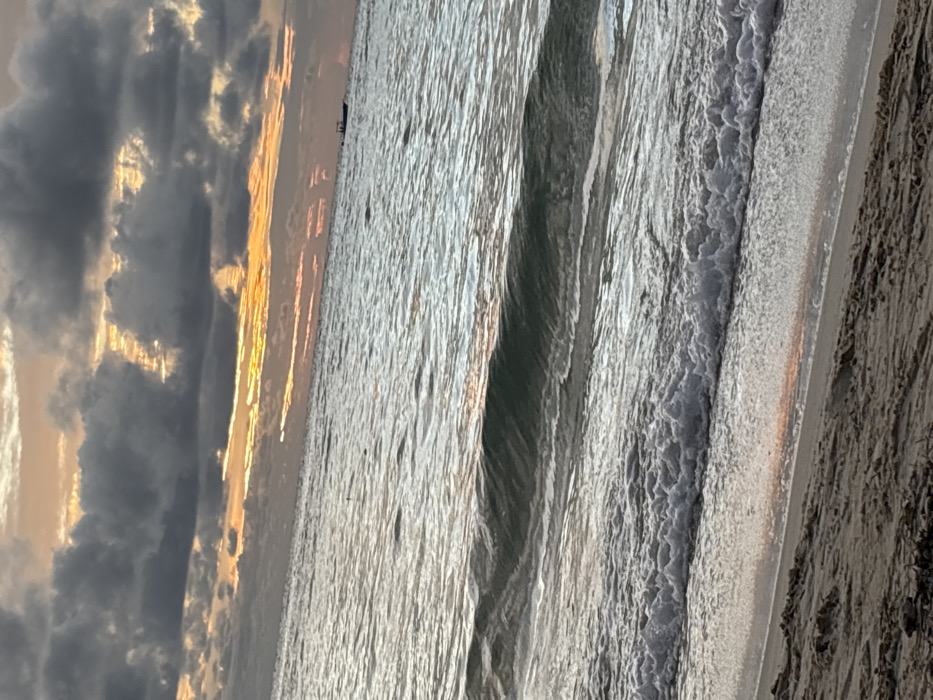
The image depicts a coastal scene during either sunrise or sunset in Roatán, Honduras. The foreground consists of light brown sand at the bottom of the frame, transitioning to the wet intertidal zone where a layer of white foamy surf from a breaking wave recedes. The midground shows the ocean with a series of gentle waves, including a more prominent, dark-crested wave just before it breaks. The water surface reflects the overhead sky. In the distant background, near the horizon and slightly to the right of the frame's center, a single small, dark vessel, consistent with a powerboat or panga, is visible on the water. The sky, occupying the upper two-thirds of the image, is characterized by extensive, dark grey cloud cover. Through breaks in these clouds and along the horizon, streaks of intense orange and yellow light are visible, indicating the presence of a low-angle sun. No individuals, discernible actions, or interactions are visible on the beach or in the immediate water.
Roatán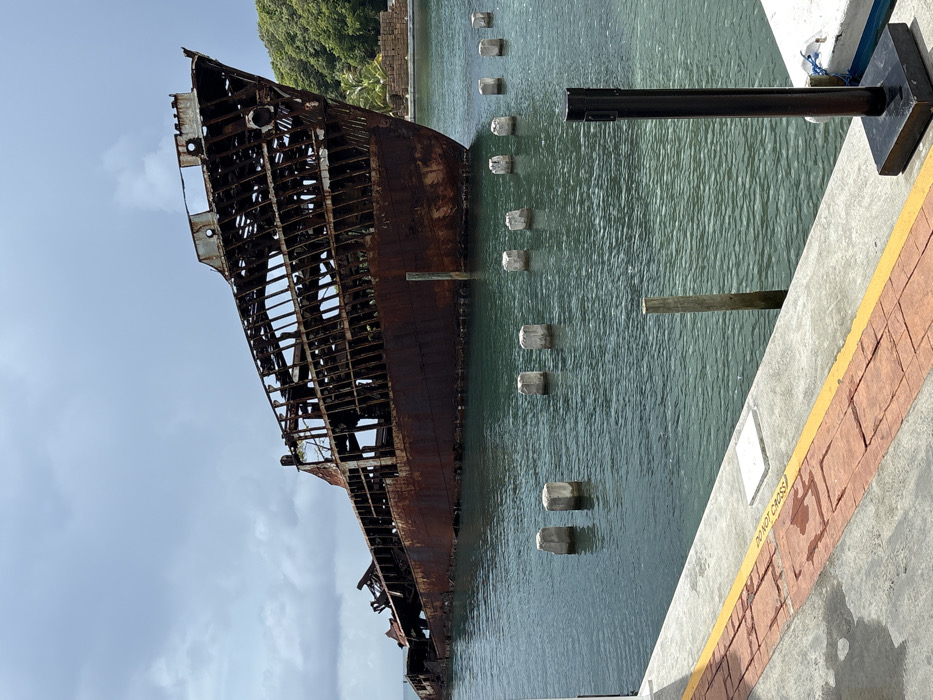
This image captures a forensic view of a large, heavily rusted shipwreck partially submerged in greenish-blue water, observed from a concrete dock in Roatán, Honduras. The wreck, identifiable as the "Odyssey," displays significant structural decay, with its metal hull and superstructure extensively corroded, exposing internal framing and skeletal remnants. The ship lists slightly, positioned diagonally across the frame, with its bow oriented towards the right. In the foreground, a section of a concrete dock is visible, featuring a yellow painted line along its edge and a reddish-brown paver section. White stencil lettering on the concrete explicitly states "DO NOT CROSS." A black, heavy-based stanchion stands on the dock in the lower right, partially obscuring a white boat or structure. Approximately ten uniformly spaced, square concrete pilings protrude from the calm water in the midground, forming a line parallel to the dock. A single wooden piling is also present closer to the dock. The background reveals lush, dense green tropical vegetation covering rolling hills on the opposite shore. A constructed wall or embankment made of large, light-colored blocks is visible at the base of the hills behind the shipwreck's bow. The sky above is partially cloudy, indicating daytime conditions. The scene is static, devoid of people or active interactions.
Roatán