CM:

ATTN

Get the app

Salzburg, Austria

30 memories from Salzburg, Austria

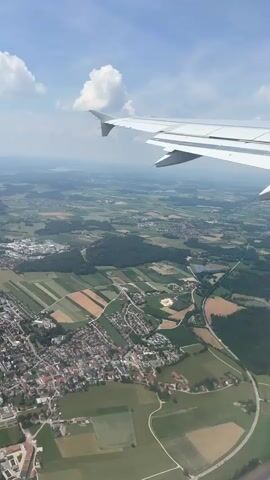
The video shows a view from an airplane window looking down at a landscape. The right side of the frame is dominated by the wing of the airplane, which is white and appears to be a commercial jet. Below the wing, a patchwork of green fields, some with visible crops, is interspersed with wooded areas and a small town or village. The town features red-tiled roofs and a network of roads. A winding road can be seen cutting through the landscape. The sky is blue with scattered white clouds. The overall impression is one of aerial observation of a rural or semi-rural environment.

The video shows a view from an airplane window looking down at a landscape. The right side of the frame is dominated by the wing of the airplane, which is white and appears to be a commercial jet. Below the wing, a patchwork of green fields, some with visible crops, is interspersed with wooded areas and a small town or village. The town features red-tiled roofs and a network of roads. A winding road can be seen cutting through the landscape. The sky is blue with scattered white clouds. The overall impression is one of aerial observation of a rural or semi-rural environment.

Salzburg

The video captures the view from an airplane window, likely during takeoff or landing at Salzburg Airport in Austria. The primary subjects are the airplane's wing, the airport tarmac, a grassy area, and a control tower in the distance. Mountains form a picturesque backdrop under a bright blue sky dotted with fluffy white clouds.

The activity appears to be airport operations, with the plane on the runway, suggesting an imminent departure or arrival. The time of day is clearly daytime, with bright sunlight casting shadows. The weather seems pleasant, with clear skies and sunshine.

Notable details include the prominent white airplane wing extending into the frame, the grey tarmac with yellow markings, and the lush green grass. The control tower, a tall structure with windows, is a distinct feature of the airport environment. The mountains in the background are impressive and add to the scenic beauty of the location. The overall impression is one of a typical airport scene in a visually appealing, mountainous region. No discernible text is visible in the video.

The video captures the view from an airplane window, likely during takeoff or landing at Salzburg Airport in Austria. The primary subjects are the airplane's wing, the airport tarmac, a grassy area, and a control tower in the distance. Mountains form a picturesque backdrop under a bright blue sky dotted with fluffy white clouds. The activity appears to be airport operations, with the plane on the runway, suggesting an imminent departure or arrival. The time of day is clearly daytime, with bright sunlight casting shadows. The weather seems pleasant, with clear skies and sunshine. Notable details include the prominent white airplane wing extending into the frame, the grey tarmac with yellow markings, and the lush green grass. The control tower, a tall structure with windows, is a distinct feature of the airport environment. The mountains in the background are impressive and add to the scenic beauty of the location. The overall impression is one of a typical airport scene in a visually appealing, mountainous region. No discernible text is visible in the video.

Salzburg

The video captures a view from an airplane window during takeoff at Salzburg Airport, Austria. The primary subject is the airplane's wing, which dominates the foreground. Beyond the wing, the runway stretches out, marked with yellow lines and white stripes. A smaller aircraft is visible on a parallel taxiway in the distance. The background features a lush green landscape with trees and scattered buildings, leading up to rolling hills and a prominent mountain peak under a bright, partly cloudy sky. The time of day appears to be late morning or early afternoon, given the clear and sunny weather. The scene evokes a sense of anticipation and the beginning of a journey. There is no visible text in the media file.

The video captures a view from an airplane window during takeoff at Salzburg Airport, Austria. The primary subject is the airplane's wing, which dominates the foreground. Beyond the wing, the runway stretches out, marked with yellow lines and white stripes. A smaller aircraft is visible on a parallel taxiway in the distance. The background features a lush green landscape with trees and scattered buildings, leading up to rolling hills and a prominent mountain peak under a bright, partly cloudy sky. The time of day appears to be late morning or early afternoon, given the clear and sunny weather. The scene evokes a sense of anticipation and the beginning of a journey. There is no visible text in the media file.

Salzburg
The image shows an airplane wing in the foreground, positioned over a tarmac and grassy area. In the background, a range of hazy mountains dominates the horizon, with a dense forest separating them from a few buildings, including an orange-colored house. The sky is partly cloudy with patches of blue visible. This scene is consistent with an airport environment in or near Salzburg, Austria, given the proximity to the Alps. There are no people visible in the frame. The perspective suggests the airplane is either on the ground at the airport or has just taken off.

The image shows an airplane wing in the foreground, positioned over a tarmac and grassy area. In the background, a range of hazy mountains dominates the horizon, with a dense forest separating them from a few buildings, including an orange-colored house. The sky is partly cloudy with patches of blue visible. This scene is consistent with an airport environment in or near Salzburg, Austria, given the proximity to the Alps. There are no people visible in the frame. The perspective suggests the airplane is either on the ground at the airport or has just taken off.

Salzburg
The image shows a hazy aerial view of a mountainous landscape near Salzburg, Austria. A portion of an airplane wing is visible in the foreground, suggesting the photo was taken from an aircraft. The sky is overcast with scattered clouds, creating a soft, diffused light that suggests it is daytime, possibly morning or late afternoon.

In the mid-ground, a dark, imposing mountain range dominates the scene, its slopes covered in dense, dark green foliage. Nestled at the base of the mountains is a small village or town, with scattered buildings, some with red roofs, and patches of green fields. Further down, closer to the foreground, are some larger, modern buildings with white facades and multiple windows, possibly industrial or commercial structures.

Adjacent to the buildings and extending towards the right edge of the image is a striped surface, likely an airport runway. The overall atmosphere is serene and somewhat muted due to the haze and overcast conditions, evoking a sense of peaceful travel. No people are visible, and no text is discernible in the image.

The image shows a hazy aerial view of a mountainous landscape near Salzburg, Austria. A portion of an airplane wing is visible in the foreground, suggesting the photo was taken from an aircraft. The sky is overcast with scattered clouds, creating a soft, diffused light that suggests it is daytime, possibly morning or late afternoon. In the mid-ground, a dark, imposing mountain range dominates the scene, its slopes covered in dense, dark green foliage. Nestled at the base of the mountains is a small village or town, with scattered buildings, some with red roofs, and patches of green fields. Further down, closer to the foreground, are some larger, modern buildings with white facades and multiple windows, possibly industrial or commercial structures. Adjacent to the buildings and extending towards the right edge of the image is a striped surface, likely an airport runway. The overall atmosphere is serene and somewhat muted due to the haze and overcast conditions, evoking a sense of peaceful travel. No people are visible, and no text is discernible in the image.

Salzburg

This media file captures a view of a mountainous landscape with a small town nestled at its base. The scene is set during the daytime, indicated by the bright, overcast sky with scattered clouds. A prominent, large mountain dominates the left side of the frame, with what appears to be a tower or antenna visible at its peak. Below the mountain, a cluster of buildings forming a small town can be seen, with houses, some commercial structures, and trees dotting the landscape. Further to the right, more rolling hills and distant buildings are visible, suggesting a rural or semi-rural setting. In the foreground, a small section of what looks like an airport runway or tarmac is present, with a hint of greenery beyond it. The overall atmosphere is serene and somewhat industrial, given the proximity to what seems like an airport. The weather appears to be partly cloudy, with the sun intermittently breaking through. No people are visible in the frame. The location is identified as Salzburg, Austria, which aligns with the mountainous terrain and architectural style suggested by the buildings.

This media file captures a view of a mountainous landscape with a small town nestled at its base. The scene is set during the daytime, indicated by the bright, overcast sky with scattered clouds. A prominent, large mountain dominates the left side of the frame, with what appears to be a tower or antenna visible at its peak. Below the mountain, a cluster of buildings forming a small town can be seen, with houses, some commercial structures, and trees dotting the landscape. Further to the right, more rolling hills and distant buildings are visible, suggesting a rural or semi-rural setting. In the foreground, a small section of what looks like an airport runway or tarmac is present, with a hint of greenery beyond it. The overall atmosphere is serene and somewhat industrial, given the proximity to what seems like an airport. The weather appears to be partly cloudy, with the sun intermittently breaking through. No people are visible in the frame. The location is identified as Salzburg, Austria, which aligns with the mountainous terrain and architectural style suggested by the buildings.

Salzburg

The video shows an airport tarmac on a sunny day. In the foreground, the edge of a white airplane wing is visible. In the middle ground, a small white propeller plane is taxiing on the tarmac. Behind the propeller plane, there is a tall, cylindrical control tower. Further in the background, there are several airport buildings, yellow service vehicles, and green trees. The sky is partly cloudy. The camera pans slightly to the right throughout the video.

The video shows an airport tarmac on a sunny day. In the foreground, the edge of a white airplane wing is visible. In the middle ground, a small white propeller plane is taxiing on the tarmac. Behind the propeller plane, there is a tall, cylindrical control tower. Further in the background, there are several airport buildings, yellow service vehicles, and green trees. The sky is partly cloudy. The camera pans slightly to the right throughout the video.

Salzburg

This media file captures a view from an airplane window at Salzburg Airport, Austria. The scene depicts an airplane wing in the foreground, with its flaps extended, suggesting the aircraft is either preparing for takeoff or has recently landed. Behind the wing, a modern airport terminal building is visible with large glass windows and a distinctive arched roof structure.

Parked near the terminal are two vehicles. One is a black bus with "Cobus" branding, likely an airport shuttle bus used to transport passengers to and from the terminal. Adjacent to the bus is a yellow vehicle, possibly a ground support vehicle or baggage loader, bearing the label "PAX-18". The tarmac area is paved with concrete, and the sky above is partly cloudy with a bright, daytime light, indicating it's likely daytime.

The overall impression is one of a typical airport scene, conveying a sense of travel and movement. There are no visible people in the frame, and the focus is on the aircraft and airport infrastructure. The visible text "Cobus" and "PAX-18" provide specific identification of the vehicles present. The mood is neutral, presenting a factual snapshot of the airport environment.

This media file captures a view from an airplane window at Salzburg Airport, Austria. The scene depicts an airplane wing in the foreground, with its flaps extended, suggesting the aircraft is either preparing for takeoff or has recently landed. Behind the wing, a modern airport terminal building is visible with large glass windows and a distinctive arched roof structure. Parked near the terminal are two vehicles. One is a black bus with "Cobus" branding, likely an airport shuttle bus used to transport passengers to and from the terminal. Adjacent to the bus is a yellow vehicle, possibly a ground support vehicle or baggage loader, bearing the label "PAX-18". The tarmac area is paved with concrete, and the sky above is partly cloudy with a bright, daytime light, indicating it's likely daytime. The overall impression is one of a typical airport scene, conveying a sense of travel and movement. There are no visible people in the frame, and the focus is on the aircraft and airport infrastructure. The visible text "Cobus" and "PAX-18" provide specific identification of the vehicles present. The mood is neutral, presenting a factual snapshot of the airport environment.

Salzburg
A close-up, head-and-shoulders shot of a taxidermied cat is shown. The cat has light orange fur, with darker orange tabby markings on its forehead and ears. Its eyes are amber-colored, and its nose is pink. The cat is looking slightly down and to its right. The background is a solid, teal color. The image is a photograph taken at the Salzburg Museum in Salzburg, Austria.

A close-up, head-and-shoulders shot of a taxidermied cat is shown. The cat has light orange fur, with darker orange tabby markings on its forehead and ears. Its eyes are amber-colored, and its nose is pink. The cat is looking slightly down and to its right. The background is a solid, teal color. The image is a photograph taken at the Salzburg Museum in Salzburg, Austria.

Salzburg
The image shows a taxidermied display of various dog breeds and a wolf, set against a light blue wall. The dogs are arranged on tiered platforms and the floor.

Starting from the top left, a large St. Bernard with brown and white markings stands prominently. To its right is a wolf, with grey fur. Next to the wolf is a white and black Great Dane. To the right of the Great Dane, a tan and white hound is partially visible.

In the middle row, a white and brown dog with a long coat, identified by text as "G'haariger Hardiner," stands on a lower platform. In front of it is a smaller dog with white and brown markings, possibly a Spaniel, indicated by text that reads "Spring Span." To the right of this dog is a white Samoyed. Further right, a tan and white fox terrier sits. To its right, a dark-colored dog, possibly a Poodle, is positioned. Behind these dogs, a white fluffy dog is visible.

On the bottom level, a black poodle stands on the left. In front of it, a small white and tan dog, labeled "Kleinpudel in Modeschur" (Small Poodle in Fashion Cut), is posed. To the right of the poodle, a white and brown fox terrier is shown. Further to the right, a brown fur pelt is visible on the floor, and a white fluffy tail of another taxidermied animal is seen.

Yellow labels with German text are placed in front of some of the taxidermied animals, identifying their breeds or classifications. The overall environment appears to be a museum exhibit. The context provided by the image crops indicates that this is a display at the Salzburg Museum Carolino Augusteum in Salzburg, Austria, specifically within a section dedicated to the history and breeds of dogs.

The image shows a taxidermied display of various dog breeds and a wolf, set against a light blue wall. The dogs are arranged on tiered platforms and the floor. Starting from the top left, a large St. Bernard with brown and white markings stands prominently. To its right is a wolf, with grey fur. Next to the wolf is a white and black Great Dane. To the right of the Great Dane, a tan and white hound is partially visible. In the middle row, a white and brown dog with a long coat, identified by text as "G'haariger Hardiner," stands on a lower platform. In front of it is a smaller dog with white and brown markings, possibly a Spaniel, indicated by text that reads "Spring Span." To the right of this dog is a white Samoyed. Further right, a tan and white fox terrier sits. To its right, a dark-colored dog, possibly a Poodle, is positioned. Behind these dogs, a white fluffy dog is visible. On the bottom level, a black poodle stands on the left. In front of it, a small white and tan dog, labeled "Kleinpudel in Modeschur" (Small Poodle in Fashion Cut), is posed. To the right of the poodle, a white and brown fox terrier is shown. Further to the right, a brown fur pelt is visible on the floor, and a white fluffy tail of another taxidermied animal is seen. Yellow labels with German text are placed in front of some of the taxidermied animals, identifying their breeds or classifications. The overall environment appears to be a museum exhibit. The context provided by the image crops indicates that this is a display at the Salzburg Museum Carolino Augusteum in Salzburg, Austria, specifically within a section dedicated to the history and breeds of dogs.

Salzburg

A close-up, medium-shot video shows a person's hand with manicured nails, reaching out and touching a display that features a round, metallic object with a painted face. The face has blue eyes, rosy cheeks, and an exaggerated red mouth with its tongue sticking out. Text on a blue surface below the object reads "Touch me!". The object is mounted on a silver stand. In the background, a blurred panel with text in German and English is visible. The video appears to be taken at an exhibition or museum. The person's hand is blurred as it moves, indicating motion. The camera angle is slightly downward, looking at the display.

A close-up, medium-shot video shows a person's hand with manicured nails, reaching out and touching a display that features a round, metallic object with a painted face. The face has blue eyes, rosy cheeks, and an exaggerated red mouth with its tongue sticking out. Text on a blue surface below the object reads "Touch me!". The object is mounted on a silver stand. In the background, a blurred panel with text in German and English is visible. The video appears to be taken at an exhibition or museum. The person's hand is blurred as it moves, indicating motion. The camera angle is slightly downward, looking at the display.

Salzburg

The video shows an interactive exhibit with two stylized face sculptures on a blue counter. The sculpture on the left has a large, red, open mouth with white teeth and large, round, blue eyes. The sculpture on the right has a large, red, bulbous nose and smaller, round, red eyes. Above the sculptures is a large circular image of a man's head with his eyes closed, and text that reads "SCHNARCHEN" and "SNORING". The text "Touch me!" is visible below each sculpture. In the second clip, a hand with pink painted fingernails reaches out and touches the sculpture on the left. The video pans to the right, revealing a third sculpture with a red nose and eyes, and then a fourth sculpture with a smiling mouth and eyes. The text "NIESEN" and "SNEEZING" is visible on the wall behind the sculptures, along with an image of a person sneezing. There are also images of bubbles on the wall. The environment appears to be a museum or science center.

The video shows an interactive exhibit with two stylized face sculptures on a blue counter. The sculpture on the left has a large, red, open mouth with white teeth and large, round, blue eyes. The sculpture on the right has a large, red, bulbous nose and smaller, round, red eyes. Above the sculptures is a large circular image of a man's head with his eyes closed, and text that reads "SCHNARCHEN" and "SNORING". The text "Touch me!" is visible below each sculpture. In the second clip, a hand with pink painted fingernails reaches out and touches the sculpture on the left. The video pans to the right, revealing a third sculpture with a red nose and eyes, and then a fourth sculpture with a smiling mouth and eyes. The text "NIESEN" and "SNEEZING" is visible on the wall behind the sculptures, along with an image of a person sneezing. There are also images of bubbles on the wall. The environment appears to be a museum or science center.

Salzburg
This is a medium-shot, eye-level photograph of an anatomical model of the human brain and eyes, displayed in what appears to be a museum or educational exhibit. The model is centrally located on a circular display table with informational placards.

The brain model is divided into two hemispheres. The left hemisphere is depicted with an orange, glowing interior, suggesting it might represent functional activity or a specific part of the brain. The right hemisphere is transparent, revealing its internal structure. Two large, anatomically detailed eyeballs are attached to the front of the brain model, one on each side, with prominent blue irises and visible blood vessels on the white sclera.

The display table has two informational placards. One is in German, titled "GEHIRN UND SINNESORGANE" (Brain and Sensory Organs), and the other in English, titled "BRAIN AND SENSORY ORGANS." The English placard is partially visible and contains text describing the brain and sensory organs. To the right of the model, there is an illuminated display area showing a patch of green grass with small white flowers and a yellow hand reaching out from the side. A green button is located on the display table near this area.

In the background, there are display cases with anatomical charts and diagrams, including illustrations of the human eye. The environment appears to be indoors, with artificial lighting and a tiled or smooth floor. The overall impression is that of a scientific or medical exhibit.

While no people are actively interacting with the exhibit in the frame, the presence of the hand in the grass display suggests potential interaction with the exhibit. The setting is consistent with a science museum or a similar educational facility.

Based on the German text on the placard, the location is likely an establishment in a German-speaking region. Considering the broader context available from other sources, the photograph was taken at the Haus der Natur (House of Nature) museum in Salzburg, Austria.

This is a medium-shot, eye-level photograph of an anatomical model of the human brain and eyes, displayed in what appears to be a museum or educational exhibit. The model is centrally located on a circular display table with informational placards. The brain model is divided into two hemispheres. The left hemisphere is depicted with an orange, glowing interior, suggesting it might represent functional activity or a specific part of the brain. The right hemisphere is transparent, revealing its internal structure. Two large, anatomically detailed eyeballs are attached to the front of the brain model, one on each side, with prominent blue irises and visible blood vessels on the white sclera. The display table has two informational placards. One is in German, titled "GEHIRN UND SINNESORGANE" (Brain and Sensory Organs), and the other in English, titled "BRAIN AND SENSORY ORGANS." The English placard is partially visible and contains text describing the brain and sensory organs. To the right of the model, there is an illuminated display area showing a patch of green grass with small white flowers and a yellow hand reaching out from the side. A green button is located on the display table near this area. In the background, there are display cases with anatomical charts and diagrams, including illustrations of the human eye. The environment appears to be indoors, with artificial lighting and a tiled or smooth floor. The overall impression is that of a scientific or medical exhibit. While no people are actively interacting with the exhibit in the frame, the presence of the hand in the grass display suggests potential interaction with the exhibit. The setting is consistent with a science museum or a similar educational facility. Based on the German text on the placard, the location is likely an establishment in a German-speaking region. Considering the broader context available from other sources, the photograph was taken at the Haus der Natur (House of Nature) museum in Salzburg, Austria.

Salzburg
This media file depicts a museum exhibit in Salzburg, Austria, showcasing a wax figure of an indigenous person wearing traditional attire. The figure is adorned with a vibrant headdress featuring red, yellow, blue, and black feathers. A striking necklace is made of numerous light brown, pointed objects, likely teeth or shells, strung together. Another decorative element, a band of metallic green leaf-like objects with red feather accents, is worn around the neck. The figure has intricate face paint in a geometric pattern. The setting appears to be a simulated natural environment, with dried palm fronds and a painted backdrop suggesting a jungle or forest. The lighting is even and appears to be artificial, typical of indoor exhibits. The figure is positioned to face the viewer, with a neutral expression. The overall scene is designed to represent a historical or cultural display. No text is visible in the image.

This media file depicts a museum exhibit in Salzburg, Austria, showcasing a wax figure of an indigenous person wearing traditional attire. The figure is adorned with a vibrant headdress featuring red, yellow, blue, and black feathers. A striking necklace is made of numerous light brown, pointed objects, likely teeth or shells, strung together. Another decorative element, a band of metallic green leaf-like objects with red feather accents, is worn around the neck. The figure has intricate face paint in a geometric pattern. The setting appears to be a simulated natural environment, with dried palm fronds and a painted backdrop suggesting a jungle or forest. The lighting is even and appears to be artificial, typical of indoor exhibits. The figure is positioned to face the viewer, with a neutral expression. The overall scene is designed to represent a historical or cultural display. No text is visible in the image.

Salzburg
The image shows a collection of carved wooden figures displayed on glass shelves within a cabinet, likely a display case. The background is a light blue wall. The figures appear to be anthropomorphic animals or mythical creatures, each with unique characteristics.

In the foreground, a wooden figure with a bird-like head and a female torso stands with its hands clasped in front. To its left, a figure with a frog-like head and human-like body is also visible. Further to the left, a figure dressed in a suit with animalistic head and horns is present. Several other figures, partially obscured or in the background, also suggest animalistic or humanoid forms. Some of these figures are dark brown, while others are a lighter wood color.

The lighting suggests an indoor setting, possibly a museum or a private collection. The overall impression is of a display of handcrafted art objects. The specific location in Salzburg, Austria, cannot be determined from the image alone, as there are no identifying landmarks or contextual clues.

The image shows a collection of carved wooden figures displayed on glass shelves within a cabinet, likely a display case. The background is a light blue wall. The figures appear to be anthropomorphic animals or mythical creatures, each with unique characteristics. In the foreground, a wooden figure with a bird-like head and a female torso stands with its hands clasped in front. To its left, a figure with a frog-like head and human-like body is also visible. Further to the left, a figure dressed in a suit with animalistic head and horns is present. Several other figures, partially obscured or in the background, also suggest animalistic or humanoid forms. Some of these figures are dark brown, while others are a lighter wood color. The lighting suggests an indoor setting, possibly a museum or a private collection. The overall impression is of a display of handcrafted art objects. The specific location in Salzburg, Austria, cannot be determined from the image alone, as there are no identifying landmarks or contextual clues.

Salzburg
The image shows a close-up of a Krampus mask, a traditional figure associated with Austrian Christmas customs. The mask is made of dark wood with bright red and black accents. It features large, bulging eyes with red and black surrounds, and pronounced white teeth, including two long, sharp fangs. The mask is adorned with fur and has prominent, curled horns made of real animal horns. One ram's horn is visible to the right of the mask. The background is a plain, dark red surface, suggesting it is likely displayed indoors, possibly in a museum or cultural exhibit. While the image itself does not explicitly show the city of Salzburg, Austria, Krampus traditions are particularly strong in the Alpine regions of Austria, including Salzburg. The mask is a cultural artifact, likely used in folk performances or as a decorative item.

The image shows a close-up of a Krampus mask, a traditional figure associated with Austrian Christmas customs. The mask is made of dark wood with bright red and black accents. It features large, bulging eyes with red and black surrounds, and pronounced white teeth, including two long, sharp fangs. The mask is adorned with fur and has prominent, curled horns made of real animal horns. One ram's horn is visible to the right of the mask. The background is a plain, dark red surface, suggesting it is likely displayed indoors, possibly in a museum or cultural exhibit. While the image itself does not explicitly show the city of Salzburg, Austria, Krampus traditions are particularly strong in the Alpine regions of Austria, including Salzburg. The mask is a cultural artifact, likely used in folk performances or as a decorative item.

Salzburg
A blonde-haired young child in a white t-shirt with a pink pattern is looking at the camera and reaching out a hand towards a taxidermied lion that is walking forward. The lion is positioned in front of a display case that contains a diorama of a desert landscape. The scene appears to be in a museum. The child is on the left side of the frame, facing the lion. The lion is in the center and right of the frame, its head and forequarters visible. The background is a white wall and a glass display case. The lighting is bright and even.

A blonde-haired young child in a white t-shirt with a pink pattern is looking at the camera and reaching out a hand towards a taxidermied lion that is walking forward. The lion is positioned in front of a display case that contains a diorama of a desert landscape. The scene appears to be in a museum. The child is on the left side of the frame, facing the lion. The lion is in the center and right of the frame, its head and forequarters visible. The background is a white wall and a glass display case. The lighting is bright and even.

Salzburg
The image depicts a detailed diorama of an astronaut on the moon, set against a backdrop of a mountainous lunar landscape under a dark, star-speckled sky. The astronaut, clad in a white spacesuit with a reflective visor, stands in the foreground. To the right of the astronaut is a golden, foil-covered structure resembling a lunar module, with a ladder attached. The ground is covered in dark, granular material that mimics lunar regolith, showing tire tracks and footprints. The scene is illuminated by artificial lighting, casting shadows on the ground. The environment appears to be a museum exhibit, likely within the city of Salzburg, Austria, given the context provided.

The image depicts a detailed diorama of an astronaut on the moon, set against a backdrop of a mountainous lunar landscape under a dark, star-speckled sky. The astronaut, clad in a white spacesuit with a reflective visor, stands in the foreground. To the right of the astronaut is a golden, foil-covered structure resembling a lunar module, with a ladder attached. The ground is covered in dark, granular material that mimics lunar regolith, showing tire tracks and footprints. The scene is illuminated by artificial lighting, casting shadows on the ground. The environment appears to be a museum exhibit, likely within the city of Salzburg, Austria, given the context provided.

Salzburg
The image depicts a display of the solar system, likely an educational exhibit. Several illuminated models of planets are arranged on a dark, circular base, suggesting a representation of planetary orbits. In the background, illuminated screens display astronomical imagery and text, with one screen showing a comet streaking across a starry sky, labeled "Boten des Himmels." Another screen, behind a bright red model resembling the sun, shows a diagram of the solar system with planets labeled, and text indicating "Unser Sonnensystem" (Our Solar System) and "Größen & Entfernungen" (Sizes & Distances).

One prominent model is a large, pale yellow sphere, possibly representing Earth or another terrestrial planet. Adjacent to it, a mottled orange sphere likely represents Mars. A large, striped sphere with distinct bands of color is a model of Jupiter, and another ringed sphere, glowing with warm yellow and orange bands, represents Saturn. Smaller, illuminated spheres in orange and yellow tones are also visible, likely representing inner planets or moons. A turquoise sphere, possibly Uranus, is in the foreground. Text projected onto the surface in front of the turquoise sphere reads "Uranus."

The exhibit appears to be located in a dimly lit indoor space, with the exhibit itself being the primary source of light. The overall ambiance is one of scientific or educational presentation. Without further context, the specific location in Salzburg, Austria, cannot be determined from the image alone.

The image depicts a display of the solar system, likely an educational exhibit. Several illuminated models of planets are arranged on a dark, circular base, suggesting a representation of planetary orbits. In the background, illuminated screens display astronomical imagery and text, with one screen showing a comet streaking across a starry sky, labeled "Boten des Himmels." Another screen, behind a bright red model resembling the sun, shows a diagram of the solar system with planets labeled, and text indicating "Unser Sonnensystem" (Our Solar System) and "Größen & Entfernungen" (Sizes & Distances). One prominent model is a large, pale yellow sphere, possibly representing Earth or another terrestrial planet. Adjacent to it, a mottled orange sphere likely represents Mars. A large, striped sphere with distinct bands of color is a model of Jupiter, and another ringed sphere, glowing with warm yellow and orange bands, represents Saturn. Smaller, illuminated spheres in orange and yellow tones are also visible, likely representing inner planets or moons. A turquoise sphere, possibly Uranus, is in the foreground. Text projected onto the surface in front of the turquoise sphere reads "Uranus." The exhibit appears to be located in a dimly lit indoor space, with the exhibit itself being the primary source of light. The overall ambiance is one of scientific or educational presentation. Without further context, the specific location in Salzburg, Austria, cannot be determined from the image alone.

Salzburg
The image captures an indoor exhibit, likely a museum, in Salzburg, Austria, showcasing models of planets from the solar system. In the foreground, a large, illuminated model of a planet, possibly Venus or Mercury due to its cratered, orange-brown surface, dominates the lower right of the frame. To its left, a larger, unlit pale yellow sphere is partially visible. Behind these, several other planet models are displayed. One is a ringed planet, likely Saturn, illuminated with a warm yellow glow. Adjacent to it is a turquoise-colored planet, potentially Uranus or Neptune, and a bright blue planet, possibly Jupiter or Neptune. The exhibit features a dark, reflective surface below the planets, which appears to be water or polished material, creating reflections of the celestial bodies and the surrounding exhibit space. In the background, exhibit displays and information panels are visible, including one with text that appears to read "Weltbild". The lighting is dim, focusing attention on the illuminated planet models, creating a dramatic and educational atmosphere. The overall scene suggests an educational installation designed to inform visitors about astronomy.

The image captures an indoor exhibit, likely a museum, in Salzburg, Austria, showcasing models of planets from the solar system. In the foreground, a large, illuminated model of a planet, possibly Venus or Mercury due to its cratered, orange-brown surface, dominates the lower right of the frame. To its left, a larger, unlit pale yellow sphere is partially visible. Behind these, several other planet models are displayed. One is a ringed planet, likely Saturn, illuminated with a warm yellow glow. Adjacent to it is a turquoise-colored planet, potentially Uranus or Neptune, and a bright blue planet, possibly Jupiter or Neptune. The exhibit features a dark, reflective surface below the planets, which appears to be water or polished material, creating reflections of the celestial bodies and the surrounding exhibit space. In the background, exhibit displays and information panels are visible, including one with text that appears to read "Weltbild". The lighting is dim, focusing attention on the illuminated planet models, creating a dramatic and educational atmosphere. The overall scene suggests an educational installation designed to inform visitors about astronomy.

Salzburg
A hand reaches out to touch a large, illuminated globe depicting the Earth. The globe shows continents with green and brown landmasses and vast blue oceans with swirling white clouds. The hand is positioned in the foreground, partially obscuring the right side of the globe. The scene appears to be indoors, with a dark, out-of-focus background. The lighting suggests it might be evening or a dimly lit room, and the globe itself is a bright, central element. The overall impression is one of exploration and wonder, with the hand suggesting interaction with the representation of our planet. No text is visible.

A hand reaches out to touch a large, illuminated globe depicting the Earth. The globe shows continents with green and brown landmasses and vast blue oceans with swirling white clouds. The hand is positioned in the foreground, partially obscuring the right side of the globe. The scene appears to be indoors, with a dark, out-of-focus background. The lighting suggests it might be evening or a dimly lit room, and the globe itself is a bright, central element. The overall impression is one of exploration and wonder, with the hand suggesting interaction with the representation of our planet. No text is visible.

Salzburg
The image displays a close-up view of a snake, likely a viper due to its triangular head and patterned scales, coiled on sandy ground. The snake's body is textured with a mosaic of dark and light brown scales, some with a yellowish hue. In the background, there are rocks of various sizes, dried branches, and some green vegetation. The environment appears to be an enclosure, possibly a zoo or reptile habitat, with the sand and sparse natural elements simulating a desert or arid landscape. The lighting is somewhat dim, casting subtle shadows. There are no people or other animals visible in the frame. The location is not specified as being in Salzburg, Austria.

The image displays a close-up view of a snake, likely a viper due to its triangular head and patterned scales, coiled on sandy ground. The snake's body is textured with a mosaic of dark and light brown scales, some with a yellowish hue. In the background, there are rocks of various sizes, dried branches, and some green vegetation. The environment appears to be an enclosure, possibly a zoo or reptile habitat, with the sand and sparse natural elements simulating a desert or arid landscape. The lighting is somewhat dim, casting subtle shadows. There are no people or other animals visible in the frame. The location is not specified as being in Salzburg, Austria.

Salzburg
This is a taxidermy diorama depicting falcons perched on a rocky outcrop overlooking a painted backdrop of Salzburg, Austria. In the foreground, a falcon with outstretched wings is positioned on a thin branch. To its right, a second falcon stands on a textured rock surface, facing the viewer. The backdrop features a cityscape with buildings, a river with bridges, and mountains in the distance, including a prominent castle on a hill. The scene is lit with warm, artificial light that highlights the birds and the rock.

This is a taxidermy diorama depicting falcons perched on a rocky outcrop overlooking a painted backdrop of Salzburg, Austria. In the foreground, a falcon with outstretched wings is positioned on a thin branch. To its right, a second falcon stands on a textured rock surface, facing the viewer. The backdrop features a cityscape with buildings, a river with bridges, and mountains in the distance, including a prominent castle on a hill. The scene is lit with warm, artificial light that highlights the birds and the rock.

Salzburg
The image depicts a vibrant and diverse coral reef aquarium. Numerous species of corals, exhibiting a variety of colors and shapes, are densely arranged. These include branching corals, plate-like corals, and bulbous formations. Several small fish are visible swimming amongst the coral structures, including a bright yellow fish and two smaller fish, one blue and one yellow. The substrate of the aquarium appears to be composed of sand and small gravel. The lighting in the tank creates a dynamic interplay of light and shadow, highlighting the textures and colors of the coral and fish. Reflections of the tank's interior are visible on the surface of the water at the top of the image. The overall environment is one of a healthy and thriving aquatic ecosystem.

Without additional context or external information, it is impossible to determine the specific location of this aquarium within the city of Salzburg, Austria.

The image depicts a vibrant and diverse coral reef aquarium. Numerous species of corals, exhibiting a variety of colors and shapes, are densely arranged. These include branching corals, plate-like corals, and bulbous formations. Several small fish are visible swimming amongst the coral structures, including a bright yellow fish and two smaller fish, one blue and one yellow. The substrate of the aquarium appears to be composed of sand and small gravel. The lighting in the tank creates a dynamic interplay of light and shadow, highlighting the textures and colors of the coral and fish. Reflections of the tank's interior are visible on the surface of the water at the top of the image. The overall environment is one of a healthy and thriving aquatic ecosystem. Without additional context or external information, it is impossible to determine the specific location of this aquarium within the city of Salzburg, Austria.

Salzburg
This is a close-up, eye-level shot of a marine aquarium. The primary subject is a black sea urchin with numerous long, thin spines radiating outwards from its central body, which is partially obscured by the spines. The sea urchin is positioned in the upper portion of the image, casting shadows on the coral reef below.

The reef is teeming with various types of coral and anemones. In the foreground and mid-ground, there are several large, branching corals in shades of tan and cream, appearing to sway gently. There are also flatter, plate-like corals in orange and brown hues, and smaller, more delicate, branching anemones in various shades of pink and white. The corals are attached to a rocky substrate, with varying textures and colors, including purples and blues. The water is dark and filled with small particulates, giving it a slightly cloudy appearance.

The scene appears to be an exhibit within a public aquarium or a private collection, and is not located in Salzburg, Austria. There are no people or animals other than the marine life visible in the image.

This is a close-up, eye-level shot of a marine aquarium. The primary subject is a black sea urchin with numerous long, thin spines radiating outwards from its central body, which is partially obscured by the spines. The sea urchin is positioned in the upper portion of the image, casting shadows on the coral reef below. The reef is teeming with various types of coral and anemones. In the foreground and mid-ground, there are several large, branching corals in shades of tan and cream, appearing to sway gently. There are also flatter, plate-like corals in orange and brown hues, and smaller, more delicate, branching anemones in various shades of pink and white. The corals are attached to a rocky substrate, with varying textures and colors, including purples and blues. The water is dark and filled with small particulates, giving it a slightly cloudy appearance. The scene appears to be an exhibit within a public aquarium or a private collection, and is not located in Salzburg, Austria. There are no people or animals other than the marine life visible in the image.

Salzburg
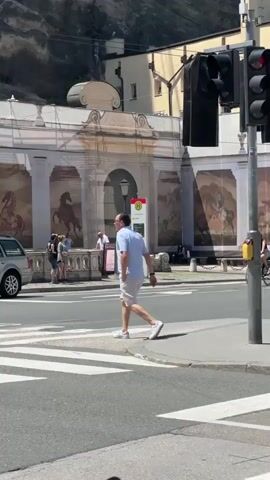
The video captures a street scene with people and vehicles. In the foreground, a person on a motorcycle is partially visible. A silver car is on the left, and a zebra crossing is in the center. A man in a light blue shirt and beige shorts walks across the zebra crossing, looking to his left. Behind him, a woman on a bicycle rides to the right. Further back, a man in a red shirt and white shorts walks across the zebra crossing, wearing a red cap and headphones. Another man in a white shirt and sunglasses is in the middle ground, facing right. In the background, there is a building with murals of horses. Traffic lights are visible. A sign with a red diagonal line through silhouettes of two people is prominent. The scene appears to be a public square or street in a European city on a sunny day.

The video captures a street scene with people and vehicles. In the foreground, a person on a motorcycle is partially visible. A silver car is on the left, and a zebra crossing is in the center. A man in a light blue shirt and beige shorts walks across the zebra crossing, looking to his left. Behind him, a woman on a bicycle rides to the right. Further back, a man in a red shirt and white shorts walks across the zebra crossing, wearing a red cap and headphones. Another man in a white shirt and sunglasses is in the middle ground, facing right. In the background, there is a building with murals of horses. Traffic lights are visible. A sign with a red diagonal line through silhouettes of two people is prominent. The scene appears to be a public square or street in a European city on a sunny day.

Salzburg
The image depicts an arched passageway leading into a building in Salzburg, Austria. The facade of the building is painted a pale pink. Above the archway, a stone plaque displays the inscription "Stortthamer Brauhaus" along with an image of a barrel and brewing tools. The arch itself is constructed of rough-hewn stone. Through the arch, a dimly lit interior arcade is visible, with several figures silhouetted within. To the right of the arch, a shop window displays colorful garments. The ground in front of the arch is paved with cobblestones. The overall scene captures a historical architectural detail in a European city.

The image depicts an arched passageway leading into a building in Salzburg, Austria. The facade of the building is painted a pale pink. Above the archway, a stone plaque displays the inscription "Stortthamer Brauhaus" along with an image of a barrel and brewing tools. The arch itself is constructed of rough-hewn stone. Through the arch, a dimly lit interior arcade is visible, with several figures silhouetted within. To the right of the arch, a shop window displays colorful garments. The ground in front of the arch is paved with cobblestones. The overall scene captures a historical architectural detail in a European city.

Salzburg

The video shows a close-up of a person's hand interacting with a display. The display appears to be a mural or artwork with cutouts of people. In the foreground, a hand is shown placing a small white object, possibly a button or a marker, onto a step in the artwork. The artwork depicts a scene with a set of stairs, a railing, and stylized trees and foliage in shades of purple and yellow. There are cutouts of two individuals on the stairs, one seen from behind wearing a backpack and holding a book, and another person facing forward with headphones. In the upper left corner of the artwork, a pair of binoculars is visible. As the video progresses, the hand lifts a small, hinged wooden frame revealing a plaque underneath. The plaque contains text in both English and German, along with an image. The English text reads "LIFE PERSPECTIVES" and describes how children from wealthy families gain diverse life perspectives, while children in poverty face limited opportunities and educational resources, making it difficult to imagine a successful future. The German text is a translation of this description. The image on the plaque shows hands holding binoculars, with different scenes visible through the lenses – one depicting a sunny landscape and the other a more somber, possibly apocalyptic scene. The video concludes with the hand closing the wooden frame, obscuring the plaque, and returning the view to the artwork with the cutouts. The overall impression is of an interactive exhibit or educational display that contrasts differing life opportunities.

The video shows a close-up of a person's hand interacting with a display. The display appears to be a mural or artwork with cutouts of people. In the foreground, a hand is shown placing a small white object, possibly a button or a marker, onto a step in the artwork. The artwork depicts a scene with a set of stairs, a railing, and stylized trees and foliage in shades of purple and yellow. There are cutouts of two individuals on the stairs, one seen from behind wearing a backpack and holding a book, and another person facing forward with headphones. In the upper left corner of the artwork, a pair of binoculars is visible. As the video progresses, the hand lifts a small, hinged wooden frame revealing a plaque underneath. The plaque contains text in both English and German, along with an image. The English text reads "LIFE PERSPECTIVES" and describes how children from wealthy families gain diverse life perspectives, while children in poverty face limited opportunities and educational resources, making it difficult to imagine a successful future. The German text is a translation of this description. The image on the plaque shows hands holding binoculars, with different scenes visible through the lenses – one depicting a sunny landscape and the other a more somber, possibly apocalyptic scene. The video concludes with the hand closing the wooden frame, obscuring the plaque, and returning the view to the artwork with the cutouts. The overall impression is of an interactive exhibit or educational display that contrasts differing life opportunities.

Salzburg
The image depicts several traditional marionettes suspended by strings against a backdrop of dark blue and green foliage. The marionettes appear to be part of a performance or exhibit. In the foreground, two marionettes are prominently displayed. The one on the left has a pale face with distinct facial features, dark hair tied in a bun, and is wearing a pink silk garment with blue cuffs and lighter colored pants. The marionette to its right also has a pale face and dark hair in a bun, dressed in a patterned pink and gold silk jacket over striped pants. Behind these two, another marionette, dressed in a reddish-orange garment, is partially visible, along with a fourth figure in the background, wearing a muted brown and gold outfit. The overall setting suggests an indoor display, possibly a museum or theater, with theatrical lighting. The marionettes are crafted with articulated wooden limbs and detailed facial expressions, evoking a sense of historical or cultural significance.

The image depicts several traditional marionettes suspended by strings against a backdrop of dark blue and green foliage. The marionettes appear to be part of a performance or exhibit. In the foreground, two marionettes are prominently displayed. The one on the left has a pale face with distinct facial features, dark hair tied in a bun, and is wearing a pink silk garment with blue cuffs and lighter colored pants. The marionette to its right also has a pale face and dark hair in a bun, dressed in a patterned pink and gold silk jacket over striped pants. Behind these two, another marionette, dressed in a reddish-orange garment, is partially visible, along with a fourth figure in the background, wearing a muted brown and gold outfit. The overall setting suggests an indoor display, possibly a museum or theater, with theatrical lighting. The marionettes are crafted with articulated wooden limbs and detailed facial expressions, evoking a sense of historical or cultural significance.

Salzburg
This image shows a display of marionettes dressed in historical costumes, set against a backdrop depicting a cityscape with buildings and a church tower, suggestive of Salzburg, Austria. The puppets are arranged in a scene that includes a red carriage with ornate gold detailing and a wooden cart with a large wheel. Three primary marionette figures are visible: one on the left, wearing a dark blue coat and a white wig; a second in the center, in a white ruffled shirt, brown vest, and a black hat; and a third on the right, a female figure with a large, curly blonde wig, wearing a light blue, floor-length gown adorned with floral patterns. The female puppet is holding a white ruffled accessory in her hand. The figures are suspended by strings, indicating they are part of a puppet show or exhibition. The lighting casts shadows on the textured ground, enhancing the theatrical presentation.

This image shows a display of marionettes dressed in historical costumes, set against a backdrop depicting a cityscape with buildings and a church tower, suggestive of Salzburg, Austria. The puppets are arranged in a scene that includes a red carriage with ornate gold detailing and a wooden cart with a large wheel. Three primary marionette figures are visible: one on the left, wearing a dark blue coat and a white wig; a second in the center, in a white ruffled shirt, brown vest, and a black hat; and a third on the right, a female figure with a large, curly blonde wig, wearing a light blue, floor-length gown adorned with floral patterns. The female puppet is holding a white ruffled accessory in her hand. The figures are suspended by strings, indicating they are part of a puppet show or exhibition. The lighting casts shadows on the textured ground, enhancing the theatrical presentation.

Salzburg