CM:

ATTN

Get the app

San Cristóbal De La Laguna, Spain

30 memories from San Cristóbal De La Laguna, Spain
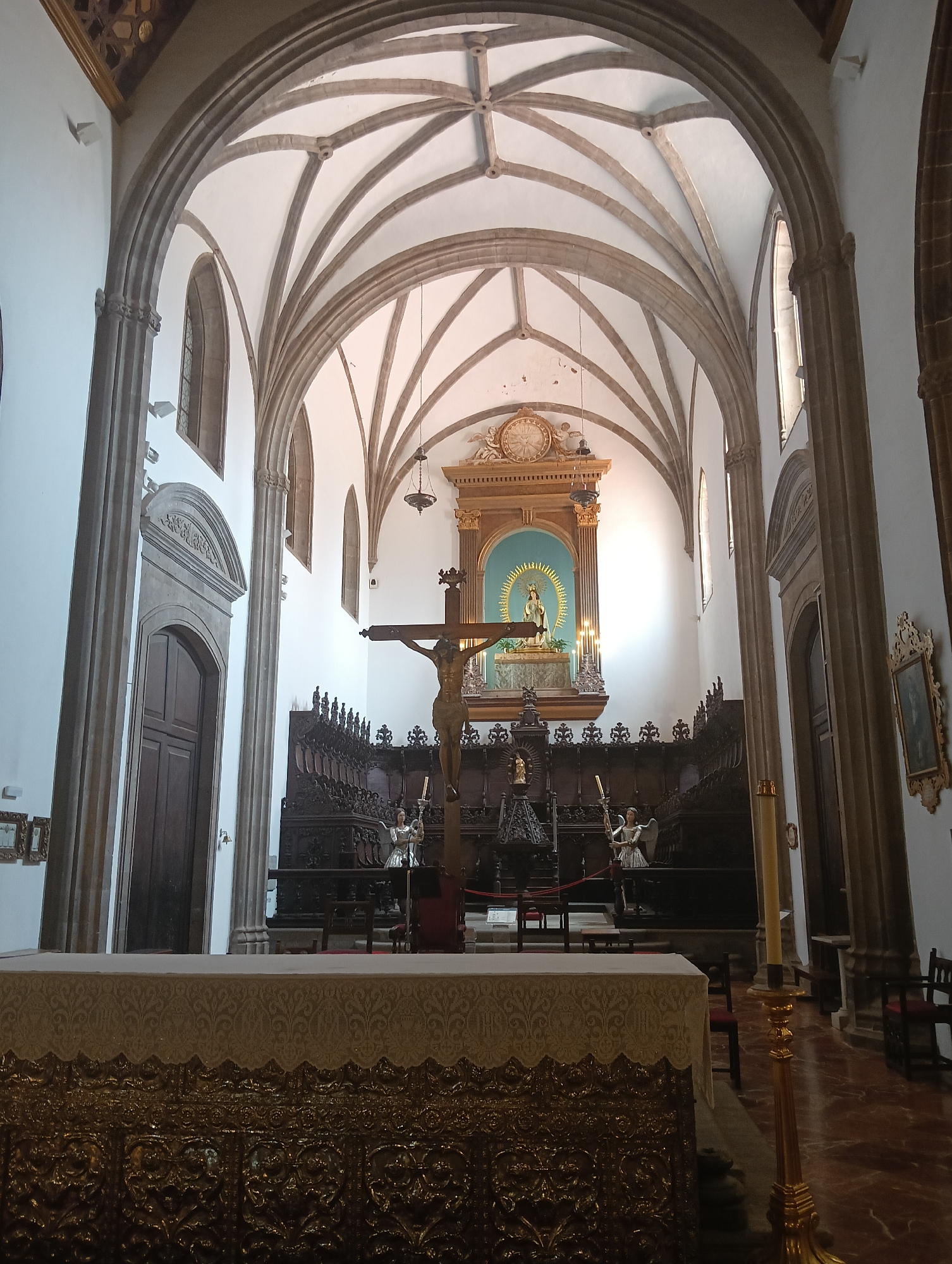
This image depicts a charming inner courtyard in San Cristóbal De La Laguna, Spain. The scene is characterized by traditional architecture with white stucco walls and dark wooden window frames, featuring numerous multi-paned windows. Lush, large-leafed plants, likely banana plants, dominate the foreground and midground, their vibrant green leaves creating a tropical feel against the old-world structures.

In the center of the courtyard, a weathered stone fountain with a yellow basin is a prominent feature. Surrounding the fountain are potted plants with red flowers and various greenery, adding color and life to the space. Several outdoor seating areas with wicker furniture and glass-topped tables are visible, suggesting a relaxed atmosphere, perhaps a cafe or a hotel courtyard.

A second-story balcony with wooden railings and a statue of a person holding flowers is visible on the left side of the building. The lighting suggests it is daytime, with soft, diffused light, possibly indicating an overcast sky or shaded conditions within the courtyard. The overall impression is one of tranquility and historical charm, with a touch of exotic flora.

One visible sign, with red and white lettering, is located near a doorway, but the text is not clearly legible. The scene conveys a sense of calm and provides a glimpse into the architectural style and natural beauty of the location.

This image depicts a charming inner courtyard in San Cristóbal De La Laguna, Spain. The scene is characterized by traditional architecture with white stucco walls and dark wooden window frames, featuring numerous multi-paned windows. Lush, large-leafed plants, likely banana plants, dominate the foreground and midground, their vibrant green leaves creating a tropical feel against the old-world structures. In the center of the courtyard, a weathered stone fountain with a yellow basin is a prominent feature. Surrounding the fountain are potted plants with red flowers and various greenery, adding color and life to the space. Several outdoor seating areas with wicker furniture and glass-topped tables are visible, suggesting a relaxed atmosphere, perhaps a cafe or a hotel courtyard. A second-story balcony with wooden railings and a statue of a person holding flowers is visible on the left side of the building. The lighting suggests it is daytime, with soft, diffused light, possibly indicating an overcast sky or shaded conditions within the courtyard. The overall impression is one of tranquility and historical charm, with a touch of exotic flora. One visible sign, with red and white lettering, is located near a doorway, but the text is not clearly legible. The scene conveys a sense of calm and provides a glimpse into the architectural style and natural beauty of the location.

San Cristóbal De La Laguna
The image is a close-up, low-angle selfie of a woman with blonde hair, wearing a black beret and a black tank top. She is outdoors, with buildings in the background. One building is yellow with a white-framed window, and another is blue with a large, weathered wooden door featuring a small, barred window and a ventilation grille. The woman has dark lipstick and long eyelashes. Her blonde hair is blowing in the wind. The scene suggests a sunny day in San Cristóbal de La Laguna, Spain, given the architectural style and the possibility of vibrant building colors common in the Canary Islands.

The image is a close-up, low-angle selfie of a woman with blonde hair, wearing a black beret and a black tank top. She is outdoors, with buildings in the background. One building is yellow with a white-framed window, and another is blue with a large, weathered wooden door featuring a small, barred window and a ventilation grille. The woman has dark lipstick and long eyelashes. Her blonde hair is blowing in the wind. The scene suggests a sunny day in San Cristóbal de La Laguna, Spain, given the architectural style and the possibility of vibrant building colors common in the Canary Islands.

San Cristóbal De La Laguna
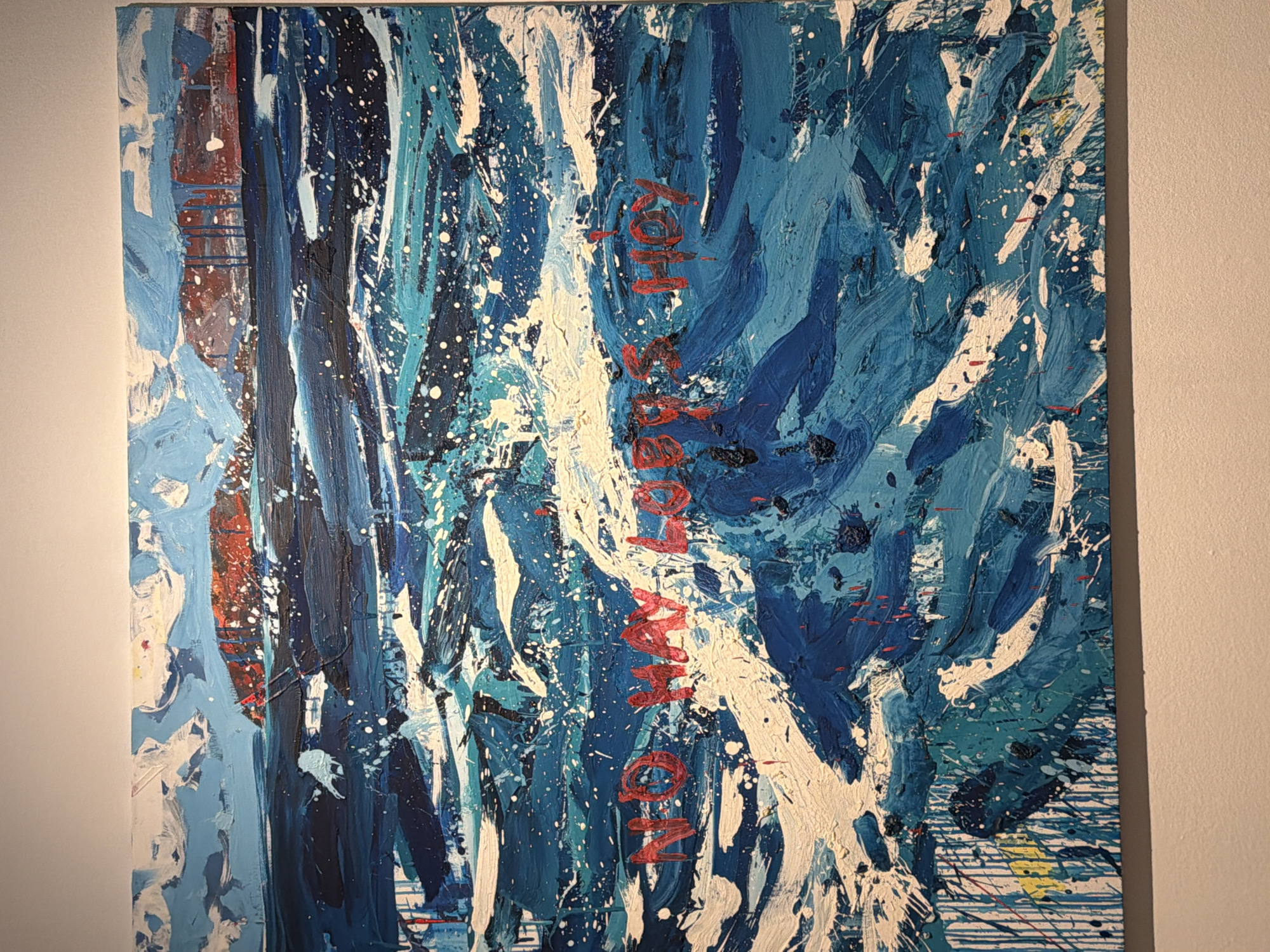
This is a medium shot of an abstract painting displayed on a plain wall. The painting is predominantly in shades of blue, white, and black, with some streaks of red and a small area of yellow. It features thick, impasto brushstrokes creating a textured, dynamic surface. Splatters and drips of paint are evident throughout, adding to the energetic feel. Vertical elements, formed by brushstrokes, dominate the composition, interspersed with broader swaths of color.

On the right side of the painting, in red lettering, the word "NOTION" is written vertically. The letters are stylized and appear to be painted with the same textured technique as the rest of the artwork.

The painting is illuminated by light from the right, casting a subtle shadow on the left edge of the canvas and highlighting the texture of the paint. The background is a plain, light-colored wall, suggesting it is displayed indoors, possibly in a gallery or home setting in San Cristóbal De La Laguna, Spain. No people or specific objects are depicted beyond the painting itself. The overall impression is one of intense movement and raw expression, perhaps evoking elements of nature like water or wind.

This is a medium shot of an abstract painting displayed on a plain wall. The painting is predominantly in shades of blue, white, and black, with some streaks of red and a small area of yellow. It features thick, impasto brushstrokes creating a textured, dynamic surface. Splatters and drips of paint are evident throughout, adding to the energetic feel. Vertical elements, formed by brushstrokes, dominate the composition, interspersed with broader swaths of color. On the right side of the painting, in red lettering, the word "NOTION" is written vertically. The letters are stylized and appear to be painted with the same textured technique as the rest of the artwork. The painting is illuminated by light from the right, casting a subtle shadow on the left edge of the canvas and highlighting the texture of the paint. The background is a plain, light-colored wall, suggesting it is displayed indoors, possibly in a gallery or home setting in San Cristóbal De La Laguna, Spain. No people or specific objects are depicted beyond the painting itself. The overall impression is one of intense movement and raw expression, perhaps evoking elements of nature like water or wind.

San Cristóbal De La Laguna
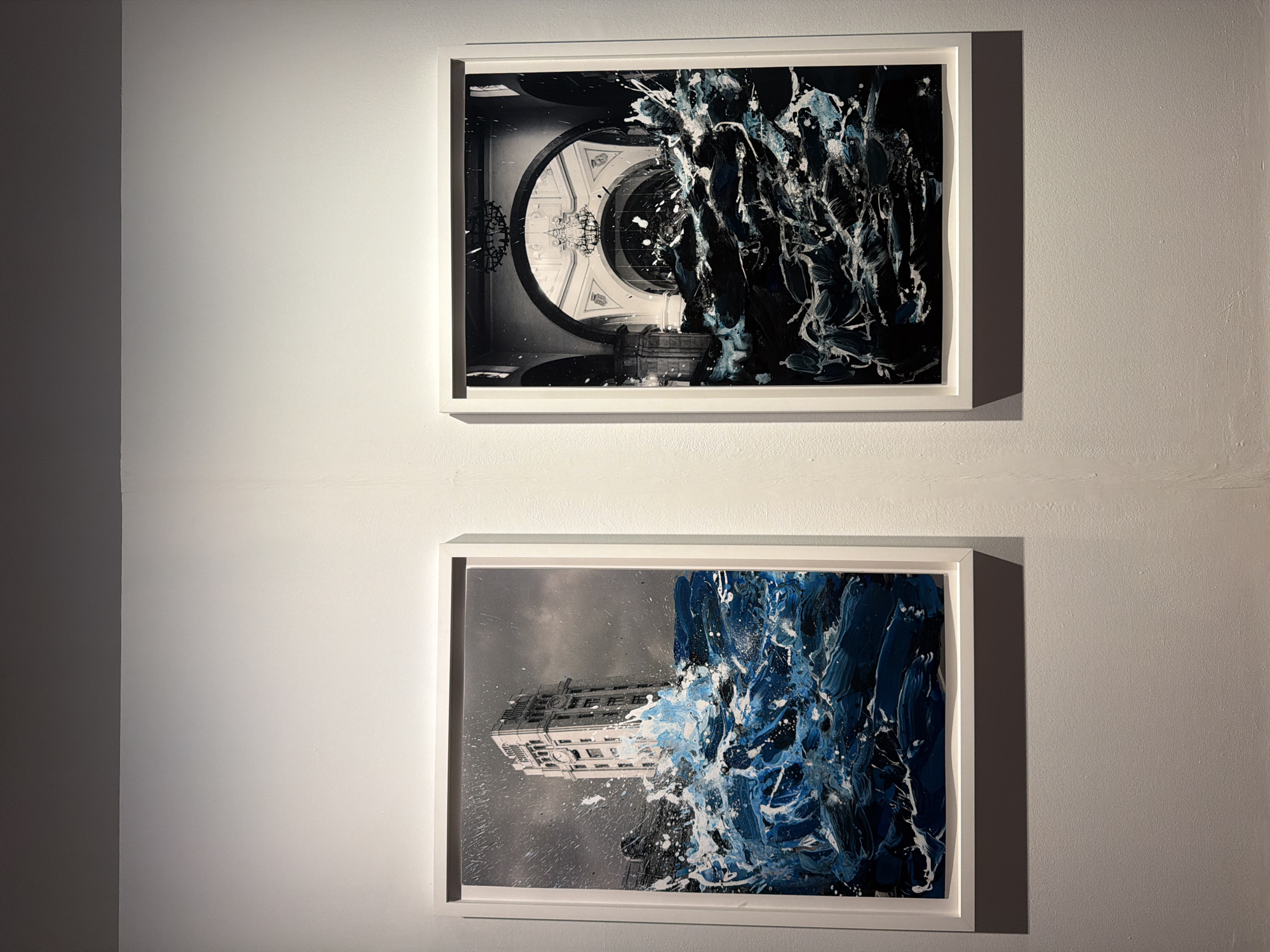
Two framed artworks are displayed on a textured, off-white wall. The artwork on top features a black and white image of an ornate circular architectural interior, possibly a rotunda with a chandelier, partially obscured by dark, abstract paint splatters and streaks of white and light blue. The painting appears to be abstract expressionist in style, with thick, impasto brushstrokes.

The artwork below is also a framed photograph with added paint. It depicts a building, likely in an urban setting, with numerous windows and architectural details, appearing to be submerged or impacted by a dramatic, turbulent wave rendered in deep blues, white, and black paint. The wave is thick with texture, suggesting movement and force. The background sky is overcast and gray, with some scattered white specks that could be rain or spray.

The overall presentation suggests an art exhibition. The lighting creates soft shadows on the wall, indicating the artworks are illuminated. There is no visible text within the artworks or on their frames. The style of the artworks suggests a contemporary art context.

Two framed artworks are displayed on a textured, off-white wall. The artwork on top features a black and white image of an ornate circular architectural interior, possibly a rotunda with a chandelier, partially obscured by dark, abstract paint splatters and streaks of white and light blue. The painting appears to be abstract expressionist in style, with thick, impasto brushstrokes. The artwork below is also a framed photograph with added paint. It depicts a building, likely in an urban setting, with numerous windows and architectural details, appearing to be submerged or impacted by a dramatic, turbulent wave rendered in deep blues, white, and black paint. The wave is thick with texture, suggesting movement and force. The background sky is overcast and gray, with some scattered white specks that could be rain or spray. The overall presentation suggests an art exhibition. The lighting creates soft shadows on the wall, indicating the artworks are illuminated. There is no visible text within the artworks or on their frames. The style of the artworks suggests a contemporary art context.

San Cristóbal De La Laguna
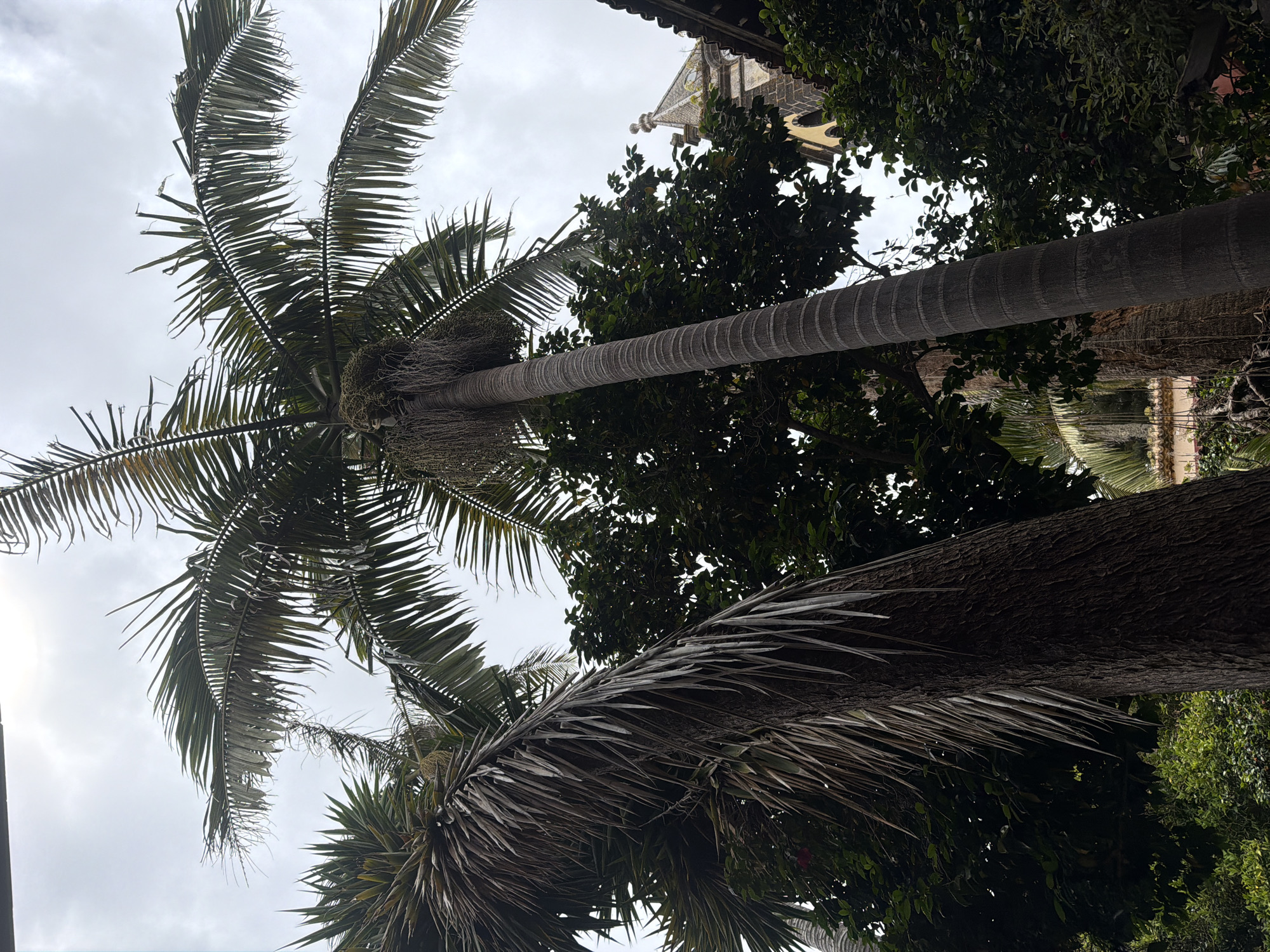
This is a vertically oriented photograph taken from a low angle looking up at palm trees and surrounding foliage against an overcast sky. The foreground features the trunks and fronds of two large palm trees. The fronds are a dark green and appear somewhat dry and weathered, with many individual leaflets drooping. The trunks are textured with horizontal rings. In the background, dense green foliage from other trees is visible, and peeking through the greenery is a portion of a building with a tiled roof and an ornate, pointed architectural feature that resembles a spire or turret. The sky is uniformly grey and cloudy, suggesting it is daytime, possibly late afternoon, with no direct sunlight. The overall impression is one of lush, tropical vegetation within an urban or semi-urban environment, given the presence of the building. The scene is peaceful and natural, with no people or specific activities depicted. There is no visible text in the image. The location context of San Cristóbal De La Laguna, Spain, points to a place with a subtropical climate where such vegetation would be common.

This is a vertically oriented photograph taken from a low angle looking up at palm trees and surrounding foliage against an overcast sky. The foreground features the trunks and fronds of two large palm trees. The fronds are a dark green and appear somewhat dry and weathered, with many individual leaflets drooping. The trunks are textured with horizontal rings. In the background, dense green foliage from other trees is visible, and peeking through the greenery is a portion of a building with a tiled roof and an ornate, pointed architectural feature that resembles a spire or turret. The sky is uniformly grey and cloudy, suggesting it is daytime, possibly late afternoon, with no direct sunlight. The overall impression is one of lush, tropical vegetation within an urban or semi-urban environment, given the presence of the building. The scene is peaceful and natural, with no people or specific activities depicted. There is no visible text in the image. The location context of San Cristóbal De La Laguna, Spain, points to a place with a subtropical climate where such vegetation would be common.

San Cristóbal De La Laguna
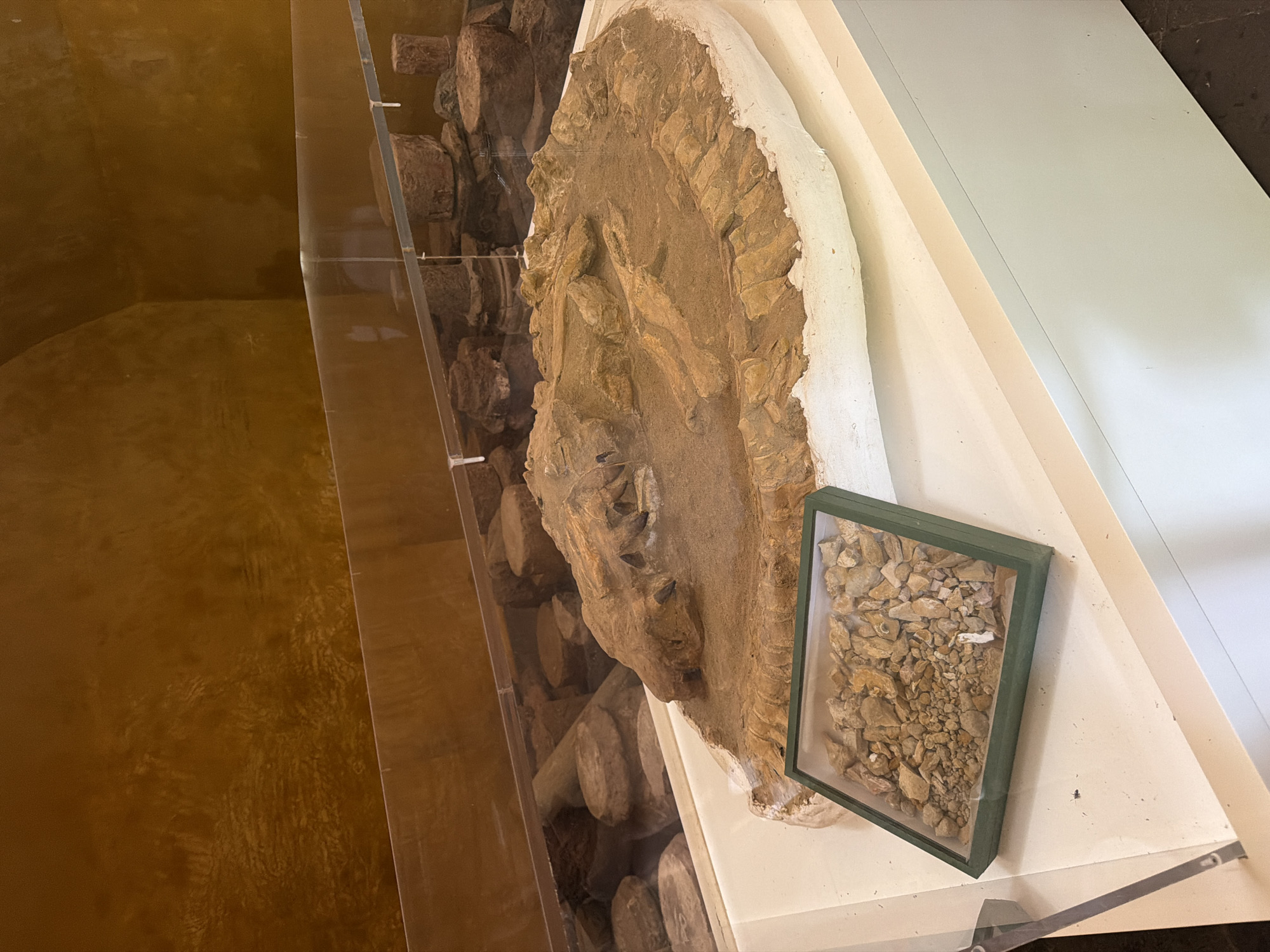
The image shows an archaeological exhibit in San Cristóbal de La Laguna, Spain. The primary subject is a large, unframed artifact made of clay and stone, possibly a relief carving or a fragment of a larger structure, resting on a white display surface. To the left of this artifact, cylindrical objects, possibly ancient pottery or structural elements, are visible through a clear protective casing. To the right of the main artifact, a smaller, framed display case contains a collection of loose stones and fragments, likely related to the larger artifact or the archaeological site. The background on the left is a textured, ochre-colored wall. The lighting suggests an indoor setting, possibly a museum or exhibition space. There is no visible text in the image. The scene appears to be a static display of historical or archaeological findings.

The image shows an archaeological exhibit in San Cristóbal de La Laguna, Spain. The primary subject is a large, unframed artifact made of clay and stone, possibly a relief carving or a fragment of a larger structure, resting on a white display surface. To the left of this artifact, cylindrical objects, possibly ancient pottery or structural elements, are visible through a clear protective casing. To the right of the main artifact, a smaller, framed display case contains a collection of loose stones and fragments, likely related to the larger artifact or the archaeological site. The background on the left is a textured, ochre-colored wall. The lighting suggests an indoor setting, possibly a museum or exhibition space. There is no visible text in the image. The scene appears to be a static display of historical or archaeological findings.

San Cristóbal De La Laguna
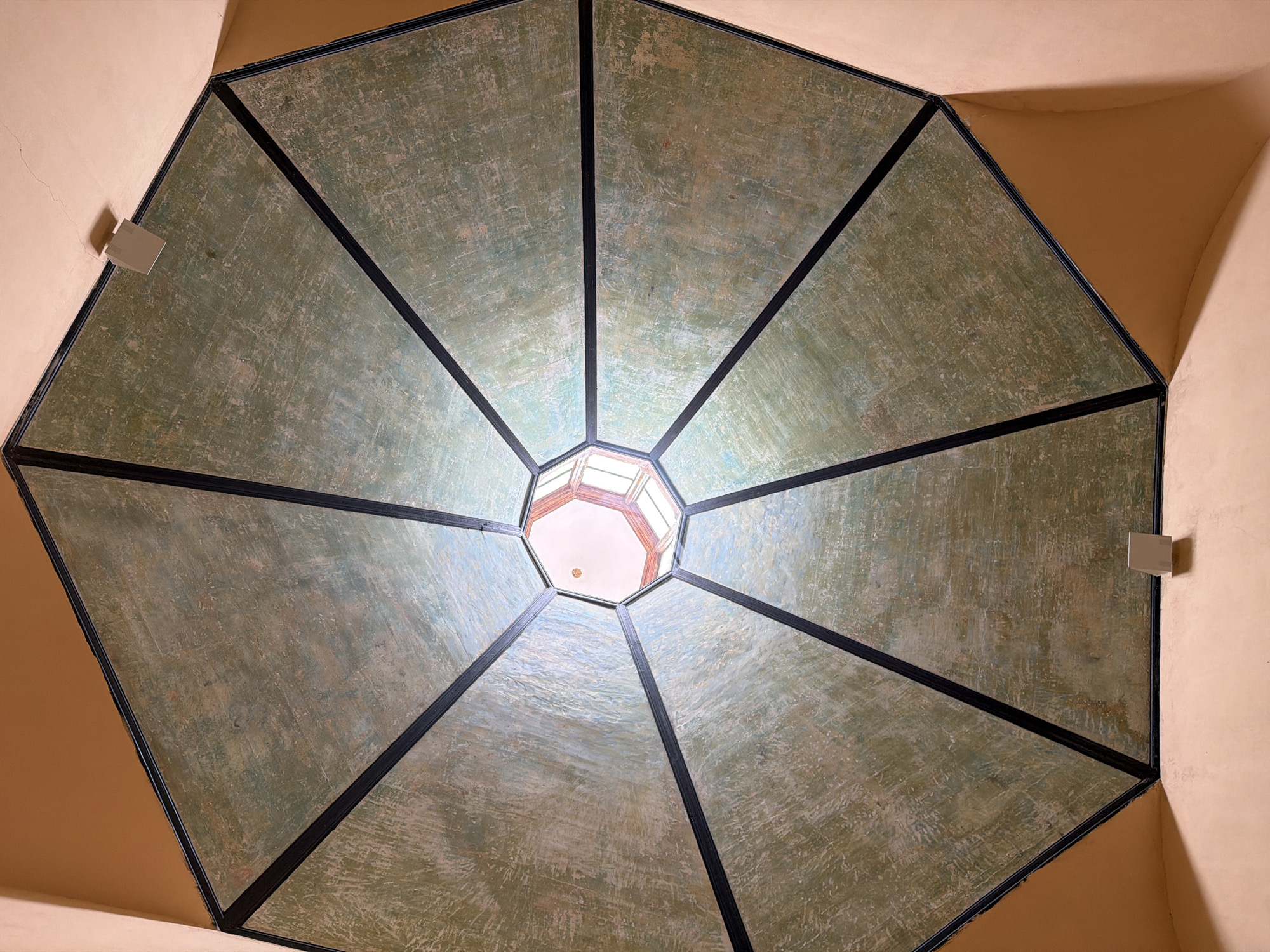
The image shows an interior view looking upwards at a domed ceiling with an octagonal opening at the apex, allowing natural light to filter in. The domed ceiling is divided into eight triangular sections, each painted with a mottled green and cream texture, bordered by dark lines. Two small white square lights are mounted on the ceiling. The surrounding walls are a warm peach color. This architectural feature is located in the Templo Masónico building in San Cristóbal de La Laguna, Spain.

The image shows an interior view looking upwards at a domed ceiling with an octagonal opening at the apex, allowing natural light to filter in. The domed ceiling is divided into eight triangular sections, each painted with a mottled green and cream texture, bordered by dark lines. Two small white square lights are mounted on the ceiling. The surrounding walls are a warm peach color. This architectural feature is located in the Templo Masónico building in San Cristóbal de La Laguna, Spain.

San Cristóbal De La Laguna
This is a photograph taken in a museum in San Cristóbal De La Laguna, Spain. The scene depicts a display of scientific instruments, likely from a historical collection, housed in wooden display cases with glass fronts. The floor is a striking black and white checkerboard pattern. In the foreground, a large glass bell jar sits within a wooden frame, with visible brass fixtures and what appears to be a pulley system. Behind this, several other display cases are visible, filled with an assortment of antique scientific apparatus, including what look like telescopes, lenses, and other precision instruments. The wall in the background is painted a light green. A dark wooden door is visible in the distance, and a fire extinguisher is mounted on the wall. The lighting appears to be from overhead fluorescent fixtures, typical of a museum environment, suggesting the photograph was taken during operating hours. There is no visible weather or time of day information. The overall impression is one of a well-preserved historical scientific collection, presented in an academic setting. Some small labels with text are visible on the items, but the text is too small to be read.

This is a photograph taken in a museum in San Cristóbal De La Laguna, Spain. The scene depicts a display of scientific instruments, likely from a historical collection, housed in wooden display cases with glass fronts. The floor is a striking black and white checkerboard pattern. In the foreground, a large glass bell jar sits within a wooden frame, with visible brass fixtures and what appears to be a pulley system. Behind this, several other display cases are visible, filled with an assortment of antique scientific apparatus, including what look like telescopes, lenses, and other precision instruments. The wall in the background is painted a light green. A dark wooden door is visible in the distance, and a fire extinguisher is mounted on the wall. The lighting appears to be from overhead fluorescent fixtures, typical of a museum environment, suggesting the photograph was taken during operating hours. There is no visible weather or time of day information. The overall impression is one of a well-preserved historical scientific collection, presented in an academic setting. Some small labels with text are visible on the items, but the text is too small to be read.

San Cristóbal De La Laguna
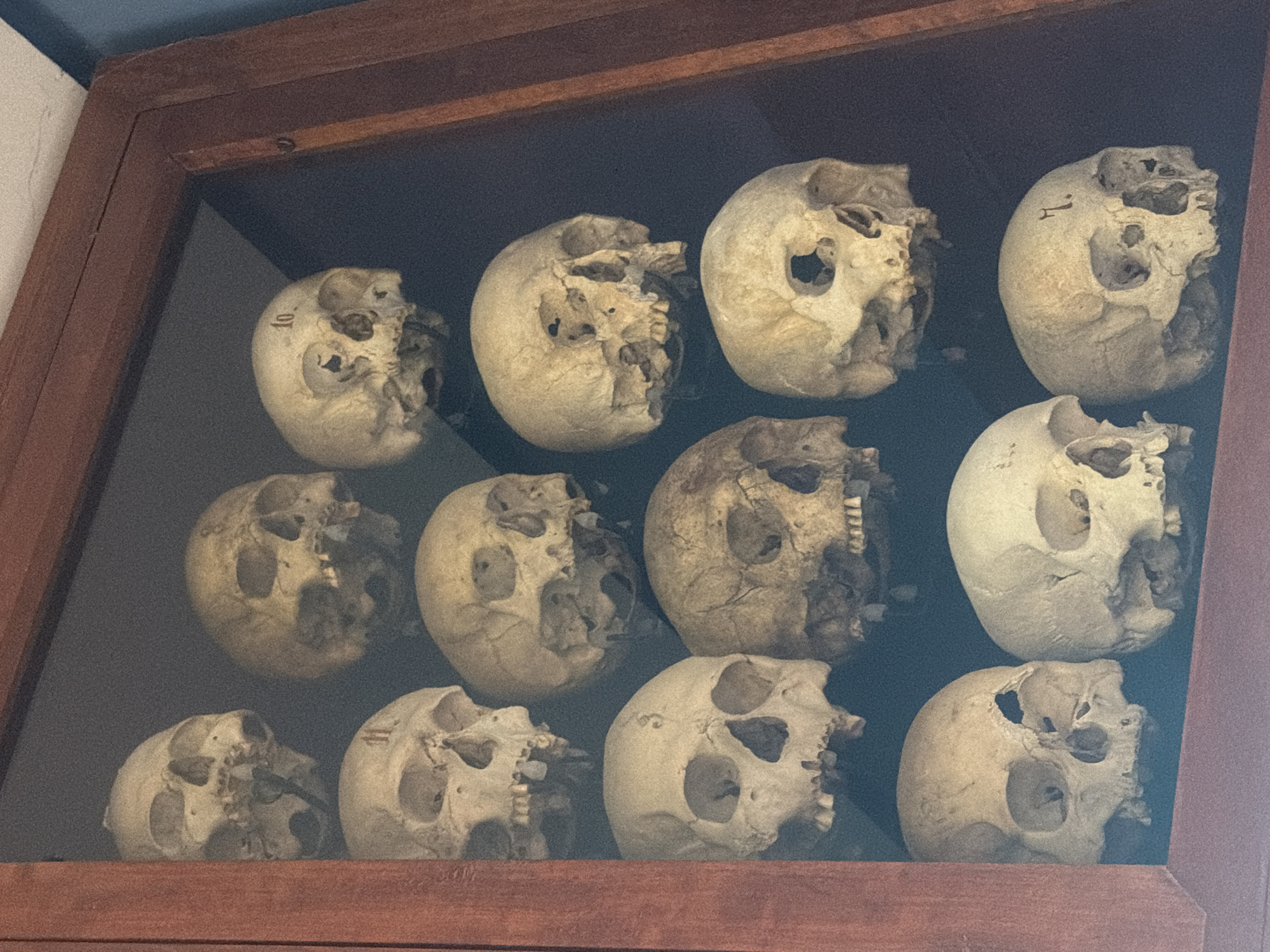
The image shows a display case containing twelve skulls, arranged in three rows of four. The skulls appear to be old and are made of a light-colored material, possibly bone. Some of the skulls have numbers written on them in dark ink. The display case is made of wood and has a glass front, through which the skulls are viewed. The background is dark. The skulls themselves are in varying states of preservation, with some appearing more intact than others. The overall impression is one of a collection of historical or scientific artifacts. There are no discernible location cues within the image itself, other than the stylistic appearance of the display case, which might suggest an older museum or collection. The lighting is consistent and appears to be artificial, illuminating the subjects without casting harsh shadows. The activity taking place is the display of these skulls for viewing. The image does not provide information about the time of day, weather, or emotions. The visible text on the skulls are the numbers "10" on one skull, and "1" on another. The image context suggests the skulls are located in San Cristóbal De La Laguna, Spain.

The image shows a display case containing twelve skulls, arranged in three rows of four. The skulls appear to be old and are made of a light-colored material, possibly bone. Some of the skulls have numbers written on them in dark ink. The display case is made of wood and has a glass front, through which the skulls are viewed. The background is dark. The skulls themselves are in varying states of preservation, with some appearing more intact than others. The overall impression is one of a collection of historical or scientific artifacts. There are no discernible location cues within the image itself, other than the stylistic appearance of the display case, which might suggest an older museum or collection. The lighting is consistent and appears to be artificial, illuminating the subjects without casting harsh shadows. The activity taking place is the display of these skulls for viewing. The image does not provide information about the time of day, weather, or emotions. The visible text on the skulls are the numbers "10" on one skull, and "1" on another. The image context suggests the skulls are located in San Cristóbal De La Laguna, Spain.

San Cristóbal De La Laguna
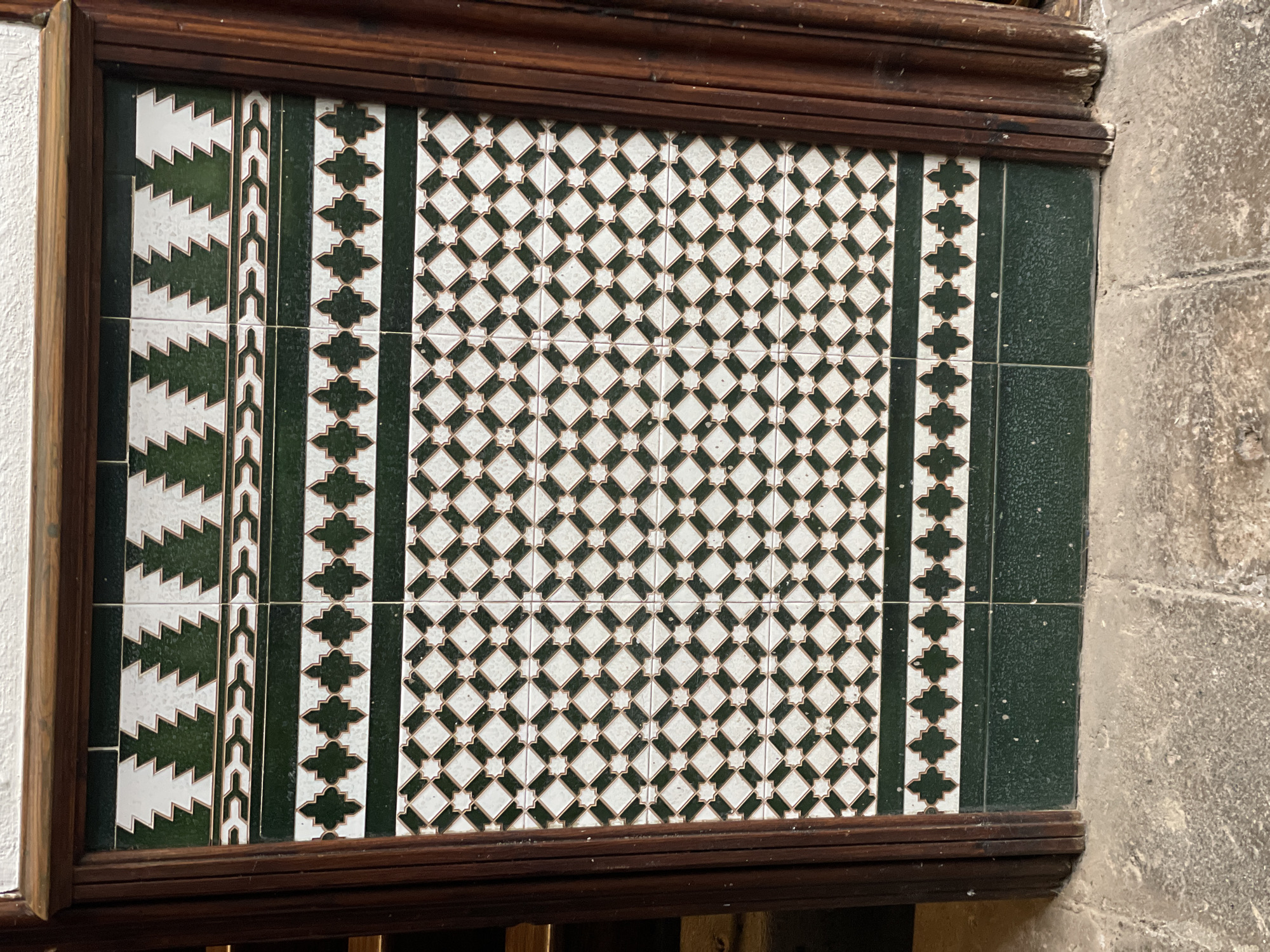
An eye-level shot captures a decorative ceramic tile panel framed by dark brown wooden molding, likely part of an interior or sheltered exterior wall in San Cristóbal De La Laguna, Spain. The tile panel displays a symmetrical, intricate design primarily in dark green and white.

The central and widest section features a repeating geometric pattern of dark green squares rotated 45 degrees, interconnected by smaller white squares and star-like shapes, creating a lattice effect. Flanking this central pattern are two narrower vertical bands, each showcasing a series of dark green trefoil or quatrefoil-like shapes outlined in white, set against a white background. The outermost vertical bands (closest to the solid dark green edges) are composed of a repeating zigzag or stepped pattern in dark green against white, resembling stylized trees or arrows. The entire tile arrangement is subtly outlined in a lighter, off-white or beige tone.

To the left of the wooden frame, a plain white wall is visible. To the right, a rough-textured, light gray or beige stone wall or pillar suggests an older architectural structure. The tiles exhibit a slightly glossy finish with minor imperfections, while the wooden frame shows its natural grain. The lighting is soft and even. No people or visible text are present in the image.

An eye-level shot captures a decorative ceramic tile panel framed by dark brown wooden molding, likely part of an interior or sheltered exterior wall in San Cristóbal De La Laguna, Spain. The tile panel displays a symmetrical, intricate design primarily in dark green and white. The central and widest section features a repeating geometric pattern of dark green squares rotated 45 degrees, interconnected by smaller white squares and star-like shapes, creating a lattice effect. Flanking this central pattern are two narrower vertical bands, each showcasing a series of dark green trefoil or quatrefoil-like shapes outlined in white, set against a white background. The outermost vertical bands (closest to the solid dark green edges) are composed of a repeating zigzag or stepped pattern in dark green against white, resembling stylized trees or arrows. The entire tile arrangement is subtly outlined in a lighter, off-white or beige tone. To the left of the wooden frame, a plain white wall is visible. To the right, a rough-textured, light gray or beige stone wall or pillar suggests an older architectural structure. The tiles exhibit a slightly glossy finish with minor imperfections, while the wooden frame shows its natural grain. The lighting is soft and even. No people or visible text are present in the image.

San Cristóbal De La Laguna
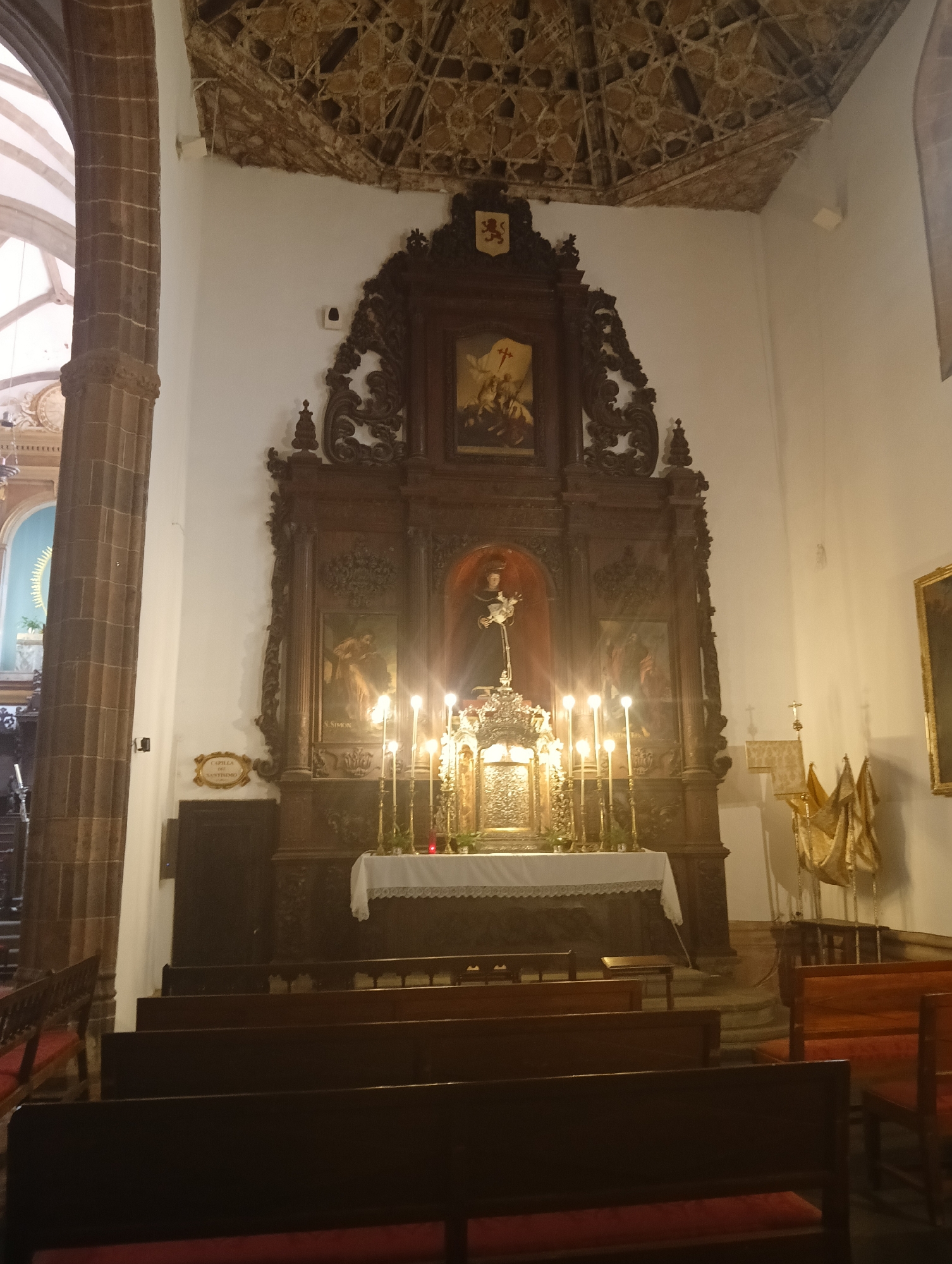
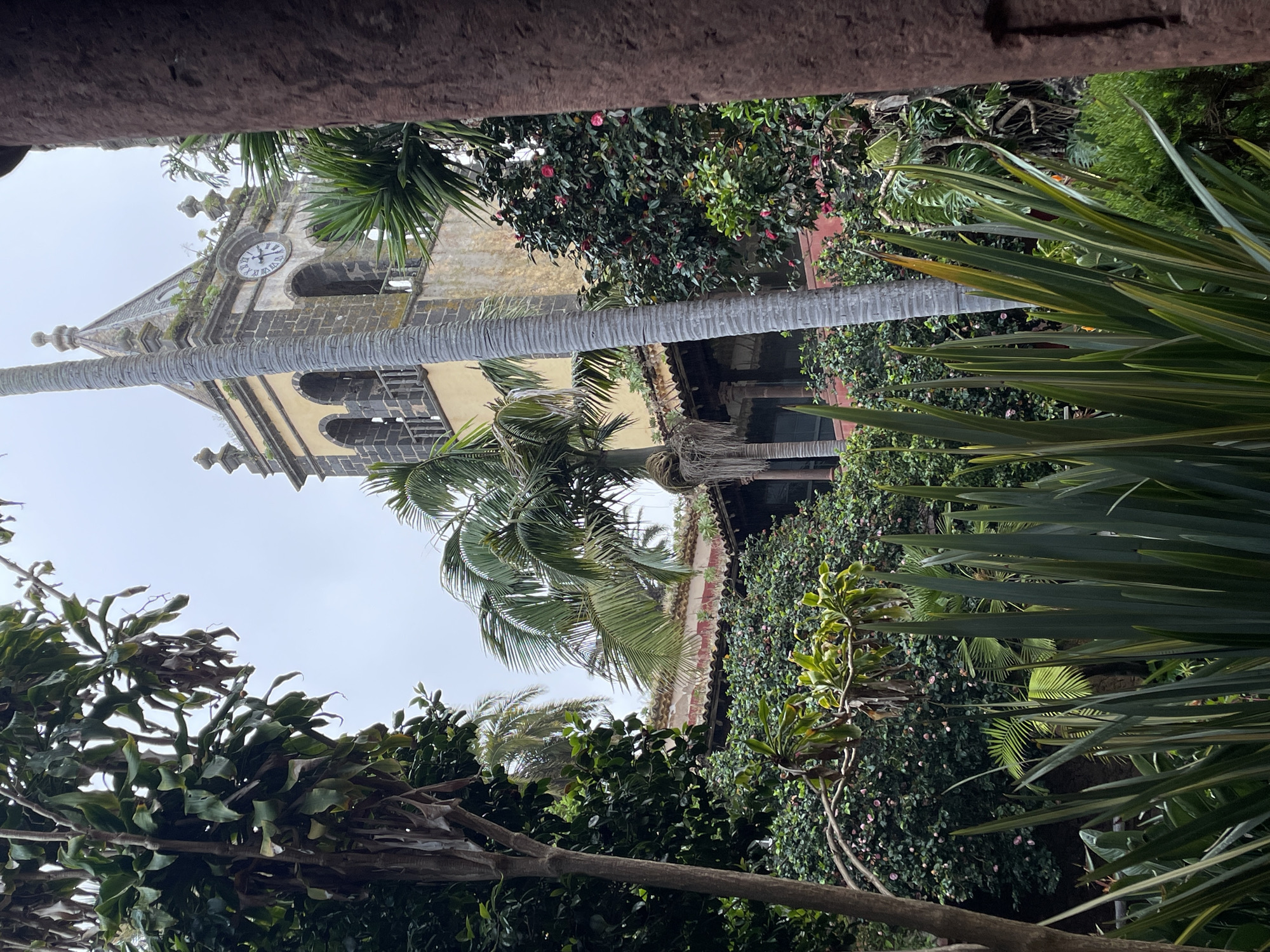
This image captures an upward view of an old stone church tower, framed by abundant tropical and subtropical foliage. The scene is set on an overcast day, indicated by the uniformly white sky.

The prominent subject is a historic church tower, constructed from various shades of stone, located slightly to the left of the frame's center. It features multiple arched window-like openings, possibly bell chambers, and is adorned with a visible clock face near its peak. The clock face displays Roman numerals, with its hands indicating approximately 10:10. The tower exhibits signs of age, including some weathering and patches of greenery growing on its stonework.

The foreground and sides of the image are filled with dense, vibrant plant life. A thick, textured palm tree trunk cuts horizontally across the middle of the frame, adding a prominent linear element. Numerous palm fronds are scattered throughout. Other diverse plants include leafy bushes with small pink flowers, resembling camellias, and various broad-leafed plants with long, blade-like leaves, particularly noticeable in the bottom right. A partial view of a building roof with red tiles is visible behind some of the foliage, hinting at surrounding structures.

No specific activity or event is taking place; it's a static landscape view. The lush vegetation and the architectural style of the church are consistent with the provided location context of San Cristóbal de La Laguna, Spain, suggesting a historical site within a verdant setting. The overall impression is one of serene antiquity intertwined with nature.

This image captures an upward view of an old stone church tower, framed by abundant tropical and subtropical foliage. The scene is set on an overcast day, indicated by the uniformly white sky. The prominent subject is a historic church tower, constructed from various shades of stone, located slightly to the left of the frame's center. It features multiple arched window-like openings, possibly bell chambers, and is adorned with a visible clock face near its peak. The clock face displays Roman numerals, with its hands indicating approximately 10:10. The tower exhibits signs of age, including some weathering and patches of greenery growing on its stonework. The foreground and sides of the image are filled with dense, vibrant plant life. A thick, textured palm tree trunk cuts horizontally across the middle of the frame, adding a prominent linear element. Numerous palm fronds are scattered throughout. Other diverse plants include leafy bushes with small pink flowers, resembling camellias, and various broad-leafed plants with long, blade-like leaves, particularly noticeable in the bottom right. A partial view of a building roof with red tiles is visible behind some of the foliage, hinting at surrounding structures. No specific activity or event is taking place; it's a static landscape view. The lush vegetation and the architectural style of the church are consistent with the provided location context of San Cristóbal de La Laguna, Spain, suggesting a historical site within a verdant setting. The overall impression is one of serene antiquity intertwined with nature.

San Cristóbal De La Laguna
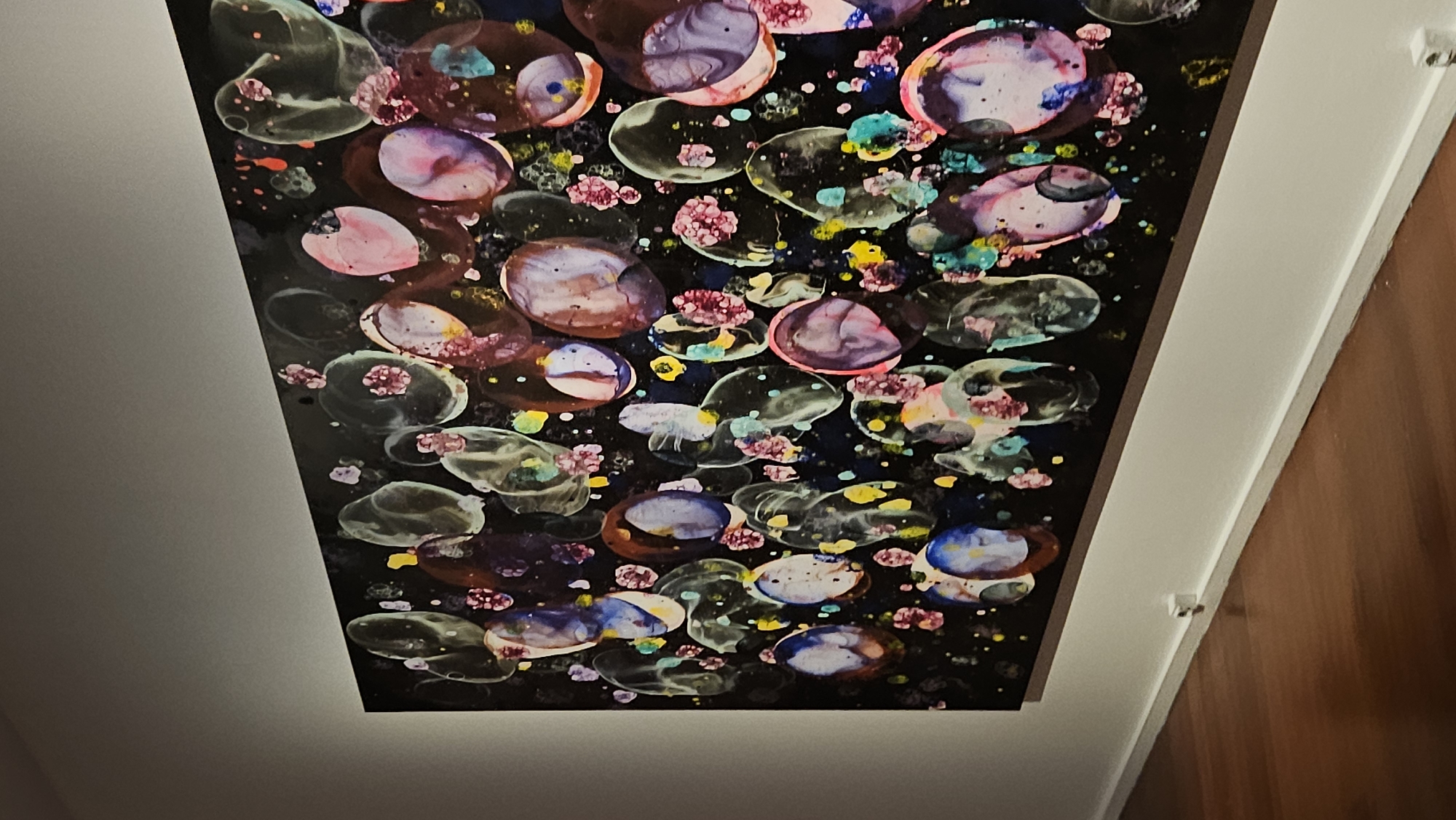
This image captures an abstract artwork, likely a resin or acrylic pour, mounted indoors. The artwork features a vibrant array of interconnected, irregular, and often translucent shapes resembling bubbles or cellular structures, set against a dark, possibly black, background. Within these organic forms, colors such as various shades of pink, purple, blue, teal, yellow, and white blend and swirl, creating a dynamic, fluid appearance. Smaller, speckled clusters of pink/red and yellow/green hues are dispersed across the dark background, adding further detail and contrast.

The artwork has a glossy finish, reflecting light and enhancing its perceived depth and texture. It is presented at an upward, diagonal angle, suggesting it might be mounted on a high wall or ceiling. To the left and right of the artwork, white or light grey wall surfaces are visible, with a wooden-colored surface appearing on the far right, possibly a door or another wall panel. A small white clip or fixture is noticeable on the white trim along the right edge of the artwork, reinforcing the indoor setting. There are no people or discernible activities depicted. No visible text is present within the image. The photo was taken in San Cristóbal De La Laguna, Spain.

This image captures an abstract artwork, likely a resin or acrylic pour, mounted indoors. The artwork features a vibrant array of interconnected, irregular, and often translucent shapes resembling bubbles or cellular structures, set against a dark, possibly black, background. Within these organic forms, colors such as various shades of pink, purple, blue, teal, yellow, and white blend and swirl, creating a dynamic, fluid appearance. Smaller, speckled clusters of pink/red and yellow/green hues are dispersed across the dark background, adding further detail and contrast. The artwork has a glossy finish, reflecting light and enhancing its perceived depth and texture. It is presented at an upward, diagonal angle, suggesting it might be mounted on a high wall or ceiling. To the left and right of the artwork, white or light grey wall surfaces are visible, with a wooden-colored surface appearing on the far right, possibly a door or another wall panel. A small white clip or fixture is noticeable on the white trim along the right edge of the artwork, reinforcing the indoor setting. There are no people or discernible activities depicted. No visible text is present within the image. The photo was taken in San Cristóbal De La Laguna, Spain.

San Cristóbal De La Laguna
This is a vibrant, abstract close-up image of a fluid art painting. The dominant background is a glossy, deep black, providing a strong contrast to the colorful, organic shapes and patterns. The artwork features an array of swirling, dripped, and splashed forms in metallic gold, copper, white, and pale pink, with some hints of silver or light blue.

The shapes vary from distinct circles and rings, some appearing like bubbles or cells, to more amorphous, flowing designs that suggest movement and fluidity. Within these shapes, the colors are often swirled together, creating intricate marble-like textures and iridescent effects, particularly with the metallic paints which catch the light. Numerous small splatters and drips of paint, primarily white and pink, are scattered across the black surface, adding to the dynamic composition.

The overall impression is one of shimmering liquids in motion. The glossy finish suggests a resin coating or a similar technique that enhances the depth and sheen of the colors. There are no people, recognizable objects beyond the paint itself, or visible text in the image. No specific time of day, weather, or discernible location cues are present in the artwork itself.

This is a vibrant, abstract close-up image of a fluid art painting. The dominant background is a glossy, deep black, providing a strong contrast to the colorful, organic shapes and patterns. The artwork features an array of swirling, dripped, and splashed forms in metallic gold, copper, white, and pale pink, with some hints of silver or light blue. The shapes vary from distinct circles and rings, some appearing like bubbles or cells, to more amorphous, flowing designs that suggest movement and fluidity. Within these shapes, the colors are often swirled together, creating intricate marble-like textures and iridescent effects, particularly with the metallic paints which catch the light. Numerous small splatters and drips of paint, primarily white and pink, are scattered across the black surface, adding to the dynamic composition. The overall impression is one of shimmering liquids in motion. The glossy finish suggests a resin coating or a similar technique that enhances the depth and sheen of the colors. There are no people, recognizable objects beyond the paint itself, or visible text in the image. No specific time of day, weather, or discernible location cues are present in the artwork itself.

San Cristóbal De La Laguna
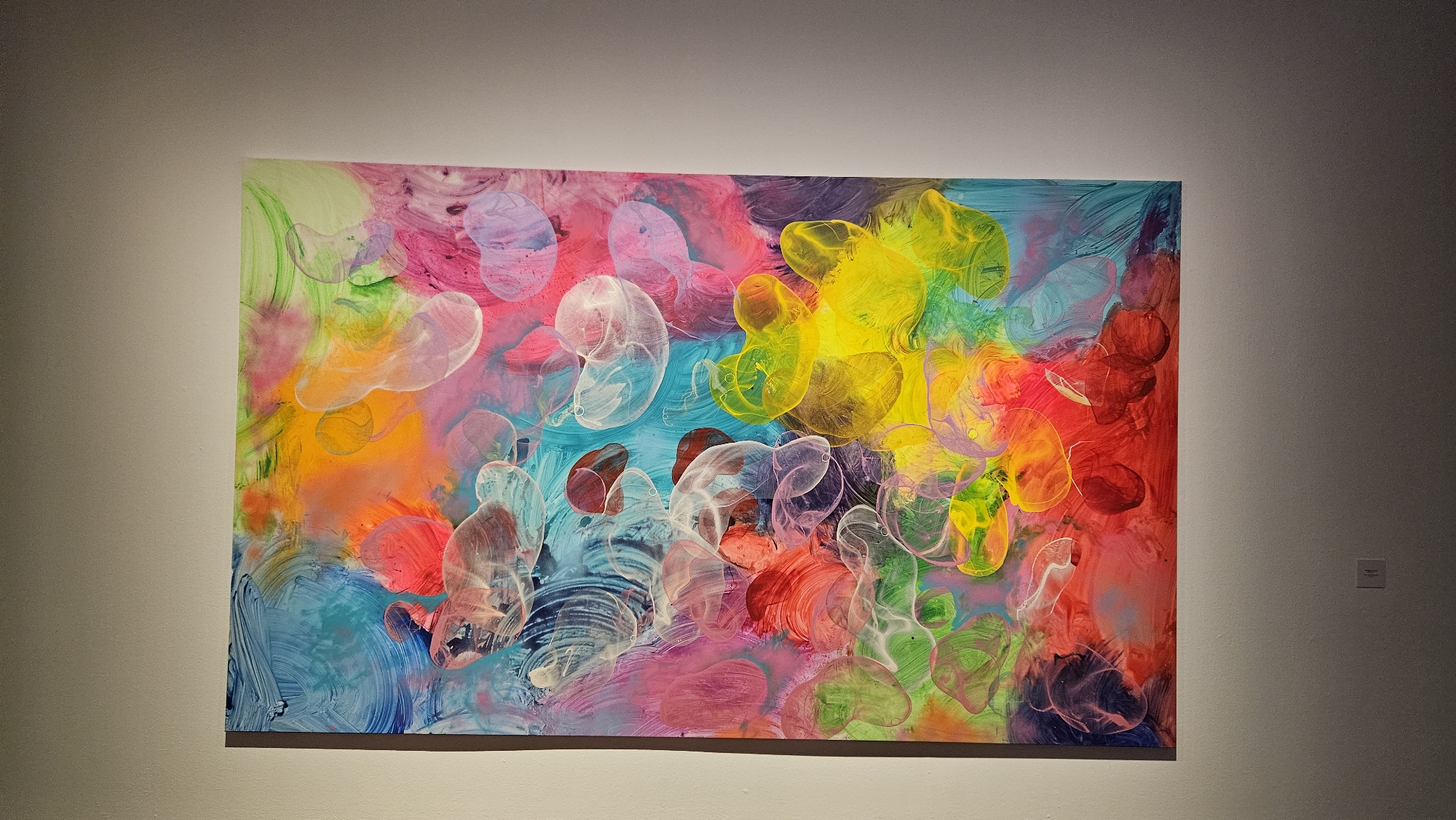
The image displays a vibrant, large-scale abstract painting prominently hung on a plain, light-colored wall, likely within an art gallery or exhibition space in San Cristóbal De La Laguna, Spain. The painting is rectangular and oriented horizontally.

The artwork is characterized by an explosion of bright, saturated colors including various shades of pink, fuchsia, yellow, orange, red, green, blue, and purple. The background features dynamic, swirled brushstrokes and blended areas of color, creating a lively and energetic foundation. Overlaid on this colorful ground are numerous translucent, irregular, rounded shapes that resemble bubbles, cells, or amorphous blobs. These shapes are delineated with lighter, sometimes white, outlines, giving them a glossy, three-dimensional, and ethereal quality. Some of these forms appear to contain or be filled with additional colors, while others are more transparent, allowing the underlying brushwork and colors to show through.

The overall impression of the painting is one of playfulness, organic movement, and a celebration of color and light. The piece is well-lit, suggesting deliberate gallery lighting, which enhances the luminosity and depth of the translucent elements and the vibrancy of the colors. A small, unreadable plaque is visible on the wall to the right of the painting, typical of an exhibition setting, possibly indicating the artist's name or the artwork's title. No people or other significant objects are visible in the scene.

The image displays a vibrant, large-scale abstract painting prominently hung on a plain, light-colored wall, likely within an art gallery or exhibition space in San Cristóbal De La Laguna, Spain. The painting is rectangular and oriented horizontally. The artwork is characterized by an explosion of bright, saturated colors including various shades of pink, fuchsia, yellow, orange, red, green, blue, and purple. The background features dynamic, swirled brushstrokes and blended areas of color, creating a lively and energetic foundation. Overlaid on this colorful ground are numerous translucent, irregular, rounded shapes that resemble bubbles, cells, or amorphous blobs. These shapes are delineated with lighter, sometimes white, outlines, giving them a glossy, three-dimensional, and ethereal quality. Some of these forms appear to contain or be filled with additional colors, while others are more transparent, allowing the underlying brushwork and colors to show through. The overall impression of the painting is one of playfulness, organic movement, and a celebration of color and light. The piece is well-lit, suggesting deliberate gallery lighting, which enhances the luminosity and depth of the translucent elements and the vibrancy of the colors. A small, unreadable plaque is visible on the wall to the right of the painting, typical of an exhibition setting, possibly indicating the artist's name or the artwork's title. No people or other significant objects are visible in the scene.

San Cristóbal De La Laguna
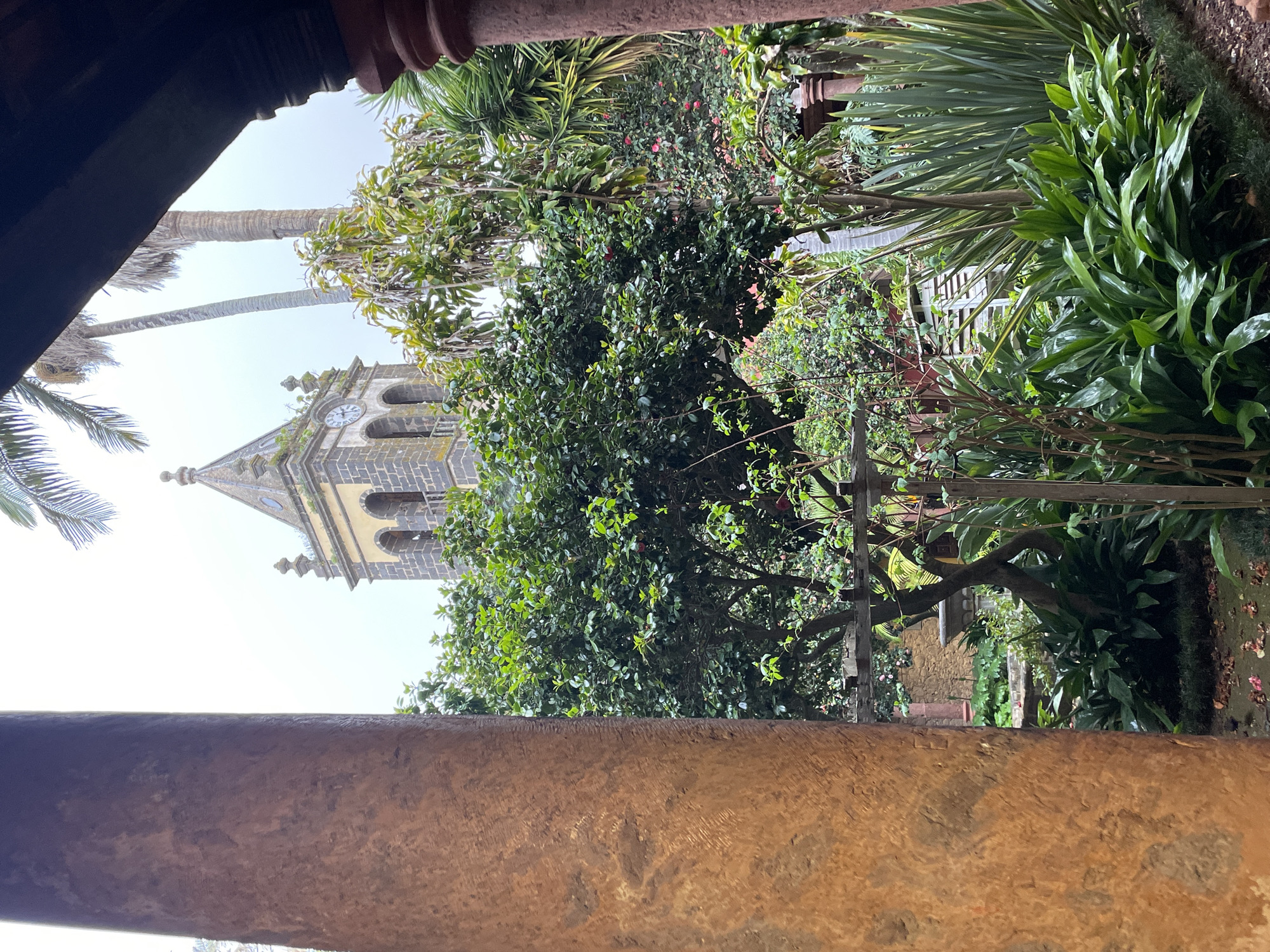
The image shows a view of the Iglesia de la Concepción tower in San Cristóbal De La Laguna, Spain, as seen through an opening. The foreground features part of a building structure in mottled brown and orange tones, possibly a wall or architectural element. Beyond this, there are lush green trees and various plants, partially obscuring the tower. The tower is constructed of grey stone with yellow arches and a clock face. Palm trees are visible on either side of the tower in the background. The sky is overcast.

The image shows a view of the Iglesia de la Concepción tower in San Cristóbal De La Laguna, Spain, as seen through an opening. The foreground features part of a building structure in mottled brown and orange tones, possibly a wall or architectural element. Beyond this, there are lush green trees and various plants, partially obscuring the tower. The tower is constructed of grey stone with yellow arches and a clock face. Palm trees are visible on either side of the tower in the background. The sky is overcast.

San Cristóbal De La Laguna
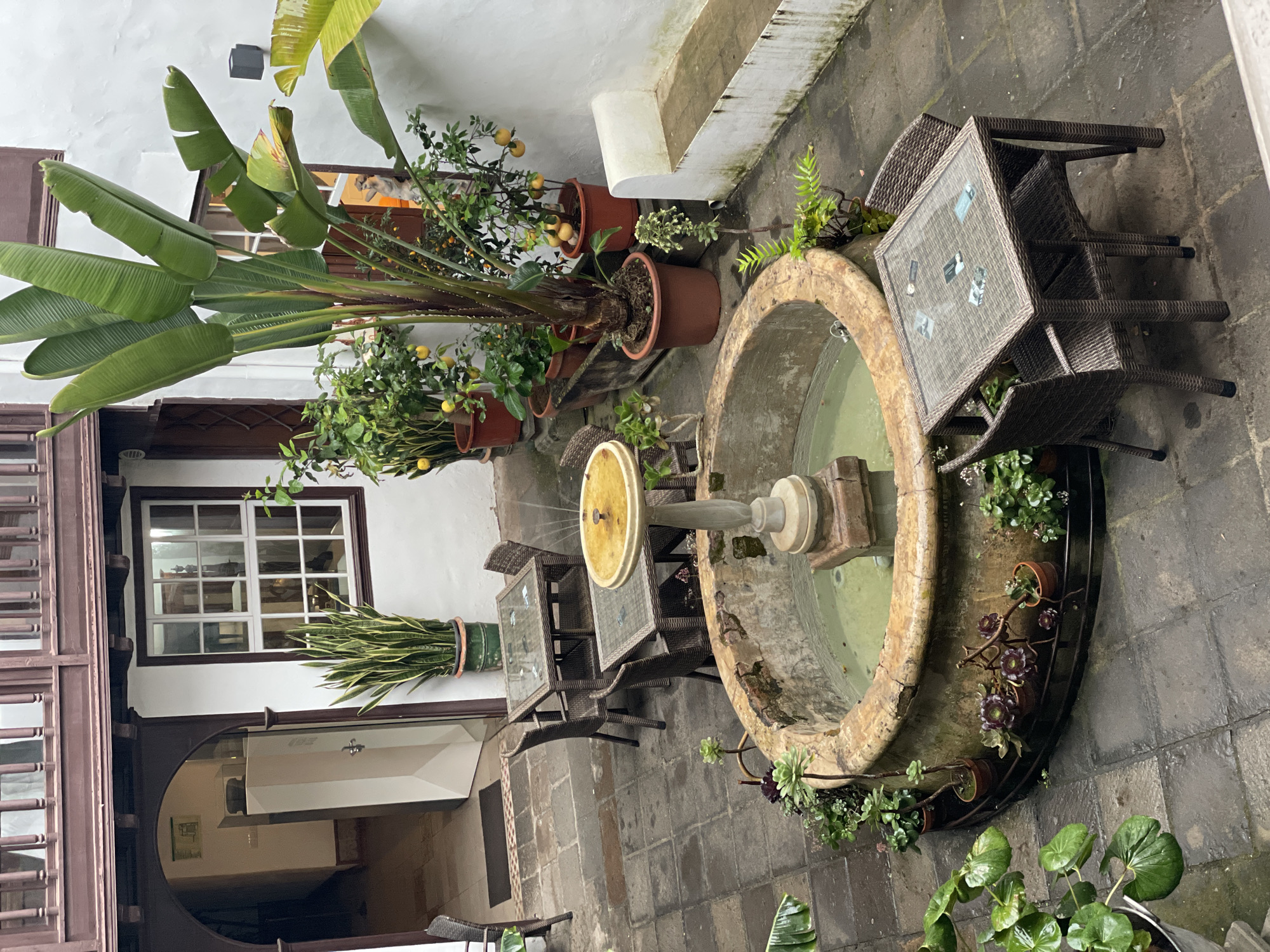
An overhead, slightly angled shot captures a tranquil outdoor courtyard in San Cristóbal De La Laguna, Spain, characterized by white stucco walls, dark wooden architectural elements, and a variety of potted plants.

At the center of the scene is a circular stone fountain with murky water, featuring a lighter-colored central pedestal supporting a yellow, dish-like top. Around the fountain, the ground is paved with dark grey square stones, appearing damp, possibly from recent rain or watering. Several potted plants, including succulents and other foliage, are arranged at the base of the fountain.

To the left of the fountain, a large Strelitzia plant with prominent banana-like leaves dominates the foreground, planted in a brown pot. Beside it are several potted lemon trees, bearing bright yellow fruit. Further along the left wall, a snake plant is visible in a pot mounted below a white-paned window with dark brown framing. Through this window and another adjacent opening, an interior space with a reflection of a light-colored cat or small animal can be seen peering out.

Various outdoor furniture pieces, made of dark brown woven synthetic rattan, are scattered around the courtyard. Two tables are prominently featured; one directly to the right of the fountain has small, indecipherable cards or coasters on its glass top. Matching chairs are placed around these tables, some stacked.

The overall atmosphere suggests a peaceful, inviting outdoor space, typical of a patio or a small square, with no discernible human activity occurring. The lighting appears soft and indirect, indicating an overcast day or shaded area, with no harsh shadows. No legible text is visible in the image.

An overhead, slightly angled shot captures a tranquil outdoor courtyard in San Cristóbal De La Laguna, Spain, characterized by white stucco walls, dark wooden architectural elements, and a variety of potted plants. At the center of the scene is a circular stone fountain with murky water, featuring a lighter-colored central pedestal supporting a yellow, dish-like top. Around the fountain, the ground is paved with dark grey square stones, appearing damp, possibly from recent rain or watering. Several potted plants, including succulents and other foliage, are arranged at the base of the fountain. To the left of the fountain, a large Strelitzia plant with prominent banana-like leaves dominates the foreground, planted in a brown pot. Beside it are several potted lemon trees, bearing bright yellow fruit. Further along the left wall, a snake plant is visible in a pot mounted below a white-paned window with dark brown framing. Through this window and another adjacent opening, an interior space with a reflection of a light-colored cat or small animal can be seen peering out. Various outdoor furniture pieces, made of dark brown woven synthetic rattan, are scattered around the courtyard. Two tables are prominently featured; one directly to the right of the fountain has small, indecipherable cards or coasters on its glass top. Matching chairs are placed around these tables, some stacked. The overall atmosphere suggests a peaceful, inviting outdoor space, typical of a patio or a small square, with no discernible human activity occurring. The lighting appears soft and indirect, indicating an overcast day or shaded area, with no harsh shadows. No legible text is visible in the image.

San Cristóbal De La Laguna
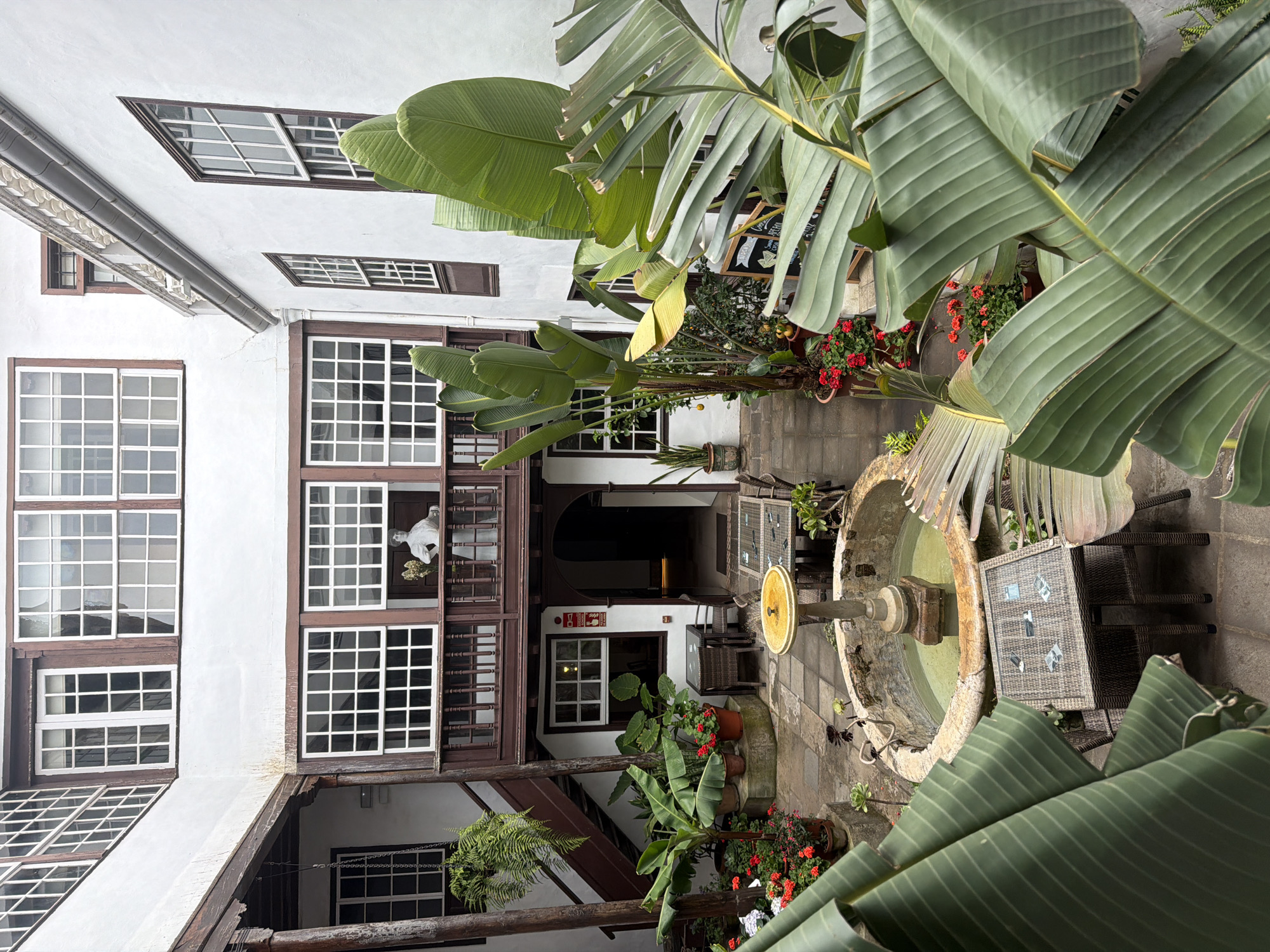
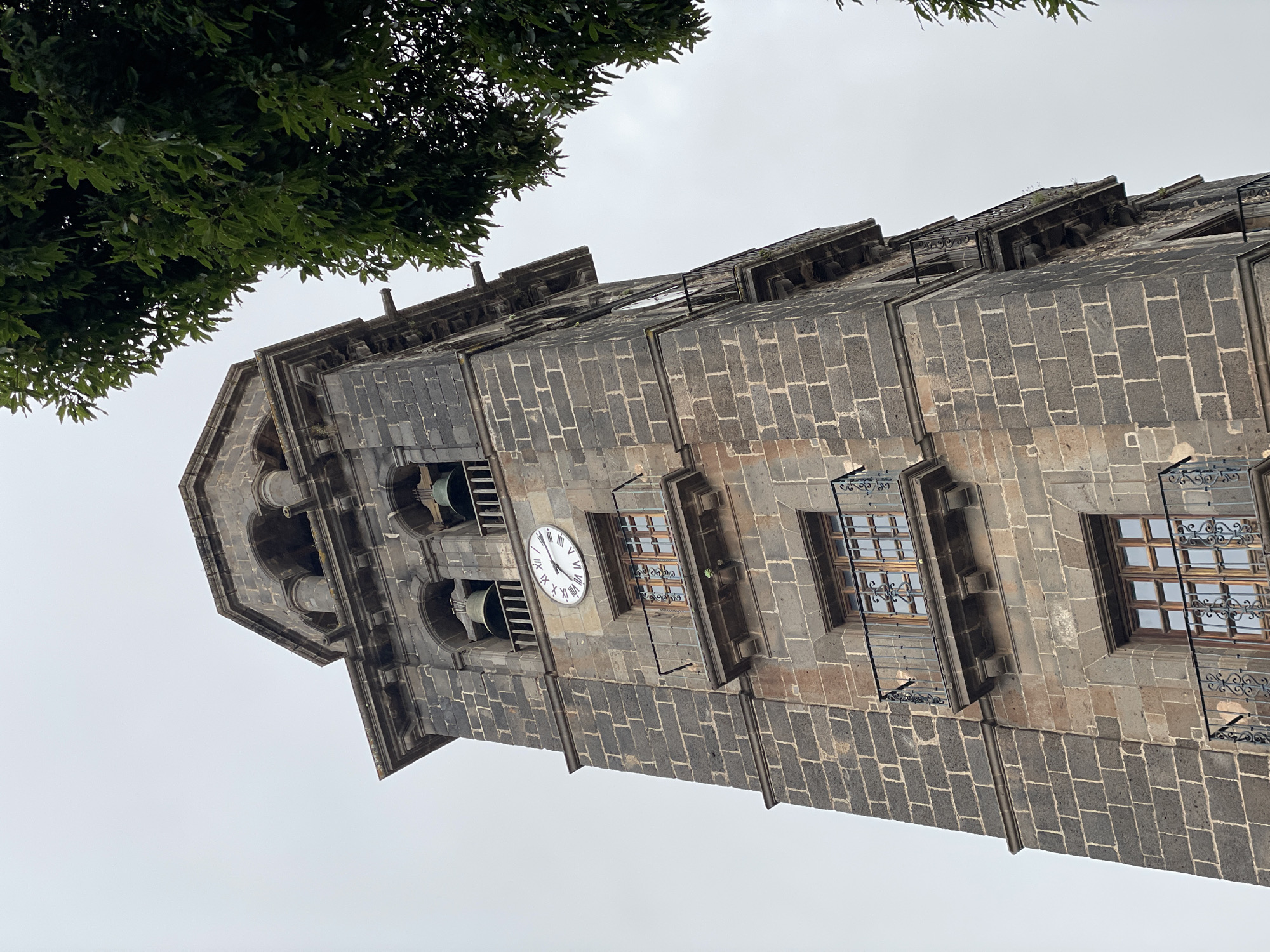
The image displays a tall, imposing stone bell tower, likely part of a church or historic building, viewed from a low angle against a uniformly overcast, light grey sky. The tower is constructed from dark, rectangular stone blocks, giving it a rugged and ancient appearance.

Towards the upper section, a circular clock face with Roman numerals from I to XII is clearly visible. The clock's hands indicate a time of approximately 1:50 or 2:50. Adjacent to the clock face and slightly above it, an arched opening reveals a large bell within, confirming its function as a bell tower. Another bell opening is partially visible further up.

Below the clock and on the lower visible sections of the tower, several rectangular windows are present. These windows are adorned with intricate, black wrought-iron grilles and feature wooden frames, adding decorative detail to the sturdy stone facade. A metal downspout runs vertically down one side of the tower, indicating rainwater drainage. The architecture also includes various decorative cornices and ledges that articulate the tower's levels.

In the upper left portion of the frame, the dark green foliage of a tree partially frames the tower, suggesting the presence of greenery nearby. The sky is completely clouded over, indicating an overcast daytime. No people or specific activities are depicted; the scene is static, focusing solely on the architectural structure.

The only visible text consists of the Roman numerals on the clock face. The architecture is consistent with historical European structures, and the provided context places this location in San Cristóbal De La Laguna, Spain.

The image displays a tall, imposing stone bell tower, likely part of a church or historic building, viewed from a low angle against a uniformly overcast, light grey sky. The tower is constructed from dark, rectangular stone blocks, giving it a rugged and ancient appearance. Towards the upper section, a circular clock face with Roman numerals from I to XII is clearly visible. The clock's hands indicate a time of approximately 1:50 or 2:50. Adjacent to the clock face and slightly above it, an arched opening reveals a large bell within, confirming its function as a bell tower. Another bell opening is partially visible further up. Below the clock and on the lower visible sections of the tower, several rectangular windows are present. These windows are adorned with intricate, black wrought-iron grilles and feature wooden frames, adding decorative detail to the sturdy stone facade. A metal downspout runs vertically down one side of the tower, indicating rainwater drainage. The architecture also includes various decorative cornices and ledges that articulate the tower's levels. In the upper left portion of the frame, the dark green foliage of a tree partially frames the tower, suggesting the presence of greenery nearby. The sky is completely clouded over, indicating an overcast daytime. No people or specific activities are depicted; the scene is static, focusing solely on the architectural structure. The only visible text consists of the Roman numerals on the clock face. The architecture is consistent with historical European structures, and the provided context places this location in San Cristóbal De La Laguna, Spain.

San Cristóbal De La Laguna
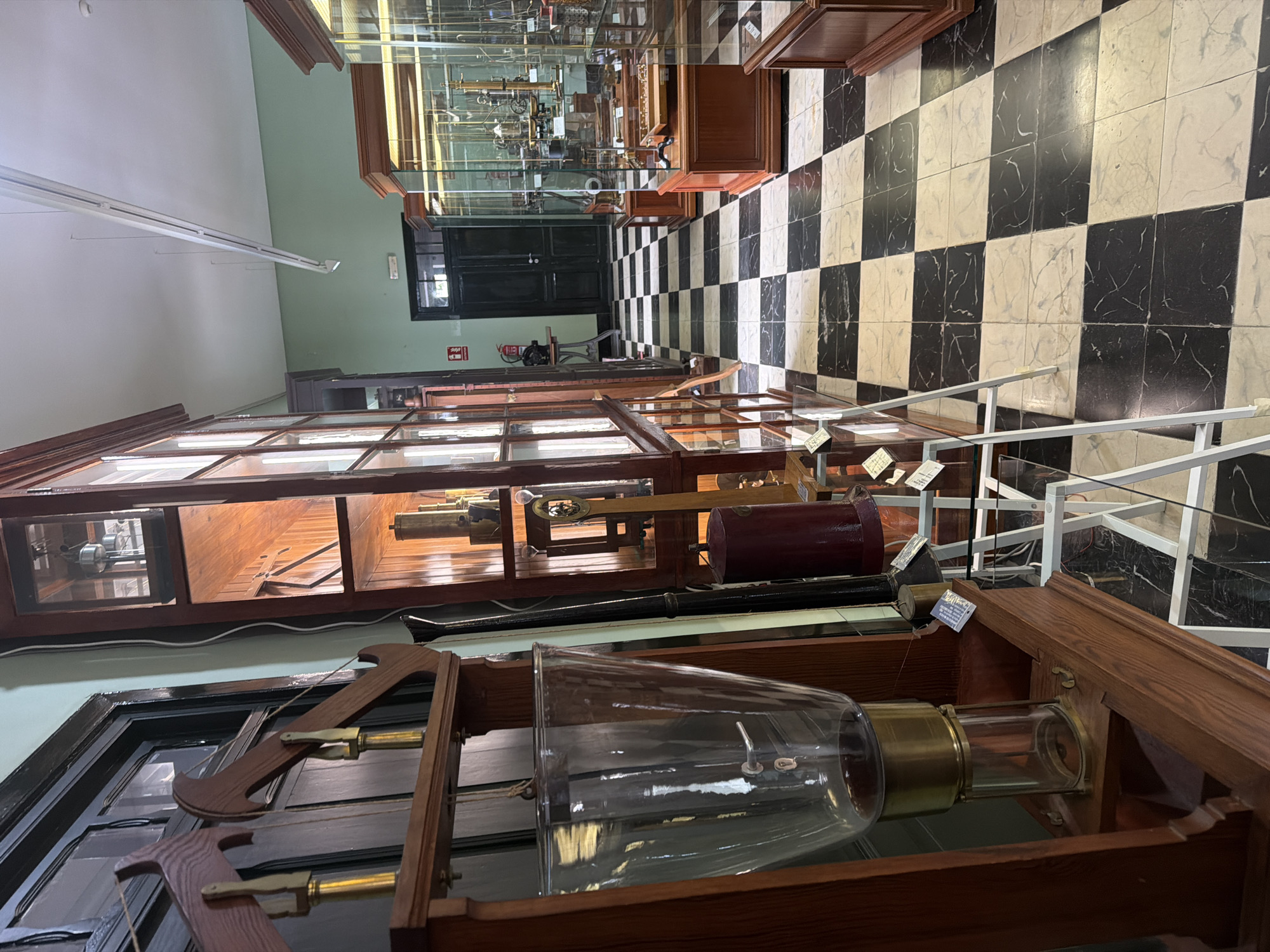
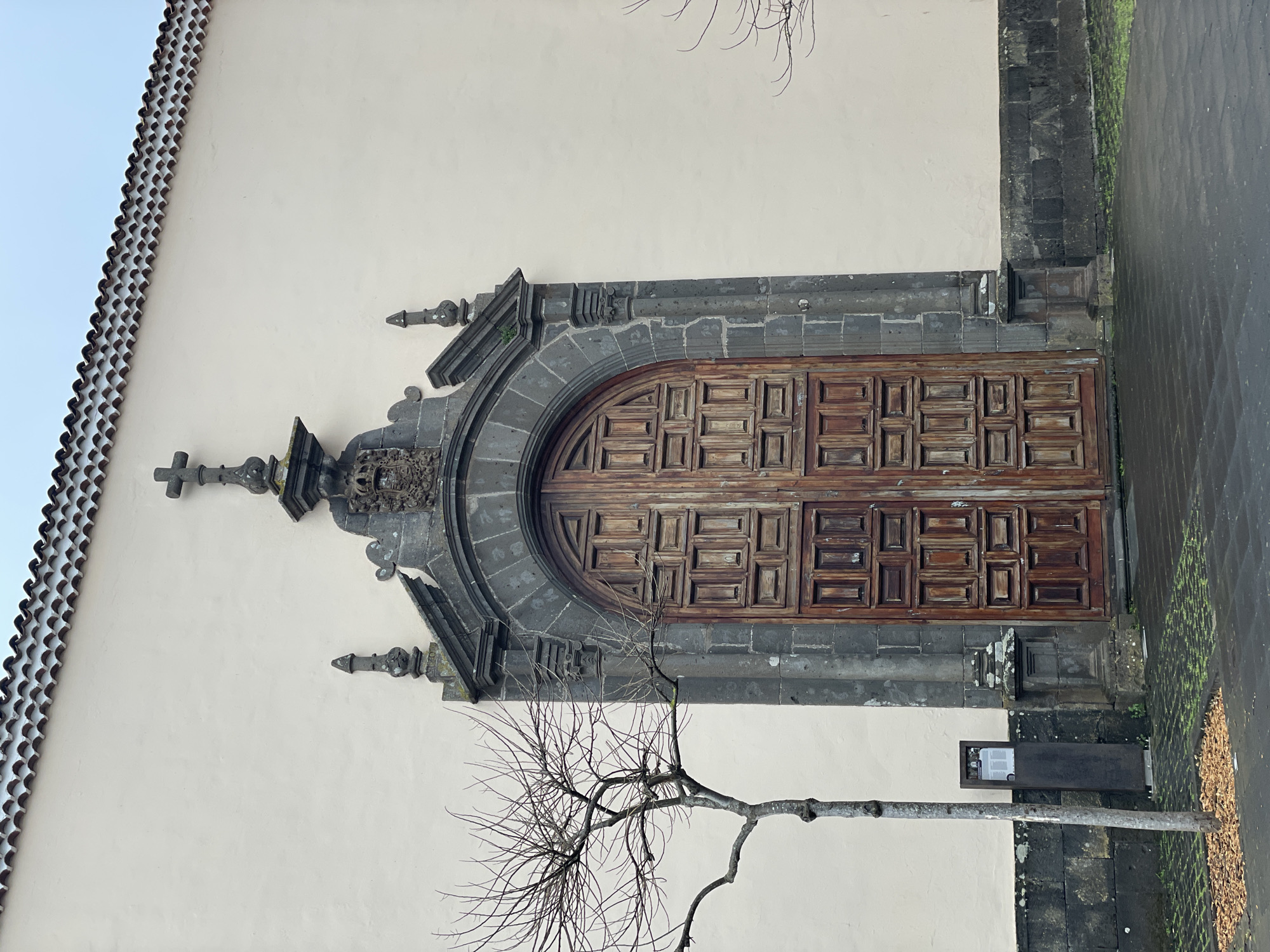
A static photograph, originally oriented vertically but presented here on its side, captures the ornate entrance of a historic building. The central focus is a large, dark wooden double door, featuring intricate geometric paneling. This door is framed by a decorative grey stone archway, which includes carved finials, a central crest-like embellishment, and a cross-shaped ornament at its top. The building's facade is a smooth, light-colored (cream or pale yellow) plaster or stucco.

A section of the roof, with rows of reddish-brown, scallop-edged tiles, is visible along the top-left edge against a pale, overcast sky. To the right of the door, the building's corner is constructed from dark grey, rectangular stone blocks, continuing down to form a low base.

In front of the building, a slender, bare deciduous tree with numerous branches suggests a cool or dormant season. Beside the tree, a dark, rectangular display stand or sign with white, illegible text is positioned on the dark, possibly wet, paved ground, which extends along the bottom right. No people or activities are present. The scene depicts a quiet moment, likely during daytime under an overcast sky. The architectural style is consistent with historic buildings found in places like San Cristóbal De La Laguna, Spain.

A static photograph, originally oriented vertically but presented here on its side, captures the ornate entrance of a historic building. The central focus is a large, dark wooden double door, featuring intricate geometric paneling. This door is framed by a decorative grey stone archway, which includes carved finials, a central crest-like embellishment, and a cross-shaped ornament at its top. The building's facade is a smooth, light-colored (cream or pale yellow) plaster or stucco. A section of the roof, with rows of reddish-brown, scallop-edged tiles, is visible along the top-left edge against a pale, overcast sky. To the right of the door, the building's corner is constructed from dark grey, rectangular stone blocks, continuing down to form a low base. In front of the building, a slender, bare deciduous tree with numerous branches suggests a cool or dormant season. Beside the tree, a dark, rectangular display stand or sign with white, illegible text is positioned on the dark, possibly wet, paved ground, which extends along the bottom right. No people or activities are present. The scene depicts a quiet moment, likely during daytime under an overcast sky. The architectural style is consistent with historic buildings found in places like San Cristóbal De La Laguna, Spain.

San Cristóbal De La Laguna
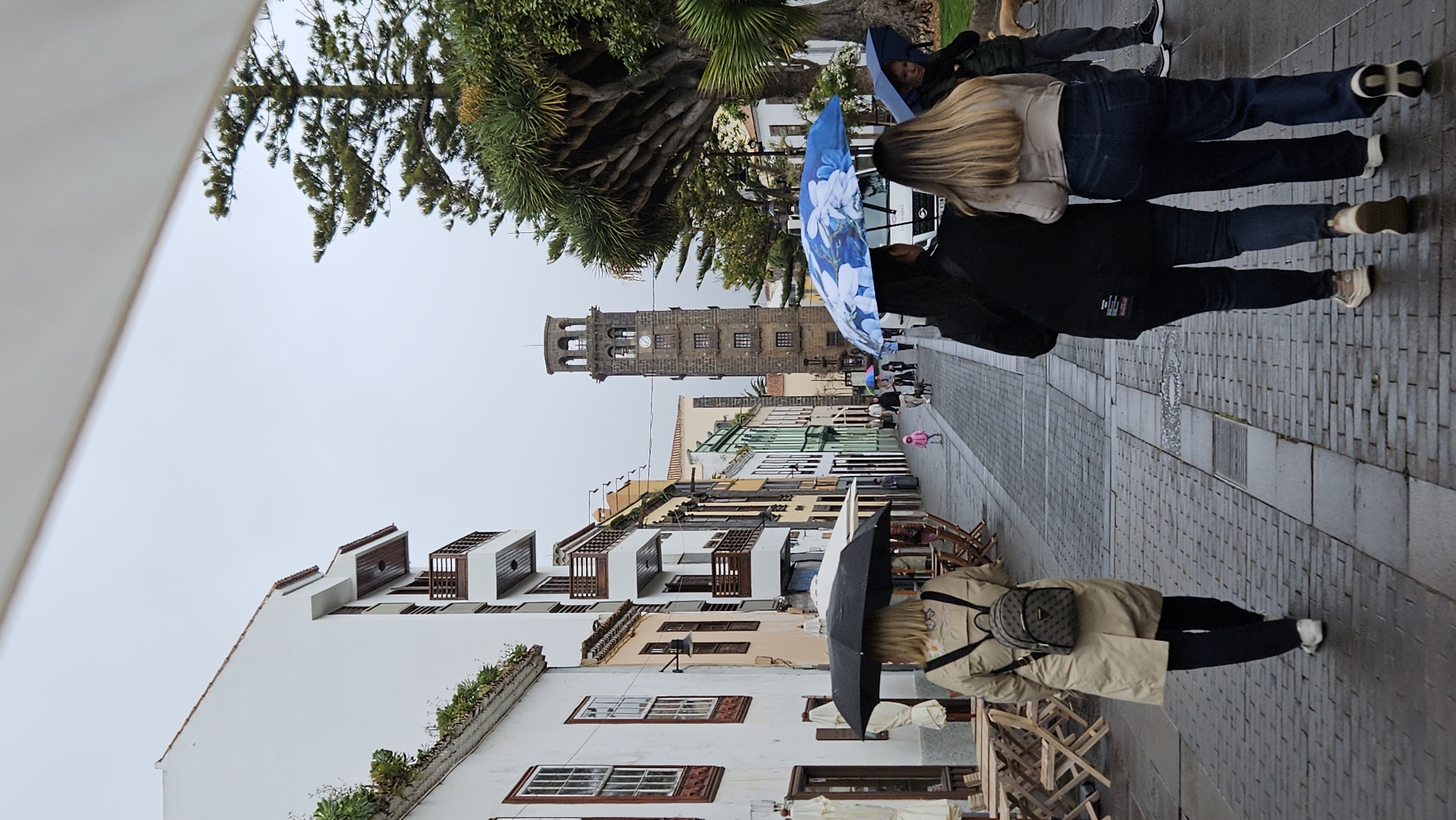
This vertical image depicts a street scene in San Cristóbal De La Laguna, Spain, on an overcast day with signs of rain. In the foreground, a person with blonde hair, wearing a light-colored coat and dark trousers, walks away from the viewer, carrying a patterned backpack and holding a black umbrella. Just ahead, two other individuals are also walking; one, with blonde hair, wears a light jacket and blue jeans, while the other is in a dark top, both seemingly also using umbrellas. A blue umbrella adorned with white floral patterns is prominently visible further up the street.

The street is paved with a mix of light and dark blocks, featuring a visible drainage line running along its center. Traditional buildings with colorful facades, wooden balconies, and multiple windows line both sides of the street, showcasing local architecture. On the left, a large, distinctive tree with thick, gnarled branches, characteristic of a Drago (Dragon Tree), stands prominently. In the background, a tall, rectangular stone bell tower with multiple windows and a visible clock face rises above the rooftops, serving as a significant landmark. The sky is uniformly gray, indicating cloudy weather. No legible text is visible in the frame.

This vertical image depicts a street scene in San Cristóbal De La Laguna, Spain, on an overcast day with signs of rain. In the foreground, a person with blonde hair, wearing a light-colored coat and dark trousers, walks away from the viewer, carrying a patterned backpack and holding a black umbrella. Just ahead, two other individuals are also walking; one, with blonde hair, wears a light jacket and blue jeans, while the other is in a dark top, both seemingly also using umbrellas. A blue umbrella adorned with white floral patterns is prominently visible further up the street. The street is paved with a mix of light and dark blocks, featuring a visible drainage line running along its center. Traditional buildings with colorful facades, wooden balconies, and multiple windows line both sides of the street, showcasing local architecture. On the left, a large, distinctive tree with thick, gnarled branches, characteristic of a Drago (Dragon Tree), stands prominently. In the background, a tall, rectangular stone bell tower with multiple windows and a visible clock face rises above the rooftops, serving as a significant landmark. The sky is uniformly gray, indicating cloudy weather. No legible text is visible in the frame.

San Cristóbal De La Laguna
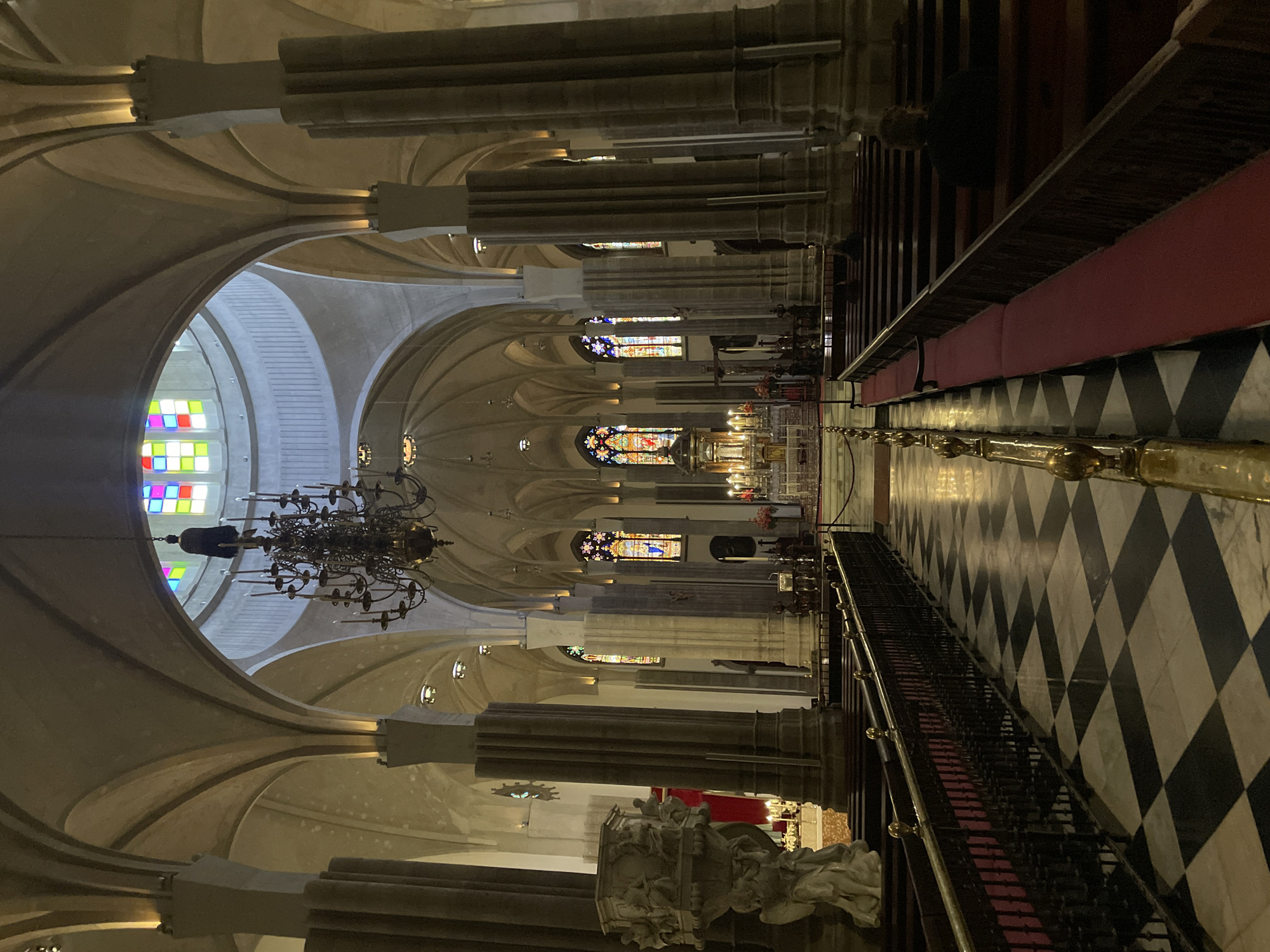
The image displays the interior of a grand cathedral or church, looking down a long central nave towards the distant altar area. The perspective highlights the impressive scale and architectural complexity of the building.

The ceiling features high, light-colored ribbed vaulting, characteristic of Gothic or Neo-Gothic architecture, supported by substantial, fluted columns lining both sides of the nave. Multiple ornate, dark metal chandeliers with many lights hang from the ceiling, contributing to the interior illumination.

Vibrant stained glass windows are visible on the left side, some featuring abstract geometric patterns in bright colors, while others depict detailed figures or scenes. A brightly lit area further down the nave, illuminated by more stained glass, appears to be the main altar or chancel, adorned with religious artifacts and candles.

The floor of the central aisle boasts a distinctive black and white checkered pattern. To the right, a long row of dark wooden pews with plush red cushions stretches along a side aisle, separated from the main walkway by a decorative black metal railing topped with gleaming brass finials. In the left foreground, a richly carved stone or marble sculpture base, possibly part of a pulpit or a monument, adds to the decorative elements.

The scene conveys a sense of solemn grandeur and historical depth. The building appears to be empty of people, suggesting a quiet moment. The lighting is a blend of natural light filtering through the stained glass and artificial illumination from the chandeliers and other fixtures, creating a serene and contemplative atmosphere. No visible text is present in the image.

The image displays the interior of a grand cathedral or church, looking down a long central nave towards the distant altar area. The perspective highlights the impressive scale and architectural complexity of the building. The ceiling features high, light-colored ribbed vaulting, characteristic of Gothic or Neo-Gothic architecture, supported by substantial, fluted columns lining both sides of the nave. Multiple ornate, dark metal chandeliers with many lights hang from the ceiling, contributing to the interior illumination. Vibrant stained glass windows are visible on the left side, some featuring abstract geometric patterns in bright colors, while others depict detailed figures or scenes. A brightly lit area further down the nave, illuminated by more stained glass, appears to be the main altar or chancel, adorned with religious artifacts and candles. The floor of the central aisle boasts a distinctive black and white checkered pattern. To the right, a long row of dark wooden pews with plush red cushions stretches along a side aisle, separated from the main walkway by a decorative black metal railing topped with gleaming brass finials. In the left foreground, a richly carved stone or marble sculpture base, possibly part of a pulpit or a monument, adds to the decorative elements. The scene conveys a sense of solemn grandeur and historical depth. The building appears to be empty of people, suggesting a quiet moment. The lighting is a blend of natural light filtering through the stained glass and artificial illumination from the chandeliers and other fixtures, creating a serene and contemplative atmosphere. No visible text is present in the image.

San Cristóbal De La Laguna
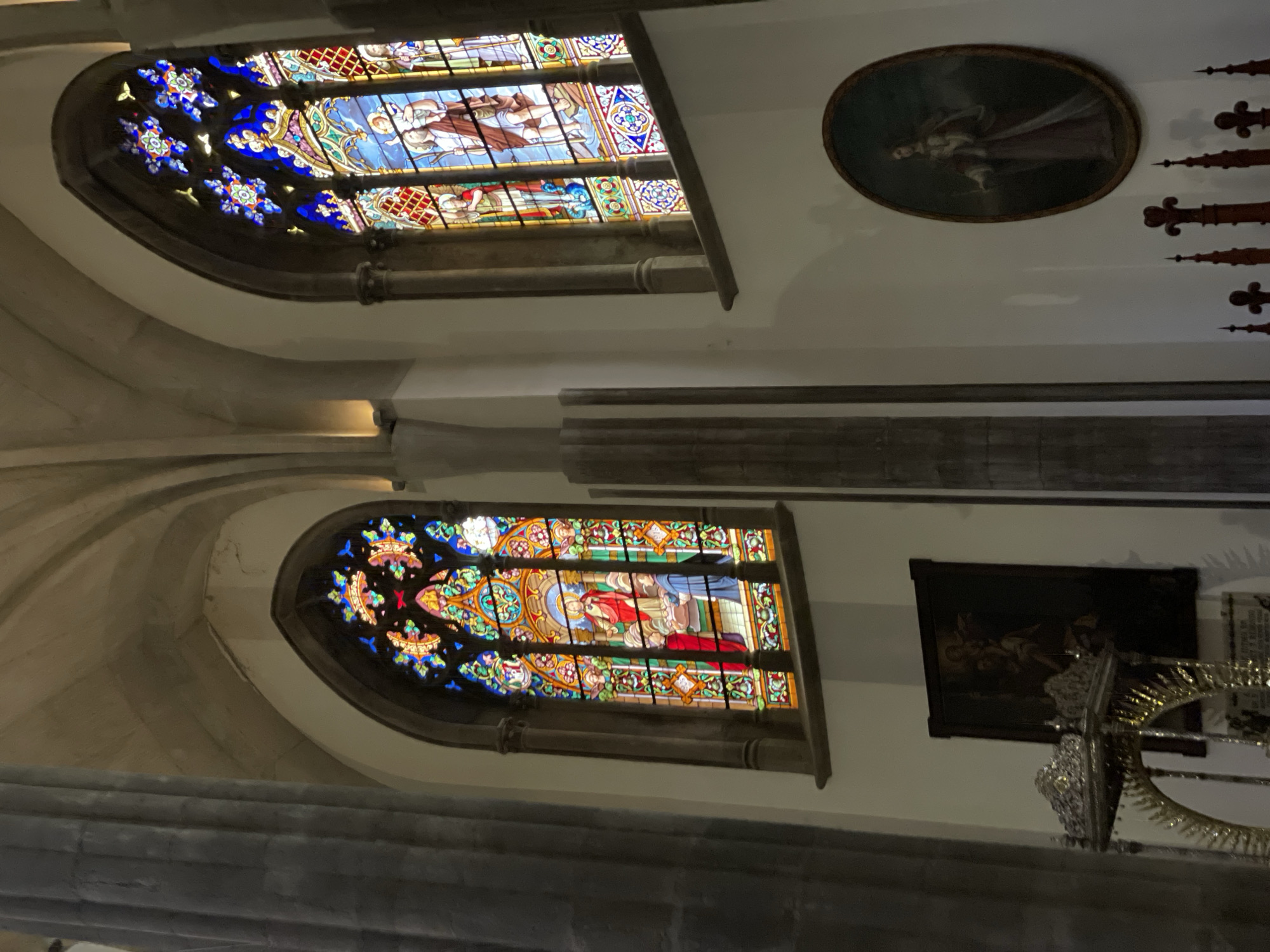
This media file captures the interior of a historic building, likely a church or cathedral, characterized by its architectural grandeur and religious art. The scene is dimly lit, with light primarily emanating from two large, ornate stained glass windows.

The upper section of the image features an arched stained glass window vibrant with blues, reds, greens, and yellows. It depicts religious figures, including a central figure with a halo, alongside other individuals. The upper parts of the arch are adorned with intricate floral or star-like patterns. To the right and slightly above this window, an oval-framed painting is visible on the light-colored wall. It portrays a solitary figure in flowing robes against a dark background, subtly highlighted by the ambient light. Further to the right, several dark, carved wooden spires or finials suggest decorative architectural elements.

A substantial dark beam or structural element spans horizontally across the middle of the image, dividing the upper and lower wall sections.

In the lower half, another large, arched stained glass window mirrors the style of the upper one, displaying vibrant religious narrative panels, with one figure prominently featured in a red cloak. To the right of this window, a rectangular painting is hung; it is very dark and indistinct, possibly depicting a multi-figured classical or religious scene. Below this painting, a highly ornate, gilded metal object with intricate scrollwork, possibly part of an altar or a large decorative fixture, reflects light.

The walls appear to be made of light-colored stone or plaster, providing a contrast to the darker architectural details and the glowing stained glass. The overall atmosphere conveys a sense of history, reverence, and artistic beauty. No specific activity or event is depicted, and no visible text is present. The setting is consistent with a religious building found in San Cristóbal De La Laguna, Spain.

This media file captures the interior of a historic building, likely a church or cathedral, characterized by its architectural grandeur and religious art. The scene is dimly lit, with light primarily emanating from two large, ornate stained glass windows. The upper section of the image features an arched stained glass window vibrant with blues, reds, greens, and yellows. It depicts religious figures, including a central figure with a halo, alongside other individuals. The upper parts of the arch are adorned with intricate floral or star-like patterns. To the right and slightly above this window, an oval-framed painting is visible on the light-colored wall. It portrays a solitary figure in flowing robes against a dark background, subtly highlighted by the ambient light. Further to the right, several dark, carved wooden spires or finials suggest decorative architectural elements. A substantial dark beam or structural element spans horizontally across the middle of the image, dividing the upper and lower wall sections. In the lower half, another large, arched stained glass window mirrors the style of the upper one, displaying vibrant religious narrative panels, with one figure prominently featured in a red cloak. To the right of this window, a rectangular painting is hung; it is very dark and indistinct, possibly depicting a multi-figured classical or religious scene. Below this painting, a highly ornate, gilded metal object with intricate scrollwork, possibly part of an altar or a large decorative fixture, reflects light. The walls appear to be made of light-colored stone or plaster, providing a contrast to the darker architectural details and the glowing stained glass. The overall atmosphere conveys a sense of history, reverence, and artistic beauty. No specific activity or event is depicted, and no visible text is present. The setting is consistent with a religious building found in San Cristóbal De La Laguna, Spain.

San Cristóbal De La Laguna

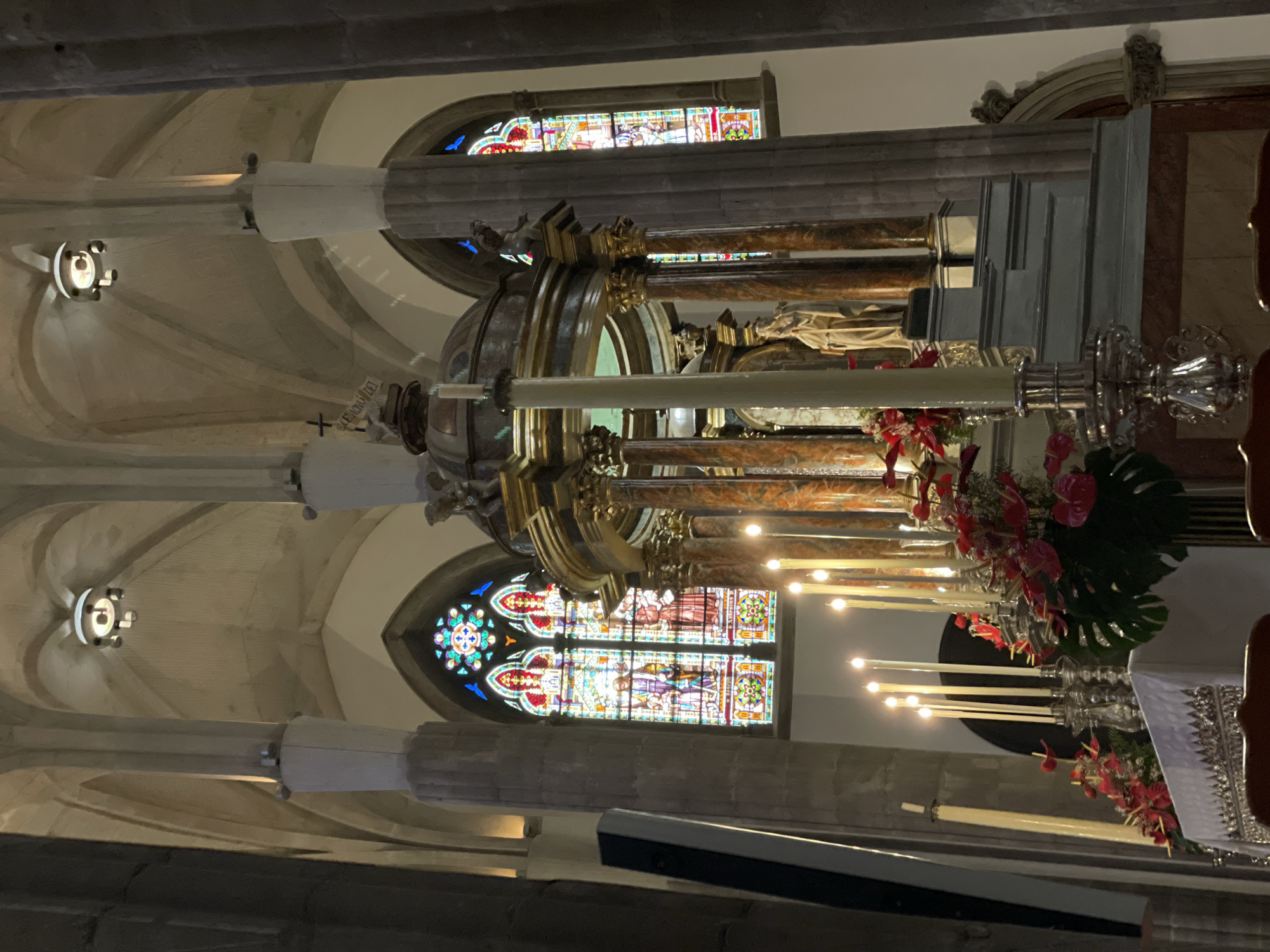
The image captures the elaborate interior of a church or cathedral, viewed from a side angle towards a richly decorated central structure. In the foreground and midground, an ornate processional float or altar, crafted from golden and dark wood with classical columns, is prominently displayed. It features statues of religious figures, several tall white candles in ornate candelabras (some lit), and vibrant floral arrangements of red flowers and large green Monstera leaves. A thick, unlit white candle lies horizontally across the midsection of the float.

In the background, two large, arched stained-glass windows, filled with colorful depictions of religious scenes, flank the central structure. Tall, light-colored fluted columns support a vaulted ceiling, typical of historical ecclesiastical architecture. Spotlights are visible on the ceiling and columns, providing illumination. On the right, a white cloth with intricate silver embroidery is partially visible.

The lighting within the church is dim, creating a solemn atmosphere, with the candles and stained glass serving as primary light sources. No people are present, but the arrangement strongly suggests a religious ceremony, a special event, or a processional display within the sacred space. A faint label with the numbers "177_000_177_379" is visible on a white strip attached to one of the columns. The setting is consistent with a church in San Cristóbal De La Laguna, Spain.

The image captures the elaborate interior of a church or cathedral, viewed from a side angle towards a richly decorated central structure. In the foreground and midground, an ornate processional float or altar, crafted from golden and dark wood with classical columns, is prominently displayed. It features statues of religious figures, several tall white candles in ornate candelabras (some lit), and vibrant floral arrangements of red flowers and large green Monstera leaves. A thick, unlit white candle lies horizontally across the midsection of the float. In the background, two large, arched stained-glass windows, filled with colorful depictions of religious scenes, flank the central structure. Tall, light-colored fluted columns support a vaulted ceiling, typical of historical ecclesiastical architecture. Spotlights are visible on the ceiling and columns, providing illumination. On the right, a white cloth with intricate silver embroidery is partially visible. The lighting within the church is dim, creating a solemn atmosphere, with the candles and stained glass serving as primary light sources. No people are present, but the arrangement strongly suggests a religious ceremony, a special event, or a processional display within the sacred space. A faint label with the numbers "177_000_177_379" is visible on a white strip attached to one of the columns. The setting is consistent with a church in San Cristóbal De La Laguna, Spain.

San Cristóbal De La Laguna
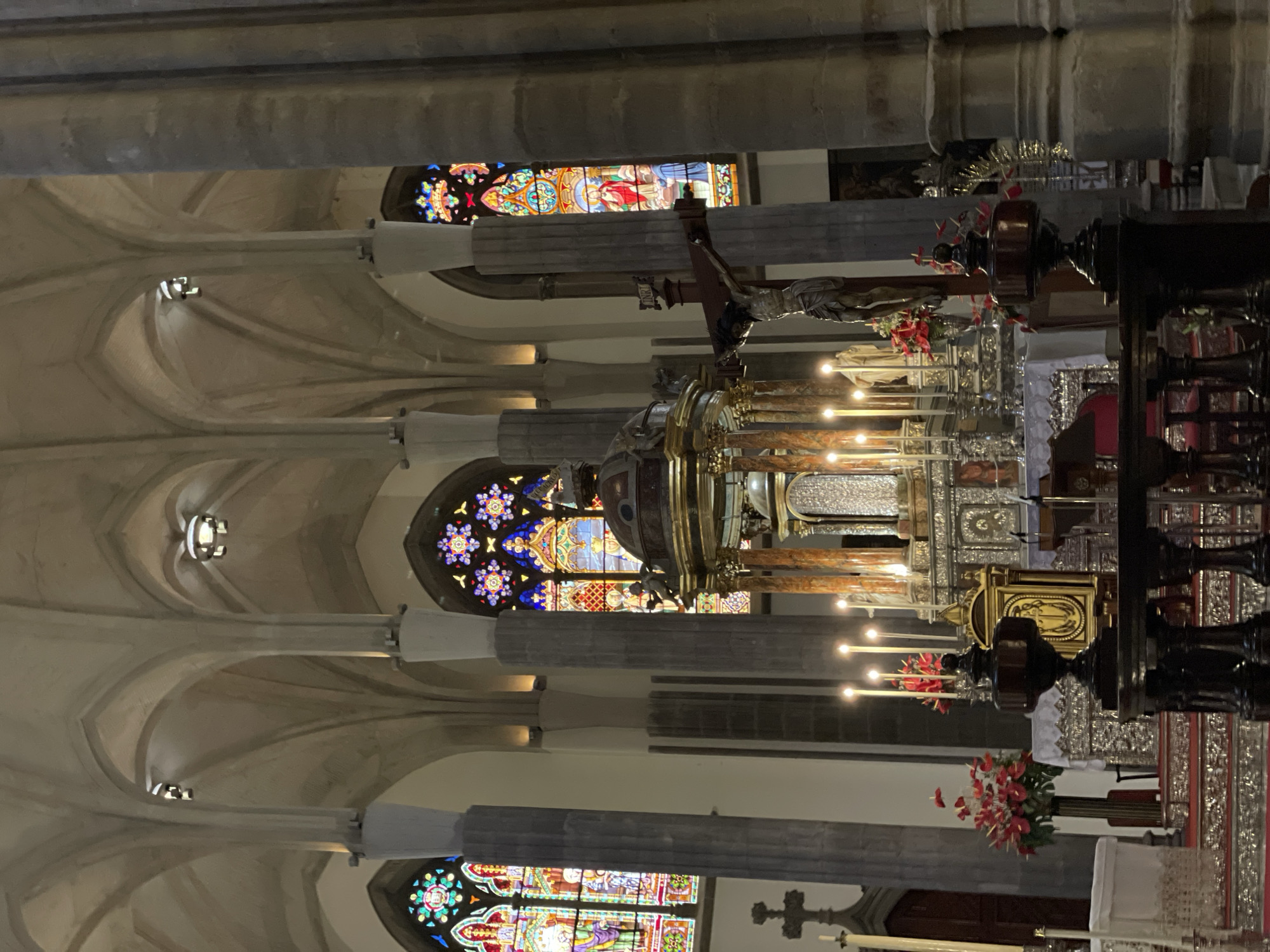
The image displays the grand interior of a church or cathedral in San Cristóbal De La Laguna, Spain. The scene is viewed from an aisle, looking towards the main altar.

**Subjects:** The dominant architectural features include tall, fluted stone columns with decorative capitals, which support elaborate vaulted ceilings in a light, neutral color. Multiple stained glass windows are visible, including round rose windows with intricate patterns and rectangular ones depicting religious figures and scenes. At the focal point is a highly ornate main altar or retable, featuring rich gold and silver elements. Above the altar stands a prominent crucifix with the figure of Christ, draped with small red and white pennants. A gold-colored structure, possibly a tabernacle or monstrance, is central to the altar. Another religious figure (possibly a statue) is partially visible to the left.

**Activity or event taking place:** No people are visible, and no specific activity or event is ongoing, presenting a quiet and contemplative scene within the sacred space.

**Notable details:** The interior is dimly lit, with light primarily emanating from the vibrant stained glass windows, suggesting it is daytime. Lit candles on the altar contribute to the ambiance, and arrangements of red flowers adorn the altar and a nearby pedestal, adding color to the solemn setting. The inscription "INRI" is clearly visible above the figure of Christ on the crucifix. The grandeur of the architecture and the religious artifacts evoke a sense of reverence and spiritual solemnity.

The image displays the grand interior of a church or cathedral in San Cristóbal De La Laguna, Spain. The scene is viewed from an aisle, looking towards the main altar. **Subjects:** The dominant architectural features include tall, fluted stone columns with decorative capitals, which support elaborate vaulted ceilings in a light, neutral color. Multiple stained glass windows are visible, including round rose windows with intricate patterns and rectangular ones depicting religious figures and scenes. At the focal point is a highly ornate main altar or retable, featuring rich gold and silver elements. Above the altar stands a prominent crucifix with the figure of Christ, draped with small red and white pennants. A gold-colored structure, possibly a tabernacle or monstrance, is central to the altar. Another religious figure (possibly a statue) is partially visible to the left. **Activity or event taking place:** No people are visible, and no specific activity or event is ongoing, presenting a quiet and contemplative scene within the sacred space. **Notable details:** The interior is dimly lit, with light primarily emanating from the vibrant stained glass windows, suggesting it is daytime. Lit candles on the altar contribute to the ambiance, and arrangements of red flowers adorn the altar and a nearby pedestal, adding color to the solemn setting. The inscription "INRI" is clearly visible above the figure of Christ on the crucifix. The grandeur of the architecture and the religious artifacts evoke a sense of reverence and spiritual solemnity.

San Cristóbal De La Laguna
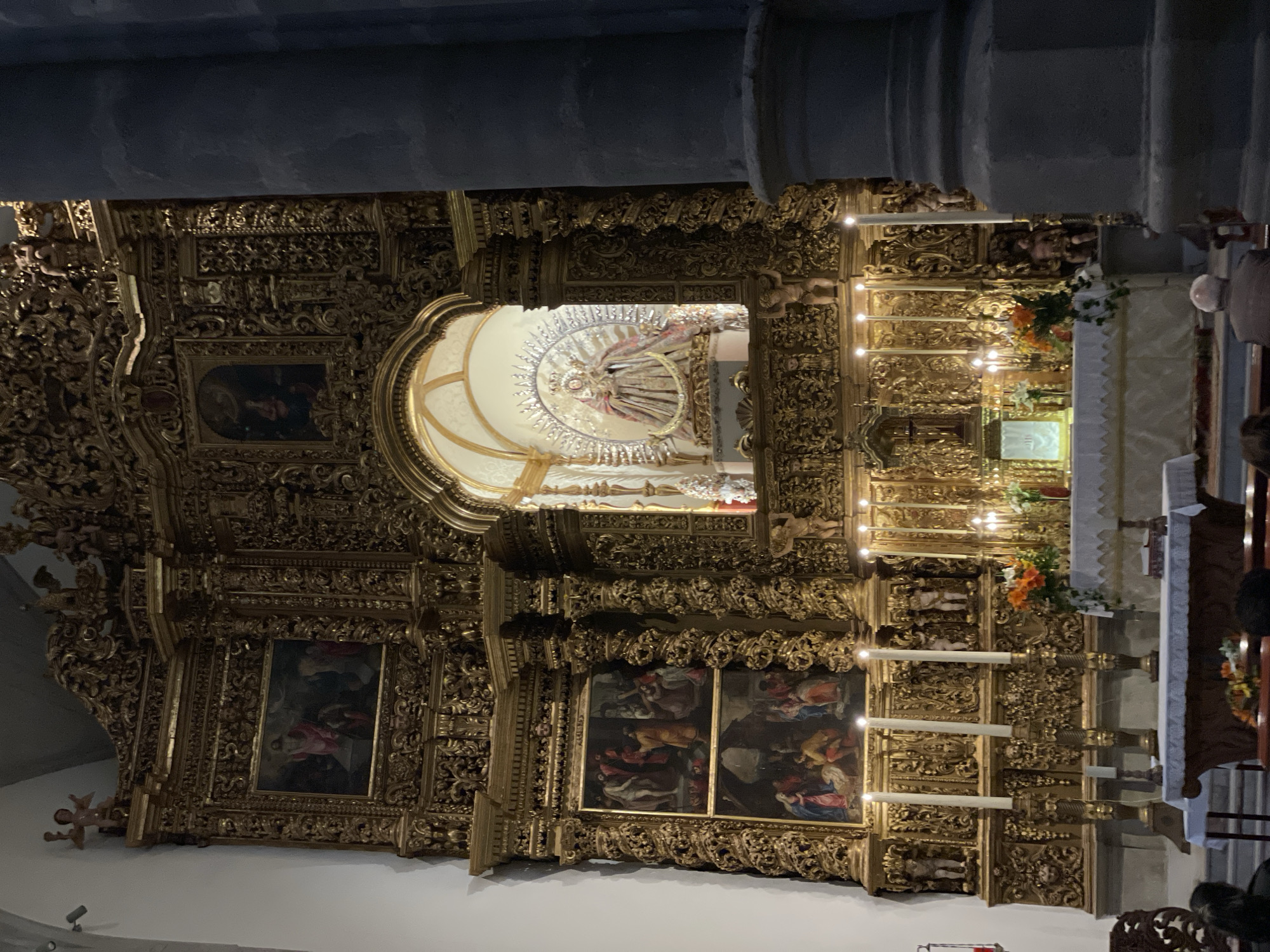
This media file captures the interior of a highly ornate church, specifically focusing on its grand, golden altarpiece, also known as a retablo. The altarpiece dominates the scene with intricate Baroque-style carving, featuring elaborate scrollwork, columns, and decorative elements.

At the center of the altarpiece is a prominent niche housing a statue, likely of a saint or the Virgin Mary, depicted with a radiant sunburst or halo surrounding its head and body. Integrated into the golden structure are several framed paintings, depicting religious scenes with multiple figures in various poses and dark backgrounds.

Below the main altarpiece, an altar is visible, draped in a white cloth. It is adorned with floral arrangements containing orange and white flowers and features a small, illuminated tabernacle or reliquary. Multiple candelabras hold lit white candles, casting a soft glow and contributing to the reverent atmosphere. The candles are placed at different levels on either side of the altar and further up on the altarpiece.

Large, grey stone pillars or columns frame parts of the scene, suggesting the overall architectural style of the church. In the foreground, parts of people's heads and shoulders are visible, indicating the presence of a congregation or visitors attending a service or moment of devotion.

The setting is indoors, with lighting primarily provided by the candles, suggesting either evening or a dimly lit interior. The opulent and detailed craftsmanship of the altarpiece is characteristic of Spanish Baroque art, aligning with the provided location context of San Cristóbal De La Laguna, Spain. There is no discernible text visible in the image.

This media file captures the interior of a highly ornate church, specifically focusing on its grand, golden altarpiece, also known as a retablo. The altarpiece dominates the scene with intricate Baroque-style carving, featuring elaborate scrollwork, columns, and decorative elements. At the center of the altarpiece is a prominent niche housing a statue, likely of a saint or the Virgin Mary, depicted with a radiant sunburst or halo surrounding its head and body. Integrated into the golden structure are several framed paintings, depicting religious scenes with multiple figures in various poses and dark backgrounds. Below the main altarpiece, an altar is visible, draped in a white cloth. It is adorned with floral arrangements containing orange and white flowers and features a small, illuminated tabernacle or reliquary. Multiple candelabras hold lit white candles, casting a soft glow and contributing to the reverent atmosphere. The candles are placed at different levels on either side of the altar and further up on the altarpiece. Large, grey stone pillars or columns frame parts of the scene, suggesting the overall architectural style of the church. In the foreground, parts of people's heads and shoulders are visible, indicating the presence of a congregation or visitors attending a service or moment of devotion. The setting is indoors, with lighting primarily provided by the candles, suggesting either evening or a dimly lit interior. The opulent and detailed craftsmanship of the altarpiece is characteristic of Spanish Baroque art, aligning with the provided location context of San Cristóbal De La Laguna, Spain. There is no discernible text visible in the image.

San Cristóbal De La Laguna
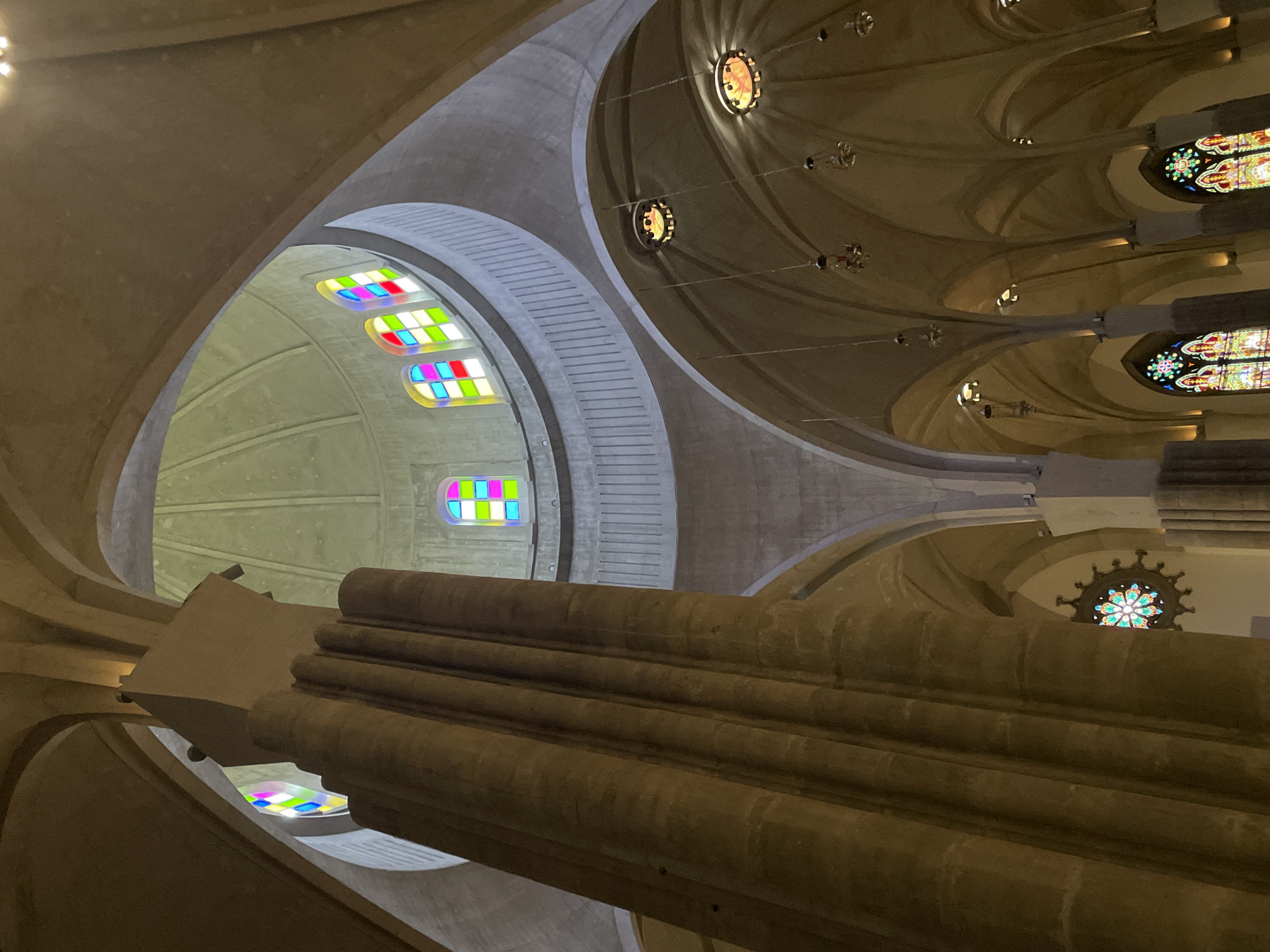
The image presents an upward-looking view inside a monumental architectural space, showcasing its intricate ceiling and upper structural elements. The scene is dominated by massive, smooth, and organically shaped columns and vaulted ceilings, likely constructed from concrete or light-colored stone. These structural elements branch out and converge, creating a complex, tree-like canopy effect overhead.

Several stained glass windows illuminate the interior. On the left side of the frame, a series of rectangular windows feature a modern, abstract design with bright, distinct blocks of primary and secondary colors (red, green, blue, yellow, magenta, cyan, white) arranged in a grid. Further into the distance and towards the right, other circular or rosette-shaped stained glass windows display more traditional, ornate patterns with a vibrant mix of colors.

Small, warm-toned light fixtures are subtly integrated into the ceiling vaults and along the structural arches, contributing to the overall subdued and majestic illumination. The architecture is characterized by sweeping curves, geometric precision, and a blend of modern and organic forms, creating a sense of grandeur and awe.

There are no people or specific activities depicted; the focus is entirely on the building's interior. The overall lighting is warm, suggesting an ambient or artificial light source complementing any natural light filtering through the stained glass. No visible text is present in the image. The location context provided is San Cristóbal De La Laguna, Spain.

The image presents an upward-looking view inside a monumental architectural space, showcasing its intricate ceiling and upper structural elements. The scene is dominated by massive, smooth, and organically shaped columns and vaulted ceilings, likely constructed from concrete or light-colored stone. These structural elements branch out and converge, creating a complex, tree-like canopy effect overhead. Several stained glass windows illuminate the interior. On the left side of the frame, a series of rectangular windows feature a modern, abstract design with bright, distinct blocks of primary and secondary colors (red, green, blue, yellow, magenta, cyan, white) arranged in a grid. Further into the distance and towards the right, other circular or rosette-shaped stained glass windows display more traditional, ornate patterns with a vibrant mix of colors. Small, warm-toned light fixtures are subtly integrated into the ceiling vaults and along the structural arches, contributing to the overall subdued and majestic illumination. The architecture is characterized by sweeping curves, geometric precision, and a blend of modern and organic forms, creating a sense of grandeur and awe. There are no people or specific activities depicted; the focus is entirely on the building's interior. The overall lighting is warm, suggesting an ambient or artificial light source complementing any natural light filtering through the stained glass. No visible text is present in the image. The location context provided is San Cristóbal De La Laguna, Spain.

San Cristóbal De La Laguna
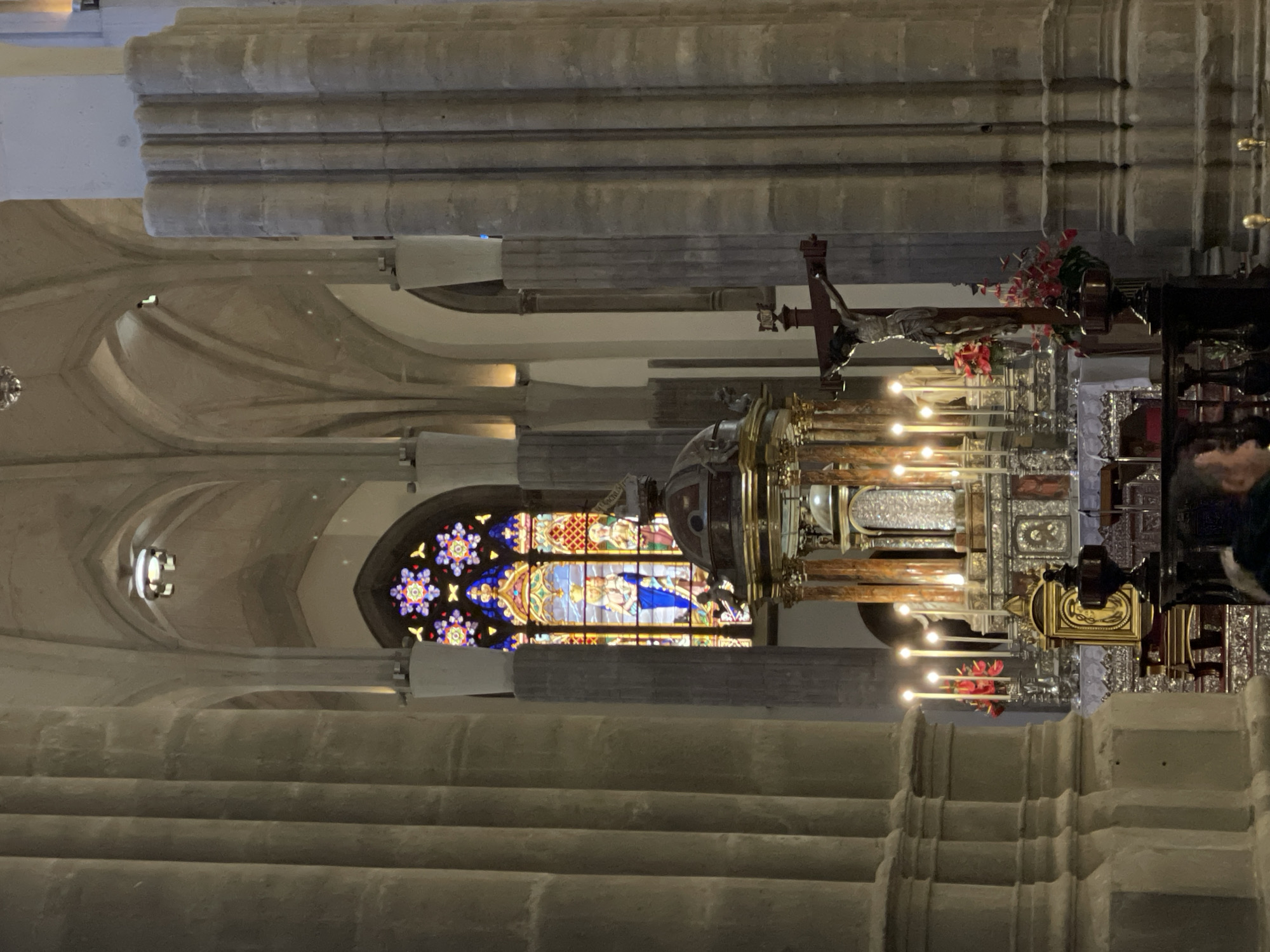
The image displays the interior of a grand religious building, likely a church or cathedral, in San Cristóbal De La Laguna, Spain. Massive, fluted stone columns rise vertically, supporting vaulted ceilings and intricate architectural details. The overall setting is characterized by a solemn and historic atmosphere.

The central focus is an ornate altar area in the mid-ground. A prominent wooden crucifix, depicting the figure of Jesus Christ, is positioned above this structure. Below it, a richly decorated shrine or tabernacle gleams with golden and silver elements, adorned with intricate patterns and reflective surfaces. Several lit candles in tall candelabras cast a warm glow, interspersed with red floral decorations. Behind this, large, reflective panels with embossed or engraved designs appear to be made of silver or polished metal.

To the left of the altar, a vibrant stained-glass window stands out, illuminating the space with a burst of color. The window features religious figures, including a central figure predominantly in blue and yellow, surrounded by elaborate circular and star-like patterns in hues of red, purple, and green.

The lighting within the space is dim, augmented by the glow of the candles and various artificial light fixtures on the vaulted arches, suggesting either evening or a subdued interior environment. A partial view of a person's head and shoulder is visible on the far right, near the altar. No discernible text is visible in the image.

The image displays the interior of a grand religious building, likely a church or cathedral, in San Cristóbal De La Laguna, Spain. Massive, fluted stone columns rise vertically, supporting vaulted ceilings and intricate architectural details. The overall setting is characterized by a solemn and historic atmosphere. The central focus is an ornate altar area in the mid-ground. A prominent wooden crucifix, depicting the figure of Jesus Christ, is positioned above this structure. Below it, a richly decorated shrine or tabernacle gleams with golden and silver elements, adorned with intricate patterns and reflective surfaces. Several lit candles in tall candelabras cast a warm glow, interspersed with red floral decorations. Behind this, large, reflective panels with embossed or engraved designs appear to be made of silver or polished metal. To the left of the altar, a vibrant stained-glass window stands out, illuminating the space with a burst of color. The window features religious figures, including a central figure predominantly in blue and yellow, surrounded by elaborate circular and star-like patterns in hues of red, purple, and green. The lighting within the space is dim, augmented by the glow of the candles and various artificial light fixtures on the vaulted arches, suggesting either evening or a subdued interior environment. A partial view of a person's head and shoulder is visible on the far right, near the altar. No discernible text is visible in the image.

San Cristóbal De La Laguna
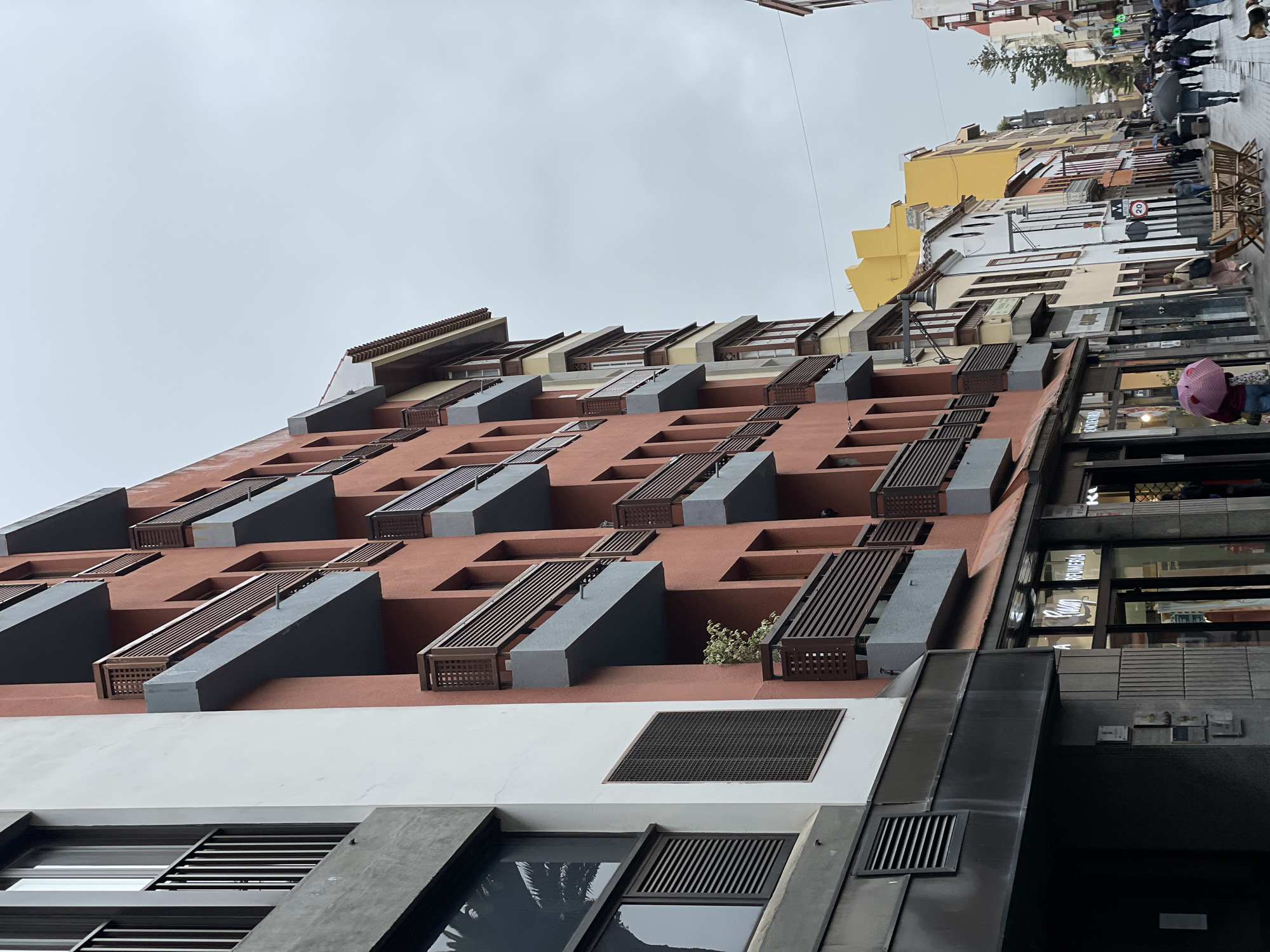
The image shows a street view in San Cristóbal De La Laguna, Spain, focusing on a modern building facade. The building is characterized by a reddish-brown exterior with projecting, angular gray balconies and wooden lattice screens. The lower portion of the building is white with rectangular ventilation grates. The building rises up and along the right edge a street is seen with people walking under umbrellas. Various shops with large glass windows are visible, and the facades of other buildings line the street. The sky is overcast.

The image shows a street view in San Cristóbal De La Laguna, Spain, focusing on a modern building facade. The building is characterized by a reddish-brown exterior with projecting, angular gray balconies and wooden lattice screens. The lower portion of the building is white with rectangular ventilation grates. The building rises up and along the right edge a street is seen with people walking under umbrellas. Various shops with large glass windows are visible, and the facades of other buildings line the street. The sky is overcast.

San Cristóbal De La Laguna
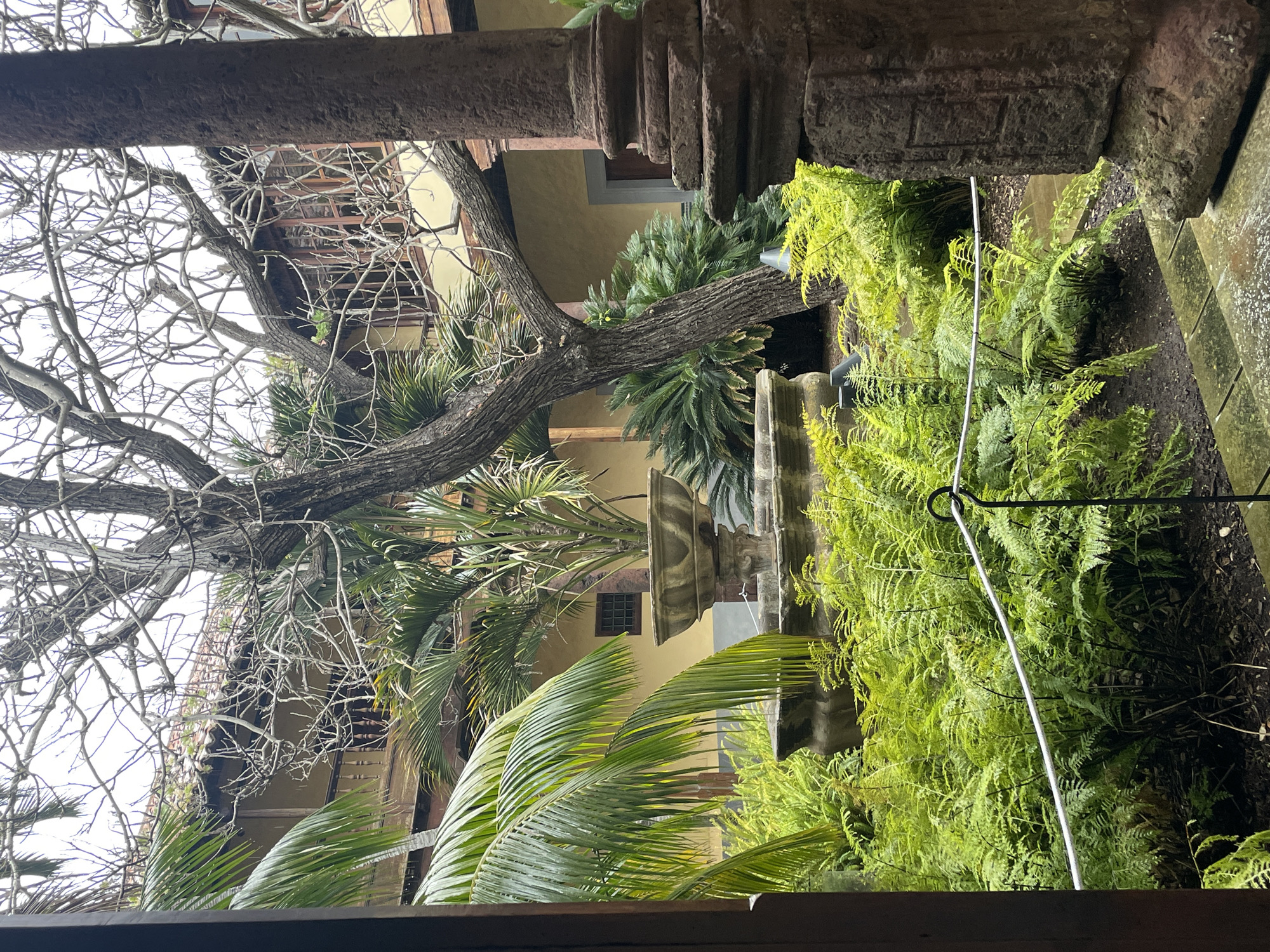
This media file captures a serene, verdant courtyard, likely part of a historic building in San Cristóbal De La Laguna, Spain. The perspective is from under a dark wooden beam, looking into the enclosed space.

The main subjects are a mix of lush vegetation and historic architecture. A prominent feature is a large, mature tree with an expansive network of bare, gnarled branches reaching towards a bright, overcast sky on the left. This deciduous tree contrasts with several vibrant green palm trees, including large-fronded varieties and smaller, sago-like palms, which are scattered throughout the courtyard. On the right, a dense bed of bright green ferns flourishes, adding a rich texture to the ground level. Partially visible within the foliage is a multi-tiered stone fountain, suggesting a central decorative element.

The courtyard is defined by sturdy, ornate stone pillars or columns, one of which is prominent in the upper right, displaying carved details. The building walls, visible through the trees and greenery, are a warm, light yellow or cream color, featuring windows with traditional wooden grilles or panes. A thin, silver-colored rod or wire extends diagonally through the ferns, possibly acting as a plant support.

The scene conveys a peaceful and tranquil atmosphere. The soft, diffused lighting indicates an overcast day, contributing to the serene mood. No human activity or visible text is present in the image. The architectural style, combined with the mix of foliage, strongly suggests a historical setting typical of Spanish or Mediterranean courtyards.

This media file captures a serene, verdant courtyard, likely part of a historic building in San Cristóbal De La Laguna, Spain. The perspective is from under a dark wooden beam, looking into the enclosed space. The main subjects are a mix of lush vegetation and historic architecture. A prominent feature is a large, mature tree with an expansive network of bare, gnarled branches reaching towards a bright, overcast sky on the left. This deciduous tree contrasts with several vibrant green palm trees, including large-fronded varieties and smaller, sago-like palms, which are scattered throughout the courtyard. On the right, a dense bed of bright green ferns flourishes, adding a rich texture to the ground level. Partially visible within the foliage is a multi-tiered stone fountain, suggesting a central decorative element. The courtyard is defined by sturdy, ornate stone pillars or columns, one of which is prominent in the upper right, displaying carved details. The building walls, visible through the trees and greenery, are a warm, light yellow or cream color, featuring windows with traditional wooden grilles or panes. A thin, silver-colored rod or wire extends diagonally through the ferns, possibly acting as a plant support. The scene conveys a peaceful and tranquil atmosphere. The soft, diffused lighting indicates an overcast day, contributing to the serene mood. No human activity or visible text is present in the image. The architectural style, combined with the mix of foliage, strongly suggests a historical setting typical of Spanish or Mediterranean courtyards.

San Cristóbal De La Laguna
This image captures a vibrant, upward-looking view through lush green palm fronds towards a traditional building under a bright sky. The scene is dominated by two large palm fronds that arc gracefully across the frame, their fronds detailed and casting soft shadows, with some areas brightly backlit by the overhead light.

In the foreground, a sturdy, weathered wooden beam or railing runs horizontally across the bottom, showing natural wear and texture. Behind the palm foliage and the foreground wood, a building with a warm, light yellow or ochre-colored facade is visible. Distinctive architectural features include a dark wooden balcony or balustrade with intricate turned spindles, suggesting a classic or colonial style. Further back, dark wooden elements, possibly a door or window frame, are partially obscured by the leaves. Above the building wall, a weathered, dark-tiled roof with undulating lines is visible, and small green succulent plants appear to be growing on its edge.

The bright, white area in the upper left suggests a clear, sunny daytime sky. The overall impression is one of warmth and tropical or Mediterranean ambiance. No activity is depicted, and no text is visible. The architectural style aligns with what might be found in a historical location like San Cristóbal De La Laguna, Spain.

This image captures a vibrant, upward-looking view through lush green palm fronds towards a traditional building under a bright sky. The scene is dominated by two large palm fronds that arc gracefully across the frame, their fronds detailed and casting soft shadows, with some areas brightly backlit by the overhead light. In the foreground, a sturdy, weathered wooden beam or railing runs horizontally across the bottom, showing natural wear and texture. Behind the palm foliage and the foreground wood, a building with a warm, light yellow or ochre-colored facade is visible. Distinctive architectural features include a dark wooden balcony or balustrade with intricate turned spindles, suggesting a classic or colonial style. Further back, dark wooden elements, possibly a door or window frame, are partially obscured by the leaves. Above the building wall, a weathered, dark-tiled roof with undulating lines is visible, and small green succulent plants appear to be growing on its edge. The bright, white area in the upper left suggests a clear, sunny daytime sky. The overall impression is one of warmth and tropical or Mediterranean ambiance. No activity is depicted, and no text is visible. The architectural style aligns with what might be found in a historical location like San Cristóbal De La Laguna, Spain.

San Cristóbal De La Laguna
This media file presents an intricately detailed architectural model of a city, likely San Cristóbal De La Laguna, Spain, viewed from an elevated, slightly oblique perspective. The model features numerous buildings constructed from materials resembling light beige or yellow walls with reddish-brown tiled roofs, typical of historical European architecture. Many structures also incorporate dark flat roofs, suggesting different architectural styles or modern additions within the representation.

A prominent feature is a tall, dark tower with several levels and arched openings, standing amidst the densely packed miniature buildings. Streets are depicted in a dark grey color, with lighter grey elements possibly representing sidewalks or road markings. Other areas within the model show textured ground, some appearing cobbled or unpaved. The scale of the model suggests a significant level of detail, showcasing a complex urban layout with various building types and configurations, including courtyards and open spaces.

In the background, outside the model's immediate area, an indoor setting is visible. This includes a yellow painted wall, a grey painted wall, and some wooden structures or beams. A red fire extinguisher with unreadable white text is affixed to the yellow wall. No specific activity or event is taking place within the static model; it serves as a visual representation of the city's architecture and layout. The lighting appears to be artificial, indicative of an exhibition or display setting.

This media file presents an intricately detailed architectural model of a city, likely San Cristóbal De La Laguna, Spain, viewed from an elevated, slightly oblique perspective. The model features numerous buildings constructed from materials resembling light beige or yellow walls with reddish-brown tiled roofs, typical of historical European architecture. Many structures also incorporate dark flat roofs, suggesting different architectural styles or modern additions within the representation. A prominent feature is a tall, dark tower with several levels and arched openings, standing amidst the densely packed miniature buildings. Streets are depicted in a dark grey color, with lighter grey elements possibly representing sidewalks or road markings. Other areas within the model show textured ground, some appearing cobbled or unpaved. The scale of the model suggests a significant level of detail, showcasing a complex urban layout with various building types and configurations, including courtyards and open spaces. In the background, outside the model's immediate area, an indoor setting is visible. This includes a yellow painted wall, a grey painted wall, and some wooden structures or beams. A red fire extinguisher with unreadable white text is affixed to the yellow wall. No specific activity or event is taking place within the static model; it serves as a visual representation of the city's architecture and layout. The lighting appears to be artificial, indicative of an exhibition or display setting.

San Cristóbal De La Laguna