San Lorenzo De El Escorial, Spain
30 memories from San Lorenzo De El Escorial, Spain
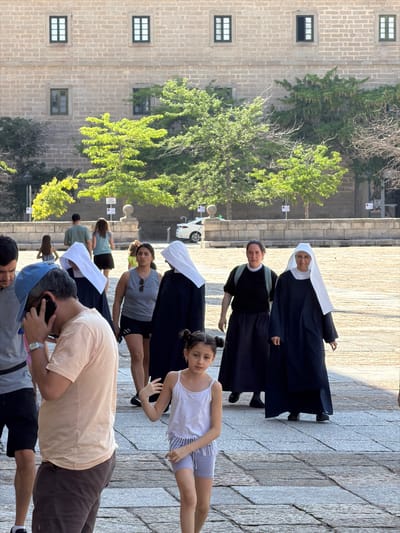
The image depicts a scene in the courtyard of El Escorial, located in San Lorenzo de El Escorial, Spain. In the foreground, a man wearing a blue cap and a light-colored t-shirt is on the phone. To his right, a young girl in a white tank top and light purple shorts walks past. Behind them, several women in nun habits are walking. One nun, in a black habit and white veil, is facing forward. Another nun, also in a black habit and white veil, is walking behind and to the left of the first. To the left of these nuns, another woman in a dark habit and white veil is visible. Further back, two women in casual clothing are walking away from the camera, and two other figures are partially visible. The background features a large stone building with multiple windows, and green trees. The ground is paved with large, grey stone slabs.
San Lorenzo De El Escorial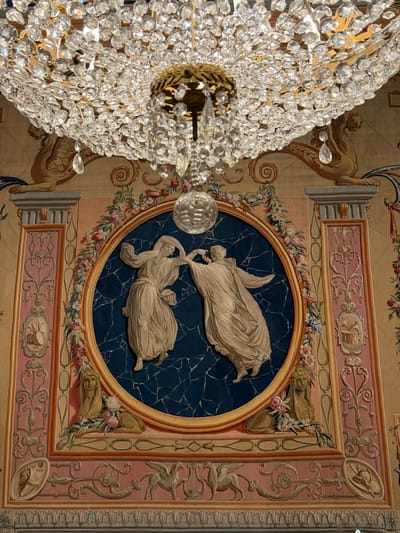
The image shows a close-up of a crystal chandelier hanging above a tapestry. The tapestry depicts two figures in flowing robes dancing within a circular frame, surrounded by floral motifs and architectural elements. The figures appear to be engaged in a graceful movement, possibly a duet. The overall scene is rich in detail and suggests an opulent setting. This particular tapestry is located in the Royal Tapestry Hall of the Monastery of San Lorenzo de El Escorial, a historical residence of the King of Spain, situated in San Lorenzo de El Escorial, Spain.
San Lorenzo De El Escorial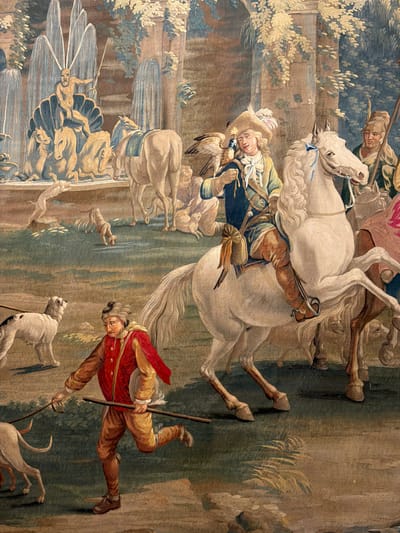
This is a detailed tapestry depicting a hunting scene in a garden setting. In the foreground, a young man in a red jacket and yellow breeches runs while holding a stick, leading two dogs. Behind him, a man on a white horse, wearing a hat and a blue jacket, holds a bird of prey. Another man on horseback, in green and brown attire, is partially visible in the background. The background features a fountain with a figure of Neptune, several other horses, and lush foliage, suggesting a park or palace grounds. The tapestry is likely displayed within the Royal Site of San Lorenzo de El Escorial, Spain, a historic royal palace and monastery.
San Lorenzo De El Escorial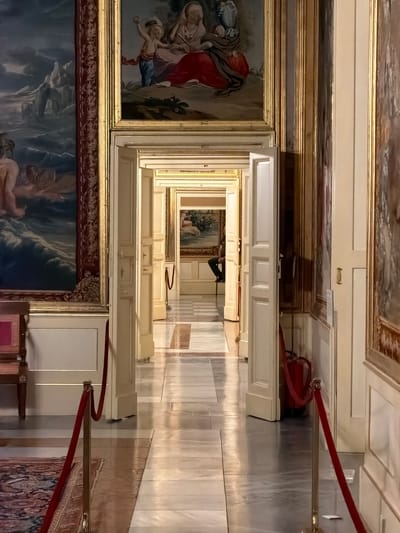
The image depicts a long, ornate hallway within a grand building, likely a palace or museum. The hallway is lined with large, elaborately framed paintings displayed on the walls. The architecture features classic design elements, including tall, white-paneled doors and high ceilings with decorative moldings. Sunlight streams in from unseen windows, casting long shadows and highlighting the polished marble floors, creating a dramatic and somewhat disorienting perspective due to the camera's vertical orientation. In the foreground, a large, dark-framed painting is partially visible, featuring what appears to be a mythological or biblical scene with dramatic lighting and figures. To the left, another framed artwork shows figures in rich red and blue robes, possibly a religious depiction. Further down the hallway, more paintings are visible, receding into the distance, creating a sense of depth and grandeur. A red velvet rope barrier, supported by brass stanchions, runs along the right side of the hallway, guiding visitors and indicating that the area may be an exhibition space. In the mid-ground, a fire extinguisher is mounted on the wall near a doorway, a practical safety detail within the opulent setting. The overall impression is one of historical significance and artistic wealth, likely within a well-preserved cultural heritage site. The lighting suggests it is daytime, and there are no indications of weather. The scene evokes a sense of quiet contemplation and admiration for the art and architecture.
San Lorenzo De El Escorial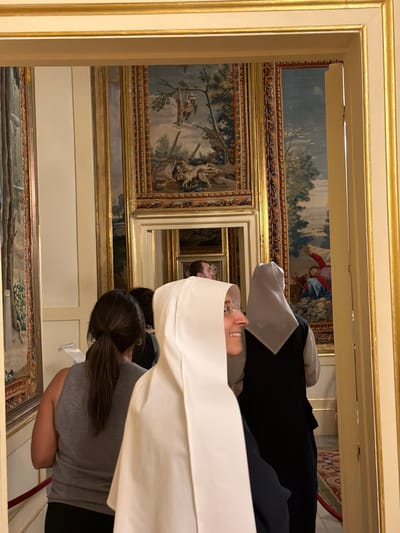
The image shows a group of people inside a richly decorated building, possibly a museum or historical site, in San Lorenzo de El Escorial, Spain. In the foreground, three individuals are visible, two of whom are wearing nun's habits. The woman on the far left is wearing a grey tank top and has her hair tied back in a ponytail. The central figure, a nun, is wearing a white habit and smiling as she looks to her right. Behind her, another nun in a grey habit is partially visible. Further back, through a doorway with a gold frame, a man is reflected in a mirror, looking upwards. The walls are adorned with large, ornate tapestries depicting pastoral or historical scenes. The flooring appears to be tiled with a decorative pattern. The environment suggests a formal and artistic setting.
San Lorenzo De El Escorial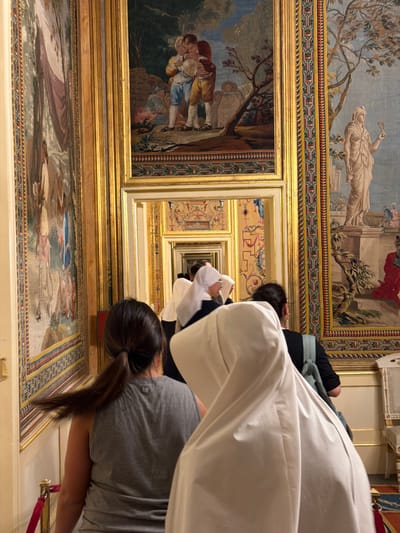
The image shows a group of people looking at tapestries in a richly decorated hall. The hall features ornate gold frames surrounding several large, colorful tapestries depicting classical scenes with figures. The tapestries are arranged in a way that creates a sense of depth, with some appearing to recede into the distance. The people in the image are observing the artwork, with one person in the foreground wearing a grey t-shirt and another in a white robe. The setting appears to be a museum or historical building, possibly the San Lorenzo de El Escorial in Spain, given the context. The lighting suggests an indoor environment, possibly illuminated by artificial lights or natural light filtering in from windows. The mood seems to be one of quiet contemplation and appreciation of the art. There is no visible text in the image.
San Lorenzo De El Escorial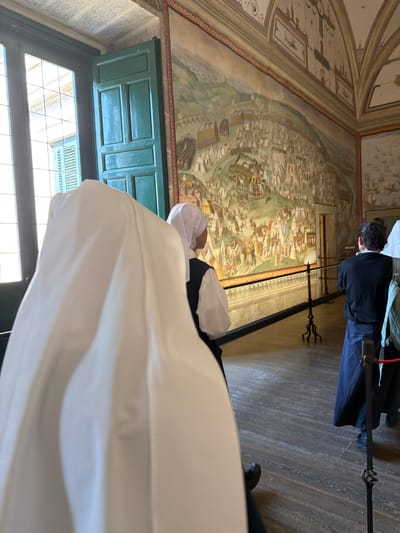
In the Palace of the Escorial, San Lorenzo De El Escorial, Spain, two people dressed as nuns stand in a room with a large mural on the wall. The first nun, in the foreground, is mostly obscured by a large white habit, with only a white wimple visible. The second nun, in the middle ground, wears a white wimple and a dark vest over a white shirt, with her back to the camera. A third person, a man in a black shirt and dark pants, stands further back in the room. The room has a wooden floor and a large mural depicting a historical scene covers the wall. A velvet rope barrier separates the visitors from the mural. A window with green shutters is visible on the left side of the image.
San Lorenzo De El Escorial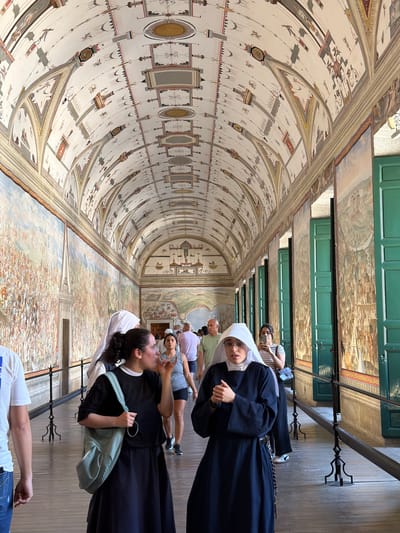
The image depicts an interior walkway within the Royal Site of San Lorenzo de El Escorial in Spain. The walkway is characterized by a vaulted ceiling adorned with intricate frescoes, featuring geometric patterns and various figures. Along the walls, large-scale paintings depict historical scenes, with a prominent mural on the left showing a multitude of people. Green shutters are visible on the right side, set within arched openings. Several individuals are present in the walkway, appearing to be tourists or visitors. In the foreground, two women are visible. One, on the left, is wearing a black dress and a light blue shoulder bag and is gesturing with her hand. To her right and slightly behind her, a nun in a dark blue habit and white wimple is looking towards the viewer, with her hands clasped. Other people are seen further down the walkway, including a man in a light green shirt and a woman holding a smartphone. The floor is made of wooden planks, and a black metal railing runs along the right side of the walkway, separating it from the wall murals. The lighting suggests it is daytime, with natural light entering from unseen sources.
San Lorenzo De El Escorial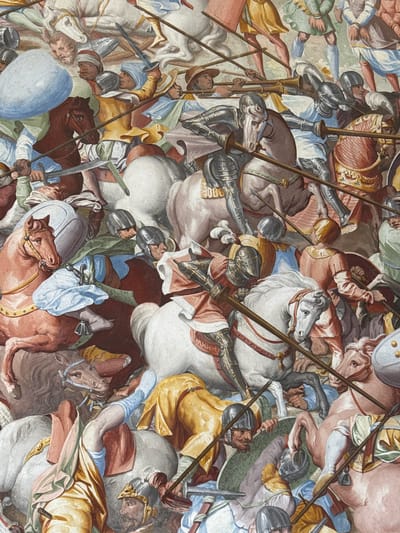
This is a fresco painting depicting a chaotic battle scene with many figures on horseback. The subjects are soldiers in historical armor and clothing, wielding spears, swords, and shields. Several horses are prominently featured, some white, others brown and grey. The composition is dense, with figures overlapping and creating a sense of intense action. The color palette includes muted tones of browns, greys, whites, and reds, with accents of blue and yellow. The event captured is a fierce cavalry engagement. Soldiers are shown lunging with their weapons, and the horses appear to be in full gallop, adding to the dynamism of the scene. The expressions on the faces of the soldiers are difficult to discern due to the scale and style of the painting, but the overall impression is one of intense conflict and struggle. Notable details include the ornate armor worn by some of the riders and the various styles of helmets and shields. The fresco appears to be a ceiling or wall painting, given its perspective and the way the figures are arranged. There are no visible cues for time of day or weather. The setting is an interior space, likely a grand hall or chapel, suggested by the fresco style and historical context of San Lorenzo De El Escorial, Spain. No visible text is present in the image.
San Lorenzo De El Escorial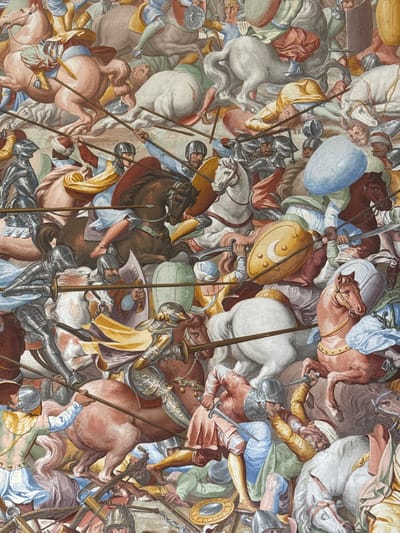
This is a section of a fresco painting depicting a chaotic battle scene on horseback. Numerous figures, both human and equine, are tightly packed together, suggesting a fierce and overwhelming conflict. The people are depicted in a variety of armor and clothing, some wearing elaborate metal suits and helmets, while others are clad in tunics and head coverings. They are engaged in combat, wielding swords, daggers, and lances. Horses are also shown in various states of distress and action, with some appearing to fall or be wounded. The scene is rendered in rich, vibrant colors, with prominent use of reds, browns, golds, and blues. The details suggest a historical or mythological setting, with an emphasis on the physicality and violence of warfare. There are no overt indications of the time of day or weather, and the setting is abstract, focusing solely on the action. The overall mood is one of intense struggle and disarray, with a sense of urgency and desperation conveyed through the contorted bodies and aggressive postures of the combatants. No visible text is present in the image.
San Lorenzo De El Escorial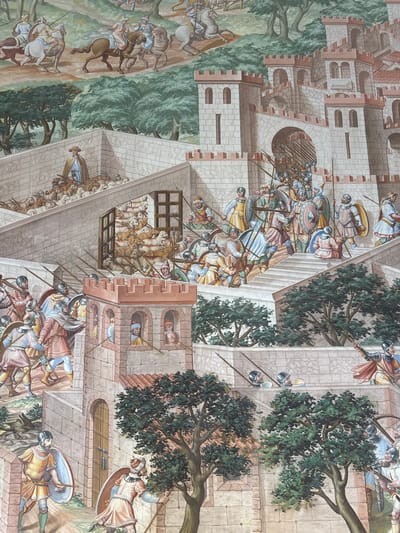
This fresco depicts a bustling scene of military activity and civilian life within and around a fortified city, likely San Lorenzo de El Escorial, Spain, given its characteristic architectural style. The fresco showcases multiple levels and elements. In the upper portion, horsemen in historical attire are depicted moving across a landscape with trees. Below them, the city walls and towers are prominent. A large gatehouse with an arched entrance is a focal point, with many soldiers armed with spears and shields gathered both inside and outside the gateway. Some figures are seen climbing stairs towards the upper ramparts, indicating movement and defensive preparations. On the left side of the fresco, a shepherd with a staff guides a flock of sheep up a stone staircase towards a fortified area. Further down on the left, a soldier in a yellow tunic and a blue shield stands guard. Throughout the scene, numerous individuals are depicted in various states of action. Soldiers are shown in formation, some with helmets and armor, others with spears and shields. Civilians, including the shepherd and people interacting near the gate, are also visible. The architecture is detailed, featuring stone blocks, battlements, and arched openings. Trees with dense green foliage are interspersed throughout the scene, providing a natural contrast to the man-made structures. The overall impression is one of a dynamic and well-defended settlement.
San Lorenzo De El Escorial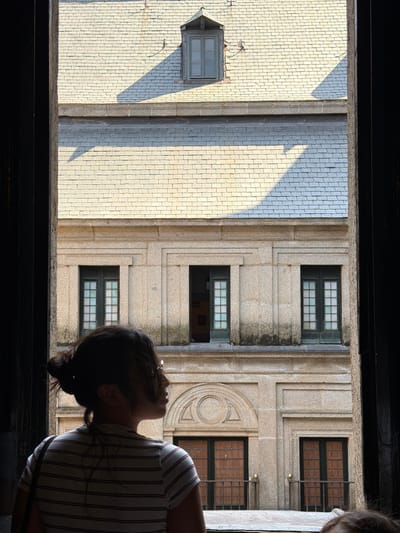
This is a photograph taken from inside a dark doorway, looking out at a stone building with a grey tiled roof and a dormer window. In the foreground, silhouetted against the light, is the back of a person with their hair tied up in a bun. They are wearing a striped t-shirt and are looking to the right. The building facade has multiple windows, some with dark frames and gridded panes, and others with closed wooden shutters. The sunlight casts sharp shadows on the roof and facade, indicating a bright day. The architecture suggests a historical or institutional building. The scene is located in San Lorenzo De El Escorial, Spain, likely within the Royal Site of San Lorenzo de El Escorial, a UNESCO World Heritage site that includes a palace, basilica, monastery, and museum.
San Lorenzo De El Escorial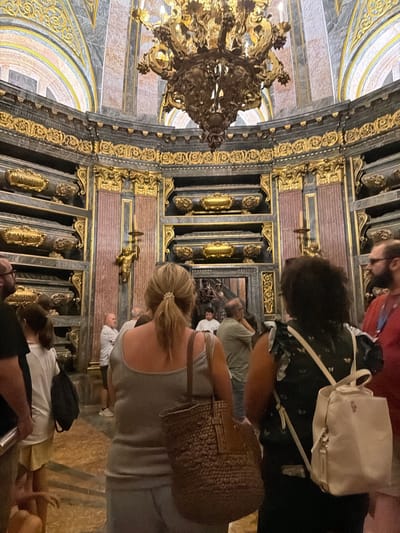
The image depicts the Royal Pantheon within the Monastery of San Lorenzo de El Escorial, located in San Lorenzo de El Escorial, Spain. A group of people are observing the ornate mausoleums lining the circular walls of the pantheon. The architecture is characterized by rich gold detailing against dark marble and pink columns. A large, elaborate chandelier hangs from the domed ceiling. Several individuals are visible from behind, some carrying bags and backpacks. The scene is one of respectful observation within a historically significant burial site.
San Lorenzo De El Escorial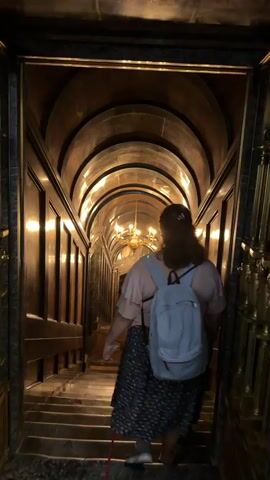
A person wearing a pink shirt and a blue backpack walks down a marble staircase. The staircase is enclosed by dark wood paneling and an arched copper ceiling, with ornate gold chandeliers hanging from the ceiling. Another person with a white shirt and dark hair walks ahead, also descending the stairs. A red leash trails from the first person's hand. The video is shot from behind the first person, looking down the staircase.
San Lorenzo De El Escorial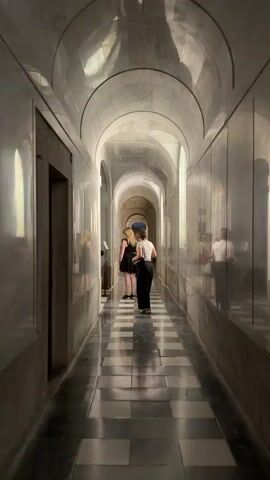
The video shows a long, arched hallway with marble walls and a checkered floor. Two women are visible in the distance, one in a black dress and the other in a striped shirt and black pants. The woman in the striped shirt is holding a phone, possibly taking a picture. The hallway is lit by ambient light, creating a somber and elegant atmosphere. The reflections on the marble walls suggest a large, grand interior space, possibly a museum or a historical building. The checkered floor adds a graphic element to the scene, drawing the viewer's eye towards the end of the hallway. The overall impression is one of quiet exploration and architectural beauty. The location context of San Lorenzo De El Escorial, Spain, further suggests a historical or religious site, known for its impressive architecture and significant cultural heritage.
San Lorenzo De El Escorial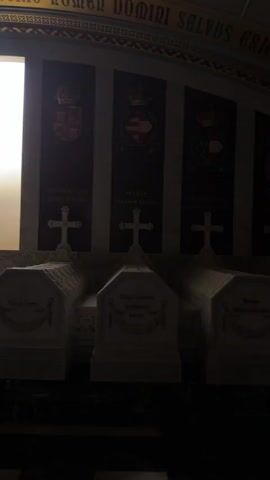
This video shows a dimly lit interior with several sarcophagi in the foreground. Behind the sarcophagi, there are three tall, narrow banners displayed vertically. Each banner has a crest at the top, followed by text and a cross. The sarcophagi are made of white marble and have inscriptions and decorative elements. The floor is marble, and there is a large, brightly lit vertical window or opening to the left of the banners. The overall atmosphere is solemn and appears to be a memorial or a tomb. The text on the banners and sarcophagi suggests a royal or historical context.
San Lorenzo De El Escorial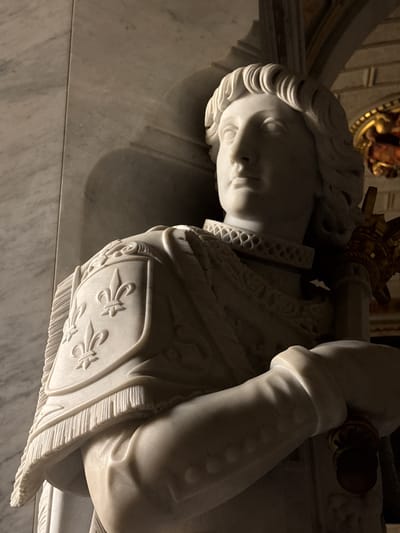
The image shows a marble statue of a male figure, likely a king or a saint, dressed in ornate armor. The statue is positioned indoors, with marble walls and a hint of golden architectural decoration in the background. The figure is depicted from the chest up, with a regal expression and elaborate detailing on the armor, including fleur-de-lis symbols on a shield. The statue is lit by a spotlight from the left, casting shadows that emphasize the texture and form of the marble. This statue is located in the Royal Pantheon of El Escorial Monastery, in San Lorenzo de El Escorial, Spain, specifically within the Basilica of the Monastery, which houses the tombs of Spanish royalty.
San Lorenzo De El Escorial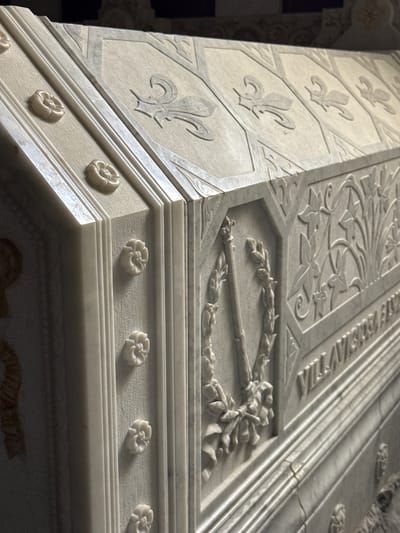
The image shows a close-up, angled view of a marble sarcophagus, likely a tomb, located in the Pantheon of Kings within the Monastery of El Escorial in San Lorenzo de El Escorial, Spain. The sarcophagus features intricate carvings, including floral motifs and what appear to be fleur-de-lis symbols on its lid. The side of the sarcophagus displays a relief carving of a wreath encircling a fasces, a symbol of authority. Partially visible text is etched into the marble on the side. The material is a light-colored marble, and the lighting highlights the detailed stonework. No people are visible in the image.
San Lorenzo De El Escorial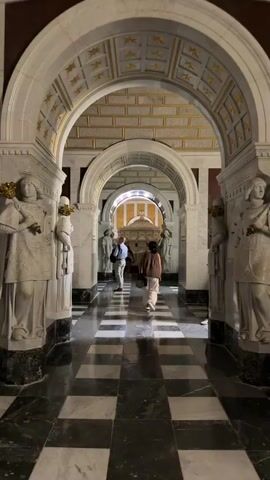
The video shows a long, marble-tiled corridor with arches and checkered black and white flooring. Several people are walking through the corridor towards a central altar-like structure at the far end. On either side of the corridor, there are large marble statues. The ceiling of the corridor features a repeating pattern of gold stars on a yellow background. The lighting is dim, creating a solemn and majestic atmosphere.
San Lorenzo De El Escorial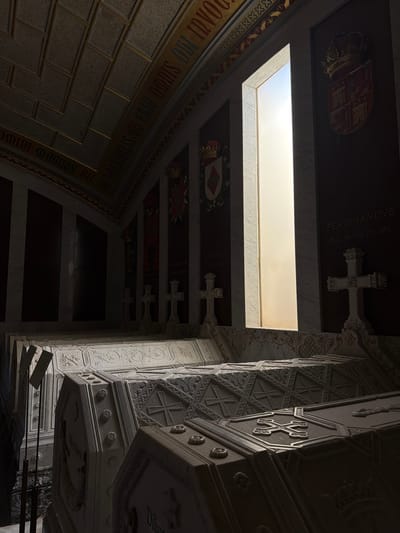
The image depicts the interior of the Royal Pantheon of the Monastery of San Lorenzo de El Escorial, located in San Lorenzo de El Escorial, Spain. The scene features multiple ornate sarcophagi, likely belonging to Spanish royalty, arranged in a dimly lit chamber. The sarcophagi are made of white marble and are elaborately carved with intricate patterns, crosses, and floral motifs. Some of the sarcophagi have inscriptions, though they are largely unreadable in the given lighting conditions. The walls are dark, with some areas featuring marble panels and decorative elements like coats of arms and inscriptions. A prominent feature is a tall, narrow window with light filtering through, illuminating a section of the chamber and casting shadows. Several crosses are positioned on pedestals near the sarcophagi, adding to the solemn atmosphere of the burial site. The ceiling is vaulted and appears to be constructed with a textured material, possibly stone or stucco, with decorative bands. The overall impression is one of grandeur, solemnity, and historical significance, characteristic of a royal mausoleum. There are no people visible in the image.
San Lorenzo De El Escorial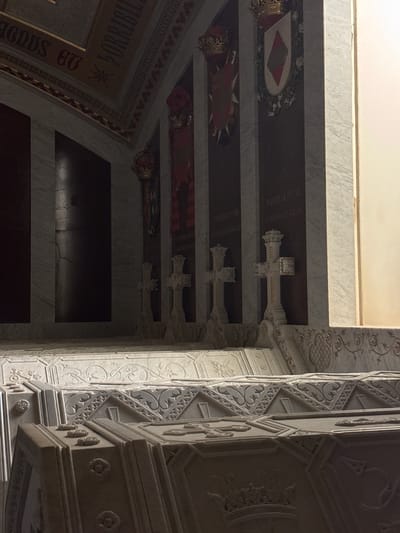
The image depicts the Pantheon of Kings in the Monastery of San Lorenzo de El Escorial, Spain. The scene shows a dimly lit interior with marble walls and sarcophagi. In the foreground, ornate sarcophagi with intricate carvings are visible. Behind them, several marble crosses stand on pedestals. The background features dark panels adorned with coats of arms and crowns, likely commemorating royalty. The overall atmosphere is solemn and historical, reflecting the grandeur of the royal burial site.
San Lorenzo De El Escorial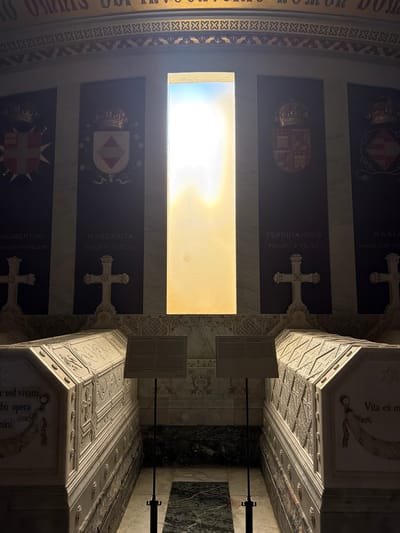
The image depicts the Royal Pantheon of the Monastery of San Lorenzo de El Escorial, located in San Lorenzo de El Escorial, Spain. The scene is dimly lit, with a bright rectangular window at the back of the chamber casting a strong backlight. In the foreground, two ornate sarcophagi are visible, made of white marble and decorated with intricate carvings. The sarcophagus on the left has text inscribed on its side, reading "er sed vivam, obo opera minini." The sarcophagus on the right has text that reads "Vita ex m". Behind the sarcophagi, on the walls, are four dark panels, each featuring a royal coat of arms and a crown at the top. The names "PHILIBERTVS", "MARGARITA", "FERDINANDVS", and "MARIA" are inscribed on these panels, along with their familial relationships. Between these panels are two large white crosses, also carved from marble, mounted on ornate bases. The floor appears to be made of polished dark stone with lighter marble patterns. Two metal stands with informational plaques are positioned between the sarcophagi. The overall atmosphere is solemn and monumental, characteristic of a royal burial site.
San Lorenzo De El Escorial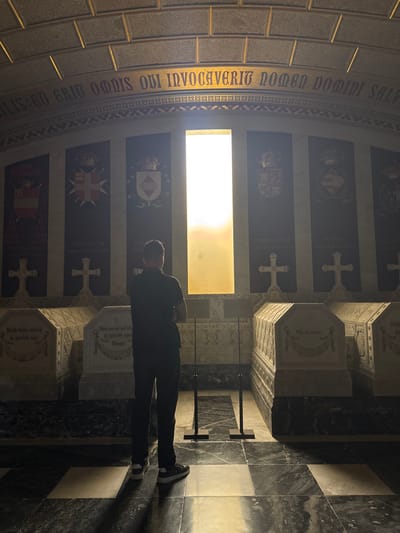
A man stands in the Royal Pantheon of San Lorenzo de El Escorial, Spain, facing a tall, narrow window that emits bright, diffused light. The man, silhouetted against the light, is viewed from behind, wearing a dark t-shirt and dark pants, with white-soled athletic shoes. He has a backpack on. The Pantheon is dimly lit, with the man's presence being the primary human element. The space features a vaulted ceiling with visible rectangular panels. A decorative golden inscription runs along the upper wall, with the visible text reading "IS: ET GRIT OMNIS QUI INVOCAVERIT NOMEN DOMINI SALV" and continuing further along the curve. Below this, a decorative border of interlocking X shapes is present. Flanking the window are several dark rectangular panels, each adorned with a coat of arms topped by a crown. Below these are large white crosses. These are set above rows of sarcophagi, which are ornate and carved, with inscriptions. One sarcophagus visible on the left has an inscription that appears to read "Similis factus est leoni in operibus suis." Another in the center reads "Non moriar sed vivam et narrabo opera Domini." A third on the right has the inscription "Vita ex morte." The sarcophagi are made of white marble and are placed on a dark, polished marble floor with a checkerboard pattern of light and dark squares. The walls behind the sarcophagi are also of dark, polished marble. Two tall, thin black poles with square bases are positioned in front of the sarcophagi, likely acting as barriers or for display.
San Lorenzo De El Escorial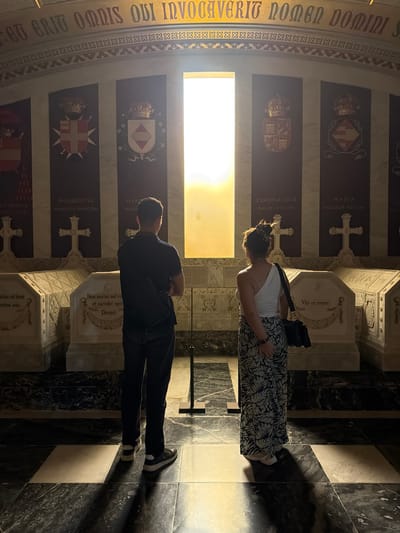
Two individuals, a man and a woman, stand facing away from the camera in a grand mausoleum, likely the Royal Pantheon of San Lorenzo de El Escorial, Spain. The man, on the left, wears a dark blue polo shirt and dark trousers, his arms crossed. The woman, on the right, is dressed in a white one-shoulder top and a black and white patterned skirt, carrying a black bag over her shoulder. They are positioned in front of several ornate sarcophagi. Above the sarcophagi are large panels bearing coats of arms and names, illuminated by a bright light source emanating from a large window or opening at the back of the room. The floor is a striking black and white checkered marble pattern, with significant shadow play. The architectural style suggests a historical and possibly royal burial site, consistent with its location within the Monastery of San Lorenzo de El Escorial.
San Lorenzo De El Escorial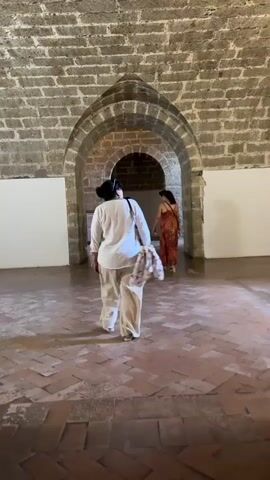
Two women are walking through a stone hallway. The woman in the foreground is wearing a white shirt and pants, and the woman in the background is wearing a patterned dress. The hallway is made of stone and has arched doorways. The floor is paved with bricks.
San Lorenzo De El Escorial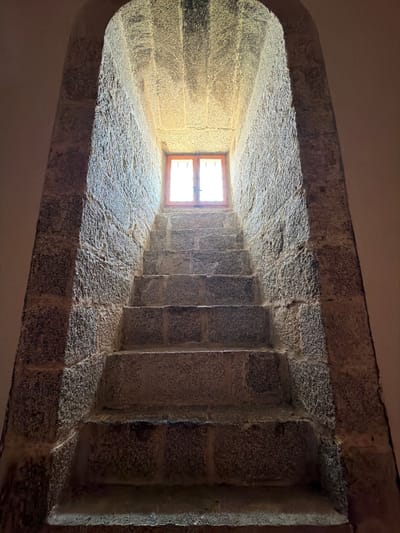
This is a low-angle, full shot of a stone staircase leading up to a small, arched window. The staircase is made of rough-hewn, grey granite blocks, with seven visible steps. The walls surrounding the staircase are also made of similar stone and curve inward to form an arched opening. Sunlight streams through the window, casting a warm glow on the upper portion of the stairs and the ceiling of the arch. The window itself appears to be a simple wooden frame with glass panes, divided into four sections. The environment is dimly lit, suggesting an interior space within a historical building. The image was taken in San Lorenzo De El Escorial, Spain, likely within the Monastery of San Lorenzo de El Escorial, given its architectural style and location. There are no people or animals present in the image.
San Lorenzo De El Escorial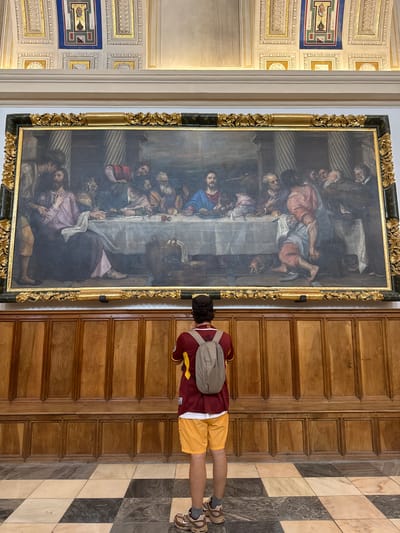
In the Hall of the Kings within the Royal Site of San Lorenzo de El Escorial, Spain, a person stands before a large oil painting depicting "The Last Supper." The painting is framed by an ornate gold frame and hangs on a wall adorned with wooden paneling and benches below. The floor is a checkerboard pattern of light and dark stone tiles. The person is wearing a maroon and yellow shirt, yellow shorts, a grey backpack, and sneakers. They are facing away from the camera, looking intently at the artwork, which features Jesus and his disciples gathered around a table laden with food. The scene is illuminated by natural light, casting soft shadows. The ceiling above the painting is decorated with intricate stucco work.
San Lorenzo De El Escorial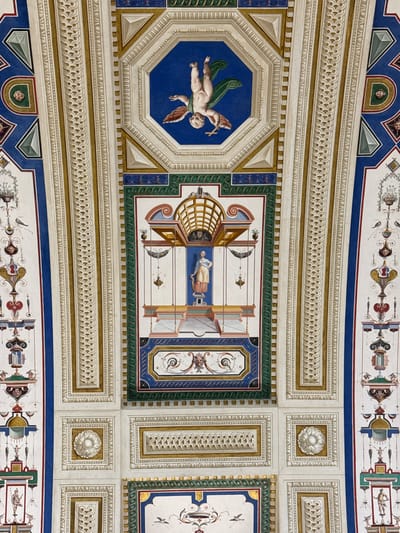
The image displays a highly detailed, ornate painted ceiling, likely an architectural fresco, found in San Lorenzo de El Escorial, Spain. The ceiling is divided into numerous geometric panels and borders, featuring a rich color palette of blues, golds, whites, reds, and greens. Dominating the upper central octagonal panel is a fresco of a winged cherub, depicted in an upside-down pose, with green drapery trailing behind it. Other panels showcase intricate decorative motifs, including geometric patterns, stylized floral elements, and trompe-l'œil architectural details. Several rectangular panels contain depictions of mythological or allegorical figures, often rendered in a classical style, standing within architectural niches or elaborate frames. These figures include a woman in a yellow garment and a male figure in a warrior-like stance. Smaller details include representations of birds, vases, and what appear to be decorative lamps or urns. The overall impression is one of opulence and refined artistic execution, consistent with Renaissance or Baroque decorative schemes found in palatial or religious structures.
San Lorenzo De El Escorial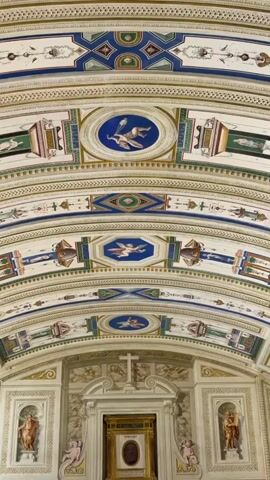
The video shows a close-up, upward view of an elaborately decorated ceiling. The ceiling is arched and features intricate patterns and paintings. The primary colors used are white, gold, blue, and green. There are multiple decorative bands running parallel to each other, adorned with geometric shapes, floral motifs, and small circular or octagonal medallions containing painted figures. These figures appear to be cherubs or putti in various poses, often depicted with wings. The overall impression is one of classical or Renaissance-inspired artistry. The lighting is even, suggesting an indoor setting with ample illumination. There are no people visible in the frame, and the focus remains solely on the architectural details of the ceiling.
San Lorenzo De El Escorial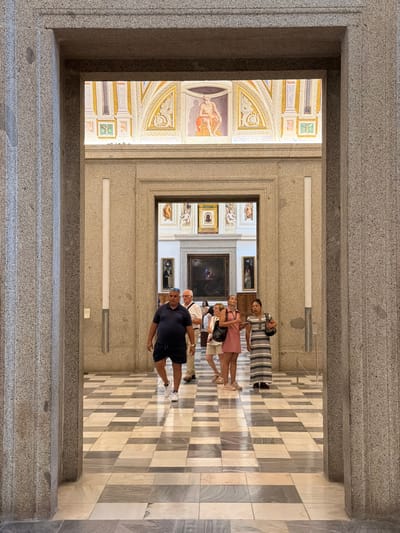
In San Lorenzo De El Escorial, Spain, within a grand hallway of what appears to be a historical building or museum, the image captures a view through a large stone archway. The hallway features a black and white checkered marble floor that creates a visually striking pattern. Several individuals are walking through the hallway, some towards the viewer and others away. In the foreground, to the right and left, are large, textured stone columns framing the entrance. Beyond the archway, the hallway opens up to reveal more of the building's interior. Prominently displayed on the walls are various framed artworks, including paintings and decorative murals, suggesting an art gallery or a historically significant location. The ceiling area above the hallway is adorned with intricate murals featuring figures and architectural elements, illuminated by soft lighting. The people visible in the scene are casually dressed, indicating they are likely visitors. One man in the foreground is wearing a dark blue polo shirt and dark shorts, walking towards the camera. To his right, a man in a white shirt and beige pants is also walking in the same direction. Further into the hallway, a group of three women is walking away from the camera. One woman in the center wears a pink dress, and another to her right is in a black and white striped dress. The overall atmosphere suggests a leisurely visit to a place of cultural and artistic significance.
San Lorenzo De El Escorial