Sani Mai Nagge, Nigeria
30 memories from Sani Mai Nagge, Nigeria
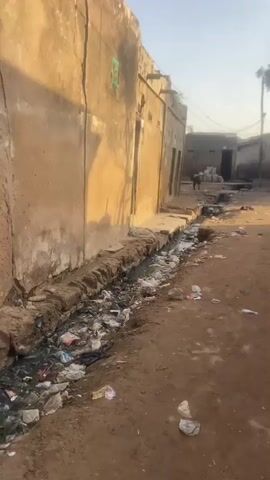
The video shows an outdoor scene in a dusty, underdeveloped area. The foreground is a dirt path with trash scattered across it. To the left, a long, narrow ditch runs alongside a rough, tan-colored building. The ditch is filled with murky water and debris, including plastic bags and other refuse. The building appears to be made of mud or adobe and has several doorways, some of which are open. In the background, more buildings of similar construction are visible, along with a few trees and utility poles with wires. A small, dark-colored animal, possibly a dog, is standing in the middle distance near a pile of white sacks. The lighting suggests it is daytime, with sunlight casting shadows. The overall impression is one of neglect and poor sanitation.
Sani Mai Nagge
A group of children, most wearing head coverings, are seated on the ground in what appears to be an open-air or rudimentary classroom setting. The children are facing forward, engaged in an activity, with some holding books or papers. The ground is dusty and uneven. The foreground shows a textured, wet tiled surface and a rough wall. The perspective is from an entryway looking into the space where the children are gathered.
Sani Mai Nagge
A group of approximately 30 children are sitting on the ground in a dusty street, facing a boy who is standing and holding a wooden board. The children are wearing traditional clothing, including colorful headscarves and robes. Some of the children have wooden boards in front of them, and they appear to be writing on them with sticks. The standing boy is wearing a yellow shirt and light-colored pants, and he is also holding a wooden board. The street is lined with buildings made of concrete and corrugated metal. Trees and utility poles are visible in the background. The sky is overcast, suggesting that it may be raining or about to rain. The overall scene depicts an outdoor classroom setting, likely in a developing country.
Sani Mai Nagge
The image displays an outdoor scene in Sani Mai Nagge, Nigeria. In the immediate foreground, two dark-skinned male individuals are prominently featured. The male on the right wears a solid black skullcap and a white traditional tunic-style garment embellished with elaborate tan and white geometric embroidery on the chest and neckline. He looks downwards and slightly to his left. To his left, another male is seen in profile, wearing a white head covering with a distinct black band at the forehead, paired with a white robe featuring a structured collar. His mouth is slightly open, suggesting speech. His right hand is visible in the lower right quadrant, holding a small object. In the midground and background, several other males are present, also dressed in traditional Nigerian attire, including various skullcaps (some patterned, some solid white or tan) and flowing robes. The background features a light-colored building with rectangular windows and an external utility unit mounted high on the wall. The ground appears to be dry, light-colored earth or pavement under daylight conditions.
Sani Mai Nagge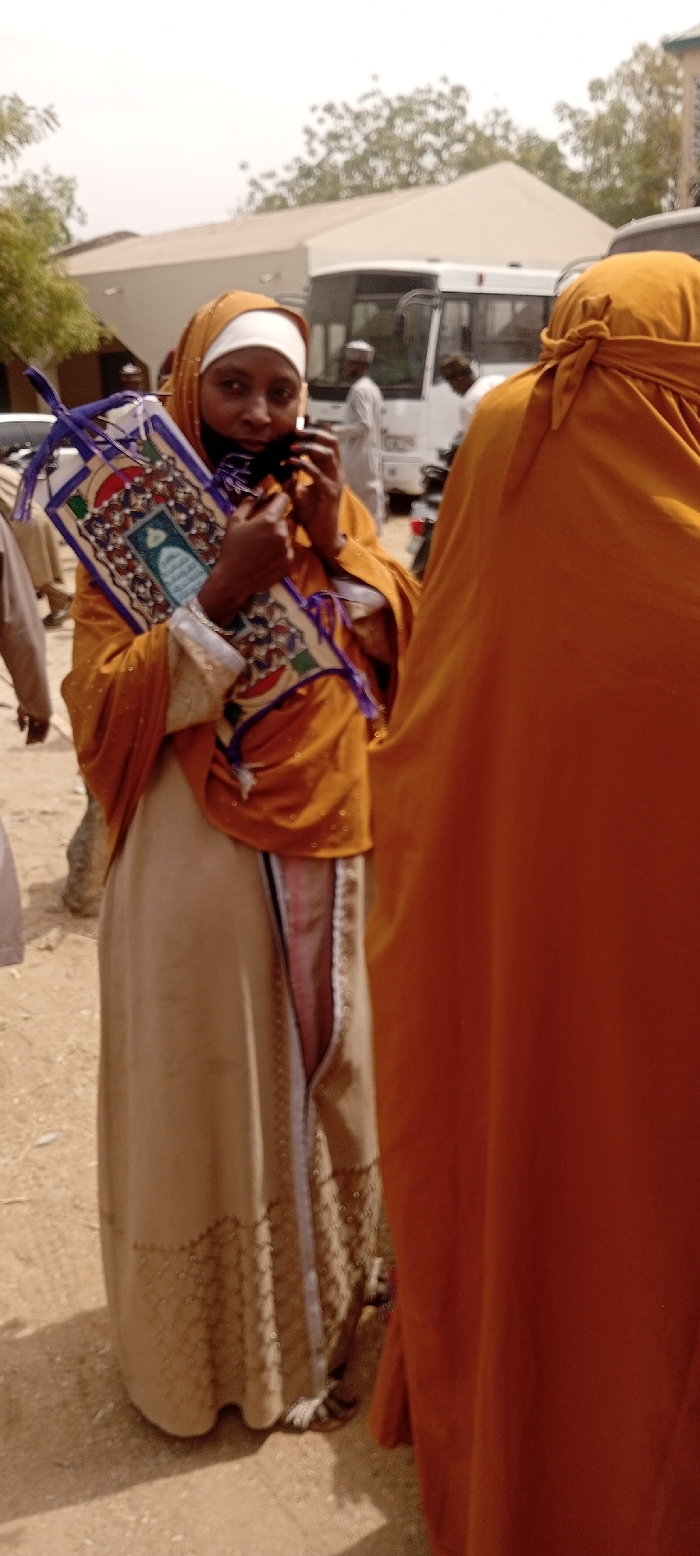
This image depicts an outdoor scene in Sani Mai Nagge, Nigeria, characterized by a dusty, unpaved ground surface. The primary subject is a woman in the mid-ground, facing slightly towards the viewer. She wears a mustard yellow headscarf over a white undercap, a matching long-sleeved garment with subtle reflective elements, and a light beige long skirt featuring patterned vertical and horizontal strips. Her right hand is raised, holding a dark object, possibly a phone, near her ear/mouth. She carries a rectangular, decorative object with blue trim and Islamic geometric patterns, resembling a prayer mat or a ceremonial Quran stand. To her immediate right, the back of another individual, dressed in a solid orange garment, is partially visible. In the background, several male figures in traditional attire are observed. A white bus or large van is visible behind them, along with portions of other vehicles and light-colored buildings. Sparse trees and bushes are present under a hazy sky.
Sani Mai Nagge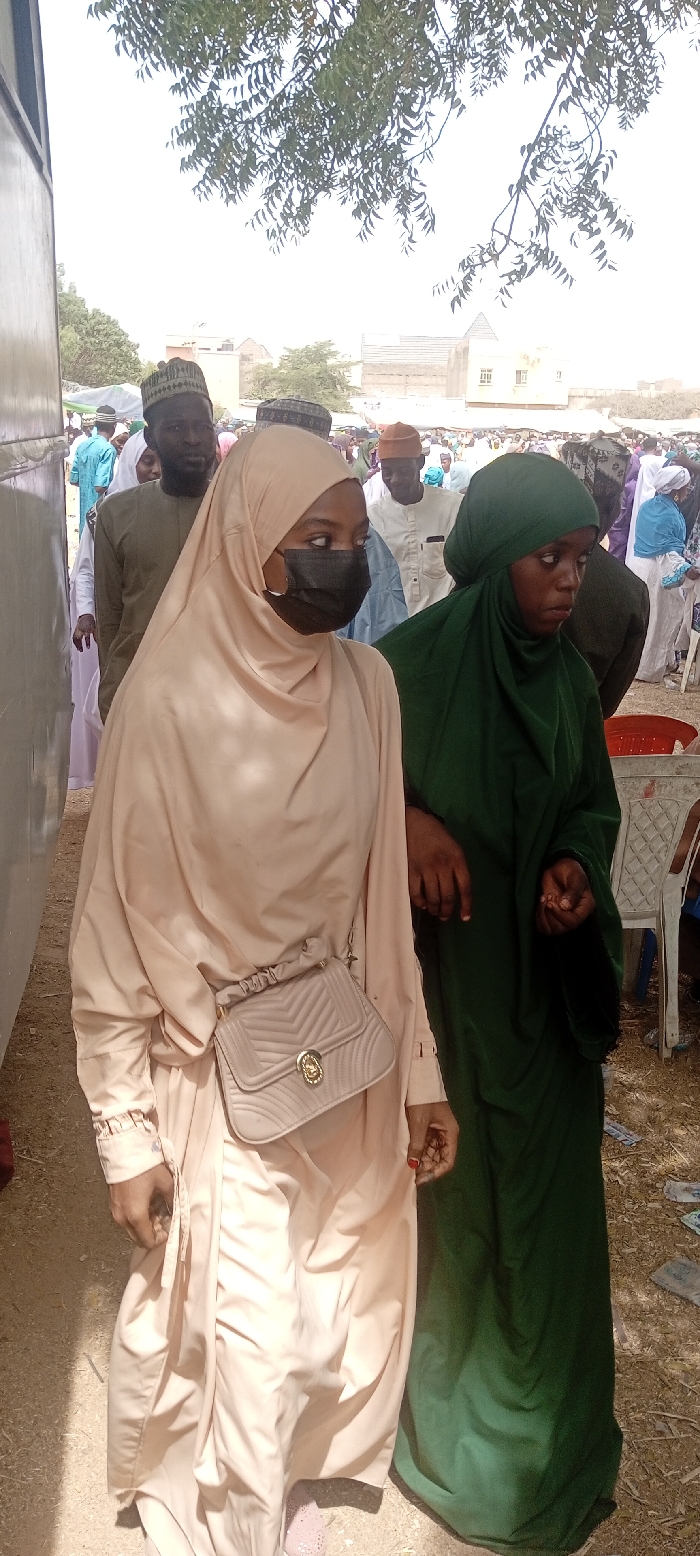
This image depicts a daytime outdoor scene in Sani Mai Nagge, Nigeria, showing two women in the foreground amidst a larger gathering of people. The woman on the left wears a light beige full-length garment and hijab, a black face mask, and carries a beige quilted crossbody bag with a gold clasp. Her left hand is visible at her side, with red nail polish on her fingernails. The woman on the right wears a dark green full-length garment and head covering; her right hand is holding the left forearm of the woman in beige. Both women are walking or standing on unpaved, dusty ground. In the mid-ground, numerous individuals, primarily men wearing various traditional caps and light-colored clothing, are visible, suggesting a crowd or event. Some women are also present in the background. A large, dark-colored structure, possibly a vehicle or building, is partially visible on the far left. Distant buildings with light-colored walls and flat roofs are present in the background. Overhead, green tree foliage is visible against a bright, overcast sky. Debris, possibly paper currency, is scattered on the ground in the lower right foreground. Partially visible white plastic chairs are on the right edge.
Sani Mai Nagge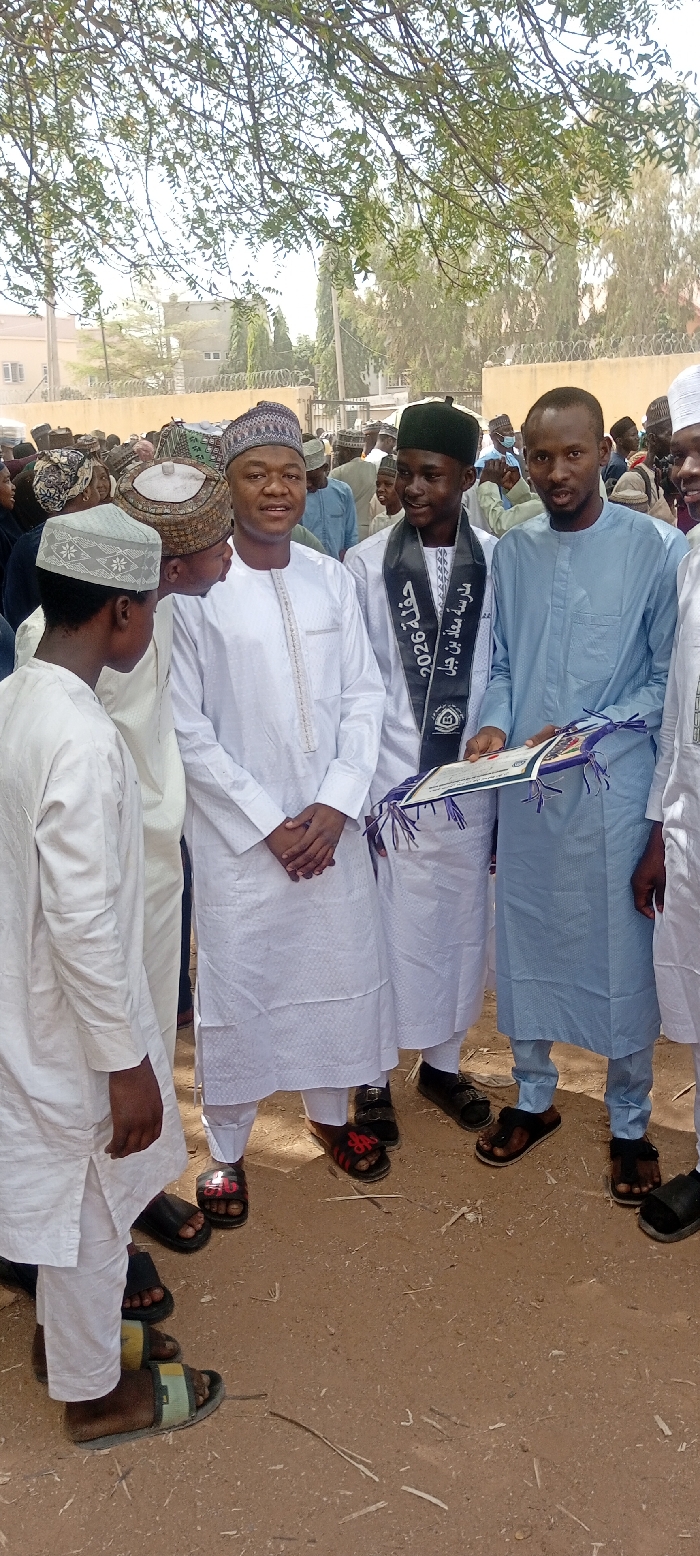
The scene captures an outdoor gathering of predominantly male individuals in Sani Mai Nagge, Nigeria, likely on the grounds of a school. The ground consists of dry, reddish-brown dirt with scattered twigs and debris. Overhead and in the background, green-leafed trees are visible, along with utility poles. In the mid-ground, a light-colored multi-story building with rectangular windows and a fence topped with barbed wire is present. In the foreground, five males are visible. The central figure, an adult male with a light patterned cap, wears a white embroidered traditional garment and smiles towards the camera, his hands clasped. To his right, a younger male with a dark cap and white attire wears a black stole over his shoulders, inscribed with white Arabic text that reads "Ma'az bin Jabal School, Ceremony 2026." He also smiles. To the right of the stoled individual, an adult male in a light blue traditional garment holds a framed certificate or award, decorated with purple ribbons, looking towards the camera. To the left, a younger male in white attire and a light embroidered cap stands with his back partially turned, facing the central figures. Another male in white is partially obscured between the leftmost and central figures. Numerous additional individuals in traditional attire are visible in the blurred background, indicating a larger assembly. All visible subjects are wearing various sandals or slippers. The scene is brightly illuminated by natural daylight.
Sani Mai Nagge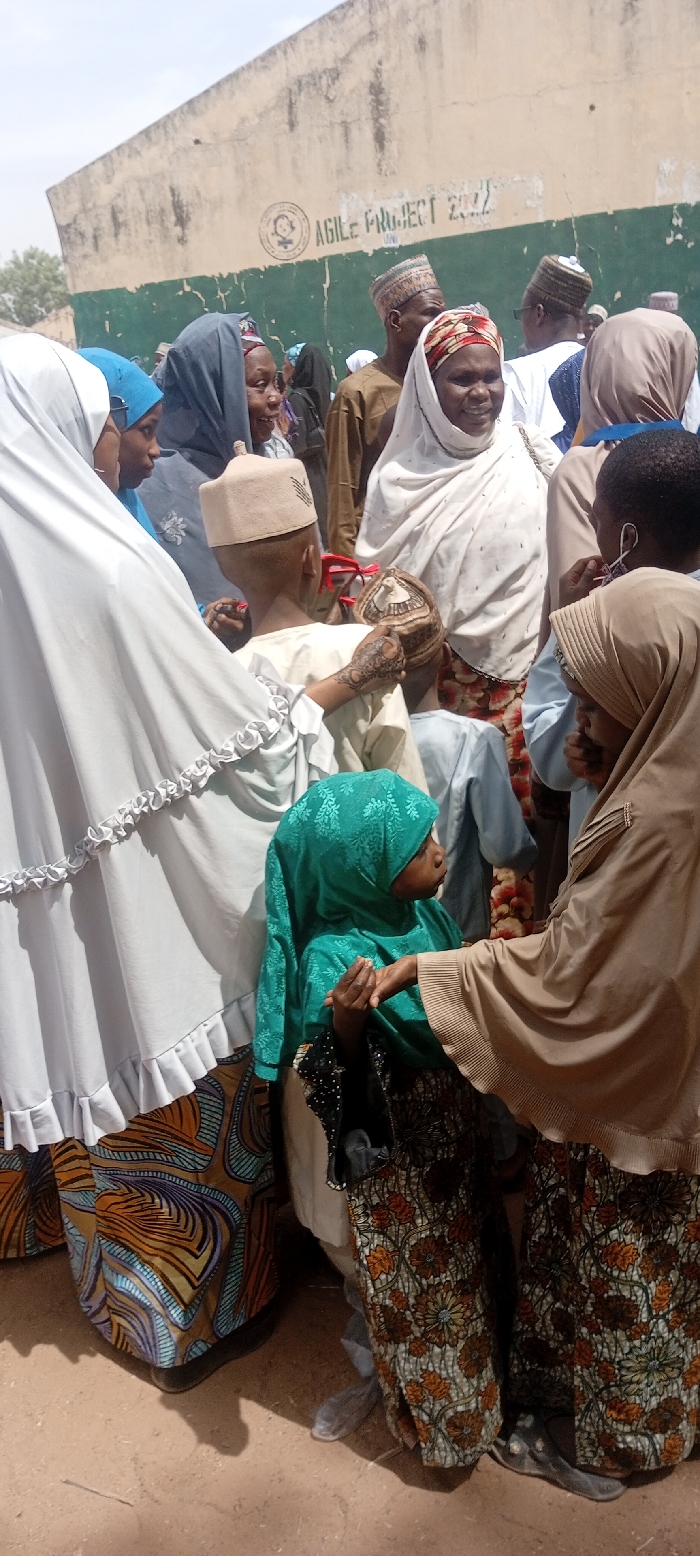
A crowded outdoor scene in Sani Mai Nagge, Nigeria, depicts approximately 10-15 individuals, predominantly women and children, gathered on dry, light brown earth under bright daylight. In the background, a weathered concrete wall, painted green on its lower section and light beige on its upper, displays the stenciled text "AGILE PROJECT 2022" alongside a circular logo featuring a stylized female figure. In the mid-ground, a woman with prominent henna decoration on her left hand (partially obscured) is interacting with a young boy wearing a light beige cap. Close to this interaction, several red, spherical objects, resembling fruit, are visible in people's hands. To the right, another woman, wearing a beige head covering and patterned skirt, engages with a young girl in a teal head covering, their hands appearing to touch or exchange an item. The individuals are dressed in various traditional attires, including multiple women wearing head coverings in white, blue, teal, and darker shades, as well as patterned skirts or wraps. At least one adult male is visible in the background, also wearing a patterned cap. The overall impression is a communal gathering or distribution event.
Sani Mai Nagge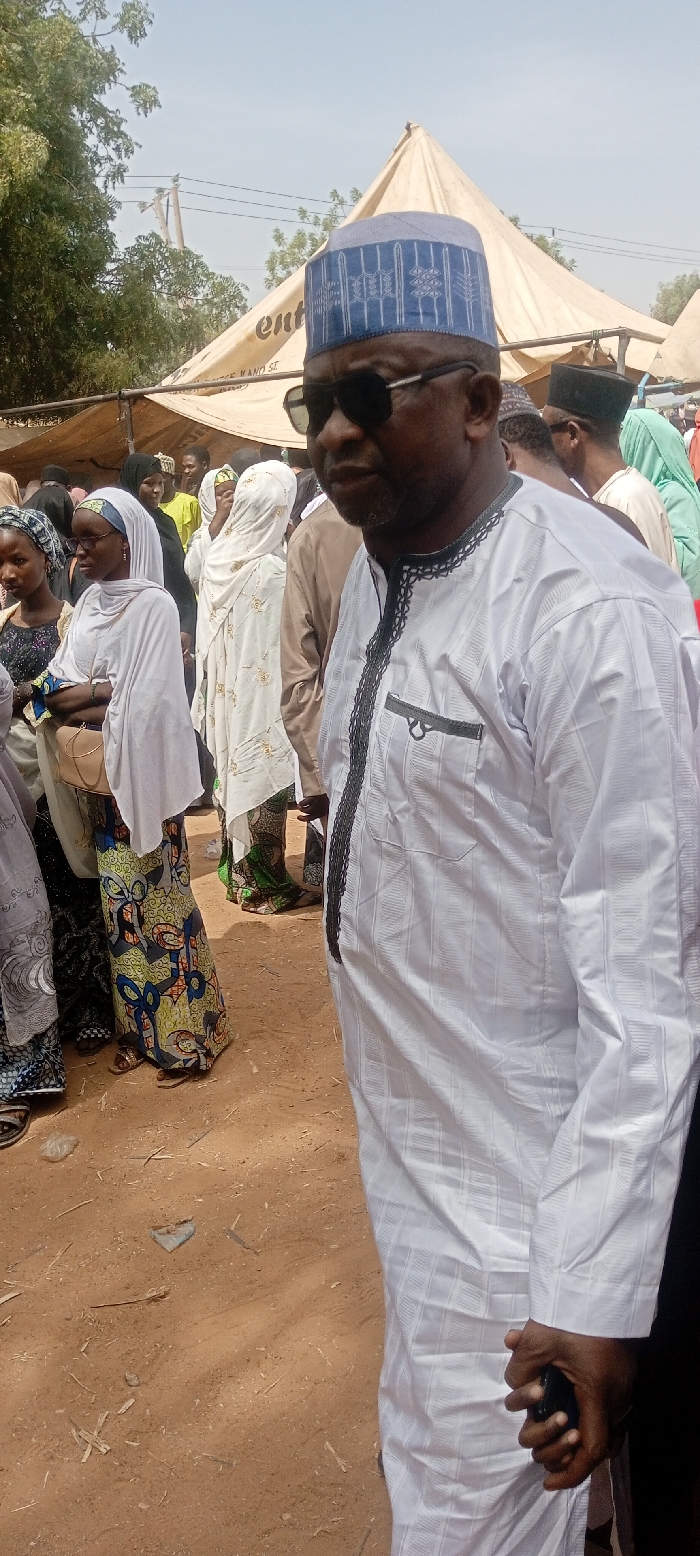
The image captures an outdoor scene under clear daylight in Sani Mai Nagge, Nigeria, featuring a gathering of people. In the immediate foreground, a dark-complexioned male subject is positioned off-center to the right, wearing a white long-sleeved tunic with intricate black embroidery on the placket and collar, dark sunglasses, and a blue-patterned kufi cap. His right hand is visible, gripping a dark-colored mobile phone. Behind the primary subject and extending into the midground, a crowd of individuals is present, mostly women, many adorned in traditional attire including white hijabs and colorful patterned dresses. One woman in the midground wears a white hijab, glasses, and a brightly patterned dress featuring blue, yellow, and green motifs. The ground surface is unpaved, composed of reddish-brown soil with scattered small sticks and debris. In the background, a large, light-colored canvas tent with a visible "ent..." logo and partial text "WANO ST." provides shade. Overhead, utility poles and power lines are discernible against a pale blue sky, with sparse green trees flanking the scene. No specific actions or direct interactions are clearly depicted beyond individuals standing within the gathering.
Sani Mai Nagge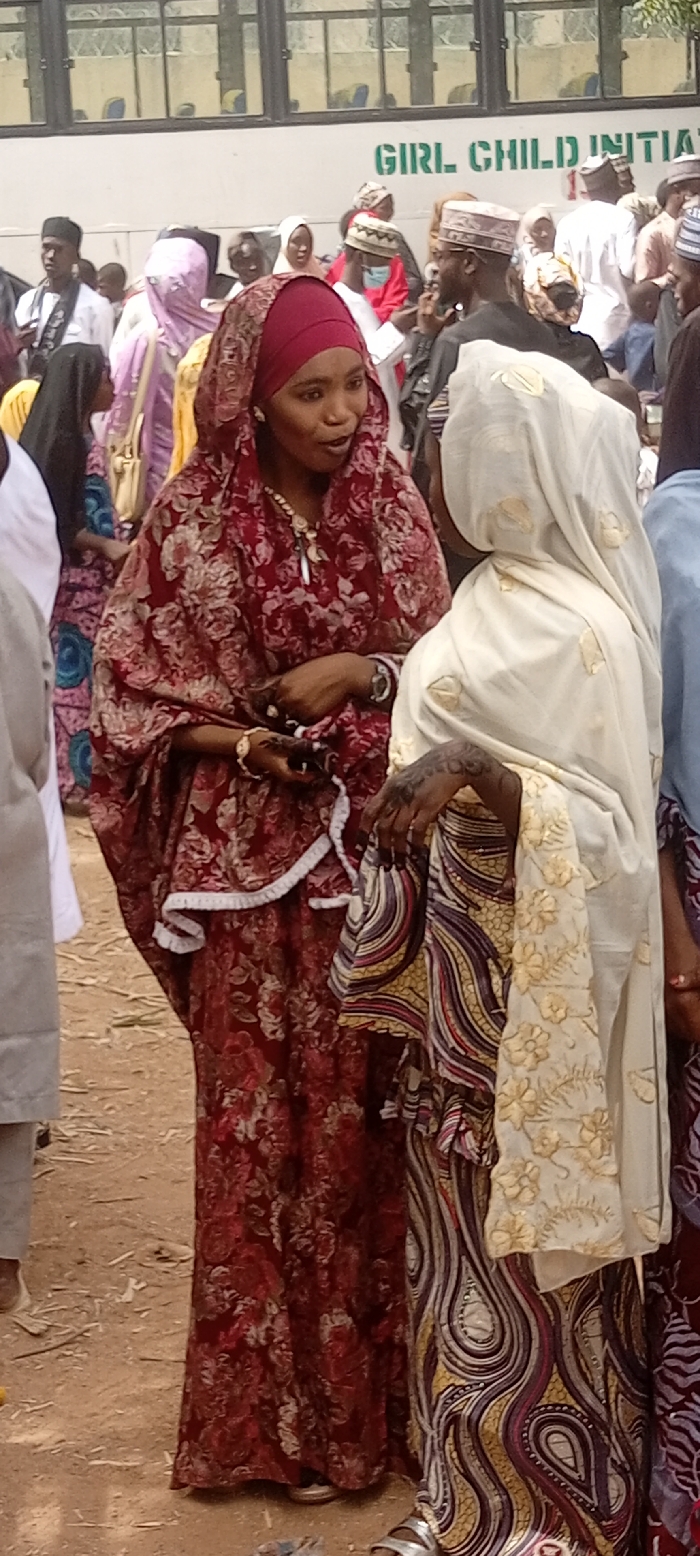
The scene depicts an outdoor gathering in Sani Mai Nagge, Nigeria, with a crowd of individuals, predominantly adults, standing on unpaved dirt ground. In the immediate foreground, two women are engaged in conversation. The woman on the left wears a maroon headscarf and a matching maroon dress adorned with a red and beige floral pattern. She has a gold necklace with a prominent pendant, gold bracelets, a watch on her left wrist, and dark henna or nail polish on her fingernails. Her mouth is open as if speaking, and she holds a dark object, possibly a phone, in her hands. The woman on the right is partially obscured but is visible wearing a cream-colored head covering with gold embroidered floral designs and a patterned skirt featuring swirling lines of purple, brown, and yellow. Her right hand and forearm display extensive dark henna designs. In the mid-ground and background, numerous other individuals are visible, many wearing traditional attire such as head coverings for women and kufi hats for men. Behind the crowd, a large white bus is partially visible, with multiple windows and the green text "GIRL CHILD INITIATIVE" clearly printed on its side. The overall environment suggests an event or public assembly under daylight conditions.
Sani Mai Nagge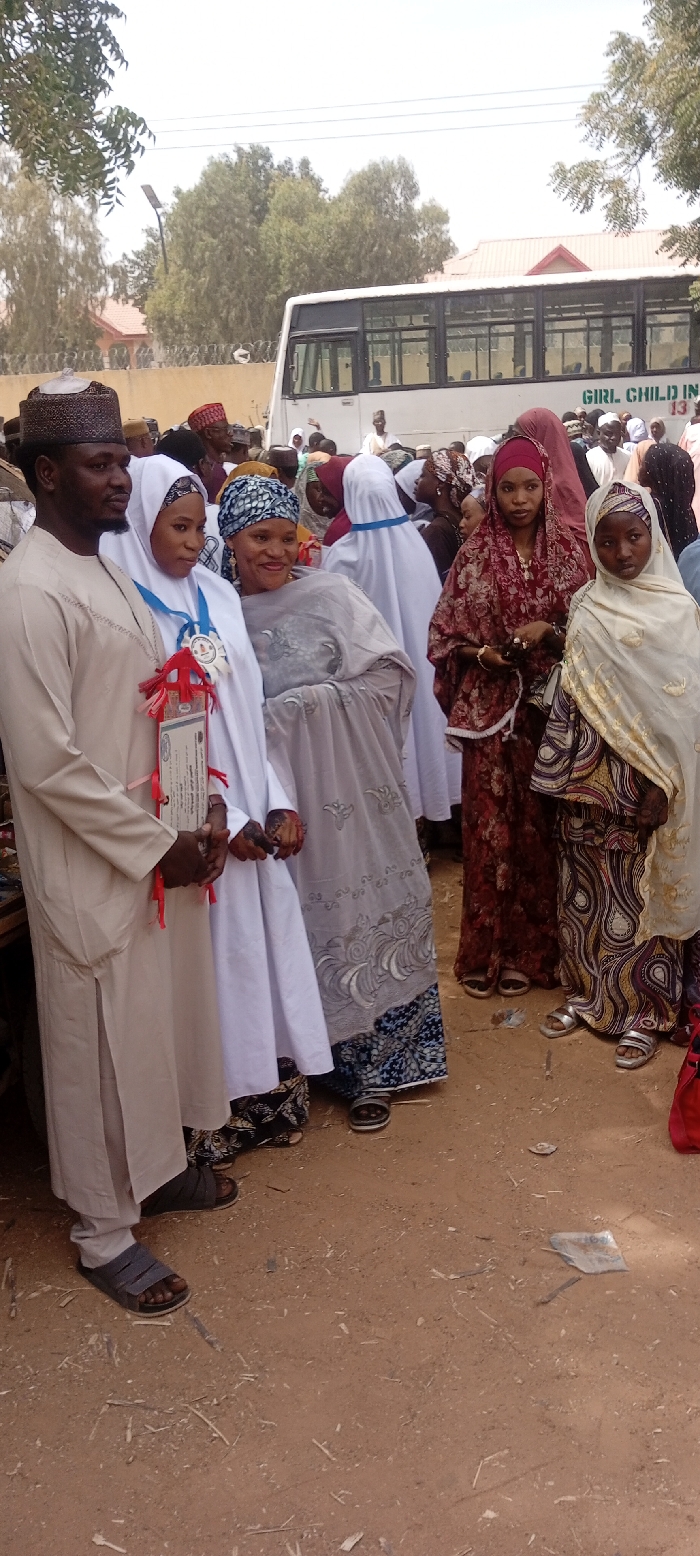
The image depicts an outdoor gathering in Sani Mai Nagge, Nigeria. In the foreground, from left to right, stand a man and four females. The man wears a light beige long tunic and matching cap, and dark sandals. He holds the hand of the woman next to him, who is dressed in a white head covering and long white garment. She wears a blue and white medallion around her neck and holds a framed certificate adorned with red ribbons. Henna is visible on her hands. Next to her, a woman in a blue and white patterned head covering and a grey embroidered top over a blue patterned skirt stands smiling, wearing dark sandals. To her right, a woman in a red head covering and a long red floral dress holds a string of beads in her left hand, wearing silver sandals. A younger female stands furthest right in the foreground, wearing a beige head covering with gold embroidery and a long beige and gold patterned dress, also with silver sandals. The ground is light brown dirt with scattered small twigs and paper debris. In the midground, a crowd of numerous individuals, predominantly adults in traditional attire and head coverings, extends behind the main subjects. In the background, a large white bus is visible, with "GIRL CHILD IN" printed on its side. Behind the bus, a fence topped with barbed wire runs horizontally. Further back, trees and a building with a reddish roof are partially visible under a bright sky. The scene appears to be a formal event or celebration.
Sani Mai Nagge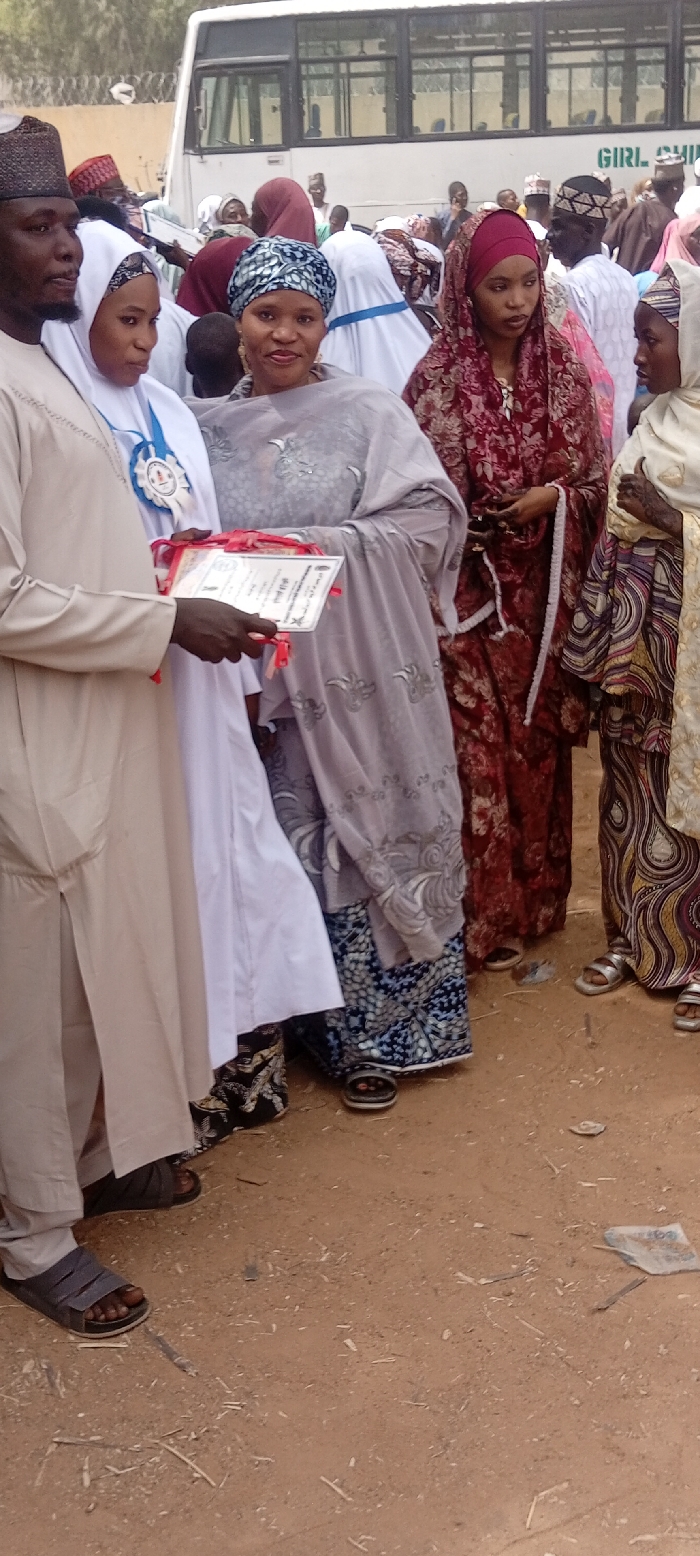
The image captures an outdoor gathering in Sani Mai Nagge, Nigeria, centered around a small group of individuals on a light brown dirt ground. In the foreground left, a man in a light-colored caftan and dark cap holds a white certificate with red ribbons in his left hand. To his immediate right, a woman in a white hijab and dress wears a blue and white decorative ribbon with a medallion around her neck, looking towards the certificate. Adjacent to her, a woman in a grey patterned headscarf and top, worn over a blue patterned skirt, smiles directly at the viewer, her right hand positioned near the certificate. Further right, a woman in a dark red patterned hijab and dress stands, her gaze directed to the right. On the far right, another woman wears a light beige head covering and a patterned dress, displaying visible henna designs on her hands and wearing silver sandals, looking towards the left. The ground is uneven, littered with small sticks and debris. In the background, a white bus with the words "GIRL CHI" (likely "GIRL CHILD") partially visible in green lettering is parked, behind which a crowd of indistinct individuals and structures are present under a bright sky.
Sani Mai Nagge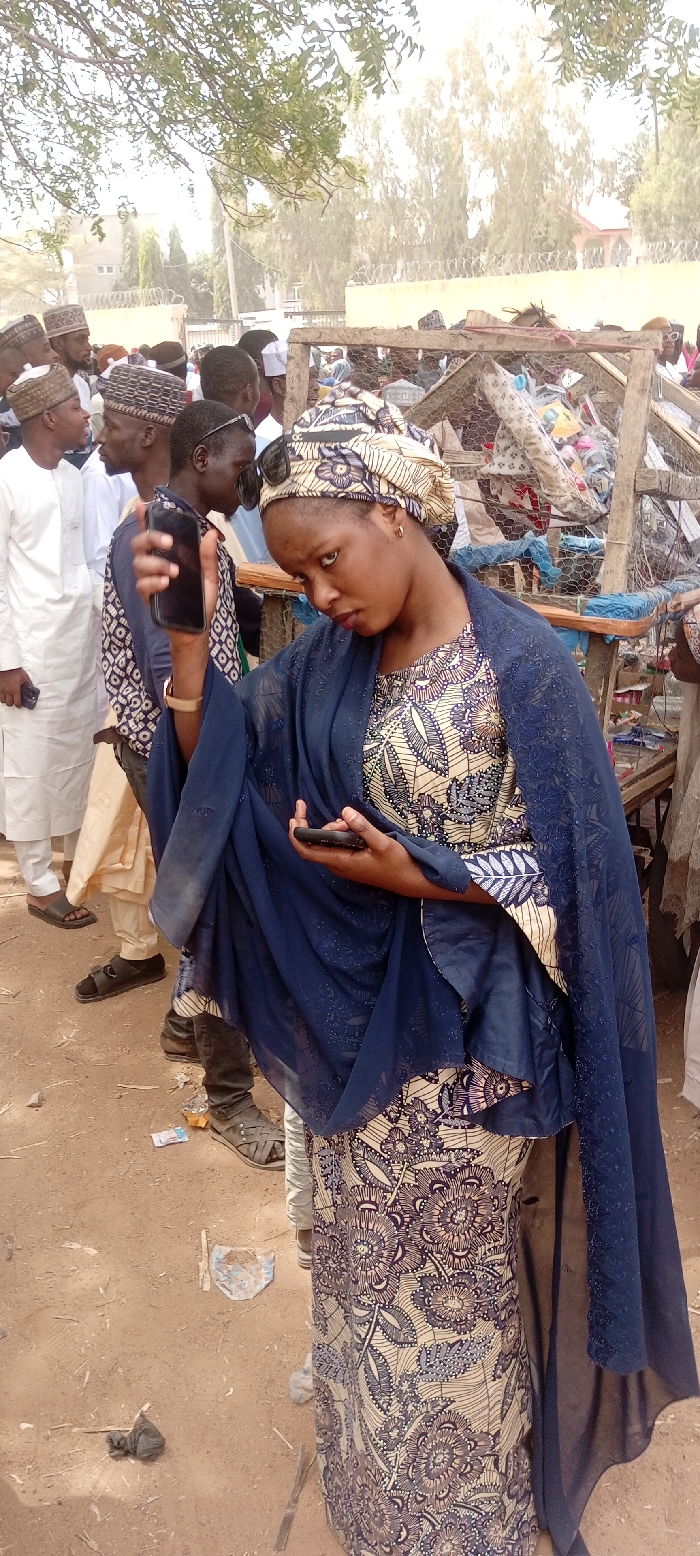
The image depicts a public outdoor gathering, likely a market, in the city of Sani Mai Nagge, Nigeria. In the foreground, a woman faces slightly right of the camera, looking towards the viewer with a neutral expression and her head tilted. She wears a cream-colored headwrap with blue and brown patterns, matching a long dress. A dark blue, semi-sheer veil or shawl covers her shoulders and drapes over her left arm. She holds a black smartphone in her left hand, which is slightly raised, and another black smartphone in her right hand, positioned near her hip. Behind the woman, a crowd of individuals, primarily men, is visible. Many wear traditional Nigerian attire, including long white robes (tagiya) and various patterned caps. Some individuals wear sunglasses. To the right of the central woman, a makeshift stall constructed from wooden frames and chicken wire is visible, containing various items such as fabric and packaged goods, suggesting a retail or market environment. The ground is unpaved, consisting of light brown dirt with scattered debris, including small pieces of paper and dark refuse. In the background, behind the crowd and stall, green foliage from trees is visible, partially obscuring distant light-colored buildings with security fencing topped with barbed wire. The lighting suggests daytime conditions.
Sani Mai Nagge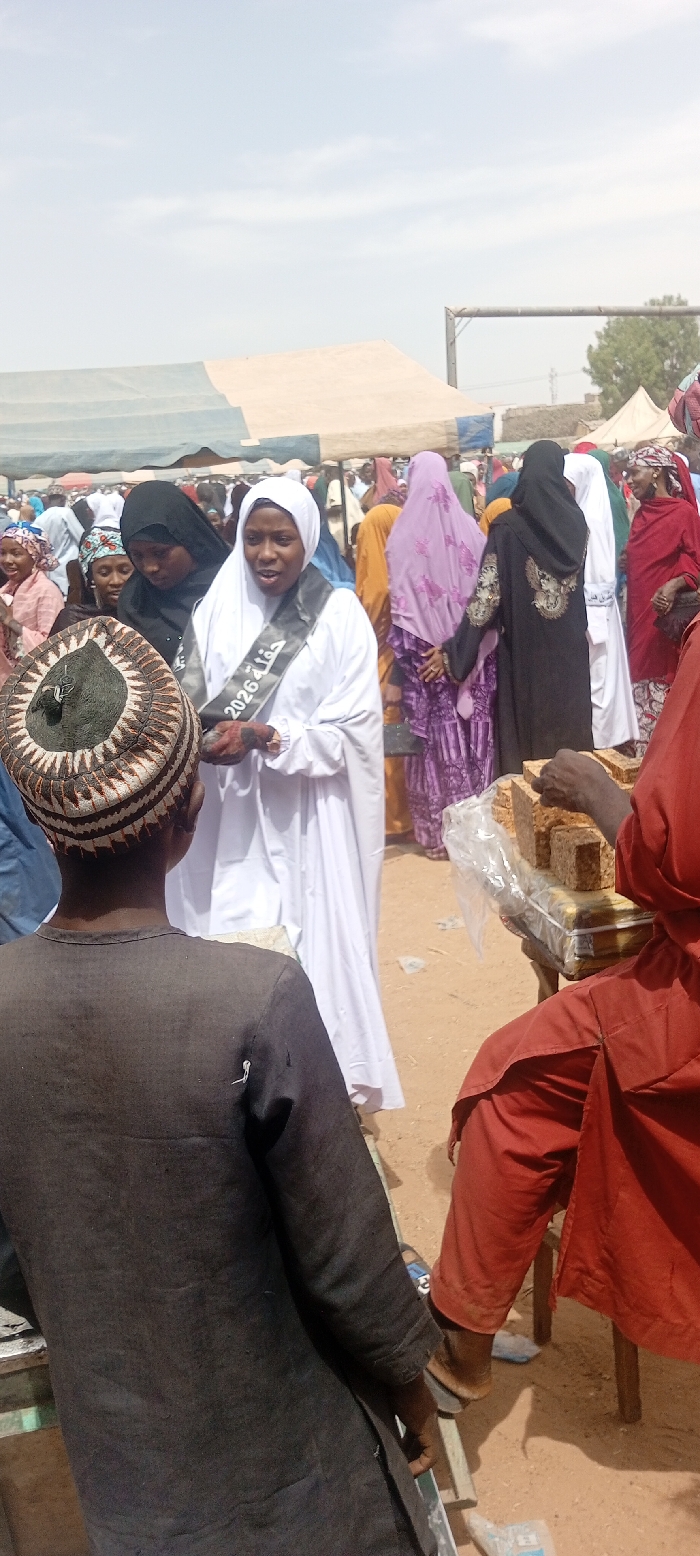
This image captures a crowded outdoor scene in Sani Mai Nagge, Nigeria, under a bright, slightly cloudy daytime sky. The ground is exposed earth. In the mid-ground, a young adult woman stands centrally, dressed in a white hijab and a long white garment. She wears a black sash diagonally across her chest, bearing white text that includes "2026" and Arabic script. Her mouth is slightly open as if speaking, and she faces towards the left foreground. To her immediate left, another woman in a black hijab and dark top stands beside her. In the left foreground, a person is viewed from behind, wearing a dark long-sleeved top and a patterned, woven brown and white cap. This individual is positioned to face the woman in white. In the right foreground, a person in a red long-sleeved garment is partially visible, seated, with their hands positioned near a display of numerous rectangular, light-brown blocks. These blocks are stacked in rows on a stand and appear to be individually wrapped in clear plastic. The background features a dense gathering of people, primarily women, dressed in various colorful hijabs and traditional attire, including purple, red, orange, and white garments. Several large tents, some striped in blue and beige, are erected behind the crowd, suggesting a market or event setting. Distant trees and a metal frame structure are visible in the far background.
Sani Mai Nagge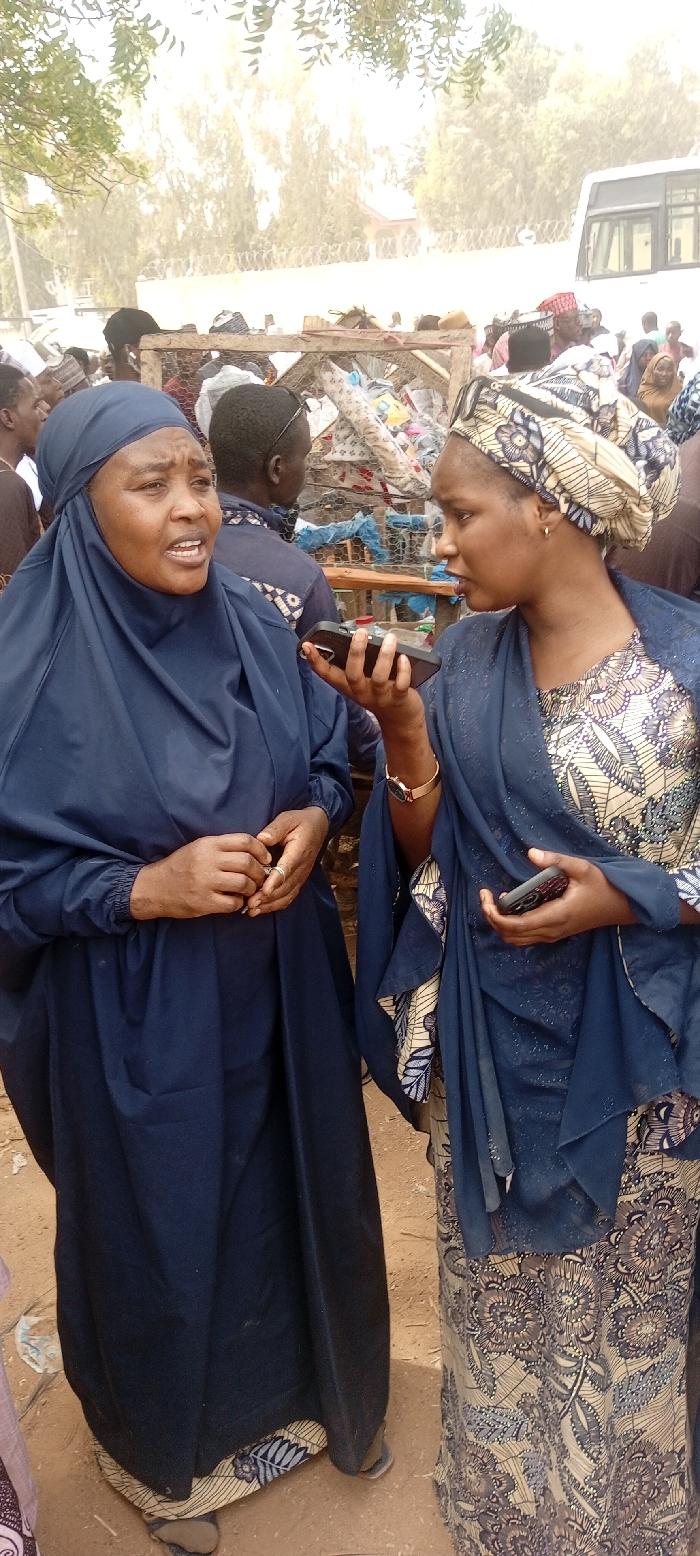
An outdoor scene in Sani Mai Nagge, Nigeria, depicts two adult females in the foreground, engaged in an interaction amidst a crowded environment. The woman on the left, facing slightly right, wears a dark blue abaya with a matching head covering, revealing her face. Her mouth is open, suggesting speech. Her hands are clasped at waist level, with a silver-colored ring visible on her right ring finger. The woman on the right, facing slightly left towards the first woman, wears a patterned dress in beige and blue tones, a matching patterned headwrap, and a translucent dark blue overlay garment. She holds a black smartphone horizontally in her right hand, positioned near the first woman's face, with the screen oriented towards her. A gold-colored wristwatch is on her left wrist. In the midground, a dense crowd of people is visible. Behind them, several rudimentary market stalls or structures made of wooden frames and wire mesh hold assorted goods, including textiles and plastic items. The ground is unpaved, appearing as dirt or sand. In the background, green foliage from trees is visible on the left, and a partial view of a white bus or large van is seen on the right. A fence, possibly topped with barbed or razor wire, separates the immediate area from a distant building. The overall atmosphere is bright and appears dusty or hazy.
Sani Mai Nagge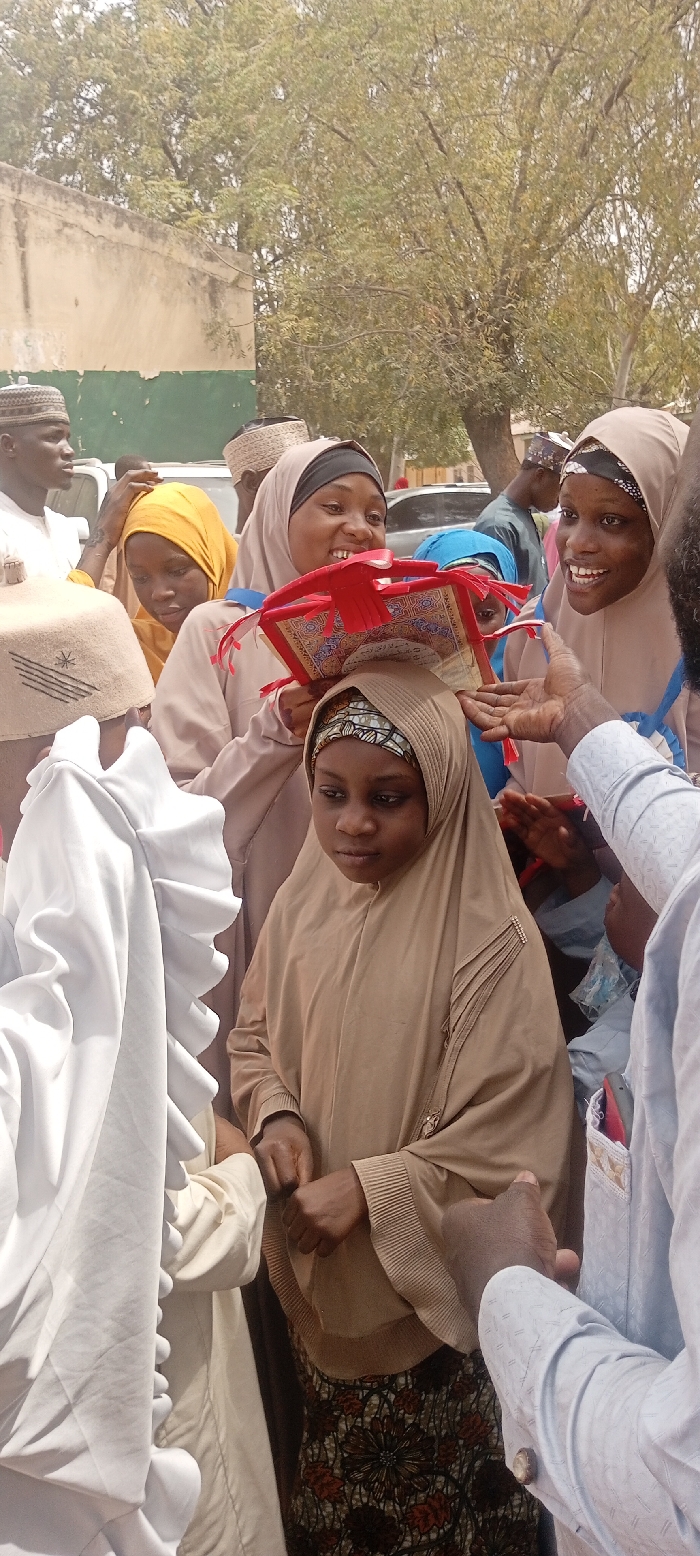
The image captures an outdoor gathering in Sani Mai Nagge, Nigeria, under daylight. In the foreground, a young female, approximately 10-14 years old, stands centrally, clad in a full-length light brown hijab and an embellished brown jilbab featuring decorative pleats and beading on the left side. She wears a patterned undercap and holds her hands clasped, displaying a neutral expression. To her immediate right, a dark-skinned male hand, wearing a light-blue patterned long-sleeved shirt with cuff links, extends towards her. Behind the young female, two young adult females are positioned, both smiling. The female on the viewer's left wears a light beige hijab with a black undercap and holds a small, ornate red book, likely a Quran, resting on a red decorative stand with tassels. The female on the viewer's right wears a similar light beige hijab with a patterned undercap and a blue ribbon accessory, looking towards the extended hand. A third female in a yellow hijab is partially visible between them. In the left foreground, the back of an individual wearing a light beige prayer cap with a distinct pattern and a white, ruffled garment is visible. Other individuals, including a male in a white prayer cap on the far left, are present in the mid-ground. The background features a light-colored building with a green lower section, and multiple mature trees with green foliage. A light-colored vehicle is partially discernible in the left mid-ground. The scene suggests a communal event, possibly a religious ceremony or presentation.
Sani Mai Nagge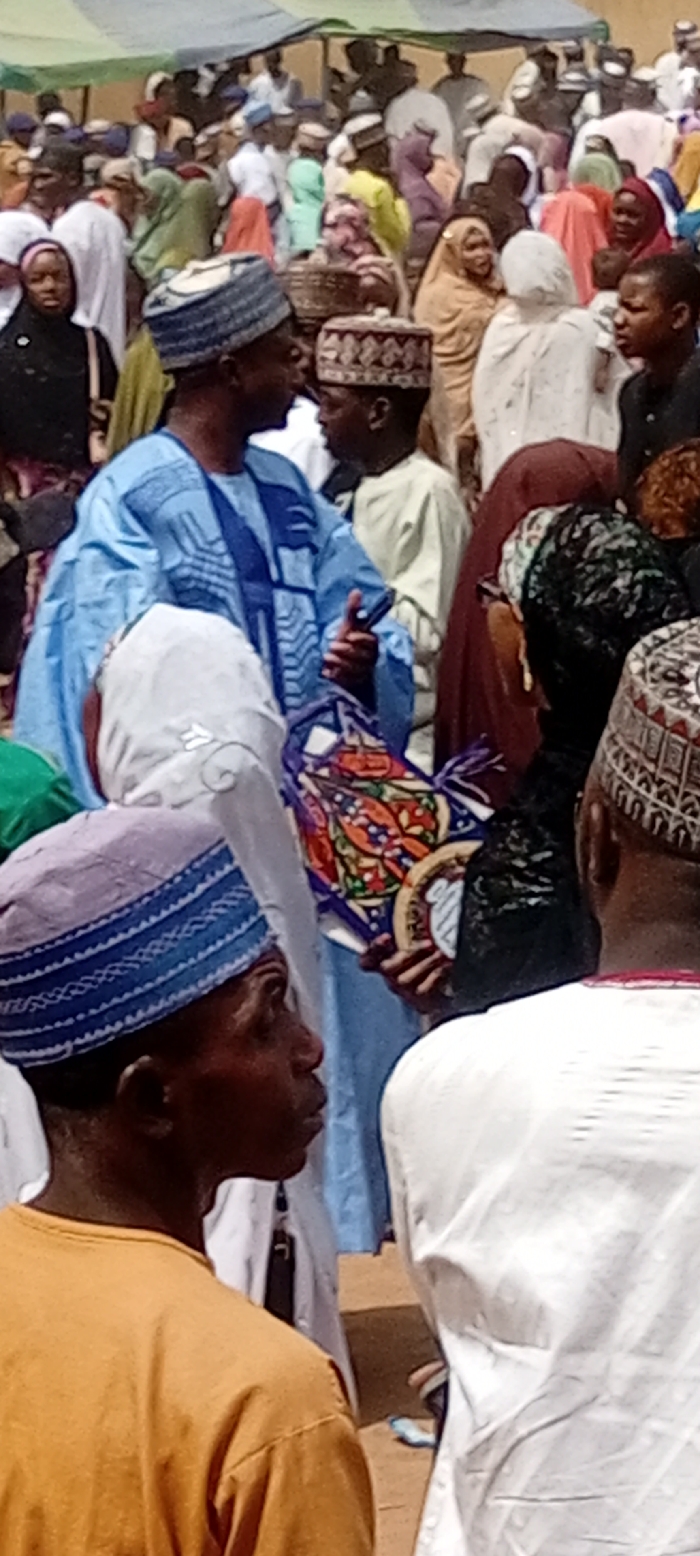
The image captures a densely crowded outdoor gathering in Sani Mai Nagge, Nigeria. Numerous individuals, predominantly adults, stand closely together on unpaved ground under bright daylight conditions. Many men wear traditional patterned caps and long robes (boubous), while women are largely observed in head coverings, including hijabs and veils, alongside varying traditional attire. In the mid-ground, a man prominent in a light blue patterned boubou and a light blue patterned cap faces right, his right hand raised in a gesture of communication. To his immediate right, a younger person in a cream-colored garment and a patterned cap faces the gesturing man. Adjacent to this pair, another individual, partially obscured, holds a circular, multi-colored decorative object adorned with geometric patterns. In the immediate foreground, a person in an orange t-shirt and a blue-and-white striped cap is visible in profile, facing right. The background features a multitude of other individuals and several temporary structures, including fabric awnings or tents, one displaying green and white stripes, suggesting a market or public event setting.
Sani Mai Nagge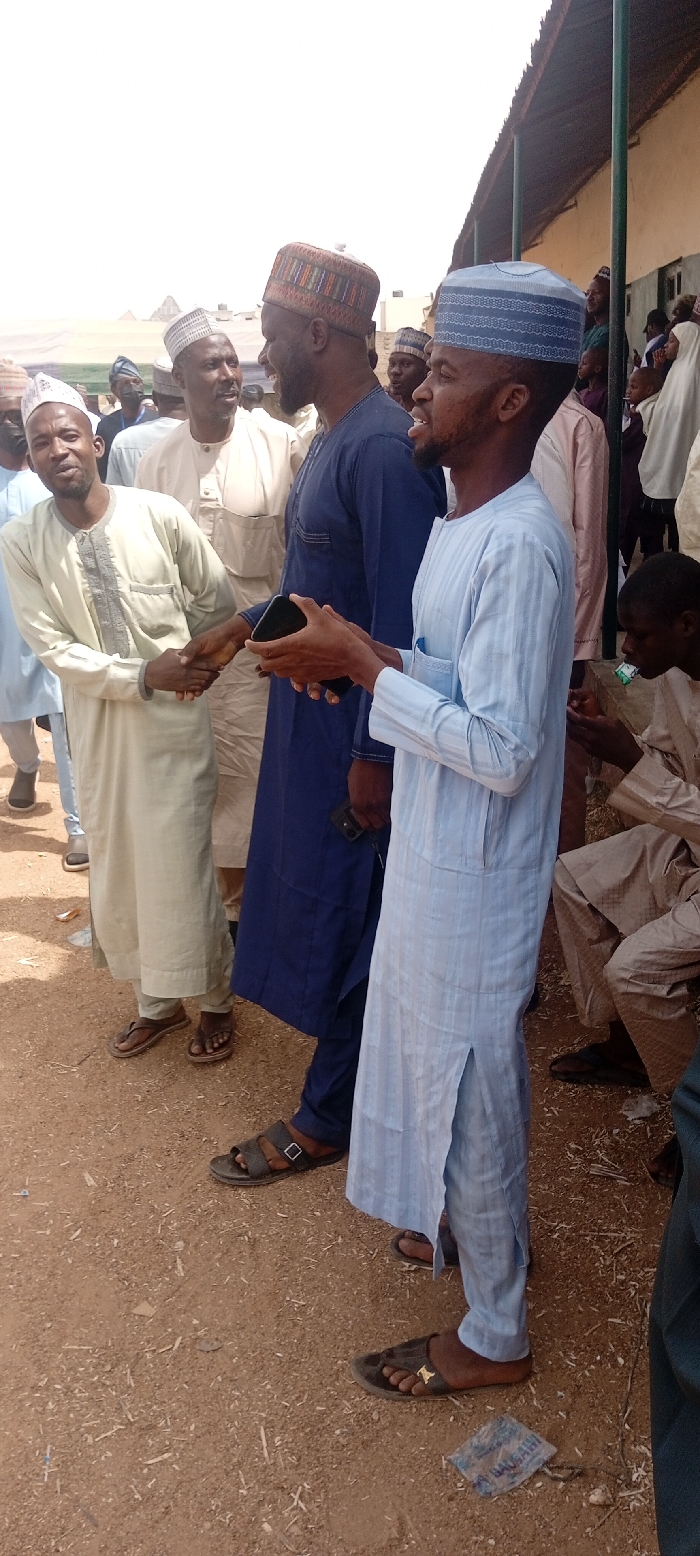
An outdoor scene in Sani Mai Nagge, Nigeria, depicts a daytime gathering of numerous individuals. In the foreground, from left to right, three adult males are prominent. A man in a light cream-colored long-sleeved tunic and matching pants, wearing a light-patterned cap, is engaged in a handshake with a man to his right. This second man is dressed in a dark blue long-sleeved tunic and matching pants, wearing a dark-patterned cap, and displays a slight smile. A black smartphone is visible in his left waist pocket or clipped to his attire. To his right, a third man, wearing a light blue striped long-sleeved tunic, matching pants, and a light blue patterned cap, holds a black smartphone horizontally with both hands, looking towards the left side of the frame. All three men wear open-toed sandals. In the midground and background, a crowd of other individuals, primarily men in similar traditional attire, are visible standing. Some women in head coverings and several children are also present in the background near a structure. The ground beneath the individuals is unpaved, composed of reddish-brown dirt with scattered small debris and a discarded plastic wrapper visible in the lower right foreground. The background features a building with a dark, possibly corrugated, roof overhang supported by green vertical poles, and light-colored walls. The scene is illuminated by bright daylight, suggesting clear weather conditions. In the far lower right, a person is partially visible, seated, and appears to be consuming an item from a small white and green packet.
Sani Mai Nagge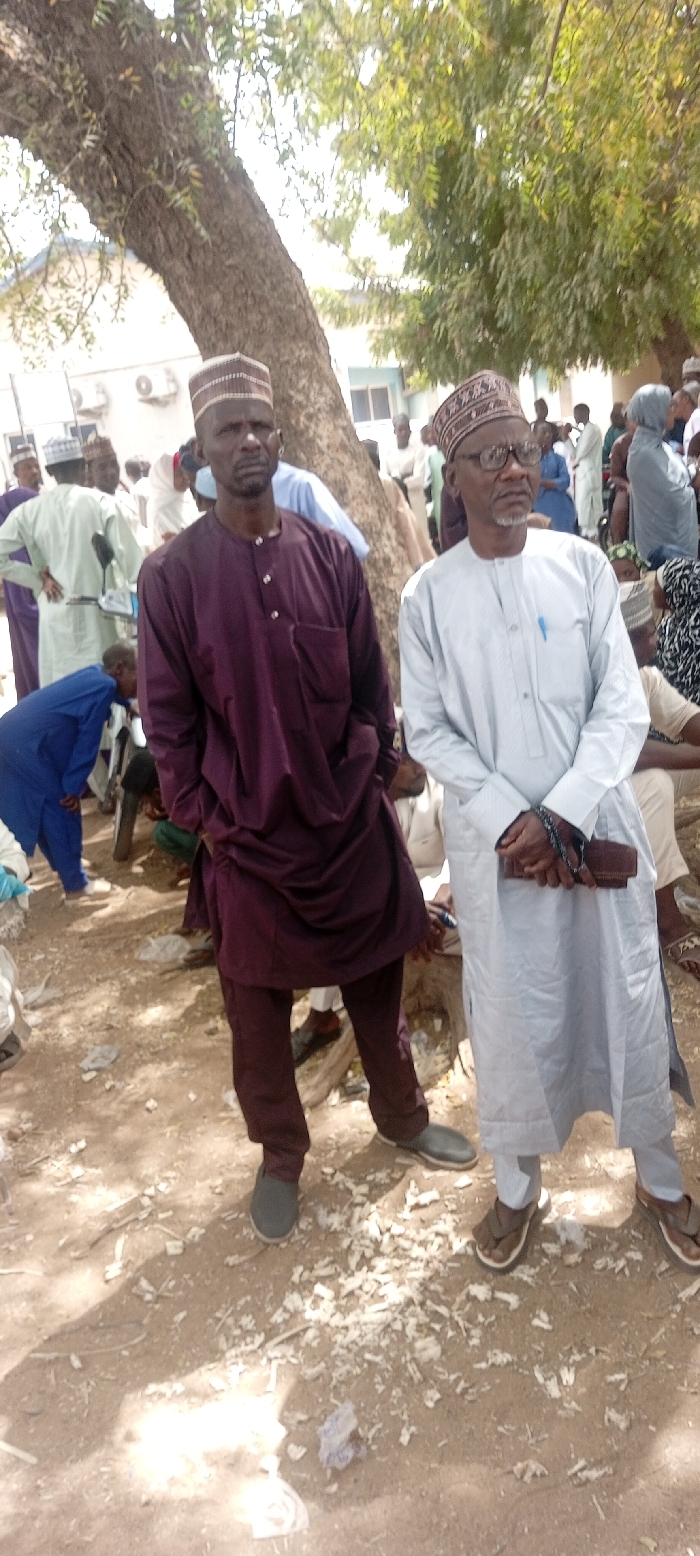
The image depicts an outdoor gathering in Sani Mai Nagge, Nigeria, under the shade of a large, mature tree with extensive green foliage. In the foreground, two men stand facing the viewer. The man on the left, of dark complexion, wears a dark purple long-sleeved tunic and matching trousers, topped with a patterned brown and white kufi cap; his hands are placed in his pockets. The man on the right, of lighter complexion, wears glasses, a light grey long-sleeved tunic with a blue pen in the left chest pocket, and a patterned brown and white kufi cap; he holds a brown rectangular object, possibly a wallet or pouch, in his left hand, and prayer beads are visible on his left wrist. Behind these two individuals, a crowd of numerous people is visible, predominantly men in various traditional Nigerian garments and caps, alongside some women in head coverings. They appear to be standing and conversing in small groups. The ground beneath the gathering is unpaved dirt, uneven, and covered with scattered white fibrous debris and general litter. In the background, behind the crowd and partially obscured by the tree, a light-colored building with multiple windows and external air conditioning units mounted on its facade is discernible. The scene is illuminated by sunlight, casting shadows on the ground.
Sani Mai Nagge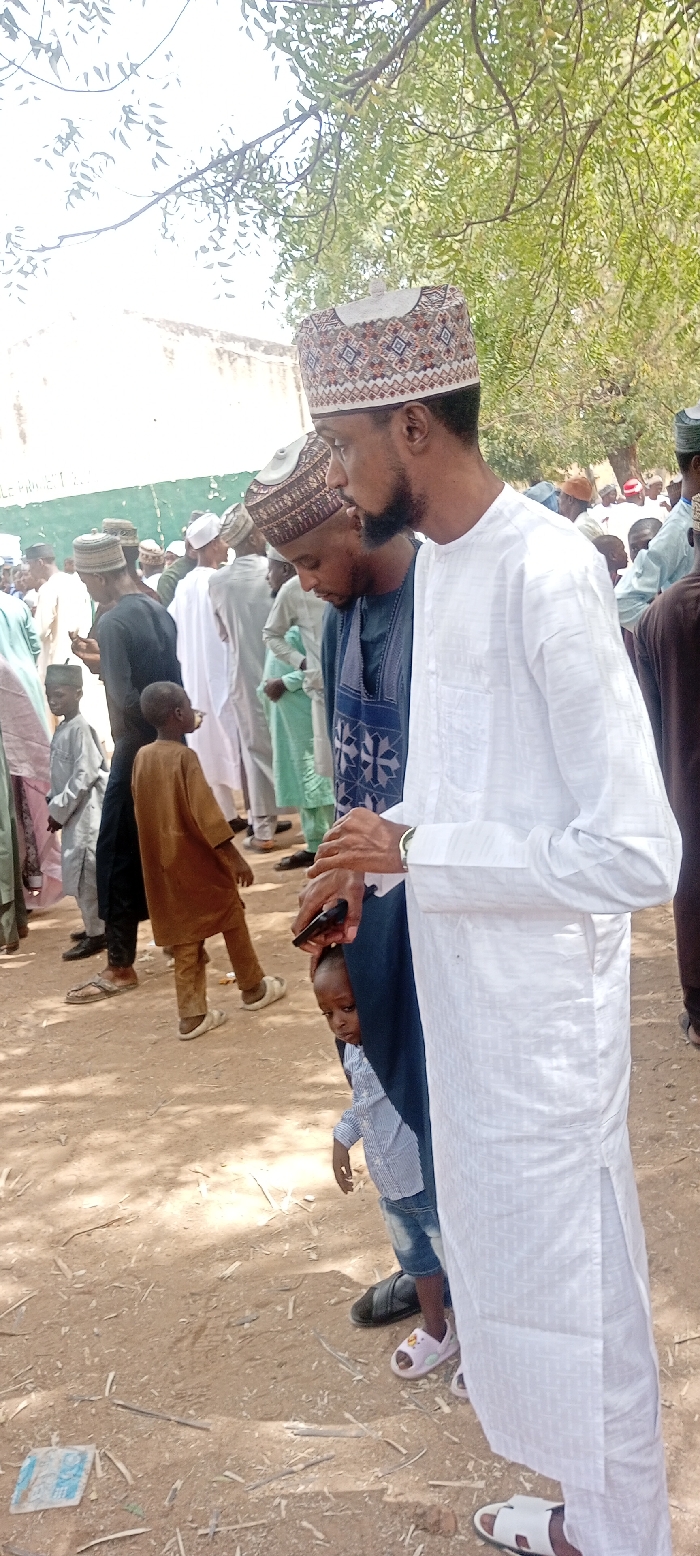
The image depicts an outdoor gathering in Sani Mai Nagge, Nigeria, under natural daylight. In the foreground, a man with a beard, wearing a white patterned kufi cap and a long-sleeved white kaftan with subtle vertical patterns, stands looking left. His right hand holds a dark mobile phone, partially obscured. He wears white open-toed sandals. To his immediate left and slightly behind, another man with a patterned kufi cap wears a dark blue kaftan with light blue geometric embroidery, looking downwards. A small child, wearing a light blue striped shirt and denim shorts with pink sandals, is partially visible peeking from behind the man in the blue kaftan. The environment consists of light brown, unpaved ground, scattered with small pieces of debris, including wood fragments and what appears to be a discarded piece of light blue material. In the background, numerous individuals, primarily men and boys dressed in various traditional tunics (white, light blue, brown, black) and caps, are gathered. A light-colored wall with some discolored patches is visible on the left side of the background. Green foliage from a tree is present in the upper right portion of the image. Shadows indicate direct sunlight. No specific interactions beyond general gathering are discernible.
Sani Mai Nagge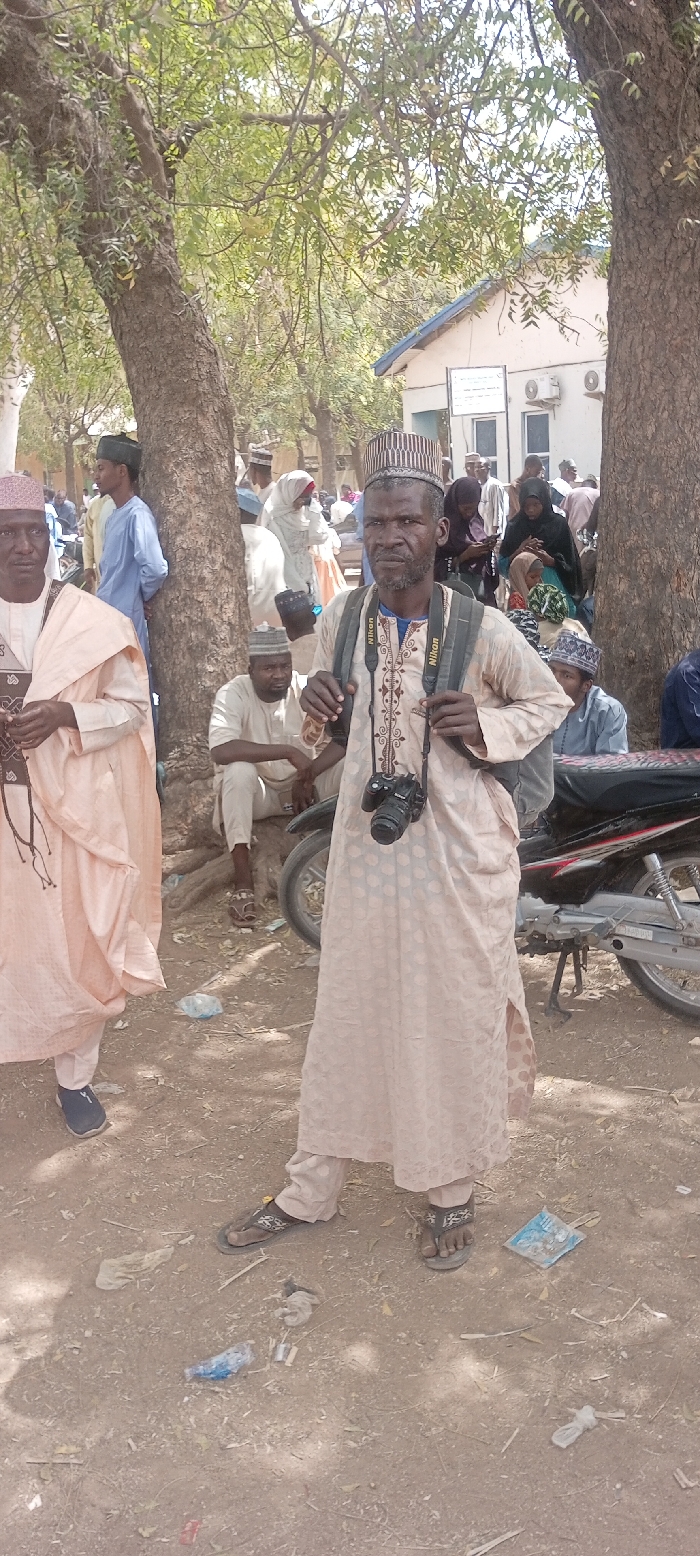
An outdoor scene in Sani Mai Nagge, Nigeria, depicts a public gathering area under bright daylight, with dappled shade from numerous trees with green foliage and visible trunks. In the foreground, centered, a male adult, appearing middle-aged with a beard, stands facing the camera. He wears a light-colored, patterned traditional tunic (caftan) and matching trousers, a patterned cap, and dark-colored flip-flops. A black backpack is on his shoulders, and a black Nikon DSLR camera with a lens is suspended around his neck by a black strap bearing the "Nikon" logo. His hands are positioned near the backpack straps. To the immediate left of the central subject, a partially cropped male adult, also in traditional attire including a light peach-colored tunic and cap, wears dark blue shoes and holds dark, beaded objects. Behind them, numerous other individuals, both male and female adults, are dispersed throughout the background. Men are generally seen in various colored traditional tunics and caps, while women are observed wearing head coverings, some in hijabs. One male adult is seated on the dirt ground beneath a tree, wearing sandals. The ground consists of dry, uneven dirt, with scattered refuse including plastic bags, paper, and other small debris. A black and silver motorcycle, resting on its kickstand, is partially visible on the right side behind the central subject. In the far background, a light-colored building with a blue-sloped roof, exterior air conditioning units, and an unreadable wall sign is present.
Sani Mai Nagge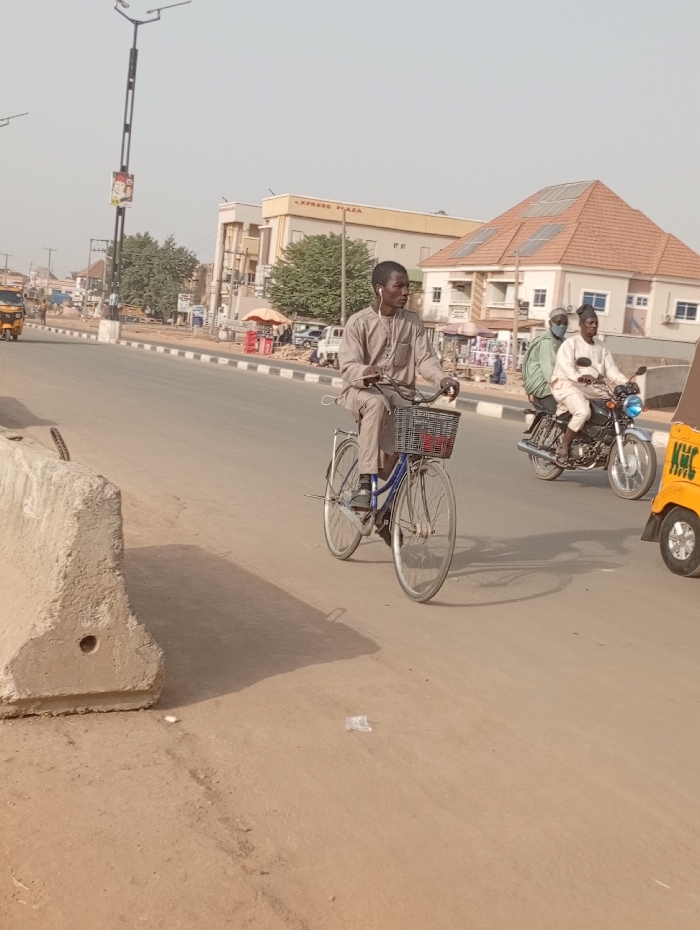
The image captures a sunny street scene in Sani Mai Nagge, Nigeria, depicting daily life and transportation. In the foreground, a young man rides a bicycle. He wears a light-colored, long-sleeved traditional garment, possibly a caftan or jalabiya, and has white earphones visible in his ears. His bicycle has a front basket. Distinct shadows are cast on the light brown road surface by the cyclist and a concrete road barrier positioned on the left side of the frame, suggesting it is either morning or late afternoon. To the right of the cyclist, two men are riding a motorcycle. The driver wears a light-colored outfit and a cap, while the passenger behind him is dressed in light green and wears a face mask. Partially visible on the far right is the front portion of a yellow commercial tricycle, often known as a 'keke napep', with the letters "KHC" visible on its side. In the far left background, another yellow tricycle can be seen. The background features several buildings along the street. A prominent, light-colored building clearly displays the text "EXPRESS PLAZA." Next to it, another building has a distinct reddish-brown pyramidal roof equipped with several solar panels. Scattered trees provide some greenery along the roadside. A tall, modern-looking street lamp stands on the left. The sky is clear and bright, indicating good weather. The scene depicts people engaged in typical urban travel activities.
Sani Mai Nagge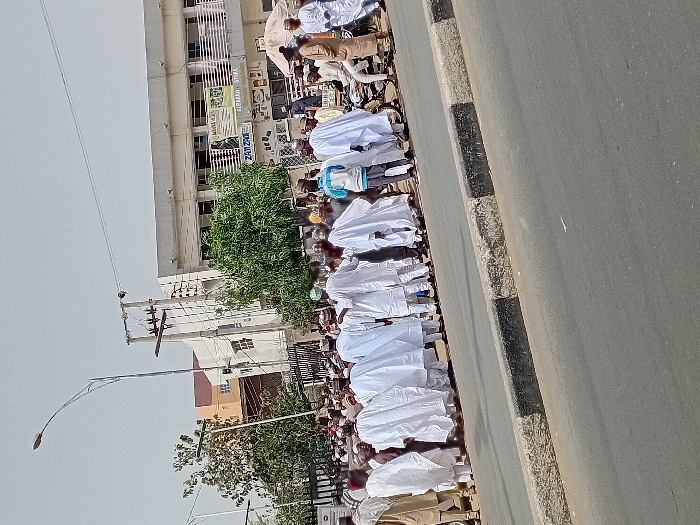
The image displays a daytime street scene in Sani Mai Nagge, Nigeria. In the foreground, an asphalt road is bordered by a concrete curb featuring a black painted upper edge. A large group of individuals, predominantly male, stand on the pavement adjacent to the curb. Most are dressed in long white robes and traditional caps, while a few wear contemporary clothing. A motorcycle is partially visible among the crowd on the right side. In the mid-ground, a multi-story building, likely commercial, displays signs such as "AGIANA HOTEL," "ALBARKA STYLE," and "ZAM ZAM." Further back, additional buildings, green trees, a tall street light, and utility poles with overhead power lines are visible under a bright, clear sky. The crowd appears to be stationary, facing generally towards the right of the frame.
Sani Mai Nagge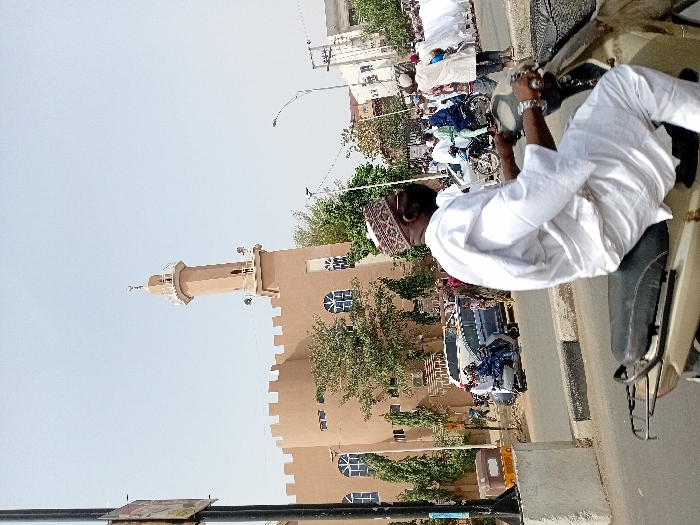
This image depicts an urban street scene in Sani Mai Nagge, Nigeria, under clear daytime conditions. In the immediate foreground, a male subject rides a light-colored scooter, positioned in profile facing right. He wears a white traditional tunic (agbada), white trousers, a patterned kufi cap, dark sunglasses, and a black face mask, with his hands gripping the scooter's handlebars. The scooter features a black seat and a rear cargo rack. The midground reveals a paved road with a concrete curb separating lanes. On the left, a silver sedan is visible alongside a blue scooter carrying two individuals. An orange three-wheeled rickshaw is partially obscured behind a dark vertical pole. On the right, a large gathering or procession of individuals, many dressed in white traditional garments, occupies the roadway. Several other motorcycles with riders are interspersed within this group. The background is dominated by a tan-colored mosque, characterized by a crenellated parapet along its roofline and numerous arched windows with blue decorative grilles. A tall, slender minaret, featuring a balcony and topped with a finial (crescent moon and star), rises from the mosque. Green trees are distributed around the mosque and along the street. The sky above is clear and light blue, with additional urban buildings and utility structures visible in the far distance on the right.
Sani Mai Nagge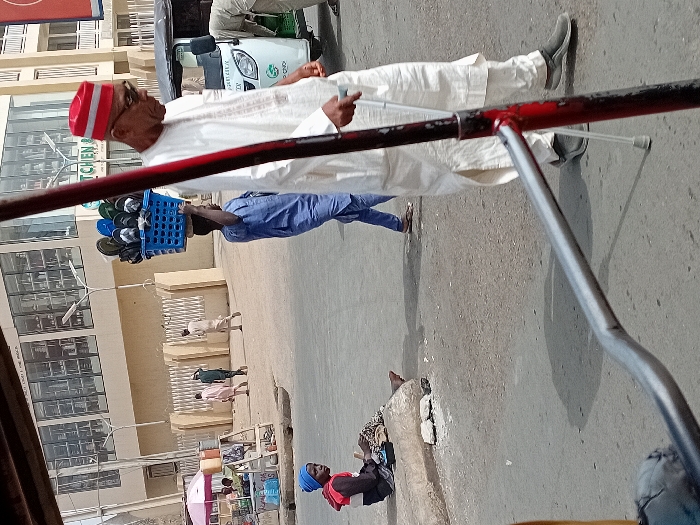
The image presents a daytime street scene in Sani Mai Nagge, Nigeria, viewed from a low perspective, partially obstructed by a red vertical bar and a silver horizontal bar in the foreground. In the mid-ground, an adult male walks from right to left, wearing a white traditional tunic and trousers, dark grey slip-on shoes, sunglasses, and a red cap with white horizontal stripes. He uses a silver crutch under his left arm, with his right hand in his pocket. Immediately behind him, a younger male, dressed in a blue traditional tunic and trousers, carries a blue plastic basket filled with various colored flip-flops on his head. To the far left, a young individual with a blue head covering, a red top, and dark patterned pants sits barefoot on a low concrete curb, looking towards the viewer while manipulating items on their lap. To the right, a white and green motorized tricycle is partially visible, with a person standing nearby. The background features a multi-story building with a light-colored facade and numerous large glass windows. Text on the building includes "SANI MAI NAGGE" and "KITCHEN &". A light-colored, decorative fence runs in front of the building. Several male pedestrians in light-colored traditional garments walk on an unpaved area adjacent to the building. To the left, a small street vendor's stall with a pink umbrella and displayed items is visible. The environment is illuminated by natural daylight, casting shadows.
Sani Mai Nagge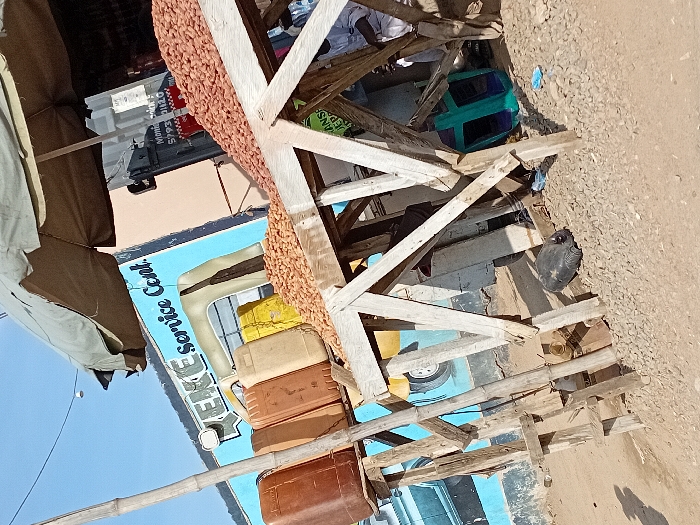
This image depicts an outdoor market or service area in Sani Mai Nagge, Nigeria. In the mid-ground, a crudely constructed wooden stand displays a substantial pile of light brown groundnuts. To the immediate left, four plastic jerricans, varying in color from reddish-brown to yellow, are arranged on an adjacent wooden support structure. The background features a light blue building wall painted with the text "KEKE service Cent." and a graphic depicting an auto-rickshaw. Above the scene, a weathered olive-green umbrella provides partial shade. The ground consists of dirt mixed with light-colored gravel, upon which a black plastic bottle and a teal plastic crate are visible. A tall, slender bamboo pole stands vertically on the far left. Electrical wires are present against the clear blue sky in the upper left. A person wearing white clothing is partially visible beneath the right side of the nut stand. Obscured signage near the right includes text related to "Money Trans" and "TRANS JEPA."
Sani Mai Nagge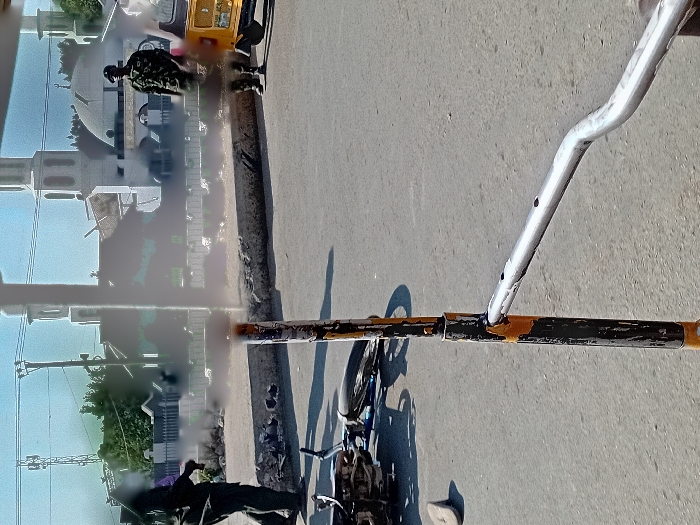
The image captures a street scene in the city of Sani Mai Nagge, Nigeria, under clear daytime conditions. In the immediate foreground, a black and yellow striped metal pole is centrally positioned, with a silver-colored horizontal metal bar extending to the right. On the asphalt road to the left of this pole, a dark-colored motorcycle lies on its left side. A single light-colored sandal rests on the road surface near the fallen motorcycle. Further back, the paved road is bordered by a raised curb and a low white fence. Two individuals are visible: on the left side of the road, a person dressed in dark clothing walks away from the center of the frame towards the left; their upper body is partially obscured by a dark, amorphous shape. On the right, a male individual stands upright next to a yellow three-wheeled auto-rickshaw. He is wearing a camouflage military uniform and a dark beret, and appears to be observing the scene, facing generally towards the left. In the background, a large white mosque with multiple domes and minarets is prominent, featuring a crescent symbol atop its main dome. A tall communication tower is visible further in the background against a bright blue sky, along with other structures and trees.
Sani Mai Nagge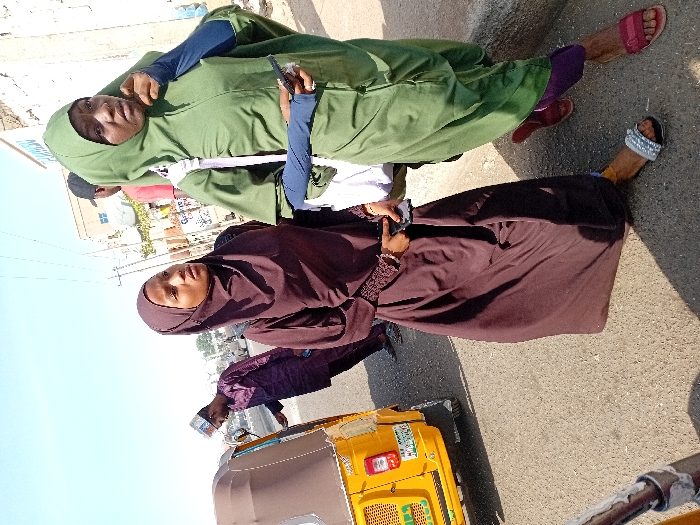
The image captures an urban street scene in Sani Mai Nagge, Nigeria, under clear, sunny daytime conditions. In the foreground, two young females stand on an asphalt road surface. The female on the left wears a dark brown full-length dress (abaya) and a matching hijab, accessorized with a dark shoulder bag. She holds a dark mobile phone near her waist and wears a silver-studded sandal on her right foot. The female on the right wears a green hijab and a loose-fitting green garment over purple trousers, with a white strap bag over her shoulder. She holds a dark mobile phone in her left hand and touches her chin with her right hand, wearing a red sandal on her left foot. In the midground, on the left, a yellow motorized tricycle (Keke Napep) is partially visible, displaying a Nigerian license plate, MNA-193YX. A male wearing a dark purple traditional tunic (kaftan) and a patterned cap (kufi) stands partially obscured next to the tricycle. Further in the background on the right, another male is partially visible, wearing a black cap and a red shirt. The background features various buildings, overhead power lines, and a street sign with partially visible text, including "GURARA". Shadows are cast on the asphalt surface, consistent with bright sunlight.
Sani Mai Nagge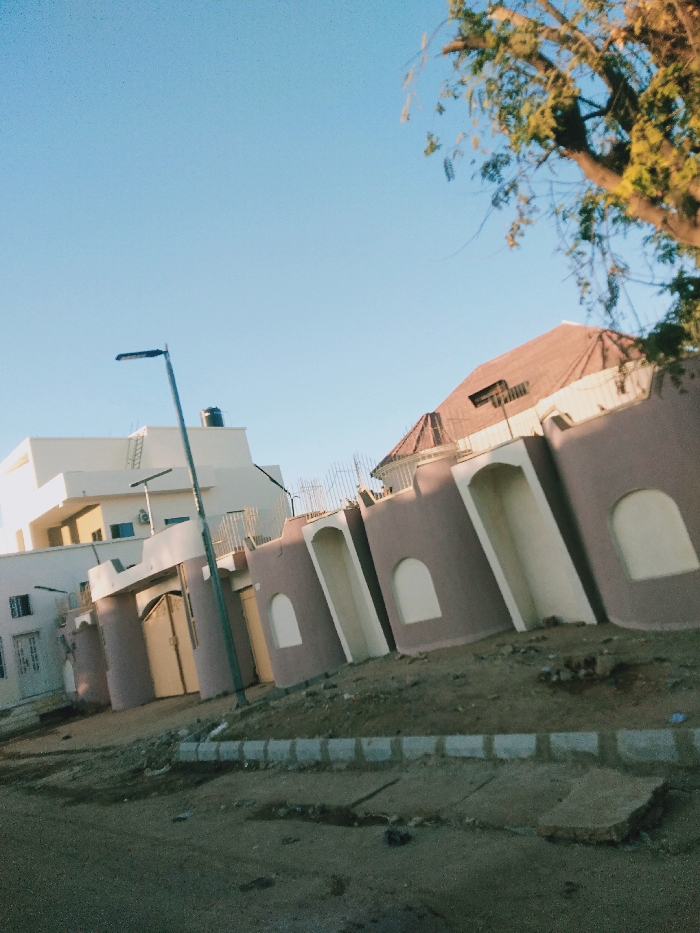
A street view under a clear blue sky features two buildings, one white and modern, the other with a brown roof. A brown wall with white arches separates the buildings from the street. A streetlight stands tall nearby. A tree’s branches reach into the frame from the upper right corner. The pavement in the foreground appears cracked and weathered.
Sani Mai Nagge
A light blue Mercedes-Benz ML-Class SUV (W166 generation) is centered on an unpaved, dusty road in Sani Mai Nagge, Nigeria. The vehicle displays a Nigerian license plate, "ABUJA BWR-156CU," on its front bumper, which is equipped with a chrome lower trim. The scene is viewed from within a yellow tricycle taxi (keke napep), with a yellow frame and mirror on the right, and a green/grey metal bar on the left foreground. The environment, under a clear blue sky, consists of single to two-story buildings with light brown or beige facades lining both sides of the street. Some structures show visible cracks in their walls. A modern street light pole is visible in the mid-ground. Behind the Mercedes-Benz, a second yellow tricycle taxi is present, followed by additional distant vehicles and multiple pedestrians. A faint silhouette of a driver is discernible inside the Mercedes-Benz. All vehicles appear to be stationary or moving slowly in a queue.
Sani Mai Nagge