CM:

ATTN

Get the app

Santiago de Compostela, Spain

30 memories from Santiago de Compostela, Spain
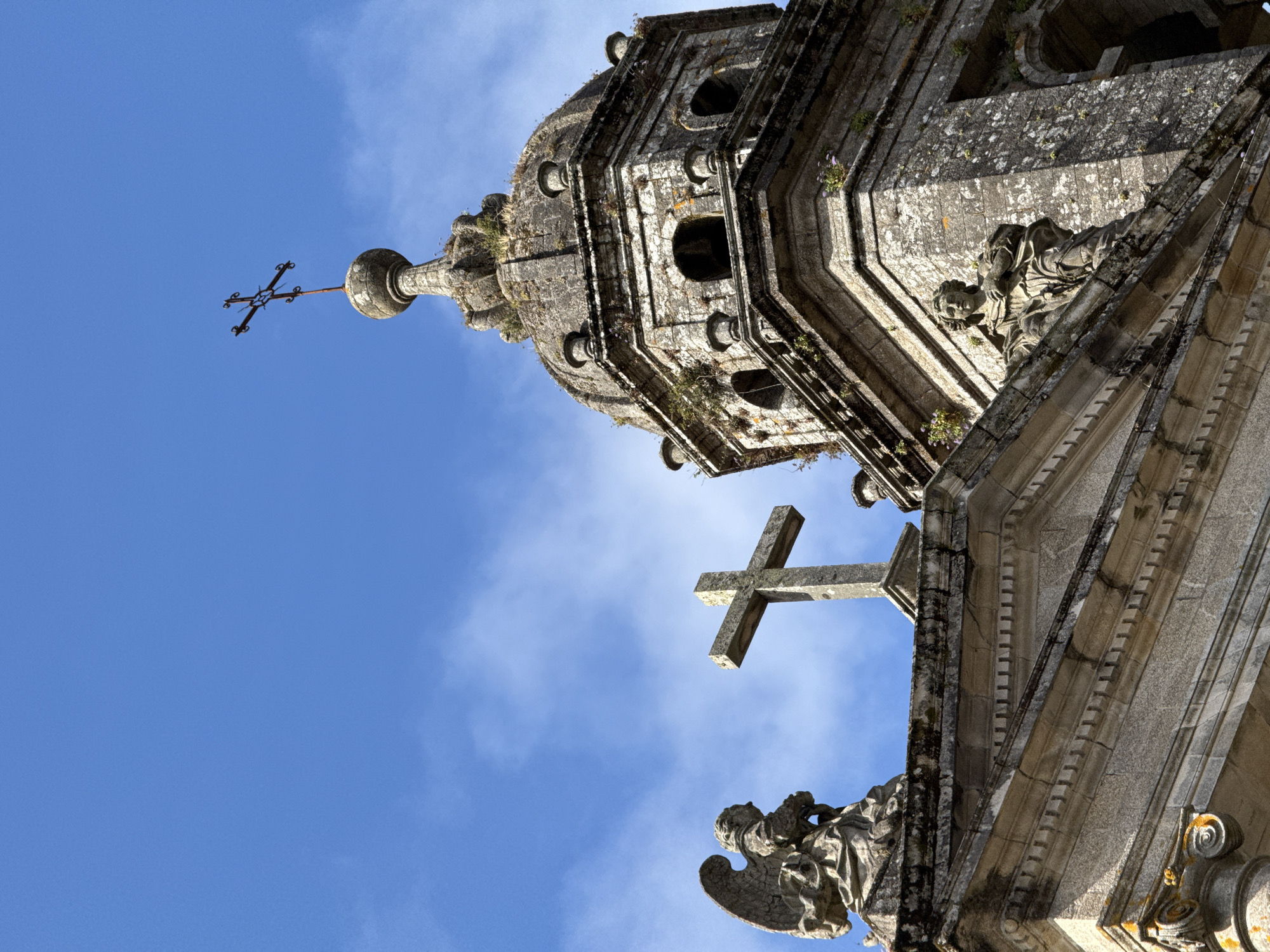
A low-angle, close-up shot captures the upper architectural elements of the Cathedral of Santiago de Compostela in Spain, set against a vibrant, partially clouded blue sky. The focus is on the weathered stone facade, featuring intricate carvings and details. On the left, a stone statue of an angel with outstretched wings stands atop the building. To its right, a large stone cross is prominently displayed. Further to the right, a domed bell tower, adorned with smaller decorative elements and patches of greenery, rises towards the sky, topped by a smaller, ornate metal cross. The stone surfaces show signs of age, with moss and lichen growing in crevices, lending a sense of historical depth to the structure. The overall impression is one of architectural grandeur and timelessness.

A low-angle, close-up shot captures the upper architectural elements of the Cathedral of Santiago de Compostela in Spain, set against a vibrant, partially clouded blue sky. The focus is on the weathered stone facade, featuring intricate carvings and details. On the left, a stone statue of an angel with outstretched wings stands atop the building. To its right, a large stone cross is prominently displayed. Further to the right, a domed bell tower, adorned with smaller decorative elements and patches of greenery, rises towards the sky, topped by a smaller, ornate metal cross. The stone surfaces show signs of age, with moss and lichen growing in crevices, lending a sense of historical depth to the structure. The overall impression is one of architectural grandeur and timelessness.

Santiago de Compostela
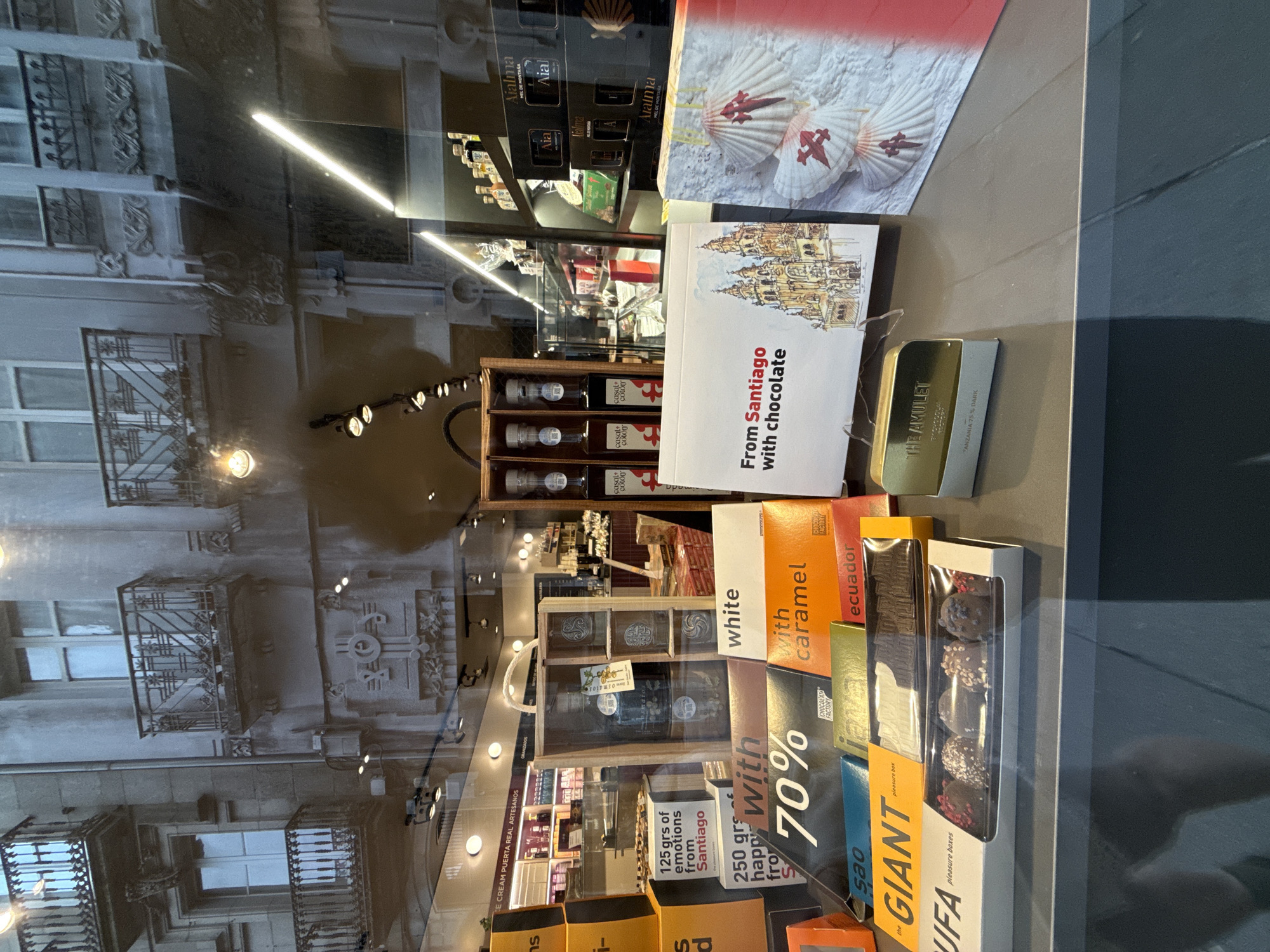
This media file shows a close-up, horizontal view of a shop window displaying various chocolate and honey products. The shop appears to be located in Santiago de Compostela, Spain, as indicated by text on the packaging. The products are arranged on shelves and boxes, with some products featuring imagery of the Santiago de Compostela Cathedral.

Visible text includes "From Santiago with chocolate," "125 grs of emotions from Santiago," "250 grs happ fro," "70%," "white," "with caramel," "ecuador," "THE AMULET TANZANIA 75% DARK," and brand names like "Aialma MEL DE MONTAÑA" and "casal+ coton."

The scene is indoors, with artificial lighting illuminating the products. Reflections on the glass window show the exterior of a building with balconies and architectural details, suggesting an urban setting. The overall mood is inviting, showcasing artisanal food items. The time of day is not discernible, but the lighting suggests it could be evening or a dimly lit interior.

This media file shows a close-up, horizontal view of a shop window displaying various chocolate and honey products. The shop appears to be located in Santiago de Compostela, Spain, as indicated by text on the packaging. The products are arranged on shelves and boxes, with some products featuring imagery of the Santiago de Compostela Cathedral. Visible text includes "From Santiago with chocolate," "125 grs of emotions from Santiago," "250 grs happ fro," "70%," "white," "with caramel," "ecuador," "THE AMULET TANZANIA 75% DARK," and brand names like "Aialma MEL DE MONTAÑA" and "casal+ coton." The scene is indoors, with artificial lighting illuminating the products. Reflections on the glass window show the exterior of a building with balconies and architectural details, suggesting an urban setting. The overall mood is inviting, showcasing artisanal food items. The time of day is not discernible, but the lighting suggests it could be evening or a dimly lit interior.

Santiago de Compostela
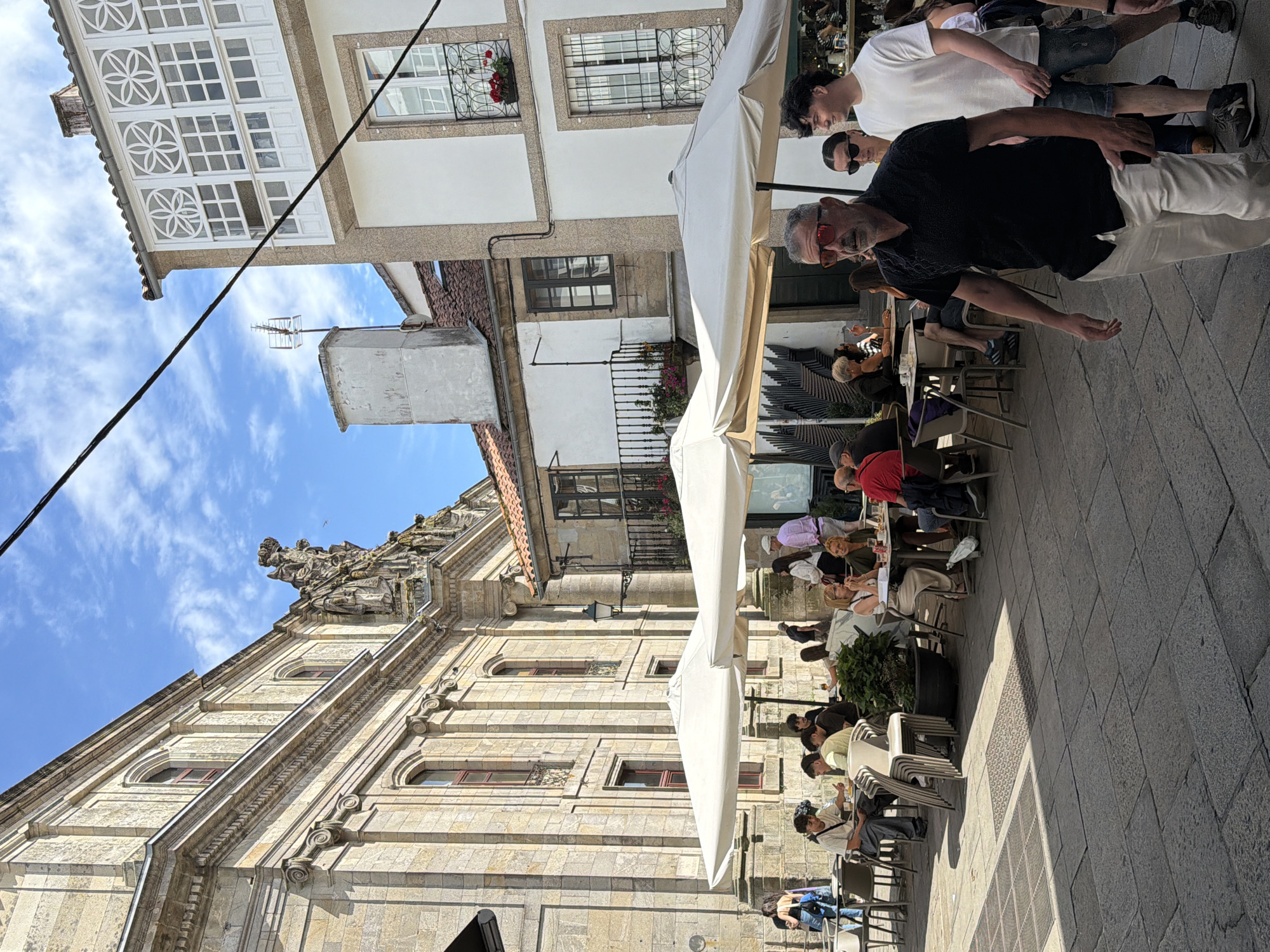
This media file captures a sunny day in Santiago de Compostela, Spain. The scene depicts an outdoor seating area of a cafe or restaurant, with several people seated at tables and others standing. The architecture suggests a historical European setting, with a stone building featuring arched windows and ornate decorative elements. A large white umbrella shades some of the tables, indicating a bright, sunny time of day. People are casually dressed, suggesting a relaxed atmosphere. Some individuals are engaged in conversation, while others appear to be dining or enjoying beverages. The image is oriented vertically, with the sky and buildings occupying the upper portion and the seating area and cobblestone ground in the lower portion.

This media file captures a sunny day in Santiago de Compostela, Spain. The scene depicts an outdoor seating area of a cafe or restaurant, with several people seated at tables and others standing. The architecture suggests a historical European setting, with a stone building featuring arched windows and ornate decorative elements. A large white umbrella shades some of the tables, indicating a bright, sunny time of day. People are casually dressed, suggesting a relaxed atmosphere. Some individuals are engaged in conversation, while others appear to be dining or enjoying beverages. The image is oriented vertically, with the sky and buildings occupying the upper portion and the seating area and cobblestone ground in the lower portion.

Santiago de Compostela

This image shows a close-up view of a person's hands interacting with a smartphone and a disposable coffee cup. The person is wearing a black long-sleeved garment and a gold ring on their left hand. The background appears to be an outdoor setting, possibly a street or a public walkway, with a blurred background that suggests a textured surface, like stone or concrete, and a hint of greenery, possibly indicating a park or garden. The lighting suggests it is daytime, but the absence of strong shadows does not clearly indicate the time of day.

The person is holding a black smartphone in their right hand, seemingly in the process of using it, possibly scrolling or typing. Their left hand is holding a white disposable coffee cup with a white lid, and their fingers are wrapped around it. The cup has some faint blue text visible, though it is largely obscured. The focus is on the hands and the objects they are holding, with the background out of focus. The overall impression is one of casual everyday activity, possibly in an urban environment.

The context provided specifies Santiago de Compostela, Spain. This information, combined with the visual cues of what appears to be an urban setting, suggests the scene could be set in this historic Spanish city. However, there are no explicit landmarks or distinct architectural features visible in the image to confirm the location. The weather appears to be mild, as suggested by the clothing.

This image shows a close-up view of a person's hands interacting with a smartphone and a disposable coffee cup. The person is wearing a black long-sleeved garment and a gold ring on their left hand. The background appears to be an outdoor setting, possibly a street or a public walkway, with a blurred background that suggests a textured surface, like stone or concrete, and a hint of greenery, possibly indicating a park or garden. The lighting suggests it is daytime, but the absence of strong shadows does not clearly indicate the time of day. The person is holding a black smartphone in their right hand, seemingly in the process of using it, possibly scrolling or typing. Their left hand is holding a white disposable coffee cup with a white lid, and their fingers are wrapped around it. The cup has some faint blue text visible, though it is largely obscured. The focus is on the hands and the objects they are holding, with the background out of focus. The overall impression is one of casual everyday activity, possibly in an urban environment. The context provided specifies Santiago de Compostela, Spain. This information, combined with the visual cues of what appears to be an urban setting, suggests the scene could be set in this historic Spanish city. However, there are no explicit landmarks or distinct architectural features visible in the image to confirm the location. The weather appears to be mild, as suggested by the clothing.

Santiago de Compostela

A black and white rabbit is lying on a rug under a table, its body stretched out and its head resting on the floor. The rabbit appears to be relaxed, possibly sleeping or resting. The rug is patterned with gray and white designs, and the table has a dark, reflective surface with metal legs. Sunlight streams in from the right side of the frame, illuminating the rug and the rabbit.

A black and white rabbit is lying on a rug under a table, its body stretched out and its head resting on the floor. The rabbit appears to be relaxed, possibly sleeping or resting. The rug is patterned with gray and white designs, and the table has a dark, reflective surface with metal legs. Sunlight streams in from the right side of the frame, illuminating the rug and the rabbit.

Santiago de Compostela
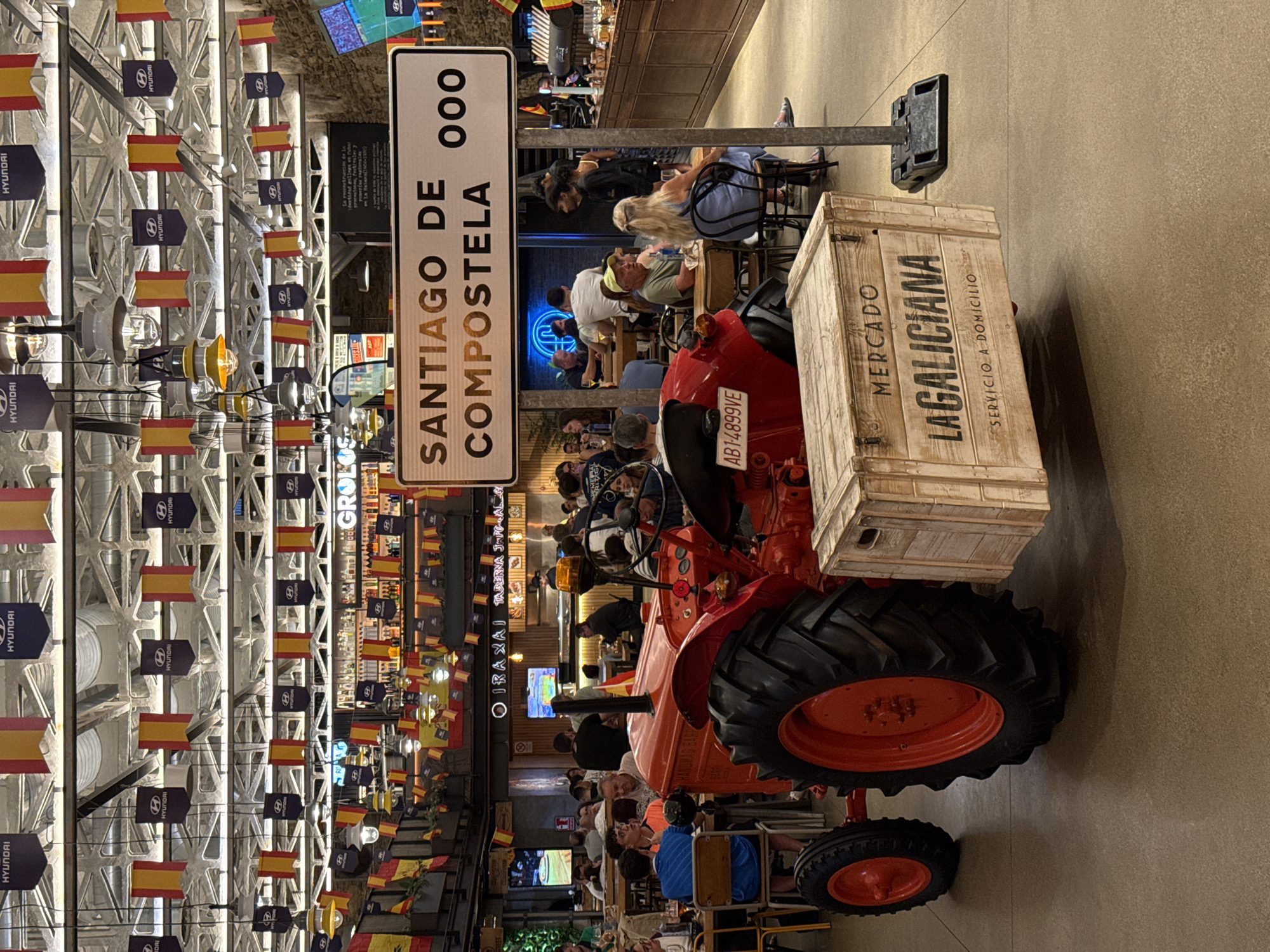
A red tractor is parked indoors in front of a wooden crate with "MERCADO LAGALICIANA SERVICIO A DOMICILIO" written on it. Above the tractor, a white sign with black text reads "SANTIAGO DE COMPOSTELA 000". Several people are seated at tables in the background, and flags hang from the ceiling. The environment appears to be a restaurant or market.

A red tractor is parked indoors in front of a wooden crate with "MERCADO LAGALICIANA SERVICIO A DOMICILIO" written on it. Above the tractor, a white sign with black text reads "SANTIAGO DE COMPOSTELA 000". Several people are seated at tables in the background, and flags hang from the ceiling. The environment appears to be a restaurant or market.

Santiago de Compostela
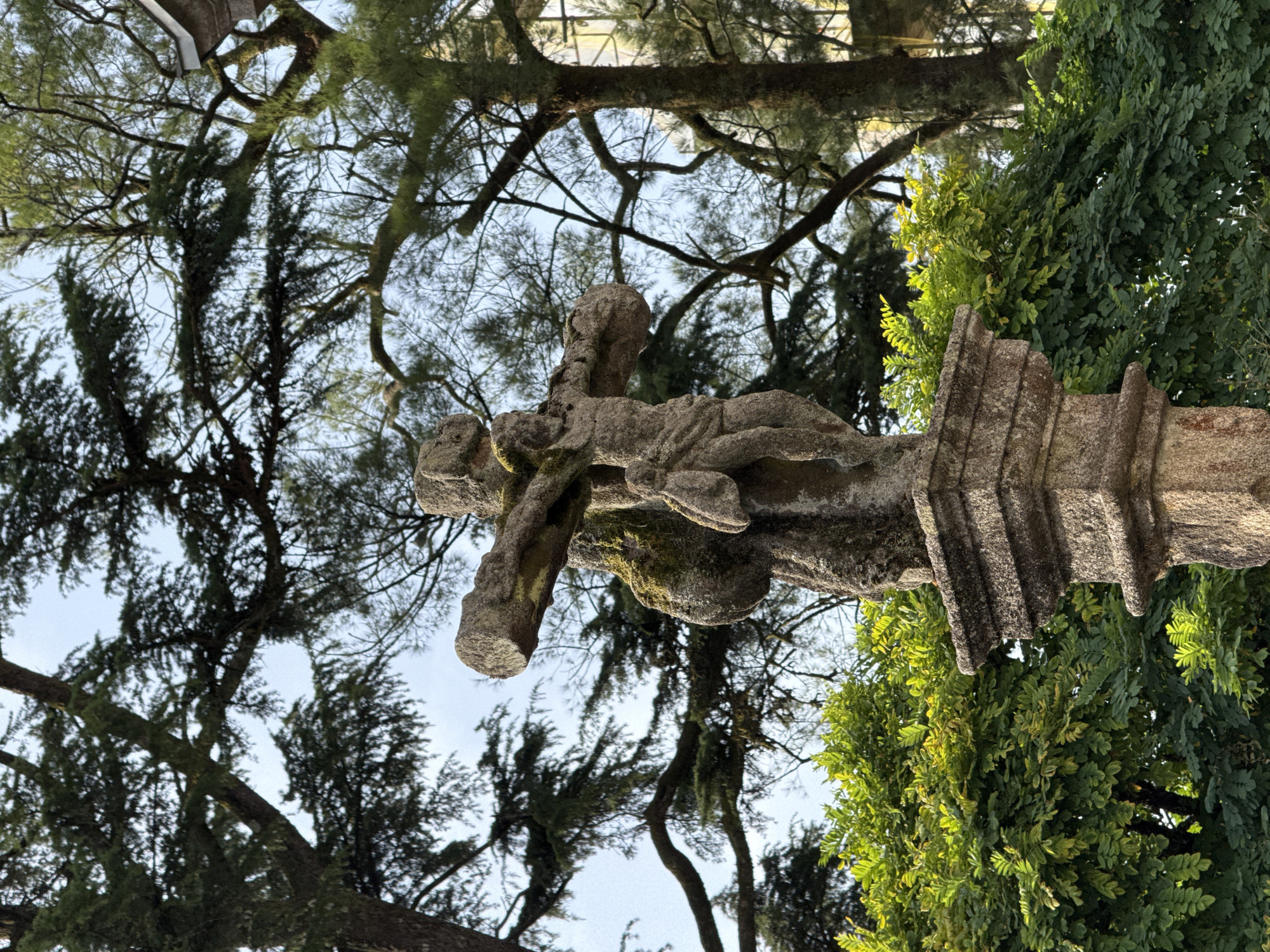
A stone sculpture depicting Jesus Christ on the cross stands on a pedestal in Santiago de Compostela, Spain. The sculpture is weathered and covered in moss. Behind the sculpture, lush green foliage and tall trees with dark branches and needles create a natural backdrop against a pale sky. A portion of a building with a gray, sloped roof is visible in the upper right corner of the image.

A stone sculpture depicting Jesus Christ on the cross stands on a pedestal in Santiago de Compostela, Spain. The sculpture is weathered and covered in moss. Behind the sculpture, lush green foliage and tall trees with dark branches and needles create a natural backdrop against a pale sky. A portion of a building with a gray, sloped roof is visible in the upper right corner of the image.

Santiago de Compostela
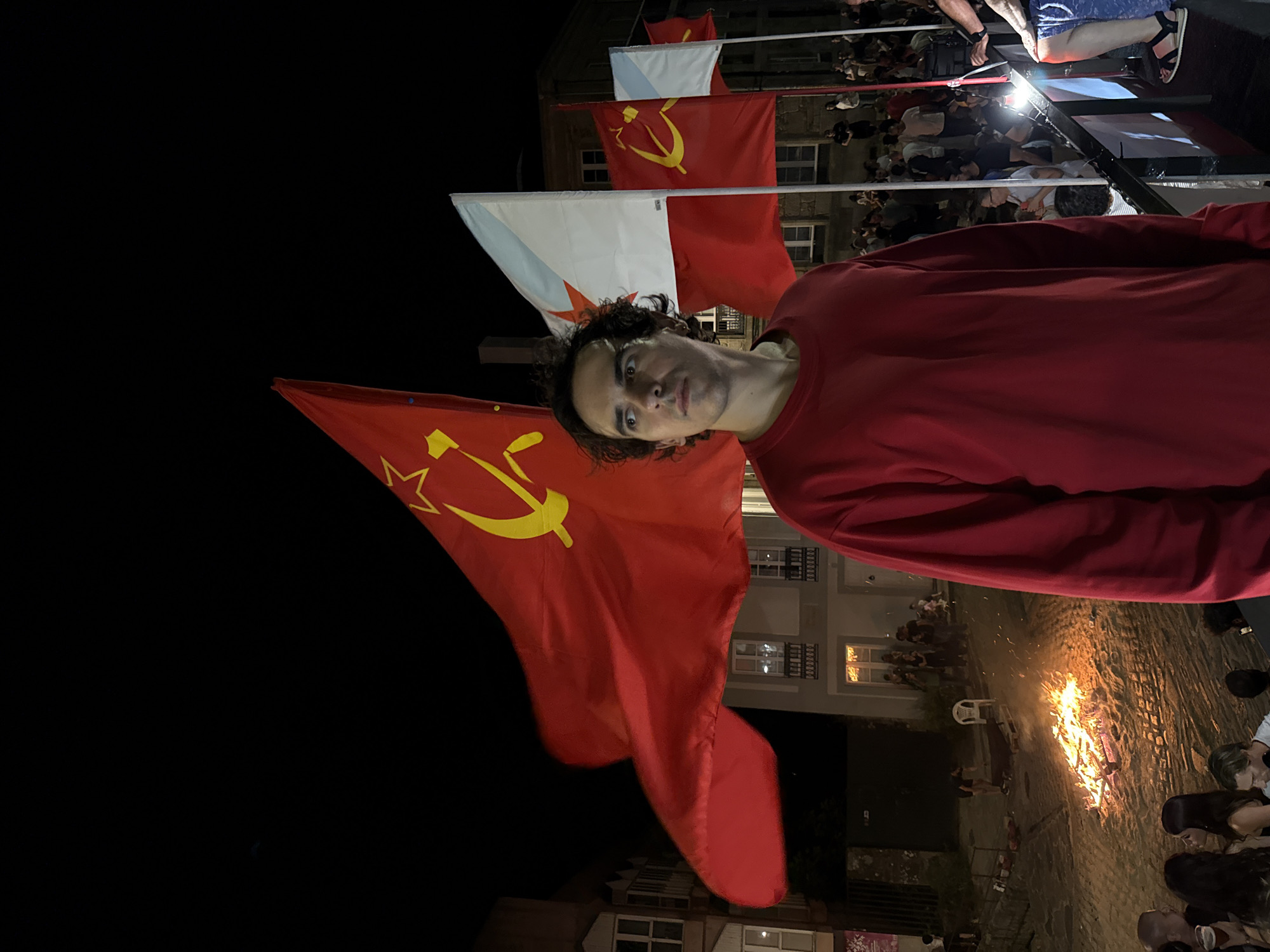
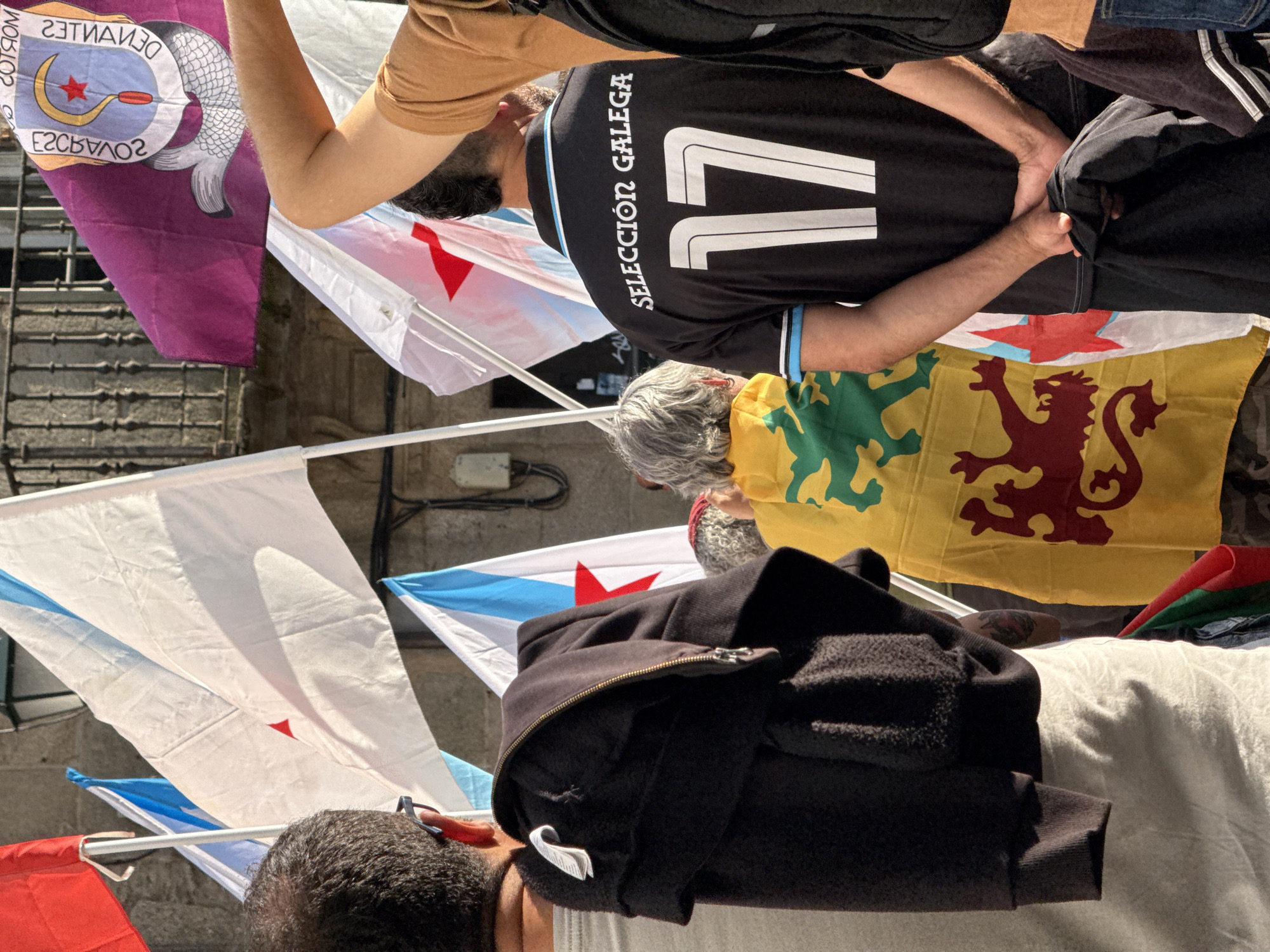
The image depicts a nighttime scene in what appears to be a public square in Santiago de Compostela, Spain, likely during a festival or gathering. A young man with curly dark hair, wearing a plain red long-sleeved shirt, is positioned in the foreground, looking towards the right with a neutral expression. Behind him, several large red flags with a yellow hammer and sickle emblem are prominently displayed, some of them partially obscured by the man. Interspersed with these are white and light blue flags.

In the background, a bonfire blazes in the middle of a cobblestone area, with sparks rising into the dark sky. Around the bonfire, people are gathered, some appearing to be interacting or observing. Further back, buildings with illuminated windows line the square, suggesting an urban environment. The overall atmosphere is festive, with a sense of community and perhaps a political or cultural demonstration given the prominent display of the hammer and sickle flags. The presence of people, a fire, and flags suggests a public event taking place after dark.

The image depicts a nighttime scene in what appears to be a public square in Santiago de Compostela, Spain, likely during a festival or gathering. A young man with curly dark hair, wearing a plain red long-sleeved shirt, is positioned in the foreground, looking towards the right with a neutral expression. Behind him, several large red flags with a yellow hammer and sickle emblem are prominently displayed, some of them partially obscured by the man. Interspersed with these are white and light blue flags. In the background, a bonfire blazes in the middle of a cobblestone area, with sparks rising into the dark sky. Around the bonfire, people are gathered, some appearing to be interacting or observing. Further back, buildings with illuminated windows line the square, suggesting an urban environment. The overall atmosphere is festive, with a sense of community and perhaps a political or cultural demonstration given the prominent display of the hammer and sickle flags. The presence of people, a fire, and flags suggests a public event taking place after dark.

Santiago de Compostela
This media file depicts an outdoor gathering at night in what appears to be a city square in Santiago de Compostela, Spain. The central subject is a person with dark, curly hair wearing a red long-sleeved shirt and dark jeans, holding a smartphone in their right hand. They are standing in front of several flags, including a prominent red flag with a yellow hammer and sickle symbol, a symbol of communism. To the left of this flag is another red flag with a white star, and to the left of that, a white flag with a red star.

The background shows buildings with windows, suggesting an urban environment. A bonfire is visible in the middle ground, with several people gathered around it. Other individuals are scattered throughout the scene, some appearing to be spectators. The overall atmosphere seems festive or celebratory, given the presence of the bonfire and the gathering of people. The lighting suggests it is nighttime. There is no visible text in the image.

This media file depicts an outdoor gathering at night in what appears to be a city square in Santiago de Compostela, Spain. The central subject is a person with dark, curly hair wearing a red long-sleeved shirt and dark jeans, holding a smartphone in their right hand. They are standing in front of several flags, including a prominent red flag with a yellow hammer and sickle symbol, a symbol of communism. To the left of this flag is another red flag with a white star, and to the left of that, a white flag with a red star. The background shows buildings with windows, suggesting an urban environment. A bonfire is visible in the middle ground, with several people gathered around it. Other individuals are scattered throughout the scene, some appearing to be spectators. The overall atmosphere seems festive or celebratory, given the presence of the bonfire and the gathering of people. The lighting suggests it is nighttime. There is no visible text in the image.

Santiago de Compostela
The video shows a nighttime scene in a cobblestone square. A large red flag or fabric is draped across the top of the frame, obscuring some of the view. In the center of the square, a bonfire burns, casting a warm glow on the surrounding area. Several people are gathered around the fire, sitting and standing. In the background, there are buildings with windows lit from within. Other individuals are seated in the background, some appearing to be watching the bonfire. The overall atmosphere seems to be one of a gathering or event taking place outdoors at night.

The video shows a nighttime scene in a cobblestone square. A large red flag or fabric is draped across the top of the frame, obscuring some of the view. In the center of the square, a bonfire burns, casting a warm glow on the surrounding area. Several people are gathered around the fire, sitting and standing. In the background, there are buildings with windows lit from within. Other individuals are seated in the background, some appearing to be watching the bonfire. The overall atmosphere seems to be one of a gathering or event taking place outdoors at night.

Santiago de Compostela
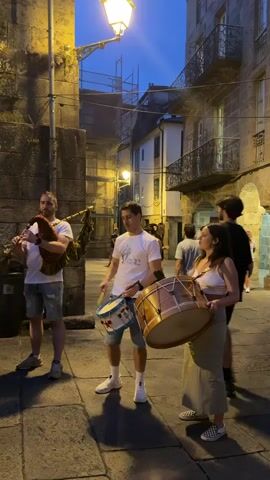
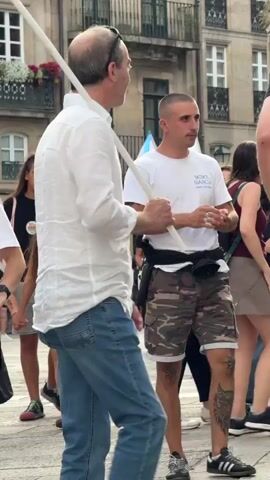
At twilight, a street performance unfolds in a cobblestone alleyway flanked by stone buildings with arched entrances and balconies. A man on the left plays bagpipes, wearing a white t-shirt and shorts. In the center, a man in a white t-shirt and shorts beats a small drum. To his right, a woman in a white crop top and a long skirt holds a large drum. Several people are dancing in a circle in the background, dressed in white t-shirts and dark shorts. A few spectators stand watching. The scene is lit by streetlights and ambient light from the buildings.

At twilight, a street performance unfolds in a cobblestone alleyway flanked by stone buildings with arched entrances and balconies. A man on the left plays bagpipes, wearing a white t-shirt and shorts. In the center, a man in a white t-shirt and shorts beats a small drum. To his right, a woman in a white crop top and a long skirt holds a large drum. Several people are dancing in a circle in the background, dressed in white t-shirts and dark shorts. A few spectators stand watching. The scene is lit by streetlights and ambient light from the buildings.

Santiago de Compostela
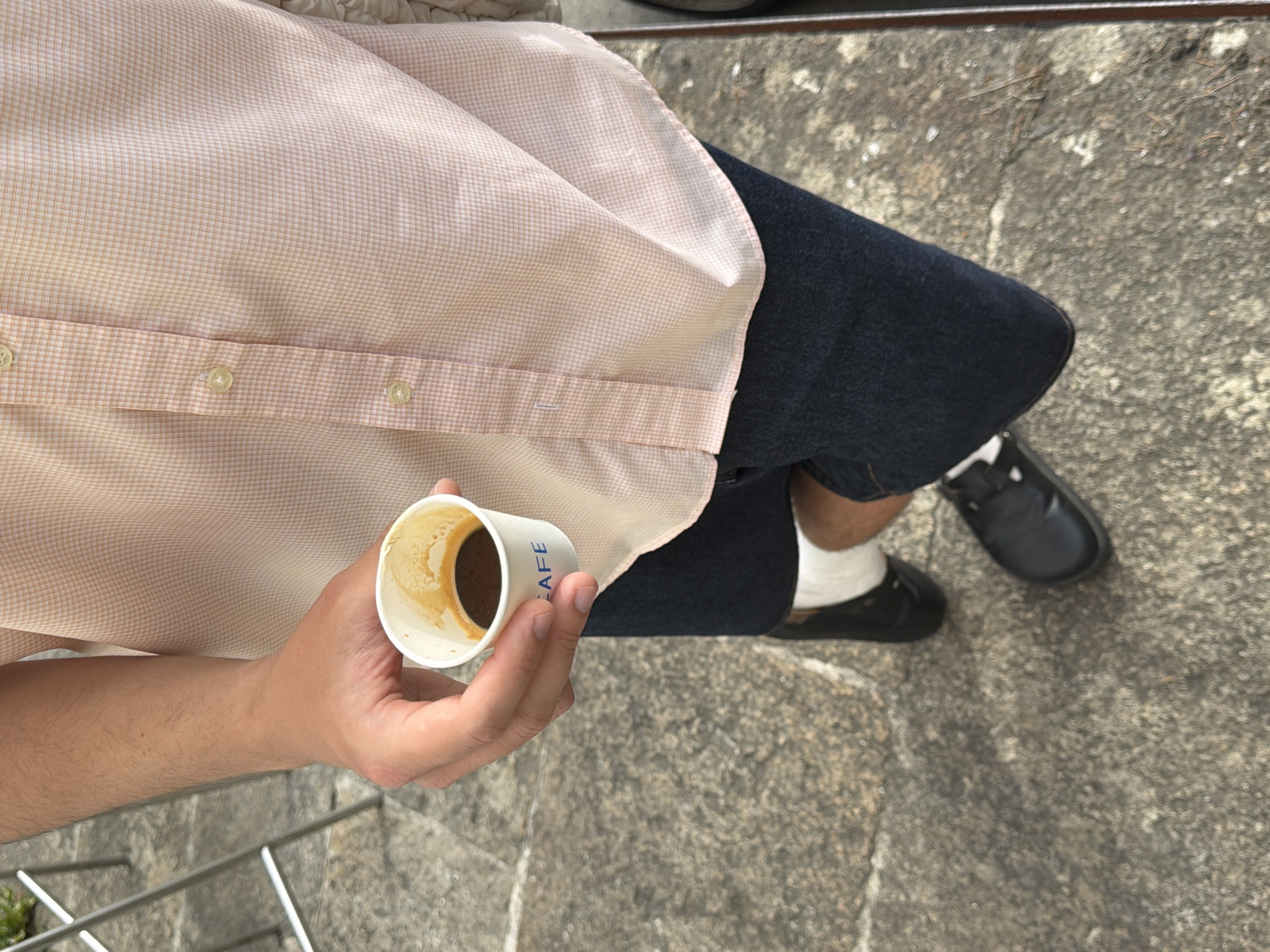
The media file shows a person sitting outdoors, holding a small white paper cup filled with a dark liquid, likely coffee. The person is wearing a light pink checkered button-down shirt and dark blue jeans, with white socks and black slip-on shoes. Their left arm and hand are visible, with the hand gently holding the cup. The background is a rough, greyish stone surface, possibly a sidewalk or plaza, with a metallic railing visible at the bottom left.

The lighting suggests it is daytime, with sunlight casting shadows. The overall scene appears casual and relaxed, with the person taking a break to enjoy a drink. The text "CAFE" is visible on the side of the paper cup. Given the location context of Santiago de Compostela, Spain, this could be a tourist or pilgrim taking a moment to rest during their travels. There are no explicit cues about the weather, but the bright lighting suggests it is likely sunny. The emotion conveyed is one of calm and perhaps slight weariness, common for those undertaking long journeys.

The media file shows a person sitting outdoors, holding a small white paper cup filled with a dark liquid, likely coffee. The person is wearing a light pink checkered button-down shirt and dark blue jeans, with white socks and black slip-on shoes. Their left arm and hand are visible, with the hand gently holding the cup. The background is a rough, greyish stone surface, possibly a sidewalk or plaza, with a metallic railing visible at the bottom left. The lighting suggests it is daytime, with sunlight casting shadows. The overall scene appears casual and relaxed, with the person taking a break to enjoy a drink. The text "CAFE" is visible on the side of the paper cup. Given the location context of Santiago de Compostela, Spain, this could be a tourist or pilgrim taking a moment to rest during their travels. There are no explicit cues about the weather, but the bright lighting suggests it is likely sunny. The emotion conveyed is one of calm and perhaps slight weariness, common for those undertaking long journeys.

Santiago de Compostela

This is a close-up video of a rabbit's face. The rabbit is white with brown markings on its head and ears. Its nose is twitching, and its eyes are not visible. The background is blurred but appears to be a wooden surface. The video is short and shows the rabbit's face in focus.

This is a close-up video of a rabbit's face. The rabbit is white with brown markings on its head and ears. Its nose is twitching, and its eyes are not visible. The background is blurred but appears to be a wooden surface. The video is short and shows the rabbit's face in focus.

Santiago de Compostela
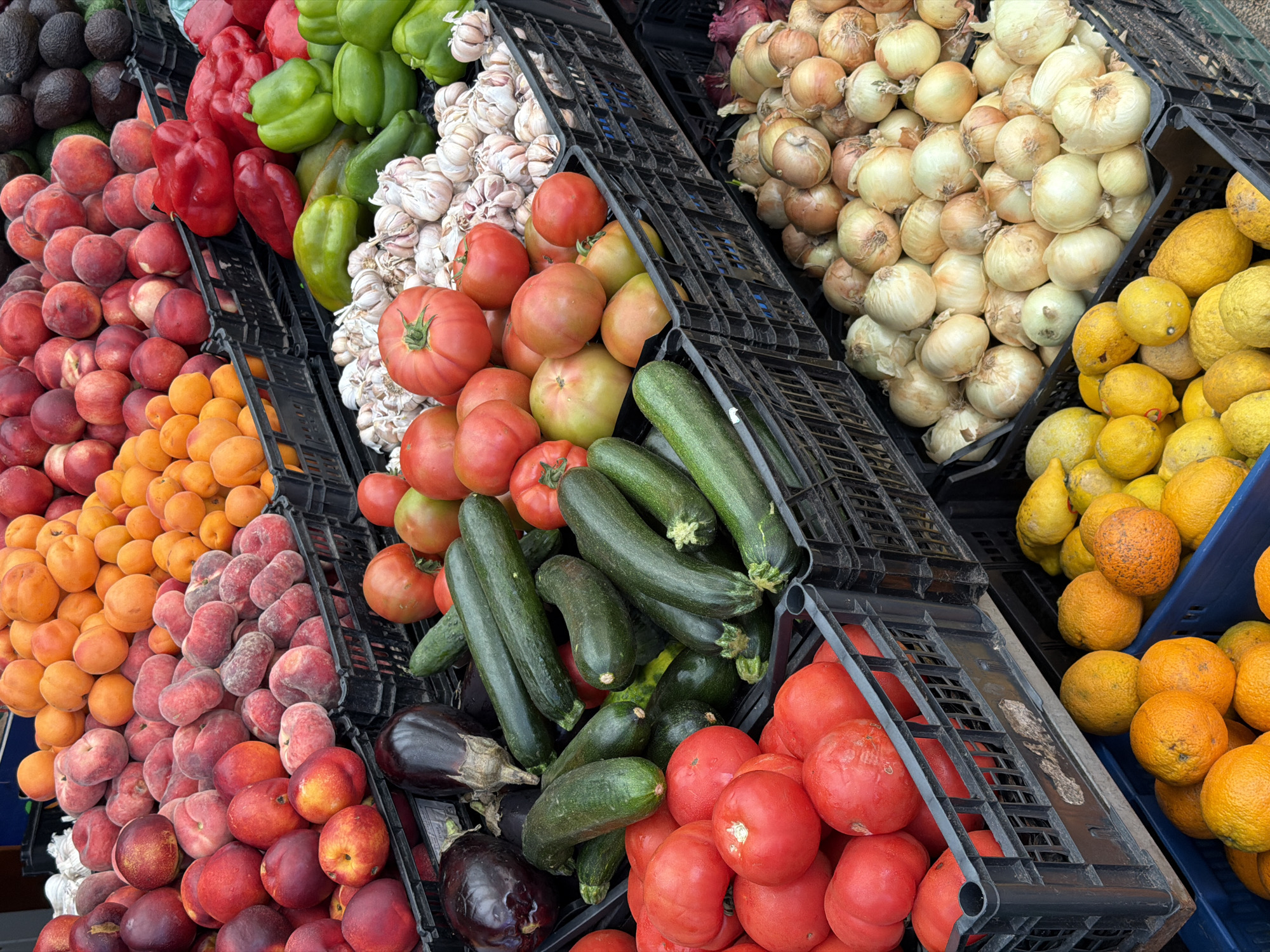
This image depicts a vibrant outdoor market stall laden with a diverse assortment of fresh produce, likely situated in a city like Santiago de Compostela, Spain, known for its bustling markets.

The foreground is dominated by crates overflowing with fruits and vegetables. In the bottom left, a blue crate holds a generous pile of bright orange citrus fruits, possibly oranges or tangerines, some with textured skins. Adjacent to it, to the right, is a crate filled with a mixture of yellow lemons and some larger, similarly colored citrus fruits.

Moving up, a black plastic crate contains a substantial quantity of red tomatoes, their skins smooth and varied in ripeness. Above the tomatoes, another black crate is filled with long, dark green zucchini, some showing slight ridges and visible stems. Interspersed with the zucchini are a few plump, dark purple eggplants.

Further up and to the right, a collection of garlic bulbs with papery white skins are neatly piled. Beside the garlic, large red and green bell peppers add a splash of color. Several large, red tomatoes are also visible in this section.

The upper portion of the image reveals an abundance of stone fruits. Piles of peaches and nectarines in shades of pink, red, and orange are stacked high in black plastic crates. To their right, a large quantity of smaller, bright orange fruits, likely apricots or similar, are visible. In the far upper right corner, dark green avocados can be seen.

The lighting suggests it is daytime, with soft, natural light illuminating the produce. The background is slightly blurred, but suggests further stalls or structures typical of an outdoor market. There are no people visible in the frame, focusing the viewer's attention entirely on the colorful bounty of fresh food. The overall impression is one of abundance, freshness, and the lively atmosphere of a European market.

This image depicts a vibrant outdoor market stall laden with a diverse assortment of fresh produce, likely situated in a city like Santiago de Compostela, Spain, known for its bustling markets. The foreground is dominated by crates overflowing with fruits and vegetables. In the bottom left, a blue crate holds a generous pile of bright orange citrus fruits, possibly oranges or tangerines, some with textured skins. Adjacent to it, to the right, is a crate filled with a mixture of yellow lemons and some larger, similarly colored citrus fruits. Moving up, a black plastic crate contains a substantial quantity of red tomatoes, their skins smooth and varied in ripeness. Above the tomatoes, another black crate is filled with long, dark green zucchini, some showing slight ridges and visible stems. Interspersed with the zucchini are a few plump, dark purple eggplants. Further up and to the right, a collection of garlic bulbs with papery white skins are neatly piled. Beside the garlic, large red and green bell peppers add a splash of color. Several large, red tomatoes are also visible in this section. The upper portion of the image reveals an abundance of stone fruits. Piles of peaches and nectarines in shades of pink, red, and orange are stacked high in black plastic crates. To their right, a large quantity of smaller, bright orange fruits, likely apricots or similar, are visible. In the far upper right corner, dark green avocados can be seen. The lighting suggests it is daytime, with soft, natural light illuminating the produce. The background is slightly blurred, but suggests further stalls or structures typical of an outdoor market. There are no people visible in the frame, focusing the viewer's attention entirely on the colorful bounty of fresh food. The overall impression is one of abundance, freshness, and the lively atmosphere of a European market.

Santiago de Compostela
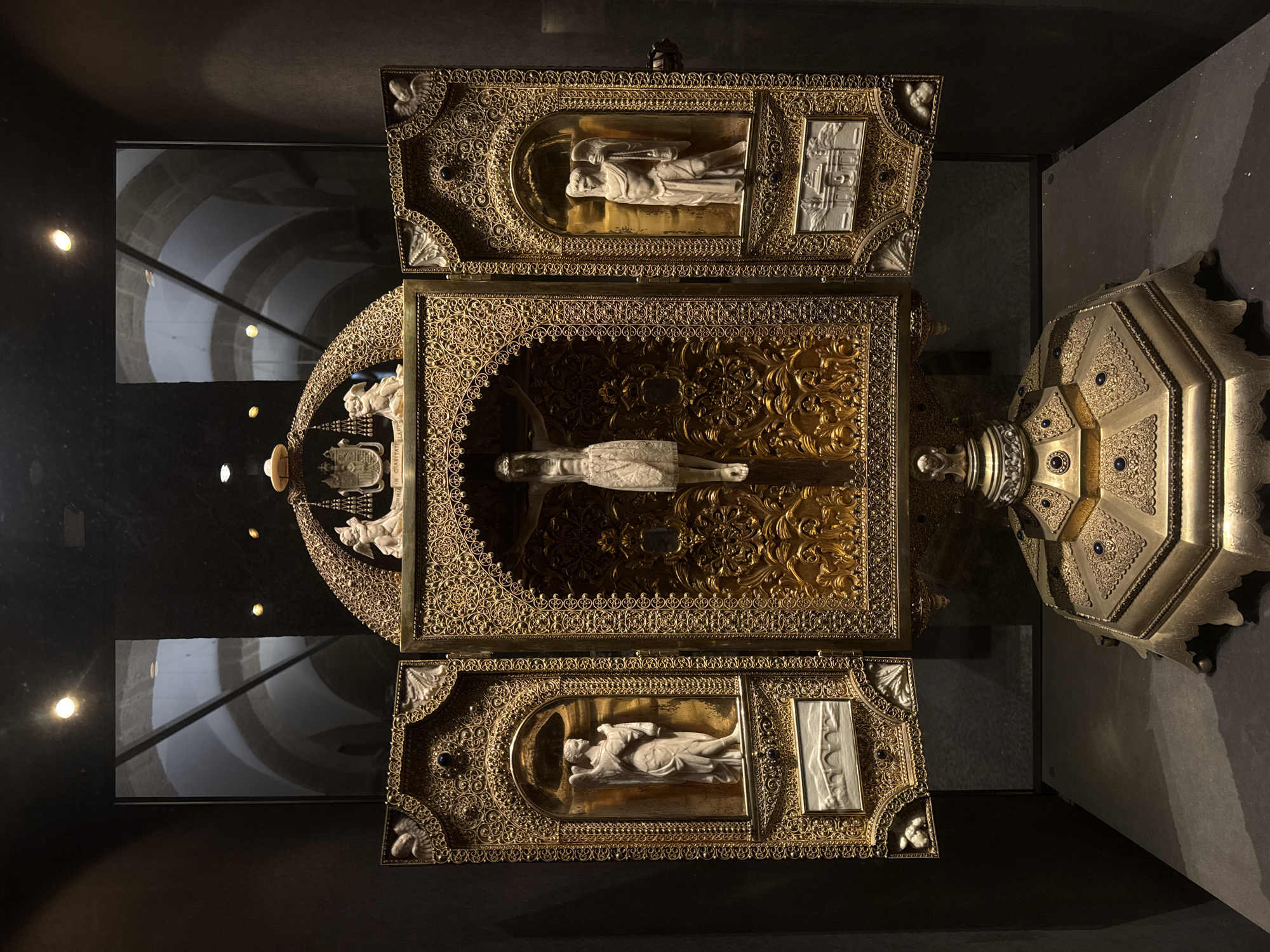
The image shows a reliquary, a decorative container for religious relics, displayed in a museum setting. The reliquary is made of gold and intricate metalwork, with enamel inlays and carved ivory or stone figures. At the center, a figure of Christ on the cross is depicted. Flanking the central panel are two hinged doors, each containing a carved figure of an angel and a smaller scene at the bottom. The reliquary stands on an ornate base. The background is dark, with reflections visible in a glass display case, suggesting an interior exhibition space. The style of the reliquary suggests it is a historical artifact, likely religious in nature, and possibly from the medieval or Renaissance period. The reliquary is part of the collection of the Museo Catedralicio (Cathedral Museum) of Santiago de Compostela, Spain, which houses treasures from the Cathedral of Santiago de Compostela, a major pilgrimage site.

The image shows a reliquary, a decorative container for religious relics, displayed in a museum setting. The reliquary is made of gold and intricate metalwork, with enamel inlays and carved ivory or stone figures. At the center, a figure of Christ on the cross is depicted. Flanking the central panel are two hinged doors, each containing a carved figure of an angel and a smaller scene at the bottom. The reliquary stands on an ornate base. The background is dark, with reflections visible in a glass display case, suggesting an interior exhibition space. The style of the reliquary suggests it is a historical artifact, likely religious in nature, and possibly from the medieval or Renaissance period. The reliquary is part of the collection of the Museo Catedralicio (Cathedral Museum) of Santiago de Compostela, Spain, which houses treasures from the Cathedral of Santiago de Compostela, a major pilgrimage site.

Santiago de Compostela
This is a detail from a fresco painting depicting two muscular men carrying a large bell. The man in the foreground, with blond hair and wearing a light-colored tunic, strains to lift a thick wooden beam supporting the bell. His body is angled forward, emphasizing his exertion. Behind him, another man, partially obscured, wears a green garment and also appears to be contributing to the effort. The bell itself is massive and colored in shades of green, blue, and dark brown. The background is textured and abstract, with hints of white and light blue suggesting a sky or clouds. The style is impressionistic, with visible brushstrokes creating a dynamic and textured surface. This fresco is located in the interior of the Santiago de Compostela Cathedral in Spain, specifically in the Ascension Chapel.

This is a detail from a fresco painting depicting two muscular men carrying a large bell. The man in the foreground, with blond hair and wearing a light-colored tunic, strains to lift a thick wooden beam supporting the bell. His body is angled forward, emphasizing his exertion. Behind him, another man, partially obscured, wears a green garment and also appears to be contributing to the effort. The bell itself is massive and colored in shades of green, blue, and dark brown. The background is textured and abstract, with hints of white and light blue suggesting a sky or clouds. The style is impressionistic, with visible brushstrokes creating a dynamic and textured surface. This fresco is located in the interior of the Santiago de Compostela Cathedral in Spain, specifically in the Ascension Chapel.

Santiago de Compostela
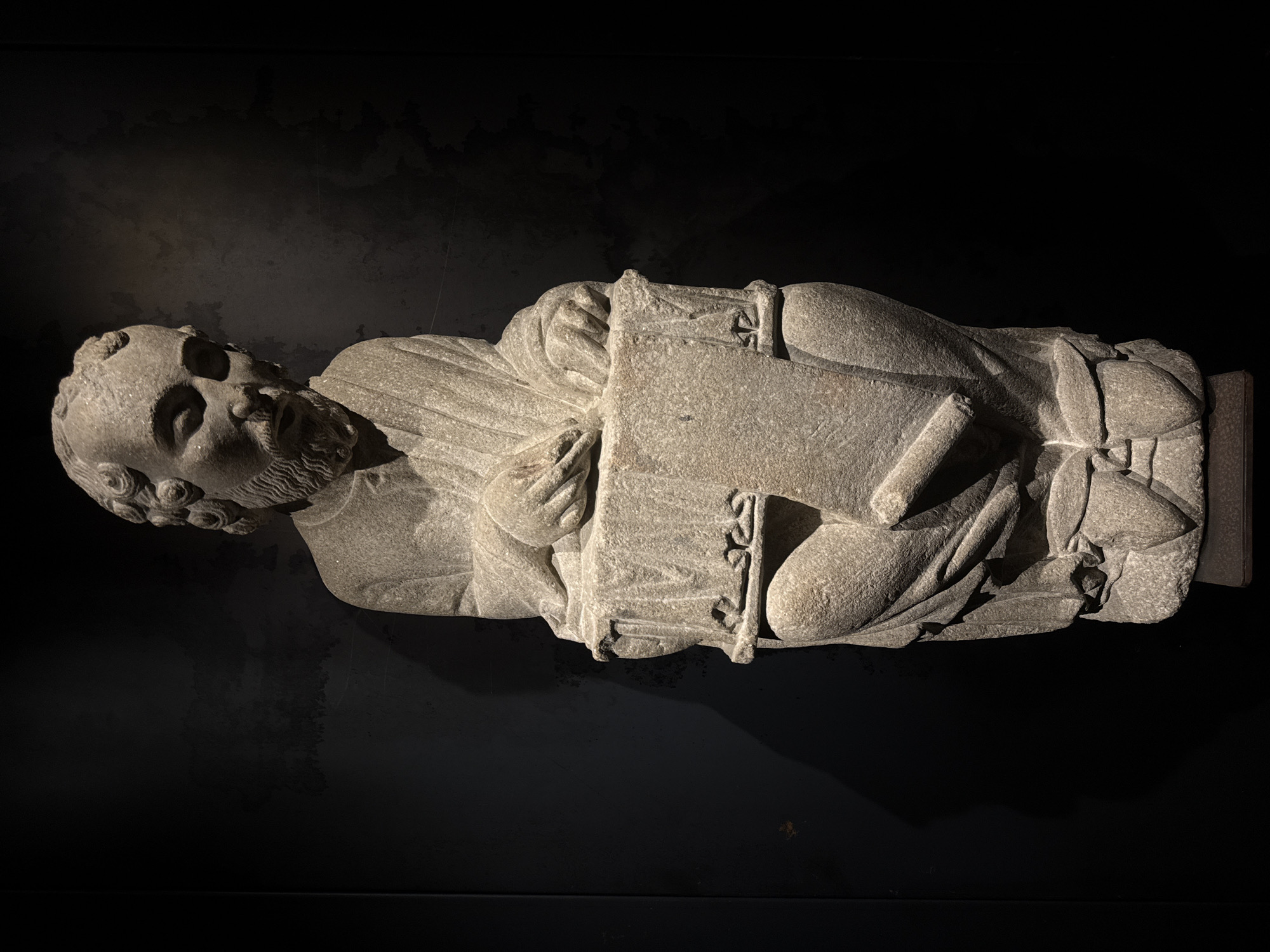
A stone sculpture of a man is displayed against a dark background. The man is seated with his legs crossed and appears to be writing on a scroll that rests on a stone block in front of him. He has a beard and curly hair, and wears a draped robe. The sculpture is illuminated from the side, casting a shadow on the dark wall behind it. This sculpture is the “Maestro Mateo,” a master sculptor, and is located in the Museo de las Peregrinaciones de Santiago in Santiago de Compostela, Spain.

A stone sculpture of a man is displayed against a dark background. The man is seated with his legs crossed and appears to be writing on a scroll that rests on a stone block in front of him. He has a beard and curly hair, and wears a draped robe. The sculpture is illuminated from the side, casting a shadow on the dark wall behind it. This sculpture is the “Maestro Mateo,” a master sculptor, and is located in the Museo de las Peregrinaciones de Santiago in Santiago de Compostela, Spain.

Santiago de Compostela
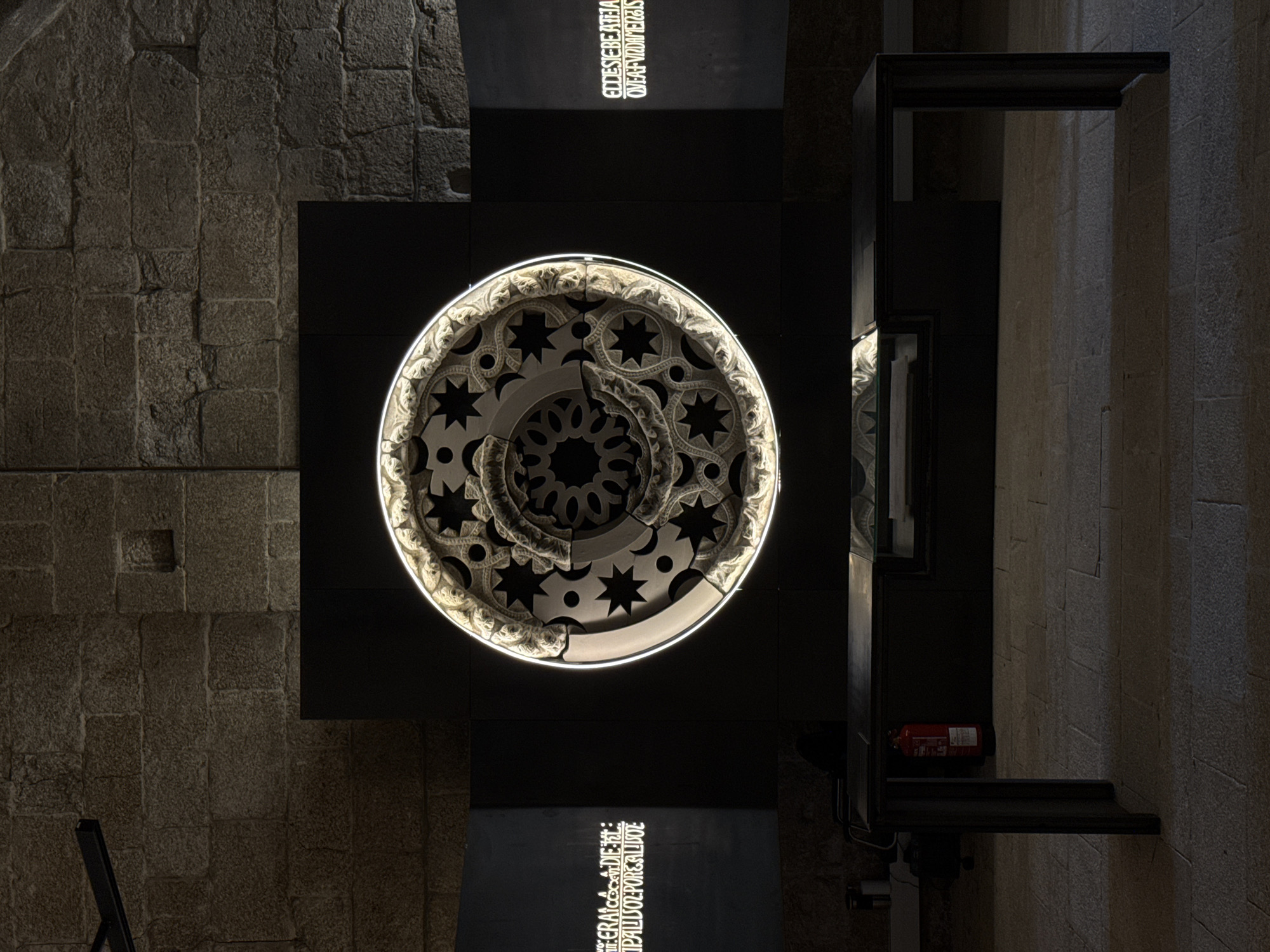
The image shows an interior view of a building, likely a historical site or museum in Santiago de Compostela, Spain. The main subject is a large, circular, illuminated art installation with intricate geometric and star patterns, made of what appears to be carved stone or plaster. The installation is mounted on a dark, rectangular structure against a textured stone wall. To the right, a dark, multi-level display shelf unit is visible, with a red fire extinguisher placed on one of the shelves.

The lighting is dim, suggesting an indoor setting with artificial illumination. The stone walls, one appearing rough-hewn and the other smoother and more regular, provide a sense of age and permanence to the location. The artwork's complex design and illumination create a focal point, hinting at an exhibition or display.

Visible text is present on two illuminated panels. One panel at the top, oriented horizontally, reads "CITES EST BEATA ESTER..." followed by more text that is partially obscured or difficult to discern clearly. Another panel at the bottom, oriented vertically, displays text that appears to be in Latin, reading "SEMPITERNAM COGNOSCITE DEI: / EIUS PRINCIPALIUS ET PORRA ILLUDE". The presence of this text suggests an informational or explanatory aspect to the display, possibly related to religious or historical themes given the location.

The overall mood is one of quiet contemplation and historical reverence, amplified by the dim lighting and the juxtaposition of ancient stonework with modern artistic presentation. The time of day is not evident, but the indoor setting and artificial lighting are the primary environmental cues.

The image shows an interior view of a building, likely a historical site or museum in Santiago de Compostela, Spain. The main subject is a large, circular, illuminated art installation with intricate geometric and star patterns, made of what appears to be carved stone or plaster. The installation is mounted on a dark, rectangular structure against a textured stone wall. To the right, a dark, multi-level display shelf unit is visible, with a red fire extinguisher placed on one of the shelves. The lighting is dim, suggesting an indoor setting with artificial illumination. The stone walls, one appearing rough-hewn and the other smoother and more regular, provide a sense of age and permanence to the location. The artwork's complex design and illumination create a focal point, hinting at an exhibition or display. Visible text is present on two illuminated panels. One panel at the top, oriented horizontally, reads "CITES EST BEATA ESTER..." followed by more text that is partially obscured or difficult to discern clearly. Another panel at the bottom, oriented vertically, displays text that appears to be in Latin, reading "SEMPITERNAM COGNOSCITE DEI: / EIUS PRINCIPALIUS ET PORRA ILLUDE". The presence of this text suggests an informational or explanatory aspect to the display, possibly related to religious or historical themes given the location. The overall mood is one of quiet contemplation and historical reverence, amplified by the dim lighting and the juxtaposition of ancient stonework with modern artistic presentation. The time of day is not evident, but the indoor setting and artificial lighting are the primary environmental cues.

Santiago de Compostela
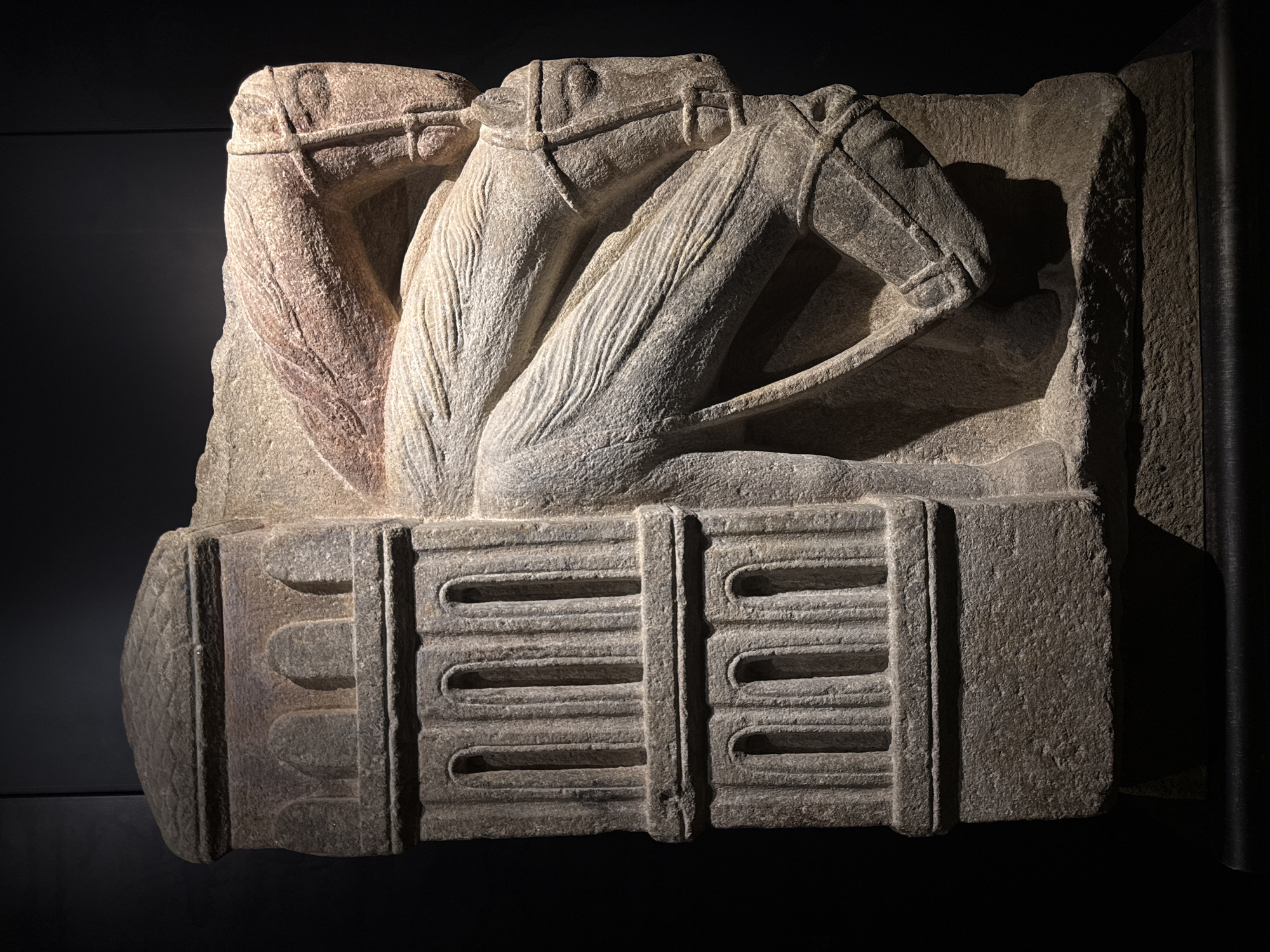
This is a stone relief sculpture depicting two horse heads, possibly part of a larger architectural element. The sculpture is carved in a rough, ancient style, with visible tool marks and wear. The horses' heads are rendered in profile, with their mouths slightly open and their manes indicated by parallel lines. They appear to be straining or in motion, with their bodies implied behind them. The lower portion of the sculpture features a decorative band with a series of horizontal grooves and raised sections, resembling a frieze or plinth. The material is a textured, light-colored stone, possibly granite or sandstone, with some reddish-brown discoloration on one of the horse's necks. The lighting creates strong shadows, highlighting the relief and texture of the carving. The sculpture is displayed against a dark, neutral background, suggesting it is an exhibit in a museum or historical site. Given the location context of Santiago de Compostela, Spain, this sculpture might be a fragment of Romanesque or medieval artwork, possibly from the cathedral or another significant building in the city. The style of carving and the depiction of horses are common in religious and secular art from the Iberian Peninsula during these periods. There is no visible text in the image.

This is a stone relief sculpture depicting two horse heads, possibly part of a larger architectural element. The sculpture is carved in a rough, ancient style, with visible tool marks and wear. The horses' heads are rendered in profile, with their mouths slightly open and their manes indicated by parallel lines. They appear to be straining or in motion, with their bodies implied behind them. The lower portion of the sculpture features a decorative band with a series of horizontal grooves and raised sections, resembling a frieze or plinth. The material is a textured, light-colored stone, possibly granite or sandstone, with some reddish-brown discoloration on one of the horse's necks. The lighting creates strong shadows, highlighting the relief and texture of the carving. The sculpture is displayed against a dark, neutral background, suggesting it is an exhibit in a museum or historical site. Given the location context of Santiago de Compostela, Spain, this sculpture might be a fragment of Romanesque or medieval artwork, possibly from the cathedral or another significant building in the city. The style of carving and the depiction of horses are common in religious and secular art from the Iberian Peninsula during these periods. There is no visible text in the image.

Santiago de Compostela
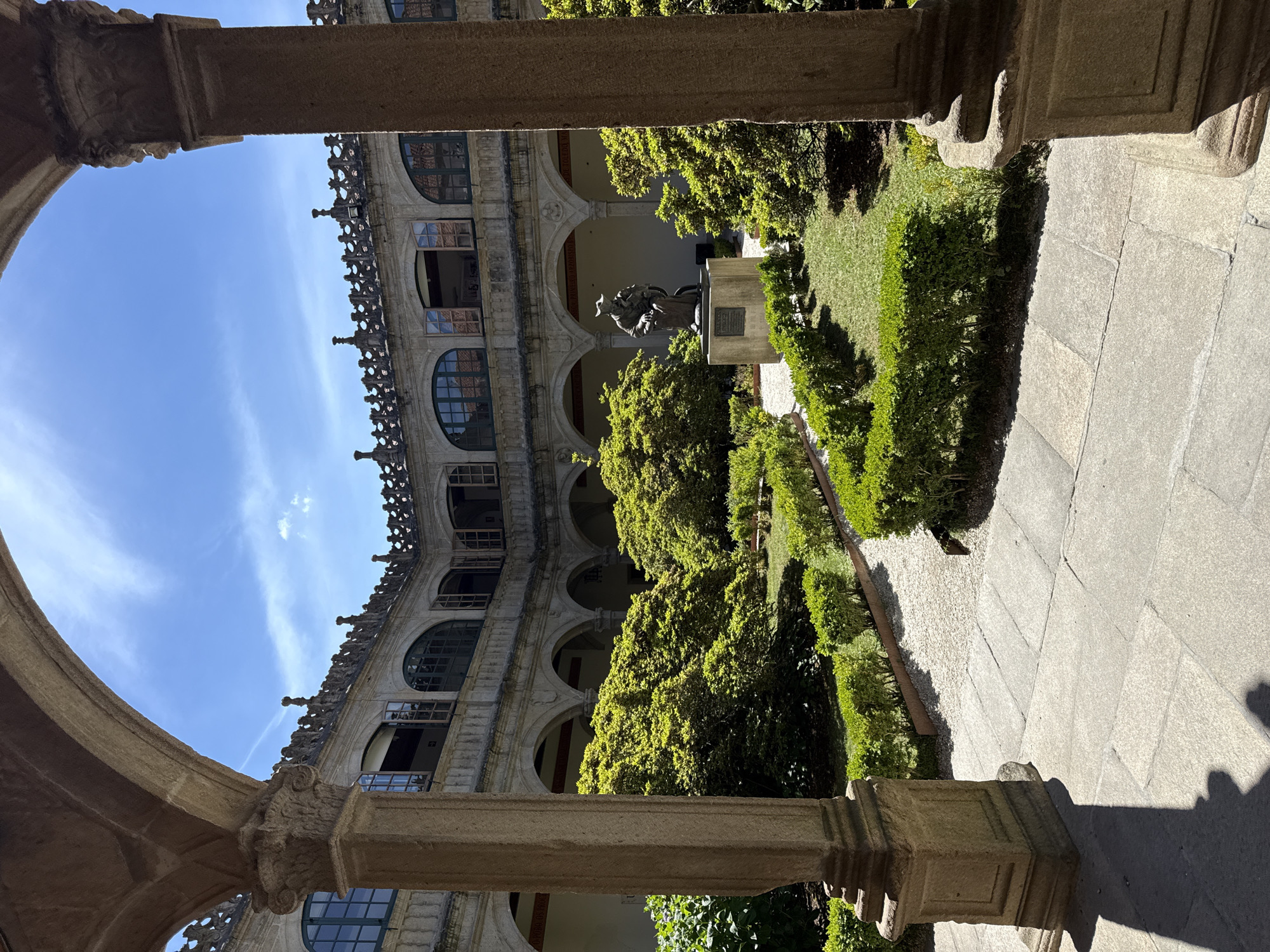
The image shows a courtyard of the Hostal dos Reis Católicos in Santiago de Compostela, Spain. The courtyard is enclosed by arcades with arched windows, and ornate balustrades line the upper story. In the center of the courtyard is a garden with manicured hedges and a statue of a figure in a robe, seated on a pedestal. The sky above is blue with scattered clouds.

The image shows a courtyard of the Hostal dos Reis Católicos in Santiago de Compostela, Spain. The courtyard is enclosed by arcades with arched windows, and ornate balustrades line the upper story. In the center of the courtyard is a garden with manicured hedges and a statue of a figure in a robe, seated on a pedestal. The sky above is blue with scattered clouds.

Santiago de Compostela
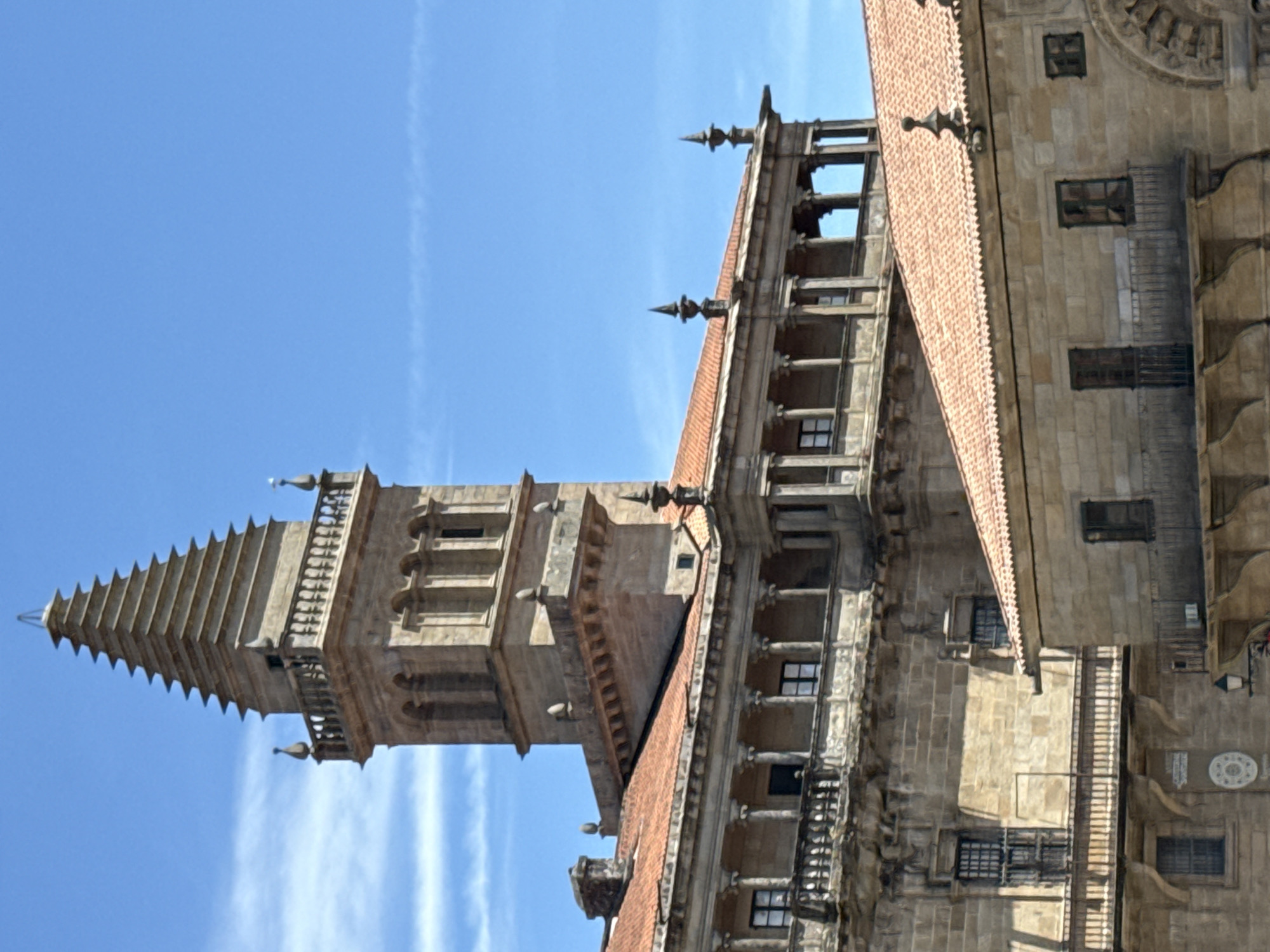
The image depicts a detailed view of the Obradoiro facade of the Santiago de Compostela Cathedral, specifically focusing on its impressive tower and surrounding architectural elements. The scene is bathed in bright sunlight, casting distinct shadows and highlighting the intricate stonework. The sky above is a clear, vibrant blue, with a few wispy white clouds present.

The central focus is a tall, ornate stone tower with a layered, pyramidal spire. This tower exhibits classical architectural features, including arched openings and a decorative balustrade. Extending from the tower, and forming a significant portion of the visible facade, is a multi-story building characterized by a loggia with classical columns and red tile roofing. This structure features numerous windows and balconies, showcasing weathered stone facades.

In the foreground, another section of the cathedral complex is visible, also with red tile roofs and stone construction. This lower building displays similar architectural styles with windows and balconies, contributing to the overall impression of a grand, historic edifice. The stonework throughout the image appears ancient and well-maintained, suggesting a place of historical and architectural significance. There are no people or animals visible in the frame. The overall environment is urban, defined by the monumental architecture of the cathedral.

The image depicts a detailed view of the Obradoiro facade of the Santiago de Compostela Cathedral, specifically focusing on its impressive tower and surrounding architectural elements. The scene is bathed in bright sunlight, casting distinct shadows and highlighting the intricate stonework. The sky above is a clear, vibrant blue, with a few wispy white clouds present. The central focus is a tall, ornate stone tower with a layered, pyramidal spire. This tower exhibits classical architectural features, including arched openings and a decorative balustrade. Extending from the tower, and forming a significant portion of the visible facade, is a multi-story building characterized by a loggia with classical columns and red tile roofing. This structure features numerous windows and balconies, showcasing weathered stone facades. In the foreground, another section of the cathedral complex is visible, also with red tile roofs and stone construction. This lower building displays similar architectural styles with windows and balconies, contributing to the overall impression of a grand, historic edifice. The stonework throughout the image appears ancient and well-maintained, suggesting a place of historical and architectural significance. There are no people or animals visible in the frame. The overall environment is urban, defined by the monumental architecture of the cathedral.

Santiago de Compostela
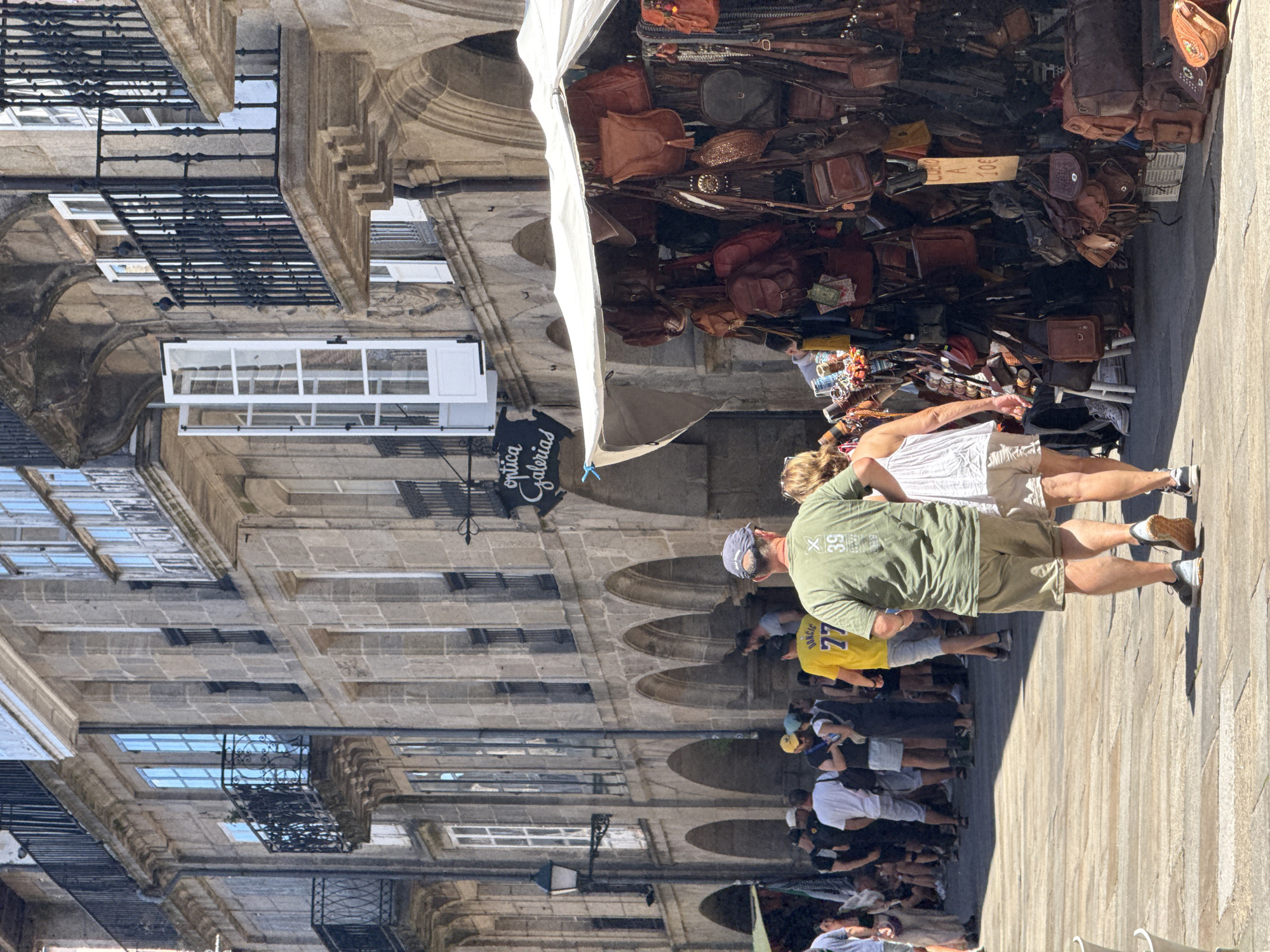
The image depicts a street scene in Santiago de Compostela, Spain, likely in the historic center near the cathedral, characterized by traditional stone buildings with arcades and balconies. In the foreground, a man wearing a green t-shirt and khaki shorts walks away from the camera, his back to the viewer. Beside him, a woman in a white tank top and white shorts walks in the same direction. Behind them, a crowd of people are seen walking along a stone-paved street, some browsing a market stall draped with numerous leather bags and accessories. The market stall is under a white awning. A sign on the stall reads "CUERO A 10€", indicating leather items priced at 10 Euros. The architecture suggests an older European city, consistent with the historic districts of Santiago de Compostela. The lighting indicates it is a sunny day.

The image depicts a street scene in Santiago de Compostela, Spain, likely in the historic center near the cathedral, characterized by traditional stone buildings with arcades and balconies. In the foreground, a man wearing a green t-shirt and khaki shorts walks away from the camera, his back to the viewer. Beside him, a woman in a white tank top and white shorts walks in the same direction. Behind them, a crowd of people are seen walking along a stone-paved street, some browsing a market stall draped with numerous leather bags and accessories. The market stall is under a white awning. A sign on the stall reads "CUERO A 10€", indicating leather items priced at 10 Euros. The architecture suggests an older European city, consistent with the historic districts of Santiago de Compostela. The lighting indicates it is a sunny day.

Santiago de Compostela
The image captures a twilight sky over Santiago de Compostela, Spain. A crescent moon is visible in the upper left quadrant of the frame, set against a backdrop of a blue sky scattered with clouds. Some clouds are dark and heavy, suggesting an approaching weather front, while others are lighter and wispy, allowing patches of blue to show through. The overall lighting indicates the transition from day to night, with the sky still holding some residual daylight. There are no people, structures, or other identifiable objects in the scene.

The image captures a twilight sky over Santiago de Compostela, Spain. A crescent moon is visible in the upper left quadrant of the frame, set against a backdrop of a blue sky scattered with clouds. Some clouds are dark and heavy, suggesting an approaching weather front, while others are lighter and wispy, allowing patches of blue to show through. The overall lighting indicates the transition from day to night, with the sky still holding some residual daylight. There are no people, structures, or other identifiable objects in the scene.

Santiago de Compostela
The image shows a clear blue sky with scattered white and gray clouds. The clouds are wispy and appear to be moving, suggesting a breezy day. There are no people or objects visible in the image, and the focus is entirely on the sky. The scene is natural and serene. It's impossible to determine the location within Santiago de Compostela based solely on this image, as it depicts a generic sky.

The image shows a clear blue sky with scattered white and gray clouds. The clouds are wispy and appear to be moving, suggesting a breezy day. There are no people or objects visible in the image, and the focus is entirely on the sky. The scene is natural and serene. It's impossible to determine the location within Santiago de Compostela based solely on this image, as it depicts a generic sky.

Santiago de Compostela
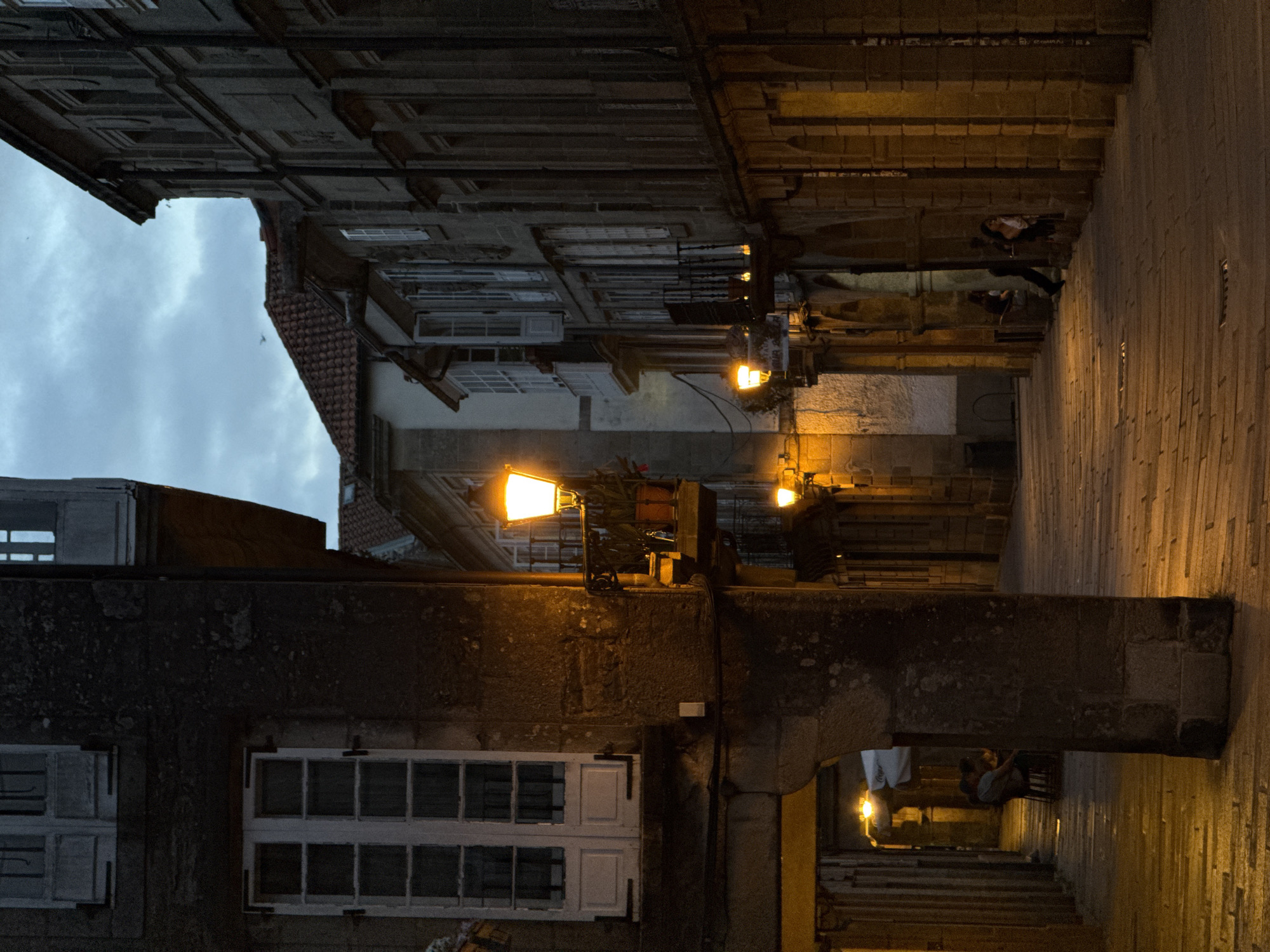
This image depicts a narrow street in Santiago de Compostela, Spain, during dusk or early evening. The architecture suggests an old European city, with weathered stone buildings lining the street. The sky, visible between the buildings, is cloudy, indicating overcast weather.

The scene is illuminated by warm, artificial lights, including street lamps and lights emanating from within the buildings. Several people are visible in the distance, walking or standing, adding a sense of life to the otherwise somber atmosphere. One person appears to be sitting or resting on a bench. The mood is quiet and contemplative, perhaps due to the time of day and the enclosed nature of the street.

Notable details include the texture of the stone buildings, the tiled roofs, and the windows on the facades. The perspective of the photograph is somewhat unusual, as if taken from a low angle or with a tilt. The image captures the architectural character of the historic city and the atmospheric quality of its streets after sunset.

This image depicts a narrow street in Santiago de Compostela, Spain, during dusk or early evening. The architecture suggests an old European city, with weathered stone buildings lining the street. The sky, visible between the buildings, is cloudy, indicating overcast weather. The scene is illuminated by warm, artificial lights, including street lamps and lights emanating from within the buildings. Several people are visible in the distance, walking or standing, adding a sense of life to the otherwise somber atmosphere. One person appears to be sitting or resting on a bench. The mood is quiet and contemplative, perhaps due to the time of day and the enclosed nature of the street. Notable details include the texture of the stone buildings, the tiled roofs, and the windows on the facades. The perspective of the photograph is somewhat unusual, as if taken from a low angle or with a tilt. The image captures the architectural character of the historic city and the atmospheric quality of its streets after sunset.

Santiago de Compostela
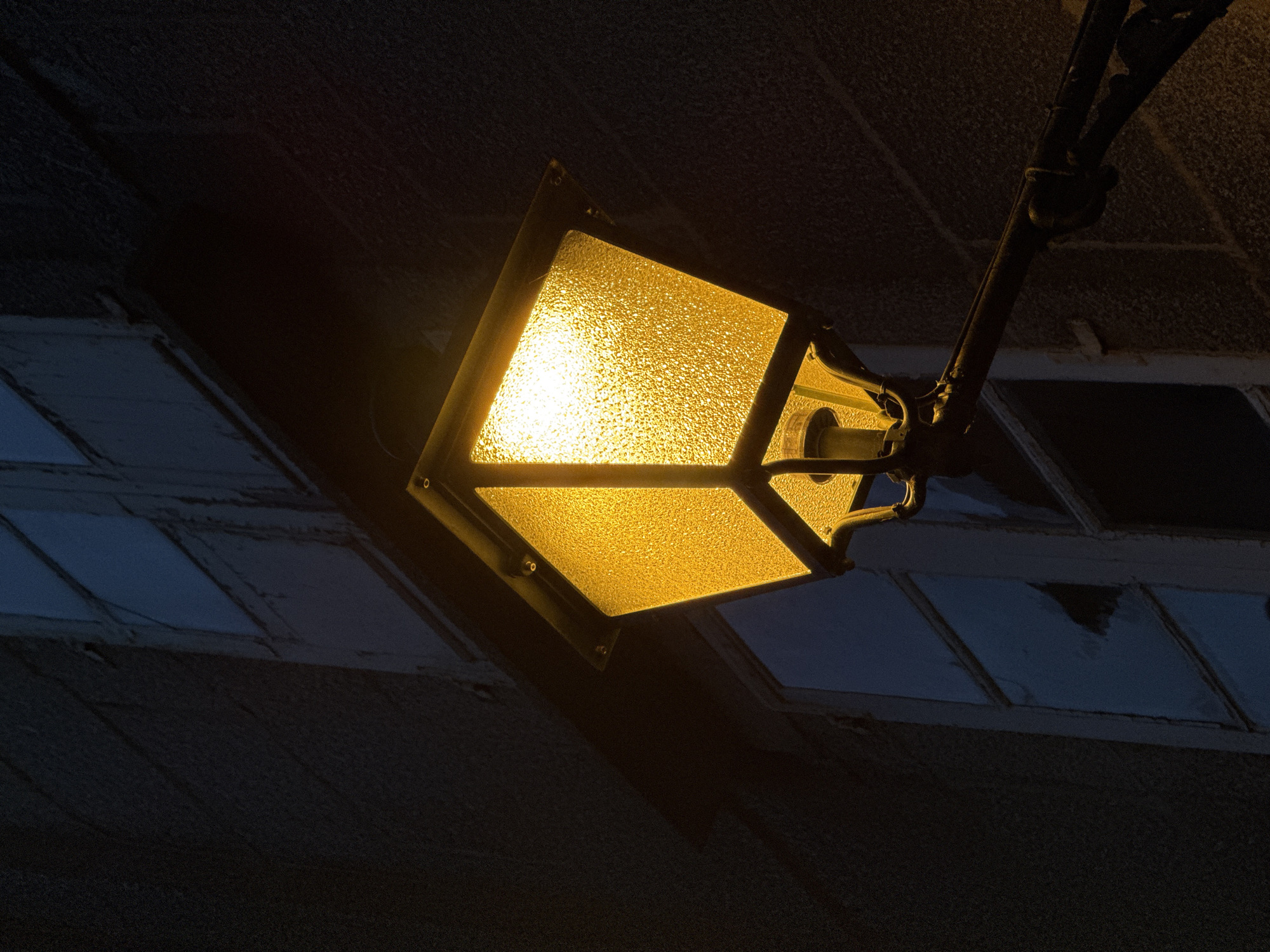
The image shows a close-up, low-angle shot of a vintage-style, yellow-lit street lamp against a dark, textured building facade. The lamp has a square, frosted glass enclosure that diffuses the warm light, and it is mounted on a black metal arm. The building appears to be constructed of stone or concrete and has several window frames visible, some of which show cracked or broken glass. The overall atmosphere is dark and moody, suggesting it is nighttime. The architectural style and the presence of a stone building are consistent with the historic city of Santiago de Compostela, Spain, though a specific location is not identifiable from the image alone. There are no people or animals present.

The image shows a close-up, low-angle shot of a vintage-style, yellow-lit street lamp against a dark, textured building facade. The lamp has a square, frosted glass enclosure that diffuses the warm light, and it is mounted on a black metal arm. The building appears to be constructed of stone or concrete and has several window frames visible, some of which show cracked or broken glass. The overall atmosphere is dark and moody, suggesting it is nighttime. The architectural style and the presence of a stone building are consistent with the historic city of Santiago de Compostela, Spain, though a specific location is not identifiable from the image alone. There are no people or animals present.

Santiago de Compostela
The image captures the facade of a historic building in Santiago de Compostela, Spain, likely in the old town, given the architectural style. The building is constructed with large, rough-hewn stone blocks, giving it a weathered and ancient appearance. Multiple windows with white frames are visible, some of which are open, allowing a warm, yellow light to emanate from within, suggesting interior illumination. Several balconies with ornate black metal railings jut out from the facade, adding a touch of elegance to the robust stone structure. The ground floor features a series of arched openings, also framed in stone, with one arch revealing a glimpse of a wooden door and a warmly lit interior. The sky above is a dusky blue, indicating either dawn or dusk. The overall impression is one of timeless architecture bathed in soft, inviting light.

The image captures the facade of a historic building in Santiago de Compostela, Spain, likely in the old town, given the architectural style. The building is constructed with large, rough-hewn stone blocks, giving it a weathered and ancient appearance. Multiple windows with white frames are visible, some of which are open, allowing a warm, yellow light to emanate from within, suggesting interior illumination. Several balconies with ornate black metal railings jut out from the facade, adding a touch of elegance to the robust stone structure. The ground floor features a series of arched openings, also framed in stone, with one arch revealing a glimpse of a wooden door and a warmly lit interior. The sky above is a dusky blue, indicating either dawn or dusk. The overall impression is one of timeless architecture bathed in soft, inviting light.

Santiago de Compostela
The image shows a view of the Rúa do Franco in Santiago de Compostela, Spain. It is an outdoor scene with a focus on the architecture of the buildings lining the street. The buildings are constructed from stone, with arched doorways and balconies. The light suggests it is either early morning or late evening, with a warm glow emanating from within some of the arched openings. A sign with the words "optica galerias" is visible hanging from one of the buildings. The street itself appears to be paved with stone. There are no people visible in the image. The overall impression is one of historical charm and a quiet urban streetscape.

The image shows a view of the Rúa do Franco in Santiago de Compostela, Spain. It is an outdoor scene with a focus on the architecture of the buildings lining the street. The buildings are constructed from stone, with arched doorways and balconies. The light suggests it is either early morning or late evening, with a warm glow emanating from within some of the arched openings. A sign with the words "optica galerias" is visible hanging from one of the buildings. The street itself appears to be paved with stone. There are no people visible in the image. The overall impression is one of historical charm and a quiet urban streetscape.

Santiago de Compostela
This image shows the facade of a stone building in Santiago de Compostela, Spain, with several windows. The windows are framed in white, and some are open, allowing warm light to spill out, suggesting an interior light source. The building's stonework is rough-hewn, giving it an aged appearance. The sky above is a pale, overcast blue. The perspective is from below, looking up at the building. No people are visible in the image.

This image shows the facade of a stone building in Santiago de Compostela, Spain, with several windows. The windows are framed in white, and some are open, allowing warm light to spill out, suggesting an interior light source. The building's stonework is rough-hewn, giving it an aged appearance. The sky above is a pale, overcast blue. The perspective is from below, looking up at the building. No people are visible in the image.

Santiago de Compostela
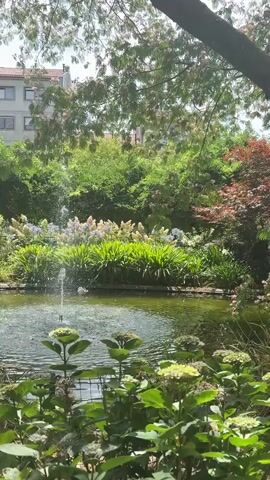
The image depicts a sunset over a park-like setting with prominent evergreen trees silhouetted against a dramatic sky. The sky displays a gradient of colors, transitioning from a deep orange near the horizon to a muted grey at the top, with wispy clouds. In the foreground, the dark shapes of ornate stone structures, possibly part of a gate or fence, are visible. These structures are detailed with carved elements, suggesting a historical or formal garden. The overall mood is serene and somewhat somber, characteristic of dusk. The location is identified as a park in Santiago de Compostela, Spain, implying a European context for the architecture and vegetation. No people are visible in the frame.

The image depicts a sunset over a park-like setting with prominent evergreen trees silhouetted against a dramatic sky. The sky displays a gradient of colors, transitioning from a deep orange near the horizon to a muted grey at the top, with wispy clouds. In the foreground, the dark shapes of ornate stone structures, possibly part of a gate or fence, are visible. These structures are detailed with carved elements, suggesting a historical or formal garden. The overall mood is serene and somewhat somber, characteristic of dusk. The location is identified as a park in Santiago de Compostela, Spain, implying a European context for the architecture and vegetation. No people are visible in the frame.

Santiago de Compostela