Sigmaringen, Germany
30 memories from Sigmaringen, Germany
The image shows a street in Sigmaringen, Germany. The road has lane markings and a directional arrow indicating a turn. On the left side of the road, there is a grey and white building with windows. A street sign is visible on a pole, reading "Am Bispingerfeld". A green sign with a white arrow is also present on the pole. Behind the building, there is a grassy area with some trees and a black fence with reflective panels. The sky is overcast.
Sigmaringen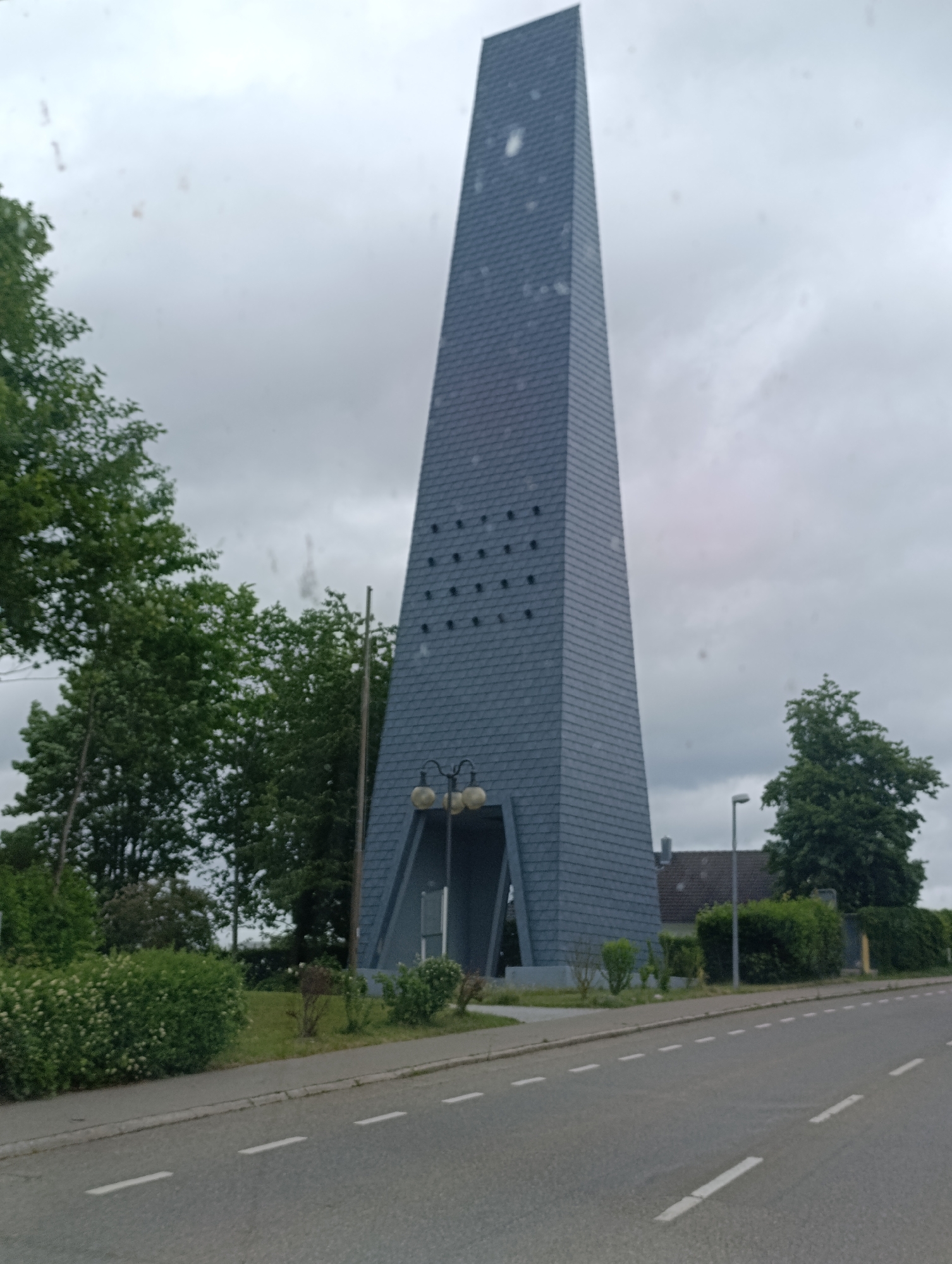
The image shows a tall, dark, slate-tiled tower with a pointed top, located in Sigmaringen, Germany. The tower has a modern, angular design and features rows of circular openings on its upper section. At the base of the tower, there is an entranceway with a distinctive geometric design, illuminated by a street lamp with three globes. The tower is surrounded by lush green trees and bushes. A paved road with white dashed lines runs in front of the tower, and a sidewalk is visible between the road and the tower's grounds. In the background, a residential building with a dark roof can be seen, partially obscured by trees and greenery. The sky is overcast, suggesting a cloudy day.
Sigmaringen
A multi-lane bridge spans a dark, calm river in Sigmaringen, Germany, under a heavily overcast sky. The bridge's concrete structure is supported by stone pillars. Cars are visible driving on the bridge. On the left bank, a white electrical box stands next to a black metal railing. Trees line the background, with a building visible behind them to the right. The water of the river is shallow enough in places to reveal the rocky bottom. The scene is devoid of any human figures.
Sigmaringen
The image depicts a view from inside a vehicle, looking forward. A white van with the license plate "SIG SF 61" is prominently in the foreground, obscuring a significant portion of the road ahead. The van has its brake lights illuminated. To the left of the van, the rear of a dark-colored vehicle is visible. The road surface ahead shows markings. In the background, a line of cars is stopped, suggesting a traffic jam or a traffic signal. Two traffic lights are visible, both displaying red signals. The left traffic light shows a red arrow pointing upwards, while the right traffic light shows a red arrow pointing to the right. The environment is characterized by a steep, tree-covered hillside on the left side of the road. The trees are lush and green, indicating a temperate climate. The sky is overcast with gray clouds. The presence of the "SIG" on the license plate strongly suggests the location is Sigmaringen, Germany. The overall scene suggests a moment of halted traffic in a semi-urban or suburban area, possibly on the outskirts of Sigmaringen.
Sigmaringen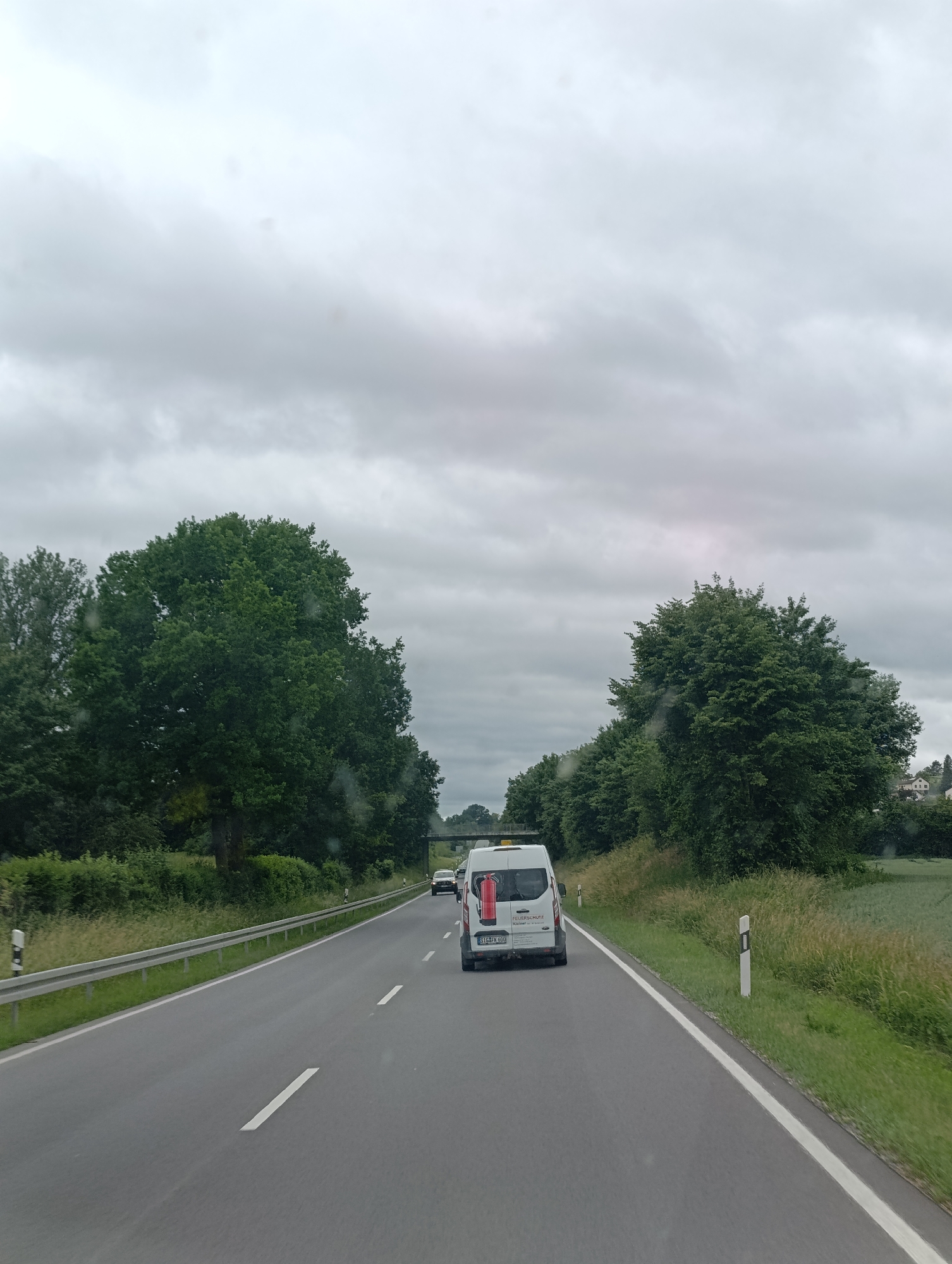
The image depicts a view from a vehicle traveling on a two-lane road, likely a highway, under a cloudy sky. The road surface is asphalt with white lane markings. On the right side of the road, there is a grassy shoulder with wildflowers and a white post with a black stripe. Further to the right, a field of green crops is visible. On the left side of the road, there is a guardrail and a grassy embankment with trees. A white van with "FEUERSCHUTZ Kilmer" written on the back and a fire extinguisher visible through the rear window is in the foreground, in the right lane. A dark-colored car is visible in the distance in the left lane. A bridge or overpass is visible in the background. The environment appears to be rural or suburban, with trees lining the road and buildings visible in the far distance. The overall scene is overcast and potentially humid, as suggested by some smudges on the windshield. The context provided indicates the location is Sigmaringen, Germany.
Sigmaringen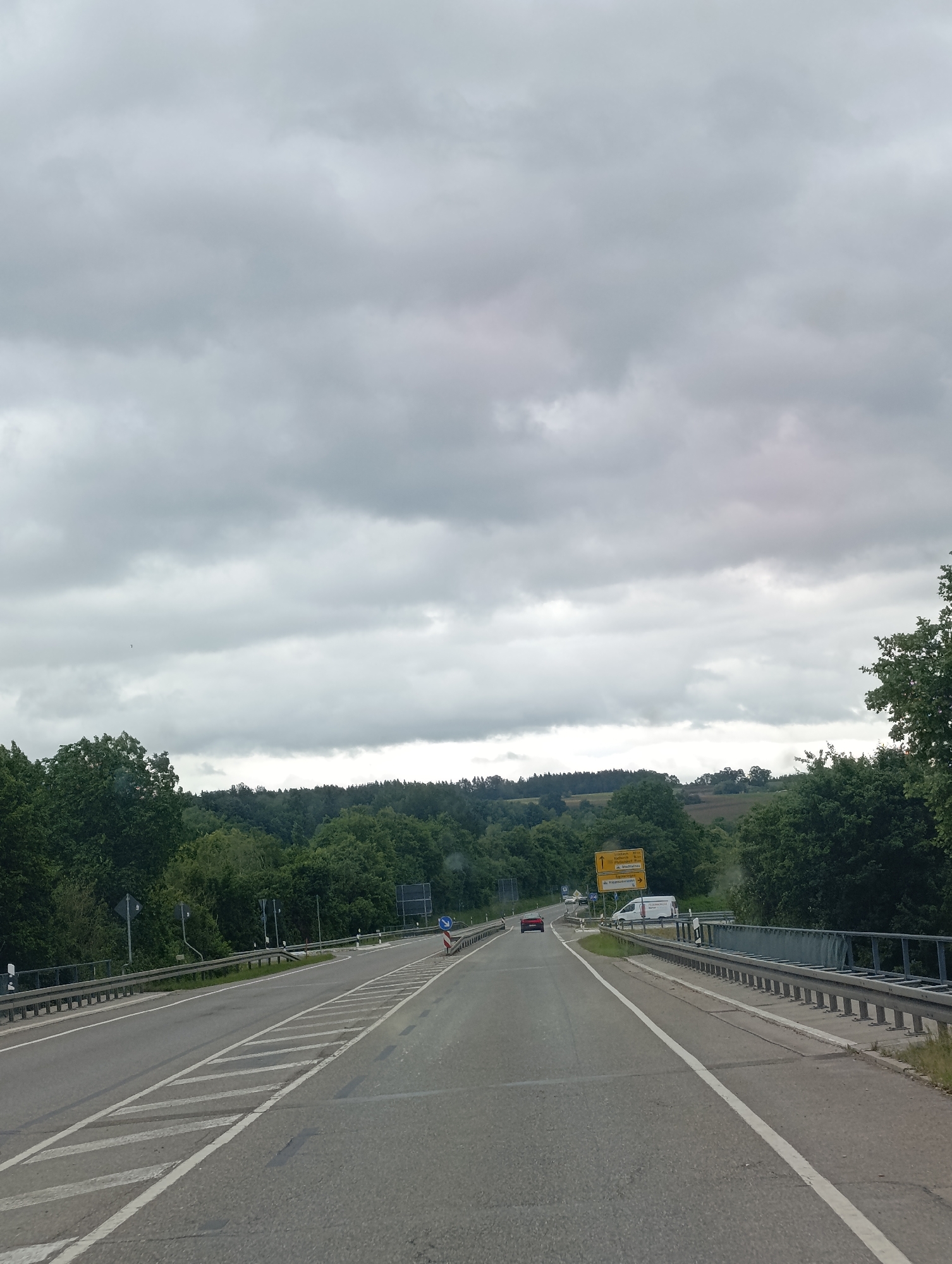
The image depicts a road in a rural area with a cloudy sky overhead. The road appears to be a multi-lane highway with guardrails on either side. There are trees and hills in the background. A yellow directional sign is visible on the right side of the road, indicating distances to various locations, including "Hohenzollern" and "Stockach." A white van and a red car are visible on the road. The scene is captured from the perspective of a vehicle traveling on the road. It is difficult to definitively pinpoint the exact location in Sigmaringen without further information, but the presence of the Hohenzollern sign suggests a route that leads towards the Hohenzollern Castle, which is near Sigmaringen.
Sigmaringen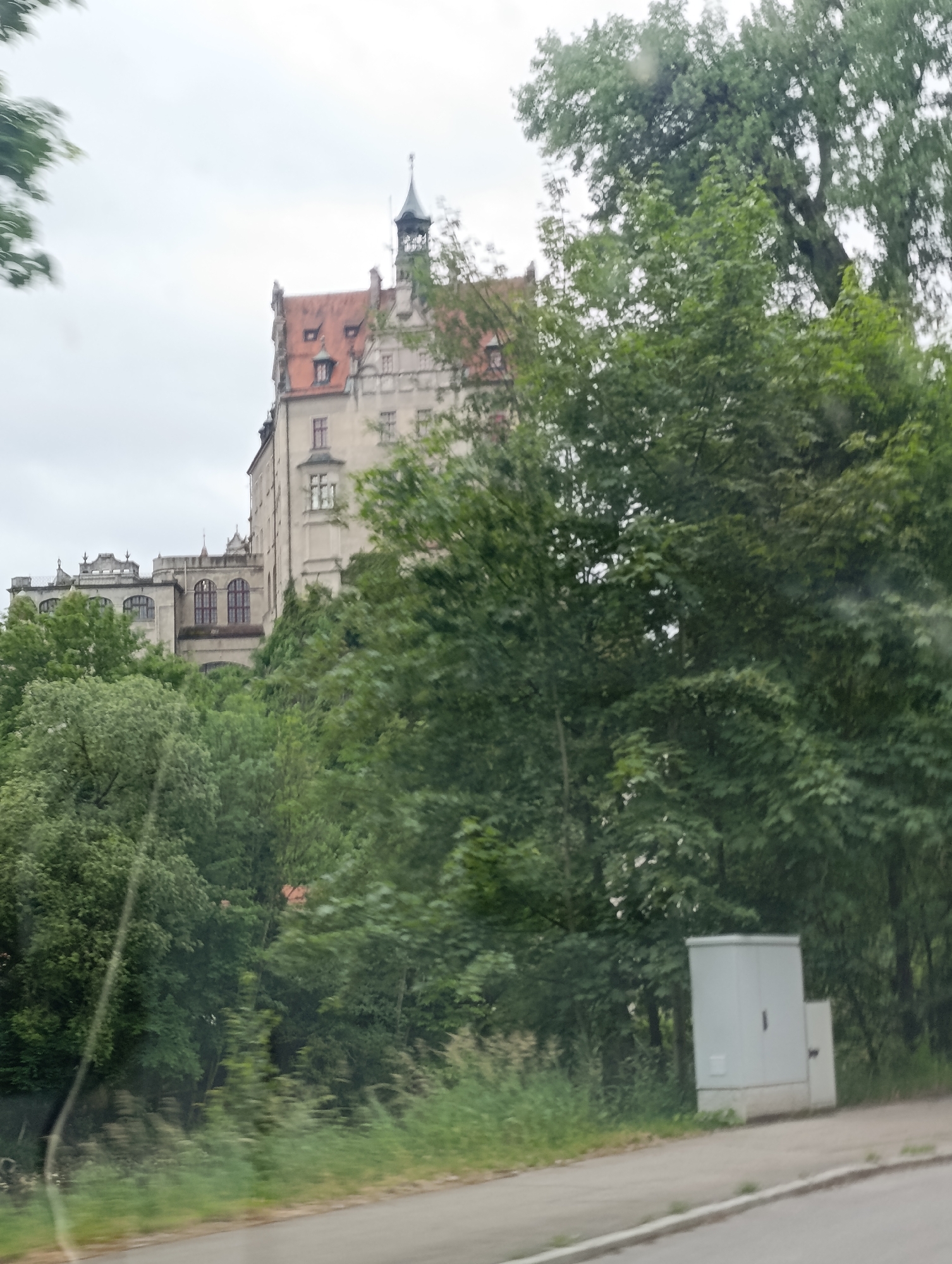
The image depicts a large, historic building, likely a castle or palace, situated atop a hill. The architecture features a reddish-orange tiled roof, pale stone walls, and multiple windows, some of which are arched. A tall, narrow spire with a decorative finial crowns a section of the building, adding to its grandeur. The castle is partially obscured by lush green trees and foliage, suggesting a natural or park-like setting. In the foreground, a paved road or path runs alongside the scene, with a modern, grey electrical cabinet or utility box placed on a concrete base near the edge of the path. The overall impression is that of an old-world structure integrated with a natural landscape. The time of day appears to be overcast, with a diffused light suggesting either early morning or a cloudy afternoon. The weather seems to be mild, as evidenced by the abundant greenery and the absence of any harsh shadows or bright sunlight. The location is identified as Sigmaringen, Germany. No people are visible in the image, and there is no discernible text. The scene evokes a sense of historical significance and natural beauty.
Sigmaringen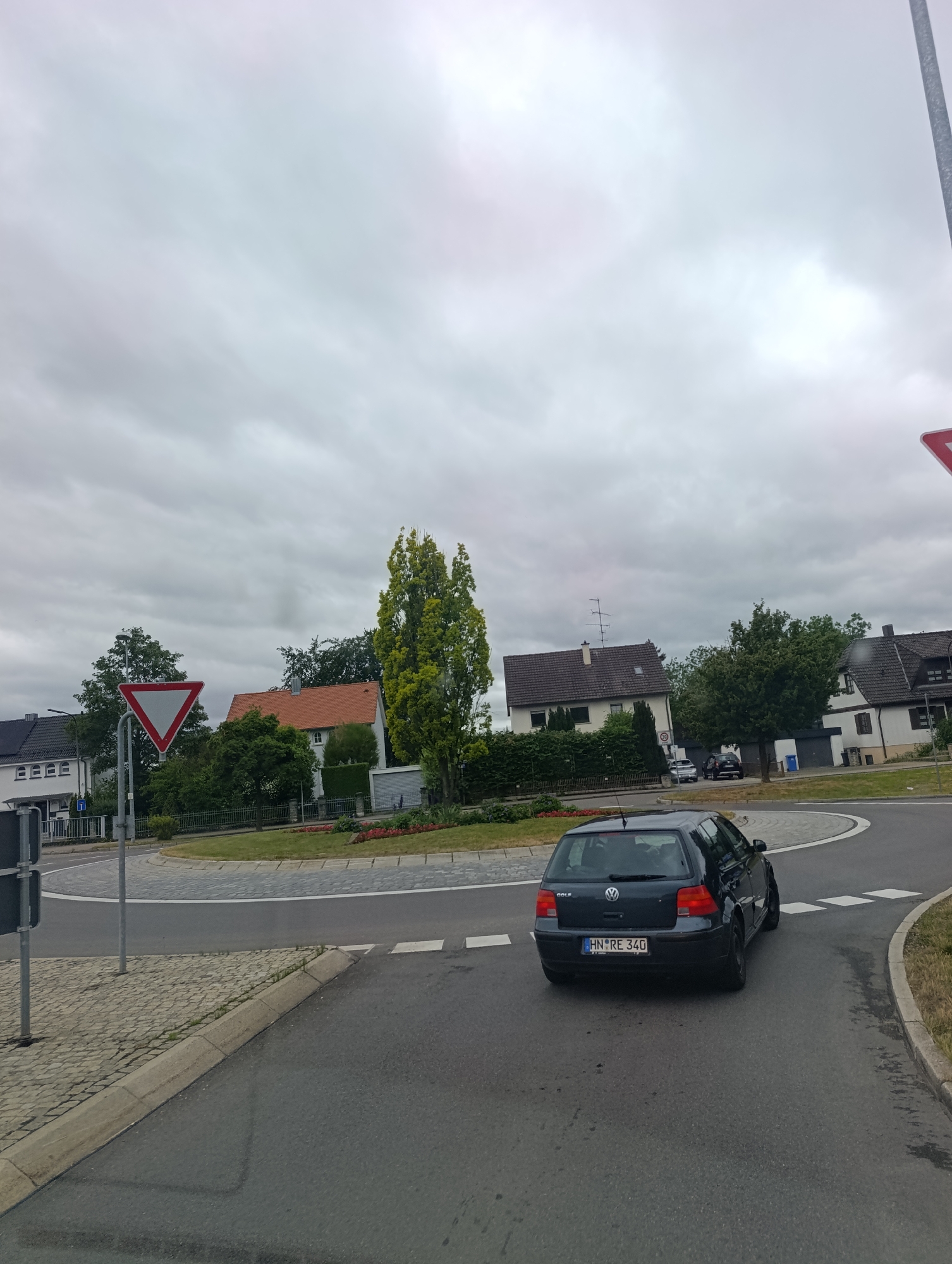
An overhead, slightly angled, cloudy sky view captured from inside a vehicle shows a dark blue Volkswagen Golf driving on a street in Sigmaringen, Germany. The Golf has a German license plate reading "HN RE 340" and is driving towards the right side of the frame. In the background, to the left, a roundabout is visible with a triangular yield sign. Several houses with tiled roofs and trees line the street and surrounding area. The road surface is asphalt and cobblestone.
Sigmaringen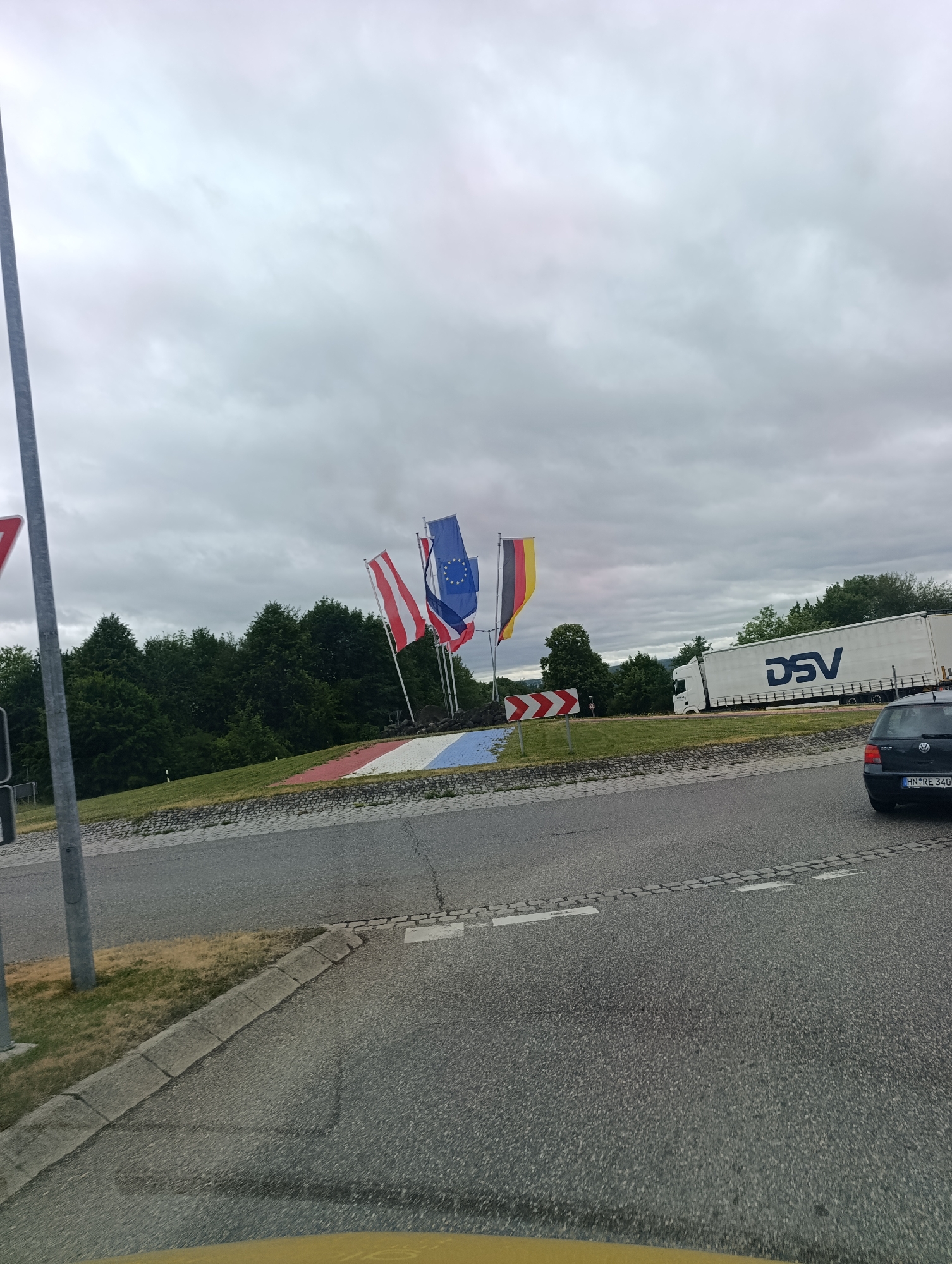
This is an eye-level, medium shot of a roundabout in Sigmaringen, Germany, on a cloudy day. In the center of the roundabout, there are several flags displayed on poles: the Austrian flag, the European Union flag, the French flag, and the German flag. The roundabout itself is decorated with red, white, and blue stripes on a circular grass area. Adjacent to the roundabout, a large white DSV truck is visible driving on the road. A black Volkswagen Golf is parked to the right, facing away from the camera, and its license plate reads "HN*RE 340". The road surface is asphalt with some visible cracks and paving stones along the edge of the roundabout. Trees and vegetation form a backdrop behind the roundabout, and a grey pole with a red and white triangular sign is positioned on the left side of the frame.
Sigmaringen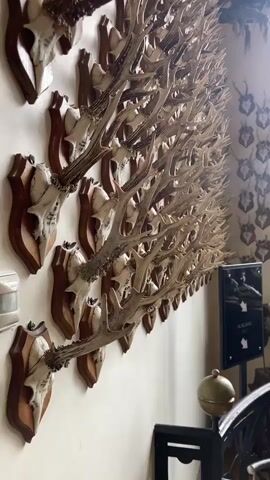
The video shows a room with multiple walls covered in mounted deer antlers. The antlers are attached to wooden plaques and cover the walls from floor to ceiling. In addition to the antlers, there are several decorative objects in the room, including a taxidermied bird, a globe, and a row of duck figurines lined up on a windowsill. The room has a formal and somewhat antiquated feel, possibly indicating that it is located in an old building or castle. The walls are painted a light color and there is a window that looks out onto a green landscape. There is a sign on the wall near an exit.
Sigmaringen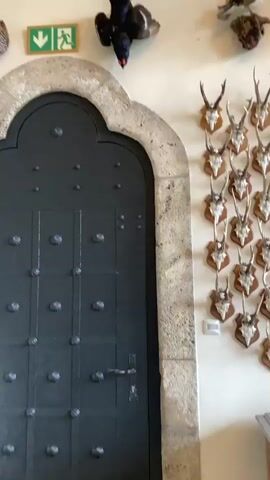
The camera pans up a wall displaying a collection of taxidermied animals and mounted antlers. At the base of the wall is a black door with a stone archway above. Above the door, a sign indicates an exit. A black bird is mounted to the wall next to the exit sign, as well as a taxidermied duck, a few animal heads, and several mounted sets of antlers. The lower half of the wall is almost entirely covered by mounted antlers arranged in neat rows.
Sigmaringen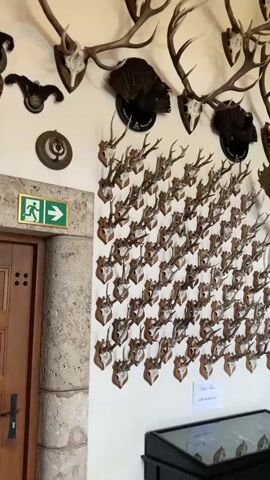
The video shows a large collection of mounted deer antlers on a white wall inside a building. The antlers are mounted on wooden plaques and arranged in a grid pattern. Above them are larger sets of antlers. The wall also features a green exit sign and some decorative items. A display case sits beneath the wall. The camera slowly zooms in on the antlers and their plaques.
Sigmaringen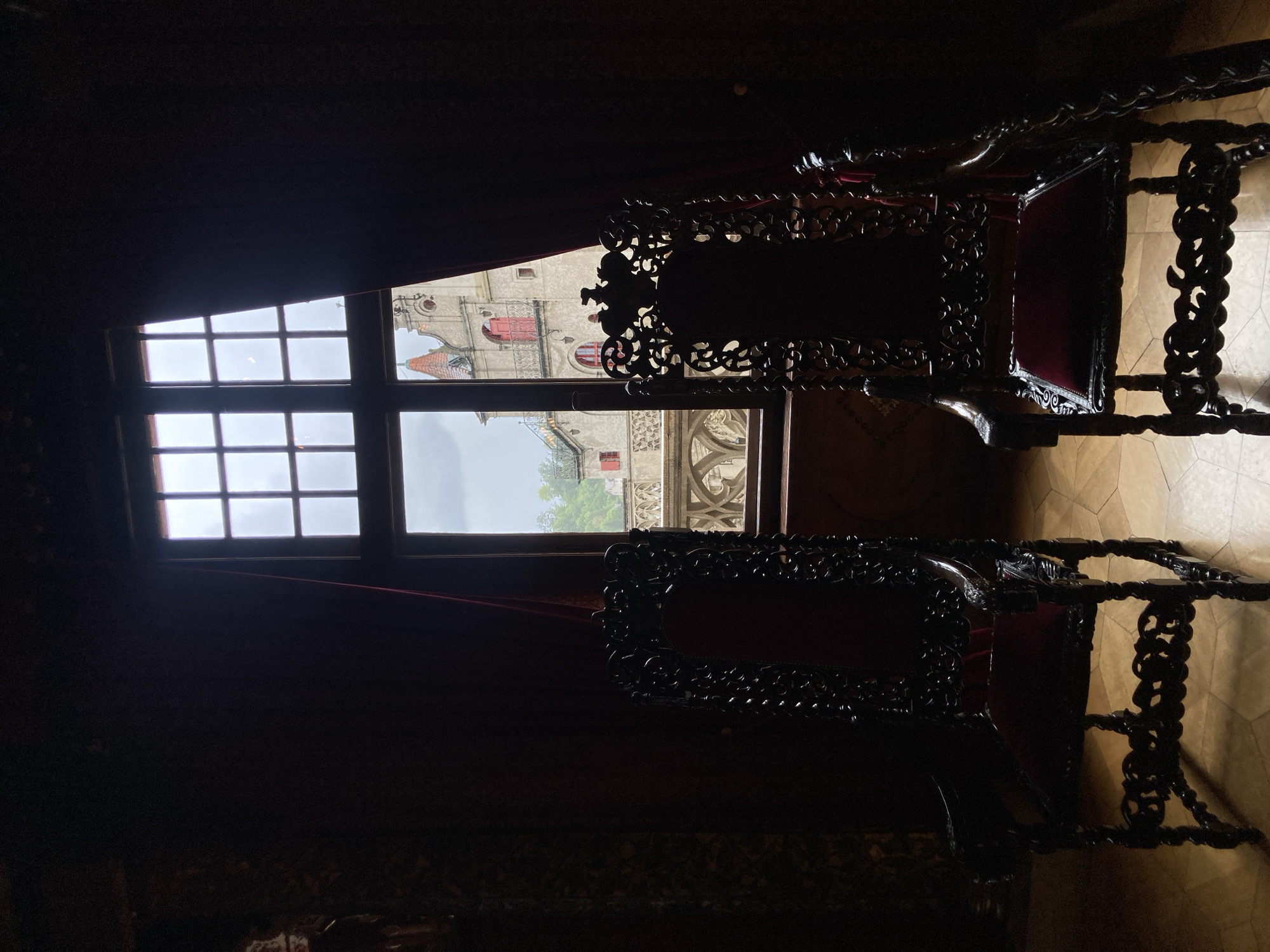
The image shows a dimly lit interior, likely a room within a castle, with a window framing a view of exterior architecture. Two ornate, dark wood chairs with red velvet upholstery are positioned in the foreground, partially obscuring the window. The window has a multi-paned grid pattern and is covered with heavy dark red curtains. Outside the window, a stone building with multiple windows, including some with red shutters, is visible. The exterior scene includes details of the building's facade. The flooring inside the room appears to be made of tiles. Based on the architecture and available information, the location is likely the Sigmaringen Castle in Sigmaringen, Germany.
Sigmaringen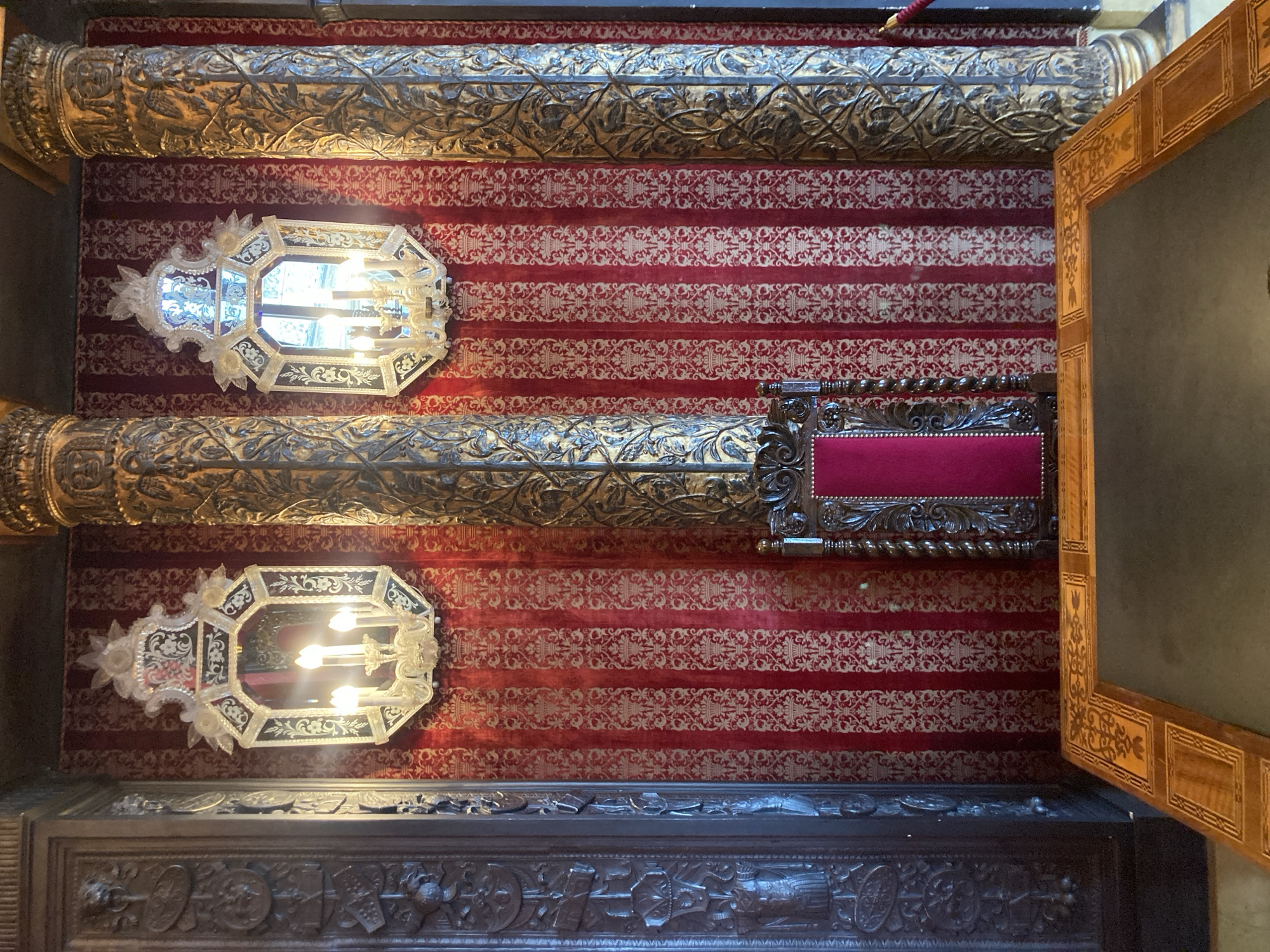
The image shows an upward view into a room's ceiling and upper walls. Two large, decorative chandeliers flank either side of the frame, reflecting light. Horizontal bands of patterned red fabric with gold designs are visible. Two ornately carved, horizontal support beams run parallel above and below the fabric. A dark, carved wooden structure, possibly a mantelpiece, is at the bottom. A chair with a red cushion is visible near the upper right corner. A wooden-framed doorway with a dark interior is also on the right. The location is likely within Sigmaringen Castle, Germany, given the architectural style.
Sigmaringen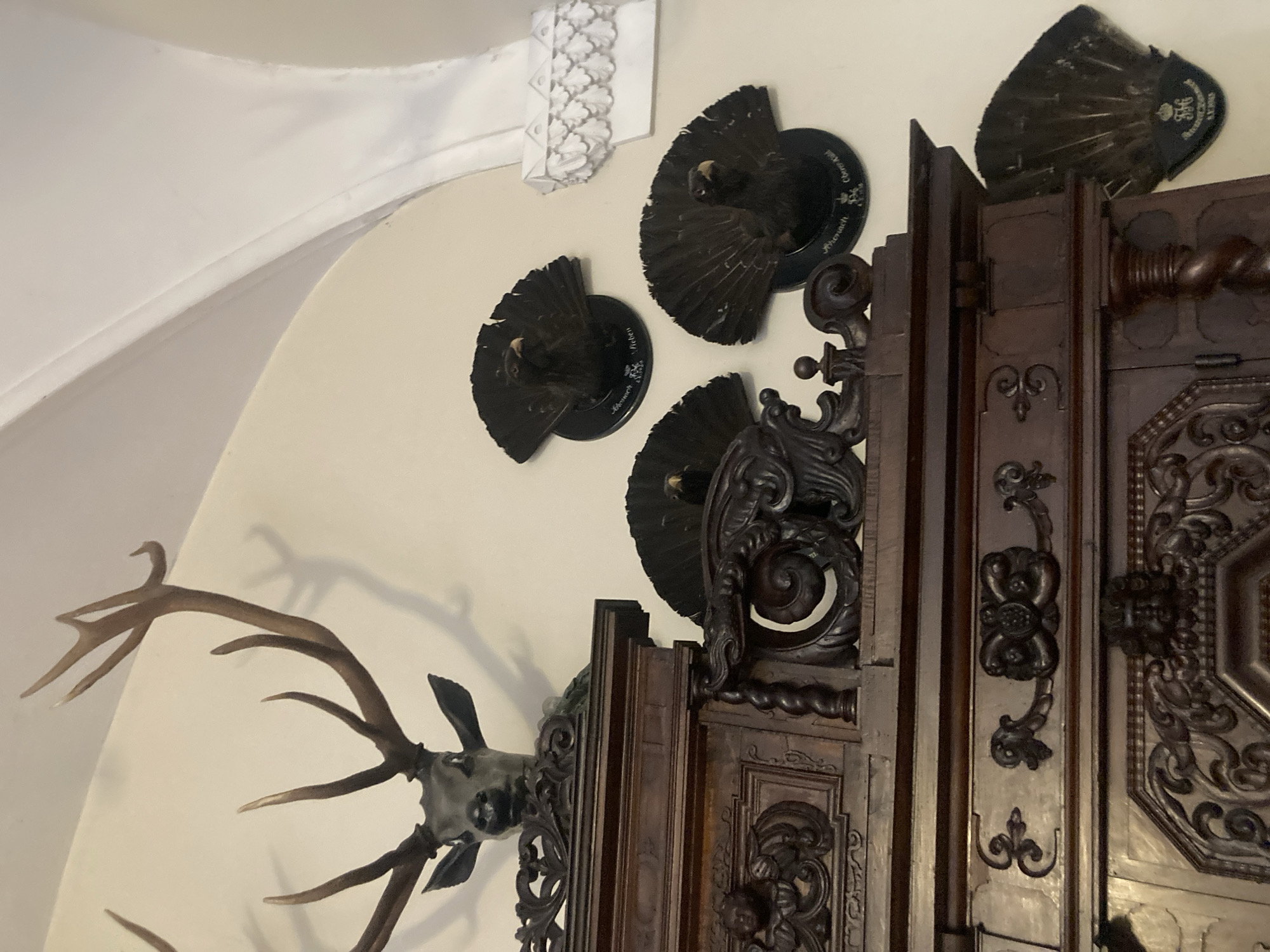
The image shows a corner of a room in Sigmaringen, Germany, likely within the Sigmaringen Castle. The wall is adorned with hunting trophies, including a deer skull with antlers and three mounted black grouse (likely Tetrao tetrix) tail fans with inscribed plaques. Adjacent to the wall decorations is a portion of a large, ornately carved wooden cabinet or wardrobe. The room has white walls and a curved archway.
Sigmaringen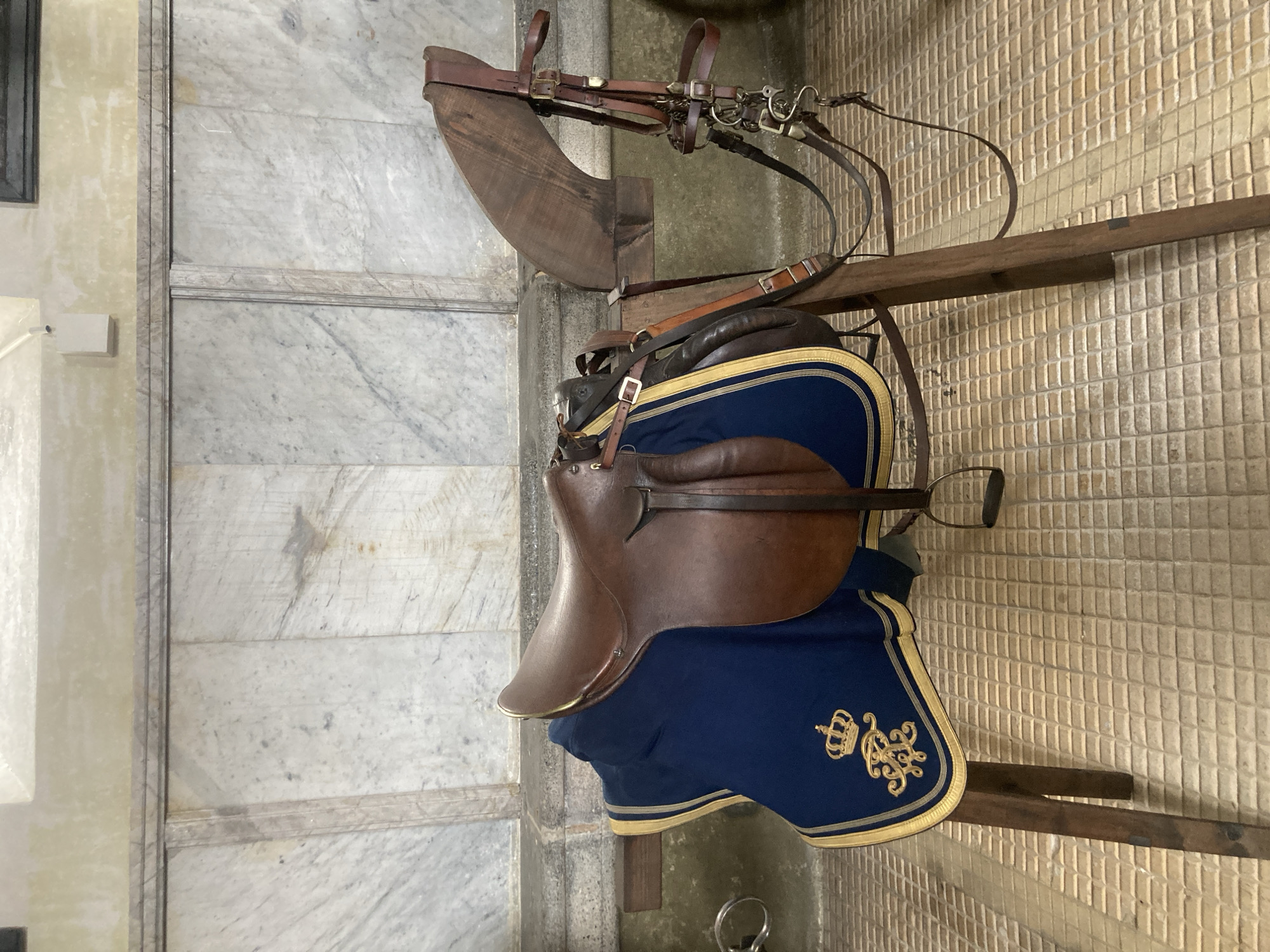
A horse saddle and bridle are displayed on a rack against a wall. The saddle is brown leather with a blue cloth draped underneath, adorned with gold embroidery of a crown and decorative flourishes. The bridle is a complex arrangement of leather straps and metal buckles. The background features two types of wall texture: a white marble-like surface on the left and a tan, small-tiled surface on the right. This is likely a display within a museum or historical site in Sigmaringen, Germany, as the saddle and bridle suggest equestrian history.
Sigmaringen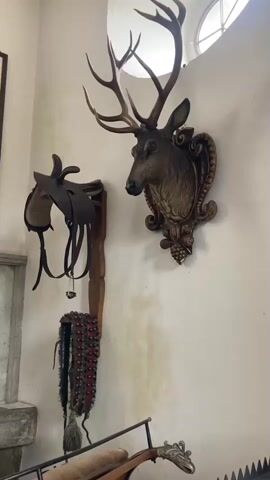
The video shows a room with old hunting-themed decorations. A taxidermied deer head is mounted on a white wall, along with a brown saddle and ornamented harness. A framed collection of metal hook-shaped items is on the wall next to a stone fireplace. A window with gridded panes allows natural light into the room. A long gun with an ornate handle sits on the floor in front of the wall display.
Sigmaringen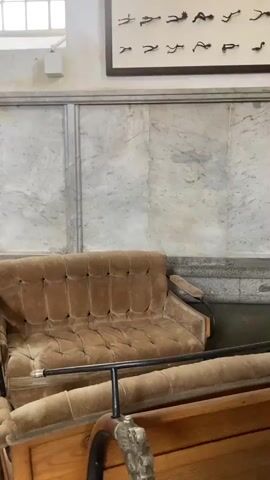
The video pans around an indoor display of carriages. The foreground shows a brown couch in a carriage and a black bar. The room has light colored marble wainscoting, framed pictures on the wall, and high windows. In the background, people stand on a balcony overlooking the carriages.
Sigmaringen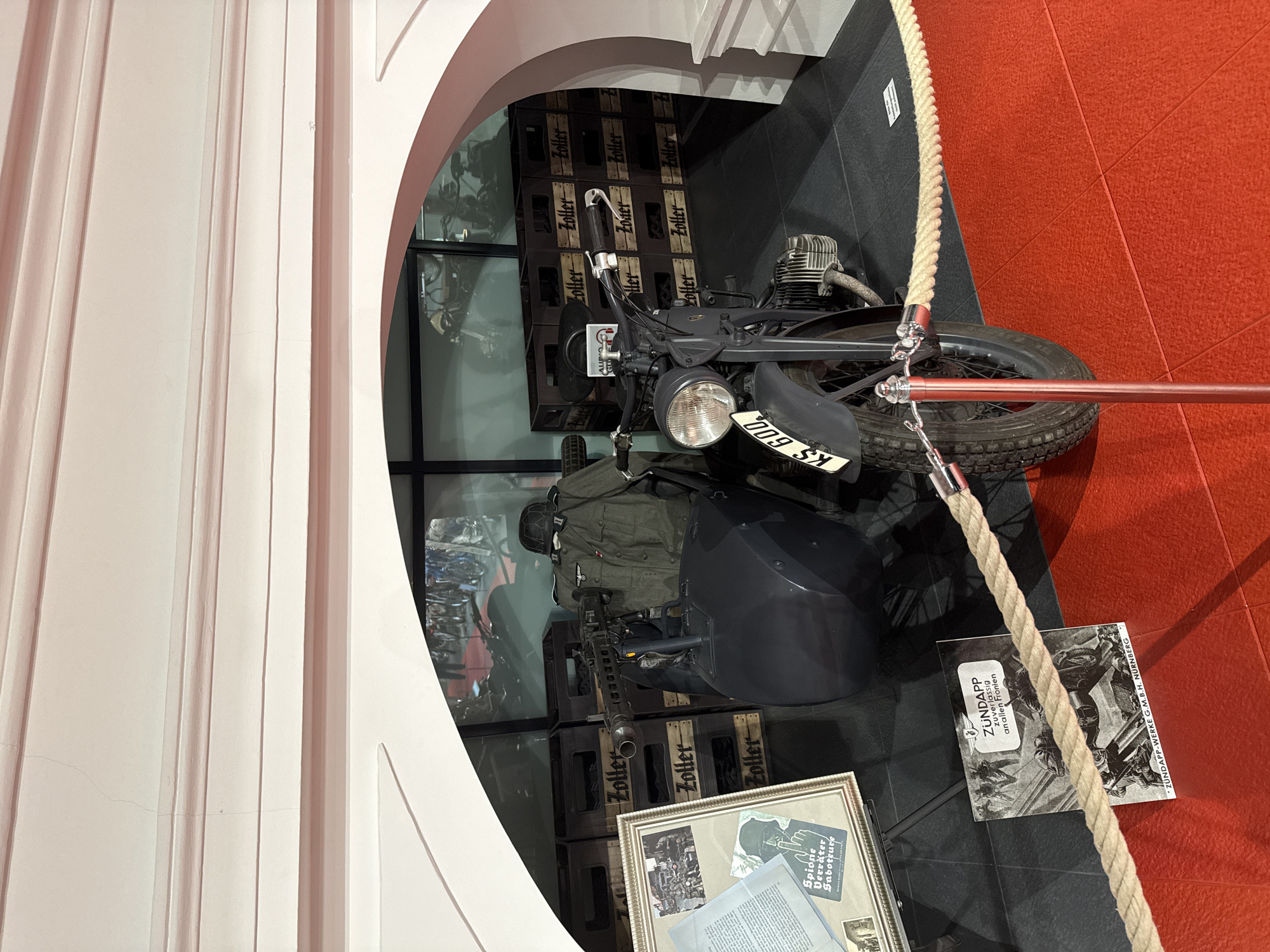
A static museum exhibit is depicted indoors, situated under a light-colored arched entryway. The primary subject is a dark gray vintage Zündapp KS 600 military motorcycle with an attached sidecar, identifiable by the "KS 600" plate on the front fender. A heavy machine gun, consistent with an MG 42, is mounted to the front of the sidecar. Behind the sidecar, a dark green military jacket with an eagle insignia, a helmet, and a green military backpack are displayed. The exhibit area, floored with dark gray tiles, is demarcated from the viewer's red tiled floor by a tan rope barrier supported by chrome stanchions. To the left, a framed display features historical photographs and a German propaganda poster stating "Spione Verräter Saboteure" (Spies Traitors Saboteurs). A book titled "ZÜNDAPP zuverlässig an allen Fronten" lies on the floor, partially under the rope. In the background, behind the motorcycle, multiple wooden crates bearing the label "Zoller" are stacked. A large reflective surface behind these crates shows blurred reflections of another interior space, possibly containing additional exhibits or vehicles. This exhibit is located in Sigmaringen, Germany, likely within the Museum im Alten Zeughaus, which houses historical collections.
Sigmaringen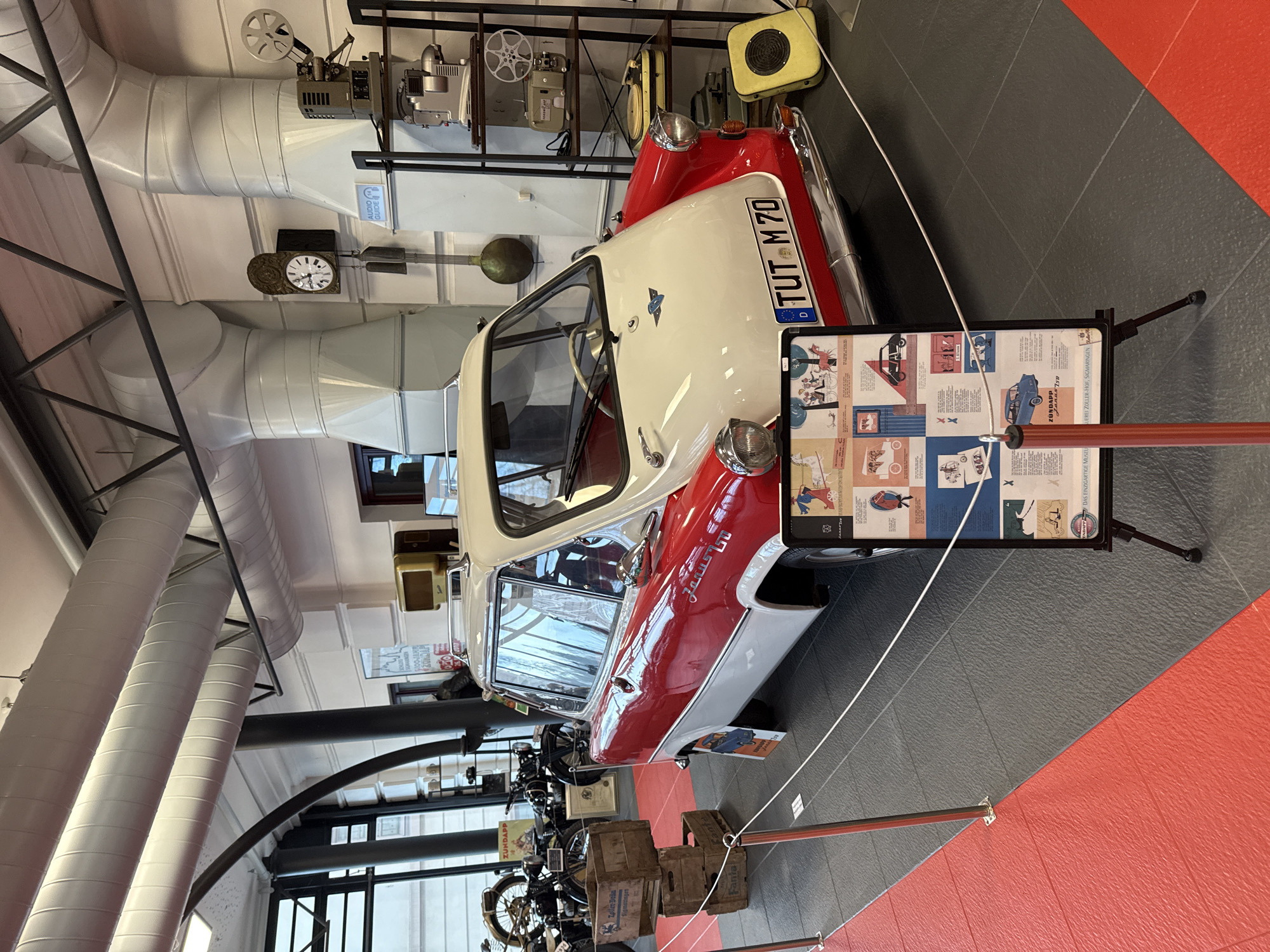
The scene depicts an interior view of a museum exhibit, specifically in Sigmaringen, Germany, likely at the Zoller-Hof premises, as indicated by labels on items within the exhibit. The central subject is a vintage, two-tone microcar, a Zündapp Janus 250, with a red lower body and white upper body, roof, and front hood. The car features prominent rounded headlights, a chrome front bumper, a small blue emblem on the hood, and a German license plate reading "TUT M 70". A chrome roof rack is mounted on the vehicle's roof. The car is situated on a dark gray textured floor and is separated from the viewer by a white rope barrier supported by chrome stanchions. To the left of this barrier, the floor transitions to a textured red surface. Directly in front of the car, a black easel-style display stand holds a poster featuring multiple graphic panels and text, providing information about the Zündapp Janus 250 and explicitly mentioning "Zoller-Hof, Sigmaringen." In the background, to the right of the car, a black multi-tiered metal shelving unit displays an assortment of vintage media equipment, including several film projectors, film reels, and a yellow portable record player. Above this, an antique wall clock with a pendulum is mounted, positioned between large, white industrial-style ventilation ducts that traverse the ceiling and walls. An "AUDIO GUIDE" sign is visible near the clock. To the left of the main subject, several vintage motorcycles are partially visible further back in the exhibition space. In the mid-ground on the left, three stacked wooden crates are present, with labels indicating "Zoller-Bräu Sigmaringen" and "Fanta." The far background on the left reveals large windows with dark frames and dark structural columns, suggesting an expansive indoor area. No individuals are present in the depicted scene.
Sigmaringen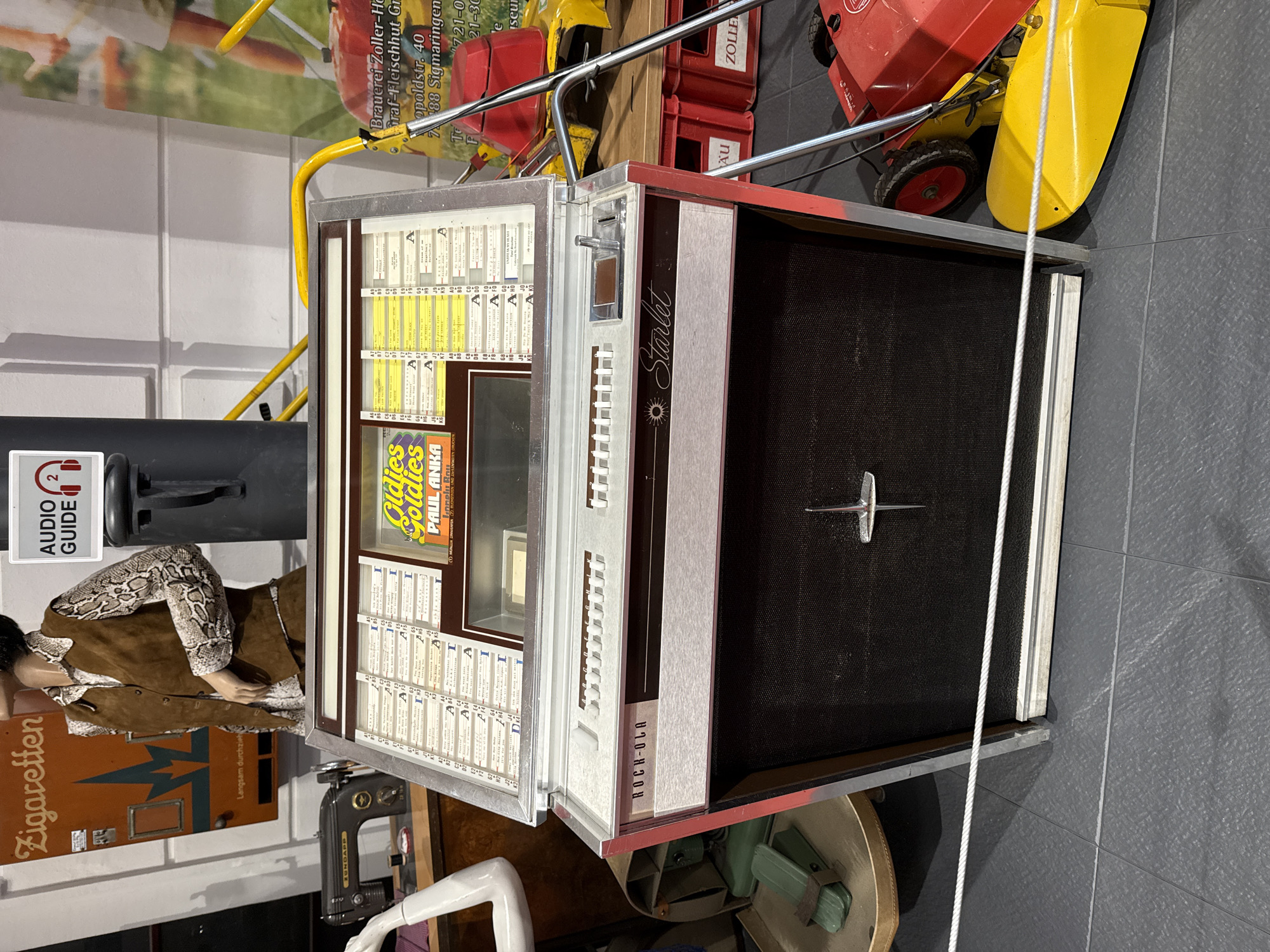
The image displays an indoor museum exhibition in Sigmaringen, Germany. A prominent Rock-Ola Starlet jukebox, featuring a metallic and red-toned frame, a glass display with visible song selections including "Oldies Goldies" and "Paul Anka," and a black speaker grille adorned with a chrome starburst emblem, occupies the foreground. An array of white input buttons is present on the jukebox's upper panel. A white braided rope runs horizontally in front of the jukebox, acting as a display barrier. To the left of the jukebox, a headless mannequin is dressed in a brown faux-suede vest over a snakeskin-patterned shirt. Behind the mannequin, an orange vintage cigarette vending machine labeled "Zigaretten" and "Langsam durchziehen" is mounted on a light-colored wall. A vintage black Zündapp sewing machine sits on a wooden surface to the left foreground. Above and behind the jukebox, a white sign displaying "AUDIO GUIDE" with a headphone icon and the number "2" is attached to a dark vertical post. To the right of the jukebox, a red and yellow push lawnmower is positioned. Behind the lawnmower, several red plastic crates marked with "BRAU" and "ZOLLE" are stacked. A partially visible poster in the background identifies "Brauerei Zoller-Hof" and "72488 Sigmaringen," confirming the city. The floor consists of dark gray, textured square tiles. The overall environment suggests a historical or cultural exhibition space.
Sigmaringen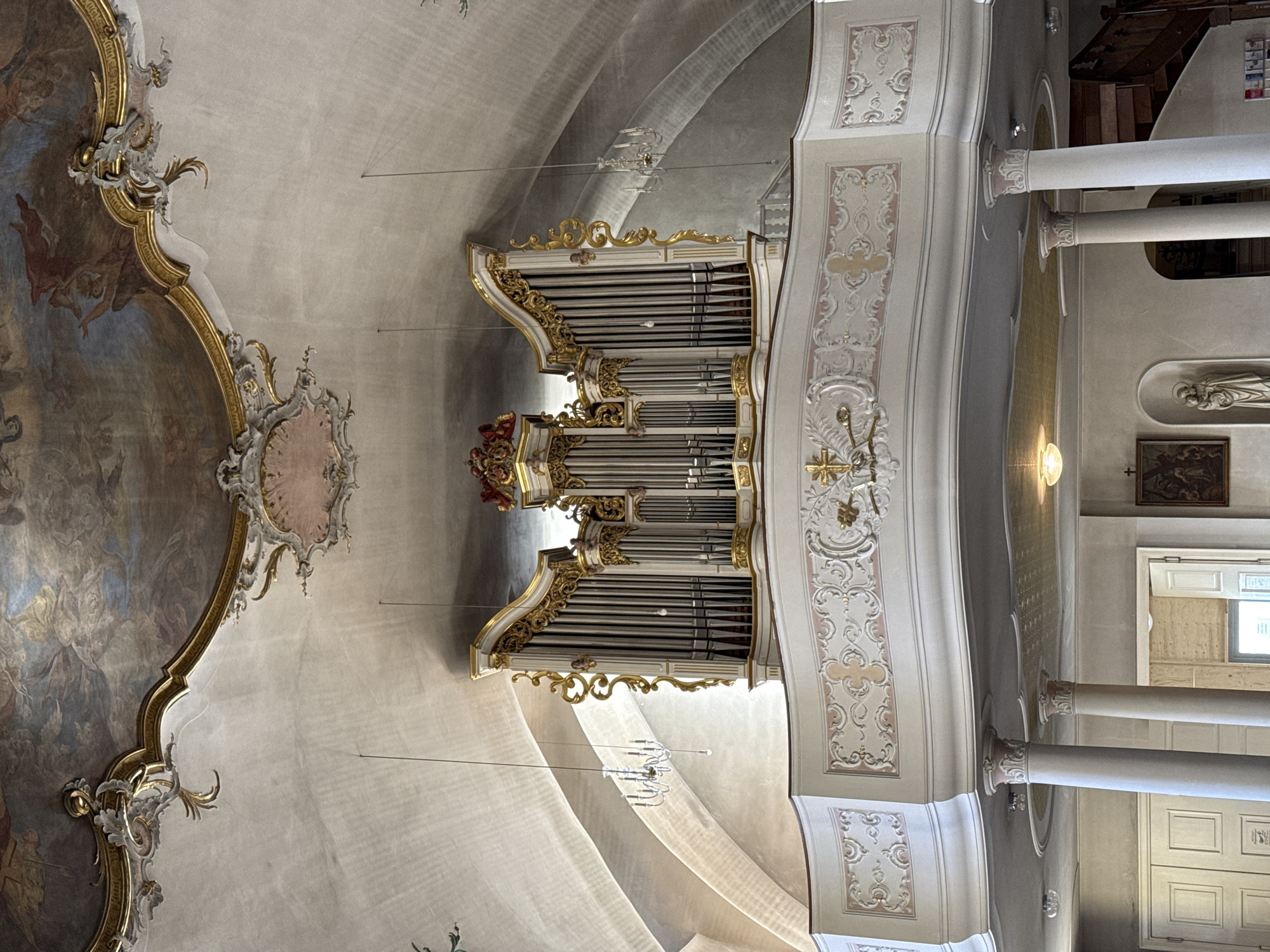
This image captures the interior of an elaborately decorated religious structure, likely a church, located in Sigmaringen, Germany. The scene focuses on a grand pipe organ situated on an upper choir loft or balcony. The vaulted ceiling features a large fresco depicting numerous figures and clouds, bordered by complex, gilded, and white stucco ornamentation. The upper walls are a light, neutral color, exhibiting the curves of the vaulted architecture. Two multi-branched chandeliers with glass elements are suspended by thin wires from the ceiling, one partially visible on the left and another on the right. The central subject is the large pipe organ, which features a prominent white casing adorned with extensive gold Rococo-style scrolling and flourishes, along with select red highlights on its uppermost sections. Numerous polished silver-colored organ pipes of various lengths are visible within the instrument's structure. The organ rests on a substantial white balcony that spans the visible width of the interior. This balcony's front facade is decorated with ornamental relief panels featuring curvilinear motifs in white and pale pink, with additional gold detailing, including a stylized golden cross or similar religious emblem at its center. Below the balcony, several sturdy, fluted columns with ornate capitals provide support, appearing in a light stone or white finish. The lower walls are a lighter beige tone. On the left, a set of closed, paneled white double doors is visible. Further to the right, an arched niche contains a white statue, possibly depicting the Madonna and Child. A framed painting hangs on the wall to the left of the niche. An open doorway or window with a light-colored wooden frame is present on the far left, and a dark wooden staircase railing is partially visible on the far right. Multiple recessed and surface-mounted light fixtures illuminate the lower area. No individuals are present within the frame.
Sigmaringen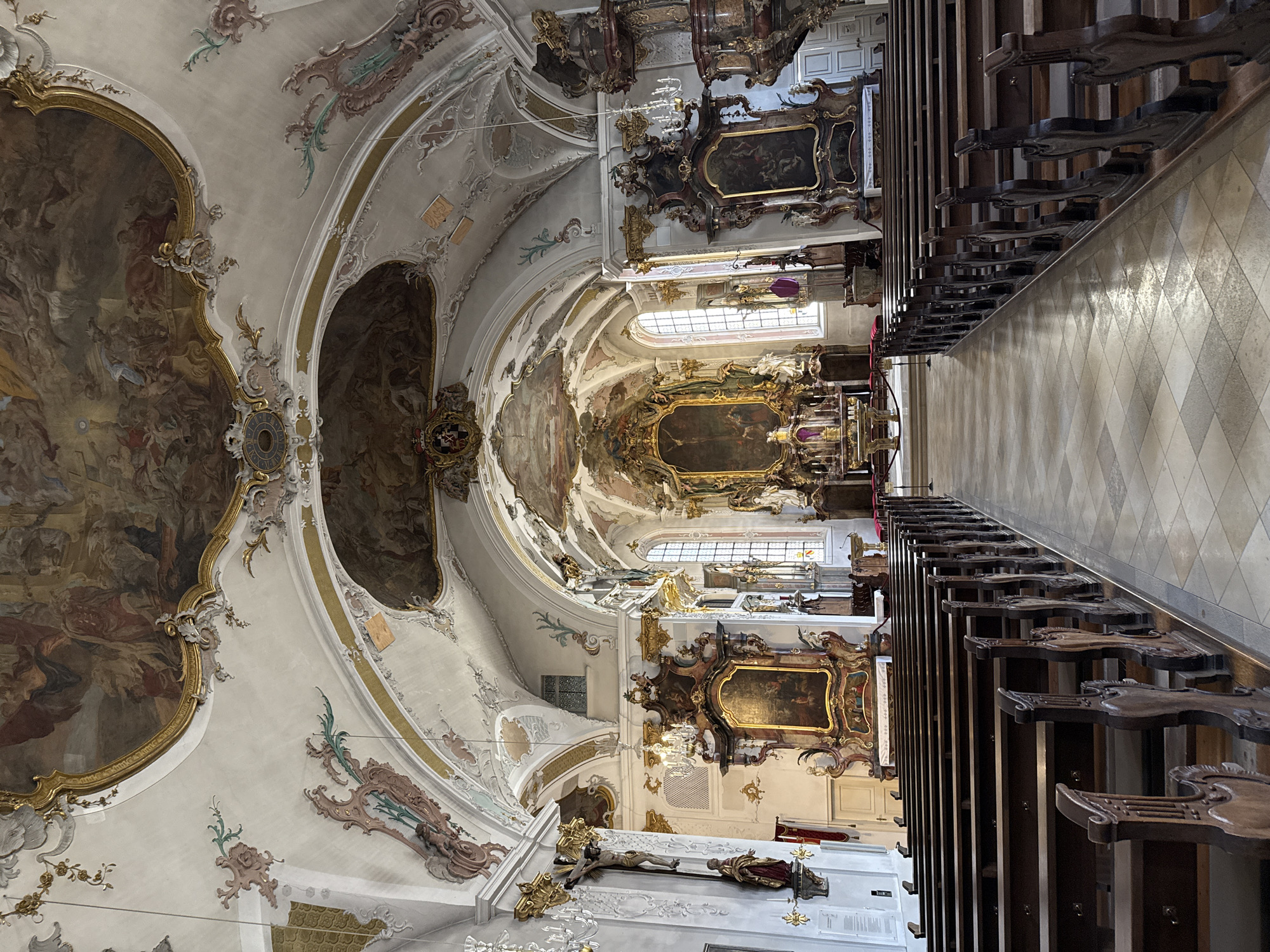
The image depicts the interior of the Stadtpfarrkirche St. Johann Evangelist (St. John the Evangelist Parish Church) in Sigmaringen, Germany. The scene is an empty church nave, viewed from the rear towards the main altar, illuminated by natural light entering from tall arched windows on the right side. The architecture is characterized by elaborate Baroque and Rococo styles. A vaulted ceiling features extensive fresco paintings depicting religious scenes, framed by ornate, gold-gilded stucco work and further adorned with white stucco motifs and painted scrollwork in shades of green and reddish-brown. A circular clock face with Roman numerals is integrated into the vaulting on the left side, partially obscured. Crystal or glass chandeliers hang at various points. The central aisle, covered with a checkerboard-patterned tiled floor in light and slightly darker hues, separates two blocks of dark brown wooden pews. Each pew has carved end pieces, and the rows extend towards the chancel. Along the left side of the nave, a large crucifix depicting Christ is mounted on a pillar. Below it, a statue of a saint, possibly John the Evangelist or Mary Magdalene, in red and gold robes, stands on a pedestal. Further along, an ornate side altar features a large painting in a gilded frame, surrounded by sculptural elements. On the right side, multiple elaborate side altars are also visible, each with paintings and sculptural decorations. A prominent feature is a large, ornate wooden pulpit with a tester (canopy) above it, adorned with carved figures and simulated marbling. Tall arched windows allow daylight into the space. At the far end, the main altar area is distinguished by a highly decorated altarpiece with a central painting, framed by columns and numerous gilded sculptures of saints and angels. A smaller altar table, draped with a white cloth and displaying candlesticks, is positioned in front of the altarpiece. Some purple or maroon fabric elements are present in the chancel area. No individuals are present in the scene.
Sigmaringen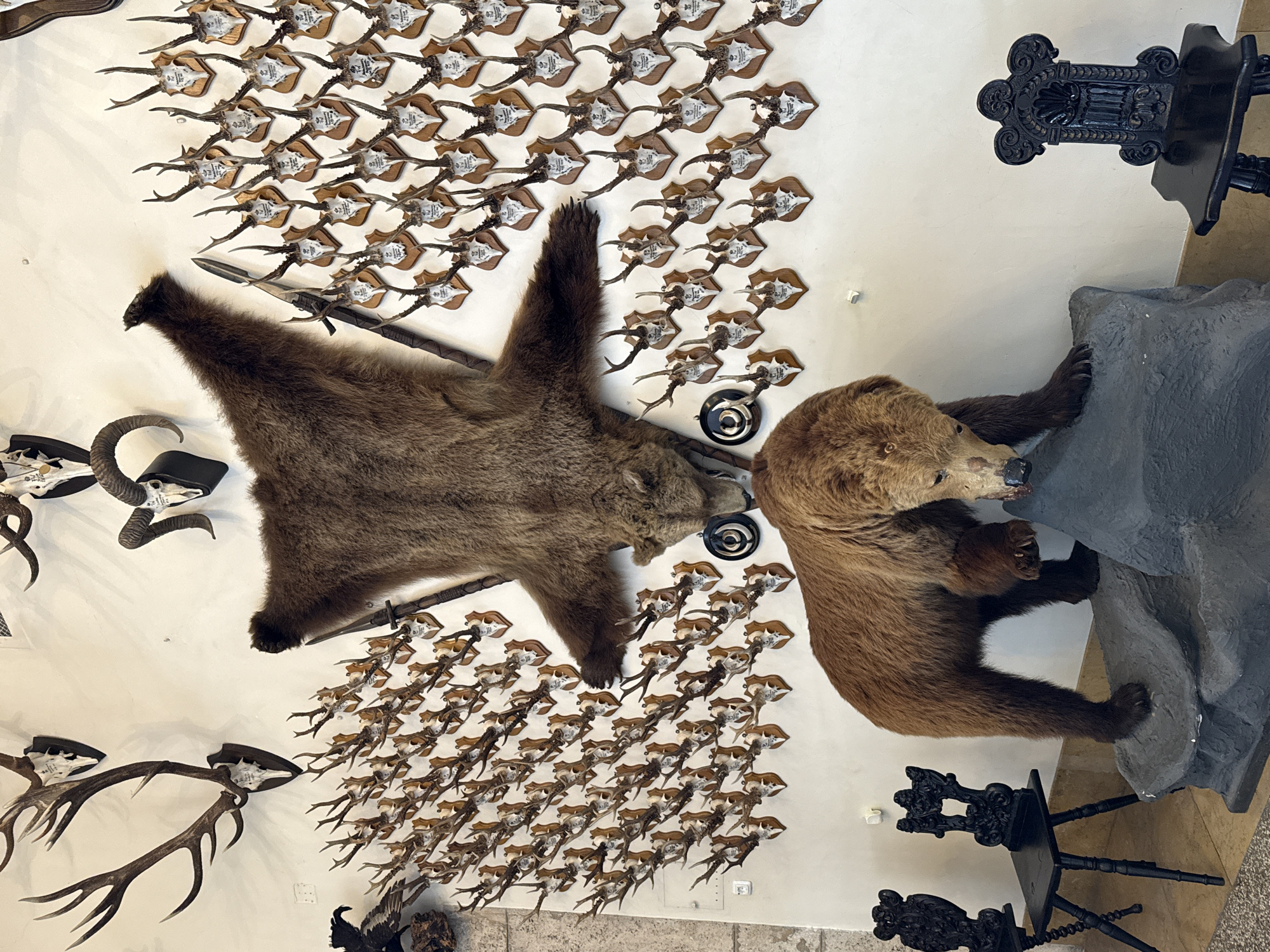
The scene depicts an interior room within Sigmaringen Castle, Germany, configured as a hunting trophy display. A large, dark brown bear skin, prepared as a rug, is centrally mounted on a white wall, its head oriented downwards. Below the rug, a full-body taxidermied brown bear stands on a dark grey, rock-textured display base, with its head lowered and facing the base. The white walls are extensively covered with hunting trophies: several large sets of deer antlers are mounted on dark wooden plaques, primarily in the upper left, while the majority of the wall space is filled with hundreds of smaller deer antlers, likely roe deer, each affixed to individual shield-shaped wooden plaques arranged in systematic rows and columns to the left and right of the bear rug. A dark, ornate circular emblem with a light-colored spiral design is affixed to the wall below the bear rug's head. A long, dark polearm, possibly a spear, leans vertically against the wall to the right of the bear rug, with another partially visible on the left. In the lower portion of the frame, two dark, elaborately carved wooden chairs with ornate backs are visible in the lower left, and a third similar chair is positioned in the lower right, all facing away from the wall. The floor is light-colored and tiled.
Sigmaringen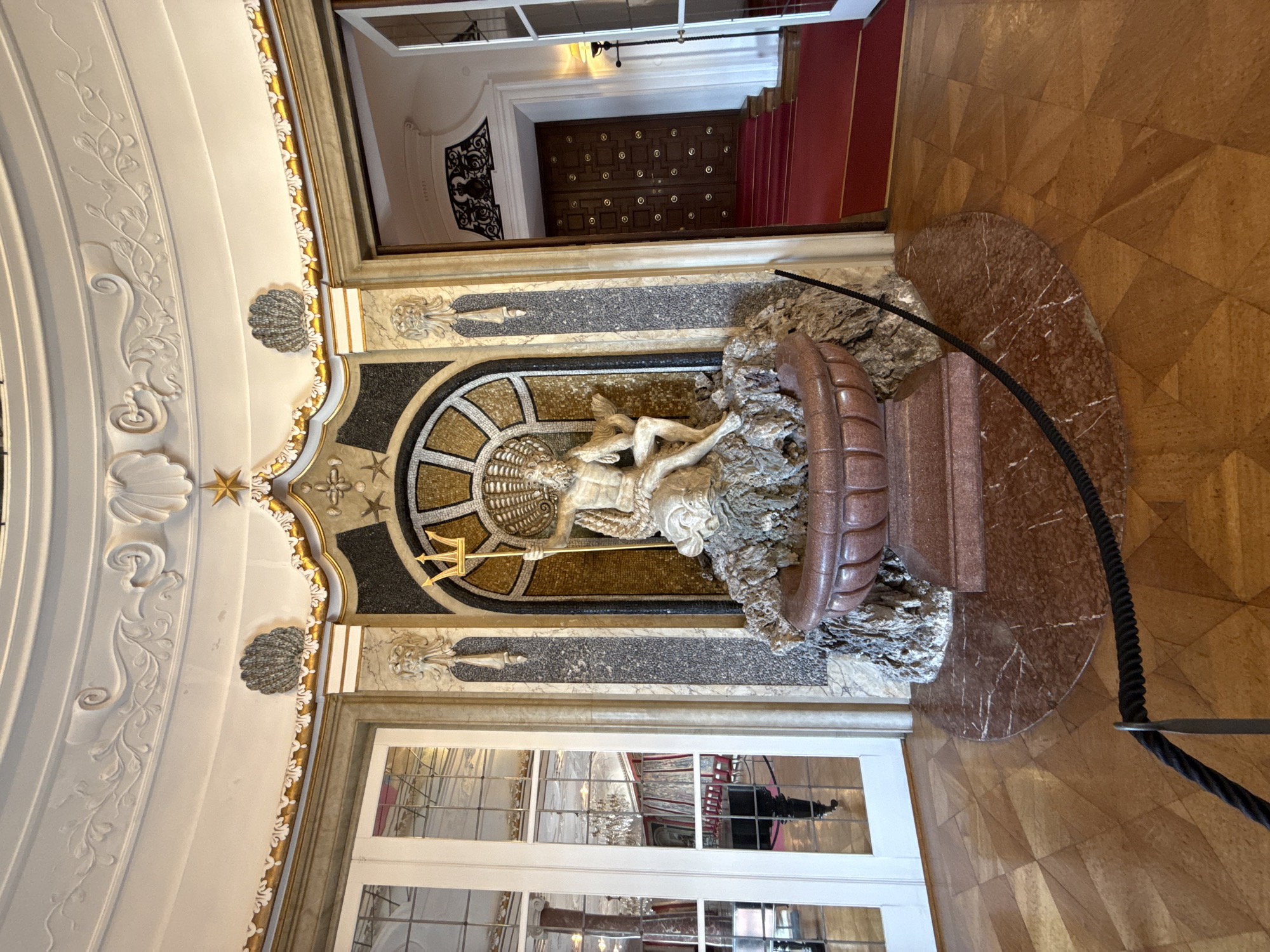
This image depicts an opulent interior within a building in Sigmaringen, Germany. The central feature is a large, elaborate fountain-like structure in an arched recess. A white stone statue of a bearded, muscular male figure, possibly Neptune, is seated on a textured stone formation, holding a golden trident vertically in his right hand. Below the statue is a reddish-brown, fluted marble basin. The arch behind the statue is filled with a mosaic pattern of gold and dark tiles. The walls surrounding this feature are paneled with various marbles, including light beige with dark veins and a dark speckled stone, adorned with white shell motifs, a gold star, and ornate plaster details. The ceiling, partially visible, is white with intricate white plaster scrollwork and shell reliefs, bordered by a gold and white decorative frieze. To the left, a tall, white-framed double door with multiple glass panes reflects an adjacent opulent room. This reflection shows a grand piano, chandeliers, red seating, and a partial, dark reflection of a human figure. To the right, an open doorway reveals a red carpet covering steps leading to a large, dark wooden double door adorned with numerous circular brass or gold bosses arranged in a grid pattern. A dark metal standing lamp with a light-colored shade is positioned to the right of this doorway. The floor consists of light brown parquet wood laid in a geometric pattern. A semi-circular inlay of reddish-brown marble with white veining surrounds the base of the central statue. In the lower foreground, a black braided rope barrier is stretched across the floor, supported by a metal stanchion, restricting access to the display.
Sigmaringen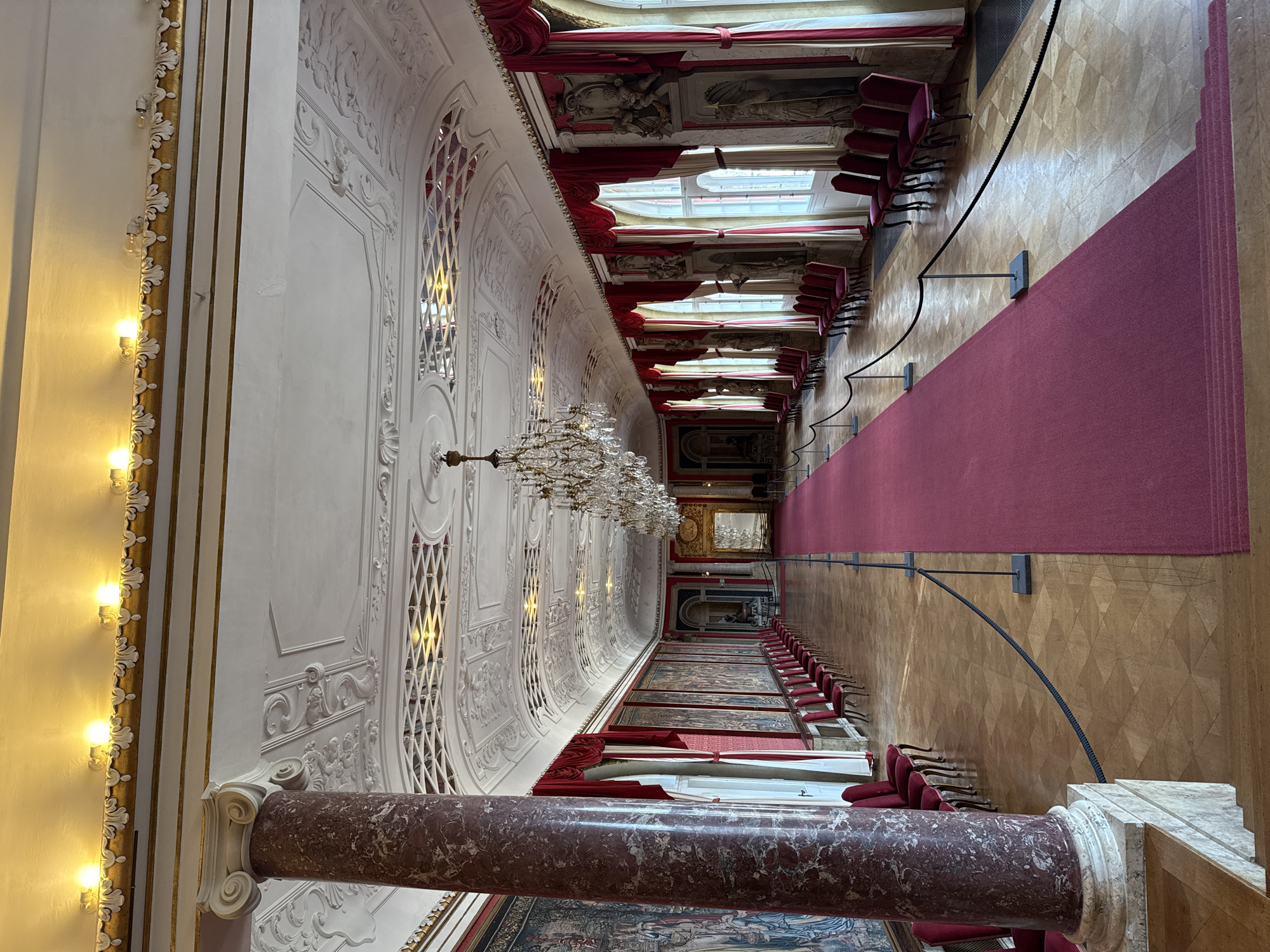
This image depicts the interior of a grand hall within Sigmaringen Castle, Sigmaringen, Germany. The long, ornate corridor is vacant of people. A deep red carpet extends from the foreground, covering the central portion of the light-toned parquet floor, and recedes towards a large, gilded mirror at the far end of the hall. Black stanchions with ropes flank the red carpet, defining a guided pathway. The white ceiling is extensively decorated with intricate white plasterwork featuring scrolling motifs, geometric patterns, and mirrored inserts in some recessed panels. A series of large, multi-tiered crystal chandeliers hang along the central axis of the ceiling, supplemented by smaller wall-mounted lights near the ceiling line. The left wall, in the foreground, displays a large tapestry or fresco featuring multiple figures. Further along this wall, sections of red and cream drapery frame windows, and a continuous line of red velvet chairs with dark wooden frames is arranged facing the central pathway. The right wall features a series of tall, arched windows, each framed by heavy red and cream curtains. Between these windows are ornate architectural niches containing stone sculptures of standing figures, some holding implements. A parallel line of matching red velvet chairs is also positioned against this wall. In the immediate foreground on the left, a prominent column of reddish-brown mottled marble with a white, classical capital and base stands, partially obscuring the left wall. The overall scene is static, devoid of discernible actions or interactions, and presents an opulent, well-preserved historical interior environment.
Sigmaringen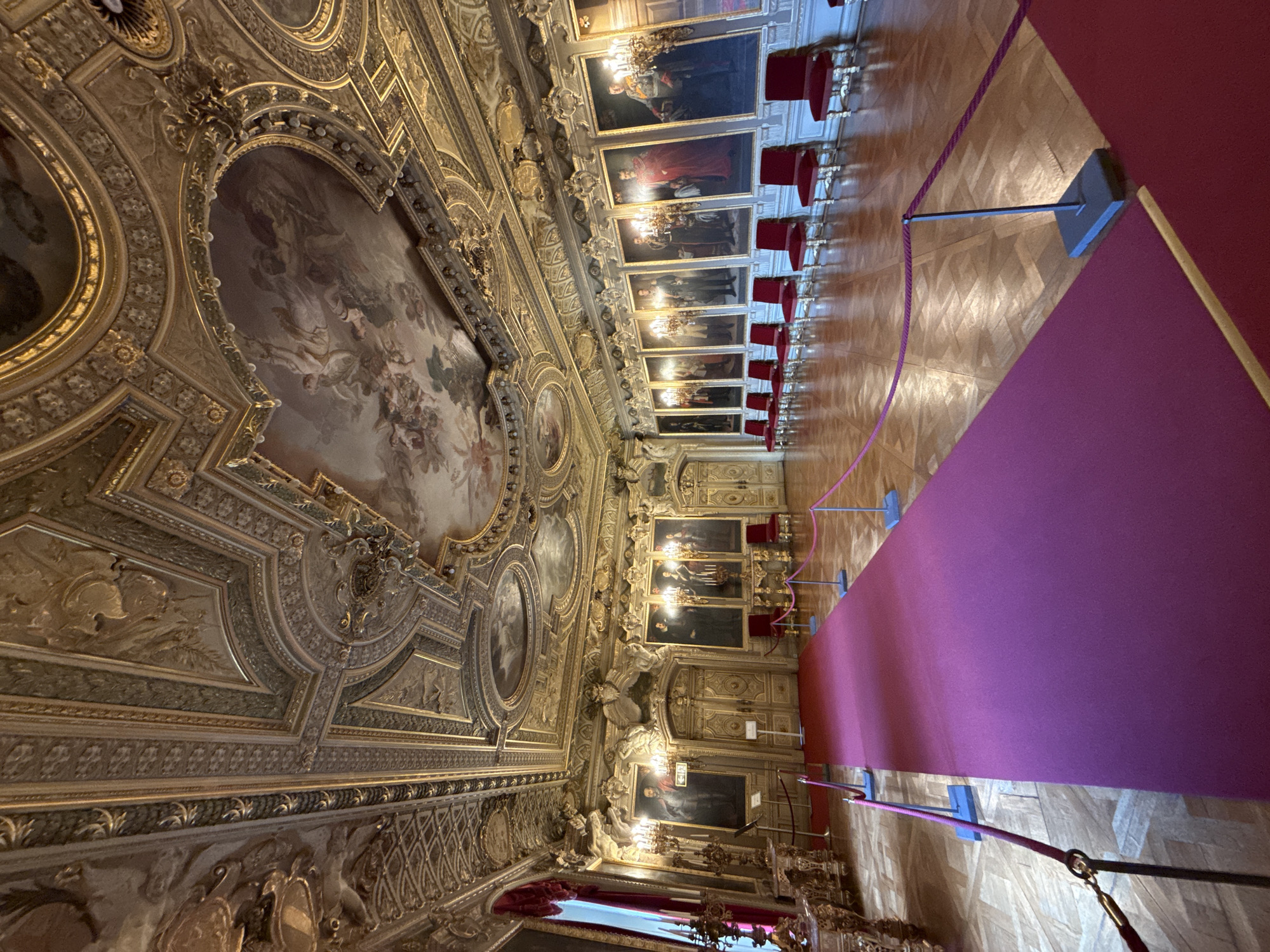
This image depicts a grand hall within Sigmaringen Castle in Sigmaringen, Germany. The scene presents an opulent, unoccupied interior viewed from a slightly low angle, looking down the length of the room. The ceiling is elaborately coffered and extensively gilded, featuring intricate gold stucco work, decorative moldings, and several painted frescoes. A prominent central oval fresco depicts classical or mythological figures, surrounded by rich gold framing. Additional rectangular painted panels are integrated into the gilded ceiling design. The walls are adorned with numerous large-format oil portraits in gilded frames, depicting historical figures. Along the right wall, a precise row of eight identical red velvet chairs with gilded wooden frames is positioned beneath these portraits. Gilded wall sconces, each fitted with multiple electric candle-shaped lights, are mounted between and above the portraits. On the left wall, a segment of a draped window or archway is visible, along with a gilded console table supporting multi-armed candelabra. Two sets of tall, double gilded doors, featuring ornate carvings, are also visible on this side of the room. The floor is a highly polished wooden parquet, laid in a patterned arrangement, reflecting the overhead lighting and room elements. A wide, dark red carpet runner extends down the center of the hall, from the foreground into the distance. This designated path is bordered on both sides by a series of grey stanchions connected by red velvet ropes. No individuals are present in the scene, and no actions or interactions are depicted. The environment is static, meticulously maintained, and presented for viewing or ceremonial passage.
Sigmaringen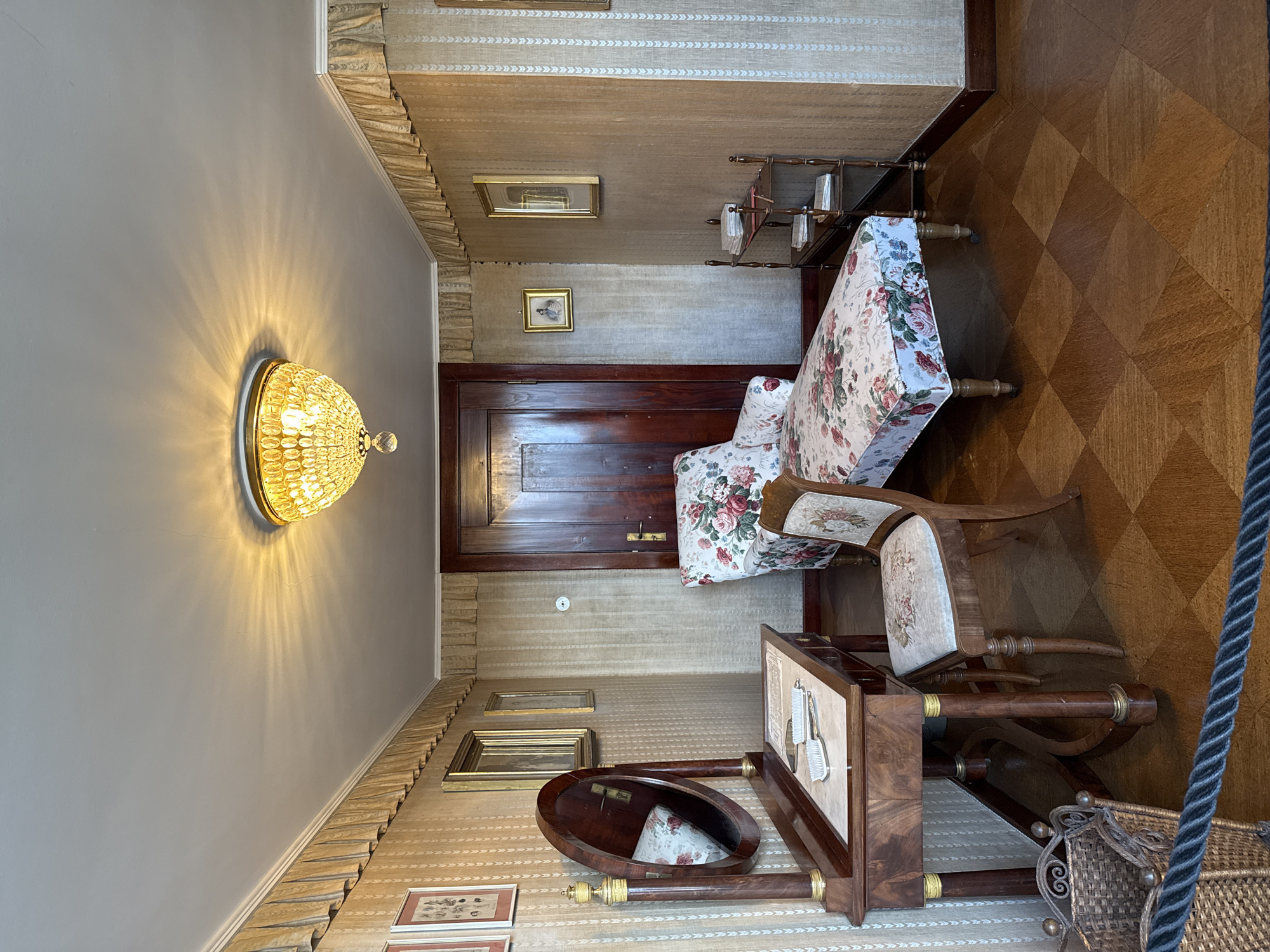
The image depicts an unoccupied interior room, likely a historical dressing room or boudoir, situated within Sigmaringen Castle in Sigmaringen, Germany. The room features walls covered in a vertically striped, light beige wallpaper with a subtle textured pattern. A ruffled fabric valance, matching the wall color, runs along the top perimeter of the walls, just below a white crown molding. The ceiling is plain and white, from which a large, ornate gold-colored chandelier with numerous crystal elements hangs centrally, casting distinct radial light patterns onto the ceiling. The floor is made of dark wood parquet, laid in a diagonal checkered pattern of contrasting wood tones. In the lower foreground, a dark blue braided rope barrier is partially visible, indicating a preserved exhibit space. To the far left, a portion of a wicker basket is also visible behind the rope. Along the left wall, a dark wooden dressing table with a white marble top is positioned. A small white rectangular box and two silver-toned hairbrushes are placed on the marble surface. An oval-shaped, dark wooden framed mirror, centrally mounted on the dressing table, reflects the floral pattern of a nearby chaise lounge. A dark wooden chair with a light-colored upholstery featuring a matching floral pattern of pink roses and green foliage is situated in front of the dressing table. Two framed artworks are mounted on the wall above the dressing table. Diagonally placed in the center-right of the room is a chaise lounge upholstered in a white fabric adorned with a vibrant pattern of pink roses and green leaves, supported by turned wooden legs. Against the rear wall, a dark wooden paneled door with a brass handle is present. To the right of this door, a small framed portrait hangs on the wall. A small white circular wall fixture is visible to the left of the door. Along the right wall, a small, dark wooden tiered shelf unit (a what-not stand) displays several stacks of what appear to be books or papers. Additional framed artworks are mounted on the right wall.
Sigmaringen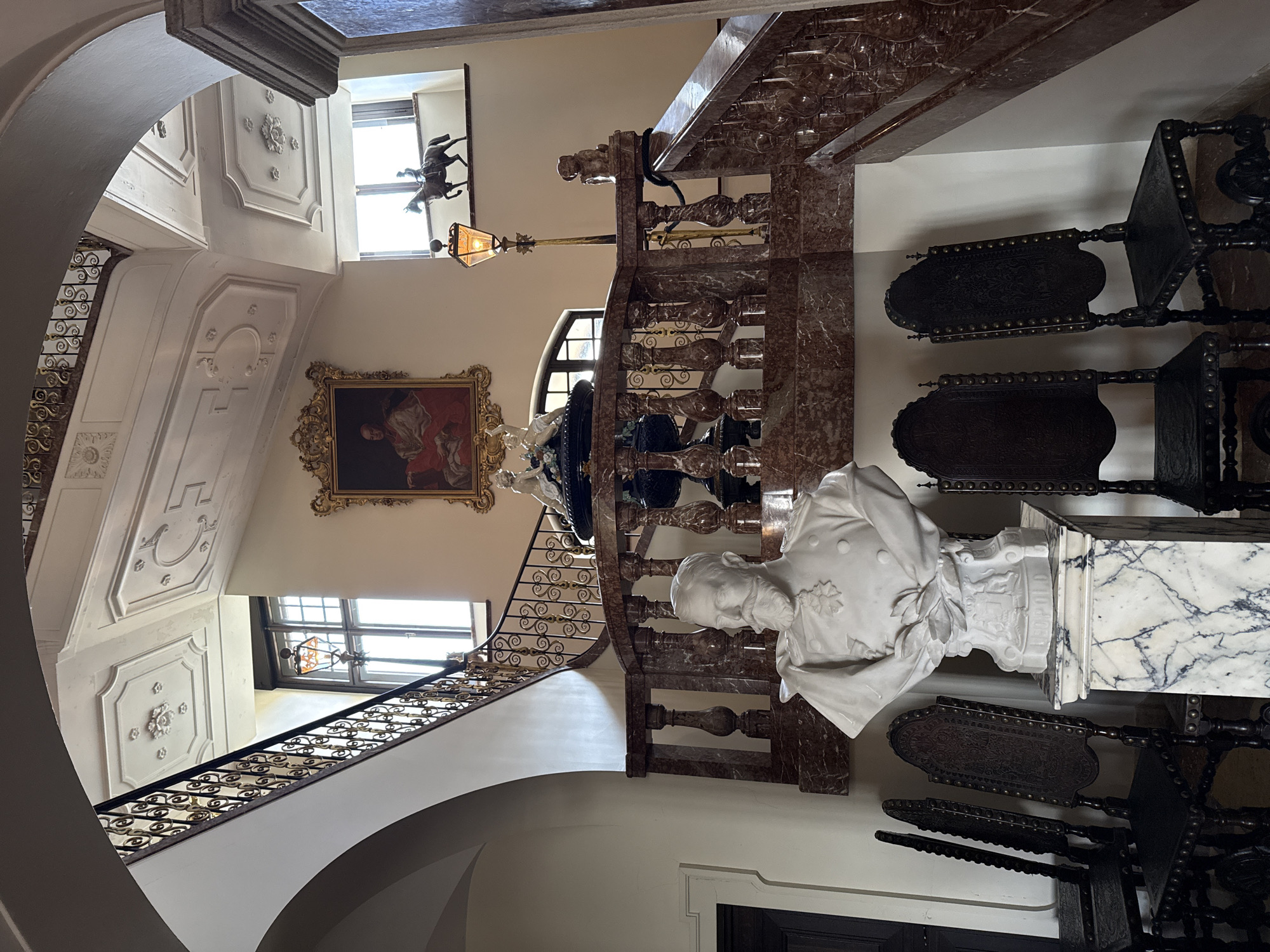
This image depicts a grand staircase within a historic building, identified as Sigmaringen Castle (Schloss Sigmaringen) in Sigmaringen, Germany. The scene focuses on a multi-level ornate interior. In the foreground, a white marble bust of a bearded man in a military uniform, complete with medals, rests on a veined white marble pedestal inscribed with "LEOPOLD." Four dark, high-backed wooden chairs with studded details are positioned around the base of the pedestal. A sweeping staircase, constructed from reddish-brown polished marble with a matching balustrade, ascends upwards to the right. The upper railing of the staircase features an ornate black wrought-iron design with gold-colored scrollwork. On a landing or intermediate level of the staircase, a large, dark, tiered basin or fountain structure is visible, topped with light-colored statuettes depicting figures, possibly cherubs. To the right of this, a tall, decorative lamp resembling a historic streetlamp, with a golden pole and an amber-toned glass enclosure, stands prominently. Further right, atop the marble balustrade, a small, dark statuette of a dog, possibly a pug, is positioned. The background features multiple large, rectangular windows with clear panes, allowing natural light into the space. On the sill of one window, a dark-toned statuette of a man on horseback is visible. A prominent, large oil painting in an elaborate gold frame hangs on a wall, depicting a seated figure in formal red and white attire. The ceiling is white and decorated with intricate plasterwork, including rosettes and geometric patterns. The walls are a light, neutral color.
Sigmaringen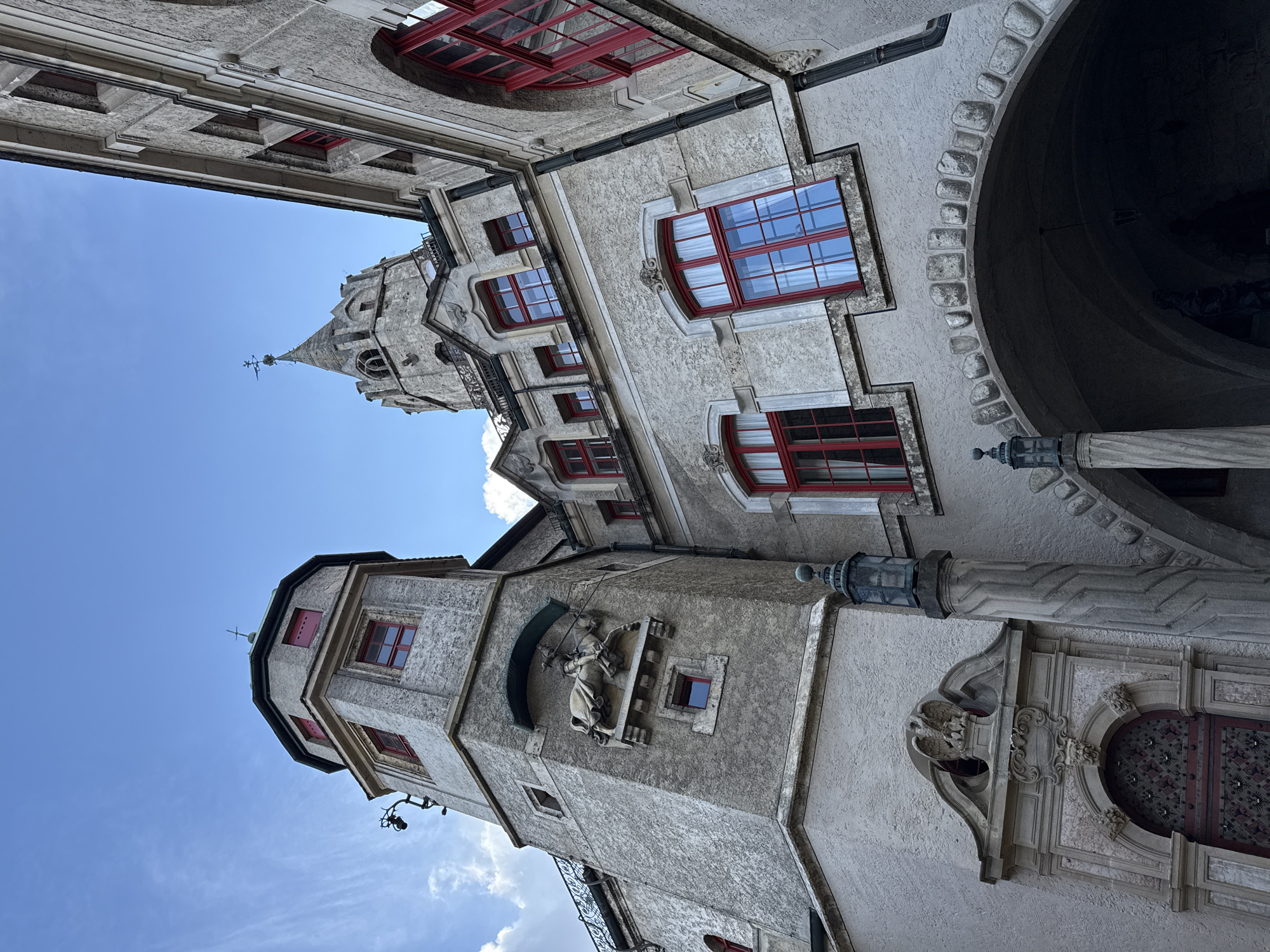
The image displays an upward perspective of a section of Sigmaringen Castle (Schloss Sigmaringen) in Sigmaringen, Germany, under a clear blue sky with sparse white clouds. The architecture consists primarily of light grey, textured stone or stucco. To the left, a multi-tiered tower rises, featuring a square base and an octagonal upper section with red-framed, multi-pane windows. This tower is capped by a dark octagonal roof with a small, dark finial or cross. A stone relief of a knight on horseback, facing right with a lance, is mounted on the side of the tower. An ornate dark iron railing is visible on an upper balcony adjacent to this tower. In the background and center, a taller, slender grey stone spire rises, culminating in a pointed roof topped by a weather vane. This spire features multiple levels with small arched windows. The main building facades present numerous windows, both rectangular and arched, all distinguished by bright red frames. Some windows contain white curtains. In the lower right foreground, a large, deeply shadowed stone archway is visible, constructed with roughly hewn voussoirs. Adjacent to the left side of this archway, a decorative fluted stone column supports a dark, ornate lantern. In the lower left, a highly decorative stone doorway or entrance is present, featuring a carved arch, an intricate dark grille, and a pediment adorned with a sculpted double-headed eagle. No individuals or discernible activities are present within the scene.
Sigmaringen