Spring Hill, Australia
8 memories from Spring Hill, Australia
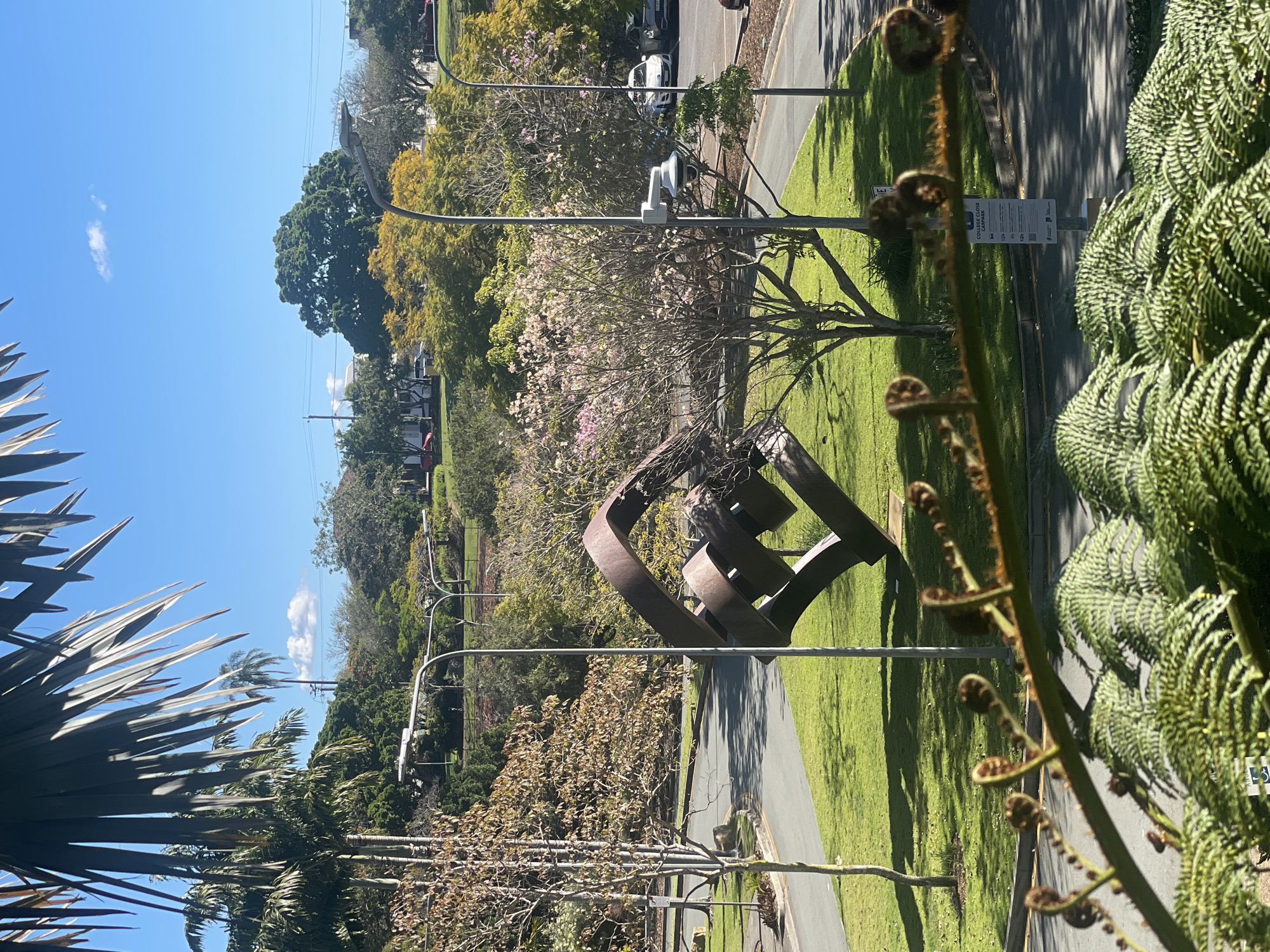
In Spring Hill, Australia, a public art sculpture, constructed from dark metal with a geometric, interlocking design, is positioned on a manicured green lawn. The sculpture is centrally located within a park-like setting, with paved pathways and streetlights surrounding it. Several trees are visible in the background, some bearing light pink blossoms, and others with autumn foliage of yellow and brown hues. Palm trees and lush green foliage contribute to the natural environment. A light-colored car is parked on the right side of the image, adjacent to the pathway. In the foreground, unfurling fern fronds are in sharp focus, partially obscuring the view of the mid-ground. The sky is clear and blue with a few small clouds.
Spring Hill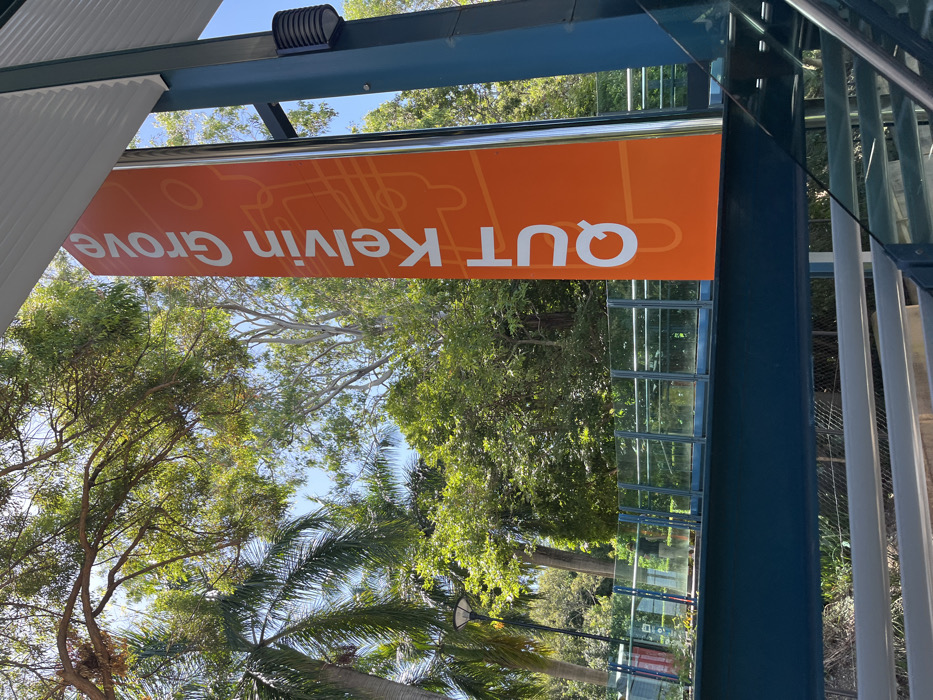
This image captures an outdoor scene dominated by an orange sign displaying white text. The sign reads "QUT Kelvin Grove," with faint, lighter orange patterns resembling abstract shapes or circuit board elements visible behind the text. The setting is bright and sunny, indicating daytime, with clear skies visible through the tree canopy. Lush green foliage and numerous trees, including distinct palm trees, surround the sign, suggesting a vibrant, possibly subtropical environment. Parts of a structure are visible, including dark blue metal beams and transparent glass panels, possibly belonging to a bus stop, university building entrance, or shelter. A black light fixture is mounted on the overhead structure. There are no people present, and no specific activity is depicted, presenting a static view of the area. The "QUT Kelvin Grove" text strongly identifies the location as the Kelvin Grove campus of Queensland University of Technology in Brisbane, Australia, which is consistent with the general Spring Hill area context.
Spring Hill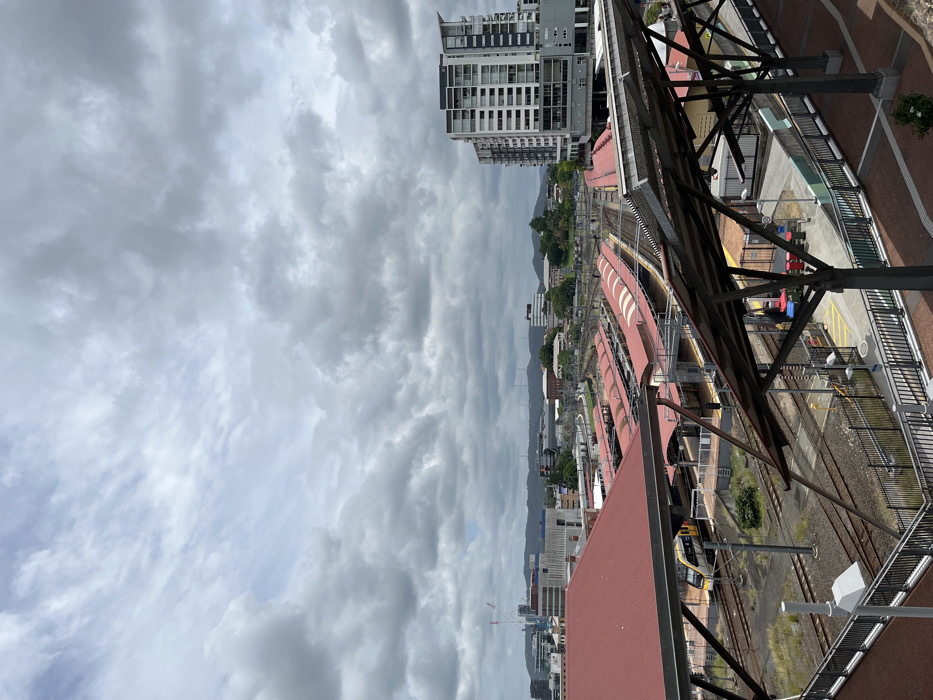
An elevated, wide-angle view captures a bustling urban landscape featuring a railway station under an overcast sky, consistent with Spring Hill, Australia. The perspective is from a high vantage point, looking down and across the city towards distant hills. In the foreground, heavy metal support beams and structural elements of the viewing platform or building frame the right side of the image. Below and to the left, the multi-track railway station extends through the mid-ground. Multiple platforms with distinctive red-brown canopies line the tracks. A yellow and grey train is visible on one of the tracks, appearing stationary. Adjacent to the tracks, on the right, there's a paved area with what looks like public seating (red and blue chairs) and light fixtures, suggesting a pedestrian area or part of the station concourse. Beyond the railway, a mix of urban architecture fills the scene. A prominent modern, multi-story building with light-colored facades stands on the left. Other buildings of varying sizes and styles are scattered throughout the cityscape, receding towards the horizon. In the far distance, a range of hills or mountains is visible, partially obscured by atmospheric haze and the heavy cloud cover. The sky is largely covered by dense, grey clouds, indicating an overcast day with diffused natural light; there is no direct sunlight. No specific activity, such as people boarding trains or clear movement, is discernible. No visible text can be identified on any signs, buildings, or the train.
Spring Hill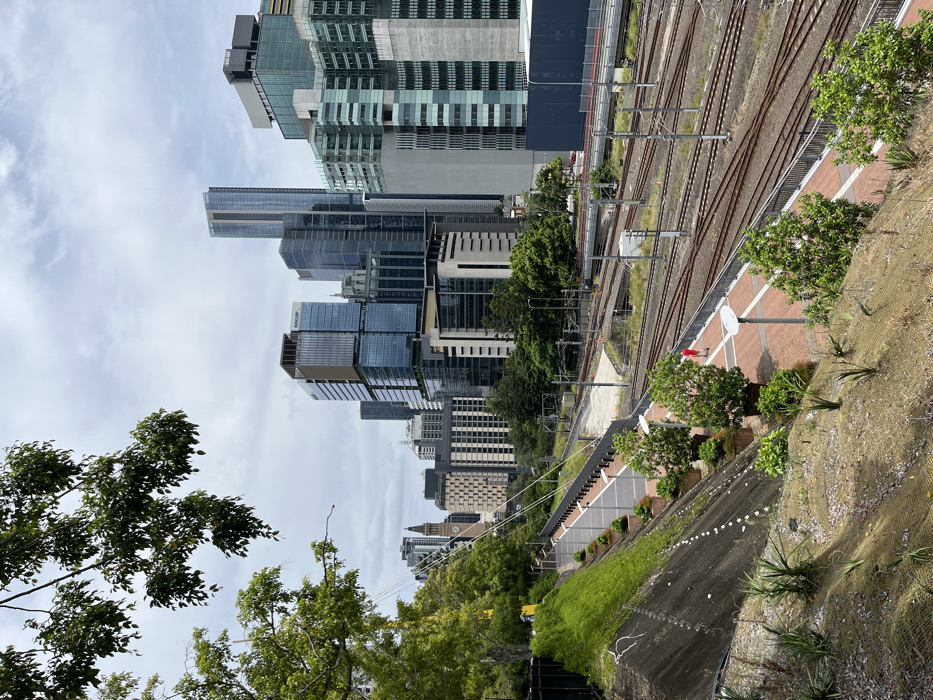
An upward-angled, panoramic shot captures a vibrant urban landscape, viewed as if looking down from an elevated position. The image is currently rotated 90 degrees clockwise; when viewed upright: In the foreground on the left, dense green foliage from tree branches partially obscures the view. To the right, a steep, green embankment covered in a protective mesh features sparse vegetation and small bushes. Adjacent to this slope is a paved area, possibly a walkway or a lower platform, with several small trees and light fixtures. The midground is dominated by an extensive network of parallel train tracks, equipped with overhead power lines and supporting pylons, stretching horizontally across the scene and receding into the distance. A train station platform is visible along the right side of the tracks, where a single person, identifiable by their red clothing, stands. The background showcases a dense and imposing skyline of numerous modern high-rise buildings. These skyscrapers feature contemporary architecture, predominantly glass and concrete facades, some with reflective or green-tinted surfaces. The buildings vary in height and design, forming a prominent urban cluster. In the far background, a distinctive building with a clock tower or spire can be seen peeking out behind the foreground trees. The sky is bright but mostly overcast with light, scattered clouds, indicating daytime conditions. No specific activity beyond the person on the platform is clearly depicted. The scene captures the intersection of natural elements, significant transport infrastructure, and a bustling metropolitan area in Spring Hill, Australia. No discernible text is visible.
Spring Hill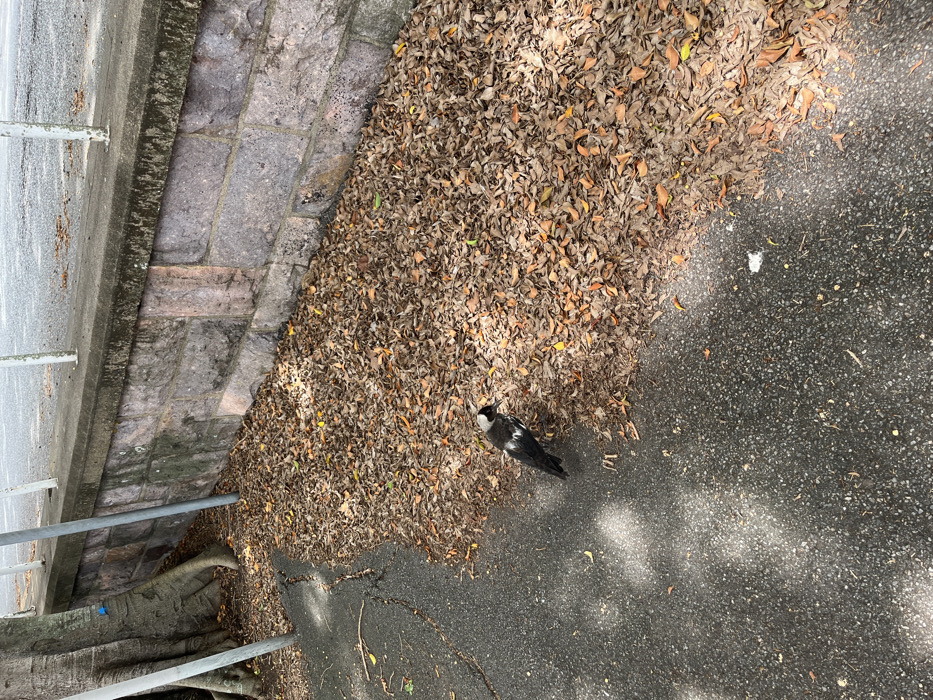
The image, captured from an overhead perspective, presents an outdoor scene in what appears to be an urban or suburban environment. The primary subject is a black and white bird, characteristic of an Australian magpie, positioned towards the bottom right of the frame. It stands on a patch where dark asphalt meets a dense accumulation of dried, light brown and yellowish leaves. The ground is divided into several distinct sections. A significant portion is covered by the thick layer of fallen leaves, which forms a natural border against an irregular stone-paved pathway or steps along the left side. These stone blocks appear aged and worn, leading up to a vertical concrete structure or wall on the far left. This concrete surface shows signs of weathering and possibly rust-colored staining. Two horizontal metal railings are partially visible, extending from the concrete structure into the lower left corner of the image, alongside prominent, gnarled tree roots. The asphalt path or road occupies the right side of the frame, featuring subtle variations in tone due to lighting and texture. The scene is illuminated by natural daylight, suggesting it is daytime, with soft shadows visible on the asphalt and among the leaves. There is no specific activity other than the bird potentially foraging or resting. No people are visible, and there is no discernible text within the image. The overall setting combines natural elements like dry leaves and tree roots with man-made structures of stone, concrete, and asphalt, indicative of a public outdoor space such as a park or street in a location like Spring Hill, Australia.
Spring Hill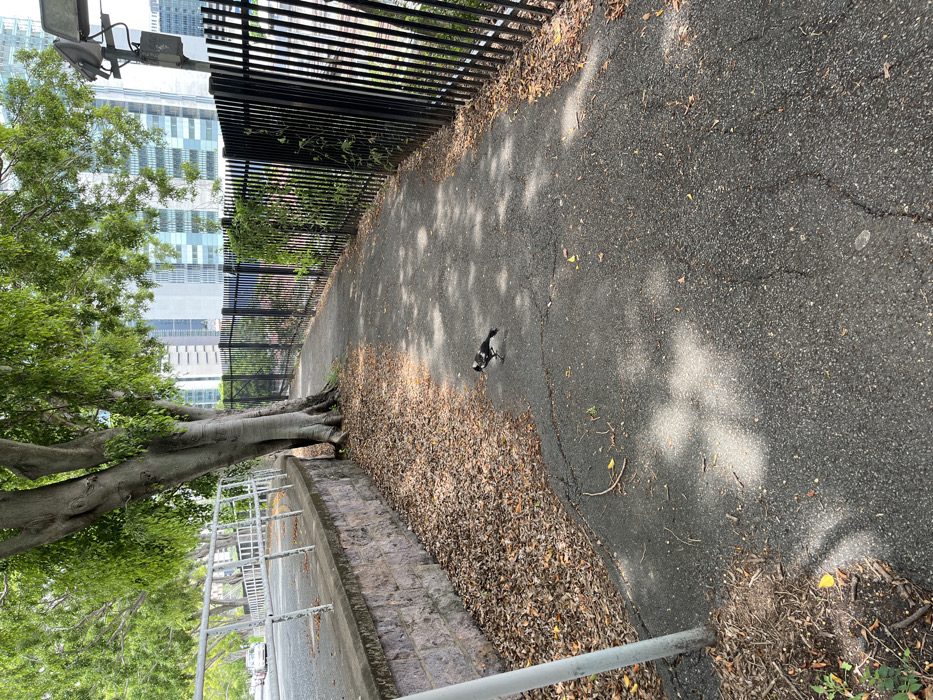
An outdoor scene captured from a slightly elevated perspective shows a paved pathway bordered by trees, a fence, and urban infrastructure. The image, rotated 90 degrees counter-clockwise, depicts a path covered in dappled sunlight and shadows from overhead trees. A small black and white bird, consistent with an Australian magpie, stands prominently on the dark grey asphalt path in the middle ground, appearing to be foraging or resting. The path shows some cracks and wear. To the right of the path (when viewed upright), a thick layer of dry, brown fallen leaves covers the ground leading up to a black metal fence with horizontal bars. Green foliage is visible behind and through the fence. On the left side of the path, a retaining wall with stone blocks runs parallel to the path. Above this wall, thick, light-colored tree trunks with exposed roots spread across the ground, leading up to dense green foliage. A modern streetlight or lamp post is partially visible in the upper left corner. In the background, beyond the trees and fence, several multi-story modern buildings with reflective glass facades rise, suggesting an urban environment. The scene is brightly lit by daylight, indicating clear weather. The abundance of fallen leaves suggests it might be autumn or late summer. The presence of the magpie and the contemporary city buildings align with the provided context of Spring Hill, Australia, portraying an urban green space. There is no visible text in the image.
Spring Hill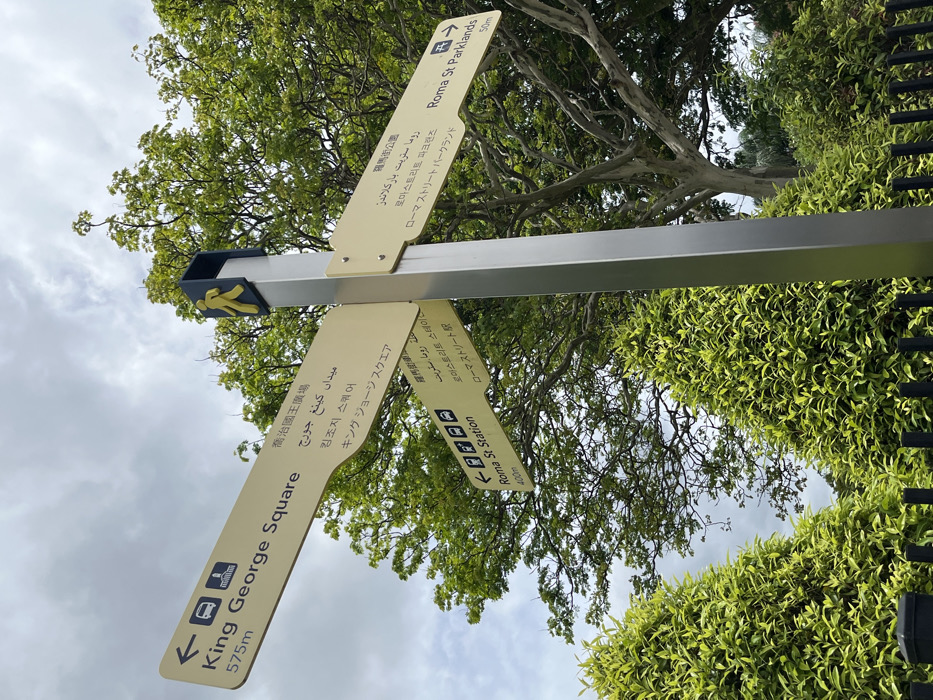
An outdoor, vertical photograph captures a multi-directional pedestrian signpost set against a bright, partly cloudy sky, with lush green foliage from trees and a dense hedge framing the background. The central subject is a modern signpost, featuring a silver metallic pole topped with a dark blue cap displaying a yellow pedestrian icon. Four light-beige, arrow-shaped signs extend horizontally from the pole, each indicating a different direction and destination with distances, translated into multiple languages. The top-right sign points towards "Roma St Parklands" at "50m," with a walking figure icon. It is also translated into Chinese (羅馬街公園), Arabic, Korean, and Japanese. The bottom-right sign directs to "Roma St Station" at "400m," featuring icons for train, bus, and ferry. Translations are present in Arabic, Korean, and Japanese. The bottom-left sign indicates "King George Square" at "575m," accompanied by a bus icon. This destination is also presented in Chinese (喬治國王廣場), Arabic, Korean, and Japanese. The scene is brightly lit, indicating daytime. The dense green canopy of a large tree is visible in the upper background, while a meticulously maintained hedge with light green leaves lines the lower right. The area appears to be a public space or park in Spring Hill, Australia, catering to pedestrians with clear, multilingual directions. No individuals are present in the image.
Spring Hill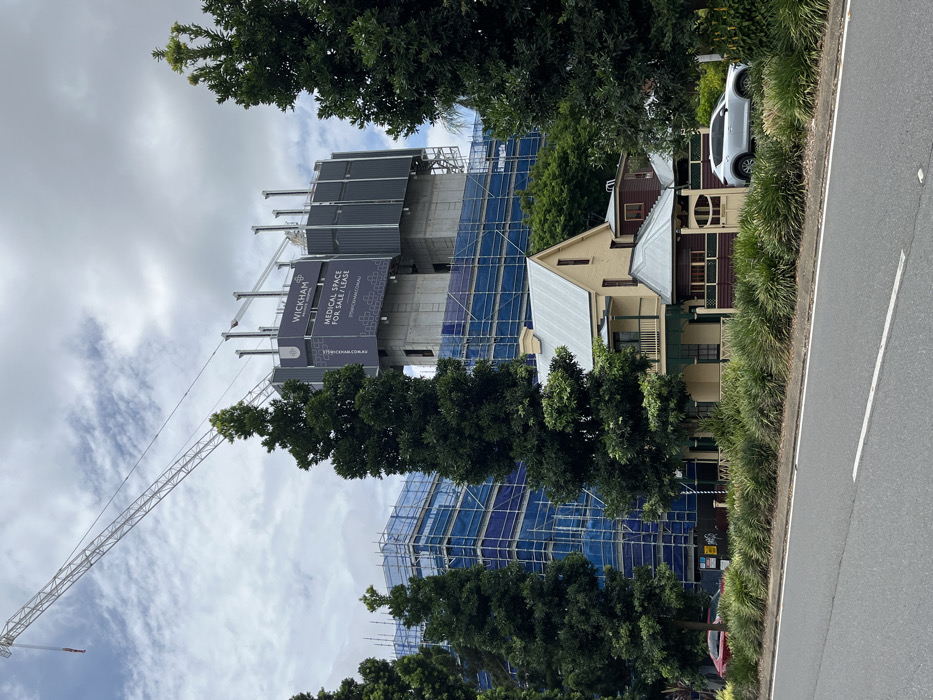
An outdoor scene in Spring Hill, Australia, displays a juxtaposition of modern construction and historical residential architecture under a cloudy sky. To the left, a multi-story building is under construction, its concrete frame partially covered by extensive blue scaffolding. A prominent white tower crane extends diagonally across the left side of the frame, signifying ongoing development. Large dark banners are attached to the unfinished building, clearly displaying "WICKHAM" with a logo, advertising "MEDICAL SPACE FOR SALE / LEASE," and listing websites "275WICKHAM.COM.AU" and "JOHNWICKHAM.COM.AU." To the right of the construction site, an older, traditional Queenslander-style house stands, painted in light yellow with dark red-brown trim and white balustrades along its verandah. It features a gabled metal roof. The house is partially obscured by lush green trees and dense bushes. A paved road runs along the far right, separated from the properties by a grassy verge. A white SUV is parked on this verge, adjacent to the house. The front of a red car is also visible at the bottom right, near the construction site. The day is overcast or partly cloudy, with no strong shadows evident. No people are visible in the image. The scene encapsulates an evolving urban landscape where new infrastructure rises alongside established historical dwellings.
Spring Hill