Staroe Rakomo, Russia
20 memories from Staroe Rakomo, Russia

A woman with blonde hair pulled back, wearing a yellow top, a red scarf tied around her head, a black choker necklace with a heart pendant, and large hoop earrings, is filmed from the chest up inside a car. She is looking to her right, with sunlight reflecting off her face. The background shows a road and trees through the car window. The video consists of a single shot.
Staroe Rakomo
A woman with light hair, pink lipstick, and gold hoop earrings sits in the passenger seat of a moving car, wearing a dark grey denim shirt with a silver necklace. Her hair blows in the wind as she looks around and moves her mouth, possibly singing. Through the car window, a bright green field blurs past, indicating the vehicle is in motion.
Staroe Rakomo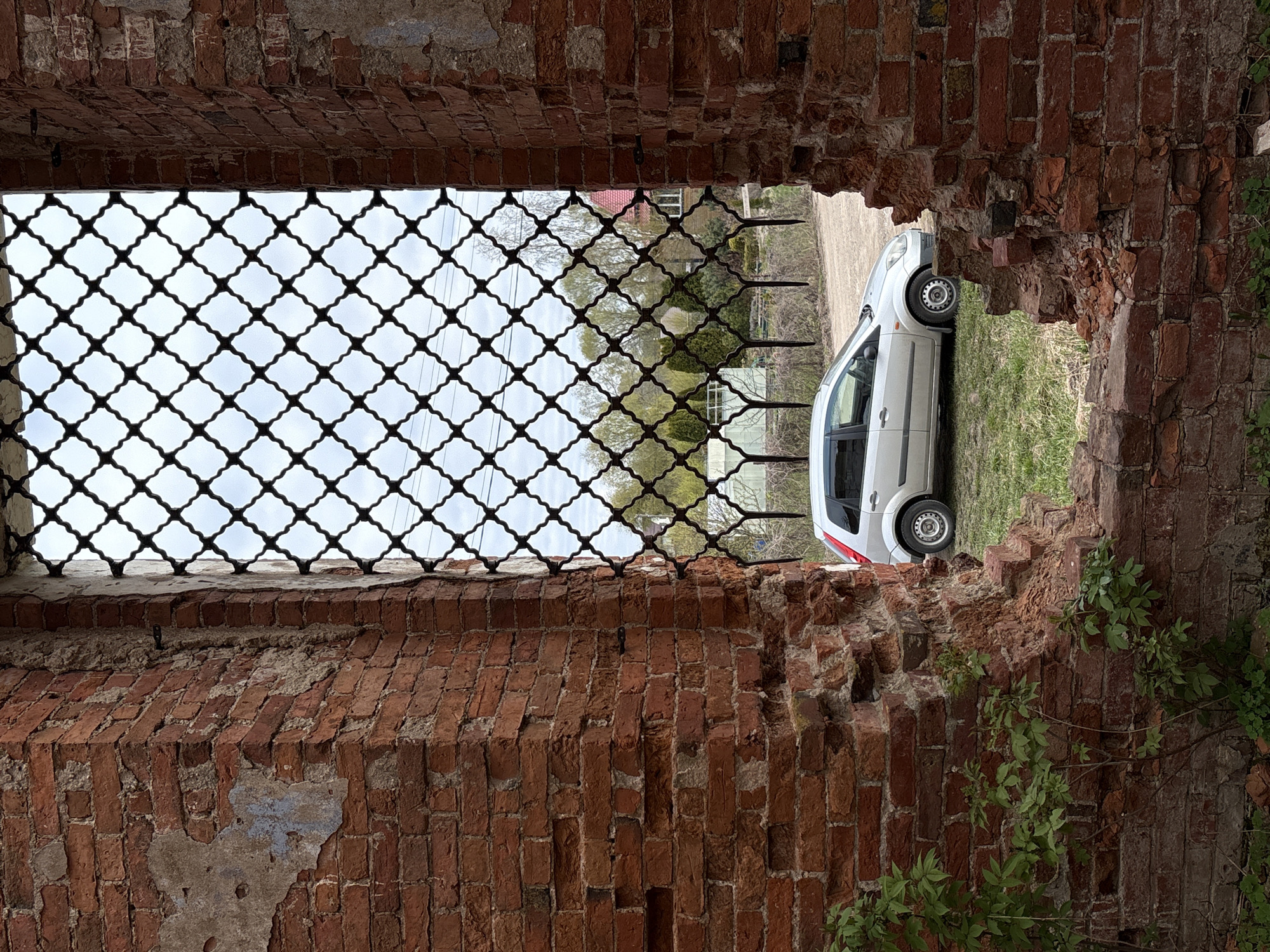
The image shows a weathered brick structure, likely a remnant of a building, with a decorative metal grille partially filling an opening. Through the opening, a white car is visible parked on a patch of grass. The location is Staroe Rakomo, Russia. The scene is still, with no visible people or actions. The environment appears overgrown and possibly neglected.
Staroe Rakomo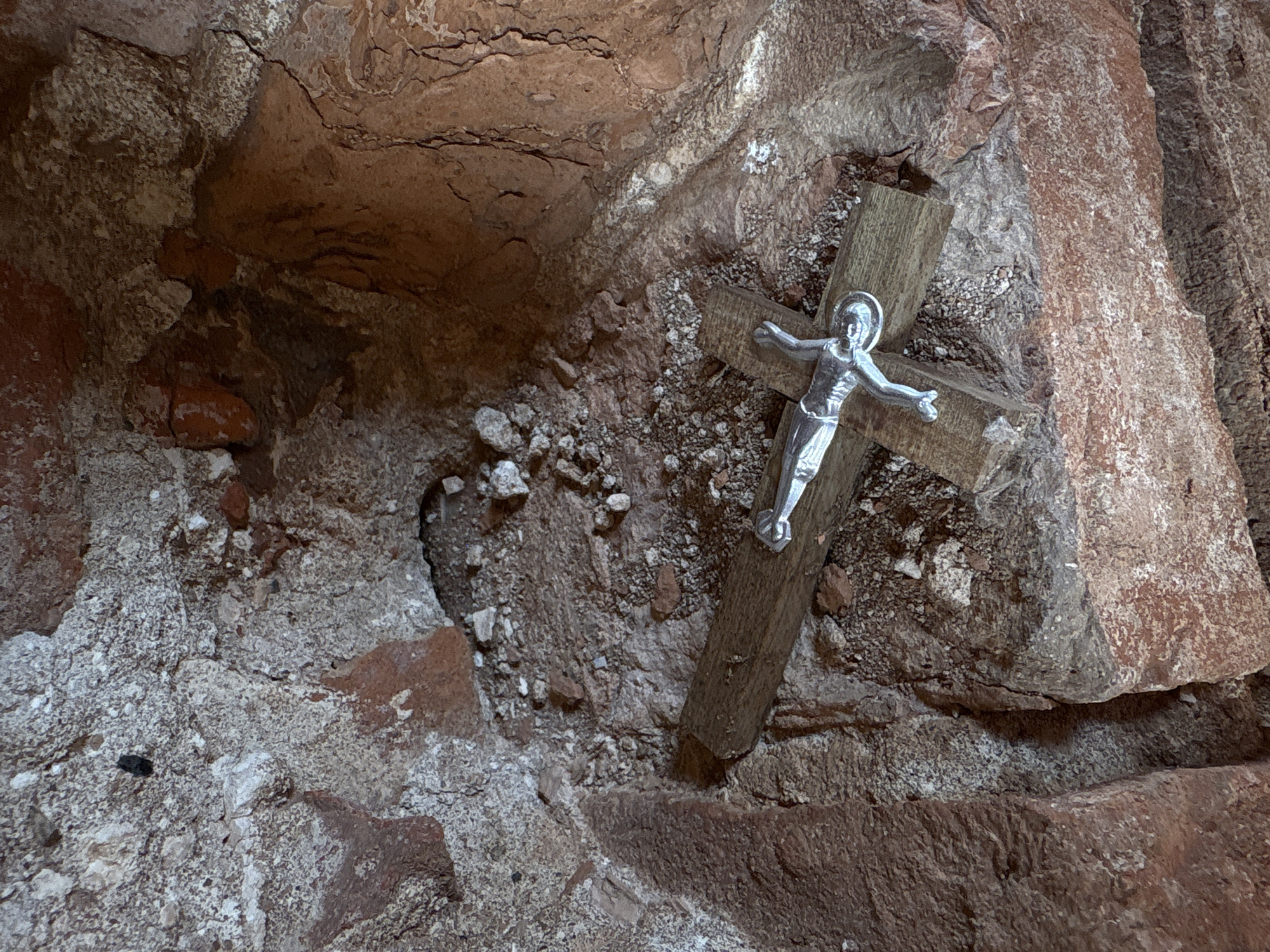
The image displays a close-up view of a crucifix nestled within a rugged, cave-like or grotto-like natural rock formation. The central object is a small crucifix, composed of a weathered wooden cross with a metallic, silver-colored corpus of Jesus Christ affixed to it. Jesus is depicted with outstretched arms, a halo around his head, and a draped loincloth. The setting is characterized by uneven, textured rock surfaces predominantly in shades of reddish-brown, dark brown, and grayish-white. The rocks exhibit numerous cracks, crevices, and granular patches, suggesting a natural and possibly ancient environment. Loose pebbles and rock debris are visible on ledges and at the base of the crucifix, blending into the earthy surroundings. No activity is taking place; the scene is a still life, presenting a devotional object in its environment. The lighting is diffused, suggesting an interior space or a sheltered area, rather than direct sunlight. There are no visible signs of specific time of day or weather conditions. The placement of the crucifix evokes a sense of solemnity and reverence, characteristic of a religious shrine or a personal devotional spot. The location context indicates this is in Staroe Rakomo, Russia. No visible text is present in the image.
Staroe Rakomo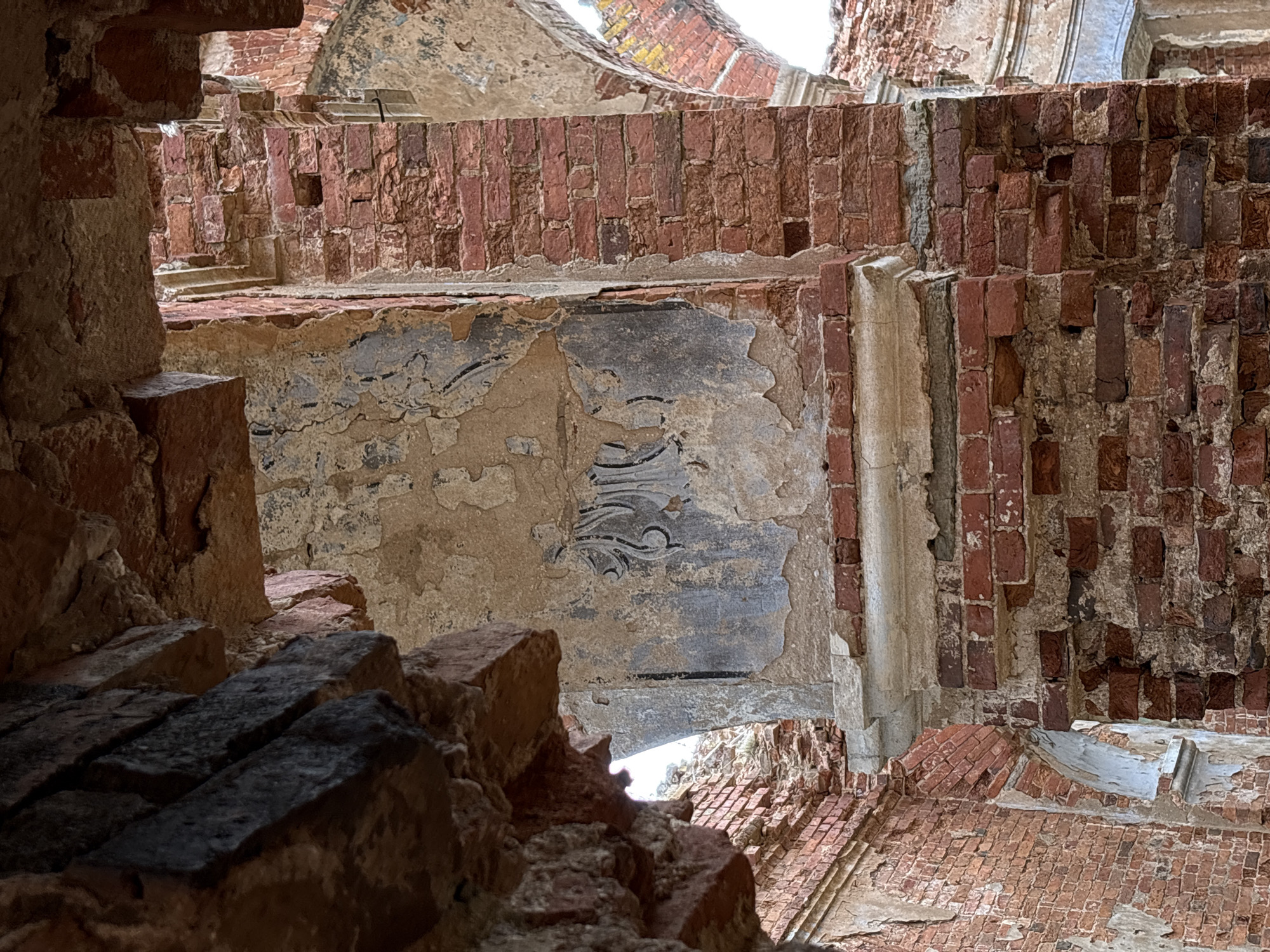
The image depicts the interior ruins of a building in Staroe Rakomo, Russia. The structure is primarily constructed of red brick, with significant sections decayed and crumbling. Plaster is visible on some wall surfaces, displaying remnants of decorative patterns in dark gray or black. The view is framed by sections of broken brick in the foreground, drawing the eye to the open spaces of the ruined structure. Light filters through gaps in the walls and ceiling.
Staroe Rakomo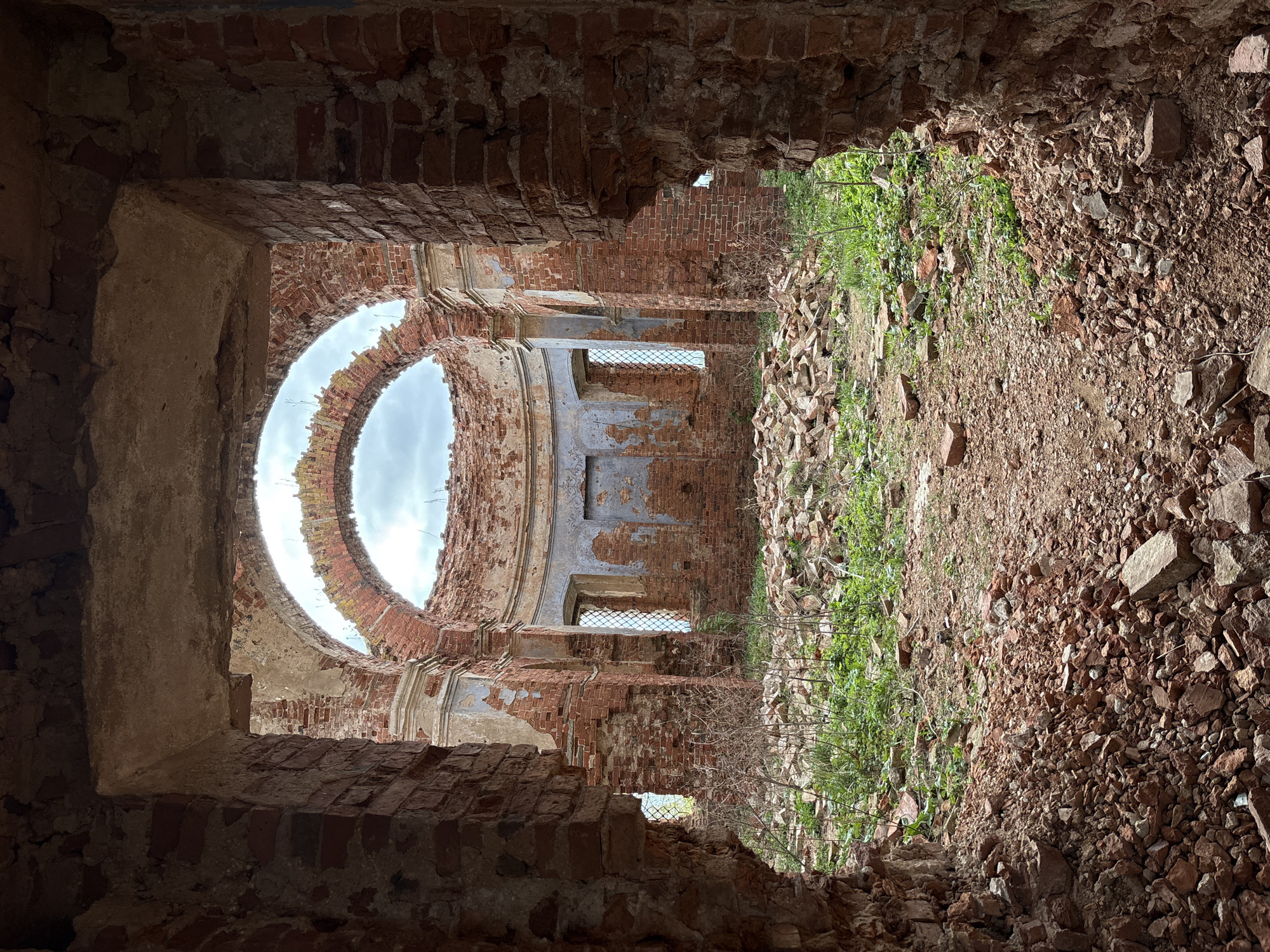
The image presents the interior of a severely ruined brick building, likely an abandoned church or a large historical structure in Staroe Rakomo, Russia. The photograph is taken from within a dark, narrow archway, looking into a larger, dilapidated space. The most striking feature is a massive, partially collapsed circular opening in what appears to be the former dome or ceiling, through which a bright, overcast sky is visible. Below this, the curved interior walls are constructed from reddish-brown brick, with much of the original plaster and decorative finishes having eroded or fallen away, revealing the rough brickwork beneath. Traces of architectural elements, such as cornices, moldings, and pilasters, are still discernible on the crumbling surfaces. Several rectangular window openings are set into these walls; one retains what looks like a metal grate, while others are open to the outside. The ground within the ruin is uneven and covered with a thick layer of debris, including broken bricks, stones, and earth, suggesting a long period of decay. Patches of vibrant green weeds and other vegetation grow vigorously amidst the rubble, particularly on the right side of the frame, indicating nature's reclamation of the abandoned space. The lighting is natural, with diffused light from the overcast sky illuminating the interior, while the foreground and the entry archway are cast in deeper shadow. There are no people visible in the scene, and no discernible text. The image evokes a sense of decay, history, and the relentless passage of time.
Staroe Rakomo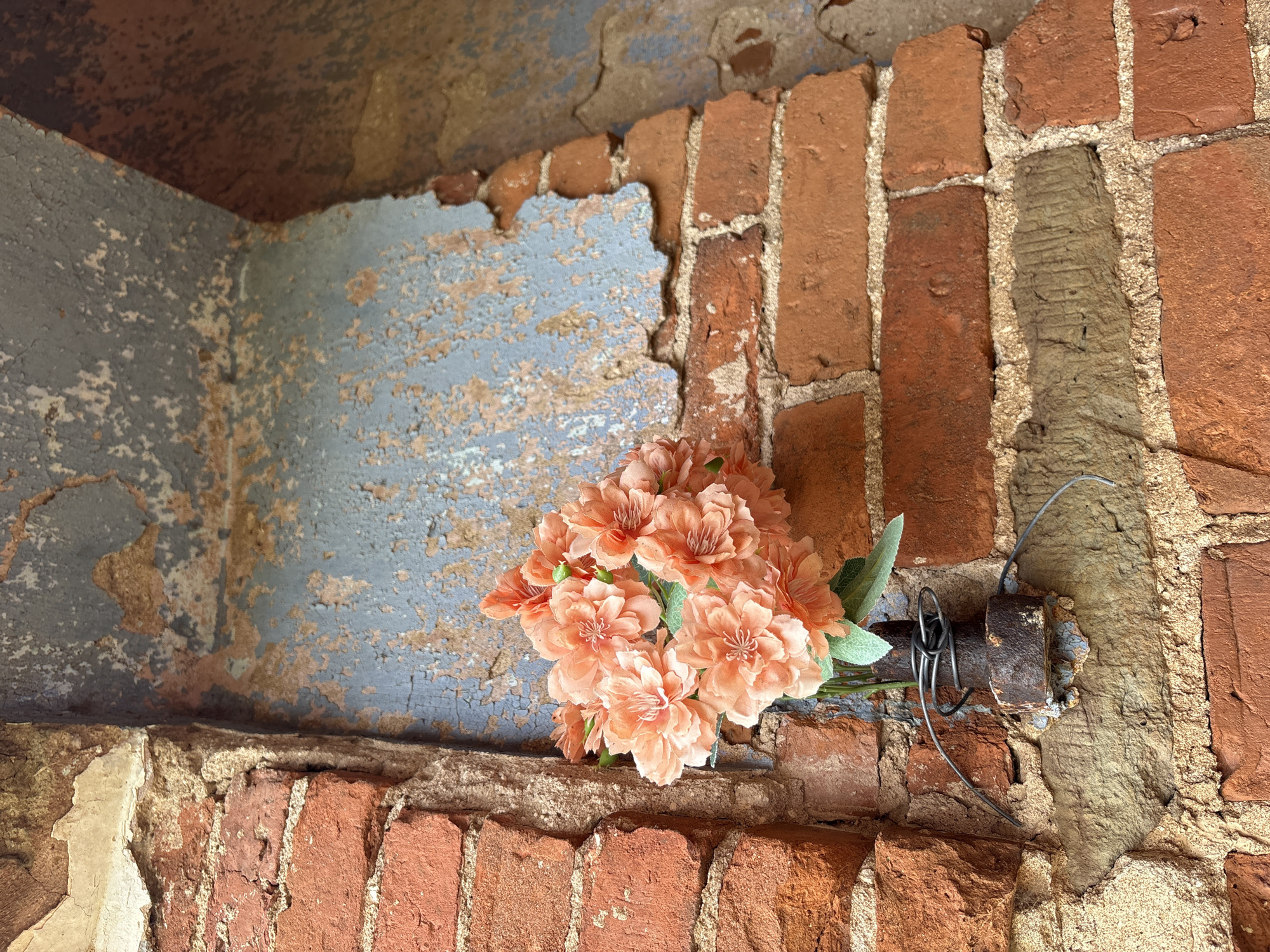
The image depicts a close-up view of a weathered corner of an old structure in Staroe Rakomo, Russia. The scene is dominated by exposed brickwork and crumbling, peeling paint. The main subjects are two perpendicular brick walls, forming a recessed corner or niche. The bricks are reddish-brown, aged, and show signs of wear and erosion, with rough, light-colored mortar between them. On the left and top sections of the image, a surface is covered with heavily chipped and flaking paint, revealing layers of light blue-grey paint over darker, possibly rust-colored or original wall material. This creates a textured pattern of decay. Resting on a brick ledge or protrusion near the center-right is a small cluster of artificial flowers. These flowers are a soft peach or light orange color, with multiple blooms and a few green leaves, providing a subtle contrast to the rustic surroundings. To the right of the flowers, embedded in the brickwork, is a rusted, cylindrical metal object, possibly a pipe fragment or a bolt. A piece of dark, bent wire is loosely wrapped around this metal object, seemingly to secure or display the flowers, or perhaps it's just discarded debris. The overall impression is one of forgotten beauty amidst decay, with the artificial flowers offering a poignant splash of color and a hint of human presence or remembrance in an otherwise dilapidated setting. There is no visible text, and the time of day or weather conditions are not discernible from the enclosed nature of the shot.
Staroe Rakomo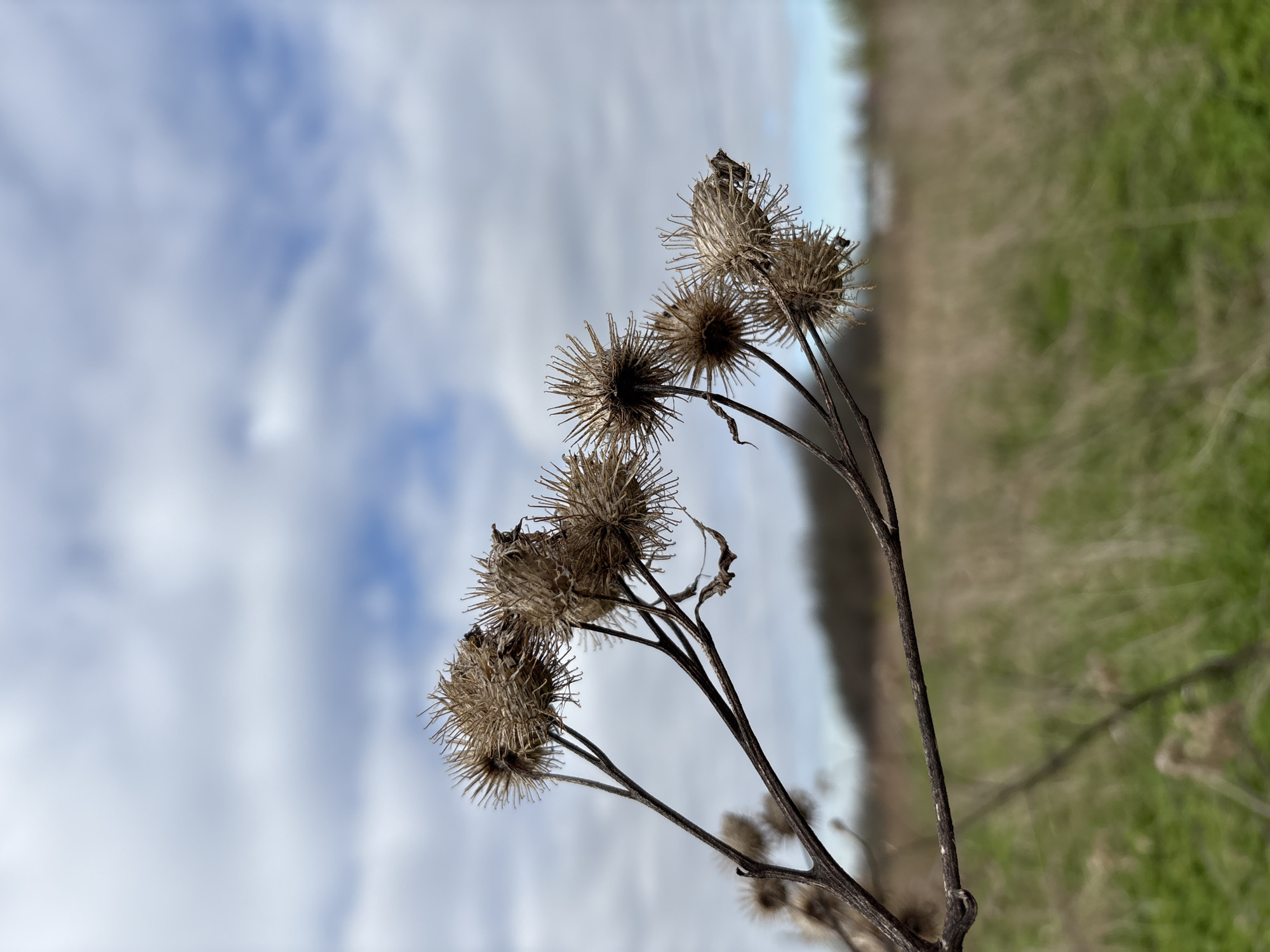
The image features a close-up, angled view of several dried burdock (Arctium) seed heads and their slender, dark stems. The plants, appearing brittle and brownish-tan, are positioned in the mid-ground, extending from the lower-right towards the upper-left of the frame. Their characteristic hooked bracts are clearly visible, forming spiky, spherical clusters. The background is divided into two distinct, heavily blurred areas. The upper-left portion of the image displays an overcast or partly cloudy sky, showing patches of light blue amidst soft white and grey clouds. The lower-right background consists of indistinct green and brown vegetation, suggesting a field or natural ground cover, rendered completely out of focus due to a shallow depth of field. A faint, blurred horizontal line, likely the distant horizon, separates the sky and land in the far right. No people or visible text are present. The scene is a static natural landscape, likely captured during late autumn or winter given the dry state of the plants. The setting is an outdoor environment, possibly a field or roadside in Staroe Rakomo, Russia. The light suggests it is daytime, though direct sunlight is not apparent.
Staroe Rakomo
The video shows a wide shot of a field with vegetation and some puddles, under a cloudy sky. A small rural community is visible in the distance. A large flock of birds flies across the sky from left to right.
Staroe Rakomo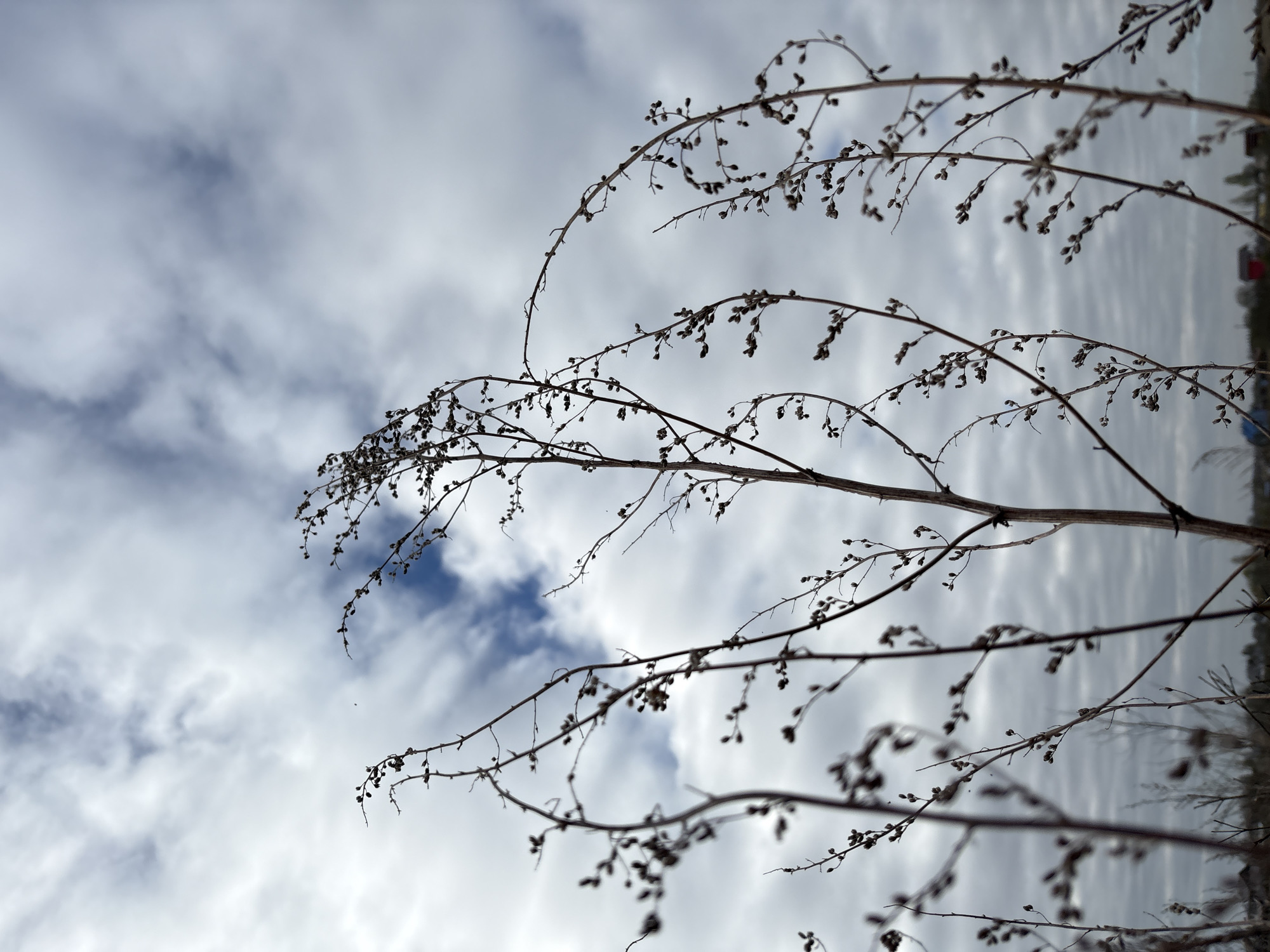
A low-angle shot shows a dead plant against a cloudy sky. The location is unknown but presumed to be Staroe Rakomo, Russia. The plant has thin, bare branches with small, dried seeds or remnants of flowers. The sky is overcast with varied cloud formations, some appearing darker and thicker. The image is oriented vertically. The ground is not visible, but a blurred line of land or foliage is at the top right. No people or animals are present.
Staroe Rakomo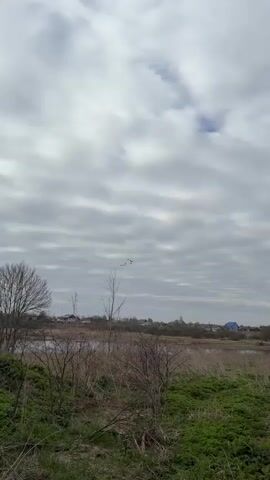
The video depicts a rural landscape under a heavily overcast sky in Staroe Rakomo, Russia. In the foreground, there are bare trees and shrubs with some green grass on the right. A body of water, possibly a marsh or lake, is visible in the middle ground, with more trees and distant houses beyond it. The houses have various roof colors, including one with a distinct blue roof. A flock of approximately five to six large birds, possibly geese or ducks, flies in a loose formation across the cloudy sky. The camera zooms in slightly on the birds as they fly. The weather appears cool and overcast, with uniform gray clouds covering the sky. The scene suggests a quiet, natural environment, possibly in early spring or late autumn given the sparse foliage on the trees. No visible text is present.
Staroe Rakomo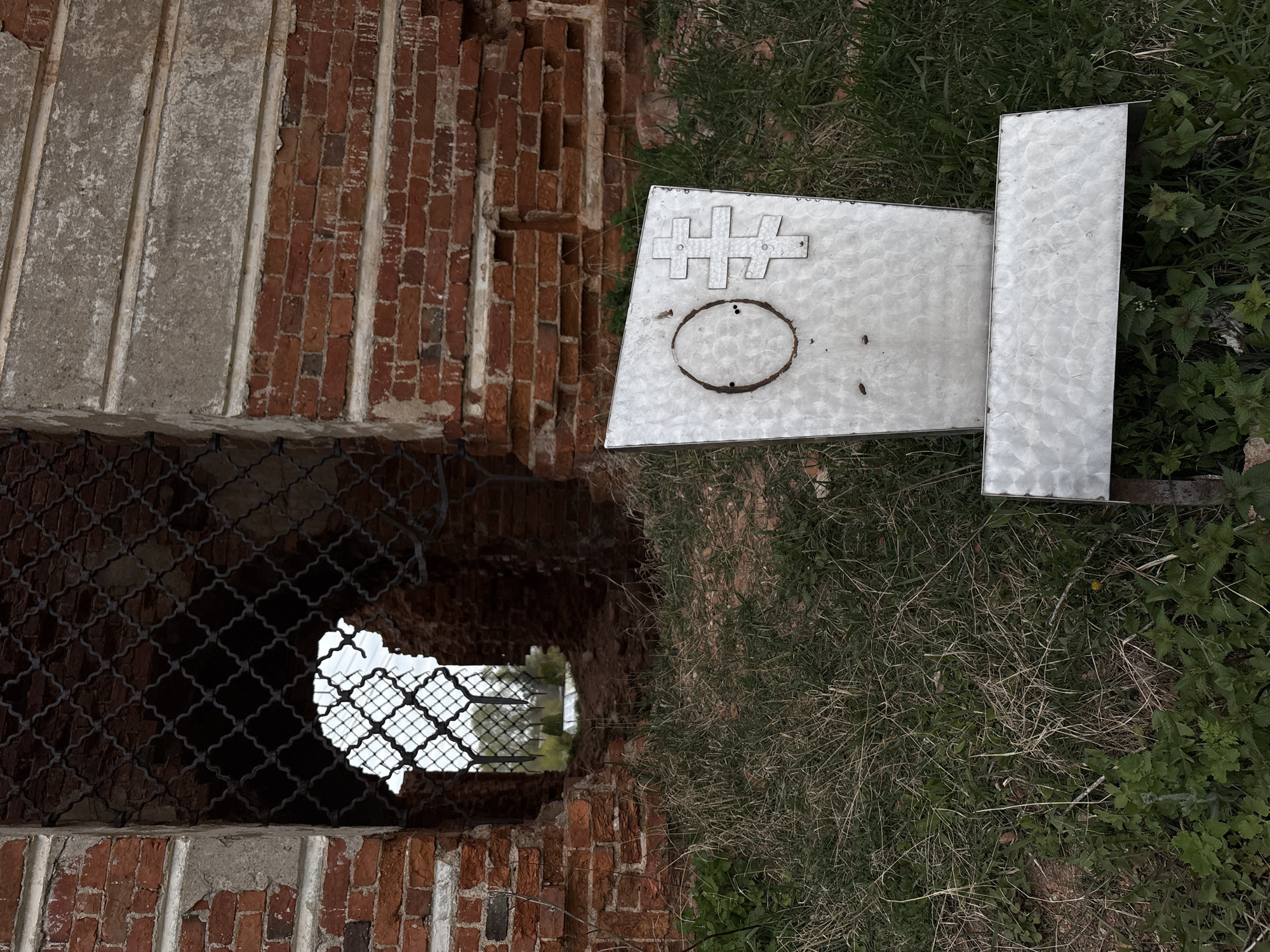
The image displays a scene in Staroe Rakomo, Russia, featuring a combination of an old, dilapidated red brick structure and a metal sign resting on grassy ground. The primary subject on the left is a crumbling brick wall, characteristic of an ancient or ruined building. The red bricks are visible, with sections of deteriorating mortar and what appear to be older concrete repairs or decorative strips running vertically. Large openings, possibly windows or doorways, are present in the brickwork. One prominent opening in the foreground is partially covered by a dark, patterned metal mesh or grille, through which a brighter, indistinct area is visible beyond. To the right, a silver-colored metal sign lies on the ground amidst wild grass and weeds. The sign is rectangular and features two distinct shapes cut out or etched into its surface. Near the top, a horizontal pattern resembling interconnected hash symbols or a stylized fence is present. Below this, a large, empty oval shape is visible, containing a few small holes. The surface of the metal sign has a brushed or swirled texture. The ground around the sign and the base of the brick structure is covered with a mix of green and dry grass, along with various leafy weeds. The lighting suggests a daytime setting, possibly overcast, as there are no strong shadows. The scene evokes a sense of decay and history, with the old brickwork slowly succumbing to time and nature. There are no people visible, and no discernible text appears on the sign or elsewhere in the image.
Staroe Rakomo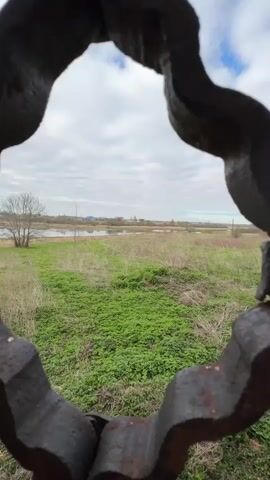
The video opens with a view through an ornate, dark metal grate, revealing a rural landscape beyond. Green fields stretch towards a body of water, possibly a river or lake, with distant buildings under a cloudy sky. The camera then pulls back slightly, showing more of the intricate, scrolled metalwork set into an old brick wall. A close-up shot focuses on the crumbling brick wall, where plaster is peeling away, exposing weathered red bricks and deteriorating mortar. The final shot is an interior view of a ruined brick building, characterized by multiple arched openings and remnants of a ceiling structure. Much of the roof is missing, allowing the cloudy sky and a tree branch growing through the opening to be visible. The brickwork throughout the structure is old and in disrepair, with patches of plaster clinging to the walls. The scene depicts the historical ruins in Staroe Rakomo, Russia, on an overcast day.
Staroe Rakomo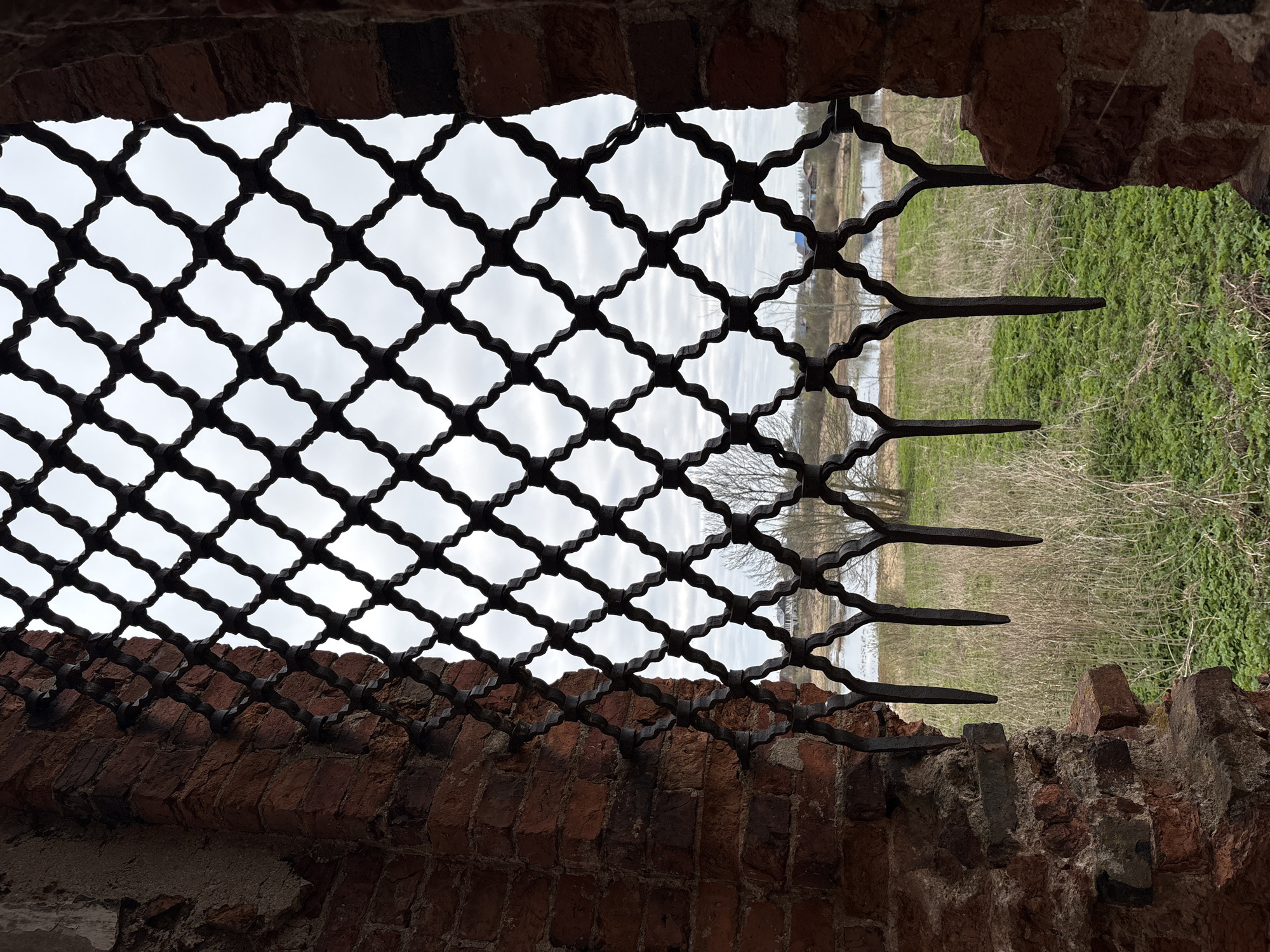
The image presents a view looking out through a robust, dark wrought-iron grate set within an old, weathered brick opening. The brickwork, a mix of reddish-brown and darker tones, forms the frame of the window or archway, showing signs of age and rough texture. The grate itself features an intricate, repeating pattern of connected diamond or quatrefoil shapes, with thick, seemingly twisted or hammered metal bars. The design is decorative yet sturdy, suggesting historical architecture, possibly from a fortress or ancient building. Beyond the grate, an overcast daytime landscape unfolds. The sky is a uniform light grey, indicating cloudy weather. Immediately outside, beneath the grate, a vibrant patch of green ground cover or grass is visible, suggesting a field or open area. Further into the distance, a body of water, possibly a river or lake, stretches horizontally. Its surface reflects the muted light of the sky. Along the far bank of the water, several bare trees with fine, skeletal branches are discernible, suggesting a season like late autumn or early spring. In some areas, sparser, dry vegetation or bushes are also present. No people or activities are visible in the scene. There is no discernible text. The overall atmosphere is tranquil and historical, set in a rural context in Staroe Rakomo, Russia.
Staroe Rakomo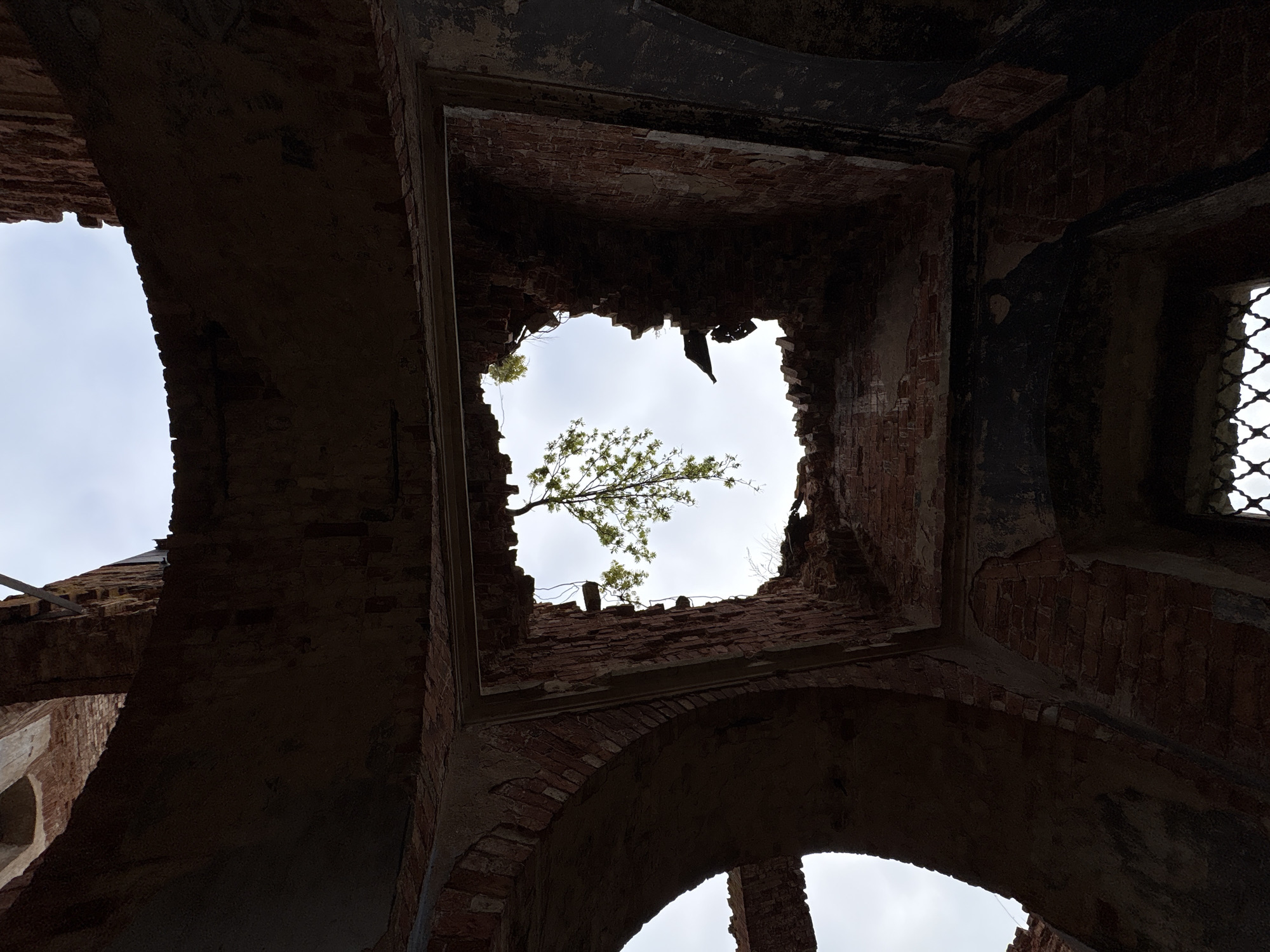
The image captures an upward view from within a large, ruined brick structure, likely the interior of a dilapidated building or an abandoned edifice in Staroe Rakomo, Russia. The perspective looks towards the ceiling, which has largely collapsed. The dominant subjects are the heavy brickwork, primarily in deep shadow, forming arches and the remnants of a ceiling, and the bright, overcast sky visible through large openings. The brick walls exhibit signs of significant decay, with crumbling edges and exposed mortar. Central to the composition is a large, irregular hole in what was once the roof or upper ceiling. Through this opening, a small tree or large bush with green leaves and branches is prominently seen, growing within or near the structure and reaching towards the sky, symbolizing nature's resilience. Several shadowed archways are visible in the lower parts of the frame, framing glimpses of the outside world or other sections of the ruin. In the upper right, a faint lattice or grate pattern can be observed against the brighter background, possibly indicating a former window opening. The scene depicts a static moment of decay and natural reclamation. The bright, diffuse light suggests it is daytime under cloudy or overcast skies, as no direct sunlight is visible. There are no people, no discernible activity, and no visible text in the image. The overall atmosphere evokes a sense of abandonment and historical significance.
Staroe Rakomo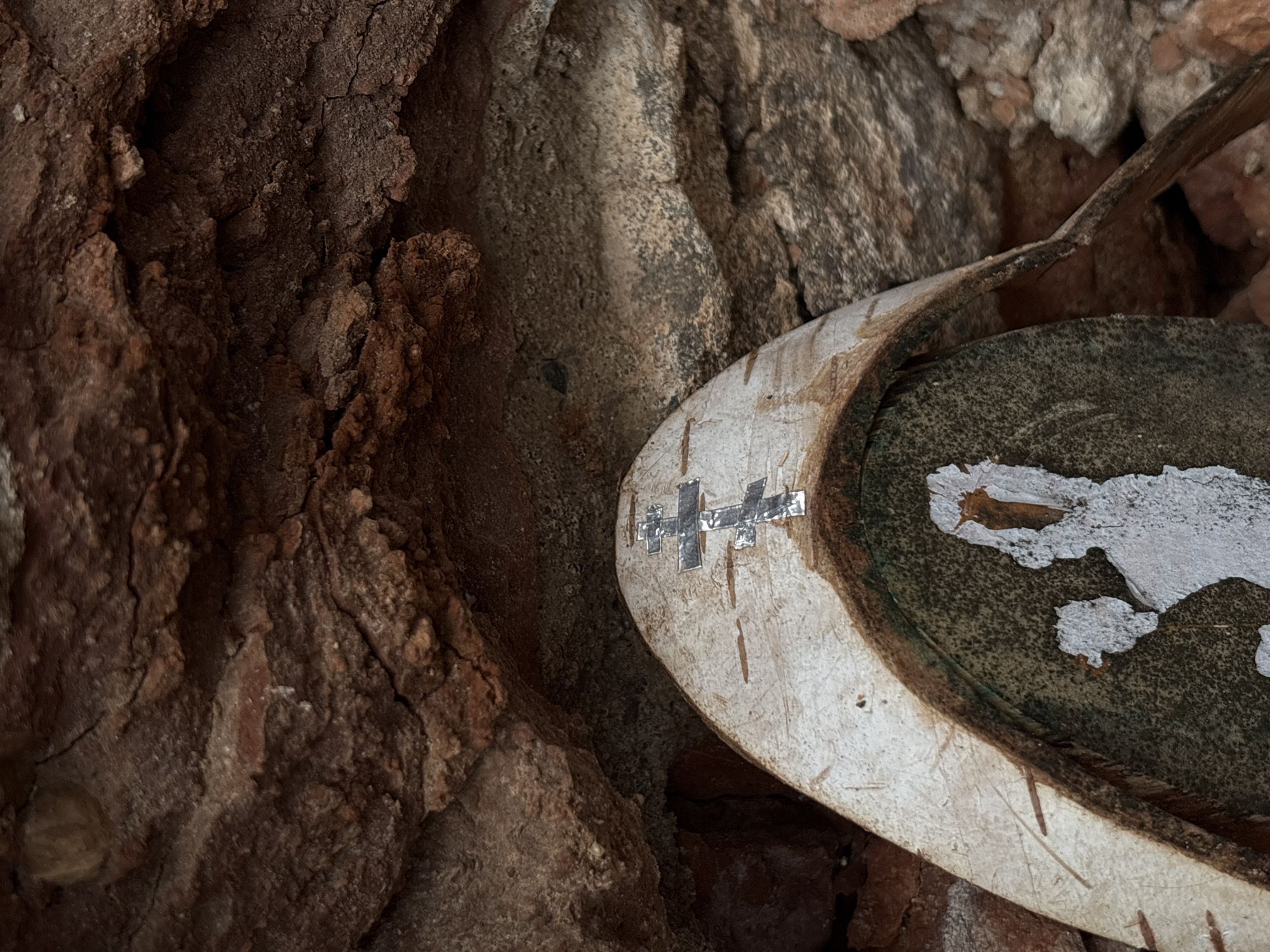
An extreme close-up shot captures a portion of an old, circular object nestled amidst rough, textured rock formations. The object, possibly a lid or part of a vessel, has a worn, light-colored rim, appearing off-white or pale brown, with some vertical scratches or marks. On this rim, a distinct cross-like symbol is visible, formed from several small, reflective, rectangular pieces, possibly metal or tape, suggesting either a repair or a decorative/symbolic addition. The interior of the circular object is a dark, speckled surface, from which patches of white material are flaking off, revealing the darker layer beneath. Extending from the upper right corner of the frame, a thin, dark, curved piece of material, possibly wood or metal, appears to be part of or associated with the main object, nearly touching its rim. The background is dominated by highly textured, earthy or rocky surfaces, primarily in shades of dark brown, reddish-brown, and some lighter greyish-brown tones. These surfaces exhibit deep cracks, rough edges, and irregular contours, indicating a natural or rustic setting. No discernible activity or event is taking place, presenting a static, detailed view of the object and its immediate surroundings. The lighting suggests daytime, but without direct sunlight, leaving the time of day and weather indeterminate. No legible text is visible in the image. Given the location context of Staroe Rakomo, Russia, the object could be a historical or archaeological artifact found in a natural or ancient site.
Staroe Rakomo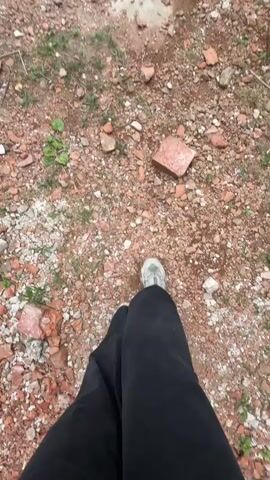
The video shows the inside of a ruined brick building, likely a church or similar structure. The camera starts at ground level, focusing on the ground littered with broken bricks and some patches of green vegetation. The camera then tilts upward to reveal the interior of the building, showcasing the crumbling brick walls and arches. The sky is visible through the collapsed roof. There is a person in the video, wearing black pants and light-colored shoes, walking on the brick-covered ground. The person's legs are visible in the foreground. The overall atmosphere suggests abandonment and decay.
Staroe Rakomo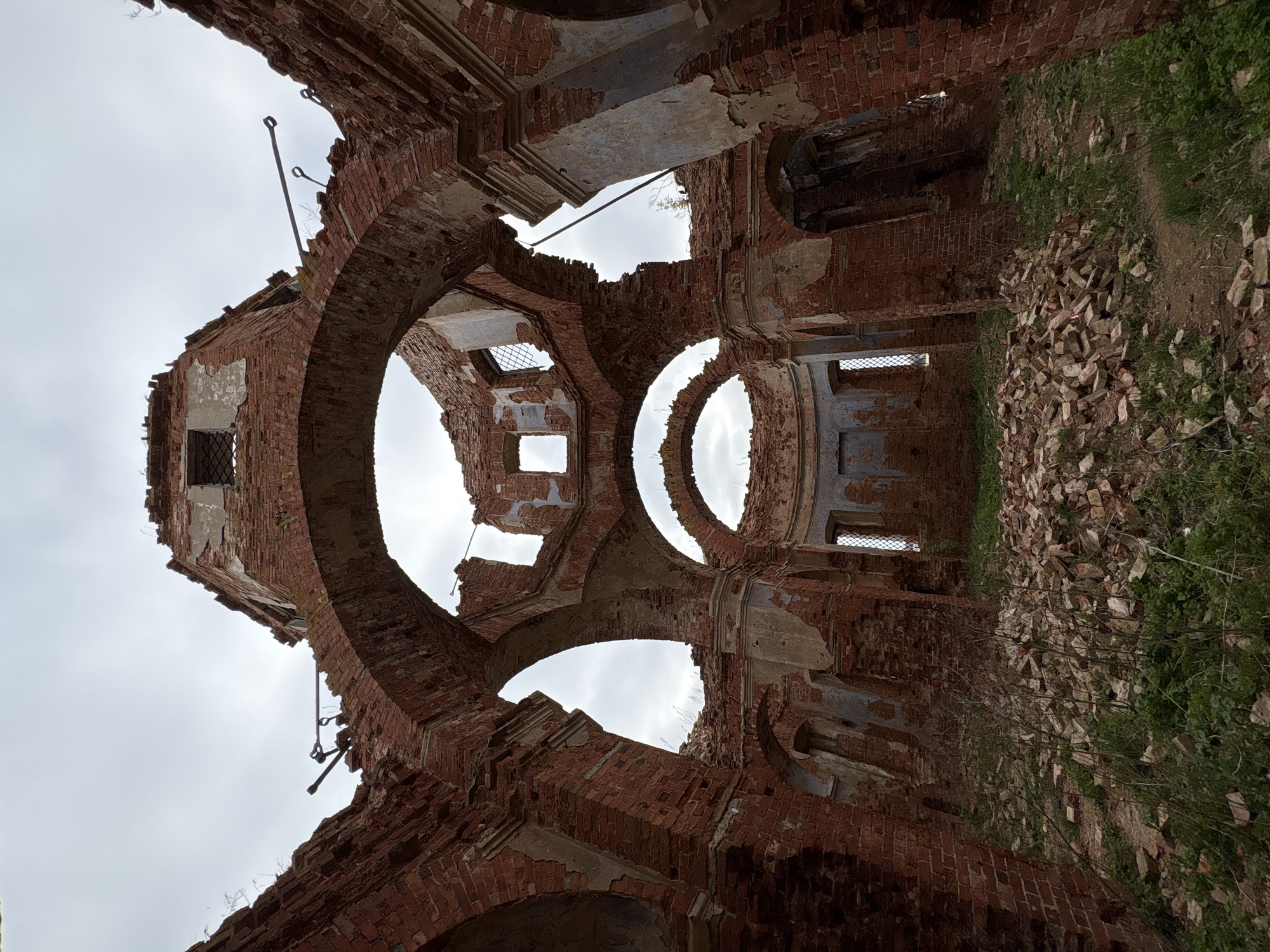
The image captures an upward-looking view from within the heavily ruined interior of a large brick structure, likely an old church or cathedral, in Staroe Rakomo, Russia. The roof and significant portions of the upper walls have collapsed, revealing an overcast, grey sky. The scene is dominated by a complex network of crumbling, weathered red brick arches and circular openings that once supported a dome or ceiling. Patches of faded plaster cling to some brick surfaces, indicating former decorative finishes. Several rusty metal rods, possibly remnants of structural reinforcements, protrude from the damaged brickwork. At the base of the visible walls, piles of fragmented bricks and debris are scattered across the ground, partially overgrown by green grass and sparse vegetation. Some smaller rectangular window openings with remnants of grates are visible in the lower sections of the walls. No people are present, no specific activity is taking place, and there is no discernible text. The diffused light from the cloudy sky contributes to a somber and desolate atmosphere, highlighting the advanced state of decay.
Staroe Rakomo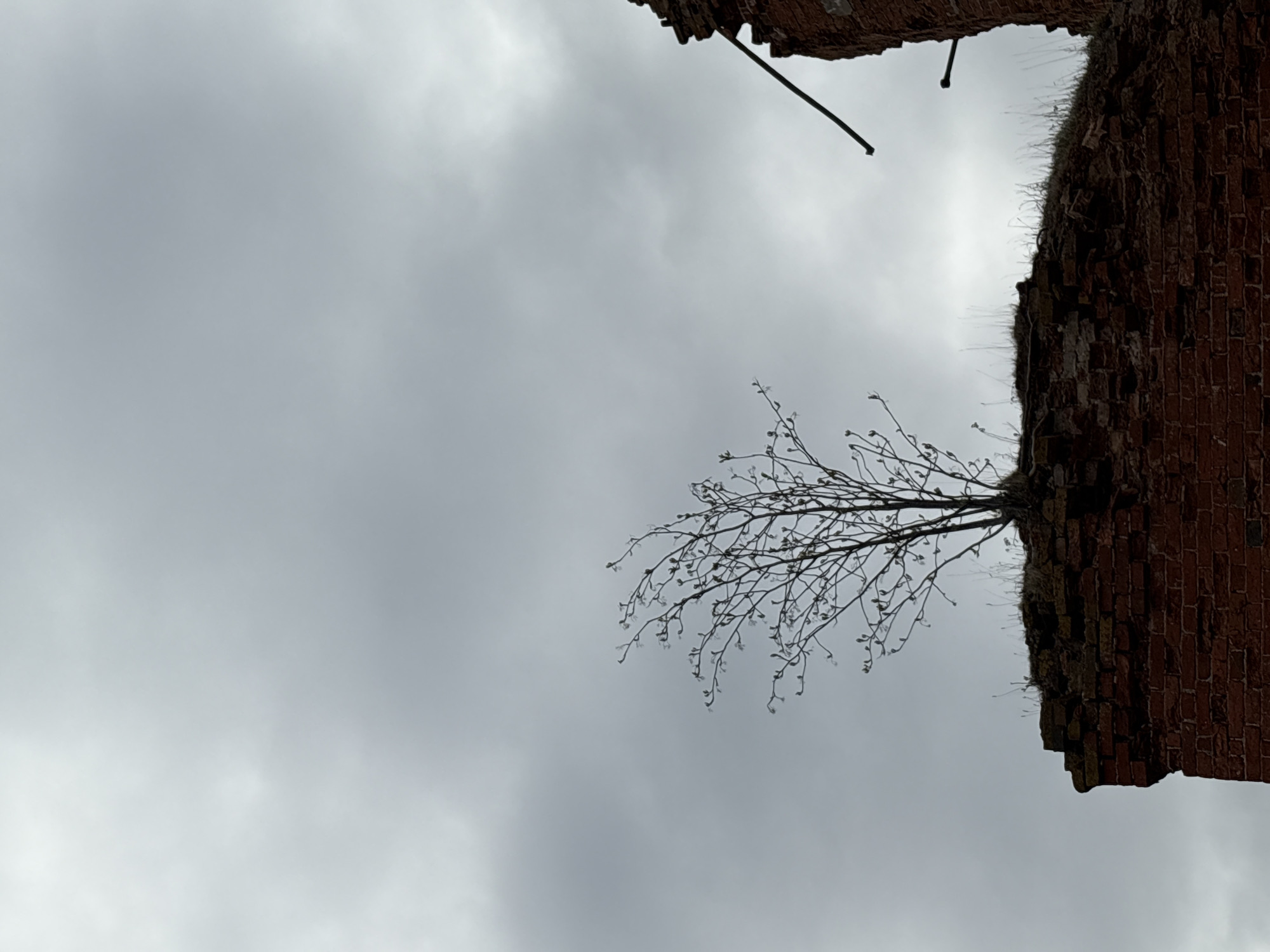
The image, correctly oriented, presents a stark and atmospheric scene dominated by a bare-branched tree growing from an old, decaying brick structure under an overcast sky. The tree, likely a large bush or sapling, shows nascent buds on its intricate network of branches, suggesting late winter or early spring. It appears to sprout directly from or alongside a reddish-brown brick wall, which exhibits signs of extensive ruin, with crumbling sections and small patches of grass or weeds growing from its top edge. Several dark, thin metal rods or rebar protrude from the broken brickwork in the upper section of the image. The background is an expansive, uniformly grey, and cloudy sky, indicating an overcast day without direct sunlight, contributing to the somber and muted color palette of the photograph. There are no people visible, and no discernible activity other than the natural growth of the tree and the quiet decay of the man-made structure. The overall impression is one of nature's resilience and the passage of time. No visible text is present. The location context is Staroe Rakomo, Russia.
Staroe Rakomo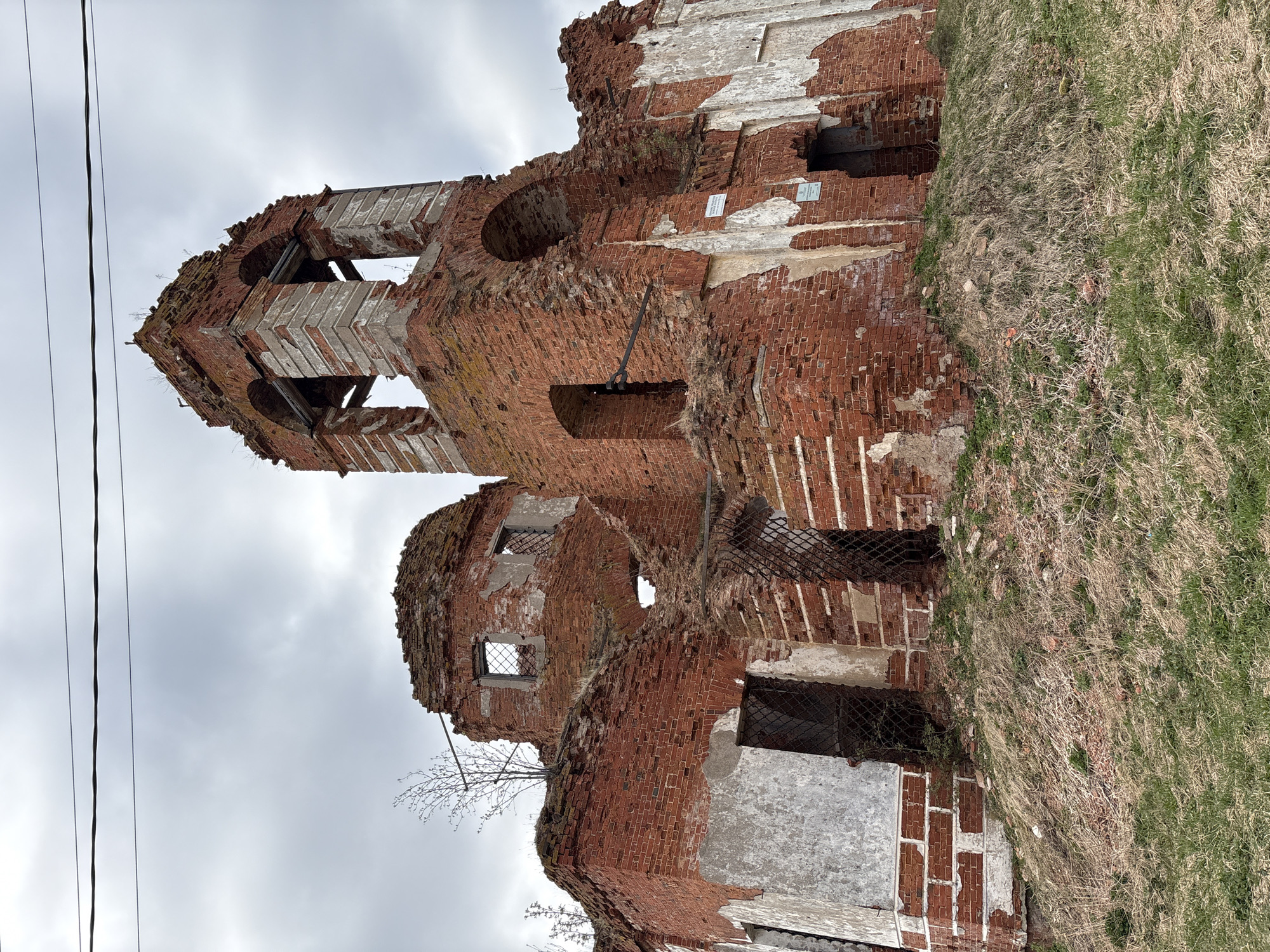
The image shows the ruined Church of the Intercession of the Holy Virgin, located in Staroe Rakomo, Russia. The church, constructed of red brick, is heavily damaged, with large sections of walls and roof missing. Patches of remaining white plaster are visible on the brickwork. Some window openings have remnants of metal grating. Vegetation, including grass and small trees, grows on and around the ruins. A utility line is visible against a cloudy sky.
Staroe Rakomo