Svidník, Slovakia
12 memories from Svidník, Slovakia
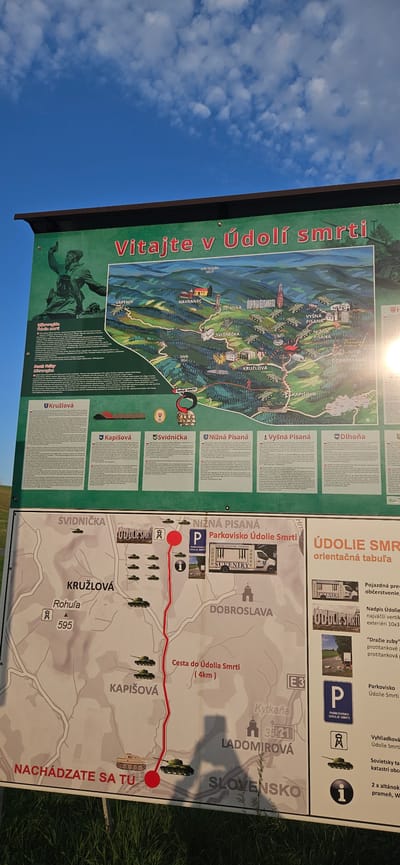
The image displays an information panel about the "Valley of Death" (Údolie smrti) in Svidník, Slovakia. The panel is divided into two main sections. The upper section features a large, colorful map of the region, highlighting historical locations and showing numerous military vehicles, likely tanks, placed along a route. The title "Vitajte v Údolí smrti" (Welcome to the Valley of Death) is prominently displayed in red. Text boxes on the left and bottom of the upper section provide historical information in Slovak. The lower section of the panel presents a more detailed map of the immediate area, with a red line indicating a path leading to "Cesta do Údolia Smrti" (Path to the Valley of Death), noting it is 4km long. This map shows village names like Svidníčka, Kružlová, Rohuľa, Nižná Písaná, Dobroslava, and Ladomirová. It also depicts several military vehicles on the map. Icons indicate a parking area ("PARKOVISKO ÚDOLIE SMRTI") at Nižná Písaná, a tourist information point, and a viewing platform. The phrase "NACHÁDZATE SA TU" (You are here) with a red marker points to a location southwest of Kružlová, near Rohuľa and a number 595. To the right of the lower map, there is a vertical information section with titles like "ÚDOLIE SMRTI orientačná tabuľa" (Valley of Death orientation panel). It includes images of a souvenir shop, a sculpture reading "ÚDOLIE SMRTI", and a tank. Text descriptions mention "Pojazdná predajňa občerstvenie" (Mobile shop for refreshments), "Nadpis Údolie smrti najväčší vertikálny exteriéri 10x3" (The inscription Valley of Death largest vertical exterior 10x3), and "Dráče zuby" (Dragon's teeth), likely referring to anti-tank obstacles. It also mentions the parking area at Údolie Smrti and a viewing platform. The overall scene is outdoors, with a bright blue sky and some clouds visible above the information panel. Green grass is present at the bottom of the image, suggesting a natural outdoor setting for the panel. The panel appears to be made of metal or a similar weather-resistant material and is likely mounted on posts, though only the display surface is fully visible. The overall impression is an informational exhibit detailing a historical site related to conflict and remembrance.
Svidník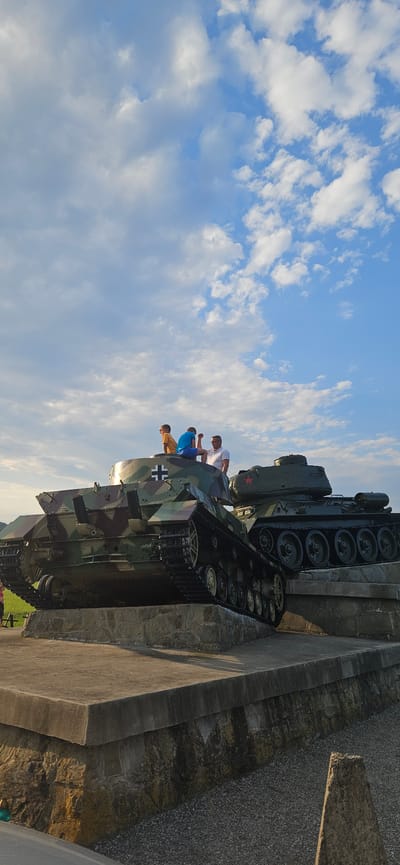
In Svidník, Slovakia, two tanks are displayed on a concrete and stone monument outdoors. The tank in the foreground, with camouflage paint and a white cross marking, is positioned at an angle. On top of this tank, three people are visible: two boys and a man. The boy on the left wears a yellow t-shirt and sits facing left. The boy in the middle wears a blue t-shirt and sits facing forward. The man on the right wears a white polo shirt and glasses and is seated. Behind the foreground tank, a second tank, painted green with a red star on its turret, is also on display. The background shows a blue sky with scattered white clouds and hints of a grassy field and trees to the far left.
Svidník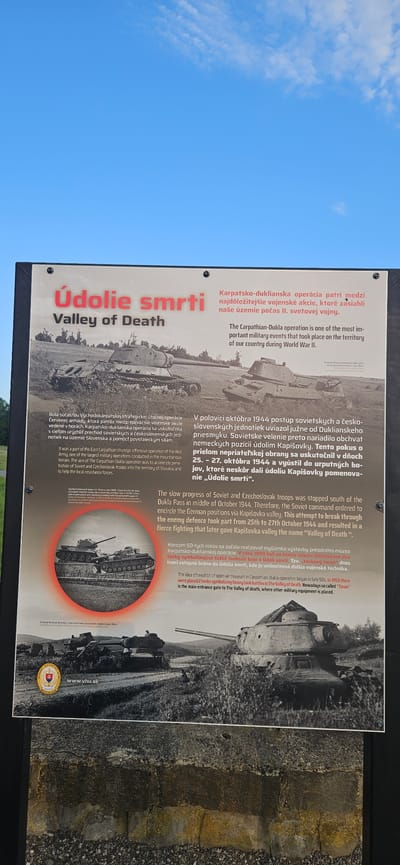
The image is a photograph of an informational plaque located outdoors, likely in the city of Svidník, Slovakia, given the textual content. The plaque is framed by a black border and displays historical information about the "Valley of Death" (Údolie smrti). The top section of the plaque features text in Slovak and English, with the Slovak text prominently displayed in red and white. Below the text are several black and white photographs depicting military scenes, primarily of tanks. The main image on the plaque shows two Soviet tanks in a field, with a backdrop of rolling hills. Another smaller circular image, also in black and white, depicts a different tank scene. The text on the plaque details the Carpathian-Dukla operation during World War II, describing it as one of the most important military events on the territory of Slovakia. It mentions that Soviet and Czechoslovak troops were stopped by German defense in the Dukla Pass and that the fierce fighting gave the valley the name "Valley of Death." The plaque also mentions that an open-air museum was created in the Carpathian-Dukla operation area in 1959, with two tanks symbolizing heavy tank battles. The bottom portion of the image shows a concrete structure with gravel in front of it, which might be part of the museum or the display area. A Slovak emblem and the website "www.vhu.sk" are visible on the lower left side of the plaque. The sky is visible in the background above the plaque, with a few wispy clouds.
Svidník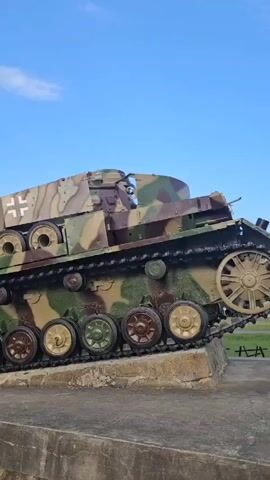
A camouflaged tank is positioned at an angle on a stone base. The tank has a German cross insignia on its turret. Another green tank is positioned to the left of the camouflaged tank, also on a stone base. A man in a red shirt and black shorts is standing on top of the turret of the green tank. He is looking away from the camera. The sky is blue with some white clouds.
Svidník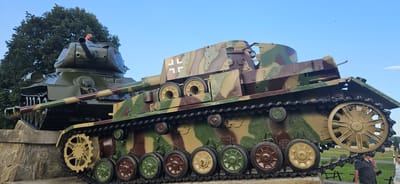
This is a medium-shot, eye-level photograph taken outdoors, likely during the daytime, featuring two historical tanks positioned on a stone foundation under a clear blue sky. The tank in the foreground is painted in a camouflage pattern of green, brown, and tan, and appears to be a German Panzer. It has a series of road wheels and tracks visible. A prominent white Iron Cross insignia is visible on its side. The tank in the background is painted a solid dark green and exhibits a red star insignia on its turret, indicating it is likely a Soviet T-34 tank. The tanks are situated in what appears to be an outdoor memorial or museum area. In the lower right corner of the frame, two individuals are partially visible; one man wearing a patterned shirt and sunglasses is looking towards the tank, and a woman in a light-colored top is standing next to him. A large tree with green foliage is visible behind the Soviet tank on the left. This scene is located in the city of Svidník, Slovakia, which is known for its significant Soviet military history and memorial sites.
Svidník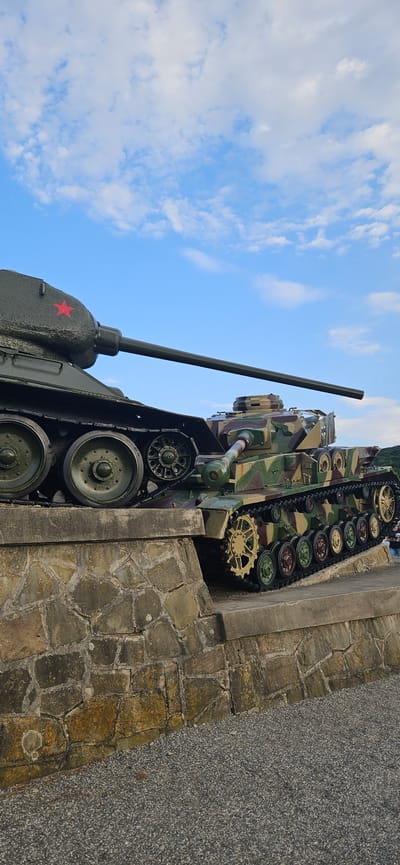
Two historical tanks are displayed on a stone embankment under a partly cloudy blue sky in Svidník, Slovakia. The tank on the left is dark green with a red star emblem on its turret and appears to be a Soviet T-34 model, characterized by its prominent road wheels and distinctive hull shape. The tank on the right is camouflaged with brown, green, and beige patterns and features a German cross emblem on its turret, suggesting it is a German Panzer IV model. Both tanks are positioned with their turrets facing towards the right of the frame. The embankment is constructed of irregular, light-colored stones. In the background, a hill is visible on the right, and the sky is filled with white, scattered clouds against a bright blue backdrop. The ground in front of the embankment is covered with small, dark gray gravel. No people are clearly visible interacting with the tanks in this frame.
Svidník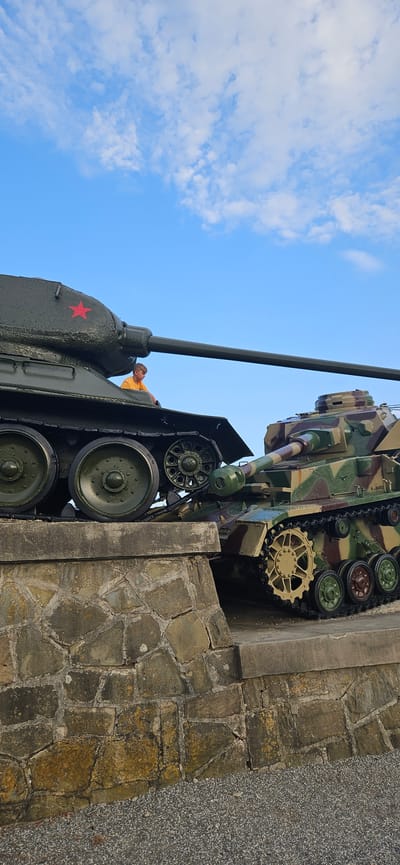
In Svidník, Slovakia, two military tanks are displayed on a stone embankment. The tank on the left, painted dark green with a red star, has a young boy in an orange shirt sitting on its hull. The tank on the right is camouflaged in greens and browns. The sky above is blue with scattered white clouds. The embankment is constructed of large, irregularly shaped stones. The foreground consists of gravel.
Svidník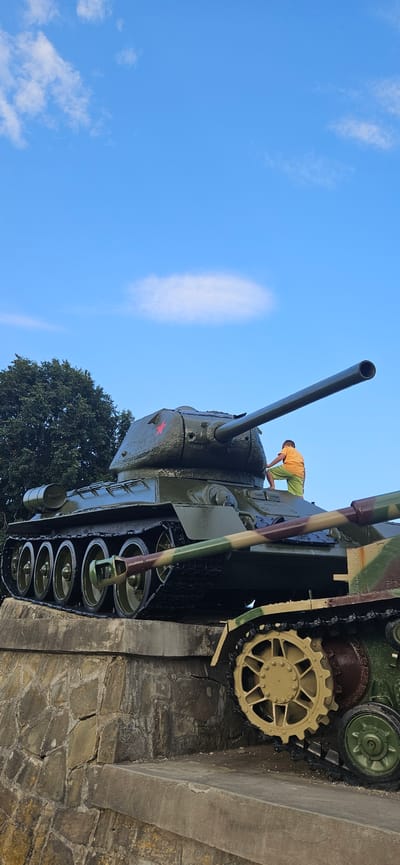
A low-angle, full-shot photograph captures two Soviet-era tanks on display, possibly as a memorial, against a bright blue sky with scattered white clouds. The tank in the foreground is partially obscured by the tank behind it. The dominant tank, a T-34, is painted dark green and has a prominent red star emblem on its turret. A young boy wearing an orange t-shirt and green shorts is perched on the turret of this tank, looking downwards. The tanks are positioned on a stepped, stone-like platform. The tank in the background exhibits a camouflage pattern of green, brown, and beige. The overall scene suggests an outdoor public space, likely in Svidník, Slovakia, known for its significant Soviet military history and monuments. The lighting indicates daytime, likely late morning or early afternoon.
Svidník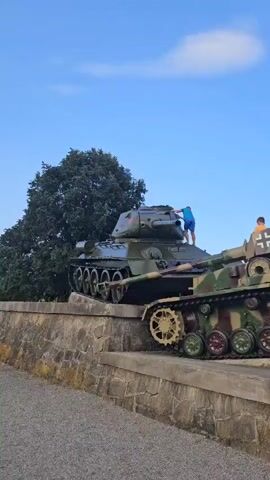
A low-angle, medium shot shows two tanks on display, one behind the other. The tank in front is green and has a red star on its turret. A person in a blue shirt and shorts is climbing on top of it. The second tank, behind the first, is camouflaged with green, brown, and tan patches. It has a white cross on its turret. A person in an orange shirt is standing on top of this tank. Both tanks are resting on a stone wall, and the background is a clear blue sky with a few white clouds. To the right, two people are standing near the front of the second tank, watching.
Svidník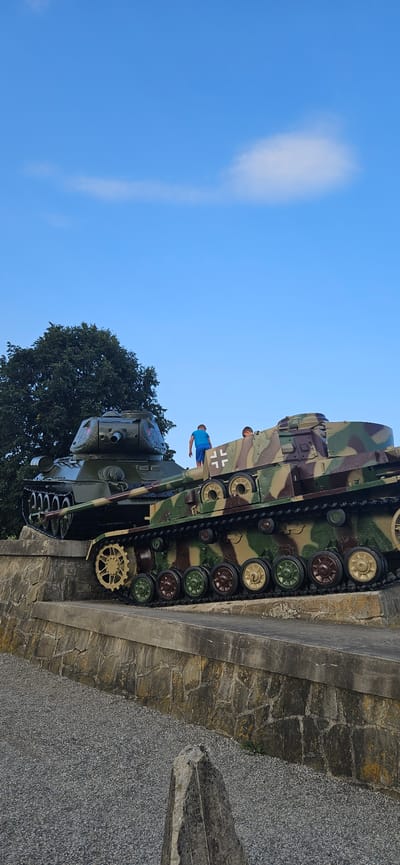
The image captures an outdoor scene with two military tanks displayed on a stone embankment under a clear blue sky. In the foreground, a camouflaged tank, featuring shades of green, brown, and black, is prominently positioned. A person in a blue shirt is standing on top of this tank, facing away from the camera. To the left, a dark green tank with a red star emblem is partially visible, positioned higher on the embankment. A large tree with dense foliage is situated behind the dark green tank. The ground in front of the embankment is covered with gravel. The scene is located at the Dukla Pass Memorial in Svidník, Slovakia, a significant historical site commemorating the Carpathian-Dukla Operation during World War II.
Svidník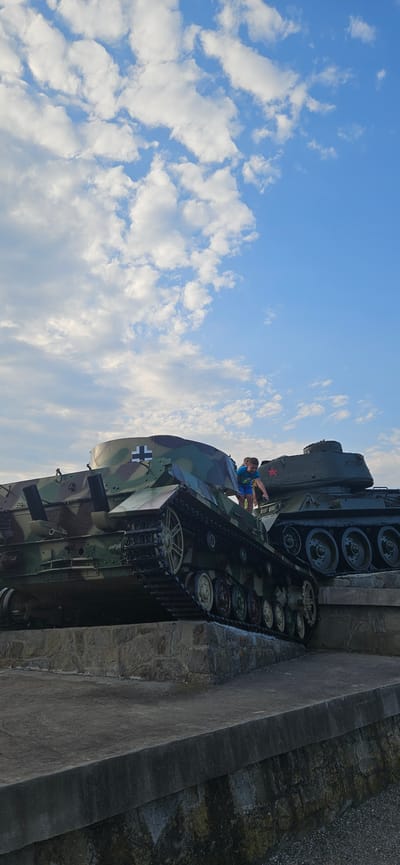
In Svidník, Slovakia, two historical tanks are displayed on a concrete and stone embankment. The tank in the foreground is painted with a camouflage pattern and features a white cross insignia on its turret. A young boy in a blue t-shirt and shorts is climbing on top of this tank, reaching towards the second tank behind it. The second tank is dark green and has a red star insignia on its turret. The sky above is a clear blue with scattered white clouds. The scene appears to be outdoors, possibly in a park or memorial site.
Svidník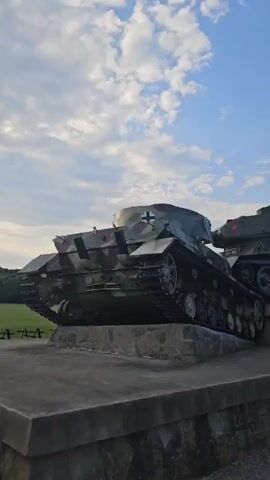
A low-angle shot shows two tanks on display outside. The tank in the foreground is camouflaged and appears to be a German tank with a German cross on its turret. The tank behind it is green and has a red star on its turret, indicating it is a Soviet tank. A young boy in an orange shirt and yellow shorts stands on the right side of the image, next to the Soviet tank. He is facing the tanks and pointing towards the Soviet tank. The tanks are mounted on stone pedestals. The sky is blue with scattered clouds.
Svidník