Szombathely, Hungary
15 memories from Szombathely, Hungary
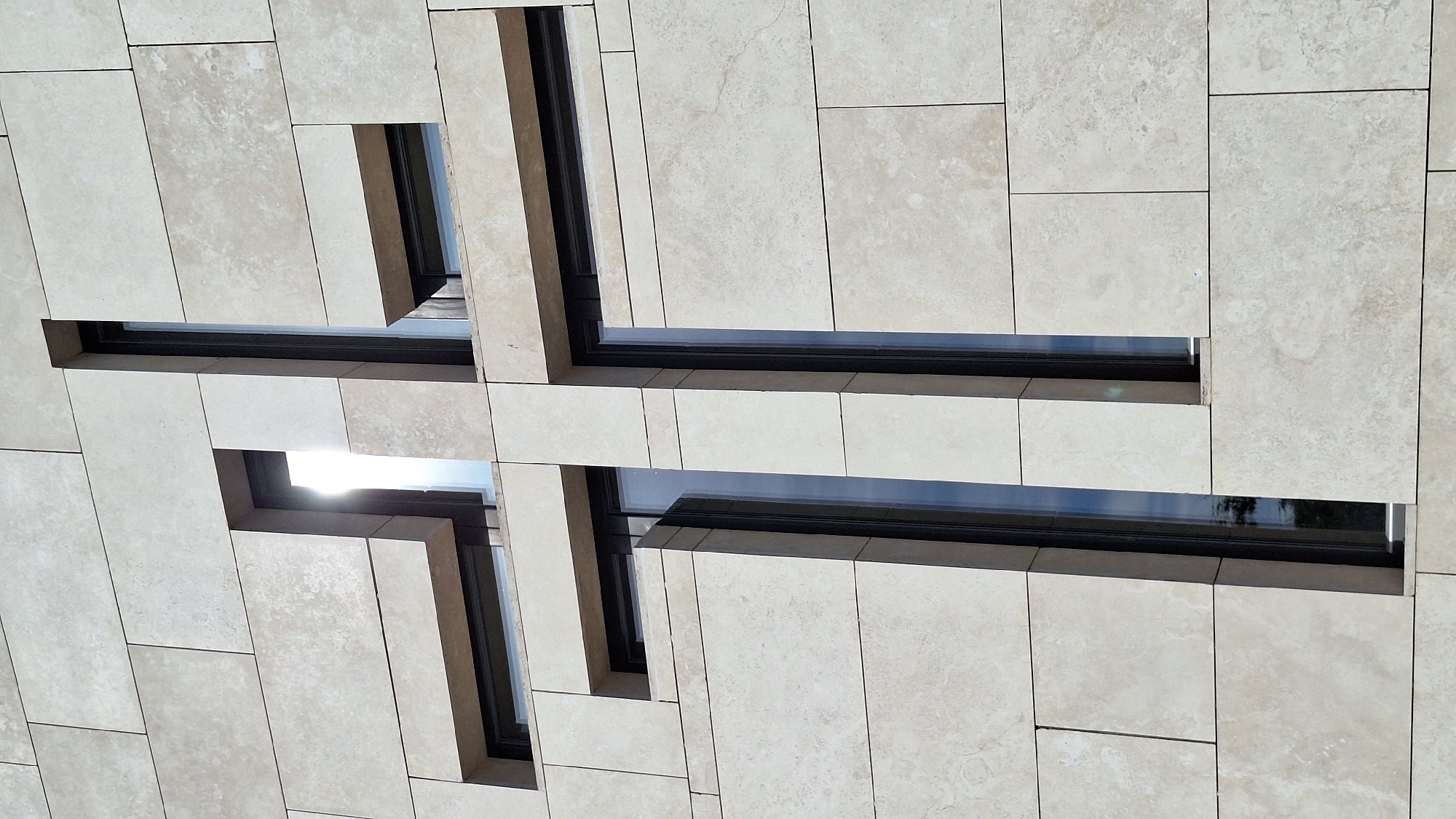
The image shows an upward-angled view of a building facade in Szombathely, Hungary. The facade is clad in light beige or cream-colored rectangular stone tiles, arranged in a staggered pattern. Two windows are visible, each framed by a deep recess in the tiled surface. The recesses are lined with dark material. The windows appear to be long and narrow, oriented horizontally. Sunlight reflects off one of the windows.
Szombathely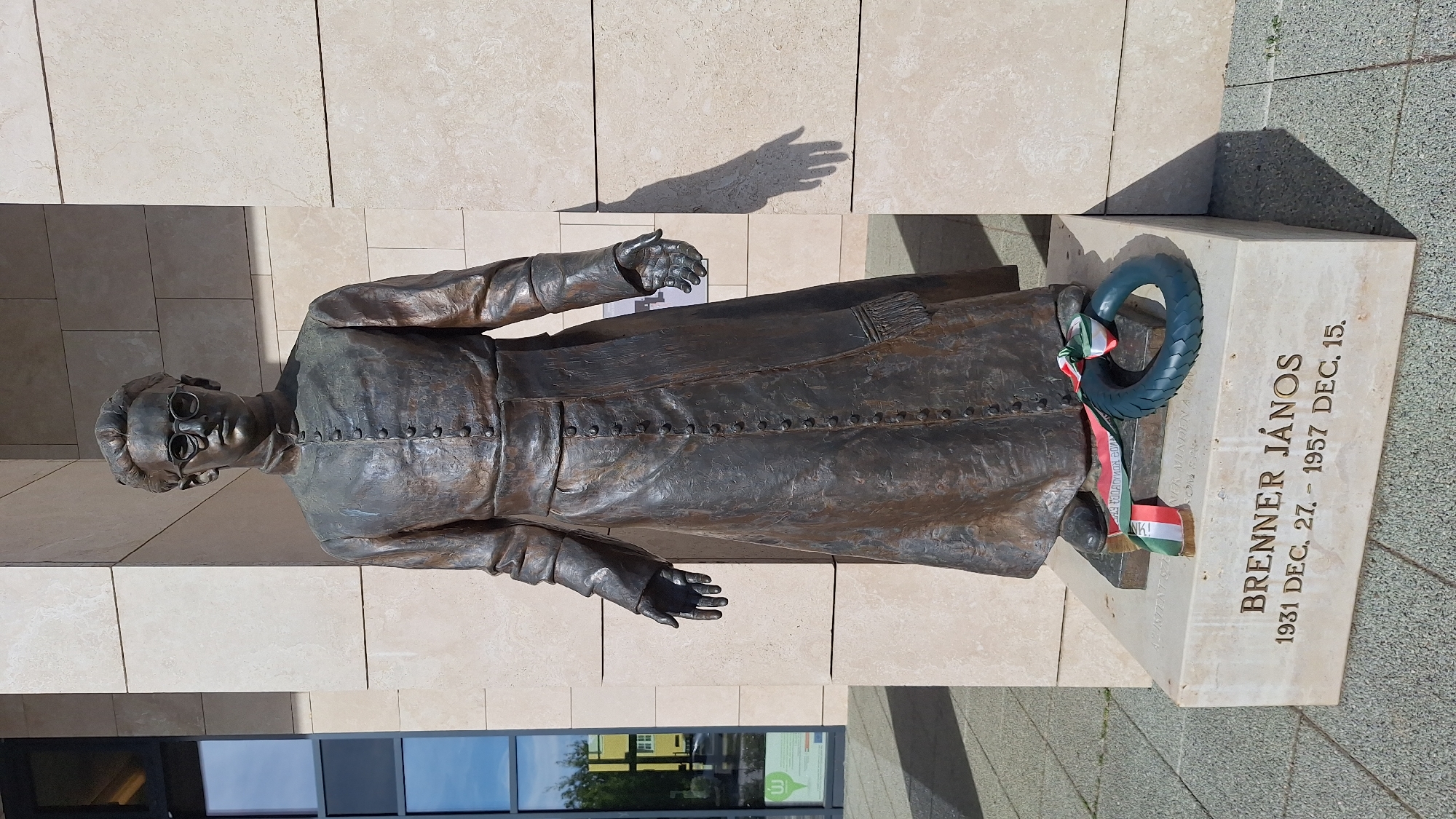
The image depicts a bronze statue of Brenner János, a Roman Catholic priest murdered in 1957, located in Szombathely, Hungary. The statue portrays him wearing glasses and a long coat. The statue stands on a light-colored stone pedestal bearing the inscription "BRENNER JÁNOS" and his birth and death dates: "1931 DEC. 27. - 1957 DEC. 15." A blue wreath, adorned with a ribbon featuring the colors of the Hungarian flag (red, white, and green), rests at the statue's base. The statue is positioned outdoors against a wall constructed of large, light-colored rectangular stones. A shadow of the statue's hand is cast on the wall. In the foreground, a reflective window captures the colors of the sky and the green colors of nearby foliage. The ground is paved with grey stone.
Szombathely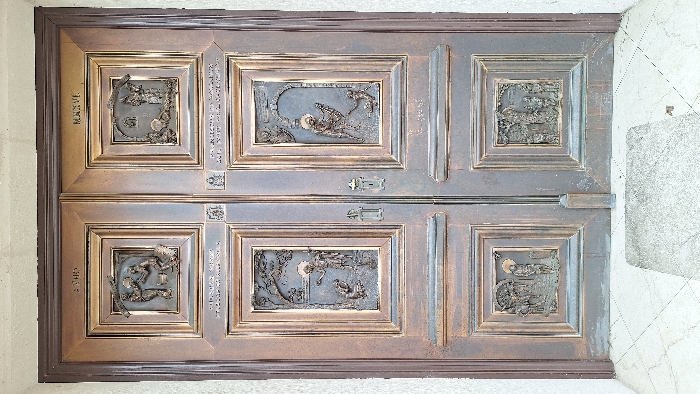
A pair of ornate, patinated metallic double doors, likely bronze, stands recessed within a light-colored architectural frame at Szombathely Cathedral in Szombathely, Hungary. Each door leaf features three rectangular relief panels, arranged vertically, depicting religious scenes. The left door leaf displays: * Top panel: Two figures, one kneeling, one standing, below the etched Roman numerals "MMXV." * Middle panel: A haloed standing figure interacting with a kneeling figure, above the etched word "SACRAMENTUM." * Bottom panel: A group of figures amidst a landscape. The right door leaf displays: * Top panel: Two figures, one standing with a staff, the other kneeling, below the etched Roman numerals "MMXVI." * Middle panel: A haloed figure with clasped hands and a smaller kneeling figure. * Bottom panel: Multiple figures with architectural elements. All panels are framed by raised metallic borders. The doors feature a central vertical seam, with handles and a keyhole located on the right door leaf. The floor in front of the doors is composed of light-colored, diagonally laid square tiles, partially covered by a rectangular, rough-textured gray mat.
Szombathely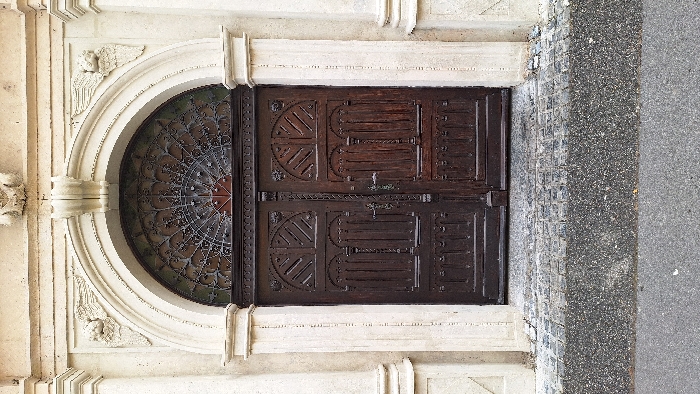
A detailed, eye-level frontal view captures an ornate entrance in Szombathely, Hungary. The central feature is a pair of dark brown, carved wooden double doors set within a cream-colored stone archway. Each door panel features geometric carvings, including arched segments at the top and vertical twisted column-like designs, with circular rosettes near the upper corners. Metal handles and escutcheons are visible on the center seam of the doors. Above the wooden doors, within the upper half of the arch, is a semicircular transom window obscured by a complex, fan-shaped wrought iron grille. The stone archway itself is decorated: a stylized keystone is centered at the apex, and on either side of the arch, above the doors, are relief carvings of cherubic heads with wings. The archway is flanked by two cream-colored stone pilasters, each with a simple capital and base, which extend vertically beyond the arch. The ground immediately in front of the doors consists of a horizontal band of small, dark grey cobblestones. This transitions to a darker, coarse-grained aggregate surface, followed by a lighter grey asphalt surface in the immediate foreground, suggesting a street or pathway. No individuals, animals, or specific actions are depicted. The scene is illuminated by diffuse light, producing minimal shadows.
Szombathely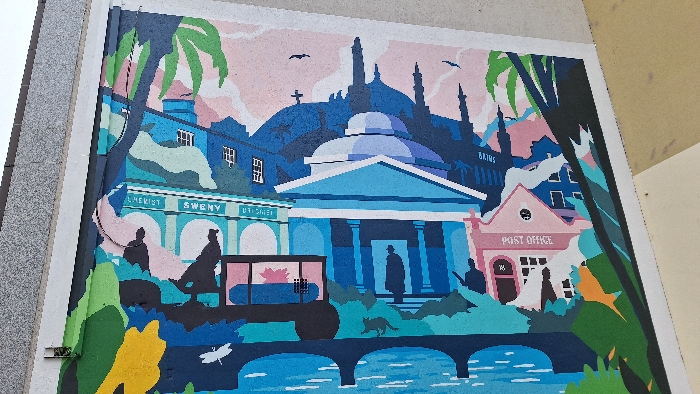
A large, brightly colored mural depicting a stylized cityscape is prominently displayed, located in Szombathely, Hungary. The artwork utilizes a distinct blocky, mosaic-like aesthetic with a primary color palette of blues, pinks, and greens. The upper section of the mural shows a light pink sky with stylized white clouds and two black bird silhouettes. In the distant background, deep blue hills are topped with various structures including multiple spires, a central dome, and a cross. One distant building partially displays the text "BRIS". The midground features prominent architectural elements. On the left, a light blue building with a series of arches is partially labeled with the text "L MERIST SWENY". Centrally, a large blue neoclassical-style building is depicted with a domed roof and a triangular pediment supported by columns. To its right, a distinct pink building with a stepped gable roof is clearly labeled "POST OFFICE"; stylized white cloud-like elements emanate from its roof. Another blue building is partially visible behind the pink post office. The foreground illustrates a dark blue river or canal spanned by a three-arched bridge. Stylized green and blue-green foliage elements are interspersed along the banks and foreground. Several silhouetted figures are distributed throughout the scene: two on the left bank (one seated, one standing), one standing in the doorway of the central neoclassical building, and two standing near the "POST OFFICE" on the right. A dark silhouetted cat walks across the central bridge structure. A white dragonfly or insect is depicted hovering over the water on the lower left. A dark-colored vehicle or carriage with a pink canopy and a stylized pink lotus is positioned on the left bank.
Szombathely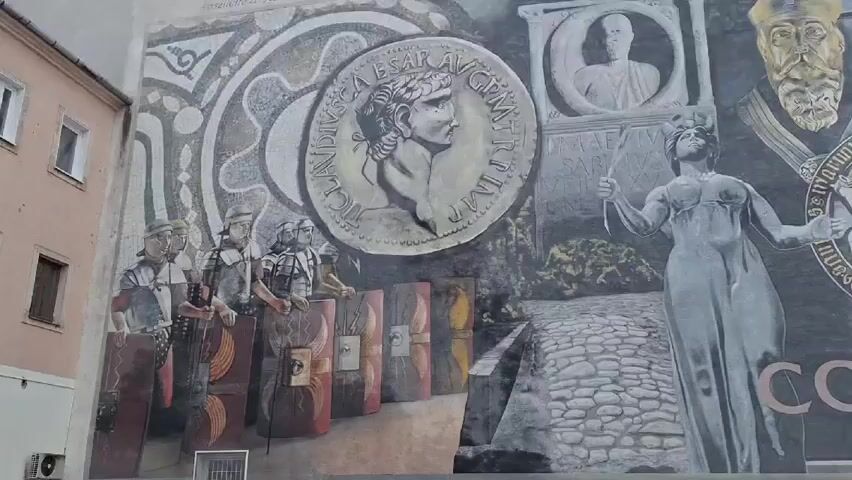
The video shows a large mural painted on the side of a building. The mural depicts various historical and symbolic images, including Roman soldiers with shields, a large coin with a Roman emperor's profile, a statue of a woman holding a staff, portraits, and scenes of cityscapes. The mural appears to be designed in a collage style, combining elements from different eras and sources. The adjacent building is painted in light pink, with white framed windows. The overall impression is that the mural tells a story or commemorates the history of a specific place.
Szombathely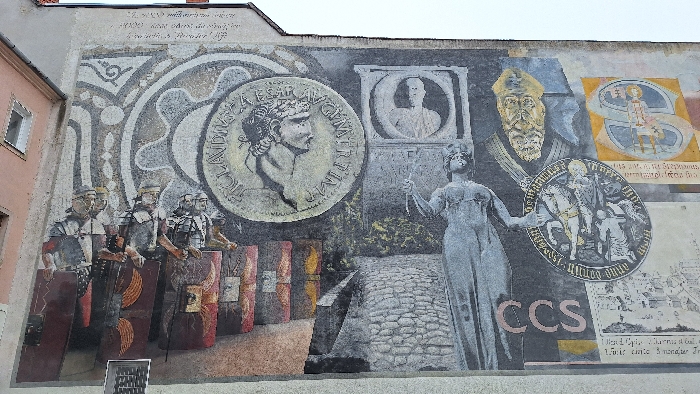
This image depicts a large, multi-panel historical mural painted on an exterior building wall in Szombathely, Hungary. The mural spans the full width of the visible wall and extends from near ground level upwards, concluding beneath a weathered rooftop line against an overcast sky. On the far left, a segment of an adjacent light-colored building with a rectangular window is visible. The mural itself is a composite of various historical scenes and artifacts. In the lower-left quadrant, five Roman soldiers, clad in segmented armor and helmets, stand in a line, each holding a rectangular *scutum* (shield) with central boss detailing. Behind them and extending upwards, a large circular pattern resembles a mosaic or ornamental design. Above the Roman soldiers and slightly to the right, a prominent circular depiction of a Roman coin features a right-facing bust of an emperor adorned with a laurel wreath, with partially legible Latin text "CLAUDIUS AVG IMP T..." around its periphery. To its right, a rectangular relief panel portrays a male bust in profile. Further right, a grey-toned female figure, resembling a classical statue in a toga, stands facing right, holding a slender staff or scepter in her raised right hand. Her left arm is slightly extended. Below her, the capital letters "CCS" are visible. Above this female figure, a bearded man with a golden miter and robes, likely a bishop or religious figure, is depicted. To the upper right of this figure, a stylized "S" letter encloses a seated figure on a patterned background. Below the bearded man, another circular depiction, similar to a medieval medallion or seal, shows multiple figures, one appearing to be on horseback, with an illegible circular inscription. In the lower-right quadrant, below the "CCS" text and the circular medallion, a monochrome illustration of a historical city plan or landscape is visible, with some accompanying text. A cobblestone path or road segment is depicted leading from the lower center towards the mid-ground, beneath the female figure. The entire mural is rendered in a detailed, somewhat faded style, suggesting age or a deliberate aesthetic choice.
Szombathely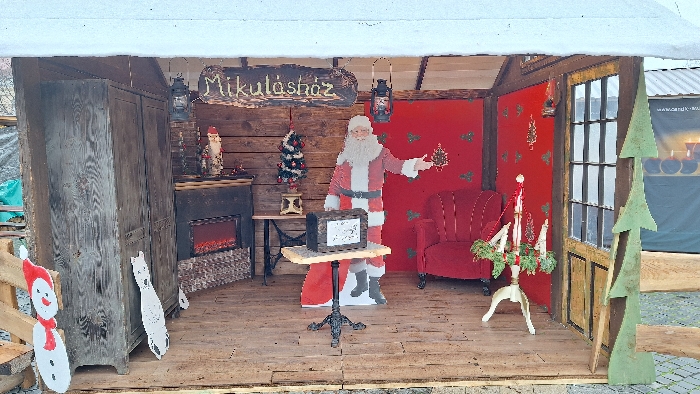
This image captures a festive Christmas market booth, identified by a sign as "Mikulásház" (Santa's House), situated in Szombathely, Hungary. The booth features a wooden plank floor and a white canvas roof. The interior's rear wall is a mix of rustic wooden paneling and sections painted red, decorated with small green Christmas tree cutouts. Centrally positioned is a life-sized cardboard cutout of Santa Claus, depicted in a traditional red suit with white trim, black boots, and a white beard, holding a small Christmas tree ornament in his left hand. Directly in front of Santa, a small table with a black cast-iron base supports a dark wooden box, appearing to be a mailbox. To Santa's left, a faux fireplace with an illuminated, flickering-effect firebox is present. Above the fireplace, a small Santa figurine, a miniature decorated Christmas tree, and a hanging lantern are arranged. A tall, dark wooden cabinet stands to the far left of the fireplace. To the right of the Santa cutout, a red upholstered armchair is visible against the red wall. In the right foreground, an ornate white stand holds a candelabrum with four white candles, adorned with green foliage and red ribbons. To the exterior left of the booth, a white snowman cutout with a red hat and scarf is partially visible. On the exterior right, a green, stylized wooden Christmas tree cutout stands. The background beyond the booth's right side reveals elements of another market stall, including lit candles and a partial banner. The scene is static, displaying Christmas-themed decorations and props.
Szombathely
A turquoise background features the phrase "Thank you" in white, centered horizontally and vertically. An emoji with smiling eyes and a slight smile is positioned directly to the right of the words, emphasizing the message of gratitude. The overall aesthetic is simple and clean, conveying a sincere expression of appreciation.
Szombathely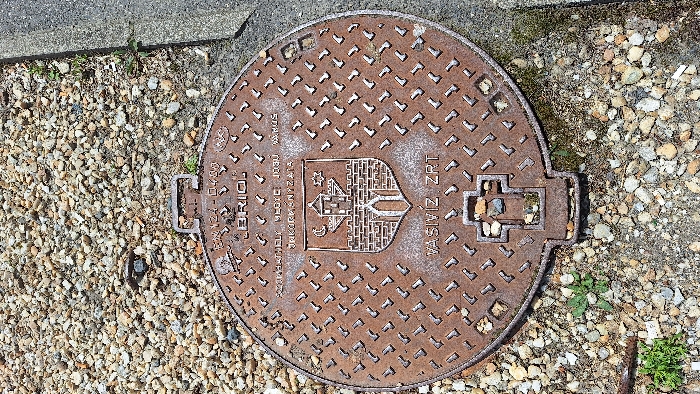
A rusty metal manhole cover is set into a bed of small gravel stones. The cover is round and has a cross-shaped design with a border around it. The manhole cover has various inscriptions on its surface, including "JBRIOL" and "VASI VIZ ZRT." Inside the cross, there is a depiction of a castle with a tower, a star, and a crescent moon. On the edge of the manhole cover is the inscription "SZOMBATHELY MEGYE JOGU VAROS ÖNKORMÁNYZATA." The coordinates provided indicate that this manhole cover is located in Szombathely, Hungary. A portion of the manhole cover is resting on a gray concrete slab. There are small plants growing in the gravel surrounding the manhole cover.
Szombathely
The image shows five yellow plush toys in the shape of ducks, all sitting on a white surface. The ducks have large, black eyes and orange beaks. The duck in the center has its head tilted to the left, while the other ducks have their heads tilted to the right. The ducks are all wearing a white tag around their necks, and the tag on the center duck has a small symbol on it that reads “You’re the Best”. The image is taken indoors, in what appears to be a store or a shop. The background is a white wire shelf with various objects on it, including other toys, cardboard boxes, and what appears to be cleaning supplies. The coordinates provided indicate that the image was taken in the city of Szombathely, Hungary.
Szombathely
A vine climbs and grows along the side of a concrete wall in Szombathely, Hungary. The wall is light grey with some darker grey sections. The vine is green and appears to be growing in a pattern that resembles the letter V. At the base of the wall, there is a strip of dark brown ground and a bit of grass growing along the edge. The coordinates given are for the city center of Szombathely, Hungary. The vine does not cover the entire wall.
Szombathely
The image shows a wooden door set within a white brick wall. The door is made of dark wood with a diamond pattern and has a metal handle. The door is closed. There is a small plant growing out of the top of the doorframe. There is also a small plant growing at the base of the wall, to the left of the door. The ground in front of the door is covered in gravel and dirt. This is located at the coordinates 47.233, 16.616, which is a residential area in the city of Szombathely, Hungary.
Szombathely
A brown wooden door with a diamond-shaped pattern is set within a white brick wall in Szombathely, Hungary. The door has a silver door handle and is slightly ajar. A small patch of green plants grows in front of the door. The ground in front of the door is a mixture of dirt and gravel. The door is slightly weathered, with some areas appearing darker than others. The door is positioned within a brick wall, with white mortar holding the bricks together. The bricks are arranged in a horizontal pattern. A few of the mortar joints have cracked and eroded slightly. The door is a single door, meaning it swings open in one direction. The handle is located on the right side of the door, indicating the door swings open to the right. There is a small, square object attached to the door, at about chest height. This object has a light brown color and appears to be metallic. There are no people in the image.
Szombathely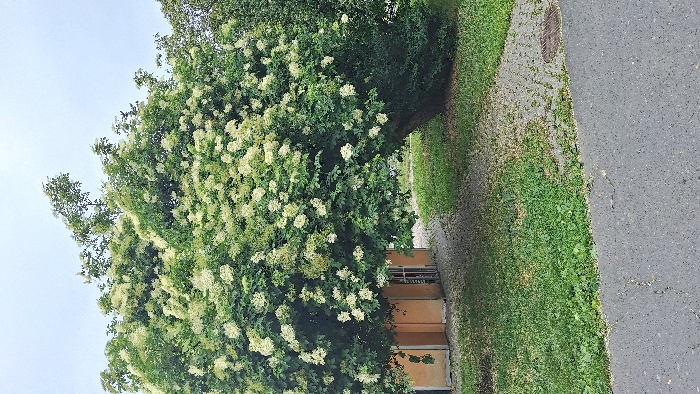
The image shows a large, leafy tree with white flowers blooming in the foreground. The tree is in full bloom and its branches reach out towards the camera. The tree is casting a shadow over a small, pale-orange building to the left of the image. The building has windows and appears to be a storage shed or other outbuilding. Behind the tree, the image captures a view of green grass and a paved path leading to the base of the tree. At the bottom of the image, a gray, paved road runs along the bottom edge of the image. There are no people in the image. The scene is located at the coordinates 47.233, 16.616 in the city of Szombathely, Hungary.
Szombathely