Tabouraht, Morocco
5 memories from Tabouraht, Morocco
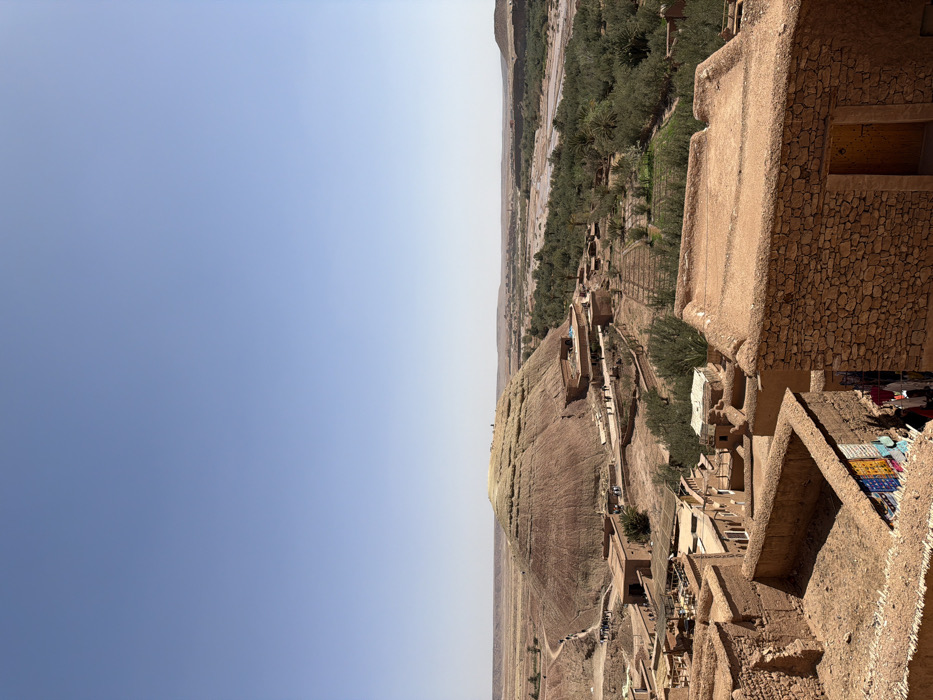
An aerial perspective showcases a fortified settlement situated within an arid landscape, characteristic of Tabouraht, Morocco. The scene is dominated by a clear, light blue sky. In the midground, a large, rounded hill or 'agdal' with stratified reddish-brown and lighter earth tones rises prominently, its upper portion displaying faint yellowish-green vegetation. Several small human figures are visible on paths ascending this hill and gathered near its summit. To the right of the hill, a verdant river valley extends into the distance, featuring a winding riverbed with water and numerous green trees, including identifiable palm trees. Surrounding the base of the prominent hill and extending into the foreground, a dense cluster of traditional buildings constructed from reddish-brown packed earth or stone is observed. These structures feature flat roofs and rough-hewn walls. Pathways wind through these structures, with additional human figures seen moving along them and congregating near entrances. In the lower left quadrant, a building displays colorful fabrics, potentially textiles, hanging outside. The overall environment suggests a dry, sunny climate.
Tabouraht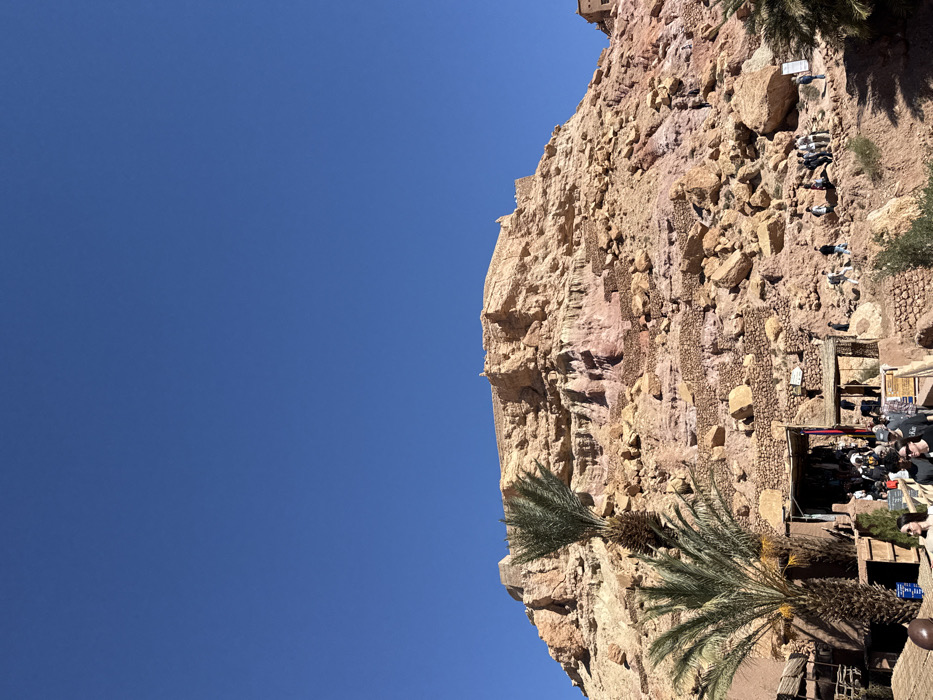
The image displays a rugged, sun-drenched mountain landscape in Tabouraht, Morocco, under a clear, deep blue sky. The prominent mountain, composed of light brown, beige, and reddish-pink rock strata, is extensively covered with loose boulders and smaller rocks. Along its summit and upper slopes, remnants of fortified structures, including mud-brick walls and towers, are visible. Tiered retaining walls, constructed from stone and mud, are integrated into the lower and mid-sections of the mountain's face. At the mountain's base, in the lower left, stands a cluster of earth-toned buildings. A large archway serves as a primary entrance, leading into a shaded commercial area with visible market stalls displaying various goods. Two mature date palm trees are prominently positioned near this entrance; one appears to be laden with dates. Approximately 25 individuals are distributed across the scene. A group of roughly 15-20 people is congregated in the foreground near the market entrance, either walking, standing, or browsing. Another group of 5-10 individuals is observed navigating a winding dirt path on the right side of the mountain, ascending or descending the slope. The scene is illuminated by strong, direct sunlight, indicating a clear day in an arid environment.
Tabouraht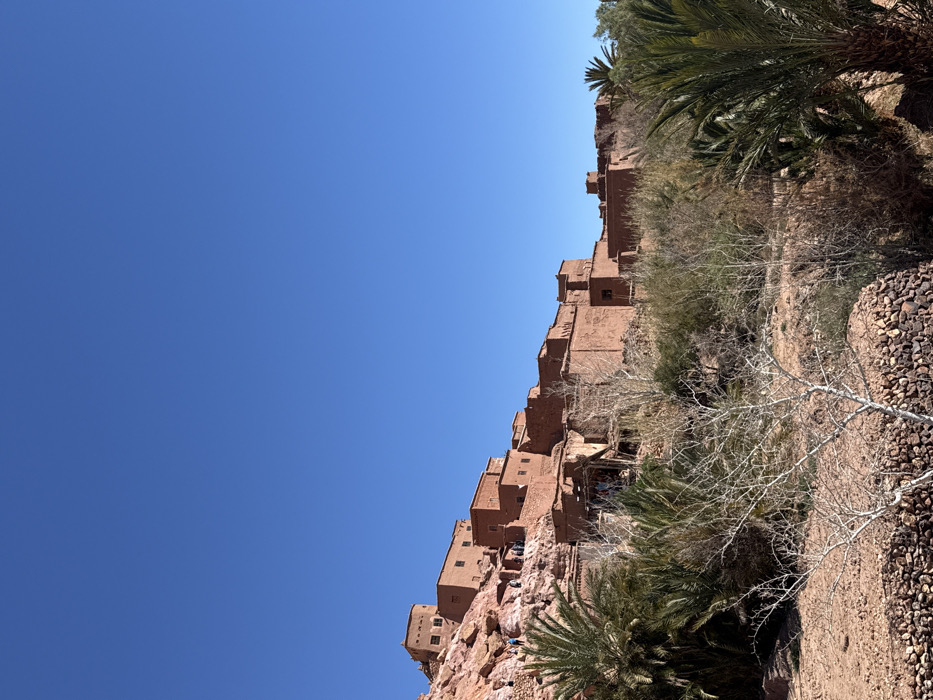
This image depicts a fortified village, identified as being in Tabouraht, Morocco, situated on a rocky, arid hillside beneath a clear, cloudless blue sky. The village comprises numerous multi-story buildings constructed from reddish-brown earthen materials, consistent with adobe or mud-brick, built in a tiered arrangement up the slope. These structures feature flat roofs and small, rectangular window openings. Visible degradation is present on some lower buildings. Several small human figures are discernible on pathways along the upper left section of the hillside, appearing to navigate between the structures. The immediate foreground features a low retaining wall constructed of dry-stacked irregular stones. The surrounding environment consists of dry, reddish earth and sparse vegetation, including several prominent dark green palm trees and various leafless, dry shrubs and trees. The scene is illuminated by direct sunlight, indicating a bright, arid climate.
Tabouraht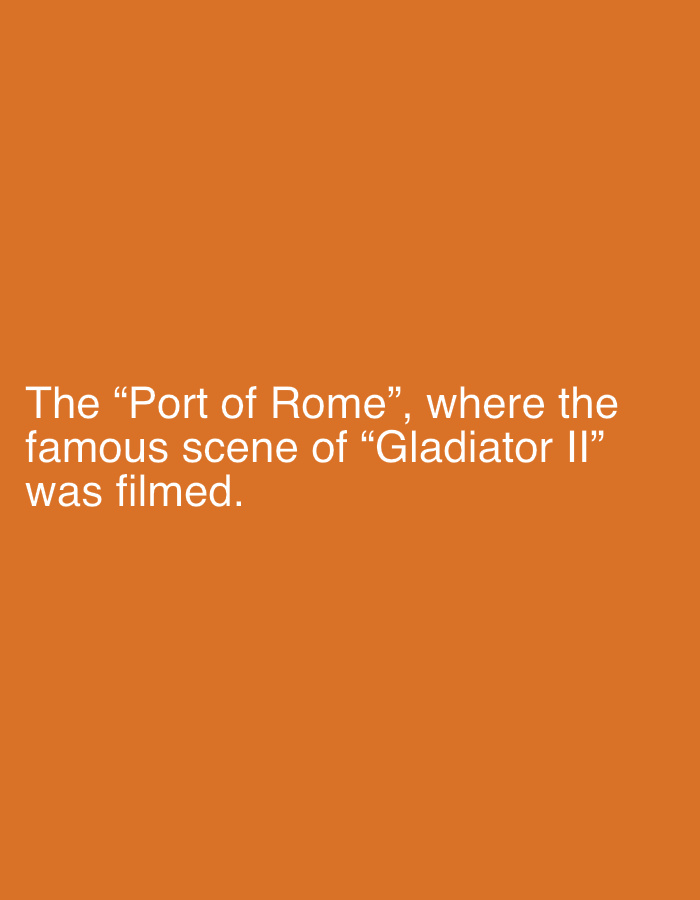
The image displays a solid orange background. White sans-serif text is positioned in the lower-left quadrant of the frame. The text reads: "The 'Port of Rome', where the famous scene of 'Gladiator II' was filmed." This text refers to a film set constructed to depict the "Port of Rome," located within the city of Tabouraht, Morocco. The image itself contains no visual elements depicting people, subjects, objects, actions, interactions, or environmental features beyond the plain colored background and the superimposed text.
Tabouraht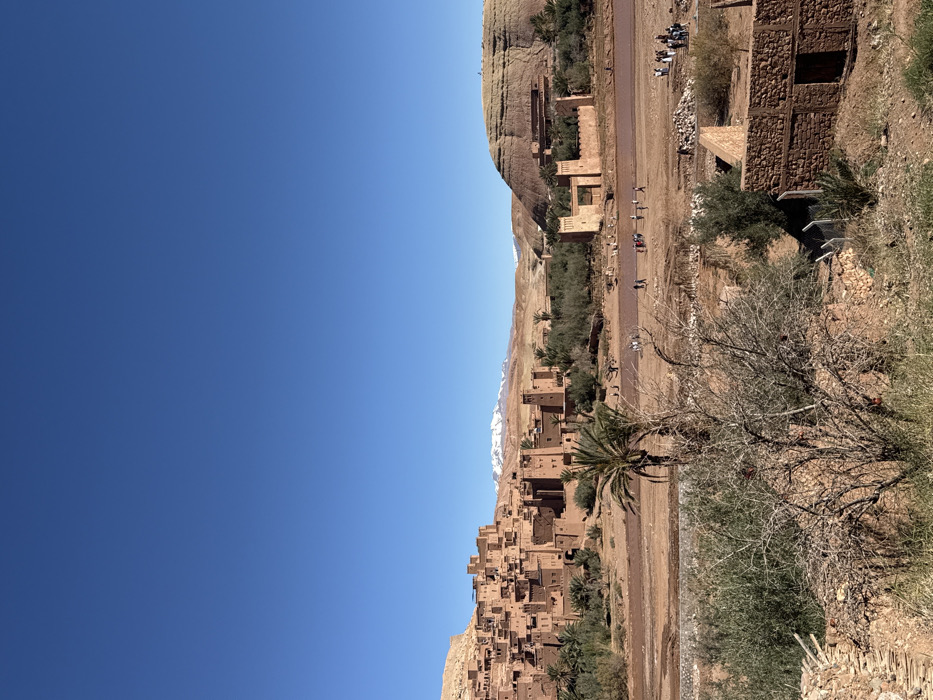
The image displays a panoramic view of a traditional fortified village, or ksar, situated on a hillside in Tabouraht, Morocco, under a clear, bright blue sky. The ksar comprises numerous multi-story mud-brick structures with towers and fortified walls, exhibiting uniform reddish-brown coloration consistent with the arid landscape. In the midground, a wide, shallow river with reddish-brown water flows, flanked by a sandy riverbed. Several groups of individuals, estimated between 30 and 40 people, are visible walking across the riverbed and along its banks, suggesting pedestrian activity and tourism. Sparse green vegetation, including palm trees, is present along the river course, contrasting with the predominantly barren, reddish-brown terrain. Beyond the ksar, a series of rounded, layered hills rise, primarily composed of the same reddish earth. In the distant background, a range of snow-capped mountains is visible. In the immediate foreground, a few deciduous trees with bare branches are present, along with partially constructed or renovated low-rise mud-brick buildings featuring stone foundations and visible fencing. The overall environment is dry and desert-like, characterized by its distinct geological formations and traditional architecture.
Tabouraht